
In short
The Intelligence episode focuses on two post-war reconstruction plans for Gaza after the ceasefire, arguing that both face major political, logistical, and funding barriers.
Guest
Greg Karlstrom, The Economist Middle East correspondent, who provides on-the-ground damage figures and assesses feasibility.
Key claims
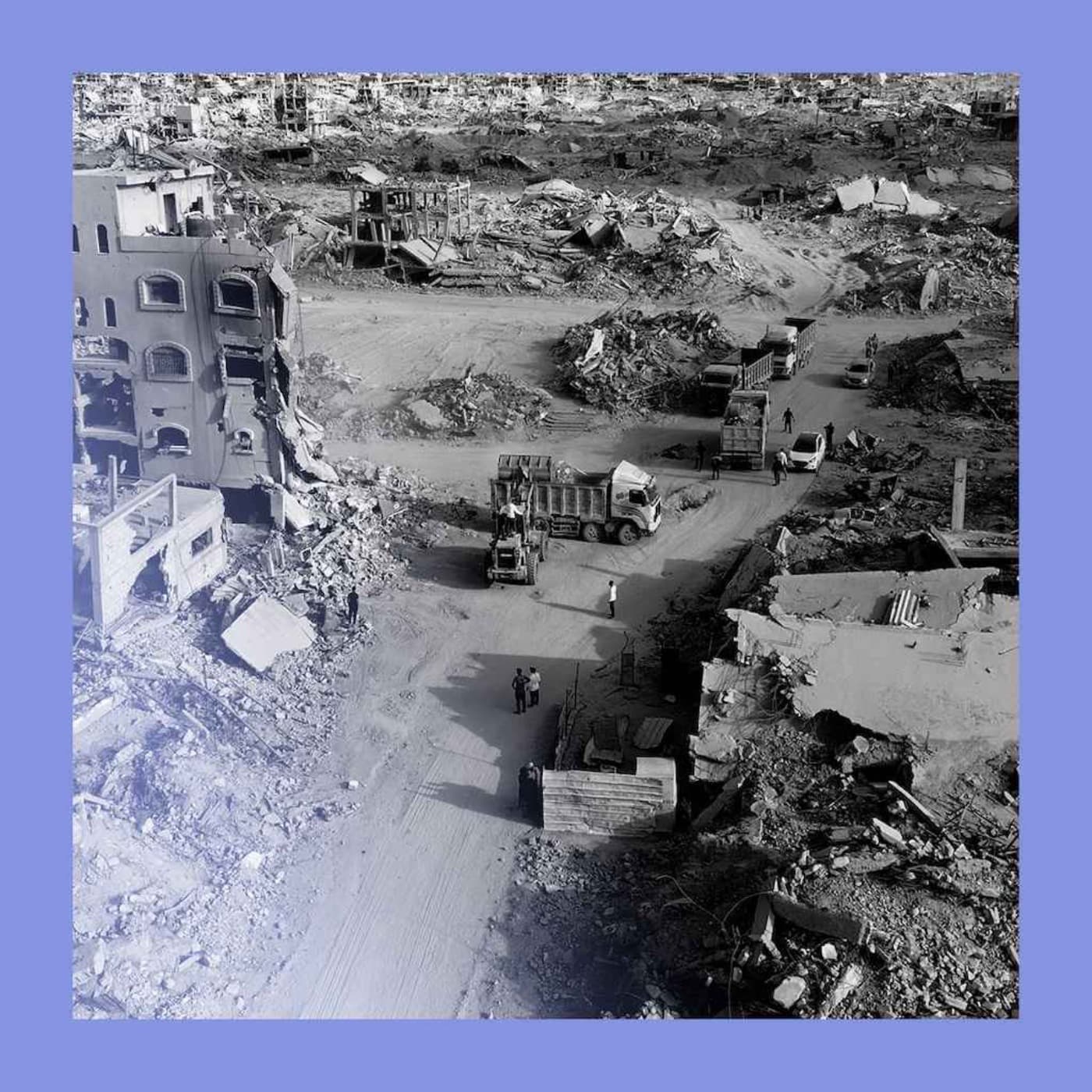
80–90% of Gaza buildings are destroyed; about 300,000 homes are destroyed or heavily damaged, leaving over a million homeless; 80–85% of businesses and most farmland are damaged; two-thirds of roads are wiped out. Egyptian plan: phased rebuilding starting with rubble clearance (55–60 million tons), then 200,000 homes over 2.5 years, then rebuilding governing institutions; impeded by unrealistic timelines, Israel’s veto at Rafah limiting materials, and an estimated ~$55 billion cost with Gulf donors refusing without Hamas disarmament. Israeli-American alternative: modular towns in Israeli-controlled areas, but Palestinians would need to relocate and Arab states fear permanent partition. Interim: rehabilitation and temporary shelter/water infrastructure, pending a solution to disarming Hamas and securing Gaza.
Written by AI. May contain mistakes. Listen to the episode to check what was said.
Chapters
Tap a time to open that second in VOAI and Job Cuts
1:28 to 2:06
Discussion on the impact of AI on white-collar jobs amidst layoffs.
“That's something we've asked before, but with the news that a number of big firms in America have made large cuts in the past month, things are looking a little perilous.”
Rebuilding Gaza: Current Situation
2:06 to 5:10
Exploration of the destruction in Gaza and the challenges of rebuilding.
“In the Middle East, the temporary has a way of becoming fixed.”
Egyptian Proposal for Rebuilding
5:10 to 7:18
Details on the Egyptian-drafted plan for rebuilding Gaza.
“So we'll start with the Egyptian drafted proposal, which is really the one that I would say is a proper proposal at this point.”
Challenges to the Rebuilding Plans
7:18 to 10:01
Examination of the obstacles to the Egyptian and Israeli-American plans.
“worth of debris accumulated across Gaza at this point.”
The Status Quo in Gaza
10:01 to 10:38
Discussion on the ongoing struggles of Gaza's population amid reconstruction delays.
“And then this so-called yellow line between the two halves starts to look like a very permanent border.”
AI and Job Layoffs: Analyzing the Data
14:00 to 18:32
Explore the relationship between AI investments and recent job layoffs.
“And much of the time they're talking about AI and what it can do.”
The Discovery of DNA: James Watson's Journey
18:32 to 22:23
Learn about James Watson's pivotal role in discovering the structure of DNA.
“James Watson was in Naples in 1951 at a scientific conference when he saw a photo on the screen that made him almost frenzied with excitement.”
Watson's Controversial Legacy
22:23 to 25:23
Understand the controversies surrounding James Watson's later life and views.
“He was no longer welcome there, and indeed his reputation everywhere had taken quite a steep dive.”
Transcript
Automatic transcript. May contain errors.0:00The best podcasts give you the sharpest view of the world. Adio is the AICRM that gives you the sharpest view of your business. It instantly builds your pipeline by connecting your email, calls, product data, and more. Then ask Adio to prep for a meeting, spot a deal at risk, or find out where your pipeline stands. It's the AICRM that keeps you 10 steps ahead. Ask more from CRM. Ask Adio. Get 10 % off at adio.com slash intelligence. A-T-T-I-O dot com slash intelligence. With no fees or minimums on checking accounts, it's no wonder the Capital One bank guy is so passionate about banking with Capital One.
0:37If he were here, he wouldn't just tell you about no fees or minimums. He'd also talk about how most Capital One cafes are open seven days a week to assist with your banking needs. Yep, even on weekends, it's pretty much all he talks about. In a good way. What's in your wallet? Terms apply. See CapitalOne.com slash bank. Capital One N.A. member FDIC.
1:05The Economist
1:12Hello and welcome to The Intelligence from The Economist. I'm your host, Rosie Blore. Every weekday, we provide a fresh perspective on the events shaping your world.
1:28Is AI coming for white-collar jobs? That's something we've asked before, but with the news that a number of big firms in America have made large cuts in the past month, things are looking a little perilous. And something as beautiful as the double helix just had to exist. That was James Watson's thought as he sought to work out the structure of DNA. He finally achieved it, but not without a lot of controversy throughout his career. Our obituaries editor remembers him.
2:05But first...
2:12In the Middle East, the temporary has a way of becoming fixed. Israel's occupation of the West Bank has endured for half a century. The Palestinian Authority, which was meant to be a five-year interim body, turned 30 last year. No wonder that a month after the ceasefire in Gaza, the two million people who live there worry that their despair will also become permanent. There's no shortage of plans for rebuilding Gaza. Greg Karlstrom is our Middle East correspondent. But the two plans that have had the most movement of late, one is an Egyptian drafted plan that was endorsed by a number of Arab countries earlier this year that lays out a five-year process for rebuilding Gaza.
3:01The problem is there are still huge obstacles to implementing that plan. And so what we've had happen in recent weeks is that some American and Israeli officials have begun to float an alternative proposal to start limited reconstruction on the Israeli-controlled side of the so-called yellow line, the ceasefire line in Gaza. That is what, again, some people in Washington and Jerusalem are pushing. But there are huge obstacles to moving forward with that plan as well. So let's just take a step back for a minute. Just give me a sense of how great the damage is on the ground. It's really unprecedented, the scale of the damage.
3:40I mean, after two years of war, 80 to 90 percent of the buildings in Gaza have been destroyed. The territory really is in ruins. If you look at housing as a good place to start, because I think the most urgent need that people have right now is shelter. 300 ,000 homes have been either destroyed or heavily damaged to the point where they may now be uninhabitable. That means more than half of Gaza's population, more than a million people at least, are homeless now. And if you compare that to previous wars, I mean, I remember covering the war in 2014, which was before this one, the longest and the deadliest between Israel and Hamas.
4:18And I remember going to Gaza afterwards and seeing entire neighborhoods that looked as if they had been destroyed. Only 18 ,000 homes were destroyed in that war. So you compare it to this one, 300 ,000 that have been destroyed. We're talking 15 times more. So that's just the scale of the destruction when it comes to housing. 80 to 85 % of the businesses in Gaza are destroyed. 80-something percent of the farmland has been damaged. Most of the farmland is also now located on the Israeli-occupied side of Gaza. Two-thirds of the road network has been wiped out. Anything that you need to sustain life in Gaza really has been reduced to rubble over the past two years.
5:01Greg, we know there have been a lot of different proposals, including Trump's extraordinary one to turn Gaza into a beach resort. But it sounds like there are two plans on the table at the moment. Tell me about them. Right. So we'll start with the Egyptian drafted proposal, which is really the one that I would say is a proper proposal at this point. And it imagines several phases of rebuilding. So the first stage, which according to the text would last about six months, is going to focus on clearing the rubble that has built up. There's something like 55 to 60 million tons of rubble accumulated across Gaza.
5:38Obviously, a lot of that has to be moved before you can start rebuilding. Some of that would be mixed with sand and ground into a substrate that you could use to reclaim land off the coast of Gaza, where eventually Egypt and Arab states are talking about building a port and building other vital infrastructure. Once they've made some progress on rubble clearance, then the idea is to start rebuilding homes for people to live in. There's a two and a half year period where, according to the Egyptian plan, they would build at least 200 ,000 new homes. In parallel to that, also rebuilding for clinics, for schools, for other basic services and infrastructure.
6:16And then in the third and final phase of the plan, which would be the fourth and fifth years, according to the proposal, they would also start rebuilding governing institutions in Gaza. So not just homes and small scale businesses, but trying to rebuild the government of the territory as well. And could that plan work? Well, I think there are huge impediments to it. I mean, there are some things it has working in its favor. There is a large labor force in Gaza. Almost everyone is unemployed at this point. So you can draw on hundreds of thousands of people who are desperate for work. Egypt would provide a lot of the expertise, the engineers and the architects and the people who would oversee the project.
6:56And then the raw materials could flow into Gaza from Egypt. But when you look at what's problematic or what's going to be difficult about the Egyptian plan. It's a very long list. I've spoken to engineers who think the timelines are totally unrealistic. The idea that you could shift a significant amount of rubble in six months, people say it's going to take closer to six years, if not longer. Again, given the size of it, we're talking about 13 Great Pyramids of Giza worth of debris accumulated across Gaza at this point. That's one impediment. Another is these materials that would have to flow in from Egypt, they need to cross over at the Rafah crossing between Egypt and Gaza.
7:34Israel has a veto at that crossing. Israel historically has refused to allow large amounts of construction materials to flow in. And I think certainly now, so long as Hamas remains in control of part of Gaza, Israel would continue to exercise that veto. And then that gets at what I think is the real underlying problem with the Egyptian plan. It needs something on the order of$55 billion to be implemented. The cost is enormous. That money has to come from donor countries. Obviously, the biggest donors would probably be wealthy monarchies in the Gulf, but they've been very clear for two years now.
8:11They are not going to contribute funds for reconstruction in Gaza unless Hamas is disarmed, unless they know that there isn't going to be another war in a few years' time. And so long as Hamas refuses to lay down its arms, I don't think anyone is going to offer to invest or to fund this project in a big way. And you mentioned an Israeli-American plan as well. What's in that? Well, this is the alternative that, again, some officials and some businessmen have begun to promote because of the lack of progress on disarming Hamas and rebuilding in Palestinian controlled parts of Gaza. So the idea that's being floated is to start small scale reconstruction in that Israeli-controlled territory.
8:54You would build, according to this concept, a string of modular towns or modular villages. They would house several thousand Palestinians. They would have a clinic, a school, some other basic services. You would start by building perhaps one or two of these in southern Gaza. And then if the idea is successful, they would expand the project and they would build more of those elsewhere in Gaza. But again, the list of obstacles to doing that, quite a long one. First, if you start rebuilding on Israeli-controlled bits of Gaza, almost no Palestinians live in that territory. You would have to convince people essentially to move into Israeli-occupied territory.
9:33It's not clear once they do that if they would be allowed to move freely throughout that Israeli-controlled half of Gaza. I think it's going to be a hard sell for at least some Palestinians to convince them to do that. It's also very, very unlikely that Arab countries are going to donate to this scheme because they worry if they do that, they are essentially making permanent the partition of Gaza. They are going to start rebuilding in Israeli-controlled territory. The Palestinian-controlled territory may never get rebuilt. And then this so-called yellow line between the two halves starts to look like a very permanent border.
10:06So I know last week there were some businessmen close to the Trump administration who were in the Gulf who were trying to sell at least one Gulf government on the idea of investing in this project. And the answer was no, the government refused to do it. So, Greg, if nothing is going to happen on either of these plans anytime soon, what happens in the interim? I think, unfortunately, what happens is this miserable status quo where most of Gaza's population is homeless, is unemployed, is struggling to find the bare necessities of life. That is going to remain the case for the foreseeable future.
10:43I think you're going to see more efforts not at reconstruction, but at, let's say, rehabilitation, at trying to provide a modicum of basic services for people. more efforts to build water infrastructure, to get temporary shelters into Gaza. That is going to be the focus, I suspect, for the international community, because unless you can find a resolution to this question of how do you disarm Hamas, how do you secure Gaza, how do you create the conditions for rebuilding, unless you can answer those questions, none of these ambitious plans for post-war Gaza are going to move forward. Greg, thank you very much for talking to me.
11:18Thank you, Rosie.
11:36Tomorrow's episode of The Weekend Intelligence has a different lens on the conflict in Gaza. Nader Sadaka was no ordinary prisoner. He's a Samaritan, a group that largely maintains neutrality. But as Nader grew up in Nablus in the West Bank and watched Israel occupy the territory, He chose to fight with the Palestinians and ended up in an Israeli jail for 20 years. He was one of over 2 ,000 people released when the ceasefire occurred. You can hear his story tomorrow. You'll need to be a subscriber.
12:12Summer can throw off even the best routines, but AG1 makes it easy to keep one healthy habit consistent. AG1 is a daily health drink that combines a multivitamin, pre - and probiotics, superfoods, and antioxidants in one scoop mixed with 8 ounces of water. From late nights to long weekends, and everything in between, AG1 offers a simple way to add consistent nutritional support to your day, wherever the morning begins. Visit drinkag1.com slash theintelligence to get a free morning person hat and a free AG1 sampler in your welcome kit with your first AG1 subscription. an$82 value. That's drinkag1.com slash theintelligence.
13:18Ask more from CRM. Ask Adio. Get 10 % off at adio.com slash intelligence. A-T-T-I-O dot com slash intelligence.
13:34It's become a constant refrain. Some areas, again, I think just like totally, totally gone. I don't know if any of you have used one of these like AI customer support bots. From OpenAI's Sam Altman to Elon Musk. Anything that is not like doing physical work, those jobs will be and are being eliminated by AI at a very rapid pace. And even the Fed chair Jerome Powell. You see a significant number of companies either announcing that they are not going to be doing much hiring or actually doing layoffs. And much of the time they're talking about AI and what it can do. So we're watching that very carefully.
14:10Many people have suggested that artificial intelligence is coming for our jobs. With a number of big firms in America announcing big staff cuts in the past month, the reckoning does seem to have arrived. But is this really all about AI? Over the past month, we have seen a wave of pretty high-profile layoff announcements by companies such as Amazon, Target, UPS, IBM, all announcing pretty dramatic layoffs at the same times that they have been talking about increasing their investments in AI. Alex Domash is an economics correspondent. Last week, we had new data that was released that showed that firms over the past year have announced close to 1 million total job cuts, which is up 50 % from a year earlier.
15:00Alex, we've gone back and forth on the show about whether we think AI is really coming for our jobs or not. What's your conclusion from this data? It comes at an interesting time when discussion of AI is at an all-time high. If you listen to earnings calls and listen to what CEOs are talking about, almost all of them are feeling the pressure to discuss AI and how they are going to incorporate AI into their businesses. And this has led to a lot of anxiety around job seekers, around college graduates in particular, who have been having a hard time finding jobs. And because of that, there has been a tendency to associate the wave of layoffs with AI.
15:42But actually, if you take a closer look at the data, that story doesn't quite add up. So you say it doesn't stack up. Explain what you think is going on. So one of the first things that really strikes me is that the industries that saw the greatest hiring after the pandemic in 2021 and 2022, These were industries such as professional services, information services, really the types of jobs that a lot of white-collar college-educated workers were doing. And there was a surge in hiring in these jobs that happened in 2021 and 2022, way above the pre-pandemic trend for what you would expect when it comes to how much hiring there should be within these occupations.
16:26And these are the very occupations that are seeing the greatest slowdown right now. So my first thinking is that it is a reversion to the mean. It's a reversion to the trend that we were seeing before the pandemic, that the industries that saw the greatest hiring are now slowing down the most. How do you explain, though, the fact that you've had big job losses where you've had a lot of investment in AI? The tech sector was also one of the industries that, after the pandemic, saw the greatest surge in hiring. If you look at job postings for software developers, for example, in 2021 and 2022, they reached record highs.
17:08The number of job openings for software developers in 2022 was over two times what it was in 2019 before the pandemic. So really, you saw this massive rush in hiring because there was a lot of excitement about AI at the time. A lot of companies just got very excited and have since pulled back and slowed down their hiring for these different occupations. So if what you're saying is that we've had investment in AI, but in terms of job growth, it's a reversion to the norm, where does that leave us then in predicting what's going to happen next? There are a lot of indicators that are showing that it is harder today to find a job than it was one or two years ago.
17:50So there is a slowdown that is happening. What I am concerned about is that if the economy continues to contract and possibly even tips into a recession, when the economic recovery eventually happens, it is white-collar professionals that are the most exposed to AI. And what my concern is, is that during a recovery period, companies, rather than invest in rehiring, they might choose to take that time to restructure, to reorganize, to invest in AI, and basically leave less job opportunities for white-collar professionals. Alex, thank you very much. Thank you.
18:48James Watson was in Naples in 1951 at a scientific conference when he saw a photo on the screen that made him almost frenzied with excitement. Anne Rowe is The Economist's obituaries editor. It was shown by Maurice Wilkins, a physicist from King's College London, who had managed to get some crystallography of the internal structure of DNA. And you could see in this photograph that a DNA molecule had repetitive motifs and was therefore a regular structure that could be dealt with. And of course, DNA was the key to life. It was the information store for all illnesses, traits, features, every sort of feature of the created things on the planet.
19:45It was so important that a number of people besides Wilkins were looking very carefully at this. James Watson himself was about to start at the Cavendish Laboratory in Cambridge, working with Francis Crick, a physicist, to try to pin down exactly what the structure of DNA was. The only thing they had needed in the early days of their research was those photographs. Morris Wilkins managed to prize them out of the possession of Rosalind Franklin, the crystallographer who they belonged to. This was a piece of bad manners. He should actually have asked Rosalind Franklin, and then he shouldn't have shown them to James Watson, but he did.
20:31Watson did not seem very worried by this, although it was really against the polite behaviour of scientists. He and Crick didn't really go for Rosie, as they called her. They thought she was drab and a plodder, probably sexually repressed. She didn't do anything about her hair, she ought to take her glasses off. All this sort of sexist thinking went on in Watson's brain when he looked at her. But he did, after a while, come to appreciate that her science was first rate, especially when he showed her the results of his, and Crick's, researches. She actually admitted that yes, they had found the answer, and the double helix was the structure of DNA, and she was very gracious about it.
21:18And after that, he was much kinder about her. He was absolutely entranced with the structure of DNA when they finally pinned it down. It took him a long time to work out what on earth it could be, even with the photographs. He knew there had to be a pair of chains, but he wasn't sure whether there should be two or four, and then he thought maybe there should be three. In the end, he found it was two chains that twisted upwards, a bit like a twisted ladder or a spiral staircase. And the steps were the four chemical bases of DNA, which were laid out side by side, always the same two side by side to complement each other.
22:05once they'd had their great triumph he fairly quickly went back to the states to continue researches there and to pursue all the paths which had been opened up by his discovery of the structure of DNA it was indeed one of the great discoveries of the 20th century his other project which was as momentous as the discovery of DNA was to map the human genome and he was the person who first decided to gather together scientists who would support this project and he was also the second person who had his genome fully sequenced and he decided that all his data from the genome sequencing should be put online so that anyone who wanted to research into it could do so free.
22:57and in this he ran into quite an argument with the National Institutes of Health who had long thought that genes ought to be patented and he was very sure that they never should be, that they belonged in the human domain and that his own particular genome belonged to the whole world. But by the time he was thinking about this in 2007, 2008 the whole world was rather disenchanted with him, at least the whole scientific world, because his views had always been not only slightly eccentric but also actively offensive, several of them not at all backed up by science. News came out of casual or not-so-casual remarks that Watson had made, such as that women were intellectually inferior, that he didn't have any time for employing black people because he thought too that their intelligence was inferior to that of whites and he claimed that testing showed this and in fact testing didn't show this.
24:04So gradually, although he'd actually stepped down from all his active work at both Harvard and Cold Spring Harbor Laboratory because he was over a certain age, He had stepped down, but he was holding emeritus positions at Cold Spring Harbour, and these were all stripped from him. He was no longer welcome there, and indeed his reputation everywhere had taken quite a steep dive. In 2014, in High Duggen, he put his gold Nobel medal up for auction, and it fetched$4.8 million. dollars, but the Russian billionaire who had bought it immediately gave it back to him because he felt that such a great scientist should not be reduced to selling his medal and had been rather badly treated.
24:54Certainly when he came back to Harvard from Stockholm in 1962 with his gleaming prize, he did expect that he would get quite a rise in salary and it didn't come. So he had felt underappreciated ever since then. But at least his Nobel Medal was now keeping him comfortably in his old age.
25:23Anne Rowe on James Watson, who has died aged 97.
Read the full transcript
25:39That's all for this episode of The Intelligence. The show's editors are Chris Impey and Jack Gill. Our deputy editor is John-Joe Devlin, and our sound designer is Will Rowe. Our audio correspondent is Sarah Larniuk, and our senior creative producer is William Warren. Our producers are Henrietta McFarlane, Alizé-Jean-Baptiste, Benji Guy, and Jonathan Day. And our assistant producer is Anne Hanna. We'll all see you back here for The Weekend Intelligence tomorrow.
26:18The best podcasts give you the sharpest view of the world. Adio is the AICRM that gives you the sharpest view of your business. It instantly builds your pipeline by connecting your email, calls, product data, and more. Then ask Adio to prep for a meeting, spot a deal at risk, or find out where your pipeline stands. It's the AICRM that keeps you 10 steps ahead. Ask more from CRM. Ask Adio. Get 10 % off at adio.com slash intelligence. A-T-T-I-O dot com slash intelligence. With no fees or minimums on checking accounts, it's no wonder the Capital One bank guy is so passionate about banking with Capital One.
26:56If he were here, he wouldn't just tell you about no fees or minimums. He'd also talk about how most Capital One cafes are open seven days a week to assist with your banking needs. Yep, even on weekends, it's pretty much all he talks about. In a good way. What's in your wallet? Terms apply. See CapitalOne.com slash bank. Capital One N.A. Member FDIC.
From the publisher
After two years of war, over 80% of the buildings in Gaza have been destroyed. Our correspondent assesses various plans for reconstruction. Do large lay-offs in American firms mean AI is coming for white-collar jobs? And remembering James Watson, the controversial scientist who discovered the structure of DNA.
Listen to what matters most, from global politics and business to science and technology—Subscribe to Economist Podcasts+
For more information about how to access Economist Podcasts+, please visit our FAQs page or watch our video explaining how to link your account.
Hosted on Acast. See acast.com/privacy for more information.