
In short
Creandum’s “Firm of the Year 2025” award discussion on venture strategy, LP dynamics, team culture, and how AI is reshaping startups and venture economics (“price always increases”).
Guests
Staffan Helgesson, Creandum (represented). Background: long-time venture investor; started in Sweden, later built a European/Californian mindset with offices including San Francisco (2003), plus London and Berlin. Mentions McKinsey and early inspiration from Guy Kawasaki at Stanford; partner Simon and Johan are referenced.
Key claims
Venture returns come from owning a few breakout companies, so stay early-stage and avoid “VC inflation” in fund sizing. LPs invest mainly on performance; liquidity matters but great assets can compound. Europe’s venture ecosystem has grown sharply (e.g., unicorn concentration and early-stage share). Creandum’s equal partnership and flat hierarchy support meritocracy and team spirit.
Notable examples
Stanford “price always increases” sign; Guy Kawasaki dinner; Yale endowment vs Norway model IRR comparison; VC inflation math (2007 $100M vs 2024/25 €500M); “20 lovable applications” in production and a coding competition.
Written by AI. May contain mistakes. Listen to the episode to check what was said.
Chapters
Tap a time to open that second in VOThe Evolving Landscape of Entrepreneurship and Investment
0:00 to 0:48
Learn how the current market dynamics challenge entrepreneurs and investors to improve.
“What we did and what you did last year to win a deal or sell a company or recruit someone, it's not going to be enough.”
The Formation of Creandum and Its Journey
0:54 to 3:21
Discover the story behind Creandum's founding and its evolution in VC.
“And I think that's actually what we have done.”
Lessons from the Venture Capital Ecosystem
3:21 to 7:04
Explore experiences in VC and the importance of early-stage investments.
“It is a tough, but 20 years on, you can sit here next to me.”
The Current State of the European LP Environment
7:04 to 9:12
Understand the landscape of Limited Partners (LPs) in Europe and their investment behaviors.
“because if you look at, I mean, what is venture really about?”
Building a Robust Partnership Structure at Creandum
9:12 to 14:00
Learn about Creandum's flat hierarchy and its impact on the organization's success.
“And I did that this time in our offices and I asked the guy, John, from Yale to jump up.”
Building a Flat Hierarchy at Creandum
14:00 to 15:56
Learn about the importance of a flat hierarchy and team spirit in building Creandum's culture.
“because at Creandum you famously said, I think many have taken note of this, that your partnership could vote you out at any time.”
The Impact of AI on Venture Capital
15:56 to 17:16
Discover how the current AI moment is transforming entrepreneurship and venture capital.
“The world has an incredible AI moment right now.”
Transcript
Automatic transcript. May contain errors.0:00What we did and what you did last year to win a deal or sell a company or recruit someone, it's not going to be enough. Because everyone's chasing you and you need to get better. So the price increases. There are some amazing firms and investors in this ecosystem. But I think more importantly, great companies are built here. I mean, the investors are not the starting point. The companies is the starting points. This is the best moment to be an entrepreneur and investor for the last 20 years. Because everything is changing. Every single vertical is being reinvented by AI. And I think if you can get that team spirit, you're probably going to get it right in the long run.
0:47Staffan Helgesson:We are live. We are live. In five. We are live. Four. We are live. Three. We are live. Two. We are live. One.
1:05I think maybe one thing that's worth mentioning here, because I think there's a lot of investors or VCs in the room, is that if there's one thing that I think we maybe have done differently to many others, is as my partner Simon said, Crandom made venture a team sport. And I think that's actually what we have done. And we're going to talk a bunch about that and the importance of the equal partnership and so on. Before we go there, I think let's just stick on that more than 20 years in the industry point. How did Creandum really come about in the beginning? I think, again, as I said earlier, one of the important parts of doing these awards is defining our heroes, telling the stories of our heroes.
1:47So how did Creandum come about in the beginning? So it's a long story, and I'll try to make it very short. but I was very fortunate that with an old employer of mine, they sent me to the Bay Area 27 years ago, actually, this summer. And the first day of that, I can't remember, two, three weeks, we had dinner in the Stanford cafeteria. And there was an amazing speaker. You may have heard him. His name is Guy Kawasaki. And I was there as a McKinsey consultant in a suit and a tie and all that. and one of the first things that he said was, guys, just so you know, and you have heard this before, but here in the Valley, only the bus drivers have ties.
2:28So we sort of all pulled off our ties. But I remember very clearly during that evening and the following two weeks that I felt this was something that I wanted to be part of. Startups, venture capital, and I very naively thought we should do this in Europe. And I actually wasn't aware that there was a small but not so thriving venture capital ecosystem here. I just didn't know. So I went back, started one company, and then after a couple of years started Crandom. Backed by two LPs, Scandia and then one of our pension funds. And then, that was 30 million euros, by the way. And then I tried to raise more money for a year and didn't raise a single dollar.
3:13That is the story of, I think, many of our, if we speak to the size of the first fund and anyone who's plowing on out there now, hustling to pull together their first 5 million, 10 million, keep going, keep going. It is a tough, but 20 years on, you can sit here next to me. Aren't you happy? Stefan, you have another story, a more recent story from Stanford as well. you teased it to me but wouldn't tell it to me will you now I mean everyone has heard of or read the book you know only the paranoid survive and I think it's spot on the you know the mindset that you need to have but two years ago I was visiting Stanford with my son who's a decent footballer and obviously wanted to play for Stanford so we were there the coaches took us around on a golf cart it was like nice experience and then we enter the gym and I don't know if you know but a US University has two gyms basically one for the students and one for the athletes and when you enter the athletes gym there's a reception it's all super fancy etc and there was a big sign above the reception the price always increases what you did last year will not be enough next year etc etc so this quote of the price always increases i think it's something that we have taken with us because what we did and what you did last year to win a deal or sell a company or recruit someone it's not gonna be enough because everyone is chasing you and you need to get better so the price increases this takes me to a question that I gotta ask you and I know that there are many that wants to know the answer to just better also require a bigger how do you think about that as you're thinking about creandum sizing and continue a journey I was I was doing a chat this fall with the Kaufman fellows program slash foundation had a big event here in London with you know four or five hundred people and we sat down and chatted like this and we talked about this exact question and then Fernando who runs this program said we've done the math and your hundred million dollar fund from 2007 is exactly the same size as your 500 million euro fund of last year why is that well there is something that i call vc inflation and vc inflation is the sum of two parts one is normal inflation and the other one is size of price increase we try to stay small but I think you can't do that in absurdum, right?
6:15You also need to move with the market. And I think a mistake that we sometimes do, and I'm not arguing for bigger fund sizes, by the way, on the contrary, but sometimes we look at the fund size of today with the exit size of today, right? And the exit size, if you do great investments, it's going to be different in seven, eight years down the road. Yeah, the exit sizes today are, should be reflected in the price of the startups 7, 10, 15 years ago. We try to stay small and do the same thing as we've done for soon 24 years. C to A, early stage. That was one of the things, I don't know if Stephanie mentioned it directly, but it was one of the big conversations in the room during the judging that you had stayed consistently not going for those massive funds.
7:06And it's quite simple, I think. because if you look at, I mean, what is venture really about? I think both in the US and in Europe, it is about three or five or seven or 10 companies every year. Those companies will stand for, I think, 90, 95 % plus of the absolute returns from that year. So you need to get into those companies at a relatively early stage because otherwise you don't get the ownership, You don't get the multiple, and you're not part of the absolute returns. So you need to devise your strategy so that you can get into those five or ten companies. Stefan, you mentioned in the beginning a bit about whether a European venture ecosystem really existed back when you started.
7:56A lot has clearly happened. I'd love to ask you, where is the LP environment today in Europe? How do you think about where we are as an ecosystem? I think it's a pretty big question. because I started in Sweden, and now we're in San Francisco, London, Berlin. By the way, our second office was not London, and it wasn't Berlin. It was San Francisco in 2003, because we felt that we needed to get the mindset. And for many, many years, I felt that we were more of a almost Californian VC that just happened to be in Europe. But in the Nordics, the LPs are pretty excited about alternatives. Scandia, who is one of our corner LPs, they have done it since 1978.
8:46Just think about that. And they have sort of 15, 17 % of their AUM in venture and buyout. But it helps their returns, right? And then if you look at France or Germany, no offense to these countries, but they have a different pension system, and they don't invest in alternatives. alternatives and you should right because it is the way to get better pensions and Sorry for taking a bit longer We had Yale at our AGM a couple years ago We were very happy because they obviously designed the so-called Yale model or endowment model and we usually do two evenings and then a day with you know Lots of boring presentations, but the first night I sometimes stand up on a you know beer bucket or whatever and say welcome.
9:35And I did that this time in our offices and I asked the guy, John, from Yale to jump up. And he obviously was a bit nervous, but he came up and we chatted about the endowment model and everyone was really interested to hear more. And then I said, I've checked up your returns. And he starts to get a bit nervous and I said, you have actually published your 25 year net IRR. and they are 10.98%. And I said, is that correct? And he's like, yeah, it's about right. And then I said, have you heard of the Norway model? The Norway model is 60 % equity and 40 % fixed income. It's basically what the oil fund does.
10:21And by chance, I also got their 25 year net IRR and they were almost the same time period, 5.98%. So let's call it six and 11. Do the math. 1.11 times 25, whatever you call it, or 1.06. It is three times as much money after 25 years. So that's your argument for doing alternatives. Sorry. Stefan, you speak, of course, and I'm throwing you a question here that we haven't spoken about before. I don't know how much you want to go into it. but if we were to address the LPs directly in the room one point is that is the returns point and one would think that that would be the most important one but for whatever reason we're failing to get them truly mobilized into venture do you have any view on what it takes I imagine that if there's anyone in Europe that would have them knocking on your on their door it would be you at the end of the day it's all about performance I think sometimes there is a too large focus on liquidity?
11:28Because honestly, if you're an LP and you happen to be an investor in a fund that owns great assets, I hate the word asset, by the way, but that's what it's sometimes called. And this asset or these assets consist of some of the best companies in Europe or in the US. Do you necessarily need liquidity to put it in the next fund? or would you want that group of assets to continue to accumulate? I mean, I'm in that camp. Obviously, it's not that simple. You also need to show returns in the form of liquidity. And I think for many of us, and I know how hard it is, because for us, the first three funds were, I mean, they were so hard, so, so hard.
12:15But then something happens, right, where it suddenly gets a little easier if you have performance. It's only about performance. So in other words, would you then say that it's fair to say that the LPs are maybe right to sit on the sidelines and wait to see more performance from more European firms before they get in? Or do you think that's a cheap... No, I think there are some amazing firms and investors in this ecosystem. But I think more importantly, great companies are built here. I mean, the investors are not the starting point. The companies is the starting points. And if you look at Europe, I mean, you know, you mentioned we had a 20-year anniversary a couple of years ago.
12:58And we had a big report. And one of the data points was, so first of all, early stage venture capital in tech in Europe has gone from 5 % to 25 % globally over these years. That's one pretty important data point. Another one was 15 years back, so now 17 years back, there were unicorns in three or four cities in Europe. And now two years ago it was 74. So something's happening, right? There's half a billion people that finally have realized that we need to build new companies. And when I went to school, you know, the words venture capital, entrepreneurship, they were never spoken. I mean, an entrepreneur, that was actually someone who took a lot of their private expenses on the company.
13:49I don't know how it is here in the UK, but that's what I was told. They expense their private stuff, right? Well, luckily, you don't need that anymore. I want to ask you, before we close, a final question on partnership structure. because at Creandum you famously said, I think many have taken note of this, that your partnership could vote you out at any time. You've deliberately built that model, that type of very flat hierarchy in the organization. Can you talk a bit about the importance of that in building Creandum and up to being what Creandum is today? I read once that Vinod Khosla in a board meeting of, I think it was Square, said, the people you hire is the company you build.
14:44So if you think that's true, I actually think it's true, it's very easy, then you have to design to optimize for that. And then have a culture on top. And I didn't think about all these parameters from the get-go because in the beginning you're so busy just plugging holes and raising money and hiring and firing and all that. But eventually I realized that I took a lot of inspiration from McKinsey actually because they have a meritocracy and they have naked and naked out and I like that. When my partner Johan joined 16, 17 years ago, he joined from Benchmark Europe. He brought the benchmark DNA of equality and what that means.
15:24and then I've always done sports and I think it's interesting I mean if you look at football or soccer every weekend every weekend the worst roster beats the better roster right? Because they happen to be a better team and I think if you can get that team spirit you're probably going to get it right in the long run Stefan, one final question before we go down. The world has an incredible AI moment right now. You obviously caught Lovable and many other AI startups. Talk to us a bit about that moment, how you're seeing it change venture or not. Yeah, I mean, Lovable is a half an hour discussion, so let's probably skip that.
16:14And it was very hard to get in, I have to say. But from our perspective, I think this is the best moment to be an entrepreneur and investor for the last 20 years. Because everything is changing. Every single vertical is being reinvented by AI. It also gives us the chance to reinvent what we do. And again, the price always increases. I don't think we as venture firms or LPs can continue to operate in three years like we did last year. Me and George, my colleague, we checked this morning. We have 20 lovable applications in full production at Crandom today. Everyone builds. We have a clawed coding competition ongoing, and I have to build next weekend.
17:12this is what you have to do because the price always increases
From the publisher
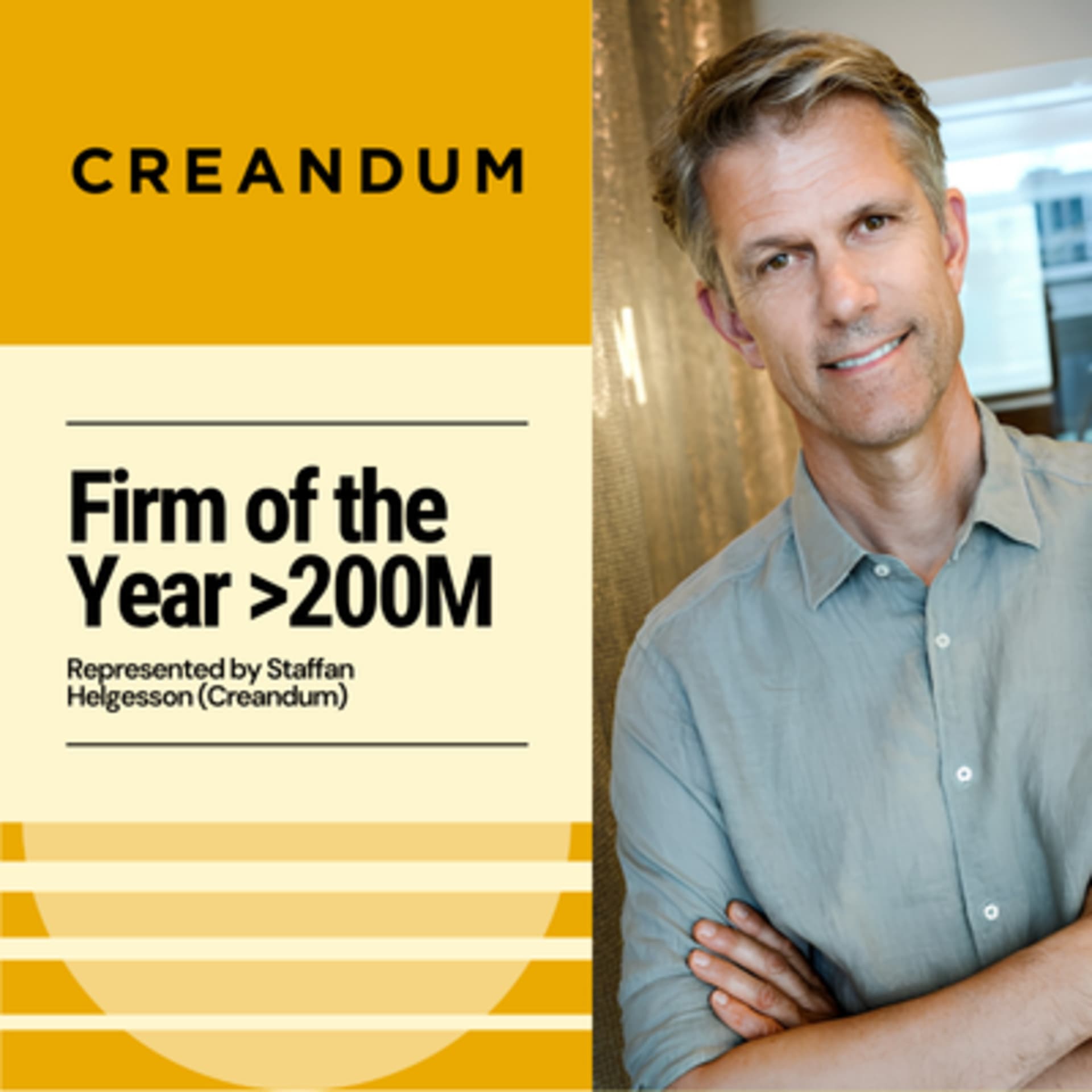
Staffan Helgesson takes the stage following Creandum being named Firm of the Year 2025 (>€200M AUM) at the EUVC Summit & Awards Show 2026.
The award goes beyond returns, recognising how a VC performs across the full stack: portfolio outcomes, founder support, LP value creation and contribution to the ecosystem, from backing emerging sectors to setting standards on transparency, diversity and fairness.
Staffan founded Creandum in 2003 and is now a Partner based in Stockholm. His work has focused largely on SaaS, alongside leading the firm’s climate practice with a particular focus on electrification.
In the discussion, he reflects on how Creandum has evolved over more than two decades, why the firm treats venture as a team sport and how it thinks about fund size, performance and Europe’s changing venture ecosystem.
He also returns to a principle Creandum has carried with it: “the price always increases”. What was enough to win a deal, recruit someone or build a firm last year will not be enough next year, especially as AI reshapes venture.
The EUVC Summit & Awards Show returns in 2027. Find out more and secure your spot here.


