
In short
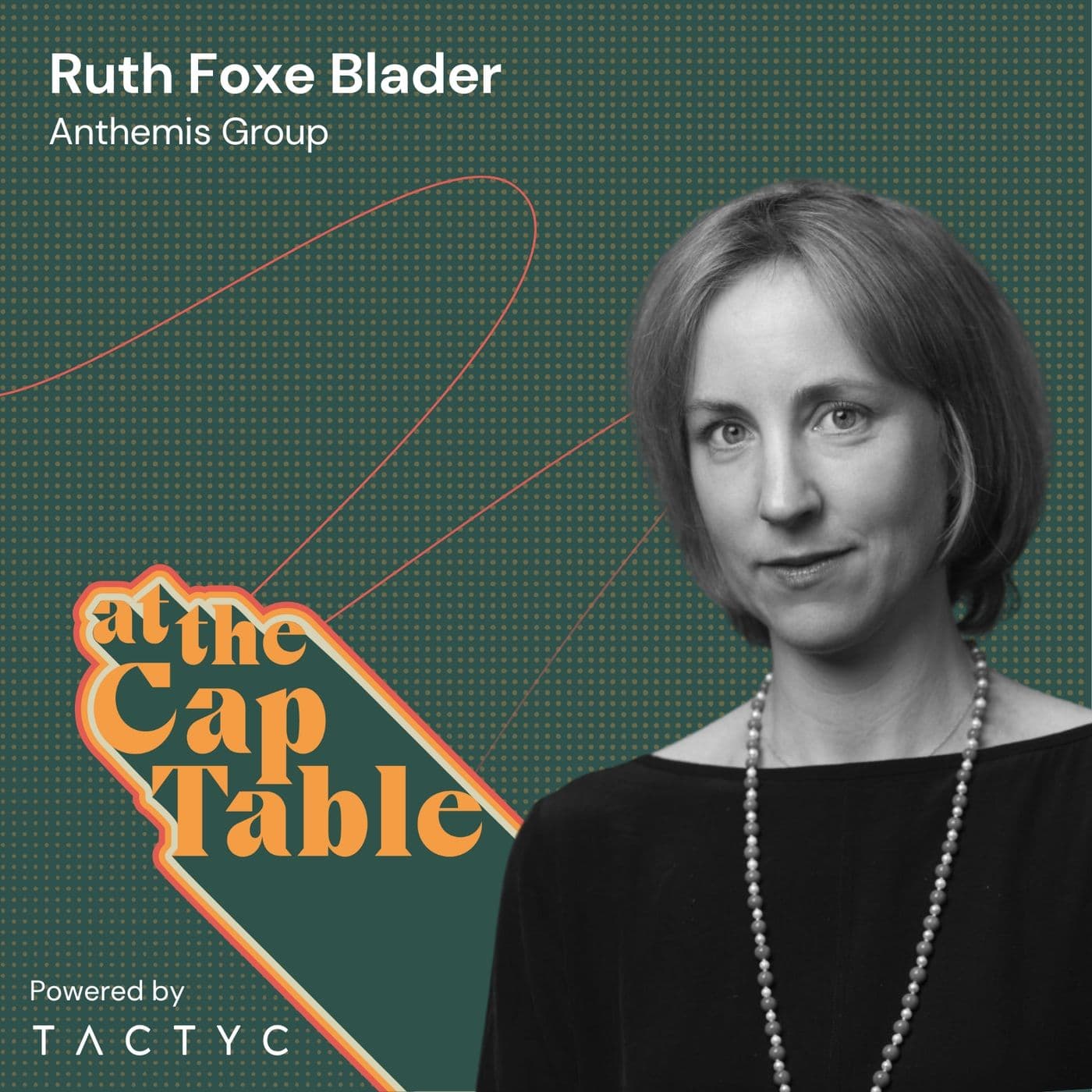
EUVC Podcast Episode Notes: E218 | ACT | Ruth Foxe Blader, Anthemis Group
Episode Overview
- Podcast Title: EUVC
- Episode Title: E218 | ACT | Ruth Foxe Blader, Anthemis Group
- Hosts: Sarah Finningham
- Guest: Ruth Foxe Blader, Partner at Anthemis Group
- Theme: Spotlight on top European female investors in the VC industry.
Guest Background
- Current Role: Partner at Anthemis Group, focusing on fintech and insurtech.
- Experience:
- 15 years in international positions at Fortune 500 companies.
- Previous role at Allianz SE, where she led digital innovation efforts.
- Invested in notable startups such as Lemonade, MoneyFarm, and Argus Cyber Security.
- Recognition: Featured in Innovate Finance's Women in Fintech Powerlist in 2018 and 2019.
- Board Memberships: Axle, Demex, Hokodo, Hometree, Kaiko, Proportunity, and Stable.
- Co-Founder of: WVC - promotes inclusion, empowerment, and integration of VC in Europe.
Key Discussion Points
Ruth's Journey into Venture Capital
- Early Career: Started at a digital agency post-dot-com bubble; transitioned to working with startups.
- PepsiCo Experience: Ran a program that connected PepsiCo with startups, igniting her passion for venture capital.
- Transition to Allianz: Invited to run a venture capital practice, leading to her current role at Anthemis.
Insight into Venture Ecosystem
- Investment Strategy: Focuses on strategic investments across the US and Europe with an embedded finance thesis.
- Geographic and Cultural Insights:
- US vs. Europe: US market often sees large potential exits; European founders are typically more conservative.
- Advocates for a more aggressive and optimistic mindset in European startups.
Advantages of Sector-Focused Funds
- Deep Knowledge Base: Sector-specific expertise helps connect companies with relevant industry partners.
- Boredom vs. Knowledge: While repetitive, this focus fosters deep understanding and enhances advisory capabilities.
Driving Positive Change in VC
- WVCE's Mission: Aims to harmonize local VC movements in Europe and create an inclusive environment for discussions around diversity and empowerment.
- Differentiation: Focus on cross-pollination and international participation, supporting both women and men in the VC space.
- Topics of Discussion: Addressing issues like maternity policies within startups, advocating for open and honest dialogue.
Lessons from Board Membership
- Governance Responsibility: Emphasizes the importance of sound governance and maintaining a realistic but positive perspective during challenging times.
- Role as a Board Member: Stresses the need for board members to ask insightful questions rather than provide operational answers.
Key Investment Takeaways
- Non-negotiables: Quality of the founder is paramount; strong problem solvers lead to successful startups.
- Market Preparedness: Founders should always be prepared for fundraising opportunities, leveraging moments when capital availability is high.
Quickfire Questions
- Underappreciated Sectors: Insurtech is still a compelling area despite general investor retreat.
- Fundraising Tips for Founders: Always be ready for investor conversations; the fundraising environment is cyclical.
- Counterintuitive Insight: Effective board members prioritize asking questions over providing solutions.
Conclusion
- Ruth Foxe Blader's insights highlight the importance of leadership, investment strategy, and fostering a diverse and inclusive venture capital ecosystem.
- Upcoming Events: Encourages participation in the WVC event in Paris, aimed at enhancing discussions around women in venture capital.
---
For more insights and to stay updated on the European VC landscape, follow EUVC on [eu.vc](https://eu.vc).
Written by AI. May contain mistakes. Listen to the episode to check what was said.
Transcript
Automatic transcript. May contain errors.0:04Hello, everyone, and welcome to At The Cap Table Podcast, a new series that shines the spotlight on the investors who are changing the VC industry in Europe. I'm your host, Sarah Finningham. In today's episode, we are speaking with Ruth Floss Blatter, a prominent figure in the venture company industry in the UK. Ruth is a partner at Anthemis, an industry thought leader in fintech and insurtech, and the co-founder of WVCE, an organization and new movement promoting inclusion, empowerment, and integration of VC in Europe and beyond. At Anthemis, Ruth leads strategic investment efforts across Europe and North America.
0:46Ruth specializes in technology-enabled business models, insurance technology, risk transfer, early-stage investing, product strategy, and digital transformation. Prior to joining Anthemis, Ruth worked for Allianz SE, where she spearheaded leading digital innovation efforts. She was a founding member of the Allens X team, where she led investments in startups, including Lemonade, Money Farm, Argus Cybersecurity, and Simple Insurance. New Jersey native, Ruth has spent the last decade between New York, London, and Paris. In 2018 and 2019, Ruth was recognized for her outstanding contribution to the global financial technology ecosystem and listed among the women in fintech perilous by Innovate Finance.
1:36And now, some words from our beloved sponsor.
2:03of data-driven fund managers and is trusted by over 250 funds globally today. Tactic is a proud sponsor of the first season of the At The Cat Table podcast series. If you'd like to learn more, please check out tactic.io. T-A-C-T-Y-C dot I-O.
2:26Ruth, a very warm welcome and thank you so much for joining us. It's great to have you on the podcast and super excited to speak with you today. Thanks so much for having me. All right. So I think to start us off, would love to dial back the clock. Let's start with hearing a little bit more about your background. Can you tell us about that and then your route into venture capital? I've talked about my background for a long time and a number of times in the past. And I've always tried to make connections between what I studied and all my different interests. And what I've come to realize is that probably, you know, aren't that many connections at the end of the day.
3:03I really got into venture on quite a circuitous route. I started my career in a New York digital agency after the dot-com bubble burst. And really, I just wanted to live in New York. I mean, at the end of the day, I was just kind of, you know, a kid who graduated from college, wanted to live in New York. There are all these Internet jobs. I happened to be somewhat protected from the dot-com bust because I worked at a digital agency, which was situated in a large public relations firm. And I started doing stuff like building websites for pharmaceutical companies and project managing intranet builds and kind of bespoke CMS systems and all these really silly things that people used to build before there were great products that did the trick.
3:50And I ended up at PepsiCo running the kind of digital and social strategy XUS. And I was getting kind of bored rolling out websites in different geographies and thinking about how to sell stuff online. And I worked on a program at PepsiCo called PepsiCo 10, where I was helping PepsiCo brands interact with startups. And as soon as I started doing that, I just completely got bit by the bug. I realized that what startups were doing 10 years after I started my career was very similar to the kind of innovative and interesting things that we were doing in the early commercialization of the internet.
4:32And I just followed a path that allowed me to work more closely with startups. So the CMO of Allianz asked me if I would come and basically run this PepsiCo 10 program at Allianz. We went on to launch the venture capital practice. I was there investing for a number of years, and then I joined Anthemis. And I have been investing in fintech companies for more than a decade. Very cool, Ruth. I guess on that move from the US to France, I would love to also hear some of your thoughts on what makes you particularly excited about the venture ecosystem. Yeah, so my focus is on startups based in the US and in Europe with opportunistic investments globally.
5:19I have some interesting investments in India and Cameroon. I have been living in Europe for more than 15 years, but I am American, as I'm sure you can hear from my accent. And I do a lot of investing in the US as well. I think that what I really like about what I do as an investor really is that I cut across geography and stage. So Anthemis is a sector-focused fund. We focus on fintech and we have this embedded finance thesis, which is really interesting. It really allows us to perceive the world as very strongly impacted by the financial system, which it is. The financial system is the nervous system of society.
5:59And at Anthemus, we're looking to invest in companies that have the potential to positively impact the financial system. And so we really look across industries. We see finance as embedded in a lot of different industry verticals. We'll do deals in prop tech and education, supply chain and logistics, agriculture, mobility, health. So although we're sector focused, we get to invest across a number of different sectors and we get to invest across a number of different geographies as well. I find it extremely interesting to invest both in Europe and in the US because the challenges are so different.
6:40In the US, we very rarely think, is this a big enough market? Market size tends to be appropriately large if you're looking at a US-based company that targets a large enough sector. In Europe, we think a lot about, can this be a big enough company? What is the potential exit strategy? And so we have done deals in the UK and France and Germany, and have also backed founders in other geographies that are looking either more geography agnostically or industry agnostically. There is a really different, I would say, cultural orientation to building a startup in Europe and in the US. And so I think what I do when I'm working on boards is really probably act a lot more American on European boards and try to sort of influence the culture to be a bit more aggressive, to be a little bit more maybe enthusiastic and sort of optimistic about the potential for the impact that we can have.
7:48And I probably act a little bit more European and slightly more conservative and attentive to the numbers when I sit on US boards. Very interesting. I think just on the topic of working at a thesis focus funds like Anthemus, what advantages does it give you being focused on the financial system and investing in that space? It gives the advantage of seeing the same thing over and over, which can be boring, but it's very educational. And so I think I can't imagine, you know, I know that there are some many extremely successful sector agnostic funds. I think that that's really hard for me to imagine just because so much of the knowledge base that I bring to the companies that I work with is knowledge which is accumulated from working in an industry for a long time.
8:42We really also look to connect our companies with relevant industry partners. So I tell founders, we can connect you to any bank or insurance company in the world. And I think that not only can we do that, but we can also make really relevant connections. But as I said, it can get boring. I think some of the most exciting deals often that you see are the ones that you know the least about. Those can also be some of the biggest pitfalls because you don't have the sufficient muscle memory to either be able to assist the founders in moving around obstacles, or just you don't see obvious things that to a sector expert could be potential pitfalls.
9:25But we do believe in our kind of sector focus as an advantage at Anthemis. Moving on to the topic of driving positive change in the industry, we recently had Jack Warner on the podcast where she spoke about various different initiatives that she spearheaded that really kind of moves the needle in the venture capital industry. I would also like to speak to you about one that you are spearheading. So I think for those that are listening in, alongside Sophie Winwood, Ruth is the co-founder of WVCE, which is really a recent movement that aims to promote inclusion, empowerment, and integration of VC in Europe and beyond.
10:07I was personally very disappointed to miss the conference last year because I was in the US myself, but I hope to join for the conference later this year. But Ruth, I wanted to really understand from you, there's so many different organizations and movements currently out there at the moment. What makes WVCE different? I think what we initially wanted to do was harmonize some of the local movements and industry bodies that were formed in different European markets. So in the UK, you know, Jack's fund and her kind of movement around diversity, VC is really powerful and unique. And, you know, there's SISTAs in France, and there are a bunch of organizations in Germany and the Nordics.
10:49But what Sophie and I noticed was lacking was that there was not a kind of industry organization that was sitting on top of those really trying to effectuate cross-pollination. And really the opportunity that we see there is not just sort of hanging out with other Europeans. And now, as you mentioned, it is quite international. We have a lot of participation from the US and are really glad to bring people in from other continents and and other countries and cultures. The importance of recognizing kind of shared goals and shared challenges, really giving space for something that was really popular in the 1970s feminist movement of consciousness raising, just giving a voice to people whose voices aren't always being heard.
11:34And that can be, you know, women earlier in their careers, allowing for a space where people can seek mentorship opportunities and seek to be mentors. You know, at first we didn't have a kind of differentiating value. Part of it was we were looking at what was happening in the U.S. and seeing that there were more conferences and more organizations dedicated to gender diversity in tech and in venture and thought, you know, that should really happen in Europe. And we should really try to convene some of these different bodies in one single location and see what happens. What has happened is really exciting.
12:12I think we are much more of a movement than an event. So we have kind of local, you know, meetups and industry events. We have webinars frequently when there are kind of important industry topics to be discussed. and obviously we have the event this year. It's taking place on the 2nd and 3rd of October in Paris again at Stasnel F, which is one of our co-sponsors and it's a really fantastic place. I really encourage people to come. And what we wanted to do was not only build the best women in venture event because we have all of these different organizations from different countries. We want to build the best venture capital event and we want to convene the best ideas and minds of venture capital.
12:57our kind of user base, our participants love this industry and they're super interested in high quality content. They want to talk about industry issues and they want to do what, you know, men have been doing since the beginning of venture capital. They want to network and do deals. And so we are really differentiating because we're creating an environment where people can talk really openly about issues in the industry and, you know, including controversial issues and including controversial perspectives on these issues. We're really an open forum for addressing what it means to be a woman working in venture capital.
13:39And we're also looking to create the highest quality and most interesting content and the most interesting conversations and learning opportunities for people who work in venture capital, man or woman. To follow up on something you just mentioned there, I guess on the topic of content that you're creating around the event, what do you hope to spark conversation-wise or change? I think we're realistic that the institutional and social conditions that underlie discrimination in tech are not things that we can kind of unilaterally solve through an industry body or organization. However, by confronting these issues and creating a space where people can discuss them openly and kind of nonviolently, I think that we can effectuate industry change.
14:25I'll give you an example. We had a lot of folks who were involved with WVCE who wanted to talk about maternity policies. As a board member of numerous startups, I've also observed that on the founder side, this is a really challenging topic. It's really challenging for small companies to assess what their approach to maternity leave should be. And venture funds as well, there is really no best practice standard. So we look to convene, we just stood up a quick webinar on the topic. We always invite a couple of industry experts. There's always really good discussion and dialogue. Then we summarize it.
15:03And now we're working on a more in-depth research piece where hopefully we can help to shape some standards, not only towards the VC fund world, but also for board members to use with startups, because it can be a very tricky question, even for very experienced board directors, how do I deal with a key member of my staff who is pregnant? And I think in terms of composition of audience for that event, I mean, I know several people that attended last year, but there was a balance of both investors and founders. What are you hoping for later this year? Are you hoping for different individuals across the ecosystem?
15:40Or what do you see there? Yeah, we really try to welcome GPs, LPs, investors, women working in tech, and also, you know, people who might be interested in getting into technology or venture capital. So it's quite a broad range. And one of the challenges that we have, and that we're also very excited about answering is how do we create content which is relevant to those complementary target groups. And we will most certainly have great stuff for everybody. Ruth, you serve as a board member to several exciting fintech and insurtech companies, including firms like Amplify, Branch, Raincoat Stable, Home3, the list goes on.
16:23Would love to hear some of your thoughts on what are your key learnings from several years of sitting on boards? My key learnings from several years of sitting on boards is really that if you're a good board member, it's really hard work. Recently, the market in venture has turned a bit. Capital availability has become really scarce. Founders are freaking out. Investors are freaking out. And I think that that's really unhelpful. So bringing panic into the boardroom, reacting to maybe pressure within your own fund, around your own fundraise, or around whether or not you think the founders that you invested in six months ago are going to grow into the valuation.
17:04None of that is really relevant or helpful to a board context. Boardrooms are about governance. And I think that during the kind of frothy period of venture capital until, you know, 2021 and probably starting five or seven years before that, I think that there was a lot of just high-fiving around the table and feeling like everybody was invincible. I think it's always important to combine positivity with realism. And so I think that your perspective on your company shouldn't change from board meeting to board meeting. We play a long game. The opportunity of venture is a 5, 10, 15-year opportunity.
17:43And so it doesn't make any sense to be suddenly appalled by what your company is able to achieve or not able to achieve. I think that founders really benefit from a balanced perspective in the good times and the bad. And founders benefit from being asked the right questions. And so what I try to do is sort of, as I said, be positive, but be realistic. Think about, help think about risks and really focus on the responsibility of being a good board member, which is ultimately a responsibility of governance. Brilliant. And I think just trying to lean into any specific examples, any standard examples that you've had where you've added impact at a critical moment in their journeys.
18:28I actually give full credit to the entrepreneurs. I think at best, most entrepreneurs will tell you at best board members just stay out of the way. It's sort of the Hippocratic oath, first do no harm. I would say that as we have had in fintech and financial services generally, some really unanticipated, very large macro movements, we've had to react and determine reactions accordingly. And I think, you know, I was speaking to a company this morning about a potential acquisition, not of the company, but a smaller acquisition that we might do. And, you know, when we think about downside risks, we also really need to think about unanticipated things.
19:15You know, we've had fastest rising interest rates since I think the 1980s. Perhaps we will get to the fastest ever. We have an inverted yield curve. We have companies that we're borrowing at, you know, sometimes close to zero percent. And, you know, this macro environment has changed really dramatically. And if you asked anyone three years ago if it was going to happen, everyone would have said absolutely not. So it's really our job to think, you know, the absolutely not might happen. Is this still a good idea? What is our decision making framework sort of, I guess, macro agnostic? and how do these exogenous factors either highlight opportunities, endogenous opportunities, or exacerbate endogenous problems, and how do we get ahead of it?
20:04And I think you've touched upon some of the points on investing through the noise that we actually spoke to some of our guests recently on. But I think as a VC investing in specifically fintech and insurtech businesses, is maybe share some of the things that you stay focused on thesis-wise, which helps you make the best investment decision. So what are the fundamental non-negotiables that you focus on? Founder quality is a number one non-negotiable. Great founders are great problem solvers, and very much of work on early stage startups is efficiently solving problems. We try to have a prepared mind, I would say.
20:44And so there are certain areas of opportunity that we will highlight. There are certain industries which we find particularly inefficient, where we think technology has a big role to play in increasing efficiency. But unless there's a fantastic founder building in the space, there's no investment to be made. Yeah, I think that that's, for me, that's really the critical key point. I really want to connect with someone who has an amazing insight, is incredibly hard working, very creative and really, you know, wants to be great at their craft. I guess as a final wrap up, we typically do a quick fire round with our guests.
21:21So we'd love to end this episode with a few questions. Take between 30 or 60 seconds. Are you ready? Ready as I'll ever be. Right. First one is what areas, technologies or sectors excite you the most that other people don't really feel excited about? Well, I would say that I'm going to make a really, really easy answer to this question, unfortunately. Sorry, very uncreative. I would say that many generalist investors have decided that insure tech isn't worth the hassle. And I am seeing a retreat amongst some of my peers from the insurance industry, given the performance of some of the publicly traded insure techs that went public in 2020.
22:06in 2021. I still think that the insurance industry is an amazing place to be investing. It is, you know, there are very few trillion dollar industries. It is massively inefficient. It's still a filing cabinet industry. We have a lot of work to do. All right. Second question. What are your top tips for founders across Europe who are fundraising right now? My top tip for founders who are fundraising and founders who are not fundraising is really be ready. During these market cycles, the window opens and closes, the winter thaws, and then it freezes again. And you just need to be ready to talk to investors when they want to talk to you.
22:46If you're getting inbound from good firms, have conversations with investors. It is easier to fundraise when you don't need the money. It is easier to bring in capital when you don't need capital. So I would say there's something really fantastic about being heads down and working on your project. But unless you are fully funded for 36 months, I would be having a few more investor conversations than maybe I historically would have advised my founders to have. All right. Third question. What's the most counterintuitive thing you've learned in venture? I think that for me, the most counterintuitive thing I've learned in venture is that people don't necessarily need answers.
23:25And I'm thinking specifically in the board context. The more I, hone my own craft as a board member, the more I realized that it's really inappropriate to answer operational questions about a company that you're not operationally involved with. And most of the time as a director of a board, you're not a day-to-day operator in the company. So I really think that rather than answering questions or kind of providing wisdom or sort of pontificating, Great board members ask great questions and they helped the founders develop an intellectual framework for confronting obstacles, you know, dealing with challenges and better understanding their business.
24:11Ruth, thank you so much for joining us. We have enjoyed having you on the cap table with us today so much and look forward to the WVCE event later this year. Thank you. I can't wait for you to come. Thank you for listening to this special episode on the European VC. If you love our show, join our community by subscribing at eu.vc. And now, some words from our beloved sponsor. Tactic is the leading forecasting and scenario planning software for venture capital funds. Tactic combines portfolio construction, portfolio management, forecasting and reporting into a unified platform. investors are empowered with data-driven insights on fund strategy reserve allocation exit planning and fund performance tactic was built using quantitative techniques research from hundreds of data-driven fund managers and is trusted by over 250 funds globally today tactic is a proud sponsor of the first season of the at the cat table podcast series if you'd like to learn more please check out tactic.io t-a-c-t-y-c dot i-o you
From the publisher
Our next guest is the brilliant Ruth Foxe Blader, Partner at Anthemis!
Ruth is a fintech investor, emerging technology & communications expert with 15 years-international experience at Fortune 500 companies. At Anthemis, Ruth leads strategic investment efforts across Europe and North America. Ruth specialises in technology-enabled business models, insurance technology, risk transfer, early stage investing, product strategy and digital transformation.
Prior to joining Anthemis, Ruth worked for Allianz SE, where she led digital innovation efforts. She was a founding member of the AllianzX team, where she led investments in startups including Lemonade, MoneyFarm, Argus Cyber Security and SimpleSurance.
A New Jersey native, Ruth has spent the last decade between New York, London and Paris. In 2018 and 2019, Ruth was recognized for her outstanding contribution to the global financial technology ecosystem and listed among the Women in Fintech Powerlist by Innovate Finance. She currently serves on the boards of Axle, Demex, Hokodo, Hometree, Kaiko, Proportunity and Stable.
Alongside Sophie Winwood, she is the co-founder of WVC - a movement that promotes inclusion, empowerment and integration of VC in Europe and beyond.


