
In short
EUVC Podcast Episode Summary
Episode Title
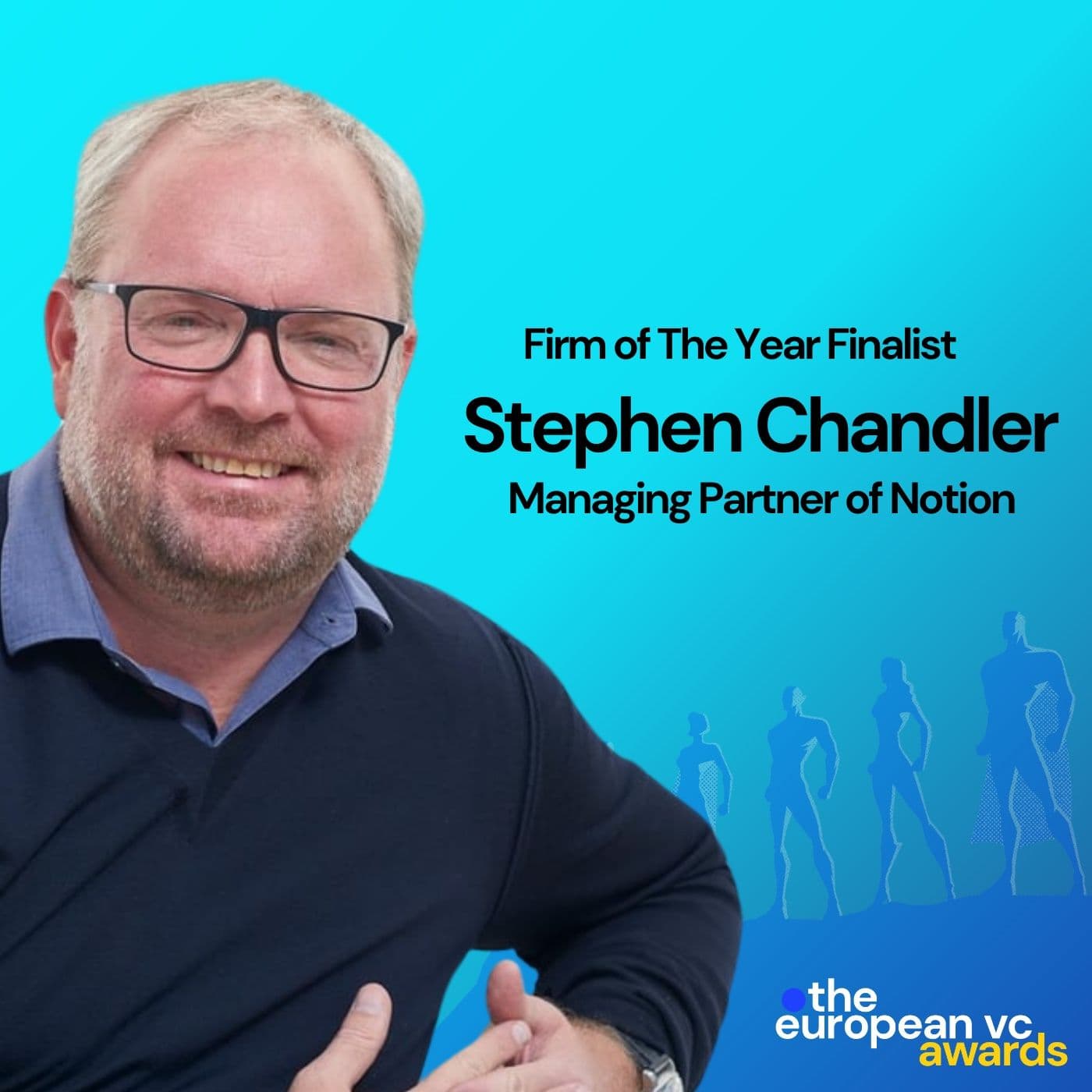
E307 | EUVC Awards | Stephen Chandler on Building Notion & Raising an Oversubscribed Fund V
Podcast Overview The EUVC podcast, co-hosted by Andreas Munk Holm and David Cruz e Silva, delves into European Venture Capital, featuring influential figures in the industry. Episode 307 celebrates Stephen Chandler, Co-founder & Managing Partner of Notion Capital, discussing the firm’s achievements and insights into VC practices.
Episode Highlights
Notion Capital Overview
- Headquarters: United Kingdom
- Assets Under Management (AUM): €1.1 billion
- Fund Size: €300 million (Fund V)
- Investment Focus: Primarily Series A, but spans from pre-seed to growth stage
- Geographical Target: Pan-European
- Sector Focus: Business Software & Fintech
- Notable Investments: Includes CurrencyCloud, Easol, GoCardless, Mews Systems, Paddle, Upvest, Yulife.
Key Discussion Points
Achievements & Fundraising
- Fund V was raised in 2023, oversubscribed from a planned €250 million to €300 million.
- The fundraising occurred in a tough market environment post tech reset.
- Notion Capital maintained a 96% re-up rate from existing LPs, which significantly contributed to the successful raise.
Principles & Firm Culture
- Founding Philosophy: Build a firm that supports entrepreneurs beyond just capital, leveraging first-hand experience in business operations.
- Mantras:
- *Have fun, make money*: Balancing enjoyment and profitability is essential.
- *Challenge everything*: Encouraging a culture that questions the status quo.
- *Don't be a dick*: Promotes kindness and karma within the VC ecosystem.
- *Play the long game*: Emphasizes building lasting partnerships and recognizing the long-term nature of venture capital.
Observations on B2B SaaS
- Early-stage investments in B2B SaaS have been a strong focus for Notion Capital since its founding in 2009.
- Evolution of SaaS: Discussion included the shift from traditional subscription models to various monetization strategies including utility-based pricing and hybrid models.
- AI’s influence on business software was acknowledged, suggesting that AI tools may simplify the development of software, reducing the need for larger teams.
Platform Team
- Notion Capital differentiates itself with a robust platform team that provides extensive support to portfolio companies, including:
- Go-to-market strategies.
- Pricing and monetization guidance.
- Interim roles such as CRO or COO to help scale businesses efficiently.
- The platform team model is a key differentiator in the European VC landscape.
Fundraising Insights
- Stephen shared that a significant part of a Managing Partner's role is fundraising, especially during cycles.
- The importance of long-term relationships and consistent communication with LPs was highlighted.
- Market conditions post the tech reset have shifted investor expectations, leading to a focused assessment on efficiency and sustainable growth metrics.
Personal Insights
- Stephen discussed the balance between work and family life, especially as a successful person in a demanding field.
- He humorously mentioned cloning his dog following the loss of a beloved pet, demonstrating his investment in technology and personal values.
Conclusion Stephen Chandler’s insights into the European VC landscape, firm-building strategies, and the nuanced dynamics of business software investing provide significant learning opportunities for those in the industry. His experience with Notion Capital serves as a compelling example of successful venture capital practices in a rapidly evolving market.
Acknowledgments
- Special thanks to Haynes Boone, sponsors of the Firm of the Year Award, for their support of the EUVC ecosystem.
For further insights and details, listeners are encouraged to check out Stephen's notes available on eu.vc, which offer additional expertise and reflections on the discussed topics.
Written by AI. May contain mistakes. Listen to the episode to check what was said.
Transcript
Automatic transcript. May contain errors.0:00Welcome back, everyone, to another episode of the European VC podcast. Today, I have what I think is one of the coolest episodes we've done so far. It is with finalists in the firm of the year category, Stephen Chandler, and he's the co-founder of Managing and Managing Partner of Notion Capital. We are diving into everything around building out Notion to the giant and amazing firm that it is today. 1.1 billion under management, just raised fund five here in 2023, 300 million oversubscribed. They had only planned to do 250 million. So an incredible feat after the tech reset or in the wake of the tech reset, of course.
0:42This episode is just one of the best ones. We get into everything from why Stephen chose to clone his dog to building Notion and the learnings from the fundraise. I hope you really will enjoy it. Just to give you some quick stats on Notion, in case you don't know, headquartered in the UK, 1.1 billion AUM, fund size 300 million. They're now in fund five. Series A focused, but they invest also in pre-seed and growth when that seems like the right opportunity. They're targeting anything in Europe, meaning geographically. Sector-wise, they are focused on business software and fintech. And they have, of course, under their roster, notable investments like CurrencyCloud, ESL, GoCartList, Muse, Systems Paddle, Upvest, and ULive.
1:30Please, everyone, if you're listening to this episode, do drop us a review and also give a huge shout out to Heinz & Boone. Heinz & Boone, because they are the official sponsor of the European VC Awards Firm Worth of Year category. We are massively indebted to them for supporting us and the awards. So if you need some legal counselling and want to be with the best, definitely reach out to Karma and the team at Haynes Boon. Here's a few words from our beloved sponsor. This episode is presented with our good friends at Haynes Boon, proud sponsors of the Firm of the Year Award. At Haynes Boon, they understand the complexities and challenges faced by VCs.
2:14Specialising in fund formation, they expertly manage the establishment of multi-billion dollar funds. and innovative private fund products, ensuring their VC clients are equipped to attract global investors and excel in competitive markets. Beyond fund formation, Haynes Boone is deeply involved in the lifecycle of startups, providing nuanced guidance on everything from entity structuring and capital raising to navigating exits through IPOs and strategic acquisitions. Their comprehensive legal services support VCs in maximizing their investments and achieving successful outcomes. Whether you're looking to launch a new fund or invest in cutting-edge startups, Haynes Boone positions you at the forefront of the European venture ecosystem, enabling you to capitalise on opportunities across health tech, AI and beyond.
3:04Stay ahead of the curve by tuning in to the European VC Podcast. Join us in celebrating the art of venture capital with Haynes Boone, where strategic legal insight drives investment success.
3:20Tear down this wall. It's more than just an alliance. This is a union of values. United and determined, we can serve as a model for other regions of the world. The nature of a problem requires a European response. Europe is a story of new beginnings. Let's start acting. This show is not investment advice and the hosts of this episode may be invested in the funds and companies featured. Stephen, welcome to the European VC podcast. Great. Thank you for having me. You have been a person I've been very much looking forward to get on the podcast. So now we are finally here and we're here for a very good reason, because you have gotten into the very small elite group of being a finalist in the firm of the year category of the European VC awards.
4:15and we're very grateful for that. Thank you. I'm excited. Now, and I think just to our audience, if anyone does not know of Notion already, you're in for a great episode because here I'm going to talk with Stephen all about firm building and what it is to build a franchise like Notion. But aside from that, Stephen has also been nominated or won as investor of the year as an example at the 2020 investors all-stars so we are with one of their greats so there's something there's a good reason to tune in today Stephen any reflections on the awards in total do you think it's a good initiative or do you think it's just another one I think it's a great initiative you know we needed something that was specific to VC specific to Europe so it's it's been long in the waiting and I think it's overdue and we're looking forward to seeing it.
5:15Amazing, Stephen. Thank you so much for those kind words. Now, I want to just dive right in and I want to ask you about the principles you've built Notion on the back of and the learnings you've had from building the franchise. So I just really want to ask you that very open question and then let you take it from there. So I guess the way I characterize it is to say that when we set up the firm, we really tried to build the kind of firm we wish we had had backing us when we were entrepreneur operators before the notion journey and and i'll i plan to talk about that a little bit more um later on when with some of the things that we did back then but but what that means to me is really uh you know we had we had good supportive investors but they weren't operators and they weren't able to help us with some of those first-hand scaling challenges that we faced so we wanted to build a firm that was genuine subject matter experts you know with that first-hand experience and could really really support on the entrepreneurial journey beyond just cash so to us what that really meant was focusing on what we know and love which is really b2b sas where we had our expertise and experience before and then trying to add genuine value along the way so that's the kind of firm that we've that we've built and I'll talk about how we do that later on as well.
6:40I know that B2B SaaS has kind of developed to be more than just the typical SaaS model. Could you talk a bit about that, not drift, but opening of the vertical that you focus on? Yeah, I think when we set up in Europe as a B2B SaaS focused firm, we were really the only firm that had that kind of level of focus in the European ecosystem. That was back in 2009. The landscape wasn't as densely populated as it is now with VC firms. So it was more of a differentiator. And I think now there are a few different firms that at least have B2B SaaS as part of their focus and armory. So it's kind of moved on a little bit in terms of the VC market, but also in terms of the business model, You know, Generation 1 SaaS companies, as we built back in the noughties, were really subscription software per user per month delivered from the cloud.
7:40Since then, you've seen form factors develop a lot. You know, there's no longer, there are all kinds of different monetization strategies and models there, whether that's utility-based pricing, SaaS plus payments. you know you see more kind of hybrid models there where they may have some edge computing or you know not pure public cloud so we don't want to be purist about it what we like where we focus is you know we don't do consumer it's not where our expertise is but anything where the primary value is delivered from software and the primary monetization is a recurring model that's where we like to focus.
8:21And I think that fits well within the way the market's evolved as well. So the recurring model is in there as well. Obviously, software is scalable. We know the Playbook, it's all the network effects, all those things. The recurring model, why is that so important still, even though it's not by subscription, but it's still a recurring model? Yeah, when I say recurring or reoccurring, but an element of predictability in it, if it's a usage based model is what's important because I think that's, you know, what people know and love about the model is forward visibility of revenues and being able to build upon existing success.
9:01So getting a customer, deriving ongoing revenue from them and then building upon that. Can I ask you to just reflect for a second on the future of, if we call it business software instead of B2B SaaS, especially with the, maybe comment directly on the rise of AI, but some say that, well, you might have a difficult time with many of the large scale business softwares that kind of like everyone had to kind of adapt to a large platform that was made for everyone because many, many smaller businesses wouldn't be able to develop their own. But some say, well, now with AI, it's actually being quite a bit, it's become quite a bit easier to build your own.
9:55You don't need a seven or 10 or 15 or 20 man team to be able to build your own stack. You can actually just be a normal business with one software developer. Yeah, I think that's right. And, you know, we're only just seeing the beginning of that about how profound an impact it can have. Some of the AI assisted development tools out there that we've looked at are really, really impressive in terms of what they can do. And creating, if you like, different personas within the AI co-pilot landscape, if you like, between can you play a data scientist role? Can you be a front end developer? Can you be a back end developer?
10:35and you can see performance across all of those areas with some of these AI products these days. So I think that's absolutely right. You're able to do a lot more with a lot fewer people and the speed at which you could do it is truly astonishing. So where you used to have to go out and recruit people and you used to make recruitment mistakes and only find out about them six months after you hired the people, you're now in a situation where you can get some really high-quality code built extremely quickly. So things like API integrations and things like that are just so much easier than they used to be.
11:11What do you see as the impact on the, how should I put it, the more traditional or more established, like if you think of HubSpot or you think of some of the big firms that we all know, the big business-to-business names that we all know, do you see it as legacy businesses are going to win or be able to win? Or do you see everything is in the flux right now, our portfolio? Some are managing, some have a good fit in this new paradigm, some have a worse fit. And for that reason, definitely seeing everything upside down. Yeah, I think the answer is somewhere in between the two, as it always is. You're going to see AI native applications displace incumbents in a number of significant areas.
12:02but also the platforms and incumbents have a significant market strength and presence there and a lot of them are still able to innovate quite well as well. So I don't necessarily see the whole world turning on its head. I think there'll be winners and losers as there are with every kind of technological innovation that we've seen in the market previously. I mean, if you think what happened with mobile, for example, you know people that got ahead of it and went mobile first quickly addressed that sea change in the market and yes there were some mobile first emergent players that came in and displaced incumbents but there were also incumbent incumbents that adjusted pretty effectively to it as well.
12:47I want to ask you about one more thing now that we're on the topic of vertical because we're going to go very soon away from this and talk about firm building so that's why I'm sticking with it a little bit. And I just wanted to ask you because some of the deep tech investors might have the cocky critique of B2B SaaS and pure digital and say that, well, it's been so well described how you scale a business now in B2B SaaS. And now I'm using B2B SaaS as the word because that's where I've heard the critique or the provocative statement, that it's almost not VC anymore because you just go in, you know what that type of business looks like, and then you put some money into it and it scales.
13:34There's no exploration anymore. There's no pushing the boundaries anymore. What would you say to a person that would be so, so cocky asked to say that? Well, I wish it was that easy, or I guess I don't, because if it was that easy, then it would be so commoditized there wouldn't be any opportunity. I think when you're early stage investing, it's only partly about the metrics, as we know. Yes, at the growth stage, people will have their own views on SaaS metrics, on CAC2LTV and margin structures and net revenue retention and all of those things where there are a number of playbooks out there. But at the early stage, they don't really have those developed metrics.
14:14The companies are still often founder-led sales with their first couple of customers on board and very much finding their way. And so us as venture investors, of course, we look at the data and of course we try to extrapolate that into the future in a kind of methodical and analytical way. But there's also a huge amount of judgment and gut feeling based on the opportunities as you see them in the market, the quality of the founder and all of those more subjective areas. So it's not as scientific as that. And also, it's true to say, you know, our origins were in B2B SaaS. I think it was important when we set up the firm to have a very kind of clear market positioning to, you know, identify ourselves.
14:59And the SaaS market was really emerging there. And we as a team had built one of the biggest success stories of the Generation 1 SaaS companies. So we had a pedigree in that area. So we used the SaaS branding a lot. If you look at our branding today as a firm, we tend to refer to business software and fintech. We've had a lot of success in the fintech space and have a number of plays there. Companies like GoCardless and companies that are SaaS plus payments have a payments element to them like Paddle and Muse, all three of those unicorn companies. So we definitely like the fintech space and have had success there.
15:37And we use business software deliberately. Rather than saying enterprise software, which implies only the kind of large end of the market, we do do stuff down at SMB, SME. You know, a number of our companies are very, very innovative and do have a deep tech element to them. Some of them are not commercializing as quickly as others. You know, we've invested in some companies that have taken a while to build commercial traction because they're building something very differentiated in terms of what they're doing. You know, and again, an example of that would be Arkit, which is doing symmetric key encryption for the post-quantum world.
16:14You know, that's very much a deep tech company in terms of its commercialization. All right. So let's leave it at that. And we could continue talking verticals, but that's not what we're here to do. But I had to ask you these questions because that's some of the questions I've had in my mind when I thought, OK, I'm going to speak to one of the giants of B2B SaaS or business software in Europe. What do I need to ask? We have one person who asked, it's George, and he asked on LinkedIn when I said that we were going to do this episode. He said, Notion Capital, is that the venture arm of Notion or what is that?
16:48I'll let you comment on that. Yeah, we get that question from time to time and it frustrates us mentally internally, of course. Even to the extent that we've been questioning our branding a little bit around it. Clearly, Notion, the app, have done very well and we use it ourselves and have a lot of respect for it. we've been around longer than they have. We were founded some five years before they were. And so it didn't influence our branding, and we're certainly not affiliated or connected to them in any way. You know, and the origins of the notion name for us were somewhat different. They had some sort of personal, as is often the case when you're founding a firm, you know, had some personal drivers as well as some professional ones.
17:30On the professional ones, if you, you know, look purely at the definition of the word, where there's an idea or concept, often imperfect at the point of communication, really sits with what we do as early stage investors, because the things that we are investing in are imperfect. You can't wait for them to be perfect or you miss the opportunity. It's about being good enough and getting live and then iterating and learning along the way. so I think it really reflected with what we do as a firm very well but there was also you know we just like the like the word there's a lot of symmetry in the word I actually I actually end the car number plate nation as well UK registration plate because I like the word and like the symmetry of that and I did that before I aimed that before I set up the firm it's much.
18:25I like that a lot. We have a guy in Denmark, one of the founders of a tech company here. He has the license plate 42, which I think there's a bunch of tech people that are really envious. Yeah, a few people use 42. From the heat of the blood to the galaxy. Yeah. Alright. And that is getting more and more pressure in that book right now than ever. So now let's get into the firm building again. And I want to just touch on, because we spoke about their principles just before, but I know you also have some mantras that you run the firm by. Could you run us through those and let's have a conversation on this?
19:05Yeah, of course. And we do have those. And, you know, we've been thoughtful about them to some extent. And I'll run you through them. So the first one we have, and these are actually on our website if you look at them. The first one we have is have fun, make money. Really, the thinking behind that is, you know, there's no point in having one without the other. If all you're doing is having fun but not generating returns, then you won't survive very long. And if all you're doing is making money and not enjoying it, it's a very unfulfilling life. So it's very important for us. We're kind of friendly and informal firm, but we are also super competitive in terms of what we do and our desire to win.
19:44So it's about having that balance. The second one is challenge everything. so we have a kind of healthy disrespect, if you like, for the status quo and think that boundaries are really there to be pushed and broken and so we're always looking for novel and innovative approaches to things which of course we should be as VCs. Our third one, sometimes we have to temper a bit but as originally voiced it is just don't be a dick and the thinking behind that is just, you know, we believe in karma and so you should treat people how you want to be treated, behave nicely. We try and do that with everyone in the ecosystem.
20:25Sometimes we moderate that to do the right thing if we're in more sensitive audiences. But that's the original phrase as I articulated it then. And we actually had sort of badges for that. And I have it thrown inside the lapel of a couple of my seats. Not that I wear seats very often. um so um it's important to us and and when you move on from that it goes beyond um that to at its heart a real kind of deep empathy for for the founders and the challenges that they face on their journey having been founders and operators ourselves with you know we know that we know it's tough at times you know the last thing you want is a vc that kind of causes challenges um within your problems within your organization.
21:13It's that kind of Hippocratic Oath point of first do no harm and then try and add value and support the founder. And that's what we try and do. And then the last one is really play the long game. And VC is a very long game. And it's not all upwards and to the right. There will be challenges along the way. And, you know, you'll hear lots of different people talking about how it's very much like a marriage. So it won't be the first time people have heard that expression. but we're just big believers in playing the long game building powerful partnerships building long-term relationships both with founders but with also other investors with our lps with with everyone in the community because this is not something where you have overnight successes you you it takes a long time and a lot of work to do that so you need to celebrate your successes but also be humble with them so that you can because there will be challenging times as well ahead.
22:11Could you maybe speak to how you instrumentalize these mantras? Because it's have fun, make money as an example. How does that run into the operations of Notion or do you see that this is where we pull it out? This is where it's important? Are there places where you say there are ways of instrumentalizing these statements that you can speak to? Yeah, there are. I mean, we revisit these and ask people about them as we've matured as a firm, because, of course, we set them as the founders of the firm early on in our development. And it's always right to check them because firms do evolve over time.
22:53But the starting point, I would say for them, is really recruitment and bringing people on that kind of fit with our own ideals and values, really. And we've done that successfully, I believe, in terms of the people that we've recruited and developed and have been successful in our organization. And, you know, I think if they didn't fit with our cultural values and intentions, you know, probably they wouldn't come in in the first place. And if they did, they probably wouldn't stay or survive or thrive within our environment. So we've had a number of people that have gone on and been very successful and thrived within the environment because we have this shared kind of belief and values.
23:33and values so um i i would say that but then of course we try and make sure that we then live these values in in everything that we do so you know we do have a very flat structure that encourages people to talk openly and challenge each other vc can be an industry that has some quite big egos in it and i think you know we are definitely on the lower ego end of the spectrum in terms of the way that we work together and collaborate with each other. And we sort of have a healthy relationship where we support each other, you know, as one would expect you to, but also take the mickey out of each other and jest with each other a lot in the environment.
24:18And that environment seems to work pretty well for us because we don't have the big egos that get too upset about it. now if i were to ask you about because you've you've built a european behemoth right you're you're you're among the top of the top of the class here in europe so i'd love to ask you what have been the most pivotal learnings in in building notion i think one of them would be focus um you know when i as i said when we set up the firm we had a clear focus you hear people talk about that in VC you either go big or you go niche and and we went niche we decided that that was better fitting for what we wanted to do and where we saw the opportunity so our strategy and our focus is very clear on sector on stage on geo and that really helps in terms of our communications and you know both with with entrepreneurs and founders knowing whether we're the right firm for them to come and talk to, but also with LPs as well, understanding clearly what kind of deals Nation does and what we stand for.
25:27So that focus has served us very well. On the LP part, oftentimes, as an example, when you talk to a PropTech fund, they oftentimes have LPs that are in the real estate business or construction business. Is that the case also for a B2B SaaS fund like yours? or business, digital business fund like yours? In terms of we got a lot of corporate money from software? Yeah, or the founders, the executive founders from this. And now I know that, of course, you're professionalized or institutionalized to a stage now where the majority of your, I think it's 80 % of your capital is now truly institutional.
26:13So obviously not. But before when you were smaller, and I ask this question, of course, because we have many GPs that are smaller this morning. When we were smaller, that was the case. I definitely think our kind of entrepreneurial heritage, if you like, our experience as operators resonated with founders who had exited and had some money and wanted to back that kind of entrepreneurial team. So we had a number of those, not actually just limited to software and technology, actually. It was kind of broader than that. but we had a number of those as our early LPs and were important to us in those early days.
26:50Now, as you say, it's changed beyond measure and it's a largely institutional and generalist LP base rather than particular specialists albeit they have asset allocation ambitions in certain sectors that they believe to be interesting and we clearly fit with those in terms of their decisions. We have had some corporate money along the way from tech businesses. I think my lesson on that would be that it hasn't been the most reliable, recurring kind of source of LP money for us. And I think for other people I've seen in the industry as well, just because, you know, one minute is something that they can decide on a strategy that sees them backing these kind of opportunities.
27:33And then that can change with changes in leadership and things like that. So we've seen that as well. Did it tend to be strategic money or was it still financial investment, but it was just from corporate arms? Well, it was somewhere in between the two. They wanted to see a sensible financial return on the money, but they weren't doing it for the financial return. That didn't make any difference. And they were doing it for strategic reasons and for insight into what was going on in the landscape and where we were investing. So it was primarily strategically motivated. it yeah what would you say to uh gps considering taking on corporate money well i guess the inference from my previous uh comment is be careful about the longevity of it because it can change over time um but you know you've seen a number of firms that have successfully built strategies around that anthemis for example and so you know i'm not saying it's the wrong strategy for some people have made it work extremely well it depends the way you're set up and what you're trying to achieve and if you if you do it when you say the way you're set up it's that means a lot do you actually cater to this lp base is that is that a fundamental part because if not it's hard to have a corporate investor be super happy about the investment yeah i think that's exactly right so it's not just about the longevity of are they going to be an investor in your next vintage fund it's also about the overhead of what do they want from the relationship and the overhead for you as a firm in delivering what they want, because often it can be spending a lot of time in their organizations.
29:11And it can be a very different model as a consequence. Yeah, yeah, that's a very good point. And for that reason, like have those conversations up front, consider if you need to have like an extra fee on top of the management fee, because what you're paying for is the investment part. You're not paying for the strategy consulting part, that type of thing. and that, of course, is contingent on the size of the ticket that you receive from them. Okay, I just wanted to add those things in because now we spoke about it and I think it's important for people to hear. If we then shift to your platform team, I'd love to hear a bit because that's something that Notion is very well known for.
29:53Yeah, indeed. So I would say one of the other kind of, you were asking about the learnings that have been pivotal for us. It's our firm belief that adding value is critical in this industry cash as we know is a commodity for the best companies and that that's even even in tougher markets like we see at the moment so you need to compete and and choose the uh the the vector on which you compete and we chose to do that through building a reputation for for really supporting founders not not just as a sounding board sitting on their board but also in a more scalable and repeatable programmatic way through our dedicated platform team.
30:33So I guess if you think about it, like A16Z in the US is a big well-known advocate for this kind of model, we're different because they're investing across the whole spectrum of technology, whether that's consumer hardware, e-commerce, crypto, et cetera, as well as B2B software. They have a very broad and wide network of platform team that supports those very disparate business models. We're able to do something with a much smaller footprint, which, of course, we need to because we're a smaller firm. You don't have 550 on staff. Exactly. But we're able to do something that's really, really impactful because it's much more focused.
Read the full transcript
31:15You know, whilst what makes our companies successful obviously differs for each one and they have their unique aspects, the challenges that they face, there's a huge amount of commonality in those. So being able to identify them before they face them and head them off, you know, is something that we can do and help a lot with. So building out the kind of expertise around B2B software and then supporting the portfolio in a programmatic way. So for us, when you hear some firms talk about platform, what they really mean by that is that they have someone that helps with talent and they do some events.
31:54Typically, that's the limitation of it. We went much, much further than that. We have dedicated people on go-to-market pricing. I think we're the only early stage firm in Europe with a dedicated pricing and monetization specialist. Product, market research, all of those areas. and go to market is probably the one where people ask for the most help and we have some great people in there, my partner Andy Lieber who has a tremendous pedigree as a go to market lead in some very successful companies behind him including the likes of Ariba and Workday and Horton Works and SuccessFactors, so very good names and that level of insight and expertise that he can bring to bear with our portfolio companies, either one-to-many or in dedicated one-to-one process, is really second to none.
32:49It's genuinely transformational. So sometimes he will step into one of our portfolio companies as an interim CRO, COO, and his job is to kind of get the engine firing on all cylinders and then backfill himself with talent as quickly as he can. So hire people into those organizations as quickly as he can. And that's a very, very different model than most VCs operate in Europe. Of course, it comes with cost and overhead, so you have to be prepared to invest in it. But it also provides us with a fantastic differentiation in the market that we're known for. I love to ask, and I'm writing a bunch of notes here, because I think there's so much to ask about when it comes to platform.
33:32Maybe let's start with the first question. We have just gone through the tech reset, obviously. And what you saw with many firms were, well, the first steps to roll were the platform teams. Could you talk a bit about what you've observed in the market, but also kind of your own reflections on that being the case that we've seen across the industry? Platform grew when we had AUM growth everywhere, right? Then when we had things settle down a bit, platform teams did not grow as much. and I think it is reflective on the market conditions. Exactly as you say, you've seen a trend towards investment in this area and there's now a kind of VC platform meetup group so enough people have kind of investments in this area and there was an event in Miami recently that some of our guys went to for that.
34:28So it is an accepted part of a VC organization certainly for a proportion of the market and you've seen greater and greater investment coming in there. We've always, you know, we built this a number of years ago. So we were drinking the Kool-Aid, if you like, on this from time before a lot of other people were and we made those investments and built the kind of infrastructure that we need. But we also didn't get crazily ahead of ourselves. You know, I think if people are cutting back on that, it's because they had a certain expectation of the size of fund that they were going to raise and they've failed to meet that expectation or they feel that they will fail to meet that expectation.
35:10We've always been pretty disciplined about the size of funds that we raise. Our venture fund is right-sized to generate proper venture returns and we've built our cost base accordingly and not let it get too far ahead of ourselves. We've recently raised, so we know exactly where we are in terms of our financial projections for the next couple of years. So we don't have any plans to downsize that investment. Equally, I don't think we'll be growing it that much either in this kind of market. I think we've got about the right resource that we need for the opportunity. You said that you've been drinking the Kool-Aid longer than most.
35:50And thus, you started building out the team longer than most, especially here in Europe. Could you reflect on when is the right time in a firm's development? When did you start building out the platform team? But when would you also say it's not doable unless you have at least 100 million under management? Or any reflections on that? Are there any rules that you tend to kind of impart on co-GPs when you talk to people building their firms? Yeah, we learned as we went along, to be honest. When I say drinks the Kool-Aid, I think what I mean by that is the feedback that we've had from our entrepreneurs and founders about the journey that they've been on with Notion, it always features very, very highly in there that they've been blown away by the support that they get from our platform team and resources.
36:47so we quickly got that feedback loop that this that we're onto something here um in in terms of really helping and uh them and and differentiating ourselves in the market you know they feel that they get a different experience from us than they do with uh other other bcs that are on their cap table and of course when um when founders are referencing us with other founders that's something that comes through and and helps us win competitive situations so that's why it's been in been important to us. I have to say it wasn't necessarily intuitive to us when we set up the firm. When we set up the firm, we were all ex-operator entrepreneurs anyway.
37:23So we were like, well, hey, we're going to add the value. But the reason that doesn't really work is that we're quite different. We have different functional backgrounds and expertise within the team. And so the whole is greater than the individual. So you'll get different perspectives from me than you will from some of the other partners in the firm. The other problem with it is you don't get the kind of scalable repeatable model you know vcs need to be spending time in market meeting new opportunities not just um and of course you need to be responsible as a board member and as and providing a strategic sounding board to founders we want to be that kind of first phone call that people talk about when in both good times and bad times from founders so that the board member sponsor can do that but in terms of the day-to-day scalable repeatable support that we have the ambition to provide, you know, you need to invest in the resources to do that.
38:18And so you're right. You can only do that once you have enough resources and funds under management in order to fund it. And probably like 100 million is probably about the right number. Yeah. But it's a journey, not a, you know, you wouldn't do it all at once anyway. You prioritize the different parts of it as you build your firm. I guess there's also a lot to be said, or I don't know about how a founder can react or will react to advice coming from their deal lead partner versus as advice or support coming from a platform team. Am I right in saying that there's a bit more of a service role from the platform team, whereas this is our board member and the guy who's going to lead the next round, hopefully, and so on?
39:07Does it also take some of that dynamic out of? Yeah, I think there is that. I think that's right. They build a different kind of relationship that's probably more of a peer service provider relationship and they're probably, you know, they will share their challenges and there'll be a lot of close interaction with that going on with the platform team. So it is probably a little bit different. I mean, different founders have different perspectives anyway. We find that the best founders will be, we're not there to enforce ourselves or impose ourselves on their decisions. At the end of the day, they're running the company.
39:45And if you start telling them what to do, then you're abdicating accountability. So we don't do that. We provide a menu of things that we can help from. And we're like, you know, where do you need the help? And the best founders will be, I need help here, here and here, but I don't need your help here. Thank you very much. And that's absolutely fine with us. Even when that's the case, there's still that dynamic, right? And I think that we should all just recognize that. Yeah, sometimes they don't want to wear all of their dirty laundry with, you know, even though you try and get through that by building a very close relationship with wind as such.
40:18You're just brutally honest with each other in both directions and very transparent. That's what you're trying to do. But you're right. There's always that slight resistance. You know, they're worried about, as you say. Yeah, you get closer to the next round and they're like, okay, maybe we should start posturing a bit and that's everything. But also, sponsors can go a bit native as well. They fall in love with their portfolio companies and the platform team can provide a more kind of objective second opinion on these things. Now, I want to ask you about a different thing when it comes to platform teams.
40:56And that's kind of on the firm development side and making sure that you have team cohesion across the investment team and the platform team. And I want to open up so that you can speak broadly to it. But I think there's two elements that are oftentimes very interesting to look at. It's carry open for the platform team or is it not? Why not? Why is it? And the other question, can you progress from being associate level platform to being partner level? Can you ever become a GP? Can you go from platform to investment? Those questions, because I think that those are some of the structural questions that anyone thinking about setting up a platform team will think about.
41:44But also anyone joining a VC would think about. They're all very good questions. and let me tell you the way we approach it. The way we approach carry as a firm is, yes, absolutely, people in the platform team can get carry, as can people in other support functions. We only go down to a certain level of seniority, obviously. There's definitely carry available for people in the platform team. We do have two partners in the platform team. There may be scope for more in the future. We don't have any GPs in there at the moment, but again, we never say never on that. The GP roles tend to be frontline investing roles in terms of historically the way we've approached it.
42:30But we want to make sure that we retain and motivate the best talent we can across the organization. So we're always flexible in that regard. It's probably less likely that they move from platform to investment side. I would say the exception to that may be things like venture partners if they if they come in they kind of often will sit in the platform team but you know ultimately they could potentially come across to assist with investments as well and could come across to the investment side as a future transition but generally the skills that we look for in the in the platform team and are somewhat different and they're not necessarily investors at heart we always value their kind of feedback they they are involved in the investment decision so quite early on when we're engaging with companies we will do workshops with them on areas that we can help with and it's part of our due diligence but at the end of the day you want the founder to go away feeling that they've derived real value from the exchange because if they haven't it's just been a use of their time so we do leverage the platform in doing that and it's an important part for us because it enables us to form views on what they're doing and learn about the way that they run their business So they are helpful in the investment decision.
43:45They don't vote on the investment decision, but we value their insights and inputs on it. Thank you. Thank you for sharing us transparently. That's really cool, Stephen. Now I want to go to another topic, which is the race of Notion 5. You've just announced mid-2023, the final close of your fifth fund. That was targeted at 250, but then you got oversubscribed and closed at your hard cap of 300 million. Huge congrats on that. Not everyone did that in that period. Incredibly well done, right? but I'd love to ask you, could you tell me in as much detail about that fundraise? So you got the numbers right there.
44:27So we were targeting a 250 million number, which was about a 40 % uplift on our previous fund. We ended up oversubscribing at the hard cap, which was 300. So a kind of 70 % uplift. It was a Euro-denominated fund for the first time. Our previous funds have been sterling. And that really just reflects the fact that we're increasingly pan-European and doing more business on the continent than we are in the UK. Yeah, let me just comment on that because I saw on the announcement article by TechCrunch, they kind of had like a funny side note saying, like alluding to this being part of Notion's greater move towards more continental investments.
45:15Is that what it's a reflection of or is it more, well, we, you know, our LP base, it seemed like it made sense to have it in Luxembourg instead of the UK or something like that. The Lux decision, the Euro decision was really just what currencies we're spending in. I mean, our cost base is predominantly in sterling. So from our perspective, from a hedge perspective, it would have been better to be in sterling for us. But we're doing more business in Europe and we have increasing LP participation from Europe. So there wasn't really a firm driver either way. We could have easily done it in a different currency.
45:56The Lux decision was the bigger one and took a lot of thinking about really all our previous venture vehicles have been English partnerships. So this was a change, a change in regulatory environment and a change in structure. What was the driver there? And the driver there was much more about LPs. You'll find that a lot of LPs don't care either way. The vast majority of the US LPs don't care either way. They probably have a mild preference towards UK and sterling, but they've seen lots of European structures they don't mind. Similarly, in the Middle East. In the UK, they obviously have a mild preference for UK and sterling.
46:41But again, it is only a mild preference. So I think the swing factor becomes the European investors where I think there was more than a mild preference, let's say a very strong preference to it being lux denominated. And some of that is kind of Brexit hangover. You know, some of them even have a requirement to invest in a lot of structure, but others have a strong preference to doing so. So in terms of our audience, it was just a better fit for that. OK, now let's go to kind of then your LP makeup. I'd love to hear you expand a bit more on that. You know, as you said, we actually did a first close in 2022, predominantly with existing LPs.
47:21and then we rolled on into the middle of 2023 for our final close. I think part of the success really came through the fact that we had very strong support from existing LPs. So we had a 96 % re-up rate from our existing LPs, which immediately puts you on an extremely good footing for a successful fund. And then we then went on to win some very good new LPs this fund round, including a kind of Middle Eastern sovereign wealth
47:54a European state bank, a number of US family offices and endowments over there. So we actually saw as a percentage of our LP roster or of our LP money, we saw increases from Europe, from the Middle East and from the US. And obviously, when you're talking about a percentage, it means one area must have gone down, which is the UK had gone down as a percentage of our overall number. And it's not to say the UK is not an important home market for us. It is. And there are still some great LPs there. But it's just we've seen most of the growth come from outside of the UK. Do you have any reflections on why you saw the growth in the other markets?
48:33Do you think that's driven by your own efforts? Or do you think that there are some things connected to the UK? Well, we didn't go backwards in the UK in absolute terms. So it's not like it doesn't feel like it's something fundamental and structural. It feels to me more like, you know, we were too UK skewed in our early days. You obviously your messaging often resonates best in your home market with local connections. And so you inevitably end up with a skewed LP base. And we've just as we've grown and our brand has expanded and more people are aware of us and they're more open to making an investment.
49:12And as we've successfully kind of diversified our LP base towards what would be a more normal one for a pan-European focused fund as we are. So that would be my take on it. I asked you in our preparation for this to be as open as you would with your pipeline. And you've already been very open, but you have a next level, which I think is very, very interesting if you take us through that. I was looking at this when you asked the question. And in terms of where we closed, we had 56 LPs in the business, but that includes some smaller high net worths that are often repeat investors that we've had over a number of cycles in a number of years.
49:54Often, you know, not large sums of money, but loyal LPs and ad values in other ways. And a lot of them are kind of like ex-founders, as you talked about earlier, in terms of that kind of profile. so the kind of significant number of LPs was somewhat smaller than that but we have 56 in total we engaged with we were looking at the numbers we engaged with about 320 people in terms of having meetings with them that was the number of final meetings that we that we calculated during that race period and if you think about multiple meetings with each individual firm it was probably approaching a thousand meetings that we had during the fundraise process one of the things I think we've done well is being very transparent and predictable in terms of our fundraising cycles so we've always raised consistently on a three three and a half year basis so we've been building relationships for a long time with these people the average time period that we had engaged with a new LP that came into fund five was over three years so these were people that had been getting to know us and we'd been getting to know them and the the timing of our raise was you know exactly as we had communicated to them from the get-go and i think that kind of predictability served as well clearly in the in the heady days of 2021 there were a number of gps who chose to raise uh on a more on a quicker cadence a shorter shorter cycle and you know that often caught lps on the hop and caused them uh challenges you know if you're if you're raising rather than every three years once a year do i do i give you a third of the size of the ticket or do I not and and how do I make those kind of decisions and it meant they had to think about it and they weren't sure where they stood whereas with us I think they've they've always completely understood where we stand and what we're trying to achieve which I think served us very well during what was inevitably a difficult fundraising environment and and in terms of the team that went after it it's really myself and one of the other GPs Patrick along with our IR person, Charlotte, and, you know, it was a lot of work.
52:01It always is a lot of work. And there is always support from the other partners and other senior staff for follow-up meetings and due diligence further down the line. But the people I just mentioned really led the process. For you as the managing partner, Stephen, how much is really fundraising? Like if you should give it a percentage, like if we say in a standard deployment year and than when we're full-on fundraising mode? It's a lot. It's a hell of a lot. Yeah, I mean, before Patrick, you know, began to take on more and more and share it with me and when I was doing it and before we built our IR resources, then it was all-encompassing during a fundraise process and it took a lot of time even when we weren't fundraising.
52:50And so, you know, it was difficult and frustrating for me. I need to spend time with my team and developing the team and the kind of other managing partner responsibilities. But I also need to spend time in market and meeting founders and investing in companies because that's ultimately why I founded Nation and what I enjoy doing. That's often a mistake, right? You should founder, mentor, firm if you really love fundraising. That was super hard, to be honest. And that needed to change, which is why we adopt the approach that we do now. So rather than it being me full time, I probably spend about a third of my time fundraising across the cycle.
53:32Clearly, it's more than that when we're in the midst of closing a fund and it's less during the out years. But even in the out years, you need to be spending time with LPs and meeting them and maintaining those relationships. So it still takes up some time. When do you come in in a conversation, in an LP conversation? You know, you're always there from first meeting, but then you're not the one following up. Or how do you do that? You know, share as much as you can about the process, how you structure it, because you're obviously massively successful. And it's not only, unfortunately, it's not only because you're a good investor.
54:11It's also because being a good fundraiser is a really important thing in venture. Yeah, it is an important skill. And, you know, the way we approach it, the thing about venture is that the LPs really want to meet the GPs who are at the coalface and they want to hear about your strategy firsthand. And so they want to meet investors. And you can't just do it through IR. You know, we have some very capable IR people who can tell the notion story very, very well. But you need to have a GP in front of them, typically at the first meeting. So a first meeting will be done by me or Patrick. A lot of the follow-up may be supported by other people in the organization, but the first meeting, we need to be there.
54:53This race was in the tech reset. Obviously, you guys racing in 2009, you have been through ups and downs in venture, but this is definitely a big one that we've just been through. So how did this race differ from the past races? Well, you know, our first raise in 2009 was largely, you know, our own money, GP money. And partly that reflected the fact that we didn't want to go and raise a fund because to raise a fund, we knew would take a year. It was a very challenging time post the financial crisis. And also we were operators. You know, we had a good pedigree and track record as operators, but we didn't necessarily have all of the evidence as investors.
55:38So we wanted to build that track record across Fund 1, which is what we did. But in terms of raising Fund 5, you know, I think on the back of following those really heady days of 2021 with COVID and after that, it was definitely a far, far tougher market. What I would say is at the same time, we were a more established firm. You know, we had a roster of LP relationships, which, you know, when I talk about our re-operate, we're clearly happy working with us and we've built stronger relationships with. So we had that and we had a brand and we had a track record and that had been growing with each subsequent race.
56:22So we'd also just distributed some capital to LPs. You know, we had a number of successful exits during that period. We sold currency cloud to Visa for a billion dollars and a bright pearl acquisition. So we'd put some capital back into the hands of our LPs in terms of DPI as well. Capital distribution and then a capital call. Yeah. But that's all helpful, of course, both for existing and for new. To prove that we can take things through full cycle with new investors is important. And for existing to actually have some cash back. So, you know, it ends up being net net more neutral, but much tougher market conditions.
57:03But we probably had a better story and a better proposition to put in front of them. When I was listening to your chat with Raina that was aired recently, we saw some of the similar kind of points that you were making there. And I think your chat with Daniel had raised the same point, which is the kind of conversations that you had with LPs did evolve during that period. There was a lot more discussion about what's happening macro level, you know, moved away from just talking about you and your market and what you do to what were the risks that you could see coming down the tunnel in terms of the market environment.
57:37And there were a lot of LPs that were under pressure for liquidity and hadn't seen DPI. And of course, the lack of liquidity in DPI has continued since then. So I think we were very fortunate to raise when we did. I think it's continuing to be a difficult period for DPI and distribution. So, you know, we're just hopeful that that improves before we're raising again in three years time. Yeah. Yeah. You have an opportunity fund coming up, if I'm not mistaken. So we have and I should just touch on that. We have our, you know, our flagship venture strategy, which is Series A focus. We will go earlier than that.
58:14We will go later. But it is an early stage fund and 300 million. and it's right-sized deliberately to be a kind of early stage fund that can deliver proper venture returns that for us means a kind of forex net return to investors is what we're trying to do consistently, vintage upon vintage. So that's our venture strategy. And then we have an opportunities fund strategy, which is part of follow-on growth stage into our best performing venture assets, but also has the capacity to do some external deals as well. and we've tended to, we actually did the first opportunities fund in Europe back in 2016.
58:52I think we were the first one to do one. The model had been, you know, proven in the US by then. And we still use the name opportunities because we do want it to be opportunistic in terms of the stuff that it does. You know, in this kind of environment, for example, it can pick up secondaries within some of our better companies, for example, from perhaps, you know, early founders who have moved on or early seed investors who want some liquidity. There's definitely some different paths that we pursue within that strategy in order to build value. We've tended to raise these funds off cycle. And that is a debate that we often have.
59:28And I suspect we will continue to revisit it because some people will say, well, just raise them both at the same time. People only want the diligence you want. They don't want to go through the whole cycle again 18 months later. which is what both reina and uh and and speed and rastaniel did uh so yeah they both did and actually it's probably more common that people do do that i would say um the alternative is that you know it's a different strategy and people want to be able to consider it as such and and and different decisions will be made in the in the in those in those vintages so it's it's a difficult one and interesting i would say probably the lp feedback from u.s investors is more towards the former and to European ones, it tends to be a bit more towards the latter.
1:00:13But it's very nuanced. I don't think there's necessarily a right answer to it. We've just chosen that path historically in the way that we do it. Are there considerable overlap between the core fund and the opportunities fund, LP overlap? Yeah, very, very considerable. We would have ambitions to diversify it a bit because our first opportunities fund was very much, the vast majority of the capital was into follow-ons into the venture portfolio. And for that kind of strategy, you will often find that LPs, they want to be in the flagship first. They may come in via the Ops Fund because of that off-cycle kind of timing that I was talking about.
1:00:56So you happen to be engaging with them at the time of the Ops Fund. But they're only likely to do the Ops Fund if they're also intending to come into the flagship venture fund. And that's something that we've found. It's a relatively tough sell to new LPs because of that factor. Where I think it will change is over time, our ability to invest outside of the venture portfolio has grown and we're beginning to kind of grow independent resources within the Notion firm focused on that strategy. So it is becoming more of a kind of independent beast, if you like. And I think that will make it easier to attract the party external capital because it is more of a standalone strategy at growth stage.
1:01:41But I have to say at fairly early growth stage in terms of where we play, you know, typically it may co-invest in a Series B with a venture fund and then put some more money to work in a Series C in terms of the profile, which is where we think the value opportunity is. And I think in this kind of market, it's actually a pretty, we did some analysis on it. And if you pick selected kind of successful companies and you look at the relative multiple that we've achieved in the venture fund versus in the ops fund, you know, the holding period is about two years shorter because it's coming in later.
1:02:15But the returns are, and yes, the multiple returns are lower, but they're not so much lower to not be attractive. It's still very attractive returns on the winners and a combination of lower fees and a shorter time horizon means that IRRs look pretty impressive. So it is a good standalone proposition as an investment proposition by itself for people to look at. But I think the messaging is often hard to land with LPs. To everyone listening in, Stephen have made super cool notes for you all to be able to read on EU.bc. So definitely, if you're listening to this and think, ah, there's a lot of learnings here, go in there.
1:02:55And we have this specific question, the three things that Stephen thinks allowed them to be so successful in this race are there. But I want to ask you instead your core learnings from the race, both the strategic and technical. I'd love to hear that. So pulling back the aperture a bit, so not just talking about fundraising, talking more about us as a firm and the way that we manage the firm, observations, you know, of the kind of where we are in the cycle and what we see at the moment. I think we're trying to be careful about deployment. We've always been methodical in terms of the way that we deploy and we raise money every three years, as I've already said.
1:03:34so we tend to invest across that period rather than trying to time cycles you know ventures a very long-term game and and what matters is you know when you exit the business in in what will be quite a long time so that's very difficult to forecast but we are trying to be careful about deployment I think you know we will need to deliver some TPI back to our LPs before we raise our next fund and we want to make sure that we remain active in market and so we didn't want to get ahead of ourselves and one of the challenges you can have is as people get promoted in the organization and move up in the organization they they want to get out there and do deals and build their track records so you need to keep some restraint in the firm really just to make sure that you are not getting ahead of yourself in terms of deployment and capital cycles I think on the valuation landscape, when I look at that, I think it's quite an interesting time.
1:04:32You know, valuations have really reset back to 2019 levels. A lot of kind of tourists in the industry have left. There's less competition for deals, but there is still significant competition for deals. So, you know, we're in a business of looking for outliers. And so if you find companies that have those characteristics, there's still enough people out there with money to make these deals competitive. So we like to try and engage very early with people and build proper deep relationships rather than rushing decisions. And everyone got forced into rushing decisions during the heady days of 2021.
1:05:07We now have a bit more time to be methodical, but still things will suddenly move quickly and you need to respond to it. So we're very conscious of that in terms of the way that we engage with the early stage opportunities that we do. I think growth is a little bit different. So Series B, Series C, I think there is more value opportunity in this kind of market. I think people have gone back to proper business fundamentals and metrics and those kind of things quite effectively. So I think we will see some decent places where value can be found. I guess I should have said on the, we were talking about Gen AI earlier at the start of our chat, on the early stage stuff when i say everything's gone back to 2019 that's if pricing that's if it hasn't you know if it's not an ai first company if it is then there's still some very crazy uh hype stage kind of multiples out there as as we all know you know it'll be interesting to see how that that all uh pans out obviously we're super excited about the opportunity and you know genuinely believe it's going to have a massive impact on uh all aspects of the industry but we We also think that those valuations have got ahead of themselves in a number of areas.
1:06:19It's going to take longer than people anticipate, as it often does. And not all of the kind of early entrants are going to be the long-term winners, in our opinion. So we're kind of exercising restraint in that area, or at least trying to. People, I think, are all making, both founders and us, in terms of evaluating companies, are really trying to recalibrate the main drivers of value creation. And, you know, it used to be revenue growth at any cost and people weren't terribly focused on hyper models. That's definitely changed. People are much, much more focused on efficiency. You know, they are looking at margin and all of those kind of efficiency metrics that you would expect.
1:07:03And they're also not prepared to take as much funding risk. So you don't like seeing companies that are exiting the runway of this pool of capital with still significant burn because we just know in this market it's a difficult fundraise to pull off for those companies. So inevitably some revenue growth is being sacrificed in favour of not letting Burn, well, reasonable cost control and not letting Burn get out of control and not letting funding risk get too high. So you're seeing that with all of the things that are in the market. Rightly so. Again, probably getting back to more sensible business mindset.
1:07:41But at the end of the day, one has to remember that what really drives valuation is still growth. And so you need to grow as much as you can within the constraints of a sensible funding plan. I want to ask you, top tip for emerging VCs 15 years on, what would you say to a Stephen that would set out to build Notion 2 in 2024? Yeah, that's a good question. I think I would probably start by saying, do you need to set up a new firm? And if you do, is now the right time to do it? Because on one hand, there's a lot of exciting innovation going on out there in the market in Gen.ai and other areas. But on the other, it's still a very tough fundraising environment.
1:08:23And setting up a new fund is really not easy. It obviously depends on the profile of the individual. You know, if they have a very strong attributable track record already as an investor, then they have a shot at it. But otherwise, it's very tough to do. So choose your timing. And also, do you need to be in a new firm? There are a number of firms that are open to welcoming and rewarding talent that they see in the market who have those skills. So definitely come and talk to me before you do that. And it may be that you have a very different strategy and focus, and that's fine, and it is right for you to have an independent home.
1:09:04But then I would still question about timing. I do think that you make a super important point there because seniors or large firms in Europe, like finding senior GPs or people that can enter on the partner level, not simple. No, really not simple. And not simple in terms of finding the right caliber candidates, but also not a simple decision to make. it's very important that you get the cultural fit right and um you know so you inevitably need to spend and really invest the time to get to know each other first you need to be kind of realistic about the process and your expectations for it it just does take a very very long time and so you need to go into that with your eyes open and and not every everyone can do that we were in a very privileged position when we set up nation having just sold message labs we'd made some money.
1:09:56We didn't get paid for three years until we raised our second fund, effectively. Because our first fund was small, there was enough management fees to pay some people and a little bit of infrastructure and IT and investment, but there wasn't enough for salaries. So I know very well that that is not a situation that most people are in. And we were just very lucky and fortunate that we were. So it can be tough in those early days as a new independent firm. We have so much more content we could talk through, Stephen, and you've been an amazing guest. And for that reason, I'm sure that there's a lot of people listening in that have fallen in love with you a bit here.
1:10:35So I want to get us to look at the man behind Notion. And I'm very mindful that I'm sure you have something important that you need to run to in two minutes. No, I'm good. Let's do that. Then tell me about your journey. and there's a kicker in here, guys, that's super exciting or super surprising. So, Stephen, take it away. Tell us a bit about yourself. Well, me as an individual, so I'm married. I have 11-year-old twin children, girl-boy twins. We live in Notting Hill. My early career was as a software banker, so advising software companies on M &A and capital raising and things like that. so I do tend to see the world through a financial lens but I love technology and I'm an entrepreneur at heart and to that end I left banking because I had an entrepreneur a lich to scratch and wanted to be on the other side of the table so I did that with a couple of startups with my now partners at Notion the one we're best known for is Message Labs which was a successful generation one SaaS company in the cyberspace, made us really passionate about SaaS and cloud, as we were talking about before.
1:11:53And I absolutely love that period of my life. You know, I feel I learn a huge amount from the startup journey. So my advice to other kind of VCs is always consider that as part of your training, if you like, before you become a VC, because, you know, I think you learn an enormous amount in an early stage startup because of all the different things you do. You learn a lot about yourself, about what you enjoy doing. And you learn, make lots of mistakes, but learn from them along the way. So, you know, we certainly made mistakes in message apps, but we had a very successful outcome as well. The stats on the business were very strong.
1:12:29We did the T2, T3, so triple, triple, double, double, double that people talk about. So from one to 100 million ARR in five years, we exited the business for 700 million in the back end of the financial crisis. They're in difficult market conditions even. We still got a very good outcome for that business. And we built a very meaningful business, 11 million users of the application, 25 ,000 business clients. So it was a great journey that I enjoyed and enjoyed immensely. But the philosophy that I came into a way with was really that I just wanted to work with people that I respect and enjoy working with.
1:13:06So it goes back to that have fun, make money mantra that I talked about earlier, which is really, really important to me in terms of in terms of what I do. I have a question that I have to ask you, and it's one that I always like. I want to ask it to someone like you who are so massively successful and at the same time have children. we know fundraising is one thing to be massively successful and an executive that at least can spend much of their time in like the main city, right? But venture just requires so much traveling. So I'd love to ask you, how have you kind of navigated that through life?
1:13:45What's like reflections on that? And what do you say to colleagues when you're talking about about managing life and family and something that requires as much as building notion? Yeah, it's a really good question. And, you know, I'm not sure I'm necessarily a poster child on this. I haven't done, you know, there are certainly regrets that I've had in terms of my period experience of not having, you know, the best work-life balance always in terms of what I've done. So there are a few learnings from that. I think, what would I say? definitely um one of my suggestions when we when we sold message ads i went straight from it into notion and i didn't take any time to reflect and and and recover if you like from from what was an extremely busy and committed founder um you know entrepreneurial experience in terms of building the message of business so i regret that because actually some of my other partners in notion did take some time off but because i'd i'd led much of the sale process and was locked in to do a handover for um uh of message labs into semantic who were the acquirer of the business it meant that i i spent the time doing that and then by the time i came out of that i was not any time so i i regret that and i probably could have um taken some more time for a reflection and i would definitely advise everyone to do that i i had children quite late so you know During Fund 2, I guess, right?
1:15:13Fund 2 or 3. Yeah, exactly. And definitely don't, you know, I've managed to spend good quality time with them and I make sure I invest in that. But, you know, I would definitely welcome the opportunity to be able to spend more time with them as well. So I don't want to look back on that and think that I haven't spent the time with them that I'd like to have. But it's difficult, you're right. We are on the road a lot. I was away all last week. I'm traveling later this week. And so, yes, you spend a lot of time on planes and meeting different people. Do you bring your dog with you when you travel?
1:15:48I'd love to. I know what the next question is about that. You want me to talk about that? Yes, please tell me. I won't queue you up. I always want to see you explaining it. So, as I told Andreas, I actually cloned my dog. I have a clone dog, partly reflecting my love of technology and interest in that whole area. But it was more of a kind of personal experience with that. We had a kind of beloved pet who died rather suddenly, not of old age, but of a medical issue. She contracted, she ingested some food and got pneumonia. The family were very upset, in particular my wife. And so I mobilized very quickly in terms of what is an opportunity to do that, which is take a tissue sample and get it off to some specialists.
1:16:42You need to do this extremely quickly, by the way, within either, you know, while the dog's still alive or within four hours of them dying or before they go into a freezer or anything like that. And so we had to move quickly to take that, get it kind of cryogenically frozen, shipped over to the US where they conduct some wizardry on it in terms of cell culture creation. And then ultimately create a clone dog, which the process for which is taking like a fertilized embryo and taking the DNA out and replacing the DNA. and then it's carried in a surrogate dog who doesn't necessarily need to be, won't be the same breed, just needs to be about the right size.
1:17:26And you have a genetic clone built, which is what we did, which is fascinating. So we have a dog that's, you know, the identical fingerprints of our previous dog. Did you name it the same or like the second? No, we gave it a different name. and we felt that was the right thing to do. And there are some differences. So, you know, our first dog, you know, and it's the whole nature versus nurture kind of argument. Our first dog was an only dog, as it were. We didn't have any other dogs, and so we were her complete focus, and that drives certain behaviors, whereas now we have two dogs, and they're kind of thick as thieves, and play and fight together.
1:18:07So there are some differences, but the commonalities are just staggering just in terms of the things that they do that she does that are completely different from any other dog but are just identical to what her um genetic twin if you like did in terms of the the things that she does are fascinating so it's been uh it's been a super interesting journey to see a lot of people think i'm crazy uh which no i love it i love it i would um i lost a dog uh as she was six years old but she she she developed a genetic sickness. And first of all, I think it's outside of my pay grade to do what you did, especially if it's every six years, because you would probably get the same genetic disease every six years.
1:18:53But I definitely get it 100%. What has it done to your thinking around cloning in general? Because I can only imagine that kind of makes you think about, should there be a Stephen Chandler II? second. You have to pay inheritance tax if it's... I did ask my wife that. She was definitely very keen on there not being a Stephen Chandler II and much more keen on there being a claimed dog. Yeah, I think there are all kinds of moral dilemmas to get over with that. And, you know, in this whole, obviously, it's not legal to do humans and it's only legal to do dogs and cats and horses in certain parts of the world the main kind of pioneers are going on in the us but also in south korea um we actually had this done in in austin texas um you know it does raise some questions i think for a pet those questions are you know not too uh taxing but for things like horses in competitive sports yes you can't use it for horse racing but you know there are some clones that are used in uh things like breeding programs polo and uh eventing so show jumping and things like that and and they'll just have to get their heads around that to make sure that um you know it's it's sensible and reasonable the the approach that's adopted so i'm not sure i have all the answers but it raises some questions what i have learned from it is you know the the dog that came from it is absolutely uh delightful but equally uh you know i love our other dog just as much.
1:20:28It was, as you alluded to before, reassuringly expensive, the process that I went through with the claimants. So I don't think it's necessary for everyone to go down this path. No, no. Final question. Do you have a sample of Stephen taken aside just in case you would want to, like something should happen and your family would say we should have a Stephen second? I haven't done that, but now that you mention it, I think I possibly should. Yeah, I think so too. I think unleashing one of me on the world was enough for the world, to be honest. We'd have like a Notion 2.0 in 2100 or so. That is incredibly exciting and uplifting for the world.
1:21:14Steven, thank you so much for joining us and for allowing me to go over time. I'm sure that I've wrecked someone's calendar today. So thank you so much. No, not at all. I enjoyed the discussion. So thanks very much. Everyone who tuned in today, I hope you enjoyed this episode as much as I did. I think that it is clear that we spent an hour and 20 minutes with one of the giants in European venture. So hope you enjoyed it. Go on to UWC. Make sure to see Stephen's note. They are quite expansive and really something that I don't think you will find many other places. Here's a few words from our beloved sponsor.
1:21:52This episode is presented with our good friends at Haynes Boone, proud sponsors of the Firm of the Year Award. At Haynes Boone, they understand the complexities and challenges faced by VCs. Specialising in fund formation, they expertly manage the establishment of multi-billion dollar funds and innovative private fund products, ensuring their VC clients are equipped to attract global investors and excel in competitive markets. Beyond fund formation, Haynes Boone is deeply involved in the life cycle of startups, providing nuanced guidance on everything from entity structuring and capital raising to navigating exits through IPOs and strategic acquisitions.
1:22:32Their comprehensive legal services support VCs in maximizing their investments and achieving successful outcomes. Whether you're looking to launch a new fund or invest in cutting-edge startups, Haynes Boone positions you at the forefront of the European venture ecosystem enabling you to capitalise on opportunities across health tech, AI and beyond. Stay ahead of the curve by tuning in to the European VC Podcast. Join us in celebrating the art of venture capital with Haynes Boone, where strategic legal insight drives investment success.
1:23:09Tear down this wall. It's more than just an alliance. This is a union of values. United and determined, we can serve as a model for other regions of the world. The nature of a problem requires a European response. Europe is a story of new beginnings. Let's start acting.
From the publisher
- Fund Name: Notion Capital
- Fund size: €300m (Fund V)
- AUM: €1.1bn
- HQ Country: UK
- Target Stage: Series A focus, but invest across pre-seed to growth
- Target Geography: Pan European
- Target Sector/Vertical: Business Software & Fintech
- Notable Investments: CurrencyCloud, Easol, GoCardless, Mews Systems, Paddle, Upvest, Yulife
From the principles building Notion to the learnings from raising fund V oversubscribed and the decision to clone his dog, this episode is one of our best to date. Don't miss Stephen's notes on eu.vc - they're legendary.
Big shout out to our Firm of The Year Sponsor Haynes Boone.
And you don't have to take it from themselves, take it from one of their long term clients, Joe Schorge: "Having worked together for many years now, they fully understand the Isomer ethos and process, and we really appreciate the value that this long-term relationship brought to this mandate from start to finish. We look forward to continuing to work with Karma, Ronan, Will and the rest of team.” Naturally, we’re incredibly excited about having the Haynes Boone team with us as sponsors of the Firm of The Year Awards - yet another testament to their support for the EUVC ecosystem. We strongly encourage you get in touch with Karma and the team for a great experience 🔥


