In short
EUVC Podcast Episode Notes: E324 - Community as Investment Focus
Episode Overview
- Title: E324 | EUVC Awards | Sarah Drinkwater, solo GP at Common Magic on community as investment focus
- Description: This episode celebrates Sarah Drinkwater, a finalist for the Newcomer of the Year award at the European VC Awards. It dives into the importance of community in investments, with insights from her experiences as a solo General Partner (GP) at Common Magic, a pre-seed/seed fund focused on products with community at their core.
Hosts
- Andreas Munk Holm
- David Cruz e Silva
Guest
- Sarah Drinkwater
- Solo GP at Common Magic
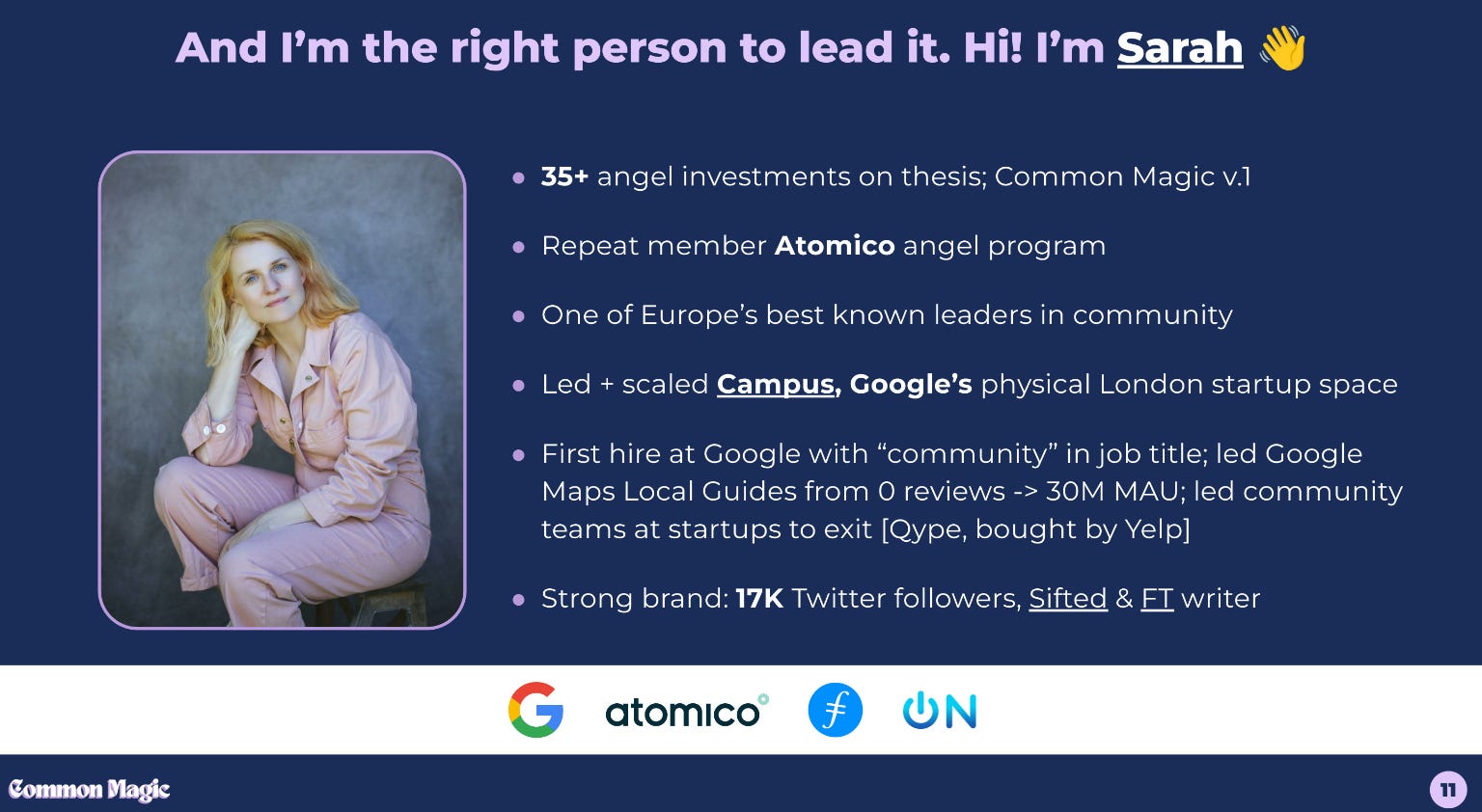
- Over 15 years of experience in community building in tech
- Formerly involved in ecosystem building for Filecoin and Gitcoin
Key Themes and Discussions
- Community as a Core Investment Focus
- Definition of community: Mechanisms that create a sense of belonging and utility around products.
- Sarah is critical of the overuse and misinterpretation of the term "community."
- Example companies that leverage community effectively include Figma, GitHub, and Unity.
- Sarah's Investment Strategy
- Common Magic aims to invest in products centered around community.
- Investment focus:
- Targeting 32-35 startups across Europe and the US, mainly in the pre-seed and seed stages.
- Investment checks ranging from €100K to €300K.
- Emphasis on operationally useful and fast decision-making processes.
- Understanding Community in Tech
- Importance of community in establishing product feedback, loyalty, and market presence.
- Community is considered a growth tactic and a mindset, providing a distribution advantage in an increasingly noisy market.
- Blockchain and Community
- Sarah believes in the potential of blockchain to create communities that are economically rewarding.
- The challenge is navigating through a space that has seen both rapid innovation and significant skepticism.
- Investing in blockchain companies requires a strong belief in the technology's ability to solve specific problems.
- Monetization Strategies
- Discussion on how companies can effectively monetize community-driven products.
- Importance of understanding customer needs and market dynamics before implementing monetization strategies.
- Challenges in Community Building
- Difficulty in building and scaling communities.
- The need for clear metrics and structure as communities grow.
- The balance between community engagement and monetization.
- AI and Community Platforms
- AI is seen as a game-changer but presents unique challenges in community building.
- Sarah mentions that many AI startups overlook the importance of understanding user needs, leading to misaligned product offerings.
- Fund Status and Future Plans
- Sarah is in the process of finalizing her fund's close and has already made 11 investments.
- Future focus on supporting existing portfolio companies and finding additional investments.
Conclusion
- The episode wraps up with insights on the importance of community in venture capital and the potential for future growth in this area. Sarah emphasizes the value of building strong connections with founders and understanding the market dynamics that can influence investment success.
Key Takeaways
- Community is more than just a buzzword; it can provide significant advantages in product development and market penetration.
- Understanding and adapting to the needs of the community is crucial for long-term sustainability.
- There are unique opportunities at the intersection of AI and community, but founders must have a clear understanding of the problems they aim to solve.
Additional Resources
- For more insights, visit [EUVC](https://eu.vc) for the full video interview and other related content.
Written by AI. May contain mistakes. Listen to the episode to check what was said.
Transcript
Automatic transcript. May contain errors.0:00All right, everyone, welcome back to another episode of the European VCB. Today, I am talking to Sarah from Common Magic. Sarah is not just an incredible solo GP. She is also one of the smartest persons in Europe when it comes to community. And she is also, for that reason most likely, one of the finalists in the newcomer category at the European VC Awards. So today, we're diving right into community and everything about community. And you get a small peek inside our thoughts at EUVC. about how we'll continue our community and our work. So that I hope you'll enjoy. But we will also like the core segment of this is, of course, how do you invest in community?
0:44Why does community matter? And why is that what most people think of as community, not necessarily the right way to think about it? So the stats on Common Magic, Sarah's Micro Fund. They are focused on products with community at their core. It's led by Sarah only because it's a solo GP. She's been an angel investor and a community operator for years, and the fund will target 32 to 35 startups across Europe and the US, but only selectively in the US. And they're doing tickets from 100K to 300K. And they're focusing, of course, on pre-seat and seat. I do hope you will enjoy this episode as much as I did.
1:22It is one of the spaces that I really care the most about. So I hope that it'll be a great fly-in episode for you as you're going to Superventure or wherever else you're going in Europe. Here's a few words from our beloved sponsor. Welcome to the European VC podcast, sponsored by Flow, proud sponsor of the Newcomer of the Year Award at the European VC Awards. Combining technology and regulatory rails, Flow is enabling the private markets. For the VC market, Flow is working with integrates every aspect of fund management, from creating investment management agreements to handling custody services and regulatory reporting.
1:58This unified platform streamlines the administrative workflow, enhancing communication with limited partners and simplifying payment processes. A standout feature is the Flow Certificate, a globally tradable instrument that boosts liquidity and facilitates secondary market transactions, reshaping fund structures with more flexibility. As Martijn, CEO of Flow, puts it, By modernizing fund structures and enhancing liquidity, we're empowering investors, VCs, and innovators to grow significantly. Yes! This will definitely turn. Tear down this wall. It's more than just an alliance. This is a union of values.
2:41United and determined we can serve as a model for other regions of the world. The nature of a problem. requires a European response. Europe is a story of new beginnings. Let's start acting. This show is not investment advice and the hosts of this episode may be invested in the funds and companies featured. Sarah, welcome to the European VC podcast once again. Thank you. Thanks for having me back. And this time around, it's not just a normal episode. We're actually bringing you on because you're nominated and have made it into the finalist group as one of the newcomers in the year that is most amazing.
3:26Yeah, I'm really pleased actually. And so maybe just because I'm going to dive right into talking about community and everything here, but maybe I would just give you the mic to say in a few seconds, few words to those that haven't listened to our past episode or don't know you already, tell us a little bit about yourself and Common Magic and how you came to be. Yeah. So Common Magic is an early stage micro fund investing in products with community at their core, mostly in Europe, occasionally in the US, built to leverage my background as a community building operator and angel investor with exactly the same focus.
4:05So now almost a year in, 11 investments down, lots of amazing LPs, sign and sealed, and this week heading to Superventure to find some more. Yes, and that's what we're all doing there. Okay, so community at its core. We just had a small pre-chat and there I said, well, David hates the word community. And then you nodded and said, so do I, so do I. What is community and why would one maybe hate it if we actually love it as well? I think the word has been bastardized, overused, corrupted, made meaningless. I guess what I mean by community is mechanisms that build modes around products and ecosystems around products.
4:48So, you know, if you look at a couple of the companies I use as examples in my deck, like Figma or GitHub or Hugging Face or Unity, These are platforms and tools that basically connected users to each other, whether they were developers, businesses, consumers. That enabled the companies to surface product feedback really early, build loyalty, build evangelism, really listen to a very particular group. That's what I've done a lot firsthand as an operator. That's what I believe in. I think we're at this weird period of time where technology is not always the advantage distribution is or the ability to speak to a very particular audience, particularly in AI.
5:25I think that's a massive thread right now that I'm seeing is that distribution advantages matter. You know, whether you're an incumbent or whether you're a new company with a very particular group you're talking to. But the word community just got layered onto lots of really bad quality companies in the last couple of years. You know, like slapping a community onto like Lidl or something. But I had to come to the conclusion that for the purposes of me communicating my funds in a really straightforward way, it's a word that's widely understood. It's occasionally misunderstood. So there's work that I have to do to kind of educate some LPs, some founders.
5:58Interestingly, founders seem to get it really fast. You know, I definitely get too many kind of consumer social companies come to me. And that's not really an area that I love. But, you know, I find whether it's kind of open source or crypto infra, there's a very strong recognition that community is part of the key ingredients to build success. You know, community is ultimately utility plus belonging. This product serves a need that I have, but it also serves an emotional need that I have. You know, me using this gives me reputation, status, bragging rights, benefits, etc. Could you maybe just elaborate a little more on what is community then, just to like make it abundantly clear, because it's going to be so centric to the rest of the conversation.
6:40Of course. Well, look, I think there's two kinds, right? I think leaving aside the startup world, communities outside of technology are these affinity tribes that we are born into or elect to be in. the geography that you live in you know I wear glasses etc that's a kind of offline non-tech community what I'm talking about are a set of tactics that live around a product that enable it to build bottom-up go-to-market so when I talk about community I talk about peer-to-peer connection or ecosystem building around a product that enables the product to build a moat so if we're thinking about github for example ultimately a platform that enables many developers and organizations to store and create and fork various kinds of code.
7:24So, you know, on GitHub, if you are a no-name developer from Bangalore, you can build incredible status through forking and building interesting versions of products, putting on great code, et cetera. That's how you build reputation status as somebody without pre-existing status. And I kind of love that. Yeah. So with community, you have network effects almost always inherently built into them or very often yeah pretty much i think network effects is a far more um transactional way of thinking about it which i don't think is incorrect it's just a bit different to what i'm talking about so um if we think that's why the reason why i say it is because we're all knowledgeable of the network effects like importance to venture.
8:09And we're used to thinking of that. And what I'm kind of seeing is that, okay, so it will typically, business model-wise, network effects will typically play out and also in scaling and go to market path and all that. But then at the same time, so, but community adds in the layer of what you leverage, kind of both tangible and intangible. Yeah, if we think about, So for example, Figma, let's take them as an example. Historically, a very long time to take to get to market, took them four years to build a product. They started selling to individual designers that they knew were kind of very forward thinking in their fields.
8:47They didn't want to be using Adobe or whatever it is at the time all day. And those designers logically would sell the product to their collaborators. You know, these were indie designers that were building status through using Figma, talking to the Figma team to increase, to improve the product roadmap, to make it kind of richer. and over time those collaborators got bigger and bigger and figma was able to sort of reverse up the stack and sell to massive enterprises so through starting with a very particular affinity group that cared about status that cared about using fresh tools that wanted to speak to each other that wanted to go to config every single year and wear black and talk about figma you know they built this natural group of massive evangelists that were able to you know if you are a less brand name designer working in a different organization you're looking at your hero who's using Figma and you're like oh I should use Figma so I think I think part of it is about um you know a set of tactics that really pull together the building lots of community for very particular fields so designers in this case you know Figma hired design advocates very early who are basically a design version of a developer advocate who would go out and and you know build very distinct communities of designers which Figma hadn't unlocked at the time as a way of building adoption evangelism loyalty scale etc so i guess um everything i'm talking about relates to network effects but it's far more about how do you truly build a product that works in service of a certain group of people and you know do those people want to be in collaboration with each other or not you know specific approach to building would you call it a go-to-market well more than that right i was thinking about that with um with fundraising something i struggled with in the early phases of fundraising is I've never really worked in pure sales roles and so the first couple of months I had a really hard time being like are you going to invest or not and then in time I was like community is all about selling but it's a lot more subtle it's a lot more persuasive it's a lot more like hey um and yeah I think it's I think ultimately everything I talk about is bottom-up go-to-market um you know I have a really strong belief that building something that works in service of a certain group of people is more commercially resilient because you're you're listening to your customer being very responsive to them you're keeping really close to them yeah yeah it makes a ton of sense the power of blockchain is of course that you have a very easy way of you know what's that called like rewarding in in economic terms or with an economic tool financial tool so are is blockchain important in your like do you look a lot at blockchain in that type of thing i invest in both um you know i used to work at protocol labs and I'm very much a long-term believer in the read-write own version of the internet.
11:25Like I believe that blockchain in distinct use cases can be an incredible unlock. You know, if we look at the need for cryptographic verification right now with AI, that's a very clear blockchain use case. I think what's interesting about blockchain at this point in time is, you know, we've had a couple of years of certain chains rising and falling. So like Solana right now, nobody would have predicted two years ago that Solana would be as big as it is now. and so I think firstly for lots of new crypto projects they're launching in that uncertainty to partner with because everything is so incredibly unstable it's very different to kind of web 2 where there are certain partners you can clearly say are likely to be like you know if you're partnering with linear in the first year you pretty much know that group of who linear influences and appeals to very hard to do the same thing in blockchain and I think the second thing is you know I think it's actually you know all of my companies that I've angel invested in that are blockchain enabled are doing quite well right now and a couple are about to raise significantly more money but i think there was so much pessimism around the entire technology last year i think people got really dazzled by the promises of ai which is an incredibly exciting paradigm shift but i actually think blockchain um and ai together are both an incredibly compelling set of technologies that applying to the right problem space can be a massive unlock but i am very you know interested in tokenization, et cetera, fractional rewards.
12:43I think lots of companies outside of crypto will take a leaf out of this book and start to think about if you have very particular early adopters, how do you reward them? How do you hold them up in the community? How do you incentivize them? How do you make them feel part of this movement beyond being a customer? Yeah, so we've invested in very early along with Isma Capital as well. And we completely believe it. But I would definitely also second what you said in terms of investor interest, investor appetite for anything blockchain these days. I have seen so many emerging managers in the blockchain fund actually fold.
13:22Yes. Because it's not working or shifting to new, like pivoting massively their fundraise strategy because they're just not seeing any reactions. Luckily, very early are doing quite well. So I'm super happy about that. If you think about it, you know, with a fund, you're a bit of a double-sided marketplace. And on the one hand, you're selling your decisions to LPs. You're persuading them that you're a great student of their capital. And you're also persuading founders, you're a great partner to them. You know, with my fund, I always wanted to do both. I always wanted to do classic technology and blockchain as well.
13:54And I think founders, you know, because what I do is so distinctive and sits across both quite well. I think some LPs, when I started raising last year, were very crypto allergic. um some were like some were like we hate crypto and other lps were like you're not crypto enough yeah and so i think you're kind of sitting in the middle which to me is really interesting like i think um i'm less interested in the technology than i am in the problem it solves and who for and how that's the important part right that's the important part which for some reason with blockchain the technology has kind of overshadowed the use case or the the need because like wouldn't it be more important that we talk about getting away from web 2 where we're all everything is owned by by by five six companies that would be nice wouldn't it why don't we keep talking about this stupid fucking algorithm instead i think what's interesting is is um you know i joined a media network in 2018 obsessed with the idea that a new internet was around the corner i think i was right but i think it was way too early and so a lot of the work i was funding in that job it it was kind of a grant-making role, was really around privacy, decentralization, data sovereignty.
15:04And, you know, I was reading a paper last night by Maggie Appleton at the local first conference in Berlin. And I've really been tracking the local first conference because all of that is around, you know, local data on local machines, the cloud being used occasionally. All of these ideas are converging. Like, you know, I think it just takes, there's always a lag between certain folks adopting ideas and the technology that enables them. And I think particularly in blockchain, you need to almost have a period of playing first. And it's a shame a lot of that playing burns a lot of LP money. And so there's, I think some funds are going to come out looking great, some funds are not.
15:39And then the space has been kind of like the terrible thing is that it at the same time attracts very bad people, which gives us or has given it a terrible rep. And then at the same time, it's both a problem of technology adoption, but it's also a problem of technology development. Because even where you have good use cases, you can say, well, it's a bit either too slow right now or it's too expensive right now to run it on a blockchain. So it has had those two at the same time fighting it. And then at the same time, we also have everyone who has power on the web right now are not too interested, right?
16:24That's kind of so I just spent two weeks in San Francisco and I must have spent, you know, is mostly there to catch up. I used to live there, mostly to catch up with very particular people. But I also met about 25 new founders. And I only met one working in blockchain, Cato Utopia Labs, who I'm already an investor in. and what was really interesting to me is he said you know they're building a really great usdc off-ramp product um called tony that is beautiful and smooth and it feels like paypal and he said you have to be pretty radical to be building in crypto now in san francisco because it's so unpopular and i love that i love that they've doubled down i love that they're focusing on who they are in the some in the same way that if you meet a founder that got into ai like last month on the one hand of course there are unique unique things that can be unlocked now that couldn't see a year ago.
17:12But you know, when you see a CV and it's like AI, crypto, SaaS, you're like, okay, maybe you don't know exactly what you care about, you kind of jump on, which is also totally fine. It's just a good data point on somebody. Yeah, yeah, you should know, you should know what you're getting, right? Okay, but let's get into community as an investment focus. And so everyone listening in, we have show notes, where we are, we're reproducing this part of Sarah's deck because I think it explains so well how community can be an investment focus as an investor. So for that reason, you know, Sarah, just take it away and talk through it.
17:49And anyone listening in, if you want to get the overview, then go in and see the deck on EU.VC. Sure. So like I said at the beginning of the call, the fund is focused on my entire background. You know, I've been building community and technology companies for the last 15 years and before that for free outside of technology. I'm like a very long-term community builder. And I started angel investing in 2019. And soon, you know, because I had quite a small checkbook, I really focused on where I could win. I have this really strong theory that great founders always pick the cap table rather than you picking them.
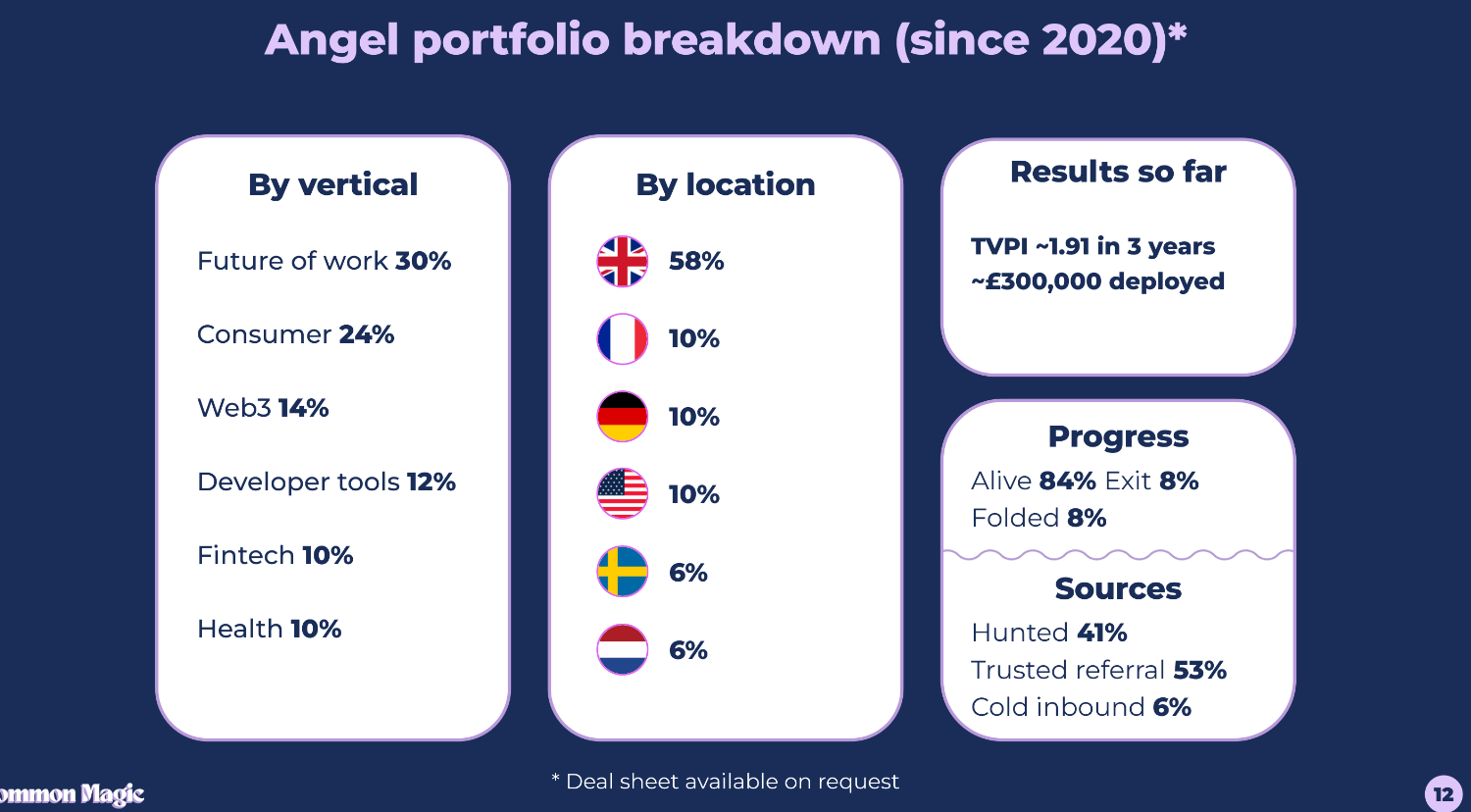
18:22And so I focused on being very value-add in terms of community strategy and narrative. You know, how do you tell the story of what you do to kind of investors, customers, new hires? and it became clear to me in the last couple of years i did 38 angel investments in three years um all but one on thesis for the fund and it just became clear to me there'll be a whole wave of new companies coming up power by community um you know if we look at europe we've got companies in gaming with like unity and supercell um you know we've got like monzo miro depot um you know there are companies in very particular like hugging face companies very particular different domains that have this one thing in common and so it just became clear to me there'll be a new wave of companies power by community.
19:02And secondly, going to the next slide, it became clear to me that at this exact moment in time, this is a group that have distribution advantages. So in the late 2000s, early 2010s, there was this very strong theory around blitz scaling and growth hacking. You know, you build a product in a room and you blitz it with ads. And I just think, you know, ads are really hard to attribute. They're expensive. They're not cutting through in the same way that they used to. And so my theory has been that in this era, you know, I'm not entirely sure that we're in a downturn anymore in the way that we were six months ago.
19:34So I might edit the deck. But I think we're still in this very noisy period. I think companies powered by community are more resilient. They keep close to their customer base, and they think about broader stakeholders early. So if I think about my companies, they are talking to their customers pretty much every single day. They are incredibly close to that group, they're able to pivot with them. They're able to be very responsive. They're able to really understand what they're selling. And, you know, you could think of community as kind of a growth tactic, but to me, it's really a mindset. And this is part of what I look for in terms of the founders that I'm working with is nearly always their technical founders building for their pay group.
20:10They're building for a problem they've experienced before. And so their first community is nearly always their friends. You know, whether it's a WhatsApp group, a GitHub, a dinner party, I'm a little bit agnostic. It just has to fit exactly what they're serving. And so part of my job is working out, okay, let's think about the market space. How do we structure and scale the community? How do we really build this into a moat? And I guess the third belief that kind of powers the funds. So first belief, the next wave of great companies will be powered by community. Second belief, in a downturn, these companies are more resilient.
20:40The third belief is that small funds can win if they have really clear operational expertise. You know, we're in this really amazing era of a whole new wave of tiny funds coming up in Europe, which I'm really excited by. And to me, the way that I think about Common Magic is having a really distinct thesis means that I'm able to access quite distinctive deal flow. You know, people know me for community. You know, it's my job to get better known. But certainly, whether it's angels, funds, people I've met before, existing founders, they're like, oh, Sarah would like this. And so it means whether outbound or inbound, you know, if I cold LinkedIn somebody, they're more likely to pick up and reply to the email if they know I have this one weird thing I do.
21:19So the fun thesis helps me access this thing to deal so, and my specialism helps companies win. And so nearly always what I get asked to do is first of all, set metrics that matter. I think that's something people underlook with community in general is if you're doing it without a sense of what the goals are, and how those goals add to your business success, you're going to lose, that's not going to work. Secondly, the lead that you hire to kind of own this work, you know, often it's owned by the CEO for a long time because normally it's a personal favorite thing for them to do. And then you have to give away your Legos and hire somebody else.
21:55So I've hired an awful lot of people in that role in my career and do that a lot of portfolio companies now. And I think thirdly, kind of thinking about the structure of the community longer term. So, you know, one of my companies had 10 ,000 downloads in December of their open source library. Last month, they had half a million. And, you know, it's a very different set of tactics that you use to, you know, from A to B. You know, you can't be speaking to half a million people a month. You have to have a really clear structure in place. And so these are the kind of three beliefs that are the backbone of the fund.
22:25Ultimately, it's a 10 million fund. In terms of geographies, 80 % of my work is in Western Europe, up to 20 % in the US, just because I used to live there. But it's very opportunistic. I only have one company out of 11 in the fund so far. and that's somebody that I met through friends that got you know we just had such an incredibly clear values fit from the first meeting such a great opportunity space the company's not announced so I can't talk about them just yet I don't think in terms of verticals to me this thesis is really kind of horizontal in the fund I have everything from developer tools to prosumer to consumer health subscription I don't tend to do high consumer or consumer social I don't tend to do ultra deep tech just because I've got a couple of deep tech companies but I'm not always the best fit for that.
23:07I think that the timing cycles are different. The funding cycles are different in terms of round and check size. I do in the fund, two thirds of my checks will be pre-seed with one third seed. I very much prefer early and I do checks of 100k to 400k depending on round size. No leading, no board seeds, very much focused on following and knowing my place on the cap table. And we could talk a ton about that, but I think we should talk community right now. I'd love to ask you, what's the litmus test for you to say this is on thesis or this is not? I mean, I think so much of it is, you know, I think there's a couple of things.
23:46As an early stage investor, I'm very founder obsessed. You know, I'm looking for people that are incredibly strong communicators that are flexible but focused. And by that, I mean, they're obsessed with the problem space, but they don't, you know, they're not obsessed with their solution. because I think that's an essential part of the puzzle of building products in the way that I like them to be built. You know, I think if you think you're a product genius, that's going to build something in secret and then release it to the world, Elon Musk style, that's probably not the kind of person that's a great fit for me.
24:13So, you know, I nearly always meet companies when there is some very early embryonic community. And I think at first round, what you're trying to work out is, you know, how great are the assumptions that this round enables them to test? That's the first thing is quality of assumptions secondly just because something has a great community doesn't mean folks are going to pay for it and ultimately I'm a venture investor I'm here to make money and so you need to understand the market size um you know most of the markets that I look at are markets in motion to paraphrase Rebecca from USD you know the idea of markets that are emergent like ultimately for my kind of investor you're you know if you're targeting very well bounded markets these are competitive spaces where the round size is the bigger and that's not really where I found like mine is best place to play and so I think a lot of what you're looking for a first round is some sense of market dynamics some sense of who will pay even if you're not planning to monetize for like another year quality of assumptions quality of team and you know do you buy the idea that community can truly be the moat for this kind of company and that very much is often something that you work out in conversation with the founder you know I don't think my thesis is not the kind of thing where the founder doesn't want to do this thing and I'm like oh you should do this thing it doesn't it doesn't really work like that um so if I think about the lowdown um so few of my fund companies are announced I have to be careful who I'm talking about I think about the lowdown which is an angel investment of mine I spent four years building review platforms um at a startup called quiet that we sold to Yelp and then on Google Maps and they are really hard to get right this was a you know Google Maps the discovery layer you're writing reviews of restaurants and coffee shops and that kind of thing um massive utility product and at google we didn't worry so much about monetization but at my last startup quite we did and so we were monetizing through selling ads against reviews i think you'll see where this model breaks down is that ultimately if you're selling a review against an ad for a restaurant and the review is terrible and when i first met alice pelton the founder of the lowdown she said i'm building a review platform for women's health and i said i really hate review platforms i really struggle with them they're hard to get right they get gamed and then she basically proved to me that she'd found a very particular sector where, you know, women want to share openly about their medical experiences.
26:24You know, the average doctor spends an afternoon in a four-year medical degree learning about contraception. Women are very varied and three hours is not enough. And so with the original platform, when I invested at Preseed, it was a very hacky WordPress site, but they basically put it out to the public and women loved it. And the reviews were coming in hand over fist and she was trying to work out how to monetize. You know, we're now a couple of rounds later, they've built on the front end, a really unique data set with millions of pieces of structured data at Women's Health. I can't say the exact amount, but really compellingly distinct data set.
26:58And the way they're monetizing is licensing data to health and pharma companies, because they want access to that data. And so I think the community powers the entire front end, because the product is free in that way. But they found a way to monetize that makes sense. and so I think a lot of what I've helped that company do is really think through kind of tone of voice how you build trust with the audience how you keep building trust while at the same time being really clear about there is a massive commercial opportunity on the back end that's in a slightly different space yeah rather different we're seeing here um path to monetizing and setting metrics I'm curious it's actually something Dave and I are thinking about on the with UBC saying, should we introduce a paid tier?
27:49Because there's so much we could do better if we were less beholden to sponsors, right? And that's what Substack basically created their whole model around. But on the one hand, we're also used to consuming content for free and getting everything for free especially as vcs you get invited to conferences for free like how do you build a community that's paid when you're up against do you want to come to lisbon for free i'll pay your i'll pay your hotel i'll pay your flight don't worry yeah i mean look i think um yeah there's a lot of tension in these models right and i think if we use sub if we continue with sub stack as the analogy you know i'm never sure whether sub stack is truly a community platform it's more of a content platform for me and that I pay for a keyword newsletter writers because I want them to be able to keep doing what they do you know you get these amazing there was this incredible example of um I can't pronounce her name Ayla um this very funny San Francisco writer who writes a lot about sex and she wrote this one newsletter and then but first penises and then it was like paid subscription underneath and I just really laughed out loud at that I think with this you have to work out what do you want to give away for free and what do you believe really lives behind closed doors because I would argue that a lot of what folks are could pay for is really access to the kind of deep private closed door conversations they can't always have you know distinct experiences I think it really is about you know there's all kinds of folks that can access and love and enjoy the free tier but there's going to be a smaller amount of folks that can pay and so you have to tier it in that way and work out okay is the free tier something you do for the broader community where you're going to have a certain amount of content but then you pay to unlock additional things you know i think let me let me um let me try something on you because what we're saying like when we looked at it we said okay so right now we have revenue of something like 350 or k or so per year then when we look at our 25K subscriber base and then said, okay, if they just pay 10 or if we just introduce a paid tier with 10 euros per month, 100 per year or whatever.
30:10Yes. It's not a lot of people that we need to put us in a substantially more free position to do stuff, right uh meaning free to free us and freedom as in being able to do things without having to you know you tend to find with every community like that there will always be 95 free riders right there will always be 95 free riders and that's engaged 1 super users and that's okay and so i think you just need to work out you know the hard thing with communities is moving platforms moving models there will inevitably be some fury and some drop-offs and that's okay and you have to work out how to effectively price because i would argue for some of the group that can pay because they're working at very big funds is 10 pounds the right amount i'm not sure maybe part of the narrative of that is like okay you know you in the same way that i get frustrated with like um certain conferences charging a flat fee for vcs and it's like anyone that knows vc knows that the new trailer fund is very different to like a massive fund.
31:15I think we need more tiered pricing there because ultimately you want to have different voices in the group. But at the same time, if you go to the paid event and it's like 10 guys. That's actually, I do it both with sponsors. And if any sponsors listen into this, they'll lead me. But I do this. I always say like I'm in service of the community. So for that reason, if there's a young aspiring firm that is trying to do something cool with AI or whatever, like I'm talking to some of them now, I'm like, don't worry, I'll bring you on the podcast for 200 euros or free or whatever. right like because because i just want to i want to see like there's some things that i want to see come out into the community and then there are others where it's like okay you're a very large bank or you're a very large corporate like let's agree that we kind of want like it's okay that i charge you a little bit more than all the small guys right maybe what maybe what you do is you get 10 people together that you know are really engaged members of the euvc community that represent the groups you want to represent and you ask them what to do you know maybe like i'm really obsessed with like citizen councils and stuff they just ask them yeah i mean ultimately you want this group to help convey to the wider audience hey this is what euvc are doing and why and i'm proud to be a member of their advisory board or something well what we'll probably do during june actually meaning this month this is the fastest turnaround we've ever had on a podcast because it's going out tomorrow yes we're on monday the day before super venture now so what What we're going to do is probably we're going to pull because on Substack, we can see who are the most engaged.
32:53So we're going to reach out to them probably just with an email and say, like, we know that you love the blah, blah, blah, blah. First, how would you react to if? And then also, what would you like more of? And if we did, blah, blah, blah. There's also the interactivity piece, right? I think I would love, you know, I read on you that is very often and I would love there to be more like big threads that came out for me in podcasts or big things that let's go deeper on. So for example, I would like more of a, like, you know, a lot of your newsletters feel like discrete pieces of content, right? This is the whole thing, but you could have it as more kind of conversational.
Read the full transcript
33:30So for example, when I listen to some podcasts, I'm like, there are obvious questions that come up for me as a listener that I'd love to discuss with other listeners. Yes, you're absolutely right. And I think this is where you also get the problem of sub stack, because as you said, is it a community or is it not, right? I think they have introduced notes, which might work for this. But we've tried to really put polls in there, like even polls, pure or not a lot of interaction, right? And then comments, like completely dead. Very few sub-stacks managed to do that well. But you're absolutely right.
34:07And this is one of the things I've thought about, which you would be able to with a paid tier, right? We'd be able to say, put out this episode with you on community, follow up like an actual paid day where we spent more time or whatever. Right. But like we'd have to have that paid tier because otherwise, you know, I love talking to you and I love doing it as a content piece. And I'm able to do it because I have a sponsor that's basically allowing me to do it. right but i wouldn't have a sponsor necessarily allowing me to bring 10 people together in a curated group in two weeks where we talk about this like just because that that's just not doable and that's where the paid tier that's one of the things we'd be able to do if we if we did a paid tier right but i also think your workshops are a great way like if you think about the maybe the podcast and the content are always free and maybe things like the workshops and some kind of ultra, you know, to me, that's an incredibly valuable thing that you do pay to access.
35:06Yeah, but that's also 100 % what we do. We will keep the podcast free, we will keep the newsletter free, but we will then have extra things that become paid. Okay, so let me, sorry, for everyone listening, and I do hope you enjoyed sharing a bit about the works behind the EVC and what we're thinking about. If you have any feelings about what we just spoke about, do let me know. I love to hear. I'd love to ask you another question, which is you mentioned it a little bit, AI. How do you see AI models working with the community side? So we've had JITPT launching their widget factory or whatever we call that widget platform, the GPT platform, which kind of has ended up super weird, very difficult to navigate, no searchability, too much clutter.
36:02So that's one take on a community platform approach inside the world of AI. But more broadly speaking, how do you see the community world work in AI? Yeah, I guess there's a couple of things. I think firstly, I feel more and more confident that distribution advantages really matter. You know, in the last year, there's been all of this kind of front-end AI development, but that's very far away from what a lot of people want to use AI for. So what's interesting to me is you have all these people on Twitter who are like, oh, I've done this and I've done this and I've done this. And then on the other hand, you have the customers that are like, actually, this is not entirely what we want.
36:41And I think the open AI example is a good version of that. These hallucinate, they're not stable. So I guess when I think about community, I think firstly about the exciting work happening in the open source AI world, where folks are training models as fast as kind of larger corporates are, which I think is exciting. I think that's the first use case of community is the thriving open source world of AI. I think secondly, distribution advantages can be held by either an incumbent who are basically rolling out, you know, who last year rolled out a lot of things really fast to their existing customers where they had existing trust.
37:18But I also believe that any new company coming up has to be speaking to like a very particular audience, has to really know that audience. If I think about tools that I use every single day, and I'm using Proplexity a lot. And I think that's not particularly a community platform, but they've just launched in a way that has so much craft and care around it. You know, it's being used by a very particular group of people who are evangelical about it. You know, in the same way that Arc Browser was a version of this about a year and a bit ago. And so when I think about AI, you know, I think AI is an incredible paradigm shift and an enabler.
37:54I'm not convinced it's purely an investing category. I'm not convinced that without distribution, any new company can win. I personally am sick of co-pilots. I've seen a thousand co-pilots. And I just think there's a massive delta between what businesses and individuals want to buy and what some founders are building. And I think that's the challenge is that, you know, you You ultimately need to build a venture-backable startup. You need to be solving for an existing problem that folks are willing to pay to solve. And I think so many companies in AI are building things that seem cool to them, that aren't grounded in that reality of problem spaces.
38:31And without that, to me, that's less exciting than problems that are really well-defined and solvable. Can you share without obviously giving away any founders because you don't want to do that? But could you say some of the things you're seeing a bit too often where you're seeing exactly that? Yeah, I mean, I think like anybody else, I've had an awful lot of co-pilot for X decks in the last year. And I actually have invested in one particular co-pilot and a pilot in a very particular space that I can't talk about yet because they're in stealth mode still. But I think you're seeing an awful lot of co-pilot decks where there is a supposition that the buyer will understand how to use this, that the buyer will want to use this, that the buyer will pay X per month.
39:19And in many cases, this is a totally new tool. You know, I think the reason why we've seen such success of legal co-pilots is that people know legal is expensive. There are certain tasks in legal that can be automated. Anyone that works for lawyers knows this. You know, lawyers themselves want to outsource certain parts of the work. So it feels logical to me that that's an area where a co-pilot for very distinct boundary tasks can work well. But I think what we're seeing is, I'm thinking particularly of, I get an awful lot of decks around AI and mental health. I am just not convinced that a chatbot that helps with your mental health.
39:52You know, like I've seen so many versions of this deck. If I saw one that felt truly unique, maybe I'd be excited by it. But I'm seeing an awful lot of very similar decks. AI for education, AI for mental health, AI for work. It's more about, so to me, it's like the use case is absolutely apparent to everyone. Like that's how I would think about it. But it's just the technical feasibility and the likelihood that the founder that you're presented with is going to be the one winning this. That's probably where I would be more scared because everyone like I see my son. He's spoken about him a bit before we started.
40:29He loves using my ITPT to talk to it about everything. uh like he'll ask it he'll he'll he'll come and ask can i can i just talk to your phone there or can i talk to chat gpt uh and then he'll go and talk to chat gpt for 30 minutes asking questions about everything right yeah just like to me it's so obvious that it's going to completely it's or at least it has to take it's technically feasible that is going to change completely how we do education, but finding the founder that will be able to both navigate it from an adoption perspective and the current entrenchment of the educational ecosystem.
41:14And then, you know, I think that is probably where I would be like, I'd be left right away if I met that guy. I think, look, I think what I like about educational ed tech is it's quite a contrarian space to be in. Like you have to be very, it's a bit like crypto. You have to be very strong when you're found to learn to ed tech. Yeah, a lot of people run away. All right. Yeah, but that's good. If you get a really strong founder in that space, you know it's kind of a good sign. I think in general, what I'm missing with a lot of these decks is kind of like unique behavioral insight. You know, to your point, all of us know the stats around how kids feel about education around the lack of personalization.
41:49But, you know, I think, I guess what I'm always looking for is like a certain depth of founder thinking. you know a certain thickness of thoughts a certain thoughtfulness of approach yeah and i think what we're seeing now is loads of folks seeing this obvious problem space going after it but i just don't think you can go after that kind of space half-heartedly i think you have to have a very strong opinion i think you have to have a very clear approach i think you have to be funded appropriately and i think to your point you know everything tends to always come back to team right and if the team is not they don't have to have done it before but you have to have conviction they can do it now.
42:24I think you're absolutely right there. Okay, so Sarah, maybe because we're up on time, we both have flights to catch. So maybe, could we just close on what's the status of the fund and what's going to happen in the next six months, nine months? Yeah. So I'm doing my final close this autumn. I'm working on the last group of LPs that will be joining. Very exciting. I have made 11 investments so far and I expect to make some more this year, number TBD. And then I think we're off to the races. I think I'm really focused in the short term on raising the rest of my fund, supporting existing portfolio founders, finding the next couple of investments.
43:08Any founders listening would love to meet you. Any LPs listening would love to meet you. That's about it. Amazing. Sorry, I cannot wait to see you at Superventure this week. And especially, of course, tomorrow and the award is going to be exciting to see if you will be the winner of the newcomer category let's see awesome cool thank you so much everyone who listened and i do hope you enjoyed this conversation if you did do make sure to go to eu.vc and subscribe here's a few words from our beloved sponsor welcome to the european vc podcast sponsored by flow proud sponsor of the newcomer of the year award at the european vc awards combining technology and regulatory rails flow is enabling the private market.
43:50For the VC market, Flow is working with integrates every aspect of fund management. From creating investment management agreements to handling custody services and regulatory reporting, this unified platform streamlines the administrative workflow, enhancing communication with limited partners and simplifying payment processes. A standout feature is the Flow Certificate, a globally tradable instrument that boosts liquidity and facilitate secondary market transactions, reshaping fund structures with more flexibility. As Martijn, CEO of Flow, puts it, by modernizing fund structures and enhancing liquidity, we're empowering investors, VCs, and innovators to grow significantly.
44:31Yes! This would have finally turned out. Tear down this wall. It's more than just an alliance. This is a union of values. values. United and determined, we can serve as a model for other regions of the world. The nature of a problem requires a European response. Europe is a story of new beginnings. New beginnings. Let's start acting.
From the publisher
Common Magic is a pre-seed/seed solo GP fund investing in and supporting founders building products with community at their core across Europe and the US. As a small fund, they act like an angel:
- fast decisions
- operationally useful
- comfortable being the first commitment
Sarah Drinkwater has been building communities in tech for over 15 years and building communities for fun for much longer. From advising protocols for Filecoin and Gitcoin on their ecosystem building to growing Campus, Google’s East London space for startups, and growing an angel investing portfolio of 36 startups, she built playbooks and networks that can help founders build powerful communities right from the start.
Go to eu.vc for our core learnings and the full video interview 👀
Chapters:
00:24 Diving into Community
00:53 Common Magic's Investment Focus
03:07 Sarah's Journey and Achievements
04:19 Understanding Community in Tech
10:58 Blockchain and Community
17:27 Community as an Investment Focus
22:19 Fund Structure and Geography
22:47 Investment Focus and Strategy
23:27 Community and Market Assumptions
27:30 Monetization Strategies
28:29 Challenges in Community Building
35:45 AI and Community Platforms
38:38 AI Investment Trends
42:29 Fund Status and Future Plans