
In short
Podcast Notes: EUVC Episode E345 - AI in the Physical World Roundtable
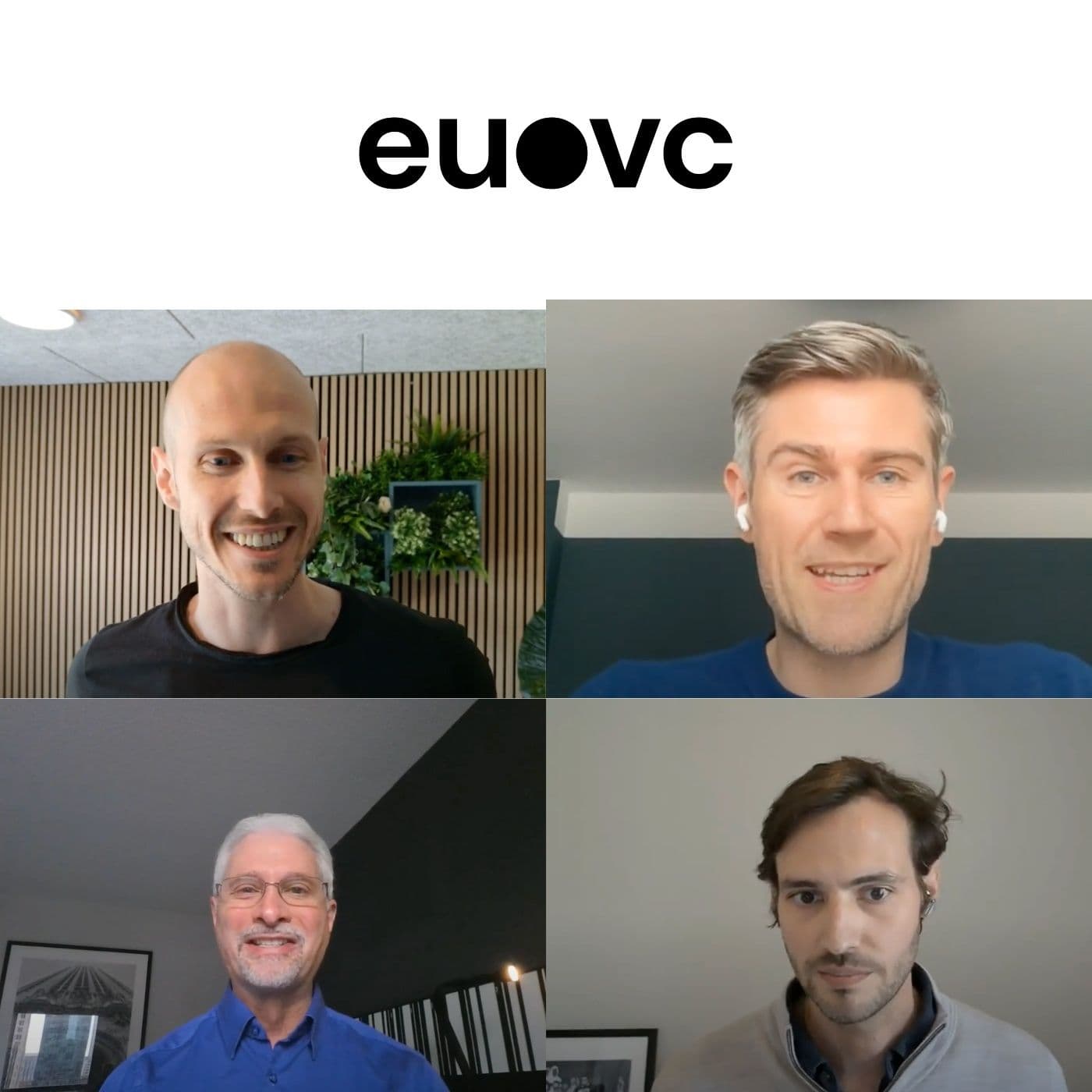
Episode Overview In this episode of the EUVC podcast, co-hosts Andreas Munk Holm and David Cruz e Silva welcome three prominent guests from the European venture capital scene to discuss the transformative impact of Artificial Intelligence (AI) in the physical world. The episode features insights from:
- Sam Cash - Founding Partner at Entropy Industrial Capital
- Eric Truebenbach - Managing Director at Teradyne Robotics Ventures
- Claude Ritter - Managing Partner at Cavalry Ventures
The discussion covers a wide range of topics, including the definition of AI in physical applications, its implications for job markets, investment trends, and the European landscape for AI and robotics.
Key Topics and Chapters
- Defining AI in the Physical World (06:23)
- Claude Ritter describes AI in the physical world as the application of AI to influence or manipulate physical environments, which can include robotics in sectors like healthcare and agriculture.
- Sam Cash expands on this by discussing the shift from virtual applications of AI to tangible impacts in real-world scenarios, such as autonomous vehicles and robotic surgeries.
- Applications and Impact of AI (08:20)
- The conversation delves into how AI is reshaping both blue-collar and white-collar job markets, with a focus on the authenticity of the impact versus hype.
- Real-world examples include applications in energy management, climate control, and advanced manufacturing.
- Challenges in AI Deployment (12:48)
- Eric Truebenbach highlights the obstacles founders face in deploying AI systems, noting technical, financial, and market-related challenges.
- Deployment hurdles include gaining customer acceptance, navigating regulatory landscapes, and addressing labor concerns.
- Transitioning to AI-Enabled Robotics (22:26)
- The discussion shifts to the evolution of robotics, particularly collaborative robots (cobots) and their integration into various industries.
- The transition is framed as a necessity driven by workforce shortages and the increasing demand for automation.
- Investor Landscape in Europe (33:27)
- The panelists examine the current state of investment in AI and robotics in Europe, identifying a lack of specialized investors and funding sources.
- Sam Cash expresses that Europe is currently underserved in terms of investment for AI innovations in the physical realm.
- Emerging Trends in AI (45:35)
- The discussion concludes with insights into future opportunities in the industry, particularly in sectors like energy, climate, supply chain, and defense.
- Sam Cash emphasizes that the impact of AI in the physical world could exceed that of digital applications, pointing to the potential for significant advancements.
- Europe’s Position in Robotics (57:26)
- The panelists reflect on Europe's strengths in robotics, noting the rich ecosystem for innovation and the importance of collaboration between startups and established companies.
- Claude Ritter mentions Germany's role in manufacturing and robotics, while Eric Truebenbach highlights London as an emerging hub for robotics innovation.
Key Takeaways
- AI’s Multifaceted Impact: AI is revolutionizing various industries by automating processes and enhancing decision-making in real-time.
- Investment Needs: There is a pressing need for more specialized investors in Europe focused on AI in physical applications.
- Collaborative Innovation: The synergy between startups and traditional companies is pivotal for harnessing AI's potential effectively.
- Future Potential: The panelists are optimistic about the next decade, anticipating significant advancements in AI and robotics, particularly in addressing labor shortages and increasing efficiency.
Conclusion The episode provides a comprehensive overview of the current landscape and future potential of AI in the physical world, underscoring the importance of investment, collaboration, and strategic innovation as key drivers for success in the European market.
For more detailed notes, discussions, and insights, listeners can refer to the show notes at [eu.vc](https://eu.vc).
Written by AI. May contain mistakes. Listen to the episode to check what was said.
Transcript
Automatic transcript. May contain errors.0:00Welcome everyone to today's roundtable conversation on AI in the physical world. I have been waiting so much for this because being an Odense boy, I have almost been brought up with robotics, at least in my professional career. So for that reason, this is something that's close to my heart. Some of you maybe also know that I'm oftentimes doing something with the Danish robotics ecosystem, Odense Robotics Organization. We're doing another event in the fall that I'm looking very much forward to bringing 30-ish DPs together to really talk robotics and the AI and the physical world. So this is a bit of a precursor for that.
0:40And I can't wait to see both Eric and Sam there. I know Claude, unfortunately, we're coinciding with their AGM. So I think we have to let Claude off this time around. But guys, let's get right into today's conversation. And first of all, I want to ask all three of you to give us an introduction to yourself. And Sam, you being the emerging manager, most emerging manager on this team, I want to ask you to be the first to go. Absolute pleasure. So maybe quick background on me. I'm from London, born and bred, engineer by training. I started my venture career back in 2015. So I joined a firm called Hedo Sophia, which is a global growth stage investor.
1:24And that really started me investing in what I invest in today, which is the intersection of software infrastructure and critical industries. So a lot in energy, climate, supply chain, manufacturing and defense. More recently, I was a partner at a firm called Project A Ventures, which is Berlin and London based. I built and led the London office. So what I observed was that post-COVID, the sales cycles for software and automation specifically decreased massively. And this was really driven by a number of macro factors, accelerated climate and energy crisis, a huge labor workforce shortage, and an increasing need to reshore a lot of advanced manufacturing and supply chains to be local.
2:13And that started the genesis of Entropy, which is my new fund. It's a solo GP fund. We do 250 to 500k checks, typically in technical founders who are building large, systemically important companies within energy, climate, supply chain, and defense. Well, I know for certain I'm the least experienced investor in this group, being as the fund has only existed for six weeks. my background is very hardcore engineering. I did a lot of different kinds of instrumentation and processor design and two internal startups as part of that. So I got a taste for doing new things in a less organized environment.
2:55And so I transferred into mergers and acquisitions at Teradyne, which is the parent company of Universal Robots and Mir in Odense, as Andreas certainly knows well. So UR was my first big project. And since that time, I've looked at other places where we could add to this portfolio of companies. But I saw so many more opportunities in adjacencies, in smaller companies that had complementary technologies or applying robotics to a new place that had never been done before. Hundreds of companies like that. And I also noticed that funding was not always available for these, especially in Europe. people had difficulty raising money.
3:42And it's not always a popular topic to apply automation in the physical world. It's not what most investors are looking for. So I persuaded my company to start this fund. And yes, we've made one investment so far, but it's only been six weeks. We write checks from 500K to about 5 million, which means that We start with series A plus follow-ons. And we're strategic investors, so it's mostly in adjacencies to our existing business and any kind of, I would say, commercial automation, business to business. And I'm particularly interested in physical AI because I've been following it for years and been frustrated that it wasn't moving faster.
4:27So that's what I'm here to talk about. Yes, and that's part of what we're going to talk about as well. And then, so just as an explainer to everyone, the reason why I said Samus, the most emerging manager is because Samus is raising a fund from external GPs, whereas Eric is investing out of Teradine. So that's why. And I think that anyone following ABC know that we have a huge affinity for the emerging managers. So we try and spotlight them as much as we can. Now, Claude, let's get to you as the more generalist investor on the docket today. Yeah. So my name is Claude. I'm one of the co-founders and managing partners at Cavalry.
5:09Cavalry is, as you said, a generalist software fund based in Berlin. We invest primarily seed. We do also do pre-seed. We don't do series days or pure pre-seed seed play. We invest in, you know, across verticals and we're not, as I said, like a sector-focused fund. My background is very much on the entrepreneurial side of things. I spent my last 20 plus years building companies, started a variety of companies that didn't go anywhere, got lucky once, had a company called Public. And then also, yeah, started Calvary with my partners together. And since then, we've done more than 60 investments and have sort of slipped into, I would say, the physical environment through some of our investments that we did.
6:02So some of our investments have been in construction, some are in manufacturing, and through that sort of our interest in building technology and obviously more and more AI in the physical world has grown a lot to the point where, you know, we have an actual thesis around it and are actively looking for opportunities. And maybe, Claude, let's stay with you for the first real big question then, which is like, let's create an overview of what is AI in the physical world? What does it entail for you? What does it not entail? Why do you think it's exciting? What makes you hesitate? And I want to start with you because you're bringing the generalist investor perspective to this, which I know we will have many in the audience that are non-specialist in this space.
6:52So for them, I think it's a good vantage point to see it from your perspective. Yeah, I mean, obviously, it really depends on sort of how broad of a definition you want to take, right? I think at the end of the day, you know, you can go very broad and say anything, you know, from robotics and broadly AI touching something like healthcare or agriculture is part of AI in the physical world. I mean, at the end of the day, for me, it's just an application of like AI to, I would say, the physical environment and a way to sort of influence or manipulate the physical environment. And so, you know, to that extent, my own definition would be very broad.
7:44but that that's obviously also i would say you know talking my own book a little bit because you know we're a journalist investor and i'm obviously interested in being able to look at as as many opportunities as possible right and so i think my my definition would be very broad it would not be you know specifically focused on you know something that that it has to include robotics for example um and and so you know i i would be in the camp of of saying that ai in the physical world is literally anything that has an influence or manipulates the physical environment by the use of AI and software.
8:20And then if we go to the opposite side of the spectrum and go to you, Sam, because you have a very clearly thought out thesis around some, let's call it more defined both industries, but also applications and technologies. So maybe you could talk about those three and where AI in the physical world sits in that? I mean, I guess to build on Claude's point, it can be a very broad definition. I think the way that I think about it is we're now seeing kind of a meta trend of AI extending beyond the virtual realm, which is where we've been concentrated to date, and really AI extending and having tangible impacts on our real world.
9:08So what does that mean? it means AI is going from a static and relatively narrow application. So this might be improving Google ads to more embodied physical systems or understanding and controlling complex systems, whether that's a car, a drone, a humanoid robot. And I think we're starting to see that impact already. If you go to San Francisco, you can ride now in a Waymo autonomous vehicle. If you are unfortunate enough to have a surgery, you can have a robotic surgery. It might be tele-controlled by someone else in some form of AI system. So we're starting to see that trend develop. I think the real long-term promise for all of this is for these embodied AI systems to have a much deeper integration into our lives.
10:00So for the robots to be more active in undertaking mundane, dangerous, or laborious tasks on behalf of humans. So whether that's an industrial setting or in a house setting or in a factory or manufacturing setting, we're starting to see that happening. In terms of how I think about the specific focus that I have, what I see is kind of quite a strong commonality between a lot of the companies that I look at. So really the view of the fund is we want to invest in companies and systems that make our industries automated, sustainable and sovereign. And whilst those are three distinct themes or end goals, they're actually very interrelated.
10:54For example, a company of mine that we invested in, which is the first investment out of the Entropy Fund, which is a company called Lambda Automata. Lambda Automata was started by a founder called Dimitrios, who's an expert roboticist at Apple, Apple SVG specifically, where he built autonomous systems. And what he does today is he effectively does civil protection, so uses computer vision that's powered by an AI backbone to do localization of threats across big domains. So this could be at sea or it could be in forests. And what we've seen so far is that has really good applications initially in forest fire detection.
11:41So forest fires, which is unfortunately an increasing problem, certainly in Southern Europe, typically done manually and typically done by people who are local. You can deploy these systems and have AI surveil large areas of landscape. It also has applications in border safety. So again, you can deploy the same system and it can protect sovereign land. So to answer your initial question, a lot of the companies that I tend to look at are using AI in these robotic systems to target one or more of those specific end goals. Yeah, very cool. And I think we'll get more into each of the verticals and kind of try and pick out technologies and some of the startups you guys have backed so that we will get a bit more into the meat of the different verticals.
12:38or different technologies. But Eric, maybe let's bring in you as the venture investor on behalf of Terodyne to give your perspective on how you read it. So my thesis on AI in general and physical AI in particular is still developing. But to me, especially where I look where I would want to make an investment, it either has to have physical input that's not visual. We've done visual a lot, right? We do visual analysis of videos and pictures and things like that, but it's other physical inputs like forces and currents and touch sensor input. That's the minimum. Ideally, it also has a physical output in that it controls some system, preferably real time, but it's not necessary.
13:31So what I tell people about my investment areas, I say it has to touch something physical somewhere. And it's not necessarily real time. So when I said I was lamenting how slow things were going before, it's because, yes, they were only doing the virtual stuff. It was analyzing still photos, text, or audio input. And it's very well established there. Speech to text is all AI based these days. All the old models didn't perform as well. But then I would look at companies that had problems that couldn't be solved any other way in robotics. This is where this really gets me excited because I feel like the introduction of collaborative robots in the first decade of this century was the next big step forward in robotics.
14:25but it needs another big step forward to really get broad applicability. It really makes a difference in manufacturing and in other commercial applications that you need to have AI to make it do the things you want it to do because programming is too complex or it requires too much expertise or too much experience that you really have to use AI-based inputs. And I mentioned that our first investment actually does this. and so I changed my tune from why is nobody doing this to why aren't more people doing this because and so this company I mentioned it's not public yet but well it'll will be at some point they do use force inputs and things and they adapt to the environment using experience on like gauging the weight of an object and doing manipulating it differently the next time So that's where I see a concrete example of this.
15:27And I'm seeing neural networks with multimodal inputs now. And it could just explode. It could go anywhere, including in the home. But my interest is outside of the home. But it could go anywhere from here. And we're right at the beginning of it. Yeah, I mean, I think to Eric's point, what we've seen is sort of this slow, historically slow, but massively accelerated over the last 18 months kind of progress within the AI field. And I think you specifically mentioned neural nets, which I think is key. And the way I see it is we've almost hit a really rich vein of progress through using neural nets and using transformer architecture, which is best known for chat GPT and sort of textual use cases.
16:21I think how that's being applied in the physical world is we now have a multitude of companies that are building multimodal models or foundational models that have various data inputs from textual to visual. And they're using that sort of rich corpus of data to be able to undertake very generalizable tasks. So before, most tasks would need to be in sort of fixed and structured environments, whether it's picking and placing something, and a lot of those rules would be hand coded. What we're seeing at the moment is the applicability of those tasks. Be, A, they're opening up a lot of use cases, but B, they're really just massively collapsing the cost of a lot of these processes themselves.
17:12And Eric, you talk about cobots. We're starting to see a lot of really cool companies within the warehouse automation space that now no longer need to operate within fixed environments. They can be put on wheels or they can work with unstructured data. So I guess it's just to sort of build on what Eric was saying. We've really just hit this pivot point over the last 18 months with a lot of this progress. A lot of the future is unknown, but unknown in an exciting way, I think. I'd love to put a question to all of you, which is the legacy robotics companies, if we can call them that. The robotics companies that were created pre and really found their model and built their technology pre this, what's seemingly from the outside a massive inflection point, where the technology developments that's happened around both LLMs, but also I'm sure many other places where there've been breakthroughs these last 18 months, as you said, Sam.
18:26where are they positioned? Because when we're looking at the impact of LLMs and AI on pure virtual or digital businesses, there's a massive impact, right? And they're all really moving as quick as they can. I'm sure Claude can attest to this, as quick as they can to adapt and find out how can we make our world work with the new AI interface and the new AI abilities? What does that look like in the robotics world and the more physical world? Because I've heard a ton about how HubSpot are changing their business, how all of the well-known players in the digital world are trying to figure out what to do.
19:18But what do we see on the physical side? Well, if you say legacy companies, if you define those as didn't use AI before, I think every company is a legacy company. Even ones that were founded a year ago aren't actively incorporating this into their product. It's their users who are just starting to. If you think of legacy as the big industrial robot companies that have been around for about 60 years, I don't see them innovating as much because where they're being applied is well-established, well-understood, a very controlled process. You don't need AI if you have a controlled process and a controlled environment.
20:07In fact, it might even be a nuisance. So you would only do it if you're starting to do new applications. It's the newer companies that are doing new applications, but they're not doing it. Their customers are. So then the question becomes, what should an automation robotics company do to make it easier for their customers? to make it simpler to implement the processing required, to get the data required for acting on it, to provide training sets for them that might help them get going, to maybe create a foundational model that will get them partway there. Everybody's thinking about this right now.
20:51A couple of companies are advertising that they're AI ready, but it's something we haven't quite figured out yet. We have a good idea, we're experimenting, but we're relying heavily on partners to find the cool applications for it. Could you try and explain to me why is it that you say that it's not the startups, it's not the companies that are creating the robots that are finding the applications, it's actually the customers. Could you try and... Who buy the robots. And that's because these robots are primarily made without a very clear purpose or application, because that's the magic of the AI, that they can actually be put into an environment that's less controlled.
21:38meaning one person will use, now I'm translating to the LLM world that we all know. One person will use JGPT to create fake meeting names so that your corporate bosses can't see that you're actually not doing any work. And others use it to write love letters to their wives. is that the same it's being used in many different applications and for that reason it's not really up to the typical model in the startup land here is not to build application centered robots is that how I should understand it? Well I should qualify what I said I'm talking about a transition period where robots have traditionally been if we just talk about robots traditionally been a component, a very complex component, but you don't buy an end effector along with your robot.
22:42You don't buy the hand, you only buy the arm. Or if we're talking about, you know, humanoids even, it's a very general purpose device that now must be given a purpose. So that's history. And it's the people who are thinking about giving it a purpose who are advancing the fastest, which is why I'm interested in investing in the space. However, the robot companies are also transitioning into being more enabling and having AI toolkits and having the GPU-type processing power inside, but also to start thinking about where should I apply this next? Is there a way to generalize the applications? Can I build something into the robot that will get you most of the way there?
23:35And now what was traditionally assembling a robot from all kinds of components and writing a pile of software now becomes more of a tuning. You know, you have a general purpose application for the robot that it's, you know, I hate to use examples because all of them are old and it's the new stuff I'm looking for. But the difference between spraying and polishing and dispensing glue isn't all that great. You have to still move in a similar way around a fixed object. And so that is generalizable. So robot companies can do stuff like that to get you, make it less work for the customer to adapt it to the application and get the most of the way there.
24:19And that's where you start having to invest in foundational models. I know several companies who are doing this specifically for robotics or specifically for logistics applications or specifically for assembly applications. So it's starting to happen. So it's a transition period, but it's not there yet. And it's more the customers that are leading the way. But the robot companies definitely want to get into this game and are working towards it. I think Eric's absolutely right. I mean, there's a lot of very smart engineers who are building very interesting technology and have been for a very long time.
24:59But at the moment, a lot of that technology is in foundational models, multimodal models, whatever you want to call them. Where that typically falls down is going from being a really good AI engineer to someone that is deploying AI within the physical world and at scale is really, really tough. That is an order of magnitude for some people harder than the initial build. And that's difficult because, you know, one, you know, very simply, you have to have a very precise sense as to what the end use case is, what specific value you're delivering to a customer, and more so how to be able to have relevant conversations to deliver a system and an end product to those relevant customers, whether that's a Teradyne or otherwise.
25:51So, you know, I think something that we see a lot of is a lot of founders who are probably a bit, you know, they're very talented, but a bit green in understanding how consequential deploying these systems within the real world actually is. Yeah, I think what Sam said is really, really, really important is that obviously building the technology, building a product was difficult, but then also actually getting it into market is also very difficult. And for some of those very technical founders, it's even more difficult than building the product. I think maybe just on the product building first.
26:30And I think Eric touched on like foundation models being built for like physical world and, you know, whatever, post estimation, tracking, and all of these things. I think, you know, the issue there is these things are also not so easy to be built. And, you know, there's a lot of stuff that needs to come together in order to build something that is actually, you know, viable in this space. So I think you already start with a rather small set of people that are building in this space. space and then you obviously need to translate that to to you know to turn it into a business right and I think so the the number of people that are actually able to you know innovate in the space and then also turn it into business I think is is very small at least from from where I sit I think one of our companies um that is doing a really good job at it is called Deltia it's you know if you think about it it's effectively a computer vision company that you know provides vision-based insights into shop floor and I think you know one thing is you know creating this technology and you know the tracking and all of that making it work on the edge but then the other thing is you know how do you actually deploy this with a customer because it's not just, you know, to show that there is a use case that it works.
28:00There's a lot of like regulatory stuff that you need to consider. There's a lot of things around sort of unions, employment law. And so there's just a variety of things that are not necessarily tied to building the product, but then actually, you know, making it, you know, packaging it and sort of deploying it so that it really fits into those organizations. And I think, you know, this is definitely something that we've seen over and over again. We've seen excellent teams from the robotics space, from the computer vision space that are, you know, doing something in manufacturing, in logistics or intra-logistics for manufacturing and all of these sort of fields that struggle a lot with actually getting this deployed into actual companies at scale beyond POCs, because everyone is interested.
28:52Everyone is willing to spend 20, 30 grand on trying something, but then actually deploying something across multiple production lines, across factories is a whole different ballgame. So I'll definitely second what Sam said, that this is definitely something that one must consider. Eric, I'd love to ask you because being with Terodyne for years, if anyone has seen how products are well deployed and how new innovations are well developed, also keeping in mind your experience with UR and taking both UR and Mir from their relative small size to where they are today, You have seen, if anyone, this trajectory, this journey for this type of founder.
29:42I'd be curious if you could share a bit about the challenges that founders in this space meets and how an investor like yourself can really add value to that part of their journey. Yeah, there are a number of obstacles to founders and some of them are financial and some of them are market and some of them are technical.
30:04so the ones that I've dealt with so far they have a good idea of the technical problem that needs to be solved but they don't have a lot of exposure to the customers and it was eye-opening for me we acquired a company called Enerjid in about I think 2017 and I transferred to help integrate them into the larger company. And as such, I took on a lot of different roles, including salesperson and applications manager and product manager and even UI designer to some extent. And it was revelatory to me, an ivory tower engineer going out into the field and seeing the real problems and the skill level of your customer and the ecosystem that seems to make it actively difficult to deploy robots.
30:58So it really changed how I saw the world. And it really changed how I thought about how founders have to go through this, where they have to learn from their first deployments. And if they have a partner who's done this before, or an investor who has connections to partners who have done it before, it can save so much time and save you so many mistakes. And that's particularly true for AI because the AI companies I've seen, you know, this is my third AI hype cycle. I saw AI hype in the 1980s when it was all heuristics. So seeing it, but this one's real, honest. It's the people who know AI do not know.
31:51It sounds bad, but they don't know as much about the real world. And there are a lot of AI companies that were founded in the last five years that were essentially smart people looking for an application. and so they would wait and just take in proposals and say, well, I think we could do that. And it was really hard to succeed because they didn't really understand what it was necessary to do the thing. So that's probably the biggest one. And I also think as a strategic investor, that's where we can be the biggest help because we know the integrators, we know the distributors, we know many customers, we know the different kinds of customers selling something to Mercedes is very different from selling it to Bob's Machine Shop in Kent.
32:39So that's probably the biggest thing. And then I mentioned before, financials is one reason I'm in on this. So it's an age-old problem, but it's particularly severe with AI and physical AI. because you're starting so far apart. And I think it's, the more we can bridge that gap, the faster this will go. And that's one thing I aim to do. Let me ask you, Sam, how do you see the troubles that Eric are describing here being currently solved? If we don't look at the financial part, because we're going to talk about that in a second, but from the value app perspective and the investors that are in this space today do you see that founders are generally well served or that we are definitely missing more actors like yourself and Eric in this space and what would you say to a generalist like Claude?
Read the full transcript
33:47So I mean if the question is do I think there are enough investors in Europe who are willing to invest in these types of companies. I don't. I think the market currently is massively underserved. I think kind of zooming out and thinking about this trend, you know, the thesis that I have and the view that I have is that technology's impact on the physical world is going to be an order of magnitude larger than that of the virtual world. Sorry, let me say that again. My specific thesis is that AI's impact on the physical world is going to be an order of magnitude larger than that of the virtual world.
34:34If you believe that and you believe that this current trend of AI is real, then what I'm seeing kind of on the ground in terms of people who are willing to deploy capital really early on in companies that are in robotics or using AI for some kind of physical world processes, there is a dearth of coverage for sure. And I think that to some extent is being because, one, a lot of generalist firms in Europe have done very well from things which are not robotics. Number one, whether that's SaaS or fintech or otherwise. And two, I think we're only just starting to see some of these big, big success stories in Europe.
35:23You know, whether it's Wave, who just announced a billion dollar funding today, whether it's Exotech, whether it's Autostore. So we're only just getting to this inflection point where I think we're having, A, enough case studies that people can get comfortable that this is a market worth investing in. be enough talent coming from the deep mines and waves of this world to build some of these companies from day zero. And I think the remaining C is having a depth of institutional investor at all stages pre-C to IPO that are willing to underwrite some of this risk and really understand what it takes to build these companies.
36:07I think that is changing. The narrative historically for these companies in Europe has been sort of okay to neutral. I think we're at this point now where people are really starting to pay more attention to some of these companies and some of these founders. So I think generally in Europe, it's undercover, but I'm hopeful that over the next five to 10 years, there's going to be far more people willing to back these types of companies. Claude, I'd love to ask you as a generalist investor who have made some bets in this space, but I'm sure you've also seen more deals in this space that you're like, I think there's something there, but it can't get comfortable.
36:51Whereas if it had been a pure digital play or something that you've done a bit more of, you would have maybe been willing to make the bet. meaning and that's of course that's the critique that we're giving when we're saying that there's there's missing investors willing to put their bets here it means that basically we're saying that the investors it's you know the problem of funding is with the investors it's not with the startups because if there's lack of quality and lack of viable business models and so on so forth then then it's it's not a matter of of the investor side but when we say that there's missing capital, it's because the investors are not comfortable making the bets.
37:33I would, I would, I would, I mean, I, I tend to agree. I think there's obviously reasons for that. I mean, if you look at a business that, that let's say produces some sort of physical device or a robot, you know, and then you talk to a generalist investor that, that typically or historically has only been doing software like that person, you know, probably doesn't have a business MBA and has no idea how the P &L of a hardware company like 10 years down the road looks like you know what I mean and so it's very difficult to sort of underwrite something like this because you have no intuitive feeling you know not from academia not from sort of doing it for years for how these companies you know scale what to look out for and so on so I think that definitely makes it more tricky to sort of look at opportunities that involve, you know, hardware.
38:28You know, I think for me, though, personally, that's not sort of the biggest issue I have. I think for me, I'm, you know, I'm happy to sort of engage with anything that I find interesting. And I'm happy to sort of, you know, spend days trying to sort of get up to speed with with something that I'm not an expert in. But for me, and that's more broader AI thing, I find it increasingly difficult to sort of, you know, really figure out what is something that might be something that lasts and what is something that, you know, might just be gone in a year or two from now. And that sort of transcends the digital software world to the hardware world, where there I even obviously have even less sort of intuition, but it's pretty much the same thing sort of across, you know, across hardware and on software.
39:30I want to add something to what Sam said. And I think this is really something that I've been thinking about a lot. I'm not sort of done thinking about it, but I think I'm kind of getting the hang of it for myself, which is, you know, if you look at some sense, sort of the impact on the physical world will be order of magnitude higher than the sort of non-physical world, digital world. I'm not sure if I fully agree with this, but if you like broadly just think about sort of the world's GDP, you have sort of, I think, don't quote me on the numbers perfectly, I think you have like 60 % in like white color services type work.
40:11And then you have like 40 % in sort of, you know, blue color, non-services, more manufacturing, logistics type work. And I think for both of these sort of buckets, we're far from sort of reaching any point of saturation with regard to sort of AI being deployed at scale, right? Like we tend, we technologists tend to think it's over. Or like, you know, I can tell your average German company has not heard of it, right? But when we think it's over, your average German company has not even heard of it. So I think, you know, there's a long way to go in both. But I do think that because of a lot of the, you know, technological innovations that both Eric and Sam have been mentioning at speed, like you can feel it, that the speed of iteration is sort of increasing.
40:57I think we will see a lot of sort of, yeah, innovation in this sort of 40 % blue collar work bucket. And that will, I think, have, in terms of impact, to come back to what Sam said, you'll have a massive impact because it will be an impact that we feel in our daily lives. And so it's not just like a monetary impact. It's also a visceral impact in terms of it really being visible in our daily lives. I think Eric also said he's not into home robotics stuff, but imagine you see home robots, you see those things appear and all of that. I think that will be part of this order of magnitude higher impact that I would say is included in what Sam mentioned.
41:49I mean, I think BMW said they want to have humanoid robots in the US in 25, right? So, and I think that's not too far away. So I think, you know, you will start to see that portion of the impact pretty soon. What Claude and Sam both said, I think, is something that is one of my great fears. AI is changing so quickly that any investment I make now will probably be obsolete by the time they get to market. And if it's a physical application, that's what takes a while. You might have the model all done, and then you have to make a product out of it and make the product work. And so there's always going to be a lag between AI, not always, but for the foreseeable future, there will be a lag between AI development and AI deployment.
42:36And it's going to be a difficult dance for as an investor to find the right places to go. How do you, Eric, because you're helping on it, right? You've made the commitment. So how do you kind of then make that jump? What's the litmus test that you used to say? Because I think many are thinking exactly what Claude said. Will this be sustainable or will it be like two years down the line? We're on to the next thing. If I had the answer, I wouldn't be afraid, right? I said I was afraid of this. And I don't have the answer. All I can say is what I'm looking at now is companies that are using AI as a key part of a product, but it is not the product.
43:23Because I think that could fall down fairly quickly. um yeah in fact there's one company that i've been following for years that it was the product and i'm just seeing them slipping to be honest so um if you have it as part of the product you can incrementally improve it without having to redo everything else i broadly agree um i think we consistently see in technology these hype cycles if anything the hype cycle seems to get more pronounced and of higher volatility as time goes by. And I think whilst we're obviously in a period of massive excitement around AI, I think most people are of the view that it is a paradigm shift in terms of a lot of the various applications that can come from it.
44:17Now, whether we will be excited about AI in its current instantiation in two years' time or three years' time or 10 years' time, I don't really know. I think what we've seen historically, if you look at some of the big sort of meta trends that we have in technology, so from the PC era to the client server era to mobile, cloud, SaaS, maybe AI is kind of the next transformational wave. And the thing I'd say is looking at those trends, whilst on any given year, people probably had varying levels of excitement from those, what you tend to see is the ability to invest for really prolonged periods into those trends.
45:05So 5, 10, 15-year periods. I mean, people are still investing in mobile and cloud and with a great degree of success today. So, you know, whether we'll be doing this podcast in two years time and talking about the same things, I don't really know. But I have absolute certainty and clarity that there's going to be fundamentally a lot of incredibly interesting investments and technologies being built over the next five to 10 years. Yeah, and I think that that's the perfect pivot to the next question I wanted to ask you guys, which is where are the largest opportunities you're seeing right now? What are the spaces where you are seeing like, wow, here it's really, really just like we're at the right point of the inflection curve right now.
45:56and we're actively looking for the next thing to invest in this. And maybe, Sam, I think I want to start with you, actually, because you have a very developed thesis on three larger areas. So I think that you're also one of the more thesis-driven investors here. I think fundamentally, if you take this meta trend, which is AI in the physical world, and you look at the sub-segments below that where there have been big, large-scale macro shifts, I think there's probably a few. There's one, a lot in energy and climate. There's two, a lot in supply chain and manufacturing. And increasingly in Europe, especially, a lot in defense.
46:47And to try and tackle those individually, where we've seen AI tackling problems of significance in energy and climate. For example, DeepMind's GraphCast model, which came out relatively recently, this is an AI model which massively improves our ability to predict weather or chaotic and relatively random scenarios. Why that's important is it just means that we have a much better understanding of climate. Climate today has been sort of a really hard to understand complex system. So we're seeing applications that are similar to that. We're also seeing a lot in materials discovery, whether it's on the chemical side.
47:34There was a big open source dump of sorbents that Meta came out with, which are sort of the key ingredient needed for direct air capture. So there's a lot in these types of fields where AI is basically increasing our ability to search and discover really complex things within the physical world and otherwise. I think looking in supply chain and manufacturing, to Eric's earlier point, I think there's a lot of interest in humanoids. That's maybe an area that is potentially overhyped. But a lot of new companies that are applying foundational models to really difficult problems within supply chain, within manufacturing, within warehouse logistics.
48:27And I think whilst a lot of those businesses are not net new. They are a massive increase and improvement on a lot of the historical state of the art. And then maybe lastly, in terms of defense, this is one that I guess is typically a bit more sensitive for people. But the reality of a lot of what is happening in Europe is a lot of countries and sovereign states need to become more technologically savvy and need to requiring new technologies within the realm of defense. And there we're seeing a lot. We've seen the market shift from effectively defense forces and departments of defense having what they describe as mass, which is these big, large systems, tanks, aircraft carriers, to actually what we've seen in Ukraine and in other places, which is kind of this new era of asymmetric defense, which are typically people using drones or unmanned subs.
49:36And there, there's a lot of AI being applied where they're making a lot of these robotic systems, whether it's a flying drone or a boat, specifically unmanned and autonomous. So there's lots of interesting things happening. I think in terms of how I think about it, I tend to get led by where the most compelling and most qualified technical founders are building. But really, there's lots of new interesting spaces in Europe and in the US that are worthy of attention. I am personally very much looking forward to the first defense fund investment from our side. I think this is a space where an emerging manager is incredibly well positioned, given that we have many legacy funds or large funds, established funds.
50:28I'm using the word legacy today, sir, for that's all the ones that feel offended by. We have many of the established funds that just do not have it in their mandate, which means that for probably a two to three year period, we will have some emerging managers that are the only ones that can really capture these amazing opportunities. Eric, let's go to you and ask you the same question that Sam just replied to, which is, where are you most excited about the recent developments? Well, what I'm most excited about and what's the most likely, maybe two different things. It's always been a question of training data.
51:06And so one of my annoyances about AI in the past has been there's been way too much research that was based around the availability of something like ImageNet. So I feel like that was limiting AI development because in academia, at least, they couldn't afford to create a new training set. Now the foundational models are starting to train on not the exact training data, but something close to it. And they figure they can tune it from there. So, where I think it's likely to see the next things are where large training sets are available or can be easily generated from the existing process. You instrument up an existing process and then see if you can improve it or extend it or do something new with it from there.
51:56And in academia, there are some, but they're generally simulator generated and that's still not good enough for the physical world most of the time. So I'm going to leave it vague around the training sets because I'm still looking into where those might be. I have some ideas, but I'm not sure I want to disclose them right now. What I'm most excited about is trying to bring collaborative robots to the next level. They were easier to use. They were safer. They were a bit more accessible to the common, the first-time user. but it's still too hard. There's an ecosystem that seems to actively get in the way of making it easy because of tradition of experts selling to experts in robotics.
52:46And there's just a lot of details that are really hard for a beginner to understand. And it's that place where I really like to see the application. And there may be training sets available on that where you can say, look, here we go. I need to do this. Is there anything that's been like that before? Can I use text input and say, design me something like that? And they're looking at the result and say, well, could you make the footprint a little smaller? I mean, you can do that in chat GPT now. It just doesn't have a physical output, but it's certainly possible. You could start developing that today.
53:25So, and then generating training sets. There are companies out there today that will follow a human around and determine whether they're doing something that's ergonomically correct. And I'm talking, this is AI based, where it's all video input and they track humans and they either verify that they're doing the right motions or that they aren't making any harmful motions or that they're being efficient with time and space. I'd love to take that training data and then take it and say, can a robot do that too? And the answer could be, yes, it could. Or only if you did this, or it'd be 10 % slower or 100 % faster.
54:09That's starting to come. And it's starting to come from an ancillary application of watching humans. But now you can start trying to generate automation around that. That would really excite me, but I don't see it happening just yet. But I see the pieces falling into place. Eric, what you just said is literally what my notes say. Like, I have a line that says, so the first thing you said, what is likely or what you see, it says for me, synthetic data and simulation for physical spaces. So it's really, and then the second thing you say, I briefly mentioned one of our companies called Deltia, the vision-based system for sort of shop floor insights, right?
54:50And so if you think about it, obviously today you watch someone manually assemble whatever, a vacuum cleaner, right? And you can, from that, you can derive things with regard to efficiency, quality, but then obviously also by watching humans, You obviously, you know, collect data around sort of how, you know, things should be done. And eventually, you, at least that is the idea, you can think about sort of moving into something like collaborative robots and eventually automation. And so this is definitely something that, you know, we are, me personally, I'm very excited about. I've just seen a few companies that have tried to sort of skip two steps and just, you know, ended up in a place where it wouldn't work or customers wouldn't accept it.
55:47Right. And so I think an approach where you start with something that is a bit less invasive, that delivers sort of value immediately. and then sort of you transition from there and build up your capabilities along the way while you sort of learn more and are able to train your own models, I think is something that I'm very excited about. And we have two or three companies in our portfolio that are sort of on a similar trajectory in sort of different areas. And I think that is something that I like a lot because obviously as an investor, if we invest today, you know, you have to think about the next 18 months or 24 months, like, you know, how can you show something as such that, you know, someone else will invest in 18 or 24 months from now, right?
56:36And so the most beautiful, and I think it goes to Eric's, you know, finance, like finance point is like the most beautiful vision of the future 10 years down the road will not help you in most cases, unless you're the most amazing salesman, you know, it will not help you sort of to get there right you have to sort of show something along the way you have to show value you have to build distribution land with customers learn and then sort of move from there and i think that approach that this particular company that i mentioned delta is taking is something that i find really exciting you know whether they end up in a situation where you know they will sort of reach this end goal of being able to sort of help customers automate is TBD.
57:21But I think that is an approach that I'm really excited about. And now to take us out of this, I just want to end on a cheery note of asking you, where do you think that Europe is well positioned and why? I guess sort of a bit of a narrative violation is I think London is actually really well placed to be a new and exciting robotics hub. so it's timely that today is the day that wave which is an end-to-end autonomous vehicle company announced their billion dollar raise but i think if you look at a company like wave there's also deep mine who put out rt1 which is a almost seminal research um paper about 12 months ago that really changed a lot of what's happening in robotics.
58:16Both of those companies are based in London. And I think what we're starting to see at the moment is a lot of robotics, regardless of the use case, a lot of robotics has moved from a lot of the innovation being predominantly mechanical to a lot of the innovation now being around vision systems and AI more broadly. And we're starting to see in London in particular, a lot of that talent leave some of those larger scale companies and start new companies. So if I was to have one prediction for the next 10 years, and maybe this is a bit hopeful given I'm from London, is I think we will start to see a lot of that really high quality, qualified talent starting new companies.
59:03And London will start to emerge as a bit of a hug for a lot of European robots. exciting Eric you come from the States so you've looked at all across Europe and decided that Odense my hometown is the best place well that's putting the cart before the horse I actually used to live in Europe so I'm not entirely an ignorant American in the Netherlands yes so I'm still forming my thesis and I'm still asking people about the investing climate in Europe. And I think the answer may be different in different countries. I certainly have heard, as Sam said, that the climate in the UK is much more similar to the US.
59:50So I expect more than half of my investments to actually be in Europe based upon all the startups I've met along the way the past 10 years. I think there's a strong focus on industrial applications. There's government funding that actually is trying to support manufacturing and commercial applications. Whereas in the U.S., if you want government funding, it either has to be educational or help the elderly. It has to be some sort of something that tugs at your heart, I guess. So I like the practicality. The heart of voters. So I like the practicality in Europe, and I like the focus on commercial applications.
1:00:32On the other hand, I'm not seeing a good geographic center. Sam thinks it's London or will be London. I haven't really found it. Maybe Berlin. I just, I'm not sure. And that makes things difficult. It makes it much harder to find things. And then just the funding environment, right? In the US, you could say, hey, I'm going to build a humanoid and people will line up to hand you money. And I'm a little arrogant about this because I think I understand the technology a bit better than the average investor and that I can make better investments. But the amount of funding available in Silicon Valley is just mind boggling.
1:01:13And it's a much harder road to go down in Europe, but I would like to try to make a difference there. Eric and Sam are both much more well-versed in the intricacies of the robot landscape and have more well-formed pieces around this. For me, the way I look at it is pretty macro, to be honest. I think in Europe, we have to do something. So it's a necessity that stuff will happen in this space. it's a bit like betting against the energy transition. Like you probably shouldn't do that. And so we're sort of AI in the physical space, robotics. It feels a bit the same to me in a way where we have demographic change.
1:02:06People are aging out of the workforce. We have sort of pressure on Europe's sovereignty and all of these sort of macro factors, I think, will lead to an environment that has to be innovative. And I think, particularly in Germany, if you look at the structure of the country, it's a bit different than other countries where there's not this one single city like London and the UK where everything gravitates towards. You have Munich, you have Berlin, you have brilliant universities in Darmstadt and so on where a lot of interesting stuff is happening. And then also you have these Mittelstand manufacturing companies spread across mostly southern Germany, to be fair.
1:02:55So I think generally the ecosystem and the experience and heritage, if you want, in the built world is here. And so there's a lot to be done. There's customers that will feel the pressure to move. And I think I'm with Eric on that one. You have to sort of work with the customers to really sort of get these things deployed. And I think here we're in a really good position to do so. The financing thing is obviously without an issue. I think a few weeks ago, I sort of looked at, I think, the combined market cap of the top three or five European stock exchanges. And it was like half of NASDAQ. So I think, you know, so I think just like from a high level, right, there's clearly a bit of a financing issue.
1:03:41But I think a lot of American capital, obviously part of Eric's capital, will be moving to Europe as well. So I think that the capital issue will be solved to a certain degree, at least enough that will allow us to sort of build interesting companies. Right. And then so I think this sort of combination really gets me excited. obviously lots of issues and so on and so forth, but I think it's a super exciting opportunity, particularly in a place like Germany where you have so much manufacturing. Amazing gentlemen. I am so thankful that you joined me for this session because you scratched an itch for me that I've had for a while to talk about this topic with some of the leading investors that we have in this space.
1:04:27So thanks so much for joining. I really hope that you will be joining us in Odense, Eric and Sam, Claude, I'll think of you when we're there. To everyone tuning in today, thank you so much. If you enjoyed this episode of the European BC podcast, do make sure to go in on eu.bc and subscribe, where you'll also be able to find the show notes of this conversation, which will hopefully enlighten you much further. Thank you.
1:05:19instead of competing. Where the ecosystem is capable of commercializing startups and new technologies. Where you will find an international test center for drones. And where the university is so good it won the unofficial world championship in robotics. That place is the Danish city of Wurmser.
1:05:49It all started at a Williams-Steele shipyard, brought to life by A.P. Muller, the founder of Maersk. Academia and highly educated people were not dominant. It was a production city. To be able to compete with low-cost shipyards, they had to rethink their manufacturing process. So the owner of the shipyard decided to donate some money to the local university to stimulate more robot research. It was so successful that actual working robots for shipyard welding were produced. Despite their many efforts, the steel shipyard had to close. They were not competitive because of the high wages and the technology at that time was not ready yet.
1:06:29Shipyard was not the only one that was closing at that time. There was really a point where there was a lot of the last companies that was closing. So there was some kind of bad years. It was a major blow for the city. I'm happy to say that there were quite a number of people who were visionary. So there was a new hope. A new team of innovative people had some great ideas. Maybe you've heard of something called Universal Robots. We wanted to make a robot that's more like a tool that helps people do their work, more than this big machine behind the fence that deals with people's jobs. The team created what today is known as collaborative robots or cobots.
1:07:09In 2015, everything changed. Universal Robots was acquired for$285 million. It actually opened the eyes for the world at large. Everybody would stop talking about the future is collaborative robots. Prior to UR, there was a lot of talk about all the things that never worked in Odense. And now people, they talk about all the things that are possible. So everybody suddenly realized there's something special going on in Odense. And this was only the beginning because it wasn't just universal robots. There's a whole string of equally great companies in the making. Companies that are also growing at phenomenal rates of more than 50 % a year.
1:07:50Ranging from startups to large corporations, Woonz and Our Houses dozens of robotics companies and a total of several thousand employees. I have not seen any denser cluster of robot technology anywhere else. We have the university with the world-class research. We have Technological Institute, which brings technology out to the industries. And then we have the local government, who is all for robotics and all for robots. People see each other as colleagues more than competitors. Companies are building their own business on other companies also. And they need each other, so they exchange information, they even exchange people.
1:08:26We have some extremely exciting jobs here that you cannot find in other cities. The limiting factor on high-tech industries is usually talent. And talent is attracted by talent. And the critical mass of talent is in Odense. There's a huge interest in investing in Odense now. And it's been a lot easier for the startups to raise funding. When you come out and say that you are part of the Odense robot cluster, you get an ear with the customers. But Odense needs more. It needs you. We are already one of the leading cities in the world, but I think that Odense as a robotic city can grow even further.
1:09:08It's probably one of the best places in the world to start building robot businesses, and that's why Odense has become, let's say, a rising star in the robot scene in the world. If you are able to succeed in robotics, then it's here.
1:09:54Thank you. Europe is a story of new beginnings. New beginnings. Let's start acting.
From the publisher
This is why we have brought together Europe’s top tech minds for a roundtable discussion that will provide an inside look at the most significant trends and investment strategies, helping you stay ahead of the curve.
Our guests:
- Sam Cash, Founding Partner, Entropy Industrial Capital
- Eric Truebenbach, Managing Director, Teradyne Robotics Ventures
- Claude Ritter, Managing Partner, Cavalry Ventures
Additionally, the event will discuss the European investment landscape for AI, weighing the strengths, opportunities, and challenges unique to this region, offering a clear picture of where the continent stands in the global AI race.
Chapters:
- 06:23 Defining AI in the Physical World
- 08:20 Applications and Impact of AI in the Physical World
- 12:48 Challenges in AI Deployment
- 22:26 Transitioning to AI-Enabled Robotics
- 29:13 Overcoming Obstacles in AI and Robotics
- 33:27 Investor Landscape in Europe
- 34:08 AI's Impact on the Physical World
- 36:34 Challenges for Generalist Investors
- 38:55 The Future of AI and Robotics
- 43:13 Investment Strategies and Risks
- 45:35 Emerging Trends in AI
- 57:26 Europe's Position in Robotics
- 01:04:13 Closing Thoughts and Future Outlook


