
In short
EUVC Podcast Episode Summary: E369 - Investing in Culture and Creative Tech
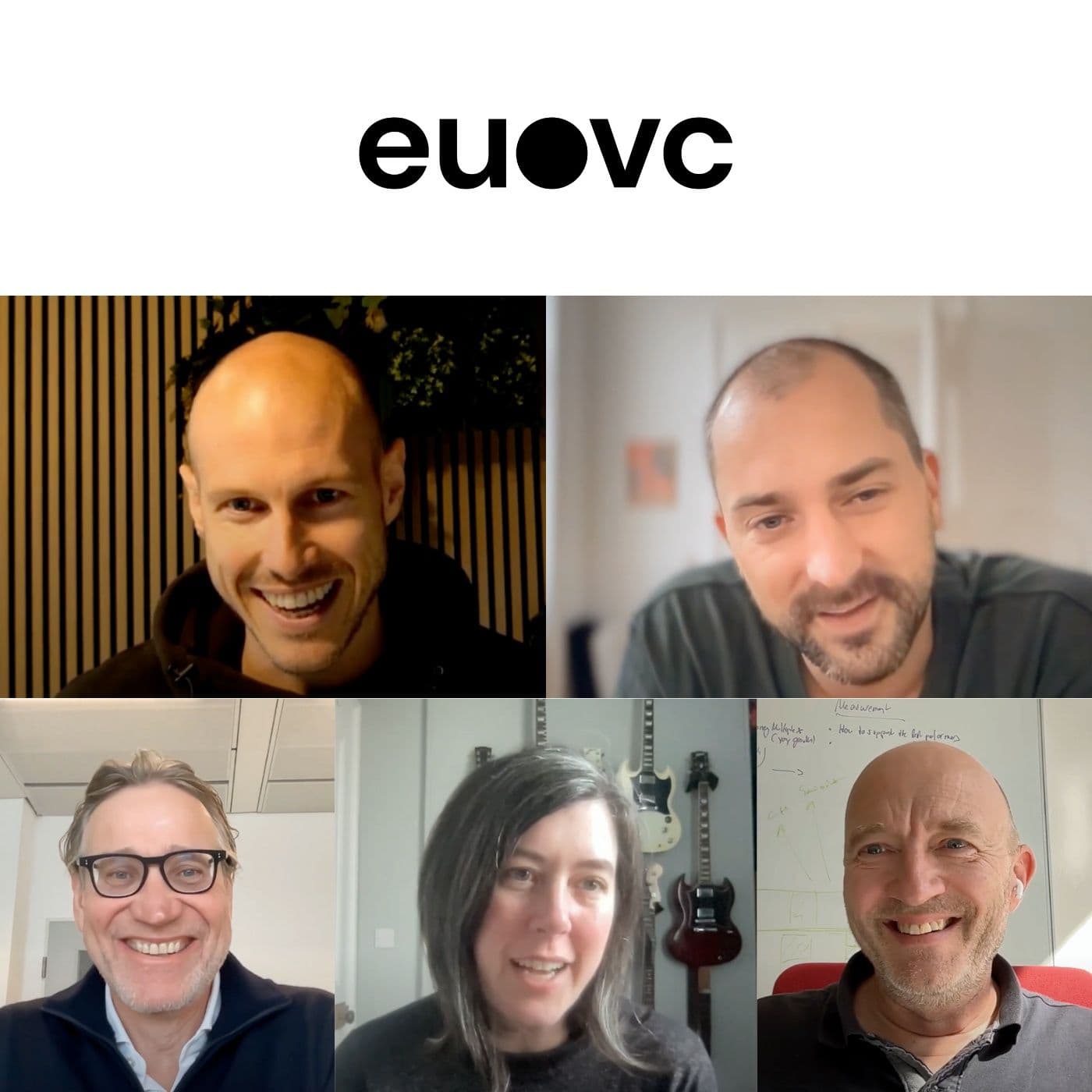
Episode Overview In this episode of the EUVC podcast, co-hosted by Andreas Munk Holm and David Cruz e Silva, a distinguished panel discusses the intersection of investment in culture and creative technologies, particularly focusing on AI's impact on the music industry. Panelists include Oliver Holle (Speedinvest), Severin Zugmeyer (New Renaissance Ventures), Uli Schmitz (Axel Springer Digital Ventures), and Hazel Savage (SoundCloud).
Key Themes
- Investment Opportunities in Creative Industries: A discussion on the potential and challenges of investing in culture and creative tech.
- Role of AI in Music: Insights on how AI is transforming the music industry, including legal challenges.
- European Competitiveness: Exploration of Europe's position in the creative industries, particularly relative to the U.S.
Chapter Breakdown
- Meet the Panelists (00:20)
- Introduction of panelists and their backgrounds.
- Defining the Creative and Cultural Industries (03:49)
- Discussion on the broad category of creative industries and what constitutes it, including tech companies like Twitter, Canva, and social media platforms.
- Investment Opportunities in Creative Industries (04:24)
- Severin argues that creative industries are overlooked in venture capital, citing that 8-10% of major VC portfolios consist of companies in this sector.
- Challenges and Opportunities in Creative Tech (05:56)
- Challenges in scaling and investment, particularly in B2C sectors.
- AI's Role in the Music Industry (14:26)
- Exploration of AI's transformative impact on music creation and distribution.
- Legal Challenges in Generative AI (16:46)
- Legal complexities surrounding the use of generative AI in music and how they may affect the industry.
- European Competitiveness in Creative Industries (21:02)
- Discussion on the strengths and weaknesses of Europe in the creative tech landscape compared to the U.S.
- Success Stories and Market Dynamics (24:08)
- Highlighting successful investments in creative tech and the dynamics of the market.
- Challenges in Consumer Investments (29:02)
- Discussion on the difficulties of investment in consumer-focused creative tech companies.
- Founder Profiles in Creative Industries (30:40)
- Insights into the characteristics of successful founders in creative tech.
- Understanding User Behavior (32:27)
- The importance of deep understanding of user behavior in developing successful products.
- Generative AI in Music (35:35)
- Insights into how generative AI is being utilized in music production.
- Emerging Technologies: Metaverse and Beyond (38:03)
- Discussion on the potential of the Metaverse and AR/VR technologies in the creative space.
- The Future of AR and VR (46:27)
- Speculation on the future developments and applications of AR and VR technologies.
- Success Stories and Final Thoughts (49:04)
- Closing thoughts and reflections on the future of investment in creative and cultural tech.
Key Takeaways
- Opportunity in Overlooked Sectors: The creative industries present substantial opportunities for venture capital, with many successful startups emerging in this space.
- AI's Disruption: AI is not just a tool but a transformative force in music creation, with both potential and challenges, particularly regarding legal frameworks.
- European Landscape: While Europe boasts incredible creative talent, it often lags in funding compared to the U.S., highlighting a need for more focus on consumer investments.
- Importance of Founders: Successful founders in creative industries often possess a blend of creative vision and business acumen, underscored by a deep understanding of user behavior.
Panelist Insights
- Oliver Holle (Speedinvest): Emphasized the importance of SaaS business models and the rising interest in creative tech investments due to AI.
- Severin Zugmeyer (New Renaissance Ventures): Advocated for the potential of cultural and creative industries as a dedicated investment focus, highlighting the unique opportunities they offer.
- Uli Schmitz (Axel Springer): Noted the importance of subscription and advertising models in media investments and how they relate to creative industries.
- Hazel Savage (SoundCloud): Shared her experiences transitioning from a founder to an investor and the evolving landscape of music AI startups.
Conclusion The episode provided a comprehensive look at the investment landscape surrounding culture and creative tech, emphasizing the transformative role of AI, the challenges faced by investors, and the promising future for creative startups in Europe. The discussion highlighted that while there are hurdles, the potential for innovation and growth in the creative industries remains significant.
For more insights and detailed discussions, visit [eu.vc](https://eu.vc).
Written by AI. May contain mistakes. Listen to the episode to check what was said.
Transcript
Automatic transcript. May contain errors.0:00Welcome, everyone, to this episode of the European VC podcast. Today, we have a massive panel for you, and we're going to be talking about investing in culture and everything related to it. It is a topic that I don't know much of, even though I'm pretty much building in this space, I think some would say. We have with us Oliver Severin, Hazel Savage and Julie Schmitz. So I'll let them just introduce themselves all around the table. Oliver, will you start telling us about how Speedinvest relates to this topic? Yes, happy to do so. And thanks for having me. So my name is Oliver. I run Speedinvest.
0:40Speedinvest is a multi-vertical seat focused fund in Europe. We have roughly 1.2 billion under management and have a pretty broad portfolio. Roughly 350 companies have vertical specialist teams, one of them being focused on consumer and market basis. And within that practice, we've done several investments in that space. And I hope I can share a few learnings here. Hi, everyone. Super happy to be here. I'm Severin. I'm the founder of a micro fund called New Renaissance Ventures, which is a fund investing only in tech startups in the cultural and creative industries. What we mean by that, I think we have tons of time now to discuss that, actually.
1:25Before that, I started my career in venture roughly seven years ago at Speedinvest. So Oliver was my big boss back then. and before that I had a bit of a corporate career first at Red Bull where I did culture and brand marketing and then at Google where I was mainly working with high growth consumer companies in the German speaking area and with New Renaissance Ventures I'm investing across Europe in the early stages so three seed seed, small tickets 100k to 400k checks in all kind of culture and creative tech related companies So my name is Hazel Savage. For anyone who doesn't know me, I was the founder and CEO of a music AI startup called Museo based in Singapore.
2:14And I sold that company, exited to SoundCloud in 2022. Since then, I've been angel investing in almost exclusively music AI companies globally, to be fair. I started my company in Singapore, but I've invested in companies, some in the UK, some in Europe, some in the US, some further afield. And so, yeah, pleasure to be here. I hope to add in some of the founder insights and also talk about angel investing. Hello. Great to be here today. I'm from Axel Springer Digital Ventures, which I co-founded roughly 10 years ago in 2013. And what relates to media, our mother is a media company. It's a corporate VC.
3:07Axel Springer is the 100 % shareholder here. and since we are in the media business, media is an important topic to us. Happy to share some thoughts. Beautiful. I'm so happy that we've just started focusing a bit more on CVCs on the UVC and we've never had Axel Springer on. So I'm so happy that we are finally getting you, Uli. I think we've actually been introduced two or three times, but where we've never followed up, I at least haven't followed up. So I think that's on us. I've never activated that introduction. So happy to now finally have you on the podcast. All right. So let's start with the very big questions of whether the potential of the culture and creative industries in venture capital is really one that's there.
3:59Is it overlooked or is it more that, well, there are some people that are passionate about it, but it's definitely not a VC sector. Severin, you're dedicated yourself with new Renaissance ventures to this industry. So I think you're probably the best guy here to really make the strong case that it is a good industry for VC. Sure. I mean, yeah, but obviously I'm biased, right? I mean, that's the whole reason why I started this fund. So I do believe the cultural and creative industries are overlooked in the venture capital world. I mean I think as part of the first exercise before launching that fund was that I looked at the portfolios of the big VCs out there of the Sequoias and indexes of the world right and what I found quite interesting is that quite a significant share actually of their portfolios are companies which can be considered companies in the culture and creative industries and that number is like between 8 to 10 percent so it's quite high if you think that those portfolios are sometimes bigger than 500 companies.
5:06So I do believe there is a big opportunity to build a VC brand or a VC network or a VC fund which is dedicated to that topic. And that's also the mission of New Renaissance Ventures. And don't get me wrong when saying this, It's very important that we have all those climate tech funds and health tech funds and fintech funds, right? But differentiation is becoming quite difficult, right? And it's all, I mean, the actual default amount of money chasing these opportunities at some point is limited. Whereas in the creative industries, you don't really have that, which opens up an opportunity to build a dedicated fund here.
5:55Maybe I could ask all four of you to just define it as you do when you are thinking of it as a vertical, because I'm sitting here thinking, is Twitter in this category? Is Canva? Canva must be in this category? Is social media in this category? YouTube, so on. Would you kind of tell me a bit, what are the borders of the category? Of course, yeah, I was going to say we probably all have maybe slightly different definitions. And especially for me, because when I'm investing, it's not even just creative industries. I'm looking almost exclusively at the music industry, which has like a sort of a yearly term of sort of 20 billion dollars, which is really small compared to other verticals that people might consider investing in, whether it's like fintech or medtech, they're much, much bigger verticals.
6:55Although for me, I think where the boundaries are is, you know, Twitter, yes, maybe. I guess I suppose no one on the call would like to think that they would pass on that if it came their way. But for me, I look almost exclusively at music, but I have almost even been spreading that out to like music community plays. And so IRL and virtual. So anywhere that people can gather to talk about music, to engage in music. So that's one way that I've kind of almost, you know, spread out, spread my remit a little bit. Also, like following discussions I had with investors and other stakeholders in the industry is much bigger than people think it is.
7:44and I mean if you follow also the definition of the European Union, what the culture and creative sectors compromise it's actually bigger than far more of the telecommunications industry in Europe it is really big, it's like 5.5 % of the overall EU economy but more like to your question how does this translate into the tech and startup world, right? And it's something like social media is that creative industries now, I would say depends right but if you look at if you look at instagram or also tiktok i mean think about and now you might argue this is the virus of our society but think of it where do these companies have the origins right i mean instagram was an app to edit photos on on on their mobile right it was one of the first um apps for for creative activities on on your mobile phone it merged into or I mean, it became a social network afterwards.
8:41And the same was the case with TikTok, right? TikTok was initially Musical.ly and Musical.ly was an app for music lip syncing. Again, creative industries, right? So a lot of those social networks and social media plays have their origins in the creative industries. And we're also seeing that now, right? I mean, if you look at all those AI generated image tools like mid-journ and stable diffusion, I mean, look at the communities they are building at Discord. This is insane. There's millions of people on these communities sharing that content. We don't call it social networks now, but these might become social networks.
9:17So that's the definition from a kind of the product side. How about the business model side or the things around businesses being built in the creative culture, creative and culture industries? What kind of makes these look alike? Or is there anything? And maybe that's a good question for you, Yuli. Because I imagine that you as Axel Springer, with the media angle, there are some things that make you incredibly good at diligencing these companies and helping these companies specifically. Maybe you can talk to some of the characteristics that make these different from everything else and for that reason make sense to kind of have them as their own?
10:02What makes them different? I think in the end, the business models of most of the media companies are either kind of subscription or you pay for something you're getting or advertising. And at the end, if you want to create a new media company, you have to deal somewhat with it. and you can go further up to transaction. But I would say most of what we called here media in the discussion before. So it's either advertising or subscription. Yeah. Oliver, Speed Invest, 500 million, Seed, across everything. how do you think then about about about the creative industries how do they fit into the investment strategy of speed and list not an easy subject to be honest because it's so as i said it's so broad that you can you can almost plug it in anywhere at the same time uh you know i'm a vc so i try to make it simple uh most about so simple So, excuse me.
11:18Ultimately, it's either a SaaS business. So it's either an enabling SaaS business where you are supporting the creative community to do their things. That can be in design, that can be in architecture and music. There are so many different SaaS businesses out there. And that's a fairly standard business model that you can also benchmark against other SaaS business models and then decide whether it's worth investing or not. So that's one category. In our world, that fits into a SaaS team, but we also have the marketplace and consumer team, which does B2B elements in there. So that's one. And then the other much more tricky one is actually B2C, right?
11:56And I think Europe has not seen a lot of B2C success stories. If they come from Europe, they typically have like a creative or cultural background, Spotify, and the examples that Severin mentioned. so that's of course the the jewel in the crown uh it's also the most difficult and the most risky investments that you can do and we have all seen it uh amazing amazing amazing traction then then explodes goes nowhere right so so we at speedwest have had a couple of of of these types of investments a few of them actually went very well and most of them didn't and i think that's story that many VCs share.
12:38So that's of course a much more also, yeah, I think demanding investment hypothesis to follow through. Yeah. Do you have stats present in mind already on how how much of your portfolio could fall in this CCI category? At least ballpark? Yeah, I looked at this. I looked at this in preparation for today. So if we're generous, where roughly speaking about 5 to 7%. So it is handful. It's not super small. And if I look at the last 18 months, actually that number increased significantly. So we've seen tons of investment in our teams, both in the SaaS and in the marketplace consumer team. Why? Because there's so many opportunities around AI and again, enabling this degraded class.
13:35We've done investments in community writing, in music, in architecture, in AR, VR. I mean, it just doesn't stop because the opportunity is endless here. So that's a new wave and I'm excited. Personally, I also expect a new wave on the consumer side. I think it will happen. Things have stagnated for too long. So there's a new wave coming for sure. Oliver, you've got me slightly worried because 100 % of my portfolio is in the creative industry. And now I'm feeling like I might not have diversified enough. There's no doubt that you haven't, but I think that you're not trying to diversify broadly.
14:18You're trying to leverage an expertise that you have. I prefer that angle. Thank you. That's a good way of looking at it. But what Oliver ended on, I think, is the perfect segue into you, because what you shared earlier with Museo and AI and everything, your role as both a business angel and VP of music intelligence at SoundCloud, is kind of, you know, leads us perfectly into then asking you, AI, what are we seeing in this space right now? Is it just blooming, as Oliver said, or are you a bit more skeptical? I'm a big user of Suno AI. I had a lot of fun there. Yeah. Well, you know, I know Oliver spoke about the difference between kind of B2B and B2C, and we were a B2B company and still are to an extent as well, even as we exist within SoundCloud.
15:12But also as well, interestingly enough, because I started my company in 2018, we were at the time we were an AI company. But in 2018, it felt like nobody was interested in AI or very much fewer people were interested in AI. And we used to use the term machine learning ML much more often than we used AI. And it's really interesting to me because in the last, I'd say, 12 to 18 months, AI has become the most interesting thing that anyone wants to talk about. I'd say I get maybe 20 pitch decks a week. I'd say 70 to 80 % of them are at least claiming to be an AI first business. And the reality is probably not quite there.
16:01But it's so it's had an explosion. You know, we definitely noticed a trend when we started in 2018, the available of the availability of GPUs and the technology had come on to such an extent that we were able to create an AI that listened to music in 2018. But it's gone even further on since then. And I think we're seeing that with really big investments in the market around music and AI. But it's controversial because data sets in music are controversial. The music industry is reluctant or a sort of a slightly unwilling participant in its own future at the minute. So it's a very interesting one to watch.
16:46How do you see the Sunu and Udiu case unfolding now with all the legal battles going on? I mean, it reminds me a bit of the Napster and Spotify story, right? When Napster was just a bit too early in a way and Spotify hit the right wave. I mean, there's obviously other factors as well. But before we go there, to those in the audience that might not know Suno AI and the others, these are generative music platforms where anyone can go in, type the theme or type of music and their own lyrics or have it generate lyrics on the back of a few prompts. And then in 20 seconds, you've got a full song. and I would say that we're at a point where it's indistinguishable from having been made by a real band that that's at least uh the layman's perspective here maybe Hazel you have a few guitars behind you so maybe you have a strong position on that yeah I think I I'm not sure I probably wouldn't use the word indistinguishable but it's good enough that it can fool me occasionally and and and or you know someone sent me a song the other day and said I think this is AI generated and I listened to the song and I was like I'd probably agree but I'm only like 80 % sure um which isn't really you know to go full circle me being 80 % sure isn't a high enough accuracy to be able to train an AI to be able to identify an AI itself if if that was the purpose.
18:22So it's, it's, yeah, it's good enough, it could get past most people, me included. So but I think in terms of Suno and Udio, and always, just to express firstly, these are my personal opinions, not the opinion of the company that I work for, currently full time. I, you know, I think that generative AI, which was not what my company did, We were like assistive AI. So we did like metadata generation, the kind of the very unsexy, boring part of AI. But generative AI is where everyone's really excited. But I agree with Severin to an extent that I think the recent court cases that we've seen, I believe, are just the first step towards negotiating what does the legal version of that everyone agrees on or the people with enough money agree on, what does that look like?
19:16So I think that in the same way, a lot of the big companies, I think even YouTube originally started without licensing in place. And we've often seen the big innovations in music occur without the licensing in place. The tech moves faster and then the rest of the industry has to catch up. So I think we're probably looking down the barrel of something similar again. and the sort of the court cases from the labels are just the first step in the process of saying how do we get a slice of this how do we how do we monetize this um so that's my personal opinion I think that's the way it's going so um but I was thinking to myself as well about this uh you know those companies while very sort of technically impressive and you know anyone who's tried the or the song generation will be able to see.
20:10It's really impressive. I think, you know, what I think the challenge is for those founders is they almost no longer have technical challenges. They have legal challenges. It's a completely different space they're in. They've proven that the tech can be done. They've proven that they can create something that's interesting that works. But now they're going to have to spend a long time with lawyers to kind of figure out how that business model works. So it's almost, it is in the creative industry in every way that counts. But as a founder, I can't help but think of the founding team and be like, yeah, you're just going to get to spend a lot of time reading legal agreements and talking with lawyers.
20:56So I think it almost becomes a very different business. Julie, I was about to kick it to you to ask you if you could tell us a bit about how you're seeing, and if at all, the European competitiveness in this space, being Axel Springer, having your headquarters in Berlin and investing out of Berlin. Are you seeing that we have an edge when it comes to the culture and creative industries in Europe?
21:27Or not as much? I think we have a lot of culture and a huge creative industry. But when it comes to, let's say, the AI-driven startup businesses, we see most of it in the US right now. And it's bigger funded and maybe more daring. And I see somewhat similar to the other venture businesses we are in. I think we have catched up in Europe a lot in terms of getting money. But when it comes to newer technologies, we see the biggest investment in the U.S. But also in our investment history, I think most of the directly media-related investments we did 10 years ago also in the U.S. here. and maybe it's the perspective of the venture industry and not everything in culture and media is a venture business and our focus is venture and maybe that's why my answer is like it was.
23:05but maybe the others have something to add to. We see great startups here, but when I see the money they get, it's at least 10 times in the US. Yeah, I would agree. So if I look at our startups in that space,
23:31the tenant material here is excellent. All of them are from Europe. some of them are from the UK. It's amazing. The markets that they cater towards and where they actually have success, for the ones that have success, it's almost exclusively US. It's just so obvious that the creative class, the creative market is so big there and so fragmented in Europe. It's super hard to scale in Europe. And of course, also the funding. This is very, very difficult in Europe. If you look at that also later rounds, all of them are funded from US investors. And you'd say that this is extenuated in the culture and creative industry specifically?
24:16Yeah, I would say so. While we have very strong growth investors in Europe that have a SaaS background, a fintech background, it ends probably there. we don't have really a lot we don't have very experienced consumer investors in Europe at least I would have to think earlier you shared that well only 5-7 % of their portfolio at Speedinvest falls in this category but if you then look at the last 12 months it's actually significantly higher what is making you bold enough to make those bets is it because they're um they fall in in categories that can attract capital from the more usual spec suspects in europe or or is it because you're seeing that that's not actually a hindrance for for the companies well what's your to be honest the former to be honest the former because uh like 90 of the deals we've done are fast business models um so they are really like one of the most successful ones is a company called Kittle.
25:26It's actually a competitor to Canva. So it's basically a new AI first design tool for creatives. Map-based, of course, they're doing extremely well. Yeah, and a typical story, very, very TSS metrics. At the end of the day, IVP came in in the industry as B. Deathlane came in the series A. So two U.S. investors, 80 % of the market in the U.S. growing extremely fast, very successful German team. So that's for me a typical story out of our portfolio. And there are quite a few others similar to that. I would agree, right? But that doesn't mean that we don't have the talent in Europe. I think it's important to differentiate here.
26:09We do have the talent here in Europe. And that reminds me a bit of the Draghi paper, right? So we fail at converting this to successful companies or maybe to have growth capital in Europe to fall on. So we have the talent, but typically quite fast to look into the US. And another company, I mean, a company, Oli and Oliver know also very well, is Inkit, right? Which is a Berlin-based team as well. But they raised the Series A already with Kleiner Perkins, then the Series B with NEA and the Series C with Coastal Ventures. So this is a pure US play now, right? But the talent is coming from Europe.
26:50and that's what we see quite often actually right and we do have I mean just looking at at like creatives in Europe and looking at the university infrastructure here we have by far the largest pool of creative talent in Europe by far this is like a multiple factor right and also looking at the cultural heritage and history in Europe there is a lot here but we we're just not very good at translating that to the tech world. But that again reminds me that there is an opportunity actually to build here. And don't get me wrong. So we are investing a lot in Europe because of that talent. And most of our investments are early stage.
27:36And here we see a lot. And also getting starting larger rounds. But at the end, the US investors make the biggest bets on it. And a couple of companies then moved to the US. But we are still investing and we are quite optimistic when it comes to this market. We had an interesting chat internally, a strategy session around our consumer practice. And you can talk to my team. What they argue is that they are really now refocusing on consumer in Europe. Why? Because valuations are so extraordinarily low. So there are so few consumer investors in Europe that actually have a conviction and are really doing these bets that you can enter really, really interesting, highly like startups with a lot of traction at the valuations that are completely unthinkable in the US.
28:47So I thought that time is far behind us, but in this specific sector, it's still around. So quite interesting. I think it's an incredibly interesting point. I think it's so important to highlight because I guess it informs also very much the company building for you, Severn, as an example, when you're building your firm, that means that I guess that you're very much spending your time, of course, sourcing deals in the early stage, but then you're spending a lot of time in the US making sure you have the follow on capital from your counterparts over there. That's very true. Yeah. I mean, a lot of the focus and a lot of the funds I talked to in terms of follow on funding are actually coming from the US.
29:34I feel like consumer topics, and I mean, just to mention it, right, I'm not only investing in consumer, I'm actually business model agnostic, but a lot of it is obviously consumer driven, if you look in the creative industries. But it's true. But yeah, I think I would agree also to what Oliver said, I mean, put it in a different way, it's picking up. I feel like we're seeing a bit of a renaissance in consumer companies. Also because we have this huge technological shift with AI and AI-VR, there is so much opportunity to build new companies capturing the attention of users today in newly innovative ways and subsequently also find new ways to monetize this.
30:20And I think we only had that like decades ago with the shift to mobile, right, when web to mobile happened and tons of very successful consumer companies emerged. Again, let's take Spotify here. And I think we are at the same brink here again. Can I ask you all, so in deep tech, we always talk about, well, are there commercial founders when there's deep tech companies? You might think that there might exist a similar problem when you're talking creative industries, that you have founders that are very creatively driven, but there may be less financially driven business savvy than your typical fintech founder.
31:07I'd love to ask you all the founder profiles that are building in this space, anything in particular that you know always to look out for, anything that makes them stronger than others, so on and so forth. I mean, I think it's true to your point that there might be more, that these founders or type of founders might be more driven by values or the ideology, right? And I think the same might be true also in health and climate, right? Because you feel like you want to change, you want to do good. And it's not just about like, what is the next tech layer you want to build? But that being said, I mean, everyone here is investing in the very best founders at the very end of the pyramid, right?
31:56And that means, I mean, these founders have both, right? They have the creative vision and also the business understanding of what they're building. And they look at this also then from a venture perspective and they want to build unicorns and big companies. But it's true, specifically looking at the long tail of founders, you have a lot of founders driven by ideology, Which is also nice, which I like, because these are typically all very nice mission, value driven people. Maybe just to add one point in assessing them. Right. I mean, for me, what is really, really important when assessing those founders.
32:33And I mean, to be very honest, 90 percent of my assessment is the founders at this very early stage. right um is how deep is really their understanding of of user behaviors of consumer shifts of of understanding of trends in the market um and not just hey we found a nice tech or product let's let's find if we let's see if we find some users for it i think you always have to come from from the other way actually having a deep understanding of the users of the markets of the trends and then building a product based on that. Building on that. In the early stage, you invest in the founders and so they like what they do when they're in media.
33:21And what they have to consider then is to get the audience and then there's no difference to what it was before. and that's something which I miss sometimes when it comes to the technical founders. They're so very deep in AI that it's not 100 % clear to them where their audience will come from. And I'd say that's also one of the ingredients they should definitely have when it comes to consumer products. Having been a founder, I can also just tell you that I was not particularly great with the old spreadsheets. I was not particularly a very numbers-driven founder. I can do it because you have to be able to do it.
Read the full transcript
34:13But my way of working around that was my co-founder, who was our CTO, who's also a mathematician, is just fabulous at numbers. And he would be very helpful in that respect. So having a kind of a balance across the founding team, because you don't often, I'm probably more data driven than most people in music, and I don't consider it my area of expertise. So just having that nice balance of skills across a founding team can be really helpful. because yeah I think I've seen I've seen a lot of decks and spoken with a lot of founders where they found a really cool solution to a problem that doesn't exist so you know because they've created a really cool tech and they think oh this would be super super helpful and I I know that there's no there's no particular market for it so you you do see that occasionally and then you also see a lot of founders um who are maybe not just well i got one deck the other day where the um the total addressable market for their music startup was bigger than i know the entire yearly industry to be worth so i also know that they just they don't know that and they don't know their numbers and they haven't looked can i ask you just i'm gonna maybe poll the whole group here I don't know if you all have feelings about this, but so Suno AI, you made me just think of these generative music systems and whether you've just found some tech that can do something that's incredibly exciting from a tech perspective, but whose problem are you solving?
35:58Because I think I'm a pretty weird cat in that, well, I have a podcast, so sometimes I need to generate some music on the back of something. So, okay, I have a use case that's professional. And sometimes when my daughter runs around, doesn't want to put on her clothes, I'll have Suno AI create a song about her having to put on her clothes and then she does it because she finds it super fun. That's a pretty special use case. I don't think there's that many, you know, that find themselves needing to generate a song on the fly. What's your take on this whole generative music AI? I think, if you don't mind me just jumping in, I think, you know, I know I have a group of friends who have a group chat that where they exclusively send each other generative AI songs back and forth with like, and so it's almost become like a chat function.
36:47I think maybe with generative AI, we're seeing the use case evolve in real time. I'd never even thought about someone with a child making up a song to get them to put their clothes on. I think that's kind of a really great use case, to be honest. I can see a whole standalone app just for the make your kids, the go to bed, the get up, the use the bathroom. Yeah, that would be nice. long. So I think it evolves in real time, but I think I'm also in some ways the wrong person to ask because, you know, I spent a long time learning this and learning how to do this this way. And I've played instruments, but I also have used generative AI apps.
37:35And it feels to me like it uses different pathways in the brain. Like there's different things that I'm having to do and to focus on and to learn when I'm writing a song on a guitar versus on an app. So I think potentially we're creating a whole new methodology of learning and creating things, but I'm not sure it will fit the sort of same paradigm as traditional music. When we're talking about music and generated music, music is so much more than just the music. So it's also the people, the artists making it. I think we shouldn't forget that it's not about just listening to something. So it's also thinking of the person who created it, going to the gig.
38:33and let's not forget about it. And that's the case also with media. Media then interesting when real people are behind it. And it's a bit like having a bottle of wine without a label. So it's not just the wine. It's always also the story around it. And I would like to emphasize it. And that's something where I see AI is not good at yet. I would argue to the contrary. I think that while personally I fully agree with you, Uli, I go to a concert every other week because I love that personal experience. But I think the beauty of AI will be the scaling of the experience and also the differentiated functional value it can deliver.
39:24I mean, we already have elevator music. you have your partic music you have music to focus on when you're writing so i think there will be so many use cases where you use the so to say you use music and you then generate the specific version of it that specifically suits that purpose and you do that at super low cost you do that at scale and so music will become just much much more differentiated in its in its use cases and it and it's in its various value propositions and i think that's a beautiful thing that doesn't take away the core physical, emotional experience of being with a true artist.
40:03No, it's not a contradiction. Everything is unpacked. Could you imagine an AI-driven club where the DJ is an AI that has facial recognition, sees how quickly people move and then it adapts to music that's played around the whole That would be pretty sick. I love it, but I also feel like I'm getting slightly past my clubbing years, so I'm also pretty grateful that I won't be going into a club with facial recognition anytime soon, probably because I won't be going into a club at all. But I'm sure young people will love it. Young people like me and Tavern, right? We're young still, aren't we?
40:51But maybe just one more thought to the Suno and Udiu discussion and generated AI music, right? I think there is a scale, right? I mean, there is tools like Suno and Udiu at the very end of it where you just have like text to audio, text to music as an input, right? Let's maybe call it the least creative or let's say the least modular form of creating that form of art. and there is tools being built to actually work with the artist to give them tools to leverage AI for the building or for the creation of music. And we have the same in the image field, in the video field, in the gaming. And I think that's the very interesting part, right?
41:32You always have the very horizontal layers. Take open AI, right? In the sense like the operating system, you can even call it. And their aim is to always be as horizontal as possible. but there is tons of opportunities to build verticalized tools. And I believe also at VentureScale to build those tools, leveraging AI, but also catering towards the actual creatives or the artists. And there sits a lot of opportunities. Can I ask a really quick, this is a weird question. When Generative AI has created a song, is it composable, so to say? meaning can you after that is generated is it generated in a way so that you would be able to take the beats and then say I want to do this there is tools doing that or there is companies building exactly that and the question is where will Udio and Suno sit and where will other companies sit and there is companies I mean I see Hazel I guess you can echo that where I'm seeing dozens of companies every week on my desk building executive at that intersection.
42:43Yeah, that's the kind of company I tend to invest in. So just to drop a few names, Audio Shake, which is where you can drop in a completed track and it will separate out all the individual instruments. So the drums, the guitar, the vocals. And so Audio Shake was one of the first investments I did. American company, super impressive female CEO, incredible tech that's had a sort of a technical jump forward ahead of everyone else. And then Master Channel, a Norwegian company that do AI mastering for music. So I love the assistive techs because they are often fully legally trained, non-controversial.
43:25They're helping musicians to do things in spaces they couldn't do before. So that feels to me like a really solid segment of the industry. Yeah, very cool. Oliver, Yuli, are there emerging technologies? Now we did a deep dive on the generative, at least in the applied world of music. Any other emerging technologies that you think are driving forward this space? One thing was the metaverse, and it's not a new one. And we have invested a lot in the past in companies working on mixed reality and all kinds of realities. And we are still missing the iPhone moment there. I think we see a lot of emerging technology and we see new devices.
44:28And I tend to further believe in it. And I think it has to do a lot with the form factor when it comes to devices. But we could also have a different angle here when we talk about the metaverse. it's not that we have to wait for it. We can have a look at the gaming industry and what people do there. So in virtual communities, working or playing with avatars, communicating, I think everything is there. And I find this still a very interesting and promising a topic? Yeah, to be honest, I would double down on AI. Honestly, I think, yes, we also have a few investments also recently in AR, VR, because there is something will happen.
45:31But if I compare it to the overall opportunity landscape in the topic we now discussed for the last 45 minutes, it's a vast difference. Again, again, as mentioned, somebody will figure out new ways to attract the next generation of young users. And there will be a next B2C app that will be highly successful and will come from Europe, I'm pretty sure. We have labs in our portfolio, which for quite a few months were actually number one at the US App Store, just by a small twist in how people use photo. It was amazing to see how that triggered. You almost could feel the need of young people to do something different than Insta or Snapchat or TikTok.
46:13So there's a huge opportunity in front of us. Somebody will pick it up. But that's not necessarily a tech question. It's much more a cultural question. I would actually echo both of that. And I think the very interesting part is, I mean, the intersection of artificial intelligence and augmented reality and virtual reality, right? Because it was the same with AI. We've talked about this for decades even. I remember when I was still at Google in 2016 and Sundar announced this is the year of AI. And it took five, six, seven, eight more years until it really happened, until we really saw that inflection point.
46:54And we have the same discussion now in AI-VR, right? People so often tell me, oh, forget about this shitty AI-VR. I mean, I've seen that 10 years ago. This is not going to happen. I mean, if you look at how much big tech is spending on these technologies, it's insane, right? and also look at Meta, right? They haven't given up on that. Just look at their latest developer conference. And I think it's always a question, and that's also what you said, Uli, right? A question of content and device adoption. And while I think we still haven't managed the device adoption thing, right? Because you don't want to put on these glasses, no matter which brand and no matter how fancy they look, it's still a shitty experience.
47:40but at some point we will come to a point where the experience will be better than taking out your smartphone out of your pocket, right? And the content question itself, that is solved by AI, I feel, right? I mean, you can build endless indefinite worlds of augmented and virtual reality worlds with the help of AI. So, yeah, I'm quite bullish on it. I was yesterday. I was at a birthday, 50th birthday, 5-0. And the Jubilee had a meta glasses. I've used them quite extensively. So this was my first life experience of somebody using this. And it didn't look awkward. It was pretty cool, actually. But it's happening.
48:28I mean, we did an investment together, right? out of an arrival in the ARV company. Julie, you were about to come in? No, it's coming closer. And it's a long time. And I think it's a good metaphor to look at the mobile phones. So I think we are still in the BlackBerry area, which was also great, but it was not the iPhone. And then the content came. And AI will drive it. Could we maybe close today's panel by just looking at some great success stories of yours? I would almost ask you to run around the horn here and let each of you pick a favorite, something no VC likes to do publicly, but pick a favorite in your portfolio and tell us a bit about why you're so excited by that one.
49:26And of course, you're not picking a favorite. you're just picking a good story for a podcast because the host asked you to. So no caveats from your side. You're not allowed to. Well, I was going to say, if we're just allowed to name one, given that I already exited, I would pick my own company. It's my favorite, most likely to be successful. Because I've only been investing for two years, so I don't have any exits yet. So it's hard to say. but probably just, I mentioned them already, but AudioShake. They've had a technical leap through being able to separate out different parts of the track, which I'd been hearing that technology talked about for about 10 years, and I'd tried every iteration and it was always, it never was good enough.
50:18There was always, you know, too much sound bleed, too much compression. You know, the result you were left with wasn't something usable. then all of a sudden this company audio shake had this breakthrough where they were able to to to create this source separation so um and then obviously just the fact that the founding team is so impressive and the kind of traction they've had over the last few years has been phenomenal so so yeah i'll go with audio shake but yeah not not not my favorite to all the rest of the portfolio their lesson. Of course. Yuli, your turn. Yeah. Maybe I take the CBC corporate VC perspective here.
51:00It's not in this case the single investment I would like to point out, but it's a group of investments where we started in the US. That was a couple of new kids on the block which became later group nine and we invested in funds like Leora Hippo Ventures and we came close also to Business Insider, which was a minority investment in the beginning as well. And we had then later the opportunity to acquire them 100%. So for us, it opened the door to a new market for us. And we're still very active there. Very cool, Julli. And always exciting to hear about full acquisitions in the European ecosystem.
52:03Severin, I'll ask you to go now. Sure. So, I mean, maybe similar to Hazel, I'm investing out of the fund since exactly 12 months. So obviously I would not expect two big success cases already. But what really makes me bullish is the deal flow I'm seeing and also the sentiment in the market around creative tech companies. and what's really also what motivates me every day is to see that the product of a VC brand in the culture and creative industries resonates very very well with founders in that space because they feel like oh wow there's finally someone speaking our language and there is not many out there doing that and that is really there is the opportunity to position oneself here in that market and to build a VC brand and dedicate it to the topic.
53:06And from a founder perspective, this works quite well. And that's quite encouraging. Amazing, Zavran. I can only say that we at UVC are supporting you with everything we can. So excited to see you be building in this space. Obviously also a space that's close to us. So my personal success case that I would love to talk about is Inkit. Ali. I've been working with Ali since almost 10 years by now, 8 years. He started off with a social platform for young novelists who want to publish their novels and already back then thought about using data to pick and select the most promising bestseller candidates for this and then publish it.
53:47Over the course, Ali found out a way to match demand and supply to find his own way with his Galatea sister app to actually publish that content to wide audiences has now hundreds of thousands of active users, has hundreds of young authors that became bestsellers, actually made tons of money with Inkit, and is using AI in a way that I've not seen anywhere else. It's beautiful to see this, you know, not just on PowerPoint, not just with those big US companies, but actually with your own portfolio company, seeing a founder making use of LLMs and AI and really make a difference in this business model.
54:28in this success story. He has now Kostler, NEA, Kleiner Perkins on the cap table. Amazing story and I'm very proud to be part of it. So now I just want to say thanks a million for joining us and I can't wait to be seeing you all at the Coltex Summit as well. I'm very much hoping that you'll be there. Hazel, I know you are. Severin, you are as well. Yuli, am I right? You're also going? Yes, absolutely. Yuli is nodding and so will Oliver. So it's going to be an incredible trip to the beautiful country of Austria. Thank you everyone for joining today's episode. I really hope to see you all soon. Here's a few words from our beloved sponsor.
55:09Introducing the Cult Tech Summit, a two-day celebration of culture and technology. Carefully selected startups, unique workshops, lectures, theater shows, investment opportunities, and more at Cult Tech Association. We enrich culture with technology because we think culture is essential for human growth. That's why we want to make it accessible to everyone. Invest with us, found with us, make art with us, and come to the Cult Tech Summit. We're on a journey to make culture a personal matter, and we would like to share this journey with you. See you at the summit.
55:46Tear down this wall. It's more than just an ally. This is a union of values. Let's start acting.
From the publisher
At the CultTech Summit on November 5th and 6th in Vienna, a dedicated panel discussion is planned, and as a foretaste, we have brought together a panel of experts with diverse backgrounds who are reshaping how we think about culture and creativity through investment.
We are joined by Oliver Holle, Founding Managing Partner at Speedinvest, who brings a wealth of knowledge from his experience backing startups across various sectors. Alongside Oliver, we have Severin Zugmeyer, Founder of New Renaissance Ventures, who specializes in pre-seed and seed investments, particularly in creative tech.
We’re also excited to welcome Uli Schmitz, Co-Founder and Managing Director of Axel Springer Digital Ventures, an expert in the media and adjacent spaces. Finally, we are completing the panel with Hazel Savage, VP of Music Intelligence at SoundCloud, whose insights into the intersection of tech and music will add a unique perspective to the discussion.
Go to eu.vc for our core learnings and the full video interview 👀
Chapters:
00:20 Meet the Panelists
03:49 Defining the Creative and Cultural Industries
04:24 Investment Opportunities in Creative Industries
05:56 Challenges and Opportunities in Creative Tech
14:26 AI's Role in the Music Industry
16:46 Legal Challenges in Generative AI
21:02 European Competitiveness in Creative Industries
24:08 Success Stories and Market Dynamics
29:02 Challenges and Opportunities in Consumer Investments
30:40 Founder Profiles in Creative Industries
32:27 Importance of Understanding User Behavior
35:35 Generative AI in Music
38:03 The Role of AI in Music Creation
43:38 Emerging Technologies: Metaverse and Beyond
46:27 The Future of AR and VR
49:04 Success Stories and Final Thoughts