
In short
EUVC Podcast Episode Summary
Episode Title
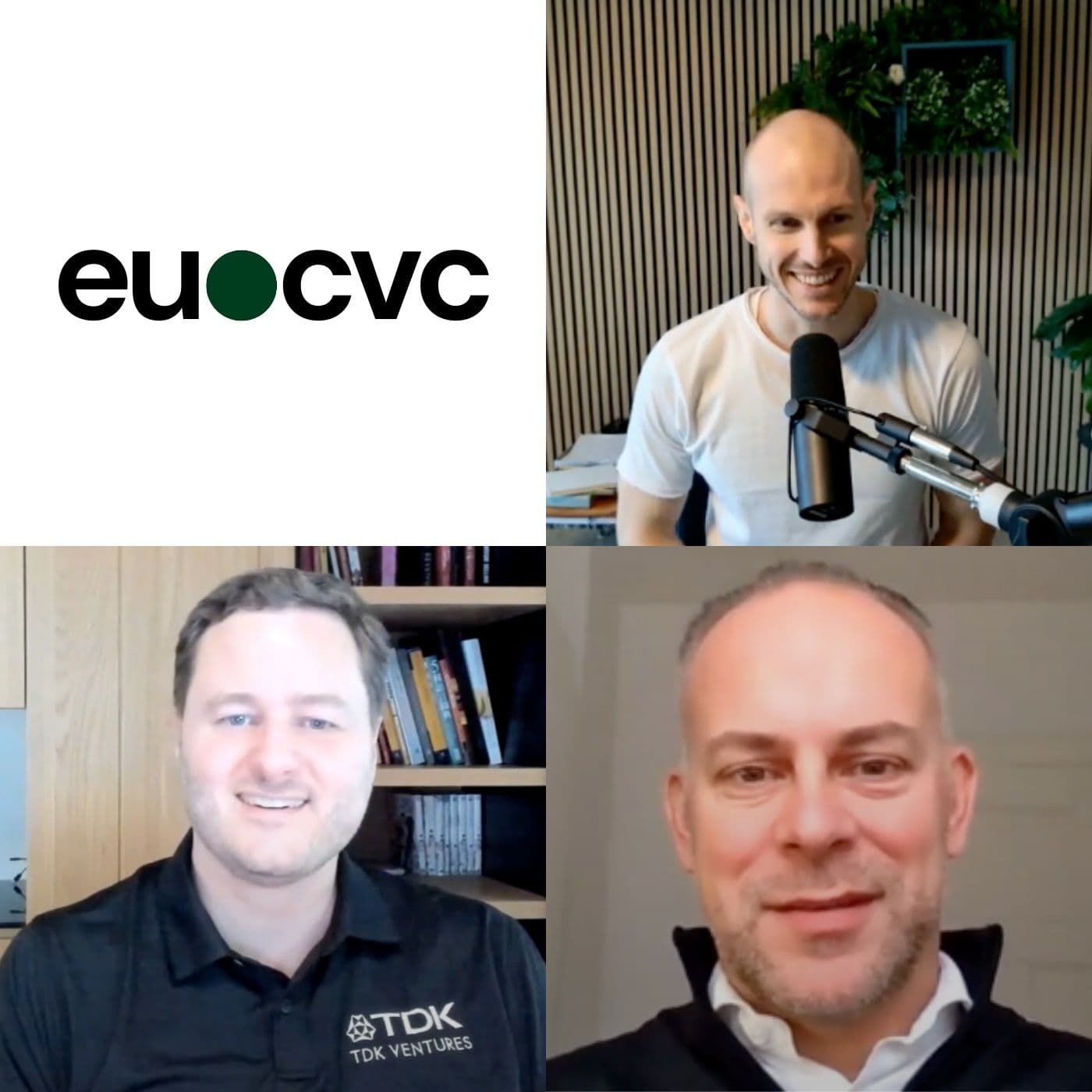
E416 | Nicolas Sauvage, TDK Ventures: Building a founder-friendly CVC and investing in DeepTech for long-term impact
Hosts
- Andreas Munk Holm
- Jeppe Høier (CVC in-house expert)
Guest
- Nicolas Sauvage, President of TDK Ventures
Episode Overview In this episode, the hosts engage with Nicolas Sauvage about his experiences building TDK Ventures, the corporate venture capital arm of TDK Corporation, and the importance of investing in deep technology with a focus on sustainability and long-term impact.
---
Key Points Discussed
TDK Ventures Structure and Investment Strategy
- Assets Under Management: $350 million across three funds.
- Investment Range: Between $250K and $10 million per deal, focusing mainly on early-stage companies (over 90% in seed and Series A).
- Focus Areas: Hard tech, deep tech, sustainability, mobility, and energy transformation.
- Diverse Advocate Process: A rigorous due diligence approach that emphasizes deep insights and a first-principles methodology.
Foundational Principles
- TDK Ventures operates under a code of conduct:
- C: Contribution to society.
- O: One team reaching for the sky.
- D: Delivering deep insights.
- E: Entrepreneurs first.
Patience vs. Impatience
- Patience: Emphasizes long-term investment, particularly in technologies like nuclear fusion, which could take time to materialize.
- Impatience: Recognizes the urgency for innovation and the need to act quickly to support portfolio companies.
Corporate Venture Capital (CVC) Insights
- Patience in CVC: Building a successful CVC requires a commitment of at least 10 years to yield results.
- Collaboration with Startups: TDK Ventures aims for deep collaboration with its portfolio companies, treating founders as partners.
- Risk and Reward: The importance of understanding risk-adjusted valuations in venture capital and the need for corporate executives to embrace the unpredictability of startup investments.
Investment Committee Process
- Investments are evaluated without pre-approvals, ensuring that decisions are based on thorough analysis and alignment with TDK’s long-term strategy.
- Diverse Advocate Sessions: Team members critically assess potential investments by highlighting risks, leading to more informed decision-making.
The Role of Nuclear Technology
- Discussion on the significance of nuclear fusion as a future energy source.
- Addressing the cultural and historical context surrounding nuclear energy, especially in Japan, where nuclear technology has a complex legacy.
Lessons for Corporate Venture Capitalists
- Importance of Understanding the "Why": Aligning the purpose of the CVC with corporate goals and stakeholder interests is crucial for success.
- Feedback Mechanisms: Regular NPS surveys help improve the relationship between TDK Ventures and entrepreneurs, enhancing trust and collaboration.
---
Key Takeaways
- Long-term Commitment: Success in CVC requires patience and a long-term vision.
- Collaborative Approach: Building strong relationships with startups and treating them as partners is vital.
- Risk Management: Understanding and communicating risks are essential for fostering trust within the investment community.
- Cultural Sensitivity: Being aware of the historical context of technology investments, especially in areas like energy, is critical for making informed decisions.
---
Conclusion Nicolas Sauvage’s insights into building a founder-friendly CVC highlight the importance of patient capital, strategic alignment, and a deep commitment to innovation. The episode serves as a valuable resource for corporate venture capitalists looking to navigate the complexities of startup investing while making a positive societal impact.
For further insights, visit [eu.vc](https://eu.vc) or listen to the full episode for a deeper understanding of corporate venture capital dynamics in Europe and beyond.
Written by AI. May contain mistakes. Listen to the episode to check what was said.
Transcript
Automatic transcript. May contain errors.0:00One of the advice maybe to the audience, especially if you're the CEO of a company and you're thinking about doing a CVCVCVC, this is back of this patience and impatience. you need to be thinking about it for 10 years. If you think I'll try for three years and see if it works out, maybe you should not even start it. You're going to distract your management team. You're going to probably never get the fruits of the CVC because you're not giving them enough chance to get to the point where you have success stories, which then helps the business group get excited. Here's a few words from our beloved sponsor.
0:32Join over 500 LPs and GPs at 0100 Europe in Amsterdam. from April 2nd to the 4th. You better be there too. Connect with top-tier investors and industry leaders at 0100 Europe Amsterdam. Engage in exclusive conversations with decision-makers from Bicycle Capital, Global Ventures, Dawn Capital, and many more. There you'll find over 80 % of attendees are LPs and GPs, and you'll also find exclusive side events. 0100 Conferences. Register now and use the code 15EUVC for a discount.
1:24This show is not investment advice and the hosts of this episode may be invested in the funds and companies featured. Welcome to the European VZ Podcast. Thank you. Thank you for having me. Thank you for holding us again. We've just crossed the New Year's. I'm happy that we're continuing to co-host the CVC podcast together. It's nice. It's nice. Nicholas, let me ask you a question here right off the bat. Everyone who listens into the podcast often will know that I usually do the intros myself. But because it's a little bit complex and the wording is sometimes important when it comes to CVCs, I don't want to do that.
2:00I'd much rather ask you to say, how do we best understand Nicholas Sauvage and TDK Ventures? Well, so my name is Nicolas Sauvage. I'm the president of TDK Ventures, which is a corporate VC of TDK, the global electronics company from Japan. I think some of your audience will remember about the TDK cassette. Needless to say, we have moved on and we are now involved with really advanced technology contributing to every mobile devices you can think about, automotives and advanced technology. And as a corporate VC, we're looking at investing where TDK wants to go in the future. Can you just share a bit of light on the sizes of your investments, the number of investments, also the verticals?
2:49So we have three funds so far. So$350 million asset under management, which we put to work to invest in entrepreneurs who are building the future. And we want that future to be sustainable and good for society and for decarbonization funding in particular, good for our planet. And so our investment thesis is to invest in the hard tech entrepreneurs, especially at early stage. So the majority of our investments are in seed and series A. And once you include series B, it's more than 90 % of our investments. And so we look for entrepreneurs who invest in areas where TDK is thinking about investing in the future, what we call the megatrends.
3:35And the check sizes vary from? It can be as low as$250 ,000 all the way to$5 million for our fund number two or up to$10 million for our fund EX1. So EX stands for Energy Transformation. And that's our decarbonization fund. And so our fund, too, is a global fund that can invest anywhere in the world. And we've invested all the way to Australia, Singapore, India, Canada, of course, Europe. And fund EXY, this one is specific for Europe and North America for decarbonization topic like energy generation, energy storage. So now with the basics out of the way, let's talk founding principles. Because first of all, if anyone doesn't know listening in, you are quite a recognized speaker and figure in the CVC space.
4:31So everyone be excited to hear what you have to say here, Nicolas. But the foundational principles on which you've built TDK Ventures, can you tell us about that? Typically, I'm the one asking questions. So it's interesting to be asked the questions. It's interesting because we started the team and we're starting to act without thinking about our core values. And I wrote a Medium article about how we actually backtracked what was our real core values from what we were doing. And so I want to share that, which we call them the code, EODE, which is a code of conduct. And the C stands for contribution to society, which is really in resonance with the TDK mission.
5:13This is what TDK has started in 1935, and it's all about doing the right things. or is one team reaching for the sky, which is really the essence for our team, which is how do we bring our curiosity and our diversity of sorts to bear, to raise about, not just for ourselves, not just for TDK, but even for the full ecosystem. The D stands for delivering deep insights, which is really our raison d 'etre. This is why we started TDK Ventures, which is to learn about things which are not obvious, maybe contrarian, and really share this inside TDK, but even going sometimes beyond that, sharing to the world through Medium Articles, LinkedIn and others, because we feel like sometimes what we learn is really useful for that contribution to society.
6:02So for example, you would see us sharing why we invested in nuclear fusion, because we think it's important for other investors to know about it and even entrepreneurs. And the E is last but not least. and I have to say that I tried to find a word that started with E and I couldn't, but that's entrepreneurs first. We see them as the heroes of our story and our customer. And so this really drives everything we do every day. Now you're talking about the foundational principles. I think I want to talk about the conflict or the complementary between being patient and impatient. So patience is really about this sense of purpose, this patient capital, this ability to invest for the long term.
6:51But then we also need this impatience, this sense of urgency. For example, nuclear fusion, you could say, this is a good example where we need to be patient. It will take time, but we got to start now. We can't wait forever to get started. I think this patience and impatience is something that we struggle every day. and knowing when to be one or the other is part of what I think is driving us to be better investors. For sure, but it's an interesting topic, right? How you collaborate between a large corporation as TDK and then your portfolio companies, right? Because that is even more patience, right?
7:31Because you have to do it at the exact right time. I think we're very lucky is that TDK is a patient company. It's got the best of what you can think of a Japanese company, which is being very thoughtful, especially with our charter about contribution to society, working with our customers like partners. And so there is a passion that's inherent to TDK. But the sense of urgency is also extremely important. And sometimes you want to make sure that when you invest in the portfolio company, you find ways to help them very quickly with very meaningful engagements. Yeah, I think it's the impatience of being a venture capitalist, right?
8:13It is you need to drive the change and make sure that this company you have invested into, they leapfrog all elements of building a company. Nicholas, why the focus on impact? And I want to ask you this first, or I want to test some thesis or probe the way you answer by saying Japan is very recognized all over the world for having incredibly durable enterprises. The oldest companies in the world are family-owned enterprises from Japan. So I'd love to ask you a bit about that Japanese heritage and whether that plays into this sustainability or long-term orientation of how you add to the world. Because most enterprises, to be honest, have not lived long enough to know the importance of being sustainable.
9:05But in Japan, that's a very different situation. And even with TDK specifically, TDK has been around long enough to really have seen the impact that technology has had on society and also the technology they have brought to bear. I really like your question. And I think you're touching on both meaning of the word sustainability. And so I'll talk first about the longevity that comes with making sure that you invest in the right places and you're capable to pivot, which is something we also look for entrepreneurs. And if you think of TDK, and I can think of Nokia, but I don't think there are many other examples of companies that were B2B, then B2C, then back to B2B.
9:50and TDK is one of these companies that if you look at their revenue over time, it looks like it keeps growing. But on the inside, you have many pivots. And I like to share this vision or this view to our entrepreneurs because I want to tell them we understand the struggle of building from scratch and then being challenged. And so when we think about sustainability and TDK, It's also an amazing story where even though it's a Japanese company, 90 % of our revenue and 90 % of our team members are outside Japan. So this is one of these transformations, and that's happening even more so in the last five, six years where we started TDK Ventures.
10:35And we have many initiatives in TDK that are quite fundamental to understand the market, the future, and so on, which gives me really high confidence that TDK can then address the next disruptions, handle it well, and address the next transformation that we want to totally capture. capture. And that's what makes my job and the team at TDK Ventures excited because we're trying to understand what the future will look like and then help TDK in a way that's very strategic. I think you used the word earlier. And strategy, the way I define it is what it is that you want to do and what it is that you don't want to do.
11:14Speaking of don't want to do and want to do, you mentioned nuclear and we should talk primarily about TDK, but I just would love to ask you a bit about nuclear because it's something that everyone is thinking a lot about. We just had in Europe a very large series. I believe it was 100 million or so in a nuclear startup. We have a lot of movement in the U.S. when it comes to nuclear. We have Germany that has said absolutely no in Europe. And then we have more and more discussions in every single member state, I think, in the union about where do we want to be on this axis? And then, of course, you have Japan that has a very rich nuclear history with the two reactors that we, of course, didn't go so well, but still, or you had a terrible crisis there, but still Japan is very pro-nuclear.
12:09So I'd love to ask you both about the historical context of nuclear and existing debates and so on, because I think any big investment in nuclear will have to factor in the trends on a political level, but also where you see the technology and TDK factor in. Let me start by saying that if we think about society 100 years from now, so you asked me about historical, but I feel like we need to start from the future. 100 years from now, they will be looking back at us, wondering why we did not start nuclear fusion earlier. They will really wonder, with everything we know, why did we not start earlier?
12:51Why did we not build that technology that is a fail-safe technology, which is very different from nuclear fission. Actually, nuclear fission is not that hard to do. And that's why we could do it 40, 50 years ago. But it's very difficult to start. There's no fail safe. Well, nuclear fusion is the opposite. It's very, very hard, very complex technology. You need to keep that energy more powerful than the sun in one place. And if at some point something goes wrong, then you lose the energy. It's a fail safe inherent to the technology. It's very interesting. So we had our investment director, Tina, really researching first nuclear fission.
13:35And she ended up concluding she didn't want to invest in nuclear fission. Then she conducted a deep exploration on nuclear fusion. And she ended up with very strong conviction that this is where we should invest, especially with an approach called the Stellarator approach, which is basically a magnet that is shaped in a way that the energy would flow logically and naturally. And this is a bet she made. And when she went to the investment committee, and this is back to your question about Japan, nuclear fission and fusion use the same characters. So it's very loaded words in Japan for obvious reasons.
14:17but when we came to present it, it was really tough for investment committee. That's probably the first investment committee where we have three investment committee members and it's basically the CTO, the CFO and the equivalent of the CSO and they really struggled because it was such a loaded topic but they appreciated the value of the technology for the future of society for our planet, but they also saw some responsibility, and this is back to this contribution to society. They saw the opportunity for TDK and TDK Ventures by investing in nuclear fusion, and we did it with Type 1 Energy in the US, to actually signal and educate about the difference between nuclear fission and fusion.
15:07And if you look at our press release when we announced the investment, it's not your typical press release because we spent some time to explain the difference between nuclear fission and fusion. We felt like because indeed we are a Japanese company as a mothership, we had this opportunity and responsibility to educate on that difference. Interesting for me here to know a little bit about the process you went through internally in Nibuos, right? Because you must have done a lot of groundwork to get that investment to go through. So is that because you have a clear definition of code or that in attached to clear defined investment verticals?
15:54So actually, it's interesting. I think you're making an assumption here. I'm going to dispel it quickly. We do not do pre-approvals or pre-warming of our investment committee. Typically, we go to our investment committee where we share the investment deck 48 hours to 72 hours in advance. They don't know in advance that we're going to present a particular investment proposal. The intention is for our investment committee to approve an investment based on, is this investment helping us build a long-term strategy and execute on that long-term strategy? So that investment committee is really the proxy of matching our exploration mission to that TDK long-term strategy.
16:43And so we do not have all this pre-warming. But, and you're right, and maybe we'll come to the investment process we follow, but our deep exploration is going very deep. We try to build from first principle. So we go extremely deep. We surface some insights, sometimes non-obvious, hopefully contrarian. So it's not obvious, but also most people would not agree with it. We surface it to the team and try to challenge it. And if it survives project presentations and also a diverse advocate process, which is extremely disciplined, and I would want to explain that a bit later in more details. Then at that point, if the investment director still wants to proceed with investment, even as president of TDK Ventures, no one in the team can veto it.
17:34So one investment director can go to the investment committee. And at which point it's about, is it part of the TDK long-term strategy? And so maybe I can explain the diverse advocate process, because this is one of the things which I think we have improved over time to the point where it's so simple and so powerful. and it touched on psychology of an investor. So first, from this deep exploration, typically our investment director and their team would come back with a few startups they like. And so they would have what we call a project presentation where they present some of the startups and everyone in the team can say what they like or what they don't like, what it is that they think is promising and what it is that we should do diligence.
18:17At some point, the investment director may end up with there is nothing I like to invest, so they move on, which was the case for nuclear fission. All they might come back with is this is a space which is really good. It would be venture-type returns, contribution to society, very good engagement with TDK. But I haven't found the king of the heap, the company we believe would be market leader in five to seven years. So in fact, we park the deep exploration, and then we move to another deep exploration, but we are ready to invest when we see portfolio companies that fits our KPIs. But the best case is when they find these companies that are so sure is the king of the deal.
18:56At that point, we have a diverse advocate session, which is one of our mandatory steps for our investors process, where they present why they're convinced this is a startup they want to invest. And at that point, our team can only follow one rule, really, which is they can only say why they would not invest in the company. So they would typically say, I would not invest in this company because of A, B, and C. And there's no starting like, oh, I like this market or I think these entrepreneurs are great or whatever it is. And the reason is everyone, if you give some good and some bad and you really believe in the project, you're going to latch on the positive and minimize whatever negative.
19:38But if you only hear the negative, there is no way you can miss on what is being said to you. Whether it's yellow flag, red flags, maybe blind spots, And what's interesting is that for one hour to two hours, you only hear from all the team why they would not invest. And of course, we try to avoid repeating someone else's points. After that, I give them the night to think about it. And the following day, typically, they would have to write down a response to all the diverse advocate points. So it's not just hearing it. It's also internalizing it and then responding to it. Sometimes the response could be about, indeed, I don't know that.
20:14indeed this is a yellow flag indeed i haven't looked enough on this and then they may decide to continue the due diligence they may decide to drop it because they realize actually now i've realized i should not invest which is about 50 of the time which is where i'm really happy with my team when they do that because it's very courageous you spend so much time looking into an investment to decide eventually not to invest. But of course, sometimes we proceed with the investment. And at that point, I know that they've done everything very deeply because they have the reason why to invest, and they are very clear on the reasons not to invest, which prepares them so well for once we invest, we already have a plan to mitigate all the risks we identified as a full team.
21:03And that's why I touch back to this one team reaching for the sky. During this diverse advocate session, We have a team of 34 people. We have 33 brands helping our investment director to really think through all those things that could go wrong. That's an impressive amount of people that you have around the table. Nivelles, can I ask, you know, so you're betting on the future and then you have TDK that is present, right? How do you bridge that gap, right? Because what I learned at my time in corporate venturing was that And sometimes it was quite hard to convince my colleagues at the core company that what I was betting on, for example, you know, fulfillment robotics, you know, would that be something for my corporate?
21:54And, you know, that gap, I had a hard time fitting in. So how does that work for you? It's probably very similar to you. Sometimes we invest when it's really not obvious. But what we try to do is to really work very closely with the TDK teams. As I've explained the process, something that probably is of use to you is we don't need championships from the business group. But I always like to tell the team that even though we don't need the championship or the sponsorship, we should act like we do. So we should really try to work very closely with every team and try to get their feedback. And by the way, the feedback many times is negative.
22:37They don't believe the market is going to be big enough. They don't believe the technology could work. They are not sure what would be the synergies with TDK. And what's interesting, and maybe this is a tip I would want to give to other CVCs or people who are thinking about building a CVC, is that when we make the investment proposal to our investment committee, we don't make it like a sales pitch where we only say the good things. we actually have every feedback, whether negative or positive, from the TDK teams. We don't want to hide any feedback because for the same reasons as I want our investment director to get all the reasons why not to invest, I also want our investment committee to have the full view of the bad, the good, the ugly, but also what the TDK teams have said.
23:27And by the way, I think if we didn't do that, at some point, they would do it themselves, which is not really a good use of the time for corporate officers to do that. And so I think having this beautiful, neutral view about an investment and being very open about all the things that can go wrong, but also how big the opportunity could be is key. And I think over time, and of course, we are only six years, so there are a number of times where we invested and we couldn't prove this was going to be important. Actually, we had the corporate officer, Ludger, who came to visit us on Friday with Taro Ikushima-san, who was another corporate officer who helped us start DK Ventures.
24:14And in early 2020, I reminded him that we invested in a company called Autoflight in Shanghai, China. And they do vertical takeoff and landing electric vehicles, so EVTOL. And at the time, I remember Ludger in charge of sales for our electronics company saying, Nikola, this is never going to be a market. Come on, why are you investing in this? And then about two years ago, he says, my sales team started pinging me about this EVTOL. Can we talk? And so we start sharing what we learned and everything, which is really interesting because on Friday, what he told us is now this is becoming a market.
24:54And it's a very attractive market because you need redundancy. You need to replace the components on a regular basis because of regulations. You need a number of technologies from TDK across the full company. And so something that in 2020, flying cars, if I'm being provocative, sounded like it's never going to be important. Now it's right in the core of what we can provide to that industry, which is going to be a trillion dollar industry. So this is really interesting to have this kind of examples. You also want to have examples where you can show it was not of use at the time and it starts to become very, very relevant for the business group today.
25:39This is also, I think, we talked about offline about the corporate VC don't have a lot of longevity. I think that's also because if you only have 3.7 years to prove yourself, you don't actually have enough time to show that some of these learnings bear fruit. And so one of the advice maybe to the audience, especially if you're the CEO of a company and you're thinking about doing a CVC, this is back of this patience and impatience. You need to be thinking about it for 10 years. If you think I'll try for three years and see if it works out, maybe you should not even start it. You're going to distract your management team.
26:17You're going to probably never get the fruits of the CVC because you're not giving them enough chance to get to the point where you have success stories, which then helps the business group get excited. No, and I think that it's an excellent story of, you know, how success looks like, right, in the CVC world. What impressed me a lot and what you also said during that was kind of like how you at TDK embrace the risk because a lot of big corporates, they can't embrace risk, right? Because it's like if you fail, you will ruin your career in a corporate. Yeah, I want to touch on that. And I think first, we have an amazing CFO, Yamane Shisan.
27:02I highly appreciate him because, I mean, if you think about CFO of a major company, you think about someone who would be very risk adverse. And if it's only millions of dollars, why would he spend time? And Yamane Shisan has this ability to understand that venture capital, like business, is all about risk adjusted valuation. Everything you do should relate to the level of risk you're taking. And what's interesting is that our CFO is capable to see that, okay, it's super risky, but it's seed stage and the valuation is attractive. Yamanishi Sun has been in our investment committee from the very beginning.
27:41So that financial discipline of risk-adjusted pricing has been here from the beginning and has been so helpful. because there are times where we show maybe a Series B when you already have a go-to-market, you already have marquee customers. Then at that point, you understand that we have to pay higher. But you also appreciate that we could invest like peak energy. We invested at inception of the company. It's a sodium-ion battery for storage solution for grids. And you understood that at inception, it's only about the team and the idea, and the idea might pivot and change over time. But he understood that the team was really amazing.
28:23And therefore, it was worth investing and, of course, at the right valuation. They've done so well since. So it's a good story. But the point is, many, many companies are risk adverse regardless of the risk. And what I'm hoping and conveying to your audience is venture capital, like private equity, like business grew, is about risk-adjusted decision making. And I think it's super interesting, right? Because also when you get, and going back to a little bit more about the investments, right? A lot of CVCs, they would say, well, let us not lead around because we don't have the skills to put the valuation of the company, right?
29:08Could you, you know, do you lead rounds and do you have built those capabilities? Yeah, and I think it's a capability. You're correct. On our fund one, 15 portfolio companies, I think we led maybe, I can't be sure, but maybe three to five times. On our fund two, the majority of the investments we have led or co-led. And this is something I would definitively recommend CVCs not to try to do at the beginning. Build the capability. Make sure that you have good mentors or good consultants or people who can advise you from the VC world. And here, one more tip, which is it's not because someone was in a VC that they are going to be good at advising you.
Read the full transcript
29:55Many people have not been successful in VCs. And so what you want is people who have a track record of making good investments and being good at VCs. But with that out of the way, the key is to make sure that you learn the craft of venture capital. And I wrote an article on Medium, which was about what you need to unlearn from what you've learned in the corporation, like I had done, to be able to do VC. And what's interesting is that in corporates, we are improving our decision-making with a distribution law. Most of the projects are going to have good returns. Few will have bad returns and very few will have exceptional returns.
30:40It's kind of a distribution law. And the quality of the management team will try to shift it to the right. So you will get more and more projects that will get better and better returns. In venture capital, it's a very different law because the uncertainty, the risk is so much higher, you end up with a power law. And power law means that most of the investments you make will do very badly. It could go zero or maybe 1x or maybe 2x, but this is definitely what you expect. But there will be a few that will do exceptionally well. and that power is very hard to comprehend and I think no one in the world can comprehend exponential.
31:24You can internalize it, but it's very hard. It's like, actually let me challenge you because this is meant to be a friendly chat. So let me challenge you. If you were to fold a piece of paper multiple times and of course the thickness starts to grow and let's assume you can fold it as many times as you want. how many times do you think you need to fold it to reach the moon? I've heard this one before, but I think, is it around 30 or something? Yeah, but try to guess. I mean, I think it's because you've done the answer already. Reyes? I have no idea. How many times do you need to fold a piece of paper before it reaches the moon?
32:12Yeah. No idea. I would say billions of times. Yeah, billions, right? That's what people would think. It's actually 42 times. 42 times. Because you double every single time. Now that you know that, what would be, you think, the number of times you need to fold the paper to get to the end of the galaxy, the end of the space? But you said 42 times, right, to get to the moon, right? So it's not going to be that many more. The galaxy is huge. That's a journey, right? And we don't have a number for that. Yeah, exactly. You can argue that the galaxy is ever expanding and you can never reach the end of it.
32:56Actually, it's quite easy because we can guess by a factor of two where the galaxy is today. So actually, it's not difficult. And I think the number, and you could have your audience checking, but I think it's 102 or 103. And that is mind-blowing. And that's my point about power low and exponential is it's very hard to comprehend. And what's interesting is that if you think about how VCs return their funds, it's typically based on one, two or maybe three investments, the fund returners. And the rest doesn't really move the needle. And that means that when you make investments, most times what I've seen CVCs do is that they invest in companies that feel safe to do a 3x.
33:40Let me tell you something. There's never a startup that is safe to invest. So if you think it will be safe to invest and return 3x, you're going to have a bad surprise. What's more important, and I think it's probably what I've learned in the first three, four years, is you need to have a very good view about all the things that could go wrong in the startup you're looking to invest. And that's one part of your brain. The other part of the brain is to look at how big could it be. If it's really, really successful, how big could it be? And you need to be able to reconcile the two. And if you reconcile the two, it's going to be amazing.
34:21And the last thing which I will explain about the exponential and the power law, and that's from a video I watched of Sam Altman, and he has such a good way to explain it. He says that it doesn't matter where you are on that power law. if you were a person sitting on that line. If you look back, it looks flat. If you look forward, it looks like a wall. And it doesn't matter where you are on that power law. And that is such a malignant way of explaining it. And corporations, because they invest in distribution law type of returns or outcomes, they don't have that power law. And so back to your question, JP, earlier is how do you reconcile the two?
35:04It's very, very hard because you're trying to explain what will be a power load type of outcomes with corporates, executives, and very smart people who are trained and for the right reasons to think as distribution law. It's super interesting. And I think, Nicholas, you have come so far with everything you've built in CDK. I'm super impressed and excited about it. So I think, you know, have you done fund-of-fund investments to learn how to do this or have you built all the capabilities yourself? So first, I want to be clear to your audience. The way I look at it for us to be successful, it means that we move the needle for TDK in a way that probably is billions of dollars type of business that are created or acquired thanks to the strategy that we augment for TDK.
35:59So that's one part. And we want to return more capital than we've asked from TDK. So we want these fund returns. We want to make sure that we justify our existence. And the best way to think about it is I want us to be free for TDK and we bring massive benefits, billion dollars businesses to TDK. So today we're not yet there. We have very good promising start. We have been profitable for the last four years. We have really an amazing set of portfolio companies, which we are very proud of. And we have already three unicorns. And I think we have three in the making for 2025, if not more. So I think we have a good start, but we are not yet successful.
36:44You ask about founder fund. I didn't need to do founder fund to learn. I think it's a decent way to learn. It's actually fairly inexpensive to do founder fund to learn. But the challenge is, and it's a bit like when I was learning Chinese, how do you know that a Chinese teacher is a good Chinese teacher when you're learning Chinese? And so here it's a question of you don't know the VC craft and how are you going to be good at choosing the right fund? And if you go for the names, they probably won't have time to coach you. And if you go for the ones in the middle, that is really important to make sure that it's not just the time they will have for you, but they will be good at it.
37:24And so I ended up with a conclusion that fund of fund for me is really valuable if you want to go to a geography you don't have access to, or if you want to go very precise on the topic that you won't have expertise or it could be more expensive to recruit. So, for example, if I wanted to go deep in China, I would want to do a fund of fund. And if I wanted to go really deep, that's not the case because we have this competency, but very, very deep in virtual reality, augmented reality, we could invest in a fund that does that. I think where we were very lucky is I had amazing mentors to support me in learning the craft.
38:07I had Paul Holland, who was nearly two decades at Foundation Capital, a very successful GP. and he spent so much time with me and with my team to teach us VC. And this is one of the things which is very important to convey is that if you want to be a good corporate VC, it means you have access to the best entrepreneurs who are going to help you get these strategic insights. And the way to get best access to entrepreneurs, the good entrepreneurs, the ones that are very important to build the future, you need to be trusted by VCs because they are the ones who are going to let you in or not. And the only way you're going to be trusted by good VCs is if you act like a good VC and you act the way they expect you to do.
38:57And so you can't be... That's the whole thing, right? That's the whole thing about why you do fund-to-fund investments. It's, you know, get access to deals that you normally wouldn't do, penetrate the ecosystem. And I think you've done such a good job finding Paul Holland, right? But there is so many consultants out there, right? When you look at where to start, because you will have normally the access to corporates is the BCG, the McKinsey's, the Baines of the world, right? And then you end up finding a Paul Holland. That's super impressive, in my opinion, right? It was very lucky. So maybe I'll share the story, which is I did the Stanford executive program, which is a six-week program.
39:42And I never thought when I started the program, I would do a CVC. I want to be very clear. And just one thing was there. Was that the Ilias Trevulich program you did? Wait a second. I'm getting... Yeah, yeah. So first, I had the professor Jesper Sorensen, who actually teach about organization and how corporations organize themselves and how they try to be innovative. And that's where the introduction of the corporate VC was. And that's where he made the case for corporate VCs to really elevate your ability to explore new market and new technologies. And the analogy he used was companies' job, number one, is an exploitation business.
40:28It's about exploiting your current market, current technology. And the analogy was you're on a mountain together with your competitors and you want to go to the top of that mountain. And top of the mountain you could define as revenue, profit, customer delight, you choose. But that's your exploitation. And the corporate VC is that tiny helicopter on a cloudy day, flying for very little cost, exploring other peaks. and then coming back saying, okay, this mountain is very hostile. Let's not go there. Back to the strategy, deciding where not to go. But also coming back saying, actually, this other mountain is really good.
41:06We could do really well. We should go there. And that's where maybe for$2 million or$5 million investments, you learn about the right place to go and make your$1 billion acquisition bet. Because then you have that knowledge and that confidence and that insight you couldn't get otherwise at low cost. And so Jasper Sorensen was the first one to explore, to explain why a corporate VC could be so valuable. And I remember that day I went on TDK.com and checked and there was no corporate VC. So I was super excited. I started preparing the project to present and to say we should do a corporate VC. Then one week later, this is where we are getting to Ilya Stribulov.
41:47I have another class with Professor Ilya Stribulov and he asked, have you heard of corporate VCs? And of course, we're all like, oh, you know, Jasper Sorensen just told us. And I say, it never works. Let me explain why it never works. And then it's basically two hours going slide after slide about all the mistakes that corporate VCs make. I'm sure you remember the cold bucket challenge. It felt like we were cold buckets. And it was poured on me because it was like, oh, I spent the week getting excited about it And now I realize all the things that won't work. And then I met Paul Holland, I think a few nights later, he came to the teacher at Turbo Talk.
42:28And I asked him, I went to see him afterwards, and I say, who is right? Is it Jasper or Elia? And if you know Paul a little bit, you would not be surprised. He said, both are right. It makes a lot of sense, but very sure corporate VCs know how to avoid the mistakes in the design phase. And so I asked him then, do you mind mentoring me and then ping me? and Paul has a really good way to explain it but he was like Nikolai is a French guy who doesn't speak Japanese who is not in Tokyo in the headquarter he's just been joining TDK through an acquisition one year earlier and he thinks he can start the corporate VC in a Japanese corporation so Brisei, I can spend some time with you and help you out but in his mind there was no chance it would happen And so he helped me, I think, many times.
43:23So I presented to TDK, to many people. I got a lot of feedback, many no's, but the no's were always for good reasons. So he helped me to adapt the design of the corporate VC in a good way. And we ended up with a really nice project. But I still remember the day I went to present to the CEO of TDK. That will make your audience laugh, I'm sure. Paul said, yeah, you got it. They're going to say, yes, it's obvious it's such a good project. I went to present and I could explain a bit more afterwards, but it was supported by the CEO. At that point, I let Paul know that, yeah, they've accepted, the CEO supports.
44:05And at that point, I say, oh my gosh, I never thought they would. I wouldn't either, right? It sounds like a crazy project. But it talks to TDK's open mind and the ability to empower team members to drive projects that make sense for TDK. And we've had more projects like this. So we've had people presenting an incubation project that was approved and that is now going on. We had regional headquarters that was created to have more autonomy and empowerment locally. That is also working. We had a corporate marketing function created. It's interesting how many initiatives have been created since TDK Ventures has started.
44:47The last one is last year we created a new company for a new business model. So it's called Sensei. And it's a company that is based in Singapore, taking assets from different parts of TDK to address IoT with a new business model. So the point is, TDK has this open mind about trying new things as long as it's well prepared. I just thought that maybe the perfect way to round off this conversation as we're heading into an hour is summarizing your core learnings or core takeaways from this journey with TDK in the format of what should a corporate that is thinking about CVC be really mindful of? What are the most important steps?
45:36I think the first, and I wrote an article about this tool on Medium, so maybe you should see us early. But I think that 50 % of the work should be on the why you want to do a CVC. And it has to be well aligned with all stakeholders. And I never counted, but I wouldn't be surprised. A CVC is at least 500 design decisions. How you recruit, who you recruit. Is it fund-based, balance sheet, decision-making, diverse advocate? I mean, there's so many design decisions which has ramifications. And there's no way you're going to have a good design for the purpose that the mothership expect from you if you don't have a good aligned Y.
46:23And I would probably think that most of the time, the CVC don't survive because the Y maybe came just from the CEO. or maybe it was just accepted or on the side of a project, but the stakeholders were not aligned. My biggest learning is that the time I spent getting the why right, which meant a lot of discussions, many people saying no, helped to refine the design to a point where it made sense for everyone. And when I say everyone, I'm probably exaggerating, but the point is focusing on the why matters. And for example, there are some corporate VCs that don't have exploration mission. They have an exploration mission of the current business.
47:08Let's say if you're a Salesforce type of company or Amazon, you may actually want to have a CVC doing exploitation. You may even want to do both, but you may have value of exploitation. If you do an exploitation, the decisions are very different. You will want sponsorship from the business group. You will want commitment from them to support the portfolio companies. You will want to make sure that you do a portfolio diversification in a certain way that allows you to drive new features in a way that helps your roadmap. So there are so many design decisions. So if I was to give one advice, I think it's focus on the why before you even start the CVC.
47:50And then revisit whether the why makes sense over time. because sometimes a company change or acquires new business or diverses old business or the CEO changes. So you have to make sure you're online with a Y, but that would be my top advice. I think that is so well put. And I also think that I just have a reflection here from someone who's always in venture, right? In normal venture. In normal venture, you have at least two-year process fundraising typically, which means everything you've thought about and wanted to do is pressure tested so hard by LPs. And that, of course, then leads many VCs to never get off the ground.
48:40And a CVC, by contrast, can quite easily be set up if there's enough movement from the right people internally. And I do think that you're absolutely right that the problem is that if you don't force a similar mechanism as that two-year fundraise period, if you don't force that within the CVC, you can very easily create something that is bound to die because it's not rooted hardly enough or strongly enough in the mothership. We didn't talk much about the entrepreneurs, but they're cool to everything we do. And I think it's true for any corporate VCs. If you don't have a strongly aligned why with your corporation, with the mothership, and you cannot communicate that why well to the entrepreneurs, you're going to disappoint them.
49:34And as you disappoint entrepreneurs, you're going to have a bad rap and not be able to invest in the best entrepreneurs. and so I think that anything you do in the design needs to resonate with that why you need to be able to communicate that why so for example I have no problem with corporate VC saying our mission is exploitation and we're only going to have business group working with you and we have to identify them and it will take six months before we decide but if we decide we're going to bring a lot of value to you that's a really good way of explaining the why and how it's designed and why it's valuable to the entrepreneurs.
50:12But if you don't have a good online why, you're very shaky ground. And which means that you may say something to an entrepreneur that you cannot deliver on. This is terrible. One thing I wrote, which I am very proud of my team and what we do at TDK Ventures because we look at the entrepreneurs as a customer and we run this NPS survey every year to know what it is that we are doing well because you want to double down on what you do well. but also what it is that they wish you would improve. And it's impressive how much things you don't know unless you asked. And a simple email is enough to learn.
50:51So I wrote an article that was published in the Harvard Business Review last year, which is about while VCs and CVCs ask the entrepreneurs to run NPS on their own customers, they don't do it for themselves. And so here I give the template of how we do it at TDK Manager. So it's very easy to deploy for VCs and CVCs. And I would highly recommend anyone who is a VC or CVC to think about how they could change maybe a little their behavior to be more customer minded for their entrepreneurs. And it's very difficult. It's actually one of the things which is not intuitive because everywhere else, if you give money, you're the customer.
51:32But here it's not the case. You give money and you should not be the customer. because you get something way more valuable than the money you give. Otherwise, you wouldn't give the money. You get equity in the business, and you join the journey of the entrepreneurs. So they are the customers. They are the ones giving you more value than you're giving. I think actually what we added at Merck, right, we did an NPS on the mothership, so the relationship between the CVC and the mothership. So we had both, right? That was exciting. We do that too, and I think it's important. but I think it's important to decide who is a customer.
52:08And I used to be in science. And for me, when I hear people saying, oh, it's both, then you have a problem. And so what we see is that the TDK teams are close partners. They are limited partners. We want to make sure that we bring maximum value to them, but we are very conscious that we can't bring value to them unless we treat the entrepreneurs super well so they would recommend us to the entrepreneurs. and it creates a right virtual circle where you get access and you support the very best entrepreneurs and then you can really help your mothership. What a beautiful conversation. Thank you so much, Nicolas and Jeppe for joining for this episode on corporate venture capital in Europe and globally.
52:51Thank you. Here's a few words from our beloved sponsor. Join over 500 LPs and GPs at 0100 Europe in Amsterdam from April the 2nd to the 4th. You better be there too. Connect with top-tier investors and industry leaders at 0100 Europe Amsterdam. Engage in exclusive conversations with decision-makers from Bicycle Capital, Global Ventures, Dawn Capital and many more. There you'll find over 80 % of attendees are LPs and GPs and you'll also find exclusive side events. 0100 Conferences. Register now and use the code 15EUVC for a discount.
53:32Tear down this wall It's more than just an alliance This is a union of values Let's start acting
From the publisher
Since founding TDK Ventures in 2019, Nicolas has built one of the market's most disciplined and entrepreneur-friendly CVCs, backing startups in sustainability, mobility, and advanced materials. Under his leadership, the firm has pioneered a unique "Diverse Advocate" investment process, ensuring rigorous due diligence and a first-principles approach to deep tech investing. In this conversation, Nicolas shares how TDK Ventures bridges the gap between startups and a global corporate parent, the power of patience in CVC, and why he believes nuclear fusion will be the defining energy source of the future.
Go to eu.vc for our core learnings and the full video interview 👀