
In short
EUVC Podcast Episode Summary: E438 | Ida Christine Brun, Maersk Growth
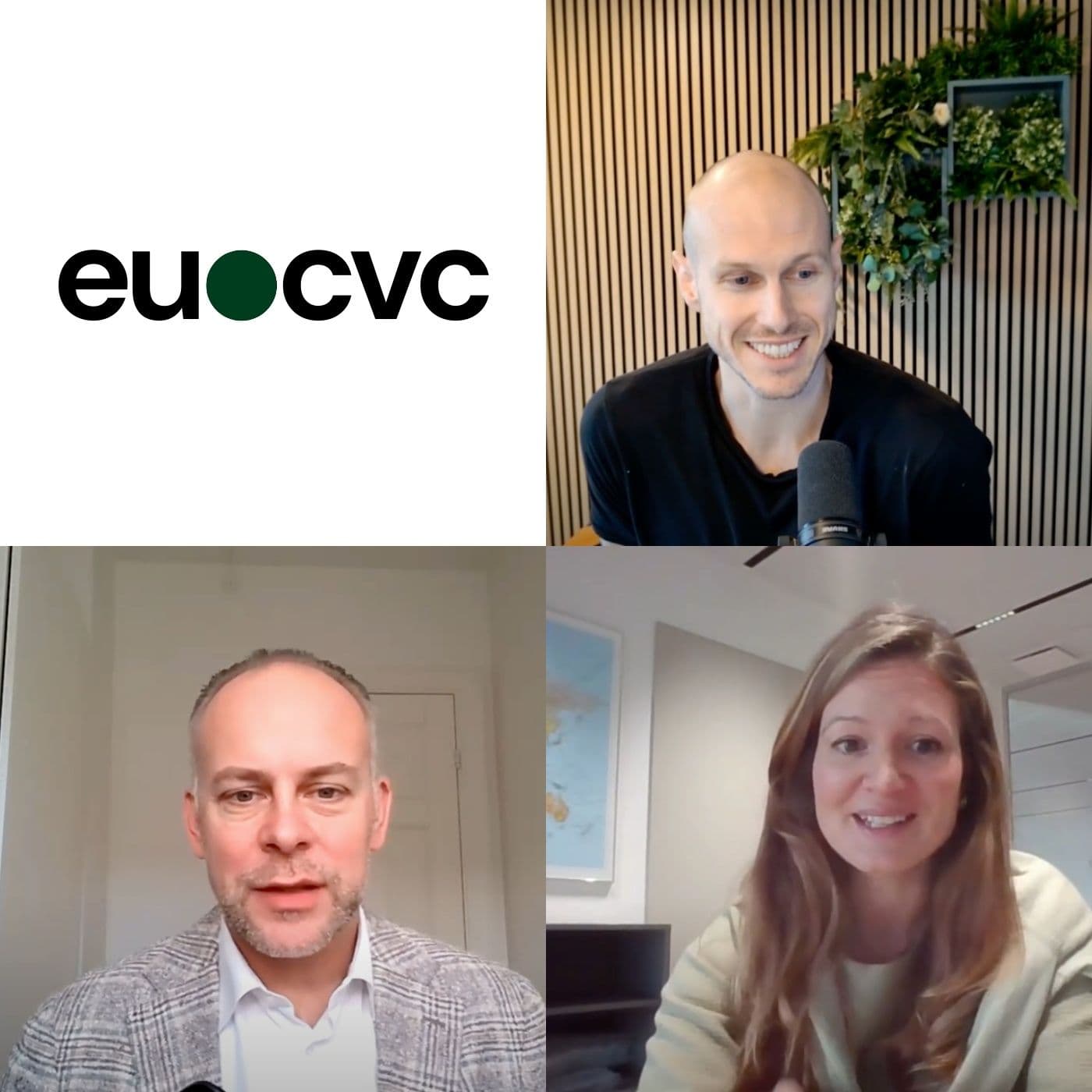
Episode Overview In this episode, co-hosts Andreas Munk Holm and Jeppe Høier interview Ida Christine Brun, the Venture Investments and Partnership Director at Maersk Growth. The discussion focuses on leveraging corporate collaboration to accelerate decarbonization in logistics and how Maersk Growth invests in early-stage startups aiming to decarbonize and digitize supply chains.
Key Themes and Discussions
- Ida's Background and Role
- Experience: Over 13 years working at Maersk with a background in commercial business development and supply chain management.
- Transition to CVC: Shifted to corporate venturing to create a larger impact through the venture arm of the company, focusing on strategic partnerships and equity investments.
- Maersk Growth's Mission
- Objective: Digitize and decarbonize supply chains.
- Investment Strategy:
- Focus on early-stage startups in climate tech and supply chain technology.
- Currently managing a portfolio of over 40 companies, emphasizing climate tech, such as green fuels and carbon capture technologies.
- Investment size typically around $5 million in Series A and Series B rounds.
- Corporate Venturing Approach
- Internal Collaboration: Maersk Growth has a team dedicated to engaging with internal stakeholders to align startup solutions with business needs.
- Value Creation: Offers portfolio companies validation through real-world testing and access to Maersk’s logistics expertise, providing unique advantages beyond just capital.
- Decarbonization Efforts
- Supply Chain Focus: Aiming for net-zero emissions by 2040 across all modes of transportation.
- Innovative Solutions: Exploring various technologies including green methanol vessels, electric trucks, and alternative fuels.
- Regulatory Challenges: Navigating a complex landscape influenced by government policies and regulations impacting investment strategies.
- Engagement with VCs and Startups
- Collaboration with VCs: Maersk Growth is open to partnerships with VCs to co-invest and validate emerging technologies within the logistics sector.
- Venture Client Model: Engaging in non-equity collaborations through pilots and proof-of-concept initiatives to test innovating solutions quickly.
- Current Climate Tech Landscape
- Investment Climate: Despite recent challenges in the US climate tech space, the need for investment remains critical.
- First-of-a-Kind Investments: Emphasis on the importance of scaling technologies and not just focusing on initial prototypes.
- Future Outlook and Opportunities
- Global Engagement: While currently over-indexed in North America due to a favorable funding environment, Maersk Growth is looking to expand its global footprint.
- Call to Action: Ida encourages startups focused on decarbonization to reach out for potential partnerships and investments.
Key Takeaways
- Corporate Venturing Importance: Effective integration of corporate strategies with startup agility can drive significant progress toward sustainability goals.
- Collaborative Innovation: The synergy between corporate giants and startups is essential for addressing the pressing challenges of decarbonization in logistics.
- Long-Term Commitment: Maersk’s pledge to a sustainable future underscores the importance of strategic investments in technologies that may take time to mature.
Conclusion Ida Christine Brun's insights into Maersk Growth's strategies highlight the vital role of corporate venturing in transforming logistics for a sustainable future. The conversation reflects a commitment to innovation, collaboration, and a proactive approach to overcoming industry challenges in the decarbonization journey.
---
*For further details and insights, tune into the full episode of EUVC.*
Written by AI. May contain mistakes. Listen to the episode to check what was said.
Transcript
Automatic transcript. May contain errors.0:00One of the very difficult things in corporate venturing is connecting with the mothership company, right? How does that work within MERS Growth? Do you need a sponsor to do your investments on the CBC side? Yeah, actually, it's really a million dollar question, to be honest. And we work very closely with our internal colleagues, actually to a much greater extent than we used to before. So part of the strategic shift and direction for us was we were moved to these, really stick with the strategy department, which have enabled us to both get closer to the opportunities and business needs of Maersk and the industry as a whole, but also being able to also help shape that innovation agenda, right?
0:50And then I think you speak about business sponsorship. I think we now actually have a team which is purely focused on engaging with our internal colleagues. So the way we split ourselves is that we have on a one side a team focusing that is really external facing and the other being purely internal ambassadors. Yep, you might recall this as part of our previous portfolio management team, but now that's their sole role. And essentially a key reason for us and for our existence is to bring external innovation solutions from startups to our internal colleagues and organizations. Here's a few words from our beloved sponsor.
1:30Discover where operational expertise meets innovation. With end-to-end coverage across fund admin, tax, accounting, compliance, ESG and more, we take care of the complexities so you can focus on what matters most. Whether it's supporting visionaries or maximising returns for your LPs, our tech-driven and comprehensive solutions empower you to achieve your goals with confidence. Partner with Ace Alternatives to streamline your operations and elevate your fund's success.
2:00Tear down this wall. It's more than just an alliance. This is a union of values. Let's start acting. This show is not investment advice and the hosts of this episode may be invested in the funds and companies featured. Welcome back, everyone, to the European VC podcast, also to some known as the EU CVC podcast, because this is the series where we're focusing 100 % on CVCs, trying to connect them into, of course, the European venture ecosystem, the pure VCs, but also to the larger landscape of corporate. So this is a bit with a different angle than the other episodes. And to help me do that, I have my good friend, Jabe.
2:45Jabe, would you introduce yourself, talk a bit about this series and introduce Ida? For sure, for sure. I've been in the VC-CVC space for quite some time now, 10 years as a VC operator and five years as an investment partner. And I am a former colleague of Ida's. So setting the stage for Ida, Ida has a long experience from MERS and supply chain and has turned into this role now at MERS Growth. We are here to talk a lot about what they do within MERS Growth and understand how they operate their corporate venturing entity. But I will give it over to you, Ida, to do a proper and right introduction of who you are.
3:32Thank you so much, both Andreas and I, it's a pleasure to be here. And yeah, I think you captured it quite well, though. Currently, I work as the Venture Investments and Partnership Director at Moersk Growth. Been working with Moersk for around 13 years in quite a wide variety of roles, commercial, business development, supply chain management in Southeast Asia, as you mentioned, and also some strategic transformation projects. And then around three years ago, coming back from my second maternity leave, I started looking for ways in which I could have greater impact, really, and ended up seeking out the opportunity to join the venture arm of the company, Mars Growth.
4:08Initially here, I was really focusing in on portfolio management and bringing to life strategic partnerships with either the companies we were looking to invest in or the ones that we had already invested in. So that was the perfect segue from the corporate lab to CVC because it could really challenge me to really understand what does it take to marry the world of startups and the corporates. Within the CVC room now, I'm currently leading a team of a very talented group of people that are responsible for sourcing companies and solutions both for the equity investment side and also for strategic partnerships.
4:44And our key ambition is, of course, really to digitize and decarbonize supply chains. For everybody listening in, can I get you to kind of, you know, describe the broader picture? What areas of corporate venturing do you do at Merck Growth? But also, right, there's 100 ,000 employees within Merck. You are one of them yourself. How, you know, how do you leverage your own background in the work that you do? So maybe first, you know, the broader picture, and then how does your background tie into what you do at MERS Growth? We really see ourselves as a global partner for external innovation. So in order to really drive forward MERS's innovation agenda, we operate with two key levers of venture cliining.
5:30So on the one hand, through a corporate venture capital unit and doing equity investments, focusing on climate tech. And on the other hand, true corporate, so venture clining and strategic partnerships with promising startups within supply chain tech more broadly. We're now on our third fund, which really invests exclusively in supply and climate tech, as I mentioned, having made investments in areas such as green fuels, energy efficiency, battery technology, carbon capture technologies. and really try to invest in early stage startups that can help fuel innovation that can enable us not only most, but also the industry to reach our net zero targets.
6:15We typically go in with a ticket size of around or up to$5 million USD as a specialist co-investor. And if we look at the investment state, we mainly invest in Series A, Series B. Currently, we hold a quite strong portfolio of more than 40 companies supply chain tech companies such as LoadSmart, Dexter, Offload, Pactum. And we have climate tech companies such as Couture, Altruis, and Prometheus. Even though you can say focusing on supply chain tech and climate tech, as you also can see, it's within quite different areas of the business. And I think that is key to what you actually asked about.
6:55So how can you leverage the experience that you build up over years working for a corporate? But you really have to bring in the expertise and domain knowledge from a lot of different business entities and colleagues. So for us, it's been really key to both work very closely with the VC community, but also with our internal colleagues. And I think, yeah, it's very clear that we are a strategic investor. But to our investments, we aim to gain, of course, insights, but also leverage emerging technologies. And from an investment perspective, we, of course, also want to encourage further investments from the financial community.
7:33So making catalytic investments. So one of the very difficult things in corporate venturing is connecting with the mothership company, right? So a lot of time, you know, it's a culture thing and it's the tie-in to your colleagues. How does that work within Merce Growth? Do you need a sponsor to do your investments on the CBC side? Yeah, actually, it's really a million dollar question, to be honest. And we work very closely with our internal colleagues, actually to a much greater extent than we used to before. So part of the strategic shift and direction for us was we were moved to these realistic with the strategy department, which have enabled us to both get closer to the opportunities and business needs of Maersk and the industry as a whole, but also being able to also help shape that innovation agenda, right?
8:38And then I think you speak about business sponsorship. I think we now actually have a team which is purely focused on engaging with our internal colleagues. So the way we split ourselves is that we have on a one side a team focusing that is really external facing and the other being purely internal ambassadors. Yep, you might recall this as part of our previous portfolio management team, but now that's their sole role. And essentially a key reason for us and for our existence is to bring external innovation solutions from startups to our internal colleagues and organizations. That's where you want to get, as a startup, that's where you want to get the most out of your corporate investor, right?
9:24And I think all the startups they're looking for, you know, ideally they want a commercial deal. But what they do get from the CBC investor is, you know, how do you actually build and run a big or a bigger company, right? And that is where I see the stronghold of being a corporate. Could you share a little bit about what value creation you do today within Merck's virtual portfolio companies? I think every CVC will tell you that they bring additional value beyond the capital that they bring. However, I really truly believe that as a global logistics player, we do have some quite unique to bring them.
10:06It ranges from quite diligent and continued support provided by us as a team, but also a wider organization, posting investments and partnerships, providing that ability to really test and validate solutions with industry experts, with, again, deep domain knowledge from everything, ranging from energy transition, actually execution, to fleet management technology, to warehouse robotics and automation, right? Like if you have a successful proof of concepts and pilot running, we oftentimes see that the status that we do work with benefit from that industry verification and stamp of approval, really.
10:46And of course, every founder would like to see their solutions having been tested and validated in real-life operations, in real-life assets, right? You know, there's two sides of the equation, right? So now we just spoke about, you know, how does your team, you know, assist on the startup side? But one of the most important thing to make, you know, a corporate venture entity survive, right? And remember, the average lifetime of a CBC is 3.7 years, and you're way past that one. But that is the connection into the mothership. And a little bit of a hint from me to you, right? What I got to learn in my last period at Mercer School was strategic insight.
11:31So if you share a little bit about what you do there to anchor the corporate venturing entity within Maersk into the mothership. You're absolutely right. And I think it is, as I also shared before, a key reason for why we really exist. So we focus a lot of our intention on, of course, we want to inspire or provoke our colleagues, but also continuously challenging internal thinking. We are, as I also shared, quite a business led in the sense that we work actively with internal teams to understand what are the biggest challenges, biggest impact areas where we can really help make a difference. But once that is understood, we really want to also plan after rolling brain in both the full market method, but also what are new innovative emerging solutions, new production pathways, new ways of really doing business to the teams.
12:34So we do that through a couple of different means. We do strategic insights reports. We do also have a newsletter, which is also shared externally. And then, of course, have demo sessions with the different teams and also work with them as they, of course, define their strategic roadmaps as well. And maybe a little bit more of labor from inside the mothership, right? So how do you extract knowledge from commerce and take that to the front of where you want to invest? We do that in a few different ways. So essentially, it's not only about bringing insights to the startups that we work with, but actually also to some of the VC partners and other investors that we actually now actively collaborate with.
13:29We do see a lot of companies bringing solutions to us. And in order to really test and validate whether this is something that is a real business problem, we're able to then, of course, bring that to the relevant teams. Say, for example, if we focus in on any digital transition, which is a space we are very active in, we have a strong team here, which, you know, all they do is really understanding how can we really get carbonized shipping and our global supply chains, really trying to understand how can this actually be implemented? How can this actually come to fruition? What does it take? What's the timelines?
14:11And how does that compare to other solutions in the market? So I think that is a key thing we focus on as well, being able to sort of help validate and stress test both the validity, but also the execution of it, really. Ida, most of your energy is used on the climate tech sector, also assisting MERS all the way to the 2040 goals. Can you share a little bit about your investment strategy? What is exciting for you at the moment? What startups would you want to see? With most of our investments to date, and the first two funds actually focusing in on supply chain technology, there was a strategic decision that was made to really focus our future equity investments towards areas where we believe the most funding was both lacking and needed.
14:58So this led us to exclusively cover decarbonization to really uncover different pathways toward net zero supply chains. And I think we have a pivotal role to play here, given the both vast amount of new promising solutions that are really emerging and also the speed at which things are developing. I think, you know, technologies and solutions which we just a few years ago deemed unviable are now beginning to really surface as something that can really help drive impact in the short to medium term as well. If you look at the different opportunity areas, it really is very broad. Well, as many of you might know us for our large vessels, when we talk about reaching the net zero emissions by 2040, that commitment actually goes beyond reducing direct emissions from our ocean fleet, but covering all modes of transportation and products that we offer to our customers.
15:58So we've made investments in the assets for transportation and storage themselves. So from a company side, investing in green methanol vessels, electric trucks, low emission warehouses, and then more on the lower scale end, actually looking into technologies that can help improve efficiency and the lifetime of those assets and the way that we actually operate them. And the alternative fuel spaces, of course, is somewhere where we are. And alternative fuels and energy sources to really power shipping and supply chain. That's also where we've actually made quite a few investments now. Both represent massive challenges, but also great investment opportunities for all of us.
16:38Obviously, climate tech and impact has taken a hit with the latest developments in the US. literally to the point where there are some, the skeptics, the potential skeptics that were there before are definitely emboldened now to say that there's definitely parts of the climate space that is going to have a harder time. Like looking at the points that you have here, assets for transportation and storage themselves, green methanol vessels, electric trucks, low emission warehouse, I can see clearly with low emission warehouses and electric trucks, there's pure efficiency gains because the technology is just better there.
17:25So you're using less energy and so on. But green methanol vessels, alternative fuels and energy sources to power your supply chain, I imagine those could be quite driven by metrics around achieving net zero and so on and so forth. which means it's actually not as much about cost cutting or efficiency creations, but it's about achieving a set goal by the government and the corporate and society. How are you thinking about this? What are the discussions you're having internally and so on? We definitely don't see this as a battle that we would like to take alone. I think everybody really has to come together in order to achieve what we are setting ourselves up for.
18:15And this, you know, goes across the large corporates to the startups to, as you also say, governments and regulations that needs to be in place as well. I think in order for customers to really, there's a lot of customers who say they do want to choose the greener, more sustainable ways of transportation and shipping their goods. But actually, when they are faced with that million dollar question around what to really go for, it comes down to can it actually be delivered at cost parity. And so for us, a key focus area is also, you know, as I also said, focusing in on exploring different production pathways, different fuels, different technologies that can really enable us to come to cost parity to also make it an attractive choice for the customers that also want to do business with us as well.
19:07So it's no question that we're looking into a somewhat more challenging environment. But I think for that very reason, investments in this space is even more needed now than ever, I think. I'm super curious, Ida, because it's one thing with your investments and the established portfolio and so on. Every VC that we have listening in will also be in that state of flux and figuring things out. like we have so many VCs that we've spoken to on the podcast about how climate change is so on so forth and in the end when they talk about it in respect to their series a or seed startups they're actually trying to figure out what's going on inside the likes of Bersk because whether their technology will be adopted it depends on to a large part how you view the coming years and whether it's important or not to actually transition.
20:02Can you share a bit like the discussions, the views that you're hearing expressed? Or even if you're not yet at a conclusion, which would make a ton of sense, right? Because we can't unravel 20 years of work on that because we have a four year interim pause potentially with an administration that doesn't care as much. But that said, I would say I've had a lot of conversations with a lot of people in the industry. Definitely, I hear a very, like almost a sigh of relief with the outlook not to have to measure every little thing. So they do want impact. They do want to contribute to a more sustainable planet and so on.
20:47but they also feel like we have probably gone overboard when it comes to making sure that we measure every little thing. Personally, I think it's difficult to really improve something without actually having the data and measurements to actually verify and validate whether we're actually moving in the right direction. But of course, we also see that it is going to be different from the growth journey that you're on in terms of companies If you look at a large and well-established corporation versus a startup as an example, but then again, you actually do see that a lot of the younger companies actually are very much impact-driven and are actually very good at measuring.
21:32and even though they might not be under the same rules and regulations that a large corporate might just be, then maybe going into your initial question around whether the jury is out on one specific technology or solution, I think since Maersk launched our energy transition strategy in 2018, we have continuously explored very diverse green energy options for our assets. And I think in order to deliver on our decarbonization targets and for the industry to really drive this very much needed change, we do need to continue to explore all possibilities. So we really do actually make an active point of saying that we are actually technology and fuel agnostic.
22:20We don't want to rule anything out because there's others that are looking more promising as of now. and that is something that we of course look at when we make short-term investment decisions but I think we would do ourselves a disfavor if we were to discount the large opportunities and technologies that might just have a large role to play come a few years. So we have the NASDAQ, the New York Stock Exchange, Larry Fink and BlackRock that have all walked back or started movements to walk back some of the ESG initiatives that have been made and requirements that have been made. Do you see that coming to the logistics side of the world as well?
23:14That the regulations will be loosened and expectations and thus also your strive toward 2040 net zero or whatever is the goal? Yeah. Yeah. Yeah, and what I would say is that this is a global challenge. And if you see different, whether it be companies or regions or countries pulling back, of course, that will have an impact on whether you can actually achieve where you need to be going. But I think within Europe, I think the foundation and the sentiment is still very strong. And I think that will also help others to really see that it can be feasible, it can be doable. and then actually taking a step back, say, okay, this is the holistic global challenge, really trying to solve it area by area and create smaller wins that in the grand scheme of things will actually make a huge impact and difference.
24:13Yeah, and it's also, you know, it is an impact either, right? Because the shipping industry is so huge, right? and a good proportion of the emissions out there, right? But one of the key drivers, as far as I remember, is also when you go into the emission discussion and what MERS can contribute with, right? And also looking from the startup perspective, if they want to do it different, right? It's not trivial to implement new sources of fuel to the ships, right? No. No. And, you know, because, you know, where I'm guiding you, right, it's more, you know, it takes quite some years to build a ship, right?
24:54It does. Yeah. That is why also I think it's important to have this short, medium and long-term perspective on things. Because essentially we're sitting here with a large, vast amount of assets and transportation was that all need to actually be decarbonized. And like you said, first of all, it takes a long time to build. Like a large shipping vessel is normally have a lifespan of around 30 years plus. And so whatever you choose to go for in terms of technical descriptions and technology and fuel solutions will, of course, have a big impact for many years to come. Of course, there is a retrofit solutions and things like that we can also look into.
25:46But you're very right in your statement. It's not a very easy thing to do and something that we, of course, also continue to look into as and when we make our investments, what will actually be feasible and viable to get onto existing assets and vessels. A lot of people is talking about the electrification of the world. Will we ski an electrical ship out there? Good question. I think, again, something that we need to continue to keep our eyes out on. I think it's really exciting what is happening within the battery technology space. We are also seeing, again, different pathways, different solutions.
26:33and what we knew a few years ago, I would say, is definitely, yeah, reality is very different today than what it was just a few years ago. But yeah, I guess right now we're looking to cruise ships where, of course, shorter distance travel, where it has been proven viable. So it's something that we continue to look at. No, I've seen all kinds of interesting cases, right? When I was the lobby employee of Merck, right? Even sales on container ships, right? And kites and so forth, right? There's been many, many initiatives to try to lower emissions, right? So I think it's super interesting to see what will happen in that space, right?
27:21So that whole side of things, the merits in part, is that part of the climate tech investments you would do with Inverse Growth? Absolutely. So whilst, of course, we look to decarbonize all of our logistics and our full supply chain, where we have almost actively invested in today, it has really been on the maritime shipping side, because that is where we, as a company, have the greatest emissions still to reduce today. So that is a key priority for us and will continue to be a key priority for us. We have made some really interesting investments to date. I mean, we have done green fuel investments.
28:05We've done biofuel investments, so drop-in fuels for our existing vessels, such as Kvisir and Amitoro. We're also starting looking into fuel cells. So reducing the fuel actually required so we can actually not only use greener fuels, but also less of it. And then, of course, looking into new innovative solutions such as different carbon capture technologies as well, made a very interesting few investments in that space as well. Ida, one of the big discussion themes within climate tech is folk investments, first of a kind, hardware, deep tech related investments. In the VC community, there's a little bit of a return to do those kind of investments.
29:06How do you view that? Is that something that you do and have done? Yeah, I think it's a really interesting debate. And I think last September, I was lucky to partake in the new climate week. And it was a huge topic there as well. And I think a better question, I think it was Department of Energy that kept on sharing this, that you should not only look at the first of a kind investments required, but the next tenth of a kind. And so actually bringing together investment consortiums that could actually not only prove it out, but actually have a grand plan to scale this for the next five to 10 additional plans that will also go to be needed.
29:55So I think that was actually quite a good way of looking at it and something that we also very much keep in mind when we look at our investments. And yeah, to answer your question, that would be something that we would be actively looking for as well. Yeah, I think it's true what you say, right? There's supply chain around these areas also, right? So, you know, fueling a ship in Denmark and setting sail for Australia with no fuel in the other end, right? That doesn't really work. So fully embrace that part of it. But Ida, when you kind of, you know, if we drill, you know, deeper into new folk, right?
30:39And we did a panel this week at GoWest in Gothenburg, right? And I think, you know, when you look at offtake agreements, letter of intent, is that something that your portfolio companies and also the ones you meet within corporate clienting, is that something that you do at Merck? Most of the time when we do our digital support for investments and our partnerships, we always really spend time with the startups to understand what are they actually looking for in terms of support and why are they keen to work with Maersk specifically. Very often it's due to the growth and development opportunities that we as a strategic investor and partner could actually bring.
Read the full transcript
31:23But of course, it's also very often to understand whether we could become a future customer further down the line. And there's, of course, a pathway to that as well. Again, we are investing and partnering with oftentimes quite early stage companies where sometimes where production haven't even started or revenue haven't even begun. But sitting down with them to understand and also help guide them to what our demand needs at what point in time and working with them towards a plan of if we were to become a future offtaker of them, what would that actually take? And yes, we have signed a few letter of intent and offtake agreements, especially when you look at the green fuel space.
32:13So actively working with our energy transition colleagues and the procurement department on that. Yeah, and just making sure that I also get a full grab on what you said when Andreas posed the question before in your answer, right? there are no green premiums to gain today in the shipping and logistics world. Is that correct? We were optimistic initially. I think one of the things we have learned through customer engagement and continuously trying to also provide greener alternatives to the transportation services that we are offering today. It's not as great as we maybe expected it to be, but there is definitely customers that are very much open and willing to go for those more sustainable routes and products as well.
33:06But yeah, maybe not as grand as we first were hoping for. I'd love to ask you because we, and I'm shifting completely the topic here, we created EUVC and now EUCVC with explicit focus to bring together the community more. And for that reason, I think just to make sure everyone understands the difference between CVC or corporate venture and then corporate venturing. Could both you, Ida and Jepa, kind of give a good explanation of that and how a VC would then engage with you on the one side and the other side, so to say? I'm very happy to elaborate a bit on venture client or strategic partnerships, as we also sometimes call it.
33:53So venture client is our most recent lever and offering. And this is really non-equity collaborations with startups through POCs or profile concepts and pilots to really test and validate innovations from the startup ecosystem. it's really about bringing readily available solutions to our operations more quickly. So if you take that into a MERS context, for us it's about accelerating transformation and looking to close innovation and capability gaps that we know we have here and now. The way that we work with it in comparison to our equity investments, of course we look for strategic partnerships and collaboration, both for our portfolio companies, but also for other startups now.
34:44So an added lever, I could say, that we have, or an added benefit that we have been able to gain from doing venture planning is that it now allows us to work with a broader spectrum of startups across all different growth stages. And also very importantly, on challenges that require solutions here and now. So we're working with companies that actually have a proven product ready to scale with us and ideally globally, right? And Jeff, I'm sure you have a lot of additional points to it as well. Yeah, I do. But it's something that I learned from you and your team, right? So let me put a little bit more on it, Sophie.
35:26So when I speak about corporate venturing, I speak about corporate's innovation path. And for me, depending on what sector you move within, it starts all the way from R &D. You might, you know, if you are heavy on R &D in the sector you are, you might even also have an R &D lab where you try things out, right? Then what comes a little for the corporate clienting part that Edith so nicely addressed was, you know, accelerators, right? How do you gain a lot of understanding and how do you tie understanding from startups and tie that into corporate culture? You can do that through a lot of roundtable discussion at events and so forth, right?
36:14And then you have the incubators of the world coming in, right? And there are specialists that do that. Then you have the corporate clienting that Ida just described. And then we have the direct investments that are, you know, corporate venture capital as purely described. And then the last flavor that some big corporates, they decide to start with also to get to penetrate the ecosystem is to do fund-to-fund investments. So for me, you know, the right strategy within a corporate looking at innovation and doing corporate venturing is to say, okay, what are all these elements and where do we want to, you know, you need to understand them all.
37:01And then where do you then start, right? I know for a fact that Maersk has been through it all, has tried it all, has succeeded in all of them, but have now a clear focus on what they want to spend their time on, right? And that is such an excellent place to be. The VCs that are listening in, when they think about you, obviously as a CVC, you're then a potential co-investor. And I'd love to hear a bit about how you, the role you like to take there. You described in the beginning, you're doing a co-invest strategy on that front. So maybe talk a bit about that. And then on the corporate venturing side, how much do you, with that arm, so to say, or that side of the business, think about the VCs versus directly the startups?
37:52It's been a great opportunity for us with this sort of shift in a direction, embracing both venture planning and in addition to the corporate venture capital that we used to do before. it really has allowed us to partner with other VCs and investors to a much greater extent, but also more targeted extent as well. And I think it's been really positive for us to see how it has enabled better expiring and collaboration, because they have actually now started embracing these venture declining efforts to push forward both POCs and pilot opportunities for their portfolio, but also using us as a sparring partner in their new gelatins for new investments.
38:42So assessing whether the companies that they are looking for are actually addressing real needs and challenges for the logistics and shipping industry and also the feasibility of actually implementing it. So for relevant opportunity areas, I think it's been great not only to work with a broader scheme of startups, but also with sort of more targeted with other investors that have similar convictions and investment theses that we do on concrete opportunity areas where we can actually help test and guide and play quite an important role in their business. decision making process. Could you either mention some of the names of the VCs that you often do things with just to kind of scope the breadth of it and the types of firms that normally play well with Maersk?
39:41So we have worked with really a lot of different VC firms. I was hesitating to mention just a few. But I think... There will always be some mentioned or some forgotten, but it's not to play favorites. It's just to... And Ida, to save you a little bit here, right? So the human brain, the ones you have talked to within the past three weeks are the ones you tend to remember, right? So this is, you know, you just, you know, put them out there, you know, nobody forgot nobody, you know. No, but yeah, if I just look back at the past week, you know, I had really great conversations with Planet A, had really great conversations with TDQ Ventures, both of which are really looking into decarbonizing or decarbonization also from my time and logistics.
40:35in the US we have a great network as well and I think we actually have started looking now at where do we have our greatest engagement whilst we invest and partner globally we're really over indexing on the US and North America we also have quite a bit of engagement in Europe but it's something that we're now beginning to work much more actively to ensure that we actually are really understanding the full breadth of market opportunity that we have ahead of us. How come, Ida, that you're over-indexed on the North Americas? Because I believe you're headquartered or yourself are seated at the headquarters in Copenhagen.
41:19And I imagine that a lot of the team, because it's so important to be close to the mothership and the strategic initiatives and so on. I imagine many of you are in Copenhagen. Yeah, actually the full team of 15 employees in North's growth that are actually sitting in Copa thing and you're completely right. There's two reasons for why we have worked a lot with North America. On the one hand, we have a lot of portfolio companies that are now beginning to really reach growth stages and also expand to the US, which of course have been really important for us to understand where is the next big market that really that we can help enable them within.
42:03And then also from an investment perspective, I think there is just a different risk appetite and fund raising environment in the US versus Europe still, where there is a lot more fund and capital being thrown after both supply chain technology, but also climate tech solutions in the US to date than there is in Europe still. That is, of course, something that we would very much like to see change. But if you look at the amounts raised for startups, there is still a big difference. Ida, how do you see investments in other geographies than North America and Europe? We are still a global investor and we continue to also look for opportunities elsewhere.
42:54It's a little bit more opportunistic, I would say. oftentimes when we do get tuned areas it oftentimes comes from other co-investors and partners but it is something that we're now again beginning to look at how do we actually set ourselves up for being able to more readily assess we have made investments from you know, upfloat in Australia to Trella in Egypt so we do also have investments elsewhere as well But yeah, it's been a bit more opportunistic. Yeah, and as you also have a co-invest strategy, right, it also means a lot of work in those different ecosystems, I must guess. Yeah, absolutely.
43:39I have to ask you, Ida, now I've got to double click and we are almost out of time, but given your high exposure to the North Americas, which I had not expected, what are the things you've heard the last four months when it comes to climate and whether you're leaning in or leaning out, because definitely the people I listen to in the States are not exactly leaning into climate. Of course, it's really a hot debate now, and I think the jury is still out on what some of the potentially changed regulations and decisions will have of the implications for all of us. But that said, if you look at, for example, areas like carbon capture, either for utilization or for carbon removal, you do see that the US is quite sort of further ahead.
44:39There's more companies that are actively taking a role in both investments and becoming a customer of that in the US versus Europe. we've made one investment within the space in Ketura which is capturing CO2 directly from the ocean I think that is for example a very interesting play where you can see both from an industry perspective but also from a financial perspective how that could be a very sound investment and the likes of those opportunities I think will continue to have quite a lot of good headwind. I'm super baffled by the climate tech number that you described. I definitely it does surprise me honestly that you're seeing higher volume in the US than here.
45:32I think at least in terms of actual funding amounts. Of course there's a few deals that really drive up. Yeah, exactly. I was about to say it's probably because you're at growth stage as well that you're seeing it so much. We also saw it from the former government in the US, right? They put a lot of more, you know, soft money into play, right? So it was a clear indicator that it was a big bet. How that's going to change, we'll have to see in the coming years, right? Yeah, you can, of course, if you start counting that into it, it gets very big. Very interesting. Okay, a lot to uncover there. Andres will be researching this further.
46:12We'll do an episode on it and then follow up with you. Exactly. Exactly. And we're a very happy team. Cool. I have no more questions. Do you have anything you feel like we should have asked? You know, I don't think so. But I think from my side, Ida, it has been such a pleasure to have you on the show. Super happy to see how far you have taken it now. And, you know, great promise into the future. So a huge congratulation from my side to you. And then just, you know, over to you, Ida, any final comments from you to the listeners? First of all, thank you so much for having me. It's been a real pleasure.
46:55Maybe a final call to action to everyone listening in. If you do have an interesting either investment opportunity areas or startups, especially with a focus on decarbonization of the logistics and supply chains, then you know who to reach out for. and I'm looking forward to continuing the conversation there. I am sure there will be a lot of incoming deal flow from the whole community listening. Ida, thank you so much, Jaber, thank you so much for saying let's bring Ida on. Of course, it's a huge privilege to have the two of you being able to cover and discuss IMRESC from the inside here on a podcast where it has naturally to be on the outside.
47:39Here's a few words from our beloved sponsor.
48:18This is a union of values. Let's start acting.
From the publisher
During the conversation, Ida shares how her team leverages Maersk’s deep logistics expertise to test and validate innovative solutions in real-world settings. She discusses the value of engaging with both internal teams and external VC partners to drive impactful change, emphasizing the importance of addressing current business challenges and paving the way for future growth. By integrating strategic insights with practical pilot projects, Maersk Growth is working to bridge the gap between groundbreaking technology and sustainable, long-term industry transformation.
Go to eu.vc for our core learnings and the full video interview 👀
Chapters:
03:08 Ida's Journey at Maersk
03:38 Transition to Corporate Venturing
04:02 Maersk Growth's Mission and Team
04:26 Corporate Venturing at Maersk Growth
04:54 Investment Focus: Climate Tech and Supply Chain
05:52 Portfolio and Investment Strategy
06:39 Strategic Partnerships and Internal Collaboration
07:05 Challenges in Corporate Venturing
07:30 Engaging with Internal Teams
09:24 Value Creation for Portfolio Companies
13:56 Decarbonizing Supply Chains
14:14 Investment Strategy and Exciting Startups
17:35 Global Collaboration for Innovation
22:21 Navigating Regulatory Challenges
32:49 Corporate Venturing vs. Corporate Venture Capital
36:59 Collaborating with VCs and Investors