
In short
Podcast Episode Summary: E443 | Gitte Aabo, Leo Pharma and GN Hearing: How to Use Corporate Collaboration to Identify Emerging Trends
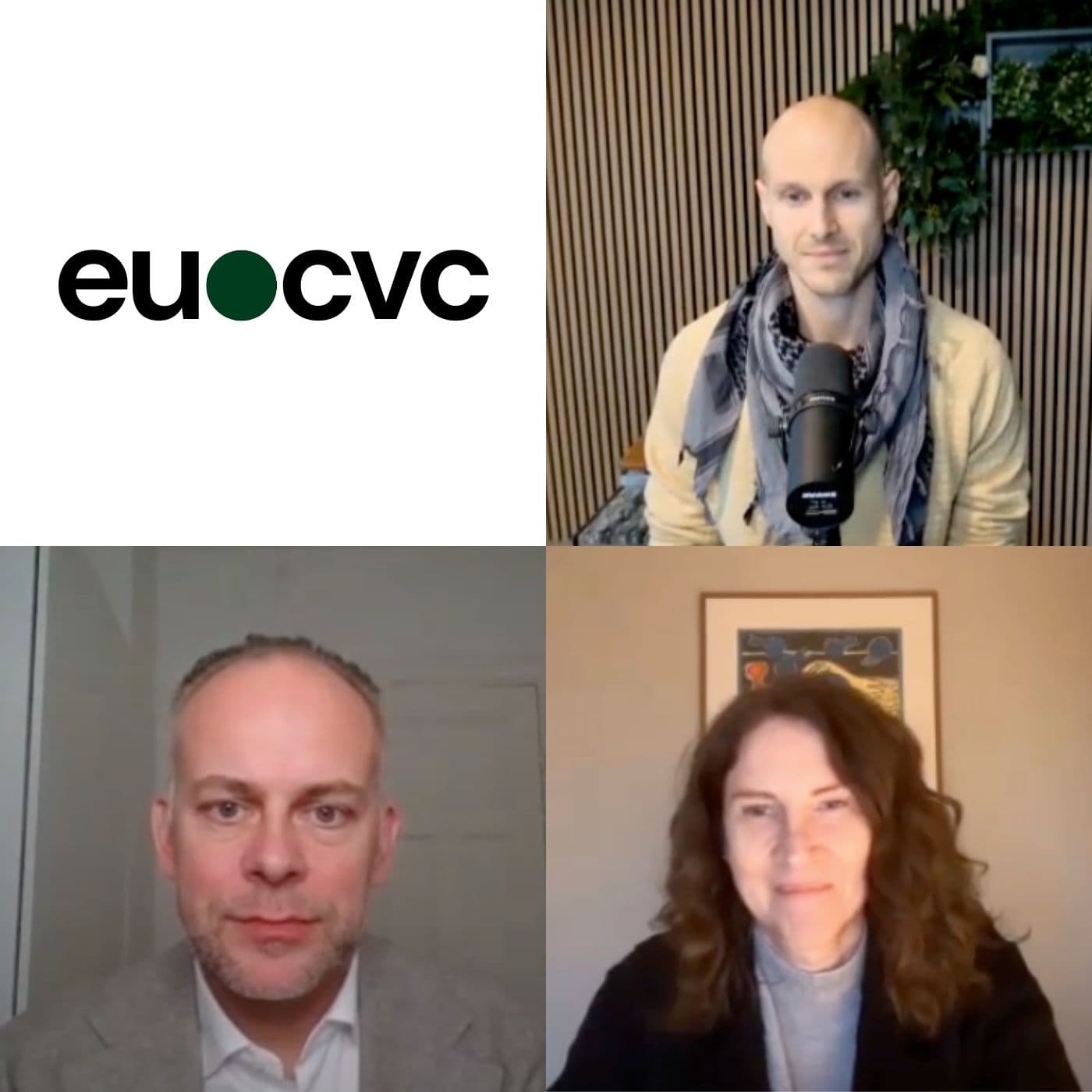
Podcast Title: EUVC Episode Hosts: Andreas Munk Holm, Jeppe Høier Guest: Gitte Aabo Episode Overview: This episode explores the realm of corporate venture capital (CVC) through the insights of Gitte Aabo, who has extensive experience in corporate innovation at Leo Pharma and GN Hearing.
Key Themes
Introduction to Gitte Aabo
- Background: Over 27 years at Leo Pharma, including 12 years as CEO; four years at GN Hearing.
- Focus Areas: Building innovation initiatives like Leo iLab; developing digital tools for better patient treatment outcomes and diagnostics.
Establishing Innovation Labs
- Leo Innovation Lab:
- Supplemented the pharmaceutical offering with digital tools.
- Developed solutions for improving treatment adherence and diagnosis of skin diseases.
- Approach to Innovation:
- Emphasizes a patient-centric philosophy where focusing on patients drives business success.
- Utilized discussions with board members and management to align corporate culture with innovative practices.
Corporate Culture and Innovation
- Philosophy on Corporate Venturing:
- Success requires ongoing, personalized discussions with stakeholders, not a one-size-fits-all approach.
- Integration of strategic insights with practical initiatives is vital for long-term impact.
Challenges and Learnings
- Challenges Faced:
- Initial separation of innovation teams from the core business limited knowledge transfer.
- While aiming for agility, the disconnect sometimes frustrated core business units.
- Learnings from Leo iLab:
- In hindsight, a smaller, more integrated team would have fostered better collaboration with the core business.
Transition to GN Hearing
- Integration of Innovation:
- Built a smaller innovation team that was physically located with the core business.
- Emphasized external partnerships over internal development, aiming for strategic alignment with core business objectives.
Strategic Partnerships
- External Collaborations:
- Worked with startups and other firms to leverage existing innovations instead of building everything in-house.
- Collaborated on projects, such as using voice detection technology for early Alzheimer's diagnosis.
Key Takeaways
- Civic Engagement and Board Dynamics:
- Importance of educating board members on the nature of venture capital and the different dynamics at play compared to traditional business.
- Engaging in one-on-one discussions with board members can help build understanding and support for innovation initiatives.
- Measuring Success:
- Defined KPIs focused on strategic partnerships, product development timelines, and alignment with core business goals.
- A successful innovation initiative should be closely monitored and should align with the broader corporate strategy.
- Collaboration Between Corporate Venturing and M&A:
- Close integration between corporate venture units and M&A efforts is essential for successful partnerships and strategic investments.
- Understanding the perspectives of both corporate and startup entities is crucial for effective collaborations.
Episode Chapters
- 03:55 - Establishing Leo Innovation Lab
- 04:15 - Digital Tools for Skin Disease Treatment
- 06:20 - Structure and Funding of Leo iLab
- 08:10 - Challenges and Learnings from Leo iLab
- 14:43 - Transition to GN Hearing
- 17:00 - Strategic Partnerships and External Innovation
- 19:52 - Challenges in Corporate and Startup Collaboration
Conclusion This podcast episode provides valuable insights into the nuances of corporate venture capital, emphasizing the importance of integrating innovative practices within the core business while maintaining a focus on strategic partnerships. Gitte Aabo's experiences highlight the necessity for tailored approaches to innovation that foster collaboration and understanding within corporate structures.
Written by AI. May contain mistakes. Listen to the episode to check what was said.
Transcript
Automatic transcript. May contain errors.0:00Guida, I have a critique of the LP space in general, which is that oftentimes limited partners are not super sophisticated in venture. So I'd love to ask you about this level of education. How do you think about making sure, not that people are aligned, but that people understand how different this is and the dynamics that govern venture versus everything else? There's not a simple formula that works in every boardroom. What I have done is that I've taken the time to discuss this on an individual basis with every board member and with every member of the management team. And most of them have, you know, either been, you know, at a point in their career in contact with a startup.
0:48They have friends that have a startup and they obviously also know the company history. That once upon a time, Leo and Dien also was a startup. And they kind of get the whole idea that we need to renew our business. But it takes some investment, in this case my time, to have that more sort of philosophical discussion about how do we ensure that we constantly renew our business and that once we hand over Leo or Jan to the next generation, we hand over something stronger and prepared for the future. So I think it's those kind of discussions at least that has worked for me. Here's a few words from our beloved sponsor.
1:28Discover where operational expertise meets innovation. With end-to-end coverage across fund admin, tax, accounting, compliance, ESG and more, we take care of the complexities so you can focus on what matters most. Whether it's supporting visionaries or maximising returns for your LPs, our tech-driven and comprehensive solutions empower you to achieve your goals with confidence. Partner with Ace Alternatives to streamline your operations and elevate your fund success.
1:58Tear down this wall. It's more than just an ally. This is a union of values. Let's start acting. This show is not investment advice and the hosts of this episode may be invested in the funds and companies featured. Welcome back everyone to the European VC podcast. Today we have a quite different discussion than usual because we have Gideon with us today. And to set the stage for this conversation, I'm going to ask my dear co-host Jeppe to intro Gide and why he is looking forward or has been looking forward to today, just as if it was Christmas Eve. So this is January, but for me, it really, really feels like Christmas.
2:44So I met Gide the first time in 2017 at Leo iLab, which was a venture entity underneath Leo Pharma. and that was my first introduction to corporate venturing. For me, Leo iLab was super visionary. I was introduced to Gide by two Danish civil entrepreneurs and I must say that was what ignited my career in corporate venturing. So everybody, please welcome Gide and let's go from here. So Gide, please put a few words on yourself and who you are and what you have done in your career. Hello everybody and good to meet you. So yeah, my name is Gide Abo. I have worked 27 years at Leofarma, which is a pharma company specialized in skin diseases, almost 12 of them as the CEO.
3:41And after that, I worked four years for G &Hearing, specialized in hearing aids. And I was there four years as a CEO. And now I do board work. So, Gide, my first question to you, right? So what were the guiding principles and key learnings from establishing Leo Innovation Lab as a corporate venture entity? Yes. So when we established the Leo iLab or Leo Innovation Lab, we actually wanted to supplement our pharmaceutical offering with digital tools. So one of the things that we were struggling with at the time was actually to ensure that people were motivated to stay on treatment when they were treating their skin disease.
4:24And therefore, we developed a solution that could help predict treatment outcome. so how would your psoriasis clear up if you actually follow treatment for the next couple of weeks so that was the one idea we had we also wanted to improve the ability to diagnose skin diseases which is one of the things that are quite cumbersome to do or difficult to do and actually generally speaking gps struggle so much that it's only 50 percent of the diagnosis that are right the first time. So we developed, again, a tool that basically you can use on your mobile phone to help improve the diagnosis of skin diseases.
5:09You don't get a mention at all, superior returns in any way. How come? Well, I think for us that was our whole philosophy as a company, and I guess my philosophy as a leader is that if you focus on the patients, if you focus on the customer, business follows. So obviously, if we were able to get diagnosis right, people will get the right treatment and therefore more likely would follow the treatment. And similar, if we were able to predict treatment outcome, more people will stick to the treatment. I think one of the big issues we were facing at Leo was that many people gave up using the treatment because it took some time before you saw the benefits.
5:57Could you get just for everyone in the audience to be perfectly familiar with iLab? Could you share a few stats on what type of structure it was? Was it purely incubation activities or did you also do startup investments? Did you do any LP investments? Why? Why not? Those things. iLab was actually set up as a separate team, if you like, under Leo Pharma. And keep in mind that Leo at the time was a pharma company with more than 100 years of history. So as you can imagine, quite traditional in our way of working and thinking. And we wanted to bring new thinking into the company. And therefore, we built this team separately.
6:46And we were very focused on, I guess, doing most of it ourselves. So we built a team of around 100 people that were located in downtown Copenhagen, whereas the main office is in the outskirts of Copenhagen in Ballerog. Gideon, can you share? So from Danish media, right, I've picked up that the initiative was, let's say, 70 million euro, 500 million DKK strategic initiative. Yeah. And I'm super interested in the process of the how to get that done. Right. Because for me, super, super impressive. It cannot have been something you could do by your own. right because as such a large amount it must have been a board decision absolutely it was a board decision and obviously it took quite a while to to i guess get our heads around both in the senior management of leo but also in the board to set aside such an amount and the reason we set aside such a big amount at the time was that we wanted to ensure that even if we failed in our first attempts we had sufficient money set aside to continue developing iLab.
8:10I mean there are a lot of learning since then I guess in the hindsight we probably should have gone about it in a different manner and not building necessarily such a big team but nevertheless that's what we did at the time. Yeah I remember when I came into Leo iLab in 17 one of the people working for Leo iLab had just returned from the US. So as far as I remember, you had people on ground in the US also to gain knowledge from there. Can you share a little bit on how you did that? Because I also remember that there were a couple of direct investments in other companies and that it was not fully just incorporating ideas from Leo Pharma.
8:53So yeah, we had a person that was situated in California and close to San Francisco and was, you know, part of the environment with all the innovation going on there and was kind of our scout in to see, you know, new opportunities that was emerging in the field. And that led to a couple of investments. They never really sort of developed the way we hoped, but nevertheless, it's obviously a way to spread the risk that you do, both internal and external innovation. I'd love to ask you about the decision to put iLab a bit outside of the main hub or the main headquarters. Because I get 100 % you want to ensure, and this is the standard textbook consideration you want to have when you want to do an innovation initiative.
9:49So oftentimes let's put it a bit away of headquarters so that they're able to do the radical innovation that they should be able to. But oftentimes that also means that you limit the ability to transfer knowledge from this organization into the main organization. What were your reflections ahead of time there? Why did you end up doing it as you did? And what would you maybe advise others to consider when thinking about building an innovation lab? So, I mean, when we set it up like that, it was to the point that you made that we wanted to, you know, if you like, set innovation free. and allow them to operate outside the pharma regulations and pharma tradition.
10:33We wanted to attract different people than we did traditionally in Leo. And I guess we wanted to build a more agile and from that perspective, different culture than we had in the core business. Now, as iLab developed, it actually limited the ability to share knowledge between the two organizations. I mean, part of the hope was that the agility, the agile way of working would rub off on the core business and obviously the deep, profound knowledge about skin diseases that was established in the core business would be used also in the work done in iLab. That was really hard to capture in real life because the organizations lived apart and developed separately.
11:23How do you think about it today, then? Do you think that an initiative like this can be successful in disrupting the ways of working in the core business? Or do you think, nah, it's an era, that's how we thought about corporate innovation, but honestly, you cannot conduct it as such? at least i would i would definitely do different today i think you can still have in an internal venture organization that impacts the core business but then it has to be sitting together with the core business if it sits separately it gets its own identity and culture and that does not change anything in the core business so i think you need to to put it inside the core business and probably also limit the size of the team so that they are forced to have an interaction and collaboration with the core business.
12:17There's a lot of core or corporate venturing entities that demand a sponsor from the core business before doing an initiative. Was that something you worked with at iLab? Yeah, we actually had our head of R &D being the sponsor of iLab. And obviously I was myself very much in favor of iLab. And yeah, so yeah, we had that. Because while at Maersk, I had a hard time solving the strategic part of the equation. We were quite successful on the financial return, but we lacked on the strategic part. And, you know, both Leofarma and Merck are huge organizations. So it's more the integration. And that's why.
13:08So one of the KPIs that I always mention on this show is that the average lifetime of a corporate venture entity is 3.7 years. And that is because, you know, people and strategy changes. But it's also it's difficult to change culture. could you share a little bit on what was culture also a part of the decision to do leo ilab absolutely i mean we we wanted if you like an innovation entity that wasn't hindered by the existing culture in the company or that could you know rethink the way you did and supported people living with skin diseases. But I think in the hindsight, it got too far away from the core business.
13:56And that meant that although our head of R &D and I was supportive of iLab, the rest got a little bit frustrated on the fact that we continued to invest. And why would European region have to save money in order to feed iLab and so on? because they couldn't see an immediate impact or benefit in their business. No, and that's the learning I also had, right? So we got pulled closer to the Merck HQ. And that was actually at that point of time, we started to being able to do the collaboration with the core business. And maybe this drives us into one more question that we have, right? because when you left Leo Pharma, you went into a GN hearing.
14:49Yeah. And there you also touched on innovation. Can you share how your learnings from iLab then led you to decide what to do within GN? Yeah, so first off, we built a much smaller organization, actually only a handful of people. and by doing that they were forced to collaborate with the core business. And also we put much more emphasis on external innovation or partnerships rather than doing things ourselves. It was established not in a separate location with fancy offices but rather in the same buildings and next to where the core business for GN hearing is living actually also in Palo. So I think a lot of things like that were done.
15:45We did differently this time around, and I think that really made a difference. We also made it very clear that in order for this venture initiative to continue to be funded, it had to support the business of GN hearing. So it had to support the sales of hearing aids. How would you describe that you measured this? How would you describe that you made sure that they delivered on this promise? In the development in GN Hearing, which is hearing aids, we worked with a roadmap where we had different features in the hearing aids planned for a certain date or a certain next launch. And we actually ensured that some of the features that were developed in the innovation hub was actually put on the roadmap.
16:36So integrated the innovation from the innovation hub into how the company already operated. When you were to make this decision around how much should be developed in-house and how much should be done as investments outside of the house, how did you make that call in first setting up the strategy? Well, I don't think we had a specific number saying 35 % needs to be internal and 65 % is external. But we were much more focused in GN on looking at what have other people developed and how can we utilize that. So as an example, one of the things that OGN puts emphasis on is to develop the ability to detect early on a potential onset of Alzheimer's.
17:32And that you can do by listening to the voice and probably detect it even 20 years before people get Alzheimer's. And there we collaborated with a company that are developing a tool for Tesla to detect if you are driving under the influence. Again, also based on listening to the voice. So rather than go about, you know, developing something like that ourselves, we instead work together with them. So why does this type of integration of external innovations require that you invest as well? Why is it not enough to just do partnerships and work closely with the startup scene? Well, I guess there are different reasons for that.
18:27Obviously, when you enter into a partnership like that or collaboration like that, it's for the long term. and you want to make sure that if you become successful, it doesn't immediately spread to all your competitors that they can then build the same partnership. So I think there are a lot of sort of strategic considerations like that that you want to make. Yeah. And to those that don't know, hearing aids is actually an incredibly competitive space and we have two of the largest producers in the world in Denmark, which is a very small country. So competition is actually quite cutthroat. absolutely but Gide so you are an experienced leader right so do you think that this kind of you know way of doing it which is similar to Leo Pharma that is also super you know competitive and R &D and patent heavy would you see it differently in another sector well I guess you don't necessarily need to invest in every partnership you build.
19:35I think also you can have a partnership that are not based on investments. You can have a partnership with a university for that matter. So I think as long as you make sure that the partnership has what is required to make it a strategic partnership, then I think it can work also without an investment. I want to get back to cut-flow competition and how you collaborate with startups then, because you're absolutely right from the corporate side, you want to log in the innovation, so to say, and not give it away to the competitor right away. From the startup side, you actually kind of want to develop it with GN and then you want to go to the competitor as quick as possible.
20:16So how do you square that circle? Yeah, well, that is obviously not so easy to do, but I guess that can be examples where the technology you develop together can be used for different purposes. And I think this is about working with detecting different things in the voice. We used it for one purpose. Tesla used it for another purpose and so on. So as long as you can ensure that this is not used by your direct competitors, I guess you can find a way to allow the company you're working with to use it in other industries. Can I ask a super off-topic question just because I'm curious? Apple has just recently launched in their AirPods that they can detect voices around them and then amplify that for someone with hearing issues.
21:10They had a beautiful advert. Anyone who hasn't seen it should definitely go watch it. That was quite striking here close to Christmas where you basically depicted a father or a grandfather who couldn't hear his family. And then all of a sudden, you know, he was sitting there around the Christmas table enjoying seeing his children open up their gifts. So they said some very beautiful point there. But I'd love to ask you, is this technology something that is no longer beholden to the real hearing aid developers? or meaning can it now be fitted into normal headphones in a good enough quality or is this maybe the generalists leaning a bit too heavily into a space they don't know?
21:58Well, I think that there's probably when you have sort of the first signs of hearing loss and you may not need a hearing device all the time, but in certain settings like around the dinner table, I'm sure that different devices can work in that solution. But when you get to a point where you need to wear a hearing aid all the day, every day, then I think what is really important in addition to ensuring that it's fitted specifically to your hearing loss is that it's also something that is comfortable to wear. and that at least one of the success criteria we had at the end was that we want to make hearing aids that are so comfortable to wear that people forget to take them off when they go to the shower or go to bed.
22:52So you kind of forget you're wearing it. And I think many sort of other earbuds, you get tired in your ears if you wear them 16 hours a day. Yeah, but more and more of us, We wear these headsets every day, right? Especially when I look at my kids, right? They have an earplug there all the time. And I'm like, can I get a device so they only hear my voice when I talk? So technology will change everything, right? Absolutely. Yeah. Gide, everyone, and this is another bit off-topic question maybe, But in Denmark, we've ended up having a very, very strong cluster for hearing aids because we have always historically had hearing aids as something that the state would cover for patients.
23:48Every single ecosystem in Europe is trying to replicate Silicon Valley and build the robotics, the Silicon Valley of robotics, or put whatever vertical you want there. Do you have any reflections on ecosystem building from the many different corporate settings you've been in and I'm sure the initiatives you've been involved in? So generally speaking around Europe or how? Yeah, in a European or even Danish context. I think definitely in a Danish context, or you could say, I guess there is sort of a medical valley, if you like, between Lund and into Copenhagen. That's for sure. I think also in the sound area, we have a tradition that does not only impact the hearing aid business, but also companies like BO that have sort of evolved out of that sound ability.
24:43and I think the prioritization early on from the Danish universities to develop sound engineers. I mean, you obviously also see in a country like Switzerland, you also see a pharma cluster, if you like, driven by big pharma companies like Novartis and so on. So I guess when you have one of these big companies or a couple of them, it certainly also means that you have the right education in the country. And then out of that comes a cluster of startups and other initiatives, I guess. Maybe to pull us a little bit back to your reflections and learnings from corporate venturing. So the next step in your career, you sit on multiple boards and have chair positions.
25:33how much does you know innovation slash corporate venturing play a role in your position nowadays i mean that's obviously really really important i mean in in the company called dynavox that i where we where we deliver sort of assisted communication tools to people that has some sort of brain disorder that prevents them from speaking we just two weeks ago had a workshop and a presentation in the board of how to use AI tools much more advanced than what we do today, both in our products, but certainly also in our processes in the company. So I guess innovation is critical in all the roles. And how do you see it, right?
26:23So, you know, Leo Pharma, GN, huge companies. So in a position where you are in a smaller company, how would you how would you lead these innovation efforts? What would you focus on when it's smaller scale? Well, I guess some of the same principles apply that you need to be quite clear on how does this support your strategy or what you want to achieve as a business? How do you ensure that you have the right few people heading up the initiative? how do you set up the right kpis to ensure that you have the progress you need and how do you ensure your scouts externally in a good manner for the right companies or people to collaborate with i think whether you are a large organization or a smaller organization it's kind of still the same principles that apply a lot of the smaller companies are small you have to be you know you You can't step on people, right?
27:26So you have to be careful how you say it, right? So a lot of the smaller ones tell me that we are too small to handle this initiative. I think that is one question that I would like to ask you. But at the same time, I think also, you know, the corporate venturing entity, where should that refer to? Is that a CEO agenda point or where do you see it belonging? Well, I think it has to be a CEO agenda point. It does perhaps not necessarily need to report to the CEO, but it has to report to somebody on the top team. Otherwise, it gets cut in the next budget round. So it has to have that support from the top, I think.
28:13I'm sitting on a panel next week in Gothenburg. There is a managing partner from an energy company participating in the panel. He's very vocal on the only right place for a venture unit to sit is with a reference to the CFO because that's where the money lies. What would be your comment to that? I get the idea, but I probably would not place it to the CFO because I think many CFOs have a job where they need to work a lot with governance and strict rules. At least you want to make sure your accounts are done in that manner. I think that you could put it under head of M &A or something like that, or R &D.
29:03But I think you would like to have that sort of innovative view on the investments. I fully agree. I fully agree with your first point, right? I think it needs to be a CEO agenda point. Yeah. Otherwise, you know, you need to protect it. Also, because it's an entity that normally does not generate revenue. So it's a cost-burning entity. Exactly. So it needs the protection. protection. Maybe a little reflection on when you did Leo iLab. So one of the things that I preach today is that corporate venturing is at least a 10-year initiative because it takes such a long time to develop something. Did you have a fully fledged strategy plan when you went into Leo iLab or what was the process?
30:00So we had a timeframe of five years, actually, which was also why we set aside the amount of money we did. And by then we would like to see, maybe not that it was generating revenue, but at least that we could see some of the solutions come to life. So I think that was the thinking at the time that we did it with not a 10-year perspective, but maybe a five-year perspective. Also, the good six months I worked with Leo iLab, it was also a lot about how we came to a point, I think that must have been four years into the five-year period. And it was a lot about now all these initiatives have been established.
30:45You had created all these companies. And then it was, let's take them fundraising. Like, let's take external money into some of these entities. And I think that's a good way to see if it's something that can live by itself. Was that something you pushed for during the whole lifetime of the initiative? No, it wasn't. I don't think that was something that we had foreseen from the start. and I'm also I must admit that I'm still doubtful whether that's actually a good purpose of a corporate venture to do that because it can also sort of make it even further away from the core business and again as you point out often it takes quite some time before they start paying it starts to have a real payoff and during that whole time you need to have your core business supportive or at least understanding why we're doing what we're doing.
31:52And if it gets sort of a life on its own, that can be really hard to handle for the rest of the business. And also this internal competition, right? You know, the not invented here syndrome still lives in corporate life, whether you want it or not, right? Yeah. I mean, you get into the discussions on, you know, shouldn't we acquire another product for a pipeline or shouldn't we invest in more sales reps in Spain or shouldn't we do X, Y and Z in the core business, which we know will pay off in a reasonable time instead of investing in this venture. How would you see the collaboration between a corporate venture entity and M &A going into the future?
32:39What would your recommendation be, right? How closely tied should they be? I think my experience from GN is that they really need to be closely tied because in order to ensure that the partnerships you build, that either they have the right sort of strategic framework or if you want to invest in the company as well, that you can do that in the right manner. And there I think M &A and corporate venturing can do great things together. One of the things that we in venture capital sometimes discuss about when the big M &A guys, they come in or just the entities, right, is that they're very, very clear in the way they operate.
33:27And some of the terms they put into legal documents are super difficult for early stage companies. Do you see a challenge in that or can that be mitigated? How did you do it at GN? What is really important is that the person that heads over, the small team you have in your corporate venturing, that they either have run a startup themselves or really understand that environment or run a small business so that they can easily build personal relationships with the founders or the people leading that business and understand from their perspective that you cannot just dump a 100-page agreement on somebody and expect them to sign that.
Read the full transcript
34:16So that it really needs to be a true collaboration where both parties benefit, even if you have sort of the upper hand and it's a larger organization. If you build it like that, it won't work. I'd love to dig in and get a little bit to how you think that a board is best prepared for thinking around a corporate initiative like an incubator or a venture fund, a CBC, or anything corporate venturing? How should the board be involved? Well, I think that it's important to be very clear on what is it that you want to achieve. and I think it'd be, you know, set a clear direction for that. The better you are able to do that, the better the board can also, you know, engage in this and hopefully support it.
35:13So you need to be clear on, you know, this is the direction. These are the ideas, broadly speaking. This is the money. This is how we track progress. This is when we can expect it to start a payoff. I think like any other investment you make, it kind of needs the same guardrails when it's presented to the board. It cannot just be free floating. Then the board will not support it. And as a board member yourself, how do you like to then engage with the corporate venturing entity? What are the important parameters for you to understand? And how should you be notified slash reported to? So I think, I mean, all the things that I just talked to, in a sense, that that follows investments.
36:05Then I think also it's really important who are the people that are leading the initiative and what are their sort of ideas and what is it that they want to achieve? How do they, are they able to build the partnerships also from a personal perspective that you need to? So that is something I would also want to understand from a board perspective. I'd like to meet the people that are running the initiative and then obviously understand what is it that we want to achieve? How do we measure progress? What are the main questions you normally get when you talk to fellow CEOs and board members around corporate venturing initiatives?
36:43many people are quite skeptical of whether this can can ever succeed or you know and and obviously i think the question is how do we ensure that they stay on track and are doing what we what we set out up to to achieve and how do we measure progress and i think in a way it's not any different than you know running an internal r &d organization or or other initiatives that you need to put the same guardrails around and be quite sort of structured around that. But once you do that, you actually also help the venture to succeed because it can sort of say, well, this is what we said we would do. This is what we've achieved.
37:28And then we've met the KPIs that were set out. So the better you do that in advance, the more you help them to succeed. But I think that's the key question that comes up. is this really going to pay off? Are we just wasting our time and money? I think that's super spot on, right? Because you kind of need to establish those KPIs for the whole C-suite and board. Yeah. You get that feedback. Are we meeting the targets, right? Because they are often mentioned as soft KPIs because, you know, where are the hard ones, right? Because there's no financial targets as such that you can do. There's a cost-burning element, but that's not the right parameter to measure on.
38:17Are there any, when you reflect, do you remember any of the KPIs that you use to measure on these levels? So it could be, you know, number of partnerships. It could be, you know, progress on a certain partnership. It could be, you know, in the case of GN, When are we meeting the deadlines for the next roadmap for a certain feature? How can we see this in, you know, in strategic discussions with clients? Can we place our venture hub in a relevant manner in those? So it also matters in that respect. So I think those are some of the things that I've used and that has worked. I know from my experience that the chairperson you had in both Leo Pharma and in GN was very supportive of innovation in general.
39:16How big a role did it play for you in the way you collaborated with that individual in setting this up and managing it? But that's obviously super critical. I mean, I think it would be extremely difficult to do this if reporting to a chairman of the board that was, you know, the opposite or was thinking, well, this innovation is not important. Then I think it's hard to do. It's similar to imagine that you set up a venture hub and it's not supported by the CEO. That will not work. But if we then drill it a little bit more and make it more interesting, right? So looking at the full board, right?
40:01When I go around and talk to large corporations, I always meet one or two board members that are not that familiar with how to work with startups and R &D, right? Because they come with a different background. Yeah. Did you have to do a lot of work on managing the boards as a CEO in that perspective? Yes, of course. And also, actually, my colleagues on the management team, because in order to ensure not only, I mean, you could say on the management team, obviously, you can ultimately make the decision as a CEO that this is how we allocate our money. But that's a card at least I would prefer not to play unless really forced to, because it's much better to get people's understanding and support.
40:55And that does take some stakeholder management. And then I think also the good thing about having people that, you know, are less passionate or excited by this is that they actually tend to pose a number of really relevant questions. And then that can help you actually sharpen the initiatives you're putting in place. I have a critique of the LP space in general, which is that oftentimes limited partners are not super sophisticated in venture. And I think that's the cause of many headaches. And in talking about a corporate venturing initiative, the limited partners in a way are the correspondences, which means that here it's the board and the executive suite.
41:47I think that a lot of the problem here is exactly lack of sophistication when it comes to understanding venture specifically. So I'd love to ask you about this level of education. And it's going to be the last question that we're going to make it to here. But I want to really understand how do you think about making sure not that people are aligned, but that people understand how different this is and the dynamics that govern venture versus everything else. because it's a lot that needs to be unlearned from a corporate context to understand how venture works. Well, I don't think that there's not a simple formula that works in every boardroom.
42:26But I think what I have done is that I've taken the time to discuss this on an individual basis with every board member and with every member of the management team. And most of them have either been at a point in their career in contact with a startup. They have friends that have a startup. And they obviously also know the company history that once upon a time, Leo and Dien also was a startup. And they kind of get the whole idea that we need to renew our business. but it takes you know some investment in this case my time to have that more sort of philosophical discussion about how do we ensure that we constantly renew our business and that once we hand over Leo or Dien to the next generation we hand over something stronger and prepared for the future so I think it's those kind of discussions at least that has worked for me.
43:31Yeah, I can imagine that it has taken quite some hours of discussion. I've definitely also been in my share of those. Gidea Yeber, thank you both of you for joining for this conversation. I love talking to smart people and Gidea, you're definitely one of them. Thank you very much for having me. Here's a few words from our beloved sponsor. Discover where operational expertise meets innovation with end-to-end coverage across fund admin, tax, accounting, compliance, ESG and more, we take care of the complexities so you can focus on what matters most. Whether it's supporting visionaries or maximising returns for your LPs, our tech-driven and comprehensive solutions empower you to achieve your goals with confidence.
44:14Partner with Ace Alternatives to streamline your operations and elevate your fund's success.
44:23Tear down this wall It's more than just an ally This is a union of values Let's start acting
From the publisher
In this episode of our CVC series, Andreas Munk Holm and our CVC in-house expert, Jeppe Høier, talk with Gitte Aabo to explore the world of corporate venture. With a remarkable background that spans 27 years at Leo Pharma, including 12 years as CEO and further experience at GN Hearing, Gitte shares her journey in building innovation initiatives like Leo iLab.
She explains how she helped develop digital tools to improve treatment outcomes and diagnostics, drawing on her extensive experience in both board leadership and hands-on management to drive change.
During the conversation, Gitte dives into aligning corporate culture with innovative practices. She emphasizes that success in corporate venturing doesn’t come from following a one-size-fits-all formula but from ongoing, one-on-one discussions with board members and key executives. By integrating strategic insights with practical initiatives, she shares how innovation teams must work closely with the core business to ensure long-term impact, even if the financial returns take time to materialize.
Chapters:
- 03:55 Establishing Leo Innovation Lab
- 04:15 Digital Tools for Skin Disease Treatment
- 05:01 Improving Diagnosis with Mobile Tools
- 05:16 Philosophy of Patient Focus
- 06:20 Structure and Funding of Leo iLab
- 08:10 Challenges and Learnings from Leo iLab
- 08:28 Collaboration with US and External Investments
- 09:31 Balancing Innovation and Core Business
- 11:24 Reflections on Corporate Innovation
- 14:43 Transition to GN Hearing
- 15:50 Integrating Innovation in GN Hearing
- 17:00 Strategic Partnerships and External Innovation
- 19:52 Challenges in Corporate and Startup Collaboration


