
In short
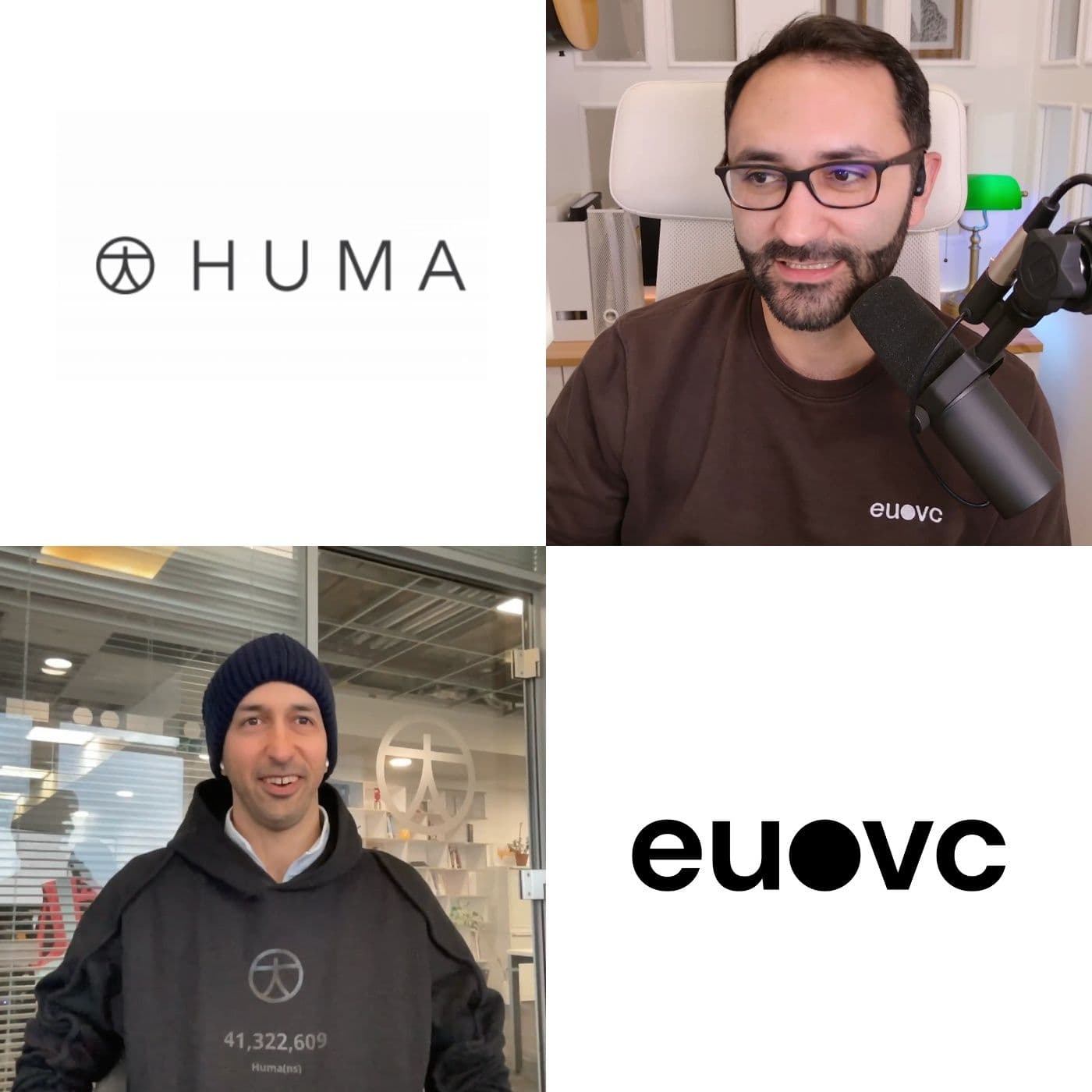
Podcast Episode Notes: EUVC E457 - Dan Vahdat, Huma: Behind European Unicorns
Episode Overview In this episode of EUVC, co-host David Cruz e Silva interviews Dan Vahdat, founder and CEO of Huma, a prominent digital health scale-up based in London. Established in 2011, Huma has evolved significantly, now boasting around 500 employees and over €275 million raised. The discussion delves into Huma's journey, its innovations, challenges in the digital health landscape, and future ambitions.
Key Topics Covered
- The Evolution of Huma
- Transitioned from supporting rare diseases to a disease-agnostic platform that enhances healthcare delivery.
- Development of Huma Cloud Platform, allowing flexible applications tailored for various health conditions.
- Challenges and Future Vision
- Discussion on the significant hurdles faced in the healthcare sector, including regulatory challenges and market dynamics.
- Vision for a scalable healthcare solution that integrates innovative technologies like AI.
- Starting a Digital Health Company
- Insights into the complexities of initiating a digital health venture, including regulatory requirements and market access.
- Emphasis on the need for efficiency in product development, as highlighted by Huma's operational strategies.
- Geographical Focus and Strategy
- Concentration on key markets: US, UK, and Germany, with a nuanced approach to state-level operations in the US.
- Emphasizing localized management through field CEOs, fostering direct relationships with healthcare providers.
- Navigating Regulatory Challenges
- Overview of how Huma has addressed and navigated the complex regulatory landscape of digital health.
- Explanation of FDA classifications, particularly the significance of Class II and Class II B devices in digital therapeutics.
- Partnerships and Organizational Growth
- Importance of strategic partnerships, particularly with pharmaceutical companies, to accelerate growth and innovation.
- Discussing the need for consistent communication and engagement with key stakeholders.
- Future Vision and Expansion Plans for Huma
- Plans to expand the field CEO model and develop more digital health applications.
- Potential for Huma’s platforms to empower other companies in the digital health space, fostering a collaborative ecosystem.
Key Takeaways
- Rethinking Healthcare Delivery: Dan emphasizes the radical approach of Huma in aiming to transform healthcare delivery, focusing on efficiency and scalability.
- Market Potential: The healthcare industry is viewed as a $10 trillion opportunity, with a significant portion rooted in operational inefficiencies that can be addressed through innovation.
- Operational Efficiency: Huma prioritizes cost-saving measures, treating saved revenue as high-margin income, which has successfully positioned the company amidst challenging market conditions.
- Focus on Talent: The necessity of finding entrepreneurial talent to drive Huma’s field units is a recurring theme, with a call for individuals who can navigate the complexities of the healthcare sector.
Conclusion Dan Vahdat's insights provide a compelling look into the future of digital health, showcasing how Huma is poised to pave the way for innovative solutions that can scale across diverse healthcare needs. As they continue to evolve their platform and expand their footprint, Huma stands at the forefront of a significant transformation in European healthcare.
Written by AI. May contain mistakes. Listen to the episode to check what was said.
Transcript
Automatic transcript. May contain errors.0:00What if the next revolution in healthcare isn't about discovering new treatments, but completely rebuilding how healthcare is delivered. In this episode, we sit down with Dan, founder and CEO of Humor, a healthcare unicorn that's already touched the lives of over 55 million patients worldwide. I can now do that literally in less than two minutes, the MVP version, and then less than two weeks, a solid version. That's Dan, founder of Humor, collapsing healthcare development timelines from years to minutes. But in an industry this complex, transformation does not come easy. It takes 10x more energy to sign the same size of deal.
0:40It's tough. When traditional approaches failed, Dan discovered the solution wasn't brute force. It required completely rethinking the scale of healthcare innovation. A lion trying to catch a mice, that lion will die from hunger. But for a cat, a smaller unit, it's a fantastic food. So we have the cat model. The potential impact? Far larger than what built today's tech giant. The whole advertising market is like, I don't know, one trillion. But healthcare is 10 trillion. And his approach to capturing this massive opportunity? Ruthless efficiency at every level. Basically, every year revenue you save, that's like 100 % margin.
1:21That has been kind of our philosophy. We still fly economy. company, we're very conscious, negotiate everything. Now, Huma isn't just building its own future. It's creating an entire ecosystem for healthcare innovation. Any companies that comes in and wants to build it, we invest in them. How can a platform mindset make healthcare scale like e-commerce, slashing costs and empowering patients? Join us as we sit down with Dan, who's proving that in the $10 trillion healthcare industry, commercial success isn't the end point. It's just the bigger.
2:18This show is not investment advice and the hosts of this episode may be invested in the funds and companies featured. To our listeners, this is one of those special episodes where we're bringing, I'm coining these episodes like behind European unicorns because we're trying to feature more of the 2024 European unicorns. This goes back to our core at EUVC of Platforming Europe. So Dan, thank you for joining. Dan is the founder and CEO of Huma Therapeutics. Huma was founded in 2011, if I remember correctly, my research, based out of London, 500 employees, focused in this digital health, healthcare technology vertical.
2:55We'll talk about that in detail. And as I said, recently coined a European unicorn. Dan, do you want to say hi and give a quick intro to yourself? Good morning, good afternoon to everyone. It's a pleasure to be here with you, David, and super excited to talk about everything and anything as real as it gets and as hard as and as ugly, as pretty and as realistic as it can get. Beautiful. Anyway, let's focus on what matters, which is humor. And so I will not try to explain what it is. I'll ask you, can you give us like the quick pitch of what is humor therapeutics? Very simple. you know i go to this marker that we used i always use a use an example of the pen i tell people what we do is very simple look at this pen think this pen is a person when the person is like healthy you're more stable and like this as soon as you have a disease a chronic conditions or going to recancer treatments you're more like this to those listening in without video dan is tilting the pen sideways so it was vertical no but doing great job i'm just giving like the the the cc version right so it was vertical and now dan is tilting it slowly so it's becoming sideways perfect and as the disease progress if you don't get the best care the best supervision you slowly deteriorate and the pen goes goes goes to more like a horizontal place which is like when you die and that's not a good thing.
4:26What we do, we come here on the top of the pen and we try to either slow down the progression of the disease or push you back to your most optimized version of yourself. Someone with asthma, most optimized versions might be very different to the other persons and that is all okay. And the way we do it, we have built this kind of applications platform. Now we call it, everybody knows it as a Huma Cloud Platform that became the first and only disease diagnostic configurable FDA class to EUMGAR class to be and lots of other geography regulatory coverage that Huma people, two people in the hospitals, three people in the garage, they can go into that platform and launch an application for that specific disease, the specific care pathway.
5:16and ultimately that app, which connects to variables, connected sensors and so on, navigates the patients to go from A to B, B being a place that their disease is managed better and they are the most optimized version of themselves. So that's what we do. It's very simple. And everything we do at Huma is around how can we do this movement of pen better and keep you the best version of yourself. Could you give like a really dumbified example, right? Because you're saying you have this Huma Cloud platform and then people can kind of build. Give us an example to those that aren't really following 100 % you're saying.
5:55Yeah. So let me tell you a little bit what we mean on the platform side. And then I go to a use case. I hope most people, they're familiar with platforms like Shopify, which is an environment that helps you to build e-commerce, right? If I'm selling, I don't know, pen, I can actually quickly open an online store through Shopify. All the shipping, all the financial billings, all the website look and feel get sorted in a matter of hours or days. And then I can sell my pen. Now, Huma Cloud Platform is that. But for launching digital health solutions across a variety of diseases and use cases. Of course, it can do a lot of things.
6:40And also, there are a lot of things that we cannot do and we won't do. And that's not kind of our core. But within the use cases we do, a good example is, I don't know, I'm already a company myself, Huma. I want to launch solutions to look after asthma patients. In this case, I go to the platform, ask the platform, can you build me an application for asthma disease management? Like this gets created, I will polish it. And then that asthma application, a doctor in the hospitals can prescribe it to you as an asthma patient. And then as soon as you get the prescriptions, you scan a barcode, the app comes to your phone.
7:18And then the app tells you what to do, when to do it, collect the data from peak flow measurements, your SPO2 measurements, your sleep data. And based on all the data that we are collecting, based on all the geolocations that we know about you, we can tell you then you are at risk of getting asthma attack, for instance, before you get the attack. Or we can say, okay, seems like your treatment is not really working because you're waking up every night. Your symptoms are getting worse or not getting better. Maybe you should see your doctors instead of six months from now, which was the original plan.
7:57two weeks, three weeks, whenever your doctor has time, sooner. So these are some of the more practical use cases that all one applications could work in that case for a patient. A lot to unpack in what you said, right? From the regulatory side to like tech and AI. But before we go there, I want to kind of go back because, you know, obviously when doing research for this, you know, I saw some content that you produce, some other podcasts you're in. And what you just described is kind of a version like 5.0 of what it was when you started, right? So what led you to want to start this company, right?
8:34And if my research serves me right, you were more of an academic profile before you went down this journey, correct? Yes, I was doing my PhD at Johns Hopkins, working, you know, and I was exposed to hospitals and health systems a lot there, growing up in a family of doctors. The start of the whole thing was me observing my family, doctors, and so on, all the people within Hopkins and partially Oxford, that they know a lot about the patient when the patient is inside the hospital. They have the EMR. They have lots of tests, this, that. The patient is in front of you. So you know a lot. As soon as the patient leaves, which is like 95, 99, 98 % of the times, depending to the conditions, you know nothing.
9:19So you go from knowing a lot to knowing nothing. And of course, most things happen when you're not in front of your doctor. So that was the whole idea that, okay, it would be really good to bring some insight, even if it's basic, even if it's really rudimentary at the time. Because we are talking about 12 years ago. These devices, they were new. Apple Watch did not exist, right? Let's think about that time. and as technology will evolve, if we get our timing right, in 10 years from when we start, that we should have more sensors, more technology, more adoption of mobile devices, more compute and all these are converging kind of factors toward the machine that it is in your pocket, collects lots of data that could be kind of really like mission critical data and based on those data drive real-time intervention, real-time diagnosis, real-time even therapeutics in some cases.
10:23So that was kind of the idea. And the very beginning, we focused on rare diseases. The beginning of HUMO or HUMO version one was doing what I just talked about, only for rare diseases. And I can talk why we did rare diseases, but that's how we started. So what's interesting here is, and you hinted to it, right? It's like how multiple other technological trends, whether it's AI, whether it's wearables, right, et cetera, influenced your vision for Huma over time. Do you want to comment a bit on what were, from your perspective over the last 12 years, roughly 13, what were the tech inflections that really were kind of a ha-ha moment also for how you viewed the future of Huma as a company?
11:11When I started, we had a very big global ambition. And that is why if you look at our history, we really tried to do stuff in China. We really tried to do stuff in multiple countries outside of the UK. The reason for it was these technologies should be something that the richest people in the middle of, like, I don't know, San Francisco to the poorest kids in the middle of India should be able to access. As crazy as it might sound, when you look at utilization of Google Map, as long as you have a simple smartphone with some basic connectivity, you have the same map functionality for anybody in the world.
11:56So certain industries, maybe a little simpler industries, they have solved that problem of access and usability. To achieve that, obviously, healthcare is tough. and there was a moment that I was really frustrated. This is like maybe three years ago that if you want to have this vision work, let's say in a vision of 20 years forward, I need to get a lot of people, a lot of people needs to be trained, how to monitor, interact, da, da, da. And then this is when I saw like two, three years ago, almost now, I saw the first version of chat GPT-2 around that time. And I was like, this could be very cool because if you can automate a lot of cumbersome things that human at the moment is doing and they're hating doing those kind of stuff, especially on the operational stuff, then you can get a nurse to look after 10 times more patients.
12:58Yeah. but working less and do stuff that really matters from the human perspective rather than do the typing and entering and this and that. And that was a moment that I thought, you know what, somebody in the industry, could be us, could be anyone, can actually build one of the biggest companies in the world, if not the biggest. And when you look at the industry of different industries, you know, for instance, Google, Meta, and a bunch of other companies, like all their market cap is on the back of advertising. I think the whole advertising market is like, I don't know, one trillion in the world, the size, but healthcare is 10 trillion.
13:39So even if you use that kind of parallel, if someone can really tap into it, and out of that 10 trillion, I think about half of it is actually human costs, right? And human inefficiencies. And if you can automate those and make people more productive, given that we also have a lot of shortage. So we are not even delivering good service to our patients. That could be something really, really special. It totally changed my perspective of where our trajectory could go. And based on that, I actually wrote a memo internally, how can we become one of the most impactful companies in the world last year?
14:17And we are really focused on delivering on that. Yeah. On that topic, and I'm glad you stopped for a sip now. Do you want to explain to us what are those numbers that we see? We see numbers on your sweater and then we see numbers on your mug. And the reason I bring it up is because you said impact, right? And I think that number speaks to it. so we we track people that we have touched when i say touched either it means they're like full fledged you're monitoring them or through some of our screening program and so on they have interacted with our software one way or the other so the number is like this one is like 40 million whatever uh this number is not new and then we chatted right i took the marker and then i draw the latest number which is around 55 million and then did the logo on my cup uh in front of you So that's kind of where we are, which is like, I guess, not bad, right?
15:11It is almost as big as a meaningful size country. Well, it's five times my country. It's not too bad. Yes. A couple of things I want to ask you. You gave this kind of parallelism between ads and healthcare. Healthcare is notoriously complex as well, right? which is, I think is quite different from the ad space. Do you want to kind of just share your perspective on like, what were some of the biggest challenges of scaling a company inside of healthcare that is very different to other verticals based on your perception and or experience? I had no experience. I was a student and then started here.
15:57I have not done anything else in my life. So I have this like singular experience, singular vision, just about healthcare and life sciences, right? Healthcare is tough. Yes, it's not comparable to advertising, but you can also argue that there was a time that advertising was very much fragmented, like billboards and media and newspaper and then TV and then radio, nothing connected. How can someone make something scalable out of it? And then there is a company that figured it out. And then people doubled down on it. I reflected back, you know, our 10 years of journey, especially the last five years.
16:37And then I got to this point that I don't know how to build the business from a use case, one use case that become a billion ARR revenue. I don't know that. I have not done that. I even don't know how to make 100 million ARR from one use case in one country or in another use case in another country. And when I say use case. Just to be clear, by use case, you mean like the example you gave, like the asthma case, right? A disease in one country or a companion app next to a specific drug, right? That's what we do. Or even, you know, supporting clinical trials of phase four or phase three. That's his own use case, right?
17:20I don't know. But what I do know, I know how I can make 10 million, maybe even 20 million ARR from one use case. I do know that. I've done that. When you think about it, okay, 10 million is not the biggest number in the world. But if you look at the number of diseases and the number of countries, and then within those diseases, you have clinical trial, you have commercial use case, you have drugs companion, digital kind of use cases. then you have like thousands of, maybe tens of thousands of use cases. And then if you only have hundreds of those, that is a billion ARR when you add it up. Now, the problem is to launch a technology for each use case in healthcare, it's very expensive.
18:15Even if you make 10 million or 5 million ARR, which is not a small number, but not a big number, and you have to invest$50 million to get there, to build the app, get it regularly to approve all the solutions and so on and so. And then if your revenue is$10 million, then maybe your EBITDA profitability, whatever you make,$3,$4,$5, whatever million out of it. That's no good business. That's actually shit business. You invest the$50 million, you're only making$3 million. It's going to take a very long time for you to make your money back. and the big things that changed our life, and that's kind of unique to us, the Huma Cloud Platform.
18:55Because with Huma Cloud Platform, if in the old world it would have costed me 30, 40 millions to launch an app for my senior gravis, a rare disease, and another three, four years of going back and forth with regulators of this country, that country, I can now do that literally in less than two minutes the MVP version, and then less than two weeks, a solid version. I'm not saying that the most perfect version, a real solid version. Let's say cost me$100 ,000. So if my cost is$100 ,000 and then I make 10 million ARR, that is actually a really good business. So I can now expand it horizontally. And that's how Huma is structured.
19:42Huma does not have this customer support and enterprise sales and account directors, none of those. We have units around use cases and a CEO for each. Field CEO, we call them. And their job is go deep in this use case, use all the shared services, including Homo Cloud Platform, and be profitable, right? That is what we have done. Now, I share with you the plan. Of course, we have a past how to get to 10 billion ARR or 9 billion ARRs. We have one big challenge, and that one big challenge is talent. Can I find and hire as fast these entrepreneurial people that actually can own the unit? The unit doesn't have to get too big, you know, 10, 20, 30 million ARR, that's as big as it needs to get, but that is not an easy task.
20:38And having these entrepreneurial people is really important because when you navigate selling to hospitals or selling to large pharma companies, it's not, you know, I'm selling a cup, buy my cup, good luck, thank you very much, transaction done. You need to deal with regulatory, you need to deal with internal politics, the medical, the financials. There's so many stakeholders that if you have too many layers in your organizations, you're not going to be the most efficient. Either you build a machine that's too complex to expensive so you lose money and then you die because you're not profitable or you won't be able to navigate it properly but by reducing the things to smaller pieces and having one person's owning it we are trying to make it work in a totally different way And to finish this thought with one example, think of a lion trying to catch a mice.
21:38That lion will die from hunger because you put more energy than what you gain from eating the mice. But for a cat, a smaller unit, it's a fantastic food. So we have the cat model. yeah no i love it speaks to your also your strategy of of firm building right of company building which is really cool how many field ceos you have as of today roughly around 16 17 and how many would you need to reach the ambition each unit can be anything from 5 to 15 million right arr our ambition is to get to 9 billion at least the origin the current plan is to get to 9 billion ARR. So do the math. Of course, some of the accounts can be bigger.
22:27And then at some point you can consolidate. Yeah, exactly. It's not for the exact number. It's just for an idea of scale, right? Because what you said is incredibly insightful. Like the talent challenge is huge, right? And as you said, it's a special profile, right? It's a very, very special profile in many, many ways, not only because they'll own a P &L and blah, blah, blah, but also because it is this specific space, this specific vertical, as you said? The talent are actually there. You know, I tell people, you know, anybody that had a problem with their family or girlfriends, they started a digital house company.
23:03So there are too many people doing digital house, to be honest. Instead of that, I think people should join companies like ours, run a unit, we give people 10 % of their EBITDA they generate. So it's actually extremely generous from that side. And you get some base salary and you have your share options and everything. And this can be a lot better than starting a company and then not getting anywhere at the end of the day. It's tough. Starting digital health companies is really easy. Having a digital health company that works out, good luck. There's not a lot. There's a handful. Yes. There's a handful.
23:45How does geo play into this? You mentioned when we were talking earlier before that you tried Asia and different regions of the world. Are you focusing on specific geos? Do these field CEOs have to cover multiple geos? How does that work? Usually we are into the whole mindset of one person does one thing, one city, one location or one use case. So we rarely get someone to go global. The most important geos for us are US, UK, Germany. the core geos that we really and then sometimes through partners especially around pharma contracts when we do clinical trial or they use our software as a companion to their drugs we do like 10 20 30 whatever 40 country rollout but that's a little bit unique but the core things we do is just like focus to one geo and in that model i can tell even that like for instance in the u.s i don't look at US as one country.
24:45I look at US as 50 countries, each state. And in the case of asthma, we are actually building a model. Each state has its own field CEO for asthma. Because we did the math. If I can have 10 ,000 patients, let's say in one state averaging, that 10 ,000 patient gives me roughly 10 million ARR, right? Sounds reasonable, sounds doable. It actually is doable. We know that. But then if you replicate that across all the 50 states and average it out, that's like half a billion ARR. There aren't that many companies that make half a billion ARR in our industry. So by actually breaking the problem to smaller pieces, it becomes in many ways more digestible, more manageable.
25:33And then also because you have one person in the state, that person can go and spend time with that account. worst case they need to drive in a couple of hours or do a flight of half an hour you have the coverage instead of now one person's flies to that country and another country and then this and that and you're far from your customers that's kind of how we are trying to solve this by breaking it to smaller pieces i want to talk a bit about huma cloud platform but before i want to ask you something I love asking, which is what's one of the best tips you've ever received whilst building Kuma?
26:11One good tip one of our investors and board members gave it to me that he told me something along the line, companies don't succeed because the amount of revenue they make versus and they succeed because all the savings they do and cost considerations they put toward making that revenue. basically every year revenue you save not to lose it that's like 100 margin on your top line that has been kind of our philosophy that's why at huma we use teabags twice we still fly economy uh we are very conscious negotiate everything we try to be very cost conscious although So in many ways, you know, we are in much better place than most companies in our industry that I know they spend a lot more than us.
27:11We don't spend much in marketing. We actually have borderline zero people in marketing. And these are all kind of savings from our perspective. I don't know how much it impacted you. Curious to hear your comments, but you saw the hype season of venture, right? In Europe, at least the hype season and then the post hype season, let's call it like that. and this this rationale i guess feeds into that timeline so roughly three years ago two three years ago something like that right i imagine how did that affect huma if at all like or you as as a founder it did it did affect us uh because there was this mindset and uh optimism that and it was true by the way at the very beginning of covid time especially that these contracts are coming you know we ourselves like signed relatively easily like a nationwide contract in germany it's no easy easy undertaking and you think to yourself okay if i sign germany i should be able to sign at this another 10 countries that way and then soon we realize it's not that easy and there are so many other considerations and then the work changed right people's perspective changed the attentions changed one is that momentum we thought is coming and then the industry and everyone investing and spending talent recruitment became really expensive uh you couldn't find talents you have to you had to pay like crazy amounts that was not like did not make sense to us but that was what what it was so we ended up kind of although in in our blood and in our bone we knew that that should not be it but we were doing it We were making the same mistake as everybody else.
28:54High burn, revenue didn't come. Shit show, right? Bad situations, as they call it. And then soon we looked into it and I said, look, if you want to continue this way, we'll be dead. There was a time in the history of the company, I projected it is like several years ago, that August 2023, we would be, or 2024, yeah, or 2024, last August, we would be dead if we would have continued what was the industry norm. And then we changed our practices. We said, you know what? Let's not listen to what industry is doing, what expectation of outside world is from us. Let's not grow at any cost. Let's reflect on what model is the right model for us.
29:40Maybe the model that I build the country team and account management and then sub account management and customer success and having unit of 30 people for that, unit of this function and empire for this. We have had the best time at the company. The company is the strongest than ever. We are profitable this year. I love what you're saying. It's like the company's version of self-esteem, right? Not allowing externalities defined like how you react or how you act in this case. yes and you know when you're a young entrepreneur i was like very naive when i started i'm still naive but learned a lot more you kind of like assume other people are correct right they tell you you should do something or i think people should do and what i learned the biggest learning was that do what you really want to do because at the end of the day as a founder the buck starts and stops with you and if you truly truly don't believe in it you only have yourself to regret if things even gonna get worse at least you want to say you know what i did it and i it up yeah the way i wanted it otherwise you know it becomes of this investor told me and then no one wants to take accountability and i think it's not a healthy dynamic okay i want to shift topics because you said something when we started off when i asked you to give us like the short pitch of humor which i found was quite interesting you said something along the lines of you get a prescription for this app this is very like if i told this to my more like uh let's call them experienced family members it'd be like prescription for an app like what what the fuck is that even possible can you guide us through that a bit because there's a whole regulatory site here at play which is quite complex let's be honest right and especially as my perception is like health healthcare systems aren't really ready to deal with like digital health, generally speaking, but now just add AI and it's a shit show, right?
31:47It's like a whole new layer of complexity. So can you guide us a bit, like, how does this work? How the hell can you get a prescription for an app? And what were the regulatory challenges here for positioning or getting human to where it is today? The way we look at it is very simple. When you go to your doctor, and if you have a good doctor, your doctor as a part of the consultations after it's done, it should tell you a few things. These are the drugs you should take because this drug can make your blood thinner and that's important for you and that drug does this. You should do this kind of exercise because most of diseases are connected to our lifestyle, one way or the other, or certain activity.
32:31Most cases There are some exceptions. It's a good thing. And food. You need to take this kind of food versus those kind of food. All of these are prescriptions. Your doctor is telling you, do these things. For the pills, prescriptions. For the drugs, for the activity. We are no different to that. What we really are, when you simplify us, we are really continuous diagnostic because you're collecting data from you. listening all the time to what's happening to you. And then based on that, either the system itself or the person sitting behind the system makes certain interventions and course correct you.
33:16Do this, don't do this, or change this, don't change that. Which is kind of really definition of continuous therapeutics, really. Because whatever makes your life better, in my word, is kind of therapeutics. That is why we use the term prescriptions. Now, I like the term prescriptions because make it a little bit more official for the patients. One of the biggest problems we have in digital health industry, by the way, is when it gets to doctors talking about it, doctors talk about it, you know, oh, there is this, the same way that, by the way, doctors make a mistake. Oh, if you do some exercise, it's good for you.
Read the full transcript
33:54Instead of really telling the patient, you must do it. Because, and I am going to check on you. So doctors, they focus too much on the science part of things. And I think the things around food, fitness, mental health, and so on gets lost. Digital is bringing all of these things together. It has the medical side and also some of the other component. and makes it really easy to measure. Because if you can measure, then you can do something about it. It's just positioning. And of course, applications, FDA class two, most of our application at least that we have in the market. So technically it's correct.
34:42Can you just explain that FDA class two terminology? Some of our listeners will not know what that means. so basically every country it's not only FDA every country has regulations around utilization of everything in the context of human health right certain things like they fall into wellness category I don't know your apple fitness app or fitbit and this and that because they're not really related to your medical care it's just more fitness so they're not they're unregulated Then you have certain applications that maybe measure your blood pressures or you input it or you report your symptom.
35:26And then they show you some articles. That's about it. It's just more of a communications tool slash education tool. Most countries, they consider those tools as class one. And then the next level is a class two, which means based on the data that you collect, you can actually drive diagnostics, predictions, decision support, ID, adding an algorithm to the platform that, okay, if this patient, this, this, this happens, doctor A or B, you may want to consider like biologic treatment for these patients because the current class of treatment is not working or whatever that decision support could be.
36:07These are class two. And then if you have a technology that injects drugs into you or sits inside your body, then you enter into class three territory and so on, which we are not. We are like, let's say in Europe, we are class two B, for instance, which means we can do all the educational stuff, all the communication of data stuff, but we can do diagnostic, decision support, and predictions. but also we can do that for normal patients, but I can do that for pediatrics, pregnant women and very sick patients. Again, if you're class 2B versus 2A, if you're 2A, you can't touch those fragile groups.
36:51And so this is just to those listeners that don't know this, this traditionally came from equipment and consumables and drugs and stuff like that. And it's been updated over the years to digital, which has been a challenge in itself, a bit out of the scope of our conversation, but obviously relevant. I was listening to something you said on another podcast, kind of a lesson learned, where you said something around when you're partnering with other organizations. And if I remember correctly, it was, you're talking about pharma companies, generally speaking, but how important it was for you to have like quarterly touch points with these with these stakeholders?
37:29Is that something, this was a while ago, this recording. So is that something that you still stand by on? You're building basically a distributed organization with your field CEOs. How do you make sure some of these learnings, because this is a very concrete, small thing, but actually quite big, right? How do you make sure that this distributes across the organization as a founder? It is really tough because I don't know which talk you're referring to, but probably I was referring to me or us as humor to have interactions with CEO of, I don't know, Takeda or AstraZeneca or whatever on a regular basis to increase the velocity and have a path to bypass, not bypass, to fast track some of the bureaucracies inside every organization.
38:13It is important. Still, I would keep it. My hope now, one to a few years, what I'm learning from that time, was I could get more support from those executives to push things through. The challenge is pharma is a risk-averse organization, and everybody in that organization, or most people, let's not say everybody, they are really first and foremost think about their job. is my intervention put me in a situation that someone puts finger toward me and say, you know why? And then as an executive, you may not want to get into all the battles or expose yourself to fast track this, fast track that, and rightly so.
39:08But that rightly so does not solve the accelerating the speed of adoption of digital and AI across this organization. What is the solution? I don't have the magic kind of word to say, okay, if you do this, it solves. But the top-down is really important. To partner with the team is really important. And I think the most important is to be patient. And again, going back to the model of horizontal growth is because the other reasons that I do not have a hundred million or a billion ARR units right now is because these things take time. As a part of these things, you have up and down and so on. And this is an environment that no VC likes it.
39:55Because if you have up and down as one product versus being 20 % up every year, or 40 % up every year, which is kind of what they like, then you can't afford it. But at the same time, there's not much you can do about it unless you expand horizontally. That's what we are trying to do. and not have that stress and pressure that I need to get this donkey to run as fast as a Ferrari because it's a slow account. It can get big, but it may take 10 years. No one wants to hear from you what is your plan for 10 years from now in the VC industry. That's the reality. That's why it has made it really tough.
40:38Some of the smartest people have dedicated their life into digital health industry. You look at based on the energy, the capital, the talent that gone into it versus the impact. It's tough kick. And I see it firsthand because we have different businesses. I see totally per 10 kilogram of brain, I put, let's use this currency, to sign a deal of a million dollar with one kilogram of brain, I can sign the same deal within clinical trial versus pure digital health. So it takes 10x more energy to sign same size of deal. It's tough. Can you just explain that difference to those that don't really understand the space that well?
41:28What does that mean when you're talking about clinical trials versus not clinical trials? Clinical trial historically has always been the currency in a clinical trial's data. historically it was manual now becoming more automated and digital and so on. So no one argues that data is important. It is the only things that helps you to get your drug approval. If you don't have it you have nothing. So you don't need to sell people on the promise of why data is important. In digital health it's not that. You don't start with like oh this is a cop, enjoy it. You have to start, okay, this is a cup. It's made of, I don't know, silicon.
42:11Silicon is really important because without silicon or without ceramic, I can't make this cup. And then by the way, with this cup, when it's made. So you have to really go back to fundamentals. And that makes it hard. And for a lot of people that they're risk averse, I'm like, okay, why should I do this? And that is the problem. Okay, we're coming to the end of our time here. and I want to wrap up with the future. So without revealing too much, what's on the horizon for Huma? You've shared a lot already, right? But let's kind of try to do it in wrap-up style. What's on the horizon for Huma? Any exciting developments that we should watch out for as bystanders?
42:53I think what we are really excited is to expand this field CEO model. So anybody and everybody that's interested or knows someone interested, we like more. I can spin out 10 use cases today or tomorrow if needed to be and make all of those profitable, literally pending I have the right talent. That's one. The second is we built this human cloud platform to really solve the pain point of building something that is a scalable, safe, secure, but then also with our regulatory approval, regulatory future proof or regulatory approved. Because all these things, they were paying for us. They were hurting us.
43:37They were eating into our margin. They were slowing us down. Now that we have built it, we started thinking, okay, maybe at some point we should open it to others to use it and build their companies on top of us. If you want to do a, I don't know, sickle cell disease project, product disease management, maybe you don't need to go and reinvent the wheel. The same way that it sounds almost stupid, someone goes and build AWS version equivalent because you need that. I think there will be a time very soon people would say like are you out of your mind you know building the old technology stack and focus on building the business focus on making your unit economy with the technology that saves you a lot of time and money so we would love more and more companies coming in and in any companies that comes in and wants to build it we invest in them from our balance sheet.
44:35And we can help them to raise money, lead the round, or co-invest next to others. We don't mind. So that it's not, HEMA is not a body technology for our own use case. The vision of HEMA beyond impacting the patients is like, how can we accelerate adoption of digital and AI across care and research? And the only way we can really fulfill our mission is by enabling others because medicine is so vast. Humo will not ever, no matter how much money I have, to cover it all. So that is another area that we are super, super excited. Now, that's really cool. I think it's really cool that what you just described, like building on top of it.
45:19And I think like the regulatory side, it's the boring side, but it actually, as you said, right, focus on the business, right? So I do really appreciate what you're saying because I do think it's super, super exciting. And also what it could mean for the future of Huma as a company as well. Obviously, I guess that vision is what excites your investors as well. Dan, thank you for your time. Thank you for being so transparent and sharing so much. I really enjoyed it. I hope you had fun. And I hope our listeners and readers enjoy it as well. Thank you so much. I had a lot of fun too.
From the publisher
In this episode of our "Behind European Unicorns" series, David Cruz e Silva talks with Dan Vahdat, the founder and CEO of Huma, to unpack the journey behind one of Europe’s standout digital health scale-ups. Founded in 2011, Huma is headquartered in London and has grown to approximately 500 employees, raising over €275 million to date.
Dan shares how the company evolved from supporting rare diseases to building a disease-agnostic, globally scalable platform used by healthcare systems, research institutions, and pharmaceutical giants.
Here’s what’s covered:
- 07:09 The Evolution of Huma
- 09:56 Challenges and Future Vision
- 22:16 The Challenges of Starting a Digital Health Company
- 22:40 Geographical Focus and Strategy
- 29:57 Navigating Regulatory Challenges in Digital Health
- 36:12 Partnerships and Organizational Growth
- 41:26 Future Vision and Expansion Plans for Huma


