
In short
EUVC Podcast Episode E466 Summary
Podcast Title: EUVC Episode Title: E466 | This Week in European Tech with Dan Bowyer, Mads Jensen, Lomax & Andrew J. Scott Episode Description: The episode discusses recent developments in the European tech landscape, focusing on various topics including the wind energy crisis, deep tech challenges, and the shift in investment models.
Key Takeaways
- Europe’s Wind Sector is in Crisis
- Hornsea 4 Project Cancellation: Ørsted, a major Danish energy company, canceled its Hornsea 4 offshore wind project due to rising construction costs and supply chain constraints.
- Economic Factors: Increased interest rates and supply chain issues have made large infrastructure projects less viable, leading to fears of a decline in the European wind energy market.
- Public Sector Catastrophes
- Fujitsu’s NHS IT Project Flop: The disastrous £12 billion NHS IT program, which was never rolled out, exemplifies failures in public sector project management.
- Need for Smaller Companies: There's a call for smaller firms to be involved in government contracts to ensure projects are successfully executed.
- UK-EU Trade Strategy & Youth Mobility Deal
- Discussion around the potential of a youth mobility deal post-Brexit to attract talent back to the UK, countering recent losses due to tightened immigration laws.
- Global Trade Dynamics
- Trump’s IP Tariffs: There’s concern over potential tariffs impacting the tech industry, especially regarding intellectual property and media production.
- Venture Capital Evolution
- RIA Funds: The shift of major VC firms like Lightspeed into Registered Investment Advisor (RIA) status signifies a broader investment strategy that transcends traditional venture capital.
- Adapting to Market Changes: Venture capital firms are adapting to the prolonged private lifespans of startups, providing more flexible funding options.
- Secondary Markets in Venture Capital
- The secondary market is becoming increasingly vital as companies remain private longer. This trend is reshaping how funds manage liquidity and exit strategies.
- AI Arms Race
- Competition: Google claims its AI model is now superior to Anthropic’s Claude, highlighting the competitive nature of AI technology development and the rapid pace of innovation.
- OpenAI’s Status: OpenAI is navigating internal controversies regarding its operational model, balancing between nonprofit and for-profit frameworks.
- European Drone Startups
- Unicorns in the Drone Sector: Two drone companies, Tegeva and Quantum Systems, have recently achieved unicorn status, showing growth in defense and surveillance technologies.
Discussion Points
- Economic Implications of Interest Rates: The episode highlighted the impact of rising interest rates on capital-intensive projects.
- Public vs. Private Sector Performance: There's a growing concern over how efficiently public sector projects are managed compared to private sector initiatives.
- Adapting to New Investment Models: There’s recognition that as the venture capital landscape evolves, firms must innovate to remain competitive.
Conclusion The episode provides a comprehensive overview of the current state of European venture capital, reflecting on significant shifts in energy, technology, and investment practices. The discussions underscore the interconnectedness of global economic factors and the rapidly changing landscape of startup funding in Europe.
Written by AI. May contain mistakes. Listen to the episode to check what was said.
Transcript
Automatic transcript. May contain errors.0:00Welcome to Upside for the real stories behind the headlines affecting European venture. Joining today is Lomax from Outsize, Andrew from 7 % and Mads and myself from SuperSeed. For a bunch of private market players, we are going to be spending much of this episode talking about public markets. So I'm not so obvious insights into why they're important to our ecosystem, how a blended VC model that crosses both has been forged, and how this new investor category will come to Europe, or will it? If you're a founder, investor, or simply lover of our startup ecosystem, you're in the right place.
0:34Tear down this wall. It's more than just an alliance. This is a union of values. Let's start acting. This show is not investment advice and the hosts of this episode may be invested in the funds and companies featured. Gents, what a pleasure to see your fine faces. Andrew, what's new with you this week? What's on your agenda? Well, tonight I'm going to go and have some beers to celebrate VE Day. I think it's something that I think it's important to celebrate these things I think it's important to remind us that our freedom comes at a cost and people have sacrificed in order to get there so I'm going to raise a glass to that and busy busy Mads what's cooking with you?
1:24Just back from Copenhagen always good to be there excited to round off the week with a chat with you fine fellas why not no max what's happening how's the beachfront to come spent actually my lunch break with a builder today scoping out the wet room the surfboard room in the wet room and the meet and the meeting rooms and the recording studio for our podcast there you go and i spent tuesday in a ct scanner and i got my radiology radiology report at four o 'clock this morning which i was awake for and it was clear so right onwards nice that's onwards every time we've spoken it's been clear so that that makes me smile good for you my man well it better not because if it's not it's you know terminal so let's you know that we yeah we don't want to be here when that happens well all i heard was clear that's all the goodness but we've got a bunch of stuff to talk about we're we are going to be bouncing around a little bit mads do you want to kick off because this is quite a this is quite a big deal the the austin project cancellation Yeah, I thought it certainly caught my eye.
2:28We've talked so much about energy, energy security in geopolitical context, in the context of AI and data centers, in the context of competitiveness, with UK energy being very expensive. of, Oersted is a huge Danish developer of offshore wind projects. They've developed several offshore projects in the UK. Hornsea faces one to three, are three of them. And they've just announced that they're cancelling phase four, which was a massive project. Kind of total project cost was estimated at eight to nine billion pounds. But since the agreement was made with the UK government, and they sort of entered into this, what's called a CFD price, sort of contract for difference, where they effectively had the government underwrite the price they could sell energy at.
3:18The cost to construct the offshore wind has gone off by 40 to 50 percent. And Oster has come back and said, listen, we can no longer make this project work. It's no longer viable. There are so many aspects to this from both an energy and a geopolitical perspective. And I thought it would be interesting for us to unpack some of them and talk a bit about them. So, firstly, economics, why is the project no longer viable? One of the reasons is interest rates. So we sometimes talk about interest rates having gone up, and people know that from their mortgages, but what does it mean for business? And when interest rates go up from, as they were sort of 0 % to 1 % to 6 % to 7 % to 8%, or whatever you can finance that commercially today, that just puts massive pressure on these big infrastructure projects.
4:06In the meantime, there's been big, big supply chain constraints. Some of them are around what's happening to the European supply chain of wind power and wind energy. If you go back 15 years, the European manufacturers were global leaders and Europe had by far the most capacity in wind. But since then, as in many other places, China has totally overtaken us. So what's happening now is all the capacity is going into China, is being developed by Chinese developers. European manufacturers are not selling as much as they had built capacity for. Therefore, prices go up because they're losing money. Therefore, projects are no longer viable.
4:45Therefore, they get canceled. Therefore, there's less utilization of the facilities. And European wind is in a death spiral. So you've gone from having 100 % market share to less than a third. And this because it's got all kinds of downstream implications. Also, if we think about this from a clean energy perspective, It is cheaper to construct offshore wind than to construct things like nuclear. Notwithstanding the fact that nuclear is great from a baseload perspective, wind is still cheaper when you take into consideration the cost to operate and dispose of the nuclear waste material. So it can be a really, really valuable addition.
5:21And so the question is, what do you do in a situation like this when private enterprise can no longer underwrite a project? And I actually think a solution here could be for the government to finance and own this project. The government's cost of capital is much lower than private cost. And so therefore, you could have government underwrite the project and take the equity upside, potentially selling the project at a future date once it's constructed. Many, many more things to unpack. But I thought it was just it touches on so many of the things we've talked about that I thought it was worth a little bit of a double click.
5:52There must have been a negotiation. I mean, they must have got, Austin must have gone back to the British government on the contract for difference price. No, there must have been a negotiation at that point. I'm absolutely sure they did. And I'm sure that they're now saying they're cancelling to try and put pressure on the government. And I think the government should simply say, fine, you know, you could drop it or we're going to pick it up. Because you've had a lot of pre-project work done. You have a lot of costs that have gone in. You're basically burning up equity and you're not getting the capacity.
6:20Everything's designed. Everything's planned. Everything's there to go, ready to go. see i slightly disagree is like i wouldn't have the british cup i mean i don't think the british government could execute this to be honest but what i what i would say is is that the hand of the government needs to reach more into this project and offer the kind of guarantees that would reduce the cost of financing offer a better price on the contract for difference you know there would still be there would still be enough upside for the well clearly there would definitely be enough upside in it for the for the private provider but who would pick it up No, Max.
6:52Which entity would pick it up? I can't think of one. Well, I offer also a better term, is what I'm suggesting. Oh, I see. I see. But I think the challenge you have with this is that the taxpayer always end up without having the upside. You've got great British energy here. I completely agree with you. The government should not be the developer. You need a private developer. But you can have a private developer, and then you can have a government contract and underwrite the project. I just think there should be some equity upside at the end of it. So it's not just cheap loans. I mean it's now bloody smart let's see if they can be smart Lymax what's been on your mind?
7:28What's been happening this week well there's an interesting report put out by Albion which is a London based venture fund summarising the recent kind of deep tech landscape and importantly the thing that caught my eye was the future of compute landscape in the UK you'll make Andrew happy then correct exactly chips new new modalities of computing companies etc so we'll park the deep tech aspect because i think we've we've talked about that a lot and it wasn't particularly nothing new there but i think what was staggering was future of compute which is this like absolutely like critical industry and capacity in 2015 3 million was the total amount invested in future of compute category in the uk 3 million outrageous yeah in 2025 it's 300 million right so it's gone up 100 times which is really really good to see it's still a tenth of the us which is three billion right so you know we are still a long long way behind that what also catches your eye but it's not surprising given that three million is there's only there's a complete lack of exits you know there's one exit which is which is graphcore company that you probably know you know well which was a chip producer out of bristol that raised a lot of money raised 700 million was heralded as the you know setups building in 2015 2016 2017 building chips for ai you would have thought ahead of ahead of the game well in place to secure a dominant position but it's been completely blown out the water by nvidia to the point where graphcore was sold to softbank for less than what it raised so actually you know you look at the future of compute landscape in the uk it's been pretty underwhelming but if you look at this report more money going into it and now you know bigger rounds over 50 million pounds for interesting companies like river lane quantum motion this is happening but it's you know unfortunately as always it's a little bit slower than we'd like certainly interesting things happening there i mean andrew and i you know make investments in this space i know andrew you've got more more in the in the field than me i don't know what you're what you're seeing at the ground at the moment i mean there's a lot of uk startups um attacking many of these problems but i agree with you we just need more money goes back to it's always more money right you need more shots on gold better funded so it goes back to the same story I sound like a stuck record.
9:45Yeah. A good example is SciQuantum, right? Which is one of the best funded and quote unquote advanced quantum computing companies, right? So they've raised in capital terms, I think over$650 million. But the academics and the research came out of the University of Bristol in the UK. You know, they ended up incorporating in the US and it's a full, largely fully US project with a bit of an Australian footprint. But that was a UK kind of IP academic story that just left these shores ab initio and moved straight to the States. And, you know, it's actually been enabled and had a lot of value unlocked by that, by doing that.
10:21Whereas we know a lot of quantum companies trapped in Europe who have a harder time trying to raise money. So it's good to see that things have improved, but still a long way to go. Andrew, we'll call you right this week. the think tank said that it was going to cost 21 billion over the next five years to modernize the nhs so not really startups but uh hopefully money that could go towards startups and i say hopefully towards startups because and we've touched on this before people may remember the national program for it and the player government which was an nhs database for 50 million patients started 2002 run by Fujitsu, Accenture and BT.
11:00Lots of smart people there, surely. Yet it was budgeted at$6 billion, ended up ballooning to over$12 billion. The National Audit Office described it as one of the worst and most expensive failures in public sector history globally. And nothing came of it. Like, it was never rolled out. It was a complete disaster. That's Fujitsu of the Postmaster scandal, no? Yeah, exactly the same Fujitsu. And isn't that terrible that they did that and then they went on to do the same thing with the Post Office. So I really worry about where this money is going to go. People in the frame are, you know, a little bit of the usual suspects.
11:33And I think there should be a policy that you bring in smaller companies to deliver smaller projects, which then work. And then you work out how to scale those projects. You know, that's what the big companies do in tech. That's what Google did with many of their products were built perhaps by two or four engineers. You know, the Google Maps and even Gmail. initially they release them to a small group of people internally to use you improve you iterate and then the real engineering cloud comes when you have to like scale it up to work for millions of people so i really worry about the direction that's going but to be fair andrew so that is exactly the approach that's being advocated for in the government's new atist ai strategy which is exactly about two policies link up because we've seen so many times that you know I have one mouth over here that says one thing.
12:21Over here, something else is happening. How are these, who is in charge of ensuring that the sentiment in that AI report will be executed on with this money that will be spent with the NHS? Well, it's a terrific question. So who's in charge is Matt Clifford, who wrote the report, and he now sits in number 10, reporting to Kirstama. So you can't get much more central focus on it than that. Now, whether that's enough, I mean, time will tell. No, but he may not be in charge of how the budget is spent by the departments that spend the health budget. That would be the Department for Health. Yes, correct.
12:57So, you know, let's hope he's good friends with the powers that be of the Department of Health. I don't know how these projects are run in government, but I've always wondered why there isn't a two-tier system where somebody just sets the frameworks for whatever project is being built. and then hands it over to private contractors, organizations, startups, whatever, to compete within the project base according to the framework that's been set. That, to me, just seems like a really sensible approach. Does anyone know how these projects are actually rolled out in government? I remember it fit very well because I was at IBM and we bid for it.
13:40And in the end, the company decided that the government's approach was so nonsensical and that nobody was ever going to make money on it. And IBM walked away from the contracts. So the government is not very good at these big procurement projects. You're absolutely right. I mean, there is an attempt to try and compete and put up competition and to negotiate smart contracts. But then there is the management of it afterwards, which is why I think, as Andrew says, the reverse project, the reverse approach of starting with smaller things, piloting them and then scaling them up, is probably a much more sensible approach than these massive, you know,$10 billion IT projects.
14:18Anybody listening to this podcast who runs a company, you know, even big or small, the same logic applies that the man's just said, which is when I did some consulting for AstraZeneca years ago, I went in with their innovation unit. The first thing I did was chop the 25 person team by two thirds for the first version of the product they were trying to get out the door because the team wasn't moving forward because the team was too large to actually just roll out a smaller MVP of value to achieve the first step of their bigger goal. And, you know, within weeks, we had something out the door. So I think the lesson there is exactly that.
14:53It's start small, prove that you can make something work, and then scale it up. You start, you know, you climb the mountain from the bottom, not from the top, right? Well, let's hope some lessons have been learned and let's hope that it's not Fujitsu leading the third attempt. Well, that's always the way with these big kind of projects is like the incumbents have the distribution and the ability and the timeframe to actually enter and participate. And entering a government procurement process when you're raising money every 12 to 18 months as a startup, the timelines don't necessarily fit. The government has a lot of questions about your financial robustness that you probably don't have answers to.
15:30and so it's a often a process that does not favor the small lean nimble startup i mean in a way there's a sort of analogy with what's going on in ai at the moment is i'm sure you've read and seen you know who's making the most money out of ai it's accenture and mckinsey and bcg and all those folks you know it's slightly different point but the point remains the same is those people have the distribution and and the relationships and it's easier for the people who are hiring these people to hire them rather than getting involved with startups which they don't really understand and it's more risky bet for them and their careers to to give this work to to people unknown so let's let's hope let's hope yeah yeah exactly let's hope there's someone smart in charge of this we've started on we decided on such a bummer and i've got another bummer i've got i've got doordash i saw that no what's the next bummer well it's i mean i've been good i've got it somehow i've got We've got upside, not downsides.
16:25We're going to somehow lift the energy. But I've got two things that caught my eye this week. One was DoorDash buying Deliveroo. And I was just looking at the trajectory of both companies. Obviously, one, Deliveroo being UK and DoorDash being the US. And DoorDash's market cap is 23x that of Deliveroo's. How much cash went in, what they did with it. I mean, an investor who bought a share of DoorDash has seen its value rise 84 % and Deliveroo's has fallen by 56%. The numbers and the way, and obviously, there's lots of shoulda, woulda, couldas that we're reading in the press now. So hopefully someone is going to make some money out of this.
16:56I'm sure some of the early teams will, which is great. Yeah, it is a bit of another bummer. It kind of makes me sad. But, you know, this is the world that we live in. The other thing that called my was the EIF is doing the rounds, looking for a pulse check, you know, interviewing people like us in private markets and asking us about how the fundraising environment is looking. Are we looking to do more deals, fewer deals? They're looking, talking to VCs and private equity. That's the EIF. But at least half of this questionnaire was around the US administration, so about Trump and how their policies and his policies are going to affect us.
17:32So no results as yet. So I just thought it was quite interesting. And this barometer survey is being done right now. So in the weeks to come, we'll be able to come and have a chat about that. It'll be out of date. It'll be out of date very quickly. Yeah, when the tariffs are all gone. Listen, other news is we're moving closer to the big UK EU summit. And there's been a lot of discussion around this youth mobility deal. I think that's an incredibly exciting idea. I always think loss of freedom of movement within Europe was one of the biggest victims of this terrible Brexit policy. And I just think London was such a magnet for talent.
18:07And this youth mobility deal could be the reopening of that, right? Making it super easy for all the best and brightest from across Europe to come to London and work, start startups and do whatever they want. Which I think is fantastic. there are some splits around how it should be interpreted, how should it be done in practice. I think a deal will be done, but it's not done yet. And there's some, I guess, in the UK government side, some anxiety over reform and Farage waiting in the wings. You know, anything that looks like capitulation to the evil bureaucrats in Brussels. Yeah, and I think it's important on today, right, where we have this sort of US-UK, I mean, I think a trade deal is overblowing it, right, because a full-blown trade deal needs approval of congress right but what whatever is being agreed between the uk and the us today and respect of trade is it's important right but remember that you know the eu uk eu trade is roughly three times what the uk us trade is right so it's like as mad has pointed out like the eu is like by far and away the most important when it comes to the trade you know trade in and out of the uk and i feel i feel for keir starmer balancing you know trying to trying to play both hands.
19:19That must be, I don't think any more letters from the king is going to wash that one. If you read the centre-right, you know, right-wing press in the UK, then it's all about the US deal. But actually, again, the numbers would dictate otherwise. I mean, certainly the playbook for how to negotiate with the UK seems clear now because we've just concluded that a trade deal with India and the crux of that seems to be India slapped a lot of tariffs on the UK and now have used those to extract concessions and they will take the tariffs away. Cue Trump slapping tariffs on the UK and we use them to extract some concessions.
19:54I hope it doesn't mean that we'll be drowning in chlorinated chicken, but who knows what will be ferried in. Gents, I want to talk about public markets, even though we are not in public markets. I want to talk about public markets because they matter. I want to talk about why they matter, how they fit together with what we're doing and what's happening right now that's going to roll back and affect Europe. A few quick fun facts before we kick off. US IPOs when they happen. I know it's all been a bit slow. I'm nearly twice the size of European ones. 30 % of series A rounds in Europe have a US investor, which has tripled over the last 10 years.
20:2770 % of Euro startups raising US VC flipped to a Delaware C Corp. I didn't know that. I thought it was quite interesting. And 50 % of Euro tech exits are cross-border with average acquisition price being two and a half times higher in the States. So Mads, talking about public markets and talking particularly about Trump's tariffs on US movies. What's happening over there? So I'll have to think maybe a bit about how to connect the movie tariffs with public markets. But while I do that, let me talk about why I thought that tariffs were interesting. Well, it's because we've often talked about the software industry being a little immune to all the tariff nonsense.
21:02We don't sell real goods, do we? We sell software. We sell IP, which you can load onto a data center sitting in Delaware or in Kentucky and therefore circumvent these tariff barriers. Now, Trump, he has in his wisdom said, listen, you evil foreigners, UK in particular, you are offering incentives for Hollywood movie studios to produce their movies abroad that creates jobs overseas and not here. And you do that by giving these tax incentives. And so he wants to put tariffs on these movies that are produced abroad to get the movie production back. and it raises the question, how do you do that practically?
21:41What is it you're tariffing? You're not moving a car. You're not moving a good. You're just moving IP. What's the cost of the IP that you're actually putting a tariff on? How would they do that, Manjib? Would they value the movie? How would they do that? You're going to have to put a value on it. And as we know from transfer pricing, which is very, very much a science within large corporates, is when you have intellectual property that you can move around the world, It is extremely difficult for governments to figure out what this thing actually should cost, which is why we have so much stuff flowing through Ireland and we have the double Dutch and we have it mixed in with a little BVI sandwich in the middle and whatever they're all called as this IP moves around the world and in an attempt to try to minimize the tax burden.
22:25So if anything, I think this is a signal that Trump is aware that IP is a big part of the global trade discussion, but also maybe that he is in his usual chaotic style trying to slap tariff on something that may not actually be so tariffable, if that's a word. Sabre rattling, surely. I mean, nothing can come of it. I have no idea how this is going to bring back. I remember reading an article that he was bringing in, it was Sylvester Stallone, Christopher Walken, and somebody else to manage the project. And I was just trying to work out. And I've seen lots and lots of reports of Hollywood dying and nobody making movies in the States anymore.
23:07So I get the impulse and I get, you know, Hollywood back open, get all the big movie studios making movies. But I can't see how a tariff is going to solve this. I'd love to be in that project management meeting though. Wouldn't that be a cool project management meeting to be in with Christopher Walken? Do you know who the third one was? There was a third actor. Do you know who the third one was? It was some other big, big A-list, the big kind of 80s A-list. I can't remember who it was. It was like Stallone X. But yeah, what are they going to do? How are they going to raise it? Yeah, I'll tell you how Europe has done it, right?
23:35Because it's hard to put a tariff in things. But basically what Europe did, the EU did, was you put this digital service tax on companies that are deemed to not pay their tax, right? And then you slap a surtax on revenue. and you basically say, listen, you're going to pay 2%, 3%, 4%, 5 % of your revenue within the jurisdiction because we don't think you're paying tax on your profits. And you could easily do the same thing in the US and you could say anybody that produces movies overseas will slap 3%, 4%, 5 % surcharge as taxed to the federal government on the revenue that comes out of that movie.
24:09It's just not a tariff. And I think that's sort of the interesting. Well, that tariff is mode du jour, right? And so, yeah. It was a beautiful word in the English language. Correct. He'd been talking about it for two decades. One of the things he's probably trying to negate is that a lot of regional centers for filmmaking, including the UK, for a long time have been very aggressive on tax rebates. And so it's been far cheaper sometimes to produce movies, even in the UK than the US or other countries. So it may be an attempt to actually lure the making of the movies to stay back in the U.S. I don't know how he's defining a U.S.
24:51movie. Is it just the studio that owns the movie and the IP can sell it as a U.S. movie? Or does it have to be made in the U.S.A.? Because if it's got to be made in the U.S.A., I understand the logic. Yeah, don't know. Maybe it is just, to learn Max's point, a bit of saber rattling, get some people talking, bang some heads together, and maybe something good will come out of it, but we'll see. We're not going to be able to segue this from public into where I want to go, but I want to talk about Lightspeed and I want to talk about them turning into an RIA for a registered investment advisor. Tiny legal change, massive commercial one.
25:26I do want to talk about why this is important. But first up, some concepts. So Lightspeed unbecoming a VC is partly because founders are staying private longer. LPs and founders have always been open to more supportive, further reaching general partners for optionality, liquidity along the track. It's always smart if you can do more than just the VC playbook. Partners who can play broad or deep across stage and structure is really, really important. The existing VC model is, as most people know, 10-year fund cycle, light ownership, power or portfolio, reliance on IPOs or meaningful trade exits.
25:59This new RIA structure, which a number of people are, and Lomax, I'm going to come to you, Perth, who's been doing what behind the scenes in the Bay. But it enables people to stay VC if they want to, pretty much do anything else in private public markets. They can acquire low cost, own more and venture build with SaaS, that's SAS, service and software, not software of the service using AI. They can build platforms, not portfolios. They can attract new LPs and founders with more supportive structures, and they effectively become an asset manager or a hybrid operator. So I've got loads of questions for the room around this.
26:35Is this our future? Is this a new investor category? Is this just for the mega funds due to the return profiles? Or is it this new AI beast that's driving this new model? And obviously, what and if anything will come to Europe? So Lomax, where would you take this behemoth of a topic? Well, I try and simplify it to describing this as a natural evolution of the US venture market. So we can talk about why this is relevant for europe in a minute you know for context the the u.s venture market is 20 30 potentially 40 years more mature than the european one so it's a lot further ahead as a market so this could be in terms of relevance for europe where europe goes further down the track so what's happening now is you have a few big u.s venture funds lightspeed andreessen horowitz general catalyst it's it's a very kind of technical change.
27:35They've registered as an RIA, as Dan said, a registered investment advisor. The reason why this is, is because historically traditional venture funds in the US have been constrained by regulation to invest 80 % of their capital into primary issuance. So new issuance of shares to raise money by companies in the private markets. So they've been quite constrained in terms of the type of investments they can make. Now that has led to, or been fine when you're running a traditional venture fund, which is normally where you take money from investors, you invest it in a bunch of startups, you hold it for 10 years, and before the end of the 10 years, you return the capital to your investors, to your LPs.
Read the full transcript
28:20But I think what's happening now is a couple of things. Number one is the time to the traditional exit, which was used to be the IPO. So the initial public offering when the company listed onto a stock exchange has grown, it lengthened dramatically from say seven to eight years to 12 to 15 years. Some of the reasons for that are number one, I think the barrier or the hurdle required to IPO is much higher. In 2008, it used to be, let's say 80 million of annual recurring revenue. It's now more like, I don't know what you guys think, but 200 to 250 million of revenue is your sort of threshold to IPO in the US.
28:58So the threshold is raised, so it's harder to IPO. Secondly, there's also more capital that's entered the quote unquote border technology ecosystem, which means that founders have more capital opportunities to raise money before going into the kind of bigger public markets, right? So what does this mean if you're sitting there as sort of Lightspeed or A16Z, Andreessen Horowitz, and you've been running these traditional A16 did this seven years ago. I think Sequoia, Thrive. I mean, almost a case of who hasn't in the Bay. No, but there's a bunch of firms that are taking this on more and more. And I think the reason why is a couple of reasons.
29:37Number one is we've just talked about companies being private for longer, which means there is a sort of opportunity there to invest in those companies, take secondary shares, right, existing shares. And secondly, I think it's product mix. from their perspective in terms of their own products, right? Which is that they have a distribution capability. They sell to pension funds, endowments, big LPs, big family offices, and they've been selling one traditional product to them, which is the venture product. Now they're like, well, actually, there is all of these adjacent products that we could potentially sell to them, buying secondaries, buying out companies, starting to encroach on what is the traditional domain of what we look at what's called buyout private equity, where you actually buy and own companies, right?
30:22And there is a relatively mature market there in technology companies. And we know the players there are Silver Lake, Toma Bravo, Francisco Partners. So we're now starting to see the venture funds cap out on the traditional venture model. The markets evolved such that there are opportunities for them to deploy capital in ways not just traditionally done. And so they can start to eat the lunch of these traditional buyout private equity funds. They can take, you know, for context, most of those buyout funds are in the sort of 100 billion of total asset under management. Whereas, you know, the light speed, general catalyst is more like 30 billion.
31:01So there's sort of ways for them to bring in more capital. And just for context here, right? One thing that I sometimes see, and I'm sure you guys see this, as venture funds get bigger, everyone gets very agitated and excised on LinkedIn saying, they're never going to be able to return five times the money on a$3 billion fund? Because I think people are thinking about things in the wrong way. Because in the case of our funds, for the risk that we take at the very, very early stage, investing to own 5%, 10%, 15 % of a small pre-revenue startup or early revenue startup, in our portfolio of 20, 25 companies, we are seeking to deliver roughly five times the money gross three and a half net of fees to investors on a 10-year period which yields a 25 to 35 % IRR depending on the nuances within that the bigger funds aren't necessarily trying to do that yeah they're quite happy to take a and actually for context why this makes sense as a business owner as in someone who actually runs one of these firms is you make more money 2xing a billion when you take the profit share on the extra billion you made than, you know, 10x-ing 100 million or, sorry, 50 million, should I say.
32:16That's the context here. It's product mix for the managers. They can make more money, quite frankly. I think it's the ecosystem now can support this and needs this because companies are staying private for much longer. I think it's natural. I think in Europe, we're just much earlier in the... There are just fewer companies at this stage. So I think it will happen. This is a factor of size and maturity. I mean, I don't even know what the equivalent of RIA is in Europe or in the UK. Well, in Europe, you have AFIM and Uveca, but they're equivalent. There's sort of equivalent regimes that you can unshackle yourself from if you want to free yourself up to do the kind of products, make the kind of investments and offer the kind of products we just talked about.
32:59So is it just a matter of time before we see more VC firms in Europe doing this? I think so, yeah. but it's more on the five to ten years ago. I sort of feel this partly is an inevitable function of a market maturing. I mean, as Lomax says, the US market's been around for so much longer, but it is still growing and maturing. It's still evolving. And these are vast sums of money these organisations manage. And it makes sense to me that if you're sitting on multiple billions of AUM, you are going to need more flexible ways to generate returns than the straight sort of somewhat arbitrary, you know, 10-year-plus-two VC model, which still persists, which started way back when.
33:48When you look at what some of these organizations are now doing, having more flexibility to manage and be a financial organization makes sense outside of the GPLP model. And it's not just on the way you invest capital, but actually the services and the types of finance you can offer to these startups. I mean, if you look at someone like General Capitalist, they've got their customer value strategy, which is where they offer to companies growth capital secured against the sales and marketing efforts. It allows companies to massively expand their go-to-market, covering up to 80 % of the costs. And the repayment is tied to the gross profits generated from the customers acquired, rather than fixed schedules of repayments or equity stakes.
34:44And the risk is actually, it is shared, but actually the startup's not obliged to pay back the funds out of pocket if the customer value isn't realized. So, you know, it's an extraordinary sort of innovative model and a way of startups accelerating their growth. And so I think it's really good news from that point of view. I'm not a big fan, as everyone knows, of multistage funds per se. So that's one of the downsides of these massive pots of money is that they can, you know, it's almost a rounding error for them to spin up a scout or, you know, carve off 100 million of their 5 billion. or in the case of, you know, double digit billions and spin up a scout program and they can come and eat our breakfast for seed deals.
35:27I always tell founders, take stage appropriate capital because otherwise you have signaling issues. So I do wonder whether that is a, how busy these bigger organizations are and bigger VCs are in early stage. I wonder whether that will continue or whether that's just a sort of function of the bubbly market and whether that, whether founders just need to learn again that that's actually a bad idea and maybe it'll go out for fashion again. So it's interesting, but I think generally it's great. You know what is interesting and it's very, very relevant to what we talked about last week from Chris with Chris from the BBCA, which is that one thing that Chris said, who works on the venture capital side within the British Venture Capital Association, was that private equity has been much better at innovating its products than venture capital.
36:14It's very interesting because this is an example of the US venture funds innovating with the kind of financial products they offer to their clients and also to the founders as well, I think. And I think that's actually a very, very good thing because it unlocks more money. And don't forget that we talked about giving access to early stage technology, offering a 25 to 30 % IRR to your LPs, to your investors. Well, there are products that sit lower than that, that offer a better rate of return than, say, the public markets, where you might expect 10 to 12 percent, that offer the kind of 15 to 18 percent in the middle that are less risky.
36:57And these are sort of these could be secondaries in EBIT, like technology companies that have, you know, lots of EBITDA, for example. It's great for technology that more people want to have exposure to it. And they may not necessarily want to invest just in the kind of funds that you offer at the early stage. They might want a different kind of product that gives investors exposure to more mature technology companies that are still private, not yet public. And also, it's all good for us because as all of that matures and more money is raised in that ecosystem, we then have an opportunity to exit our positions in the secondary market, which is maybe something we're going to come on to in a minute.
37:37Is it a new venture capital model or is it a whole new category? It doesn't feel like we're innovating in VC. It's a whole new category. I mean, effectively, there are three things that are happening here. Outcomes of technology companies have grown to a size that is unlike anything we've ever seen before. And it's not just that tech companies are a little bit bigger. It's that we are now talking about unicorns to decacorns to bona fide trillion dollar companies, which is what we're looking at, the likes of OpenAI and thinking, well, that is probably what that could become. At the same time, the hassle of being a public company has gone up and it's become a lot harder, a lot more onerous to be a public company.
38:26And so companies can absorb more capital than ever before. the place they would have done that in the past would have been public markets, but it's difficult. And if you're a founder, you can either choose between going to the types of public funds that you would have underwritten your IPO in the past, or go to the likes of Coatu that will underwrite you or Lightspeed that might underwrite your next private round now, which is much easier, much less hassle. It's expensive for investors because as an investor, you might have invested at 50 basis points or less, right? The 50 basis point might've been for a managed fund.
39:06You might invest in a tracker to get just the largest stocks and public enlisted equities. But in private capital, you're investing 1 % to 2 % plus 20 % performance fee. So it's extremely expensive. And my main concern with it is, you know, two things. The pension investors should be able to invest in these companies without paying so much when they're very late stage and very mature, and you probably don't need a private capital regime. I put the regulators that I put made it difficult to be a listed company. I hold them responsible for that. The second point is private savers, it's much harder for them to get access.
39:46Even if you're talking about offering some of these products up through wealth managers and selling it through UBS and whatnot, a lot of people don't have access to those channels. so a lot of the wealth that is created in these companies is just out of reach for miss and mrs jones but i think it's inevitable i think it's a new it's a new category and for sure it will come to europe i mean it's just a question of time when when when what was your what's your what's the crystal ball saying 10 years within i love the fact that there is a a new way a new version a new kind of and it's all kind of been when lightspeed have brought this to the fore.
40:25I just can't see how it's going to affect us in Europe as early stage venture capitalists. Well, hang on. I mean, hang on a second. I mean, it will affect us. And I think it will affect us in a good way because there are more people to buy the shares in the companies that we've invested in early stage. Yeah. But you also see more seed deals being done as five on 20 or six on 24 when actually for our fund size, the economics just don't make sense. I mean, it might make sense if you can follow on in all the successive rounds in your winners and everything is just an option. But I do think it messes up economics to some extent for early stage investors.
41:04So there are positive aspects to it, but there are also issues with it. And it's as with any market development. okay although that's a slightly different point in the sense that what what like what we were talking about with this with the ria you know with these registrations or with these um funds moving into different types of investments in a way they're moving upstream or depends how you define upstream or downstream they're moving like downstream rather than upstream do you know what i mean we're not talking about them coming back to do to our world which i think is a separate thing that is happening because they have so much money that's the point that's the point is they're doing both and because they can raise and they have more money than god as andrew says it's very easy for them to set aside you know 100 200 300 million for an early stage program because it's just optionality do we think this is just a natural part of a natural part of like both you know capitalism and the way that humans buy it's just you know tech the technology investment market has grown significantly in 20, 30 years.
42:10And, you know, these are, you know, investors are coalescing around big brands in the same way that we had in private equity with Blackstone, with BlackRock, in the same way we had it with Fidelity and public markets and, you know, like, and Vanguard, et cetera. Like, is this not, is this just natural part of how the world works, isn't it? And now the numbers are just getting really, really, really big. Does that not mean everything will become, all VC will flow in the same direction? Or we get squeezed out? No, I don't think so. No, no, I don't think so. I don't think so at all. I do think it messes up the economics on some deals.
42:45And I actually think it will do some founders a disservice. Because we all know that sometimes too much capital can kill a good guy and kill good outcomes. So I think there are founders that will struggle with this. I think there are managers that are struggling to carve out a niche and be value-add and be specialized and expert in something that will struggle. But I think there will be rich opportunity for specialized early-stage managers because even with the best one in the world, no light speed can do six on 24 on every single contrarian bet. So there will be a lot of opportunity and the industry needs it because what they're going after are all the obvious things.
43:27It's the second and third time founders coming out of open AI and starting something new. I think that's where you're seeing issues, but there will still be opportunities. But come on, look, how many engineers, how many smart people do you meet every month that are struggling to raise capital for what could be a great company? but i'm also trying to think of how many how many of those wouldn't want you know do it do a deal with somebody that can see all the way through and and give them more optionality and give you know i i cannot help but think that's it we've got more bifurcation happening but there's no option there's less optionality from the founder though because if like if all goes hunky-dory and you know you take a seat check from a16 and then they can they go oh well i took the money because they can leave the series there it's like yeah but if they don't like what you do or you fall out with part of the board, they're not going to lead your Series A.
44:13And then everyone's going to look at you and go, why isn't A16 leading your Series A? And actually, if you're an amazing company, they'll lead your Series A anyway. So there's far reduced optionality from a founder perspective. So I don't think it's good actually for, as Matt says, for a bunch of reasons that these big firms do seed deals. The RIA structure specifically or equivalents in other countries probably won't filter down to medium-sized firms because the cost of management, the transparency, the regulatory overhead and the operational complexity of doing it, essentially as a former sort of public finance house, is such that it would be awful to do that as a VC.
44:52It's bad enough as a VC anyway, especially if you're on the lower end of the fund size like we are. So I don't think you're going to see it filter down. I think it is a function of them becoming a multi-asset class finance shop. and uh you know as i think as the uk and europe continue to increase at the top end you know the billion dollar dollar or two billion dollar borders of fun next time becomes a four billion they'll probably go the same way what's more interesting is will the existing as you've touched on dan structure for us change i mean there's two and twenty gplp model has been around donkey's years when i first raised uh look to raise a gplp fund we look quite closely at other structures i thought surely there's a way to innovate on this i took my sort of entrepreneur's hat on and thought there must be a better way doing this all these people this seems really archaic and pretty soon realized that it's hard enough to raise a vc fund using an established model let alone try and sell yourself your thesis and a new model which is unproven and i think that's probably as big a reason as any why the model has not changed despite everyone complaining about it because it better the devil you know.
46:08I want to stay on a similar topic and talk about secondary so this is liquidity has always been an issue uh you know especially now with everything staying private for longer and illiquidity is a feature not a bug invention is a pocket phrase that's thrown around quite a lot and let your let your winners ride is another one I've read a lot recently but Lomax you wanted to have a quick check-in on secondaries I guess that you're following on from RIA and new models and how things are evolving where would you take this topic I just think it this is in response to a couple of you know interesting pieces that have been put out by prominent VCs of late so Thomas Tungans and Hunter Walk in the US and I think just making the point that last year's 78 percent of venture exits in the u.s came by way of secondary so we talked about earlier the traditional exit route was either an ipo which was three percent of venture exits last year or mna we talked about that plenty on on this on this group before the ipo windows are clearly very sentiment and public markets driven by definition and you know that with Klarna, which had to defer its IPO six weeks ago, eight weeks ago with all the tariff nonsense that kicked off.
47:25So we've also touched on the fact that the Bar 2 IPO has massively, massively risen from the sort of 80 million to the 250 million ARR. The point that Mads elegantly brought up is the pain of being a public company and the sheer cost of IPOing, depending on how much you're raising it's in the 20 30 40 50 million range for founders the public markets have become less appetizing appealing mna also depends on cash on balance sheets of either old economy incumbent incumbent companies or new tech companies and are subject to you know our friends at the ftc who seem to want to scrutinize every single tech piece of tech piece of tech mna so i feel that has led to um the secondary market which you know means that i you know we as event early stage backer of a company would be selling our shares to another fund one of these you know ria funds like light speed etc secondaries is now a big big feature of what we do and i don't know about you guys but like getting on the phone managing your book of investments working with founders like secondaries is absolutely critical and this this this is relevant for founders because you know often you know as a VC the secondary needs to be blessed by the company blessed by the founder right they want to know who is exchanging shares within within on their cap table so this is a big big feature of venture at the moment and it's only going to continue to be you know as a reminder you know a venture fund is 10 years sometimes gets extended to 12 years And as all of these timelines get pushed out for growing companies and for waiting for IPOs and exits, et cetera, I feel that this is a new structural reality that we face today.
49:11And I think we actually think a lot of managers are not skilled up enough at this at the moment, quite frankly. I don't know what you guys think. I certainly still have stuff to learn. I mean, when I look at some of the exits that we're looking at now, a lot of them are potentially by secondaries. Well, I think as a low-stage manager of other people's money, you need to think about how to realize those people liquidity. So we have a strategy internally where if the asset reaches a certain multiple, we'll look to sell a little bit of that asset. We've not done much of it. as a function of the fact, you know, our current fund too is only five years old.
49:49So that's those, some of those companies coming to that series B stage now, or series C where you'd think about selling some of that asset. I think that's the smart thing to do, a bit of a hedge, but you also don't want to sell the core of your crown jewels. You know, we all talk about the power law game. I think I saw a stat, something like 80 % of returns coming from 4 % of your deployed capital. I don't know if that's still true, but the general sentiment's definitely right. And so you don't want to be selling off stuff, which could give you a 100X at a 10X. One of the good things about more VCs is that there's a bit more liquidity in the market, either from secondary specialist funds, or just there's more of a market for people to play in.
50:32And as the ecosystem continues to expand, that will make it easier for us to sell secondaries. I must have seen, you know, 15 or 20 alleged secondary platform markets like software players that are trying to match, you know, secondary assets to third parties. I've only tried a couple of them. They're pretty bad, actually. There's not much liquidity. And it would be great if there was some easier way to sort of offload your asset or a secondary for an asset rather than going through what is a very backward sort of placement agent approach often of engaging someone who emails all their address book.
51:12And, you know, I'd love to see that change. I don't know how we get there, but so far, none of the platforms I've seen that claim to do that do it very well. It's a natural evolution of a market where companies stay private for longer. Of course, it's capitalism. We're going to buy and sell things. And so, of course, secondaries are going to become bigger over time. I am extremely suspicious of secondary platforms that offer to do business on a retail or retail-like basis. Venture capital is a really difficult sport. You go in early, you need to get to know companies and industries and management teams and try and form a view on the basis of no publicly available information, right?
51:57Just on the basis of the research you can do with the people in the market. And secondaries, you are then buying from people that have done that and have all that insider information. And you're trying to create a market in a world that's effectively a market run on insider information. And it just goes totally counter to all the reasons why we have public markets and why there's some regulation around them. For my book, it would be much better to lower the threshold for companies to go public and try and get more companies public. And then you have exchanges and you have good mechanisms than to try and create these weird pseudo exchanges for private companies.
52:39It's exactly the wrong answer to this problem. But secondaries in general, yes, of course, it's going to be a thing when companies are private. It makes sense. And I would say that, yeah, because, you know, and Carter, by the way, in the US tried to do this and then gave up. But because what you're really, you know, trying to create, if you really want to kind of liquid secondaries marketplace, well, there is a thing that exists for that. It's called the stock market, right? And it's heavily regulated. And there's a whole infrastructure that sits around it. So what are you going to do? Create this other infrastructure that's like maybe less regulated or less regulated stock market?
53:11Well, you've already got one of those. It's called AIM, for example, in the UK. So like, actually, yeah, I totally agree. You don't need to reinventing the wheel. But what I was just reflecting on this is, what does this mean for me in my day job as someone running a fund? Because I have a fund now that's going to be maturing in two years time. So I'm starting to think about this, right? Some of the positions in the fund is so for the good assets in the fund, you have generally no problem. You can always find a buyer for the companies that are flying, right? right the for the companies at the bottom you might as well give up on and you know you just don't waste your time but there's like a middle of your as a venture manager there's like a middle bunch of cohort of companies say five to eight positions where you can go and try and like manage a secondaries process or try and sell some secondary one thing i would tell you is it's really really really it's a lot of work yeah because you don't want to rely on all of the inbound brokers that you know ping you because they're like generally not reliable and not trustworthy and generally unregulated.
54:09None of the platforms for the reasons we just talked about are either any good or a bit shonky, et cetera. So it requires a lot of phone calls, a lot of emails, a lot of like, you know, in the case of what the project I've been working on is I will yield liquidity for my LPs and it's going to be great. But that is becoming a sort of a area that I'm spending more and more of my time of as a venture manager. And I'm expected to continue to do so. And maybe as we grow our firm, we end up firms will have, you know, head of, I think, some of these firms have now, is it Speed Invest who have ahead of DPI?
54:41I think it is. It's DPI being distributions to paid in. So actually like cash delivered to LPs from exits, which a lot of which will be secondaries as we just discussed. So maybe supersede your next hire will be ahead of secondaries. I don't know guys, but I think this is going to become a big part of our jobs for the next 10, 15 years. Mads, anything in AI Corner this week caught your eye? always a lot going on. Google have now said that yes, for sure. Now their model, which has got a name so long, I can neither remember it nor pronounce it, is definitely better than Anthropics. Claude Sonnet 3.7 at coding.
55:22So Google is saying we are now on top of the leaderboard. That is remarkable for a number of reasons. First of all, Anthropics is obviously hot competition, but also because it juxtaposes with Google's overall position in the AI market, where despite being the inventors of the transformer technology, they've now let themselves fall so far behind OpenAI that just powers ahead. And yeah, they will have to make some rapid moves now or get completely swept away and have their search business killed, I think, if they're not careful. OpenAI, of course, still mired in controversy around their, shall we stay a non-profit or shall we become a for-profit?
56:08They've now said that they definitely will stay a non-profit for now. And they're trying to renegotiate their deal with Microsoft to give them less of a profit share. The fact that they remain a non-profit puts their funding round announced earlier this year at risk. It was agreed with SoftBank in the lead. And kind of part of it was, well, you get 10 billion of investment now, another 30 billion by the end of this year but only if you manage to convert to a for-profit which it now looks like they're abandoning those plans so on one hand it's an incredibly impressive business that keeps growing growing growing but on the other hand yeah there's just controversy all around in terms of the company so it will be interesting to see how that shapes up loving it low max deal of the week two deals of the week i think mads you had most notes on these Yeah, so two amazing European drone companies announced new rounds.
57:03They're both unicorns. You have Tegeva, which is a Portuguese company, actually, so from Lomax's Nega the Woods, founded by Ricardo Mendes and Pedro Senogas. Am I saying it right? About 25 years ago, they specialize in autonomous maritime drone systems for coastal surveillance and security, and they've raised what I believe is a 100 million Euro Series B funding round They're expanding as part of the round into the UK. And this is interesting because, as we know, the UK has had huge issues around immigration and monitoring our coastline. And effectively, the drones here are special purpose-built for marine surveillance.
57:43So the idea is you could potentially add two and two together and say, well, the idea is probably to sell them to a UK government for coastal monitoring. In parallel, you have Quantum Systems, which is a German company that doesn't do quantum, but also does drones. Founded in 2015 and now also a unicorn. They produce drones that have vertical takeoff and landing capability. And they're purpose engineered for battlefield reconnaissance. And I think, obviously, we've talked about on previous programs how China is well ahead in drone technology. The question is, why aren't we just buying their drones?
58:21Well, there are all these issues around data privacy and are we going to let our security forces use drones that have called home systems to the Chinese Communist Party and all these things. And so the fact that we have some really strong European drone manufacturers here with strong financial backing seems super relevant. And I think one aspect, one other news piece that came up around drone technology is the Ukrainians. They had a naval drone that was reported to have shut down Russian jets. And to my knowledge, it's the first time kind of a sophisticated fighter jet has been shut down by a drone.
59:00So something we've been talking about coming for a long time, but clearly a sign that it's here. It's going to totally change how warfare is conducted. I think a couple of observations there as well is we just talked about the length of time that it takes to build big companies. Well, TechEvil was founded in 2001, as you said, Mads, and Quantum Systems was 2015. So both of those have gone well past the standard 10-year fund, or Quantum Systems has just gone past it. As was OpenAI. it also it's also good to see sometimes in venture being around for too long is perceived to be a very bad thing because everyone will look at your company and be like oh you've been around for ages why haven't you like done anything have any yeah just like if you're a VC Lomax correct you've been around for too long why haven't you where's your thousand x exit that's right exactly so i and i i feel that you know we all we all on this on this group i'm sure realize this is a very very long-term game whether it's you know investing and company building and sometimes in you know often in specialist areas like this it just takes time and to build real substantial meaningful value and now clearly there's more of a need for their products now but stuff takes time let's just not forget that and not lose patience andrew anything else that's on your mind this week that you wanted to talk about i'm off to uh marrakesh next week i'm already here so yeah looking forward to spend uh two two days with you know 80 of my peers it's always great to to talk to someone who feels the pain but has the wisdom and uh yeah not not to be always they're always great events all power to you and Lomax for setting them up and I will join you there obviously I'm already here with the family so I'll be here by the pool after this and then I'll see you next week and we're going to be doing a special upside with Dragon Chases and speaking to people from the community and bringing some stories to life there Lomax you'll be joining us soon I will be joining you in Marrakesh yes we have yeah as Andrew said we have 50 GPs 30 LPs European early stage venture spending high quality time together away from laptops away from phones i am going to be paragliding in the atlas mountains on thursday with five gps and four lps so i hope i come back from that there is a lot to a lot to look forward to yeah i was super looking forward to it man there's a very serious yeah it's a very serious outcome to what what what we do with dragon chasers and it's exciting to really really actually spend time with with people as individuals yeah and really get to know them yeah it's important building relationships.
1:01:52Mads, what's happening with you? I'm with the other lot. So that's the EUVC crew. They have their annual get-together in London next week, and I'll be joining them, and I'll be looking forward to meeting many other peers here in London town. Whittling armoustaches. Lovely. Thank you, gentlemen. I will catch you all next week. See you on the flip side. I'll see you on the flip side. See you on the flip side.
1:02:22It's more than just an alliance. This is a union of values. Let's start acting.
From the publisher
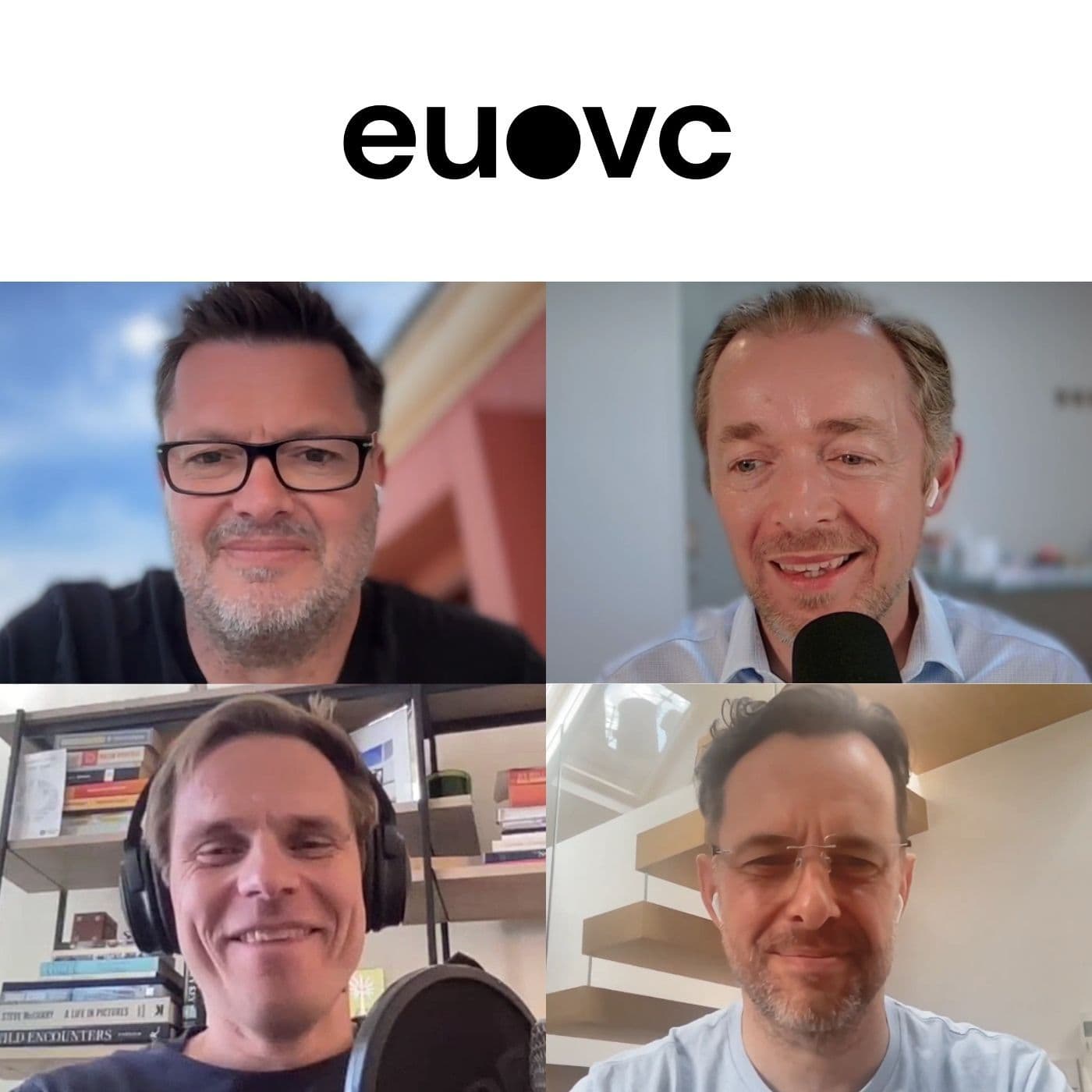
Welcome to a new episode of the EUVC podcast, where our good friends Dan Bowyer and Mads Jensen from SuperSeed, in discussion with Lomax Ward from Outsized Ventures to cover recent news and movements in the European tech landscape.
Behind the headlines—wind implosions, deep tech dead ends, exit deserts, secondaries, and AI drama—lie seismic shifts that will define the trajectory of European startups and the capital that fuels them.
Here’s what’s covered:
- 01:30 Europe’s Wind Sector in Crisis
- 05:12 Hornsea 4 Fallout & Government Accountability
- 10:24 The Collapse of Deep Tech Momentum in the UK
- 15:36 Public Sector Catastrophes: Fujitsu’s £12B Flop
- 20:48 UK-EU Youth Mobility Deal & Trade Strategy
- 26:00 Trump, IP Tariffs & Global Trade Disruption
- 31:12 RIA Funds & the Evolving VC Model
- 41:36 Secondary Markets in Venture
- 46:48 The AI Arms Race: OpenAI vs. Google
- 52:00 European Drone Unicorns & GovTech


