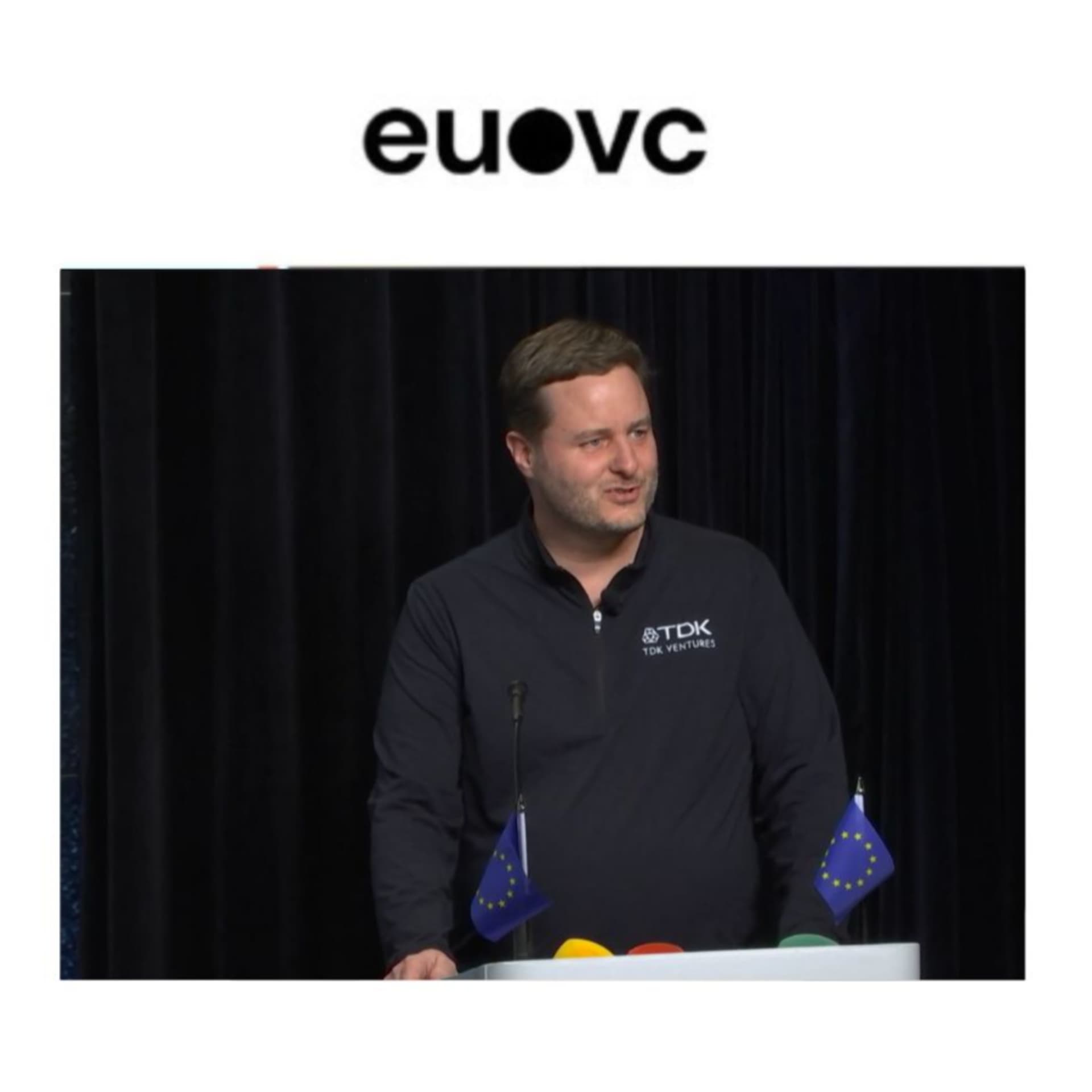

In short
EUVC Podcast Episode Summary: E591 | EUVC Summit: Nicholas Sauvage, TDK Ventures: The Path to CVC Success
Episode Overview In this episode of the EUVC podcast, Nicholas Sauvage of TDK Ventures discusses the landscape of Corporate Venture Capital (CVC) at the EUVC Summit, providing insights into its evolution, practical advice for founders, and the benefits and challenges associated with CVCs.
Key Concepts and Discussions
Introduction to CVC
- Definition: CVCs serve as a bridge between startups and corporates, providing essential resources such as capital, market access, and operational insights.
- Current Relevance: CVCs account for a significant portion of startup funding in Europe, highlighting their importance in the venture capital ecosystem.
The Three Eras of CVC Nicholas outlines the evolution of CVC through three distinct phases:
- CVC 1.0:
- Focused on balance-sheet-driven investments.
- Characterized by corporate sponsorships and complex term sheets that often benefited the corporates more than the startups.
- Potential for synergies but also considerable downsides due to inefficiencies.
- CVC 2.0:
- A transitional phase that is often overlooked.
- CVC 3.0:
- Represents the modern approach, where CVCs operate with financial discipline and strategic alignment, similar to traditional VCs.
- Emphasizes the possibility of achieving both financial returns and strategic benefits.
Debunking Common Myths about CVC
Nicholas challenges several misconceptions surrounding CVCs
- Myth 1: CVCs are inherently bad.
- Reality: A significant number of CVCs are effective, with many startups reporting positive experiences.
- Myth 2: CVCs are slow decision-makers.
- Reality: The most efficient CVCs can make investment decisions in as little as two weeks, highlighting the importance of preparedness and streamlined processes.
- Myth 3: CVCs hinder financial VCs.
- Reality: CVCs can actually enhance portfolio performance by providing strategic support tailored to the startup's phase and needs.
- Myth 4: CVCs cannot balance strategic and financial goals.
- Reality: Nicholas argues that successful CVCs can achieve both by aligning their investments with broader corporate and societal goals while also seeking venture-type returns.
Characteristics of High-Performing CVCs Nicholas identifies key traits that distinguish effective CVCs:
- Quick Decision-Making: Ability to decide swiftly, often in under two weeks.
- Clear Investment Theses: A well-defined rationale for investment choices.
- Empowered Investment Committees: Smaller, agile teams that avoid cumbersome consensus-based decision processes.
- Strategic Preparedness: Companies need to have a clear understanding of how they align with the startups’ objectives.
- Giver Mindset: Focus on adding value to startups rather than merely extracting value.
TDK Ventures' Framework for Investment Nicholas describes TDK Ventures' strict three-pillar framework for evaluating potential investments:
- Contribution to Society
- Venture-Type Returns
- Strategic Synergy (Giver-Focused)
- A score of less than 9/10 in any of these areas disqualifies an investment, indicating their commitment to long-term impact.
Practical Advice for Founders and VCs Nicholas stresses the importance of asking the right questions before accepting CVC investment:
- What’s their motivation?
- What specific value do they bring?
- Are they prepared to support your startup at its current stage?
Conclusion Nicholas Sauvage emphasizes the improving landscape of CVCs and encourages both founders and financial VCs to engage thoughtfully with CVCs. He underlines the critical role of asking tough questions to ensure alignment and maximize the potential for successful partnerships.
Key Takeaways
- CVCs can be beneficial when they operate with a clear purpose and streamlined decision-making processes.
- The evolution from CVC 1.0 to 3.0 reflects a shift towards more strategic and financially disciplined practices.
- Effective CVCs can enhance both strategic and financial outcomes for startups.
- Founders should conduct thorough due diligence on CVCs to ensure they align with their long-term goals.
---
For further insights into European venture capital, follow the EUVC podcast at [eu.vc](https://eu.vc).
Written by AI. May contain mistakes. Listen to the episode to check what was said.
Transcript
Automatic transcript. May contain errors.0:15There is absolutely not aologique comrade a very clan, but I'm not just want Missed opportunities, orphaned investments, and diluted strategic impact. But when done right, CVC can offer a powerful edge, giving corporates a front row seat to disruption while helping startups scale with patient capital, operational insight, and market access. to unpack the path to success with CVC for European Corporates. We're joined by Nicolas Sauvage, president of TDK Ventures and one of the leading voices on how corporate VC can drive real innovation impact in Europe and beyond. So thank you to EUVC for inviting me.
1:12I had an amazing podcast with Andreas and JP And they were very good at asking questions, which really gave me a super good impression of EUVC. Typically, I'm the one asking questions. I have a podcast I host, which is called Corporate Venturing Insider, Corporate Venturing Insider, which is about asking to the best corporate venturing talent the best practices they follow. And so it's basically asking the best of the best what they think, and I ask them questions. And so they thought I should be talking about corporate venturing today for VCs and LPs in Europe. So I'm going to go through some myths.
1:55And I'm sure you like the first slide already. Our CVC is bad. So let's start with a positive. Who had a good experience with at least one CVC? Raise your hand. Okay, I like it. It's not 100%, but I like it. How many had a bad experience with CVCs? It's all right, we are between friends, okay? Okay, it's actually fewer hands raised for bad versus good. So I think you're correct is my answer. Yes and no. So I think there are three types of CVCs, but I'm going to do like earlier today, someone said that now you go from pre-seed and you skip seed and you go to series A. So I'm just going to talk about CEC 1.0 and 3.0.
2:451.0 is the one you had from 20, 30 years ago, which was like balance sheet based. They need business group to be sponsoring an investment. It comes with very strange terms that doesn't make sense for a VC, but that makes sense for a corporation. But it means that the startup gets synergy with a corporation guarantee. So it's not totally negative, but it came with a lot of bad behaviors in the past. CVC 3.0 is when you actually challenge that and you start to act like a financial VC, but you also refuse a premise or the false choice of strategic versus financial. How many of you think that it's a trade-off between financial and strategic?
3:30One? Come on, Andreas, I know you know better. So I think it's a false premise, but I'll come to that later. So yes, I think there are many CVCs that have behaved badly, but we have about 4 ,000 CVCs according to GCV. Even 10%, which I think is more than that, would be 400 CVCs who are exceptionally good. And so I'm here to talk about the good ones. And it's important because a third of all the startup funding now with CVCs and 16 % of the rounds. So that's why you have so many of you having good and not so good experiences. And the advice I give to corporate VCs or those who are thinking about doing it is to be very clear about the why.
4:22And it's important for you as VCs to ask them about their why when you meet CVCs. Some will have an exploitation mission. Their job is to make sure that they help their corporations become better at what they do. And some will be exploration mission, which is to help the corporation know where to go next. A new market, new application, and new use case. All right, myth number two. CVCs are slow decision makers and it hinder startup growth. Anyone recognize that? Okay, all right, a few. Yeah, that's true, but some of the best CVCs actually can be very, very fast. Sometimes they can move within two weeks.
5:07It's just about their preparedness, if they have done it well, if they have a thesis mindset, If they have an investment committee that's not 12 people, but maybe three or four or five, and they don't need consensus where everyone has to vote yes. And if they have a strategic alignment, they already agree this is a place they want to learn or to study. And so my advice to them, and this is really important, is to act like a financial VC, because then you start to have the right behaviors. And some are still balance sheet, but I would still advise they can use a vintage-based type of investment.
5:45So they can track their financial performance on top of their strategic APIs like a vintage, like a financial VC. Of course, the best is fund-based. And I just closed my fund, my fourth fund. So I'm very happy to say that we're on the fund-based path. Myth number three, CVC's strategic goals are an impediment for financial VCs. Raise your hands if you feel that could be true. Very timid, I like it. Okay. Actually, no, I think this could be really, really good for financial VCs, for your own portfolio. But you have to think about the CVC that makes sense for your portfolio at the right time. Some will be about de-risking the science, like TDK Ventures.
6:34We can help de-risking the science when it's very early stage. We can help on the engineering side. Maybe we can help on the go-to-market as CVCs. Maybe it's more of a Series B type of support versus Series A versus C. So you have to think about what are the superpowers that the corporate VC can bring to your portfolio. And so this is my advice to the corporate VC, which is build your superpower. If you don't build a superpower, you don't have a reason to be winning a round or even helping entrepreneurs. And so here it could be, if they're on the exploitation side, it could be about business groups, champions, making sure that they bring that superpower, that value to them, and advocates in the case of exploration where you don't need championship, but you should act like you need one.
7:25And so here this is what we call TDK goodness, which is everything we do to help entrepreneurs be more successful more quickly. And that's how we refine and improve our superpowers over time. Myth number four, CVCs can't be strategic and financial. And this one, yes? It cannot be or they can be? It doesn't always matter. Actually, I think it's a false choice. There is nothing strategic in losing money. If my 44 portfolio companies all goes to zero, I cannot argue strategic value. If they all become unicorns, financial show is very good, but the strategic would be amazing because my 44 portfolio companies become, with the level of intimacy we have with them, the best customers, the best suppliers, the best partners for TDK, my mothership.
8:23All right, and so this is how we think about it is we have three investment criteria at TDK Ventures. One is contribution to society, one is venture type returns like all of you, and one is synergies we can bring to the portfolio from a giver point of view, not from a receiving, but from a giver. And the best way to explain it in a way that you can see why I think it's a false choice is if we were to score one to ten the three pillars, unless it's a nine and ten for all of them, we would not invest. So it could be a ten on strategic, ten on contribution to society, but if it's a six on financial returns, we wouldn't invest.
9:02That kind of simplification. Now the patience paradox. And this one I think is where we have an advantage as corporate VCs to be even more patient capital than VCs who are under pressure today from LPs to return some capital. We have some of that. And so I'm showing Magnus Carlson. I think we have some Scandinavians here. I like to think about him as being the paradox of being impatient and patient. And if we think about venture capital done well, we need to have this paradox because we should have this sense of purpose, the patience, doing the right thing. And in our case, it could be climate tech, clean tech, and so on, but also the impatience, the sense of urgency.
9:52So for example, we invested in a nuclear fusion company called Type 1 Energy. We know we will have to be patient. It will take a long time to de-risk the engineering, to get the go-to-market right, and so on. But we also have this sense of urgency. We need to start now to invest in Type 1 Energy or in nuclear fusion, Because we can't afford not to have green energy nearly free by the time we have all the things we discussed earlier today about climate change and everything else. We need that. And so with this, I just want to say that I'm really happy to have a chance to explain to you corporate venturing.
10:31Not all of them are bad, and they are really improving. and the best advice I can give you is make sure you ask the right questions. What is their why? What are they going to bring to the startups or to your portfolio? And why is it the right time for your entrepreneur to have that corporate VC joining the cap table? So be challenging. Ask them the tough questions. Thank you. Before you go, I just want to give a massive shout out to the partners who made the EAVC Summit and awards possible. So please do not tune out. We're partnering with these firms because they're great people with offerings that we know from our friends in the ecosystem are truly world-class.
11:13First up, I want to give a big thanks to HSBC Innovation Banking. They helped us incept the awards in the very beginning and truly they are the leading bank for anyone in European venture. There's a reason why everyone knows them. Google Cloud, they were our venue hosted the summit. What a team, what a big effort they put on to help us. We're hugely grateful. Make sure to reach out to Arabella or Oksana at the Google Cloud team to hear how they can help you as well as your portfolio. Massive credits goes to them. Ace Alternatives, we have so many friends in the Berlin ecosystem partnered with these guys.
11:48Just the best fund ops team around. And as with any good restaurant, where the locals are is also where you get the best service. And now they're expanding across Europe. so they're definitely someone to talk to. Hainspoon, they're longtime partners of ours in both our own legal work. They're great supporters of us here at EUBC, and I definitely think that they are one of the go-to legal teams to have in your corner. CW Communications, our dear friends who helped us secure CNBC, Bloomberg, Financial Times, and many more for this summer. It's a joy working with Dan and Kathy and the team. Fundcraft, Digital Native, Full Suite, Lux Headquarter, and a great partner as you grow your firm out of Luxembourg.
12:29Definitely a fund admin to consider in your stack. I can only say that the team are incredible to work with. I'm very thankful that I've gotten to know them. I think they're one of the up and coming fund admins that you want to be thinking about. Portfolio IQ by Synaptic. You may know them for the Discover tool, which is branded on a Synaptic, but Portfolio IQ is absolutely a product you should know because there's no one that understands intelligence better than this team. And finally, Goodwin. They are a truly world-class legal partner you can trust. They're hands-on, business-oriented, and expert in everything and anything transatlantic.
13:05So those were our partners for the summit and awards. I know this might have been a bit long and boring, but really, if you have these guys on your side, I don't think your firm could be in any better hands. And also, they're helping us do what we're doing every day for you.
From the publisher
Corporate Venture Capital (CVC) can be both a powerful ally and a cautionary tale for founders and financial VCs alike. At the EUVC Summit, Nicholas Sauvage of TDK Ventures took the stage to break down the CVC landscape — past, present, and future — and give practical advice for founders considering CVCs on their cap tables.
Nicholas challenged the audience with a question: who’s had a good experience with a CVC? Hands shot up and fewer hands went up for “bad experiences.” This, he noted, shows we’re at a new stage for corporate venture.
He outlined the three eras of CVC:
CVC 1.0: The early days, marked by balance-sheet-driven investments and corporate sponsorships. These often came with odd term sheets and slower processes, but could unlock synergies.
CVC 2.0: Skipped over, just like today’s pre-seed to Series A jumps.
CVC 3.0: The modern era: financially disciplined, strategically aligned, fast-moving, and structured like financial VCs without sacrificing strategic purpose.
Importantly, Nicholas debunked the idea that financial and strategic returns are a trade-off - a "false premise," as he called it. The best CVCs aim for both: venture-type returns and deep strategic synergies.
Nicholas shared the characteristics of high-performing CVCs:
Fast decision-making (some in under 2 weeks!)
Clear investment theses
Slim, empowered ICs (not consensus-based groups of 12)
Strategic clarity and preparedness
A giver mindset — value-add first, not value-extract
He also offered advice for traditional VCs:
“Be thoughtful about when a CVC joins your cap table. Some are great at de-risking science, others support go-to-market — it's all about matching their superpower to your founder’s needs.”
TDK Ventures uses a strict three-pillar framework:
Contribution to society
Venture-type returns
Strategic synergy (giver-focused)
If an opportunity scores less than 9/10 on any one of the three, they won’t invest. Why? Because climate tech and deeptech take time and patience, and TDK is playing a long game to back meaningful technologies — like Type One energy and nuclear fusion — that can shape humanity’s future.
Before taking CVC money, ask the hard questions:
What’s their why?
What value do they add?
Are they ready to support at the right stage of your journey?
“Without exits, we don’t have a VC ecosystem,” Nicholas reminded the room — so make sure you’re partnering with CVCs who can help drive toward them.
CVCs: The Good, the Bad, and the MisunderstoodWhat Makes a Great CVC?TDK Ventures' Framework: Triple MandateAdvice to Founders & VCs


