
In short
EUVC Podcast Episode Summary: E600 | EUCVC Summit 2025
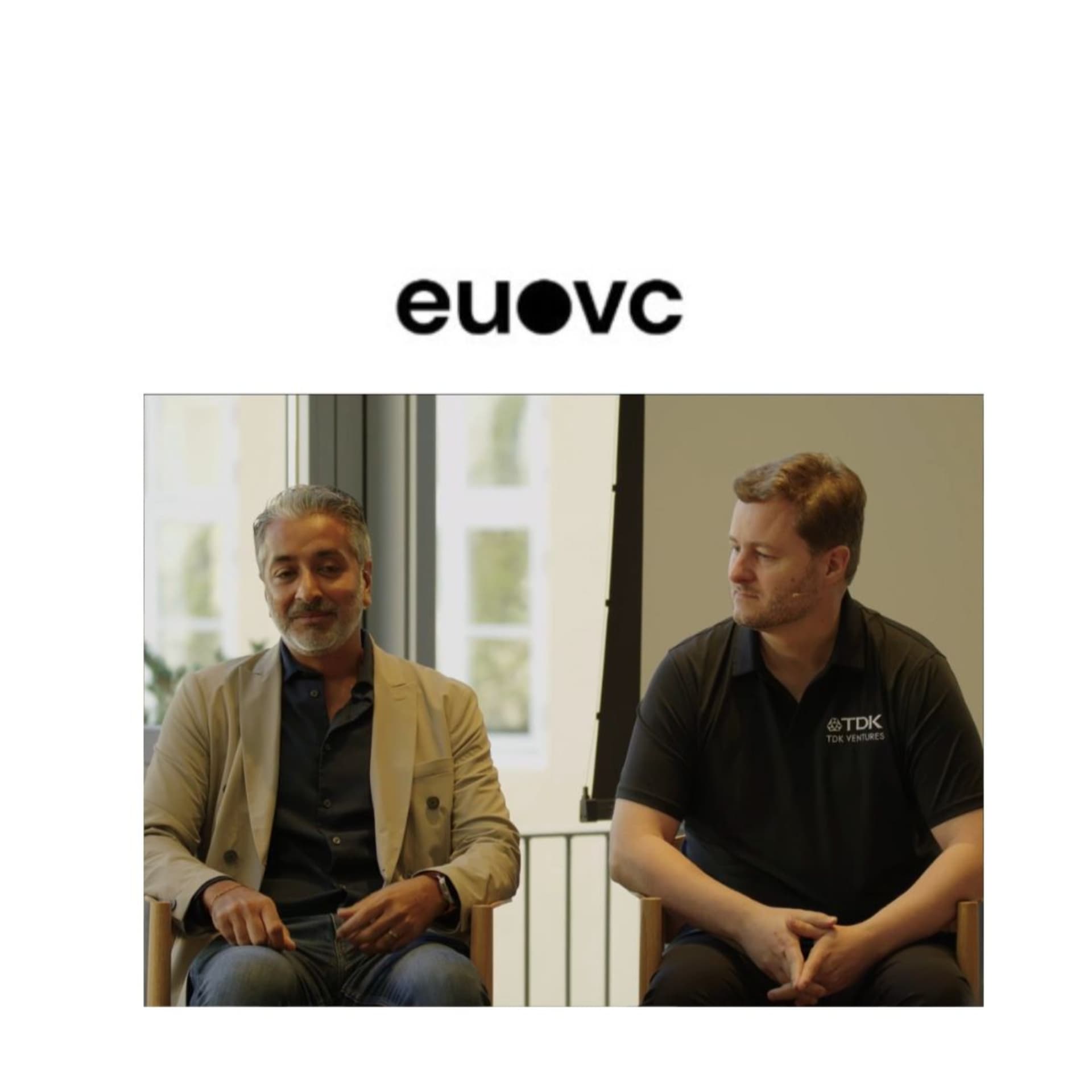
Episode Overview In this episode of the EUVC podcast, co-hosts Andreas Munk Holm and David Cruz e Silva engage with Alokik Advani from Fidelity International Strategic Ventures and Nicolas Sauvage from TDK Ventures. They delve into the topic of corporate venture capital (CVC), particularly focusing on strategies to ensure that CVCs can thrive beyond the industry average lifespan of 3.7 years.
Key Topics Discussed
- Balancing Short-Term Pressures with Long-Term Goals
- The challenge of delivering short-term growth while investing in long-term venture opportunities.
- Measuring Strategic Impact
- Importance of continuous communication in assessing the strategic impact of VC investments.
- Governance Models
- The structural design of investment committees at Fidelity and TDK to align with long-term strategies.
- Strategy vs. Finance
- The need to integrate strategic returns with financial returns, debunking the myth that these are mutually exclusive.
- King of the Hill Concept
- Investing in potential market leaders even in nascent markets to secure future financial and strategic returns.
- Financial Bar as a Priority
- Emphasizing that financial success must precede strategic success for sustainable partnerships.
- Avoiding the “Strategic-Only” Trap
- Discussing why purely strategic CVCs often fail and how to ensure longevity.
- Building Equal-Win Partnerships
- The necessity of mutual value for both corporates and startups for long-lasting relationships.
Detailed Insights
- Balancing Short-Term and Long-Term Goals
- Discussion Point: The complexity of demonstrating growth and profitability while navigating the inherently elongated exit horizons of the VC landscape.
- Measuring Strategic Impact
- Key Takeaway: Corporates must establish metrics for strategic impact that go beyond financial returns, including fostering ongoing interactions between startups and the corporate ecosystem.
- Governance Models
- Fidelity and TDK’s investment committees are designed to ensure alignment with corporate long-term strategies:
- Fidelity's Structure: Involves executive-level members and external advisors to bridge different perspectives.
- TDK's Model: Emphasizes a governance framework that allows for strategic alignment and oversight.
- Strategy vs. Finance
- Argument: The narrative of choosing between strategic or financial returns is a false dichotomy.
- The focus should be on identifying future market leaders that can yield both types of returns.
- King of the Hill Concept
- Concept Definition: Investing in startups that demonstrate the potential to lead emerging markets, even if those markets do not yet exist.
- Importance of Financial Viability
- Crucial Insight: Financial success should be prioritized as it helps secure strategic value and attract high-quality partners.
- Avoiding the “Strategic-Only” Trap
- CVC Longevity: Discusses the common pitfalls that lead to the early demise of CVCs and strategies to circumvent these issues by focusing on both financial and strategic objectives.
- Building Equal-Win Partnerships
- Essential Principle: For sustainable partnerships between corporates and startups, both parties must derive significant value, preventing imbalance that can lead to disengagement.
Conclusion This episode emphasizes the necessity for corporate venture arms to establish structured governance, maintain a balance between financial and strategic goals, and focus on building equal-win partnerships. Key insights from the discussion reveal that successful CVCs are those that strategically align with their corporate parent’s long-term vision while navigating the complexities of the venture landscape.
Next Steps Listeners are encouraged to reflect on their own CVC strategies and consider how these insights can be applied within their organizations to foster enduring and impactful ventures.
Written by AI. May contain mistakes. Listen to the episode to check what was said.
Transcript
Automatic transcript. May contain errors.0:00Short-term returns kill long-term innovation. In this session, we hear from two global leaders who've built CBCs that endure. Fidelity's ILO Kik and TDK's Nicolas Sauvage. From governance to internal alignment, they lay out the blueprint for building venture arms that stand the test of time. So guys, short term, long term, how do you strike a balance when you have pressures to show growth, to show profitability as a corporate? and you are in the middle of VC where we all know that our exit horizons only get longer. 10 years used to be what we say, but now it's more like 14, 15, 16 years if it's a real breakout success.
0:46I mean, for me, you've got to show the impact. And I think impact is a few different ways. The hardest thing to measure is how does a corporate measure the strategic impact of a VC? So one is financial return, and that may take time, but you can show the progress, and then making sure the interactions happen continually between the startups and the corporate ecosystem. There's a partnership, there may be revenue, there may be other things that come through that, which is critical, but to make sure that communication is continuous is really, really important. We do that by bringing our startup to continuously meet not only our IC, but to meet broader part of the organization.
1:23Just to learn, just to engage, just to share ideas, it's just continuous as much as we can. Sometimes both sides get something out OF IT, SOMETIMES ONE SIDE GETS OUT OF IT. I AGREE ON THE COMMUNICATION. I THINK ONE DESIGN CHOICE WE MADE WAS FOR INVESTMENT COMMITTEE TO BE RIGHT AT THE TOP OF THE MOTHERSHIP. SO THE CFO, CTO, THE EQUIVALENT OF THE CSO, SO THREE INVESTMENT COMMITTEE MEMBER. AND THEIR JOB, BECAUSE OUR MISSION IS EXPLORATION, WE'RE looking at new market, new technology, new use cases where TDK might go, our mothership. And they are basically the proxy of that TDK long-term strategy so that when they approve an investment, it's because this is in line with that TDK long-term strategy.
2:08And one of the value of that is that it signals to everyone inside the organization that this investment, this portfolio company is highly strategic. Yeah, so you're pointing to two different places, and you have a top-down approach, what you're describing, the importance of having a structure, a governance structure, that allows you to all the time stay in sync with the strategy. And you have on the more boots-on-the-ground system, so to say, where you're insured. And I imagine that you have the same reflections when it comes to governance. Yeah, so governance is very similar, right? So with us, our IC, what we did is we did it in two parts.
2:43So we've got the sort of CEO slash president and the CFO. And then we've got two external people who come more from one part of an LP side of an equation externally and one part of a sort of VC side of an equation externally. And so with those two pieces together, you kind of get quite interesting different opinions at an IC and you ensure continuous, let's call it enough friction to make good decisions. And you keep that group informed. Now, we get money from one side of the house, but we still do twice a year full detailed LP meeting for that group. and a little bit beyond. Everything, front to back, market, dynamics, portfolio, financials.
3:23And we bring a couple of founders to come and meet that group to just give an update of what's happened through that session. How do you balance this strategy and finance, like financial returns versus strategic returns? It's something we all the time talk about. What are some concrete pieces of advice when it comes to this? I think the first thing is to agree that this is a false choice. It's not strategic or financial. At the end of the day, our job is to pick the winners, who is going to be the market leader in the future. And if you're good at picking the winners, which will not be all the time, you're going to get the financial returns and hopefully a fund returner.
3:59But you're going to get highly strategic value. And if I think about TDK Ventures, we invest in potential suppliers of TDK in the future, potential customers, potential go-to-market partners. If they do become market leaders, the strategic value will be immense because this is about the megatrends we want to go into in the future. And we are building intimacy with those who will be the market leaders. Nikola, is what you're saying here that it must have primacy that the startup will grow? Absolutely. And for that reason, you need to align first and foremost on what you would normally call the financial side.
4:38because that's equal growth. Because if you end up getting strategic value out of a mediocre player, that will always be beaten out by the relationship to a better and stronger financially successful player. Yeah, I think we call them king of the hill. We are trying to find the startups who are most likely going to be the market leader. That's it. Describe the format or describe this concept a bit more, king of the hill versus... Yeah, King of the Hill is basically a company that has the most promising potential to be market leader in a market that may not exist today. But we believe it's going to be a massive market in the future.
5:18We invested in vertical takeoff and lending back in 2020 when the market was zero. But we believe it's a trillion dollar plus market in the future. So our job was to find what we believe is a market leader potential. If we are correct, we will get the financial returns, we will get the strategic returns. I mean, I think that's spot on. The financial has to be first. Like the bar of what you're going to take, is this the best founders and the best companies, the best ways that they can execute that strategy has to be first. That strategic angle will always take longer, right? And I think the key part is, and we can all, you know, I've sadly have done this for my third chapter, the CVC, right?
5:59So with three different organizations. And I think the first thing you learn is when anyone sets up a new CVC, I ask them, why are you doing it? And they say, oh, we're doing it to learn. I said, that's really cool, but what do you want out of it? Do you want to make money or do you not want to make money? Because you've got to have a goal. And I think having that financial bar is really important. I think the other part around it is, what does this founder need from a corporate at that time? You can get money from a whole bunch of people. They need revenue, and they need a logo, and they need it fast.
6:27the fastest way you can try and get that company, that logo and revenue, even if it's small-scale revenue, but a big logo, it's huge. What would you say, and you kind of touched on it, but I just keep hearing this from corporates that want to get into venture and startup investing. They're looking for those strategic returns to the learnings. Where are you most effective when you help your colleagues think through avoiding this pitfall? Because as Japa said, the scene today, 3.7 years, that's the annual lifetime of a CVC. And it, to a large extent, comes from this problem. Yeah, no, it's a really good point.
7:11We've been going for seven years, so we've lasted two lifetimes. So I'll take that as a good thing. I'm sure you've been going even longer. Seven, so seven years. So we've got two lifetimes. The learning is, again, it was really interesting what some of the points made earlier were, which is hit on the open door. There will always be people, I think Petra mentioned it, which is parts of the organization which are welcoming you, that are the more forward-thinking crowd. Start with that. Start with the people where you can demonstrate that this is, you know, it will make sense. They are interested.
7:47They want to lean forward. They want to engage with the company. They want to think about the innovation a few miles ahead, not just what's coming next. What are crucial measurements when it comes to measuring the value of a CVC? First, I want to double down on what Eloke said, which is when you start a CVC, you're going to have three types of members. People who are so excited you finally have a CVC. Those who don't care and those who really don't think you should do it. double down on those who want to work with you because you can build success stories that will get people who are neutral with you and then people who didn't want you start to see that they should go along.
8:26So I think this is actually really an important tip. Work with the champions early, build success stories. Back to your questions, we have, for example, an engagement team. Even when we were four people, one of the person was all about building equal win between the startups and TDK. And equal win, because if you think about startups and a very big company, it's typically a small win and a big win when we say win-win. And the problem with that, and this is a real problem, is when it's a small win and a big win, whoever gets a small win at some point leaves, and whoever saw that a big win gets nothing.
9:02And who gets the blame is a CVC who started that partnership. But if you start to build it as an equal win, you make sure it's really, really valuable for both. And the partnership can last for decades, then you get real value. And back to the king of the hill concept, if this is built as an equal win, then 10 years later when there are market leaders, you have a real strategic value on top of financial. My dear corporate longevity experts, thank you so much. Thank you very much.
From the publisher
From governance models to internal alignment, they share the blueprint for how corporate venture arms can thrive beyond the 3.7-year industry average lifespan. The discussion ranges from financial vs. strategic returns, to the “King of the Hill” philosophy, to why equal-win partnerships are essential if corporates want to play the long game.
This is essential listening for corporate leaders, founders, and investors who want to understand how to build CVCs that stand the test of time.
🎧 Here’s what’s covered
00:00 Balancing short-term pressures with long-term horizons in corporate venture.
01:00 Measuring strategic impact: why financial returns aren’t enough, and how to keep communication continuous.
02:00 Governance models: how Fidelity and TDK designed their investment committees.
03:12 Strategy vs. finance: why it’s a false choice and the case for picking future market leaders.
05:00 The “King of the Hill” concept: investing in potential category leaders even before markets exist.
06:00 Why the financial bar must come first—and how corporates can offer startups more than just capital.
07:00 Avoiding the “strategic-only” trap: why CVCs fail and how to last beyond the 3.7-year average.
08:00 Working with champions inside the mothership and building early success stories.
09:00 Equal-win partnerships: why both corporates and startups must feel the value for relationships to endure.


