
In short
Podcast Episode Notes: E610 | EUCVC Summit 2025
Hosts
- Andreas Munk Holm
- David Cruz e Silva
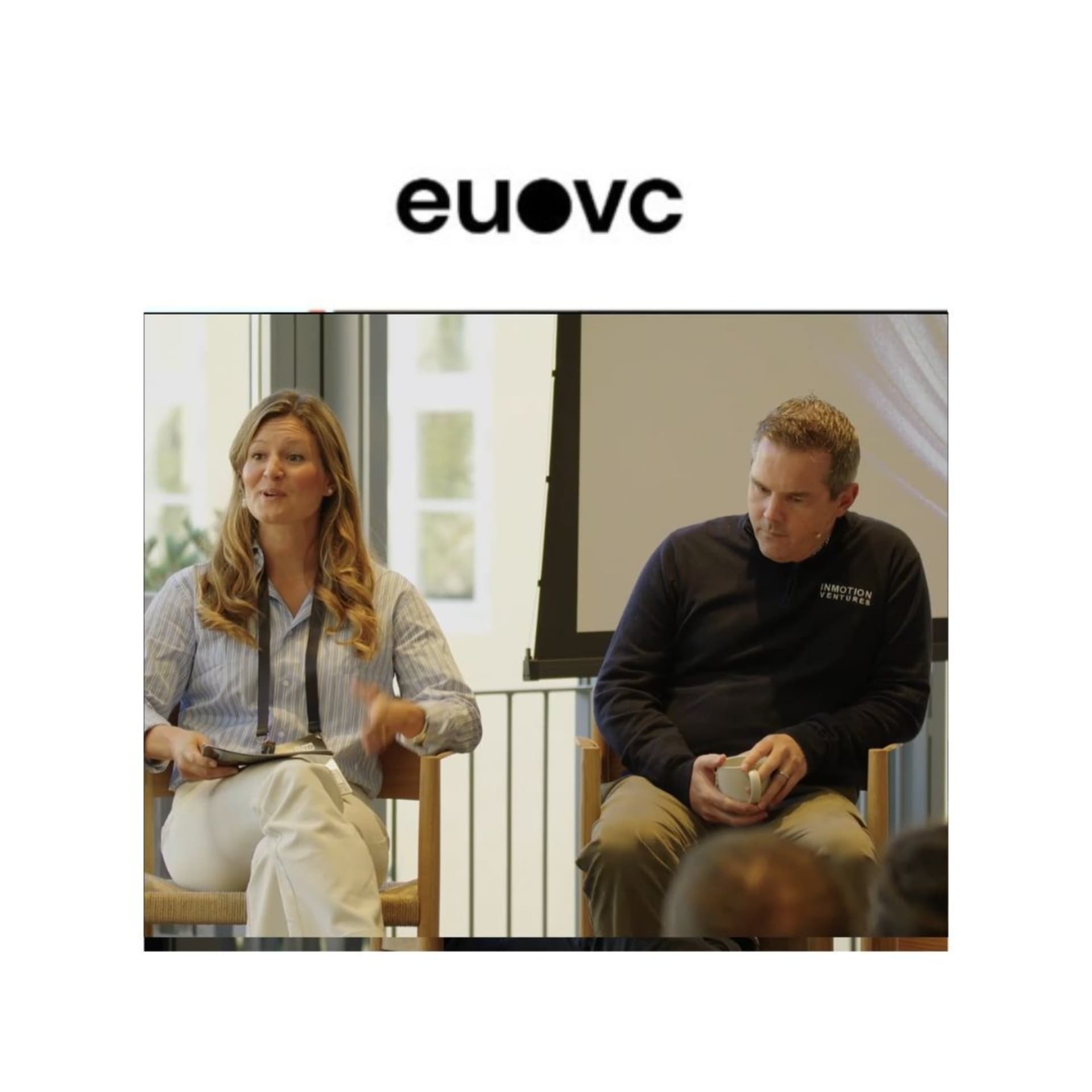
Episode Overview In this episode of EUVC, co-host Jeppe Høier engages with Mike Smeed (InMotion Ventures, Jaguar Land Rover) and Ida Christine Brun (Maersk Growth) to explore the nuances of corporate venture capital (CVC) amidst a rapidly evolving landscape. The conversation focuses on balancing financial returns with strategic alignment and the role of corporates in supporting startups.
Key Takeaways
- Importance of Corporate Venture Capital (CVC)
- Rebooting CVC: Legacy companies often face challenges in their initial attempts at corporate venturing. Successful CVCs that are rebooted tend to become stronger after recognizing and addressing past failures.
- Alignment with Core Business: Both InMotion and Maersk Growth emphasize the necessity of being closely connected with their parent companies to ensure relevance and effectiveness in their venture activities.
- Strategic Alignment
- Business-Led Focus: Ida emphasizes the need to integrate the CVC within the core business structure. This includes reporting to the Chief Strategy Officer and aligning investment strategies with business priorities.
- Defining Roles: Understanding the strategic problems that need solving is vital. Shifting focus from simply investing in startups to addressing business challenges is crucial for success.
- Key Themes in Corporate Venturing
- Decarbonization and Electrification: These are identified as major themes driving innovation within mobility and logistics sectors.
- Digital Supply Chains: The evolution towards more efficient, technology-driven supply chains is a focus area for both companies.
- Unique Offerings of Corporates to Startups
- Corporates can provide startups with access to:
- Customer networks
- Distribution channels
- Industrial expertise
- This access is often not available through traditional venture capital.
- Avoiding "Tourist Investing"
- Discipline in Investment: Corporates need to avoid superficial investments that don't align with their strategic goals. Establishing serious commitments and understanding the startup ecosystem is vital for success.
- Building Trust with Founders
- Transparency and Incentives: Establishing trust with startup founders is crucial. This can be achieved through transparent communication, aligned incentives, and a commitment to providing patient capital.
- Challenges of Corporate Bureaucracy
- Speed vs. Bureaucracy: Both guests highlight the risks of corporate bureaucracy slowing down innovation. Identifying and mitigating these risks is essential for maintaining agility in the investment process.
- The Future of Corporate Venturing
- Central Role in Transitions: Corporate venturing is posited to be central to Europe’s green and digital transitions, underlining the importance of innovation in achieving sustainability goals.
Episode Insights
- Both Mike and Ida reflect on the importance of learning from legacy portfolios, stressing that financial returns should be the foundation of strategic investment decisions.
- The episode provides real-world examples of how CVCs can evolve, adapt, and thrive by aligning closely with their parent companies and addressing real business needs through innovative partnerships with startups.
This discussion illustrates the intersection of corporate strategy and venture capital, highlighting how established companies can leverage their resources to foster innovation and achieve strategic objectives in a competitive landscape.
Written by AI. May contain mistakes. Listen to the episode to check what was said.
Transcript
Automatic transcript. May contain errors.0:00When legacy companies try corporate venture, the first attempt often fails. But some come back even stronger. In this panel, Mike Smead of InMotion, Jaguar Land Rover, and Ida Christine Bruhn of AP Muller Maersk reveal what it takes to reboot a CVC. With Jeppe moderating, we explore how to align with strategy, earn internal trust, and build a venture engine that lasts. Ida, Mike, you have both been part of a restart or a continuation of a CVC. So in your experience, what does it require more than more capital? Is it defining the role? And what was your first strategic move after going into this process?
0:50Ida, you want to start? Yeah. So for us it was very much around connectedness to the core company. I know there's many debates around connectedness versus independence in order to gain agility. However, for us, in order to deliver what the startups actually wanted from us and what our colleagues expected and needed from us, and to be able to deliver that true strategic impact, we needed to become even closer to the business and become a lot more business-led. So to your question around what was our first strategic move, we became a lot more business-led and connected to the company in every sense.
1:31We became part of the strategy department, now reporting directly into our chief strategy officer. We actually changed our whole mindset. So instead of asking ourselves which startup should we be investing in, we started asking ourselves what are the strategic business problems that we need to be solving for. In terms of physical location, we even moved into our headquarter office instead of having our separate little office. So the starting point for us is really being anchored in strategic priorities. I know it's been said a lot today, but really focusing on the capability gaps and the technology gaps where open innovation can really help move the needle for the company.
2:12Mike, you came into InMotion Ventures after many years at Jaguar Land Rover. What learnings did you bring with you and where did you start? Yes, so for us, InMotion has been around since 2016, so about almost 10 years now. But I came in pretty much three years ago. I also, we've just announced that our third CEO since I joined is starting in December. So I'm on a countdown to getting fired next year. So it was a pleasure to have been with you all for this. But very much what we saw as was a renewal of our wedding vows, almost, between the parent company and the CVC unit. You know, I would say that the CVC before I joined was suboptimal because of exactly what you said, Ida, was that the priorities of the business and where the CVC was heading were in different ways.
3:08And therefore, we'd lost relevance. And I think that's what we've heard really across today. and what we've just heard from the fireside before us is that it's about the relevance and even the first speaker mentioned the why. So why do you exist and all of those things. So very much making sure that we were... When we were rebooting the CVC, making sure we were really clear on the priorities of the parent company. We took a very different path to yourself, Ida, which is great, because, again, there's many different ways that a CVC works, but it only really works if it's relevant to the context that you're in.
3:43And I think that's the most important thing, is recognizing when you've drifted a little bit too far away from whatever that context is and then bringing it back in. Then I think Peter Axel kindly mentioned, you know, CVC also a little bit as an organ transplant. It is what it is. You know, the medicine is also the trust. Ida, how are you building that trust with your core colleagues? I think when each and every one of us goes to work in the morning, we want to make a difference and bring value to the company we work for, for the industries that we work within. For us as a CVC, in order to deliver really strong outcomes, I think just I want to point out that I think we already were delivering quite strong outcomes from our supply chain tech funds one and too, but we realized there was a little bit of a disconnect with the way we perceived the value we brought and that of our colleagues.
4:41And this was a bit of a wake-up call for us. So it was a good point in time for us to actually take a step back, ask some of our senior leaders, how can we actually deliver more value-add to you and business as a whole? So in order to build that credibility and trust, it was around actually just sitting down and understanding their priorities, sourcing startups that actually deliver solutions to their problems here and now, and also of course facilitating those collaborations and partnerships in a fast and agile way so that it was a good experience both for our colleagues but also for the startups that we ended up working with as well.
5:25Not rocket science but it was around those landing priorities. Mike, how has that been for you? It was slightly easier for me in the sense that I was a company insider. So I'd been in the parent company for five years before I took this role on. And also I was a member of the finance team as well. So that comes with a level of credibility working across the business. So you're not coming in. I think it would be slightly different if I was an engineer or I was something else coming into a particular role with maybe a perceived bias. I think typically, and I'm biased as a finance professional, that you come there with a level of objectivity and doing the right thing for the business, I think really helped me.
6:07During our talks, one of the things that have intrigued me a lot is also both of you, your view on the legacy portfolio that you took over. And Mike, you specifically mentioned that there are some learnings in there that are big for you. Could you explain a little bit more on that topic? Yeah, completely. I mean, I think just echo what Nicola said earlier on, which is that there's a financial return is almost the basis of being strategic. So I think that and again, within I was very lucky, we inherited a portfolio on our previous thesis. And again, you always navigate towards the ones that are performing particularly well through that.
6:48But we've separated very much what we call fund one and fund two. So since 2022, when we reset the fund, we're very much focused on separating out the performance of those two things, making sure that we have an active portfolio from the legacy, which we still continue to support the winners in those things that we do. But also being very clear with those companies that are no longer part of the thesis and aren't performing with a level of strategic return or sorry, financial return that we would like. We're very clear with them that, you know, they're not part of of our of our ongoing plan. And I think just that honesty with a startup and with a founder, I think, is really important.
7:28The other reflection we had was just how slow I was to talk to our legacy founders when I first started. And if anyone's in the same position as myself, a relative newcomer coming in, I'd really encourage you to go and talk to the founders of your portfolio. Because they will know what's going on. They will know what's like. I mean, our portfolio companies hated us when I first started. I heard a lot of things talking about, well, we'll do an NPS with our portfolio companies to understand. And my team said, please don't do that. Because you'll get the answer you really don't want. But I think there was a level of corporate arrogance that I had because I was only really used to working corporate to corporate.
8:09And therefore, I didn't quite understand that actually, you know, a third of my job is working with the founders. And I spend a lot of times when I'm walking my dog in the evening talking to our founders. and they'll talk to me and say, oh, for God's sake, this has happened, or help me translate, you know, what do they really mean when they said this and all of those things. And I completely miss that as part of my role. And Ida, you also mentioned that you've gone even deeper with some of your startups in the portfolio. Yeah. So I think for a lot of the companies that want strategic capital for strategic investors, oftentimes they seek partnerships and large commercial contracts at the end of the day.
8:45So actually, when we started doubling down on venture clining and building strong processes to bring about POCs, pilots, to validate their solutions, that has actually helped enable many of our portfolio companies. So we were lucky also we have had a very strong portfolio, which continue to be just as relevant and strategically important for us. So, yeah, through venture planning, we have actually been able to also, not only even in capital, but also some good global framework agreements to work with the company overall. Thank you so much both for sharing. Thank you.
From the publisher
Welcome back to the EUCVC Summit Talks, where we bring you candid conversations with Europe’s leading founders, corporate leaders, and investors shaping the future of venture collaboration.
In this session, Jeppe Høier sits down with Mike Smeed, Managing Director of InMotion Ventures (the venture arm of Jaguar Land Rover), and Ida Christine Brun, Partner at Maersk Growth. Together, they dive into how two global giants—one in mobility and one in logistics—approach corporate venturing, what they’ve learned about balancing financial returns with strategic purpose, and how they decide where to play in a fast-changing landscape.
From decarbonization and electrification to supply chain innovation and customer-centric business models, Mike and Ida share firsthand lessons on what works, what doesn’t, and how corporates can create real value in venture.
🎧 Here’s what’s covered
00:10 Why corporates must venture beyond the core — InMotion and Maersk Growth’s mandates.
01:00 Balancing financial return with strategic alignment — why both guests insist on “financial first.”
03:00 The big themes: decarbonization, electrification, and digital supply chains.
05:00 What corporates can offer startups that VCs can’t — customer access, distribution, and industrial know-how .
06:00 Avoiding “tourist investing” — the discipline corporates need to compete with top-tier VCs .
07:00 Building trust with founders — transparency, aligned incentives, and patient capital .
08:00 Lessons learned: when corporate bureaucracy kills speed, and how to prevent it .
09:00 Looking forward: why corporate venturing will be central to Europe’s green and digital transitions .


