
In short
EUVC Podcast Episode #194 Summary
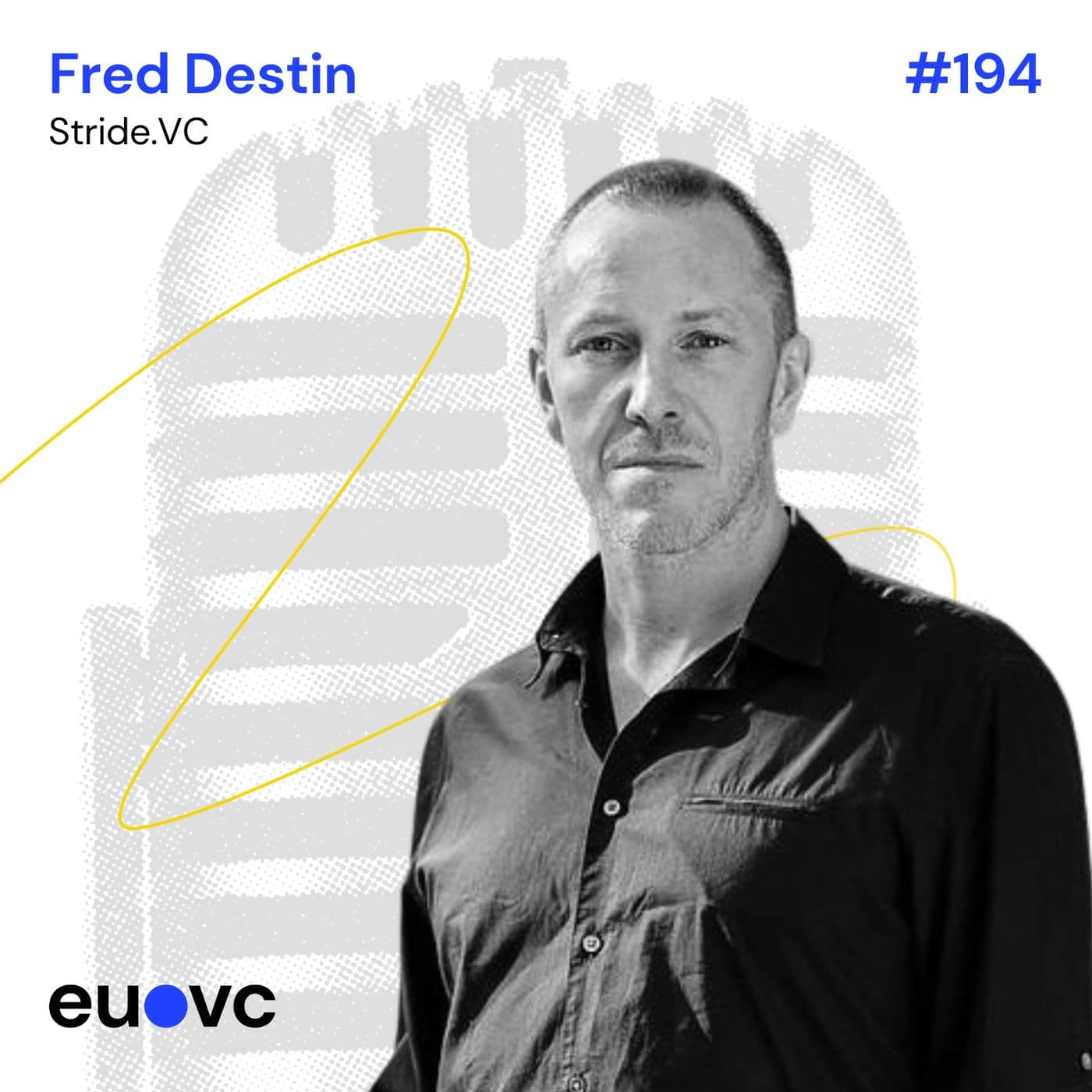
Episode Title: EUVC #194 Fred Destin, Stride.VC Co-hosts: Andreas Munk Holm and David Cruz e Silva Guest: Fred Destin, Founder and Partner at Stride.VC
Episode Overview In this episode, Fred Destin discusses his journey into venture capital, his experiences at various firms, and the founding principles behind Stride.VC. He emphasizes the importance of trust in founder-investor relationships and shares insights from his career, including key lessons learned through both challenges and successes.
Key Topics Discussed
- Fred's Journey into Venture Capital
- Started in the tech boom of the late 1990s, with his first exposure to startups.
- Transitioned from investment banking (Goldman Sachs) to venture capital at Speed Ventures.
- Emphasizes the importance of building relationships and trust with founders.
- Stride.VC Overview
- Currently investing from Fund II with £123M AUM, following a £100M Fund I.
- Focuses on late seed investments in London and Paris, targeting companies that "reinvent the UX of the world."
- Significant investments include Triva, Conceivable.Life, TechWolf, and Hofy.
- Cultural Influences and Branding
- Stride is described as the "punk of VC," portraying a rebellious and innovative spirit.
- Fred connects his interest in punk rock to his approach in venture capital, advocating for breaking traditional norms and fostering creativity.
- Lessons Learned in Venture Capital
- Pivotal Experiences:
- Navigating the dot-com crash (2001-2003) revealed resilience and a love for the job amidst crises.
- The semi-blow-up of Atlas Venture highlighted the importance of leadership during tough times and building empathy towards founders.
- Key Insights:
- The need for patience and focus on user-centric development rather than rushing towards scaling.
- Importance of understanding emotional dynamics in founder relationships and the balance of power.
- Addressing Challenges in Venture Capital
- Discusses the tendency of VCs to overreact to company performance metrics and the need for a supportive environment.
- Emphasizes the importance of empathy, curiosity, and effective communication in board interactions.
- The Power of Presence and Relating
- Fred shares insights on personal development, emphasizing the significance of being present and building genuine relationships.
- Personal work leads to freedom and better relational dynamics, especially in the context of leadership.
- Advice for Emerging VCs
- Avoid being generic when pitching to LPs; focus on unique value propositions.
- Understand portfolio construction and reserve management as critical aspects of fundraising.
- Don't shy away from making direct asks during meetings to secure commitments.
Conclusion In this episode of EUVC, Fred Destin offers a wealth of knowledge on navigating the venture capital landscape, emphasizing the importance of trust, empathy, and strategic thinking in building successful partnerships with founders. His personal journey and insights serve as valuable lessons for both aspiring and established venture capitalists.
Key Takeaways
- Trust and empathy are foundational for healthy VC-founder relationships.
- The importance of patience in scaling businesses and focusing on user needs.
- The necessity for VCs to maintain self-awareness and continuously evolve their skill sets.
- The role of creativity and presence in effective leadership and decision-making.
For more insights on European VC, follow the EUVC podcast at [eu.vc](http://eu.vc).
Written by AI. May contain mistakes. Listen to the episode to check what was said.
Transcript
Automatic transcript. May contain errors.0:00Today we're happy to welcome Fred, founder and partner at Stride. Stride is investing out of Fund 2 with a total of 220 million in assets under management. with an established portfolio of 25 companies per fund and notable investments including Triva, Conceivable.life, Techwolf and Hofi. At Stride, Fred focuses on late seed in London and Paris in companies that reinvent the UX of the world by going deep on the areas founders care about. Strategy, brand, culture, talent, leadership and fundraising. If you're listening in and love our show, drop us a review, follow the pod and subscribe at eu.vc.
0:40And now, some words from our beloved sponsor. For investors looking for capital, the UAE has become the hub of choice for VCs to connect with startups, sovereign wealth funds, family offices and funder funds. This October, join fund managers representing over$500 billion of assets under management from CVC, General Atlantic, Techstars, Sequoia, Speedinvest, MEVP and more, who join Expand Northstar to connect with hundreds of early stage to growth startups from all markets for a curated concierge style meetings program. Previous participating founders hail from Stripe, Binance, GoOne, Baidu's, InterSwitch, Caro and more.
1:23Register now at expandnorthstar.com forward slash EUVC.
1:30Tear down this wall. It's more than just an alliance. This is a union of values. United and determined we can serve as a model for other regions of the world. The nature of a problem requires a European response. Europe is a story of new beginnings. Let's start acting. This show is not investment advice and the hosts of this episode may be invested in the funds and companies featured. Hello, everybody, and welcome to another episode of the European VC Podcast. I am David, the LP Syndicate Lead, and as usual, joined by my dear co-founder, Andreas, the LP Hypeman. So, Fred, I'd love to hear the story of how you got into venture.
2:20You want to start by sharing that? My journey into venture started right in the bubble in 1999. When I graduated, it was 92, and there really was no startup ecosystem to speak of in Europe. And I frankly had no idea what to do. So I stumbled into doing structured derivatives, as it's known. But by the time Netscape was founded, I was paying attention. So I think I remember, this will make you laugh, but I remember when I was at Goldman, we were exchanging little hushed comments about this thing called Google. oh you have to try the normal thing and get all the o's when you search and whatever um and what was what was interesting at the time when people may not realize this the the web felt like a revolution it felt like a social revolution is driven by the youth in france for example in particular there was a notion of upending the order uh you know the hierarchy and so it's a little bit like crypto in 2018.
3:25It felt very exciting that way. It was like the rule breakers were all moving in. And then in 99, interestingly, Goldman promoted me to run a team. And I went around and asked all the people who were 45, which at the time felt very old to me to be 45, what's your life like? What's your relationship with your wife? Why did you come to work? And the answers were awful. So I resigned and went to an incubator. So they promoted me and I resigned. They were a little bit confused, but I went to an incubator called Speed Ventures. I remember cutting my compensation by 10x, which was, you know, that's you make good money when you're in government.
4:02And then I would say Monday morning, never felt like Monday morning again. And from there, I found my kind of found my calling, really, because for me, it's really a calling. It's not a job. It's kind of what I do. Before I was at prestigious firms, I was at no-name firms. And really, that's where I built my chops. You know, I was at Speed Ventures, which was a venture incubator. Then I was at a god-awful, you know, Dresdner, trying to run a strategic fund on the side, investing in IP services. And then that Dresdner thing, which is called Online Markets Technology Investments, you know, it took me a year to extract it out of Dresdner after they got bought by Allianz and to find a new home for it at Vertex Israel.
4:46And then I went to Atlas Venture. And Atlas Venture was kind of a name, a very good name in the 90s. But by the time you get to only 2000, they were off their peak and actually was quite a complicated firm. Too many partners. The funds were too big. And, you know, there were some really good people in it and also a lot of bloat. And so I really built my reputation, if you like, doing the turnaround of Atlas Venture with a guy called Jeff Fagnon, who will probably be my closest partner forever in the world of venture. And we spent, you know, I spent 10 years there. We went from 13 partners in tech down to three, if you can believe that.
5:25I moved to Boston and we reinvented this thing from the ground up. And the proudest moment of my career is doing that. And when we were in Boston with the Atlas Venture name, I wouldn't say the name was prestigious. The name was a negative. Like people thought the firm was dead. It was like really hard. And so, but it was quite interesting because all you had to sell was yourself. Like nobody wanted to come to us because we were Atlas. People wanted to run away from us. And then so Jeff, myself, and over time we added a third person called Brian Moore, you know, we're out there just pitching us, you know, it's like, please work with me.
6:01And I thought that was great. And then I moved to Excel, which is the prestigious firm when I came back to Europe. And, you know, I wanted to come back to Europe for personal reasons. And Excel was like wide open doors, logical place to go. It's an incredibly well-run firm. For me, doing 500 million funds wasn't my jam. Like it's just a different game. It's slightly more industrial. And I lost my sense of mission a little bit. And my sense of mission is grounded in the kind of ambiguity of early stage and being with founders in the room, trying to sort out hard problems. And they're like making decisions in conditions of uncertainty, trying to figure out.
6:46There's a lot of creativity, actually, in my work. I think creativity is very underestimated quality in our jobs. And I like thinking creatively about complicated issues. And I found that I was missing that. And then the other thing I would say is I wanted to build something where we're grounded in trust. Because founder to VC relationship is very often about power and money in some ways. And I thought, well, you know, we're just trying to collectively get to the same goal, which is to build a great business. You know, can we ground ourselves in deep trust with each other in the way that we operate?
7:22And I would say if there was one founding principle behind Stride, it was that. You know, can we try and be that? We're not going to make any claims to value out and all that crap. But, you know, can we build a relationship of trust? And from there, let's see what we can do. Could I ask one question? And that is just because you said jam there. And I also know that you've referred to yourself and Stride as a bit the punk of VC. I'm curious to hear the connection between you and punk rock. Are you a big music fan? yeah i mean first of all we are vcs so i don't want to play it overplay like you know at the end of the day we raise funds we put them to work in startups and we run portfolio so we're not we're not you know fundamentally that's our job um yes the initial brand work around stride if you saw it is all punk rock all of it and the general attitude of you know you don't need to know how to play an instrument you just go play you organize a gig and it organizes itself you know this kind of the whole attitude around punk through fashion the arts music is really where i live or where i grew up in myself right and this notion of rule breaking and you know this is like the red pill experience don't take the world as it is you know go explore what the world really is like and don't take the rules that were handed down to you over the generation just go reinvent so very much so i'm into i so i grew up with hard rock so slayer south of heaven and graduated to metallica and then i was reading tarang magazine or something i discovered neil young so neil young was like my godfather and then from there i get into uh you know punk and seattle and blah blah blah and so my favorite bands are probably from that era must be the pixies but the early albums you know before so surfer rosa that kind of stuff and then my absolute favorite band my my the the music expression of me is pavement and an album album called zurek is stained or a song called zurek is stained um so that's me musically expressed and then you can throw in early early nick cave and all that stuff that's kind of where that's sort of where i live we have to do a mashup of all of that and get Fred Best in and out.
9:44That'd be cool. And then, oh, and I'll give a shout out to my favorite recent artist, which is John Hopkins. So his albums, Immunity in particular. So this guy is a classically trained piano player. And then he's gone into electronica and he's a DJ. And then you'll see that he merges and it's basically art meets techno and EDM and I just love the soundscapes he creates blow my mind so I think John Hopkins I've listened to 5 000 times in last year has been my companion of building stride okay I don't know that one so I'll go I'll go and listen to it Fred um I'd love to move on on the script and ask you and I think you've hinted to it quite a bit to be honest but um you know most pivotal moment or one of the most of loans in your career and how it has shaped you as an investor.
10:37We'd love to hear that.
10:41So there are two, I think, and I'll run through them really fast. I think the period 2001 to 2003 was very formative because people think the bubble was 1999, 2000, and then there was the dot-com crash. The pain really settled in over time. You know, we had 2001 and then we had WorldCom go bust in March 2002. After WorldCom went bust, all the so-called CELACs, competitive local exchanges went bust. And so all the CapEx went out of the telecoms world, which at the time, you know, was underpinning all the spend of the internet, right? And I mean, man, quarter after quarter of slashing your projections, firing people, and you try to fire all the people you need to fire.
11:28Then the market gets way worse and you have to fire another 15 or 20%. It was absolutely relentless. And then I found out I still loved it. I still love the job. You know, I still, I'm good in a crisis. You know, I never found this grind to be unpleasant. I was still in it. It was like, how do we survive, you know, and how do we work our way through this stuff? And let's just keep believing. So I found that I'm a marathon runner, right? So I ran six marathons in 2019. I'm a marathon runner at work too. I'll just plug through, keep going. So that was pivotal. And the second one was the semi-blow-up of Atlas Venture.
12:12Early 2009, our fund was roughly at 50 % of target. We decided to close it anyway. And then we had to get to work with nothing, with this damaged brand and just a small SWAT team. And I'm like, man, there is power in leadership. and this is so true in startups right but it's maybe the moment i realized it was like looked at myself in the mirror and just went like let's just go do this you know like believe in yourself decide you're going to make it work and go and then from there you learn like i said you learn the mechanics of leadership why is it that startup founders can rally troops can they can power through moments of despair and pull a white rabbit out of the hat and you know it's like all this you find inside yourself and you have to kind of galvanize yourself and other people to to power through and i think that was quite pivotal for me and it also helped me get more empathy honestly about like what the journey is like you know and at the end of the day my best weapon quote unquote if i can use that word with founders is empathy yeah what is it like for you at this moment of the journey is the fear in your belly is the fear in your chest are you about to puke because you're so anxious, right?
13:22It's like, where are you emotionally when I'm interacting with you so that I can help you show up as the leader that you want to be? Yeah. Can I ask you on, so on the first one, right, the 01 to 03 period, I can't help but think, you know, are there lessons learned there that you're now kind of revisiting in your head as we're going through the, you know, the ups and downs, mostly downs of the market? it is we do the same mistakes over and over again and the primary mistake I think we make is to think it's a sprint and I just had this conversation with one of my founders, I'll use a very specific example, they've launched an app, it's quite complex, it's like science-backed etc, anyway this thing is not retaining because it's not feature complete to capture the whole journey of the user.
14:22But then the VC market is there telling them, you got to monetize, right? So then they're like, oh, we got to get into growth marketing. And now the team is growing. They're starting to spend marketing budget, et cetera. And I'm sitting down with our founder and I'm like, hey, why don't you rethink for a moment what you're really trying to do? You're trying to change your users' lives and capture a portion of their experience and do something meaningful for them. until such time as you've done that, there is no point doing growth, marketing, et cetera, whatever the VC market's telling. And so the lesson we keep relearning again and again is just to go slow, focus on our users, really deeply understand whether we're solving a problem and scale when we decide to scale.
15:03And we systematically fall into the same freaking trap of trying to scale too early whilst we're building the machine. And I would say, Pilt Pack, Zoopla, you know, the integral ad signs, the best companies I've been involved with, you know what? They took their time to build and then compound kicks in at some point and you build something amazing. And it's one of the hardest decisions is knowing when to press the accelerator. But we collectively always fall into the trap of going, let's just fucking grow. The market's there. Somebody else will take it. Somebody else never takes it. If you're the best at serving your customers, you will succeed.
15:41You know, I give you one example, Whoop, which is a company that I was involved with in Boston. They do these personal trackers, right? So Amazon wanted to invest in them, basically went all the way through to investment, copied their product and launched Halo. And Halo just got shut down last week after years and billions of dollars. And Whoop is on top of the world. And Will Ahmed was like, look, just focus on your users, fuck the big boys, build the business you want to build. And I'm like, amen to that. You know, we have to fight our own battles.
16:25So now let's go to the take a stand section where we're going to ask you to comment on a quote from one of our past guests. If we say fix the system, I think it means fix the man. So I picked this quote from Simone about if we want to fix the system, we got to fix the man. And my first comment on that is we got to listen to the women. And most men don't know how to do that. And I think they misunderstand the extent of their frustration, their anger, the collective anger and justified anger. And so I think step one is to stop and take stock and understand what it's like in the collective feminine.
17:09I don't want to fall into some kind of gender war. That's not the point. But then it's like, actually, especially for me, the thing we can have the most impact on is actually changing how we show up as men. And I think if you talk to men, first of all, most of us are overwhelmed. It's not like we love how the system is functioning. A lot of us have addiction or light forms of addiction. It could be work, it could be smoking, it could be drinking, it could be drugs. And we're not in great shape. But on top of that, we don't show up to our women in the right way. So I think step one is to go and understand a little bit at a systems level, you know, what it's done to us collectively, the men, the women, and everybody else, to be in this system that only measures progress on performance and grind.
17:56And the whole world is run on results. It's like, well, look where that led us. So I think for me, I have a side project besides Strides. We're doing our first cohort. It's a small cohort and we call it Band of Brothers. And the whole idea is that we work with a therapist actually, who's a woman and who's been running a feminist group and organization for a long time. But the point is that together as guys, we come together and we try and understand our shame, our guilt, our anger, all the ways in which we didn't show up in the right way, our patterns, type of work that we can only do as men together so that we learn over time to kind of deprogram ourselves, reconnect with what we call the divine feminine, the feminine part of us, and then gradually try and show up in a different way.
18:46And we have a curriculum. So curriculum has got 10 steps. We try and run through, you know, origin story, our patterns, do some shadow work, et cetera. And so I'm playing with that as we're trying to develop some kind of productized version of this. I mean, the point is not to necessarily turn it into a large business, but to impact more men, because I think that is one of the spheres of influence that we have is fixing ourselves and fixing how we show up. So I thought it was a good quote, again, not to fall into the gendered walls. The dark side of the feminine also exists, shows up in different ways but i thought it was like i said important to listen first and to take stop andreas and i found ourselves really enjoying reading the notes to this one and smiling at each other i really enjoyed it for its specificity so i'm just gonna cue cue you in by kind of saying You know, it is incredibly interesting for me to hear, you know, a man of strong opinions in venture as yourself, kind of going beyond the kind of, I don't know, the herd mentality of saying the same things and then not really backing it up with anything concrete.
20:02And I really love that. So I'd love to hear you talk a tiny bit about how you think VCs and you yourself as one, of course, can really have an impact. So the question of how you show up as a VC and a board member is one that the industry grapples with constantly. And if we look at the feedback from founders, it's generally quite somewhere between poor and average. On occasion, terrible. On rare occasions, there's real success stories. But clearly, there's something in the way venture capitalists show up with founders that's a little bit broken or that's ineffectual or sometimes harmful. So when I go back to first principles and I put myself in the shoes of a founder, what is the first thing I want from a partner, especially someone who's going to sit on my board?
20:54Well, number one is, do you have my back? It's quite basic, really, which is I'm going to go out on this crazy journey of building a startup. It's all going to go wrong because chaos is the name of the day, the name of the game. It's going to be relentlessly hard. There are going to be moments that are great. We're going to almost die three times. And we know this because every freaking startup goes through this chaotic journey, right? It's like how it is. And what happens most of the time is investors get anxious or they get angry. Very often they're angry because they're anxious. and so they'll come to a board and you've missed your numbers by 80 % and they come with a big baseball bat and they whack you around the head.
21:36And the founder has already lost sleep for the last six weeks because he knows he's missing his numbers and he knows the company's not doing what he's doing. You don't actually need to go and tell him again. He knows or she knows. So then it's like, all right, let's sit down together and figure out root cause and what to do. and you're in extremely rare cases, the founder is the wrong leader. But I mean, that's a five sigma edge case. It almost never happens. So usually you have a willing, high quality leader and he or she is trying their best and using their brain. And so let's go back to root cause analysis.
22:11And question number one is, do you, Mr. or Ms. VC, do you have my back? And can I trust you to come with the hard news? Can I trust you to come with the things I don't know? I used to love Will Shue at Deliveroo. He used to arrive in his shorts and he just lifted weights and was a bit sweaty. He's like, guys, nothing's working. Nothing's working. And he put his big hands on the table. He was like, we are in so much trouble. And then he would just go through the list of Uber, poaching their riders. And it was so refreshing because there was no pretense. We're just like, all right, we're right in the thick of what we need to be talking about.
22:46But of course, he's got strong natural authority. Not every founder is going to be like that. So number one, trust. Do you have my back? And can we talk about the future and how we fix stuff instead of constantly looking back at whether it rained last month, whether we made our numbers, didn't make our numbers, and obsess about that, which is completely useless. Then I think you go into, okay, so I as a person, as a human, I'm going to have some spheres where I'm potent, right? I'm going to have some underwriting surface where I can really help people, whatever that looks like. Okay. So what is that for you?
23:26And can you deploy that to, in a meaningful way to founders? There are a thousand models. You could be ghost in the machine like YC and say, my product is my network. I don't even need to exist in this thing. I just need to connect you into the matrix, right? In the stride version of the world, it's the opposite. So my partner, Gabby, is all about narratives. You know, do we think narratives make the world go around? Yes. Do powerful narratives ground most success stories? Yes. And so I will start by shaping your narrative from there, your brand, from your brand come culture and values, come messaging, come sales messaging, comes recruitment.
24:07And so Gabby is world-class and everything that stems from the narrative, right? And so he goes across the portfolio and he's like, can I help you build better narratives? Can I help you understand your culture and values? Can I help you understand your messaging? By the way, can we build a narrative for fundraising? you know so that's what he does and then in my case it's a mixture of my primary my superpower is not expressed in business terms specifically it's like i derive simplicity out of complexity so come with your team all 12 or 14 of you and you're the mess that has become your collective mind because you don't know where to focus people are in disagreement they can't agree on even the language to call things just get everybody in a room for a day and by the time you leave we're We're going to have clear focus areas.
24:54We're going to have decided what not to do. And everybody will have gone through the disagree and commit process. And I've facilitated that really well. Okay, so that's my superpower. There also the benefit that I've been through, I don't know, 40 startup companies. And I've seen every mode of failure under the sun, right? So at some point, your analogs really help you think through stuff. It's okay. So I can do that really well. Am I good at making commercial intros? Absolutely not. I actually suck at network building. It is not my forte. I'm a thinker. I'm a creative mind. So I don't do that.
25:27Do you want to come to me for customer intros? I mean, I might by accident be able to make a few. It's not what I sell, right? So I think this goes back to self-awareness and then not trying to pretend to the founders that you're anything you're not. Now, the problem with VCs is a lot of people are not actually that deep necessarily in the craft of building companies, right? So the problem we have is, I think in Europe, we have a lot of people, they're all smart and stuff, but it's like, have you gone deep enough? Do you care enough? And do you have enough specific expertise and skills that you can really move the needle on either how companies make decisions or whether they're hiring the right talent or whether they're going to fundraise successfully?
26:14And I think partly, it's really that's where the problem is. And VCs kind of feel they're owed some kind of respect because I wrote a check and I sit on the board. They're like, well, okay, but not really. You know, you run some kind of midsize fund. You're a midget in the world of finance and you put a check in my company. I mean, it doesn't make you anything special. And I think we have this problem and it's kind of implicit in the system that people think they're important because, hey, I'm a VC and people come to me and they tell me I'm great and they try and get my money and then I give it to them on my terms.
26:45so that like inherently it's bad for the ego this business you know because you're everybody's always flattering you people call me a legend i'm like i'm a legend of what like you know i gotta i gotta do exits i mean like i'm a divorced dad of three with a messy house like that's who i am like no legend inside here you know but so if you don't watch it you will your ego will get out of whack and it's sometimes i'm a little bit harsh when i talk about the vc industry it's not from arrogance it's just like we just go back to what we actually are we are in the room what chic founders build great things and our business is the business of raising money investing it intelligently and having some form of product offering from founders that's not crap and by the way where we don't destroy value because what i've seen a lot is you know if you just came to every board and shut up, you probably have a net positive influence.
27:42It's what you've actually done. So if you look at the makeup of the team that we've built together at Stride, everybody has some sphere of expertise that is their own and that they can deploy specifically across our portfolio. So Gabby on narrative, Fred on strategy, Clio has a deep expertise in scaling up teams. You know, she scaled up, she was VP operations for Uber in Europe, up, scaled up teams there. I was then COO at Spotter Home, where she also grew a team from pretty much zero to 120 people. She was very good at the scaling phase and understanding what that takes and how to manage through that.
28:21And then we recently promoted Lena. So Lena is some fascinating background. She was at sort of a school for the gifted when she was a kid. She went to Secret Escape. She got promoted like six times in three years to head of growth. And so she used to work across data and analytics, the customer side and the product side to really understand the overall growth engine of Secret Escape. She's got quite good expertise, like kind of bridging all these things. And, you know, so she's very good on the go-to-market side. So we each try and have these areas of expertise so that we can deploy them across the portfolio.
28:56And the key is, are they evergreen? Because at some point, you know, your knowledge of a specific technique on hacking growth, that will have a lifespan of about six months. And so you need to morph your skill set into something that can help companies consistently over time. So the game for all of us at some point is to become leadership coaches. Because if we can help you show up as a better leader, we're always creating value, right? So our dream, our collective dream is that everybody ends up being a world-class leadership coach on top of a good investor. And then, you know, we're evergreen.
29:36Like we can't be replaced by AI, you know, that's our defense. Yeah. Fred, I want to come back to the topic you raised a minute ago, which was about kind of, you know, not only adding value, but not destroying value. And I know you have a cool example in there. And I'd love to hear you talk to us a bit about the example of Dailymotion. So sometimes investors mean well, and they're trying to be disciplined and they're trying to create good outcomes. So the question is usually not one of intent. The question is one of whether you've spent the time understanding deeply enough the specifics and the mechanics of a business.
Read the full transcript
30:20So one example of this going wrong that I use sometimes is Dailymotion. So Dailymotion was a video sharing platform. it was neck and neck with YouTube in terms of growth for quite a long time, until YouTube piggybacked MySpace and just took off. But we were a number two video sharing site in the world, excluding China, for quite a long time. So out of 140 video sharing sites that started around that time, it was a pretty good success story. There were like 300 million uniques. I mean, it was a solid company. When inevitably we had trouble monetizing, you know, it's a free model, ad-based. And we were spending about 25 million a year to run the company in total.
31:06And one of the investors said, I just want the burn to go to 15 million. There was no particular reason why. He just said, I think we, because our revenues were 12 or something, company is burning 25. He's like, well, let's find an acceptable burn rate. I know what, well, we'll just slap a 15 million burn rate on it. And then the problem with that is Data Motion built a fixed cost-based infrastructure because it was building its own CDN. It's actually the whole reason why this company survived is because instead of paying variable bandwidth costs, they actually built its own infrastructure, which was a genius move.
31:40But you sit down with my co-investor and go, you know, they're spending about 10 million on infra. so if you try to take the burn by down by 15 i mean it's you're gonna cut the team by 80 percent and his response to that was i don't care there's information asymmetry they just need to figure it out and i remember sitting with him going that's kind of absurd because that do we there's no way we can do that and he's like i don't care just have to hit the number and i just sat there in complete disbelief going, well, you know, you haven't understood the operating leverage of this company and the fundamentals of how it runs.
32:18And now you're telling the company how much to spend because you looked at the PNL and cashflow and you decided on a number. So you get to these, you get into these discussions with management, where management thinks you've lost your mind. And then the investors get upset. They start shouting at the founders and then the founders, you know like even at an emotional level they're kind of impacted they only have ptsd from the board meetings yeah then they have to go back to work and motivate everybody and make money and avoid that the head of sales resigns because youtube's trying to coach him so what has the board done in that case we're destroying the energy of our founder what is the most valuable resource we have in the world that is not replenishable easily is the energy of the founder.
33:06So I always think in terms of energy balance sheet, am I adding to it or am I subtracting from it? You know, you can go through hard times and sit with someone and go, I know this sucks, but you have to fire your co-founder. This doesn't need to be some kind of imposed drama, whatever. It can be, these are hard times, but I'm here for you. I can feel you, but you still have to go and do the thing. And I'm with you in that moment, right? Because again, it's the loneliness of the leader. Your bigger leader is lonely as hell and being a leader of a startup is lonely as hell and hard. Can I ask you for it?
33:47Cause the way you described it, right? Incredibly obvious. It almost feels like it's so obvious. How could you miss it? Right. And that's the benefit of us also having, you know, it's been some time, you've had the time to reflect about it, of course, right? But I'd love to ask you and, you know, dive into whatever specifics you feel comfortable with and can. But where do you think behavior like that comes from, from the VC side, right? Is that just, as you said, a blind kind of financial analysis, just looking at the Excel sheets and the tables and whatnot? Or is it something underlying? So I think it is important not to simplify the narratives too much.
34:27So on occasion, you actually need someone to be hard and you need someone to change the tone of a conversation so that a founder stops believing their own narrative. And so sometimes you think exactly what a company needs by the way i'm not very good at that so i would say one of my one of my shortcomings as an investor is i'm not the best at being super rigorous when hard cost cutting needs to come in but you know it's important that we don't end up in these narratives of like vc bad founders good because you know i have one of my companies in both rudo that's expanded very quickly through 2019 and onwards with big international expansion and with a founder who, you know, he's still, I don't think he's fully grasping the severity of market situation.
35:19And thank God, one of my co-investors came in and said, basically, I'm going to be your boss because you're going to screw this company up. And she's right. She has to be the fucking boss because he's not getting it. And I'm like, thank you for doing it. And she's doing it in a way that is, you know, tough, but also grounded in the reality of the company. So I think we have to watch that. The problem with VCs, again, that is structural, is simply that people are too busy. They think they understand and they use dramatic shortcuts to decision making. So you're on 12 or 15 boards. You land in a boardroom.
35:59You've read the board pack in the taxi. Company's in trouble. you have two hours and by the end of the two hours you want some kind of outcome so i think problem number one is people are kind of overwhelmed and then from that they still feel that they need to have impact or it's their job to make a decision and instead of saying i don't know what to do this is complicated they'll come out and they say we are good cars so let's do something dramatic because i'm the vc here and we you know without if i wasn't in the room you would be sleeping at the wheel, you know, like some kind of thing like that, where I think part of it is they justify their own existence to the world.
36:38Part of it comes from a well-placed desire to make decisions quickly to help the companies. And the problem always is in the quality of the analysis. Are we asking the right questions? Do we have the right data? Can we take our own projections or, you know, what we think we know out of the room? You know, everything in life goes back to this beginner mindset thing and trust. Instead of thinking your founder doesn't know what he or she is doing, why don't you start by saying they probably have thought about this very carefully for the last few months and are on top of and have thought about the many options.
37:15If people just showed up in the room with that kind of attitude, we'd be in a much better place. By the way, you can do the same with your spouse or partner. You know, I think I know you, but maybe you've changed in the last week when you were walking in the mountains and maybe I should look at you as a beautiful mystery that's emerging. Maybe I don't know you as I thought I did. You can apply this everywhere in your life. You know, it's like, so if we had a bit more curiosity and open-mindedness instead of being focused on outcomes, this is another one of these masculine qualities, right? I come in and I want an outcome at the end of the meeting.
37:50Well, maybe the meeting is not conducive to have an outcome. You know, maybe we pause, Maybe give ourselves a few days, let it land. Don't make the decision in real time. Let the introvert in the room in the back internalize the data and then come back to us with the insight none of us saw. Can we run everything a little bit differently?
38:20So now I'd love you to give us a shout out to Cohen Master Angel or LP for being absolutely awesome. And of course, share with us the story behind that awesomeness. So my shout out today will go out to a pair of founders, Matt Robinson and Hiroki Takeuchi. So Hiroki was biking around Regent's Park and he was thinking about company strategy when I was on the board of GoCardless. And he went right into the back of a parked car with his bike. A very severe accident. And overnight, his co-founder, Matt Robinson, who by that time had started Nested, funded by Global Founders Capital and others, immediately stepped back into running GoCardless pretty much full time.
39:05which means he was running two companies full-time. And the way he did, I mean, the level of speed, accuracy, dedication, as well as the way he showed up for Hiroki in hospital, arranging for his medical care to be paid by the investors, running the company incredibly well. We had an incredible series of difficulties and he was running two companies at the same time. And I think there were two founders who stood side by side one stepped up to save the other and save his business. And I have to say that I was so amazed by the ability of someone like Matt to take on so much pressure, so much information, running two companies in parallel, and then look at GoCardless today.
39:50Because the other person in this story is Hiroki, you know, ends up in a wheelchair, goes through rehab at an incredible speed, lives with insane pain, is back on email unbelievably quickly. And it's a multi-billion dollar company that he's running. You know, he had to rearrange his flat to be able to function from a wheelchair. I mean, you imagine his entire life in turmoil and the two of them sticking it out and contributing to building one of the most beautiful payments companies to come out of the UK. So I think that as a journey, as a heroic journey of going through hardship is incredible.
40:31I'd love to ask you to share with us the three biggest learnings from the last 10 years in your life. So my three key learnings or key bullet points of the last 10 years are number one, the infinite power of presence. Number two, the pointlessness of attaching to outcomes. And number three, the power of better relating.
40:58And I think let's start with the first one. I really want to dive into all three of them, really. But let's see if we have the time. But the infinite power of presence. I think we've all felt it here in the interview that you're definitely here, not doing other things and powered up. But I'd love to hear why you're saying this is so important for you. So I think we spend most of our lives in our heads, either thinking about the past or the future. What should I have done differently? Did I upset my colleague? Or in the future, which is I have this and that and that to do. And we're constantly talking to them.
41:37The voice in our head is talking to us. And it's constantly stressing us out or making us hopeful or whatever it may be. And because we're either in the past or the future, we're not really ever there in the nature of the experience that presents itself to us. and the costs of that are infinite and enormous. So to give you an example, maybe your little girl is coming home from school and she's upset, but you're not feeling her because you're thinking about that podcast you have to record tonight. What's the cost of that loss? Now, you can then expand that and to say that to be present is to give yourself the opportunity to experience the infinite beauty of the world and of your own life in it.
42:25So when you boil it all down, it's like savoring coffee. It's like you go to a restaurant and you allow the taste to blossom in your mouth instead of eating. And then you realize that, oh my God, if I'm allowing myself, you can do it right now. You can say, let me be fully present to the fact that the few of us here on this podcast present to each other and that we see each other as human beings and that we have our history and that it brought us all here. And can we celebrate that for a minute and ourselves in the process? Okay, was that a richer moment? And just showing up and thinking about how we're going to edit the podcast?
43:04Probably, right? So that's what I call the infinite power of presence. And it is something I experienced gradually more intensely. And then there is a moment where it's almost like a breakthrough moment when you feel everything around you all at the same time. and it is beautiful and it happened to me last july and um it kind of it's like opening a door to a different way of being with yourself and people around you doesn't mean you're there all the time sometimes i'm like stressed and off my head and you know but you know it's something that you can try and go back to because it makes things richer but could i ask you fred you brought up something earlier in this in this chat about you know your empathy towards founded right and and And as you said, you know, where are you feeling it?
43:50You're feeling like just up here in the anxiousness. You're about to puke, right? And sometimes you find yourself interacting with people who are at that level of stress and anxiety because, you know, they're worried about their business. They're trying to build it. So what you said right now kind of goes the opposite route of thinking, okay, if you just stop and focus on the presence and on the now, maybe that's a good way to deal with that anxiousness. But it's, you know, myself, I have a bit of that profile, right? And it's incredibly hard as an individual to go through that process. So here I am feeling incredibly anxious, incredibly nervous.
44:25The world is going to end. Everything is an issue. And then kind of forcing yourself to kind of stop, take a breather, forcing yourself to kind of stop, take a breather, and put yourself in that position. Okay, I'm here now. Let me focus on what's around me. Let me be present. How do you try and help founders and also colleagues and even employees with kind of keeping present, staying present and being there? So if the foundation is trust, trust allows for some form of vulnerability, which is a very overused word, but let's use it very practically. You can pause with a founder and go, hey, I detect fear in your system.
45:05How much fear are you feeling? And then the person will go, fuck, I'm scared. right and they were like okay good all right well now it's on the table by the way expressing it feelings don't last very long right this is what neuroscience tells us they actually being sad for example doesn't last very long so like okay okay we've expressed the fear can we find out where it's from well it's fear of failure it was like okay well let's work through you know you can't deny fear that's what teams will tell you you have to accept your fear what does accepting your fear mean? Well, what fear do you have?
45:43Failure. How bad is failure really? You have to fire people. They're all competent. They'll find new jobs. You have to go and talk to your seed investors and your friends and family and tell them you lost their money. And you may have to go live with your mom. Okay. So now we've listed the worst outcomes. In fact, does any of this threaten your existence or your place within the world? Or it might threaten your view of yourself for a bit, but that's for a bit of therapy work. And then you're like, you know what? Okay, I can live with the worst outcomes. Okay, good. So now we're back in a place where we can talk about what we can actually do.
46:20So this is a very practical example. You know, the samurai, I always say, can I mention the way of the samurai? So there are two things I love from samurais. Samurais are not great examples because they used to kill people for a living, but they did have some things to teach us. One is they would meditate upon their own death a thousand times before going to battle. The very Japanese thing to go meditate a thousand times. But the idea was, if you can envisage your own death, by the time you get to the battlefield, everybody else is freaking out because they're like, I want to see my kids tonight.
46:52And the samurai is there ready with whatever outcome is going to come. As a result, his probability of survival is a lot higher and his probability of being effective in the field is a lot higher. So meditate on your own death a thousand times could be your startup or you is useful. And then the other thing with the samurai is economy of movement. Parry, strike, the person's dead. And then you see Errol Flynn with his sword and going like this, you know, the kind of typical, the musketeers, you know, and the Japanese in the meantime would have one hit of the sword and you'd be dead. So this is all about impact.
47:28It's like, what is the movement that I can take that has maximum impact and about thought about it? So instead of being busy, I'm impactful. So, you know, I like the way of the samurai for distancing, which I try and apply to my own life for sure. So did you meditate on the failure of stride before you started stride? Do you meditate on the failure of stride? I will go a little bit further than that. What is the meaning of life? We don't know. How far can you push present? Can you be present at the moment of your own death? in other words if you think about the act of dying or the moment of dying could it be just another moment of presence if you can get to that then you're in the zone where you can take anything so in that context sure i've meditated about the video stride no problem demo.
48:28I like that. I like that. So I actually, we've danced a bit around the topic of both being present, but also the power of relating better, which is the third one that you mentioned. And I think those two go very much hand in hand. I know at least for me, it really does because I always say that me being in the presence is very much connected to the power with which I relate to the core people that are in my life. I'm curious to hear how you think about the power of relating better and, and, and if you see it connected to, to, to be impressed in your life as well. So if we think about personal work and personal work being the journey of discovering yourself and how you relate to the world and others, a lot of people don't want to do it because it's uncomfortable and it opens up old wounds and all that.
49:22and it can be quite anxiety inducing. The beauty of personal work though is that over time you understand yourself, the stories you tell yourself about the world, others and how you show up better and better and better. And there are two gifts from personal work. The number one is freedom, which is because freedom of social conditioning, family conditioning, trauma, et cetera. Like if you really want to understand your place in the world and how the world works, personal work is a prerequisite for me because now you're going to open the door to understanding how shit really works. Now, don't think you do because if you start kidding yourself, you're in trouble, but you'll get closer to the truth and you'll get closer to freedom.
50:08The second thing is better relating. And better relating relies on understanding yourself equally and others, right? So if we have a difficult conversation, you're going to be emotionally in a complicated zone, and I will be emotionally in a complicated zone. And if I can hold awareness of both of us, my boundaries, my reactions, and then your emotional state, et cetera, if I can hold us both in that space, now we have a chance of actually having a deeply meaningful conversation about something that's complicated for both of us and where we can get closer. And the objective, of course, is to build companions for life, friends, founders, partners, etc., that we can live our lives with.
50:58And where these are relationships where we can relax, where we are in full trust, where we are safe, where we can be vulnerable. And you can't really do that without developing your ability to relate. Because what we do most of the time, we're like, this person's like this, or this person hurt me or this person, you know, and you're like, actually, anything you get triggered by is a reflection of something inside yourself you haven't worked on. Like start with that, you know, but it was very empowering. Fred, I have to ask you because you are recognized as one of the best investors in Europe. And I think that people who have listened to this episode is likely to also think, ha, this guy's one of the most philosophical, almost spiritual guys I've also heard.
51:44I'm curious to hear how much do you leverage everything we hear here in your relationships to founders and how you work with founders and how you try and get founders to grow themselves as both as a founder, but also as executive teams.
52:08the way in which I interact with founders is primarily around what I consider to be my highest impact zones and it is primarily around core strategy because designing business models designing pricing designing go-to-market methods and linking it all together you know the difficulty is always to take product pricing, people, technical capacities of the team and bring it all together. That remains my zone of genius. That's where I'm best at, right? And that usually is the highest value thing that I can do with founders. So that honestly is where I tend to live. All the personal work is unbelievably useful in terms of enhancing the quality of these conversations, again, because you're present to the other person.
52:58I have not to date brought that into a specific work around coaching, etc. You know why? Because I don't think that's my highest impact area. And, you know, in my choice of where I deploy my energy, I'm like focused on the highest impact thing I can do. So today I'm still I'm trying to be in my zone of genius and trying to help founders in the limited way that I can with the thing that I do best. And then let me flip the question to firm building, because it's one thing, okay, you've got very limited time with founders, you want to make sure that you're spending that time in the best way, and you don't want to be pushing shamanism on a founder, and then the founder thinks that he has to do that because his investors said so.
53:44but we're all building firms here and we're all trying to build a culture and you being the founder of Stride, I'm sure you're also spending quite some time with your partners and your team thinking about how do you grow as a team and as individuals. So the internal culture of venture firms is incredibly important in my mind. Why? Because the core product of a venture capital organization is our decision-making engine. The decision-making engine most of the time tends to be a battle of influence between A, B, and C. And depending on your level of seniority, how much of an alpha you are, or how eloquent you are, or something, you're going to win the day.
54:33So most venture partnerships are structured as this heavy debate environment. So step number one for me is to say, okay, can we move to systems thinking? And it's quite inspired by Ray Dalio and the idea of meritocracy at Bridgewater. But can we move away from this opinion-based discussion to systems thinking? Does this fundamentally have venture scalability? Does this have the kind of amplitude we need to return the fund? Is this executable in terms of the funding pathway and what we have in the team? And we try and break it down into just understanding whether the kind of risk return profile we're taking is adequate for the firm rather than is it going to work?
55:14Is it not going to work? Because if I knew if it's going to work, not going to work, I'd be an absolute genius. We don't know. So it's like, well, is it the right kind of risk? And are we backing the right kind of people? So we flip that. I would say if the quality of our discussions was good enough, the decisions should emerge. Like you wouldn't even need to make it. It would be obvious to everybody because the discussion was so good that we'd be nodding our head going, this one should be done or it shouldn't be done. And if you have a debate about an aspect of the business model, somebody believes in it strongly, which happens often, somebody doesn't, you still have such a quality debate that you'd be, but I understand why you want to do it and it makes sense.
55:49You know, I just have a different view of the world on that. So that's number one is decision making engine. And then number two is back to trust. partnerships are complicated animals because trust is fragile and needs to be rebuilt time and time again and people have complicated relationships with money money usually is the thing that destroys the trust inside venture organizations so when i started with harry we're basically like hey eco economics on the carry side we paid ourselves different amounts of cash because i have three kids in private school and blah but you know we were equal econ on the carry side.
56:25People thought I lost my mind. I'm like, you don't understand. We're aligned on the incentives. This is not something we ever need to talk about. And now we can just go win in the market and whoever generates value, you know, venture funds make people wealthy anyway. It's like, who cares? And so I think people get stuck in these debates of their relative worth and contribution. The reality is, I don't know. You know, Lena's whatever age is, I've never asked her. She's probably around under 30 or something. It's like, okay, well, she might be the biggest contributor in five years time. How on earth should I know?
57:00So, you know, incentivize people in the right way, focus on culture deeply and make sure your decision-making engine is protected. Now the tension is you're trying to build a championship team, not a family. So you still also at the same time want to go, hey, we're trying to build a world-class group of people. So adventure is an interesting business because none of it is intellectually that complicated. Like you don't need to be a rocket scientist to assess an investment, right? But it's the combination of things because it's like, oh, I need to be a networker. I need to know how to source. I need to know how to convince somebody to take my money.
57:42I need to be able to assess an investment. I need to be able to make an investment decision and have the kind of nose at some point that it's going to work. Then I need to be a board member. Then I need to be able to run a firm. Then I need to be able to raise money from LPs. And in all that, I need empathy, strategic thinking, rigor. So the problem with venture is not the specific one skill that you is the holistic nature of the job. And so I have found for me, the hardest thing is to build a championship team. It's difficult. I'm very humble about it because it is an ongoing learning process.
58:20And now, the Quickfire.
58:32Now it's time for the Quickfire round. where we will ask you three quick answer questions. If you were stranded on a desert island, what book, disc, and luxury item would you bring? If I was stranded on a luxury island, I would not bring anything to read or listen to. I'd bring stuff to make with. So I think I would want a big fat box of journals and lots of pens, and maybe something to draw with or work wood with. Oh, nice. and maybe a punk album or two the music's in my head ah beautiful best reply ever what advice friend what advice would you give your 10 year younger self I would give my 10 year younger self the advice of taking way more risk number one when you're young you can take every risk you want in the world and you should.
59:34You have no mortgage, you have no kids, what's the worst that could happen? So just go do crazy stuff early in your career. Number one. Number two, start personal work earlier. I cannot express how much doing the seeking and the personal work has helped me become more connected to the world and others around me. And I think it is a lifelong journey and it's a great journey and I would wish I'd started 10 years earlier, for sure. I love that. And now, what are your top tips for marketing VCs across Europe who are fundraising? When Harry Stebbings and I started Stride, we were getting no money and people thought the team was weird with the young guy and the older guy.
1:00:19And it was actually more difficult than people might realize. And at some point, we put ourselves in this kind of mindset of deciding not to fail. It doesn't mean you're not going to fail, but it was like a mindset of, hey, we're just going to make this work. It's going to take however long, we're going to do however many leads, but it was probably the most helpful thing that we did was to really go there and kind of own that success mindset. And again, it doesn't mean you're going to make it, but at least it's a great prerequisite. Number two would be, please do not be generic. LPs are overwhelmed.
1:00:53They hear pitches all the time. For example, there are too many funds whose investment thesis is limited to underrepresented it found dirt. It's unlikely to carry you because it's not enough in itself. Right? So whatever angle you take, please don't be generic. I think today you have to find what you're uniquely good at and ways to stand out and force yourself to hone that value proposition until it feels quite differentiated. This is not an exercise in fitting the slide deck. It's like understanding exactly what you're best at and demonstrating it. And then my third thing would be a lot of emerging VCs, they're not that great at talking about portfolio construction or reserves management.
1:01:38First of all, LPs love that. Number one, it's important to them. And thirdly, you kind of have no excuse. Just be a student of venture and portfolio construction and know what a Monte Carlo simulation is or whatever method you want to use to talk about portfolio diversification. But you have to be a student of that stuff because if you don't demonstrate to LPs that you're a good money manager, they won't give you money. And then my fourth piece of advice is make the ask. You don't leave a meeting without going, I would like a check from you. What's the likelihood of me getting that and how big is it going to be?
1:02:14You know, make the freaking ask. It's like everything in sales and push them. You know, I'm closing this year. Could we expect three million from you? And what will the process be? Don't just leave with information about the LP. Make the ask.
1:02:32What is the most counterintuitive thing that you've learned since you've been in venture? You know, what I find the hardest is predicting greatness and the notion that you want to invest in Decacorns. Nobody knows what a Decacorn looks like at the beginning. everything looks tiny and fragile. Dropbox didn't look like a Decacoin, it looked like a feature. I know because it was developed in the Atlas Venture offices way back in the day in Boston, and it didn't look like anything at all. So what I've found the hardest is this anticipating greatness in projects that are unbelievably early. And very often you underestimate how far founders can go as leaders and how far companies can go.
1:03:18Zoopla looked like a tiny company. People thought it would never sell for more than 150 million pounds. I had a discussion with 25 VCs. And that I find really difficult. And I have to say, on top of that, all my best investments were by far the most controversial ones. I had to pound the table on Zoopla. I had to pound the table on Piltpack. I had to really pound the table on Integral AdSigns. Which is a$4.5 billion outcome. I returned$700 million in cash out of this thing. I thought I was crazy. There was something cognitively bizarre about it, which I'd done the work, I'd done the diligence.
1:03:53I'm like, I feel there's an opportunity, but everything objectively was telling me not to do it. They were behind competition. It was difficult. It wasn't clear whether the founders were going to be involved for very long. It was just such a mess. So everything about it said, don't do it. It's my best outcome ever. If that's not counterintuitive, I don't know what it is. People think venture is easy. I mean, maybe if you're sitting at Sequoia and you're on top of the world, maybe it's easy, But for everybody else, it's just hard, you know, and it's a bit random. It's a bit locked in this bit. It's just a weird.
1:04:24I'm going to derail it a bit, but I want to ask you, Fred, do you have the self-awareness to realize where that came from? Because Jesus said, like, everything seemed wrong. I thought myself that I was a crazy person, but there was something something there. Right. There was something there driving you to want to push that forward and make it happen. So they had built something really quite unique, which was the ability to analyze hundreds of millions, billions of web pages in quasi real time and to derive contextual information from that. And the more I looked at this thing, the more I'm like, okay, wow, as we move into a real-time world of publishing and advertising, it felt somewhat foundational.
1:05:13And then the founders also, I thought, had something quite special to them. In fact, I've backed their new business, which is an IVF lab automation play. Talk about something they knew nothing about two years ago. And so this, in a way, overrode the rational. You know, it overrode the experts telling me not to do it and the competition analysis. And, you know, so this is the piece where you you're informed by data, but you go against the data and, you know, that's hard, right? It looks irrational, but then there is something there that looked like a wedge into, you know, a much bigger opportunity.
1:05:53And I'm like, you know, there's something foundational in what they've built here. I don't freaking know how we're going to get to a big business. It looks awful in the meantime, but you know, so, so that, that was it. So you know what it takes a little bit is courage, because you can rationalize your way out of every investment decision. So you kind of sometimes need to really have the courage of your convictions, even though rationality is not the thing you want to do. And you might have an egg on your face. I mean, we put a six million dollar check in Integral, first check out, which was huge for us.
1:06:29If that thing had gone sideways, so not only was it controversial investment, we put a big check in it. If that thing had gone sideways, I would not have had easy discussions with my partners. Which is where the courage thing comes in, which is to have the courage of your conviction. You know what? SVC, that's what we're being paid to do. We're being paid to have the courage of our convictions and to put things on the table that sometimes other people will dislike and look irrational. In a way, that's our job. I'm curious, Fred, and I have to ask you, given this, because there's a lot of co-investor loco hunting happening.
1:07:06And it's almost the easiest way to kind of justify that you did a deal or that obviously my track record is good because I've co-invested with all these or they've come in after me or something like that. I'm curious to ask you, because I would almost say that the definition of a controversial investment is that, well, other people didn't see. And just the second that, and I might even go so far as to say that Stride is one of those firms, just the second that you have one of those big firms on the cap table or committed to the round, it's almost not controversial anymore. Then it's just a fight about getting in.
1:07:46What's your take on that? So let me tell you a quick story about logo hunting. Imagine me sitting at a bar with an investor I've known for a very long time. And he's telling me the story of how Deliveroo went into Germany. And he's telling it like he was there in the room. And I'm sitting there going, you know i was on the board of that company i led the series beat and you were nowhere near it right and i was i just i didn't even bring it up i was just absolutely like wow that's that's how it happens this is it let's go hunting and practice i've found i i get it i mean it works i find for me i don't care about any of that uh rigmarole the only thing i care about is was i on journeys with founders where i'm proud of how we build a company and what we built and you know can we take can we take index venture money into cord and that's a good thing of course can we take insight into sedna of course why do we take them not because of the logo because we have jan hammer on the board of code and because the insights operations team is mind-blowing so i honestly try i don't play that game at all okay works i get it and then you have the minus list which is an exercise and people trying to shift their track record to receive ownership for things they didn't really do and this is this is the theater of venture do i care about it not really do i need to play a little bit of it for fundraising and stuff sure do i do as little of it as possible Well, yeah, because that's why I'm a seed investor.
1:09:30You know, I don't need to worry about all that crap. I'm just like, let me go work early stage with founders. And then, of course, I will select the full-on partners carefully, but I won't select them for a logo. I'll select Philippe at Excel and Luciana at Sequoia and, you know, Stefan Kurgan at Index for the specific things they're good at. Awesome, Fred. Thanks a million. This was so fun. Thank you, guys. Really appreciate it. I'm going to run through my train. And it was really, really great. So I look forward to the update.
1:10:01All right, everyone, if you enjoyed this episode of the European VC podcast, drop us a review, follow the pod and subscribe at u.vc. I'm Andreas the Hype Man, joined by my dear co-host David, the LP Syndicate Lead. Thank you so much for tuning in today and can't wait to see you all out there. And now some words from our beloved sponsor. For investors looking for capital, the UAE has become the hub of choice for VCs to connect with startups, sovereign wealth funds, family offices and funder funds. This October, join fund managers representing over$500 billion of assets under management from CVC, General Atlantic, Techstars, Sequoia, Speedinvest, MEVP and more, who join Expand Northstar to connect with hundreds of early stage to growth startups from all markets for a curated concierge style meetings program.
1:10:51Previous participating founders hailed from Stripe, Binance, GoOne, Baidu's, InterSwitch, Caro and more. Register now at expandnorthstar.com forward slash EUVC. This will definitely tear down this wall. It's more than just an ally. This is a union of values. United and determined we can serve as a model for other regions of the world. The nature of a problem requires a European response. Europe is a story of new beginnings. New beginnings. Let's start acting. Actually, acting, acting, acting, acting, acting, acting, acting, acting, acting, acting, acting, acting, acting, acting, acting, acting, acting, acting, acting, acting, acting, acting, acting, acting, acting, acting, acting, acting, acting, acting, acting, acting, acting, acting, acting, acting, acting, acting, acting, acting, acting, acting, acting, acting, acting, acting, acting, acting, acting, acting, acting, acting, acting, acting, acting, acting and acting, acting, acting, acting, acting, acting, acting, acting, acting, acting, acting, acting, acting, acting, acting, acting, acting.
1:11:37Thank you.
From the publisher
At Stride, Fred focuses on late seed in London and Paris, in companies that "reinvent the UX of the world" by going deep on the areas founders care about: strategy, brand, culture, talent, leadership and fundraising.


