
In short
EUVC Podcast Episode #224 Summary
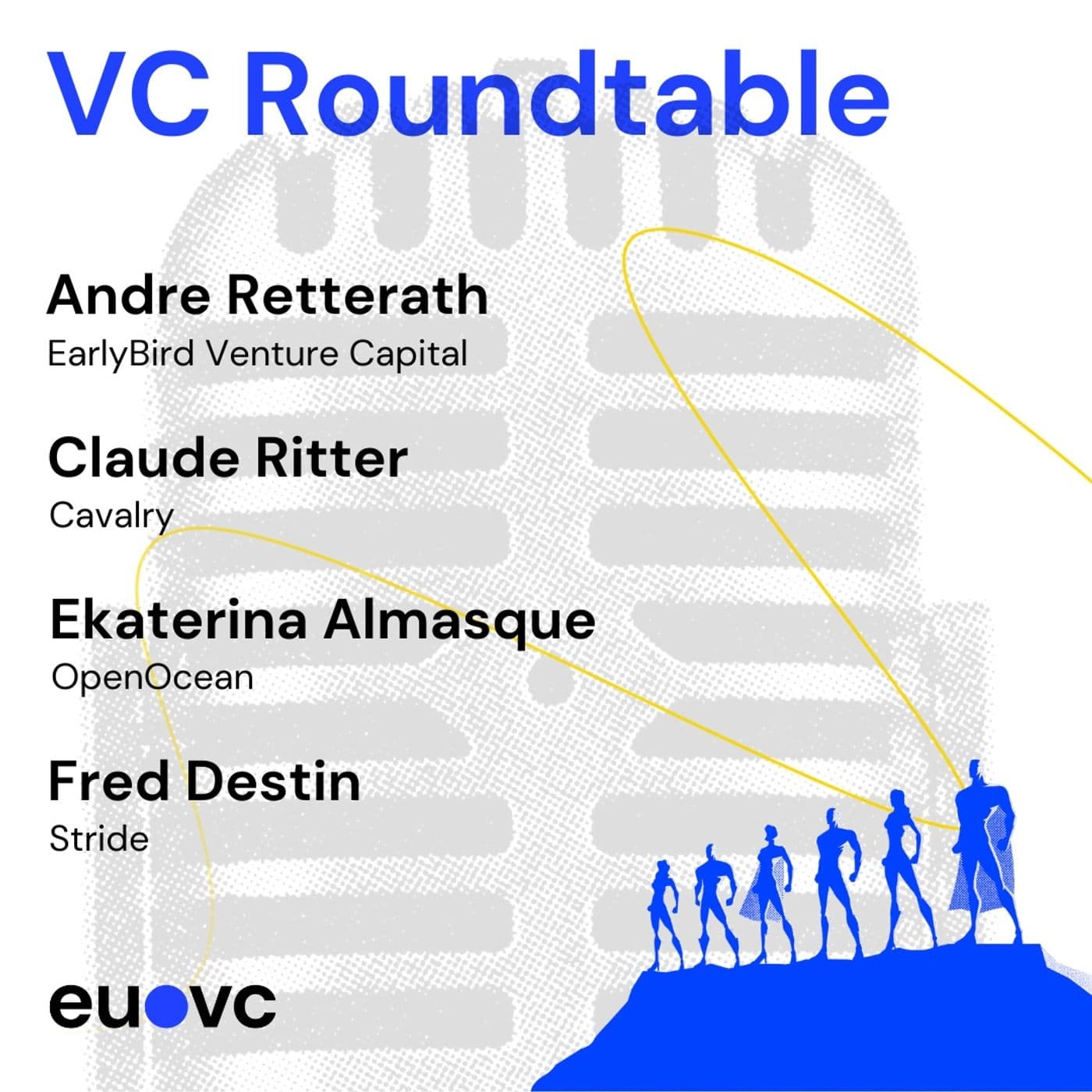
Podcast Title: EUVC Episode Title: EUVC #224 Roundtable on Impact of AI on VC Co-Hosts: Andreas Munk Holm & David Cruz e Silva Panelists:
- Fred Destin, Founding GP of Stride
- Claude Ritter, Founding GP of Cavalry
- Ekaterina Almasque, GP of Open Ocean
- Dr. Andre Retterath, Partner of Earlybird Venture Capital
Episode Overview In this roundtable discussion, prominent European venture capitalists discuss the transformative impact of Artificial Intelligence (AI) on the venture capital landscape. The focus is on practical implications of AI in VC investments rather than theoretical discussions. The agenda includes exploring venture opportunities in AI, the dynamics between incumbents and startups, strategies to avoid hype cycles, and a philosophical reflection on AI’s societal impact.
Key Topics Discussed
- Venture Opportunities in AI
- Current Landscape: Panelists note a significant interest and investment in AI technologies, highlighting the race to understand and leverage foundational models and applications.
- Technological Advancements: Claude emphasizes that recent technological advancements, particularly transformer architectures, are critical to current developments in AI.
- Incumbents vs. Startups
- Hype Cycle Awareness: The panel discusses the potential for AI to favor incumbents due to their existing customer bases and resource advantages.
- Investment Strategies: Panelists express the need for startups to offer differentiated products and services rather than merely layering AI onto existing solutions.
- Avoiding Hype Cycles
- Substance Over Hype: The conversation stresses the importance of identifying genuine innovation and unique value in AI applications versus transient trends.
- Focus on Execution: Success hinges on companies effectively addressing customer needs and differentiating their offerings in a crowded market.
- AI's Societal Impact
- Job Displacement Concerns: Fred warns of significant job displacement due to AI, as many roles traditionally seen as “knowledge work” may be automated.
- Call for Reskilling: Panelists agree on the necessity of upskilling and reskilling initiatives to prepare the workforce for the impending changes.
Key Takeaways
- AI as a Foundational Technology: The consensus is that AI is not merely a vertical but a foundational technology affecting various sectors, akin to the internet.
- Value Accrual Dynamics: The discussions highlight concerns over value accrual in the tech landscape, emphasizing the concentration of gains among a few large players, leading to societal inequalities.
- Intentional Venture Capital: The concept of “intentional venture” emerges, proposing that VCs should align their investments with societal benefits and ethical considerations.
- Future Outlook: The panel expresses cautious optimism, urging venture capitalists to be proactive in shaping the future by supporting technologies that contribute positively to society, rather than merely seeking profit.
Conclusion The episode encapsulates critical insights on how AI is reshaping the venture capital landscape, highlighting both opportunities and challenges for investors. The discussion urges a balance between leveraging AI's capabilities and addressing the societal impacts that accompany its widespread adoption.
For more insights and updates on the European VC landscape, tune in to EUVC.
Written by AI. May contain mistakes. Listen to the episode to check what was said.
Transcript
Automatic transcript. May contain errors.0:00Hi, everybody, and welcome to this EUVC Roundtable on the impact of AI on VC. Heading up today's conversation, I am Andreas, and we've got a killer panel for you. We've got Fred Destin, founding GP of Stride, Claude Ritter, founding GP of Cavalry, Ekaterina Elmask, GP of Open Ocean, and Andrei Ratterath, partner of Earl Bird Venture Capital. And just to put the pressure on, we are just around$3 ,500 for this virtual roundtable. So this is, in fact, the most sought-after roundtable we've ever done at EUVC. Let's celebrate. Yay! And for that reason, let's not hold anyone up any more unnecessarily, but get right to just set the context for this roundtable.
0:41Because when we first decided to do this panel, we had a decision to make. Should we decide on the one hand on focusing on how AI changes what we invest in as VCs? Or should we focus on how we invest as VCs? And we opted for the former, meaning we want to focus on what it is we're investing in as VCs and how that is changing. And we did that because we've all been to too many webinars on how AI might change how VC works and how our processes are changed inside. But where we only just get to the superficial part of it and in the end, really just hear about how scrapers, integrations and automations make VC ops much, much more efficient.
1:25but in fact doesn't really reveal the secret sauce behind everything. So we'll dive much more into that on the UBC podcast. But for now, here today, we're focusing 100 % on what it is we are investing in as VCs. And as such, we have four core topics to explore. One, where our panelists see the biggest venture opportunities in AI. Two, whether and where and when AI will favor incumbents versus startups. Three, how to avoid just getting caught up in the new hype cycle. And four, and this is on a slightly more philosophical note towards the end of our webinar, how the impact of AI on society will be and how we as VCs should think about this and navigate it.
2:08But before we get into it, let's cue the usual EOVC jingle and then we can get started. Before we start, we just want to give a massive shout out to the sponsor of this roundtable, Affinity, without whose continued support we couldn't dedicate all our time to create content like this roundtable for you. So if you're not yet a client, our message is clear. Do reach out, say thanks, and consider if their platform is for you.
2:44United and determined we can serve as a model for other regions of the world. The nature of a problem requires a European response. Europe is a story of new beginnings. Let's start acting. This show is not investment advice and the hosts of this episode may be invested in the funds and companies featured. All right, everyone. Now let's jump into the meat of today. But before going into the question of where the biggest opportunities in venture will be, let's just circle around the virtual roundtable here and ask everyone to introduce themselves. Fred, can I ask you to go first? For sure. Thank you.
3:28I'm the founder of stride.vc. We started five years ago. We are founding principles. We want to ground ourselves in trust. And we always say that we try to ensure that every board meeting is a whiteboard meeting. And in practice, we run small artisan funds out of London, 100 million inside. Ekaterina, will you take over? Let us know a little bit about OpenOcean. Sure. I'm Ekaterina Moské. I'm general partner at OpenOcean. We are a Helsinki, Finland-based venture capital firm investing across Europe in early stages. I'm based in London. We have a team in London as well. Our focus is mainly enterprise technologies.
4:09A lot of this is B2B, but we are looking at the data infrastructure, including artificial intelligence and so on. So what we like is a product, a very well established product at the early stages, which can potentially become a platform. Claude, will you come next? Yeah, my name is Claude. I'm a co-founder and managing partner at Cavalry Ventures. We are a 160 million euro pre-seed and seed fund based in Berlin, Germany. We invest across Europe in software startups and like to sort of back teams that tell us something new, have unique insights and domain expertise. As it relates to AI, we've invested in seven AI companies and, you know, I guess most notably Aleph Alpha out of Germany.
4:55Beautiful. And Andre, tell us, except for data-driven VC, who are you and who's Early Bird? Thanks a lot for having me. So I'm Andre. I'm a partner with Early Bird Venture Capital. Early Bird is a pan-European early stage venture firm. We have offices across Munich, Berlin, London, Paris, and Istanbul. We have a bit more than$2 billion in assets under management, and we focus on European pre-seed to series A stage companies. Early Bird has invested in teams of different AI companies across the last 26 years, including some like UiPath, Ivan, Snig, and also, thankfully, Aleph Alpha, where we joined, Claude.
5:38All right, everyone. Now, I want to take us into the first question, and I want to go directly into discussing the question of whether there's actual substance in the current AI boom. And Claude, I'll actually ask you to maybe get us started there. Tell us a bit about how you view this, and then I'll go to you afterwards, Fred. So obviously, a good question. I think, you know, we're always kind of after experiences like crypto and so on, we're obviously always quick to call something a hype or a boom. I think, you know, there is definitely a boom and everyone is super interested in what's happening in the space.
6:11I think, you know, what we're seeing right now is definitely enabled by a, you know, big shift or big technological advancements, right? So if you look, if you think about sort of transformer architecture, which is, you know, the basis for many of the amazing things that we see today, you know, this just hasn't existed a couple of years ago, or wasn't as accessible. So there's definitely like actual technological advancements that are, yeah, the foundation for what's happening. Same goes for like diffusion models like stable diffusion, where the Technique University in Munich had a big part in it.
6:51And so I think, you know, this is not just a marketing gimmick. And there's definitely, you know, actual innovation that is sort of underpinning this boom. But obviously, it depends what you make out of it, right? So not just because something is amazing technology doesn't mean that it's going to be an amazing product that's going to be used by millions of users. Yeah. And Fred, I want to bring you in because I know you have a good view on the funding boom that we've seen as well and some thoughts around Mistral and so on. So I'd love to hear you pick up on that thread. Yeah. So let me try and frame a little bit how we think about it.
7:28So at the base, of course, we have the models. And if you look at Mistral in France, which raised$115 million, or how Sam Altman has built his company, you can see that these are strategic investments. And you have to be able to play a game where hundreds of millions of capital are going to have to go into building the core infrastructure layer. And a bit like Palantir would feel, you need some significant strategic backing if you're going to play that game. So from there, we've seen these endless number of application layer companies. The most obvious might be AI email assistants. And usually they're either GPT-4 based or they're minimally fine-tuned open source models.
8:15And it's either use case specific or some form of go-to-market innovation. So they might grow top line really quickly, but then struggle with differentiation over time. And that's the so-called thin wrapper layer. So this is kind of obvious. Now, everything in the middle is interesting. So I would say there's one winning strategy where instead of attacking a feature, you really go and attack an entire workflow from the ground up. So a good example would be Jasper AI in the US, raised$125 million in the first round, and is attacking content generation across the enterprise, trying to nail every product function, starting with marketing.
8:51The other strategy, of course, is to go vertical. and one company that's impressed me in that would be Harvey, funded by Sequoia. So what they're trying to do is to line up funding, large team capabilities, and then launch partners, design partners from day zero. So you can basically lock it in and scale it up. So they launched with Allen & Overy, PwC. And then when you see how they talk, they talk about security, data segregation, custom data models. So they're going right into enterprise. And, you know, that's very different from a lot of the future companies that we see. You can also play the LLM tool stack.
9:29So, you know, that's a specialist enterprise software investor area. But, you know, there are some good examples like Pinecone trying to combine AI models and vector search so you can build better spam detectors or recommendation systems. So as a VC, you see this diversity is enormous and there's opportunities everywhere. and I think in a way we can try and thematically attack it but the key is you know focus on the basics what constitutes a unique insight figure out if you're either fixing a hard customer problem in a truly novel way or leveraging AI for something completely new and I always say entrepreneurs are better at finding white space than we are so it's a question of going back to first principles and sort of daring to be surprised the one thing I would say to is I don't think this is a place where you want to do any form of incremental innovation powered by AI.
10:20I don't think these things will get crushed. So we have a company in the portfolio, for example, called TechWolf. They do skills and talent middleware, completely AI powered. And that's of interest to anyone who wants to manage talent strategically. So selling exclusively to large enterprise. So I think that's an example of something unique and scalable. But you know, that took five years of work to get to product. I'd love to ask the whole panel here, because Fred just said something that some might be surprised by being that if you're not very substantially differentiated from anything else and almost building from the ground up, or if you only have a thin application layer on top of something existing, then you're going to be squashed.
11:05Andre, can I call on you to give me your view on that? because we're seeing tons and tons of startups doing exactly that, right? No, I think I mostly agree with Fred, and I think he highlighted some super interesting companies out there, which we are certainly tracking. I think zooming out a bit, for me, it's the biggest question mark of value accrual across the stack. So there are these two fundamental different models. You can go horizontal on one of the different layers. So for us, we typically think about four different layers being the infrastructure layer at the bottom, where we have essentially everything like NVIDIA, TSMC, ASML, and all the value chain downstream.
11:42And we have this foundation large language model on top of that. So this layer where we have companies like OpenAI, Alice, IFA, stability, but also hugging face like platforms. And then on top of that, we have essentially this middle layer that reduces the friction. So this is everything like the vector database companies, all of the prompt engineering, prompt ops, vector ops, all of these companies in there that essentially enable the companies in the application layer to build proper applications. So the application layer being the last and highest layer. And if we think about these four different layers, you can be either fully vertically integrated or just partially vertically integrated where you cover like two or more of these different layers, or you can go like quite horizontal where you focus on one pure layer.
12:30And this is what Fred also called essentially a wrapper company being in the application layer whatever if we think about the value equal i think we see today on on a geopolitical level that the core bottleneck is really on the infrastructure layer and we see on the llm layer that many of these providers actually converging so both in terms of performance and also with these open source variants of lama2 for example we see also the way how these models are set up is also partially converging so for us the major question is where will be the value accrual really across this stack? Will it be in the infrastructure layer?
13:07How will the margins shift? Will it be in the LLM layer or will it be in the middle or application layer? And then also the question, how can you be differentiated if you just focus on one of these few layers? And I guess there are different examples where you can see, and Fred mentioned some of them already, for example, on the application layer, where the teams have shown with like super aggressive execution and strong product capabilities to build a leading position like super fast and ramp it up but the question is really is this sustainable in the long term and then the same is on the underlying layers where it's more about like research technology product perspective so this is how we think about it in a very high level and i couldn't agree more there are like tens and probably thousands of companies out there We just put we are AI powered XYZ on there.
13:59But in reality, it's just like casual products where they put an AI feature on it. And for us, it's really important to understand what is really the core AI functionality under the hood. And is this really a sustainable differentiation in the long term? That's more on a higher level without concrete examples, I've read already, guys. Katja, I want to pull you in here because I saw you nodding and smiling at a couple of things. Andrei said, so feel free to comment. Of course. No, I agree, actually, with Andrei and Fred and Claude's very valuable points. So I'm smiling sometimes because, you know, I have a background in artificial intelligence since the 90s.
14:38I actually graduated in computer science and my master's thesis was in artificial intelligence. So the reason we couldn't do artificial intelligence back in the 90s was the lack of compute power. And then in 2006, deep learning was kind of invented and it was a breakthrough that allowed to do the artificial intelligence workloads with a reasonable compute spending. And actually, I am investing in artificial intelligence since 2006. And so we have seen it all. So what we are observing today is a very interesting phenomena where we have these foundation models that are getting bigger and bigger.
15:15And there is a lot of resources that are going into this. it actually scares the community that has been there for a long time. So this is something that we need to see. And those models get also commoditized quite quickly. So basically there are billions of dollars going into making these models, so much compute power to train each model. It's probably that the carbon emission is equal to the lifetime of one vehicle on the road. So all this cost to the society we are observing. So having said that, we do believe actually that artificial intelligence is a breakthrough technology and those who are not adopting or enterprises that are not working and adopting artificial intelligence today will be probably not winning in the future.
16:04So the winners of tomorrow are made today. So basically what we want to see and what we are seeing today is that a lot of value actually is generated in the infrastructure because of the cost of resources. These huge LLMs or huge foundation models, they consume a lot of compute power as it was kind of feared in the 90s. But majority of investments on the venture capital side actually is pouring on the application level. We are publishing maps next week, and we saw that actually in the UK, for instance, a majority of VC money is going into application layer, which is incremental, kind of incremental innovation based on foundation models.
16:46And there is a mismatch there where the value is, like, for example, where NVIDIA is making a lot of cash today because they are selling a lot of GPUs, even if we want to build those models, and where venture capital money is going on. So basically, at OpenOcean, what we do believe, there are several ways where actually it would make sense for smaller funds like ours to invest and where still a lot of value will be generated in the future. And one of those sectors is enterprise customization of models, because today foundation models, they are mostly over-the-shelf models. They are great for certain things.
17:27But when you talk about enterprises, they cannot just take them and adopt. And then when they start deploying them in production, they run into a lot of issues. So companies like Latest Flow, for instance, in Switzerland, they do help to understand those issues and customize models and understand where they're not performing. The other subsector, actually also on the infrastructure side, would be working with data. Data is needed for those models. Models are very hungry. However, high-quality data is not available. And this is where enterprises are really struggling today. There is a lot of data, but this data is not readily available for artificial intelligence.
18:06So this is somewhere where tools are coming in to help enterprises to deal with this. So these are the subsectors where actually value will be generated in the near term. And in the longer term, of course, we will want to see reduction of hungerness of those artificial intelligence models because, as Andres said, it's not sustainable in the long term. No, I just wanted to add to that because it really reflects also what we are seeing. Essentially, if you think about this stack, these different layers from the infrastructure up to the application layer, the number of companies across these different layers are essentially an inverse pyramid.
18:41Really like that. and essentially we see most of the companies in the application layer we see less because this layer is just very recent in this middle layer where companies are just evolving in the past year or so and then we see even fewer companies in the LLM foundation layer and we see the fewest number of companies in the infrastructure layer and I think that has a lot to do with the requirements to start a company in that layer and also the complexity of solving this problem like setting up the whole value chain and infrastructure layer is just like a super complex problem. And similarly, it has been super complex to train LLMs in the past, whereas, for example, it's comparably easier to start an AI application layer company, like a new productivity tool whatsoever that has an API and two external LLMs.
19:32So I think this is a natural consequence that we have more companies at the upper layers and less companies at lower layers. Can I ask you, Fred, to come in and especially on the application layer part and the inverse pyramid that Andre just described? I don't disagree with the framing, but I think you have to think about venture capital as a global game. And historically, most of the cloud, if you think about cloud infrastructure, actually Snyk, somebody's in code security with Snyk. If you think about cloud infrastructure companies, there are very few companies that pull away from the rest of the lot and become providers to the vast majority of the market.
20:15Say Docker, for example. So there is such scale advantages to these businesses that for me as a European investor, I think we do have opportunities to build global winners at the infrastructure plus one layer. But you have to be extremely careful because typically that is one of these areas where the Bay Area will manufacture companies at scale with better access to capital, better engineering, maybe not better engineering, but suddenly better go to market and come and railroad you. So it is logical that these infrastructure layers are fewer because they're inherently building blocks for everybody else.
20:55And then I don't particularly subscribe. I think it's useful to look at the stack layers. But actually, if you think of AI as a 25-year transformation or 50-year transformational thing, then it really applies to everything. So then you say, well, whether it's middle office in an insurance company or whether it is, you know, content creation across an enterprise platform or whatever it is, you know, the question really becomes, do you have disruptability of the incumbent in that field? and that's a thorny question. I quite like what Katya was saying because I think what's happening a lot here which is different from previous era is that people are actually leveraging AI internally a lot more than they used to because we benefit from software fabrics that are a lot more flexible.
21:49They have the data internally anyway and so now we're seeing people iterate and experiment internally rather than necessarily buy from startups. So that's another factor here which is different from before, which is people are building their own. We have no code interfaces and environments. You can design your own workflows. You can leverage your own data. So that changes the game quite a bit. And in fact, we're seeing that enterprises used to before trying to buy from the outside and now saying, hey, we have the skills internally. We're actually going to build this in a way that makes sense for us.
22:22And so I think the world is a lot more complex than when we're trying to apply. And the models are useful as a reading grid. But in reality, what I found is a blossoming of AI opportunity. And a lot of it is at the application layer because you're effectively trying to solve a customer problem that's significant. So you're attacking a workflow. You're attacking a division. You're attacking a vertical application. And I think it is natural that you see a blossoming of these opportunities at the top. By the way, we can afford to lose capital as an industry because we can shut these companies down quite quickly.
22:57it's kind of what we do, right? We let a thousand flowers bloom and then, you know, some of these look like toys and then they become real companies and others fail. And, you know, that's part of our industry. Yeah, and am I right in saying, Fred, that what you're also saying here is that it's okay to be investing as a VC or an angel in the application layer. It's not, you can't just say, well, because it's just application, it's not going to be a venture outcome. There's plenty of room, but it's going to be very difficult to write up front, to say, is this going to be a toy or is it going to grow into becoming something substantial?
23:31Well, I think the difficulty and the difference here is that the ability to adopt AI is much higher. See, in the past, you had these evolutionary curves of code. So every time you had a new platform, a new code generation, you could build a new company that would replace the code base of the old one. And that's kind of how you want. And this time around, everybody's on pretty much the same stack. And now you're seeing that if you're trying to attack Intercom, for example, well, good luck, because Intercom launched FIN and without any kind of tuning, they drop customer response costs by 30%. And that's before they started making the model specific to each customer.
24:13So you look at Intercom applying, adopting AI. And I mean, I don't believe you can start a new customer support company just saying we're going to leverage AI and kill Intercom. It doesn't work that way. So the position of the incumbents is really quite strong because they have distribution, they have customer data, etc. So I think there is something quite fundamentally different here, which means you have to look at whether this is a 80 % existing, 20 % AI, in which case the speed at which you build will not save you. or whether you're doing something fundamentally different. Like the paradigm has shifted because AI powers something that could not exist before.
24:50And there it's more interesting. Let's take one example. If you could build a fully integrated multi-channel bidding engine for advertising that was fully AI powered, I mean, that changes the game from tools that were built to present bidding engines to humans who would decide where the budgets went because now you're changing the entire workflow. Okay, so maybe that's something interesting. I don't know. But, you know, that's one example where you would be changing the paradigm. And then you might have something really interesting and sustainable to do. Yeah, we've got another example of Jasper in that space, I think, as well, who just attacked the whole stack.
25:26Yeah, correct. And, you know, there's also, we are a little bit focused on software and applications. But, I mean, there's also entirely new areas. So, I think there's a laboratory in the U.S. that started self-organizing nanostructures. and you know okay that sounds like science except what you can do with that is you can do new masks for semiconductors that nobody was able to do before and there you're applying ai to the you know self-assembly of molecules and nanoparticles okay that's like clearly fundamentally interesting right even though it's probably heavy with science risk just one comment is the question of course with the application layer is the long-term differentiation because as a venture capital we do need some kind of, not guarantee, but some kind of thesis around how this company is going to become a leader.
26:12And very often when there is not substantial differentiation on the laws that everyone is using the same models, then actually what we are doing is investing in a company that provides, I don't know, let's say 97 % accuracy on certain outcomes. And then the next company will provide 98 % of accuracy. And then everyone jumps into this and the ball is rolling. and then this is really difficult to pull enough capital to create real leaders. So this is the challenge, I guess, in the application layer. So now there are some companies, for instance, that are trying to rebuild the stack. And then the question is, of course, how credible is this strategy?
26:48Like there are companies like Somatics out of Germany, for instance, they are building their own foundation models. They have rebuilt their stack based on their research at Dortmund University. And they are providing then these models for the German market and even with the German language and so on. So these are also approaches that are probably popping up, bottom up. And then, you know, this might be also some unique differentiation in some of those solutions. Claude, I saw you reacting a little bit here, so please come in. Yeah, there's a couple of things. I think just to what Katja said, honestly, I also think we're just sort of overcomplicating things a little bit to a certain extent.
Read the full transcript
27:31talking about stacks and layers and all of these things. And just in the context of AI, obviously you could have talked about exactly the same thing with looking at the cloud stack. And I think this is, I mean, it's a valuable discussion, but I think at the end of the day, every company that we invest in as a VC needs to build something that is interesting and relevant for whoever is supposed to be using it, regardless of whether it's AI enabled or not AI, right? And I think, you know, I fully agree with what Katya says with regard to, you know, can the company build something that is differentiated enough to, you know, establish a mode over time and so on.
28:13But that's nothing to do with AI. Like AI has, you know, AI obviously allows companies to do things, as Fred also said, that just maybe haven't been possible before or would have taken years to sort of build or implement. right but it's just it's just a tool in the tool belt in a sense and it will become sort of a very present tool that is being used in in you know old software new software incumbents in enterprise and so on but at the end of the day of course it's important to understand how the stack is built and all of that but that's not new it's kind of like i don't know what the the essay was from paul graham but it was you know he literally writes something like he wrote something like build something people want.
28:53And then, you know, that hasn't changed. And if it provides enough value over time, you know, you will also be able to sort of build a defensible product. Now, you know, obviously, and I think also kind of going back to what Fred mentioned, you know, distribution is obviously an absolute key, right? If you come with something, you bring something to market that is sort of marginally or incrementally better than what's already out there, but you don't have the customer relationships, you're not going to win, right? You're probably not even going to make a dent in the market because customers were just going to stick with what they have and maybe use the slightly inferior product.
29:30But, you know, maybe it's bundled into whatever they already have. And so there's very little incentive to sort of go and try your thing. So I think if you really, as a startup, if I think about sort of the companies we invest in, I think the question is, you know, is this something that has not been possible before if the company would have not been built with AI at its core from the ground up? A, or is it something that is existing or coming into existence because we're using AI? You know, for example, the topic of AI governance, we invested in a company in Northern Ireland, you know, AI governance was a non-topic up until recently, right?
30:13But now, obviously, as we also already explained, like in enterprises, people are starting to use machine learning models. You know, anyone from financial industry, insurance and so on are using lots of models for all kinds of things. And then obviously questions arise like, how is this thing trained? Who owns the data? How do we run this? Does it deliver the results that we want? And also the regulator is becoming interested in the whole topic. Like, okay, what does it do? And wants to have a certain level of insight. And so if you would have asked me like three years ago, if AI governance is a software category, I would have probably not known what you talk about or said no.
30:53But today it certainly is, right? So it's a good example of something that just exists because AI is here and it's being adopted rapidly in enterprises. So I think at the end of the day, if you just build a better paperclip or a better something to a product that has massive distribution that already exists, that's not something that will work. You either have to change the workflow drastically, as also Fred said, or build something that is an entirely new category that only exists because of AI. But again, this whole thing of like, you know, the whole discussion is a bit, I feel it's a bit superficial to a certain degree, because at the end of the day, you know, it's true today that you have to build software that really matters to your customers.
31:39And that's been true a few years ago as well. It matters from a VC perspective in terms of the teams that are required to build a company. I think these layers matter in a sense of if you build an application company, for me, the first thing I look for, like, do they have proper designer product people who are capable of building like a super nice UI UX? And are they capable of go to market execution? So do they have experience in terms of scaling a company, finding go to market fit, and then really executing upon that? So it's more excellence and execution in a way. If I look at the lower layers, for example, at an LLM company, I would like in the first place look for are they capable to attract like proper research talent, like AAA researchers, AAA people who are capable of training these models potentially on the infrastructure layer, connecting the different GPUs, knowing how to put like the different checkpoints in training and so on.
32:33So from the VC perspective, it matters in a sense of which kind of teams, which kind of profiles are we looking for, depending on the venture solution they are building. Otherwise, I fully agree with you, Claude. So let me hop in here. So the venture industry historically has a terrible track record of funding 10, 20 competitors for every obvious opportunity. A good example would be recently, Hybrid Work. Let's fund a payroll, rebuilt payroll company in every European country, 10 of them in the US. And then guess what? Two of them made it and there were the original two from the US who crushed everybody else.
33:13So I think we, and the same was true in storage and networking. I mean, so the whole history of venture is to back competitors. I think the question is what's changed. And we had Lean Startup 10 years ago. now we have, you know, readily available software infrastructure. We have high commonality in the fabric of how the companies are built. We have a high level of sophistication in go-to-market strategies. And we have, we're data-informed, so we replicate very quickly what other people do. So I think in a way, that race for differentiation is no joke. And I think that we are at risk because we see this mega trend and it's so obvious and then your lps are asking what's your ai strategy and then you're like oh shit we haven't invested in ai and so you have all this tail wagging the dog here and in the meantime you have to go back to the foundational principles of is this fundamentally differentiated does it have staying power and but ask yourself the question at a deeper level than before because you know replicability is such a problem right like we are able to replicate pretty much any fucking thing today starting with your code so i think there is a more existential problem a little bit and which for me at least warrants a kind of healthy caution because like it is just difficult to find things that you where you have a clear path to something other than a 200 million exit you know um and so i i do question in what way the world has shifted and i think one of the ways is the power of the software incumbent is stronger because of the reason we talked about and i think that's quite different for example and so i think there are additional there's opportunities and completely new things that are incredibly exciting and then there are challenges in the established markets because of call it replicability and the power of the incumbent which i do think shift the game a little bit so we're we're cautious in ai especially as a european investor because man you know i'm so scared of getting my ass handed to me by a 5x more funded u.s company with with an incredible team Yeah, so we need to unite more for funding as funds to back those amazing things.
35:43I just wanted to make a comment. I think, Claude, you made a good point about us as venture capital. We need to look more for customers. Like if customers want a solution, this is good enough, whether it's AI or not. However, I think that we cannot ignore the opportunity opening in front of us because of artificial intelligence. And again, going back when cloud started, it was 2004, 2005, when people were quite skeptical about the cloud technologies because it kind of looked like distributed computing, more or less, like with a new marketing term. And suddenly there was something very powerful growing 20 % year on year with a lot of opportunity opening up.
36:25And suddenly all this Microsoft and Amazon and so on built 20 billion businesses just within a few years and continued to grow very fast. and suddenly you have a huge pull from the market for acquisitions and IPO was falling. So now talking about artificial intelligence compared to cloud computing that was growing 20 % year on year, artificial intelligence is growing 40%, so it's doubled. And there is such a vast opportunity in front of us, we don't know exactly what's going to happen, but definitely there will be new winners. And as venture capital, we just cannot ignore. So the question is, of course, for us as many of us have quite small funds like our fund is just 120 million euros of course we want a question mark where do we put our capital to work so we create the most value in the market for our piece as well but but that's sorry to jump in but that's kind of like your job no and it has been your job before i mean like being informed about the mark how the market moves you say cloud has been growing 20 year over year now ai is growing 40 percent over year good for you i I guess, you know, and good for me, right?
37:31You know, but so I think being aware of these things and understanding the environment in which we operate and, you know, talking to people from researchers to product builders to investors, you know, that's our job, right? And I think I fully agree with you that things are turning, like iterations are quicker, things are moving faster, companies can, you can build, you know, like years ago, it would have taken you like a long time to build software that reliably can whatever detect a dog in an image right now you just throw throw like a hundred thousand dog images at the off-the-shelf model and you have the best dog detector ever right so so i i fully agree i think things you know go very quickly it's very the speed has certainly accelerated but i i also think you know like if you evaluate an opportunity today right i give you a concrete example back in 2019 we looked at a company that that's active in the automotive space.
38:26It's about engineering, collecting information from old CAD tools and combining them into sort of a unified digital twin and so on and so forth. And that just did not work before, like we had the techniques for machine learning and so on that we have today, right? And I think as a VC at the time, to be honest, you know, in 2019, you know, I've learned some stuff, read some stuff and so on, but I was not an expert by any means, such as yourself, right? But like you were an expert clearly, but I wasn't. But like this obviously sounded so crazy that we started digging into it. And so, and we found out that, yes, okay, there is like a technological shift happening.
39:07And we're, you know, we try to back into this or underwrite partially this technological shift by investing in that company. And so, so I think, you know, yes, things are moving quicker and, you know, there's the wheels are spinning faster and so on and so forth. But at the end of the day, that's what we're paid to do. And we have the whole day to sort of be informed about these things and make up our mind. But it doesn't change, I think, what I said earlier. It's like, if you build something that no one cares about, it can be the most amazing piece of AI software ever. But just no one will buy it.
39:42I'm just reflecting on us and including myself here, which is kind of interesting. we have a little bit of a european bias collectively of let's not fail and when katia was talking about do we don't know i think this is very true the thing that's different about the eye because you always have to look for the differences it is non-linear i mean with this recursive learning etc and this thing is just evolving at a speed that we cannot control or fathom and so in a way i would say collectively as europeans well like let's just fucking experiment and fail and learn and if founders are going to do rapper companies let them do rapper companies because you know what they're learning they're working with ai they're iterating and maybe the first one fails and the second one they group up with a few others and do something meaningful and when you go to san francisco you know nobody ever fucking tells you your idea is bad everybody's like go for it man or girl and i i think we kind of have to do the same here because it is the wild west and it is non-linear and chaotic and it's like let's just put some chips on the board and go learn and build and some of it will look really stupid you know and i'm like shoot me like you said claude it's our job to look stupid you know we have to do this on behalf of everybody else you know kind of with our name insisted for an object failure because that's part of our job too.
41:10So I agree with you, Fred. I think honestly, like especially when we talk about deeper tech or cutting edge, I think a little bit of adventurous attitude is missing in Europe. And this is what I'm missing a little bit as well, because I lived in Silicon Valley for quite some time and have picked up some of this culture as well. So being also first institutional check in companies like Graphcore, you know, believe me, we want to be a little bit more kind of cutting edge and trying things out and especially knowing that a lot of things are happening in the space of AI and infrastructure so by one thing that is missing a little bit and I want to talk about this is growth capital, we can spread our capital in early stages quite significantly as we do in a lot of early stage funds and we can put a lot of money behind ideas believing that different founders can build and some of them will fail but what is really important for us to build real leaders and to have actually exits at the end of the day is growth capital.
42:11And this is something that we have learned time over time that once we get to this growth stage, it's really hard out of here. Whether it's Graphcore, whether it's, I don't know, hopefully Mistral will avoid this future, but we want to have those companies much easier life in the growth stages. Can I bring you in here, Fred? Because I think I can read your face well enough to know that I think I saw a reaction. Well, look, I think Katja has a point, in particular, in the difficult stages that are the Series B-ish things, where you haven't proven enough to get the US funds to jump on board. And it is that difficult value creation moment when you're in the gray zone and you know do we have enough depth i was smiling a little bit because i'm like please don't bring in more government money um and number two you know i was also smiling because i'm not convinced we have a fundamental problem with lack of VC money i think the last few years have taught us that you know there was just too much of it and it pollutes the outcomes you know the thing about growing companies too fast with too much cash is that complexity attracts complexity it's like you hire one person they hire another two and then before you know it you've created a monster and you've lost touch with your customers and your product and and you end up vaporizing cash and so i'm both in agreement the reason why i was smiling is because i'm always worried about the vc phenom of what it does to high growth companies and i thing again especially when we're doing when we're doing things like ai the bleeding edge you know just kind of having time to experiment and not trying to go too fast and not playing the stupid game of over over promising on your forecast and then raising too much money and then you're you're already halfway to hell you know and so this kind of going back to like hey this is going to take time to build this is a 30-year opportunity let's get our heads down let's build from real value.
44:20And so this is why I wasn't commenting on Katya to actually agree with her comment, but there was all these other things that came into my field about the last few years. I just wanted to bring both of these together. Like on the one hand side, we've been talking quite a bit about AI in this conversation here and also the impact of AI. And on the other hand side, of course, VVCs for every new fund generation, we think about what's the size, should we increase, should we stay the same, should we go smaller and then also availability of capital across stages in our ecosystem. And I think connecting both of these dimensions, there are some interesting studies on the cost of experimentation.
44:55So essentially, how many resources, how much cash is required to achieve a specific milestone? Like, for example, product market fit or a million in ARR or 10 million ARR whatsoever. And I think if you've looked at that over the past, say, 50 years or something, we had a few exogenous shocks. One was the introduction of the Internet. So the second one was probably introduction of cloud. And now the third one, the big one, is also the introduction of AI. I think if we look at it over time, we can see that it was steadily decreasing. But then we had these exogenous shocks where it quickly decreased, for example, through the introduction of the internet and the same of the cloud and now the same again for the AI.
45:39So I guess eventually companies will be able to achieve more with less. So what does that mean for us as VCs? Either we keep like round sizes, fund sizes, all the same, and companies can either accelerate with the help of AI to get to a specific milestone by paralyzing different streams, or they can just get way further in terms of the milestones. So assume, I don't know, in the past it took them whatever, 24 months to get from initial concept to product market fit, say just this hypothetical time period. But now with AI, you suddenly don't need to hire this designer, this marketing person to send it out.
46:21Because with AI, you can just use some of these applications, stitch them together and just like iterate super fast. So I think specifically in the early stages, there is, in my perspective, sufficient capital available that I think funds shouldn't grow any further in the earlier stages and really allow the companies to achieve more with less through the help of AI. I wanted to take us to another question, which killed me if I'm stupid here. But I wanted to ask you, do you think that AI is actually a vertical or is it more a generational shift or a platform shift in technology that then affects a bunch of other verticals?
47:03Meaning, do you focus on AI as a vertical or do you focus on everything else that you've done all the time? And then you know that we have a platform shift that's rewriting the rules. I mean, if I may, I think there's an obvious answer to that, which is it is absolutely not a vertical. And the simple way in which you convince yourself of that is you look at all the fields in which it's been applied. Protein folding, tech bio, 3D printing, designing homes. I mean, it's foundational technology. So I think when Andre compared it to the web, he's right on. Sometimes I invest in funds as well. And I know some of you do too.
47:43And then you see a deck from a fund that says, we invest in fintech healthcare and AI. I always have to smile a bit because exactly what Fred said. I mean, it's obviously not a vertical. I'll just do a host comment here and say that when Claude said that we had a full panel smiling a little bit. And that's exactly why I asked the question, because it's exactly what you hear from everyone. I invest in AI or we're going to build a fund that invests in AI. And I think sometimes the question is, of course, we all build our marketing for an audience. And if the audience is asking you, do more AI, or as Fred said before, the LPs are asking you, where's your AI strategy?
48:25Fred, I see you jumping in, so come on. We should frame this question differently because AI is a foundational enabling technology. is there expertise that you can develop and deploy as an investor in the process of building AI infrastructure? Yes. So if you're asking me whether somebody coming in saying I'm a vertical AI specialist is credible, I would say yes, because there is a specific set of issues around tooling, data security, blah, blah, blah. There's a whole vast set of issues around how AI is built that I think both things can be true. So I think when I was making a comment that is the generic application of AI, by all means be an AI vertical focus fund.
49:11Because at the moment we are building all of that stuff in the same way that being web infrastructure was a specialty and being enterprise infrastructure is a specialty. I think there is something inherently unique about the challenges posed by AI and how they can be deployed inside companies or on the web or whatever it is that completely justifies that. So I think both we can hold both statements to be true. I couldn't agree more. This is, by the way, also how we align internally. So I think we have these different verticals or sectors and that can be everything from, I don't know, FinTech, Introtech.
49:43It can be enterprise software. It can be deep tech. It can be like anything. but I guess these technologies and for me AI as a technology is really horizontal to it so it's a second dimension within the matrix it can be also like internet it can be cloud it can be whatever blockchain it can be IoT it can be AI and I think depending on how you look at that AI will intersect with mostly every vertical and I think it does make sense to also focus on this technology however I think Claude's example was great if there are like funds to understand themselves as like, oh, we invest in fintech and whatever, consumer tech and AI.
50:21It's like, okay, you pick some of these dimensions which intersect with these dimensions, and it seems like a bit random. This is how I would think about it. So I fully agree with Fred. It's completely, completely useful to actually focus on AI and say we are purely dedicated AI fund because it intersects with all of the different verticals out there. But you shouldn't, in my perspective, focus on like, okay, a few verticals, And I just picked this technology because it's a hype and I put it on my VC fund deck about raising. I'm in general in agreement with this, so it's not vertical, but there is a slightly different angle on that.
50:56So we do focus a little bit more on data infrastructure and coming with this background of MySQL and LampStack, you know, we do look at this more fundamental layer of technologies. And I have to say, when we compare AI companies, it's helpful to have expertise on this layer. and maybe this is sometimes why fans are saying we are focused on AI, because you want to signal that actually you understand what you are talking about. And even when we evaluate opportunities and we do customer calls, it's important to understand why customers are buying a certain AI solution or why they are puzzled what to buy.
51:33So this kind of background helps to look at the technology rather than just, oh, you know, like I do an optimization, and by the way, I'm using AI for this, or I do a health tech startup and, you know, I help to analyze images. And then you look at this and it looks similar to 100 other startups you have seen before with AI background. So it's a little bit slightly different head of how do you actually evaluate the opportunity in that space. All right. So now we have just around 15 minutes left. And I want to take us into talking about something that I think that especially the four of you here being leaders in our industry and thus at the bleeding edge of tech in general.
52:16I want to know, how do you think about the future impact of AI on society? And to just kind of frame this, I think we should bring Fred in because first I had a quote by him that I wanted to read aloud. But Fred, I want to just give this to you and then tell us how you see the world and then we can pick it up from there. I mean, I don't know if I'm any good or anything, but I'm not short of opinions, that's for sure. So first of all, you know, there is a prevalence within the tech community that AI is wonderful. And I think we want to first acknowledge that and say AI will do wonderful things.
52:51If you think about the first application of DeepMind inside Google, it was to save 40 % of their data center cost by optimizing actually cooling inside data centers. So it is possible that AI holds the future of our planet. So you can make that statement as a plausible statement and understand the excitement. At the same time, I'm a keen student of history. And what I would observe is most people react to it in terms of their personal productivity. It helps me do my job better. It takes the drudge away. However, if you go back a little bit, you can see that the big changes in population were agrarian to industrial, industrial to white collar, and then white collar to X.
53:38White collar is primarily middle and back office in reality. When we call it knowledge work, it's a bit of an overstatement. And these are areas where we started to work with workflow automation. Now we're bringing in the UI path of this world and now we're going full AI. So I think it is naive to think that we will not have dramatic job displacement in relatively short order. And when you bring that up, people say you go into AI panic. So I don't think robots will kill the planet. But I do think that a very large number of people will be displaced out of a job very quickly. And I think that the tech community is a little bit in denial of its impact.
54:24And it puzzles me because look back at Facebook and you move fast and break things. They fucking broke everything. It was like, what have we learned for the past 20 years in terms of what we did to democracy, media, citizen participation in information? Apply that to jobs going forward. And so I think there is a looming issue that is absolutely enormous. And I think that whatever explanation I've heard around driving knowledge work and creating new jobs, I don't think it will be able to absorb the shift that we're talking about. The problem is the speed and the magnitude. So in the long term, we'll all be dead.
55:04In the short term, we might have riots. In other words, the long term doesn't matter. I'm worried about the next 25 years. I guess sharing my perspective on that I think there's a lot of right and obviously it's a very polarizing perspective but I think the underlying arguments are very true and what we will see is we as venture capitalists are very much aware of that there is a power law distribution so essentially there's 80-20 also and we see it's oftentimes like 10 % of the portfolio make up 90 % of the returns and I think we will see also a shift in society if we look at the value creation overall, we will see even fewer companies, the Microsofts of these worlds, which will generate even more of the value creation going forward through the impact of AI.
55:52Because these companies already had, we spoke about that before, the distribution, they have these large customer bases. They can easily bundle stuff like Teams, which then quickly killed Slack, for example, and they can easily bundle also more AI features into their existing product suites. So I think what we'll see is that going forward and I agree with Fred that will be sooner than later we will see even more value creation by very few players and many people will be displaced in their jobs so what we need to think about in the short term in my perspective is a lot about reskilling upskilling but this will probably apply to a fraction of the workers so if we look for example across like the German parliaments different kind of companies more traditional companies like here In Germany, for example, we have a huge layer of super strong hidden champions, SMBs.
56:43We have also some more traditional corporates in here. And if we look at the age distribution in these companies, I'm just afraid that majority of these peoples are not even applicable or even interested in reskilling and upskilling. So this is something we need to incentivize in the very short term, anticipating what will come thereafter, which is this shift in value distribution. So I think as a society and specifically on the political level, we need to think about how can we ensure redistributing this value creation ahead of when it happens. So if we wait until the point where this value shift already happened, a lot of this value is aggregated in terms of money for like few large companies and then distributed to individual people, then essentially the gap between the rich and the poor will continue to increase.
57:33And I think that's like the huge problem ahead that we need to anticipate. And also we as VCs, but also the founders shaping this technology, we need to contribute our perspective and help shape that so that it's just not left by itself. I fully agree with everything that was said. The only issue I have in sort of my daily life and every day is the word problem. problem because the problem for me personally in my head is that if I think the way that Fred thinks and and what Andre just has built upon I get very stressed in my head and I really you know it really bugs me that that we're you know running into something that we clearly have no answers for yet right I I do think however though that for sort of what what we do on a daily basis our job I think there's a lot of opportunity for us not just in you know for to sort of make money but also to actually support this change, hopefully for the better.
58:34Andra, you mentioned upskilling and reskilling. It's probably something that's not going to work for everyone, but it's probably a piece of the puzzle that will help us get to a point where we don't have 100 % of the people that get dislocated out of their jobs and are rioting in the streets. So I think the way I try to make myself think in my head is to think in what can we do as investors, where are the opportunities, and have a lens through which we look at companies and try to sort of intuitively get a feeling for what the impact of a particular company will be going forward. That's obviously not very scientific, but this always happens internally with a group discussion.
59:18We talk about it and really try to figure out, is this a company that if the company succeeds, given the backdrop that you both sort of elaborated on will hopefully get us to a future that we think is better than what it could be without this company being in existence, right? But I fully agree. I mean, there's going to be very big change. It's going to happen fast. Obviously, you probably have some counterbalancing things like a workforce that is aging, that is going out of the world, that people that are leaving the workforce and so on. But I don't think it will be enough to sort of counterbalance the motion because as also Katja said, you know, this or some of you guys, this doesn't grow linearly.
1:00:04It grows exponentially. And I think, you know, the sort of more linear functions that counterbalance this will not be enough. So I fully agree that there's an issue. I just really try to sort of, you know, think in problem solving and solutions and opportunities because otherwise in my head I go crazy, quite frankly. The only brief comment on that, I think specifically because it is exponential, we need to be thoughtful and proactive, anticipating and thinking ahead. And in this situation, society should not be in a position to be reactive because then I think it's mostly too late. But you know we will be.
1:00:41I mean, you see, I'm an optimist. We are all. We cannot be otherwise in venture capital, right? We cannot do the job without being optimistic. I think so if I can add two things here so when we talk about impact of AI there are actually two big things coming one is societal impact and the other one is environmental so on the societal impact what worries kind of what worries me day to day is that knowledge becomes more and more centralized we know that big companies today are driving a lot of this model building and reasoning based on the foundation models that and this data sets these models i built for very small largely non-diverse community of technology pioneers okay so and then you know that the impact of this is not well understood yet i'm talking about this also from my personal kind of background because you can hear my accent maybe have difficulty to detect where it's coming from i I have lived in more than 10 countries in three continents and speak five languages.
1:01:50And I see some of these languages, there is a real threat of languages disappearing in the future because everything is in English and all these models are fine-tuned for English. Centralized knowledge and reasoning is another thing because we do, there is a threat of losing some of the opinions, world opinions and representation of different opinion groups. The second impact is environmental. There is a very interesting opinion by Azim and his exponential view that actually if we continue growing artificial intelligence as we do today, by 2030, all energy produced in the world should be spent on training models.
1:02:31This is probably a very provocative opinion, but it's something to think about. As investors, again, like as Claude and André were saying, we need to think how do we counteract on this and at OpenOcean we have a very open source background and so we are looking at two things. One thing is can we democratize AI? So anything that helps us to democratize building models, democratize data gathering will gain our interest and the other piece is can we make AI more efficient? It can be even a breakthrough completely going away from foundation models and starting again small and beautiful for the edge or whatever.
1:03:09It could be something that helps us to create performance gains on a larger scale, using less computer power, using less data and so on and so forth. So we can definitely invest in ideas that would help tackle those issues long term. Fred, I want to kick it to you to close this off, because you said there will be riot in the streets, at least in the long term or in the short term. So Fred, I think that you deserve the final word here to either end us on a similar somber note or tell us how you see that we might be able as stewards of tech to move in a better direction. So I was going to take it in a different direction, which is fundamentally the question is what is our action and our impact?
1:03:57Because now we're forming views about the world, but what can we do? and in a way that impacts our founders, the companies we back, and by ripple effect, the society that we're in. And I think, so we've toyed with this idea of intentional venture. So in other words, can we filter the companies by intentionality, intentionality of the founder, intentionality of the product, and most importantly, intentionality of the reward, of the incentives, because the world works on incentives. So how can you change incentives? And to what extent can we bake that into how we think and invest? I'll give you one example.
1:04:40VCs will tend to drive companies to maximum value that is not very often aligned with maximum societal interest. So at a company level, how do you keep things in balance? and this is where my interest is which is what each of us can do to generate the kind of society we'd like to be a part of with more conscious leadership with more intentionality in what we do without making grand statements it's just a day by day which investment you choose to back which founder you choose to back and are you contributing to the kind of future you want to see and if one of us wants to go into politics at some point and really change the world that's great it's not going to be me But so I'm very focused on that.
1:05:24You know, what is it that we can do in the next one, two, three, five, 10 years that moves us somewhat in the direction of the future that we'd like to see? And on that note, everyone, thanks so much for joining us for this roundtable. And to our audience, do not forget to head over to EU.VC to stay in the loop with everything venture. And don't forget to also keep an eye out for a dedicated series on data to your own venture. And Andres Newsleves definitely also want to follow if you're a VC that care a lot about how to become a better data-driven venture investor. Thank you, everyone, for joining us.
1:05:59Thank you. Thank you. Thank you. Thank you, guys.
1:06:05Tear down this wall. It's more than just an ally. This is a union of values. values. United and determined we can serve as a model for other regions of the world. The nature of a problem requires a European response. Europe is a story of new beginnings. New beginnings. Let's start acting.
From the publisher
- Fred Destin, Founding GP of Stride
- Claude Ritter, Founding GP of Cavalry
- Ekaterina Almasque, GP of Open Ocean
- Dr. Andre Retterath, Partner of Earlybird Venture Capital
- Where our panelists see the biggest venture opportunities in AI.
- The debate on whether AI favors incumbents or startups.
- Strategies to avoid getting caught up in hype cycles.
- A philosophical discussion on AI's societal impact and how VCs should navigate it.


