
In short
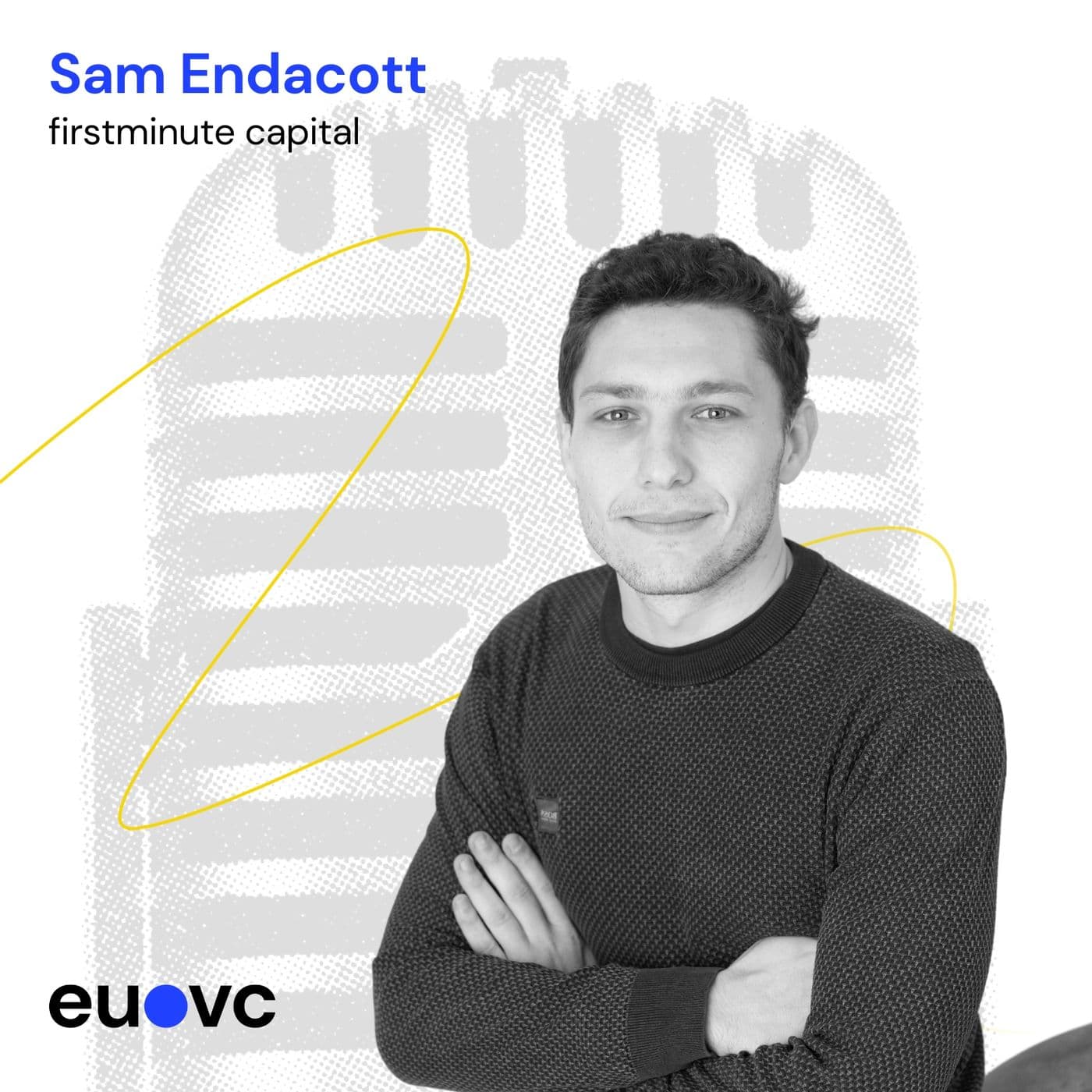
EUVC Podcast Episode Summary: EUVC #228 - Sam Endacott, firstminute
Episode Overview In this episode of the EUVC podcast, co-hosted by Andreas Munk Holm and David Cruz e Silva, the guest is Sam Endacott, a Partner at firstminute, a €400 million seed-stage venture fund based in London and Berlin. Firstminute invests in a variety of sectors, focusing mainly on SaaS, DeepTech, Developer Tools, and FinTech.
Key Highlights
- Firstminute's Portfolio: The fund has invested in over 130 companies including notable names like A.Team, Storyblok, and Robocorp. The portfolio has attracted follow-on financing from leading venture capital firms such as Sequoia, Andreessen Horowitz, and SoftBank.
- Investment Focus: Sam specializes in SaaS, Developer Tools, AI/ML, and FinTech, leading investments in high-performing companies.
Sam Endacott’s Journey to Venture Capital
- Background: Initially aimed to become a diplomat, Sam's path shifted towards investment banking at Goldman Sachs, where he focused on the fintech sector during a pivotal time of market change.
- Transition to Venture: He chose to join firstminute, founded by Brent Hoberman, to learn from someone with extensive entrepreneurial experience.
Takeaways from the Discussion
Insights on Venture Capital and Entrepreneurship
- Role of Luck: Sam argues that while luck plays a part in success, having structured processes can better prepare entrepreneurs to capitalize when luck strikes.
- AI and Generative AI: The recent surge in AI developments represents a significant opportunity for startups. Sam notes the importance of focusing on verticals with minimal existing digital transformation.
- Consumer vs. Enterprise: The discussion touches on the opportunities for AI in both consumer internet applications and enterprise software, emphasizing the need for innovation in less digitally transformed sectors.
Regulatory Environment and Open Source
- European AI Landscape: Sam discusses the importance of having a strong European presence in AI, contrasting it with the monopolistic tendencies of US tech giants. He advocates for an open-source approach to AI development as a means to foster innovation and community engagement.
- Regulatory Challenges: The need for clear regulations surrounding AI and data usage is highlighted as critical for fostering a safe and innovative environment.
Future of AI in Business
- Generational Adoption of AI: There is a disparity in AI adoption between younger entrepreneurs and older investors, with younger generations more inclined to integrate AI tools in their workflows.
- Investment Opportunities: The conversation explores the potential for startups to leverage AI for productivity gains, especially in small to medium enterprises (SMEs) lacking resources traditionally available to larger corporates.
Final Thoughts
- Shifts in Venture Capital: The narrative suggests a potential shift in how venture capital funds perceive investment rounds, with startups able to achieve significant growth with reduced capital requirements, particularly in the AI landscape.
- Community and Learning: Sam emphasizes the importance of ethical behavior, collaboration, and continuous learning within the venture capital space.
Key Quotes
- “Everyone needs a little bit of luck, but you need to put the right processes around what you do every day.”
- “Europe needs an alternative to OpenAI; otherwise, the mistakes of the past will repeat themselves.”
Closing Remarks The episode concludes with a call for further discussions on the evolving landscape of venture capital and AI, encouraging listeners to engage and seek more insights from industry leaders like Sam Endacott.
For more information and to follow the podcast, visit [EU.VC](https://eu.vc).
Written by AI. May contain mistakes. Listen to the episode to check what was said.
Transcript
Automatic transcript. May contain errors.0:10Hi, everybody, and welcome to the European VC podcast. based in London and Berlin to back founders across Europe, but also opportunistically in the US and rest of the world. The fund has investors across all sectors. As such, it's a generalist VC fund, but typically focused in SaaS, deep tech, developer tools, and fintech. First Minute is also backed by over 130, that's one, three, zero, unicorn founders, in addition to current and former CEOs of global corporates. First Minute are now investing out of Fund 3 with a total of 100 million USD and AUM and an established portfolio of over 130 companies.
0:49Notable investments include A-Team, Storyblock, Robocorp, Enkflow, Wave, Clang, Clockwork Labs, Ramp, Element and Generation Home. The portfolio has raised follow-on financing rounds from Embracer Soft with the long list, Sequoia, Andersen Horowitz, Tomiko Index, Benchmark, KOTU, SoftBank, Tiger, General Catalyst, North Zone, Mubadala Capital, NFX, Bolton, D1, Felicis, Bain Capital, and Tencent. And I had to take a breather in the middle of that. At first minute, Sam is focused on SaaS, developer tools, AIML, and FinTech, and has led investments into a number of the fund's high-performing companies, such as Storyblock, and a number of recent deals in this space of AIML, which are not yet announced, but we'll talk a bit about the space.
1:33If you're listening in, love our show, drop us a review, follow the pod and subscribe at EU.VC.
2:03Europe is a story of new beginnings, new, new beginnings. Let's start acting, acting, acting, acting. This show is not investment advice and the hosts of this episode may be invested in the funds and companies featured. After David rattling all that off, let's get into your story on how you got into venture. Yeah, absolutely. So my journey into venture, I suppose it was a little bit unusual. So I went to study at the London School of Economics in London, and my plan was actually to go into the foreign office. So I wanted to be a diplomat when I went to university at 18. And whilst there, I fell into the trap that I think many people do, especially when they go to university in London.
2:50I ended up going into investment banking at Goldman Sachs, which was actually just down the road from my university campus. So it was about a two minute walk, you could almost see it from the library. At Goldman, I ended up working in the investment banking team in the financial institutions group. And that meant deep diving into the world of banks, insurance companies, credit management companies, payment companies, and eventually fintech as well. It was quite an interesting period because it was 2016 to 2018. And that was the time when the Revoluts and the Monzos and the N26s were popping up.
3:34And I was covering UK banks and I could kind of see the writing on the wall that was coming. And actually a couple of colleagues in my group actually ended up leaving and going and working at these digital banks. So that was kind of my first foray into the technology world. I really enjoyed that. I ended up leaving Goldman and actually had two options on the table. One was to go and work at WeWork and the other was to join First Minute and work for Brent Hoberman's new fund. And Brent built lastminute.com back in the late 90s and took that business public in 2005. And I thought that was a really incredible opportunity to go and learn from someone who'd scaled such a sort of large unicorn company in a very interesting space and had an amazing network.
4:23And his pitch for the fund was I wanted to build a venture fund that I would have raised money from when I was starting lastminute.com. And that was with 30 unicorn founders at the time. And now we're at 130. So that was my story of getting into venture. And I just want to say Brent was, if I remember correctly, He was actually the one that recommended we brought Sam on the pod. So a shout out to him from our side as well. Thank you for the introduction, Red. Sam, normally we ask people to share a pivotal moment in their life at this stage. But I actually want to detour a bit and ask you about, you said you wanted to be a diplomat.
4:59That's not very common, right? I think many young kids might not even really know what a diplomat does, to be honest. So I'd love to ask you, why was that? And does that relate in any way to what you do today as a VC? Yeah, a little bit. So I was always really into history and politics. And I used to, for fun, I used to read biographies of, you know, famous politicians and military leaders and things like that. So I was really into history. And then as I sort of went through my teenage years, I got more into modern history and modern international relations. So that was just a big personal interest of mine.
5:34And actually, I studied political science at university as well. So that was one reason. And the second reason was just coming from a pretty international background. So my mom grew up all over the Middle East and Europe. So I'd always been quite exposed to that kind of international background. So I think that was ingrained for me from quite an early age. In terms of like how it relates to venture capital, I was thinking about this a little bit. it does in a sense, because especially in somewhere like first minute, I mean, I'm constantly meeting entrepreneurs from different parts of Europe, as you mentioned in the intro at the beginning, other parts of the world, you know, we've been doing investments in emerging markets, we've, we've made investments in South Africa and Egypt and in Kenya and Nigeria, the US and also Pakistan.
6:27So it's been it's been pretty global in that sense. The other point to mention is just, when we're backing companies, these entrepreneurs are thinking global from day one, we don't tend to back sort of national champions. So it's pretty exciting in that sense. So you're always meaning different personalities, people from different cultures, people from different upbringings, and people who want to take their products and sell them to all different types of people. So it is a bit like that. You said that you'd like to read, you know, books from famous politicians or historical figures or whatnot is there one that you have like as i won't say as a role model but one that you kind of come back to in your thinking oftentimes that you would uh advise any of our listeners to learn a bit more about yeah actually there was um uh there was a few books that william haig who he used to be the the leader of um the conservative policy, Conservative Party.
7:24And he wrote two very good books. One was on William Pitt the Younger and the other was on William Wilberforce. So those are two books I'd highly recommend reading. Pretty interesting periods of British history. Sam, let's get into the Take a Stance section. Take a start.
7:50Sam, I would love to ask you to comment on the following quote by Daniel Kiberk-Knorr from Speedinvest. But if you need luck to become successful, then you might rather restart. Yeah, so I disagree with that comment because I think everyone needs a little bit of luck. and and I completely understand the intention behind this statement but I think everyone needs a little bit of luck but you just need to put the right processes around what you do every day so that when you need that luck it finds you rather than you sort of relying on it if that makes sense so I think luck is important but uh you you still gotta have that sort of very disciplined and, you know, daily grind as an entrepreneur and as an investor, if you want to succeed.
8:47So Sam, to my knowledge, you've been traditionally focused on fintech enterprise SaaS, and also some work in emerging markets that you kind of hinted to it. But it would be, I don't know, almost silly of us to not talk about DevTools AI these days, especially because It's something you're looking into and everyone's actually, everyone's thinking about it at least. And by the way, before we deep dive into this, there's a really cool article that you guys put out at first minute about how you think of the space. I'd really advise everyone to check that out. We'll add the link to the notes. But I'd love to ask you about these interests of yours and how they converge.
9:26And actually specifically, you know, where do you personally see the most potential for investments in the Gen. AI space, right, that everyone's talking about. But I think very few actually have strong frameworks of thinking towards that space these days. So the space has got incredibly busy over the last 12 to 18 months. And, you know, we're seeing a lot of pitches. And we've invested pretty heavily in the space, both at the application layer, but then also we have an investment at the foundational model layer. And then we've also backed a number of infrastructure companies, and then also a number of vertical SaaS companies.
10:03So we're invested across the stack, which as a seed VC is pretty important to build a sort of diversified portfolio in that sense. And not to have too concentrated a position in a space which is moving in incredibly quickly and changing all the time, but it's also incredibly important to have exposure in that space. So I think a couple of things to mention on why we're so excited. I think if you kind of look at the Western world's productivity over the last 30 years, 30, 40 years, it's just been a consistent decline. With AI and generative AI, but also AI more broadly, it's probably a chance for that trend to reverse itself.
10:45And I think that's an incredibly exciting prospect for knowledge workers and developers and corporates, enterprises, etc. So small businesses. So that's why it's such an exciting trend. In terms of where we're getting excited at the moment or where we're spending a lot of our time and trying to figure out how we can capture the most value in the space without 20 competitors sort of coming and building similar products, it's probably being very specific in terms of the verticals that we look at. So one of the problems with GenCVR at the moment is that a lot of companies are pitching co-pilot for X.
11:26The issue with that is a lot of the spaces they're going after are dominated by big cloud incumbents who are also incredibly focused on AI and can roll out those co-pilots pretty quickly and are doing so. And it's very difficult to compete with their level of distribution. So how we're thinking about it is saying, where are the areas, where are the verticals? Where are the industries? Where are the subsectors where there aren't cloud incumbents? Maybe those workflows are still dominated by pen and paper or spreadsheets or legacy software that runs on premise. Let's look at those categories. And what the AI native products can do is they can act as a catalyst for those parts, for those industries to make the shift from those, from that legacy software or from spreadsheets to a cloud-based product.
12:27That's where you can build defensibility and find value also as an investor. So vertical SaaS in less digitally transformed industries and sectors is where we're spending time right now. And then the second piece is actually consumer software, consumer internet. So I think consumer internet has taken a bit of a backseat to B2B software over the last few years, both in terms of sort of venture funding and venture interest. And that makes a lot of sense because, you know, there are huge companies in that space. It became incredibly saturated. Customer acquisition has become very, very expensive.
13:05It takes a lot of capital to scale those businesses, etc. And there hasn't really been a major platform shift to open up a new wave of companies in consumer internet. We had iPhone moment and crypto was a moment where a lot of consumer companies were built and that was exciting. People talked about VR and AR and that potentially being a platform shift where you could build new consumer applications. And generally, AI feels like a potential platform shift where you can build new consumer internet applications. So, you know, we're seeing AI therapists, AI lawyers, AI personal trainers, these types of things.
13:49So there could be a sort of renaissance in consumer internet. I want to go back to not B2B necessarily, but rather say it goes for both of them, right? Because you said you're looking for the spaces where there's been less digital transformation already. And for that reason, there will be more opportunity for a completely new player because the incumbents, of course, have less ease to adapt. Am I right in saying that this also doesn't encompass the models where imagining an AI version of a CRM, as an example, would be a complete change of how HubSpot would work, right? They might be natively in the cloud, but everything they've built would kind of go to shits if they had to change the UI or the experience of the user to be seen.
14:42That's really interesting. So in terms of the less digitally transformed industry, so I'm thinking things like construction, insurance, these types of industries, maybe industrial engineering, you know, like those types of areas. And so that's kind of where we're quite interested in. We've got a couple of computer vision startups applied to industry and logistics and things like that. So we're looking very, very closely at those types of spaces. Now, when it comes to your point around sort of HubSpot and it's sort of an AI native CRM, I think you touched on a really good point. I don't think it's about architecture and revamping, you know, the back end and the way the product is built in that sense.
15:24It's not about like backend infrastructure. I think you hit on the point, which is a complete novel way of consuming software. So what does the CRM of the future look like? How do I like interact with the CRM of the future? Do I connect with Google, log in, see a list of my contacts and things like that? Or is my CRM sort of like a browser widget just sort of sits in the background and then surfaces insights to me and allows me to follow a workflow based on like how I'm interacting on, you know, my, my phone calls and my emails and all these types of things. Like, yes, I, so I think this is, this is a great point around new UIs.
16:07And I think that's an area that's actually really exciting because if, especially if you're a seed investor, because, you know, when you see people pitching in a category like saying, hey, I'm going to build like sales automation software. And you see the same pitch nine times in two weeks. But then you get an entrepreneur who comes in and says, you will have heard this pitch 10 times, but I'm doing it differently because of X, Y, and Z. And if it's so different that you haven't seen it before, and you're so wowed by the founder's level of conviction, and you think they have the ability to execute on it.
16:42And it's just something, something that other people haven't figured out, then that's when you lean in. So for us, it's kind of when we say we have a thesis on the space, it's not really, hey, we're looking to back X. It's more we have a framework which helps us avoid making mistakes, but we always keep ourselves open to the possibility of being led down a different path by an awesome entrepreneur. And on that on. Okay, so sorry. Sorry for making a slightly provocative pivot there. So because now I'm going to ask you, speaking of being let down a path, I need to ask you to talk a bit about Mistral and 105 million euro seed round.
17:28You know, and obviously for the context to everyone here, this is one of the deals that people are using to say something's up in AI, in generative AI, something's up with the size of the rounds. And you've even, I don't know if it's you personally, Sam, but we've even had individuals with a similar profile as yours being young and new to the industry, being commented on in the All In podcast saying, these guys don't know what they're doing. They're putting millions and millions into seed rounds where the majority of the camera will go right into just installed hardware or buying chips really.
18:05And you might as well have bought a stake in NVIDIA then. that type of shit have been spoken a lot about in the industry and by the very notorious four that I just mentioned. I'd love to ask you to comment on that, both when you heard from me now, but also what you've been thinking over the last two months. Yeah, totally. So I think Mischal is a very interesting company for a couple of reasons. One, Europe needs an alternative to open AI because otherwise the mistakes of the past are just going to repeat themselves in Europe, which is that the US has the monopoly on big tech. So I think it's very, very important that Europe has a potential major winner in the artificial intelligence space.
18:53That's number one. So I think it's really good for the ecosystem that someone like Mistral can raise a lot of money, hire incredible talent, and be a sort of standard bearer for the AI community in Europe as an alternative to open AI. So I think that's important. The second point is Mistral's open source approach. And I think, again, that's a very European thing. I think open source has a lot of its roots in Europe. And I think when you think about the Facebooks and the Googles and the Amazons, these big tech companies, they're closed ecosystems. And I think it's great that Europe has the potential to have a major open source player in the AI space.
19:31And so I think that's great. The third point is this space is so early and I think it's still to be determined how companies like Mr. Al and OpenAI actually go and monetize and build their businesses. Whether they become the Amazons of this world, the AWSs of this world and just become sort of the plumbing and the sort of like hosting ecosystems is one path. But with Mr. Al's open source approach, I think they've got a lot of flexibility in how they can build out a commercial business. But I think it's good news for the ecosystem. And we should be rooting for more of these types of companies, especially in the AI space.
20:13You addressed many of the things there, but you didn't address the, when you do a 105 million euro funding round for the seed stage, are you buying chips with that? or can you talk a bit about the mix there? Because I think it's something that's been spoken so much about, but I haven't heard someone like you who's close to the deal actually touch on. Yeah, I think with all the companies at the foundational model layer, a lot of the resources will be going to compute and training models and the infrastructure side of things. And so that's always going to be a core component of companies who are touching the infrastructure side or the foundational model there.
21:00And, you know, I think you'll see that with some of the other big raises like poolside in the US, which is going after code creation and things like that. So that's an important part of it. And anyone building these large language models will need to get a significant amount of resources to that. Could I ask you on the open source part then, because this is definitely, I 100 % agree that this is one of the very exciting parts about Mistral and some of the new players coming up, because we are seeing open AI not being that open anymore. the other major models are coming from the leaders of the centralized web.
21:39So I'd be super curious to hear your thinking around that. And also, especially because, yes, we have in Australia, we have a great open source community in Europe, but we also have a very, very tight regulation on anything that has to do with consumer data. And you can't do much with AI if you can't be allowed to use data. and so on. I'd be curious to hear how you think about, you know, are we in a good regulatory framework right now? And are we headed in that direction? Do you think so in Europe? I think it's in flux, right? I think the rules are kind of being written and the standards are being discussed at the moment.
22:18So I think it's too early to tell. What's really good to see is that the UK is actually becoming a leader in that debate and is really focused on it. So I think that's been a really positive development just being you know UK citizen living in London to see to see the UK taking a leading role in that debate I think that's point number one but point number two is that I think you know we can go down many different paths still so I think it's too early to tell but regulation frameworks are super super important and I think there needs to be a massive amount of focus on that. In terms of the actual open source piece, I think we're big believers in open source.
23:01We really like open source software here at First Minute, and I'm investing in quite a lot of open source companies. And there's a philosophical reason for that. But I think there's also a commercial reason for that, which is big enterprises like using open source software because they can, for a couple of reasons, like one, they can go and audit the code, and they can see what they're actually running and how the software is operating. That's point number one, which in the AI space, when we talk about control of data, is going to be increasingly important and is incredibly important to enterprises.
23:34And secondly, they want to run things on their own infrastructure and open source projects make that super easy for them to do. So yes, regulation is important. It's great to see Europe taking a lead on it. It's still early days And I think open source plays into that in a really important way, because it's both from a very practical point of view, but also from a philosophical point of view. I'm going to ask a completely different question. And it's because in the article that you've put out, you stated something that was quite interesting to me. And let me just give you the background of it.
24:07I was at an LP forum connected to the Tech Barbecue event here in the Nordics last week. And when moderating a panel, I asked a group of LPs, or I guess we had 50 or 60 or so, and I asked them, how many of you are actively using AI in your day-to-day? And I almost want to ask you, how many do you think raised their hand? And these were LPs like family offices, institutional investors, so on. I'd say one in three, one in four. Yeah, I was blown away because that number was three in total out of this 60, 70-ish people, right? I was blown away seeing that. Obviously, many of them are using tools that have AI in the background, but the fact that they don't think about it themselves and how to apply it and so on was really startling to me.
25:03But then I'm connecting this to your piece because there you're saying that you did a survey amongst your portfolio companies and 84 % of the responders said they were using generative AI tools internally for their work. And 75 % were using or thinking about using it in their actual products or outward facing operations. Obviously, there's probably an age chasm between the two groups here. I'd love to ask you, Sam, to talk a bit about how you see the adoption of AI across generations, because I'm definitely seeing, you know, the other day I saw a young kid talking to his friend. And then he asked him, you know, why are you writing on your phone?
25:51And I was like, that's interesting. And then he said, well, my dad has blocked access to Siri because otherwise I'm not writing because he was in the process of learning how to write. So and that just blew my mind, the fact that a friend would ask, what the hell are you doing with your fingers on your phone? Speak so loudly about how the next generation is acting completely differently when using tech than ours. and we are from our seniors. So Zam, I'll let you take the floor and talk a bit about AI adoption across each group. Yeah, totally. So you know what's been really interesting this year is how, so usually when you're a seed investor, you're thinking about how the world will look like in 15 years time.
26:38So, you know, 10 to 15 years time because the companies you back take 10 to 15 years to go public and mature. Now, what's been fascinating in the genus of AI space is the number of new businesses being created at the seed stage and the number of publicly listed businesses on the NASDAQ who are talking about generative AI and actively rolling out generative AI features, right? And being rewarded for that by investors and their stock prices rising on the back of their announcements when they talk about how they're using AI and generative AI specifically. So I think that's an important thing to actually mention.
27:18I think that's been a little bit confusing and it's like a slightly different thing to experience in 2023. Am I right in saying that you're kind of using that to argue that you might see seed stage startups move very rapidly up towards a very largely scale? Yeah, I think what I'm saying is that you do see that, that companies are generating revenue and creating value a lot quicker now than they did maybe. You can grow incredibly quickly. You can get a product to market incredibly quickly. You can hire people incredibly quickly. It's never been easier to get distribution, all these types of things.
28:02So I think that is an important point. But the second point is just I think it's on everyone's radar. It's permeating, you know, all sectors of the economy, all stages of companies, and it's touching every single sector. So I think that that's really the point I'm trying to make. And then in terms of sort of our portfolio survey, the reason I think the numbers are so high is comes down to two things. One, yes, our companies are early adopted. And then two, our companies have big engineering teams. And the two strongest use cases for generative AI in production right now, I think a code is software creation or, you know, basically GitHub Copilot, which is the dominant player in that space, and then sales and marketing.
Read the full transcript
28:46So content generation, right? So code creation and content generation. So that touches both knowledge workers and then also developers. So that's, I think, why the numbers are so high. But the important thing in that survey to call out is that people had a lot of sort of difficulties with implementing generative AI. People were talking about how the latency was poor. The costs were extremely high. It was very difficult to monitor things. So there's a lot of problems that still need to be solved, which people were calling out. So I think the way we see Genescape AI is that, and we invest in a lot of companies, so we've got a bit of a front row seat into how people are using things in production.
29:39We're incredibly bullish long term, but in the short term, there'll be blocks in the road because of some of the difficulties of things getting set up. And then also people not knowing what they want to automate and what use cases they want to apply this software to. And not everything is sold by generative AI. Very specific things are sold by generative AI. So if you try and throw generative AI at a problem that shouldn't be solved by generative AI, people are going to get disappointed. They're not going to trust the software and things like that. So I think lots of bumps in the road, but long term, we're extremely bullish.
30:17I just have one final question before we can move on. I have to ask you within the B2B space, do you see the opportunity for startups being bigger in selling to enterprise or selling to SMEs? Or is it the same, the appetite is both places? It's just a matter of the model and the product that they're developing. I'm asking because first of all, enterprise, no, let's start the other place, right? At SME level, there's so much to be harvested just by adding more hands, because oftentimes it's the lack of higher margins and thus workforce productivity that limits the growth of an SME, right? And they can't just throw, they simply just do not have enough smart people to throw at a problem or at growing or whatever, right?
31:11And for that reason, whether I get 100 % right results or this AI that is going to tell me who are the most prioritized my lead list as a salesperson, as an example. You know, if I were a big enterprise with a bunch of people employed, I'd probably have a pretty good process to make sure that we hit the right leads. But any small SME, you know, they're, you know. Yeah. Yeah. Yeah. This is really interesting. So I've invested in quite a few companies in the no code, low code space. And one of the things that always got me excited by the no code and low code space was this idea that a billion dollar business could be built with an extremely small team, maybe one person, maybe one or two people, maybe just a founding team could build a billion dollar company without ever having to hire a team of engineers and a team of sales and marketing professionals and things like that.
32:08And I don't think it's happened yet. And I don't think the no code, low code spaces has fulfilled that promise. I think there's been a lot of skepticism about, you know, there are great platforms and great tools that have been built in that space, but they're still quite hard to use actually. And a lot of people start building their businesses on that. And then when they get to a certain scale, they roll off and bring things in house anyway. So I always thought about that in that context. Now, when it comes to AI and generative AI, the same story can be created. It's like, could I go and build a business just myself or with one or two people and scale it to a billion dollars using AI tooling and generative AI tooling?
32:50It's probably possible to make a case for that. We've invested in a company which is in stealth right now, which is an application builder where the interface is natural language. So you don't need to be a developer or an engineer to build a fully blown application. That's for internal tooling and external. And similar tools have been built for all the other knowledge work tasks that you mentioned in the beginning. So yes, I think there is an absolutely huge amount of value to be captured from the SME side of things. but the same can be said for big enterprise, both on the cost-saving side, but then also on the revenue-generating side.
33:33I need to ask you a final question. I'm sorry, David. I know that we're running out of time here. I want to ask you, because you touched on it, the capital efficiency of these companies. Do you see this impacting the VC model? Have you seen that the capital efficiency of these startups is actually so profound around that we're likely going to not necessarily for many of these see anything beyond a series a round and then they'll actually be able to get to a point where they're either exitable or or IPO able I don't know the answer to that question yet because I haven't seen it and I think it depends on what type of business you're building so um uh you know there are a lot of tech enabled businesses out there, which are still being built and are perfectly good businesses, but they require a lot more R &D and CapEx and investment and capital raise to achieve their goals than pure play software companies.
34:32The other point is the expenses and I guess cost of good souls associated with becoming like an AI native company or product. So the margins can be lower as well with all the compute that you need to use and things like that. So I think still like TBD on how that looks. But when you think about the rest of the P &L, you can make a very strong case for cost being significantly lower in terms of operating expenses, size of engineering teams, etc. So it should make people more efficient and more productive over time as the technology matures. And, you know, that's really scary because this is going to impact people's livelihoods.
35:19And people are nervous about that, especially people of my generation as well, you know, who are growing up with this technology. so going back to the regulation point and um and and how governments can support the education piece is going to be super super important and the reskilling of people is going to be super important which um i think falls in falls at government's responsibility but then also um company responsibility as well so making sure that we can actually engage with this software in the right way. So, you know, get re-skilled and make sure, you know, we're not out of jobs. I think it's an important thing to think about.
36:01And I think that's a great way to kind of close this section to everyone listening. And we had so many other topics that we would love to talk with Sam. And I'm sure Sam would love to share his thoughts as well. If you feel like we missed out on anything like AI geeky specific, feel free to drop us a line, email us. We'll happily invite Sam back again or do some special content And just for that, I'm sure Sam will be happy to help if he can, because now it is time for the shout out segment.
36:36Sam, I'd love to ask you to give a shout out to a co-investor, angel or just an LP for being awesome. And do share that story behind that awesomeness. Yeah, I'm going to shout out to Camille, who's a partner at Notion BC based here in London. I've known him my entire time in BC. So coming up to six years now, I think he's a great investor. And pretty much every entrepreneur I've met likes him and thinks he's a great investor. He's incredibly empathetic. He's also technical himself. He's a builder. he's been an operator and he's incredibly generous with both his network and his time to brainstorm on things so that's my shout out.
37:23Keeping with the time let's try and move quick through this one the three biggest learnings in your life over the last 10 years tell us. I think one is just like always act you know ethically and responsibly and in a super transparent way. Yeah, always be honest, always be honest and transparent. That's really something I've always found really important. Secondly, is work with people you like, you spend more time, you know, with your colleagues than with your family. So I think that's really important. And then the third thing is always, always try to learn more and to grow more. And that's why venture is such a fun job, because it's literally like being at university every day is like having being in three to four lectures from people who know spaces and topics and domains better than you do, which are entrepreneurs.
38:15So those are some thoughts. And on that note, let's go into the quickfire round where we'll ask you three quick answer questions.
38:36Sam, what advice would you give your 10-year younger self? Learn how to code. Get machine learning, engineer. I love it. Now, what are your top tips for emerging VCs across Europe for fundraising? Yeah, so last year, I was actually in New York with the head of investor relations at one of the largest multi-stage VC funds in the US, who was giving us some advice on the fundraise for our third fund. and he said something was very interesting and stuck with me he said fundraising success is an equation with the following inputs track record usp and simplicity of story and he said if you can focus on on getting the right balance between those three inputs that will determine the success of your fundraiser and what's the most counterintuitive thing you've learned since you've been in venture this is always a tricky one because i think the one i've learned the thing I've learned is that venture is all about the power law.
39:36So usually only a few of your investments drive the majority of your returns, but you end up spending probably the least amount of time with the companies that drive your returns. That's always been counterintuitive to me and something that I've struggled with when thinking about, you know, using my time most spec.
39:57Sam, thanks so much for joining us, everyone listening in. I hope you enjoyed this episode of the European VC podcast to drop us a review, follow the pod or go on EU.VC and bask in all the content that's there. Thank you.
40:24United and determined we can serve as a model for other regions of the world. The nature of a problem requires a European response. Europe is a story of new beginnings. Let's start acting.
From the publisher
firstminute are investing out of Fund III with a total $100m AUM and an established portfolio of over 130 companies. Notable investments include A.Team, Storyblok, Robocorp, Engflow, Wayve, Klang, Clockwork Labs, Ramp, Element and Generation Home. The portfolio has raised follow-on financing rounds from Sequoia, Andreessen Horowitz, Atomico, Index, Benchmark, Coatue, Softbank, Tiger, General Catalyst, Northzone, Mubadala Capital, NFX, Balderton, D1, Felicis, Bain Capital and Tencent. At firstminute, Sam focuses on SaaS, Developer Tools, AI / ML and FinTech and has led investments into a number of the fund’s high performing companies such as Storyblok (raised $58m) and a number of recent deals in the AI / ML space which are not yet announced!


