
In short
EUVC Podcast Episode Notes: Nucleus Capital - Announcing Our Investment 👀
Episode Overview
- Co-hosts: Andreas Munk Holm & David Cruz e Silva
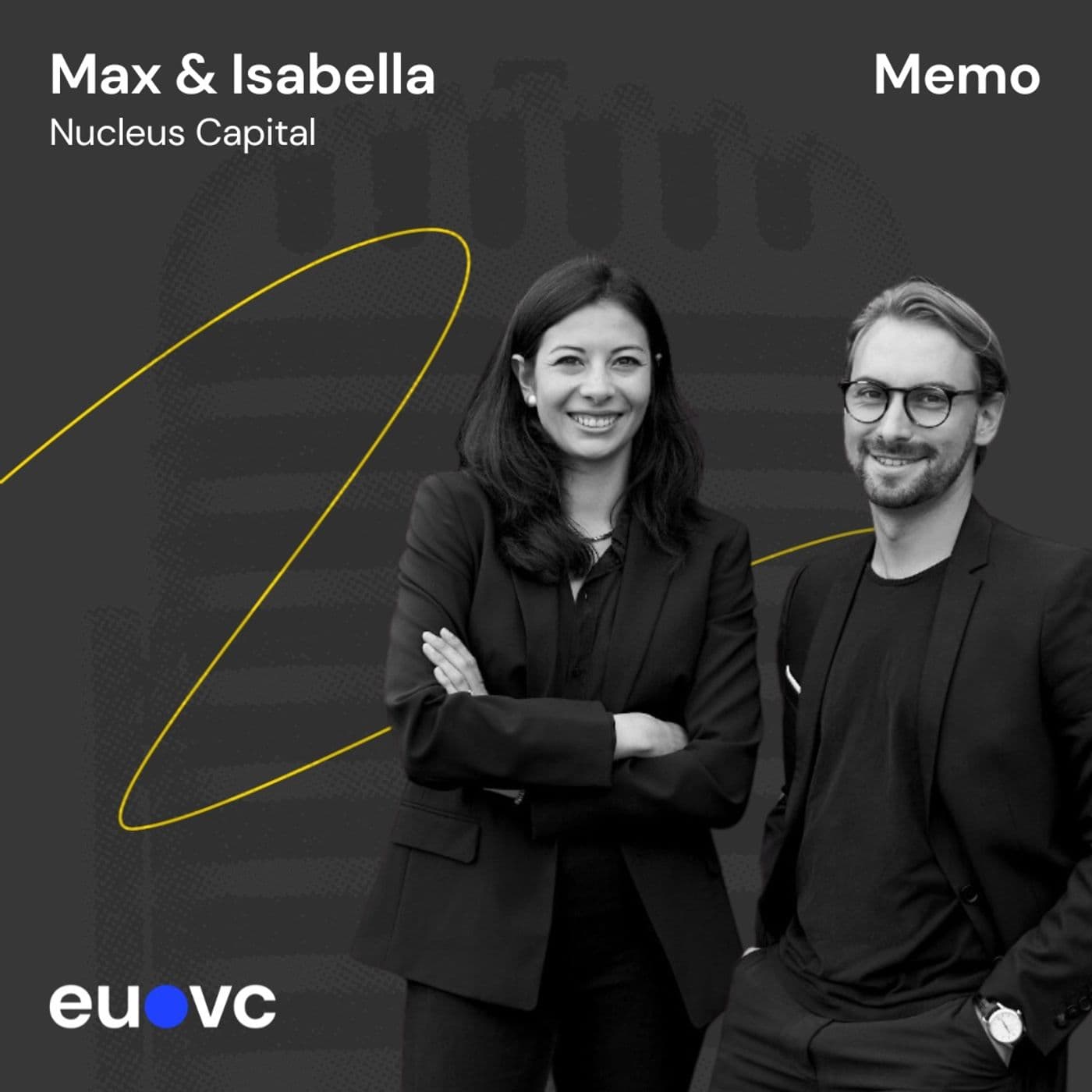
- Featured Guests: Max and Isabella, General Partners at Nucleus Capital
- Announcement: EUVC's investment into Nucleus Capital and exploration of their mission and journey.
- Focus: Nucleus Capital’s approach to investing in purpose-driven founders tackling systemic challenges related to planetary health.
Episode Chapters
- Introduction to the European VC Podcast (00:00:00)
- Pooling Expertise and Building a Community (00:04:10)
- The Journey of Building Nucleus (00:08:11)
- Decision to Work Together (00:11:30)
- Lessons Learned from Fundraising (00:14:38)
- Supporting Founders and Inflection Points (00:16:18)
- Tech Bio and Software-driven Models (00:17:43)
- Importance of Meta-level and Environmental Factors (00:19:44)
- Building Relationships and Effective Decks (00:21:41)
- Differentiation and Positioning in the Startup Industry (00:23:30)
- Delivering Change and Driving Returns (00:25:16)
- Bio-based Solutions for Industry Decarbonization (00:27:14)
- Sector Focus for Better Returns (00:29:17)
- Sustainability and Deep Tech Premiums in Valuations (00:30:51)
- Investing in Technologies for Sustainable Production (00:32:53)
- Repath and Climate Change Risk Exposure (00:34:23)
- Planet A Foods and the Cocoa Industry (00:36:15)
- Enabling a Viable Future (00:39:41)
- Balancing the Portfolio (00:41:38)
Key Takeaways
Nucleus Capital's Mission and Approach
- Purpose-Driven Investment: Focus on companies addressing planetary health challenges through innovation.
- Investment Strategy: Emphasis on early-stage (Pre-Seed and Seed) ventures with a specific focus on biotechnology, food technologies, and decarbonization solutions.
Founding Insights
- Origin Story: Founded in 2020 during COVID-19, initially started as an angel syndicate that transitioned into a structured venture fund.
- Community Engagement: Building a network of functional experts to support portfolio companies and enhance investment quality.
Fundraising Challenges and Lessons
- Significant Fundraising Milestone: Faced a critical moment two weeks before the first close of Nucleus One, revealing the importance of having financial commitments secured before executing deals.
- Empathy Toward Founders: Gained insights into the fundraising struggles of founders, emphasizing the need for support during such processes.
Sector Specialization and Focus
- Tech Bio and Sustainability: Strong belief in sector specialization to yield better returns, with an acknowledgment of the risks associated with emerging technologies and market uncertainty.
- Examples of Portfolio Companies:
- Repath: Climate risk analysis for corporate infrastructure.
- Planet A Foods: Innovating in the cocoa industry to create sustainable food products using bio-derived ingredients.
The Importance of Differentiation
- Market Positioning: Nucleus Capital distinguishes itself through deep sector expertise and a strong network, enabling them to provide specialized support to founders.
- Investment Philosophy: Prioritize companies that demonstrate a strong value proposition for both business viability and environmental sustainability.
Conclusion
- The episode emphasizes the dynamic landscape of European VC and the critical role of specialized funds like Nucleus Capital in addressing global challenges through innovative solutions. The insights from Max and Isabella highlight the importance of community, expertise, and strategic positioning in the venture capital space.
---
Follow-Up Actions
- For Listeners Interested in European VC: Subscribe to the EUVC Podcast and explore additional resources on eu.vc.
- Engagement: Consider sharing experiences with fundraising or investing in purpose-driven ventures to foster discussions within the community.
Written by AI. May contain mistakes. Listen to the episode to check what was said.
Transcript
Automatic transcript. May contain errors.0:00Hello, everyone, and welcome to another European VC podcast. As usual, you know who I am. I'm David, known as the LP Syndicate Lead and joined by Andrea as my co-founder, the LP Hype Man. As David just said, you know, I am the one responsible for hyping things up between the two of us. So allow me to enthusiastically introduce this episode. We are today talking to an exceptional team because we're talking to Max and Isabella from Nucleus Capital. And if you are, which you likely are a reader of our newsletter, you will know we have been paying close attention to Nucleus since they started with Nucleus One.
0:37Unfortunately, and I do truly mean this, we came short of doing anything with them because that was just about the time we were starting ourselves at EUVC. But now it's time for fun too, which is really, really exciting for Nucleus, but also exciting for us because we can bring the team on the pod today. It looks like we will have a very impressive line of angel investors who are participating on this journey. So it's going to be super exciting. But David, now let me hand over the reins to you so you can give us the usual EVC intro to an episode. The usual intro. Today we have Max and Isabella with us.
1:09Max and Isabella are both GPs at Nucleus Capital, a pre-seed and seed venture fund in Germany, Berlin, with the mission to be the first capital and driven founders tackling challenges to planetary health. Nucleus is investing out of Nucleus 1 with a total of 7 million AUM and an established portfolio of 24 companies. Notable investments include the likes of Planet A Foods, Repath, Yuri. Nucleus focuses on programming biology, food tech and industry decarbonization in Europe and selected hubs in the US. If you're listening in, love our show, drop us a review, follow the pod and subscribe at eu.vc.
1:50Tear down this wall. It's more than just an ally. This is a union of values. United and determined. We can serve as a model for other regions of the world. The nature of a problem requires a European response. Europe is a story of new beginnings. New beginnings. Let's start acting. All right, Max and Isabella, let us start this thing off by asking you to just share us the founding story of Nucleus. Thank you so much for having us. It's a true pleasure to be on the show. We're both big fans and have been since you guys started, which, as David alluded to, kind of coincidentally aligned with when we started.
2:42So we're really happy that this is happening and that we're doing things together in the future. And yeah, I would love to start by shedding a little bit of light on the origin story of Nucleus, which dates back to roughly September 2020, right in the middle of COVID, without much opportunity cost and a deep desire to be entrepreneurial. I decided to leave my then great employer Atlantic Food Labs and start an angel syndicate very much with a similar idea to yours in terms of democratizing access to the asset class. Unfortunately, at the time, I was a little bit naive without knowing the drawbacks of specifically German regulation.
3:35And so the entire idea to basically start a massively scalable syndicate got halted fairly fast, but it did enable us to effectively bootstrap our way into a baby venture capital fund. And the key differentiator or the key insight that we had back then is specifically for companies within our sectors. It makes total sense to bring people onto the cap table with very distinctive functional expertise. This could be in science, this could be in scaling, scientific ventures, in go-to-market, in branding, etc. And this is basically what we originally did with the syndicate. So basically pool people with that expertise into a deal.
4:23And that started with a lot of hustle, sometimes with small checks as 2 ,500 euros, and then And eventually ended with us doing about 13 investments in seven or eight months. And that was, in retrospect, a perfect way to demonstrate our ability to source deals, access deals, win that allocation. And that served as a great kind of entrance, if you will, for more sophisticated LPs to then judge our abilities and eventually build out what is Nucleus 1 today. And I remember fondly one of our first conversations, Max, where you said something along the lines, I can't imagine what has happened and why it has happened.
5:08But for some reason, many institutional LPs have really taken a liking to us. And for some reason, fundraising for Nucleus 1 turned out to be incredibly good. But I do think that it is a testament to the power of running a syndicate effectively as a way to demonstrate your track record. Also, because you then went on to build Nucleus with a very strong community mindset or angle to it, which is, of course, why we're so excited about this as well. and why we've been perfect partners right from the beginning. So I'd love to ask you to reflect a little bit on that as well and especially also maybe let's start with the point around bootstrapping a fund and the learnings from that.
5:55Yeah, most definitely. So I think today the community aspect of Nucleus is one of our key USPs, if you will, to founders, but also to some degree towards our APs. We have productized the idea of co-investing with functional experts, and that obviously had its origin or the DNA in the original Angel Syndicate. But we've carried this forward into Nucleus 1, and it's also something that we're still continuing to do with Nucleus 2, where we pool smaller checks of functional experts, for example, scientific advisors, professors, people from industry, or simply experts in our domains, under a special purpose vehicle, which is a community pool for Nucleus 2, to enable them to invest in the fund, but then also to expect them to support our portfolio where it really matters.
6:51And I think that specifically in the fundraise of Nucleus One has helped us to raise a lot of money with small checks and demonstrated to more sophisticated APs that we are able to raise money at all. It doesn't matter how much it is, but it definitely helped. And so if I look back to the first fundraise, it obviously wasn't, It was the best time, but it was also a difficult time because, as you remember, during COVID, you weren't able to meet many people in person. And as we all know, if you're selling a narrative and if you're selling a story without a track record, it's very important to kind of leave a personal impression.
7:29So I'd say on that end, it was a little bit more difficult than it might have been. But on the other side, we were in the hype of the market. And I think while I appreciate your comment on quality, et cetera, I think it's fair to say that a big part in us setting this up was also just luck, right time, right place, because a lot of money at that stage was just invested into venture in general. And I think the people were a little bit more bullish than they are today. And so if you'd ask me whether we would be able to do the same thing today, I think most likely, but it will not be as quick. And Isabella, I want to bring you into this and I want to ask you how you came about to make the decision, the very big decision to leave McKinsey and embark on the journey of building Nucleus.
8:22Yeah, yeah, super happy to share. I mean, my background is in engineering. So my studies were in engineering. I always had a very strong passion for technology. But I also like this concept of bringing technology and business together and creating true value. And so I started out at McKinsey working in the digital practice where I mainly supported on digital business building. So you set up startup-like concepts for corporates. You discuss with corporates how to drive innovation internally, how to really bring innovation in accelerator programs and things like CBC programs. I slowly moved from general digital more into digital manufacturing and decarbonization and manufacturing.
9:06And I realized that while corporates have this tremendous potential to truly have an impact on how we change climate change at the moment or the trajectory of it, I also realized that innovation within corporates is quite limited and oftentimes gets killed before it can really see the light. And during that time, I was already starting to have a lot of conversations with Max on angel investments, especially in the sustainability elements and also in the bio elements. And I realized that founders really like super audacious, mission driven founders, they need to go out and bring this new ideas, this true innovation into life and then build it up.
9:52And then at some point they might find ways of partnering with corporates who then have the capital and who then have the expertise. But so this concept formed in my mind that I really want to be part of this innovation part and really spark the ideas. And I mean, Max and I, we de-risked the entire endeavor by starting as angel investors together in Max Syndicate and having very long discussions around what we believe in, what kind of founders we want to back. And that, after, I think, nine months of having these discussions led to having discussions around Nucleus One and then, again, trying to problem solve it, see whether we're very aligned.
10:33and then the decision was very clear. And I mean, I don't look back at all. It wasn't as straightforward. So Isabella is completely right in the terms of like, you know, we retrospectively de-risked our business relationship. It's maybe also important to notice that, you know, we've known each other for like 18 years. So we're really good friends. We went to school together back in Munich, not the same school, but neighboring schools. And so we always knew that there was like a very trusted relationship between the two of us. And we always, you know, discussed like professional elements of our career and like important steps in life.
11:04And so for me, it was very evident that Isabella was basically the first choice whenever I wanted to do something in an entrepreneurial sense. But it wasn't that easy, right? So yes, we did invest and yes, we learned and we talked a lot, but Isabella actually rejected it the first time around. It was not like, you know, cold shoulder. It was not like, yeah, sure, I'm going to do it. But it took a little bit of convincing and I think, I mean, it's totally, you know, it's a tough decision to make. Right. And I think in the end, neither of us regrets that decision. And I think it's perfect. And I always knew we were going to be the perfect team.
11:40And I couldn't be more happy today that she made that decision and eventually let me convince her to join me on this crazy ride. And, you know, now we're building it together. And I think we couldn't be more complementary to each other. And that's just a great feeling. Also to be able to pick with whom you work. Right. I think that is like one of the biggest freedoms of entrepreneurship. And now, Max, you just wiggled the carrot in front of me, so I have to try and eat it, right? Bella, I'd love to ask you, right? What was going through your mind and what was the inner battle, right? What was leading it and what ended up kind of scaling the balance?
12:16Yeah, you know, I mean, I had this in my mind, I had this very clear path already laid out and I've worked very hard to where I was at McKinsey. And then Max came along and he had this distracting ideas of building a company from scratch. And I was already on my path. And I really had, like, I've established my network. I've just established, like, people knew what I was standing for and what I really liked doing. And they pulled me onto the right projects that I enjoyed. And so Max came along with this distracting idea. So I said, like, no, look, I already have everything figured out that I really want to do.
12:51and I said no and then like for for several weeks I had this nagging feeling inside that I made like the worst decision I could have possibly made I felt I felt really bad and it got worse over time and so at some point I said look Max we need to meet again and we need to have another conversation and we discussed again the strategy around Nucleus 1 and Max was telling about his vision and And at some point, I just said, like, look, we need to have another discussion around this because I think I really can't miss this opportunity of building this together. And guys, I cannot tell you more how lucky I was in that moment and how good it felt because obviously afterwards I had to start speaking to other people.
13:34But dating is really hard, right? And finding the right co-founder is, I think, one of the toughest things that you can do. and you know i had a company straight out of university uh basically my first kind of real job and back then i i went through a co-founder breakup and so i learned very early on what it means if you don't have the same values or the same vision and i didn't want to go through that again and so the you know the trust-based relationship really helped you and since we are strolling down the memory lane i'll ask you guys to share with us a pivotal moment in your in your firm's developments and described how it has shaped you forward, but also today as investors.
14:13Probably one of those crucible moments was two weeks before the first closing of Nucleus One. We had very actively warehoused five investments that were directly tied also in a legal obligation to the first close. So basically, we somehow convinced some crazy founders to take our money without taking our money that was contingent on us actually fundraising. In some cases, for example, with Planet A Foods, it was a very small round, like 360K pre-seed round, and we were leading it, and we had the biggest check, but that check was contingent on us raising the fund. In the end, it really worked out, and today Planet A Foods is a really, really well-run and executed company, has raised a significant Series A, and we're super happy with the development.
15:06and we're still part of the board. But that was certainly a moment where we said, okay, we have these five warehouse deals. They're contingent on us raising the fund. And then two weeks before that closing, 30 % of the commitments all of a sudden dropped away. And we had to reach a legal minimum to actually then execute upon those deals. And so that was a couple of sleepless nights. It definitely taught me a lot about empathy for founders when they're fundraising. And it taught me the simple truth that unless, and I mean, this is like a very common sense thing and everybody talks about it, but unless the money is really in the bank, commitment doesn't mean anything.
15:47And so somehow I managed to pull up together those 30 % of the fundraise, largely also thanks to the community investors and so some of the smaller checks. And that was basically one of the moments where I had just convinced my future co-founder to leave her career. promised to founders that we would fund them. And then suddenly it didn't look that great. So it did teach me a lot. And in the end, I think it just made me a little bit more calm when it comes to those stressful moments. Over time, of course, you always have some inflection points, right? There's not just this one pivotal moment, but there are several inflection points and also cool elements part of our journey.
16:32So seeing talent applying to Nucleus and saying, hey, we heard of you and we've always wanted to work for you and like we i mean we don't have a lot of budget right we're not a lot like doing a lot of marketing out there we're just trying to be really good at what we do and then trying to support founders as much as we can and we have people who are very excited about what we do and that's really rewarding it's a really rewarding feeling i can imagine i love that so i don't want to i don't want to kind of delay this anymore i I want to give you guys a chance to give us a quick pitch of Nucleus.
17:06We tried our best, but I'm certain you guys can do it better. Give us a quick rundown. What is Nucleus? Why does the world need Nucleus? And why are you positioned differently? Nucleus Capital is a dedicated first check investor in purpose-driven entrepreneurs who are solving some of the systemic challenges that the world is currently facing. And those challenges are largely tied to the systems of production. So you can think of food production, you can think of manufacturing and how those two sectors specifically are related in terms of related to climate change and in terms of climate mitigation.
17:43Particularly, we're very much focused on programming biology, which for us is a wrapper to kind of combine a approach that's called synthetic biology with a newly developed sector, if you will, which is called tech bio. and it's important to highlight that it's not traditional biotech as in pharma, but it's really the reverse in terms of tech bio, which is like software-driven models that leverage biological data sets. And for us, this is a key enabling technology for, let's say, food applications or decarbonization applications. For example, net zero manufacturing or cell-cultured meat as some of the more prolific examples.
18:28It is important to highlight that we try to support entrepreneurs very strongly with a dedicated network that is targeted and tailored towards the three sectors, which is comprised of our community, which all of those community members are investors in the fund. So there's incentive alignment and it's a strong mix of seasoned entrepreneurs, scientists and also functional experts. And lastly, I think if you look at what Atomico actually released a research paper in the end of 2022, I think, in the context of Slush, if I'm not mistaken, where they highlighted and where they did some research on what are the factors that founders, specifically at the pre-seed and the seed stage, look for when they pick investors.
19:21And I think the four most important factors were, of course, personal fit and vision alignment with the partners. But then it was really sector expertise and access to a relevant network. And I think those are exactly the three things that we bring to the cap table besides diversity in our DNA. And quite simply, a very deep understanding of the sectors that we invest in. And I think every conversation with the founder for us doesn't begin by, you know, state the problem or why it's important. But we really like understand these like meta level and environmental things and can dive straight into the technicalities.
20:01And, you know, if you always come prepared, I think that just changes things from the moment founders meet us all the way through our diligent process. And then also in terms of supporting. I just want to say to our audience, I have been looking so much forward and we will have to wait a bit as well because we all know that legal rules in anywhere pretty much prohibits us from sharing your deck while you're fundraising. So for that reason, we can't do it now. But I cannot wait to kind of lift the covers a little bit on Nucleus' deck, because it's one of the best presentations I've seen on diving into or explaining why we have these megatrends, why they're real, the technologies that are exciting to keep an eye on.
20:56And you can dive deeper by following the research that underpins it. I think it's a huge testament to you. And we see a bunch of tech slide. I really love how that, just by being pitched by you, makes me smarter and allows me to take a journey to get smarter in this sector. That is not typical. That's not something you see normally. And of course, that is for me as an LP or potential LP, a harbinger of what's to come, right? Because I I can see, okay, if you're this thoughtful around that, the LP newsletter is probably going to be pretty interesting as well. And the updates that I'm going to get in between those is also going to be interesting.
21:41And whenever I have a question, I know I can take it to you. So in that sense, I think that that's just something that I want to double click on here and say that, first of all, give you the compliment, but also say to our audience who are LPs, 100 % take a look at that type of thing when you look at decks. if you're just a new angel investing into funds. And if you're an aspiring manager or emerging manager, building your deck, working for your deck, try and take it on with that view or give it to whoever in your network who knows nothing about your sector and ask them how smart did you get by reading my deck?
22:19Did you know anything or did you get to learn anything new apart from how amazing I am? Because then I think that you're going to, you're going to be on a good path in terms of building a relationship to future angel piece that want to want to mess with you for the you know the insights and for the co-invests thank you very much for the flowers i appreciate it we have to admit i think we are now on version 270 of the deck and it's been a process that started sometime in august last year Yeah. For any emerging manager out there, I think it's also quite evident to share that the positioning and the strategy and the exact breakdown of the sectors is something that develops over time.
23:05I don't think you just sit down and basically jot it on the whiteboard and that's it. I think as with every company, there is hurdles to take and it flows and sometimes it doesn't flow. And it was a process. And I think we're quite content with the way that we are now approaching this and that we're also positioning nuclear. because let's be honest, I think if you want to launch a new venture capital fund, which in many ways is comparable to starting a startup, of course, the key is differentiation and positioning, right? And for us, it was always important to be known for being sector experts and really being able to help those companies between Precid and Series A, which is where we effectively contribute the best.
23:48And I think we have so far done an okay job at that. and hopefully we will continue to do so. And I mean, when you're looking at pitch decks from startups, you also expect a certain degree of quality, right? Like if there's no information on why this company is truly unique and why their business model is really thought through, then also you don't really want to dive into that pitch deck all too much because you can already instantly see that there's not a lot of food for thought in that. And I think why shouldn't emerging managers think about it differently, right? They should also put in the effort and demonstrate that there's a lot of thinking behind it.
24:27I want to take Andreas' comment and make it specific for everyone listening to this episode. Because, you know, as we just heard you guys share with us, you're really focused on kind of, you know, solutions that are helping us rethink, you know, systems of production. Right. And I love, I have this little quote that was written by one of you during the prep of this. I love a bit that says, and then just context again. We name these three sectors, programming biology, food technology, and decarbonization technology. And I love something that you write where you say these three sectors are less heterogeneous than you might think because SynBio can be seen as an enabling layer.
25:06So I'd love to ask you to kind of deep dive a bit into that. You know, I'm not an expert in this area. And obviously, this is an interesting kind of rationale for me to kind of understand and think of. But I also think it's a good testament of what Andreas was just saying as, you know, if I am an angel or potential LP, you know, just understanding this space that in itself is incredibly valuable. But it also helps me understand, OK, what actual change are you guys hoping to deliver right in the world and also what will drive returns from this fund? It might make sense to kind of zoom out one level further and look back at, you know, 2020 and 2021 when a lot of like very holistic climate funds were raised.
25:45You know, there's absolutely no criticism in doing that. And we love all the folks that we, you know, co-invest with. And I think the challenge at hand is big enough so that we need a lot of people to support it. But specifically from an LP perspective or also from a how do we best deliver returns as a manager, we fundamentally believe in sector specialization. And we believe in the fact that if one of us, either one of us, spends 12, 14 hours a day in a given topic, it is very hard not to eventually become really good at it. And this is not only just understanding topics, but also building very strategic relationships to people, companies, scale-up partners, other ecosystem players that eventually will support those companies.
26:35And basically, by definition, any generalist fund or also any holistic climate fund has too many industries to focus on to be really good at that. And I think this is a key differentiator for us. We really like to be very deliberate about the sectors we focus on. And with that, we have less heterogeneous, and between these, like our three sectors are less heterogeneous, precisely because we have this enabling layer of synthetic biology, which could be described as effectively programming microbes. So many like small organisms like yeast or bacteria to produce certain things. And that can be proteins, that can be any kind of molecule, which eventually make up, you know, food or materials or you name it.
27:25To give you a very concrete example, if you think about our three sectors in a Venn diagram, the ideal nucleus deal intersects with two, potentially even three. It's a little bit of a definition question, but to give you a precise example, in industry decarbonization, we've invested in a company that's called Ukaneo. And Ucaneo is effectively a direct air capture solution that uses an enzyme and a biomembrane to filter out CO2 directly from ambient air. So instead of having these huge fans that are very energy intensive and also release some toxic solvents, you have a bio-based approach. And the outcome is obviously that you can use this approach to decarbonize heavy emitting industries.
28:06For example, materials, right? Thinking about bio-based materials like textiles, nylon, leathers, but also fuels. Like there are so many materials in our world are actually based on fossil fuels and finding ways of using biology to create similar properties, hopefully the same performance qualities and then also hopefully at the cost competitive positioning you can really take out the carbon out of the equation and you know this effectively makes us better to select but also to support these specific kind of companies and i would say if you're a holistic climate fund and you know you have food you have shipping aviation mobility you name it, there is not that much overlap in analyzing or supporting these kind of companies.
Read the full transcript
29:02So it kind of feels like you would actually need a siloed strategy for each of those verticals, which only makes sense in funds that are large in terms of AUM because you can afford the team or have a dedicated partner for all of those, which to our know-how and knowledge of the ecosystem currently is not the case. Very curious how that will develop. We believe that sector focus will yield better returns in the long term. And I think we can also point to some very successful examples, such as 0.9 within the SaaS realm and other funds like FJ Labs and marketplaces. Have you gotten any pushback?
29:41I'm just curious to hear your experience, your fundraising so far. Have you gotten any pushback with the scope being too refined? And I'm coming from this, I'm remembering my experience back in the days when I was involved in a team raising a biotech focused fund, drug development mostly. And one of the biggest, like first question we got all the fucking time was, I don't believe there's that many interesting projects for you to finance, you know, like, is there enough like, you know, opportunities out there? So just kind of thinking back and I wonder if that's something that you guys hear, but more importantly, what kind of data points do you have to help people kind of understand that while there is actually enough, enough hunting grounds out there?
30:20I think it's less pushback on the availability of great founders in the space. It's more pushback on the uncertainty of exit environments because let's be frank, besides food, both decarbonization technologies as well as synthetic biology in particular are fairly new. Recent advancements in genetic engineering like CRISPR tools like CRISPR, et cetera, they're not a couple of years old. And so these entire industries were enabled, you know, not so long ago. And so there is some uncertainty about the fact or the belief of whether you can build a venture scale outcome in those markets, which I think is a fair statement.
31:02And to some extent, you know, we can't foresee the future either. But we, of course, believe that there is room to include sustainability premiums in valuations, as well as deep tech premiums in sectors where it might not typically be the case. To be very specific in food, you have a lot of history, specifically in CPGs, where, for example, at Exit, companies traded like 2 to 4x revenues, right? Those are multiples that, quite frankly, any venture capitalist would be very scared to kind of see. And we really fundamentally believe, and I think it must be the core belief of any food focused fund in the ecosystem as well, that in 10, maybe 15, maybe 20 years time, there will be significant sustainability premiums.
31:53And there will also be a deep tech premium priced into those acquisitions, because the large food corporates of the world realize they cannot do innovative new ingredients, new products in house, but they are really or should be really focusing on what they're good at, which is talking to consumers and distributing products. And simply, you know, So today, there's potentially data that is indicating this early signals, but there's not enough to yet say and put a stamp on it and say, yeah, this is similar expectations as in B2B ZaaS. And I mean, this will also apply to several chemical players or minerals, not only thinking about the green premium, but also thinking about supply chain security.
32:37So to date, commodities naturally don't have a very high multiple. But when you think about the dependencies of entire industries on certain regions or certain commodities that are getting more and more scarce, then there might actually be very high premium in technologies that enable the use of these kind of ingredients that are needed. And decentralized or local production of those commodities ingredients. We thought about this very narrow scope versus a broader scope a lot. And we have a lot of discussions about it too. And we specifically decided against being a SynBio intersection climate, intersection food only fund.
33:20And we're opening up our scope slightly to also enable some diversification in terms of software, some diversification and hardware, just to also not be overexposed on one kind of technology. For a fund two, it is quite clear that we will have this optionality and then maybe fund three or four, we will become more narrow, but that is something we will then reassess. Basically, portfolio diversification, right? If you believe that, you know, SYNBIO has a strong potential for returns, but one of the foundational technologies is precision fermentation and you end up with 10 precision fermentation companies, but then the path to industrial scale is not yet proven, you might be in a little bit of an undelightful situation.
34:00Yeah, and you don't want all your investments to only materialize at the very end of your fun life. So you would also think about that. Time to go speak for now. Amazing. Now let's go from the abstract to the more concrete. And I'm saying that with some hesitation as we're still talking about some pretty breakthrough innovation that your portfolio companies are doing. So we might still stay in the upper echelons of most people's nomenclature. But nonetheless, let's dive into your portfolio and look at two or three of them. And I'll ask you to pick whichever you feel that will make the most sense for us to dive into right now.
34:40Super happy to start with one company that we're particularly excited about, which is Repath. It is essentially a very science-driven analytics player who analyzes the risk exposure of infrastructure and assets of large corporates. So essentially, we know that climate change is real. We know the world will change in quite severe and dramatic ways over the next 50 to 100 years. And particularly, some regions are very exposed to heat waves, lots more rain, floods and fires. And therefore, also all the assets and the infrastructure in those regions are highly exposed to those risks. So Repath is a player who maps the entire world on a very granular level.
35:27and identifies how climate change, depending on what kind of degree we will reach in terms of increase of heat, they will tell you the exposure and the value at risk. And I'm particularly excited about this player because they have a very vertical approach, because every industry has different kind of challenges here. And they're particularly focusing on the energy sector. So they, of course, they have power plants, they have energy transmission lines, they have vast amounts of infrastructure. They will have to think about how can they create a future-proof business. Another example, I think, and this is something that is very haptic, if you will, and delightful, is Panaday Foods, who operate in the cocoa or chocolate industry.
36:17I'm not sure if you knew, but chocolate or specifically cocoa has a very high CO2 footprint. I think it's number four in terms of the food value chain. So right behind beef, cheese and lamb. Effectively, you can think of it as a company that creates a bio-derived ingredient that is not chocolate, but tastes and performs exactly like chocolate would in any application. And we are talking about things like a Magnum ice cream coating or the chocolate layer between two cookies. So really mass market products. It's a global term of over 500 billion in the chocolate market. And specifically, the company uses two technology strains.
37:09So one is precision fermentation, where you effectively insert or reprogram a host organism, for example, yeast in this case, to produce a very specific molecule, in this case, lipids or fats, that eventually will be used as the substitute to cocoa butter. So the butter and fat in food is always something that transports taste and creates texture. And this effectively mimics the exact counterpart of dairy, of milk or of milk fat, if you will. And the other part of the product mimics the cocoa flavor. And the cocoa is produced by fermenting and roasting seven natural ingredients. So those ingredients tend to be side streams or waste, if you will, from the food industry.
38:01So you have a very nice circular story to tell because you effectively rescue side streams and then reuse them and revalorize them. And I can't list the entire ingredient list here because that's a trade secret. But for example, they use oat, which is obviously something that every consumer is already used to, and six other natural ingredients. and they ferment it in a way that biomimetically from a molecules level, it achieves the exact properties as cocoa in chocolate. And they are going to come to market in Germany later this year in cooperation with retailers, and they will launch their first products into mass market this year.
38:45Very cool, guys. Before we go into the wrapping up, I want to throw kind of a curveball at the end. You know, we were talking a bit about the different verticals that Nucleus is focused on. And we spoke a tiny bit about SynBio, TechBio also a tiny bit. And Repath as an example, right? Super interesting case. I struggle to see how it fits into that Venn diagram that Max shared, right? It's clear, decarbonization technology for me, like no questions. What about the rest? Like, I'd love to hear your thinking about that deal a bit more as someone kind of challenging you on, how does that fit the thesis?
39:20Yeah, it's not part of this intersection to SynBio. But it's very much tied to thinking about how do we enable businesses to be future proof and how do we create or secure massive amount of value despite of climate change? So it's really about adaptation and it's really about creating a future where companies that we need to operate in a day to day business because we need electricity, we need infrastructure like roads and trains and like we need these assets. So how do we enable a world that is still viable in the future? And I think thinking about creating business value is super important to us as well.
40:02It's not just that we want to be very altruistic. It's really about combining this business opportunity together with also preventing climate change. And as Isabella alluded to earlier in the session, we, of course, take a very careful approach to portfolio construction. So we love deals that are intersecting within that Venn diagram, but we purposefully also would invest in companies like Repath that are only representative of one sector, taking into account that Repath has a software as a service business model, which helps us diversify the risk profile of our portfolio slightly. because you do not add another precision fermentation company or another company that has a certain scaling trajectory, right?
40:53So we're effectively hedging time to revenue ramp up relative to scientific IP or defensibility. And as any responsible fund manager would do, I think it's our mandate and our job to kind of spread risk across the portfolio, but also have a couple of investments in the fund that drive markups a little bit sooner than you would, for example, expect with deep tech science companies, where it sometimes takes four years until you have an MVP of some product, and then another year until that gets commercialization. And so if you look at it from a bird's eye view, we also have in our deck in the deep dive section a kind of like a four-by-four matrix where we really think about, okay, what are companies that get into revenue quicker, Repath, for example, and what are companies where we have a lot of scientific defensibility because we have patents and IP, but they will inevitably take a lot longer to get to revenue.
41:53And so we try to balance that, right? And Repath basically would be an example for us where we doubled down only on the industry decarbonization sector and really took into account that we need to balance the portfolio. On the note of balancing the portfolio, let's call this a wrap and thank Max and Bella for joining us for this episode of the EUVC. We are so thankful for you guys inviting us on to your cap table and journey. We are humbled and we will do everything in our power to make this the journey of our collective lives. Thank you, everyone, for listening in. If you enjoyed this episode of the European VC podcast, do not forget to drop us a review, follow the pod and subscribe at EU.VC.
42:40As always, I'm Andreas, the hype man of the David and Andreas duo. Thank you so much, everyone. See you out there. Thank you, guys. Thank you.
42:54Tear down this wall. It's more than just an alliance. This is a union of values. United and determined, we can serve as a model for other regions of the world. The nature of a problem requires a European response. Europe is a story of new beginnings. Let's start acting.
From the publisher
For those who've been with us for a while, the name 'Nucleus Capital' might ring a bell🔔. And for good reason, as we’ve been tracking the firm's journey right from the launch of Nucleus I. To big hardship, we missed the opportunity to invest in Nucleus I, so of course, we’re now buzzing with excitement as we’re binding the final knots for our Nucleus II Syndicate.
Based in Berlin, Nucleus Capital is a frontrunner in the Pre-Seed and Seed venture space, dedicated to supporting purpose-driven founders who are solving systemic challenges to planetary health.
Dive in with us 👀 and read the whole article covering Nucleus on eu.vc
Chapters:
00:00:00 - The European VC Podcast Introduction
00:04:10 - Pooling expertise and building a community
00:08:11 - The Journey of Building Nucleus
00:11:30 - Making the Decision to Work Together
00:12:56 - Isabella Realizing The Worst Decision She Could've Made
00:14:38 - Lessons Learned from Fundraising
00:16:18 - Inflection points and supporting founders
00:17:43 - Tech Bio: Software-driven models leveraging biological data sets
00:19:44 - The Importance of Meta-Level and Environmental Factors
00:21:41 - Building Relationships and Effective Decks
00:23:30 - Differentiation and Positioning in the Startup Industry
00:25:16 - Delivering Change and Driving Returns
00:27:14 - Bio-based solutions for industry decarbonization
00:29:17 - Sector Focus for Better Returns
00:30:51 - Including Sustainability and Deep Tech Premiums in Valuations
00:32:53 - Investing in Technologies for Sustainable Production
00:34:23 - Repath, Analyzing Risk Exposure and Climate Change
00:36:15 - Planet A Foods The CO2 Footprint of the Cocoa Industry
00:39:41 - Enabling a Viable Future
00:41:38 - Balancing the Portfolio
#EUVC #VC #VentureCapital #Investing #TheEuropeanVC #Podcast #Tech #Startup


