Ask ChatGPT

 EUVC
22 Oct 2026 · 14m · 6 chapters
Basecamp Research and Singular discuss using AI to “rewrite the map of life” by expanding what’s known about biology and turning disease biology into medicine, with a focus on Europe/UK advantages in AI+domain deep tech (biology, chemistry, materials, quantum fusion). They argue most life is unknown (>99%) and that biology data/modeling can scale intelligence similarly to AI scaling laws, enabling “prompt to cure.”
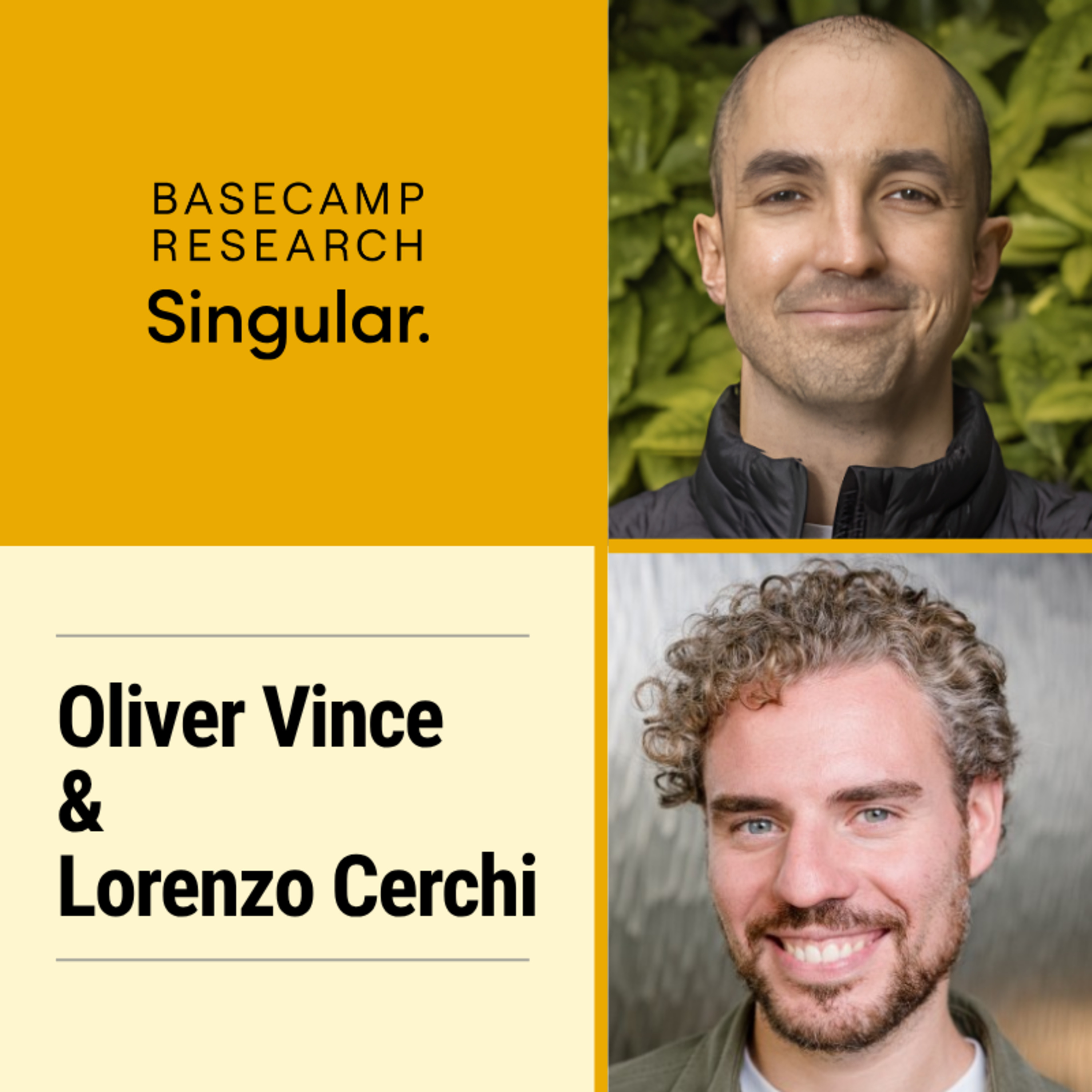
Oliver Vince (Basecamp Research; built expedition teams expanding known life 50–100x; trains large biology models; works on disease-to-therapeutic translation; mentions NVIDIA collaboration). Lorenzo Cerchi (Singular investor; focuses on deep tech venture and Europe vs US ecosystem dynamics). Key claims/examples: transformer/scaling laws enabled predictable AI scaling; Basecamp launched ~3 months after scaling laws; healthcare queries are ~20% of ChatGPT/Claude demand; “prompt to cure” already demonstrated; example: an Australian using ChatGPT to cure a dog (cited as illustrative). They claim Basecamp can reach clinic/patient use in 5–10 years; compute may cost ~$1B+; US investors are more comfortable with ambitious timelines.
Written by AI. May contain mistakes.
Discussion on Europe's advantages in combining AI with various domains.
“We've seen this quite quickly with you guys.”
Exploration of scaling laws in AI and their implications for biology.
“We just do not understand biology at all.”
Identifying challenges faced in applying AI to biology and healthcare.
“that's here in the UK, particularly in Europe as well, in some of the great universities, to apply the AI to hard challenges that haven't currently been been solved.”
Contrast between US and European approaches to deep tech investment.
“because we want to scale, we want to do this and there is a place you can do it.”
Speculations on the future impact of AI on healthcare and Basecamp's role.
“I think we have to be honest about which camp we're in and where we are.”
Discussion on the technical possibilities of AI achieving medical breakthroughs.
“So we discussed a little bit about the origin story of Basecamp, the past, where you're at at the moment, you know, the data gathering piece, the models that you're building at the moment, the collaboration with NVIDIA.”

Get the gist, explore an idea or ask about something said.
 Claude
On EUVC, what are the key points of this episode?
Searching your listeningAutomatic transcript. May contain errors.
0:00Now, the problem in biology is that far more than 99 % of life on Earth, we have no idea what it is, where it is. We just do not understand biology at all. So that was sort of the premise that we started on. Europe and the UK particularly won't necessarily win on the scaling of chatbots, and nor should we really try. That race has come and gone, and there are also a few clear winners in space. Where Europe has a real advantage, a real structural advantage, is the combination of AI and the domain. So that is quantum fusion, materials, chemistry, and ultimately biology as well. And it quite quickly came across for us that building such a company like Basecamp in this triangle between London, Cambridge, and Oxford, it's actually very positive.
0:44There's access to a lot of talent. We've seen this quite quickly with you guys. Do you want to elaborate a little bit on that? It might cost a billion dollars. It might cost more than that. But technically, it is possible. We've already seen to go from prompt to cure. And if it's possible to do that today, that is a technology that has such a huge demand and such a profound potential impact on humanity. There is no way that stays in a box forever. We are live. We are live. In five. We are live. Four. We are live. Three. We are live. Two. We are live. One.
1:22Why did you guys think about five years ago this was a good moment to start building this? And maybe a little bit of a parallel on what's the data problem in biology that is a parallel with, you know, Aoucha GPT, obviously, and Claude is trained on internet, publicly available data and others what happens with biology today and what did you guys believe five six years ago when you started base camp so we launched base camp about three months after the transformer not transform paper but the scaling laws paper came out so for reference for those of you who are not super into the space basically the transformer moment was basically the moment where people realized actually AI is going to be really simple basically these algorithms are going to be really, really simple, and we're just going to scale them up.
2:11The Scaling Laws paper, which was published by OpenAI, but the last author was Dario from Anthropic, kind of gives you the inception of all of it there, was the paper where people found out that if you just basically dump compute into these systems, they get smarter and smarter and smarter on a pretty predictable time frame. They proved over seven orders of magnitude, and basically that was the inception of the AI scaling race, because it's basically like, Like, hey, look, we know now, pretty predictably, that if we dump money into this, it will result in increased intelligence, and we're still effectively riding that wave.
2:44Now, the problem in biology is that far more than 99 % of life on Earth, we have no idea what it is, where it is. We just do not understand biology at all. So that was sort of the premise that we started on. We've built expedition teams to go around the world. we have expanded what was known about life on Earth by between 50 and 100x already depending on how you measure it and we've used that to train huge models that the basic problem is that no one understands biology we've gone and fixed that and then what we're seeing is a commensurate increase in the intelligence of these models. What do you guys see in terms of applying AI into other verticals like for example healthcare that you guys are spending a lot of time in, what are the areas that you're most excited about, that you guys spend a lot of time on in terms of Applied AI?
3:35Yeah, I mean, something I've talked about quite a few times in different forums is, like, I think Europe and the UK particularly won't necessarily win on the, like, scaling of chatbots, and nor should we really try. Like, kind of that race has come and gone, and there are also a few, like, clear winners in the space. where Europe has a real advantage, a real structural advantage, is the combination of AI and the domain. So that is quantum fusion, materials, chemistry, and ultimately biology as well. And so effectively the thesis is like, what if you can invest in DeepMind or OpenAI or Anthropic a few years ago?
4:11You've got to basically have a thesis on what that would do and how that would change the world. And I think the parallel with being a deep tech company, right, is, and it's particularly true in America, it's starting to be more true in Europe, people understand that if you can articulate and imagine what that might do, it's like you've got your multi-trillion dollar outcome, and it's whether you can now get there. And that then becomes an engineering step to whether you can get there. But I think ultimately, for us, it's the combination of AI plus the talent that's here in the UK, particularly in Europe as well, in some of the great universities, to apply the AI to hard challenges that haven't currently been been solved.
4:48And the problem, the sort of problem space and the opportunity space is absolutely enormous, right? I mean, you can just take anything, any problems in healthcare, if we can solve any of them at all, they are all, you know, huge, huge opportunities for all of us. You were slightly talking about a little bit on the challenges of doing what you're doing. I guess for me as an investor, it's always helpful when I speak to founders to understand and not just the vision, but it's great to see entrepreneurs that have clear the barriers they need to break to really be successful. So we'd love to hear from you.
5:24What do you think are the challenges that you've already solved, what you're facing today, and what will you have to really overcome to be successful in what you guys are doing? So, I mean, I guess the challenges we've overcome, right, is we've built these huge data sets of biology, and we've trained these models that are enormous at any one scale, and have been able to translate from disease biology into medicine, into therapeutic candidates. The opportunity of the scaling laws is we have a predictable path ahead that says, you know, if we continue to do this, we will get this outcome, or we're pretty sure we'll get this outcome on this time frame.
5:56The counter to that is that's an expensive thing to do, and that requires, you know, research and funding and all that sort of thing. From our perspective, there are two ways you can do that, right? And that's the obvious path. you can either build the business organically or you can basically take on investment and you can go sort of zero to a hundred and basically what we find is that being honest in America that is very well understood right you walk into Silicon Valley and you say that and they're like holy shit that's cool let's go and in Europe everyone's like well have you proven this and it's like and I think it's more I think it's changing but I think I mean that is why we see the sort of structural sort of barriers to entrepreneurs in the US and just to be clear like we're half we're already half in the US in terms of our head count and likely we'll just continue moving that way because we want to scale, we want to do this and there is a place you can do it.
6:42We started here, we like it here but also like if it doesn't support it, it's kind of like that's the ultimate challenge but I guess like we're not going to change it by moaning about it so like it can be done, just move basically. That's not to say Singular is great, Singular does all the great investments in the UK so basically follow anything they do. That would be my suggestion. I guess you touched a little bit upon difference with the US I wanted to double click maybe a little bit you know we're UUVC here I think for me it's a very personal topic I love to understand and also Staffan before we're talking about this what Europe has already done to improve its ecosystem but what are still the differences that you see a little bit on especially maybe building a very ambitious deep tech projects in Europe not just a normal startup.
7:34If you're playing to win, you've got to play to win and not play to be halfway in the middle. And the Americans, I think genuinely, the only difference is they've seen it work out multiple times, right? All of our U.S. investors have personally and are on their private jets and on their yachts because they have seen this happen multiple times. And also when you talk to them, they're not angsty. They're not bothered. They basically know this will play out. They just want to watch it play out and work with it. And then everyone, and the opposite is the case a lot of the time when you've got people who aren't relaxed and haven't seen that, and they're genuinely not comfortable with what the very nature of true venture is in my personal controversial opinion.
8:13I mean, it's basically, but you have to have seen it happen before, I believe, for you to feel genuinely comfortable. And when someone says, look, we're going for a trillion dollar outcome, and it's going to take maybe five years, maybe it's going to take longer, just be cool, right? Here's the money, and let's just wait and see. And also, if it doesn't work out, like there's a hundred other things I've bet on that may work out. And that is just the difference and it's absolutely fine. It's just, I think we have to be honest about which camp we're in and where we are. And that's basically what we try and work out when we meet investors for the first time.
8:42It's like, how much do you actually want to play for these massive outcomes? And if you do actually want to play, then like the specifics of the deal right now are not important. And the specifics of the timeline are not that important. It's the like, whether we are actually on track to, to have that ambitious level and the signal of whether we're on the on track is whether you're allied with the best people in the world right now, right? And those teams are the Frontier AI Labs, the big tech firms, and some other people in pharma, but not many of them. Giving a bit more of a positive note, speaking about the pros of building Basecamp, starting from London, something we stress a lot about as investors, we're trying to always understand what's the right to win for a team based in Europe compared to, you know, one in the US and it quite quickly came across for us that building such a company like Basecamp in this triangle between London, Cambridge and Oxford, it's actually very positive.
9:35There's access to a lot of talent. We've seen this quite quickly with you guys. Do you want to elaborate a little bit on that? You touch upon about your dual setup now, optimizing what you have here in Boston. Yeah, I mean, I think particularly when you're doing any scientific work, right, you're always dealing with skeptical people who are like who have built their career doing PhDs or whatever they've done and ultimately what you're trying to do is convince them to take a risk so if you're and so basically the concentration of talent and also the cost of talent in the UK is dramatically lower than it is in the US and the availability of people who just want to try things it's very very high and if you basically can can find them you can build an amazing team here the challenge is then like can you convince them to take big risks and ultimately what that requires is giving them a comfort like a comfortable place to try and that's basically where we've had a lot of success in Europe is basically saying look we've got these great people we need them to feel like if they try something that doesn't work that's absolutely fine as long as they're trying stuff that could be a 10x outcome and if you can get that right it really really can fly and you can get amazing results quickly and also if you want to you can sort of stay under the radar but I mean the read there's a big reason that AI labs are moving aggressively into London there's a big reason like lots of the big firms are moving into London like the talent is here that the appetites here.
10:49So we discussed a little bit about the origin story of Basecamp, the past, where you're at at the moment, you know, the data gathering piece, the models that you're building at the moment, the collaboration with NVIDIA. Where do you think Basecamp, you know, is going to be? What are your top priorities in the coming, you know, 12 to 24 months? I think for us, it's sort of, there's a non-linear outcome that, you have to be able to articulate and understand what the nonlinear outcome you're playing for is right you have to actually play for that and so effectively what we're working on is a model as i said before you can you can prompt on disease biology and it can generate you a medicine and effectively basically the further we go on the more complex that model will get the more sophisticated it will get and the closer it will get to being used by clinics doctors and maybe ultimately even patients and we're starting to see this and it's a bit of a silly example but there i mean i brought this up i think on the podcast but there was that guy in Australia who used chat GPT to cure his dog right which is a silly example and I'm not even sure that I did actually work but the point ultimately behind it is that these tools are getting very sophisticated very quickly something like 20 % of all demands on chat GPT and all demands on Claude are healthcare related queries doctors are starting to use it all that sort of thing there is a big shift coming in the world you want to play towards that and articulatable but that outcome in our case.
12:14And it's sort of like, there is a world where in five, 10 years time, the most complex diseases, diseases that we don't even think about treating or curing today, come under the remit of some of these models. And I think to be clear, right, there's also a chance none of that happens and we carry on in the world today and loads of people don't get treated, right? And I think we may as well just accept that there's two scenarios and play for the win. And that's kind of the way we focus. And it kind of removes all of the like, secondary thoughts about what if not, what if not. It doesn't matter. Let's play for the win and see what happens.
12:45Do you think it is going to happen or is it just a matter of time? So it's an if or it's a when that we're going to unlock this with compute basically? Technically I am 100 % certain it will happen. The question for me is whether it's Basecamp that does it or someone else that does it. And it's probably realistically going to be Basecamp in collaboration with one of the big labs or something like that. It is technically possible. again the the realistic scenarios it might take two years it might take three years it might take slightly longer it might cost you know a billion dollars it might cost more than that but technically it is possible we we've already seen to go from prompt to cure and if it's possible to do that today that is a technology that has such a huge demand and such a profound potential impact on humanity there is no way that stays in a box forever I think the only difference might be that it's like kind of like driverless cars like driverless cars have been possible for years and they're only just starting to hit the street of London.
13:38I think it may be possible to do this in a lab a few years before it actually reaches a patient impact. But again, there's a whole lot of things that we don't control and again just like play for the outcome.
AI has transformed what is possible in language, but biology remains a much harder frontier. Oliver Vince, Co-Founder at Basecamp Research, believes one of the biggest constraints is that we still understand only a fraction of life on Earth, leaving AI models with a fundamentally incomplete picture of biology.
Speaking at EUVC Summit 2026, Oliver joins Lorenzo Cerchi, Venture Capital Investor at Singular, a backer of Basecamp Research, to discuss how new biological datasets and frontier AI models could change therapeutic design, and why Europe may have an edge where AI meets deep scientific expertise.
Oliver explains how Basecamp Research approaches the data problem in biology, how scaling laws could translate into better models and how those models might eventually help move from disease biology towards new medicines.
The conversation also looks at the gap between European and US attitudes to risk, what it takes to finance highly ambitious deep-tech companies and why scientific talent needs room to pursue outcomes that may be uncertain but potentially enormous.
They close on the longer-term possibility that AI could help tackle diseases that remain difficult or impossible to treat today, and why Oliver believes that potential is too significant to remain confined to the lab.
Highlights