
In short
EUVC Podcast Episode Notes: Super Angel #206 with Manolis Manassakis, Qogita
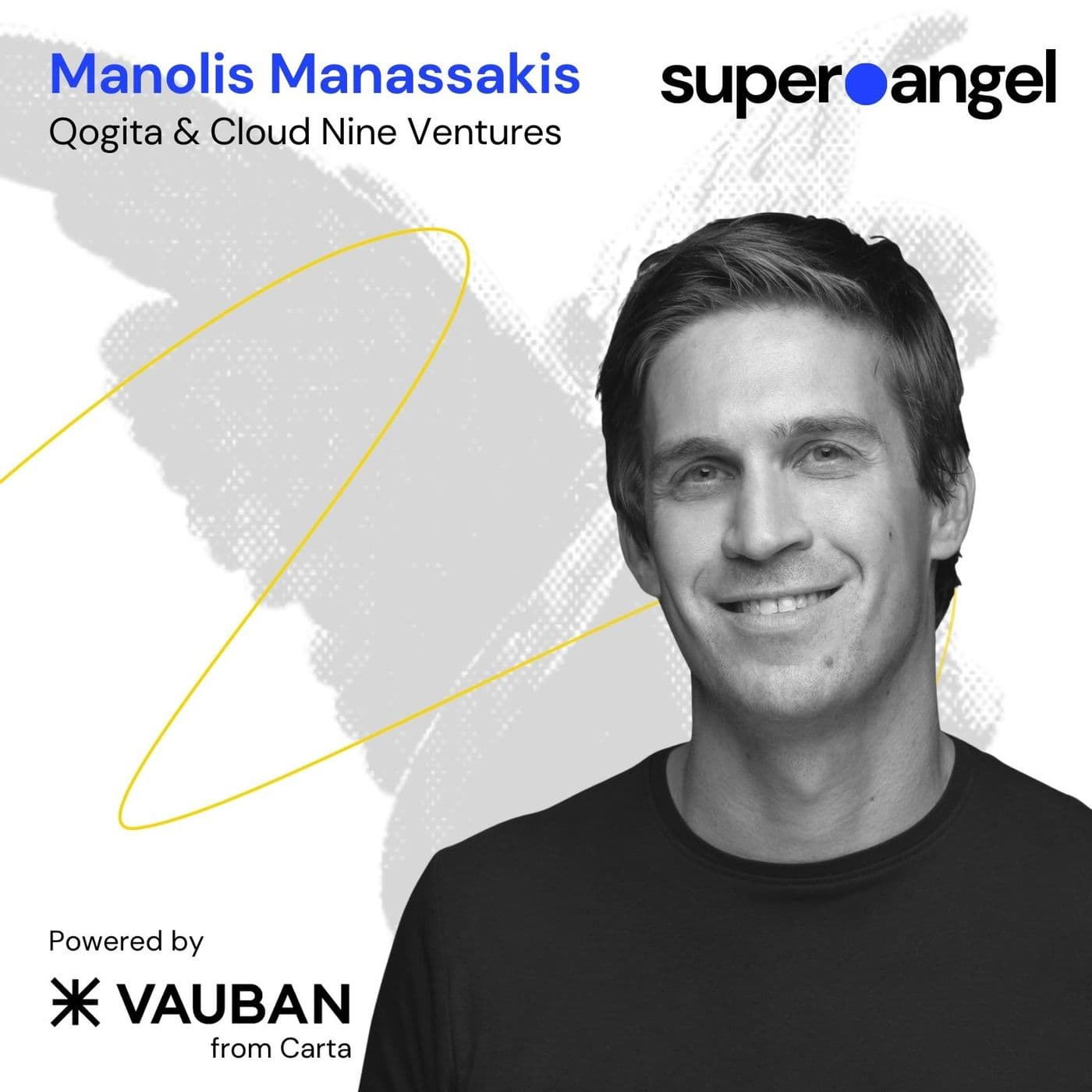
Episode Overview In this episode of the EUVC podcast, co-hosts Andreas Munk Holm and David Cruz e Silva engage with Manolis Manassakis, the CEO of Qogita and a prominent figure in the European venture capital scene. They discuss Manolis's journey from a lawyer to a technology executive and angel investor, shedding light on his experiences at Google and Uber, as well as his approach to angel investing through Cloud9 Ventures.
Key Highlights
Introduction of Manolis Manassakis
- Background:
- Former Director of Operations at Uber for EMEA.
- Industry Manager at Google, aiding European businesses in online sales.
- Co-founder of Lawspot, an online legal hub in Greece with over 1 million monthly users.
- Current Role: CEO of Qogita, a technology-driven global wholesale supplier.
Angel Investing Journey
- Starting Point:
- Manolis entered angel investing through his connections in tech communities like Google and Uber alumni.
- His first investments were made about 10 years ago, not initially with a structured or deliberate strategy.
- Investment Strategy:
- Focuses on startups where he and his partners can add significant value.
- Emphasis on "right to win": Understanding why a startup is positioned to succeed.
- Investments are concentrated on teams, market angles, and less on fleeting trends.
Investment Philosophy
- Core Principles:
- Right to Win: Evaluating the team, market space, and timing of the investment.
- Skepticism towards the “why now” concept, emphasizing that while it is crucial, it often leads to opportunistic thinking.
- Diversification:
- Cloud9 Ventures does not aim for a wide variety of investments but instead focuses on making impactful choices.
- Emphasizes quality over quantity, doing 6-8 deals per year for better support and involvement with founders.
Notable Experiences
- Memorable Investment:
- An investment in a Middle Eastern company that initially felt risky but has since thrived through multiple funding rounds.
Lessons Learned from Angel Investing
- Listening Skills: Importance of being a good listener in understanding startups deeply.
- Unique Execution: The need to appreciate the specific details and unique strategies essential for success in each business.
- Caution with Trends: Advises against jumping on trendy opportunities without thorough evaluation of their sustainability.
Collaboration and Networking
- Manolis discusses the importance of collaborating with other angels and VCs, leveraging shared expertise and insights for better investment decisions.
- Believes that building a reputation as a subject matter expert significantly enhances access to quality deal flow.
Advice for Aspiring Angels
- Time Investment: Genuine commitment and effort are critical to becoming a successful angel investor.
- Community Engagement: Joining both formal and informal networks is essential for sourcing opportunities and gaining insights.
Quick Fire Segment Highlights
- Counterintuitive Realization: Trusts more introverted founders, finding them often more data-driven and concise.
- Advice for International Investments: Reflect before pursuing international opportunities to ensure genuine interest rather than following trends.
- Advice to Younger Self: Emphasize the importance of less stress and the understanding that not everything pursued will lead to happiness.
Conclusion The episode wraps up with Manolis emphasizing the joy and passion behind angel investing, advocating for a thoughtful and engaged approach to the ecosystem. He encourages listeners to focus on building networks and sharing insights, ultimately contributing to the European venture capital landscape.
Call to Action Listeners are encouraged to join the EUVC community for further insights into European venture capital and to connect with fellow angels. For more information, visit [eu.vc](https://eu.vc).
Written by AI. May contain mistakes. Listen to the episode to check what was said.
Transcript
Automatic transcript. May contain errors.0:02This is a dream? No, it's not a dream I'm an angel. Why would God send me an angel? Because God knows that everyone needs a little coaching now and then. I'm loving angels. I saw an angel. All angels say for a long day. Please say it's me an angel. The smile on her face. Be in it together. But don't love me, Angel. Thanks, let's buy an angel. Girl, girl. Hi, and welcome to the Super Angel Podcast. The go-to podcast for angels backing the next generation of European unicorn founders. If you love our show, do drop us a review, share it with your friends and join our community at eu.vc. Today, we're happy to welcome you to Manolis, CEO of Kogita, a leading global wholesale supplier revolutionizing the market through technology.
0:53He was formerly the Director of Operations for Europe, Middle East and Africa at Uber. Earlier in his career, he worked at Google as an industry manager, helping European businesses boost their online sales and make the most out of the web. Parallel to his work, Manolis co-founded Lawspot, providing openness and transparency of the law to all citizens. Lawspot is now Greece's number one open online hub for all things legal, trusted by one million monthly users. Through Cloud9 Ventures, Manalis is also an active angel investor, passionate about the European tech ecosystem, and loves helping startups and mentoring founders on operations, scaling and international expansion.
1:33If you're an angel listening in and wanting to get closer to the European angel scene, do not hesitate to reach out to us. We'd love to connect and see how we can play together. And now, some words from our beloved sponsor. Verban from Carter is the easiest way to launch and run your syndicate. Verban's end-to-end platform automates your back office so you can focus on what matters, supporting the next generation of entrepreneurs and building your network. Angel investors are the fuel to innovation, and they've created the Atom SPV to allow for more deals, more ownership, and less fees. Backed by Carter, the leading fintech infrastructure company, Verban will be with you all from fundraising to exit.
2:16Investors on the Verban platform have raised over$2.5 billion in global investment for companies including Revolut, Bolt and SpaceX. If you'd like to learn more, please check out www.verban.io forward slash EUVC.
2:37Welcome back to another episode of the Super Angel Podcast. We're so excited to have you with us, Manolis. you are quite the superstar so this is exciting. My pleasure, nice to meet you guys and it's been we've been trying for a few months to get here so it's additionally exciting. Yeah exactly, half a year. Super excited to have you on Manolis, also a fellow Greek among other things but also phenomenal operator and investor as well so really excited to get started. Do you want to share with the listeners a bit about your story and what got you into angel investing in the first place? Sure. I'm a bit of an old case.
3:12So I was a lawyer early in my career. Then I got into technology quite randomly. I joined Google in Greece when it was starting. I love marketplaces as an operator. And I'm the CEO of Kogida, which is building Amazon for wholesale, which is the world's second largest market, second to finance only. So it's a huge mission, huge space. And it's where I spend most of my time, as you can imagine. And then equally relevant to our conversation, we've started Cloud9 Ventures, which you'd call a micro VC, which is a vehicle through which me and my four partners do a lot of angel investing across Europe.
3:48I'm very happy to get into the details of how that started and how we think about it, et cetera, down the line. We obviously have to dive more in there. And full disclaimer, Manolis, before we joined Anthony being a Greek countryman as well, I said to him, so I just realized we're going to have the Greek mafia here. We hope it's a bit bigger than the two of us. I guess we've got another four in cloud nine. Am I right? Yeah, exactly. I love that. Again, sorry for bumping and barging in on the scripture, Anthony. Take it away. No, no, not at all. Do you want to tell us a bit more if you remember the first time you got into angel investing and what got you there in the first place?
4:27And then maybe share your first or some of the more memorable deals you've done. You're happy to. I mean, if I'm very honest, and that was many years ago, because I happened to be in these communities where it was quite relevant and cool and a bit of a fad, I would say, like Stanford, Uber alumni, Google alumni. That's how I started without being really, to be honest with you, very deliberate and very thought-through about it. But if you're asking if that was how I got into my very, very first angel investments around 10 years ago. And then since then, I mean, things have progressed a lot. Also, I've gotten professionalized.
5:09It's a completely different story now. But my beginning was thanks to my very tech and startup oriented communities. Could I ask you to expand a little bit? because I am sure that many in our audience will add the revered clubs of the Google and Uber alumni as, huh, I wonder what's going on in there. How does it work? Is it a Slack group? Is it do you guys actually need? Could you share a bit more? Sure. I mean, each company, I mean, the logic of these syndicates is quite simple, right? The LPs are alarms of a company, typically that syndicate is managed by ex-alums who do it on a full-time basis usually, and they try to invest, most of them either in alarms of that company, or even they get access to some very good deals outside the company.
6:02So for example, with Uber, it works over email. It's a very well-structured syndicate, in my opinion. You get deals by email, very well organized. It works by angel list, and the logistics are super simple. But again, each company, each syndicate might have a different way of operating practically. It's something that many, you know, think about how does it actually work. So I think it's cool that you shared that part. Let's get back to what Anthony asked before, because I think that the part around a memorable deal is always fun to get concrete. So give us something. Doesn't have to be the first one or the last one.
6:36I'm not going to mention the name of a company, but I remember when I was looking for work and my financials were very poor, especially regarding liquidity. And I was quite stressed about it. There was one company in the Middle East where I was so borderline and I love the founder. It was super highly recommended, but I was really stressed financially and I couldn't decide. And I ended up investing. It's done super well. We're now three rounds after that, They're doing great. And I'm glad I took a bit the financial risk back then. So I guess beyond financially, which I'm very curious, what would you say has Angel Investing given you, I don't know, personally and professionally, right?
7:24How do you see it adding to those two vectors? Sure. I mean, because we're also asking about the personal level. I mean, obviously, number one, I've met some great people. and because we're quite diverse in geography spaces we do early stage but we're we can do for example from pre-c to series a or even early b right so there's a lot of variance and that i think is somewhat correlated with the different profiles different situations different businesses different spaces we see so it's really eye-opening for me so just at a personal level i'm just loving it right number two there's a lot of stuff that i learned as an investor, which I implement as an operator.
8:06And again, personally, I love marketplaces, right? So as you can imagine, there is a bias or at least a concentration in terms of investing in marketplaces, because I know them better and founders reach out to me more. There's a lot of different things that I've learned from other founders or teams, which the following morning, I'm going to actually change something in my operational role because of something I saw in another company, a concept or a strategy or a tactic, supply growth, market-less operations, how you tackle fulfillment. There's a lot of complex topics with a lot of detail. And also, again, at a very personal level, I'm just having fun, also at a personal level.
8:49I enjoy it. We didn't start, and we can talk about it if you want, we didn't start Cloud9 only for, you know, or at home back then for the financial return of it, all five of us are simply enjoying doing it. And all five of us are very heavy operators. And that was by design, by the way. So we've committed to spending 10 % of our time on angel investing, primarily because it's enjoyable for us. And we believe that we can add value. So one of the things we look at, and we can talk about it, is this company materially more likely to succeed because we're on its cap table or not? If the answer is no, we're not going to invest because it's not the best use of the set of our resources, nor are we the best option for that founder and team, right?
9:37And why play that game, right? There's an ample amount of opportunity on both sides. So we want to play in an optimal linkage between a founder slash team and us. Oh no, it's not about the business.
9:58Now we've heard that you're committed to this, you're doing your five guys together, you're doing at least 10 % of your time spent on angel investing. Could you share a bit more about your investment strategy? One thing is that you want to do investments where you have a value added as a group, but I'm sure that there's more to it as well. Let me start with a bit of a broader thought. I think in the investing world, by the way, in many asset classes, I don't think that's unique to technology. There is a bit of a, I don't know what to call it exactly, a bit of a feigned over sophistication and over complexity, right?
10:36If you screw up as an investor and you did a 37-page investment memo and you thought about every possible question and every possible data point and every possible segment and retention and data point and everything, you feel much better, right? Or your LPs are going to be way less stressed. So I think there's a lot of, if I'm honest, either unnecessary or just random or over-indexing on factors, which the earlier you go, the less predictive of or conducive to success are. So personally, in Cloud9, we try to really, from a first principles perspective, very fundamentally to think about how we invest, and that is the following simple thought.
11:24So our number one concept is the right to win, right? What is the right to win of that team, right? So if they have won, can we clearly say why it happened? Can we say why this team won and not another team? Can we say why this team won in 2023 and the other 10 teams in the last 10 years or 1 ,000 teams or big companies or whatever did not win in the years before. So what is the right to win? There was something very clear and very tangible. Now, this can take different forms, right? But the four things we look at, kind of the big areas where we search for that right to win, number one, it's the person and the team, obviously, right?
12:09I'm not saying anything intelligent. The area you go, the bigger the weight there because, frankly, You have less to assess. There is less traction or no traction, less product, right? Less historicity. Number three is the angle. How is this company playing in whichever space? Number three is the space. And number four is the time. I'll make a caveat on the time. I personally do not love the overindicing of the why now concept. Especially in B2C, I think it leads to some opportunistic thinking, some opportunistic founders, some fad or risks around not deep trends, a lot of betting on where things will land.
12:56So personally, I'm more attracted to what I would call heavier spaces and more concrete angles not linked to the why now. You know, take shipping, take infrastructure, right? Mobility, some aspects of it, not all the plays we've seen lately, right? Take B2B SaaS plays, right? I want to see the why now in terms of there is a new way to do with problems, not that the problem suddenly merged. Again, that could be a great way to build a gazillion dollar business, but it's also very highly probable that there is something not thought through. The team could be more opportunistic. It's more a me too game.
13:39it's suitable for ABC, which has 50 bullets are going to spend one there, you know, like AI now, obviously, right? And chatbots, like mobility two years ago. So I'm right now with a caveat. Question for me is diversification. So how do you think about that? Right? You said you put 10 % of your time, you know, portfolio theory says diversify. There's also the earlier you go, shots on goal is important. But I think it's also a conscious decision, right? Like you can do a volumes game and index the market you can be more selective and select so we'd love to understand how you think about diversification and your capacity to support the founders let's take the two sides right our investors and actually our own money right and then the founders so the former we are not a vc which plays that game right 50 investments each time thinking will this return the fund right you need enough shots to increase the probability of that happening once or twice or three times, right?
14:36So if you're an LP and want to get that diversification benefit, you'll not get it from us where we do six, seven, eight deals per year max. You'll get it from a... And by the way, we don't have any commitment. We might say, hey, we didn't like anything this quarter. We're not going to invest in anything. You as an LP will find that benefit from a more spread out approach. So simply, we don't care about the number of shots. We care about making the best shots possible. And we very well know that mathematically, it could be possible that we took eight shots and the ninth shot would be the huge winner.
15:09But we feel quite comfortable about that because I'm getting a bit also to the founder's point. And I think I mentioned earlier, right? We're not going to back a company unless it's not very clear why we can really materially increase the probability of its success, right? What I personally like about us is that our backgrounds of the Cloud9 partners are very diverse, right? There's a finance guy who's insane finance guy, like Harvard, Goldman Sachs, private equity, KKR, etc., right? I have no idea about financing detail, right? I'm a marketplace operations expansion guy, right? Now there's a very, very strong tech person.
15:50So the idea is that we have complementary capabilities in the basic pillars of an early stage venture needs to succeed. So with one ticket, you're going to get, so to speak, the value of five investors. So that's how we try to offset that lack of, let's call it diversification, benefit by really maximizing the probability of a company succeeding. Additionally, thanks to hopefully our support. And that's one of the reasons we do a few deals a year so that if you do the math, how much time we have, how much time we can allocate, we really can support founders. Not, hey, WhatsApp me once a month.
16:27If you need an intro to an HR person, I'm going to send you on LinkedIn profile. We are way more hands-on than that. It's a bit funny to hear you say that we only invest in companies where we can see that we can make a material difference because that's actually where I sometimes think that less experienced angels kind of tend to end up doing investments because they can see that they can help. But then if you do seven of those or 10 of those, in a way you end up doing investments that need help. As a consequence, you end up with not the best of the bunch, right? And at the same time, it's also, well, the static criteria to be looking for, right?
17:09What if the perfect deal is there, but you see them probably not needing you too much, but you're still invited on to the cap table. How do you think about that, Manol? It's two layers of considerations. Number one, independent of our ability to help, right? What is the right to win of this team? Primarily in terms of the four pillars I mentioned. If we have very strong conviction around that, there's the additional consideration. It's not the other way around. And I'll give an example. We invested a few months ago in a company called Relay, which effectively is bringing the Chinese delivery model into Europe.
17:47And they're doing super well, by the way, right? After, quote-unquote, passing our test, let's now explore our ability to help, right? As you might know, I was at Uber for five years. One of our founding partners leads a very big part of the DoorDash product team. DoorDash itself is considered the same model in the past, right? So you can imagine there that we at least think that of a unique ability to help Jonathan, who's the founder and the team, right? So it's an additional consideration we're going to inject after the first degree of criteria have been met. But I agree with you, Andres, that's a very possible psychological bias, right?
18:27And it's also flattering for investors to create that story in their head of, oh, I'm uniquely valuable and this is exactly what I know. I had this idea in the past. So you need to be aware of all your biases. And that's exactly probably the point that I would want to make on exactly that, right? That it's so tempting to do, you know, to kind of confirm your own beliefs of grandeur. I think even seeing opportunities sometimes, Andreas, you know, it's like, I won't say I've done like two and a half years of operating. So I'm not going to claim I'm an operator, but I have been specializing in fintech in a wide sense.
19:05So there is a risk from the fact that I've been doing FinTech for a long time or human knowledge, I've been doing marketplaces for a long time that you see all the problems in a company. And it's like as a founder, you need to be slightly naive to start something. As an investor, do you need to be slightly naive for an opportunity? Or maybe at least I think you need to be firm beliefs, loosely held and driven by the inside of the founder, right? I think it's that very fine line. And I think the way I look at that is you need to swing to both sides of that pendulum to balance yourself, right? You start from naivety.
19:40You have no idea. You get carried away by the enthusiasm or some opinion or some data point, right? After becoming mature and knowledgeable and data-driven and detailed and you learn the space, and to your point, Anthony, you know all the problems immediately, which is equally unhealthy. and then it's about deliberately balancing yourself right and being insightful not too risky not too risk averse not too naive not too not over detail but insightful like to the right degree and if i'm if i'm being completely honest i'm sitting back here thinking that well the fund investments that david and i do we tend to also do you know primarily funds that we have a very close connection with in terms of us having similar worldviews, similar focuses, similar community-based dynamics, similar focus on activating the angel groups and so on.
20:36And in the end, you could argue that that's the fund investment equivalent to doing exactly what you're saying. On that note, actually, how do you collaborate with other angels and VCs if you do so? Manolis would love to hear. I mean, with VCs in multiple ways. I mean, we're very close to most of the European VCs you'd have in mind. We either co-invest or we partner with them on deals of startups we've already invested in. Where VCs very often, we'll ask for our opinion, we'll offer co-investment opportunities, they'll ask us to vet a team or a founder, etc. So we work very closely with them. And other angels are the same, right?
21:15We're going to exchange good opportunities. We might ask each other for an opinion and we might join cap tables together. it's not an antagonistic if that's no but i love that organic part of because you're operator with subject matter expertise that many times some of those firms or vcs come to you because they want even diligence and opportunity and get that insight so it's so it's so organic that happens very well and i've learned by the way the most sustainable way of being top of mind from a sourcing perspective is to be the go-to person for something specific right like for me going back to that, it's been paying off for me that if it's something fintech specialist, it pays off more for someone to say, oh, maybe Anthony has seen something or has an opinion or knows someone, so let's ping him versus Anthony is a good friend and a good guy and I'll think about them next time.
22:03It doesn't really work like that. Exactly. And again, to my point around complementarity, each one of us at Cloud9 would gravitate towards that's your fintech equivalent, right? And have some sort of broader or more specific identity around that expertise. Everybody, for me, I get a huge number of things on marketplaces, which I don't mind because I do love them, but that's a pattern for me personally. I'd love to ask you, because now we spoke about the Google and Uber alumni before. You also mentioned the Middle Eastern investment that you've done. How do you think about investing internationally?
22:42I don't in the sense that it's not something we're trying to optimize for in itself. We've invested in, I'm not sure if I'm getting the number right, as clouded in 10 different countries, and personally maybe in 20. So it's not a factor in itself. It could influence some of the things we do care about. Do we understand the market for us to have a view? Does that market make sense in terms of right away? But we don't have any bias, positive or negative, for a given market per se. because one thing, how you think about the opportunities, right? But how do you build the access points into those opportunities?
23:19Let's take myself as an example. I mean, I've had the pleasure of belonging to most international communities of different countries, right? So I'll give you an example. The Stanford GSP network, which is super active, California-based, right? Kogira is based in London and Amsterdam. Uber, US, Amsterdam-India headquarters. right there's a Google Southern Europe and by the way South Africa was also part of that region again there's a network there so a lot of things come to to us and to me specifically from different markets without some additional effort for that to happen in my opinion if you want to you know how to become an active angel investor and you start it starts becoming faster and easier and more meaningful etc I mean number one is you actually need to put in the time and the effort like everything else.
24:10There's a lot of people, I think, who, as I said, regarding how I started 10 years ago, my first couple of days, it sounds cool. Oh, I'm an angel investor. Oh, I put money in that startup. Oh, I get a bi-monthly update. Oh, I get to ask smart-seaming questions to a business. The more juvenile way to live at it, right? But just put in the effort, put in the time, and one thing brings the other. try to join communities and communities doesn't mean formal communities it can be informal communities, we're a community in this conversation right, you Anthony might think of me in three weeks and send me an amazing marketplace you saw in Denmark, you have no idea about what it means right, and you might call me to ask for my opinion, so formal and informal communities, and again something general back to my point on us having great fun you need to enjoy doing it because it takes passion, it does some repetitive things right you know better than me intro calls bags right it's very repetitive you need to genuinely actually enjoy it and not do it for the for the because it's fashionable another veteran seed investor gp once told me that like angel investors or seed investors that do it serially or they do it really meaningfully are like by design irrational right because if you want to optimize for making money you might as well just be a growth guy and sit back and relax and do like big checks, right?
25:36So you have to be passionate, right? You have to be driven by that energy when you talk to that one person that's like, you know, obsessed about the space and going after some passion area. So I totally agree with that. Yeah, exactly. Well, you can become an LP in a VC and do nothing, right? I love that. And then start a podcast as well because that is very comfortable. I have one question before we go to our core learning segment and that is, Manolis, we just spoke about doing international investments. And Cloud9 is consisting of five Greek descendants. I'd love to ask you, how did that come about?
26:15Why Greek? Did you all meet in high school? First of all, I want to be very clear from the get-go. We're not proud of our lack of diversity, both in national heritage and gender. We're not that prone. But what happens in reality is that, and it has its upsides, right? We know each other for 20 years in different combinations, these five people, right? One person there was my best friend since childhood, and we went to Stanford together, right? The other is a partner of mine through Google 13 years ago. So organically, we knew each other, and that is important, right? That is important. It's part of why things can work out is knowing who you work with, you've worked with before, there's good chemistry, you respect each other, you admire each other, there's no equivalent of founder risk, right?
27:03And the thought we all had, I mean, how this happened was quite simply, so all of us were quite active angel investors and we were operators and we have different backgrounds. So we said, hey, one, this supermarket approach, right? We become one ticket, which means that a founder can pick and choose. Oh, I want marketing. Oh, I want help on operations. Oh, I want help on scaling. I want help on product. I want help on hiring a PM. we can do all that without one ticket because simply we're five complementary people. Number two, we're all operators. So we don't share with you the classic article on Medium about what market is the marketplace.
27:43You share a wallet, blah, blah, blah. You need to go way deeper. And that's one of my learnings, by the way. The truth and the value can lie 11 layers deep, which is very specific to a space, and angle a G on a company. Something to unlock something. It can be very detailed. So we're all kind of detailed, healthy operators. And number three, we said, hey, we can, like, mathematically speaking, quadruple our deal flow and get to be extremely selective because we're not increasing the number of companies we bug. We're massively increasing the denominator, and there's a compounding effect. So that's how we got together.
Read the full transcript
28:22I just want to double-click on it because we've got, of course, an audience listening in, and some of them are going to be thinking about forming groups similar to Cloud9. So I wanted to unpack your learnings there. You're learning more about them angels, are you?
28:40So I know you might have already shared some, but I would love to hear if you had to share three core learnings from your time angel investing, what would those be? Honestly, for me personally, number one, to become a better listener. I'm not a good listener. I speak a lot. There's the Greek heritage. Yeah, there's a culture. So that one sentence, one phrase, one word can be extremely crucial. That one bullet point, I don't know, again, let me use my, around how you're going to unlock supply in that ICP, in that geo, in that space, right? So you just need to listen way more than you speak, which is not my natural inclination.
29:24Number two, which is what I mentioned a minute ago, is this uniqueness of execution. I mean, of course you can extract learnings, right? And there's podcasts, right? That's why the podcast exists, because somebody can be asked, what are the best things, I don't know, again, let's use marketplace, to solve the chicken-eating problem marketplace, right? Or to build supply, or to fix fulfillment. I'm sure that, of course, there are extractable learnings, right? These things generally have worked and might work, but it's so specific. And so there's so much discovery that you need to be very deep and think uniquely about each business.
30:06And an example which has stayed with me is the Airbnb example. I remember at Stanford, the professor gave us a list of 25 bullet points. And it's like, guess which of the following things was the breakthrough point on Airbnb to unlock the marketplace? And one of the bullets, which I remember I saw, it was like having bigger photos and more professional looking photos. I'm like, no way, right? That's a detail. And it was actually that, right? One of the things that unblocked Airbnb, which was a huge trust problem, was to pay for their photographer capability and actually send their own photographers to each property to take the right photos, which increased the professionalism, and that's how they broke through the lack of credibility problem.
30:49I would never, ever have guessed. I remember I was in class, I looked at that bullet point, I'm like, there's no way this is it, let me look at the rest ones. It was that. You cannot discover that by any podcast or any list or any interview with a founder in another space, in another stage, another geo. It's not unique, I'm not going to necessarily say unique, but it's very closely linked to this specific set of where your business is, right? So that's number two. And number three, which again, I also mentioned in the beginning, be careful of this why now. Both as a founder and as an investor, right?
31:29I've seen a lot of heads jump into the same cave because everybody convinced everybody else, right? And I do, by now, personally, have, again, a preference for the less sexy, the less obvious why now, heavier, older, dinosauric businesses. Sure, if you're talking about Chajibiri, sure. But there, you need to bloody be a huge deep tech expert to really know what the why now really is, right? And I'm not, personally. So I'm not going to claim I am nor play that game around this huge why now, which is what builds Google, right? If you really can assess that why now, sure, I can't with the level of comfort that I demand of myself.
32:23Look, I think the why now, putting a softer touch to it on my side, like I totally get where you're coming from, right? Which is a why now can super hype something and can put too much attention to something. and even become almost a Ponzi scheme from a VC perspective. Like everyone's backing this trend and so it's like taking off and so it's a self-fulfilling prophecy to nowhere. So I can definitely attest to that. I would say though, just to be devil's advocate to that, and I'm not saying that's not why now, but tailwinds do matter though, right? It's a bit like I would back execution and team quality at that stage versus market any day, but like really good execution with a market that's not working, It's probably going to lead to failure.
33:05And I'm happy to do that and then repack that founder. The other way around, a market that's really working because it's essentially riding on extreme tailwinds gives, let's say, a bit of room for errors in execution, right? So I think there's a very interesting... I'm going in a derivative of what you said. 100%. Not only tailwinds, even why now matters. My point is to be very mindful of it. Not that it doesn't matter. Real why now matters. My point is that real why now matters, but it's very easy to mistake why now for the absence of it. Yeah, it's a very good point to pin out, right? Because it's the nuance of what the why now question is actually about.
33:49It's not about do we have a huge growing market and a trend that points in your direction and then go ahead and mess, right? It's much more granular and detailed than that. And that is where probably you see many, and I don't see that many pitch decks from founders anymore. And when I do, I'm very quick to close them again. But that's probably where both founders and angels sometimes get it wrong in the sense that they don't dig deep enough to have a good, credible why now answer. I did see someone bash on the why now and the whole Sikora approach to their old pitch deck. But I do think that there's still massive credibility to putting that up front and center both in your pitch, but also in your analysis of investment.
34:36Do you agree with me that it's just about nuancing the question in the right direction? I'm not at all invalidating the concept of why now. I'm just saying that it's easy to get it wrong and it can be correlated with more opportunistic thinking and less mission-driven funding teams that you'd want to back. That's my point. It's even more nuanced, right? And going back to bottom up and seeing things. I've seen, you know, going and projecting on MySpace, right? In like FinTech, how many people have backed in companies on a regulatory shift that's about to happen, right? It's like, now is the time in one month, this regulation is changing.
35:18Everything's going to change. I will never back on the basis of that. I will factor that in. It will be a small factor. And I will assume it's going to take a year longer, by the way. And it's going to be a small factor into the investment decision. Just want to give a concrete example. Now I want to take us into our quick fire. Quick fire.
35:40Are you ready for it? Sure. Sounds menacing, but let's go ahead. It is absolutely menacing. And I'll start with the worst question of them all, which is what is the most counterintuitive thing you've learned since you started Angel Invest? I have a proclivity to trust more introverted founders than extroverted, even though I'm an extrovert, because sometimes they come a bit across more as salesy or less data-driven. Again, unfairly and rightfully so. It's a bias on my side. That's my bad, but I put trust in less fancy, less salesy, data-driven, concise founders. Second question, what would be your top tip to angels that want to do more international investments?
36:28Go for a walk and think if you actually really want to do that or it's trendy and you look good. and finally what advice would you give to your own 10 year younger self if you only had 30 seconds oh my god that's a very hard question stress way less because you have no idea what's good for you in the first place the amount of times that i thought i wanted something i didn't get it and then some years later i'm like god thank you i didn't thank god things worked out that other way and vice versa. I got something I thought I wanted in any part of life. It's not professional only. And then I realized, okay, actually, why did I really want to...
37:14No. So I'm not saying from a romantic perspective or from a self-help perspective, just very rationally. You don't know, like a lot of things are like literally 50 % conducive to success or happiness, 50 % the opposite. So just recognize that and then like leave it to happenstance to some degree because you just simply don't know. The power of the bottom up. That's what I call what you were saying before with your learning of being an operator. Always refreshing to have more angel investors like you and Manolis. Thanks for taking the time. Nice packaging, Anthony. I hadn't thought of it. Like, nonetheless, I think it's a quite all-encompassing one.
37:55Thanks for taking the time. Really appreciate you joining the pod. My pleasure, my pleasure. Nice to see you guys. Take care.
38:04Thank you for listening to this week's episode of the Super Angel Podcast. The go-to podcast for angels backing the next generation of European unicorn founders. If you love our show, do drop us a review, share it with your friends and join our angel LPSyndicate at eu.vc. And if you're an angel listening in and wanting to get closer to the European angel scene, please do not hesitate to reach out to us. We'd love to connect and see how we can play together. And now, some words from our beloved sponsor. Verban from Carter is the easiest way to launch and run your syndicate. Verban's end-to-end platform automates your back office so you can focus on what matters, supporting the next generation of entrepreneurs and building your network.
38:50Angel investors are the fuel to innovation, and they've created the Atom SPV to allow for more deals, more ownership, and less fees. Backed by Carter, the leading fintech infrastructure company, Verban will be with you all from fundraising to exit. Investors on the Verban platform have raised over$2.5 billion in global investments for companies including Revolut, Bolt and SpaceX. If you'd like to learn more, please check out www.verban.io forward slash EUVC. I've been touched by an angel, girl.
39:27Thank you.
From the publisher
Parallel to his work, Manolis co-founded Lawspot, providing openness and transparency to the law, to all citizens. Lawspot is now Greece's no1 open online hub for all things legal, trusted by 1M monthly users. Through Cloud Nine Ventures, Manolis is also an active angel investor, passionate about the European tech ecosystem, and loves helping startups and mentoring founders on operations, scaling and international expansion.


