In short
How writing, resilience, and human connection can survive and guide AI adoption in work and schools; concerns about “AI slop,” algorithmic narrowing, and screen-based disconnection.
Guests
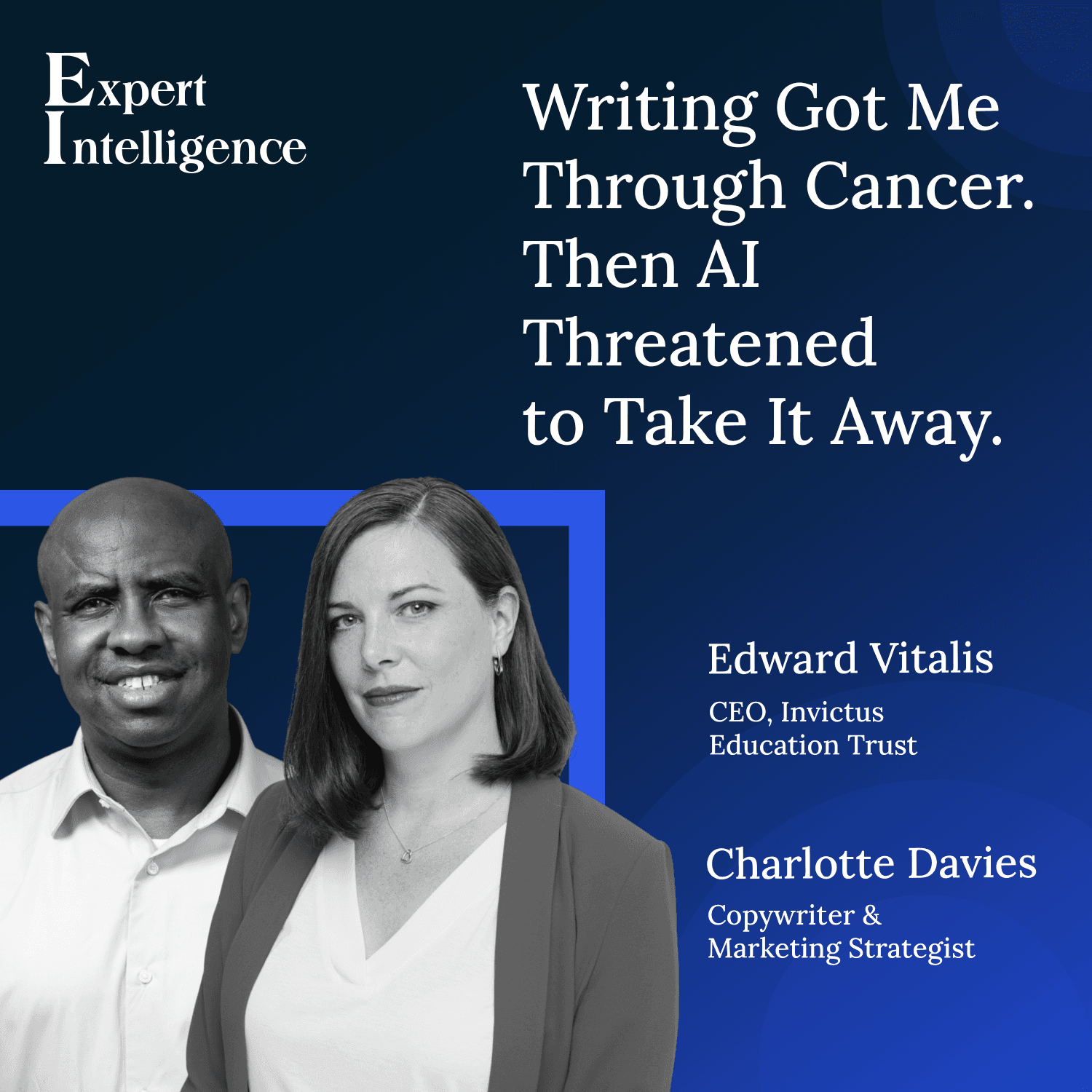
Charlotte Davies, TEDx presenter and content strategist; received a cancer diagnosis in Thailand in 2014, later used writing and experimentation with ChatGPT/Claude to reclaim control and create “android”/comic-style AI projects and a newsletter about learning AI. Edward Vitalis, CEO of Invictus Education Trust; leads prompt-lab style training for teachers/students on human-first AI workflows.
Key claims
AI shouldn’t replace identity or dictate life; resilience is practiced through connection. “Human-first” means using AI after interviews/questions and for enhancement, not outsourcing thinking. In classrooms, the bigger risk is edtech/social-media mechanics disconnecting teachers and students, plus adversarial “cheating” framing. Algorithms can shrink the world via agreeable, siloed content.
Notable examples
Charlotte’s hospital writing notes; creating android images and an AI-themed newsletter; prompt lab group creating an Elvis-style song about “Christmas in detention”; parents restricting algorithmic content (no YouTube shorts/social media) while allowing creative tech use.
Written by AI. May contain mistakes. Listen to the episode to check what was said.
Chapters
Tap a time to open that second in VOCharlotte's Cancer Diagnosis
1:07 to 1:40
Charlotte shares her personal journey with cancer and its impact on her creativity.
“The human experience of AI, the tension it creates in our work and identity, and ultimately, what it means for the future.”
Resilience and Human Connection
1:41 to 4:59
Charlotte and Paul discuss the meaning of resilience and the importance of human connections.
“And it was a real life-changing moment, as you can expect, but in several different ways.”
AI and Identity Threats
5:00 to 6:41
Charlotte expresses her fears about AI taking away her identity tied to writing.
“And I've had family members go through the same.”
Exploring AI as a Creative Tool
6:42 to 10:55
Charlotte discusses experimenting with AI and its potential as a creative collaborator.
“It's an absolute segue for us to remain focused on this theme.”
Balancing Optimism and Dread
10:56 to 13:20
Paul reflects on the duality of excitement and fear regarding AI's impact on the future.
“stack with Claude and analysing all the different subscriptions I've got.”
Human-first Workflows with AI
13:21 to 14:00
Discussion on how to integrate AI into workflows while maintaining human-centric values.
“people that say, oh, don't worry, one day none of us will work.”
Embracing Human-First AI Workflows
14:00 to 15:06
Learn about the importance of human-centered approaches in utilizing AI technology.
“And I think that was Webster's number one word this year in the Webster dictionary.”
The Role of AI in Education
15:06 to 17:06
Explore the challenges and opportunities AI presents within educational settings.
“And the challenge is people don't have time.”
Concerns About AI in the Classroom
17:06 to 21:19
Discuss concerns regarding AI's integration into classrooms and its effects on learning.
“Just reflecting, I want to turn to our children, because after all, we're here to shape their lives.”
The Impact of AI on Authenticity
21:19 to 23:25
Investigate how AI may affect our perception of reality and authenticity online.
“So the way to counterbalance that is really focusing on what you can do in real life.”
Show all 16 chapters
Algorithmic Influence on Perspectives
23:25 to 25:15
Understand how algorithms shape our views and interactions in the digital age.
“what you see in real life is you're going to have a better chance of seeing what's authentic and genuine.”
Parental Guidance in the Age of AI
25:15 to 28:01
Learn about strategies parents can use to navigate their children's use of AI and technology.
“because their world became so small and the urgency around the things that they believe was so disheartening that it impacted those relationships.”
Navigating Technology and Social Engagement
28:01 to 30:23
Explore the impact of technology on children and social interactions.
“I mean, there are times where we'll go put on a show or something, but watching shorts on YouTube is not something that they're allowed to do.”
The Role of Schools in an AI World
30:24 to 32:49
Discuss how schools can integrate technology while emphasizing traditional skills.
“the BBC yesterday, and Bill's going through the parliament right now on not allowing children under 16 to use social media.”
Advice for Teens in the Age of AI
32:50 to 35:01
Insights on how teenagers can navigate their futures with AI.
“Get to know people, build your networks, because the people you know, they can give you advice.”
Leadership Priorities in AI Integration
35:02 to 39:13
Understand key leadership strategies for managing AI in organizations.
“We have almost 6 ,000 children who we look after.”
Transcript
Automatic transcript. May contain errors.0:00Writing got me through being in hospital when I didn't know what else to do. I was writing notes to myself. So when people were asking me, are you scared AI is going to take your writing away from you? It was saying, are you scared AI is going to take a piece of you away from you? I don't want to be scared of it. I don't want it to take over my life without me having any say in it. So then I started.
0:26Paul Estes:Today you're going to hear something a little different. Recently, I was in the UK with the Invictus Education Trust, running hackathons and workshops to help teachers and students think with AI. Between sessions, I sat down with their CEO, Edward Vitalis, and TEDx presenter and content strategist, Charlotte Davies. The conversation got vulnerable fast, as Charlotte opened up about receiving her cancer diagnosis while alone in Thailand, and how that shaped her views on creativity and human connection. We ended up in a raw discussion about AI, kids, screens, and what it means to be algorithmically infected.
1:00Paul Estes:This one will give you a completely different way of thinking about humanness in this age of AI. Enjoy. So today, we're going to explore this from three angles. The human experience of AI, the tension it creates in our work and identity, and ultimately, what it means for the future. Charlotte, I'd love to start somewhere personal. your TEDx talk began with a cancer diagnosis. Can you take us back to that moment and what it taught you about resilience? Paul, Edward thanks ever so much for having me. I'm delighted to be here and a star guest. Thank you ever so much for calling me that. So yes my cancer diagnosis was in January 2014.
1:43And it was a real life-changing moment, as you can expect, but in several different ways. Because when I got my diagnosis, I was in Thailand, in Chiang Mai, in the north of the country. And I'd already been in hospital for about four days by the time I had that scan. And when they first admitted me, I thought maybe it's pneumonia. They were talking about Legionnaire's disease. But when I got the news that the scan that afternoon showed a 10 centimetre tumour, I remember it just felt like the world had been pulled from under my feet. It felt like I was free falling. And I still remember that moment so clearly because it felt like chaos.
2:34around me though I had so many nurses looking after me the marketing manager of the hospital he and his wife had come in to visit me they'd organized a friend come to visit me as well so all of these strangers were really supporting me when I was thousands of miles away from my friends, my family, because I'd been part of a group which had to move on to back down to Bangkok. So while I was there by myself, I had to go through these experiences by myself, but it taught me just how kind strangers can be and how we need to be around other people and how important that is to building resilience, not just in ourselves, but with each other.
3:25Wow that's quite powerful such a challenging intersection in life how did that shape your thinking moving forward in respect of creativity and the work that you do? It shaped every element of my life really because I think it showed me that nothing in life is guaranteed you can have all these ideas, all these plans, but just like that, it can switch and you need to be able to adapt to it. And I think creativity comes from finding solutions to problems and thinking about things in a different way. So it's really made me since then look at things from different angles, not just take things at face value because somebody might say something but you don't know what's going on behind the scenes either so it's also really made me value people and people's lives and people's experiences and what we can learn from each other as well because I know from my point of view knowing other people who'd gone through struggles especially cancer diagnosis and come out of it the other side, that gave me real hope for the future.
4:51Thank you, Charlotte. And Paul, I know that your version of resilience, once it looks a little bit different, there is a common thread. What does resilience look like in your world?
5:01Paul Estes:Thank you for sharing your story. And I've had family members go through the same. So while I don't know it personally, I can understand the struggle. There's a famous quote that says 99 % of life is showing up. And when I think of people going through things like cancer or even people going through mental health challenges or anything, that ability to wake up every day and put your shoes on and tackle life is the core at what resilience is. And I think today it's harder than ever because we're being bombarded with things on social media or crazy news. I mean, you think it's crazy, just wait till tomorrow.
5:38Paul Estes:And then you think of AI coming to take jobs in the future, and it all seems very bleak. And so that resilience is becoming harder and harder, but at the same time becoming more important than ever. And so I think resilience, while it's an easy word to say, in practice, like Charlotte said, how do you practice it? I think she nailed something that is often sort of said tongue in cheek, but it is that connection with people. It is our connections with each other and those things that happen in passing where somebody gives you a smile or when a teacher spends extra time with you or when a parent puts down their phone and has breakfast or lunch with their child.
6:20Paul Estes:Those are the moments that I think we sometimes forget and become too busy to really make sure we protect. And so I think when we talk about resilience, it's hand in hand with the human connection that, by the way, is under attack in many ways by technology that promised to connect us and bring us great things and in many ways is fighting that human connection that we so desperately need. Yeah. It's an absolute segue for us to remain focused on this theme. What does it mean to stay human? But let's build AI into that context. Charlotte, you asked AI directly, are you going to take my job what did you mean by that so edward uh last year and so yeah i'd say early part 25 um latter 24 people kept coming up to me and saying charlotte you're a copywriter are you scared ai is going to take your job i was asked it so much and it got me really depressed if I'm honest, because I've been writing since I was at school.
7:32I used to write student newspapers. I used to write stories. For me, writing the event, which was fantastic, the AI News Night at Invictus, I was writing tons of notes in my little notebook with a pen. I still do it now. So for me, writing is tied in with my identity. It got me through being in hospital when I didn't know what else to do. I was writing notes to myself. So for me, it's a kind of, it is me. So when people were asking me, are you scared AI is going to take your writing away from you? For me, it was saying, are you scared AI is going to take a piece of you away from you? So I thought after a while, I don't want to be scared of it.
8:19I don't want it to take over my life without me having any say in it. I want to take back some control. So then I started experimenting with it, chat GPT and Claude and trying different things out. And it was around the time of there was a trend on LinkedIn where people were creating AI action figures of themselves or toys in boxes. And I thought, I'm not really interested in that, but I've always been a fan of sci-fi. So I thought, what would I look like as an Android? Super geeky, but you know what? I love it. And so I started testing out all these different prompts and saying, what would I look like with this?
9:10And I uploaded some photos from an event. And then I realized, actually, AI can be fun and it can be creative. So I started seeing these pictures of me as an android and thought, well, this is interesting. But, Paul, you've talked about the AI slop. It was at that point just kind of AI slop. I didn't really know why I was creating it. But then I started experimenting a little bit more about, OK, so what could this character wear? and then we developed we me and chat GPT um we um created a wardrobe and a different style and all these different things and it became fun then on LinkedIn as well I saw a copywriter who I became friends with during the pandemic Marianne Vosso she's a former screenwriter for soaps like Hollyoaks and Coronation Street soaps in the UK and um she was experimenting with AI and she was talking about how she speaks to the AI tools as if they're a creative collaborator.
10:16I thought, oh, okay, I didn't know I could do this. So I started having more kind of conversational chats with Claude. And that opened my eyes up to, okay, we can work together. It doesn't have to replace me. And then at the end of last year, I thought, actually, let's revisit this Charlotte X. Makina, a Shell XM character. How can I use this image? And then I thought, I've always been interested in comics. When you're running your own business, you're advised to have your own email newsletter. And I'd already started one, but it was very inconsistent. So again, chatting through my tech stack with Claude and analysing all the different subscriptions I've got.
11:03I've got an email subscription with a software kit. I know I want to keep using it, but I want to put it to good use. How about I turn this newsletter into my experiences with AI so I can prove to people I'm learning, everybody's learning, AI isn't taking my job. And this is how I can show you why I'm still important within the mix. Thanks for that response, Charlotte. I'm still concerned, I have to say. And I want to turn to you, Paul, because you work in a sector that has some fast paced tech development. We know that you give your sector a challenge and they really go for it. We've got AI now.
11:51Everybody's telling us that it can't deal with emotion. Are our developers going to turn to that challenge? We heard last night at our session that that is why AI will not ultimately replace teachers. Will the technicians, will the developers rise to that challenge? 20 years ago, it was inconceivable that we'd be here today. That's one of my worries. I wonder what your thoughts are, Paul.
12:21Paul Estes:I wouldn't even say 20 years ago. I think you could say five years ago, we wouldn't imagine that we were in this place. And a group of people decided, without our permission, to unleash ChatGPT to the world and free for everyone to use. And so I often say there are days that I wake up and I'm unbelievably optimistic. And to Charlotte's point, I find amazing use cases and really exciting, creative ways to use the technology. And there's other days that I wake up and I, with existential dread on the future that we will live in, that I will live in, that will be dictated to me by someone, a developer or a piece of technology and what it means for my kids.
13:02Paul Estes:And so sitting in that balance of dissidence and uncomfortableness is back to resilience as a thing that we have to learn because it is an emotional rollercoaster. To Charlotte's point, it really starts to pull at people's identity, you know, the things that make them human, the work that they do. Work is important to people. And so I rail against the people that say, oh, don't worry, one day none of us will work. I'm like, but we want to work. We want to have work in healthy places and connect with people. And so work, I think sometimes we talk about the toil, but we don't talk about the connection and the other things that happen with work.
13:36Paul Estes:Back to your question, I think the technology has outpaced our ability to understand how to use it. And I think we're all in a stage right now. And Charlotte, your examples of your journey with this technology were spot on. I think we all go through a phase where we get the technology and we start overproducing stuff and it's slop and we feel productive and we feel like we're making progress. And if you're honest with yourself and you go look back at it, it was kind of slop, AI slop. And I think that was Webster's number one word this year in the Webster dictionary. You know, I think last night in Edward, the prompt labs we've been doing with the teams are designed to help people quickly adapt to and accelerate their learning on how to use this technology, how to take the fear out of it, how to find ways to create human first workflows that enable this technology.
14:31Paul Estes:And I think one of the things that I'd like to educate people on, and Edward will probably use this workflow for this podcast, is when you say, what does human first mean? Well, you could take a conversation like this, three humans talking about the human experience and this technology. You could take this transcript and you could use AI to do a lot of great things with it, whether that's to share the message, whether that's to produce an article with the help of a copywriter. There's a lot of parts in a human-first workflow where you can use AI to be helpful, to gain insights or to produce different things.
15:05Paul Estes:And so I think that's what we're advocating for. And the challenge is people don't have time. And so I encourage all organizations, and Edward, I think Invictus does an amazing job of this, just to carve out time for all different levels of professionals and students and parents and teachers to just learn about the technology, but also just to play with it and have fun. Yesterday in a prompt lab, at the end of it, we created a song. We had, I think, 20 people around the table, and we all created a song about Christmas in detention. You had to be there to understand it. It was the first time that I think that group of people realized that we could create an Elvis Presley song about some human work that we had just done.
15:45Yeah, when you said about the existential dreads and how something that I find frustrating is how people who are really advocating that the productivity and efficiency side of AI is that, are we going to have 100 extra hours every day to go and lie on a beach? And just for me, work isn't just about, as you say, the toil. It's the sense of achievement. It's working through something different. It's working together. It's creating experiences and you forge connections through going by going through something together. if everything is produced by AI with no human input, so what? But yeah, for me to have that human first, the inputs, the interviews, the questions, thinking through what the problem actually is, what are we trying to solve?
16:45What are we trying to create? And then use AI to enhance that. I think that's where I'm excited when you can see people's skills and abilities teamed with AI to create something that's going to improve life, because otherwise, what's the point? Thanks for that contribution, Charlotte. Just reflecting, I want to turn to our children, because after all, we're here to shape their lives. and in doing so, do we have any concerns about AI entering the classroom and what are those concerns if we have any?
17:24Paul Estes:I have a strong opinion. I am very concerned and I spend a lot of my time advocating, especially in my school district, around those concerns and I think there's three parts that drive my concern. Number one, I don't think that the education administration, people in leadership really understand the technology. And I don't blame them because their job is not to understand technology. Their job is to manage schools and budgets and make sure that the schools are ready to educate kids of the future. And all of a sudden, especially during the pandemic, the pandemic really accelerated this because everybody was at home.
18:04Paul Estes:So technology came to the rescue and said, well, we have laptops that can keep people connected. And we have ed tech that can help in this digital world that was thrust upon us with the pandemic. And so I think the technology usage in education just accelerated beyond administrators' ability to really understand it. I don't blame them. Everybody was doing their best. I think the second part that really concerns me is a lot of the ed tech, the technology that's being used, has the same type of mechanics that we see in social media. It's got a lot of the gamification. It's got a lot of the things that drive engagement, that drive attention.
18:41Paul Estes:and the technology can be helpful, but getting students addicted to that technology or engaged to that technology starts to separate the thing that we're talking about, which is human connection. And so as budgets go down or under pressure, as class sizes go up and as technology becomes the answer, you've got more kids staring at screens being air quote educated and less connected with teachers. It's not AI that's going to replace teachers. It's the technology that's going to to disconnect teachers from students. And we've seen that. It's not like, oh, hey, that could happen. It is happening with social media.
19:18Paul Estes:Social media is disconnecting people. And you see a big movement of people fighting back, deleting their apps, getting outside, going back to the pubs, and things like that. And so my second concern is around that technology in the classroom. My third concern is that the disconnect between a student's understanding and usage of this technology and an adult's understanding of this technology is significantly wide. And so we're not even having the right conversation. We're having a conversation around cheating. It is a student cheating. And the teacher's job is to stop the cheating. And in that kind of construct, I don't believe we get to a place where we're able to educate students for a future that is going to contain this technology.
20:03Paul Estes:We're still battling between you're cheating. No, I'm not cheating. and it creates an adversarial relationship, not a forward-looking relationship around this technology. And so I think the work Edward were doing with the prompt labs to start the conversation around what does it mean to actually educate with this technology? Look, it was the same as scientific calculators not too long ago. Teachers did not want scientific calculators. And it took us a long time to sort of get everyone into using that technology and adapting the pedagogy to support that. We don't have that much time with this technology.
20:40Paul Estes:And so I think there's urgency around figuring out what it means to have AI as part of a pedagogy, whether it's science or math or anything. So those are three of my main concerns. I want to bring Charlotte in. Thanks for that context. That's really helpful. Charlotte, you shared something with me recently ahead of this conversation. It really stayed with me and I found it really profound. You said to me that the internet expanded the world but AI has the potential to shrink it. Given that context that Paul has just provided with us just building upon that what did you mean by that? It's something that I heard on an AI workshop it was the founder of Delphi which Delphi's a you can digitize your identity and that's what that complete does and he was saying how because it's so easy to create content and it's so easy to amplify that content as well deep fakes ai slop you're just going to be overwhelmed on the traditional kind of social media channels it's you're not going to know what's real and what's fake.
22:00So the way to counterbalance that is really focusing on what you can do in real life. So who's in front of you? What can you actually see with your own eyes? Who can you speak to? And then you can tell, not 100 % because people still lie, but it's that what's right in front of you, you can't fake as easily as what you see online. Also, I think the nature of AI as well. We've seen it with the algorithm and social media. It's very easy to be siloed and see all the content that you agree with. With AI, it's trained to be supportive. It's trained to be agreeable. So this was brought up yesterday. If you have an argument with your friends in real life, it's very easy to go online and start chatting to a chatbot who is there to be nice to you and say, yeah, you did the right thing.
22:59So I think in terms of shrinking the world, it's a case of rather than look at lots of different sources via Google, you can get all your information from ChatGPT or Claude or whichever tool you want to use. So that's one respect. And then the other side of it is when you don't know what's real or fake online, what you see in real life is you're going to have a better chance of seeing what's authentic and genuine.
23:32Paul Estes:Charlotte, you mentioned something and Edward, it was a conversation that we had yesterday and I call it the algorithmically infected. I don't have a better name for it, but I've noticed that more and more stories and more people I talk to, and a lot of people are trying to find the right balance with social media and, again, all of the AI slop and fake stuff and fake news and all that stuff that's coming out. There are people that have gone down the rabbit hole or been red-pilled, as some people call it, and they're algorithmically infected. And when you talk to them, they talk with anger and urgency around topics that you can tell they're being fed.
24:08Paul Estes:Not that they're not important topics, but they're not life-consuming topics. And so to your point, their view of the world becomes very narrow around these topics and their world shrinks. And then these friends that I've had for a long time end up talking to me about, and you can tell that whether it's Twitter or I guess Grok or Facebook or whatever they're using, you can tell that they're being impacted significantly, their mental capacity, their focus. And these people who used to be very broad thinkers and talk about gardening, whatever it was, are now talking about these things. And I think when you say is AI or technology algorithms making the world smaller and more narrow, you can see it.
24:50Paul Estes:Everybody has a friend that has been algorithmically infected whose world became much smaller than it was before they stared at their phone and doom scrolled various content. And so that's, I think, a real life example of people's world becoming smaller. And it's sad to me because I've had friendships that have been impacted. I've had family relationships that have been impacted by our ability to connect anymore because their world became so small and the urgency around the things that they believe was so disheartening that it impacted those relationships. Building on that conversation, Paul, I said to you yesterday that I was fortunate enough to have grown up in the 70s and 80s and I started to work in the 90s.
25:36I lived in the expanded world. and because of that I'm able to hold on to it and I still live in the expanded world. I'm really concerned that our children don't have that experience and some of them were never around in that expanded world. They only know the narrow world. How do we give back to them? I'd quite like to add to that from a female point of view as well because a lot of the tech founders, well, the majority are male. And I think thinking about teenage girls in particular with social media and young boys as well, thinking of the sextortion and the emphasis on looks, when you're being presented with filters, first of all, but now AI generated images of people, then they're living up to these huge beauty standards, which just not are achievable.
26:33and there was an article on BBC News this morning saying how from a doctor an aesthetics doctor saying how people are now bringing in AI generated images of themselves and saying I want to look like this but it's just not possible and I think because generating the images with AI as well I've had to program it to say I don't want it perfect I don't want it young I don't want it symmetrical because that's the default and that's what it considers to be beautiful because for a machine symmetrical systems that's the gold standard of beauty but that's not human either that I think there's beauty in our imperfections but when you're being fed just one standard whether it's opinions how people look your point of view becomes warped you know as a father of two
27:30Paul Estes:daughters, I spend a lot of time thinking about technology in general, AI and algorithms. I think a lot of times people don't talk about the algorithms when they're talking about artificial intelligence. And I think the two are hand in hand, but I agree with you, Charlotte. If there's a parent out there listening, there's some rules. And I was asked last night, I mean, there's some rules I've put into place in my house. And I hold myself to the standard too. I try to reduce as much as possible, but they're not allowed to use or watch or consume algorithmic content. and that means all social media.
28:01Paul Estes:That even means YouTube. So we don't do YouTube in my house. I mean, there are times where we'll go put on a show or something, but watching shorts on YouTube is not something that they're allowed to do. And I think it won't be until they're around 16 that they're allowed to do that. But they are allowed to use technology to create. My daughter has an iPad and she wanted to go make a movie. And so her and her friends took that piece of technology and spent a whole day putting together an amazing movie or drawing. So they wanted to use drawing. There was a way to teach them drawing. And so there are ways to use technology in a healthy way.
28:39Paul Estes:But I agree with you, if you allow all of us, I think sometimes the conversation is, oh, just the children. No, it's all of us. I don't care if you're 60. I don't care if you're 70 and retired, because we're starting to see more grandparents visit their kids and they just doom scroll their phones all day instead of connecting with grandchildren. So it's not an age-bound thing. That's the thing that we need to fight against, whether it's you're comparing yourself to others in the way you look or comparing yourself to others in how much money you have and what success actually looks like. Because if you look at social media, having a yacht is what success looked like.
29:13Paul Estes:That's not what success looks like for me at all. In fact, it'd be crazy to try to manage a yacht. So - I get seasick. Right? So I agree with you. I think it's especially for young girls. And there is no, I say this provocatively, and I believe it, there is no healthy way to engage with social media. The algorithms are more powerful than our ability to put them down. It becomes a default behavior. And when it becomes a default behavior, you're eating junk food for the brain. And guess what? We like junk food. Not everybody likes broccoli. And eating broccoli is hard. And yes, there are some people out there that love their veggies, but it's not a default behavior.
Read the full transcript
29:53Paul Estes:And so I think, and this is what we were talking about yesterday, Edward, is as leaders and as parents, we have to make the hard choices and we have to fight the hard fight of understanding technology, AI and algorithms, and then limiting it and understanding where it's appropriate, just like we do other things. We don't allow cigarettes in school. We don't allow a lot of things in schools. A lot of parents don't allow certain things in their house. And technology has now become one of those categories that we need to actively manage in many ways. I was watching the BBC yesterday, and Bill's going through the parliament right now on not allowing children under 16 to use social media.
30:31Paul Estes:And so it's a global effort to really start looking at technology and regulating technology just like we do alcohol and just like we do cigarettes. Paul, you make a really strong case. I think that's fantastic parental advice. you've touched upon schools Charlotte maybe you can address this one for me what does this really mean for schools and what should we be teaching how should we be teaching and how should we different really big questions aren't they so I think it's integrating the tools in a learning style which emphasizing that they are tools and not a replacement for yourself modeling good behavior as was discussed last night and thinking about are they a crutch or are they a catalyst so how can you use them in a way that is going to enhance your skills or help you to develop your skills, but focus on the traditional skills at the same time, because communication, teamwork, critical thinking, if you can speak in public, if you know how to have a sensible debate, if you can listen to somebody, take on board their point of view, and share your perspective as well and come to a compromise.
31:59Those are skills that they've been around since prehistoric Roman times. They're going to be important forever, even more important when people are losing them. So if you can develop strong communication skills, if you can focus on your perspective, collaborate with others, I think you're going to be in an advantage in the future if people are using AI as a crutch to do all the work for them. So what advice would either of you give a 16-year-old today about their future in an AI world? Learn how to use the tools, be aware of them, their advantages and their limitations, but really focus on developing your interpersonal skills as well.
32:52Get to know people, build your networks, because the people you know, they can give you advice. They've lived in this world. AI, it's based on training from all different things. But sometimes you just want to ask, mum, have you done this before? Yes, this is how I dealt with it. And this was the response. Make mistakes. You don't have to be perfect. Just be human. Paul, would you like to build on that?
33:22Paul Estes:Yeah, I would say join a club, play sports. If sports aren't your thing, join an acting club. If acting's not your thing, join a chess club. If a chess club's not your thing, find another, whether it's your church or a social organization, but don't let technology take away from you the thing that keeps us connected. And if you're a parent out there, I had amazing parents. I'm very fortunate that I I had parents, but they had a one rule. You have to do something. You have to go to school. You have to get grades. You have to eat your vegetables. Mom, thanks. I now like broccoli. But you have to go and do those things.
33:59Paul Estes:And it worries me that the participation rates in those sorts of extracurriculars are going down for a lot of different reasons. Look, they're hard if you're a parent to drive your kid to and from those things. And so it's hard. And I respect the tradeoffs given to parents working and all of that stuff. but work really hard to find something that's maybe closer that keeps you connected. And so I have the same rules that my parents, to your point, Sean, it's lasted for a long time. I have the same rule that my parents have. I've gotten in trouble for kicking my kids out of the house and saying, get on your bike and go knock on doors.
34:32Paul Estes:Maybe that makes me old fashioned, but the kids still have to find whatever their passion is and participate in extracurriculars. And I that keeps a distance between technology and hopefully it creates a pull towards human connection for my kids where they want to go and spend more time with other people having fun and doing those things versus getting sucked into the algorithms and the technology and so that's the advice i would give okay i want to come back to me as you know i'm the chief executive of invictus Education Trust. We have almost 6 ,000 children who we look after. We have parents and carers and we have almost 800 staff.
35:13I'm trying to lead a high performance culture. In the context of AI and the future world, what should my top three priorities be? Top three priorities as a leader? I'm not sure whether I have three, but I'll start. So I think listen to people, create an environment where people can question and ask if they're not sure about the tools and why are we using them? What is it for? I don't know how to use this. Can you give me training? and just being really open. I think if people start hiding or hiding their use, then the secrecy around it can lead to more issues in the future. So creating that open environment where people can talk about what has worked and what hasn't, and then you can all share that experience and build from it.
36:14So I don't know what the three priorities would be, but I think the main one for me is that communication and that openness around how it's being used. That's good advice. I really appreciate that, Charlotte. Paul, do you want to build on that?
36:29Paul Estes:Yeah, I think Charlotte hit one of them square on the head. Listening. I think you have to meet people where they are. I think if you look at the hype cycle and everything else, we're being told, hey, there's a future and you're behind. And I think as a leader, it's important to say, hey, where are we? Check in with people. And that allows you to start the conversation from a place where people are starting. Then you can take them on a journey. I think the second thing is being transparent. People don't feel safe right now. They don't feel oriented because the world is kind of a crazy place. And so I think if you're transparent and clear, especially around AI with how you think about it, hey, we're going to go on a journey together, but let's be clear, we're going on a journey together and then help frame transparently and clearly what that looks like.
37:17Paul Estes:It sets people at ease. I think there's a belief to think, oh, well, here's this person and we're all going to be replaced. And a lot of that comes, one, because you didn't start with step one and listen and meet me where I am. And two, you weren't clear and you didn't explain to me how you think about it. We're not here to replace you, but let's be clear. My expectation is that we all start playing with this technology. We are going to adopt this technology and it will take time and we're all in this together. And there's just a sense of clarity that I don't think a lot of leaders do. And so without that clarity, without that transparency, people's brains are going to fill in the gaps.
37:51Paul Estes:And guess what? That's not a healthy place. And I think the third thing that builds on that is to continuously improve, like show those examples, tell those stories, share those use cases so that people start to realize we are a human first culture. And what does that actually mean? Well, here's an example. Here's the example of an attendance professional using this technology. Here's an example of a teacher, like we were talking yesterday, a special ed teacher, using it to help her student learn physics, but using visual cues and things like that. I think they're within those examples, you can start to see what an organization looks like that is adopting the technology in a productive and a human centric way.
38:32Paul Estes:Instead of using just the platitudes and the words, it's like, oh, this is what this means. And it really helps people adopt it and get their heads around it versus the fear. And I think you can't skip any of those steps. If you skip any of those steps, then, yeah, you're going to have an organization that doesn't feel like it's being heard. It doesn't feel like it understands anything besides what they read on the news about being replaced. And it doesn't have a pathway to really evolve as an organization. And if your organization, Edward, doesn't evolve, then it's not going to impact the students.
39:05Paul Estes:And so you're starting in the right place with teachers and administrators because only they are going to be in the classroom on the front lines working with students. And they have to have a clear understanding of where things are going. Okay, so look, thank you guys. My closing was going to be to ask you in one sentence to tell me what the staying human mean to you in this AI world. I think you have responded to that question, both of you, effectively throughout. In summarising, resilience isn't a reaction. It's a practice. We've confirmed that. Technology will keep changing. The question is whether we will keep growing, because the future won't be defined by the technology we adopt, but by the humanity we choose to keep.
39:57So, in closing, human first, always. Thank you very much.
40:03Paul Estes:Thank you, Edward. This conversation reminded me that our anxiety about AI is really about losing the things that make us feel like ourselves. And Charlotte's line stuck with me. AI is trained to agree with you. And that is exactly what makes it dangerous. If this episode made you think, send it to someone who needs to hear it. Until next time, stay curious.
From the publisher
Charlotte Davies has been a copywriter her whole life. She wrote through a cancer diagnosis alone in a Thai hospital. She wrote student newspapers as a kid. Writing is who she is. So when people started asking her whether AI was going to take her job, it didn't feel like a career question. It felt like an existential one.
In this conversation, recorded live with Edward Vitalis, CEO of Invictus Education Trust, Charlotte and Paul Estes go somewhere most AI conversations don't: what it actually feels like to be human in a world that's changing faster than we can process.
It's a conversation about what we risk losing if we're not paying attention, in our schools, in our families, and in ourselves. Paul shares why he's banned algorithmic content in his house (yes, including YouTube), Charlotte unpacks the unsettling idea that AI might be shrinking our world rather than expanding it, and Edward pushes both guests on what leaders and educators should actually do about it.
You'll Learn:
- How Charlotte's cancer diagnosis in Thailand shaped everything she believes about human connection and creativity
- The difference between using AI as a crutch versus using it as a catalyst, and why it matters more than most people think
- What Paul means by "algorithmically infected" and why it's damaging friendships and family relationships
- How the internet expanded the world, why AI has the potential to shrink it, and what to do about it
- How AI's default settings (agreeable, symmetrical, smooth) are training us to accept a version of the world that isn't real
- Paul's household rules around technology and the crucial distinction between consuming content and creating it
- What leaders and educators should prioritize right now to build a genuinely human-first culture
Subscribe to Expert Intelligence so you don't miss future conversations with the innovators, operators, and thinkers shaping the future of work and technology.
Producer: David Grabowski | Theme Music: Aleksey Chistilin