In short
Podcast Summary: Expert Intelligence with Paul Estes
Episode Title
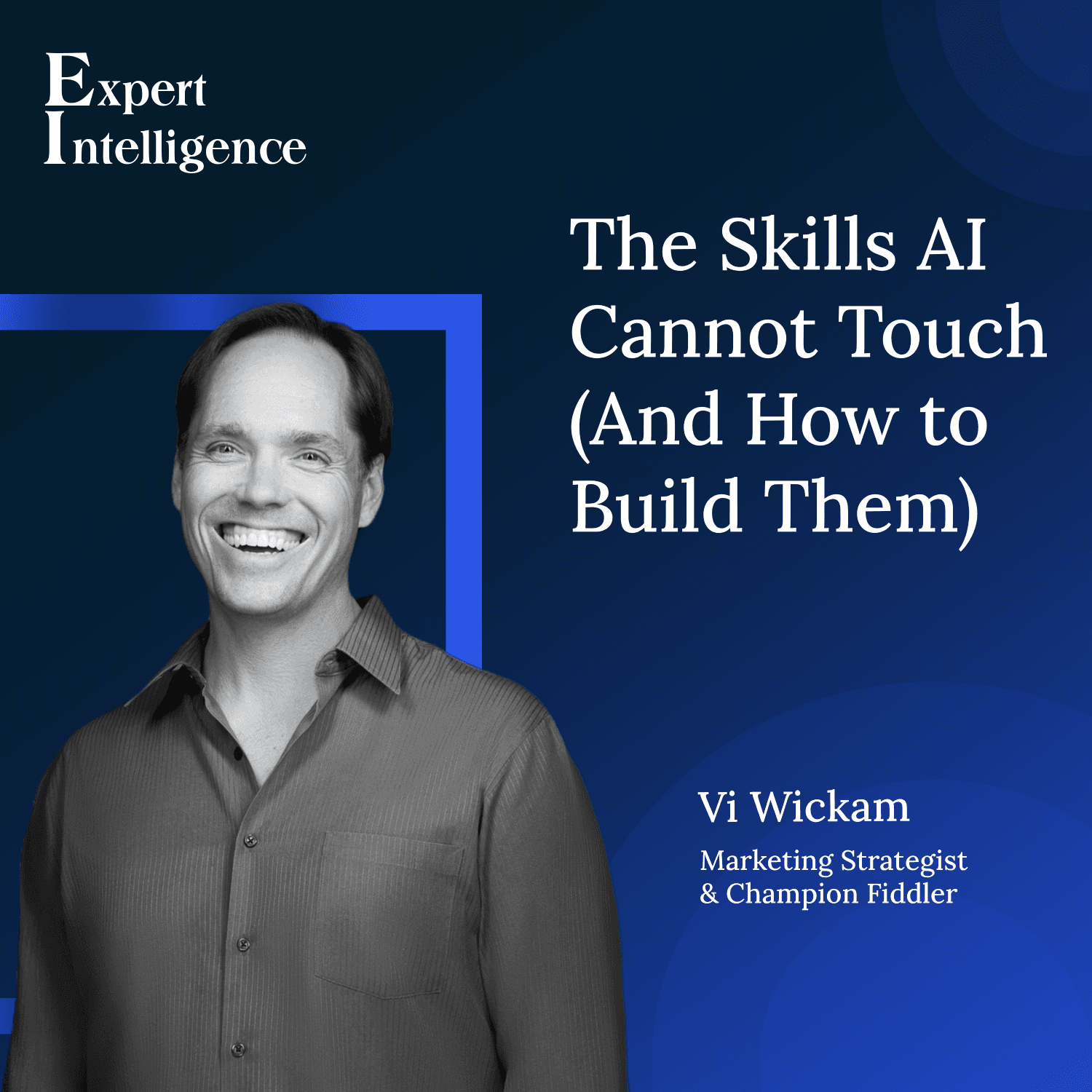
The Skills AI Cannot Touch (And How to Build Them) — with Vi Wickam
Overview In this episode, Paul Estes interviews Vi Wickam, a digital marketing expert and accomplished musician. The conversation explores the profound impacts of AI on creativity and marketing, emphasizing the essential human skills that machines cannot replicate. Vi shares insights from his diverse career, advocating for a return to honest marketing and the importance of clear communication.
Key Themes
- Emotional Connection in Marketing:
- Honest marketing is essential for building genuine connections with customers.
- Many companies fail to create a real brand identity, leading to ineffective marketing strategies.
- The Transparency Revolution:
- Vi introduces the concept of transparency in marketing, where clients should own their data, and companies must communicate authentically.
- Creativity and its Stagnation:
- The rise of AI is leading to a decline in human creative thinking.
- Encouragement for individuals to explore different inputs to foster creativity.
Important Takeaways
- The 10-80-10 Framework:
- A strategy for integrating AI into workflows:
- 10%: Understand the problem and scope it effectively.
- 80%: Use AI for routine tasks that consume significant time.
- 10%: Review and ensure quality control.
- Brand Authenticity:
- Companies need to uncover their core identity before crafting any marketing messages.
- Consistency across various platforms strengthens brand identity.
- The Value of Reviews:
- One-star and three-star reviews provide more actionable insights than five-star reviews, revealing crucial areas for improvement.
- Creative Play:
- Encouraging individuals to engage in playful exploration without pressure can lead to increased creativity.
- Changing perspectives can unlock new solutions to challenges.
Discussion Points
- Marketing as Communication:
- The interaction between brands and customers is akin to musical performance, where audience feedback is crucial.
- Successful marketing requires attentiveness to customer responses and real-time adjustments.
- Navigating the Future of Work:
- The role of humans will likely focus on emotional intelligence, problem-solving, and creativity—areas where AI struggles.
- Encouragement for the next generation to develop marketable skills that cannot be easily automated.
- Advice for Career Navigation:
- Emphasis on the need for practical skills over traditional job roles, especially in a rapidly changing job market.
Conclusion The conversation between Paul Estes and Vi Wickam sheds light on the ongoing evolution of marketing and creativity in the face of AI advancements. By focusing on authentic communication and fostering human-centered skills, professionals can thrive in the new landscape of work.
Resources
- Subscribe to "Expert Intelligence" for more insights on the intersection of work and technology.
- Links for Vi Wickam's work and resources will be available in the show notes.
Producer Credits
- Producer: David Grabowski
- Theme Music: Aleksey Chistilin
---
This summary encapsulates the key concepts discussed in the episode while providing insights into how individuals and organizations can navigate the challenges posed by AI in the workplace.
Written by AI. May contain mistakes. Listen to the episode to check what was said.
Chapters
Tap a time to open that second in VOThe Intersection of Music and Marketing
1:20 to 4:24
Vi Wickam discusses how music skills translate to marketing success.
“Hey, when your team reached out and mentioned that you are a nationally ranked fiddle player who was also in digital marketing and knew about AI, it caught my attention.”
Journey from Music to Engineering
4:24 to 6:40
Vi shares his educational journey balancing music and engineering.
“You studied computer engineering in college, but you were in music performance before that.”
The Art of Reading the Audience
6:40 to 10:01
Exploring the parallels between musicians and marketers in audience engagement.
“One of the things you've said in your writing is that musicians make great marketers because it's an art of reading the audience.”
Simplifying Complex Marketing
10:01 to 12:36
Vi explains how to clarify marketing messages for better audience connection.
“listening and you think, Oh, that guy's just a jerk.”
Balancing Algorithms and Authenticity
12:36 to 14:00
Discussing the importance of human clarity in a tech-driven marketing world.
“You talk about transparency a lot, transparency revolution, back to that point of being honest and trying to break through in a world where everything is messy.”
The Importance of Clear Communication Online
14:00 to 15:53
Learn how to effectively communicate with both humans and search engines.
“And you could create a giant load of garbage that nobody will ever read that might get you some rankings.”
Brand Consistency in Marketing
15:53 to 17:41
Understand why brand consistency is crucial for successful marketing.
“That's a very good question because I've worked with a lot of brands who are doing these things well, but it's never easy.”
Navigating AI's Impact on Education and Careers
17:41 to 20:31
Discuss how to guide the next generation in a world increasingly influenced by AI.
“Being consistent in your messaging and consistent in your customer experience is probably the most critical thing for me when it comes to marketing going forward.”
The Role of Humanity in Decision-Making
20:31 to 21:41
Explore the importance of human touch and critical thinking in an AI-driven world.
“the 10 % hard work up front to make sure you understand the problem, that you scope out the problem.”
Creativity and the Human Experience
21:41 to 24:25
Learn how to foster creativity and why it remains essential despite technological advancements.
“A challenge with social media, which I'm six months off of social media, minus LinkedIn.”
Show all 11 chapters
Changing Perspectives to Boost Creativity
24:25 to 26:29
Discover techniques to enhance creativity by altering perspectives and inputs.
“The next thing that I would say is there's a class I've taught a couple of times at Wizard Academy called Da Vinci and the 40 Answers that talks about looking at the problem through one of these 40 lenses.”
Transcript
Automatic transcript. May contain errors.0:00Vi Wickam:You don't need to have a job, but you do need marketable skills. You need to be good at things people are willing to spend money on. What's going to change, I think, is what role the humans play, and it's going to be the emotional work, it's going to be the hand-holding, and it's going to be the things that require physicality.
0:23Paul Estes:Today's guest has one of the most unconventional career paths I've ever come across. He's a four-time Colorado state fiddling champion whose album hit number one on the Folk Alliance radio chart. It comes from a family of musicians going back generations. His great, great, great uncle wrote the song that became Elvis Presley's Love Me Tender. And somehow, in parallel to all of that, he spent 30 years in digital marketing, generating great results for his clients. What makes Vi Wickham generally fascinating to me is that he's built an entire business philosophy around something he calls a transparency revolution.
0:58Paul Estes:The idea that honest marketing always wins in the long term, that clients should own their own data, and traditional agency model is fundamentally broken. I wanted to talk to Vi because his story says something important about expertise in the age of AI, about what it means to master multiple crafts and why the future of work might belong to people who refuse to choose just one path. Bye, welcome to Expert Intelligence. Thank you, Paul. It's a pleasure to be here. Hey, when your team reached out and mentioned that you are a nationally ranked fiddle player who was also in digital marketing and knew about AI, it caught my attention.
1:33Paul Estes:And the idea that you come from a family who helped Elvis Presley write Love Me Tender. I've seen a trend in my career of very successful leaders who are also talented musicians playing bands and play instruments. True.
1:47Vi Wickam:What do the two have in common? Well, the first thing that music and all other types of success have in common is you have to learn to listen. And you also have to be willing to be disciplined. because music is one of those things where there's an element of it where you have to spend large quantities of time by yourself doing hard things, you know, on your own, self-motivated at some point. I mean, our parents can kick us in the butt so long, but you know, that only works till we're 12 or 13 and then we're bigger than our parents and you're on your own at that point. It also teaches community.
2:26Vi Wickam:It teaches so many elements that are fundamental for success in other fields. In fact, when I teach my fiddle lessons, because I've been teaching fiddle students since I was 14, the approach I take is that everything you face in music, you will face in your real life, you know, outside of music. So if you're facing something you're afraid of musically, and you face it down and you conquer that thing, you will be able to conquer things in real life better from that point on. You know, if you're being shy and you conquer that by performing music publicly, you have now faced that fear publicly and you've won.
3:13Paul Estes:One of the things that if you read all of the news articles about AI and, hey, what traits do we need? What are the things, the skills that'll help us? Yeah. Hard work is one of them. But the other one is agency. Yeah. You talked about that. The idea that I wake up and I take agency and I do something. When you look at yourself or we were just talking about your daughter.
3:35Vi Wickam:Yeah.
3:36Paul Estes:What are the things that you lean on when you wake up and you say, hey, I'm ready to take on a hard thing?
3:43Vi Wickam:Well, that's a good question. It's a challenge because it's so easy to do the things that don't really matter that can keep you busy. And when you're self-employed, when you've spent your entire adult life self-employed, you know that you have to do the things that make a difference. And those are the things that are hard. So if I choose that today, I'm creating those exponential bits that push me forward, that propel me towards a successful outcome. And if I choose those things that are easy, that are comfortable, I can swim in my own poo for years without making any progress. Let's talk about choices.
4:25Paul Estes:You studied computer engineering in college, but you were in music performance before that. So I'm trying to imagine when you were sitting there in music performance and you're like, let me check out engineering. Tell me about that fork in the road.
4:39Vi Wickam:Well, for me, engineering has always been about solving problems and figuring things out. And I've always been driven by mystery and being challenged. And, you know, whether that challenge comes in the form of competing on the national level in fiddle contests, or that challenge comes in the form of, this is a problem that hasn't been solved yet. And how are we going to solve that? that challenge is one of my big drivers. And there never really was that moment of giving up music for engineering. It was really the kind of thing where I was driven to do both all along. And when I went to college, I started out as a double major in music performance and computer engineering.
5:29Vi Wickam:And about two months in, I thought, this is terrible. I had two hours a night of engineering homework. I was studying viola in college. My viola professor wanted me to practice two hours every night. And I also wanted to have some fun. I was in college. I'm on my own. I'm free. Do I want to be spending four hours every night studying? And so I went to the guidance counselor and I was like, this is terrible. I don't want to study and practice four hours every night. And she said, well, you didn't have to pick the two most demanding degrees we offer. And I was like, oh, I kind of did. That's kind of how I am.
6:10Vi Wickam:But on contemplation, what I decided was that nobody cares if you have a degree in music. So I could take the ensembles and I could study music theory and I could play in bands. I could play in rock bands and I could play in the jazz band and I could still play in the orchestra. And it didn't matter whether I had a degree in music or not. But it does matter in engineering. if I wanted a job in engineering, it mattered if I had a degree. So that was why I completed the degree in engineering and ended up two credit hours shy of a minor in music.
6:46Paul Estes:One of the things you've said in your writing is that musicians make great marketers because it's an art of reading the audience. Yeah. Unpack that for me.
6:57Vi Wickam:So anytime you're performing in music, It's a communication. It's a communication between the members of the band and each other. It's a communication between the band and the audience. And if you're tone deaf as a musician, and I don't mean literally tone deaf, but that would be even worse. But if you're not reading the audience and you're not paying attention to the feedback that you're getting from the audience, you're going to proceed in a direction where nobody's going to follow you. You're going to proceed in a direction that nobody wants to listen to you anymore. And I've had those situations where I was playing with someone who really was in their own world and they were playing their own stuff.
7:40Vi Wickam:And it's no fun when you pass a lick to them and you want them to hand something back to you. And there's nothing there. And when you're doing marketing, that same kind of dynamic happens between the customer and the company. And that brand conversation, if the brand's not listening to what the customer is saying and it's falling on deaf ears, you've created a situation where there is no brand. You don't have a relational brand. You have a logo and you have colors and you have a style guide, but you don't have a brand. You don't have connection with your customers. You have a broadcast of crap that nobody wants to listen to.
8:27Paul Estes:When you were saying that, one of the things I thought of was being on stage, even if you give a keynote or you're playing music, and you start seeing people pick up their phone. Like there's nothing more. Like, oh no. When you're on a stage and you're looking at the audience, you've done all this prep and you've done all this work and you've got hours behind it. And maybe one or two people in a big audience pick up their phone and you only see those one or two people. When you see that and you can translate it into business or marketing, what do you do?
8:58Vi Wickam:So when you see that is that you're looking for those disconnects. You're not just looking for the positive feedback, the positive reviews. You're looking for where are there disconnects between what we want to communicate and what people are receiving. So, you know, an example of this would be going back to reviews. If you read a review, read the one star reviews and the three star reviews, because they're going to have far more content and detail than the, hey, you guys are awesome. I love you. You know, I'll be back to buy more. That makes me feel so good. But where I learn is the, hey, you know, I ordered this thing and it hasn't shown up yet.
9:43Vi Wickam:And I called and nobody answered. What the heck, guys? you know, like you guys suck. And so you see the, the cracks in the facade, you know, that your brand promise isn't delivering and then you have things you can fix. But if you're not listening and you think, Oh, that guy's just a jerk. If you're not listening to where that's coming from, you do not take that communication. You don't grow as a brand. You don't grow as a company.
10:14Paul Estes:It feels like a lot of companies when they are listening to your point.
10:18Vi Wickam:Yeah.
10:19Paul Estes:What they give back is complicated. This week I was listening to your music because I knew I was going to talk to you and you had some Louis Armstrong on there, which was awesome. A lot of it feels complicated. So when I see a performer or listen to a performer like yourself or even see Steve Jobs, the old Steve Jobs on stage. Sure. To our earlier point behind that is thousands or hundreds of hours of work, experimentation, failure for that brief moment that I get to hear or I get to witness or see. A lot of companies are making marketing complicated. When I see their marketing, I get more confused than I get clarity.
10:58Paul Estes:In your experience, how do you make the complex simple?
11:02Vi Wickam:The first thing you got to do is get clear about your message and who you are as a company. And so at Wizard of Ads, we do what we call an uncovering. So instead of having a discovery call or something like that, we call our meeting process an uncovering, where we uncover the truth about this client or this business and who they really are down deep. What is it that drives them? What do they believe in? And who are they? What is it at their core? And when you're clear about who you are, it's a lot easier to be clear in your messaging. So the first thing is to get clear about who you are and what your message is.
11:48Vi Wickam:The second thing is to have that consistency of message across different platforms. And this is something that I often find when I come in on a new client is that they've had a disconnect between their offline media and their online messaging. because they have digital people who think that digital is different than offline. And they think that what they need on digital is to talk to computers instead of to talk to people. And the truth is, when you're doing online stuff, you have to make sure that Google can read what you put out there and that Google can understand it. But the primary focus really needs to be people because you're not selling to Google.
12:35Vi Wickam:you're selling to people.
12:38Paul Estes:You talk about transparency a lot, transparency revolution, back to that point of being honest and trying to break through in a world where everything is messy. I mean, add on the AI stuff. SEO used to be SEO and now it's SEO for AI and the list of
12:53Vi Wickam:AEO, AEO, AIO, E-I-E-I-O.
13:02Paul Estes:How do you balance the machine, the algorithms and everything that's going on with the idea to sort of uncover you or uncover and speak your truth? How do you find that balance? And not only in business, but people who are doing soul searching about their careers or their path. There's an analogy there that it's all the same.
13:23Vi Wickam:I always think that you've got to start with humans first. It's got to be people first. It's got to be clarity first. If you don't get clear about who you are and what your message is, you've got no foundation. So you've got to lay that foundation. You have to be authentic to it then consistently. So it's really easy to get off track. It's really easy to go back to the things you were doing before. so you know if you were out of sync in your communications before but we get clarity about this it's really easy to go back to what you were doing before because that was comfortable you know so spit out a whole bunch of gobbledygook you know go to chat gpt and say write me 400 blog posts that would be good for a home services company to have on their website and spit it out in a way that I can upload that to my website.
14:19Vi Wickam:And you could create a giant load of garbage that nobody will ever read that might get you some rankings. But when people land on that page, they're going to say, what is this and why? You've got to communicate to people. And, you know, when it comes to things like Google, you have to have technical SEO. So your website has to load fast, which is also great for people, you know, like slow loading websites. Nobody likes slow loading websites. And you have to like have good usability and you have to have good accessibility for people with low vision. You know, you've good contrast and proper markup language and that proper markup language will help a screen reader, but it will also help Google understand your webpage better and what the context is and why this is a headline and why this is a bulleted list or a numbered list.
15:16Vi Wickam:So ultimately, if I communicate clearly to humans and I use proper technical standards, so I'm using schema markup for things like frequently asked questions and addresses, which is talking computer to the computer, but I've still got the address and the phone number on there so that a human can see it and the phone number is clickables, So it's usable. You can do both, but you should always focus on the humans first and then make it work for Google or ChatGPT or Cloud or whoever you care about today.
15:52Paul Estes:When you think of brands that are doing it right, who kind of sticks to the top of your mind?
15:58Vi Wickam:That's a very good question because I've worked with a lot of brands who are doing these things well, but it's never easy. It's always a challenge. This is our focus at Wizard of Ads is message consistency. And it's easy to say, oh, yeah, like Nike is great at that, you know, because they really are great at that. And they have hundreds of millions of dollars annually marketing budget to spend on these things. So they better be great at it. If you're spending$10 million on an ad, you really want to make sure that ad really lands. But, you know, Apple historically has been a fantastic brand in that regard because they're clear that what they're selling is individuality and self-expression.
16:46Vi Wickam:They're not selling bits and bytes.
16:49Paul Estes:When you think of marketing in the next five years.
16:54Vi Wickam:Sure.
16:55Paul Estes:I use all the new AI tools. I'm sure you do. And Claude Cowork came out. So they have now a very specific trained model on brand. They have a trained model on sales. Like all these really fine-tuned models that you use. And you're like, I started my career as a brand marketer at Dale Computer in Texas. Dale. Dale Computer a long time ago. And I look at that and I'm like, wow, if I had that back then, it would have done everything that I did back then. When you look at the next five years, what does it mean to be a marketer?
17:36Vi Wickam:As I see it in the world of AI, brand is more important than ever. and that brand consistency and that consistency of operations from when the customer calls or uses your website or sees an ad, whether that ad is a Google ad or a YouTube video or a Facebook ad or a radio or TV ad on traditional broadcast media. Being consistent in your messaging and consistent in your customer experience is probably the most critical thing for me when it comes to marketing going forward. That consistent experience and that cohesion from awareness through hopefully becoming a brand ambassador, somebody who is a super fan of your company, that's only going to happen when who they think we are is who we actually are.
Read the full transcript
18:37Vi Wickam:And we over deliver on their expectations.
18:41Paul Estes:When you think of your daughter, we're both parents trying our best to - Both girl dads. Both girl dads trying to raise kids. I still, to this day, having spent a lot of time in technology and careers working with a bunch of amazing leaders, I struggle on what I'm telling them, how to navigate sort of their education and their career, given all of the, some of it's hype, but some of it is. Some of it's legit. Some of it's very real. How are you thinking about your daughter and advising her?
19:14Vi Wickam:Well, my daughter already has started her own business doing business administration help and is writing for companies and doing accounting work and a variety of useful skills. So I really think the same thing my dad told me when I was in junior high and high school is true today, which is that you don't need to have a job, but you do need marketable skills. You need to be good at things people are willing to spend money on. I was just advising one of my fiddle students a couple of weeks ago about, you know, she's getting ready to go to college. And we were talking about that. And she's talking about going into a career that is already seeing AI creep into it.
20:00Vi Wickam:And what's going to change, I think, is what role the humans play. And it's going to be the emotional work. It's going to be the handholding. And it's going to be the things that require physicality. And I don't think AI is ever going to be the kind of thing where we really hand off 100 % of big decision-making things to it. It might happen. It might be a huge mistake when it does. But I think at least for today, we're in a world where the best AI is still a 10-80-10 kind of situation where you have to do the 10 % hard work up front to make sure you understand the problem, that you scope out the problem.
20:43Vi Wickam:You come up with a solution. Then you put the AI to work to do the things that require a lot of grinding and would require tons of time from a human. And then in the end, you have to edit and review and quality control and check and test. And so I don't see those elements of being able to ask a good question, being able to understand and communicate what needs to be done. Those things are going to be critical skills forever when humans are operating with computers. And I would avoid the things that have already started to be taken over by computers, though. You know, like if reading x-rays is something that computers are already as good as humans at, probably don't want to be the one reading the x-rays.
21:38Vi Wickam:That's my take.
21:40Paul Estes:Again, I think we're all trying to figure it out. A challenge with social media, which I'm six months off of social media, minus LinkedIn. Congratulations. High five. It's been an amazing journey because what I found was I was in an echo chamber, especially around the AI and all sorts of things. I wasn't able to see clearly or think clearly. It started affecting how I think and what I read and what I believed. And when I stepped away from it, it was, to your point, very helpful to start to say what is actually valuable. Yeah, no, that's brilliant. Stop the chat bots. Like, I had to clear a carbon in my brain.
22:20Paul Estes:Actually, I get much better sleep. So if I look at my sleep scores on my aura ring, sleep scores have gone through the roof. I want to ask you one final question. If you look at all the headlines in the news, they say, you know, besides agency, creativity. Everybody's got to have creativity. Everybody's got to be creative. And one of the things that you learn when you see truly creative people or even try to do something creative is that it's hard.
22:48Vi Wickam:Yeah.
22:48Paul Estes:Creativity is messy. It's not linear or logical. You know, the idea that you are both an engineer and a fiddle player. So that one side's this messy brain and the other side's this organized brain. When you look at folks and say, hey, I want to give you one piece of wisdom about what it means to be creative, because I believe and I'm sure you believe it's important to have that side of your brain and you work with students to develop it. How do you develop creativity?
23:18Vi Wickam:So the first step to being creative is to realize that as a human, we are creative by nature. that is who we are fundamentally we are all musicians and we are all creative and our school system sometimes beats that out of us and we think we're not creative but we are the second thing is that the fastest route to creativity is play and you have to look at what is play to get clearer about that. But as a general thing, I'll just say play is when you're exploring and you don't have a deadline, you don't have an outcome that you have to have to meet. You're free exploring, you know, you're following your curiosity.
24:09Vi Wickam:And doing that will put yourself in that mindset that you're going to start feeling more free because you are free. And the only thing that keeps us from being free is our belief that we're not free. So we can all do it. The next thing that I would say is there's a class I've taught a couple of times at Wizard Academy called Da Vinci and the 40 Answers that talks about looking at the problem through one of these 40 lenses. And so every problem or challenge that you're facing, you can choose what viewpoint, what perspective you want to look at this problem through. And by changing your perspective, you change what the problem is.
24:54Vi Wickam:And so that could be zooming in or zooming out. It could be speeding it up or slowing it down. It could be turning it on its head. It could be going backwards. But if you're able to change your perspective, that is a really good way to come up with a different outcome. So if you have different input, you're going to have different output. I think Paul Simon summarized this well when people asked him, how is he still creative, putting out different music all the time? It was after he put out Graceland and people were like, this is totally different. This isn't all like Simon and Garfunkel. This is amazing.
25:34Vi Wickam:We love it. How'd you do that? And he said he listens to different music. And I think that people get stuck in their ways and they have the same input coming at them over and over again. And just stepping back, I think getting out of the echo chamber of your social media was a perfect example of the kind of activity that people can do to prepare themselves to be more creative. change your perspective, change your input and play freely explore the curiosity that you have. And we all have curiosity, but we may be drowned in social media and TV and reels and garbage that doesn't make a hill's bean of dip, a beans hill, doesn't make any difference in our lives.
26:24Vi Wickam:You know, we're, we're surrounding ourselves with that garbage.
26:28Paul Estes:Vi, thanks for taking the time. Anybody who wants to learn more about Vi's work, we'll have the links down in the show notes. And I look forward to following your fiddle career and the work that you're doing in marketing.
26:40Vi Wickam:It was a pleasure getting to hang out with you, Paul. I look forward to seeing you again in the future.
26:47Paul Estes:Take care.
26:48Vi Wickam:You too.
26:58Thank you.
From the publisher
Think about the last time you saw a company's marketing and actually felt something more than mild interest.
Chances are you're struggling to come up with one. And that's not an accident.
Vi Wickam has spent 30 years in digital marketing, helping companies fix this mistake. His premise is simple and kind of uncomfortable: honest marketing always wins, most companies aren't doing it, and AI is about to make the gap between the two a whole lot wider.
But this conversation goes deeper than marketing. Vi and Paul get into something most people don't want to sit with: your creative thinking might be slowly dying. You probably haven't noticed because your social media feed has been doing your thinking for you. Just one example from the episode: Paul Simon didn't stay creative by consuming more of the same thing. He listened to different music. That’s it. And if that sounds too simple to matter, that's exactly the problem.
You'll Learn:
- Why most companies don't actually have a brand, and the uncomfortable truth about what's missing
- The “10-80-10” framework for working with AI without letting it take over the parts that actually require a human
- How to uncover what your company genuinely stands for before you build a single word of marketing around it
- Why your one-star and three-star reviews are worth more than every five-star review combined
- The real reason your creative thinking has stalled (hint: it's not a lack of talent)
- What skills will still matter when AI has absorbed everything it can, and how to start building them now
- Why brand consistency isn't a marketing problem, it's a truth problem (and how to close that gap for good)
Subscribe to Expert Intelligence so you don't miss future conversations with the innovators, operators, and thinkers shaping the future of work and technology.
Producer: David Grabowski | Theme Music: Aleksey Chistilin