
In short
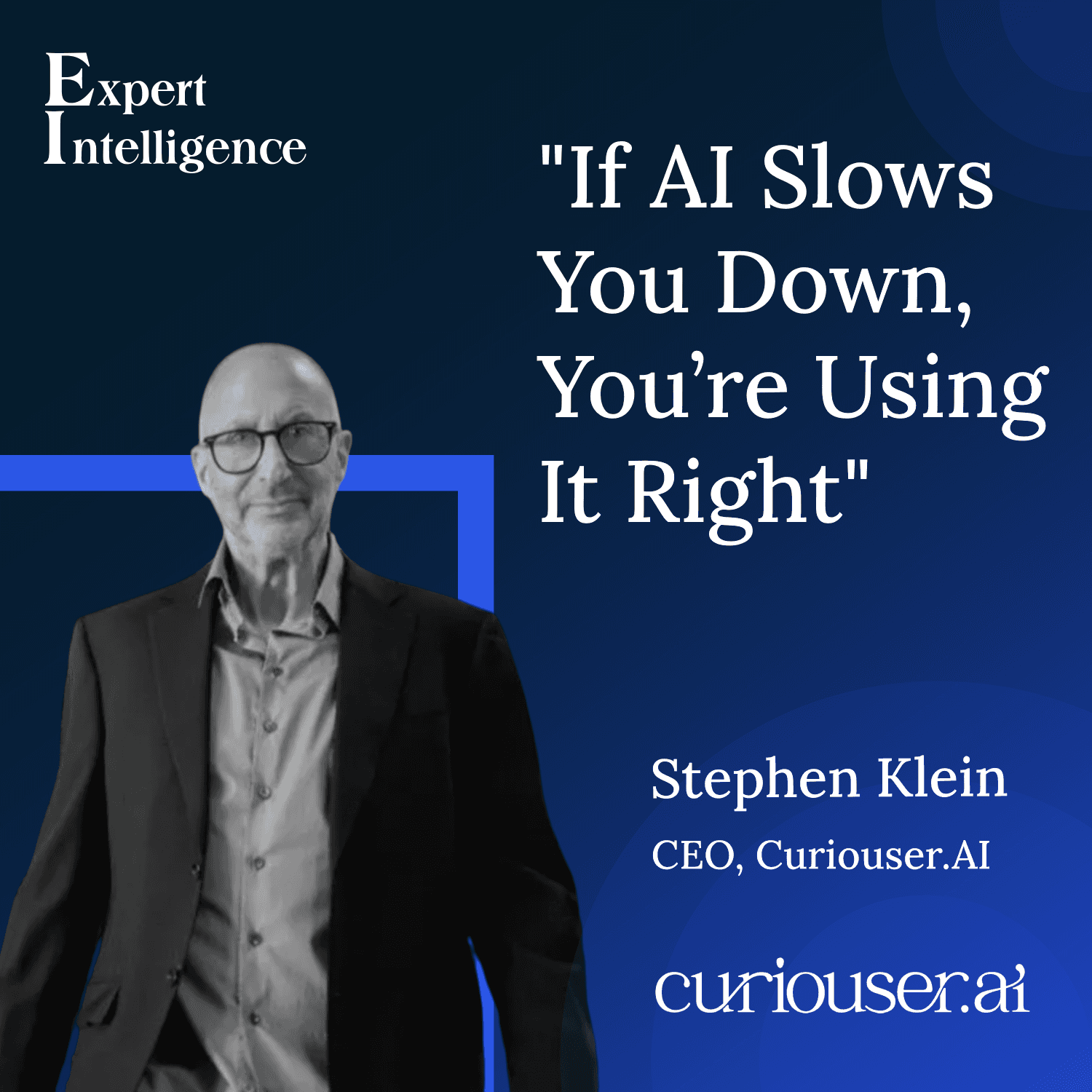
The episode argues that generative AI is being sold as “automation” that replaces people, but its real tradeoffs are outsourcing thinking and curiosity. If AI slows you down, Stephen Klein says you’re using it “right,” because current tools are optimized for engagement, not critical thinking.
Guest backgrounds
Stephen Klein is founder of Curiouser AI and a Berkeley lecturer. He’s described as a contrarian voice on what AI is doing to companies and workers.
Key claims
AI hype (“AI job apocalypse,” “no jobs needed”) is “hype as a service.” Most enterprise pilots fail; CFOs are now demanding better cost/intelligence ratios (“intelligence divided by cost”). LLMs are becoming commodity like electricity, pushing differentiation to the “intelligence layer” and domain-specific tools.
Notable examples
the November 2022 ChatGPT launch; “one guy in Sausalito” viral WSJ-style outlier story; Henry Ford/industrial-revolution analogy; “monkey with a nail gun” for unreliable AI replacing workers.
Written by AI. May contain mistakes. Listen to the episode to check what was said.
Chapters
Tap a time to open that second in VOThe Hype Around AI
0:42 to 1:41
Explore the misconceptions and hype surrounding AI technologies.
“What is the real cost of AI, not just in terms of the investment dollars, but also in terms of outsourcing our thinking and curiosity?”
The Trade-offs of Technology
1:41 to 3:21
Understand the trade-offs we face with the adoption of new technologies like AI.
“One of the things I want to say is I'm not a contrarian by nature.”
Rethinking AI's Role
3:21 to 5:30
Discuss how AI is perceived as a tool and its impact on critical thinking.
“And what we were gaining, I think, was really clear.”
AI and Business Efficiency
5:30 to 8:00
Analyze how businesses are using AI to improve efficiency and the associated costs.
“But the AI that we're all currently using now was not designed to augment our ability to think.”
Shifting Corporate Mindsets
8:00 to 12:10
Examine the changing attitudes of corporations towards AI investments and performance.
“That's a business model that Henry Ford would recognize.”
The Future of AI and Commoditization
12:10 to 14:00
Explore the potential future trends in AI as it becomes more commoditized.
“You talked in the article a lot about the large language models all becoming commodity, sort of like electricity.”
The Future of AI as Infrastructure
14:00 to 16:10
Understand how AI is evolving into a commodity and infrastructure.
“The one that you're talking about is also really interesting in that the value is going to be is going to move up to this intelligence layer.”
The Reality of AI and Job Market
16:10 to 20:20
Explore the challenges companies face in AI implementation and job retention.
“You have a lot of good one-liners, by the way.”
Cognitive Dissonance in AI Adoption
20:20 to 26:05
Learn about the false narratives around AI success and individual achievements.
“And part of that playbook was to make certain that we all felt that we were left behind.”
The Importance of Creativity and Focus
26:05 to 28:00
Discover how creativity and focus will be key competitive advantages in the future.
“I mean, when you think about it, before the Industrial Revolution, we were all entrepreneurs, right?”
Show all 11 chapters
The Value of Focus in a Distracted World
28:00 to 28:32
Learn about the challenges of attention spans in today's digital age.
“to focus on things that may not be in your best interest or the best interest of your personal future, but in their best interest to monetize.”
Transcript
Automatic transcript. May contain errors.0:00The industry monetized fear, and part of that playbook was to make certain that we all felt that we were left behind. The shortcut I have for people is that if AI is slowing you down, then you're probably using it the right way. The reason why AI was designed the way it was, which is automation versus augmentation, is...
0:27Paul Estes:My guest today is Stephen Klein, founder of Curiouser AI and a Berkeley lecturer, and one of the sharpest and, by the way, most entertaining contrarian voices on what AI is actually doing to us, companies, and the people that work for them. He's been asking big questions. What is the real cost of AI, not just in terms of the investment dollars, but also in terms of outsourcing our thinking and curiosity? Stephen and his team built tools designed to think with you, not for you. He may have figured out a way for us to realize the potential of AI, but not at the expense of our own ability to think.
1:02Paul Estes:Stephen, welcome to Expert Intelligence. It's good to be here, Paul. It's a pleasure. Thank you. So I've been following your content for a long time. And for a while, you are a lone voice in calling bullshit on all the marketing that the companies were doing, that this new technology would replace all of us. And, you know, even Elon Musk's, we don't need jobs anymore because there's going to be so much abundance. And you use a term that I like, and I've used it in a few talks of mine, and credited you, of course, hype as a service. Tell me a little bit about the moment you realized that the message that was out there was more hype than any form of reality.
1:41Yeah. One of the things I want to say is I'm not a contrarian by nature. I found myself in that position. It's not something that I sought. And I think the good news is I'm not a contrarian anymore. I think I may be in the majority at this point. But I actually realized that we were moving very quickly in the wrong direction in November 2022 when ChatGPT was launched. And I just had this epiphany. The writing was on the wall for me in that all of humanity overnight began prompting an AI and no one was prompting us. And I didn't get the memo. Nobody asked me, you know, is that what you want to do for the rest of your life?
2:25Be a prompt engineer. And you could see where that was going. You could see where that was going. And I'm old enough to be familiar with disruptive technology. I've been through a lot of disruption. And one of the things I know about technology is that they all require a trade. And I don't know whether people are aware of that, but there's always a trade involved. So, I mean, for example, books is a great example, right? We gained the democratization and scale of knowledge, but we gave up our memory. We used to have to memorize those books. With calculators, we gave up the ability to do math in our heads.
3:04We don't do math in our heads. I don't, anyway, do math in my head. With the mobile phone, a lot of us stopped memorizing phone numbers. We just outsourced that. I don't even know my children's phone numbers right now. It's all on my phone. And so I look at technology as a trade. And so the question I ask myself is, what are we giving up and what are we gaining with generative AI? And what we were gaining, I think, was really clear. It made our lives much easier in a lot of ways, right? It was faster. It was easier to write. It was easier to at least pretend that we were thinking. Super convenient.
3:41but we were actually giving something up that I think was extraordinarily valuable and maybe not a good trade, which was our ability to think. And that's what very, very much concerned me. And back then, people weren't concerned at all about that. And now I think that more and more people are thinking about it with the appropriate perspective. But that was really where I started being concerned.
4:11Paul Estes:One of the things I experienced, and I think you hit on it, everybody kind of had their aha moment where they started prompting and learning. And I think some people over time, and I've noticed this with a lot of executives I work with, are saying, hang on, it's actually not helping me. It's either confusing me or kind of taking me down paths that are not as helpful. And so they're sort of rethinking, I call it a relationship, but their relationship with this technology and trying to figure out, hey, it's kind of good at these couple of things, search plus plus or knowledge retrieval. But as a thought partner, I think the jury's still out on how helpful it can be or should be.
4:50Paul Estes:When you think of the hype of, hey, here's this thing that's going to augment us and make us superhuman, just opposed with the idea that, hey, maybe it's confusing us and not as helpful a tool. How do you coach students or people through that journey? The, I think, shortcut I have for people and students, my students at Berkeley, is that if AI is slowing you down, then you're probably using it the right way. If it would take you longer to do whatever it is you're doing with an AI than without an AI, you're probably on the right track. That's sort of my shorthand for it. But the AI that we're all currently using now was not designed to augment our ability to think.
5:40It wasn't designed to help us think better. It was designed to perform tasks and to make us like it. It's been optimized for that relationship, that likability, because the model is engagement. That's a Silicon Valley sort of social media 2.0, right? The more they can keep you engaged, the more eventually they can monetize you, either your data or advertising. And that's sort of, I think, where the model was, where it came from. But in order for a generative AI technology to actually help us think more critically, be more creative, push the boundaries of our imagination, redefine our limits, I think it has to be designed organically from the bottom up differently.
6:26And I think there are people out there doing that. Curiouser, my company is doing that. But you start from a different place. You start from a place where the AI is being trained to be curious, to ask questions. So essentially, the AI is prompting you. The AI is asking you questions. The AI is challenging you. It's sort of a hybrid between Socrates and Toyota's five wives. And when you put that together and you create a listening layer and sort of this metacognition that can watch that conversation, you put all that into the technology and you design it that way, you end up with a very, very different experience, very different experience.
7:11And I do think that's where this goes. The reason why AI was designed the way it was, which is automation versus augmentation, and maybe this is obvious, but that is the easiest thing you can have to sell an enterprise. If you want to basically sell a technology into a Fortune 500 company, the fastest way to do that is by going to the CEO or the CFO or the CTO and saying, I've got a technology that will improve efficiency, optimize process, cut costs, and your ROI is immediate. So put this technology in, eliminate those people, and you'll save all that money. That's a very, very easy way to sell a technology.
7:59And that was the industrial revolution. That's a business model that Henry Ford would recognize. Except that instead of the factory, now we've got the office as a deconstructed factory. It's a very different and more challenging business model to go into the enterprise and say, I've got an AI that you'll have to invest in your people.
8:18Paul Estes:It's a perfect segue to your latest Substack article when we talk about intentional design and also cost. in the past couple of months, the amount of articles of CFOs getting clawed bills and turning around to their teams saying, hang on, I had a budget of X amount of money and we've blown through that in the first two months of the fiscal year. They've been all over the place. And you said something in your article, which I thought was really insightful. It will be intelligence divided by cost. Tell me a little bit more about, and I'll have the article in the show notes. Tell me a little bit more about that article and what you were trying to get out there.
8:58Until recently, as little as maybe three or four months ago, five months ago, the corporate mindset was spend whatever it is you need to spend to get the AI as fast as you can. You have to check that box, right? There was just enormous, enormous pressure from the shareholders, the board down of the CEO to basically implement AI. And so the only way you could survive as a CEO was essentially hire McKinsey or Bain or BCG, hire one of the big consulting firms, implement a generative AI pilot, which by the way, 95 % have failed. Issue an AI first press release. Let some people go. Say it was because of AI.
9:41For extra credit, buy your stock back and do your victory lap. That was the model. And all of a sudden, I would say three or four or five months ago, to some degree, because of what the Chinese are doing. But all of a sudden, the open source model or open weights, which is closely related, but not the same thing, have emerged and have become very much a factor. And so in a sense, you could say that the CFO has showed up. You could honestly say the CFO has finally showed up. And now the CFO is there. And the CFO is starting to ask some questions like, well, wait a minute. Here's the deal. If I can get 80 % of my performance at 5 % of the cost, and I look at that cost-benefit analysis versus a closed source cost-benefit analysis where I pay 100 % of the cost, and maybe get 99 to 100 % of the performance, convince me that I don't want to do the more economical approach.
10:43And that is an enormous, enormous shift. And that's putting Anthropic and OpenAI on their heels right now in a very, very big way. Because one could argue that you can get almost the same performance. I've heard as low as 1 % of the cost with some of these models. And it's not just the Chinese that are doing it. The article that I wrote was more about Mira Mirati and Thinking Machines Lab. And I think she's extraordinary. I think she's absolutely brilliant. And she's following a very, very similar model. She's essentially saying, I'm going to give you the large language model. Here, it's free.
11:25And you can tweak it. You can fine tune it. You can do all kinds of amazing things with it. It may not be exactly at par with the more expensive closed source Fable 5, but it's going to be pretty darn good. And it's free. Now, if you want, you can buy my tools, Tinker, and you can fine tune and so forth. So the whole model is shifting. And it's now being treated like every other business decision, right? There's opportunity cost. There's hurdle rates. And that is, I think, the single most significant shift in the industry that is underway now. And I'm not sure we've caught up with it completely.
12:07And I think people are still trying to figure that out. But it's become a business.
12:11Paul Estes:You talked in the article a lot about the large language models all becoming commodity, sort of like electricity. And I've seen a trend of companies who used to have maybe a deal with Anthropic or even maybe open AI and building harnesses where they just can plug in whichever model may be the cheapest to your point and provide the outcome. And the other trend is the verticalization. Most of the large language models are general purpose models and the ability to train a model on say a finance vertical if a CFO needs it or even a go-to-market motion for a marketing team. I think even you at Curious are doing some stuff for people who want to fill the top of funnel and get leads into the pipeline.
12:55Paul Estes:How does this sort of one size fit all and, hey, you actually need to understand my domain and the work that it takes to do that? How do you balance those two where we are in the market today? The large language models, to your point, I believe have become commodities. probably the most expensive commodities in the history of humanity. And if that's too harsh a term, they're certainly, to your point, substitutable, right? I can take one and plug in another one and plug in another one. And I might not even notice. You could do like I often wondered, what if you did, you know, a Coke, Pepsi taste test, blind taste test with these various AI?
13:38Would anybody really know which one was which? Maybe, maybe, maybe not. But that's not the point. The point is that they're all very similar. What happens in an industry that gets commoditized? It's always the same thing. The only thing that then begins to differentiate one company and one solution from another is cost. And so all of a sudden, cost is going to become an enormous, enormous factor in terms of the business decision. So that's one huge trend. The one that you're talking about is also really interesting in that the value is going to be is going to move up to this intelligence layer.
14:15Electricity is a great, I think, example. You know, electricity was great, but it's not going to toast bread. You're going to need somebody's going to have to come up with the toaster. Somebody's going to have to come up with the waffle iron. Somebody's going to have to come up with the oven, the refrigerator, the air conditioner. They used to call those wrappers. I'm old enough to remember when we used to call them applications. so that is where this is going to go people are going to get very creative in solving very specific narrow problems and they're going to do it better than anyone else and that's where this industry goes you it seems pretty obvious in that sense let me say one more thing because we talked a little bit before we were recording paul about electricity i want to use electricity just as a quick example i think we'd all agree electricity is a commodity right now when electricity was invented.
15:03It was very disruptive. It was extraordinary. But then, like all disruptive technologies, it disappeared. It became infrastructure. The mainframe became infrastructure. PCs have become infrastructure. The spreadsheet has become infrastructure. The internet has become infrastructure. AI will become infrastructure. AI will become infrastructure. It's already starting to happen, in which case it's not going to necessarily be a competitive advantage anymore. It'll still be valuable. Electricity is valuable. But I don't compete on it. I don't have to go to electricity first workshops. I haven't been put out of business because somebody outspreadsheet me.
15:41Right. I haven't been outspreadsheeted in a long time. And so people who don't have a sense of history don't actually see that happening. But it's happening. and knowledge and intelligence will be ubiquitous. Knowledge and intelligence will be commoditized. And we're going to have to figure out new ways to compete. And it won't be based on generative AI and who prompts better, I guarantee it.
16:05Paul Estes:I couldn't agree more. I want to shift. We talked a little bit about it, jobs. You had the great quote. You have a lot of good one-liners, by the way. Thank you. The AI job apocalypse is being quietly canceled. I forgot this is from one of your posts, maybe even recently. We talked a lot about how do you sell AI? And the easiest way to sell it into an enterprise is saying, hey, look, I can fix your bottom line. And if you buy my tool, you'll need less humans. And humans are expensive until you actually figure out how expensive the tool is. So now you're having that battle. What are you seeing in the way that companies are starting to be honest, I would say, about this tool and this technology as it relates to jobs?
16:46It's really hard to get the data because it's not a good look for a company to admit that they were wrong, that they didn't implement generative AI successfully, and that they do need to hire people back. Their stock price may struggle if they announce that. So they're doing it quietly. They're doing it quietly. But generative AI, and let's just use our common sense for a second. Anybody that's ever used GPT or Claude or any of the AI know that they're extremely unreliable, right? Unpredictable, unreliable. The idea that you can replace somebody with something that is that unreliable is insane.
17:36It literally is like giving a monkey a nail gun and saying, now I can build houses more efficiently. It's just ridiculous. And so what these companies are beginning to realize is that while they did save money in the beginning through layoffs, they're going to have to figure out ways to bring people back because at some point they're going to actually have to think about revenue, think about innovation and that thing called growth. Whatever happened to growth? Remember growth? And so they're doing it quietly and they're trying to hide it because it's embarrassing to them. The shareholders are not going to reward them for hiring people back right now.
18:21Paul Estes:What I've seen, and especially hearing from a lot of people that are in those boardrooms, that are in those meetings, is that they all admit, at least to themselves, to your point, It's not reliable that the promise is nowhere close to what they were sold. And the CFO is now definitely in charge of AI rollouts. As it should be, as it should be. It's about time the CFO showed up because they are usually the most strategic person, at least from my experience, in any company. And it's where the truth of the balance sheet lies. The CFO is where the rubber meets the road. Yep. Revenue and cost. I'm starting to see dialing back the sort of use as many tokens as you want, the leaderboard concepts.
19:04Paul Estes:And this has only been in the past four or five months. I mean, the trend is moving so fast. There was a time in 2022, 23, where you were sort of a lone voice in calling it out. And now to your point, like everybody's kind of caught up with you in saying, hey, this kind of doesn't make sense. But we have a challenge that individual workers, there was a poster, an article you had about the outlier problem. We all look at these videos or hear these stories of this one-person company or the way this one person prompted their way to make a million dollars. And so we all feel that that outlier, that person, which by the way may or may not be truthful, is the norm.
19:45Paul Estes:And everybody else is caught behind. When you talk to people, whether they're students, whether they're business people or just friends at a dinner party who are feeling left behind or like, hey, I'm now locked out. Maybe I'm in Gen X or a boomer and the world's passed me by, so I might as well just give up. What do you tell people? How do you explain this cognitive dissonance between what they see of this person that is accomplishing and the rest of the world that's actually still showing up at work every day and doing hard work? The industry monetized fear. And part of that playbook was to make certain that we all felt that we were left behind.
20:29And one of the ways they did that was by communicating the fact that there are these people using this AI and they're doing way better than you. They're making a whole lot of money. They've got their own business. You're the only one that's not smart enough. You're the only one who's not actually learning enough. Go out and take those workshops, buy those tools and so forth. One of the things that I discovered was that the most popular poster child for that story was one guy in Sausalito. And the story ran 20 times. The same story ran 20 times, most recently in the Wall Street Journal. Imagine a media environment where the Wall Street Journal is the 20th publication to run the same story.
21:15And the story was that here's this guy who is so extraordinary that he has found a way to, by himself with no employees, build a$10 million ARR company, right? But when you read it carefully, you realize he seeded the company with$1 million of his own money, and he raised$30 million. So you have to ask yourself, this guy had$31 million, and now he's got$10 million in revenue. I don't know what he was doing with his money, but that is not an example of being left behind. And that is probably more typical than not. And so the playbook was manufacturing these false examples, quite frankly. Maybe to your point, Paul, maybe there are people out there that are using AI and making a lot of money and they don't need any employees at all.
22:11I mean, my company uses AI, and the more effectively we use AI and the more efficiently we use AI, the more successful we are, the more people we hire. We're building opportunity. We're creating opportunity. So what I explain to people, and I wish I could do this more at scale, is that you're really not being left behind. It's a tough hiring environment right now because most of the large businesses were rewarded for cutting people. We went through a recessionary sort of a phase where companies were rewarded for letting people go and cutting costs. And the best way to do that was to say that it was because of AI versus we're just cutting costs.
22:54So, yes, the job market has been very difficult, particularly for, say, Gen Z. But it's going to come back. It always does. And you're going to be fine. And the advice I have to people is your success in the future is not dependent on how well you use AI. That would be like saying your success in the future is dependent 100 % on how well you use your mobile phone. You know, like, holy shit, I'm the best on this. I've gone to so many workshops. Don't mess with me. No, no. What you're going to compete on is your ability to think, your creativity, your judgment. what it is you know your experience those things are going to become more prominent and more important not less important and that is the message that i try to bring to people you know
23:45Paul Estes:you look to the future and you talk about creativity and curiosity and you know i have two young daughters i talk about quite often and how old are they paul how old are your daughters 11 and 12 oh my god i'm so jealous and i that's so amazing i often think about what is the advice my father gave me, and rightfully so at the time, was find a good company, find a good manager, work really hard. His world, they had these things called pensions. My world, they had these things called stock options. And that advice, I think, was good at the time. And so I do this work to explore how to advise them.
24:21Paul Estes:And curiosity and creativity are forefront. I was talking earlier about how I don't do algorithms. I've deleted algorithmic news. I've deleted social media because I found that it was hurting both my curiosity by hijacking my attention and not giving me time to be creative and to be bored. You know, I was constantly trying to get dopamine from the machine and that I went on a walk and just did some thinking kind of went away. You had some stats and I forgot which article or writing it came from. About 98 % of five to seven-year-olds scored as creative genius level. Their level of creativity was extremely high.
25:00Paul Estes:And by adulthood, that had shrunken to 2%. I want to end on if curiosity and creativity are important and if AI, like a golden retriever, wants to be liked and the algorithms of social media and news constantly want your attention, how do we fight back? I am not absolutely certain that I have an answer to that. I think that there may be some fundamental change going on right now in society and the economy that may last, not necessarily because of AI, but AI has sort of catalyzed it to some degree, which is I think that we may end up spinning off into more of an entrepreneurial economy where people are starting their own small businesses and doing more on their own and not necessarily spending their dreams trying to find a big company to work for.
25:55And if in fact, that's the case, curiosity, the ability to think critically become paramount. Honestly, I don't think the ability to think critically is that important in a big company because you're just a cog in a machine. You literally are. I mean, when you think about it, before the Industrial Revolution, we were all entrepreneurs, right? We were all artisans, craftsmen. We had stores. We were all entrepreneurs, essentially, before the Industrial Revolution. I believe, and the data would support that we're moving back into that direction. I would basically encourage my children to read books, study liberal arts, study history, write poetry, read all kinds of literature.
26:39And I believe that the ability to connect dots and the ability to think, the ability to exercise judgment are going to be the competitive advantages in the future. Because I do believe that, Paul, I think knowledge and intelligence will be ubiquitous. I mean, at some point, we're all going to have access to just about all the knowledge in the world. Okay, I don't know how you stop that. So then what? How do I compete? If you know everything in the world, and I know everything in the world, how are we going to compete? What then becomes scarce in a world of commoditized intelligence and commoditized knowledge.
Read the full transcript
27:19In a world where everything that can be measured is automated, the things that become valuable are the things you cannot measure. And what can't you measure? You can't measure values, imagination, creativity. You can't measure trust. And so I do believe that those are the things that are going to become representative of scarcity and competitive advantage in the future. And for me, that's a very optimistic outlook, quite frankly.
27:48Paul Estes:I think the only thing I would add is focus. Focus is something you can't measure and focus is not something that is easily monetizable. In fact, they're trying to take attention and disperse attention and get you to focus on things that may not be in your best interest or the best interest of your personal future, but in their best interest to monetize. My mom used to say, Stephen, you have the attention span of a gnat. And the other day, it was funny, I was thinking about that. I did some research on what the attention span of a gnat is. And the gnat has an attention span of approximately three seconds, which is longer than the average human on LinkedIn.
28:28So maybe focus is an opportunity.
28:31Paul Estes:I think I've used that with my kids as well. Hey, Stephen, thank you for your time. It's a pleasure. Thank you. Look, I encourage everyone out there to follow Stephen on LinkedIn, his company, Curiouser AI, and the work he's doing with Alice. His message is pretty simple. The apocalypse was a product. The future of work is still human, and the companies that are winning aren't smarter. They're just early. So until next time, stay curious. It's been a pleasure. Thank you, sir.
29:06Thank you.
From the publisher
Stephen Klein, founder of Curiouser AI and a Berkeley lecturer, was one of the earliest voices calling out what he memorably termed "hype as a service,” the marketing machine promising that AI would replace us all.
In this sharp, contrarian conversation, Stephen explains why the AI job apocalypse is being "quietly canceled," why 95% of enterprise AI pilots have failed, and why the CFO has finally shown up to ask the questions that matter. Along the way, he reframes AI not as a magic productivity engine but as a trade, one where the thing we risk giving up is our own ability to think.
From the commoditization of large language models to the myth of a solo founder who built a $10M company alone, Stephen makes an optimistic case for what becomes scarce and valuable in the AI era. If you've ever felt "left behind" by AI or wondered whether the tools are actually helping you, this episode is a refreshing dose of clarity. As Stephen puts it, the future of work is still human, and the companies winning right now aren't smarter; they're just early.
You'll Learn:
- Why AI was designed to perform tasks and be liked, not to help you think better, and what a tool built for curiosity looks like instead
- Stephen's counterintuitive rule of thumb: if AI is slowing you down, you're probably using it right
- Why large language models have become "the most expensive commodities in history,” and what that means for cost, competition, and open-source models
- The truth behind the viral "solo founder" success stories and the "outlier problem" that makes everyone feel left behind
- How companies are quietly rehiring after over-aggressive AI-driven layoffs, and why they're hiding it
- Why creativity, judgment, trust, and imagination become your real competitive advantages in a world of commoditized intelligence
- What Stephen would tell his own kids (and yours) about thriving in an increasingly entrepreneurial economy
Resources from this episode:
- “Mira Murati's Design” — guest post by Stephen Klein on Substack
- Stephen Klein’s Substack
Subscribe to the Expert Intelligence podcast so you don't miss future conversations with the leaders and thinkers shaping how we work, create, and lead in the age of AI. Each episode brings you practical insight to navigate our rapidly changing world.
Producer: David Grabowski Theme Music: Aleksey Chistilin