
In short
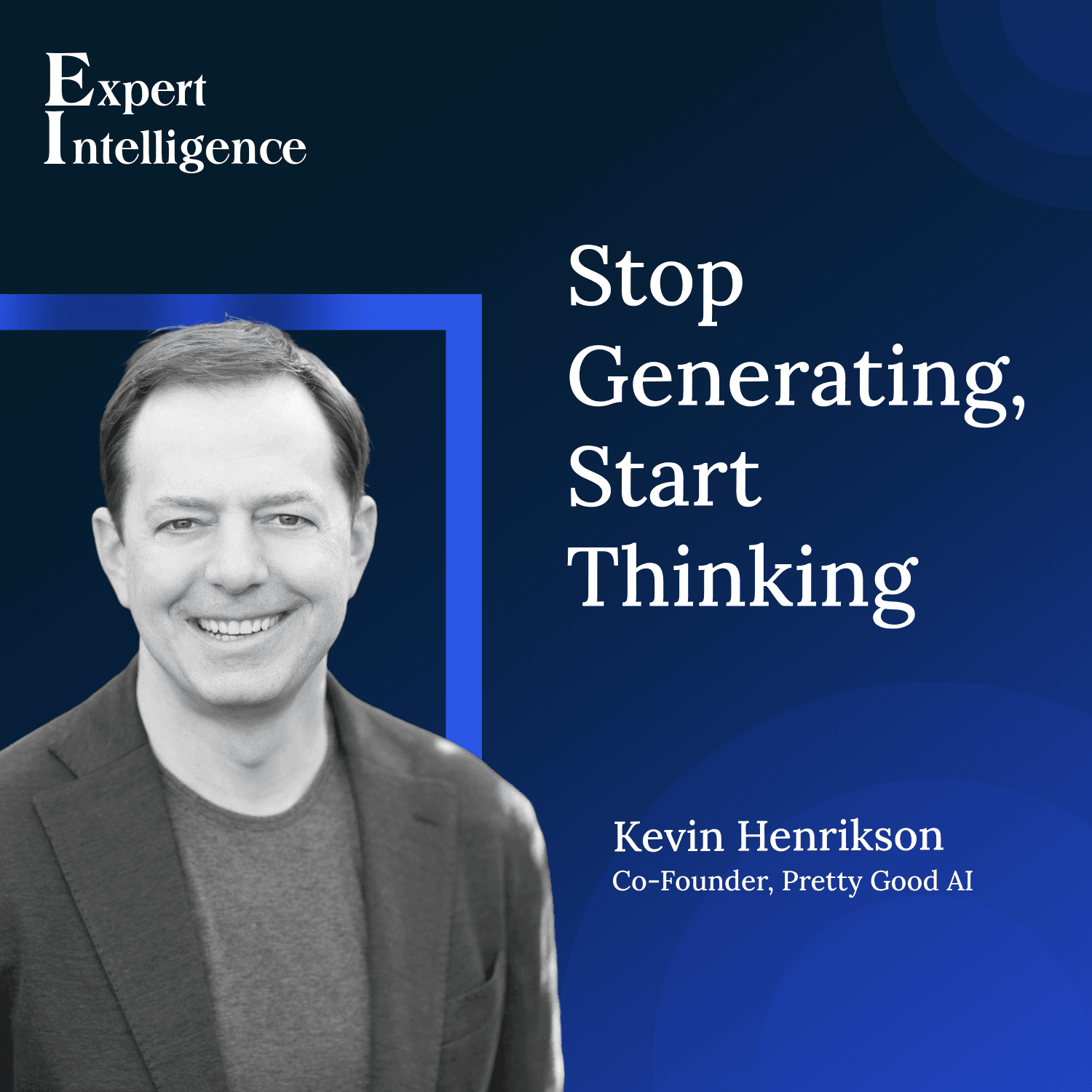
Podcast Summary: Expert Intelligence with Paul Estes - Episode: Stop Generating, Start Thinking with Kevin Henrikson
Episode Overview In this episode of Expert Intelligence, host Paul Estes interviews Kevin Henrikson, an accomplished entrepreneur and AI healthcare startup founder. They delve into the complexities of productivity in the age of AI, misconceptions about efficiency, and the necessity of giving oneself permission to step back and think deeply.
Key Themes and Insights
The Productivity Myth
- Kevin Henrikson's Perspective: He challenges the notion that AI tools inherently enhance productivity, arguing that, instead, they often create chaos and confusion.
- Quote Highlight: "If you got in a car accident tomorrow and had to be out for three days, you'd cancel everything. You need to give yourself permission to have that car accident periodically."
The Importance of Sleep
- Protecting Sleep: Kevin emphasizes the need to block out time for sleep on his calendar, signifying its importance for productivity and mental clarity.
- Personal Practices: He maintains a strict schedule that prioritizes sleep, moving his sleep block when traveling to different time zones.
Redefining Productivity
- AI Chaos: AI can lead to scattered ideas and outputs without significant progress. The solution isn't more AI tools, but knowing when to pause and think critically.
- Framework for AI Use: Kevin discusses establishing a balance between utilizing AI and ensuring personal critical thinking.
Parenting and Technology
- Self-Regulation for Kids: Kevin suggests teaching children to self-regulate their technology use rather than strict monitoring, allowing them to navigate challenges while still under parental guidance.
- Real-Life Skills: He emphasizes the importance of practical experiences, like driving and engaging in real-world interactions, to prepare children for adulthood.
The Future of Healthcare and AI
- AI in Healthcare: Kevin is focused on creating AI solutions that automate mundane tasks in healthcare, allowing professionals to focus on patient interactions rather than administrative burdens.
- Navigating Resistance to AI: He addresses concerns about job displacement, suggesting that many employees find relief in no longer handling monotonous tasks.
Practical Takeaways
- Take Time to Think: Schedule regular periods to reflect and synthesize ideas, akin to taking a mental "sick day."
- Balance AI and Human Thinking: Leverage AI for repetitive tasks but prioritize human thought for complex decision-making.
- Embrace Change: Stay flexible and adaptable to new technologies and methods, avoiding long-term commitments that could hinder progress.
Advice for the Audience
- Experiment and Adapt: Don’t be afraid to try new tools and methods; if they don’t work, pivot quickly.
- Engage with Technology Wisely: Use AI as an assistant for research and learning rather than as a crutch for completing tasks.
Conclusion Kevin Henrikson's insights remind listeners that we are in a decision crisis rather than a productivity crisis. It's vital to prioritize critical thinking over simply generating outputs, adapt to changing technologies, and foster self-regulation in both personal and professional contexts.
---
Host: Paul Estes Guest: Kevin Henrikson Listen to more episodes: Subscribe to "Expert Intelligence" for ongoing discussions on the evolving landscape of work and AI.
Written by AI. May contain mistakes. Listen to the episode to check what was said.
Transcript
Automatic transcript. May contain errors.0:00If you were in a car accident today or tomorrow, and you're like, man, I've got to go to the hospital, I'm going to be out of touch for three days, you would just have to cancel all your meetings. and people would understand. And I'm like, you kind of need to create that ability for yourself or give yourself permission to sort of have a car accident periodically where you're like, I just need two days to like think about stuff.
0:22Picture this. You open up a new AI conversation and prompt your way to five new versions of the same document. Even after reading every one of them, you end up more confused than where you started. AI promised to make us productive. Instead, we're drowning in outputs with real progress flatlining. Today's guest is a founder who's built and sold companies for hundreds of millions of dollars. He's scaled engineering teams at companies like Microsoft and Instacart, and now he's calling bullshit on the productivity myth we've all been sold. The solution isn't another AI tool. It isn't a perfectly engineered prompt.
0:54It's learning when to stop generating and when to start thinking. Kevin, welcome to the show. Thanks, Paul. I appreciate you having me. So I want to get your insights on AI chaos. There's a story you wrote from 2005 when you presented Zimbra at the super happy dev house. And I watched the video and it's you like late at night, super dark. I'm sure somebody's holding a camcorder. Yeah. First, like what's a hacker house like in 2005? Dude, it's crazy. So yeah, there was this guy, David Weekly. He's still like a big exec at a bunch of tech companies here, also a pilot. So we've connected through pilot forums, you know, reconnected 20 years later.
1:30but yeah he had had this house in hillsborough and um it just started with kind of like friends coming over and writing code talking about what was going on in the internet again this is like pre sort of mobile wave pre all the things it was like just the early days of kind of web 2 javascript those kind of things where we were starting to do some more dynamic web apps and people were just hacking around with that and blogging and so the hack it was literally like Just a bunch of kind of smart people getting together, working on things, and then sharing their projects. And part of that was some of them were startups.
2:05Some weren't even companies. They were literally just ideas. You would kind of go in there and work on your thing and show people what you're working on and how you're integrating with something. And there was this word mashup where people had sort of figured out that you could use JavaScript to connect different applications. And so you could write a web page and have it connect to other web pages through this kind of like really early days of APIs and early days of JavaScript. And so that was kind of what kicked it off. And a lot of people were working in that mode. But we were working on Zimbra.
2:35It was a small startup at the time. And I was kind of doing developer relations. And I kind of went to this house to kind of like look for people to integrate with us and kind of see what we were building and show some of the stuff that we had done. And then ended up there. It's like, hey, there's a demo. And I'm like, cool. I'll just throw my name on it. and yeah, ended up demoing. And like I said, you saw the projectors kind of essentially somebody grabbing a phone in the back and taking pictures. And it was Cal Newport actually, which is crazy. He's wrote a bunch of famous books on productivity now that was taking most of those pictures and posting them to a website called Flickr, which Yahoo ended up acquiring.
3:11And yeah, so kind of a crazy blast in the past. If you look back, what made you a builder? Like what motivated you to go to a hacker house? Like what is it in Kevin that makes him wake up every day and build this stuff? Yeah, I mean, I've just crazy curiosity. I mean, even when I grew up, I grew up on a pig farm and I would just go outside and work on things. And my mom always used to joke that you would spend more time working on stuff than actually using it. So I'd spend a week trying to fix this go-kart, ride it for 10 minutes, wreck it, break it, whatever, and then spend another three weeks putting it back together, reassembling it, changing engines, taking an engine off a lawnmower to rebuild it.
3:46And so I always just had this curiosity of how things worked. And I think when you do that with mechanical stuff, there's a certain speed to it. And then with digital and internet, it just went so much faster that you could just build and do so many things. And so, yeah, the Zimber thing was like, man, I was just curious where other builders were and like wanted to go see what they were doing. And quite frankly, it was trying to kind of be like a marketer in disguise, like kind of had this sales angle of like, hey, if I could get more people using our stuff, then that would be better. It was this whole open source movement back then where everybody was like building in public and things like that and more in the open source way and not in the like building in public marketing way and Twitter way, which people talk about today.
4:24And so, yeah, it was just curiosity combined with like an interest to show people cool stuff and have engaging conversations. You know, AI is everywhere and building is fast. It's accelerating more and more. What's changed and what stayed the same? yeah so for me i mean if anything the curiosity is kind of like cranked it up like i mean right now i can look at my browser i've got four chat chpt tabs and two manis windows and probably three of those are active like they're just running on stuff that i keep giving it and so like you're constantly nudging prompts and so i think the idea of being able to hyper paralyze your ideas and thoughts and sort of become curious and get a way more synthesized view and learn things just way faster.
5:09So like in one tab, for example, I'm asking about some company we're looking at in another tab, crafting like a proposal to sort of understand like how we're going to go re-architect one of our features. And then in a couple others, I'm like asking about like my diet for this week. I'm like, what am I going to change what I'm going to eat? And like, I was like, no, there's nothing in the fridge. I'm like, man, what should I get for food? And then, so I like, I just ripped off a tab. I'm like, Hey, what should we order this week? And so to me, that sort of hasn't changed the curiosity, but what has changed is the ability to sort of like unbridled sort of energy where you can just keep asking questions at nauseam.
5:42But I think, you know, sort of to the post and what we had talked about was that like, because of that, you end up with a lot of, you know, scattered ideas. And so you need to find time to say, okay, let me sit down and be calm and synthesize. And I was telling a buddy of mine once, I had this idea where, you know, most of my cars are Teslas and they're all connected. And I walk out with my phone and I drive it and I push the button and it auto drives me and it's like, you know, all the AI, everything. And one day I have one car that's like a hybrid kind of a gas car essentially. And so I walked out there and I just literally had the key, no wallet, no phone, no, no, I had taken off all my trackers and they were charging.
6:18So like none of my connected, I was literally kind of naked in the, in the like digital sense. I literally just had the physical key to unlock this car. And I'm like, Oh, I'm just going to run down and grab something from the store. And I got out of the car and I was like, you know, didn't have my phone. And I was like, kind of like, Oh, that's weird. And I'm like, Oh, wait on my watch. And there was this first sense of panic. Like I lost my like sort of pulse. But then as I started walking around the store, I was like, holy shit, this is kind of amazing. Like there's this level of calmness of like, this is what it's like to not be sort of like constantly jacked into the internet and with multiple devices syncing.
6:51And I've done this twice now where we have the team or do a dinner and be like, Hey, everybody just take off all your devices and just like literally a device free sort of environment. And it completely changes it. It like brings the humanness back to things. And so I think that part of it is, you know, what's changed, but also probably has some negative connotations of like the fact that we're always just jacked into like the internet in real time. It reminds me of walking into a Lunch and Learn. It must've been a long time ago. And there was this founder at the startup that Microsoft had just purchased.
7:23And he was gonna teach people what it was like to be an entrepreneur. And like, I still remember it like it was yesterday. And you put up this slide that showed your calendar. It was just a screenshot of your calendar. I said, on Mondays, I have a team meeting and on Friday. And the rest of it was blank. Tell me about focus. In a world where we're always distracted, to your point, and always like, if you want to be successful, you've got to hustle and grind. Tell me about your philosophy around focus and how you think about productivity. Because that, to this day, still sticks with me. Yeah. And it's funny because my thinking on this continues to evolve.
7:57How do I do efficiency? How do I delegate all these things? And what's funny is like when I think back, like before that talk, I was the like code late at night, sleep under your desk kind of model in my 20s. And then my 30s got a little smarter. And now in my 40s, the biggest unmovable meeting every day on my calendar is sleep. It says 8 p.m. go to sleep, 5 a.m. wake up or 4 a.m. wake up, depending on the day. When I travel, that moves. And so I know like I'm on East Coast, in Asia, like in Europe, I move that, my admins move that sleep blocker. And it's like, no, no, I just don't compromise on the sleep thing.
8:30And it's like, if it's going to be out late, I'm just not going to do it. I'm going to go home and sleep. And so I think the calendar day time, I think I've adjusted. And so like, I still have these free time blocks. And I joke, if you were in a car accident today or tomorrow, and you're like, man, I've got to go to the hospital and be out of like touch for three days, you would just have to cancel all your meetings. And you would be like, and people would understand. And I'm like, you kind of need to create that ability sort of for yourself or give yourself permission to sort of have a car accident periodically where you're like, I just need two days to like think about stuff.
9:02And that to me is like still something that's pretty powerful. I try to build in blocks of that every week and then periodically take like a couple days where you're like, hey, I'm just going to do nothing. And it's weird now because I have like a sales calendar for some of the stuff that we're selling. And I let people book meetings on Saturdays and Sundays. And surprisingly, people will book them in the mornings. But then, you know, I'm like, okay, if that's a good time for them, I'll take those meetings. And then I'm just not going to work Tuesdays. You know, I sort of like trade it off where it's like, you can't do the 996 thing that we talk about.
9:29You know, these people are working nine to nine, six days a week. And I'm like, yeah, you're just not as effective in the last hour of that nine to six sort of schedule. We both have kids. You know, I watch them kind of navigate the world. I'm sure you do. And you look at the distraction and the technology and everything. Similar to your trade-offs in your sleep and those sort of frameworks, what are some of the things you're implementing at home? It's interesting because when the kids were really young, like they were sort of the iPad generation, right? My daughter knew how to use an iPad at two years old.
10:02She's now, she just turned 16, the youngest. COVID changed this because I saw a lot of kids struggle with COVID coming out of that, kind of leaving high school, going to college and not having sort of a transition of like, what does life look like and going to COVID and into these things and not learning the life skills. And so my rules with her are actually pretty loose. Like I'm like, you know, what time should you be at? I'm like, you tell me. And then, you know, have her using things like Lyft and Uber early. She uses those on her own now. And I think the other thing that's interesting is the phone stuff is like, you can take the phone away and lock them out of their digital footprint, but then they go to college and then you're like, okay, wait a minute.
10:42Now, like you never knew how to like self-modulate on the phone. So I'm kind of like, let it go. And if you sleep into school or you sleep through your class, it's better to learn that in high school where you have the guardrails of people kind of watching you for in college, if you sleep through a bunch of casts and miss it, nobody's going to call you. Right. And so I think that's one thing where I've kind of arguably let the boundaries out in the sense that like, if I thought of when I was a kid, I was driving tractors at nine years old, like, you know, on a farm and like there was no rules.
11:09Like I'd go out and just fire the welder up and arc the thing and be like, wow, that, that didn't work and like have to go fix it most city kids don't have those experiences today because they're not in that physical world that their devices are thing and i think the other one that this is controversial i think it sometimes but i'm very very strict i'm making sure that kids drive i've seen a lot of teenagers make it all the way through high school and some into college and never get a driver's license because they don't need it right they're either at a walkable location they're getting rides from their friends they're using lyft and uber and again like there's ones that just barely get the driver's license and never use it.
11:44And there's ones that don't get it. And I think both of those lack confidence to actually navigate the world in a way that I think is going to be required. And so that's one thing that I'm very hard on. Like, you got to get your driver's license right away and you got to go drive. You have a permit now. I don't drive anymore. You want to go somewhere? I'm like, great, grab the keys. Let's go downstairs. I'll sit in the passenger seat and we'll drive you and we'll go. And then that's it. And she's like, well, I don't feel like driving. That's cool. And we're not, I don't feel like going because that's real life and I think my view is that now she's through that hump and she's like about to get you know gonna take her driver's test in a few weeks and and so I think to me the kid thing is like almost going back in a weird way to our parents and not helicoptering and not giving them over protections because it's just too easy to like track everything what they're doing on their phone and I can I used to block everything in the early days and now I'm like what's the point like at some you know when she's 18 she can just clear the like apple protector and she's free to go And I'm like, well, why don't we let that happen when she's 16 or 15 and kind of figure out what her boundaries are and understand that self-modulation.
12:43So I think driving and sort of releasing those sort of like really strict rules. And again, you know, every kid's different. Like people have different abilities to sort of self-navigate. I'm sure there's people listening that are like, dude, you're insane. My kid wouldn't be able to do that. Great. Then that's a personal thing. But I think my personal thing is like, look, we should start to simulate college. It's like, I don't do your laundry. I don't cook your food. Hey, the food's in the fridge. What do you want to order? we'll go to the store together. In fact, you'll drive me to the store, we'll buy the things and come back and you know, we can cook it.
13:10Because I think a lot of that teaches a set of resilience that if you end up in college, and you're like, only no way to get food is to click DoorDash, or buy Lyft or Uber to go to a restaurant, like I'm like, or go to the mall, right? It's just so easy to go to the mall and have 20 things to pick from. And I'm like, yeah, that works. But that's not real life. Like it's you're gonna have to figure things out. And same thing, having them travel alone, go to airports, flying in different, you've got to learn those things. And I'd much rather learn that where there is sort of the protective of the home that, hey, eventually you are going to end up in a bed and back at home with your parents versus, yeah, I think learning that for the first time in college is a lot trickier.
13:44And partly because kids are way less prepared with real life than, man, I was debating with other farmers that are 60, 70 years old as like a 15 year old in high school. Like, cause that's just the way it was. Like I would drive the truck over, load up two tons of corn, negotiate the rate, figure out the thing. Oh, you don't have this feed, go get this silage. And like, again, useless sort of like metrics of knowing how much soybean to mix with how much corn and real Vista, but knowing how to go drive over, connect the person, figure out where they are, make that discussion and be able to look in their face and talk to them eye to eye, shake their hand.
14:19Like a lot of kids can't do that today. And I think because of that, it's like, man, I'm like, well, let's let them go interface with the world. Right. So that's my view. That lesson could almost be told to people that are well older than 16 these days. If you go back to your comment around AI and just the overwhelming nature of the information that the chatbots give us today, especially when kids are learning, you have a 16-year-old and even younger, and they're learning skills that are not about, I wrote the paper and I got a grade on the paper. It's about the act of learning. What are you coaching parents on or kids on around how and when to use AI?
14:57So you don't atrophy that learning or that like ability to navigate the world. It's a good one. I think, and it's funny because my daughter's school is pretty progressive in the Bay area here. And they're very anti AI. Okay. You can use AI for like, they have, they have like a very, almost like a rubric of when you can use AI and when you can't. And it's pretty good. It's like, Hey, you can use it for research. Cause my thing is I liken it to construction where if you want to build your first house, like, yeah, it's probably good to drive your first hammer and nails and, and, you know, do that with a hammer and a nail before they give you the nail gun.
15:27but more than likely a new journeyman contractor joining a construction site today on their first day would be issued a hammer and some nails but also would be issued a nail gun like they're not going to be like no no for the first year we only want you to do hammer and nail like the old school way like no they're going to like hey you have that but you're going to start using the nail gun pretty quickly and so my view with ai and kids is like i think you're going to be behind it'd be like saying my parents even though like when i was a kid it was like modems and like very early internet and like kind of BBSs and things like that would have said, Oh, no, you're not allowed to use a computer or a calculator.
16:02You need to learn it to do it all by hand. And my parents were quite the opposite. They're like, I don't know how to use these computers. Here's a computer, go figure it out. You should go learn it. Cause that's a cool tool that I think people in the world are going to need. And grateful for my parents for doing that. And my dad in particular pushing us there. And so I think today, like I'm always encouraging my daughter to ask chat, like, what do you think? Like, what would chat say? Like, push yourself to go find those questions. don't ask me, right? Like learn to use the resources that are available.
16:26And again, same reason they would want to use Google maps. Like we had Thomas guides when I was growing up, you had the fricking big old thing, J seven page 52. And like, our kids will never learn that. I don't think they have to, like, they kind of are self-aware of their area and just trust and know that GPS is there. And so I think a lot of that with AI, like if you're not using it, I think you're going to fall behind. But I also agree that like going in every day and dumping in all of your homework into chat gpt and saying just give me the answer is probably also not the right solution so i think it's honestly just educating about those same boundaries like when you shouldn't and shouldn't use these tools just like you know we had to burn our hands when we were kids i'm like oh stove is hot like how do you figure that out there's a much more nuanced sort of stoves hot with today's modern tech but i don't think you can learn that by being told not to use it it's like never use the stove is actually never gonna like you're not gonna learn the lesson.
17:17It's like, no, use the stove. Here's a few guardrails, but you're going to kind of have to figure out what kind of pot you can grab the handle by and what kind of pot you need to go get a mitten for, like looking at it and like, does it have a plastic handle or is that a metal handle that can, you know, some of these things you just got to learn to kind of build your own perception for. And I think the other thing is kids need to also build perception for what's fake in the world, like, you know, deep fakes and deep voices and like the recognizing being human is a skill that's hard. And I think, you know, both older people struggle with this.
17:47I mean, so many people have been faked by the calls, you know, my mom getting a voice faked of me saying, Hey, Kevin needs something, you know, those kinds of like scammer calls, right? Like, so I do think that kids need to experience that because just sheltering them from the tech is actually going to make it worse. And then at some point they're going to like, that sheltering is going to go away. And then they're going to be faced with a pretty raw reality. It reminds me of this, a study that was once done about how school playgrounds have gotten too safe and like helicopter parenting. And it showed that, hey, actually, kids are getting more injured because we've made the world too safe.
18:21And so I've actually did the same experiment with my daughter who wanted to use chat for a school thing. I let her do it. And then she started to represent information that was wrong. It was like a learning moment. Like you have to let kids go through this and fail and be like, you just said something that wasn't true. Now let's go and have a conversation about what's true in the world and the importance of knowing what's true and what's not. Yeah. And being able to like cross check and validate like what you read is actually fiction or nonfiction, right? Like just like a reading a book in the library, you can go to book today and be like, I don't know what section I got it from.
18:53Did I get it from the fiction section or the nonfiction? Like, and you know, how deep are you believing some Stephen King stuff versus like, oh, that's all fiction. Oh wait, that's nonfiction. Okay. You wrote an article once you were talking about your nutrition plan about health and just the health stack in general. I wear an aura ring. I have Function Health. I have a lot of the different services. I'm finding myself piecing together my own healthcare because it's affordable to go direct and the information that you get is really helpful. And now you're working on a startup in healthcare. Healthcare is a highly regulated space.
19:27It's big, it's expensive, it's complicated. What are you seeing in that space and what's encouraging you to go spend your time and energy in healthcare? Yeah, it's a good question. I think two parts. So I think one on the consumer side, the tools are available to sort of like do your own version of concierge medicine today. And like it is relatively inexpensive for most people. What is Kevin's personal concierge medicine stack? If I wanted to go and mimic it, what are you using? So I've had the really expensive, like five figure, you know, tens of thousands of dollars concierge doctors in the past, but I don't use it anymore.
20:02I think what I do now is literally sleep is the first one. So like some version of aura ring, whoop and Apple watch, I wear all three because I'm crazy and I like to correlate the data. And so I'm probably, you know, not normal in that sense, but literally any one of them. And so like, if I had to pick one, I think aura is the simplest and the best. It's the coolest form factor. It's this ring. It just sits on your hand. The downside is when you pick things up or do weights or any kind of gym workout, you kind of got to take it off. And then, so it's like, well, the whoops better for that. And so I kind of wear both for that reason.
20:32Apple watch is just cool. The problem is Apple watch battery only lasts a day or two. So like, you know, you got to charge it more often. So I think that's the like, Hey, tracking my activity and my sleep, those are kind of the two things you get from those. And all of those have some version of sleep. And even the newest Apple watch stuff has great sleep. So it's like sleep and activity, right? Pretty good, right? You want to sleep well, and you want to move, right? Kind of the classic rings. If you think of the Apple watch, their Apple fitness has three things. It's like, Like, did you stand?
20:57Did you move? And like, are you actually actively exercising? I think sleep is the other sort of big one that I would track. So that's like the day-to-day, like, are you sort of doing something? Are you improving? Do you know how much you're sleeping? And then the other one is sort of inside your body, right? The cheap version is like you said, there's function health. There's a lot of things that are like a hundred to 500 bucks a year. You can get enough blood tests to give you a lot of good data that's directionally gonna tell you like, do you have some issues that are worth following up on?
21:23I think the next level up, and function now has a relatively, they bought a company called Ezra. It was, there was a really expensive one in the Bay Area called Pronovo. Ezra was also very expensive. I'm getting my first Ezra MRI in a month. Incredible, yeah. So I've had multiple Pronovos, multiple Ezras and they're really interesting. I think the cost is pretty affordable. It's like down to four or 500 bucks now for the basic one. And I think the only caveat that I've heard people complain about is that like it does cause false positives. And I've heard both providers care about it where like I show up with my report and I'm like, hey, I want you to check these three shadows right in this MRI.
21:57And the guy's like, Oh, you're like one of those Ezra guy. You can just see they're kind of annoyed. Cause they're like, why did you get a referral for cancer in your lungs? And I'm like, dude, I'd rather you check it out and tell me if I have hay fever or if I had cancer like that's. And so then they'd run a second scan and they're like, you're fine. Cause you, you know, you have two scans you can compare. You're like, that was temporary. So I think that's the only downside is that there will cause you some moments of panic, but I'd much prefer a few moments of panic and a little bit of investigative reporting than to not know.
Read the full transcript
22:25That's the basic stack of like, hey, something to scan your blood, something to sort of scan your sort of insides with one of these MRIs or CTs, and then just day-to-day tracking your sleep and health. And honestly, like, man, that's kind of the 90-10. People would say it's 80-20, it's the 90-10, and then just eat well. And then the cool thing is you take a week or two of that data and drop it into a chat GPT project and be like, hey, here's my data. What should I do different to improve? And you don't have to say like, go make me perfect. Just be like, here's my baseline. Here's my goals. I want to lose weight.
22:53I want to have more energy. I want to have more exercise. What should I investigate? And it comes back with reasonable suggestions without, and there's a ton of other apps out there. If I want to give you two specific ones, one's called Guava is an iOS app. And another one's brand new. It's the same guys that started a company called Forward called Torch. And both of those have like very comprehensive connectivity into all of your blood tests, all your medical sort of scenarios and all of your tracker data. And they give you in one case, a local version and another case, a cloud version of like your sort of like healthy score kind of thing and a lot better.
23:24But again, honestly speaking, unless you're really into the tracking and stuff, probably not worth it. I found that the Aura data alone, as it relates to sort of sleep and gives you a readiness score, it's just a check. Like, Hey, all right. Cause I'm data oriented. It gives me like a goal and I go and I say, okay, well, I want to be here. And then I went, I do things like, hey, screens, like I put my phone to bed at six o 'clock every day. I put in these rules and you start to see like these basic things. And it makes a difference. A huge difference in changing the data and just how you feel.
23:53Like literally mine is just charge my phone in a different room. So I don't charge it in my bedroom. I just put it in the bathroom or the room next door. You don't wake up in the middle of night, three o 'clock. And I go, let me grab my phone and check. And then you're sucked into two hours of whatever cool things on your phone that's always there. And yeah, that makes a big difference. And none of that required me seeing a doctor or taking a pill or doing anything like that. Zero. Yeah. And it's essentially free at that point. It's like, you know, the cost of one more iOS cord. I think a lot about when you were at Accompliant, and one of the innovative things that you did at Accompliant, which is why I first connected with you, was that you use gig workers as support.
24:27That sounds like, oh, of course you use freelancers to do support tickets. But that was unbelievably controversial when you walked into the megacorp of having a freelancer that could answer a support call for a mail app. It sounds funny even saying it now. When you think of systems, you worked at Instacart. Now we see MeriCorps like hiring doctors, lawyers, and musicians to train models. When you think of this idea of human expertise and these AI systems, where is it all going? A lot of times it's binary. It's like, oh, I've got the software and then there's these users and these people over here that use it.
25:03And you're starting to see this merge over time or a trend that says, no, actually, it's just a big system. I think the gig worker sort of contractor thing, Upwork, Freelance, Elance, all these things like informed a lot of my thinking around how we use AI. It lets you mentally break things into smaller, more consumable tasks that can be done by a lower skilled worker. And I think in many ways, the early versions and even sort of the current versions of AI are a lower skilled worker. right they have things that they do really well and are rote they have a lot of things that higher level thinking that they're not good at and so for us like you said we're building this new company pretty good ai and it is healthcare focused and specifically what you hit on is is where we're focused which is like look you can do the things that are repetitive and easy to train and then you start to work down that complexity sort of pyramid of like okay i've done things that are like how many, what hours are you open?
25:59Right. But without sort of in the, the first version of like a lot of these AI phone systems, for example, we're like rules-based. If you said this, it would say this, it's looking for keywords. Like it's looking for certain things. Now, because of conversational gen AI, we can actually have an intelligent conversation where when you say something, I can kind of match what you're saying, even if it's not matching some exact rule that I pre-programmed into the phone system. And so what we find from that is that, and that what we call what we're building is like a clinic intelligence platform. If you could take all of the phone calls, both inbound and make all the outbound phone calls for a given medical practice, the intelligence to do that is incredibly high.
26:39And it's not just going to be great that you can solve all their phone calls, which is a very one-to-one like me and you on this thing, we can't do other things. You can actually use that knowledge to go do lots of other things across the practice to automate different workflows, to sort of interrogate the data, to give analytics. And so our view is that voice is the trickiest thing to get right because it's real time. And the intelligence doesn't have to be just high intelligence, but it actually has to be very fast. Where chat GPT and all these kind of asynchronous things, I can ask it a question, you're like, no, no, that's not right.
27:09Oh, here's some more context. Oh, no, that's not right. And two or three turns into the conversation, you get a good answer. But with voice, you get one shot, and it's gotta be, you know, four or 500 milliseconds or it sounds weird on the phone. And so that's why we focused on voice to build that top level intelligence and then use that intelligence in the practice. And so your point about like, okay, does that mean that we don't need doctors and we don't need professionals in the medical office? Not at all. It basically allows them to go back to focusing on better customer service and actually talking to people and spending more time with patients and not essentially speed running the encounter, which is what a lot of providers have to do today because they're like, man, I've got to hustle through this 10, 15 minute encounter because I'm going to take 12 minutes to go fight with the system after and document all the things and fill out all the insurance codes and all the things where it's like, you've heard these ambient listings where it listens in the room and then it's able to like sort of pre-cook what the provider needs to update into the system.
28:03But we really think about that sort of clinical decision-making, sort of the thing that happens with the provider and the patient as something that AI is going to be the last thing to get to. And it's also the like the most human part of the environment of like when you're actually face to face with your doctor, you don't really want like this robot between you sort of talking to the glass. And so we focus on everything outside of that, everything up until the encounter starts. So how do you get the scheduling booked? How do you get referred? How do you get all your information gathered? How do you get your billing and insurance all validated?
28:33How do you make sure that you show up on time with reminders? And then the instant the encounter stops, how do we make sure insurance is billed correctly? You pay your co-pay, we work through all the authorizations and we make sure the clinic and the provider actually get paid. And so those big value chain pieces end up being where no one in the practice is like, man, I can't wait to wake up every morning and come in and work on billing and fix all the errors with the insurance agency, you know, or fix all the issues that happened with our billing and collections team. You're like, no, they don't want to do that.
29:01And so you take away the stuff they don't want to do. You get a lot less resistance, first of all, from the team. Cause they're like, great. You're solving stuff that we're not excited to do. The team gets to spend their time working on a higher value things. And many of those are those personal sort of interactions with patients, whether that's when they're first coming in or when they're actually in the practice. When you look at selling AI or selling these sort of solutions to solve a problem into companies, there's a lot of resistance. I mean, I understand that, hey, there's work that people don't want to do.
29:30I can imagine a counterpoint that says there's a person sitting at a desk and that's their job. They may not like it, but it pays them X amount of money. It gets the health care they need to take care of their kids. They show up at 8 and they leave at 4.30. And so there's one thing of, hey, it drives efficiency and better outcomes and it allows people to focus. But a number of these things impact what somebody considers their job and also doesn't say, OK, and by the way, this is what you get to go do once we sort of outsource this to a technology, to a person. And when you're selling in, how do you address that?
30:04How do you address that person who feels that very personal displacement? Yeah, I think there's two things. So I think, one, there's this general very, very deep and painful scar tissue from all the existing sort of early versions of quote unquote automation, early versions of AI, like all the nasty IVR phone trees that people have gotten used to. And so the first thing is like, you have to break through the fact that the technology teams that have been working in healthcare for the past 20 years are nowhere near the ones that are working on it today. So I think that's the first thing. And as a medical provider who's not a technologist, they don't know the difference.
30:43They're like, this is just another sort of IT guy that's coming in and selling me a song that's going to give me a long-term contract that's super painful and my team's going to hate it a week after it's turned on. and so that's the first aversion is to be like no no this is fine it's going to be a lot better than it was before and then I think the second piece is we usually discover in the pilots that the people that are the most impacted become delighted that they're not doing this thing that was very monotonous to them because they're able to sort of like put their head up and be like oh people aren't complaining that I'm behind on phone calls or behind on billing and like some of the people we're talking to you literally can google them and they're mentioned by name in the Yelp reviews and the Google reviews of the practice of how terrible they are.
31:28And they're like, look, man, I can't, every day I come in, there's like already a line at the door before I even open the door to the practice. The phones are ringing off the hook. You know, it's the classic sort of like office space meme of like just crazy, crazy activity. And then the person just sitting there being like, I've already lost. And so surprisingly, the resistance is not with them. It ends up just being with the fact that they're not technology companies. And you're like, oh, let's connect to your phone system. It's crazy. Like at one of the practices we're working with, they're like no problem we're going to contact um gary at our it company to help gary's like oh i don't work on that area let me contact the subcontractor for that and the subcontractor is like oh that's a really old system we put that in 20 years ago we don't support that one anymore you've got to contact this third guy who doesn't really want to respond to you and so it's like they're so helpless because they don't even know how to like unwind the dinosaur like you know legacy thing that they have and so most of the the resistance is not from them they want to do it Like it's their own system fights against it.
32:25They're like, well, we don't have a cloud phone system. We have, literally I've had multiple providers be like, oh, the phones come here. They just hold up their cell phone. They're like, oh, the phones just rings here. And we just pass the phone around during the day of who's gonna take it. And they're like, I think it's T-Mobile. And then other ones are like, oh, we get it from Comcast. And you're like, Comcast is like, they sell phones. We're like, well, they have this business solutions team that sort of like sold us this third party thing. And it's just the randomest kind of IT stuff that you would imagine because they're just not technology people.
32:53And so the biggest barrier is just the fact of non-technology practices, adopting new technology is hard. And then the sort of scar tissue of the past 20 years of just them being underwhelmed with what they were delivered. And you're a technologist, you're a builder, you're on the edge and you spend a significant amount of time understanding this stuff in a pretty deep way and understanding the problems in a deep way. That's why I love your newsletter and the content you put out because it's just a reminder of some basic things from somebody who's, to your point, out with the welder on the pig farm, just taking apart the go-karts.
33:25What advice would you give to someone who may be listening that says, hey, I get it. I've used this thing. I've had my wow moment with AI. Like, oh, wow, that was really cool. I might be in my slop zone where I'm kind of creating stuff and it's like, oh, this stuff isn't really cool. It's actually causing more problems because I sent this thing to my boss and it was a lie. And now I look back, like whatever the case may be, what is the mindset or framework that you tell somebody who knows they need to maybe learn new skills or, hey, this is different? Like there's this different tool, just like the internet was.
33:56Like there's this different thing. I need to kind of learn it. But I'm, you know, to your point, like the line's out the door. I'm busy at work. I've got two kids at home. I've got to run to soccer. By the way, we've got to go get groceries. And they feel just sort of stuck. And then they open their phone and they feel like the world's passing them by. And they're in this sort of stasis of not knowing what to do. What do you advise to those folks? Yeah, it's tough. I think if they're in a position where they can make a technology selection. So I think that there's two camps, right? So people that are in these roles that have a voice to make a technology selection, find somebody you trust, right?
34:33It's like an IT person, somebody slightly more technical than you, that can help you sort of provide a little bit of guidance. And so we work with a lot of consulting companies that have like, you know, that are consulting on these type of things that are already in these practices or already in these businesses because it's, you know, we have other businesses that are working outside of healthcare. And then I think if you are in a decision practice, I think ensure that you're not time bound, like nothing worse than signing a new contract and then starting the pilot. And I think a lot of practices make this mistake because that's the way software people like to sell.
35:06and it's good for them because they can lock in the deal they get the commission they kind of get the thing flowing and our view is like no no the trial should be free the pilot should be free you should be able to like look at your own solution and see it working and then be like oh i want to buy this like literally the try before you buy which is not typical in medical software right they try to sign them on long-term contracts and pilots that auto convert and you know so i think that's the other thing is like there are many solutions out there you can just try that don't cost you anything and are also really low impact on your current staff.
35:36They really adapt to what you're doing. And so I think if you're in a position to make selection, make sure you're not just buying like the first one that comes in your door that tries to sell you the next widget. And I think even with, if you are gonna sign a contract and agree, like the world's changing really fast. Like there's nothing worse than we've talked to some of these companies that are locked into three and five year deals that that's what these enterprise deals sold them on. They're like, oh, that's the only way we could have got the thing done. I'm like, oh, that's never ever again, right?
36:01Like you should be signing at the max one year. The world's going to keep adapting and changing and you should have the willingness to be able to look at that again and not lock yourself in. The technology is moving too quick to lock yourself into a multi-year agreement on any kind of technology thing. Just like you would never, like I always think of your actual cell phone. I mean, yeah, you might buy a one-year contract to pay the phone off or something, but most people are month to month. And it's like, you should be month to month, right? If you like it, you keep paying. If you don't, you stop paying and then you get rid of it.
36:27And I think very few people buy software that way because it's historically been sold in this really tricky point. And so my thing with everybody is like, just don't get locked into something that you're going to regret and prevent you from sort of trying the next thing that may work better. Kevin, I love following your content. Keep writing. I know that it's one of those things that sometimes you wonder if people are listening. Well, I know a number of people that are. So congratulations on founder mode and podcast and everything. If people want to follow your work, what's the best way to do that?
36:59Yeah, just Kevin Henriksen on Twitter or Kevin Henriksen on LinkedIn. But yeah, Paul, thank you so much for having me, man. And this has been an incredible conversation and I've always enjoyed to kind of reconnect with you and talk through stuff. Kevin, appreciate your time. Thanks so much. Kevin just laid out something most of us do not realize. We're not in a productivity crisis. We're in a decision crisis. Five versions of the same document don't make you more productive. It makes you more confused. Kevin's insights from growing up on a farm stuck with me. The importance of spending time building, experimenting, or is it just consuming?
37:34That's the trap we're in right now. We're obsessed with generating outputs instead of learning through creating. Everything's changing and fast. The move isn't committing to the perfect system. It's staying flexible enough to pivot when something stops working. Go out there and try stuff. It's not helping. Try something else. We're all just figuring it out as we go. Don't just consume this episode, use it. I'm Paul Estes, and this is Expert Intelligence. Subscribe to hear from people trying to make sense of what's next. Until next time, stay curious.
From the publisher
Kevin Henrikson has built and sold companies for hundreds of millions, scaled teams at Microsoft and Instacart, and now runs an AI healthcare startup—and he called complete bullshit on the productivity myth we've all been sold.
The most unmovable meeting on his calendar? 8 PM: GO TO SLEEP. When people want late meetings, he says no. When he travels, his admin moves the sleep block. In his 20s, he was the "code until 2 AM" guy. Now? He protects his ability to think like his business depends on it. Because it does.
But the biggest insight that stuck with me: "If you got in a car accident tomorrow and had to be out for three days, you'd cancel everything. People would understand. You need to give yourself permission to have that car accident periodically."
What You'll Learn:
- Why AI is creating chaos instead of productivity—and the one habit that breaks the cycle
- The health stack that replaced Kevin's expensive concierge doctor
- Why teaching kids to self-regulate with technology beats helicopter parenting every time
- How voice AI is solving the work in healthcare that nobody actually wants to do
- Why blocking sleep on your calendar might be the most productive decision you'll ever make
- Kevin's framework for when to use AI and when to just close all the tabs and think