 Ask ChatGPT
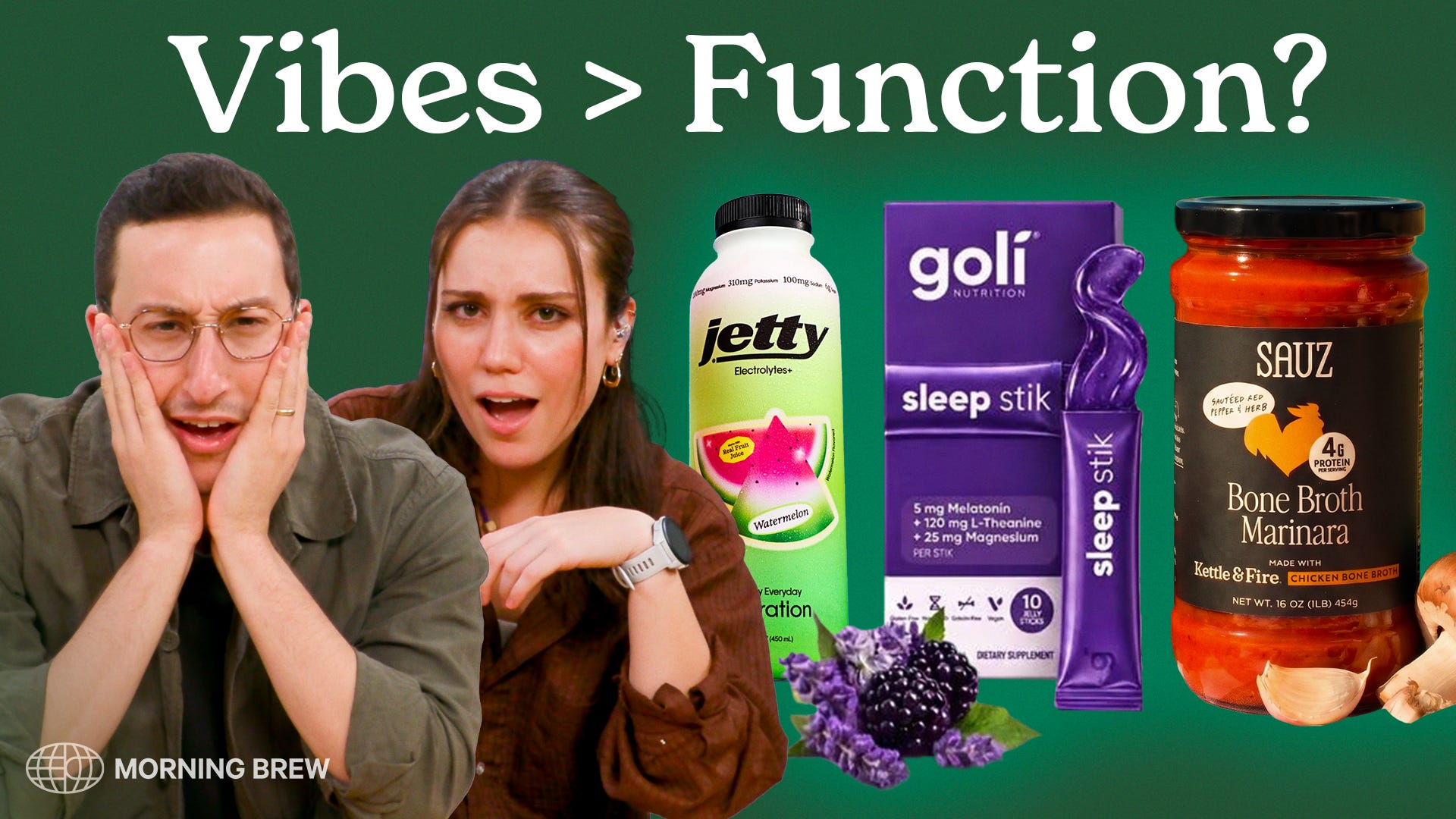

CPG news and debate over why acquisitions feel “dirty,” plus how diet/functional brands are repositioning amid GLP-1s.
None. Hosts are Nate and Jenna (no guest interviews in the provided transcript).
Written by AI. May contain mistakes.
Jenna shares her thoughts on Javi Coffee's new protein coffee and creamer.
“I am obsessed with the peppermint mocha.”
Nate discusses a new pasta brand called Wasted, made from bread waste.
“different pick of the week this is something i mean you could put this in a coffee it'd just be weird, but I brought a new pasta brand called Wasted, and it's made from bread waste.”
Hosts revisit discussions on Halloween candy preferences and virtue signaling.
“One was filled with a brand called Joyride, which is a lower sugar, better view candy from a big YouTuber named Ryan Trahan.”
Discussion on Atkins' rebranding strategy as GLP-1s rise in popularity.
“Well, one of my favorite stories actually is from this week is about Atkins.”
Exploration of Just Ingredients becoming the hydration partner of the Lakers.
“And Just Ingredients has like a ton of professional sport partnerships, not just with the NBA.”
Analysis of Undercover Snacks being acquired by Mondelēz and its impact.
“So this story is that Undercover Snacks, which is these chocolate covered quinoa crisps, they were just acquired by Mondelēz.”
Exploration of how flight attendants influence consumer perceptions of snack brands.
“Yes, it's a mass sampling opportunity, which I mean, brands pay a ton to sample in stores to be able to sample to anyone who is flying is incredible.”
Discussion on the implications of acquisitions for emerging brands.
“And then we'll see what Mondelēz is able to do for undercover.”
Consumers express strong emotions regarding acquisitions, viewing them negatively.
“Another thing that happens is they are paying more attention to price.”
Analyzing how brand identity and product quality may change after acquisition.
“And when you look at what acquisition means, it's not actually that cut and dry.”
Investigation into how consumer perceptions clash with business success stories.
“So like when we're talking about these stories, we're going to share a lot of numbers where we show why this was such a good thing for the brand from a business perspective.”
Discussion on the trade-offs brands face between product quality and profit margins.
“Them buying the rest of their – of Rayo's supply chain and owning that supply chain, a consumer is probably not ever going to see that news.”
Discusses the difficulties brands face in sourcing regenerative organic ingredients amidst market pressures.
“They used to be an A2 regenerative organic ice cream company, and they very recently and kind of silently cut regenerative organic dairy from their formulation and also from the packaging.”
Explores how acquisitions can lead to changes in product quality and brand identity.
“And it's actually the same argument with avocado oil.”
Analyzes the downfall of Miyoko's Creamery and the challenges faced post-acquisition.
“Hey, Miyoko's Creamery, can you just stop calling yourselves Miyoko's Creamery?”
Discusses Zico's journey, its acquisition by Coca-Cola, and its eventual discontinuation.
“So an example that I think is really interesting is this brand called Zico.”
Examines Coca-Cola's approach to acquisitions and the implications for acquired brands.
“Like, and I don't know what Coke's vision was with this acquisition.”
Discusses how acquisitions can impact brand identity and community perception.
“I'm like, that's what a waste of your money and time and effort.”
Explores consumer skepticism regarding ingredient quality and ownership transparency post-acquisition.
“And, you know, Pepsi also bought Siete, which a lot of people also have issues with that acquisition and feel like the brand has changed, even though from my research, it really hasn't.”
Lists various brands and their parent companies to highlight the hidden ownership in the CPG market.
“And I don't think anyone would have any idea that it's owned by McCormick.”
Learn about Hershey's growth in the salty snack segment and brands prioritizing clean ingredients.
“Their salty snack category, which apparently is their fastest growing segment in Hershey's.”
Discover how private equity affects brands like Spindrift while maintaining core values.
“Spindrift is one of the most ingredient-forward, clean-label, values-oriented brands we know.”
Examine the complexities of acquisitions in the CPG sector and their potential effects on consumers.
“So this leads us to the big boy question.”

Get the gist, explore an idea or ask about something said.
 Claude
On Express Checkout, what are the key points of this episode?
Searching your listeningAutomatic transcript. May contain errors.
0:00Welcome back to the Express Checkout Podcast. I'm Nate. I'm Jenna. And today we're going to be sharing some CPG news that will answer the question, when did acquisitions become such a dirty word in the world of CPG? But first, let's get into our picks of the week, Jenna. All right. First up, my pick of the week is Javi Coffee's new flavor. So I have Javi Coffee in front of me if you are looking. Javi Coffee was a company that made a cold brew concentrate. And now they have protein coffee and protein coffee creamer. So they come in a powder form and you mix them with water and you get a coffee that also has whey protein in it and zero sugar, but some great flavor.
0:47I am obsessed with the peppermint mocha. It is very seasonal. It's delicious. I've actually been having it cold, which kind of feels like an abomination to have like cold peppermint. But it's a shoulder season. Sure. So we can experiment with, you know, in-betweeners. What I love about it, one, other protein coffees that I've tried have been like have a really intense artificially sweet flavor. These I really enjoy because they are made with Reb-M, which is extract or like fermentation of stevia. But I don't know exactly how, but it doesn't leave the like stevia aftertaste. And I'm not even like stevia sensitive, but I do personally find this to be like a lot cleaner of a sweetness, if that makes sense.
1:31And the protein isn't chalky, which is like a huge thing. The creamer is so smart too. The creamer might be my favorite of the two. It works so well. It's so smooth. It mixes really well. Like I was genuinely very shocked at that. Right? Yeah. It's delicious. And both are such interesting innovations because like if you are really adamant about having like your specific coffee brand, you can still use the creamer. They also have MCT oil in them, which I know has a lot of health benefits as well. And people were blending into their coffee anyway. There was that whole like bulletproof coffee trend.
2:05So it has a lot of good stuff in it already. It's 10 grams of protein. So it's nothing like actually crazy. I know Clean Simple Eats came out with a very similar product that has, I think, 20 grams of protein in one scoop. soup um so it is like not the highest protein possible thing but the taste is amazing and it serves a purpose just like i don't know have it with like a normal breakfast i like that it doesn't position itself as a breakfast replacement yeah so that's my pick of the week you have a very different pick of the week this is something i mean you could put this in a coffee it'd just be weird, but I brought a new pasta brand called Wasted, and it's made from bread waste.
2:45I was curious about this product, and I've been using it a lot, and I made a pasta salad last night with it. It is really, really good pasta. It tastes excellent. It also, for some reason, has like a good amount of protein in it as well, which they don't really call out on the front, but all it is in there is is is wheat there's bread waste there's gluten in it i'm sorry to my celiac friends but it's a really good pasta and they actually started selling it at whole foods recently yeah i love this concept so much of turning bread waste into pasta there's no reason to not right and it feels like a like a nice like recycle upcycled product that doesn't feel too like in your face about it it's like hey it's pasta and it's upcycled isn't that cool such good innovation love that innovation well before we get into the news we wanted to like do a little not recap but revisit of last week's episode because we both have some updates from it so if you didn't listen to last week's episode this is your sign to listen to last week's episode but it was our halloween edition and it has since been halloween and one of the things we talked about was better for you candy versus mass market like conventional candy um being given out as for to trick-or-treaters.
3:58And one of the things I was saying was that I don't think that parents care enough about other kids' children to give out Better For You candy. And my friend who is a middle school teacher in a, I would say like wealthier school district, reached out to me and said she listened to the podcast and she was like, Jenna, don't underestimate the value of virtue signaling. She was like, you would be shocked how many parents will give out a Better For You candy or bring the Better For You candy to school, not because they necessarily care about the other kids well-being but because they want to show that they come from a healthy household that they have the money to pay for something that is like a little bit more premium um and i just love that like don't underestimate the value of virtue signaling that is like half of how the world of cpg runs is on virtue signaling and well wellness specifically i would say yeah but i know you actually like accidentally ab tested halloween candy i i did so i realized this especially when you told me this story, I had two separate bowls.
4:55One was filled with a brand called Joyride, which is a lower sugar, better view candy from a big YouTuber named Ryan Trahan. And then Happy Candy, which is also a new lower sugar candy brand. I had another bowl with Skittles, with Nerds Gummy Clusters. And I think with one of the big chocolate brands, I don't remember which brand it was. And there were two separate bowls. And I would bring out both bowls when there are trick-or-treaters coming by and honestly nine times out of ten better for you candy bowl it's so interesting i'm like is it because they know ryan trahan the youtuber so i think it was partially that there were some kids who were like literally screamed they're like oh my god you have joyride can i yeah that's fandom that's fandom talking a few years ago i gave out feastables that was crazy this was like early in feastables when mr beast was like just did it and everyone was excited People were ecstatic about that.
5:49But not too many people mentioned the Ryan Trahan piece of it. But, like, there were some kids who, like, literally screamed and ran away. And they were very excited. But I just noticed kids were going to the Better for You Candy Bowl. And I don't know what it was. Maybe it was the aesthetic of it. But they went to that one first. I think it's novelty. Because I imagine that at every other house they saw the Skittles, you know, they saw. Although Nerds Gummy Clusters, that's a good one. That's an elite of the conventional. That's an elite offering that you had there. I'm aware. But yeah, I think it's probably a mix of novelty, a mix of fandom for this YouTuber brand that they love.
6:23And yeah, aesthetic. I think that the aesthetics of these newer brands speak to kids much better than they used to. But yeah, so interesting. A little Halloween A-B test. Yeah. And now I have so much candy at home, which makes me really happy. Happy accent. I love adults just like accidentally buying too much candy every year. Guilty. Guilty. Well, should we get into the news of the week? No, I would love to. Yeah? Okay. Well, one of my favorite stories actually is from this week is about Atkins. And if you're familiar with the Atkins brand, Atkins diet, you know that it is a low carb, somewhat high protein, but like most of the focus is low carb diet.
7:03It was invented in the 1970s. It's been around for a hot minute. And it was started as a clinical answer to appetite suppressing drugs that were around in the 1970s. And if you think about it, we are currently in a wave of another very large appetite suppressing drug. Which one? So with the rise of GLP-1s, Atkins is having a hard time. Sales were down 20.9 % this year, which is a lot. And so they, in response, the parent company, which is called Simply Good Foods, is giving them a bit of a rebrand to not be about dieting, but about, quote unquote, changing a person's metabolism and helping them maintain weight loss after stopping GLP-1s.
7:50So if you're watching this, you can see a screenshot of their homepage that says, what's next after the GLP-1s? So they're really making all these lofty promises to help lapsed GLP-1 users keep the weight off. I think this is fascinating because they are specifically trying to say we are not a diet. When Atkins quite literally is a diet, it's called the Atkins diet. The Atkins brand, which has a lot of like bar products, shake products, they're trying to say this isn't a diet brand. This is a weight loss maintenance brand. And what this really got me thinking about is just the fact that all of these weight loss oriented brands can't fight against a GLP-1.
8:32GLP ones will always win. So they have to find a different way to position themselves that's not weight loss. The brands I'm most concerned about are ones that have centered themselves around keto, around paleo, where like if GLP ones remove the need for dieting for weight loss reasons, obviously there are reasons to diet not for weight loss. But if GLP ones remove the need to diet for weight loss, what's the point of these brands? Right. And now there's all these other brands that are leaning into like Better For You and Permissible Indulgence that satisfy the need that like Atkins was kind of trying to build to where they have like dessert flavors and things like that.
9:14So people can just go into any grocery store, pretty much buy any product that's on the shelf and be like, yeah, this probably will work for me in some way because all these brands are building now around the concept of GLP-1s and this new burgeoning GLP-1 consumer. Yeah, but the irony of like I think our culture might be more focused on weight loss than it has been in decades. And the weight loss brands are the ones that are going to suffer. It's so interesting. It's also because like GLP ones just work so well and all these other diets like kind of work, kind of didn't work. Well, they rely on adherence and that's the issue.
9:51They were less magical. Yes. Yeah, so I thought that was super interesting. Another story that piqued my interest in particular is this brand called Just Ingredients, which is a clean supplement protein powder hydration brand out of Utah. They just became the official hydration partner of the Lakers. The Lakers is an NBA team, if for some reason nobody knows what that is. And what's really interesting to me about this is, so the Lakers went through a few different hydration partners. They had Gatorade for many years, which basically everybody had Gatorade for many years. Then they went to BioSteel.
10:30Last year, for only a year, they had Prime Hydration. And now they're going with Just Ingredients. And I think this is a really interesting pivot because Just Ingredients, yes, it's a functional product. Yes, they talk about the efficacy. But it's a lifestyle brand. It's not really positioned as the sports and performance entity. It's positioned as everyday nutrition for everyday people. And it's really showing like the transition from this like sports and performance to everyday lifestyle and wellness. And this is a great example of something that we've been talking about a lot, that this hydration and protein and all these functional ingredients are not just for athletes anymore.
11:10It's for everybody. And they're repositioning it as such. And Just Ingredients has like a ton of professional sport partnerships, not just with the NBA. They have with the NHL and they have a football team that I don't remember. I'm not a sports person. I'm a CPG person. You can be both, but I'm not both in this case. But I think it's a really interesting transition. Like you can kind of see with like Gatorade to BioSteel, to Prime, to Just Ingredients, you can kind of see it starting to trickle out a little bit. Because even like BioSteel and Prime, yes, they're very focused on like performance, but those are both like a little bit more lifestyle.
11:47Yeah, absolutely. And Just Ingredients is not just hydration. Also, it's what you're saying. Like, I think they started more focused on protein. And that is definitely interesting, like, from the perspective of the team going with Just Ingredients. But I actually think it's really interesting from the brand deciding to do these kinds of partnerships because clearly the hydration skews are ones that they want to highlight. Right. Yeah, it is really interesting. And it opens up just ingredients to like the professional sport focused person, but it also opens up the professional sports world to the everyday lifestyle person.
12:21And it helps sort of both angles. Yeah, absolutely. Last story we're going to cover before we get into the big boy news of why is acquisition a dirty word is about an acquisition. Yes. So this story is that Undercover Snacks, which is these chocolate covered quinoa crisps, they were just acquired by Mondelēz. Mondelēz is a big CPG company. They own Oreo. They own Cadbury. They own Cliff Bar. They took a majority investment, so they acquired Undercover Snacks. And this is interesting for a lot of different reasons. But the thing that we both really latched on to, because we don't actually know much about, we don't know what the investment was.
13:03So we don't know if this was kind of like a let's save the brand or if the brand was doing really well. What we do know is that they have a United partnership. And we think this is so interesting because the United partnership, as in they are undercover snacks, is given out on United flights, has been a huge builder of the brand in a lot of ways. I know you're really passionate about this. I think it's great. I mean, they've given out 175 million of these quinoa crisps, which I think is great. I think it's a wonderful sampling opportunity. I know a lot of people who know the brand from that environment only and not even from retail.
13:40And they're sold everywhere from a retail perspective. Jenna, I know you have a slightly different point, which I also think is very interesting. So I take United. United's my airline. Unfortunately, I fly out of Newark. and I get an undercover every single time. Yes, you should. And the thing I think that's really interesting about it. Yes, it's a mass sampling opportunity, which I mean, brands pay a ton to sample in stores to be able to sample to anyone who is flying is incredible. At the same time, one, I associate it with flying. So every time that I have one of these little snacks, I'm like thinking about being in the airplane for a lot of people being in the plane is a very stressful experience.
14:21I don't think about it as like necessarily indulgence on the plane, even though I love how it tastes. The other thing that happens every time that I get them is the flight attendant positions it a little bit differently. And this is something that I just think is so interesting more broadly to be thinking about with snacks that are on planes. The brands are leaving it up to whoever is the flight attendant that day to communicate what that brand is. And that's a lot of power to put into those individuals because if somebody hears that it's something and then tries it and it doesn't match that expectation, it can ruin your perception of the brand.
14:55Right. And the instance I'm thinking of, there have been multiple times when a flight attendant says, do you want the pretzels or the chocolate cookie? And the chocolate cookie is referencing this cookie shaped quinoa crisp, but it's just literally, it's dried quinoa covered in chocolate. It is not a cookie. I think they're amazing. If I was expecting a cookie, I would be gravely disappointed and I would be upset with this brand. So I think there is something really interesting in these mass sampling opportunities of a brand allowing a larger entity to define it and position it that can really mess with how consumers perceive it.
15:27And I've never once thought to buy it in stores, even though I know it's in retail everywhere, because I'm like, oh, next time I fly, I'll just have one. So there are pros and cons, and I would love to see the data behind And that I don't really know how you could even you'd have to like do a large survey of chin surveys. Yeah, there's probably a lot of like who flies and who eats snacks and whatever. But it would be really interesting to see that data. And if if that did have the impact that I think it might have had, I'm not sure that this was the most favorable acquisition for undercover. But we'll see.
16:02And then we'll see what Mondelēz is able to do for undercover. Yeah, we're excited to see how Undercover fares under Mondelez. Mondelez is a pretty good steward of brands. They have a very clear perspective on M &A and it's like very clearly laid out on their site. So I think they could do well, but, you know, Undercover is among countless, countless emerging brands that have been acquired over the past years, both by Modelers and by a ton of other big CPG companies and private equity. And while these acquisitions have been happening literally since the dawn of time, consumers right now seem more hyper aware than ever and have very, very strong opinions about it.
16:50Shall we roll the tapes? Roll the tapes. This is why people who support these companies when they're small, because they have a quality product, get so mad when they sell out to private equity. There's a dirty little secret in your grocery store aisle, and that is your favorite health food brand is likely owned by one of the bigger players in the market. As someone who bought this sauce for years, this is one of the most disappointing rabbit holes we have ever seen with our food. Rouse was one of the most beloved clean ingredient staples in every health-conscious consumer's kitchen, but then they were bought out by Campbell's in 2024.
17:22Crazy. Crazy. People have opinions. People are, acquisition's a dirty word. There is no denying it. Something has changed and people are up in arms about their favorite brands getting acquired. And we have a lot to say about it today. Thank God we have a lot to say. Yes. I guess it would be boring otherwise. Totally. So true. So, okay. I think we need to back up a little bit because what does it even mean for a brand to be acquired, right? Like we know, but when a brand gets acquired, an emerging brand is what we're talking about here. When emerging brand gets acquired by, there are a variety of different parties who can make an acquisition, but I'm going to keep it simple, get acquired by a larger strategic CPG company.
18:04Think Amandalees, think PepsiCo, Coke, you get it. There are a few different things that can happen. The first thing that happens is that they probably start manufacturing the product with their manufacturers or if they own their manufacturing on their plant. Another thing that happens is they are paying more attention to price. So they might make some changes that help improve margins. The founder may or may not continue to be involved. The employees may or may not continue to be involved. There are a lot of different factors, but those videos that we just saw, they're reacting to something very specific.
18:39They are only reacting to ingredients and formulation changing for a product that they once loved or thinking that the ingredients or formulation for a product they once loved have changed. We'll get into that because that's often a misconception as well. But ingredients are part of just such a broader story. And when you look at what acquisition means, it's not actually that cut and dry. No, no. And so I'm like, what exactly makes it good or bad? is it the product itself, which is what a lot of consumers think? Did the price change? Is it better? Is it worse? Did the vibe change? Branding, aesthetic, the marketing, the whole ethos of the brand.
19:22Can it be found in more stores? It might get better distribution. And like you were saying, is the founder still involved? Or is it operating independently under a bigger code? There's so many different scenarios that can happen. And a good example is Goodles just got acquired by Barilla Group. We found out it was about a billion dollar acquisition. It was 750 million. Huge roundup you got going there. Yeah. And people are already making comments about like, this has already gone downhill. This is going downhill. But it's too early to know. I mean, they said that Jen, the founder, is going to stay on.
19:59Everybody's going to stay on. But things might change we don't know but a company that we've seen in these that's pasta adjacent fun phrasing uh reyes so reyes was bought by sovos brands uh in 2017 and then campbell's bought them in 2024 and they're a billion dollar a year brand now under campbell's and campbell's helped really grow the brand. I mean, right now as Q3 2026, Rayo's drove 75 % of the total sauce categories growth. So that brand alone is driving the tomato sauce category right now, that brand, that is crazy. But as we saw in the video earlier, people are like, oh, Rayo's is bought by Campbell's.
20:44It's gone downhill. The ingredients have changed. Everything's bad. But we're seeing from the numbers, from the earnings, from just out in the market, That might not be the case, but there's there's there's more going on here. And we actually talked to the chief communications officer for Campbell's, which is really cool. Beth Jolly about this. Yeah. One of the things Beth said that we thought was really, really interesting is that they actually acquired a 49 percent interest in La Regina, which is which is Rayo sauce producer. And it's in Italy. They have been Rayo sauce producer since 1993. So like truly nothing about the way that the pasta has been produced is changing.
21:29They are making the pasta in Italy, which I would imagine is not the most cost effective option. And they don't want to cut corners because Campbell's knows that people buy Rayo's for these reasons. And so I think it's really interesting when the rhetoric becomes like big company buys them. And so therefore, all of the values and the formulation of the product entirely changes. And what I really think, I mean, it's also, it's virtue signaling, right? Like people don't want to buy something that's associated with a company that also under its Portco has, you know, not better for you products or products that they don't associate with being home style or handcrafted in some capacity.
22:12And so there's a lot of fear in that. But I think one of the things I want to point to that you mentioned, because I don't want to conflate the two, is that Rao's is growing a lot. That's a business side. That's not necessarily what people are mad about. I don't think that they should be mad necessarily about them theoretically changing the products because from our understanding, that's not what's happening. But consumers don't care about business growth. So like when we're talking about these stories, we're going to share a lot of numbers where we show why this was such a good thing for the brand from a business perspective.
22:45Obviously, that is something that is kind of like at war with how consumers perceive how the brand is doing. It's almost like a brand being successful from a business perspective feels like it can't possibly match my values anymore. Which is so funny because a brand being successful from a business perspective also means that people are buying it. I know. And enjoying it. And they're clearly buying it more and more and more. I mean, you look at their earnings report, it's growing. It's growing in market share. It's growing in revenue. It's there. So it's like so interesting to see like a big discourse around this online with consumers and talking about their feelings around the brand, but then also seeing it like legitimately grow and scale.
23:31Obviously, some of this growth in scale could just be they're getting it distributed and maybe it's not moving on shelf. But clearly somebody is still buying this. That doesn't necessarily change the consumer perspective on it. Right. Exactly. Exactly. And like I almost think, again, some of those things might be in conflict because it's like I don't want to be buying the thing that the average person in middle America is buying. Yeah. I want to be buying the thing that I found that I think is better for me because it's made by the small producer and only I can buy it. And price usually goes down.
24:00When a brand is doing this well and they are producing at the scale that a company like Rao's is producing under Campbell's, the price can go down because that's how scale works. They have better economies of scale. They have better access to ingredients. And, you know, a lot of consumers, they might be claiming it's getting watery. Maybe they removed the word organic from their labeling. Like, sure, some things – they might be right that some things are changing, but the formula hasn't changed. The ingredient sourcing might have changed. It didn't in this case. But it didn't. Exactly. Yeah. And it's hard because a lot of consumers don't have the time or the access or the base knowledge to even look into some of this stuff.
24:43And like this is a great example. Them buying the rest of their – of Rayo's supply chain and owning that supply chain, a consumer is probably not ever going to see that news. No. They're going to see this company is affiliated with a big company and therefore it's bad. Right. And it's like I don't blame them. I don't blame the consumer for thinking about that because sometimes they're right. Sometimes this stuff does change. But, like, this should be, like, a really good sign for consumer. If I was Campbell's, I would, like, blast this out a little bit more. Totally. You're going to get pushback, but it's also going to be like, hey, we're still sourcing from Italy.
25:19We're making it in Italy. We're making it in Italy. Like, it's not changing. Like, the consumer, you might just not like Rayo's. and you might like some of these newer brands. There's an ungodly amount of tomato sauce brands out there right now. It could also just be you just don't like it anymore. Yeah. One of the things you mentioned is the term organic might change, and that brought up another example that I think is so interesting, which is Purely Elizabeth, which was recently acquired by Ferrero in August, right? August. In August. Of this year, 2026. Purely Elizabeth. The creator in the first video of that little reel that we showed said that Purely Elizabeth, within the first few months of its acquisition by Ferrero, stopped using regenerative organic coconut oil and coconut sugar.
26:09That was her point. And she said, this is the problem with private equity. They lower the quality to up their margins. First of all, this is not private equity. This is Ferrero. Big multinational confectionery giant. We just love being like devil equals P.E. And if I say P.E., everyone will get on my side. But what I think is really interesting here, first of all, in the three months since the acquisition, you think that they were able to fully develop a new product and put it on shelves? No. This likely was a pre-acquisition product. You just have seen the headlines now and you're associating this action with the headlines.
26:45The other thing too is I want to know where she bought that product because some retailers have different formulations, which a lot of people do not know. Costco, Whole Foods, a lot of retailers have different desires for what's in their product. Like Whole Foods has very specific ingredient standards. Costco, for example, you just have a larger product size that just might need to be on shelf longer. So you need to formulate it differently. So that's just like another caveat that I just don't think a lot of people see. No, that's a great point. And the other piece here is like every brand has to care about their margins.
27:18So like the critique of like they're lowering the quality to up their margins, that actually happens on every scale. That happens with emerging brands actually all the time. Because especially the second that you get an investor, when you raise money, a very similar thing happens where you have people who are on your cap table that are helping you make decisions and are often pushing decisions on you to improve your margins. margin is the big word and they will make similar decisions. And an example, I don't want to call out this brand because I actually love this brand, but I think this is a great example.
27:51Alex ice cream, A L E C apostrophe S. I feel the need to spell it every time I say it. Alex ice cream who makes a two dairy ice cream in pints and also these culture cups, which are single serve cups. We've talked about them before. They're fantastic. They used to be an A2 regenerative organic ice cream company, and they very recently and kind of silently cut regenerative organic dairy from their formulation and also from the packaging. It doesn't say it on there anymore. That was a margin decision. I actually spoke to one of the I spoke to the founders about it. And they were saying that it as they've been scaling at the pace that they've been scaling, sourcing regenerative organic is nearly impossible, especially when they're getting pressure from investors.
28:34They're getting pressure from retailers who want them to lower their prices. There's so many forces that make brands, not just brands that are owned by big conglomerates, but brands generally betray some of their original values in order to just stay on shelf. Right. And like the thing with regenerative too, to their credit, there's, and to what you said, there's not enough available. There's not enough farms producing it. There's not enough other brands making it. And like, if you want to be mad at Alex for that, sure, I get it. You can be. But like, you should be mad at bigger entities that are like government incentives for farmers.
29:12Yeah, totally. And it's actually the same argument with avocado oil. And recently, actually this week, there was a headline about how CTA is under fire for having their avocado oil in their chips was shown in this study that you see. kind of like yes this uc davis study that threw a lot of brands under the bus um that the avocado oil isn't pure avocado oil and it has seed oils in it and what's interesting about this i would imagine that people probably saw that headline and were like that happened because pepsi bought and when pepsi bought them they ruined the ingredients first of all we actually don't know if they are using they could be using the same avocado oil source like i'm sure it's different it might be different i don't know we don't know but the real truth there is similar to what you're saying about regenerative organic dairy like that was actually a sourcing problem and a lot of these brands are coming out being like we thought we were buying avocado oil we didn't have the means because we were an emerging brand to test our oil the way that this massive study is testing them and so they used what they had and it was a sourcing problem it wasn't like this big company came in and ruined the oil right you can't i also think some of these criticisms are like a little bit far-fetched like yes you can be mad at the brand but also like be mad at the ingredient supplier for duping them and selling bad oil.
30:32It's not always like the brand's fault. And especially because some of these brands are like family run, they're small brands. You can't always do it. You can't always test it. But yeah, I think purely Elizabeth one, it's still pretty new. I mean, really good for her. She built this brand over 17 years and got acquired and it's still running it. And it's great. People should be excited about that. But sometimes things do not go so smoothly for these acquisitions, whether it's the founder or the brand. Let's run the tape. Hey, Miyoko's Creamery, can you just stop calling yourselves Miyoko's Creamery?
31:10Because I want people to know that I have nothing to do with what's going on right now with your tainted products. honestly i don't want to be associated or blamed for causing you diarrhea stomach cramps fever or vomiting because i had nothing to do with it i mean i haven't had anything to do with the brand for over four years how do you ruin a perfectly good vegan brand well you first kick out the founder and then you sue her for stealing intellectual property and then you cheapen the ingredients and change the formulas and nothing tastes the same anymore and then you declare bankruptcy or near bankruptcy and you sell off the assets to the highest bidder.
31:48Now, of course, the founder tries to buy it back, but she's outbid by a hunter who owns a competing brand and they change the formulas even further. And who knows what else they're doing at this point? Oh my God. It's so bad. I feel so bad for her. I feel so, well, okay. This is, we should preface a unique story because she didn't sell this. No, no, no, no. The company was sold out from under her basically there was a huge internal restructuring there was a lot of executive disputes this all came from the board of directors so this is a great example actually of having investors can make things a little sticky um lots of litigation going on this is a crazy story but it is an example of another brand owning what once was an emerging brand and changing a whole lot about it in ways that can come back and haunt the original owner yeah and i i just i feel so bad because it's her name.
32:41It's her namesake. And like how many people know about this situation? Thank God she's like very public and putting this out there and people are like, have her back. But I know like having your name so tied to this and also like having the product go so downhill, especially now that it's not under your belt. It's it's it's terrible. But that was probably one of the most dramatic examples. But we have some other brands that got worse or even killed off. after they got acquired. So an example that I think is really interesting is this brand called Zico. So Zico is slash was slash is again, a coconut water brand.
33:21Coca-Cola's venture arm took a stake in 2009, and then acquired it outright in 2013. And around 2016, the US coconut water peaked and then fell 16 % after that and sort of declines accelerating each year. But there were some winners in the space. Vita Coco is probably the biggest winner. Their stock last year has performed great. And mind you, when Zico was operating, there were three players at the time. It was Zico. It was a brand called One, and it was Vita Coco. And then in 2020, Coke just discontinued Zico outright. Shut it down. No sell-off. No nothing. Just done. Mark Rampolla, who was the founder of Zico, he reacquired it through his own fund in 2021 and is now off scaling it again.
34:12I think last year they said they did like eight or nine million. So like they're starting to grow it up again. But like Zico, like they should have done well with that. Yeah. And what's most unfortunate is the timing because they miss peak coconut water. Yeah. Like, and I don't know what Coke's vision was with this acquisition. And like, that's one of the questions where like, it's, there are instances where it's a little bit more obvious of a large brand buying up a company that maybe they have a competitor on shelf, they kind of just want to kill it, which Miyoko's is actually an example of that.
34:47It was bought by a competitive vegan butter, who probably kind of wanted her quality to go down, which is also crazy. But I don't really understand like why or how Zico happened the way that it did when it could have been such an opportunity. There's no reason it should have, like, done this poorly. And now, you know, now they have a good team behind it. The former CEO of Chamberlain Coffee is now the CEO of Zico, or they renamed it to Zico Rising. Oh, wow. Because it's rising from the ashes, perhaps. What's funny is, like, this is not the first example of this that happened under Coke. Yeah. So Coca-Cola also bought Honest Tea a while back, which was a tea brand.
35:29Coke also owns Pure Leaf Tea. And very quickly, they shut down Honest Tea pretty much right after they acquired it. They kept Honest Kids, which is just like a juice box brand. It's not even like a tea brand. And then Seth Goldman, who built Honest Tea and sold it to Coke, eventually effectively rebuilt Honest Tea called Just Ice. And now that's scaling and growing very well. So, like, it's just so funny. This has happened twice. Under Coke. Yeah, and beverage brands, which is also kind of interesting. But yeah, like there are there is reasonable fear when your favorite brand gets bought that something might happen.
36:08Right. So it's not like all sunshine and roses. No. Yeah. Not not all of these big conglomerates are good stewards of these brands. Sometimes they just simply do not have a strategy. They're just buying it because they see an opportunity. Right. And like I was looking through a lot of these big companies earnings reports like Mondelez, for example, is really the only one that stood out that they were like thoughtful about what they were acquiring and how to integrate it into their. portfolio of brands and building a better for you portfolio. Coke, Pepsi, they all kind of just either said like, we're not prioritizing acquisitions at this point, or we're just kind of opportunistic.
36:41We're seeing how things play out. I'm like, that's what a waste of your money and time and effort. And what a waste of just what a waste of that brand to like honesty was a beloved brand. Yeah, I remember when that shut down, people were like, Oh my god, what, what am I going to do? Like, I like this brand. I want to buy this brand. And they just nixed it because they had a competitor for some godforsaken reason. You know, we'll see what happens with Poppy, for example, which was acquired by Pepsi. We'll see if they're good stewards of this brand. Right now, it's kind of unclear. The signs are pointing to no.
37:15The signs are pointing to no. Based on the news that we shared last week. Yeah. They are not meeting sales expectations or anywhere close yeah and they are launching these two other functional skews of poppy lift and calm which could be cool but we don't think really like fit the brand ethos necessarily it's really interesting we're actually going to have the founder of poppy ellison ellison ellisworth on the podcast soon we will be asking her what she thinks we're going to be asking her what she thinks for sure but send us your questions yeah oh yeah please do send us your questions but it'll I think her perspective will be very telling.
37:53Like it's from our understanding, this isn't one of those products where like the formula got totally botched. And it's more that the community essence and having a founder led brand and what that means for the like branding and essence and feel of the brand is no longer there. So it'll be interesting to see how she feels about that. And, you know, Pepsi also bought Siete, which a lot of people also have issues with that acquisition and feel like the brand has changed, even though from my research, it really hasn't. It's gotten cheaper and more accessible. But, like, that's another brand that was like the whole story was it was a family owned and built brand, all these siblings.
38:35So, like, the acquisition, you kind of taint that marketing story, which was a big part of it. And you ruin the consumer trust. So, like, it depends. A lot of it, it just depends who's acquiring, how they do it. Do they keep on the founders? Like, it depends. And who's the person reacting to it? Because if I'm someone who never could afford Siete and it wasn't in my local Safeway, whatever it is, like, it didn't have the distribution manpower. It didn't have the pricing accessibility. And now I can. I'm a huge fan of the fact that this brand was acquired. if i'm the family that built this i'm a huge fan that i got acquired dollars right and it's like good for them oh my god yeah there's some there's a very weird dissonance of like i love this brand because it's built by this family and i'm supporting this family and then when the acquisition happened which is actually the biggest check that they're going to make yes we're like nah they suck their sellouts yeah and interesting also a lot of the rhetoric that i've seen online about people's concerns with these types of acquisitions have been from, like we were saying earlier, people who are very ingredient minded and also like they're selling fear often too in some capacity.
39:52Oh yeah. There's so much fear mongering around. Like there will be gums added to this brand. There will be preservatives added to this brand if it gets bought because they need to maintain their margins and blah, blah, blah. It's like, maybe, maybe. And I understand there's a difference between like this is like objectively good or bad and this is something that like a consumer can perceive as good or bad or bad obviously i think like the consumer perception and your personal takeaway it's very fair to be like i was i trusted this brand yeah and now i don't and i think that is a perfectly reasonable takeaway but to say this is bad for the brand or or the brand will objectively fail, or the brand is objectively not as good for me, is a bit harsher of a takeaway.
40:38It's really good to see consumers be skeptical and try to do their own research about these products and be more educated. But there needs to be a little bit more critical thinking around it and going a little bit deeper than just like the surface level or the headline of it all. But it's really good to see consumers be more curious about what's in their products, who owns who all of this stuff yeah clearly like they don't always know who owns who no yeah there's actually a lot of brands that we were thinking about that people probably don't even know were acquired yeah it's it's so fun so should we go through some of these let's do it okay stacy's pita chips pepsi pepsi owns this they bought them what like or a frito-lay bought them technically but that's under Pepsi like 2004 uh Kettle Brand Late July Cape Cod all owned by Campbell's uh Larabar and Epic owned by General Mills Epic is a um meat sticks meat sticks uh Blue Bottle the coffee that's owned by Nestle Cholula is owned by McCormick that's a good one because I do feel like Cholula has this essence of family owned in some way like people it's a it feels like a heritage brand.
41:54And I don't think anyone would have any idea that it's owned by McCormick. Lesser Evil owned by Hershey's. One of their Lesser Evil Skinny Pop Dots all owned by Hershey's. Their salty snack category, which apparently is their fastest growing segment in Hershey's. Wow. Hershey's the chocolate category. The chocolate, yes. Salty Snacks is their fastest growing category. True Fru, the freeze dried and frozen chocolate yogurt covered fruit brand owned by Mars. Yeah, that's fascinating to me because that's chocolate. I mean, it's chocolate, but... And in air quotes, better for you. Exactly. It feels so much better for you that you're like, this is owned by a candy company.
42:31Yeah, it's crazy. And would that make you distrust it if you knew, potentially? Yeah. Mondalas, we've talked a lot about in this episode. They own Perfect Bar. Yep. They own Hue. Yeah. Tate's. Yes. Mm-hmm. I think Hue is also a really interesting one because that is a very ingredient forward brand. Yeah. Hue is a chocolate company that makes very minimal. Actually, I think they started paleo. Like that was their position with paleo. Yes. And they have totally maintained that. Like they don't get much backlash, if any, that I've seen on their ingredients. And specifically, Mondelez has done a really good job of protecting their premium ingredients.
43:06It's still a premium price product. Perfect Bar, also known for having very clean ingredients. One of the like OG staples of the bar category that people continue to go back to because they trust it. Yeah, I do. And it's owned by Mondelez. And it's great. And that's why it's so well distributed. And we love that. Yay. Yay, peanut butter. And then, yeah, there's one fun last one that I want to talk about, which is Spindrift. We love Spindrift. Spindrift is owned by private equity. You would never know. You would never know. You should have, like, thunder in the background. I know. Yeah, private equity.
43:39Anytime we say private equity. Boom, boom, boom. Yeah. Spindrift is one of the most ingredient-forward, clean-label, values-oriented brands we know. If you don't know Spindrift, it is mostly sparkling. It's a beverage company. And they only sweeten their products with real fruit juice. And it's so tasty. It's a fantastic product. They are vehemently against non-nutritive sweeteners, any processed foods. We are friendly with their innovation team. And they will not even consider, like, making that as another option or, like, line extension. Or a sub-brand. Yeah. And they're owned by private equity.
44:17And they're still making these choices because whoever is in charge of them either is trusting them to run it or is trusting that the best business decision is to maintain these core values. So sometimes those things don't have to go against each other. And the right owner who is treating this acquisition in the most strategic way still might want to protect ingredients from a price perspective too. because they're like, this is the best business decision that we can make. So I love that. Yeah, I think Spindrift is a great example. Their products have only gotten better. Also, like most of the team members that we met, we went to their innovation offsite, which was really fun.
45:00We got a sneak peek of some things that are in the pipeline that are really, really, really, really good. A lot of their team members have been there for five, six, ten years, 15. Like they've been there for so long and they're still there even under private equity. Cue the thunder. It's a great example of a brand that like has not really been touched and probably have only benefited from being acquired in this way. Yeah, absolutely. I freaking love them. So this leads us to the big boy question. Is acquisition a dirty word? Depends. It's nuanced. It's complicated. Like, I think for anybody who's watching, who is not in the industry, who is a curious consumer, continue to be curious about these things and continue to ask questions.
45:51But don't always assume an acquisition is a bad thing. In fact, it might actually be a great thing or completely a neutral thing for you as the consumer. Sometimes it does affect it. Sometimes it does shut the brand down. But sometimes it just gives it more access. And that's a great thing. That's a great thing. And if you really care about everybody experiencing better for you foods and you're not just virtue signaling, then you should care about access. So there are reasons to be hesitant and there are also reasons to celebrate when a brand gets acquired. And hopefully the next time that you see a headline, probably from us, I hope from us, about an acquisition, you will, yeah, like dig in a little further or just not have that instant gut reaction of like it's going downhill.
46:36Yeah. And ask us. DM us on Instagram. Totally. Text me.
46:43Anyway, thank you everybody so much for listening. If anybody is not subscribed to our newsletter yet, please find us at expresscheckout.co. Find us on Instagram at expresscheckout, where you can also DM us. And subscribe and review and like this podcast wherever you listen to podcasts. Precisely that. Precisely that. Amazing. Thank you, everyone. Go find a fun snack. and we'll catch you on the next one. See ya. Bye.
This week on the pod, we’re digging into one of the biggest controversies in CPG right now: what it means for a brand to be acquired.
But first, we’re sharing the three headlines that piqued our interest this week: Atkins’ new rebrand as a “weight maintenance” brand (NOT a diet brand, apparently), the Lakers’ interesting new hydration partner, and Mondelez’s acquisition of Undercover Snacks (plus, why being the “plane snack” may or may not be a winning strategy).
Then, we’re getting into the big question: is it actually a bad thing when your favorite emerging brand gets acquired by a bigger company? We’ll investigate some recent acquisitions, when consumer rhetoric may not match what’s actually happening, and when an acquisition may, or may not, be something to worry about.
Let’s get into it!
🎧 Love the show? Subscribe to the Express Checkout podcast wherever you get your podcasts! New episodes drop weekly.
📧 Get the inside scoop Subscribe to Express Checkout, our newsletter packed with consumer insights, trends, and exclusive content straight to your inbox at expresscheckout.co.
🗣️ Let’s connect! Follow us for behind-the-scenes content, quick tips, and more: @expresscheckout
💬 Join the conversation Have a product you’re curious about? DM us your questions or drop them in the comments—your topic could be featured in our next episode! [email protected] :)
⭐ Help us grow If you enjoyed this episode, please rate and review us on Apple Podcasts or Spotify. It helps other curious consumers find us!