 Express Checkout
7 Oct 2026 · 45m

 Add vo to ChatGPT or Claude to ask about everything you hear
vo listened to this episode to put together the overview and transcript, so there may be the odd mistake.
Episode topic: Tristan Walker discusses durable consumer brands, why “bad capital” happens, and how Collab Holdings aims to redesign private equity for consumer brands that don’t fit the VC/PE playbook.
Tristan Walker, founder of Walker & Company (parent of Bevel), acquired by Procter & Gamble (announced Dec 12, 2018). He serves on the board of Shake Shack and is helping lead Collab Holdings at Collaborative Fund. Heirloom Craft is a separate venture he runs, focused on leathercraft apprenticeship/training. Craig (Collaborative Fund) and partner Parker are mentioned as key collaborators; Parker has invested in durable brands like Beats by Dre, Supreme, and BeautyCounter.
Demographic/cultural shifts plus technology and “great brands” drive durable outcomes. Consumers can sense extractive capital; durable brands rely on community identity and product truth. PE/VC incentives often push extractive timelines, but Collab Holdings can offer founder-friendly returns (including dividends) and optionality.
Bevel’s N10 shaving system for coarse hair (80% of Black men/women experience shaving irritation). P&G brands like Tide/Pantene as durability examples. Consumer resistance to PE (e.g., “pliables” cited). Heirloom’s Hermes artisan lineage and leather restoration/training.
0:00Welcome back to another episode of the Express Checkout Podcast. Today, we're talking to Tristan Walker. Tristan built and sold Walker & Company, the parent company behind Bevel, to Procter & Gamble. He currently sits on the board of Shake Shack, which sounds delicious. He recently joined Collaborative Fund, a VC firm known for backing brands like Beyond Meat and Sweetgreen and Olipop, where he's helping to lead a new effort called Collab Holdings, a private equity arm built specifically for consumer brands that don't really fit the traditional VC playbook. And we're getting you right after you've stepped into that seat, which is really exciting.
0:42We're excited to hear how you're thinking about this next chapter as an investor and not just a founder. Tristan, welcome. What's up, guys? You know, let's get to it.
0:53Tristan Walker: Let's get to it. I love that energy. Amazing. We're so excited to have you. And you clearly have the craziest resume of all time. And they got into that. But I want to hear from your side a little bit more detail on some of those background pieces that we shared and your new role. Yeah, look, I've had a multitude of experiences in Silicon Valley and CPG and now Kraft. And, you know, the best way I can explain how I think about my career is to talk about the three themes of the world I care about pretty exclusively, right? I only focus on these three things and try not to get distracted by anything else.
1:31First is the demographic shift happening in this country and the cultural influence of folks within that demographic group that's growing so fast. I think it is singularly the most important theme of my lifetime and I've dedicated my life to it. Second is technology, of course, and its impact on businesses. But I think a lot about it's mapped back to that demographic shift, right how do we equip these curators of culture with the tools they need to spread it right and then lastly I love great brands you know I love great brands because they're fun they're sexy they're cool but I think you know great brands could be a forceful good in the world and the best of the best are what I like to call like the kindling to the brush fire public opinion if you really get it right you can change things so everything that I've done really fits at the intersectionality of those three things, whether it's Walker and Company and Bevel, whether it's some of the stuff we're focusing on for collaborative holdings, at least kind of my part in it, Shake Shack even, and now with Heirloom Craft, which I run, everything kind of gets explained by that and starts to make sense for the sort of moves I try to make.
2:36Tristan Walker: I love that. I want to dig in to that first point. When you say the demographic shift happening in this country, what do you mean Yeah. So two things. Number one, consumers of color, majority of the world currently will be the majority of this country in, you know, gosh, less than 20 years now. And I think that they are the most culturally influential demographic we are in the world, right? So as a consumer and consumer brand, you know, this is a neglected audience that, you know, spends a lot of money and deserves to be respected. And it was really the entire double thesis. And secondly, youth, empowers all culture.
3:13I think the combination of youth within these demographic groups is really the thin edge of the wedge. If you can really serve this audience, everyone benefits.
3:25Tristan Walker: Yeah. This is an easy transition into Bevel because Bevel was a company that you founded that fits within some of the demographics you're describing. A grooming and razor company specifically for coarse hair. Tell us about building Bevel. Yeah, yeah, yeah, yeah. So I was in Silicon Valley at the time in Palo Alto. Who would have thought that like a kind of consumer packaged goods company focused on the needs of consumers of color would be built out of Palo Alto. But really, Walker Company was really birthed out of my own kind of authentic experience. I couldn't shave. It's just as simple as that, right?
4:01You know, a lot of the kind of modern day technology, you think, you know, two, three, four, five, six, 17 blade razors today don't work for skin like mine. And the reason is very simple, because those things have technology that cut the hair beneath your skin, right? So the first blade will pick up your skin, the second blade will cut, the third blade will do something else, the fourth blade will make your breakfast in the morning, the fifth blade will do something else, right? And for someone with curly hair, if it kind of cuts beneath your skin, it's just going to grow into your face, leading to all types of irritation, right?
4:33Now, I think what's interesting about that, You think about an audience where the majority of the world has curly hair without products that work and serve that consumer base. That's ridiculous. It's like absolutely ridiculous. And for 15 years, I had to use products that actually damaged my skin. I had to use, it's called a depilatory cream, which you guys may or may not be familiar with. So think about like a Nair. Yeah, so these are kind of creams you put on your face or skin or whatever. you let sit for six to eight minutes and magically you can wipe it off, which is wild when you think about it, right?
5:08You know, I remember I had this epiphany back in, I guess it was January of 2013 when I was thinking about starting this company and I was using a depilatory cream on my face, right? And I actually read the back of the thing, the package, and this is a product I've been using for 15 years, right? And I read the caution statement, right? And the caution statement said, do not use this product two days in a row. Now, I just, what consumer packaged goods product tells you not to use it? You know, like it's a, you know, you can kind of damage your skin, burn your skin, discolor your skin. And at that point I stopped using it and I said there had to be a better way and Bevel was born.
5:54So we actually ended up building the first and only N10 shaving system designed to eliminate shaving irritation for both men and women alike, a problem 80 % of Black men and women have, and 30 % of everyone else. So yeah, we had a much broader audience. Again, when I talk about that thin edge of the wedge, that kind of was proof positive to that point.
6:15Tristan Walker: And then Procter & Gamble found you at some point. Yeah, no, we were very attractive. I would imagine. How did that deal go? How was that acquisition? And the part that came after where you've built this whole thing you have so much soul in it it's like you're the founder and now it's under this bigger company what was that like yeah you know it's it's interesting so we we sold or announced the acquisition december 12th of 2018 2018 was probably the most difficult year of my life we sold frankly because we had to and it was also good timing if we hadn't sold we would probably run out of money right but you know it was fake and destined that like our two kind of organizations got together.
6:57So I'll kind of take you back to January of 2008. The previous year, we had grown as two, 300 % in revenue, right? We were like, I spoke to my kind of COO at the time, let's go out and just raise a new round of funding. I mean, we were growing crazy. And of course, like we're going to kind of raise that money. So we started pitching in January, no takers. February, no takers. March, no takers. April, no takers. It just so happened that kind of venture capitalists no longer wanted to invest in this category anymore. We were part of that kind of D2C 2.0 wave kind of thing. And they just stopped wanting to invest.
7:35And, you know, when you take all that venture capital, you have to grow, right, or kind of fuel that growth with more capital. And we had to make the tough decision kind of as a team. We said, all right, we're not going to be able to raise this money. We got to fuel this growth. You know, our vision is to have this brand live on for decades. so we're going to have to tighten up the ship. You know, we had to do a reduction in force at the time, right, which was one of the hardest things to do, do a reduction in force when you just grew 300 % over the previous year. But the blessing in all of that is between January and March, April, we had four or five CPG companies kind of circling us wanting to partner in some way.
8:15And, you know, they didn't know about our economics at the time or kind of what our growth imperative was, but they just wanted us. So once we made that decision, my COO and I were like, all right, let's kind of go all in here. And in July of that year, we got an email from Procter & Gamble. Maybe five days after that email was sent, a couple of executives came into our office in Palo Alto. Five days after that, we had a letter of intent from Procter & Gamble. Our values aligned. It just made a hell of a lot of sense. In fact, the very first article that was written about us was Tristan Walker building the Procter & Gamble for people of color.
8:50So it's like a true full circle moment. And then maybe three, four months after that, we sold the business. And we actually announced that acquisition five years to the day that we launched the company with that title. You know, so it's kind of the fates aligned and it made sense. So that's the kind of first part of your question, right? And then the second, I stayed with Rockman Gamble for five years, which in founder years is kind of like dog years. It's kind of forever, right? and I stayed because I wanted to. And I think that Procter & Gamble is the best run organization on the planet. The amount that I was able to learn about how CPG actually works on the other side, the importance of scale, the importance of brand, the importance of good governance really, really mattered for me.
9:38And they were allowing us to kind of run the business autonomously. So it was a square deal. Like I was very, very happy, excited, and thankful for the relationship I had with them and still continue to have to this day. And Bevel continues to go on and thrive. Wow. You don't often hear that kind of praise post-acquisition or even that much insight. And five years is a long time for a founder to stay on with the acquired company. Did you move to Cincinnati? No. No, no, no, no, no, no. No, no. We, as a part of the deal, we moved the company to Atlanta, Georgia. Oh, okay. So a part of the deal was to, you know, do just that.
10:24We felt, you know, most of our consumers, actually, our number one city was Atlanta, Georgia. We wanted to get closer to the consumer and closer to the culture. It made a hell of a lot of sense. And also, it kept us separate, right? So, you know, a couple of things that people forget about in acquisitions is it's not like a company just comes and takes you away. Like, you know, we had something to offer and we were in a pretty good negotiating position at that point to get what we needed. And Procter & Gamble got out of us what it needed. But no, Cincinnati, in fact, they didn't want that to happen.
10:56Right? We didn't either. So it all worked out quite nicely. Yeah. Yeah. Great town, though. Great city. I do think this leads us nicely into kind of what you're doing now. You have this background personally of how an acquisition works and how, what funding options were available to you when you were raising and the difficulties there. And you also know what it takes to build a brand that matches consumers need and not just is a sexy brand. And now you're reimagining what that looks like for other brands at Collaborative Fund and at Collab Holdings. And would love to learn like how this came about, why you're doing this.
11:38And also, like, did they approach you? Did you find them? How did that relationship get built, too? Yeah, yeah. That's a good question. So I've known Craig for over 15 years. Wow. So since I was kind of a little tyke at Foursquare. Remember that app? Were you guys too young for that? Oh, no. Don't worry. I used Foursquare. When I was in Foursquare, you know, it was the New York startup, like, king, you know? Yeah. And that's where I got to know Craig right around the time that I think he was like starting the fund, you know. So he and I got, you know, super cool. And he actually invested in Walker & Company through Collaborative Fund.
12:13And I've always, look, I mean, it's in this business. It's very hard, or it's a very transactional business, as you know. And it's hard to find like authentically committed, loyal, courageous, just interesting people who stick with you. And Craig has always been that for me. And he's also sharp. And he hasn't only been that for me. I've just observed his being that for other people, right? So that was really meaningful to me. You know, fast forward again 15 years later, you know, I start this company, which we'll talk about at some point, Heirloom. And he got excited about it. And he's just like a personal kind of investor in Heirloom.
12:53Like we didn't take very much capital only from people that I trusted, individuals, no institutions. and I told them how I wanted to grow the company, right? I didn't want to take VC capital or anything like that based on kind of my learnings. I think around that same time, you know, Craig using some of heirloom as a bit of inspiration, but some of the kind of thinking that he had, he said, you know, Tristan, you've had this really interesting experience with Walker Company. You've raised tens of millions of dollars. You know, that turned out in ways that make you have mixed feelings about it, you know?
13:25And now you're kind of building heirloom in a completely different way. But there are kind of these exceptional founders who have these exceptional brands that are durable, profitable, and don't want to take VC capital. But we can still potentially get the sort of returns that, and maybe greater, that your standard kind of extractive PE firm might get. But we can do it in a way that's truly founder friendly, where perhaps we get returns not only through exit, but also things like dividends, et cetera. Right. So it was this idea almost of a, not a permanent kind of like funding vehicle, but, you know, thematically that way.
14:08Right. To make founders really excited to stay in their seat for as long as they want and do things in their way without having to worry about making choices that they wouldn't have otherwise had to make with VC capital, MP capital. Does that make sense? So around that time, Heirloom, Collab Holdings were like, let's do it. You have an interesting point of view. Collab Fund's really successful. We have a good relationship already. while I'm working on my own kind of company, I have some time to kind of give to this because I really do believe in it where we can find heirloom-like things. But, you know, and then we brought on a partner, Parker, who's absolutely fantastic, who has a ton of experience in investing behind durable brands, some names like Beats by Dre and Supreme and Beauty Counter, So these are the sorts of durable kind of brands that we're looking for that, again, those kindling to the brush fire of public opinion, focused on a consumer audience that's growing and thinking about technology in a way to scale that cultural influence.
15:18Tristan Walker: It's so interesting. This should be a more intuitive structure to PE. PE should look like this, right? Why didn't it before now? And why are you able to make PE look like this? Well, there's enough money for Pete to not have to do that. Sure. Right. So I think people make their choices, right? Also, look, I think not all investors are operators. Not all investors have a point of view about the durability of great consumer brands. Craig has always had like a, I think a unique insight while he's an investor, you know, he's operated businesses before that sort of thing. But he's kind of treating even the fund as like an entrepreneur.
16:09So I think some of it is like, how do you set up the core structure of the fund and the partners that you have to look for these things? I think it starts from the very beginning. It's a lot harder for private equity. That's like, hey, I need to get my 3x return in 10 years. now let's kind of go back and try to change that. As any other kind of company, it's just hard to make changes when you already have some entrenched way. But, you know, I always, for your question, I always just think about incentives. The incentives have traditionally been there for PE to not have to worry about that. But now the world's changing.
16:44We're founders. You're more founders building more profitable businesses with more durable brands that have more leverage and kind of what they say, and more optionality around the ways in which they can be funded and supported. So it's kind of right time, right place, right moment, right partners, right structure to get it done right now.
17:04Tristan Walker: Yeah, it's also an interesting time too where consumers have somewhat of an understanding of what PE is and feel really resistant to supporting a lot of brands when they hear that PE got involved. I saw something actually this morning. There's this incredible newsletter writer slash content creator. Casey Lewis, who writes something called After School, and it's about Gen Z culture. And I saw she shared something on Substack about how a girl in college or maybe even high school was saying not to support pliables anymore because pliables was bought by PE and we don't want to support anything that has to do with PE.
17:44Tristan Walker: Why do you think that consumers have this understanding of what private equity is now and feel this resistance to it now? Yeah, that's a great question. I think we have a lot more access to information than we did before. So I think that's first. Second, I think we're in an era where people crave things to touch, things that feel real, you know, and we live in a parasocial world to connect with a founder that like is identifiable. Even as I think about Bevel, I was the core consumer. Right. You know, and there were 20 other black men like me, right. That were going to have the same problems, spoke the same language in the same way with the level of authenticity.
18:37They saw me on social media. They reach out to me. I answered kind of customer tickets. Like I was all in it, you know, P is not doing that. They're going to set up some AI agent to like reply to all of your emails and you know gen z is just going to put that into an ai decoder to see okay this isn't a real person you know so i think this goes back to your original question around like what are those demographic groups that i care about the youth gets it they always do every generation every generation the youth always gets it and i think it's worth listening to and transparently you know to your previous question the youth they're not a part of these pe firms either and while I'm getting up there in age and I have a couple gray hairs and all that, you know, I still feel connected to the youth because I also, well, you know, you got to shave them off every now and then, but I have a, I have a kind of connection to it and I actually try to kind of immerse myself in the culture.
19:40So I'm speaking the same language. And I think that's like a big reason that the youth can always see the like old person in the club, right? Who's trying to be cool. And I think a lot of PE folks don't understand that.
19:55Tristan Walker: I want to go back a little bit to the phrase that you said a few times, durable brands. We, the examples you gave are great examples, obviously a little bit more tech focused. We mostly focus on consumer packaged goods. And I I think people have a relative concept of durable brands in like fashion or tech, but it's sometimes a little harder to conceptualize in consumer packaged goods. What are examples of CPG durable brands and what makes a brand durable? Yeah. Bevel's a great one. You know? Bevel's a good one. Totally. Yeah. I mean, I think, you know, like Apple's a great one. Look, I think like I can share the principles of them.
20:42And then I think it's easy to think about kind of brands that fit that, right? So I think it's hard to have a durable brand without like the exceptional founder and owner too. So there's brand side and then there's exceptional founder and owner side. On the brand side, one way that I like to think about or we like to think about is community identity, right? How do I connect with that brand? How does that brand signal belonging? How is it driven via word of mouth? It's hard to sustain word of mouth without that belonging. And the brand should show how customers see themselves. So I think about a Bevel or a Supreme.
21:27These are communities that are born out of a feeling of belonging. Skater culture for Supreme, right? Kind of hip hop culture for Bevel, right? And kind of we focused on that lane with force, right? And authenticity. So community identity and then product truth. Got a product that works, right? You know, Bevel built the first and only to do that, right? It was created out of a lived experience that 80 % of us have. And it had a functional superiority. You know, it's one thing that I certainly learned at P &G, but I kind of knew even before it. P &G has built 25 different billion dollar brands.
22:09It's an$80 billion revenue company that's been around for 180 years. You talk about durability, you know, Tide, Pantene, right? Like, these have been around forever. and their functional superiority, people can say what they want about just like the aesthetics of their brands, but their product truth is real and they work better than everything else, right? So on the brand side, community identity and product truth matters. On the founder side, kind of look, the profile has to be someone who lives the brand, right? So me, my story, my shaving story, et cetera. And look, I mean, I felt like I was uniquely positioned to build Bevel in 2013.
22:53I felt I was the best person in the world to do that. I wouldn't be the best person in the world to do it now, right? So there's something about kind of timing and an irreplaceability of kind of the founder in that specific moment. And then like, you know, what the founder does, you continue to innovate while you protect the brand, right? Bevel, for example, we had, gosh, over 50 different products, soft goods, hard goods, electric goods, right? All was like pushing the envelope around innovation. I built a culture that attracted talent, right? Which goes back to this idea of belonging. You know, we had an employee base that was like 95 % employees of color, which kind of is a bit unheard of, kind of on the margin.
23:37But people live the brand and we're consumers of the product. And I think this is the most important. You kind of make decisions with intuition too. right and when you do things through intuition you can only do that if you belong to the culture you know that's such an interesting point yeah yeah like i mean like people can sniff out when like you know you're a culture brochure i thought it was like really really really important that when people saw anything that showed up with devil when they heard me speak on panels when they met me in person, it wasn't like he's trying to extract value from the culture.
24:17He's like, he's of the culture, you know?
24:20Tristan Walker: Yeah. And I do think that we were in this, and I don't know if we're out of it yet, but this era of people founding brands, like the white space founders, where they're seeking out a business opportunity, not necessarily trying to solve a problem that they're experiencing, which I don't think there's anything inherently wrong with, but I do think the consumer can feel that. And so, yeah, but what what you're saying really clicked for me of like, okay, why can the consumer feel that? And it's probably because yeah, they can't make intuitive decisions around their business because they're treating it just like a business plan and not like something that they are experiencing and can understand the problems and therefore intuit the solutions.
24:58Tristan Walker: So that's a really, yeah, interesting point. For CPG brands, the best lesson I ever got, have, and I kind of think about it for even things that I do now is what makes you the best person in the world to do this thing right now. And for me, look, I didn't know anything about the science of products, that sort of thing, right? But look, I had the problem in 2013 with proximity to capital, right? And a kind of point of view. And it was around the time when D2C 2.0 was taken off. Like there were a mix of things that made me uniquely positioned. You know, when I go speak to a lot of folks, I'm like, hey, hey, you might have the best idea in the world based on your lived experience around how to, like, make a better version of toilet paper, right?
25:45And it's funny, when I speak to folks about that, I usually get a chuckle with that. And the thing I follow up on, I'm like, yeah, well, somebody invented toilet paper, right? Like, there was a kind of unique reason at that point in time when that happened. So I think you know how to build a durability because like as N equals one, there's usually more people who've experienced a similar thing. Right. And I think what makes what you had said, Jenna, a little earlier worse is like AI. Now it's in a situation where you prompt something because you just want to kind of accrete some value to yourself.
26:24So now you're kind of giving AI the time to solve somebody else's problem, right? Right. And it's like, where's the intuition insight of the culture-ness in that? Yeah.
26:43Tristan Walker: Do you think AI can ever mimic intuition? That's a good question. I think, and I trust Moore's Law on top of Moore's Law. it'll get there. Yeah. And I think it'll get there sooner than we think. And I think it's up to us to think about how we can leverage its intuition to sharpen our own. Right. I don't think intuition should be outsourced. It can be complimentary. It's think of it like a co-founder, right? Like I want to find someone who has a trust of my intuition and perhaps have a trust of her intuition, but I would never outsource my intuition to Boston Consulting Group. And there you go.
27:28Yeah. Speaking of intuition, I want to go back a little bit to the capital side, to the brand side. Yeah. But I was curious, why do some of these good brands get bad capital? And what does bad capital even look like in practice? Yeah. Depends on the stage. Yeah. I, you know, when I, look, December 12th, 2018, I'll never forget the day we announced. And I learned something really important that day. I understood what the definition now of freedom was. Up until that point, I kind of felt free, but I didn't realize I didn't have freedom. And on December 12th of 2018, I didn't owe my investors anything anymore.
28:17I didn't owe P &G anything. I didn't owe my colleagues anything. And that was a feeling that I said, I need to bottle up and keep forever. And so what does that mean for me in practice? Ownership. A lot of the issues, I raised$40 million for the company. And in hindsight, I had to. But also in hindsight, I wish I didn't raise a cent of it. And the reason I say it depends on the stage of the company, is, and this is how I'm thinking about things now, very few people think, like their first thought is, how can I raise money? You know? Yeah. And I've learned to respect the math. The math suggests that 95 % of you are not going to raise money.
29:08It's probably higher than that, right? So you should be starting with like a different approach. And how do you think about, you know, profitability sooner or getting to that first sale and owning the thing, you know, and not being so paranoid that there's somebody else going to come behind you. So I first start by saying, like, I don't know, all capital could be bad to all people if it's not used right. You're right. And I think the only way you know that is by starting with, like, a product truth and kind of, like, an identity that is worthy of payment, you know? So that, I think, is one thing.
29:52What does good capital look like? You know, now that I've been on the other side, a part of Procter & Gamble, very profitable business. Shake Shack, very profitable business. I was on the board of Foot Locker, very profitable business. These are all, like, very durable brands. Cash flow matters, and it matters because it gives you leverage, right? And that's when capital can be really good for you. There's all types of options you have on how to find cheap capital. And the last thing I'd say is, and this is the most interesting thing to me that I learned by the time I sold, in a lot of ways, debt can be cheaper than equity.
30:36Especially depending on who the investor is. If you're a VC and they need to get their return in 10 years, the return profile could be so extractive of what you would have paid if you had a debt coupon, for example. Right. So and even debt is hard to raise sometimes. So like there's all types of, you know, there's a verbose answer to your very short question. It depends on the stage. And I'm partial to not taking the money first because freedom matters to me. Yeah. But it might not matter to you. And I think you just need to be honest about that and be okay with the outcomes that come with whatever decision you make.
31:14Yeah, there's a really sexy thing about raising money, but it's really, it's more sexy to the industry than it is to like anybody else. Correct. And I used to work at a debt provider. So like I've, when you said debt, I was like, well, yeah, it's pretty good. Like I've seen it firsthand from behind the scenes, seen people's P &Ls and balance sheets. And I'm like, okay, I get it now. And luckily there are so many different options for these brands. And yeah, there's a lot of founders who like the first thing they say to me, like, do you know any investors? I'm like, I do. Is that the route you want to necessarily go?
31:52You just build a – like the issue is too, there's so many people who want to virtue signal with their brand, whether that's – Like, and I specifically mean from like, like an ego thing. They want to have the$3 billion exit and are ignoring, like, you can have a very profitable business with almost nobody on the cap table, sell for less and probably make more than that person who built it to a$3 billion business. So, yeah, I think. And you might be happier. Like I remember I started Walker company thinking I wanted to have a billion dollar brand only to realize that like I'd be really happy owning my own business that makes a million dollars a year.
32:38You know, like I it's it's I don't want to run a billion dollar company. I mean, now that I know what it takes and what that is, it's just it's not something I want to do. It doesn't mean that it shouldn't be something that you want to do. But I think you should be very, very thoughtful about what you give up. Yeah. To make that happen. Yeah. I don't want to do it. Yeah.
33:00Tristan Walker: Sorry, Jenna. No, I have no desire. Not even a little. Not even a little. No, I totally. And I think what you're saying is interesting, too, because obviously you're speaking from the founder POV of not wanting to give up freedom. But I also think that a consumer can sometimes sense when a founder has given up that freedom. Like it bakes into the brand. It's not just the experience of the founder. So with Collab Holdings, which is this new model that avoids some of the downfalls we've just been describing, how are you finding the brands? And what has been really exciting to you as you stepped into this role with Collab Holdings?
33:36It's still early. Again, Parker, my partner and Craig are doing most of the kind of heroes champion work. What's been exciting for me is to see the caliber of brands that are excited about the thesis that we have. It's still very, very early. But it's a pitch that they hadn't heard before. So, you know, the access and the types of brand names that hopefully when we kind of do our first deals, you're going to be like, wow, like they were serious about this. And the brands that they have like really fit squarely within that thesis. So, you know, I'm just surprised by how quickly we are getting the attention of some of the most important durable brands, consumer brands that you wouldn't even think are doing as well as they are, you know?
34:24And I think that's really cool that they just exist. And it's also somewhat inspiring for me, for someone who now wants to build that, to know that there are potential funders like a collab holdings that give you the optionality to choose how you might use that capital or not. It's beautiful.
34:48Tristan Walker: It's so exciting. Yeah, I think just like opening up that there's this other path. Yeah. And funding options and support more broadly for building a consumer brand have felt really limited and prescriptive for a very long time. So it's exciting that there's just like someone's thinking about a new model, even if you haven't fully taken off just yet. And I know you kind of mentioned this, but when you're referring to building something like this on your own, do you want to tell us about heirloom? I want to hear. Yeah, yeah, yeah. So last October, I bought a small business. And it is a trade school and kind of bespoke product atelier that was founded by an Hermes artisan who worked at the Maison in the 80s and came to the United States from Paris as the first U.S.
35:37ambassador for Hermes. She was actually profiled in the Acquired podcast on Hermes. That's where I heard of her. And look, the thesis for Heirloom in general is, look, we're building the succession infrastructure for the forms of mastery that America has forgotten how to reproduce. And, you know, for the past half century, America's really, like, dismantled the chains of transmission and knowledge from, like, master to apprentice, right? Like, production has gone abroad. Manual skill is not looked on as favorably. The word apprentice almost creates this assumption that you couldn't get into a four-year college, right, which is kind of crazy.
36:21and you know we want to really reassure this idea of you know the luxury handcraft supply chain in the united states and we're starting with leather craft right so we have a formal curriculum to teach people how to make great things with leather to the standard that or greater that that an Hermes might, right? And we have the kind of expert, the master artisan and her daughter to do that. But I also think about what this means in jewelry making, watchmaking, fragrance design, right? So the kind of goal of Heirloom writ large is to be the definitive platform for handcraft artisans, find handcraft artisans to get educated on the ways of handcraft, to create, whether it be for brands of their own, once they've gotten kind of educated or apprentice with us and create with us or restore, right?
37:22So you have your Hermes Kelly, you can take it to Hermes to get restored and wait 12 months to have it happen or come to us. And the quality of our kind of artisanship, and get it back much faster and probably at kind of better terms and rates. So, you know, we're really building the first and only kind of scalable solution to developing a platform for fine handcraft artisans in the United States, which, you know, I want to do for the rest of my life. Yeah, I would too. That's incredible and beautiful too. Yeah, that's cool. It's fun. Craftsmanship is such a lost art or has been overly consumerized in some capacity where it's just, I don't know, 3D printer, 3D printer farm or something like that.
38:08Or it's like, where was this piece of ceramic actually made? And like, you want to know that it's like made by hand and it's, that's, it's beautiful. Yeah. There's a, there's a soul to it. Yeah. And look, I mean, four year college has gotten too expensive. AI is taking all of our work, the contract for college that you have, or like we'll get you a job after college. It's no longer definitive. And I think that there's, when I think about Gen Z, Gen Alpha, you'd be surprised by how many folks want to do the trades, but they don't want to become electricians and HVAC folks for Facebook to make their data centers, you know?
38:49They want to find ways to actually have sustainable soul.
38:55Tristan Walker: And my food and beverage obsessed brain gets very excited about bringing craft back to food and beverage in particular, I think has gotten really lost and we're seeing demand for it. An example is we wrote about yesterday that Swedish candy companies are really taking off. And there's an element of that that is because I think these Swedish gummy candies feel like a more like they're a cultural experience. They are a higher quality product. People are seeking indulgences that feel connected to culture and craft, even in something as trivial as confectionary. And that makes me really excited about the model that you're building being applied to all of these different industries and kind of seeing how that plays out.
39:42There's craft in everything. Like, I mean, even I think about Shake Shack, right? They're doing fine culinary and fast casual food, right? Like everything's made to offer. I think so too. You know, at Procter & Gamble, you know, one of my favorite things to do is to go to where all the essential oils are. And they have what they call a nose, right? Yeah. And it's pretty well known even in like fragrance. Yeah. Where it's like they just know every, but like you have to, like it's, that's something that like AI can't replicate. I mean, it could probably mix some things together, but there's a knowledge of like the feeling of like the combination of these smells and how it impacts the consumer.
40:21And while, look, I mean, P &G is like a very mass kind of appeal brand. They don't know that a nose exists, but it does. And I think the thing that I've learned in my work is to bring these artisans to the forefront. Yeah. And in your Swedish Fish example, like who are the folks that kind of nail kind of the taste before it goes out? Or is there an innovation in that taste? Is there like a new kind of, I don't know, whatever it is. I think that over time we're going to have to shine light on these artisans because look, I think we want slower, more deliberate and fewer, you know? Yeah. And there's almost a revolution against mass.
41:09Exactly. Yeah. Exactly. I mean, this is the same reason why like YouTube has been so prevalent over the past few years is because it's slower than the short. Obviously, short form is blown up beyond anything. But YouTube stays so strong because it's slower and it's thoughtful and it's not put out as much. And it's crafted. There's AI slop. There's always going to be. But there's a lot of craft that goes into it. And I follow a lot of YouTube creators who like you can tell love their craft and talk about their craft too. And it's something that, you know, we're also looking to do a lot more of in our content.
41:47You know what? One of the things that got me really excited to start an album, Soap Arandon. Leathercraft and Leatherworking is one of the top Reddit groups in the world. God, love Reddit. Think about that for a second. Like, think about that for a second. So cool. And it's where are they going to go to learn this stuff? And I haven't even tried to look at watchmaking and fragrance and all that stuff. But there's a reason for that. Yeah. And the question is, what do you do with that information? Yeah. I mean, I think you're spot on. I mean, that's why I like the cooking subreddits too. Yeah. It's beautiful.
42:22Yeah. Reddit saves us all. Reddit. You know?
42:26Tristan Walker: Sure. The glimmer of hope. The glimmer of hope in this world. it's so cool to hear someone who, you know, built this consumer packaged goods brand. You have been in the grooming beauty space. Now you're in leather goods. You're also on the board of a fast casual, like you have such a broad lens and it gets me thinking back to what you said of like, in some ways you're grateful you didn't build a billion dollar brand. I mean, if you did, you wouldn't be doing what you're doing now. And so there's so much beauty in having, like, I always say having many lives within a life. I think you're a fantastic example of that.
43:02Tristan Walker: And we need more passionate founders translating their passion to other things. So many learnings. Actually, though, you are a renaissance man. Well, this was so awesome, Tristan. Thank you so much for taking a time to talk with us. Oh, you're already invited back. Let's just make this a recurring calendar invite. Wonderful. wonderful no but there really is so much to talk to you about and also i mean for our listeners this is this was a really different experience than a lot of our typical podcast because you have this unique lens so i'm really glad that we got to talk to you about this and get get a little heady about consumer goods because it's fun to talk about i love the broader news they're awesome yeah yeah not always be talking just about like what launched but actually the the cultural influences that are driving the industry that we care about is you're doing great work so thank you so much so are you and yeah yeah where where can people find all of the things that you're involved in yeah so for heirloom leathercraft we're just heirloom leathercraft.com at tristan walker everywhere on the internet and yeah thanks for coming on and thanks everyone for listening we will catch you on the next one bye
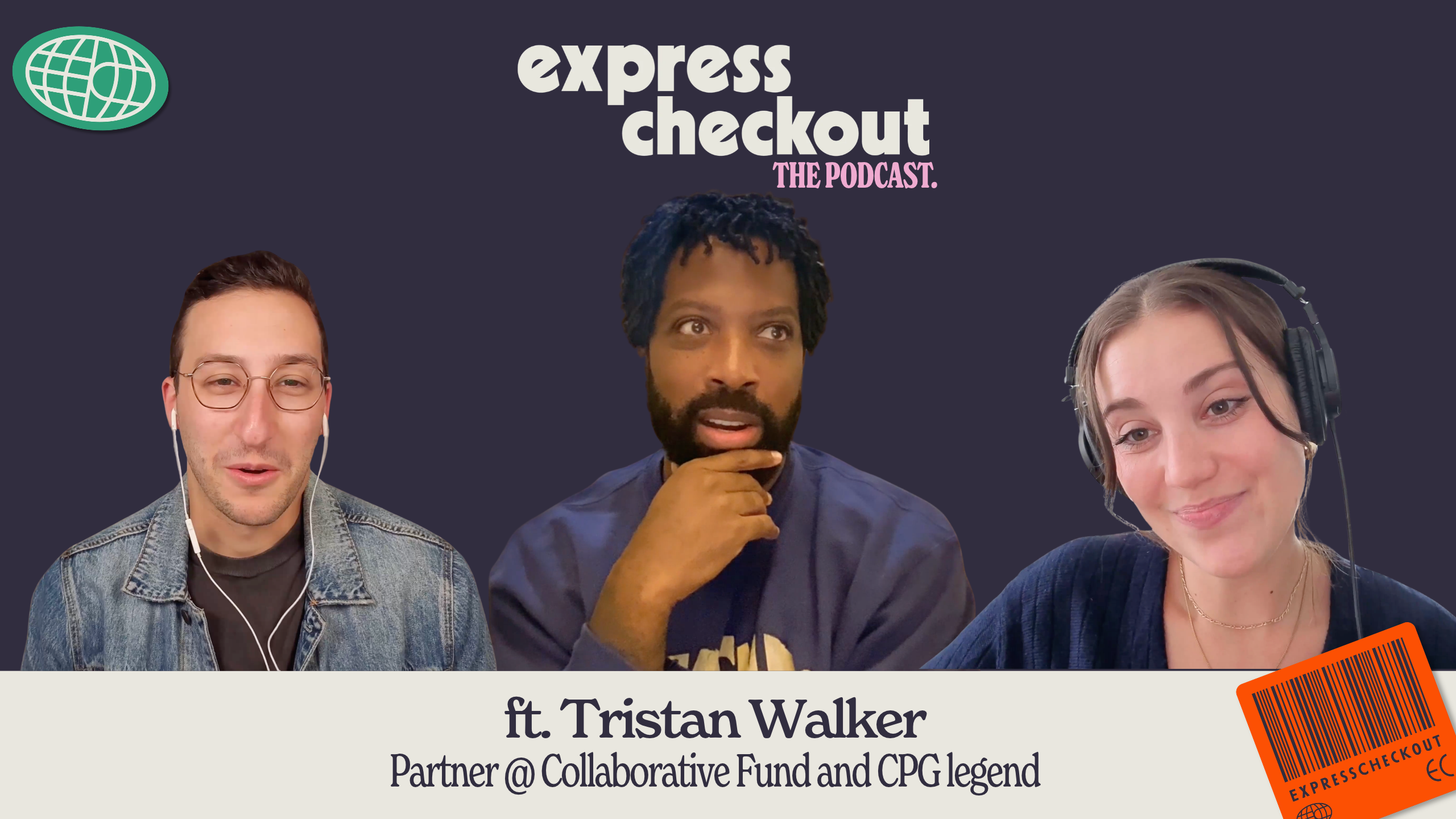
Welcome back to another episode of The Express Checkout Podcast!
This week, we’re sitting down with wildly impressive Tristan Walker, who built and sold Walker & Company (the parent company behind Bevel) to Procter & Gamble. He also sits on the board of Shake Shack and recently joined Collaborative Fund to help launch Collab Holdings—a private equity arm built for consumer brands that don’t fit the traditional VC/PE playbook. He also runs Heirloom Leathercraft, a trade school and atelier bringing fine handcraft back to America.
He walks us through building Bevel from a personal shaving problem to a national brand, the difficult decision to sell to P&G, and why he now believes most founders shouldn’t take VC money in the first place. We also dig into what makes a CPG brand “durable,” why Gen Z is increasingly skeptical of private equity, and whether AI can ever replicate intuition. 👀 Let’s go!
The breakdown:
0:00 - Intro + Tristan’s background and new role3:42 - Building Bevel: from personal problem to national brand6:35 - The P&G acquisition and life after11:45 - Launching Collab Holdings20:27 - What makes a durable CPG brand27:48 - Good brands, bad capital, and the true cost of VC money35:16 - Heirloom Leathercraft and bringing fine handcraft back to America42:30 - Outro
🎧 Love the show? Subscribe to the Express Checkout podcast wherever you get your podcasts! New episodes drop weekly.
📧 Get the inside scoop Subscribe to Express Checkout, our newsletter packed with consumer insights, trends, and exclusive content straight to your inbox at expresscheckout.co.
🗣️ Let’s connect! Follow us for behind-the-scenes content, quick tips, and more: @expresscheckout
💬 Join the conversation Have a product you’re curious about? DM us your questions or drop them in the comments—your topic could be featured in our next episode! If you have any thoughts/questions/suggestions, feel free to email us at hello@expresscheckout.co :)
⭐ Help us grow If you enjoyed this episode, please rate and review us on Apple Podcasts or Spotify. It helps other curious consumers find us!
Scan the code with your iPhone camera
Listen in the app.