Ask ChatGPT


 Extraordinary Life Stories
3 Oct 2026 · 50m · 20 chapters
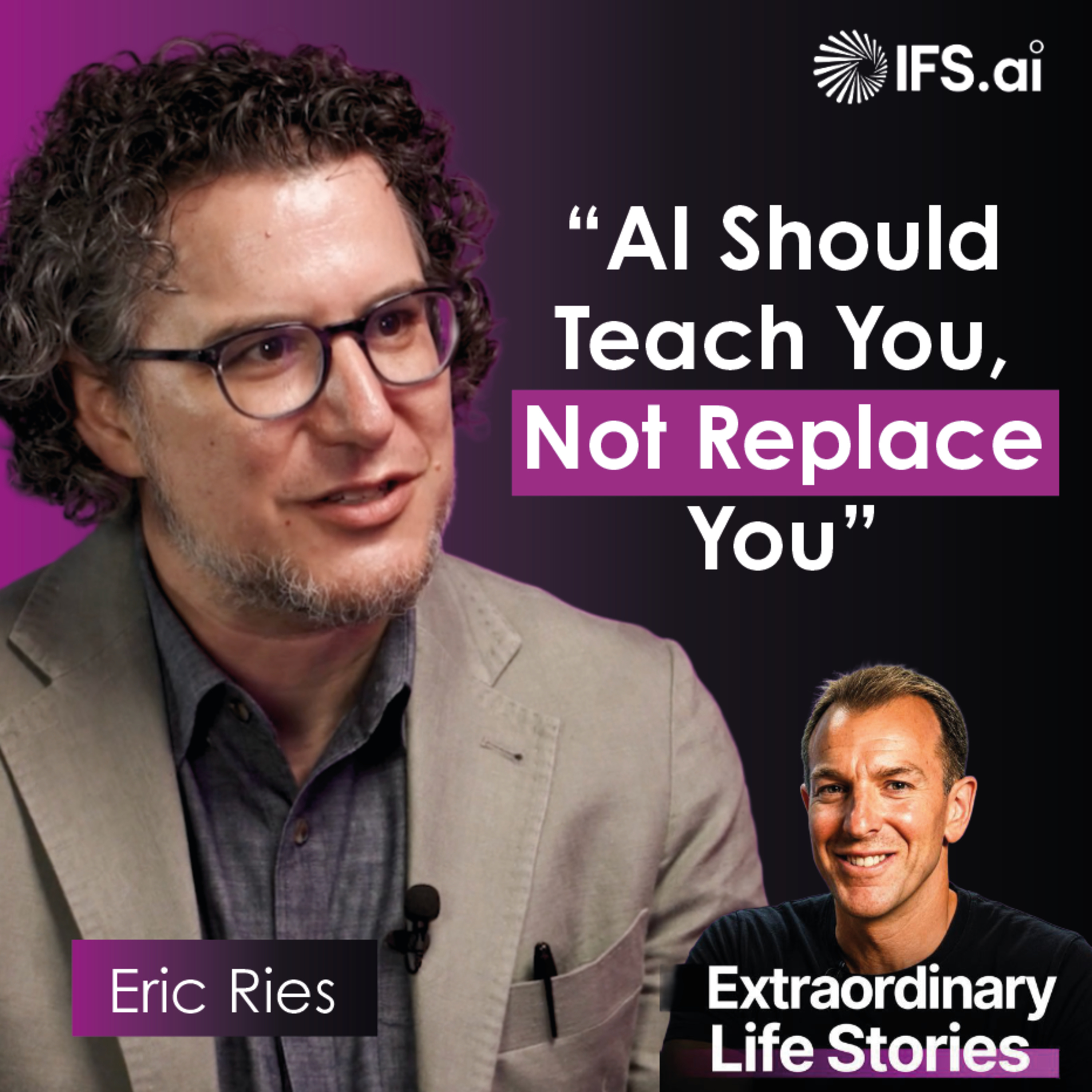
Eric Ries argues that AI should augment human learning and creativity rather than replace human agency, and connects this to his broader entrepreneurship themes: failure, trust-based leadership, and “profit as human flourishing.”
Eric Ries is the New York Times–bestselling author of The Lean Startup and an entrepreneur who became involved in startups after the dot-com bubble. He credits concepts like “minimum viable product” and “pivot” (and in a newer book, “financial gravity”) for shaping business vocabulary. He also cites mentors including Steve Blank (customer development).
AI is often marketed to outsource thinking, which can atrophy skills and reduce the ability to judge one’s own work; LLMs should be used as learning tools (ask for teaching, not artifacts). Trust is the top leadership asset, and modern “best practices” treat trust as disposable. Entrepreneurship is not inherently riskier than other careers; success should be defined as maximizing human flourishing, not shareholder extraction.
a study (nonprofit “Meter”) where developers using AI reported 20% higher productivity but measured 20% lower productivity; Steve Blank refusing to let Ries pay for lunch (“pay it forward”); Aesop’s “golden goose” as a metaphor for companies being “murdered” after capital infusions.
Written by AI. May contain mistakes.
Eric Ries discusses his background and the concept of entrepreneurship.
“We just moved into our new house and I didn't realize just how close we were to the neighbors.”
Eric Ries discusses his background and the concept of entrepreneurship.
“And instead of getting customer feedback, they just ask Claude, Claude, would customers like this?”
Eric shares insights on the challenges and failures in entrepreneurship.
“Oh gosh, I don't know how to answer that.”
Discussion on how AI should be used as a learning tool rather than a replacement.
“We live in a world now with AI, and you can't actually bottle up that gut instinct, that fulfillment, purpose that you get from doing something.”
Eric reflects on mentorship and the importance of giving back in the tech industry.
“What's conventional wisdom and what's not?”
Eric Ries shares his experiences with mentorship and the importance of paying it forward in Silicon Valley.
“Listen, Silicon Valley has gone through a really radical change in recent years and has kind of become, I think, known as a mercenary and selfish place, frankly.”
Discussing the essential role of trust in leadership and its decline in modern institutions.
“I've heard that over and over again from the originators of the Silicon Valley ethos.”
Eric discusses perceptions of entrepreneurship and the misconceptions that deter people from trying it.
“That's why we're seeing institutional collapse all over the world.”
Exploring the phenomenon of involuntary entrepreneurs who turn adversity into opportunity.
“But I think most people don't know if it's for them until they try it.”
Eric discusses the importance of interconnected learning across disciplines for entrepreneurs.
“So I never want to say that suffering is good, of course, but one of our oldest and most ancient spiritual teachings is that there is a redemption to be had in suffering because why?”
Eric shares his experiences with imposter syndrome and how he found confidence in his journey.
“So as entrepreneurs, one of the things I is wonderful about it as a job is it is one of the truth-seeking professions.”
Discussing the shift from self-centered fears to a service-oriented mindset in entrepreneurship.
“And it was one of my first times talking about Lean Startup in public.”
Eric discusses the impact of social media on mental health and the importance of service over self-promotion.
“rather than it being all about you and the nerves and all the people.”
Explore the impact of social media on mental health and the true motivations behind entrepreneurship.
“So I've known the company for a long time, but it's not a product I've personally ever used before.”
Discuss the importance of genuine values, long-term thinking, and the true meaning of success.
“Gosh, use that analogy of the forest floor.”
Exploration of how fatherhood changes perspectives on ambition and priorities.
“you know, obviously it's been well known for mothers for a long time, but for fathers too, you go through a biological change and your perspective on things changes.”
Emphasis on the importance of making mistakes and learning from them in business.
“It puts out the success is guaranteed, which is, of course, the code of the charlatan going back many, many, many decades.”
Discussion on the relevance of sustainable growth models in the context of AI.
“the idea, who use it in their practice, many of whom don't even talk about it because they view it as completely obvious.”
Discussion on the relevance of sustainable growth models in the context of AI.
“This is a job for Indeed sponsored jobs.”
Eric Ries discusses his new book on preventing corruption in business practices.
“come from my own personal pain okay i don't write about the things i don't know i'm not capable of doing that.”

Get the gist, explore an idea or ask about something said.
 Claude
On Extraordinary Life Stories, what are the key points of this episode?
Searching your listeningAutomatic transcript. May contain errors.
0:00When you need to build up your team to handle the growing chaos at work, use Indeed Sponsored Jobs. It gives your job post the boost it needs to be seen and helps reach people with the right skills, certifications and more. Spend less time searching and more time actually interviewing candidates who check all your boxes. Listeners of this show will get a$75 sponsored job credit at Indeed.com slash podcast. That's Indeed.com slash podcast. Terms and conditions apply. Need a hiring hero? This is a job for Indeed Sponsored Jobs. We just moved into our new house and I didn't realize just how close we were to the neighbors.
0:36That's when my friend told me about Blinds.com. Blinds.com isn't a medication, but it can improve how you feel about your home. Customers who shop at Blinds.com experience excellent customer service, from consultation to installation. Side effects include increased privacy and better sleep. Talk to your partner today and see if Blinds.com is right for you. Visit Blinds.com to order your free samples. And instead of getting customer feedback, they just ask Claude, Claude, would customers like this? The thing that we made together, is it any good? And Claude tells them, oh yeah, we did a great job.
1:09Good job. Keep spending tokens on this. Absolutely. Tell me, who is Eric Ries? Yeah, most people know me as an author or as an entrepreneur over a book called The Lean Startup. I think if I'm proud of anything in my work, it's that I've been able to introduce certain concepts into the lexicon like minimum viable product or pivot bar. In the new book, things like financial gravity. Entrepreneurship is not always easy, right? It's not all about the successes. It's not ever easy, and the successes are hardest of all, first of all. I feel like anyone that's talking about entrepreneurship, leadership, innovation, any of those topics, if they're not talking about failure, they're lying.
1:40I think LLMs are best used as a learning technology. I know a lot of college professors who say that AI is robbing their students of the ability to learn. Instead, we should use AI to augment creativity. So next time you're tempted to ask AI to make it artifact, I mean, a piece of software, give me a whatever, just one subtle change. Ask the AI to teach you how to do the task instead. What values you measure the most is most important in the industry? Well, the number one asset a leader can have is trust. And yet we have become, frankly, indoctrinated to a series of best practices in business that treats trust as a purely disposable commodity.
2:28Sorry to interrupt. I'd never asked this before, but if you can subscribe and follow, that will allow me to keep bringing extraordinary guests onto the show. Now let's get back to it. Looking forward to this conversation. Me too. Tell me, who is Eric Ries? Oh gosh, I don't know how to answer that. Yeah, most people know me as an author or as an entrepreneur. I wrote a book called The Lean Startup. To me, I think those are just surface accomplishments. That's not really who somebody is. I think if I'm proud of anything in my work it's that I've been able to introduce certain concepts into the lexicon, create new conceptual vocabulary terms like minimum viable product or pivot or in the new book things like financial gravity.
3:11I think the highest compliment people pay me is they'll say something like Eric's not very original. He just put a name to something everyone's always known or thought about. I feel like that that's the best people feel. They can dismiss the person because the idea has now become so obvious to them they can't imagine somebody ever invented it. We already understood it or living it but then you get you get to actually kind of put a box around it. Well you get credit out of it you know yeah you can't worry about that but the much more important thing is to have you created a mechanism for people to then communicate more clearly about what they think and believe.
3:43And clearly that's really resonated because you're very humble very humbly into it but New York best-selling author so it's reached a lot of people it's influenced a lot of people particularly in business and entrepreneurship. Give me the background to you becoming an entrepreneur. You know, I was not someone who grew up hoping to be a business person or do entrepreneurship. I didn't have a lemonade stand as a kid, nothing like that. I was really interested in technology. I thought software was the future. And I just as a kid was programming computers from my earliest memories are doing that. I actually couldn't believe you could get paid for computer programming.
4:18That was to me like getting paid to play video games. That's what I wanted to do anyway. So And I was like, oh, you can make a career out of it? How exciting. So I didn't become an entrepreneur until many years later when I was kind of swept up into the dot-com bubble. I might have been the last person in America to get the memo about the dot-com bubble, okay? I was very late to the game as a young adult, did a startup. It was a disaster. But I got a little taste of that feeling of being able to take an idea and translate it directly into a product that you take directly to customers. And even though I did it very badly and we made no money and it was a disaster.
4:51in every way you can imagine. The feeling of the exhilaration of it really, really hooked me. And I thought, okay, I want to do this right. I want to learn how it's done. That ultimately would lead me to Silicon Valley and then, you know, launch me into the rest of my entrepreneurial career. There's a couple of things there, the feeling, which we're going to open up with. We live in a world now with AI, and you can't actually bottle up that gut instinct, that fulfillment, purpose that you get from doing something. You saying, I couldn't believe I was being paid to do something I actually really enjoyed.
5:20And then also the fact that you openly admit you failed. You know, you did it all badly. Oh, sure, yeah. And that's a key part of your relatability and storytelling into the fact that entrepreneurship is not always easy, right? It's not all about the successes. It's not ever easy. And the successes are hardest of all, first of all. You know, I feel like anyone that's talking about entrepreneurship, leadership, innovation, any of those topics, if they're not talking about failure, they're lying. Or they're selling you something. You know, I feel like it's very important to be honest. but I feel like that is a little bit at odds with being a professional expert.
5:51So one of the things that's very strange about me, I used to be a very introverted, very like interior focused person. I did software engineering, you know, alone in my parents' basement with their computer and later, you know, alone in my cubicle in the startups that I built. Like it was very, it was a very me in the screen, you know, not very sociable, not very outward focused. And then, you know, Lead Startup became such a phenomenon. It kind of took over my life and I wound up getting to travel and meet people all over the work. It's been wonderful in so many ways. But it's a little bit strange to be up on stage in front of thousands of people and say, hi, I'm Eric.
6:25I'm a big failure. And if you follow me, like you too could be a big failure, right? That's not the pitch you're supposed to make. You're supposed to promise people success and riches and fame and all this stuff. And yet that's not the reality of what entrepreneurship is really like, as you well know. So I think that is one of the things where like people say the medium is the message. Here's a place where the medium and the message are in permanent tension. I think it's why we see so many snake oil salesmen and so much social media influencers that are selling nonsense. It's because that's really what the medium demands.
6:55That's where the attention is. And to try to create a more realistic, more truthful story about what entrepreneurship, what really what leadership truly is, is more challenging. So I've taken what I think of as the harder road to try and do that as best I can. but I recognize it has its trade-offs for sure. There's lovely vulnerability in what you're saying there from someone that is successful, but he's openly saying that there's all sorts of obstacles and bumps in the road, but actually that's where the learnings come from, right? Can we bring AI into this? There's now so many ways of automating and being uber-efficient, and a key part of what you've championed is sustainability, if you like.
7:37And I just wonder now how an entrepreneur watching, listening to this that is keen to learn from you how that's changed and what you might have changed about anything you've written previously and how that landscape's changed. Yeah, this is a very hot topic and I think many of the hot takes about it are quite wrong-headed but, you know, are worth a lot of money to a lot of people including friends of mine, you know, who are very invested in these narratives. So I feel like I always have to be a little careful what I say because we have both a, burgeoning, almost tech oligarchy that's being built around this technology and a massive public backlash to it, so much so that I have to really check myself, like what environment am I in?
8:16What's safe to say and what's not? What's conventional wisdom and what's not? It's very tricky. So let's begin with one thing. When I'm with young people these days, if I give a lecture or something, I invariably get the question, is this new AI, is it a transformational technology or is it a massive financial bubble bordering on a scam? And I always have to say, like the old meme on the internet, why not both? Both things can be true at the same time. And in fact, in history, most transformational technologies have also been accompanied by a lot of scams and a lot of financial bubbles. In fact, financial bubbles have, through history, financed the build-out of much essential infrastructure.
8:54So the technology can be wonderfully useful and also be accompanied by all this darkness and bad stuff. So AI is no exception and maybe even the apotheosis of this trend, the worst we've ever seen, could be. So we have to be very careful with it. I unfortunately think the way that AI is being marketed and sold, both from a PR and marketing messaging point of view, but also in terms of like how the products are being architected. I don't know if this is intentional or unintentional. We can debate that. But regardless, it's being constructed in such a way as to diminish human agency. So many people are using these tools to substitute for their own thinking and to outsource their creativity to the machine, which is the worst possible way to use the technology.
9:37It's new, so we don't have so many studies, but the initial studies that have been done show that the more people use AI in this mode, the less capable they become. They actually have their own skills atrophy. And the second thing it does is it robs them of their ability to evaluate the quality of their own work, which I think is even more pernicious. So for example, in one study done by the nonprofit meter that does AI alignment research, really wonderful organization, they did this study where they recruited a lot of software developers from open source projects and asked half of them to use AI for a task, half not use AI for a task and report back.
10:11And because they did open source, they could take the self-reported productivity and measure the actual productivity. So what did they find? For the engineers who used the AI, they reported being 20 % more productive on average. But in their measured productivity, they found them 20 % less productive. That's fascinating. So it's not just that VibeCoding and these other agentic tools have problems and have defects. They do. They also have things. They're good at some things, but they're really bad at other things. When they're used in this way to delegate, they seem to create consistently this loss of something really human.
10:48So I'm a big advocate. When I've used it, and I've used it extensively. I'm the founder of an ag research lab. I know many of the principles involved in this story. I use it myself. I think it is transformational, but I'm very careful not to delegate. Instead, I think LLMs are best used as a learning technology. So I advise people, especially young people who are trying to navigate. I know a lot of college professors who say that AI is robbing their students of the ability to learn because they don't read. They just ask for the summary. They delegate their thinking to the AI. Everyone's so excited about the possibility of replacing human creativity with AI.
11:19What a scandal, an industrial-scale scandal. Instead, we should use AI to augment creativity. So next time you're tempted to ask AI to make an artifact for you, write me a novel, write me a poem, write me a piece of software, give me a whatever. Just one subtle change. Ask the AI to teach you how to do the task instead. That's brilliant. Because this AI has been trained involuntarily on every piece and scrap of human knowledge that has ever been written down. Okay? None of us were compensated for this, by the way. It's, again, a massive scandal. But given that there is no topic of human endeavor, you can't ask it to teach you.
11:56It's like the world's most patient and most infinitely knowledgeable tutor on everything from crocheting to nuclear physics or anything you could possibly want to learn. So ask it to take you step by step to build your own skills and to critique your work as you go. It's not a substitute for a human teacher, but there's a lot of topics for which you're not going to seek out a human teacher. So in those cases, this is still much better than sitting there delegating to tell it to do the work for you.
12:46Terms and conditions apply. Need a hiring hero? This is a job for Indeed Sponsored Jobs. We just moved into our new house and I didn't realize just how close we were to the neighbors. That's when my friend told me about Blinds.com. Blinds.com isn't a medication, but it can improve how you feel about your home. Customers who shop at Blinds.com experience excellent customer service from consultation to installation. Side effects include increased privacy and better sleep. Talk to your partner today and see if Blinds.com is right for you. Visit Blinds.com to order your free samples. That's brilliant.
13:22I've not heard that explained like that at all before. There's a laziness. I'm guilty of that. Just tell me that, show me that, and almost give me the result. And it's often not, say I'm putting out a post on LinkedIn, and I think, that's not me. That's not me. But actually, there's a whole element of being taught, which we get fulfillment from, don't we? We actually love learning and that stimulation of creativity. I'd love to bring that into you. There's mentorships, that's something you talked about a lot. I feel like there's a part of you that loves giving back now. And I just want to sort of open that up where who has helped you and how does that feel to them be able to help people like you did the talk this morning, this conversation now, sharing what you know.
14:05No, I feel very privileged. Listen, Silicon Valley has gone through a really radical change in recent years and has kind of become, I think, known as a mercenary and selfish place, frankly. I think it's sad. The OGs of Silicon Valley, the people who built it, they did not have that ethos. They very much believed in paying it forward. So I'll never forget one of my early mentors was the great Steve Blank, who originated customer development, among other things, other contributions that he's made. And I remember once even, you know, we went out to lunch and I tried to pay for lunch. And he was like, how dare you?
14:34You know, this is my responsibility. I'm the one who's older and more successful. I'm the one who I'm mentoring you. You know, who do you think you are. Let me, I'll buy you lunch." But he's like, not because of the lunch. You can't really pay me back for what I've done for you. All you can do is pay it forward. So one day you will provide this mentorship to somebody else, to probably a lot of other people, and that would be the way that you compensate me, that you thank me for what I did for you. And I just, that was such an important and early lesson for me. I've heard that over and over again from the originators of the Silicon Valley ethos.
15:05Many of them are horrified by what's been happening in recent years so yes i've been i've been blessed with terrific mentors and i do try as best i can to follow an effort no i can tell and that's genuine that's coming right off you now and there's real management of ego there so that's someone that in their own right at that time steve was successful yeah enjoying your eagerness to learn from him and i can feel that that's again what you're wanting to to pay forward i would love to bring you mentioned earlier leadership yeah when silicon Valley was set up, it was like an incubator of innovation, you know, and then the money, the checks, the whole kind of ego that spreads around the world is enormous.
15:42I just wondered if I can ask you, in your experience, people who spent time with your own experiences, what values you measure the most as most important in leadership? In leadership, well, the number one asset a leader can have is trust. And yet we have become, frankly, indoctrinated to a series of best practices in business and in institution building in general, in both leadership and governance, that treats trust as a purely disposable commodity. So we don't teach people to generate this asset, nor do we teach them to protect it once they have generated it. And so my experience, especially in recent years with organizations, I think this is a universal experience.
16:24People feel this way about the places that they've worked, from the places they buy products from, from their governments and unions. I mean, you just see it absolutely everywhere, this infection that has spread from institution to institution, where people no longer believe the promises that institutions make. They cannot trust them anymore. And this is breeding a cynicism and really sense of desperation into the body politic that I think is quite dangerous. Frankly, and in the new book, I call it what I think it's rightfully called a form of corruption of the moral logic of these institutions.
17:00That's why we're seeing institutional collapse all over the world. So, yes, I think for an individual leader, for an organization, trustworthiness is that most essential asset. And we have to learn to generate it and to protect it. It's a great share. So let's talk about the book because that also brings that whole entrepreneurship and the startup ecosystem, which we both thrive in. I'm off to Ideas Fest, which is like a kind of glass of the entrepreneur kind of awards, if you like, in the UK. And just that ecosystem as it is, can anyone be an entrepreneur? Can anyone be? Well, yes and no. So I don't think everyone is suited to it, but that's not because I think I want to be the judge of that.
17:45Most people judge themselves right out of entrepreneurship the second they even consider trying it. So on the one hand, if I could change people's perception of entrepreneurship, I would do two things. One is people consider it to be risky, which I actually think is a misunderstanding of what entrepreneurship really is. Entrepreneurship can be a career just like any other career. The fact that it involves failure, like we culturally stigmatize failure, but that's on us. As an individual person, I think you're no more likely or less likely to experience failure as an entrepreneur than any other career.
18:17And I know so many people who, when they were younger, picked the safe career of journalism or banking or whatever, and then they get laid off. Then they become absolutely like they have all these terrible things happen to them. And I, of course, counsel many people through these kinds of tough times. And even then, people can be in the middle. I remember in the financial crisis, people were in the midst of being laid off at a time when their whole category of job had been eliminated. There was no other jobs to be had. And I would say, well, why don't you give entrepreneurship a try? And they'd be like, oh, that's too risky.
18:47Too risky compared to what you've just been through? That's really fascinating. But of course, the second misconception about entrepreneurship is that it's easy. Because in the movies, it's always darkest before the dawn. And the plane is losing altitude, losing altitude. in the movies, you pull up on the stick and just at the very, you pull right up, right? In real life, you tend to more slam the plane right into the ground. So for people for whom the cognitive dissonance of feeling that you are right when everyone thinks that you're wrong, and also when you are right about something that doesn't exist, it's actually very difficult.
19:19You're telling people we have to build this thing. It's going to be a glorious future, but you look around and there's no evidence for that. It doesn't exist today. It's a future-oriented thing. That tension is not for everybody. But I think most people don't know if it's for them until they try it. So I wish more people would give it a try, especially when they're younger, especially when the stakes are lower, to just get a flavor for it and see if you like it. And if you don't like it, there are so many other ways to participate in an entrepreneurial venture. You don't just have to be the founder.
19:47There's a lot of other roles that are very important. Most people have, in my experience, are able to find a niche within that ecosystem that is suitable to their skills and talent. There's so much there. You got me thinking. So a lot of people by choice or maybe a passion and a sort of a purpose or something they've enjoyed, like you enjoying the coding and so on. And then you take that into, but some people can be forced into this. You mentioned kind of COVID and changes. And we've now got AI. We know the accountancy role, the legal role. So many of those relatively safe jobs forever are now not looking at all in any way a safe job for the future.
20:23So do you see people, that's why I actually asked you that question, do you see people leaning into entrepreneurship because they're almost forced to? Yeah, I call them involuntary entrepreneurs, which in history, there's a lot of people like that who are served adversity and transform it, transmute it into something glorious. I mean, that's as human as it gets. Yeah. So I never want to say that suffering is good, of course, but one of our oldest and most ancient spiritual teachings is that there is a redemption to be had in suffering because why? not, there's no great insight of mine as an old idea, that in suffering we finally, there's something about the status quo we find intolerable and we're forced to change.
21:01It's an inner change that that requires. Again, I don't want to make a big deal about it. It's more just we've been taught this for a long time, and yet somehow every generation we manage to forget these universal truths and we have to be shocked into remembrance of it. And I think one of the things that a lot of people have been taught, the way our education system has evolved, we tend to teach disciplines or domains as separate. You know, science as like something you learn in the classroom as opposed to what a practicing scientist would do. Same with history or politics or any field of study or religion for that matter.
21:33Spirituality partitioned off over here, business partitioned off over here. And of course, the truth is not like that. Every part of the truth is interconnected to every other part. So as entrepreneurs, one of the things I is wonderful about it as a job is it is one of the truth-seeking professions. Right up there with being a scientist or an artist. At the end of the day, it is applied philosophy. You are saying, I will make a thing that does not exist. I will make it come into being and something will happen. And if you are right, if the thing that you say is truthful, then wonderful things do happen.
22:04And if you're wrong, it doesn't. You can't evade it. You learn from that experience, don't you? You learn from the experience. So if you're the kind of person that wants to know the truth of a thing, it can be very rewarding, even the failure can be rewarding because you are so committed, you learn the truth. And in a lot of jobs, unfortunately, in our modern world, jobs are designed to evade accountability. So we can work a whole career without ever really finding out the truth of whether what we do in fact matters to anybody at all. Some people call that safety, but to me that sounds like a kind of torture.
22:35I would rather know the truth. I know from my own experience, and I know you know this and spades that the growth for me to try and be the best version of myself regardless of any outcome of trying something new and then getting that amazing surprise when it works and and then building on that is that that's where i've grown as a person my confidence my character and i think that's really something the key that you champion as well and i just want to wonder that that introverted version of yourself has come to now being best-selling author did a talk this morning. Have you got your own experience of that, where that innovation and backing yourself personally has made you the best version you can be of yourself right now?
23:16Well, who knows? Other people around me probably would say they're tired of hearing about it. So I don't know. Best version is kind of judgmental. We're always improving. But my point being that - That's certainly been my goal. And I can look back on key moments in my career where there's this kind of fork in the road, right? Like I can remember the first time I was asked to give a big talk in front of a room of 800 people. And I'd never done anything like that before. And it was one of my first times talking about Lean Startup in public. I was very nervous, as you can imagine. And I remember kind of feeling like right before the event, what have I done with my life?
23:52I used to be an engineer. Now what is this? I felt almost like a huckster or I was like a fake celebrity. I'm like, who am I getting up in front of people to tell them something? Imposter syndrome, right? Yeah, terrible imposter syndrome, especially because in business, we tend to lionize the richest people because they are the most successful. I get this. If you look on the Hacker News comments or the Twitter comments, whenever I do something, there's always someone being like, if you were so smart, how come you're not so rich? It's like, yeah. And I'm always like, well, look, if you want to get advice from rich people, there's no shortage of that going around.
24:22What are you in my comment section for? Go do it. You know, whatever. But anyway, but I had that feeling of like there's more successful entrepreneurs than me. Why should anyone listen to me? And I had this moment of realization. I thought to myself, well, maybe of the 800 people who came to see me, there will be one entrepreneur in the room who's like I was five years ago, 10 years ago, just beginning their journey and about to make the same stupid mistakes that I did. And if I accomplish nothing else today but I help that one person avoid that one, I would give anything to go back in time and not have made those mistakes.
24:51So if I can pay that forward to even one person, it will redeem the other 799 people that maybe are just there to laugh at me. Whatever else happens, it will be worth it. And that's really the key for me has been in these moments of stress or crisis to try to figure out like, not what am I afraid of, but who is this for? What is the commitment that I'm making in this moment, even to a person I might never meet that I'm trying to accomplish something on their behalf? And that change in perspective, now we go from an egocentric conversation about me and my fears and my career and what am I doing with my life to a more of an ethos of service.
25:24How can I be of service to somebody? How can I feel like I am accomplishing something that is on solid ground? And then if it's a success, if it's a failure, you know, those issues become secondary. Versus did I do the best that I could do to deliver this message on this day? And that was very helpful to me. Then I didn't throw up in the bathroom, you know. I got through it. When you need to build up your team to handle the growing chaos at work, use Indeed Sponsored Jobs. It gives your job post the boost it needs to be seen and helps reach people with the right skills, certifications, and more.
25:56Spend less time searching and more time actually interviewing candidates who check all your boxes. Listeners of this show will get a$75 sponsored job credit at Indeed.com slash podcast. That's Indeed.com slash podcast. Terms and conditions apply. Need a hiring hero? This is a job for Indeed sponsored jobs. Afternoon glare totally ruined my watch party for the big game. That's when my buddy recommended Blinds.com. With custom window treatments made to fit your style, space, and budget, Customers who shop at Blinds.com experienced overwhelming satisfaction. Side effects may include a fuller, deeper night's sleep and the sudden urge to host the watch party again.
26:36Blinds.com isn't a medication, but it can improve how you feel about your home. Visit Blinds.com to order your free samples today. Yeah, and I love that element of giving service rather than it being all about you and the nerves and all the people. Because in the same way that I've been so looking forward to this conversation, your perspective counts. You have all the lived experience and then all of those around you that you've interacted with to be able to write the books, do the talks. So you're someone that people want to listen to. What advice would you give to an aspiring entrepreneur now looking in?
27:10And two things, from a perspective of what you've learned and also perhaps if they don't know what they want to do, they just know they want to back themselves and start something. What would you lean into? Yeah, so I would be careful. I know a lot of people that want to become an entrepreneur. And I don't think that is correlated with a lot of entrepreneurial success. Because want to be an entrepreneur is kind of like a cultural identifier. Like I want to be a fan of a certain sports club. Or I want to, it's like a tribal, I want to have this status. Totally. Social media has not helped as well.
27:41Especially with the guys selling the courses and so on. Dubai Marina behind me. Look at my Lamborghini. Listen, I don't use social media myself. I think it's bad for your mental health. But because I launched a book just recently, I felt obligated to get on. And I used Instagram for the first time. I never used it before. I knew the Instagram founders before they started the company. So I've known the company for a long time, but it's not a product I've personally ever used before. And so I was like, well, I got to get on there to see. And it only took like one hour before I was feeling so miserable.
28:10I was like, I got to buy this course and I got to listen. And I just felt so insignificant compared to these legendary figures. And what was funny is I was talking to some friends about it and I started naming these people on Instagram who I was so jealous of and no one had ever even heard of them because in their corner of Instagram, everyone gets a customized algorithmic feed to exploit whatever their insecurities are, right? Totally. And I just was like, wait a minute. My depression kicked in in no time. It was shocking to me. And it's like, because I had been away from it for such a long time, I didn't have that gradual feeling of like the frog boiling in the pot of water.
28:47That didn't happen to me. I got the pure, unadulterated, refined, addictive version of Instagram right off the bat and it was really terrible. So the ethos of service we talked about before, that to me is the key. Entrepreneurship is not a career in itself that you should pursue for the sake of entrepreneurship. Rather, building things or making people's lives better or accomplishing something should be the motivation. And so that doesn't have to necessarily be a high, maybe we'll use the word vision or mission. It can sound very high concept, like, oh, I got to save the world. I got to work on climate change or whatever, which is wonderful.
29:22People work on that. Great. But a lot of people get into entrepreneurship for the very humble start. It's like, I just want to bring a little beauty into my customers' lives. I just, I like building quality products. I want to be around other employees who care about craft and quality like I do. Or I care about design. I always think about Steve Jobs, one of my favorite Steve Jobs. So many great Steve Jobs stories. One of my favorite is when he was designing the Mac Plus, just as the original beige Macintosh from 1984, he would get into these massive fights with his engineers about the visual layout and look of the cables inside a case that he did not think the customer should be allowed to open.
30:04Okay, this is how particular of a person he was. And the engineers would say, Steve, since the customer can't open the case, they'll never see this thing that we're designing. So what does it matter if it looks good or it doesn't look good? No one will ever know. And Steve would say, but we will know. Right? So that was to him, it wasn't like, oh, when it's convenient, I care about this. It was all the time. That was his ethos. That's what he stood for. That's a habit and a discipline that carries through. And people hear that story and say, oh, I should be an a-hole like Steve Jobs was. I should wear a black turtleneck like Steve.
30:38No, the point is not to ape or copy the values of some other person, but to discover your own authentic values and be as stubborn and clear in defense of your values as he was in his. that seems to me consistently correlated with the best entrepreneurial outcomes. But no matter what that passion or belief is, in our day and age, the era of what's called shareholder primacy, if you have such a belief, it doesn't matter, design, efficiency, quality, any belief like that that is one of your animating core values, then you are a business revolutionary whether you know it or not. Because unfortunately, our modern best practices about corporations hold that a corporation is nothing more than a financial instrument designed to enrich its shareholders.
31:21And what a sad and degraded view of an institution. Where's the fulfillment there? Where's the passion? Who could ever feel passion or glory in that? I think it's one of the saddest things in the world. In the U.S., this idea dates to like 1986. It's not even like some ancient pillar of capitalism. It's a new and relatively perverse wrong turn that we have taken on both sides of the Atlantic. But what's interesting to me about it is most founders, so you ask like, I want to be an entrepreneur. The first step is to find a problem worth solving or find a person you would willing to commit yourself to.
31:50In the book, I tell the story of the great Saul Price, one of the fathers of modern retail. He talked about business as a fiduciary to the customer, meaning I put the customer's interest before my own and I sacrifice to see the customer well treated. This generates that asset of trust. If you know someone would never betray you, you're much more likely to shop with them, to partner with them, to do what they want. It's a natural form of reciprocity, one of the oldest and deepest human evolutionary instincts there are. Empathy as well, right? Of course. It drives all this good stuff. So what we have to do is we have to start by finding something like that, that we can feel that passion and sense of service around.
32:28And then, as I said, build up the trustworthiness and then learn to protect it. So to me, this is like a lifetime practice, not a get-rich-quick scheme. You can tell that. Legacy play. I was going to bring that up, actually, but in the same vein, I think, you know, I ask everybody this, but it's a lovely feed into this part of the conversation is how do you define success? Oh, that's a that's a tough question, actually. People think it's so simple. In the book, I I lay out what I think of as the actual correct definition of being a for profit company. What does it mean to make a profit? Because for most companies, and frankly, for most organizations, you see this in charities as well as in for-profits, profit is the scorecard by which we measure success.
33:10And like I was saying to people on Hacker News, giving me a hard time, right? If I had more profit, I'd be more worth listening to. Unfortunately, we have built an economy where there are so many ways to make money without creating any value at all that the word profit has become deeply confused. If you talk to young people, I meet a lot of young people now for whom the very idea of being a for-profit business is inherently suspicious. It must be something exploitative or extractive. If you're trying to make a profit, you're stealing. I think that's a very dangerous idea to be embraced by young people, but we can't be mad at the young people.
33:42This is their response to a lifetime lived under this crazy idea. They've seen nothing else. They don't have anything to replace it with. So first step to understand success, we have to define profit properly. I define it in the book, I give the whole economics derivation for this, I promise. It's more rigorous than what we can talk about in a few minutes here. Is that profit is about the maximization of human flourishing. That's what it means to make a profit. So if you have an organization which is committed to making money by improving the lives of the people it touches, that's true profit.
34:13And that is much more sustainable, also frankly much more satisfying than other ways of making money. So when you translate to, ask me personally, the way that I think about it, I have young kids now. And, you know, from a success perspective, I know the research that shows after you make a certain amount of money, that the incremental happiness you get from extra money is either zero or very marginal. So I've been very blessed to be successful in my life by conventional measures. But I'm surrounded, I live in Silicon Valley, I'm literally surrounded by people who have had orders of magnitude more of that traditional success than I have.
34:48I know many billionaires personally. And a lot of them seem miserable. I thought you were going to say that. So it's hard for me. I live in a very materialistic society that tells us that my scorecard as a man, as a provider, as a this, as a that, it's basically on a yardstick. How big is your bank balance and whatnot? So, of course, it's easy to get wrapped up in that stuff. And any time I catch myself making decisions from that place of feeling scarcity, of feeling the need to be competitive and whatever, Those decisions have always led me to nothing but misery, as our most ancient philosophical and spiritual teachers have made for many years.
35:24So I've learned, especially as a parent, to start to think more in generational terms, in legacy terms. And I try to do this exercise. I say, okay, the thing I'm working on right now, whether it turns out to be a quote-unquote success by society standards or not, one day in the future, my children or maybe even my grandchildren, if I'm so lucky, will ask me, hey, grandpa, at a time of rising fascism, at a time of climate crisis, at a time of, think of all the terrible things happening in the world right now. At that time, hopefully they're taking from the point of view of having lived through it, everything's turned out great.
35:57We're in a new utopia, a new golden age. What were you working on at that time? Do I really want to be like, I helped create some shareholder value by addicting some people to my advertising algorithm or do I want to tell them something else? And I feel like since you can't judge, you can't know in advance if something will be successful, better to work on something where you'll sleep well at night and feel good about having made the attempt no matter what. So I've built companies myself where people ask me, how do you know if this is going to be successful? They're so audacious. They're so ridiculous, frankly.
36:34And I can be honest and say, you know, I actually don't know. And I don't think it's our business to know. We're going to make the attempt and maybe we succeed. Maybe the people who made the attempt with me will go on to create great value based on what we learned from this experience. Maybe future entrepreneurs will feed off the carcass of the thing we attempted to make, like a forest floor, and that will generate the new growth. But something good will come of having made the attempt. Either way, I sleep okay.
37:11and helps reach people with the right skills, certifications, and more. Spend less time searching and more time actually interviewing candidates who check all your boxes. Listeners of this show will get a$75 sponsored job credit at Indeed.com slash podcast. That's Indeed.com slash podcast. Terms and conditions apply. Need a hiring hero? This is a job for Indeed sponsored jobs. We just moved into our new house and I didn't realize just how close we were to the neighbors. That's when my friend told me about Blinds.com. Blinds.com isn't a medication, but it can improve how you feel about your home.
37:46Customers who shop at Blinds.com experience excellent customer service, from consultation to installation. Side effects include increased privacy and better sleep. Talk to your partner today and see if Blinds.com is right for you. Visit Blinds.com to order your free samples. Yeah, I love that. Gosh, use that analogy of the forest floor. Setting the foundations, showing people and showing that it can be done. and at least setting out with the intention to do that. Because you've seen the other side of it, living in the heart of Silicon Valley with people that have, what so many people that are back to that social media sort of thing, people aspiring to have perhaps the flashier things in life.
38:25But will that make you happy? Have you thought about that? We know for sure that it won't. It's just very funny, like how you can sound so radical and revolutionary spouting some of the oldest teachings in the world. You know, I feel like what, as if I did an event this morning, I was with business people and leaders, and I'm talking about how money won't make you happy. And they looked at me like I had the guy striking them with a thunderbolt. And I was like, look, I'm just repeating what we all should know. It should be old news. But somehow as a society, we have lost the thought of this in such a profound way.
38:58And I guess I bring it up not as a moral teaching, not as a spiritual teaching. Of course, that's important. But it's actually also a very practical business teaching because so many organizations, I think leaders are so naive about this. The very success that makes an organization worth building in the first place also necessarily attracts predators. The more gold in the goose, the greater the temptation to butcher it. So, so many organizations are undone not by their failures but by their successes. And if we are not prepared to face that, we can wind up, as many of the stories I tell in the book, being an entrepreneur whose company is taken away from us, who is summarily ejected from a company.
39:40We have example after example after example. I just did this exercise with the whole audience this morning. Everyone in the room, tell me, raise your hand if you have a favorite brand or product you love to buy or a company you love to work at. Everyone's got a hand. Keep your hand up if at any time that favorite brand or product had a huge infusion of outside capital. It was acquired by private equity, it raised venture capital went public, it got acquired by a public company. Everyone's hand is still locked. It's a great. Does anyone have a story for me? Anyone in this room have a story for me of a situation where thanks to that massive infusion of capital, the product got better?
40:14I swear everyone's hand went straight down. No. And of course, in the book I tell dozens of these stories of companies that are murdered in the name of profit. We're used to it so we forget how strange this is. They've articulated it beautifully. Why? Hey, what did we do this? Why are we killing the golden goose? Aesop wrote it down 2 ,000 years ago. We probably should have learned this lesson by now. So I think we have to kind of shake ourselves out of the stupor of that we've gotten used to this, acclimatized to it, and start asking ourselves what would it look like to intentionally adopt leadership practices, governance practices, cultural practices that are designed to resist the temptation to this betrayal.
40:55I've loved listening to this. I want to finish on you personally, actually, and just the flow of that conversation into the consistency of Eric from the young entrepreneur to sitting here now, prioritizing your mental and physical health. I wish I was as good at that as I seem to be. Yeah, exactly. You've got perspective now. I imagine a young version of you was just relentless. Absolutely, yes. And now there's a measure. You understand that the Silicon Valley example, the output of innovation at the expense of human bodies destroying themselves, not sleeping and being stimulated by making money, by seeing things develop and change.
41:33But actually the body can't keep up. And so you've seen that through people you know. You've got your own journey. And just almost like what works for you now is probably why I'm going with it. Yeah. You know, I'm lucky. I mentioned before to become a father. And there's all this wonderful research. There's actually a great new book out by a friend of mine named Darby Saxby called Dad Brain, about the biological changes that fathers go through as a result of having children, being involved in their children's lives. And one of the documented forms, and the research is actually very documented that, you know, obviously it's been well known for mothers for a long time, but for fathers too, you go through a biological change and your perspective on things changes.
42:07And in particular, the more involved fathers are, the research shows, the less of the traditional testosterone-oriented behaviors they exhibit because of the biological change in their body. So they become less risk-seeking. They become less ambitious in a certain way. But I don't like using the word ambition for it because it's less of that kind of maniacal striving that actually is not necessarily correlated with good outcomes. You have this much more broad perspective. You're much more interested in stewardship and longevity of things. It becomes bigger than you, right? it becomes bigger than you and you start to imagine a world that your children will inhabit.
42:44I think those are actually really generative impulses towards a much more humane way of looking at business. Now, if you told me that one day I would be talking to you like this when I was 20 years old, I would have been like, what happened to that guy? Oh, that sounds so sad, right? Like, because when I was young, I was very ambitious. I was so eager for success and status and all the things the world could give me. So, you know, I appreciate that energy and the vigor of that. You I can see the positives of it, but I can also see the toll that that took on my physical and mental health. And I can also see how that maniacal focus cost me something, not just in my personal relationships and in my life, as of course it does for many of us, but even in terms of business opportunities.
43:26I can see now the opportunity cost of being so focused. And it's ironic, the more focused on success I was, the less close to success I became. and it's really the biggest successes I had almost came by accident like while I was busy doing the wrong thing I tripped and fell over the opportunity and thankfully I had just enough wherewithal to be like oh maybe I got I'm busy doing this plan but oh maybe over here there's something that's that's more interesting and so you know it worked out worked out all right but I think how inefficient it was how much more valuable it would have been if I could have the perspective I have now if I could have had it then yeah you know to have been so much more successful I'm gonna go and buy that book because I think that's something we can all relate to in context of becoming a dad and then it's not just about you and then but maturity at the end of the day the young version of you wouldn't have listened to you or potentially wouldn't have no I was horrendous at take people always ask me what advice would you give your younger self my younger self would not take an advice from anybody so no certainly would have had no no effect whatsoever and of course I accept the fact I appreciate it now that I had to make those mistakes for myself and in fact I think a lot of business advice and all these gurus and nonsense you see on social media, it's pretending that they can prevent you from making mistakes if you just follow them there.
44:41It puts out the success is guaranteed, which is, of course, the code of the charlatan going back many, many, many decades. But more importantly, I think it's wrongheaded in the first place. People should be allowed and encouraged to make their own mistakes. The question we should be asking is not how do we prevent mistakes, but rather how do we make mistakes less costly? And that's why having an experimentation mindset, that's why minimum viable product and pivots and all these things. That's why it's useful is that we can take a mistake and turn it into a learning opportunity rather than into a catastrophe.
45:09Before we filmed today, I listened to the audio of the Lean Startup. And that reiteration of the importance of sustainability in business was reinforced into me. And I just wonder the relevance of that now as we sit here in mid-2026 and with AI around us now, what you change or how you position that now? Entrepreneurs are like the fruit flies of business, okay? Like, entrepreneurs are on average very short-lived in business. Most entrepreneurial ventures fail. Most of them fail quite quickly. And although our world is dominated by the outliers who are successful, statistically speaking, they are a very small minority of entrepreneurs.
45:45That has many consequences. Power laws always do. That's of course the math that every venture capitalist has to study and master. All that is true. But one of the other funny characteristics about it is that the generations of entrepreneurs turn over very fast. And they don't have the kind of institutional longevity of other professions. Which means that for a book like Lean Startup or an idea like Lean Startup to maintain cultural relevancy among entrepreneurs, they have to re-choose it every generation. Every few years, an idea like this can easily fall instantly out of the culture. Because it's really word of mouth from one entrepreneur to the next that keeps it alive.
46:22So it's a conscious, keeping it front and center. Otherwise, it would be gone. And to me, the fact that you have this whole generation of AI entrepreneurs who have embraced the idea, who use it in their practice, many of whom don't even talk about it because they view it as completely obvious. Like, of course, you would test and do it and learn. What else would you do? Is I think the ultimate compliment. On the question of sustainability, there's an idea in Lean Startup that I don't get asked about very often. and I'm glad you're bringing it up. I called it the law of sustainable growth, which is a growth pattern whereby new customers come to the company as a necessary side effect of the actions of past customers.
47:03So that can happen like in a viral product where in order to use the product, I must use it with somebody else, Facebook or PayPal being famous examples of that. It might come in the form of paid advertising. So I make money from you as a customer. I reinvest that margin into customer acquisition. My marginal profit per customer determines how fast I can grow. Or it might be in the case of a high retention business where I grow basically by compounding interest because word of mouth, I have such a sticky product that word of mouth can compound. In any of those three what we call engines of growth, we can grow sustainably without necessarily needing investment capital.
47:38And in general, companies where the investment capital is merely used to grease the wheels to prevent friction in the turning of that engine, that's the highest and best use of venture capital. Those are the really breakthrough companies. You'll see this pattern over and over again. I think that's just as true in the age of AI as it ever was. In fact, maybe even more true. Because frankly, I know so many entrepreneurs who have been able to use AI to build their whiz-bang fancy demo faster than ever. But there's no customers involved. They've got any customer feedback. And I even know entrepreneurs who've admitted to me that instead of getting customer feedback, they just ask Claude.
48:14Claude, would customers like this? The thing that we made together, is it any good? And Claude tells them, oh, yeah, we did a great job. Good job. Keep spending tokens on this. Absolutely. Please do. It's like it's absurd. So I think one of the most important lessons here is that to create sustainability, ultimately, it is not a choice. Growth is not a choice we get to make. It's a choice ultimately the customers that the market gets to make. It is a judgment that is formed by others on our own work. And to get into that feedback loop with AI, I think it's even more important and actually more difficult to get away from the siren song of building and building and building without ever validating.
48:53When you need to build up your team to handle the growing chaos at work, use Indeed Sponsored Jobs. It gives your job post the boost it needs to be seen and helps reach people with the right skills, certifications and more. Spend less time searching and more time actually interviewing candidates who check all your boxes. Listeners of this show will get a$75 sponsored job credit at Indeed.com slash podcast. That's Indeed.com slash podcast. Terms and conditions apply. Need a hiring hero? This is a job for Indeed sponsored jobs. Afternoon glare totally ruined my watch party for the big game. That's when my buddy recommended Blinds.com.
49:30With custom window treatments made to fit your style, space, and budget, customers who shop at Blinds.com experienced overwhelming satisfaction. side effects may include a fuller deeper night's sleep and the sudden urge to host the watch party again blinds.com isn't a medication but it can improve how you feel about your home visit blinds.com to order your free samples today you're best known for the best-selling book the lean startup you've got a new book called incorruptible tell me about that all my books come from my own personal pain okay i don't write about the things i don't know i'm not capable of doing that.
50:04And thanks to the success of a lean startup, I've had the privilege over 15 years now to help hundreds, thousands of people create companies. I don't even know how many. It's really wild. And in fact, not a day goes by in my life where someone doesn't call me for advice about starting a company, about reinvigorating an existing company, leadership challenges, investment challenges, all this kind of thing. So it's been the privilege of my life. And I'm so grateful to have been on this journey with so many people. But I've also seen the dark side of this, the downside, the companies that are destroyed, that lose their way, that lose their mission.
50:35And I've seen it up close. And I really think this could be prevented. So for you and for every other entrepreneur that is starting out or on a board or in a leadership position, I want them to confront the fact that we've built this economy with this financial gravity that pulls companies down into mediocrity. And we treat this force as if it was inevitable. But if it was inevitable, there would be no exceptions. And yet there are. So if you look at it, the book collects a whole series of exceptional companies that have not had this corruption happen to them. They're like the equivalent of bridges built with stainless steel.
51:17So the corrosion just doesn't appear. And you ask, what do they have in common? It's none of the things you would expect. It's not strategy or culture or values or decade or country. They have very different brand and value propositions, very different business models. What they have in common is they all defy our modern sense of best practices in terms of leadership and governance. And one of the questions I ask in the book is, if there are so many exceptions that prove the rule, maybe the rule is broken. So the book is first a diagnosis of this problem so that you as an entrepreneur, anyone listening, will be prepared for these forces as they, say, come for you.
51:55but much more importantly, a blueprint for how to build organizations that are structurally strong enough to resist the temptations and pressures that so many succumb to. In other words, how to build organizations that are incorruptible. You'd maybe want to read the book now. That's for sure. Can I ask you, is there one key message in that book, the one key kind of like you said, who made the rule, if you know what I mean, that we now almost like that's archaic, that's broken. Is there one thing that really stands out? Sure. So I mentioned earlier in our conversation this idea of shareholder primacy, the idea that organizations are merely financial instruments designed to enrich their shareholders.
52:31I told the story in the book of the retailer Costco, which I think is well known the world over as one of the great exceptions to every business rule. Why is it that Costco is able to maintain its integrity as a multi-hundred billion dollar public company when so many others have succumbed? There's a funny story about a time when Wall Street, they do this every few years, tries to attack Costco and make them conform to the best practices and Costco resists. That's been a recurring story of their history. And in one of these debates, a Wall Street analyst wrote, mind you, this is meant to be a criticism.
53:07Costco is a company that takes money that rightfully belongs to shareholders and instead invests it into the customer experience. Okay, this is the ethos, the attitude of our financial system. So if I could ask people to take one thing away from the book, one idea, it's that this idea of fiduciary duty only to shareholders is too small of an idea. Companies can and should make much broader fiduciary commitments. The question I ask in the book is who would you rather die than betray? And almost every leader I've ever met has people on that list other than shareholders. They would say that about their customers, their employees, their community.
53:46I don't tell them what to believe. You tell me. We have to then structure the company to make and keep those promises. The good news, the very surprising good news, is that the mechanisms, the techniques for how to do this are known. This is not some esoteric, weird new thing. Some of these examples in the book are hundreds of years old. And most of them have extensive academic research that shows that they are sources of competitive advantage. yet most leaders have never been exposed to this data. So it's a bit of a secret hidden in plain sight. And I think when leaders get their hands on it, they're going to be pretty excited.
54:21Yeah, you genuinely made me excited about that. Your articulation is beautiful, clearly putting it out into words in the book as well, but just captivating when you talk. Thank you. And reframing things that perhaps, you said it right at the beginning of our conversation, actually, that we're already there, but actually you kind of, you almost, you sort of draw them out and kind of go, well, actually look, and then explain why we should be doing these differently. Thank you for explaining the work. Thank you. You are a pleasure to talk with Eric. I hope you've enjoyed this. I have loved it. Awesome.
54:49Thank you so much. Appreciate it. Thank you. Yeah, thanks.
54:54I work here. You know, that thing you have to wake up for every day. I know I've made things a little difficult in the past. Okay, a lot difficult, but I got some help from UKG. And finally, I understand. Now I'm making work work better. I've even got AI agents helping me find new ways to help you, your people, and your business. Because when work works, everything works. UKG, HR, Pay, and Workforce Management. Starting a business can seem like a daunting task, unless you have a partner like Shopify. They have the tools you need to start and grow your business. From designing a website, to marketing, to selling, and beyond, And Shopify can help with everything you need.
55:38There's a reason millions of companies like Mattel, Heinz, and Allbirds continue to trust and use them. With Shopify on your side, turn your big business idea into... Sign up for your$1 per month trial at shopify.com slash special offer.
In this powerful episode of Extraordinary Life Stories, John Reynolds sits down with bestselling author, entrepreneur and The Lean Startup creator Eric Ries for a deeply honest conversation about entrepreneurship, failure, success, AI, leadership and what really matters.
Eric reflects on his journey from an introverted software engineer to one of the most influential voices in modern entrepreneurship, revealing why some of his greatest successes came when he was busy pursuing something else.
He shares his concerns about AI replacing human thinking, why we should use AI as a teacher rather than a substitute for creativity, and why failure is not something entrepreneurs should try to eliminate, but something they should learn to make less costly.
Eric also explores the importance of trust in leadership, the dangers of social media's manufactured version of success, the importance of service, and why building something meaningful may matter far more than building something profitable.
At the heart of the conversation is a powerful question: What do you want your children and grandchildren to remember you were working on?
From The Lean Startup to his new book Incorruptible, Eric Ries offers a thought-provoking perspective on entrepreneurship, purpose, leadership and what it really means to succeed.
Extraordinary Life Stories is proudly sponsored by IFS.ai