
 Extraordinary Life Stories
14 Nov 2026 · 35m

 Add vo to ChatGPT or Claude to ask about everything you hear
vo listened to this episode to put together the overview and transcript, so there may be the odd mistake.
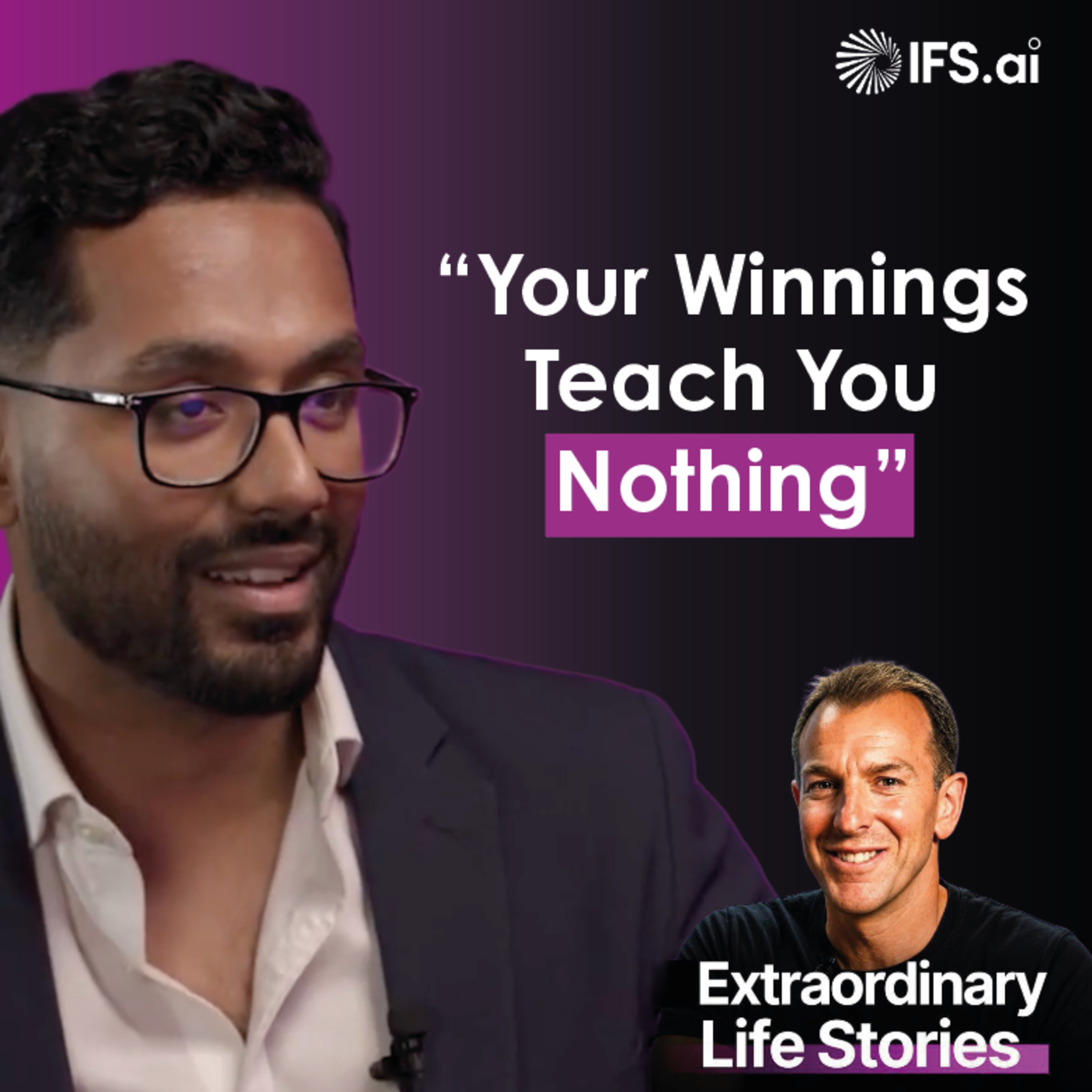
Anmol Goel discusses how scarcity-driven ambition shaped his career, why “winnings teach you nothing,” and his mission-led approach to investing via a family-office-style platform. He also outlines strategies for backing diaspora founders, cost-arbitrage manufacturing, and women’s sports/entertainment—potentially including fractional ownership of sports infrastructure.
Born/raised in West Delhi, India (Janakpuri area); moved to the UK at 9.5. Worked hustling from age 13–16 (mowing lawns, babysitting, charity runs, Primark). Taught himself trading and coding; built first company at 17, second at 19; exited at 20. Later became a beta tester for OpenAI’s early GPT and worked with Bard/Gemini; built a venture platform reaching 50M+ by 24.
Motivation shifts from “push” (family trials) to “pull” (legacy). Failure teaches; luck doesn’t. He emphasizes fail-fast and cash-flow obsession. He invests based heavily on founder “why” and hunger.
Refreshing to confirm his first six-figure exit; losing 60k in sports betting; sleeping on friends’ sofas in London after cash dropped; buying houses for parents; investing in women’s sports access and discussing fractional stadium/infrastructure models.
0:00Look at Bezos when Bezos wasn't the Jeff Bezos or Musk wasn't the Elon Musk. They weren't waking up to red light therapy and then sitting in the sun for half an hour and sipping on juice. They would wake up and they were like emails, letters, meetings. Tell me, who is Anmol Goel? I would say a kid with a dream. There's a hunger and a drive. I can feed it off you. But there's also a lot you've already achieved. I want to go back to the kind of the young version of yourself that grew up in a room with five people in it, right? You know, in life you have a pull or a push motivation. Sometimes when you've gone through certain trials and tribulations, separation in the family, which sort of happened in my case, it's a lot of the push.
0:35You're running away from something. You had that exit at 20 years old. Do you now have money? How did you feel and what did you do? I clicked refresh once. It was still there. I clicked refresh the second time. You know, it was still there. And I was like, this has really happened. If you are really, truly determined and you want to be the best, you don't want to be good. You don't want to be great. You want to be the best. One, it takes something. Something needs to be wrong with you. There needs to be a screw loose. But it takes massive copious amounts of sacrifice to get there. And that's what that entails.
1:08It's great to share that. You better learn to fail fast. Don't be afraid of failure because failure is the only thing which will teach you to get better in life.
1:27Anmol, welcome. Thank you very much, John. My pleasure. Tell me, who is Anmol Goyal? I would say a kid with a dream. You know, a short backstory would be someone who came from India to the UK when he was nine and a half years old with lots of hopes. And ever since then, he's worked hard to get somewhere. And he's now trying to make his name in the family office and investments in the tech world. and maybe now that I'm sitting here, maybe I've done a little bit of that. Oh, absolutely. Always on a journey, right? Yes, sir. And I've done a huge amount in 25 years. I want to capture that because there's a hunger and a drive.
2:05I can feed it off you. But there's also a lot that you've already achieved. And I want to go back to the kind of the young version of yourself that grew up in a room with five people in it, right? Talk to me about that. Yeah, so I grew up in India, an area near Janakpuri. Maybe some of you viewers might know it. It's a very small area, West Delhi, where at one point the average person would earn about$600 a year. So I grew up there, five people, my mom, my dad, myself, my brother and my nan, one bedroom house. And, you know, I saw my dad and mom working tremendously hard, multiple jobs. Dad came here and he brought us here.
2:41And even then, you know, the sort of the middle class struggle didn't really end. You know, money was always a topic of contention on the dinner table. So that kind of motivated me of just wanting to make money. I think, you know, people always say, like, what pushed you? Like, what do you really wanted to do? And I was like, I truly just wanted to make money so I could help mum in that out. Like, that was the only thing that I was trying to do, which led me to start hustling and working when I was 13 and 14 years old. Did everything from mowing the lawns to babysitting to charity runs to working at Primark till sort of turned 16 at the age where I started learning about trading.
3:21Ran into it randomly on YouTube, taught myself how to trade and taught myself how to code. From that, built my first company at 17, took that to hedge funds. Wasn't able to exit it, but got great feedback. and then at 19 built my second company. I grew that to six figures and ended up exiting that when I was 20. So then sat in my dorm room wishing and wondering, what do I do with this sum of money? And a small movie night of Wolf of Wall Street later, I realized that investment banking might be the calling, which it kind of is and isn't, was at the same time, I would say. It taught me a lot of things about capital raising, structuring, financing, networking.
4:07But I think the climate of it was very different to, I think, where I feel like I thrive. I realized I needed a lot of people and I'm the lucky or unlucky year of 2021, 2022, where during COVID, I wasn't really getting exposure, right? The time I was interning both at Marsh McLennan and JP Morgan, I think I went to the office once in a period of like four or five months right and then i think the second thing i realized about myself was like i hate taking orders from other people so which led to me to pursue some further studies i enrolled into a course at harvard taught myself uh well the course was called uh innovation and entrepreneurship taught myself more about innovating a lot more of the entrepreneurial side of things and uh during that time again ran into open ai right so again i don't know if it's luck or hard work or whatever you want to call it.
5:03Ended up getting onboarded as a beta tester in the team four months before GPT went live. So the first iteration of it. So worked on that, did a lot of backtesting, did a lot of breaking of existing code of seeing what makes things tick, what doesn't. Ended up doing the same at Bard. Bard is now Google's Gemini and eventually came back to the UK and built out a venture platform, which long story short, I grew to 50 million plus when I I was 24 and things started to plan out. So much there, Anmol. There's so much there. I want to pick up on the fact that that time during COVID could have been really difficult for you, but the mindset and the habits that you'd created before that, just like from starting out mowing lawns and so on, to just be constantly hungry and vicious.
5:50It feels like there's never a chance for you to sit still and be willing, because you're just constantly innovating and evaluating all the time. I'm not good at working for someone else. so seek more knowledge yeah seek education and then take that into what what can I do have I got that right yeah yeah no absolutely I think you know in life you have a pull or a push motivation right the pull is something is attracting you towards that you have that a lot of times connotation of positive motivation whereas sometimes when you've gone through certain trials and tribulations separation the family which sort of happened in my case it's a lot of the push you're running away from something uh which you know only in the recent years i as i started to learn more about myself and earned enough money that i could take catch my breath right before that it was just like run run run try and make fight or flight fight or flight exactly right so i i learned about that mechanism so in that time whatever would it take for it to work right i was trying to do it so in that moment i i didn't even know what exactly i was trying to do but the goal was just to increase the value in the bank account um and somehow it worked so that's interesting because i was going to go there next that kind of scarcity or abundance mindset so when you were growing up back to that that young version of you where ultimately probably looked around uh and those those conversations that happened around the dinner table if you like were about the lack of funds the lack of money so you're looking at the fact well if i can make money I can have a better life a different life and I can look after my family yeah and so I want to take you to that time where you clearly then set about making money and you had that exit at 20 years old so you now have money how did you feel and what did you do so I think it was a very strange feeling I remember when he first said that he will wire the money and I remember speaking to my housemate about it he's like mate he's he's chatting BS he's not gonna do it he's not gonna do it and i was like yeah i mean like i'd essentially built up code i was trying to sell properties the the vision was never really even to build a company essentially the company that i built was a ui of scrape data from right move and zoopla scrape data from gov.uk website and bank apis which would show in which given postcode which properties are below market value what the current mortgage rate is you would allow you to do certain calculation it would show yield and it will show pricing and how much you can make.
8:14So for me, as someone who was very computational and data-led, I didn't think it was something that big. So when someone, and again, coming from a household where pocket money was like 10 pounds, 20 pounds, and conversations was about two, three, 400, maybe a thousand pounds, a six-figure sum was a really, really huge amount. So when it landed in my account, I remember sitting there for the rest of the day and I was like, just refreshing. I clicked refresh once, it was still there. I clicked refresh the second time, you know, it was still there. And I was like, this has really happened. So then at that time I was like, right, how do we figure out how to double it?
8:53Which was sort of straight away, I was like, okay, the next target. And I think this is your advantage or disadvantage as someone who's ADHD. I was like, you don't really feel the feeling of accomplishment. You're like, you achieved it, okay, what's the next goal? So as soon as the six happened, you were like seven. You have to go to seven, right? You hit 100-something K, now it's got to go to 250. Then 250 has got to go to half a million. The half a million has got to go to one million. So I immediately started planning on that. And then my next venture was trying to basically build a tool which would do sports betting.
9:25And it could automatize it, do small bets, scale over it, build a Gaussian theorem, which is using Gaussian theorem, which is a math theorem, um you know which is able to put six cent of your money in and no bigger trade and then calculate that out and um with that I ended up losing 60 grand so ended up coming all the way back down after making a and then I purchased a house which was a I guess a half decent investment but on the cash on cash side I came all the way to zero right which is which led to me when I started building this third company and I you know did my course at Harvard and started working I went back to sleeping on the sofas.
10:01So I moved to London, I started working and then I was like, okay, now my cash is zero. Even though I had an asset as a real estate asset, but I didn't see that as an asset because it wasn't liquid. I couldn't see in the bank account. All right. So for me, I was like, okay, I'm back. I'm back to ground zero. Now I got to build the cash again. So I spent when I came to London seven weeks on sofas of my friends trying to build my third company, which was the eight figure valuation that I took to. So it was always that. And then even now, sometimes when I'll buy out assets, even though the asset value has gone up, I'm like, no, what is the free cash flow level?
10:34All right. And continue to develop that. This episode is brought to you by Indeed. You're ready to level up your business, but the pressure to find the right person to make that happen is intense. Indeed Sponsored Jobs can help carry the load. It boosts your job post to help but reach quality talent fast. Cut through the chaos with Indeed Sponsored Jobs. Get a$75 sponsored job credit at indeed.com slash podcast. Terms and conditions apply. Hiring now? Then this is a job for Indeed Sponsored Jobs. Your sausage McMuffin with egg didn't change. Your receipt did. The sausage McMuffin with egg extra value meal includes a hash brown and a small coffee for just$5.
11:16Only at McDonald's for a limited time. Price and participation may vary. Promotion pricing may be lower than real pricing. So do you see that 60 grand loss as a seriously important part of your journey? Because ultimately there's a humbling, there's a grounding, because a version of animal that could have been quite arrogant, because the next one could have been a success and the next one, and then you're like, I'm good at this. Yeah, yeah. Which you clearly are, but we learn so much from things that don't go right. Absolutely. And I think this was the biggest thing which I learned, that your winnings teach you nothing, right?
11:45You can only learn from your losses. When you lose something, that's when you realize you've done something wrong and how to make it better the next time. When you want something, you could have gotten lucky and it hasn't taught you anything. So I actually preach in my team, like anytime someone is new, I'm like, you better learn to fail fast. And don't be afraid of failure because failure is the only thing which will teach you to get better in life. So I have that big philosophy, like I will fall on my face 20 times, but I'll get up 21. Fair play. So how would you define success? I think success is pretty much just that, right?
12:18It's refusing to accept defeat. You can lose the battle, but not the war. And eventually, you know, you continue hearing that no, you continue hearing that no, and that gets you one step closer to that final yes. And that's what success is, right? That's what the milestone is. And once you get there, then, and I think success itself as well, further than that is a journey, right? You might get there in your business life, but then what about personal life, right? and what about relationships without something else so just building on that failure realizing that being your biggest critique yourself is okay right then and just learning from that and getting better every single day I think for me that's success yeah appreciate that you mentioned really early when you first sort of said who you are about wanting to make money to where to look after your parents and I know that's quite a big part of Indian culture yeah So I also know that through the success you've had of making money, I want to know when you did that and how that's kind of almost like being received by them and how you feel about that.
13:21Yeah. No, like the first thing that I did and in every trips that I do, I just buy my parents everything. I don't like to buy for myself because I feel like there's nothing monetarily which makes me happy until I see someone that I love, you know, smile. So my mom now, she's partially retired. She does whatever she wants. she travels i just took her out for her 50th birthday to italy i'm taking her out to singapore at the end of the year i just sent her to india right now she's you know seeing family uh dad as well i'm taking him out this year to vietnam and cambodia earlier in the year sent him to india before that paid for my dad's car um i shouldn't be saying this because it's going out loud but i i bought two houses uh in dubai one for my mom one for my dad so that's sort of my biggest purchase um you know i still don't own any house under my name but that's for them you know um so yeah i think that's the biggest thing for me i appreciate you sharing that because i think the ambitious animal it wasn't about buying the bentley yeah it was about um giving back yeah it was about uh perhaps correcting what was always talked about as a negative like well actually let me let me let me see what i can do and i think um i really value this part of the conversation because that lack of ego and you have to have an ego yeah to be driven and motivated and so on but also you mentioned the adhd so i mean you're stimulated to the next thing anyway it's not it's not they're not about the goal it's all about the trophy yeah if you make x amount of money at the end of next week you've moved on to how you can make more yeah and i'd love to segue into that because the 25 year version of you that's got so much experience and perspective i feel like you've got a great vision facing for us and we're in this disruptive time with ai and so on and so i'd love to know what you're working on and where you think things are looking in terms of the sort of perhaps um investment particularly in family office structure i'll quickly say a point to that and then and move forward i think the way i say is like i want to make a lot of money to prove it that it can be done from someone who came from my background um and then say it's not everything like i want to earn it not the sake of because i love money but just to say that anyone who comes from my background can do it right someone who came from a background like myself whose parents combined back before 2010s didn't earn you know more than a thousand dollars together and now I get paid you know more than a couple thousand bucks an hour to get to speak all right I make more than double sometimes triple the annual in combined income in an hour you know what they used to make so I want to sort of do it to show that if I can do it I know I'm no one special you you can as well so that's the that's the aim there like i i want to hit the billion i want to hit the trillion right just because everyone said i couldn't do it and i want to get there and i and i just want to distribute it out there um inspiring to others basically pretty much right i mean that that's what i want to try and do um what i'm working towards right now it's kind of assembling into that um so family office when typically people think of the structure is it's a investment management arm of a single family or multiple families who have done quite well.
16:28Then they put the pocket of money into something and they try and preserve the wealth. That's the traditional concept of family office. I think the way I've structured is a little bit different because I've got there four decades before most of the people who get there. So I was kind of like well if I just go on like you know third gear and driving you know like 40 miles an hour for like 50 years of my life I'll be bored out of my head so I got to do something else so my concept is a little bit more of a mixture between a sort of a conglomerate a holding company which acquires plus a family office so or like a wider asset management platform where yes we're trying to get into all of the asset classes from venture, private equity, hedge funds, real estate, entertainment, sports, but also looking at it from a perspective from the private side of how can we bring value out in such an extent where money is a secondary thought, right?
17:28And then on top of that, the focus is I only want to be involved in companies which are going to change the world for the better. Mission led. Mission led, massively, right? Because again, And maybe it's just the way I am. Maybe it's the wiring. I don't know the exact answer, if you may ask. But it's like, when I die, I want to be remembered for the next thousand years. And I don't want to be remembered as someone, oh, he put in$10 million and made 50. There'll be hundreds of thousands of people who have done that, right? I want to be part of that legacy of like, he was the one who backed this company when no one else was going to.
18:01And that company's changed lives of 100 million people. And he was the reason behind it, right? He was attached to this mission. He was attached to this mission. And this mission has lived on for the next 100 years. So through that mission, Anmol and his values are always living on. That's sort of my goal. That's the ethos behind the investment scene. And then to just double click on that further, three of the strategies that I am really focusing on within the family office, because we have two managing partnering families as well. First one is investing in diaspora or immigrant founders, especially, you know, from my side, Indian diaspora founders, where I've seen there's the hunger that, you know, that comes in from that.
18:43Right. It's it's not visible, you know, on on on the sheet of paper sometimes. But when you look at the the past results of what the diaspora has created, it's astonishing. So I want to back those guys who came from similar background to myself and are capable of doing incredible things, but they just don't have that confidence yet. So that's one of them. Second is obviously doing a lot of the cost arbitrage, getting into manufacturing stuff. So I love AI. I've done a ton of AI investments, but I am now starting to pull back on that AI. But not because I think it's a bubble, but I think the market cap and the valuation has gone too high.
19:28And it's kind of not making logical sense to me anymore. So on that private equity side, we're essentially looking at two things. One, we're seeing, OK, well, there is labor cost advantage in countries like India and Bangladesh. So let's manufacture it there and then ship it into Europe and US to manufacture and have a stronger foreign trade policy relationship there. And then on the other side, it's essentially doing what's called roll ups. So we're looking at anti-AI companies. And this could be your RV parks. This could be beauty parlors. This could be construction companies. This could be senior care living facilities where these companies are imperative and AI is not going to disrupt it in the sense that if your wife needs to go for a bridal ceremony, what's AI doing?
20:17Nothing, right? Your pipe breaks in your house. What is AI doing? Nothing. So these are cash flowing companies. They've been around. But what we're looking for is operators above the age of 65. So these guys, they've been running these companies for 10, 15, 20, 30 years. and the next generation doesn't want to take over it. So they have two choices. They either shut it down or they try and sell it to someone who's going to continue building that out, pull it together and continue to grow it from there and give them a fair exit, which they deserve. So this is on the second side. And then on the third side, we're trying to get into, on the sports and entertainment side, a lot of women investments.
20:57As we've seen, women's sports doing fantastically. and we see there's a massive opportunity there so everything is sort of led in some sort of impact plus ROI way the all three things which I'm trying to construct super interesting I'd love to just ask you on that I'm quite close to people that are really interested in the trajectory of what's already happened with women's sport but also the fact that there's an opportunity to do it completely differently yeah to how it's been done so rather than just the fact that the Red roses and the lionesses have won their respective world cups and everything's on the map now and you know people are going to watch women in their games and so on and then just copy the playbook yeah that's been done by men there's a chance to do it completely differently are you involved in any of that this episode is brought to you by indeed you're ready to level up your business but the pressure to find the right person to make that happen is intense indeed sponsored jobs can help carry the load.
21:53It boosts your job post to help it reach quality talent fast. Cut through the chaos with Indeed Sponsored Jobs. Get a$75 sponsored job credit at indeed.com slash podcast. Terms and conditions apply. Hiring now? Then this is a job for Indeed Sponsored Jobs. Your sausage McMuffin with egg didn't change. Your receipt did. The sausage McMuffin with egg extra value meal includes a hash brown and a small coffee for just five dollars only at McDonald's for a limited time price and participation may vary promotion pricing may be lower than real pricing yeah so we're trying to look a lot from from the media perspective right so if you see what has become the currency uh for Gen Z which is my generation and the upcoming generation which is Gen Alpha and then what will be in the future Gen Beta attention has become a currency right so you have to now learn how can you monetize that in a way which will give back dividends to people who are shareholders to that.
22:52So for that, we're having a look, okay, well, how can we democratize access? So if you look at right now, women's sports isn't televised as openly, isn't as accessible, right? Also, ticketing platforms, also merchandise, also trading cards, also games, like all these kind of things which sort of comes into the retail and media side of things it's massively limited and that was the reason when there was an implosion I mean obviously internet activity also massively increased but in the 2000s which led to men's sport becoming so lucrative and everyone who invested in the early 2000 is now exiting for like a 20x multiple and I think there's the same opportunity there with the with the women's market and an additional thing and and this is something I sit on the fence of is fractional acquisition of infrastructure.
23:47So the, and, and I'll tell you why I sit on the, the, the fence for it. So that's something like there's, there needs to be a stadium build, let's say for 10 ,000 people capacity, right? Which is kind of what right now we're projecting where most women's sports, like congruent watches, how many they'll be able to get during the season. something like that when it needs to be built i mean cost of that is three two hundred two to three hundred million give or take maybe a little bit higher a little bit lower depending on where you're building you can democratize that access to the general public of who wanted to invest it's almost like if you look at platforms like crowdcube yeah right they gave access to a revolute and other large companies at a certain point so those who are women players women supporters families and so on and so forth if that can be fractionalized let's say smallest check is half a million uh sorry five thousand pounds well you can get a lot of those guys right so the same capacity you have 10 000 people putting in 5 000 each well all of a sudden you have five million right and and and you have 50 million and and so on and so forth so that is an interesting way the way I'm sitting on the fence is because when it starts to then get institutionalized decision making becomes really difficult um so what sort of share allotment you give to them how and and also another thing is the average joe doesn't understand about liquid markets and illiquid markets and when they need an exit uh and you know if they might be putting their last five grand into something so that's where things become slightly difficult so it's one of those ideas where I'm like if I look at the pros it's something which is super exciting but there's also a lot of things when it comes to infrastructure where things can go wrong things can delay I mean in our country HS2 being the biggest infrastructure example so that's why I'm on the fence here but if done right I think that's also another super super cool way where you know we can we can give that infrastructural advantage as well to the up and coming women's sport yeah fascinating I'm interested to see how you go about that, because that's a real moment in time where you can get this really right or you can make a load of mistakes.
26:01But either way, it's exciting. It's what humanize you. There's a chap here that's bright-eyed, still ambitious, with that kind of desire to not just make money for yourself, but to have that legacy, if you like. So much is talked about with the entrepreneur that works every hour of the day and makes no time for anything else. And you've already said you're taking your mum away, your dad away, and I love this. And I just want to know how you sort of bait that in early. Because it feels like there's a contentment to you and an understanding to look after yourself. Whereas countless entrepreneurs, including people that have sat there, that are talking about success they've had in the culture, the hustle culture, where they've worked every hour they've got, but then they didn't spend time with their family.
26:45Yeah. I think, look, I wouldn't lie and say that I've been good at it. I think there's often and more often than not the darker times of me missing something. So, for example, you know, I ended up missing my dad's birthday, ended up missing, you know, I mean, I'm missing my own birthday. I miss Diwali. So I'm a Hindu. I miss Diwali, which is sort of our version of Christmas. So there has been those moments where I should have been somewhere and I wasn't. and you know I think me and a lot of other entrepreneurs understand that that is the sacrifice that it takes or you can't have it all you can't be there ever present and then also run you know a multi-million well billion dollar operation right it just doesn't work those two don't go hand in hand something has to give so this is my way of just being like what truly makes me happy yes I want to be successful yes I want to have this legacy but ultimately why am I doing that for so oftentimes and I struggle to do and I'm trying to get better I try and take a step back and go well I'm doing this for the family I'm doing this for the people I love about so let's actually take them somewhere where we'll have fun what I try and do in certain cases is bake it in with something else so when I was in Italy I was speaking in a conference so it was a two-day conference so on the final day of the conference i decided to bring my mom so she got to see me speak on a stage in front of like 300 people and then i extended that with two extra days so then i took her around you know in lake como we went hiking we went on the boat we tried all the pizzas and the pastas and similarly we're like when i'm in india when i'm going to see family i'll go in let's say for a week trip and then i'll make a couple of days for the family so i think i I try and balance it out in a way because otherwise my conscience feels really bad.
28:40I feel like if I'm not working 24-7 and if I'm taking time off, which I know is not unnecessary time off, it's important time off. But I think I'm just wired in such a way that I just go, no, like you need to be working. You need to be working. So to not feel that guilt, I anchor it to something which is work related. and then my bonus is, you know, my reward incentive is I get to see the family, I get to spend time with the family. So it's that sort of mechanism, right? You know, you might get motivated to say, hey, if you win this race, I'll give you a five or I'll give you a chocolate. But that's sort of the kind of thing that I'm trying to lever.
29:16I like it. There's a lot of learning from that as well. There's a conscious decision you're making to make that effort and to plan it in rather than like that could compromise route one. I've got to be on my A game for my talk. no distractions you can you could you brought that in early which is something i i try and do with my yeah my family you have to make that judgment where it could be a distraction or or not but making the conscious decision to make time the other thing is uh there's countless people that talk about the success they have alongside getting up really early in the morning having a routine where they run a marathon at four o 'clock read a book yeah meditate yeah where are you with that absolutely no and and actually this is a conversation that i've had with quite a lot of my friends who are multi-million dollar execs and ceos and i think where the average or goes wrong is they see what the lifestyle these executives have now right now that they've made it now that they're worth 100 200 million billion dollars that's the lifestyle which is now you can't copy the lifestyle which is now to what it used to be so i would always say look at what they were doing when they were when they had nothing that's wrong exactly look at bezos when bezos wasn't the jeff bezos or musk wasn't the elon musk what were they doing they weren't waking up to red light therapy and then sitting in the sun for half an hour and sipping on juice they would wake up and they were like emails letters meetings like it was bang bang bang bang bang and and that's how i am like from the moment that my eyes open to the moment my eyes shut, I'm on emails or calls.
30:50Like if I show you my phone, you'll see call logs at 1am, 2am, 3am, 6am, 9am, 10pm. Like there'll be days where I'll take 18 to 19 meetings. I'll do 20 hour days because that's what just needs to be done. And, you know, of course I'll have also those weeks and times where I'll, you know, take some time off. I'll, you know, be on a beach, you'll be a bit more relaxed and I'm doing all the nice cool stuff which i'll put on my instagram but that's not the that's not the reality of it right so anyone who's watching this thinking okay this is what i have to do i'm like no no no you have to look at what they were doing when they were building and once they've done that set then you can afford to do that otherwise you're just trading your time um for that balance which i guess if that's what they want which is also fine right i mean um there's a multitude of those people who are happy making a couple million bucks, right?
31:42Which is, again, a very good number as well. But if you are really, truly determined and you want to be the best, you don't want to be good. You don't want to be great. You want to be the best. One, it takes something. Something needs to be wrong with you. There needs to be a screw loose. But it takes massive, copious amounts of sacrifice to get there. And that's what that entails. It's great to share that. So you've got that. You've got that mindset. You've built those habits. And again, the mindset to be animal. You back other founders. You back other entrepreneurs. What are the values that you now value as a leader that you look for in someone else?
32:23Yeah. I think the biggest thing is I like to find out what the why is. You know, like what is driving them? What is the background and the why behind the person? And I've invested in founders in maybe 12, 13 odd countries, five continents. I've never invested in someone who I haven't gone and met myself. I'm very old school in that way. I like to see what's driving them. What is their vision? Where do they want to take this? And how hungry are they? Again, if you're a founder who likes to start his day at eight, finish it by five, six, great. Good for you. Not that I have anything against that, but I'll never invest in you.
33:02I want to see that they have that hunger. Like if I'm sending them something at 7 p.m., they're not saying, yeah, I'll get back to you tomorrow midday. Or, you know, if I'm sending something on Friday, it's like, yeah, we'll figure out it on Monday. I'm like, he's on it. Right. And what is driving that, you know, and what is his or her vision? Do they just want to make a company which is for the sake of it? They're trying to solve their own problem, their community's problem. There's a bigger vision to it. How do they foresee that? What is the big idea that they have in mind? How are they planning on impacting the world?
33:34What part of the world are they going to fit into? Or if they're going to fit into, they're going to make something of their own, which is going to be even bigger than that. So that's what I look for. And then after that, it's all the technical jargon where my team would come in and look at the machine learning aspect or look at the user aspect and financial aspect, which is equally as important. And I would put 50 % of the weightage on that. But 50 % of the weightage would just be on the founder and the team and the mindset and the why and the hunger. This episode is brought to you by Indeed.
34:03You're ready to level up your business, but the pressure to find the right person to make that happen is intense. Indeed Sponsored Jobs can help carry the load. It boosts your job post to help it reach quality talent fast. Cut through the chaos with Indeed Sponsored Jobs. Get a$75 sponsored job credit at indeed.com slash podcast. Terms and conditions apply. Hiring now? Then this is a job for Indeed Sponsored Jobs. your sausage mcmuffin with egg didn't change your receipt did the sausage mcmuffin with egg extra value meal includes a hash brown and a small coffee for just five dollars only at mcdonald's for a limited time price and participation may vary promotion pricing may be lower than real pricing that was my next question oh it's really interesting to know that yeah i want to finish on legacy because i i haven't said this with you until now but i felt like the timing of meeting you now and the the fact that there's so much potential with what you could go on to do and the fact that you want to like you're clearly super ambitious in a very non-arrogant way and i want to know what that legacy would look like if you could achieve one key thing to make a difference to make a change what would it be i think when i was 15 i i wrote this on a piece of paper and i still have it in my mom's house in birmingham and uh i wrote two things on it the first line of that reads I will be the first ever trillionaire in the world and then a second line of that wrote I will open 100 schools 100 hospitals and 100 rehabilitation centers so for me those two things would be legacy for me so just you know again going back to the point which I raised about reaching somewhere which just isn't supposed to be possible for someone like me who came to a country who didn't know the language whose parents were working multiple jobs an hour i you know i grew up again in a rough area in birmingham most of the the friends that i had in my primary school and early stage of secondary school they're either sitting at home they're in the jail they're pregnant they're you know that that's where things are right so i i wasn't supposed to be here it was against um the the norm right so so getting everyone to get there right and then the second aspect is like i want that to be my legacy that building other schools which i think education is super important hospitals again super super important and and rehab centers um you know a lot of people are struggling going through a lot of problems uh men women and just want to be able to sort of support that so i want that to be my legacy and those to continue running for eons well huge you know make it happen right what a what an amazing legacy to make happen I will ask you is not forget about me and I'm another another chat when you're either part way towards it or when you've done it but I back you to do it Amal you've got an amazing energy about you and as a busy man thank you for making time to come and talk to me no it's it's really been my pleasure and I really appreciate you bringing me here and challenging me in some of those things and getting it really out of me because oftentimes when you're in the middle of these things you you sort of forget your why or you sometimes you know things are cloudy so when someone outside asks you that then it's it allows you to refocus a little bit so i i really appreciate you
37:38We'll see you next time.
37:54holiday song like all I want right. Okay, we can't afford that. You know what? Forget the music budget. We're going to stick with whatever's in the public domain. Give it a try at mintmobile.com slash switch. Upfront payment of$45 for three months,$90 for six months or$180 for 12 month plan required. $15 per month equivalent. Taxes and fees extra. New customer offer for initial plan term only. Greater than 50 gigabytes may slow when network is busy. See terms.
In this episode of Extraordinary Life Stories, John Reynolds sits down with Anmol Goel, an entrepreneur, investor and family office founder whose journey from a one-bedroom home in India to building a multi-million-pound investment platform is anything but ordinary.Arriving in the UK at just nine years old, Anmal grew up watching his parents work multiple jobs to support their family. Determined to change their circumstances, he started earning money at 13, taught himself to trade and code at 16, built his first company at 17 and successfully exited his second business at just 20.But his journey hasn't been without setbacks. From losing £60,000 on an investment to sleeping on friends' sofas while rebuilding his next venture, Anmal explains why he believes "your winnings teach you nothing" and why failure is often the greatest teacher.We explore his approach to entrepreneurship, his experiences working with OpenAI before the launch of ChatGPT, his views on the future of AI, and his ambitious vision for investing in businesses that can genuinely change the world. He also discusses the opportunities in women's sport, backing immigrant founders and building a legacy that goes far beyond financial success.Perhaps most remarkably, Anmol reveals the ambitions he wrote down at just 15 years old: becoming the world's first trillionaire and opening 100 schools, 100 hospitals and 100 rehabilitation centres.An extraordinary conversation about ambition, resilience, family, failure and the importance of never forgetting your why.
Extraordinary Life Stories is proudly sponsored by IFS.ai

Scan the code with your iPhone camera
Listen in the app.