Ask ChatGPT

 Extraordinary Life Stories
10 Oct 2026 · 37m · 14 chapters
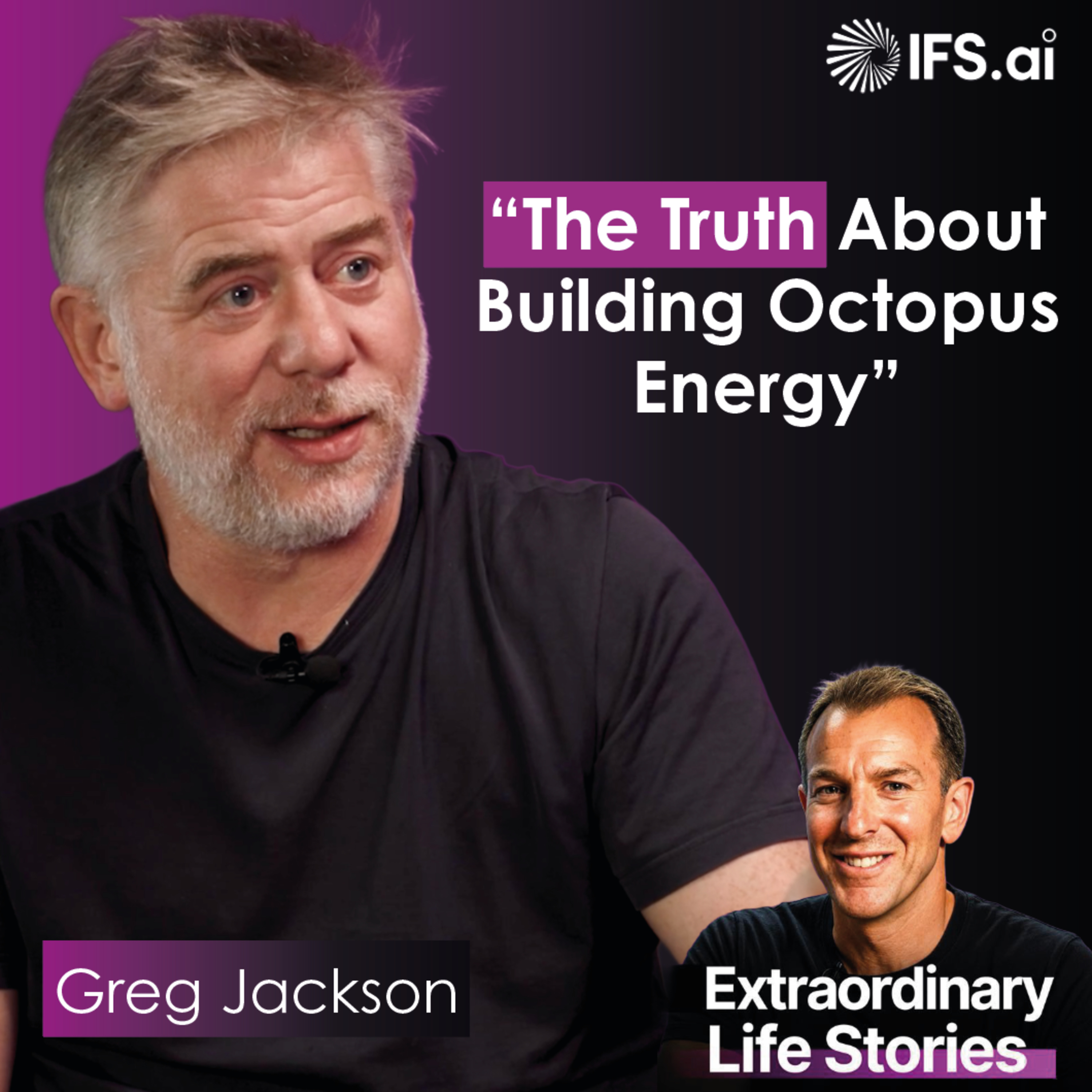
Greg Jackson, founder of Octopus Energy (and Kraken within Octopus), discusses entrepreneurship, leadership culture, risk management, and how AI is being used in energy customer service amid AI and superintelligence concerns.
Greg Jackson is an entrepreneur known for building Octopus Energy into a company employing just under 12,000 people (and collectively ~13,000–14,000 including Kraken). He previously co-founded an enterprise software business in 2003 and worked at Procter & Gamble for four years.
He’s “risk averse” (no gambling, no public-company investing) but takes calculated business risks; success is ongoing, not declared early. Leadership should prioritize group goals over ego/corporate politics. Octopus uses AI to improve service, not just cut costs.
As energy bills spiked, Octopus rapidly increased AI-written customer-service emails (about 45% by May 2023; ~9% answered without human). Early AI “invented” a nonexistent product and sold it to 23 customers before detection. Octopus holds frequent “family dinner” culture sessions and rarely hires senior outsiders.
Written by AI. May contain mistakes.
Discussion about Greg Jackson's background as the founder of Octopus Energy.
“If I'm going to do big things, I've just got to do them.”
Greg shares his childhood experiences that shaped his entrepreneurial spirit.
“Computers generally, you know, anything kind of gadgety.”
Exploration of Greg's early interest in technology and programming.
“Computers weren't very powerful, so to get them to make a game that was fun, you had to do a load of technical tricks.”
Greg reflects on lessons learned from early business endeavors.
“we started a business that built enterprise software.”
Greg discusses the inception and vision behind Octopus Energy.
“Yeah, so I think that bit about taking action, I've enjoyed being an entrepreneur.”
Greg talks about the importance of taking risks in entrepreneurship.
“You only need to have a plan for the distance you can change.”
Learn about the importance of leadership focused on team goals and values.
“I show leadership outside of Octopus in tune to talk about the issues that affect our customers, affect businesses, affect investment in the country.”
Explore strategies for maintaining a positive company culture during rapid growth.
“Well, I think we employed just under 12 ,000 people.”
Understand how to prioritize family, health, and career for a fulfilling life.
“These are blanket statements, but I love it when people are humble enough.”
Discover how personal definitions of success evolve and the importance of fulfillment.
“Yeah, no, I think, look, it's fine for people who do.”
Learn how companies can thrive by focusing on long-term societal value rather than short-term profits.
“I'm inspired by there's a guy called John Kay who wrote a book called Obliquity it's well worth reading for anyone who's in business.”
Explore how AI is transforming customer service and the operations of energy companies.
“And there's probably a chance to bring AI into the conversation.”
Understand the importance of self-awareness and pursuing personal happiness in entrepreneurship.
“You've got to learn not to let those drive you.”
Discuss the evolving nature of work and the role of mentorship in entrepreneurship.
“There's a sort of mentoring, giving back element to you that probably will transition at the right time where you'll get fulfillment from that.”

Get the gist, explore an idea or ask about something said.
 Claude
On Extraordinary Life Stories, what are the key points of this episode?
Searching your listeningAutomatic transcript. May contain errors.
0:00I worry enormously about the threat of AI. I don't think my cat has any idea how smart humans are. It has no idea what we do when we leave the house and come back and feed it. And in the same way, I don't think we understand what superintelligence will look like. Tell me, who is Greg Jackson? I'm known for being the founder of Octopus Energy and as a result a big tech company called Kraken. How big is Octopus now? Well, I think we employ just under 12 ,000 people. I want to make things better. I don't like being told what to do and I don't like rules when they're wrong. So that's pretty disruptive, right?
0:33And also brave. What I don't want to do is every moment of every day being designed to deliver an objective. I've enjoyed being an entrepreneur. And the interesting thing is once you've been an entrepreneur for a while, you're probably unemployable. If I'm going to do big things, I've just got to do them. It's like skydiving. Just choose. Are you going to jump out of the plane or not? But you can't sit at the door thinking about it. how is AI changing the landscape for you as a business and the overall industry? We dominated this planet for good and for bad only because of our intelligence. When there's something more intelligent than ours, we genuinely have to think hard about this.
1:06I think in the short term, we're beginning to see ways in which AI can be very, very useful in companies like ours.
1:23welcome hey thank you for having me my pleasure tell me who is Greg Jackson in some ways I'm known for being the founder of octopus energy and as a result a big tech company called Kraken but really I'm someone who is quite irreverent I want to make things better but I don't like being told what to do and I don't like rules when they're wrong when did that start because you had an early journey into entrepreneurship 15 years old yeah maybe I mean but those early influences that perhaps influence that whole I don't like being told what to do but want to make an impact want to make a difference yeah well I mean everything for me stems from I guess my mum you know my mum and dad got divorced when I was about eight had a younger sister and a much younger brother and I don't remember David had a job so one of the ways that she made things work I mean she went and got a job she studied to improve our lives but one thing that she did was she gave us a lot of responsibility very early and so you know I remember her sitting me down and saying the government give me this like two pounds a week or something you know to buy food and clothes for you and I'm just going to be direct to you and from now on you buy your own clothes you're doing your own washing and things like that and for example I didn't care about clothes so I saved the money up and used it to buy little bits of electronics and and learn to do things in computing prioritizing yeah exactly choosing like you know how much better is it while I'm getting clothes to be able to do that kind of tinkering that I learned so much from so that tinkering was computer games?
3:01Yeah. Or programming? Computers generally, you know, anything kind of gadgety. So you were drawn to tech is where I'm going with it. And so it sort of talks to me from that early interest is one thing, but then to actually grow something the size you have, I just want to know that sort of transition. Well, again, I think there's a couple of things going on from the background there. I mean, one was because we were kind of brought up without much, without much, you know, without any privilege, but without much material stuff, I didn't ever have a sense of that's what mattered in life. Instead, rather than feeling you had to do something conventional, I felt I had total freedom to do whatever I wanted, to pursue the stuff that was interesting, stuff that could solve problems.
3:47That's what I found with tech, it solves problems. It could solve problems and stuff that was enjoyable. So for example, I guess, yeah, my first thing was writing video games. But was that always with the mind to make money out of it? What I mean by that is you're enjoying it. So you were doing something that was a passion and fulfilled you. But I'm wondering where that transition came to where you're with me, where it turns into I can make a living out of this. It was something about making money. In fact, nothing I've ever really done has been about making money. It has, and by the way, if money is a byproduct, that's great.
4:22If it's an enabler, you know, like if you're going to get investors, you need to be able to make them money. So it enables you to do all the other things. But for example, back then I was obsessed with just writing the best code that had ever been written. Computers weren't very powerful, so to get them to make a game that was fun, you had to do a load of technical tricks. The interesting bit was I had a really big lesson from that because one of my... In fact, the first game I was commissioned to write, the code was, if anyone looked at it, elegant, beautiful. really efficient but the game was no fun to play and so it didn't get published and so i didn't get paid and i really did learn a lesson there which is uh you know look i really wanted that enjoyable process of writing the game but if you're not going to get paid for it if you're not if you can't earn a living then it was you know i couldn't do it anymore no interesting and also that being good at one thing there's other moving parts to it so the code was was brilliant beautiful But the game wasn't playable so the whole thing ultimately doesn't go anywhere.
5:29In business, it doesn't matter how great you think things are, it's about your customers. And I think it was that moment that I learned that everything is in the customer. And I meet great businesses. For example, I was talking to an artisanal food business and they were talking about the need to educate customers. I was like, well, first of all, find out where your customer is. if you can make great products that they already love, you've got a greater chance of success than hoping that you can change them, i.e. be where your customer is. It can take them on a journey. You can understand things they don't.
6:05But you have got to be able to find customers and will buy your stuff. This episode is brought to you by Google Chrome. You think you know a browser, but Gemini and Chrome, that's new. It can help you with practically anything on the web, like restoring a vintage motorcycle from a 50-page restoration block or finally break down that long article you've had open for weeks. Gemini and Chrome is here for it. Ready to make anything online make sense? There's no place like Chrome. Check responses set up required, compatibility and availability varies 18+. It's really powerful. And how many businesses don't do that or get that wrong because they're not engaging with their customer base even before they've started to find the why, if you like.
6:45So with Octopus, the early vision, if you like, and the desire to go into energy? Where did that come from? I had a series of businesses in different sectors. But ultimately, tech was kind of like, you know, the core. And in 2003, with some co-founders, we started a business that built enterprise software. And we worked with really big companies, building technology that could make them more efficient, more responsive to their customers, and more agile. What we observed was when we helped a big company with this stuff in an incumbent sector, it was nowhere near as transformative as when you saw more modern companies that were very agile and grew to scale.
7:27What you realised was that fundamentally we were adding, hopefully, really good software into a legacy organisation. And actually what you needed to do was reinvent the organisation. So we came up with the idea that we could build an entire technology system from scratch, a bit like Shopify if you've ever seen it, but Shopify for big corporates, so that you could move the whole company onto an agile, purpose-built software system that would enable them to behave like a modern tech company. Anyway, we went and pitched the idea to utilities because, you know, utilities globally are a$3 trillion sector.
8:11They're largely running on systems that are 50 years old. And their inefficiency means that they have often overcharged customers. They provide poor service and they can't keep up with technologies like solar power, batteries, electric cars. So we could solve all this. Those utilities said to us, well, this all sounds good. that someone's got to do it first. And we began to think, well, maybe we'll do it first. Maybe we'll build our own energy company, built the way that we think it should be, you know, like Amazon or Uber or whatever. They weren't built by people from the industry. They were built by people from tech.
8:51That's what we would do. And so we started Octopus. So that's pretty disruptive, right? And also brave. I really want to champion you for that because that bravery that goes in entrepreneurship and pioneering something where there was an archaic, if you like, and proven system that had been working, you come in and go, I've looked into this and I can see how to do it differently and then take the action. Yeah, so I think that bit about taking action, I've enjoyed being an entrepreneur. And the interesting thing is once you've been an entrepreneur for a while, you're probably unemployable, right?
9:23I mean, not entirely, but I'm not sure how many big corporates would want me and I'm not sure I'd want to do those jobs. But that does give you this kind of freedom to think about, like, you know, if I'm going to do big things, I've just got to do them. And I used to spend a bit of time with friends, you know, and chatting about all these things. One of them kept saying he was going to start his own business. And after two or three years, he kept thinking, there's just one more thing before I do it. One more book to read, one more podcast to listen to. Exactly. You know, one more business plan, whatever.
9:53And I said to him, look, mate, you're either going to do it or just give up kidding yourself. You know, be an entrepreneur, but not a one-trepreneur. Or carry on with what you're doing, because it's totally fine. Anyway, the next time we went out for curry, he said, well, I've done it. I've set my own business. And I must admit, I felt this terrible sense of nervousness and responsibility in case it went wrong. A year later, he was like, this is the best thing ever. I'm never looking back. And I think it almost doesn't matter what you're doing. It's choosing whether you're going to, it's like skydiving.
10:27Just choose. Is he going to jump out of the plane or not? But you can't sit at the door thinking about it. No. It's great advice. And there is a dopamine that comes with the risk-taking, if you like. But you had calculated, to a point, I always think of it as a jigsaw puzzle. You haven't got all the pieces. There may not even be any edges. But you can see enough. And you can back it. That's it, backing yourself, isn't it? And you were prepared to do that. I'd love to know. It'll take you back. Those sort of almost those early challenges or things that might have been perceived as failures. that you look back on now that were almost like the making of you and an octopus?
11:00Yeah, well, I think, first of all, just on that jigsaw puzzle, I mean, I think I like driving in the fog, right? Indeed, it's like going on a long journey. If you want to drive from here to, like we're in London, if you want to drive from here to Newcastle, you're going to be heading broadly north. You don't need to work out every turn before you set off. You certainly don't need to know which parking space you're going to take in Newcastle. You know, if you overthink it, it's a waste of time because as soon as you hit the roads, there's going to be roadworks, traffic jams, accidents. There's also going to be nice things on the way, right?
11:32You know, as you wander off, you suddenly see a nice little cafe and decide to pull in. So I think that, you know, with business, it's like know where you're going, but you only need to drive. You only need to have a plan for the distance you can change. And by the way, if you know your direction, you can always say, like, Newcastle's amazing. In fact, I'm just going to keep heading north and go to Aberdeen. And that's how you build amazing businesses. Now, back to experiences for me, I guess I learned so much actually working with large companies. Because what you found was that this desire to overthink and overplan things, to answer every question before you start, meant that they either never got started, and what we saw time and again was they'd get out-competed by more agile rivals, or they would get everything in place, and by the time they set off, the world had changed and it was out of date.
12:31And that really, really kind of motivated, it made me think so hard about how do you build super quality at scale rather than kidding yourself about the plan. And the last thing you talked about there I think was taking a risk. And it's really interesting. I don't know about other entrepreneurs. I'm massively risk averse. I don't gamble. When people are putting a bit of money on the World Cup or something, I don't do any of that. I don't have any money in publicly traded companies because I've got no special knowledge there. I'm actually really risk averse. What I like about running a business is I get to make my own decisions every day.
13:19In fact, if you're an employee, you're essentially dependent on the decision being made by your bosses. So again, I feel kind of, for me in some ways, that's riskier than what I do. Yeah, I like that. So without being a control freak, you have the control rather than investing some money into something over here and then hope it does well. That also brings leadership values into this conversation and you're a proven leader you know you from this point of the conversation you've just set octopus up to the point where we're sitting here now where it's did you say a third of the country i think 28 or so yeah it's huge so i'd love to just ask you this point what your core values are in leadership yeah so i think uh first of all you know i i did for a period work in a corporate i worked at procter gamut for four years i loved working there I learned an enormous amount and most of what I learned was very positive but I also learned something I didn't want to do and I think um on leadership people get yeah there's tons of training available there's tons of course on it and books on it I think if you're leading for your own purposes your own goals ultimately like it may or may not work but I find that far less satisfying than leading in order to fulfill the goals of the group of people I lead and it's bigger than you yeah and beginning but it's in their interest right you know I think you can use the powers of persuasion and leadership to do good or to do bad and as a leader in many ways you know your choice is I think a hugely important one and I hope that for me that you know I lead a large group of people at Octopus.
15:03I show leadership outside of Octopus in tune to talk about the issues that affect our customers, affect businesses, affect investment in the country. I don't have to talk about that, but I choose to do that because I think we can do better than we do today. That's great. I love that because there's a vulnerability piece that's often not talked about where you're prepared to front up and be honest. And actually that team element, I love the fact you brought that up because it's almost the same question. So by bringing the team into leadership, I'd love to ask you what you're looking for from the people to join you on that mission.
15:37What are the values that they've got that allow you to then be the leader that ripples that out? So something I think about sometimes, I hate corporate politics. And we can all say that. And yet it's endemic in so many organizations. And if you define it, I think it's when people are promoting themselves against the interests of either the company or their colleagues. And I think for me, what I look for is people who will put the interests of their colleagues, their customers and the company first. interest. Now, I don't ask them to do stuff against their interest, but it's so important to align all those things.
16:27And what it means is that, for example, if you've got a management team, but it applies at every level and every chunk of an organisation, they don't need to look out for themselves because they know that others are not trying to stab them in the back. They know that others are there pushing in the same direction. You can still disagree but you disagree publicly in principle with the right objectives in mind and if you don't win you disagree and commit our famous phrase but you know the idea of having a team that are not supporting each other you know I'd hate that. This episode is brought to you by Google Chrome.
17:11You think you know a browser but Gemini and Chrome that's new. It can help you with practically anything on the web, like restoring a vintage motorcycle from a 50-page restoration block, or finally break down that long article you've had open for weeks. Gemini and Chrome is here for it. Ready to make anything online make sense? There's no place like Chrome. Check responses set up required, compatibility and availability varies 18+. This episode is brought to you by Nordstrom. For 125 years, Nordstrom has been part of your story. The stylist who found the perfect outfit for your big interview. The first pair of walking shoes for your one-year-old.
17:46The tomato soup you shared with your sister at the cafe. These are the moments that make Nordstrom, Nordstrom. Big or small, we're here for all of it. Celebrating 125 years with new moments still add. Discover it all in Nordstrom stores and at nordstrom.com. No, that's a proper culture to instill, which comes from the top. It's a fair play to you. How big is Octopus now? Well, I think we employed just under 12 ,000 people. It was more because we also built a company called Kraken within Octopus, which we've just emerged. So collectively, 13 ,000 or 14 ,000. Big number, right? So for you to, and I share this without in any way your level of responsibility and the journey you've been on, I share that whole, I can't stand the whole political politics, if you like, that go in the corporate world.
18:35So how have you managed that? Because you set out to manage that from the beginning, but you still are. at this stage. I'd just love to know how you manage that and stop other people around you, the ego coming into it or the money turning heads and so on and then them changing. It doesn't always work perfectly all the time. And that's fine. It's great to admit that though, right? Yeah, but you have to deal with it. It's like the broken windows thesis that if you've got an area of town where some windows get smashed, unless you repair them quickly, more windows will get smashed. It kind of... Sets the precedent.
19:09It sets precedent. It creates permission for the bad thing. And in the same way, you know, when I receive pockets of it, and hopefully one of my colleagues see pockets of it, we deal with it quite quickly so that it doesn't become endemic. Recognising, you know, at one point, COVID, as far as we know, a small number of people in China, I remember the original news reports, and the pace at which that viralised the entire world and closed the world down was unbelievable. So when things start small, you have to take them seriously. A couple of things we do, though, are perhaps unusual. So every single Friday, we get the whole company together for what we call family dinner.
19:46We're not family, it's not dinner, so the name's probably wrong. But the idea really is, I talk for half an hour, 45 minutes, I host it, there's a lot of people talk about what we've done that week, and it helps keep us together as a culture. We'll talk about innovations, great things we've done for customers, and so on. We'll talk a little bit about the negatives, but mainly it's about the stuff that we are great at and that we want to stay great at. And that's a really important part of our week. So I think a lot of companies might do a town hall every quarter, but that frequency drives our culture.
20:18By the way, to be really precise, one week we do the whole company across the world, the next week we'll do countries, next week we'll do teams and we'll go back to the countries. Anyway, global, sorry. Right. And the other thing that's very unusual is we very rarely recruit very senior of people so uh from within yeah i i do we provide from within but particularly among for example the leadership team uh you know we grow the leadership teams the company grows because i'm very conscious that what what's very tempting is you say now we need to find a new director of whatever who's done it before and you bring them in and they you know the first i see it all the time you'll have a job interview where they'll say um oh wow you know i really want to work at octopus love the culture what you've done is amazing and then they start and on day one they go like wow this is chaotic we've really got to change these processes and i'm going to bring in some people from my old company before you know it you're not octopus anymore you're wherever they used to be being recreated and there's a reason that they joined us there's a if you love us because of what you see from the outside, you can't come in and change the inside.
21:29It's great to show that. Also, there's an element of the fact that they're coming in wanting to prove themselves and do something different when actually just for the sake of doing something different, if you've already got something that works, that's not the right thing to do. It's ego again. These are blanket statements, but I love it when people are humble enough. So when they do come in a senior role, instead of day one writing a massive post on LinkedIn and on Slack, that's the internal communication channel, or whatever saying, here's all the things I'm going to do and what I'm bringing to the company.
21:56And there's a lot of pressure on people to do that. A lot of companies like it and they think it's leadership. I want them to come in and just quietly observe and learn because, look, we're not perfect. We've got a lot right. And I want them to know about that before they question it. That's a good shout. I want to humanise you. It's so clear you love what you do. There's a whole passion to you. And I can see the twinkle in your eyes still. I can't imagine you retiring. but the journey you've been on from the early years to sitting here right now how have you prioritized your both physical and mental fitness yeah there's something called the four burner theory uh which is four gas burners on the stove although by the way um induction hops are better but the um uh yeah you've got friends family uh career and health um and you don't have enough supply to keep all four of them on full all the time and I genuinely think you know like you end up choosing where you put the balance so for me I've got two sons I'm not with their mums but they're top priority ahead of everything else because they didn't choose to be born they didn't choose to be born in you know to someone who's got this career and and so enabling them to have to know they're loved and to know that their top priority is number one.
23:21And then the rest is genuinely tuning between them. So I once read a great book. I briefly raced motorcycles badly. There was this book written by an amazing rider. The forward was by Chris Walker. And he said, if you want to race motorcycles, we need to talk about injuries. Look at your fingers. You're going to break them. Your toes, they're going to break. Collarbones snap. All this stuff. He said, at the end, he said, if you're still reading this, then you're probably fit to be a motorcycle rider. And in the same way, I think I once read something he said, if you want to be an entrepreneur, look at your family, look at your friends, tell them you'll love them and tell them you'll be back in 20 years.
24:00And in a way, you know, these are very extreme statements. But the point really is recognizing the sacrifice. So with my friends, I don't see them anywhere near as much as I would like, but I stay in touch. Every now and then we get together and it's fantastic. And there's one or two I see all the time that keep me mentally straight. WhatsApp groups have been an amazing invention for long-term friendship maintenance, by the way. And then aside from my sons, I don't see my family as much as I would like, but when I do, I make it special. Every year I book a big house for holidays and then have friends and family come and we spend great time together.
24:40And that's memory making, right? It's memory making. It's super high quality. And it kind of compensates the fact I'm not there. I mean, both ways, you know, and it's genuinely wonderful. And it maintains the closeness we need even without seeing as much. and then on health you know I probably run that one way too ragged now the reality is I you know I've certainly always been very very very robust but as you get older definitely your body lets you know it needs a bit of attention and at one point I went to see a doctor and he said well my job is to get you to the point you can retire and still be healthy enough to survive so I don't optimize on it but I want to make sure I'm going to be all right what works for you though because there's so many books, podcasts where people are saying, you know, to be successful, whether it's them talking or all the algorithm of like successful people got up at four in the morning, read a book, run a marathon.
25:34Where are you with that? I don't do any of that, no. It's refreshing to hear that. Yeah, no, I think, look, it's fine for people who do. We're all different people, right? I get up every morning reasonably early, but the first thing I do is have a bath. And the reason I have a bath is I can multitask. I get clean while I kind of gently wake up. and typically listen to the radio or a podcast. So I'm just easy in my way of the day. It's a lovely way of doing it. I cycle a lot because it's a great way of getting from A to B in a big city like London. When I'm traveling, you know, I tell you what, even cities like Brussels turn out to be amazing once you start cycling around them.
26:11You can't do it by bike. Yeah, I did, yeah. But also it gives me fresh air and helps keep fit. I've never been able to convince myself to put aside the time to do fitness properly. Yeah, but I like the fact that you're building it into the routine because to be the entrepreneur that you are, you live and breathe your business. You're still hands-on as the leader, right? But you know that the fitness element, it got you here rather than an Uber, which could have been the easier option. So I think the fact that you consciously are doing that, I also think it's, I've used the word refreshing already, the fact that you're not sort of out there trying to prove all that concept of smashing fitness and so on and you still look really healthy with it.
26:46The passion and the fulfilment is key, isn't it? Well, back to those four burners. I mean, genuinely, and it is passion for me. I want to be happy. What I don't want to do is every moment of every day being designed to deliver an objective. What I do want is the entirety of my life to deliver the things that I will find fulfilling. And you sometimes hear nurses saying, people who've worked with people when they're dying, saying people in the deathbed never say, I wish I'd worked harder. I've got to say, I'm worried I might say that, right? Because, you know, look, the opportunities we've had to have a positive impact are phenomenal.
27:28And I definitely don't want to get to the end of my life and go, I let myself down, I let everyone else down. I always like to ask what the definition of success is. You've been so successful in what you're doing. I was just wondering if that happiness, which we're all striving to achieve, you seem to have achieved that. But how would you define success? First of all, I often say that I definitely don't think I can declare I've been successful yet. I can say I've had lots of successes. So there's definitely a lot of things our company has done that have made a long-lasting impact on people, on customers, hopefully on the environment, on energy costs, through cracking on other companies their ability to the you know helped people I'm really proud of that but there's um yeah we talked about risk aversion I don't gamble but there is a song by Kenny Rogers who died recently then he sadly but uh uh called the gambler in which he says you never count your money while you're sitting at the table there'll be time enough for counting when the dealing is done and it's not about money it's not about gambling but but it is about you know life throws all kinds of things at you and I don't think you can declare success while you're still in it.
28:47That's brilliant to share that and on that parallel in the business journey as well you've had to ride through so many unforeseen you know COVID springs to mind and all sorts of political uncertainty particularly in the last few years and how have you managed that? I'm inspired by there's a guy called John Kay who wrote a book called Obliquity it's well worth reading for anyone who's in business. He describes, in fact, the subtitle is how our goals are best achieved indirectly. And what he says is like, you know, companies that set about with a mission that is more fundamental to society than simply, for example, making money are more likely to deliver long term value for their shareholders as well as for society.
29:32And one of the drivers of this is if you're doing stuff that is, if you're just chasing short-term profits, as soon as the world changes, whatever you do is not going to be valuable anymore. But if you deliver stuff, if you focus on building stuff that is of underlying value, when the world changes, it's still valuable. And so I think, you know, for example, we've just always been focused on how do we use technology to drive down the cost of energy, deliver better service, and speed up the energy transition. And it kind of doesn't matter whether COVID happens or an energy crisis happens or whatever.
30:10Those fundamentals really apply. And in fact, if anything, they apply more than ever. You know, if you look at energy crises, the work we've done, we were already focused on how do you make energy less expensive? I can't say we've been successful at that yet, but we've had some impact. That mattered before, but it really matters during these energy crises. You know, how do you speed up the energy transition? we've just had obviously we've had the hottest summer on record you've seen wildfires in Britain but especially across Europe, a huge natural disaster driven by climate that stuff, it doesn't matter what's going on in the short term that stuff matters and I think that having a if you're looking far enough in the distance hills look like molehills This episode is brought to you by Google Chrome.
31:03You think you know a browser, but Gemini and Chrome, that's new. It can help you with practically anything on the web, like restoring a vintage motorcycle from a 50-page restoration block, or finally break down that long article you've had open for weeks. Gemini and Chrome is here for it. Ready to make anything online make sense? There's no place like Chrome. Check responses set up required, compatibility and availability varies 18+. This episode is brought to you by Nordstrom. for 125 years Nordstrom has been part of your story the stylist who found the perfect outfit for your big interview the first pair of walking shoes for your one-year-old the tomato soup you shared with your sister at the cafe these are the moments that make Nordstrom Nordstrom big or small we're here for all of it celebrating 125 years with new moments still add discover it all in Nordstrom stores and at Nordstrom.com.
31:56It's a beautiful analogy that. And there's probably a chance to bring AI into the conversation. You are a tech-focused person and business. How is AI changing the landscape for you as a business and the overall industry? First, I have to use the opportunity to say I worry enormously about the threat of AI. I don't, there is a high risk that AI can be so disruptive to our economies in a time that we can't incorporate it, it could lead to, you know, it could make the closure of the coal mines look like, you know, a small thing. And we need our leaders to be taking that seriously. There's also, you know, real risk that we don't know what super intelligence looks like.
32:43I don't think, you know, I don't think my cat has any idea how smart humans are. It has no idea what we do when we leave the house and come back and feed it. And in the same way, I don't think we understand what super intelligence will look like. It's changing so fast, right? Yeah. We dominated this planet for good and for bad only because of our intelligence. When there's something more intelligent than ours, we genuinely have to think hard about this. Now, we've put those things aside at the moment because they're too big for you or me to deal with right now, but I think it's important we acknowledge them and put them on the table for our leaders and those responsible.
33:23I think in the short term, we're beginning to see ways in which AI can be very, very useful in companies like ours, for our customers and for our team. So during the previous energy crisis, almost overnight, we started getting twice as many cores as usual. and they were much longer because people were struggling with energy bills so you know so challengingly and there's no way we could train enough team to be able to look after customers without rapid change of needs in the way that we've got reputation for and so we adopted AI very very quickly in customer service and you know by about May of 2023 about 45 percent of our customer service emails have been written by AI.
34:09The incredible thing is they get a higher satisfaction rate than those written by people because the computer, our team are amazing, but the computer never gets tired. It's got time to look at every aspect of an account and someone's history. So it's more likely to zero in on the issue quickly. And it's a surprisingly good empathy because it's not emotionally affected by what's happening. You've probably trained it to be that way as well. How you train the AI, right? It's all trained on our existing emails. So we've had one or two amusing things. I mean, one of them was we found in the early days the AI had sold a product to a customer that didn't exist.
34:45It just invented it. It invented a great product. In fact, because it is trained on emails, it trained itself and sold it to 23 more people before we spotted it. Now, everyone in the emails is signed off by the team, but what happened was the team trusted the computer more than themselves. So, you know, that was an amazing learning. By the way, I talk about this, like people in a lot of companies worry about this, oh my God, that's terrifying. It's like, look, it's 23. But we write, you know, as a company, we deal with half a million customers a week. These tiny little things you learn on the way are worth it to be able to do the big job well.
35:21But the other thing is, I mean, we're now at the stage where among some of our teams, I think 9 % of the customer service emails are now answered by AI without a human in the loop. and the AI doesn't just do sort of chatbot stuff, it carries out actions. So, you know, you might write in and say, you think you need a refund, and the AI will look at your account, it'll understand, you know, whether or not that's the right thing to do. If it is, it will send you a refund. And, you know, instead of having to wait, either typically a few hours or a day for a human to do that, it'll be within a minute or two.
35:59So, again, the computer's getting great satisfaction ratings and I think this understanding that you know this isn't about cost saving it's been about improving service and we were worried about introducing it to the team we thought the team would worry about you know is this gonna de-scar jobs jobless but actually the team have loved it because it reduces a lot of drudgery yeah of course a lot of admin yeah a lot a lot of high maintenance stuff but I suppose as long as the checks on the machine are in place if that makes sense to catch the 23 emails that went out and so on but You've obviously got that in place.
36:34Yeah. It's so interesting. And I think people always at this day are kind of nervous about what might go wrong. It's a really important thing about what might go wrong. It's really important to keep it in perspective because otherwise you don't do what might go right. Yes, so true. Which goes back to the measured risk-taking and entrepreneurship, which you've got right at the top. You're so interested to talk with. I want to end with the perspective, maturity, or the lived experience that you've got sitting here now, flipping it back to giving a young Greg or an aspirational entrepreneur that sees you as a role model sees you as someone they can learn from what advice would you give I think the first is know yourself I often speak to young people who have got aspirations and goals that are actually somebody else's right so you've got expectations from your parents from your grandparents but from friends, you want to look good in front of people.
37:28You've got to learn not to let those drive you. What you've really got to learn is what will make you happy. I learned so much. I was once sitting outside a pub with some friends just after we graduated. And most of them were lawyers. And one of them said, I can't believe I have to do this for the rest of my life and I said to him like I said to him back then I was being in my joyous career I said well you don't have to and he said I do my parents paid for this they put me through school and you're like oh my goodness like to spend the entirety of the rest of your life on a track that makes you unhappy that's appalling meanwhile by the way another mate um said uh also I said I can't believe I get to do this it's so easy I love it and and that's the point the same job different people do the one that's right for you will you ever retire yeah it's quite funny most entrepreneurs version of retirement is kind of carry on working just not uh yeah you step back right yeah but i mean i don't know one of the privileges of my job is i get to meet so many people who are setting up and running companies uh and you know if my version of retirement would be working with them rather than running them myself, what a great way to live.
38:46I like that. There's a sort of mentoring, giving back element to you that probably will transition at the right time where you'll get fulfillment from that. I've got no choice. I don't play golf. Well, you are a pleasure to talk with. I look forward to this conversation and I have loved it. Me too, by the way. Thank you so much.
39:09glazed, roasted, and edges perfectly caramelized? Sweetgreen's fall harvest is back on the menu, and the season's most overlooked little green vegetable is dressed to be devoured. You know what to do. Order on the Sweetgreen app.
39:27Fall never arrives all at once. First the air, then the light, and slowly the things you love begin to find each other. A jacket meets a dress. A hoodie slips beneath a blazer. An old cap finds a new scarf. Because you don't simply step into the season. You create it layer by layer until it finally feels like fall. Find fall your way at Ross.
What does it take to challenge an established industry and build a business that changes the rules?
In this episode of Extraordinary Life Stories, Greg Jackson, founder of Octopus Energy and Kraken, joins us to share the experiences, beliefs and decisions that shaped his extraordinary entrepreneurial journey.
From programming computer games as a teenager to building one of the UK's most recognisable energy businesses, Greg explains why solving problems matters more than chasing money, why understanding your customers is fundamental to success, and why taking action can be more valuable than having the perfect plan.
He also reveals his unconventional approach to leadership, explains how he has worked to build a culture free from corporate politics, and discusses the balance between business, family and personal fulfilment.
Looking ahead, Greg shares his thoughts on artificial intelligence, the risks and opportunities it presents, and why businesses should focus on creating lasting value rather than pursuing short-term profits.
His advice to aspiring entrepreneurs is simple: understand what genuinely makes you happy, stop living according to other people's expectations, and have the courage to pursue your own path.
Extraordinary Life Stories is proudly sponsored by IFS.ai