
 Ask ChatGPT


 F1 Beyond The Grid
13 Oct 2026 · 25m · 14 chapters
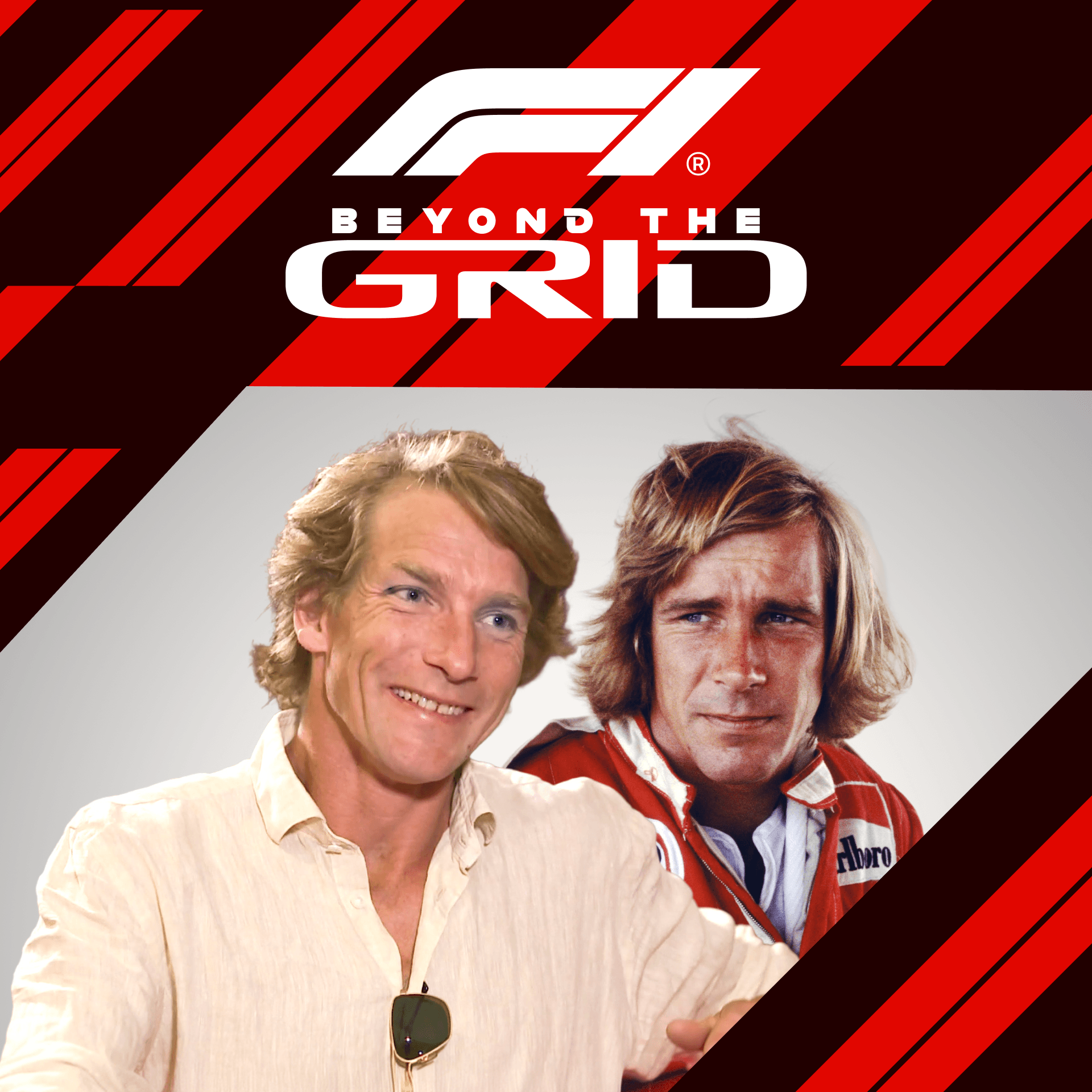
50 years since James Hunt won the 1976 Formula One World Championship with McLaren, celebrating his character, driving style, rivalry with Niki Lauda, and legacy in and beyond F1.
Freddie Hunt, James Hunt’s son (racing driver and TV presenter). Backgrounds mentioned: played squash (family sporting competitiveness), later started racing seriously at 19 after Goodwood; competed in British Formula Ford (from 2007), had an early Donington crash (“Hunt the Shunt Junior”).
Hunt’s standout quality was adaptability—driving quickly even with car problems (e.g., broken gear-stick knob in his first F1 race; understeer in 1976 after a hastily repaired car). He glamorized the sport and changed F1’s image. Hunt and Lauda were opposites but close friends; Hunt was safety-minded.
1976 Nürburgring restart after Lauda’s crash; cockpit redesign for Emerson Fittipaldi-sized fit; 1976 title decided by one point at Fuji amid Lauda’s near-missed restart; Hunt’s post-F1 BBC broadcasting career; Freddie’s own Donington spin that made headlines.
Written by AI. May contain mistakes.
Freddie shares insights into his father's character and racing style.
“50 years since James Hunt became Formula One World Champion with McLaren, we're celebrating one of the sport's greatest characters.”
Freddie describes the remarkable and controversial 1976 F1 season.
“I know you were only five when he died in 1993, but when you think of him as a driver, what do you think his standout qualities were?”
Discussion on Hunt's fierce competitiveness and adaptability as a driver.
“You know, he was top runner in his school.”
Exploration of the friendship and rivalry between James Hunt and Nicky Lauda.
“The way I do it, I just pretend I'm racing against my mates and I don't care where I finish.”
Freddie discusses key events and challenges faced during the 1976 season.
“I don't think Nicky was very impressed by that.”
Insights into the final race at Fuji and the dramatic championship conclusion.
“But at that time, everyone thought it was just a crash and he's burnt, but he's absolutely fine, apart from the burns.”
Freddie Hunt shares memories about his father's championship win.
“and he would have been able to see because he was struggling to blink.”
Discussion on whether 1977 was a better year for James Hunt than 1976.
“Do you think 77 was actually a better year for dad?”
Freddie discusses his childhood memories of growing up as James Hunt's son.
“That was Gilles Villeneuve's debut, wasn't it?”
Freddie recounts how he started racing later in life and his early experiences.
“I was focused on my own sort of path in front of me.”
Freddie shares the ups and downs of his first race experience in Formula Ford.
“But with your name, if you like driving, if you're good at it, you could probably make a career out of that.”
Freddie reflects on his career aspirations in Formula One and its impact on his life.
Discussion on Freddie's current life and interests after racing.
Freddie reflects on James Hunt's legacy in Formula One and beyond.
“Oh Fred, well it's been wonderful to chat look finally, when we talk about legacy what do you think is James' legacy?”

Get the gist, explore an idea or ask about something said.
 Claude
On F1 Beyond The Grid, what are the key points of this episode?
Searching your listeningAutomatic transcript. May contain errors.
0:022026 marks 50 years since an F1 icon became a champion. James Hunt. There's never been another driver quite like him. The story Nicky told me, they were testing one day and they had the track and Dad didn't come back round and so everyone panicked. I think he's had a shunt. And he set some quick lap times. He got bored of testing, basically, and pulled over and had a nap. He was outrageous. I think we can say that about the day, bro. He glamorized the sport, didn't he, really? And I think he changed F1 and sport in general. So he's well remembered. And I'm tremendously proud of him, what he achieved and how he achieved it.
0:53Hello and welcome to F1 Beyond the Grid with me, Tom Clarkson. 50 years since James Hunt became Formula One World Champion with McLaren, we're celebrating one of the sport's greatest characters. He was a one-off, flamboyant, fast, loved by fans and respected by rivals, particularly Nicky Lauda, whom he fought for the title in a remarkable season in 1976. After retiring from F1 as a world champion, with 10 race wins and 23 podiums, James became a broadcaster. He was as entertaining in the commentary box as he had been on the racetrack. He died in 1993, aged just 45. His memory and legacy live on through his son, Freddy, also a racing driver and TV presenter.
1:46In this special episode, Freddie and I talk about what made James great.
1:56Welcome everybody to this week's F1 Beyond the Grid, and I'm delighted to say we're joined by Freddie Hunt. Freddie, very warm welcome to the show. Thank you, Tom. It's a significant year because 50 years ago, 1976, your late great father James won the world title what does that anniversary mean to you well 50 years an awful long time ago it's amazing how the sports evolved you know since then I mean it really was just it was one of the most incredible seasons of the history of Formula One you know controversial and ups and downs and uh all sorts going on and that I think that whole era of racing was one of one of the best you know I'd love to break down the season in a minute but Can we just talk about the old man, first of all?
2:40When you think of James, the racing driver, I know you were only five when he died in 1993, but when you think of him as a driver, what do you think his standout qualities were? I think probably his adaptability. I think even times when the setup wasn't great, he managed to drive around problems. One, I think his first Formula One race, he won not a Grand Prix, it was at the race of champions here at Silverstone, I think, the knob of the gear stick broke off. So he did half the race with the spike into his hand. And then the British Grand Prix in 76, because of the very hastily repaired car after the first lap incident, they didn't have the setup right at all.
3:27Well, they couldn't, they didn't have time to. And he said in the interview afterwards, how was the handling of the car? And he said, well, it was understeering an awful lot to begin with, but then it gradually got better. And I think he just managed to figure out how to adapt his driving to still go quickly with a wonky car. Yeah, but and Freddie, fiercely competitive, right? Absolutely, yeah. Because the stuff I've read about your dad, you know, brilliant squash player. He played junior Wimbledon as well. Junior Wimbledon, champion squash. I mean, unofficial, I don't think, but he beat the Japanese champion, I've been told.
4:00You know, he was top runner in his school. Oh, I met someone the other day. who was the running captain at Wellington. And he said, your dad used to piss me off so much because he wouldn't turn up to a single practice run, training session. He smoked and he still bloody beat everyone. What I was going to say is that a fierce competitor, and actually was it the love of competition or the love of driving for him, do you think? Probably the combination, I think. he didn't know much about driving as a youngster growing up or anything because he was at school at Wellington when he went to watch one of his mate's brother at a race and that's when he decided he wanted to be a racing driver but anything he did he was competitive that was his nature What about off track then?
4:53As I've said you were only five when he sadly passed away what memories do you have of your dad? uh memories of you know at home bathgate road his voice mostly sort of stands out um uh that you know the budgerigars vivid memory of him lighting a bonfire in the garden and getting out of control and setting the silver birch tree alight uh that's quite entertaining in the middle of wimbledon yeah i know you've had your own racing career as well um how seriously did you try and follow in his footsteps? Well, I would say seriously, but I mean, I didn't start until I was 19 because I didn't know anything about motorsports.
5:33But equally, he was probably only 19 when he started. Yeah, a bit different in those days, because most people were. I was dead serious, but I think I was... Well, I know I put too much pressure on myself. I had pressure from... Well, perceived pressure from media and photographers and all that, and journalists, because I'd never experienced that before. But then I put a lot more pressure on myself, and I couldn't deliver. in competition at the beginning. It took me a long time to be able to get over that. And even now, I still have to deliberately, in my mind, get over the pressure. The way I do it, I just pretend I'm racing against my mates and I don't care where I finish.
6:10And that's when I can relax and drive quickly. But it took me a long, long time to figure that out. I watched a great movie, Hunt vs. Lauda, The Next Generation. You and Mattias. Yeah, I saw it. You saw there was a few mental issues there where I just couldn't, you know, clocked it up. Well, just an intensity from you that certainly wasn't in Matthias Laude. Yeah, Matthias is so relaxed. He's so cool. It's like, how can you be so cool, man? Yeah. Tell us about the making of that, I suppose, documentary. Yeah, well, it came about an Indian fellow called Jose. And he rang me up one day, or rang up my manager and said, this is what they wanted to do.
6:49Are you interested? And I said, yeah, great. let's do it why do you think Nicky Lauder and James Hunt got on so well I don't know exactly but I mean they are opposites and opposites you know often attract I think they they share the same sort of sense of humour and I think I don't know they just they were good mates so you know you say they're opposites so what Nicky's serious your father was more light hearted how were they opposite do you think well just their personality personalities, their character and their behaviour certainly as well. But I think, what was it, a story Nicky told me, that was it.
7:29They were testing one day and they both had the track and he said, James, I'm flying down. If you want to lift in the plane, you're welcome to, but make sure you're not late. I think Nicky was literally on the runway, just revving up the engines, about to pull up, about to fly off and dad arrives. I think he was a little bit hung over, gets in the plane and puts his music on, has a nap, and then off they go testing. And Dad didn't come back round. And so everyone panics, I think he's had a shunt. And he's set some quick lap times. And Dad got bored of testing, basically, and pulled over and had a nap.
8:04I don't think Nicky was very impressed by that. He was outrageous. I think we can say that about you, Dad, right? Well, what about 1976, the great season? As you said earlier, it had a little bit of everything. There was Nicky's terrible accident, obviously. There was a lot of politicking as well between McLaren and Ferrari. Some things never change, I suppose. Yeah, well, there's all sorts of tricks and games going on. I don't know if you ever had a check with Alistair Cordwell, the tricks he was playing with Ferrari and stuff like that. Let's start at the very beginning, though. So your dad had come into Formula One with Hesketh, and he'd done three seasons there.
8:40He then moves to McLaren for 76. Do you think he settled in very quickly or did it take him a while? Well, he seemed to. I mean, I think they only had a couple of shakedown tests before going to Brazil was the first race, wasn't it? And apparently Jochen Maas was saying, you know, obviously I'm my number one driver, I'm my number one. And Alice said, well, we'll see how we get on qualifying and that will answer the question. And Dad, you know, got poor position. So I think Dad was number one straight away, settled in. They had to sort of redesign the cockpit a little bit because it was built around Emerson.
9:14Who was much smaller. Much smaller, yeah. So I think Dad initially couldn't really fit, so they had to somehow make it bigger. I don't know how they did that. They couldn't make the footwell big enough. Do you remember he had to cut the toes off his boots? Yes, I think that was more in the Hesketh. Oh, was it more in the Hesketh? Yeah. I think by the time he was in the McLaren, he had toes on his... He had his toes, yeah. But they are tight, those cars. you know I'm more or less the same size as him and it's a tight fit so it took him until race four to actually get a win that was his first win but then well then it got politic again well exactly because his car was too wide which dad's response was he put a stick on the rear wing saying caution wide vehicle by an eighth of an inch or something it was too wide was he a political animal would he have seen the funny side of that would he?
10:04yeah of being disqualified no just of like Ferrari constantly politicking with what was FISA at the time no because he was well I don't know but he's a very serious person you know when it came to his work you know he might have always carried a smile on his face it seemed you know joking around but no he was dead serious dead serious it was one and a half centimetres too wide is that what it was yeah it was very little and it was only because the tyres the change of tyres didn't think to measure them the defining moment came at race 10 didn't it at the Nürburgring where where Nicky has his crash.
10:38What did it say about your dad that one of his best mates had had this very serious crash, yet he took the restart and then won the race? Well, they didn't realise that Nicky was in that kind of shape because he was standing and talking, and he was burnt, but they thought he's fine. It was only much later on after the race that they found out that actually Nicky's in a real pickle. He might not make it. But at that time, everyone thought it was just a crash and he's burnt, but he's absolutely fine, apart from the burns. I mean, Nicky hated the Nürburgring. He tried to organise a boycott and things like that.
11:13Oh, he did, did he? What was your dad's attitude to the Nürburgring Nordschleife? Probably something similar to Nicky's, because, you know, dad was very safety, you know, pushing for as much safety as possible. So I don't know the answer, but I imagined he was, you know, with Nicky. So I think they both stood, when it came to safety discussions, I think they were pretty in agreement. Did he get very nervous, your dad? I mean, reports of him vomiting before the start? Yeah, I think the vomiting, I think that was more an F3, or even Formula Ford, but partly because of the physical dangers of it, but also partly if he crashed the car, that would be game over financially because he borrowed the money to buy the car.
11:57So it was more of that, I think. By the time he got to Formula 1, And yes, he was still very highly charged with adrenaline and nerves. I've heard of people sitting on the car without the engine running, but it feels like the engine is running because he's just vibrating. To quite Alistair Caldwell, yeah. Do you think he thought of stopping when he understood the severity of Nicky's accident? I think it probably would have crossed his mind, but he hadn't won yet. He was determined to do that and he knew what the risks were and he was prepared to take that risk in order to achieve his goal. So, you know, when he did retire in 79, I know that Ronnie Peterson's shunt, fatal crash, that hit him pretty hard.
12:40And, yeah, Ronnie was a good friend of his. And, you know, in 79, he didn't have a competitive car and he wasn't prepared to risk his next for sixth place, I think were his words. But maybe at the end of 76, he did consider retiring. I don't know.
13:05Nicky only sits out two races, remarkably. Comes back in Monza. There are those amazing images of, you know, Nicky with a bandaged head and all sorts. I mean, I wonder how your dad dealt with that. Do you think there was an element of him thinking, I wish he hadn't come back? Or do you actually think he... No, no, no, not at all. Dad wanted to race against him. I think that's what he was saying on the phone. He wrote to me, you know, he said, get better soon because I need to race against you. Did they speak a lot? Oh, absolutely. Yeah, yeah, yeah. I think Dad was phoning him every day in hospital and writing to him.
13:39He was like, you know, cheer him on. Hurry up. Get ready. Come back quick. And then it all comes down to Fuji, doesn't it? Fuji, yeah. Yeah, wow. Wow. I think I heard the other day from Richard Wiseman, the archivist. He was saying that had Nicky managed to persevere a few more laps or they started the race a few laps later, it stopped raining and he would have been able to see because he was struggling to blink. That was the issue. It was almost, you know, he almost, maybe he didn't retire. And then I think dad said that he wished they could have shared the championship. They both deserved to win it.
14:16But yeah, they couldn't do that. That's actually a really nice thing to say to Nicky, isn't it? He had to make that pit stop. Yes. To change tyres. I mean, maybe a different tyre compound altogether, but Andretti finished the race on one set. Yeah. as other drivers I think as well but dad refused to cool his tyres so I think he cocked that race up and only just by the skin of his teeth so he wins the championship by one point can you imagine what the the celebrations were like afterwards catastrophic yeah it would have been a good one the journey home and then he goes into 1977 as the reigning world champion and we see it so often we've even maybe seen it this year with Lando Norris Lando maybe driving better this year than he did actually in his championship season.
15:04Do you think 77 was actually a better year for dad? Yeah, I think I've heard him saying he drove better. He was definitely more rounded. My history of that season isn't great. I mean, he won the British Grand Prix in 77, didn't he? Yes, I hear it at Silverstone. Exactly, yeah. That was Gilles Villeneuve's debut, wasn't it? Exactly, yeah. And he won another race. he won three races in 77 so nothing in 78 nothing in 78 my history is not that great 76 I don't know a bit about but 77 not much although I know the M26 wasn't his favourite car that M23 was so successful that was what 73 it came out yeah it was a long 7 then they swapped halfway through 77 from the M23 to the M26 yeah but he just couldn't quite fall in love with it it wasn't quite there for him and then of course your dad stays involved in Formula One through sponsors, that iconic voice that you mentioned earlier with the BBC.
16:05Did you start coming to races with him at any point? I did, yes. Vague memories. I think most of the time we were confined to the Morbro Hospitality bus to naughty little boys running around. Very vague memories. I remember there was a white picket fence around a marquee, I think here at Silverstone. or one of the hospitality areas. But all I was concerned with was catching the ladybugs on the bush. That was... I didn't give a monkey about the car, but I was tiny, you know. But it must be fun for you to be able to look through the archive now and at least A, watch the races from when he was a driver, but also as a commentator alongside Murray Walker.
16:46Yeah. I'm sure I remember watching a Grand Prix. I think I must have been staying in a friend's house or something and they had the Grand Prix on it. And then I could hear Dad talking. I feel like I'm talking to your dad now just the voice the look you're definitely James Hunt's son yeah no question no chance of post we've got him there
17:10and tell me more about what it was like growing up as James Hunt's son because there's certainly inside the Formula 1 paddock there's a lot of love for him such an iconic figure he won the championship you know you're a racing family why didn't you start racing till you were 19 because a lot of people in your position might have been put on a go-kart at the age of eight no but i was raised by my mom she knew nothing about um racing and her world was horses so it's natural that i i you know i grew up on on horseback uh uncle dave did suggest it once or twice do you want to go karting but i just didn't i was so oblivious to who dad was you know i know i know dad was a driver and He was famous and everything, but that just didn't really come into my mind.
17:55I was focused on my own sort of path in front of me. So what happened at the age of 19 that brought it more? That was just sheer sort of fate, I suppose. Popped into town to rent a movie. I was a little bit ill. I remember I had a chest infection or something like that. So I went to get a movie, went past the pub. I thought, hmm, I could sneak in for a quick one. Then bumped into a friend. and he said, do you want to come to the Festival of Speed tomorrow? It's Goodwood. So I said, yeah, I'd love to. And then they offered me a drive in a car, without a license or anything. I was pretending to be Jodie Kidd.
18:29It was her car. It was a Maserati GT4. I drove that. I think the Maserati guy thought, Christ, if he bins this, that's the end of my job. But I didn't bin it. I cruised up the hill, and I thought, wow, this is pretty cool. And the guy that I was with, my friend who was Jodie's boyfriend at the time, he was an ex-racing driver turned polo player. and he said, Fred, look, you're not a bad polo player but you don't have a farm, you don't have a horse breeding program behind you or millions, so you're never going to get that far without the horsepower, literally. But with your name, if you like driving, if you're good at it, you could probably make a career out of that.
19:04So I suggested you do that. So that's how it started. So it started at Goodwood and then I sort of learned through the movie I watched and doing a bit of research, there was a bit of Formula Ford as well. Yep, so I started 2007 the British Formula Ford Championship Yep. Did it come naturally? So the driving part, it did. I mean, the first few tests, I was really quick and I just felt comfortable in the car. And I didn't really, no one ever taught me how to drive. You know, the balance of the car, apart from what I learned in my arts test. So you didn't attend one of those famous race schools, the Winfield School or the Jim Russell School?
19:40No, it was all just instinctive, yeah. But I think that's where a lot of the pressure came from. So I had these tests, and then I knew I was fast. Faster than I should have been from my experience, on average. And then the word got around, and I knew that other people knew I was fast, so they're expecting me to be fast. And they got to the first race, and it was a shit show. It was at Donington. I think I spun and crashed. I qualified, oh, yes, it was quite a hell of a start, actually. I qualified about 18th which is a good second half, two seconds off my own pace I had the pace to be in the top four top five but anyway, I am quite good at clutch control again, don't know how to do it just natural I launched off the line at Donington everyone goes to the inside to cover the inside so left the outside open before the braking zone I'm already up to about P12 and then everyone brakes earlier I brake normally, I'm about P5, P6 now around the outside this is bloody great I'm thinking and then I just dip a wheel into the grass and spin into the pack and take out five cars it was going so well and yeah front page of most sport news look it's Hunt the Shunt Junior thanks guys Hunt the Shunt of course the old man as he was learning the ropes that was the nickname wasn't it did you get much support from I don't know manufacturers or anyone in Formula 1 no a little bit from Ford I think they may have wavered the entry fees for the championship I think I've got a got a few sets of tyres from Avon I think I think what else Ford lent me a car road car that was nice of them but that was about it and there's so many what ifs in life aren't there but do you ever sort of stop and think had you know were dad still alive can you do you imagine going karting together I don't really dwell on those thoughts no no no what's the point it's a waste it's a waste of energy yeah yeah yeah and is it one of your great sadnesses that it that it didn't work out in formula one for you or have you no you're totally no no i mean no i was it i was a bit up you know i was upset by it but i'm i'm very happy with my life and you know i just trust trust the universe that i'm going in the right direction i was on the right you know in the right place at the right time so so any budgerigars now for you no they don't produce enough eggs you can't eat them I have chickens I have chickens and ducks and peacock as well which disappointingly tastes just like chicken literally just like chicken I thought I was going to have a nice game bird here but no, boring Oh Fred, well it's been wonderful to chat look finally, when we talk about legacy what do you think is James' legacy?
22:33I don't want to sound too well I don't want to be too bold but I mean I think he really he glamorized the sport, didn't he, really? He had a significant impact in F1, I think, and sport in general. So he's well-remembered and it's lovely. And I'm always hearing new stories from people I haven't met before, like his running coach the other day. That was great. So I'm tremendously proud of him and what he did and what he achieved and how he achieved it. And with humility and integrity. So, yeah. He was much loved. Freddie, thank you very much for your time. You're welcome. Thank you for having me.
23:22Yes, James had humility and integrity by the bucket load. And it truly saddens me that I'm not able to sit down with him personally to reflect on his world title in 1976. All these years later, he's still much missed And Freddie, thank you Thank you for these memories of your dad You sound like him, you act like him And your mannerisms are like his It's almost as if James is sitting in front of me Thanks for your time And I hope you, like me, will be raising a glass to your dad On the anniversary of his title success next week Now if you want more on James Hunt F1 TV has highlights of the 1976 season and a documentary about Hesketh Racing, the rebellious team that gave James his F1 debut.
24:10Find those at f1tv.formula1.com. And on the Beyond the Grid podcast feed, you'll find interviews with that team's boss, Lord Hesketh, as well as other drivers whom James raced against. There are lots of stories about James for you to enjoy. Elsewhere, do check out F1 Nation for our review of the Singapore Grand Prix. James Hinchcliffe, Jolian Palmer, and I dissect Max Verstappen's brilliant maiden win in the Lion City. And F1 Explains is your place to go for answers to your questions about the sport. Thanks very much for listening. F1 Beyond the Grid is produced by Formula One and Audioboom Studios.
24:48Until next time, keep it flat out.


