
In short
Female Founder World Podcast Episode Summary
Episode Title
Business School Professor: This Is How To Figure Out What To Do With Your Life! (Suzy Welch)
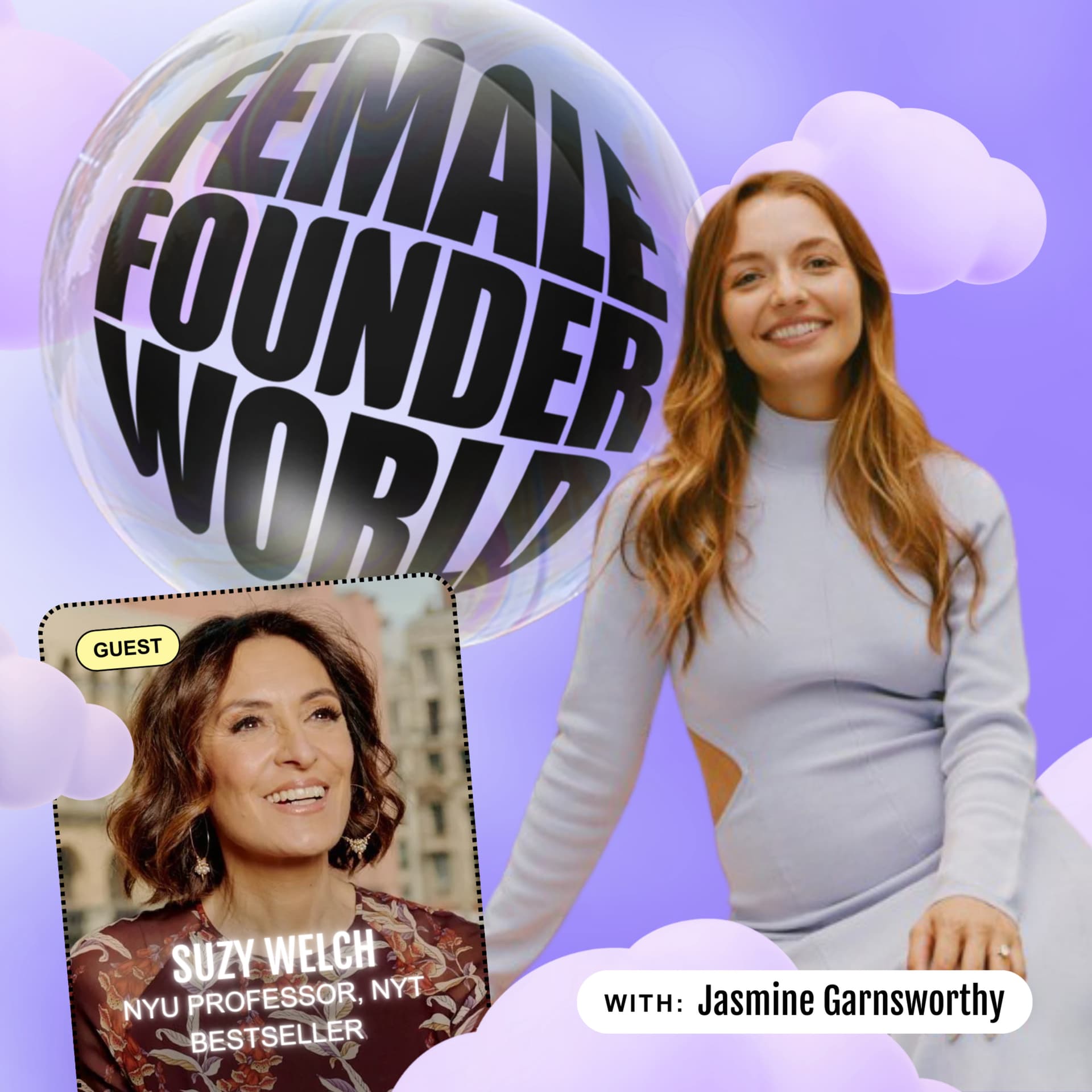
Episode Overview In this episode, host Jasmine Garnsworthy interviews Suzy Welch, an accomplished NYU Stern professor, bestselling author, and business expert. The conversation covers Suzy’s unconventional life journey, her insights into purpose-driven career discovery, and her latest research on Gen Z values.
Key Themes and Insights
Suzy Welch's Background
- Origins: Suzy grew up in Portland, Oregon, in a "hippie" household, which shaped her values and outlook.
- Career Journey: Her career trajectory includes:
- Working as a crime reporter for the Miami Herald.
- Transitioning to business journalism.
- Founding and selling a music tech startup.
- Teaching at NYU Stern, where she created the "Becoming You" course.
The "Becoming You" Class
- Purpose: Designed to help individuals identify their purpose, especially post-pandemic.
- Methodology: The class applies a systematic, science-based approach to career discovery, contrasting with spiritual or vague advice often offered elsewhere.
- Inclusiveness: The program caters to a wide range of ages, from 16 to 78, and is expanding beyond NYU, including applications in various sectors like recovery and venture capital.
Finding One's Purpose
- Three Data Sets for Self-Discovery:
- Values: Understanding actual values vs. perceived virtues.
- Aptitudes: Identifying true strengths and personality traits.
- Economically Viable Interests: Aligning passions with marketable skills.
- Immediate Questions for Reflection:
- What do you want people to say about you when you're not in the room?
- What did you love and hate about your upbringing?
- What would make you cry from regret on your 85th birthday?
Insights on Gen Z Values
- Finding: Only 2% of Gen Z's values align with what hiring managers seek.
- Gen Z Values:
- Eudaimonia: Self-care, leisure, flourishing.
- Voice: Authentic self-expression.
- Helping Others: Altruism.
- Hiring Implications: Companies need to adapt to these values or clearly communicate their own culture to attract the right talent.
Balancing Ambition and Family
- Personal Experience: Suzy emphasizes that it's possible to balance work and family life, advocating for commitment without daily second-guessing.
- Advice: Make decisions about work and family and stick to them without doubt, allowing for trade-offs and compromise.
The Impact of Online Presence
- Navigating Criticism: Suzy discusses the importance of developing a thick skin against online haters and maintaining a positive mindset.
- Authenticity: It's crucial for women, particularly in entrepreneurial spaces, to remain true to themselves while sharing their stories.
Recommended Resources
- Memoirs: Suzy recommends reading memoirs as a way to learn from others’ experiences and reflect on personal aspirations.
- Notable Mentions:
- "Them" by Francine du Plessix Gray
- Catherine Graham's autobiography about leading the Washington Post.
Conclusion The episode concludes with Suzy Welch sharing her journey of personal and professional reinvention and encouraging listeners to embrace their unique paths. The conversation serves as both inspiration and a practical guide for those seeking to align their careers with their values and aspirations.
---
This summary encapsulates the key points from the episode while providing insights into Suzy Welch's philosophies and methodologies for career discovery and personal growth.
Written by AI. May contain mistakes. Listen to the episode to check what was said.
Transcript
Automatic transcript. May contain errors.0:00Hey, business besties. Welcome back to Female Founder World. It's Jasmine. I'm the host of the I've ever had on this show. You are. I'm really happy to be here. I'm a mother of four and I've got three crazy dogs. How about that? Okay, well, I'm nearly a mother of two and that feels like enough for now. It is. It is. Okay, let's talk a little bit about your background and your history and how you got to where you are today. We've got some really pointy stuff to focus on in the show, but I want to talk a little bit more about your origin story and your background and how you got here so people understand who you are.
0:42Okay. Well, it seems relevant to say that I'm from Portland, Oregon. That's where I was born. I had a really kind of feral, earthy upbringing with two hippie parents. I mentioned this because my whole life is business now, but I mean, my dad was an architect. My mom was and still is an artist. And we had this hippie-dippie upbringing. And I just very luckily ended up getting sent away to a good boarding school because a teacher suggested it. My mom was like, hey, want to go to boarding school? And I was like, okay. So I ended up going to boarding school and then went off to Harvard where I fell in love with writing for the Daily newspaper and lacrosse and a boy, but it all worked out.
1:18And I ended up working at the Miami Herald as a crime reporter. I mean, life is crazy. Miami Herald was hiring and I was looking for a job. And I learned a lot about life and people that I'm really grateful for as a crime reporter in Miami. But accidentally and serendipitously, I was reassigned to cover business because the business reporter quit. And it was like that Harry Potter scene where he goes over on another platform and discovers there's a whole other world. That happened to me. I discovered business. I was in my early 20s. I was managing 12 people in the newsroom at that point. So I was also a manager.
1:51And I had twinklings of the fact that I had no freaking idea what I was doing. And I fell in love with business. And I remember saying to my family, I think there's this thing called business. And my mom said to me, what they do in those buildings downtown? And I was like, yes, that mom. And to this day, my folks don't really, my mom doesn't really understand what I'm up to in this world, I ended up thinking I needed to know a lot more about business. So I went to business school. I was very lucky, got to Harvard Business School. And after that, my life took off in directions I could have never predicted.
2:21I ended up becoming a business journalist, combining my ability to write and process information with my love of business. I ended up writing books. I met and married my second husband, Jack Welch, who was a CEO. And so I learned even more about business from him. And my life was kind of a combination of those two worlds of writing and of business happily. I was also raising four children along the way. And it was really exciting and fun. It wasn't exactly like how I would have designed my career, but it was good enough because I had a lot of stakeholders in Susie Inc., if you know what I mean.
2:54The kids and my husband and family. And I wasn't really hearing my own voice very loudly in those years. And then life, you know, it has its own story for you. And my husband got sick and he passed away in 2020. Sorry. Yes. Thank you. And it was the period of COVID. We all went into the woods. I went into the woods and I thought I was never coming out. But eventually everybody left the woods. I was literally in a house in the woods with my children and their spouses. And I was asked to come back on the Today Show where I had been working. And I went back to work almost kind of out of a favor to Hoda when they asked me to come on.
3:31And I had this gigantic eureka, which is that the cure for my grief, which I thought was incurable at the time, I really thought this is it for me forever. I'm going to wander in the woods walking my dogs, was work. Like once I was working again, I was like, oh, wait, I was like happy for an hour. And so I decided that's it. I got to go back to work and I got to throw myself into it because I can't keep living like this. It's grief is hard. And I had an idea, a long time idea for a class that I wish I had taken as a young person, which was how to figure out what to do with your life, which I was pretty sure I hadn't quite yet figured out.
4:06I had had two shows on CNBC. One was called Get to Work with Suzy Welch, and the other was called Suzy Welch Fix My Career. And I had been telling people what to do with their lives. And I had this idea about how you could help somebody do that, a methodology, really. And so I created it into a class. And I was talking to my kids one night. And I said, I've got this idea for a class. I don't know what to call it. And my oldest son said, what about becoming you, mom? That's what it's about. It's about becoming who you should be. And I was like, that's the name. I packaged it up. I took it to the dean at Stern, who I knew from my previous life.
4:38And he said, well, try it. And we did. And next thing you know, I'm on the faculty at Stern teaching this now in very large mega sections, along with teaching management. And it became a phenomenon, I guess. I feel very, you know, cringy saying that because it's embarrassing. You know, I don't want to sound like an asshat if you put my French. It is. It is. Because my timing was immaculate, you know, in that people were wondering after the pandemic, I don't want to postpone joy. What do I do with my life? But also much to my amazement and in total credit to a team that I built around me of data scientists and psychometricians and very, very smart people, the methodology really works.
5:15And we have thousands of test cases where it works very well. It helps you figure out what it is you should be doing with your life in a way that's very systematic and science-based. And it's not woo woo. It's sort of people are always told to go live their purpose and no one tells them how. Well, we tell you how. So it ended up going outside the walls of NYU with NYU's blessing. And I teach at NYU, but we also teach it in these three day intensives, these immersive classes. I go around the world and teach it. The book came out. And so that is what I'm doing now. That's how we ended up right here.
5:48I am a founder myself. I founded a music tech company during the pandemic and we ended up selling it, which was great and a great learning experience. It was only 55 people, but we were a mighty fighting band, and we were able to get out alive after the startup. This is a company I'm going to stay with forever, which we call it Becoming You Labs, and it is the group of us, mainly data scientists and other people in technology, creating the tools and building the method so that more people can take it than students at NYU. Now our students range from ages of 16 to 78, and we're finding all sorts of new applications for it in all sorts of settings.
6:29And VCs are starting to use it, and people in private equity use it. And so we're riding that wave and growing. I think it's so incredible that you took it out of the business school because people are asking these questions well beyond their early 20s. Everywhere. I mean, we have a whole group of people who take it and are passionate about it who we call third halfers, who are people sort of 55 who say, OK, I gave my life to the man. I gave my life to now I can own now I can write my own story. What is my story? And we say, well, let us help you write that story. And so there's a whole application for it, you know, in all different places.
7:04It's finding an application in the recovery space where people are coming out of recovery who have had various forms of addiction, who have forgotten who they are. and this is helping them figure out who they are again and what they should do with their lives. We just got a call from a major teaching hospital that would like to use it with people who have had brain injury. And then when we were approached by VC to say, we would love to use this methodology to see if we've got the right founding team, if we've got the right founders working together, do they have the right C-suite? We're like, we would love to help you if that didn't dawn on us, but you're right.
7:38That's an application. Incredible. Yeah. For people who are asking these questions around their own purpose and what they should be doing with their own lives. All of these applications are incredible, I think, for people who are in business. But for people asking those questions about themselves, what are kind of like three things they can think about to help come to that kind of conclusion? So if you're trying to find your purpose, I'm really systematic about this. Please don't hate me for it. I'm very, very like, you know, methodological, like, you know, you cannot pluck this out of the air.
8:05I don't think you should ever have magical thinking when it comes to your purpose. You have one wild and precious life. So we excavate three data sets, if you will, your values, which no one actually knows their values. People generally think values are virtues, which they're not, or they think values are either like my family and financial security, but there's actually 16 values. So we excavate what your values actually are and how much you have of each one. Then your aptitudes, and I'm talking about your cognitive, your intellectual aptitudes, which are actually good at, not sort of good at, but very good at.
8:36And then your emotional aptitudes are just your personality, which we codify. I mean, your personality is not the words you use to describe yourself in every case. Because if you ask people to describe themselves, they say things like, I'm kind, I'm loyal, I'm a very good listener, but we've got to figure out how the world experiences you. So the second data set is your true aptitudes. And then the third are your economically viable areas of interest. What kind of work calls you intellectually and or emotionally, but also will pay you what you want to be paid according to your values around affluence.
9:08And so we get very clear on those three data sets. And then we have a tool that figures out the intersection and basically hands you five jobs. So this is the work that sometimes takes our entire lives to do. We kind of do this zigging and zagging, you know, all the way through our lives, a little of this, a little of that. And sort of when we're 55, we figure it out, but this can sort of get you there faster. Amazing. What questions can somebody ask themselves? Obviously, we want people to go on and do, you know, do this a little bit more in depth. But as they're listening, what can people ask themselves now to kind of start thinking about this stuff?
9:42Yeah. I mean, in general, we say to people, just take 22 minutes and do the values bridge. But if you don't have 22 minutes and you want to think about it right this minute, I like to ask three questions, which I think can really surface your values and you can use them immediately. So the first question is, what do you want people to say about you when you're not in the room? And you can answer that a lot of different ways, and it's very revealing. So for instance, you could say, I want them to say, I'm an incredible founder who, you know, created a niche where there wasn't one before, and, you know, I'm an inventor.
10:11Or you could want them to say, what a fantastic mother. And these are, you know, you only get to answer one way with this question. And so the first thing that comes to your mind, you know, you've just been in a group of people and you walk out. I have heard everything from that. that woman must be, you know, I'm just giving you some examples of what people said. That woman must be very rich all the way to she's not crazy like her mother, you know, all the way to she saved the family business. What your answer is, is a way, is a real reflection of what one of your values is. I mean, you can answer around family.
10:40You can answer around affluence. You can answer around legacy. There's a lot of different subtleties, but I would ask you to listen to your first answer. You've walked out of room. What do people say about you? You know, she's CEO material. I would lend her money. Or do you want them to be saying, she's so kind? I mean, that is a different, that reflects a different value. You may want them to say 10 things, but the first thing that comes to mind, very revealing. The second question is, what did you love about your upbringing and what did you hate? And this is a question that gets at your values around lifestyle.
11:14And people can say things like, I loved all the love all the time, but I hated the secrecy. Or I love that we lived in an exciting city, but I hated how I didn't have good enough friends. And whatever your answers are to both sides of the love and the hate are values around how you, you want, you want to live. You want to live in accordance to the love part and you want to be living in, you know, differently from the hate part. Now, unfortunately, sometimes we also follow the hate part because family, family narratives are strong. But that's a topic for another podcast. But I would say that those are two really interesting answers.
11:49And the wide variety that I've heard over the past five years doing this work reveals so much about your inner values and how you want to live and build your life. How do you make sure people are honest with themselves when you answer those questions? Because you're saying it. And I think the first response definitely is the most honest. Yes. But then I can convince myself of something else. There's one part of running a business that ChatGPT or Google just can't solve for me. And that is business finance. It is one of the most gatecapped areas of business, and yet it is what separates running a thriving company from really just having a very expensive hobby.
12:23Every founder at every stage of business deserves to feel confident managing your money. And that's why FEMA Founder World is partnering with Mercury to bring you Cash Camp. It's a free three-part live workshop series designed to teach women in business the financial skills that we need to scale. Across three virtual sessions, you are going to learn how to build a pitch deck that attracts investors, how to understand the different funding options that are available to you to help you grow your business, because it is not just about fundraising and getting investors. And finally, how to forecast cash flow and plan for long-term financial growth and stability.
13:01Each session is led by an expert founder or operator from the Female Founder World community, and it'll be delivered in our simple, easy to follow, no fluff format. If you haven't tried Mercury yet, they are the banking platform that every founder seems to be switching to right now. It's simple, intuitive, refreshingly modern, and just nothing like the business finance tools that so many of us business owners are used to. Head to femalefounderworld.com and click on Cash Camp to join the workshop series or click the link in the show notes. Mercury is a fintech company, not a bank. For important details, check the show notes.
13:35You know, you ask a brilliant question because this is why we created the Values Bridge, because people lie. People lie to themselves. They lie to themselves. They lie to themselves. And identity issues come in. I mean, I, in my early work in excavating values, didn't have the values bridge. We had to develop it in the lab. And I would see people literally physically manipulate their values, move something up from the bottom of the list to the top because they didn't like the stink off of it. Like, ooh, why does my family, my 10th value, that doesn't feel good, move it up to number one, even though it's not.
14:03So you're right. I mean, look, it's like manufacturing, you know, quality in, quality out. You have to be honest. but people typically aren't. That's why at the beginning I said to you, almost no one knows their values because we separate ourselves from them all the time. Now, the last question though, people tend to be pretty honest on, and that is I ask people to fast forward themselves to their 85th birthday. Some birthday off in the distance when you think I've done, I've been done, I'm done with what I'm, my work, maybe 90th birthday as longevity increases. And a picture of yourself at that birthday and think to yourself, what would make me cry from regret?
14:40Not from joy, from regret. What unfinished piece of work? What unfixed relationship? What unmet goal? And if you could just like close your eyes and allow yourself, okay, I'm at that birthday and I've heard everything from that I'm alone, that I never had kids, that I never started the company, that I never wrote the book, that I never found my soulmate. I think that this reveals a very deep value because I, again, just one answer. What would be the one thing that would make you cry the most at your 85th or 90th birthday from regret? Amazing. I watched a video that you posted a clip on Instagram the other day and you were talking about, you know, don't project your values on me that was kind of the premise of the video and I thought it was really interesting um especially as we kind of think about Gen Z and maybe they're you know shifting values around work and and other parts of life and when you're talking about what you're going to regret on your 85th birthday actually like some of the things that I think about when you're saying that I like very dominant around work and achievement and that's um like something you actually can feel quite uncomfortable to admit to yourself.
15:55Right, because you're supposed to, the common line is that nobody goes to their deathbed saying, I wish I'd worked more. I wish I'd spent, you know, everybody goes to their deathbed saying, I wish I'd spent more time with my family. And my reply to that is, really? Does everybody say the exact same thing on their deathbed? Why must we have some kind of like doctrinaire statement about what everybody is saying? I mean, you know, I think that values are choices. They're not virtues. Everybody agrees about virtues. kindness, integrity, resilience, everyone agrees. These are good. But values are choices.
16:29How much you want to work, if you're not hurting somebody, how much you want to work and how much you want to achieve, that's personal. I am 99 % sure I'm going to be on my deathbed saying, I have one more thing to do. And it's not going to be about, I love my family. I say to my kids all the time, I wouldn't give you one kidney, I could do both. I mean, I love them, but I didn't organize my, I was a working mom. And I said to them, you know, one day you're going to grow up and be gone, but I'm still going to be here. I'm going to work. And I said to them, I'm going to spend my entire life helping you, you be you.
17:00Will you help me be me? And thank God all four of them bought in. I made the case and I did love them. And I was there when it was important, but I suited up every day and went to work. And they understood that was my job. And now they all have wonderful careers and families and they get it. And they saw what I did. It was pretty courageous when I was doing it. I mean, this was, you know, 30 something years ago to basically say, I love my work and I'm not going to be disingenuous about it. We have a lot of women who listen to the podcast and yesterday we had our big end of year summit and I am very visibly pregnant.
17:31So a lot of people came up to me to talk about a lot of fear that they have around starting a family when they have so much ambition and kind of being told that they can't do that. And I'm in the thick of it. I don't have answers for them. You know, I'm kind of like, I'm, I'm very much figuring this out now. All I know is I would not be happy if I wasn't giving everything to my work right now while I'm also building the family. And I kind of thought when I was in my early twenties, I thought there would be a big like work chapter and then there would be a family chapter and these things would be separate.
18:03And now I'm realizing, oh no, that's just life. It all happens at the same time. That's right. It's a little trick of biology, isn't it? In that the years that work needs you and your children need you are the exact same year. So it's 25 to 45. These 20 years, it's like biology just does it to you. Your kids need you heart, mind, and soul. And your work need you heart, mind, and soul. Those 20 years overlap for women. And nobody, look, they told me I couldn't do it either. And I said, just watch. I was so mad that they were. Now, look, it was freaking hard. All right. And every single day you suit up like Daenerys to take on the dragons and the world.
18:40And it's not easy. and no woman has cracked this code. I mean, I think we just have to give ourselves grace every single day. The one piece of advice I have is make your decision and live by it. Don't relitigate it every day. Make your decision. If you're gonna work, work, and don't sit there and try to decide every single day. And if you're gonna go home and stay home, go home and stay home and don't doubt it every day. Do a two-year plan. I am going to work full-time for the next two years. We're gonna do our best to accommodate it. It's gonna be a lot of dodging and weaving. There's gonna be a lot of compromises.
19:10There's gonna be a lot of trade-offs. but this is the commitment. I'm not going to relitigate my decision every day because that's what's hard is the sitting there in your mind going over and over again. Like, can I do this? Can I torture yourself all day long, every day? Just, and I made a commitment very early on. I was going to do it. I wasn't going to go home. I couldn't give up my love of my work and of my achievement personality. I was going to be the best mother I could. And so now I'm past it.
19:40My my best friends. And we talk about those years about how hard they were, but we did it together. I mean, I asked my kids to help me and I was going to help them. And we were a little team together. It was, but there were, look, there were plenty of nights. I mean, there were plenty of times I cried alone in my car, as I like to say, you know, you drop the kids off at some kind of practice. You've missed an important meeting at work because of it. And you put your head on your steering wheel and you cry. That's part of it. But that is inescapable. I want to switch gears and talk about this article that has been going pretty viral recently.
20:13Did you say it was like the most read article the last month or something like that? Yes, that's what the editor told me, the most read article in the Wall Street Journal the past month. It's a blessing, a curse. I mean, I'm telling you, I knew that it was going to get attention because its finding was explosive, but every single person has an opinion about Gen Z apparently. Tell me what their finding was. Well, we have research on values because of the values bridge. We have 70 ,000 people have taken it. So we have 70 ,000 people's data points around values. And we were able to, we are able to cut that data by generation.
20:50And so we were able to establish a list of Gen Z's values ranked one to 16. There's 16 values. And so we could see what their top values were. And then I thought, well, wouldn't it be interesting to take a look at what the values that hiring managers are looking for? because Gen Z is generally looking for jobs. And the job market right now is quite brutal. So we did a separate survey asking hiring managers in the knowledge industries, people who would be most likely to be hiring Gen Z into entry-level jobs, here's the values, here's their definitions, which are the top values you are hiring for.
21:24And when you crunch those numbers together, it ends up that only 2 % of Gen Z has the values that hiring managers are looking for. Interesting. And what are those values? Well, the values that hiring managers are looking for are not surprisingly achievement, which is the desire to have success that other people can see. The second value they're looking for is what we call scope, which is the desire to learn, grow, have action and stimulation. And the third value that they're looking for is something we call work centrism, which is a desire to work hard and organize your life around work. And when you look at Gen Z's top three values, number one is a value that is called eudaimonia, that's self-care, leisure, pleasure, recreation, flourishing.
22:07We use the Greek word because we found that when we use just self-care, people's heads exploded more than you would expect. The second thing, second value that Gen Z has is voice, which is authentic self-expression, being their authentic selves, living their inner lives outside. And then the third value is helping other people. Basically, altruism. We have another word for it, not for oneself, non-sibi. And so those are the three values, self-care, authentic self-expression, helping others. And the overlap is 2%. Wow. How do you, when you think about what that means for Gen Z, how do you think about that?
22:47Well, it has, it means a couple of things. Number one, it means that either they are going to have to temporarily or permanently suppress some of their values if they want to have a high paying job or if they want to enter the 2 % and get the jobs. Or they can live their values. It's more comfortable and easy to live your own values and try to find the companies that will accommodate them. A lot of this depends on where the value of affluence falls in your list of 16. If it falls at number four, it's a different thing than if it falls at number 16. If you want to have money and get a high paying job, you may have to think about your top three values or when you're actually going to be able to express them fully.
Read the full transcript
23:27I think it also has a lot of implications for companies that are hiring. This is what I'm interested in. So a lot of I think a lot of women who listen to this show have Gen Z team members or they are looking to hire Gen Z. What is the implication for them as they're trying to like motivate this group of people, retain them? You can't motivate people out of their values. So I think you have to hire for values. I mean, when I'm hiring, I'm hiring people all the time. I say, look, we hire for the 2 % here. I'm really clear about it. And we, in during interviews, I read our company values to candidates.
23:59I read them. Like, we are urgent. We email on Saturdays. We, you know, we are never off. The mission is the boss. And we've had people come in for interviews and say, but what about work-life balance? And I say, if you're asking that question, I'm not sure this is going to be a fit. and it's maybe we're going to get to be a company at some point where we but we're startup i i um i can't do that right now and that's the beauty of running your own company is that you can design the values that work for your goals i would like everybody at my company to be very rich someday with equity you know and and and so right now we are in a building stage so i think for people who are hiring you can either build a company if you share the values of gen z that's fine you know That's beautiful.
24:40No shade. Values are choices. I am a total values agnostic. Your values are yours to choose. You can actually create a company that reflects Gen Z's values and it's going to have an effect on your growth trajectory. And that's fine as long as you don't go into it with your eyes closed and you know it. Or you can be very clear and say, we hire for the 2%. Let us know if you're in it. As someone who is working with young entrepreneurial people all the time, what values what attributes do you think make for a good entrepreneur well I think that there's a value called radius which is the desire to change the world people who want to have see systemic change want to have a legacy want to make a dent want to be known for changing something I find a lot of entrepreneurs are very high on radius for me it's my third value I like see my company's place and sort of changing how certain things are done, how people figure out what their purpose is.
25:40So I think that's an important one. I think another one is that value I mentioned earlier, achievement, the desire for success that other people can see. You know, being an entrepreneur is hard and you have to have stamina like no tomorrow and you have to outlast the doubters of which there will be many. And you have to get up and do it even when you yourself don't believe doing it is going to work. I mean, all of these things that are just endemic to the founder's life, those fall under the value of achievement that you want to forge through and almost prove the doubters wrong. So I think those two, I think there's other traits that matter a lot.
26:17Like I think stamina really matters. And I think the ability to admit you're wrong and cut your losses really matters. I asked our community in the group chat for a couple of questions. They wanted to ask you. I love it. One of them is, what does reinventing yourself look like when you're an entrepreneur without burning everything down? Well, sometimes you do have to burn everything down. But that's the beauty of being an entrepreneur. It gives you permission to do it. I mean, I had a startup. We sold it. And I made it. I mean, I said out loud, here are the 20 mistakes I made. It was probably 200 mistakes I made.
26:50I'm not going to make them next time. And so reinvention is owning your, you know, owning what happened in the past and then just stating out loud what you're going to do differently. Reinvention, to reinvent without knowledge about yourself is a fool's errand, though. because if you're going to pivot, you have to pivot with commitment. You have to have conviction because when you pivot, it's hard at first. And that's why I really like you knowing yourself, knowing your values, knowing your aptitudes, knowing your interests before you pivot. So I think reinvention with knowledge is a powerful thing.
27:19I'm going to bring up a couple more questions that I have on my phone for you, Susie, that came from the group chat here. I love it. Okay, this one. What's the best question you've been asked by one of your students? I was asked a really disturbing, deeply profound question by a student once. I literally had to pull a chair up to the front of the room and sit down after he asked it. I don't know if it's the best question, but maybe it was the most important question, which is, why do we even have to ever care about our careers and all of this stuff if at the end of it we're all going to die? Okay, so this is like a very profound question.
27:55I mean, maybe it's the ultimate question. and it was really asking, what's the point of hope? And so I teach a class called Becoming You. The questions get very profound. Like people have asked me, what if I have found out my values and my aptitudes and my interests and I don't like myself? I mean, that's a big one. Can you change these things? Can I change my values? Can I change values? Not really. And I don't think you can't, certainly can't change your aptitudes. They're inborn by definition. It's really hard to change your personality, but I've seen it done. Interest, pretty hard. But I think you can definitely remove the stuff you don't like.
28:29I mean, I think that this is the beauty of understanding what your Enneagram type is, is that this is your personality type indicator and you can tweak parts of yourself. But getting back to the bigger question about hope, which is why do we even do this? And I mean, when you're a founder, an entrepreneur, some days are really hard. You know that with what you've started. Some days are really hard and you think, why don't I just go to the woods and like, you know, raise my children and read a book, you know, and like, yeah. Yeah. I mean, look, there was a period when I was running Quadio, the music tech company, where I would, to talk myself out of a tree, I would go onto Zillow, the real estate site, and I would look for farms in Alabama.
29:10I mean, honestly, I would say, look, here's a farm in Alabama and only cost$100 ,000 for 600 acres. I am going there to run away and no one will find me. Like I one time Googled, like, how does one go off the grid? Because it can be really hard. And so I get this question because it can feel overwhelming and you think, why did I even go down this road? And I think that the answer is that the alternative, you know, that that's a dark way to live. I don't want to live that way. I love living with hope because when you're hopeful and you have joy and meaning, it's contagious. You spread it to people just like darkness is contagious.
29:43So I think it's actually a moral imperative to have hope. I have a question for you around. I obviously follow you and follow your work. I watch all of your videos. I think they're amazing. Thank you. Something, you know, when you just said about running away to the woods, and I feel this sometimes, especially when I've been very forward-facing. Yeah. So when I've been putting out a lot of content, creating a lot of videos, sharing my opinions on the internet, which just seems like such a fundamental part of being entrepreneurial now is kind of being forward-facing. And it can kind of sometimes make me feel like all of my skin is gone.
30:16Yes. Like you're so raw. and I want to know what advice you have for women who are starting to show up in that way online now and how to do that in a way that doesn't leave you actually going to run away to the woods and close everything down. It's a delicate balance every single day. You make it sort of decision by decision about how much you want to share. I think one thing that helps is if you know if you're going to be doing this without a doubt you're going to have haters. Yes. And you have to grow a thick skin. I mean, my kids can't stand the haters. And I have one daughter who's 35 and she just goes online and she tries to pick them off one by one.
30:56Like, how dare you say that to my mother? And I'm like, I signed up for it. I signed up for it. If you stick your head up, there are going to be haters. And you just, you know, because we're not Taylor Swift, we can't write songs about our haters. But we can make a decision just not to give a damn. And you're going to have people who also really love you, which is very gratifying. and so I think it's more about adjusting your own mindset around it and just saying man I feel sorry for them every time a hater writes me and I actually do bump into it directly I write back I love you um just because it's the way I've dealt with it yeah amazing why are people like that I don't understand because they can be you know before social media there were haters but they didn't have a they'd never way to tell you they hated you they just had to keep it to themselves it was a lot harder for them to tell you that they hated you or there would be some confrontation because it would have to be in person.
31:45But they had no way. Yeah. And you were oblivious to it. It was kind of gorgeous, I'm sure. Yes, what a time. Okay, the last thing I want to ask you is for some resource recommendations. Yes. For people who are out here, they're building businesses, books, resources, podcasts, anything that can help them get further along in their journey today. I want to recommend reading memoirs. Okay. I mean, I am a voracious consumer of memoirs. I read everybody's. I mean, my kids can't at Christmas buy me a memoir because I've already read it. And I just think that this is a fast way to learn who you want to be and not be.
32:21Like, OK, I am sitting here telling you I have read both Britney Spears and Cher's memoirs. I mean, and I learned a lot from both of them. Now, of course, I'm listening to those. I usually listen to them. I'm listening them through the ears of a person whose whole work is understanding human nature and how people operate. So I would say read memoirs and use them as a mirror to reflect on who you want to be and not be. And you listen to them on the audio board? I do because I'm usually making puzzles. So if I'm going to be having any downtime, I, you know, I'll just, I have a puzzle going all the time from a puzzle family and I will make a puzzle and I'll listen to them.
32:54Are there any that you've particularly loved? There's an incredible biography that Francine de Plexus Gray wrote of her parents called Them, which is probably 20 years old now. And it's a daughter's observation about how her parents lived. And I learned a lot about parenting from it. And I think Catherine Graham's autobiography about how she built the Washington Post changed my life, changed my life in terms of her understanding of what it took to step into leadership as a woman. Suzy, thank you so much for coming on Female Founder World. Where can people find you and your work? On Instagram. I'm at Suzy Welch and the same on TikTok and LinkedIn.
33:32And I have a newsletter, which you can subscribe to for free on my website, suzywelch.com. I'll put the link in the show notes for that so everyone can go and check you out. And I highly recommend everyone. I think you can listen to this conversation and be wanting more from Susie. Thank you so much. Thank you. I just wanted to end the show with a quick shout out to all of our paid business besties subscribers. For$12.99 a month, you get access to a weekly live call with mentors who we handpick from this podcast community. These are founders who have been on the show, experts and operators that are helping to build their businesses.
34:04And we want to give you access in a small group setting on live calls every single week so that you can get the mentorship and advice that you need to take your business to the next level. In addition to the live calls and the community, you also get access to a big database of workshop recordings, group coaching call recordings, templates, contact lists, and just all of the tools and resources that you need to make this business a success. Head to bestie.femalfounderworld.com or the link in the show notes to sign up now.
From the publisher
NYU Stern professor, bestselling author, and all-around business powerhouse Suzy Welch is joining Jasmine Garnsworthy on the Female Founder World podcast, and trust me, you’re going to want to hear this one. Suzy’s done it all: she’s reported for the Miami Herald, anchored on network TV, written multiple New York Times bestsellers, founded and sold a music tech startup, and now she’s shaking up the world of purpose-driven career discovery with Becoming You Labs.
In this episode, Suzy gets real about her unconventional journey, from her “hippie" Portland childhood to Harvard, to building a career at the intersection of business, media, and tech. She opens up about founding in the midst of grief, what it’s really like to reinvent yourself, and the surprising questions everyone should ask to find their purpose (spoiler: it’s not as woo-woo as you think).
We also dive into Suzy’s latest research on Gen Z’s values - why only 2% of them match what today’s hiring managers want, and what that means for founders hiring young talent. Suzy shares her honest take on balancing ambition and family (yes, you can do both!), her practical framework for reinvention, and why memoirs are her secret weapon for founder inspiration.
Plus, she gets candid about surviving online haters, building a business that actually reflects your values, and how to future-proof your career—no matter what stage you’re at. If you’re ready for actionable advice, a few laughs, and a fresh perspective on work, life, and purpose, this episode is for you.


