
In short
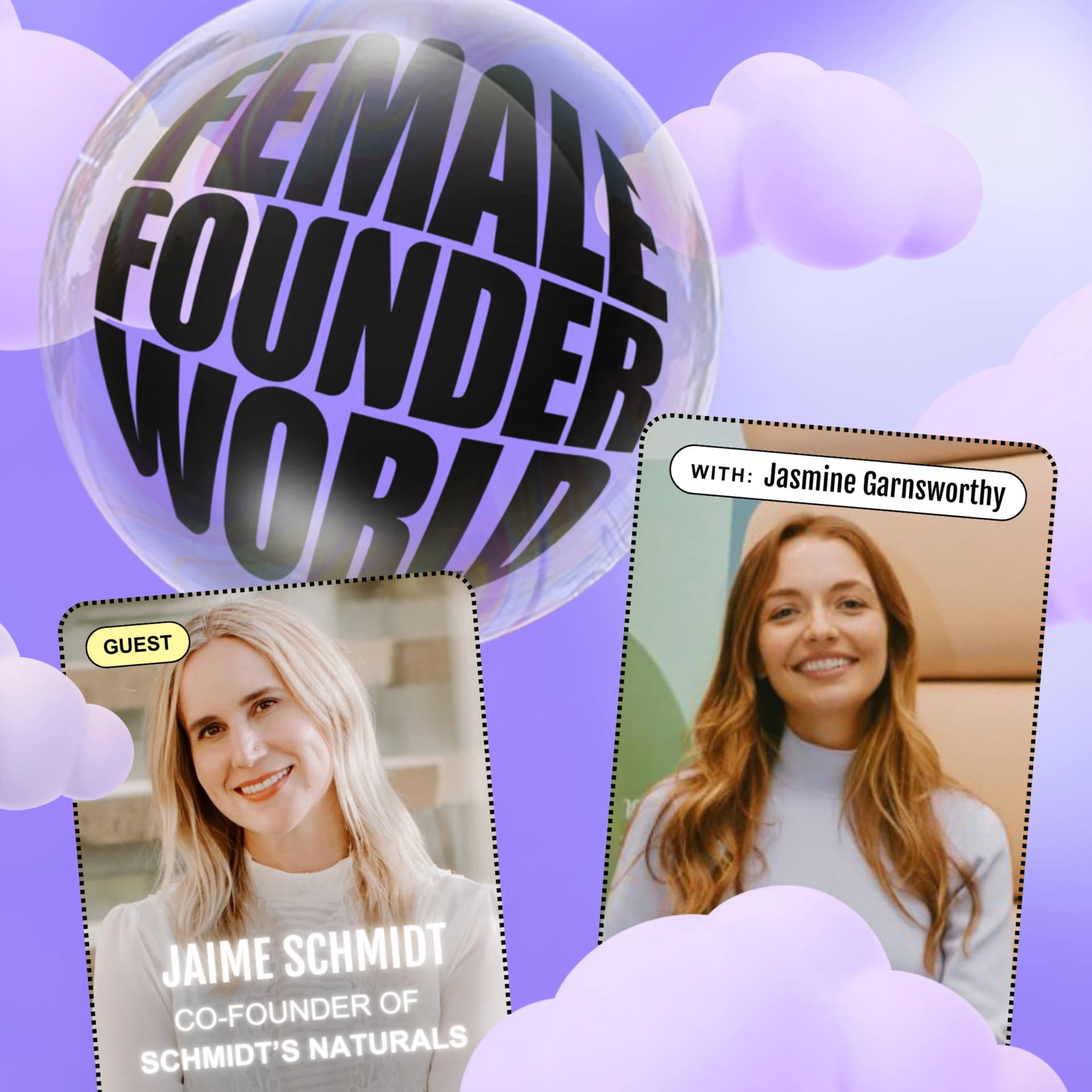
Podcast Summary: What’s Life Like After Selling Your Brand to Unilever? with Jaime Schmidt, Schmidt Naturals
Podcast Details
- Title: Female Founder World
- Host: Jasmine Garnsworthy
- Episode Title: What’s Life Like After Selling Your Brand to Unilever? Jaime Schmidt, Schmidt Naturals
- Episode Description: In this episode, Jaime Schmidt, founder of Schmidt's Naturals, shares her journey from launching a natural deodorant brand in her kitchen to selling it to Unilever for nine figures. The discussion covers her experiences post-exit, growth strategies, and lessons learned.
Key Themes and Highlights
Jaime Schmidt's Journey
- Jaime Schmidt started Schmidt's Naturals in 2010 in her kitchen while navigating motherhood and seeking natural products.
- Initially sold deodorants at farmer's markets, gradually scaling up to national distribution.
- Sold the company to Unilever in 2017 for nine figures, a significant milestone many entrepreneurs aspire to achieve.
Reflections on Success and Life Post-Exit
- Life After Selling: Jaime discusses what her life looks like after the sale, emphasizing the importance of not becoming too fixated on exit goals.
- Daily Activities: Engages in personal hobbies such as collecting golf balls and playing pickleball, emphasizing the need for balance and enjoyment outside of work.
- Community Engagement: Maintains a connection to the entrepreneurial community to stay relevant and inspired.
Early Business Foundations
- Initial Steps: Jaime experienced an identity crisis post-college, leading her to explore business opportunities through making personal care products.
- Market Response: The initial sales at farmer's markets validated the potential of her products, encouraging her to pursue the business further.
- Intuition and Customer Feedback: She underscores the importance of intuition and customer response in shaping her business decisions.
Scaling and Growth
- Professionalization: Jaime learned the basics of business management through online resources and by paying attention to customer interactions.
- Retail Partnerships: She progressed from local stores to larger retailers, taking a "ladder up" approach to scaling her distribution.
- Funding the Business: Initially bootstrapped, she relied on revenue reinvestment and a line of credit to manage cash flow, particularly as distribution expanded.
Challenges Faced
- Jaime faced operational setbacks, such as product manufacturing issues that affected customer satisfaction.
- She learned valuable lessons from a challenging partnership and the complexities of leadership in a rapidly growing startup.
Marketing and Industry Trends
- Adaptable Marketing: Jaime highlights the importance of being flexible with marketing strategies and messaging as the market evolves.
- Industry Changes: Discusses how the natural product landscape has changed since her inception in 2010, making customization and personalization key trends.
Resources and Advice
- Practical Tools: Jaime recommends using simple tools like the Notes app for capturing ideas and reflections.
- Photography: Emphasizes the importance of documenting the entrepreneurial journey through photos for reflection and motivation.
Conclusion Jaime Schmidt's story is one of perseverance, adaptability, and community. Her insights provide valuable guidance for aspiring entrepreneurs in the consumer goods space, especially those looking to navigate the challenges of scaling a business and understanding the emotional and operational dynamics post-exit.
Additional Resources
- Join the Retail Bootcamp waitlist: [Retail Bootcamp](https://bestie.femalefounderworld.com/retail-bootcamp)
- Subscribe to the Female Founder World newsletter: [Newsletter](https://femalefounderworld.beehiiv.com)
- Check out Schmidt's Naturals: [Schmidt's Naturals](https://schmidts.com/)
Written by AI. May contain mistakes. Listen to the episode to check what was said.
Transcript
Automatic transcript. May contain errors.0:00Hey, business besties. Welcome back to the Female Founder World Podcast. I'm Jasmine Gansworthy. I am the host of the show and the creator of the Female Founder World Universe. Today, I'm chatting with an actual icon. I'm speaking to Jamie Schmidt, the founder of Schmidt Naturals. She started this business in her kitchen back in 2010, and she bootstrapped it all the way to selling to Unilever in 2017 for nine figures. She is very candid, very real about what that process looked like and about what her life looks like now. Let's jump into the show. You are now entering Female Founder World with your host, Jasmine Grinsworthy.
0:45Jamie, welcome to the Female Founder World podcast. Thank you, Jasmine. I'm excited to be here. I kind of want to start at the end because in 2017, I think it was, you sold your company to Unilever. You had this big nine-figure exit that you created. And I feel like we need to start here because, you know, for all of us who are building businesses, this is just like the dream scenario. This is kind of what everyone's working towards and hoping that they get. They're not everyone, but a lot of us are kind of working towards and hoping they get somewhere like that. and so now I want to know you know you're you're a few years past that exit what did you do today what does your life look like after that kind of success yeah I love it I love that question but I do want to say I think if you're striving towards this like you it's very easy to get just caught up in the hustle and like having these end goals that might be kind of unattainable so if that is truly like what you're going for is like this big exit and you think you know that's a light at the end of the tunnel or the I guess the the pot at the end of the rainbow whatever it might be um try not to focus on it too much and I think that's truly like what got me here is that I was never 100 % committed to an exit it was more like I love this business I believe in what I'm building and we'll see where it takes me and obviously it took me to great places but so I do want to put that in your minds like you know like don't feel like you have to be like you know hustling towards that.
2:16But what did I do today? So I live on a golf course. I don't golf. But on Mondays, the golf course closes for maintenance. And every week I go out and I walk the course and I hunt golf balls. So I'll collect balls that I find along my walk. And my son's on summer break right now. He's 14. And he came with me today. And so he helped me find golf balls. And so usually I'll bring home maybe like 20 or so. But today we got a whopping 33 balls that we dug out of the trenches on our walk. So that was really fun. I love a day like today with a podcast. I want to, you know, stay in the scene, right? I love talking to founders.
2:54I love talking to communities like this, just to, you know, to stay relevant and just to continue to share my story and hopefully inspire other people. But a normal day, I was generally filled with some pickleball. I've definitely become an avid player. So that keeps me in good shape. Like my mother-in-law is obsessed with tickable, by the way. Is she? Oh, man. Yeah, absolutely. Once you start, you can't go back. I don't know. I mean, this is the thing I keep hearing from people who have started it. It becomes like this absolute defining part of your life. I've never tried it, but I imagine I don't have, you know, right now I don't have the time to become obsessed with something.
3:32So maybe I'll save it for another part of my life where I have, you know, an hour a day or something. It sounds amazing. Yeah. I mean, it opens up opportunities to make new friends. The majority of people that I hang out with today are people that I've met through pickleball. It's a way to be competitive, you know, and to just stay in good shape and be on the sunshine. So it's, yeah, I definitely appreciate it. I'll try to talk about it too much on this podcast. I don't know if my mother-in-law listens to it, but I feel like she would love it if we did. Yeah, she'll have to hear it. Hi, Carol, if you're listening.
4:02So let's go back to 2010. Let's go back to 2010. I want to now kind of like go back to the early days and draw a through line of what you did to get there and what that journey was like. So 2010, I think you're living in Portland. You're pregnant. You're starting to make your own personal care products. I would love to know what that first year looked like and the things that you did or what you learned that you think kind of like set you up for that success as the business started to take off. I was going through like a major identity crisis after college. I got a pretty good job right away was working my way up the corporate ladder.
4:42And I just I think probably a lot of people can relate to this. Like it just felt like it happened so quickly. I was not necessarily like convinced that that was the right path for me. And so I just kept like, you know, exploring and trying to get my hands dirty and figure out like what I was good at, what I more importantly, what I enjoyed doing. And so when I started making personal care products, you know, part of the inspiration there is because I was pregnant, like you said. But also I recognized pretty early, like maybe there's a business potential in what I was doing. Maybe it was just small scale, kind of part-time, but it was just something to kind of fire me up and keep me excited.
5:15And then once I did start selling products at local farmer's markets, I saw there really was big potential and I just kind of went with it. And I think in those early, early stages, intuition is such a big part of the journey. You'll feel it. You know you're on the right track, if you're like onto a concept that has some potential and just paying attention to how customers are responding, keeping a very open mind and just being humble, I think helped. I was just so grateful to make one sale at the farmer's markets. I would sell a deodorant for $8 and I just felt like so grateful that somebody put their trust and their money into me.
5:50And so just trying to maintain that mentality for as long as you can, I think is just so important as you're starting a business as a new entrepreneur. How did you go from making deodorant in your kitchen and selling them at farmer's markets to the next stage of just like step one of professionalizing and building up this process? I definitely didn't know much about like how to start a business, all the basics like filing for a business license and a lot of things are Google-able, right? So I definitely relied on the internet, but then just started, you know, paying attention to people approaching my booth at those markets.
6:25I had retailers who were saying, hey, the customers are starting to ask for your product. Is there any way we could get in our stores. And I was like, wow, there's something here. So I started doing the research quickly on things like wholesale pricing, right? Like how do I set a price that's going to like reap a profit but still be attainable for your customers? Things like local manufacturers and suppliers and all the stuff. It's just like, there's so many factors that play into it, especially with a product like mine where I was making it in-house. I wasn't outsourcing production. And so there's so much to learn, but I just trusted that I could figure it out.
6:56I made a lot of errors along the way. Like I was definitely losing money, you know, during a lot of parts of the business. I was mixing personal and business expenses. I was just getting, getting just, just kind of messy. So I think, you know, that would be one piece of advice, you know, as boring as it is when you're starting your business is like, is literally just keep those expenses and revenues like as distinct as possible because it just helps with your bookkeeping later. That's a really good piece of advice. What was the first big retailer that came to you and how did that happen? Tell me that story.
7:25I call it like a ladder up approach. So I had a lot of local, small kind of mom and pop stores that worked really well because we were kind of getting to know each other. Some of them were like new business owners themselves. And so just figuring out those dynamics. And then from there, I started to get into some of the smaller grocery stores and then sort of the bigger chains from there. And then that led to things like Costco and Target, eventually Walmart. So I think for me, it worked really well just to sort of like work my way up. But then all throughout that process, also selling on my website.
7:57So I did have a web store. It was not sophisticated by any means, but I was always getting sales that way too. I feel like there's this thing that I hear from founders over and over where there's kind of, you need to kind of up level at the same speed that the business is growing so that you can kind of like steer the ship and lead it and like take it to the next place. Was there anything that you were doing in those early days, like in that process? Were you doing any courses? Did you have any mentorship? Did you find any advisors? Like what was helping you do that in the beginning or in those first few years?
8:32Yeah, it's so hard because just because we have a good business idea and we are entrepreneurs, it doesn't mean we know how to lead teams and to take on all the operations. And so it's definitely a challenge and it's not something that comes naturally to everybody, including me. I didn't, honestly, I didn't have a whole lot of time to be taking classes and to be reading books and things. And so one thing that was helpful was surrounding myself with others in the community who were early stage entrepreneurs. I think it sort of depends on where you live, the sort of access you might have to those people.
9:02But being in Portland was great. There were a lot of local kind of craft shows, street fairs, farmer's markets and things where I could just talk to my people around me and be like, how are you handling this? And then as the business got more sophisticated, I did study, I guess, a little. I would read, you know, Inc. and Fast Company and those kind of things. But in terms of like how to be a good leader, how to manage an organization, like I just, I didn't prioritize it in terms of my learning. And it was more just kind of fly by the seat of my pants and asking my staff, like, hey, like, let's learn this together.
9:33Like, let's just be transparent and like help one another through this process. Because a lot of them were, you know, new to working for a startup too. And so there were challenges that they were overcoming as well. And so just having patience together and being very honest and just, you know, a lot of like check-ins and saying, hey, like. How are we feeling? What have we learned? And what are the upcoming challenges that we should be prepared for? How did you know that it was time to kind of like make a couple of hires back in the beginning? This is something that, again, I hear in the community all the time where it's this, I think I can afford it.
10:06I don't know if I can afford it. I definitely need it. Like how do you know that it's time to bring someone in? It's really tough, you know, especially because we don't have a lot of money to be paying people. So as long as I could. I was trading for services, right? Like if you know an artist or somebody who maybe can do a little PR or whatever it might be, or website design, and then just trading product or, you know, just something to get you by in the beginning. But I also, I was, it was important to me to hire friends or like people I trusted in the beginning. It's not always the best advice.
10:36I think as a business grows, you know, hiring your friends can actually be a big challenge. But in those earliest days, it's like somebody who's going to like put up with me. And the fact that I don't necessarily know how to run a business and like, and somebody you can just, you know, trust to like give autonomy to and be like, Hey, I need this, like, please figure out how to do it. So that was helpful. I actually, my first couple of employees worked for my house, which of course you outgrow that too. But if you have that opportunity, like I had my production happening in the garage and the shipping.
11:06So it's close to home. I didn't have to pay for the rental space. And so they would come over. And so it wasn't like ideal working circumstances but for some people they loved it you know they would turn up the music and they had like the whole space themselves it was just like like a very chill work environment yeah i saw that now the the gear office that not the non-alcoholic brand it's like a like a home if you're gonna work from home it's so much more cozy why not make an office a home as well i really like that vibe yeah okay cool this is all so so interesting i feel like we've got a really good picture on like what the early days were looking like for you what was that like inflection point where you realized okay this is going to be something really big was there a moment was there like a period in the business what was that I think one part of it was when my husband and I decided that he should quit his job and work with me full-time um so giving up all other sources of income and saying hey we're gonna go in on this um you know big time together so that was one piece and then just like realizing like I for the first time ever I I really enjoyed my work and I felt really inspired and motivated every day, obviously completely overwhelmed.
12:14And not every day was a good day, but when you're working towards something that you created or that you build, it's different. And so I think once I had the validation from my customers that were continuing to come back, that was everything I needed. This person taking a chance on a product for the first time is one thing, but when they start coming back again, then you're like, okay, I'm doing something right. They liked it. I'm curious about your husband coming into work in the business. What was that like and how did that decision kind of come about? Yeah, he's talented and skilled in a lot of ways.
12:47And I took advantage of those things as much as I could because, you know, that was free. But then we got to a point where like we had to pay him something because, again, working up startup income for the whole family. It's challenging. The good thing is we had met at another job, but it comes with challenges for sure. I mean, there's, there's ego that you have to deal with. There's like the fact that you might not want to talk about work at 10 PM, but also like realizing that is, that is your life and that it's okay. Sometimes we'll talk a lot about like work-life balance and having boundaries and things.
13:19And I think it's like important to aim for that, but you, but also be realistic. Like it's not always going to be perfectly balanced, right? There are going to be days, weeks, months, years where you're just like completely like 100 % in the business. And that's just the fact of entrepreneurship. And I do want to encourage people to realize like that is okay. It won't be that way forever, but there will be times when it's like totally consuming you. And when you're working with your spouse, you know, that's another level of consumption, right? That the business takes, but it's worth it. It's fun.
13:53As you were starting and then scaling things up before the exit, how are you funding the business? So I did bootstrap the business, which is always my, this is just so incredible. Yeah. Thank you. You know, I, it's funny because I, when I started the business, I didn't put a whole lot of thought into like, how am I going to fund this thing? I knew nothing about fundraising. I was like, what are the investors? What does that mean? Like I just didn't, I didn't have exposure to that industry. And so I started, I think because I grew at my own pace and I didn't have people I was accountable to like investors, I was able to to create something that was sustainable and that I could, you know, maintain long-term.
14:27And so it's really about making small investments in the business, you know, as much as you can slowly or quickly as, you know, your revenue allows, but it's constantly recycling, you know, profits back into the business and making major sacrifices in other parts of your life. I wasn't buying clothes because I wasn't going out to eat with friends and things. And so bootstrapping is not easy, but it worked for the first few years. And then I also got a line of credit a couple of times as the business started to like really pick up in distribution. Because when you start selling at retailers, you know, you have tons of inventory on shelf and all your money is tied up in that inventory.
15:02And so in those situations, it helps to have a line of credit. And I do encourage entrepreneurs, like even if you aren't fundraising, have your ideal investors that you would approach, like who would you go to in the situation where you like really needed capital. And then at the same time, if you are fundraising, have a plan for bootstrapping because fundraising is not always successful. And so if you're not able to raise that capital, you know, what's your plan to bootstrap this thing? Do you remember when you took your first paycheck from the business? Was it formal like that or in the early days when things were all kind of like mixed in together?
15:35Yeah. It felt strange because it felt like, I was like, do I really deserve this? Or should this money go towards operations? But then at the same time, it was like so liberating. I guess I clearly deserve this. Maybe it's not enough. You know, I think I would have, I wish I had done it earlier. I didn't take a paycheck for several years, but I think as an entrepreneur, just have that in your budget, right? No matter how small it is, just a little something where you can feed yourself and your family and things. I was sitting on a little bit of savings. It didn't get me far, but it was just enough.
16:08And one thing that really helped me too was I had a couple of side jobs in the first couple of years of the business. So I wasn't 100 % full-time in the business for the first couple of years because I just financially couldn't manage it. And so I had a couple little jobs that were related to the business. So for example, a local retailer that was carrying my products hired me to run their cash registers. And so I was able to interact with customers and see my product being sold. And so things that were like, I was always looking for something that was like relevant to the business that would bring in a little bit of money.
16:41I think that's something that people don't talk about enough, but that I hear, not everyone wants to talk about it on the show because they might be still doing it a few years in and they don't want to kind of dilute the messaging about where their company's at but most people that I speak to even even folks who have VC money behind them are doing some kind of consulting work other work part-time work to to pay for their lives especially if they're living in New York San Francisco LA like these really expensive cities often you can't afford to pay yourself a salary that it requires to live there and also be able to like put money into the business.
17:15Yeah, a hundred percent. And it's also, you know, it's smart in case something was wrong with the business and you need a plan to fall back on. I always encourage people to be all in, but at the same time, like, you know, it is responsible to have some sort of backup plan if you need to. Yeah. Yeah, absolutely. We've spoken a lot about the wins that you've had along the way, the exit that you had. I'd love to know some things that went wrong because no one built a company like yours without some things going wrong along the way. Yeah, that is very true. I had a number of operational setbacks, things like, you know, I built up all this hype around a new product launch and then something would go wrong with the manufacturing and we would ship out hundreds of orders and then have very upset customers because their deodorant was extremely like mushy and couldn't be used.
18:03And so all the customer support that comes with that was a lot. I had a business partner for a few years, which was not a good choice on my end. And I had to manage that relationship and all the things that came along with that. One thing I learned there was like, if you are going to bring somebody on, you have to support you no matter what role, obviously, do your diligence, do your background checks. And sometimes we get so busy that we think we did enough, but really dig in, especially if it is a partner that's taking on some equity, which was my situation. So that was tough. And I think like some of the things, just like the personal issues of running a business, where like, we talked about this a little bit before, just like being a good leader and jumping in, you know, to being seen as somebody leading a company, but you've never had that experience before.
18:51And so it's like, how do you live up to this expectation of your customers and your employees and your family, you know, being in this role that you like have no experience doing? It's tough. It's, you know, not just business challenges, but all the personal ones that come with it for sure. Yeah. How do you, how do you live up to that? This is something that, I mean, like I even feel this in my teeny tiny little business where I'm trying to, I'm yeah, I'm trying to figure out how to be the leader for the community and for my little team and what that requires. And I'm at a point now where I'm doing things that I never did in my career before I started this business.
19:27I think, yeah, congrats. Yeah. That's awesome. It's just like, you know, it's trusting trusting yourself and your ideas and like if you can't do it then who could right like if it's your business you come up with the idea you are the face or voice or whatever of the brand like you're the most equipped it doesn't mean you have to have like tons of experience in certain areas you'll figure it out you know and yeah i one of my sayings that i've become known for is like say yes now then figure out how and i think that that mantra is just like powered me through so many things and it's just you and you're also gonna be your like own your most harsh critic right like you are the one that's gonna judge yourself more than anybody else and so you just have to like cut yourself some slack just like keep reminding yourself why you started right like that is so key as the business gets you crazier and crazier how do you know the right people the right companies to partner with and I think you know a really good example or a big example is obviously your exit to Unilever.
20:25How did you know that there were the people that you wanted to exit to, that the timing was right? I'm sure that's like a muscle that you kind of built over time as you were building the business. But for people who were kind of like early on making those decisions on like a smaller scale, how do you know? What is that? I think the most important factor is timing. You know, for me, the industry was becoming really competitive. when I first started there were just a handful of natural deodorant brands but then seven years in you know there were a lot and the competition was coming a lot more fierce one of our biggest competitors was bought out you know a month before we were and so it's like the time was was ripe you know for natural deodorants to you know be um sort of you paid attention to by big cpg as they call it and so that was that was the first thing and then just on a personal level to like how ready I was feeling.
21:17Right. Um, I felt like I had gotten to a place, I took the business to a place where I, I don't know what else I could have done. I was like, I put in, you know, all my, my personal effort and all, everything that I could do, you know, I still was fully in love with the concept, but I also knew that like, okay, I've maxed out distribution. I'm in all these stores. I had this amazing marketing plan. And so like, what, what do I do from here? Like I need like experts and like, you know, kind of like experienced, you know, team to help take it to that next level and to really compete on a global level.
21:49So that was important to me. But in terms of like knowing if it's a good fit, you know, there were a lot of conversations around company culture, what were my non-negotiables, what were things I was willing to flex on or give up with the acquisition, but some things, you know, were important to me. And And so, you know, having those conversations and it's tough, you know, and you'll second guess yourself. But I think, yeah, it's basically to like how, I think the biggest thing is how far can you continue to go on your own, right? How much are you willing to do? Like, what else, what's your next step in your life?
22:24Like, what do you want to, what do you want to do next? Yeah. You mentioned before how the natural deodorant market had changed. And I can just imagine, you know, what you saw over the years that you were running your business. But just this whole personal care space has changed so much since 2010. Yeah. And there are so many new brands, clean and natural, are like table stakes now in a way that they didn't used to be. for people who are kind of starting businesses now in this area, is there anything that you look at and you're like, oh, that's, that's an interesting trend or that's an interesting shift that's happened or that you think is a, um, yeah, something that folks should pay attention to who are building now.
23:15Yeah. That's a good question. I, I like, uh, like, like a personalized approach to things specifically like body care personal care makeup whatever where yeah they're creating a product specific to your your unique needs right so you'll see um a lot of brands that have little questionnaires that you can fill out and then they'll have so basically behind the scenes i i know a cosmetics company that is creating a product like this and so behind the scenes basically they'll have you know hundreds or i guess more like tens of thousands of different potential formulations. And then based on the answers you're giving for your personalized assessment, you create something specific for you.
23:53And so while it's yours, that's custom made, it's also like, I'm not explaining that. No, I understand it. Also, Jamie, Jamie, I have to interrupt you. I have to interrupt you because, you know, my business that I built for four years and that failed and led me to Female Founder World, I was building it while working as an editor and building communities for other companies and anyway it led me to female founder world was a customized clean beauty brand called the buff and we did um exactly this yeah and this is before you could have a shopify app with a quiz on it we had to get a developer and originally it was like a little form that people completed and then it went from there but i could never really figure out the operations and i couldn't figure out the cash flow piece and just didn't know enough and that's where i know i know but that's what female founder world came out of kind of like looking at that missed opportunity and thinking like what didn't i know and what didn't i have access to that i needed to be able to build that business that's so cool yeah you can explain it more than i can no but when you're like stabbing my heart a little bit when i say that as well um something else that you said that was really interesting that i want to i want to double down on for a sec.
25:04You're talking about marketing and how you had, you know, the beautiful marketing plan that was all in place. What were some of the things that you were doing that you think were really working to drive growth for the company? I think being open to different types of marketing messaging is key. Because you might think you've developed like this perfect pitch that everybody's going to respond to. But then as you start testing things like through online ads and our social posts or whatever it might be, you'll, you might be surprised, right. At what customers are actually responding to. So always keeping an open mind around like who your customer is too.
25:43Right. Um, and then also like how you're talking about your product. So one example with natural deodorant might be, um, you know, we were using the messaging, um, finally a natural deodorant that works, right. Cause natural deodorants had a reputation for being ineffective. Um, and that worked for a while and I worked with certain customer groups, But then as the industry started to mature and more competitions coming up, we had to get creative in how we were talking about it because that was no longer like a really strong selling point. So then we were focusing on things like, you know, the different fragrances or maybe the unique texture of the product.
Read the full transcript
26:14And then realizing that our competitors were not just other natural brands, but also the bigger heritage to our brands like Dove and Axe, you know, ones that were not natural at all. And then how do you tweak your messaging to start competing on that level? So I think that was really key. Yeah. That's super interesting. Okay. And then the last thing that I want to ask you is for a resource recommendation. I ask everyone who comes on the show for this, something that you recommend anyone who wants to follow a path like yours should go and check out. Yeah. Oh, man, this is really dorky. The Notes app, like literally the Notes app on Apple has just been everything for me because I was always the type when I was younger, walking around with a notebook and a pen.
27:00But anytime you have any idea, like as weird or like kind of dumb or irrelevant as it might seem in the time, write it down. And later it might like, it might spark some sort of like inspiration in your business or whatever it is you're doing. I think that's been so key. And then another thing I suggest, this isn't a resource, but it's a practice that I, that I love is just to literally take pictures of everything. Like I, that's one regret I have in building a business is I didn't take enough photos. Like I was doing cool things. I mean, I was like, yeah, you were. Huge warehouse. I was just like, yeah, like packing up boxes.
27:33I was like, why wasn't I recording anything? So just like get it all on camera, you know, and you'll appreciate it later. Yeah. I have a small pool of things, but like, yeah, I wish I had more. Well, we'll, we'll have to get some of those photos to use them in your, in your case study that we have in the newsletter on Instagram. So people can see the few photos that you do have because, yeah, I'm sure they'd be amazing to look back at. Jamie, thank you so much for coming on Female Founder World. This has been so incredible and so inspiring to hear your story. Thank you. I really enjoyed it. Quick shout out to all of our business besties subscribers.
28:10If you are loving this show and you are building a consumer, CPG or e-commerce business or you're about to build one, This membership will give you access to the people, experiences, and the tools that you really need to build your dream business. Head to femalefounderworld.com forward slash subscriber for more.
From the publisher
Schmidt's Naturals founder Jaime Schmidt is on the Female Founder World podcast with Jasmine Garnsworthy this week. Jaime is the co-founder of Schmidt's Naturals, one of the original natural deodorant brands. Jaime started the business after becoming a mom and wanting to move towards the natural industry.
After starting selling her deodorant at farmer's markets, Jaime grew to major national distribution and eventually to sell her business for 9-figures to Unilever. In this episode we chat about what life looks like after you have a major liquidation event, how she looked at growth and the journey while building Schmidt's Naturals, and what she'd do differently a second time around.
Links Join the Retail Bootcamp waitlist: https://bestie.femalefounderworld.com/retail-bootcamp
Get the Female Founder World newsletter https://femalefounderworld.beehiiv.com
Become a Business Bestie subscriber: bestie.femalefounderworld.com
Check out Jaime's business: https://schmidts.com/


