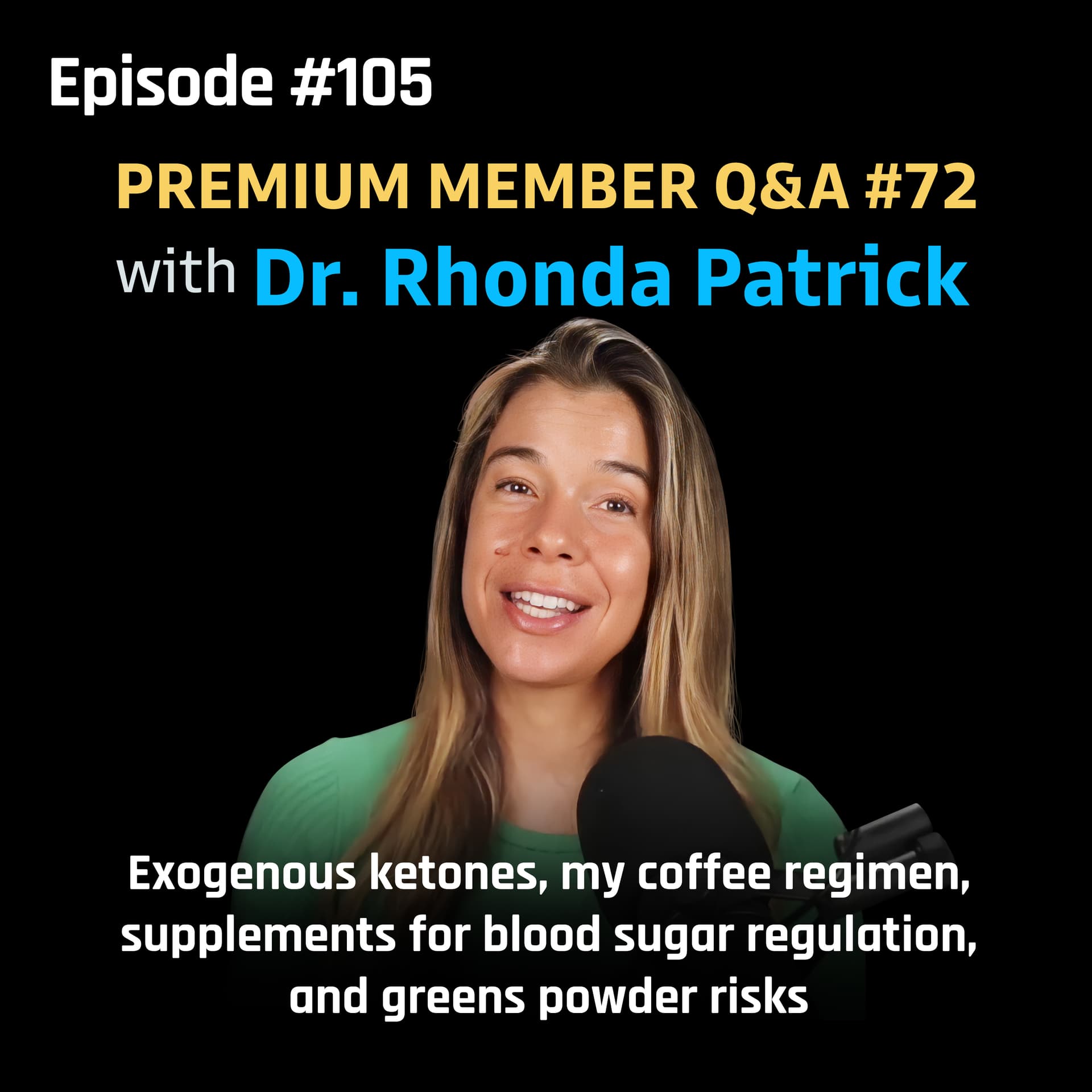

In short
Premium Member Q&A preview on exogenous ketones, a “coffee protocol,” and supplements for blood sugar regulation; includes rapid-fire coffee, nutrient timing, heavy-metal/contaminant concerns, and dosing guidance; plus a teaser that the full episode will cover sleep continuity.
Guests
No external guests. Host answers audience questions (live AMA preview).
Guest backgrounds
Not applicable (no guests).
Key claims
Exogenous beta-hydroxybutyrate can mimic lactate pathways (including BDNF) and may produce calm focus/anxiolysis; Oxford “ketone ester” (beta-hydroxybutyrate ester) gives faster effects than 1,3-butanediol-only products. Coffee polyphenols may increase brain blood flow; paper filters reduce LDL-raising diterpenes. Dairy and protein can delay immediate coffee polyphenol metabolite rise. Coffee dehydration claims are largely unsupported at normal intake; iron absorption may be mildly affected. Green powders can carry heavy-metal risk; test via blood work.
Notable examples
Delta G/Oxford ketone (11 g serving; immediate minutes + “long tail”); KetoneIQ uses only 1,3-butanediol (slower; take ~1 hour prior). Coffee: Purity Coffee; Chemex unbleached filters; pour-over glass Chemex. Supplements: berberine 600 mg TID with meals (~1.8 g/day); alpha-lipoic acid 600–1200 mg/day; ubiquinol 100 mg/day (higher doses for fertility discussed). Choline: prefer phosphatidylcholine (TMAO unchanged in a cited 4-week study) over choline salts (TMAO increases).
Written by AI. May contain mistakes. Listen to the episode to check what was said.
Chapters
Tap a time to open that second in VORapid Fire Questions and Exogenous Ketones
2:19 to 3:20
Dive into the benefits and effects of exogenous ketones in cognitive function.
“I see people saying hi from their location.”
Types and Effects of Exogenous Ketones
3:21 to 6:04
Explore the different types of ketones and their specific effects on the body.
“So what I find when I take some exogenous ketones is that I feel, it's not the same as like drinking a cup of coffee, but I feel focused, but a very calm focus.”
Coffee Preferences and Benefits
6:05 to 10:35
Discover the host's coffee preferences and the science behind coffee consumption.
“you're also converting that 1 ,3-butane diol into more beta-hydroxybutyrate.”
Coffee and Nutrient Absorption Concerns
10:36 to 14:00
Understand the potential effects of coffee on nutrient absorption and hydration.
“And the brands that I use for both decaf and also regular caffeinated coffee, because I'll cycle back on.”
Coffee and Nutrient Absorption
14:00 to 18:52
Learn how coffee may affect mineral absorption and hydration.
“And then another related question on coffee was from KRD who says, hi, Rhonda, on the subject of coffee, what does the research say about coffee causing loss or malabsorption of minerals such as iron or zinc or copper?”
Dairy and Polyphenol Absorption
18:52 to 21:14
Understand the impact of dairy on polyphenol absorption from coffee.
“Okay, there's a few more rapid fire questions we're going to get to before, but I want to look at the chat to see some coffee related questions here.”
Caffeine Metabolism and Sleep
21:14 to 23:18
Explore how genetic factors influence caffeine metabolism and sleep quality.
“Chris Hall asks, you recently mentioned the potential benefits of ubiquinol, berberine, and alpha lipoic acid in Synergy.”
Supplements for Glucose Regulation
23:18 to 25:49
Discover recommended supplements for managing glucose levels and lipids.
“Some other things to add for women that are looking to improve their egg quality, that they'd obviously want to add a prenatal vitamin that has all those important B vitamins in it and the methylated ones as well.”
Choline and TMAO Risk
25:49 to 28:00
Learn about choline sources and their potential risks for TMAO production.
“Not a lot of people talk about this, but there is some evidence on it.”
Understanding Choline and Its Forms
28:00 to 31:28
Learn about different forms of choline and their effects on TMAO levels.
“And that's what people are wanting to avoid.”
Transcript
Automatic transcript. May contain errors.0:00Rhonda Patrick:Hey everyone, today's episode is something special and I'm truly excited to share it with you. Rather than a typical Found My Fitness episode, you're about to listen to an exclusive sneak peek of my most recent live Ask Me Anything session. Normally, these AMAs are reserved only for Found My Fitness premium members, but I think this one is so packed with valuable insights that I wanted to share it with everyone. So every month, premium members join me live to ask questions and get direct personalized answers about nutrition, supplements, longevity, sleep, fitness, you name it. No topic is off limits.
0:33Rhonda Patrick:And we dive deep. Members tell me they love these sessions. And personally, they're one of my favorite things to do each month. They're genuine, interactive, and filled with actionable insights grounded in rigorous science. What you're hearing today is just the first 30 minutes of a full 90-minute AMA. So in this preview alone, we cover fascinating topics like why I started taking exogenous ketones, my current coffee routine, including what beans and brewing methods I prefer, optimal doses of supplements like ubiquinol, berberine, alpha-lapoic acid, vitamin K2, and even whether certain popular greens powders contain concerning levels of heavy metals.
1:11Rhonda Patrick:But there's so much more waiting for you in the full ask me anything. If you enjoy what you hear today and if the science and advice resonate with you, I'd like to invite you to join our Found My Fitness premium community. Becoming a premium member isn't just about accessing hundreds of hours of exclusive, deeply researched health content, though that's definitely a great perk. It's about being a part of something bigger. Your membership directly supports my mission to keep Found My Fitness entirely ad-free, free from commercial bias and focused on delivering trustworthy, science-driven insights to as many people as possible.
1:49Rhonda Patrick:Every new member empowers me and my team to produce better episodes, deeper research, and even more high-quality content for everyone, free and premium alike. Give it a try. If you love it, stay with us. If not, no worries. You can always cancel. But I genuinely believe you're going to find incredible value, and you're going to love it, and you're going to have a sense of pride being a part of our community. So thank you so much for considering supporting this important work. Now let's dive into today's special AMA preview. Hi everyone. Welcome to Q &A number 72. Nice to see people from all around.
2:25I see people saying hi from their location. Excited to be here. Today we're going to do things a little differently. I'm going to start with the rapid fire questions that I usually end with. And then after the rapid fire questions, I'll kind of get into some deep dive questions today. But I did mention in the chat that I was going to get my exogenous ketones, and I see some questions already in the chat about exogenous ketones and the different types of ketones, when to take them and why. And some of you may be wondering why I'm taking it right now. I didn't get to do any of my high intensity interval training this morning.
3:05And that usually gives me a pump of lactate. And that lactate gets into the brain and it really sort of gives me a little extra pump so that I can feel cognitively ready to do this Q &A. And so I took my exogenous ketones because beta-hydroxybutyrate, which is the major circulating ketone, and it's the one that's found in all these exogenous ketone products, acts very similar to lactate in a sense where it activates a lot of the same genetic pathways, including brain-derived neurotrophic factor. It's also anxiolytic. So what I find when I take some exogenous ketones is that I feel, it's not the same as like drinking a cup of coffee, but I feel focused, but a very calm focus.
3:56So it seems to calm me a little bit and allow me to focus better. And I really like that. So when it comes to the type of ketones right now, I don't have any affiliation with any brands, but I've been experimenting with Delta G. And this is what's known as the Oxford ketone. It was developed by Dr. Richard Veach and Kieran Clark, who is at Oxford. It's the real deal. It's the ketone that was sort of developed with funding from DARPA. And it was really the aim was to kind of help military personnel be able to be cognitively on their game during very stressful periods where they're sleep deprived, perhaps not eating under a lot of just stressful conditions.
4:47And so that is the ketone I'm doing. And the reason I'm experimenting with that one is because it's the only, well, actually there's the Oxford ketone is the only ketone out there that actually is the beta-hydroxybutyrate ester. that one and also ketone aid, which was started by Richard Beach. That one also uses the same ketone ester. So what that is, is the beta hydroxybutyrate and it's esterified to 1 ,3-butanediol. What that is, is it's an ester that your liver converts into beta hydroxybutyrate eventually. Um, so what happens is when you take a product like Delta, Delta G, and I'm using their Delta H product because it's the, I don't really need the really, really high ketones.
5:41So this is about 11 grams of, of ketones in, in, in a serving size of a bottle. And they have higher, higher dose ones. That's like 25 grams. And I don't, I don't really need that. So, um, you feel the effects immediately because it does have beta hydroxybutyrate in there without having to be converted into beta-hydroxybutyrate by your liver. So you feel the effects immediately within like minutes. And then because it's asterified to the 1 ,3-butane diol over the course of an hour to 90 minutes, you're also converting that 1 ,3-butane diol into more beta-hydroxybutyrate. And so it's sort of not only do you have an immediate effect, but you have this sort of long tail effect as well.
6:24Now, someone asked about ketone IQ. you. That product only uses the 1 ,3-butanediol. So there's no actual beta-hydroxybutyrate in that product. It's a much lower dose. I believe it was five grams. And it's also slow acting. So if you're using that for something like in my case, where I'm doing a Q &A, or let's say I'm I'm doing a podcast or a talk, then I would take it at least an hour beforehand because it takes a while to convert the 1 ,3-butane dial into the beta-hydroxybutyrate. You can kind of think of it as like a precursor, ketone precursor. Whereas the one I'm taking right now, I can just take, boom, right away.
7:12I'll feel it immediately. And then I continue to feel it over the next couple of hours. It's also given me a little bit more motivation to revisit my experimentation with ketogenic diet, certainly cycling. I like the way I feel. I like the calming effect. And that largely has to do with, I had a podcast with Dr. Mark Mattson a few years back, and he was explaining when you're in ketosis and your body is making beta-hydroxybutyrate and ketones, The beta-hydroxybutyrate appears to, it gets into the brain, and it sort of shifts the balance between GABA, a neurotransmitter, inhibitory neurotransmitter, and glutamate, which is more of an excitatory neurotransmitter.
7:59And it tips the balance more towards GABA. And that sort of has this anxiolytic effect where you feel calmer and you're less anxious. So for me, that is hugely beneficial because I do sometimes have an amount of background anxiety, particularly if I have to perform. And so I like that sort of calm focus that I feel when I'm either in ketosis because I have experimented with ketogenic diets. And I do remember that being one of the most profound effects that I noticed when I was doing a ketogenic diet. and also I've been in ketosis from fasting same thing and then I've tried exogenous ketones and so it'll they all sort of replicate that feeling of sort of calm focus which I do really like.
8:50I see people in the chat asking Faisal's asking about advice on sleep and shift work. We are going to we are going to do a little bit of a deep dive on sleep today so we'll talk more about that later. I want to go ahead and get some of the rapid fire questions. I love how a lot of people asked questions, follow up questions on my recent coffee episode that I released. I don't know, a few weeks ago. So Ruby asks, follow up on a great coffee episode. Do coffee filters have any sneaky chemicals or glue in them? Yes, some of them can. I use the Chemex unbleached coffee coffee filters. Those are the ones that I use.
9:34I really like them. If you want to try them out, great. A related question from Michelle was, loved your deep dive on coffee. What brand and type of coffee maker, filter, and coffee do you use? And are you saying that a paper filter does remove all the bad stuff that you mentioned? Okay, so the coffee that I have been on or been using right now, I've tried a lot of different brands and honestly right now I'm on a bit of a decaf coffee kick because my creatine is amazing and now that I take 10 grams a day instead of 5 grams a day I find that I'm not having that afternoon crash I don't want to call it a crash because I wasn't really crashing.
10:24But I would often get a little sleepy, you know, two, three o 'clock in the afternoon. I no longer have that with my higher dose of creatine. And so I've also gone down to decaf. And the brands that I use for both decaf and also regular caffeinated coffee, because I'll cycle back on. And the great thing about cycling off of coffee and then going back on is that when you go back on, the coffee is so effective. And so you kind of, I like to use it for those moments when I really need it. I use the Purity Coffee brand. I really like their organic coffee. For the decaf, I use their Calm decaf, which is great.
11:05They have regular coffee, which is also great. And so right now that's kind of like my brand that I've been using. I already mentioned the filters I use, the Keymex unbleached coffee filters. And then for a coffee maker, I like doing the pour over. And so I do Chemex pour over glass coffee maker. So it's like a big glass coffee maker. And then you put the filters inside and the coffee and then you pour the hot water and then there it goes, it drips through. When it comes to the filter, it does filter out a lot of the oily substances, the diterpenes, which I know I kind of painted a bad picture of in the episode because they raise LDL cholesterol.
11:45And that could be a concern, particularly for people that already are higher risk for dyslipidemia. Perhaps they have higher LDL cholesterol. Maybe they have LP small a. There's a ton of reasons why someone may want to really just be very anal about making sure that they eliminate all the things that can raise their LDL and try to keep that down. But the diterpenes also, there is at least some in vitro evidence. So this means these are just cells in a Petri dish. It's not the strongest type of evidence, but it is still something to talk about that there can be some anti-cancer effects with the diterpenes.
12:32So they're not all, it's not like they're just like villain and there's nothing good about them. There is potentially something beneficial, although we don't have a lot of evidence to support that. It does seem like there's a possibility that there's some benefits there as well. In other words, what I'm saying is if you like your French press coffee, by all means, keep making your French press coffee, particularly if your LDL and lipids are looking great. And we're going to talk about lipids as well today. A related question from Freda Vera. They ask, what's the best overall company to purchase organic beans for cognitive protection?
13:06Again, I'm turning to Purity Coffee because one of the reasons I really like their brand is they have a lot of testing and data posted on their site. They sort of validate the organic beans. They do independent analyses on, you know, the polyphenol content. So this would be the chlorogenic acid. And it seems to be pretty much like, you know, a really high, high amount of the chlorogenic acid. In fact, their light to medium roast preserves around 65 % more of these polyphenols than other organic brands do. And they also have third-party testing showing that they're free of pesticides and heavy metals and other contaminants.
13:48So I like that brand. And again, the polyphenols are really what is beneficial for brain health. Again, caffeine itself also appears to be beneficial. So I'm on my decaf kick right now, but I will shift back to my caffeinated coffee eventually. Okay. And then another related question on coffee was from KRD who says, hi, Rhonda, on the subject of coffee, what does the research say about coffee causing loss or malabsorption of minerals such as iron or zinc or copper? Also, does coffee cause dehydration? In what way can we drink coffee to prevent nutrient loss? So with respect to nutrient loss, coffee, really, most people are fine.
14:31I would say it's very minor. And the biggest minor effect would be iron. So even most people that have normal amounts of iron don't have to worry about this, but it can cause a little bit of an absorption issue with iron. And so if you are eating a meal, you probably want to make sure it's like the coffee spaced out by like an hour so that you're not inhibiting the absorption of iron from your meal. When it comes to dehydration, it's totally like it's just not it's kind of unfounded, basically, especially for people drinking normal amounts of coffee. And you start to get into like the really high dose.
15:17maybe you can cause some issues, but there was a study showing that four 200 ml cups of coffee per day, so this is about four milligrams of caffeine per kilogram body weight per day. Over the course of 72 hours, there was no difference in terms of water, total body water, and urine, osmolarity, just all that stuff. So there's really just not a lot of evidence that it's causing dehydration in most normal circumstances. Another rapid fire question from Farid Gargore. They ask if there's any issues of drinking coffee on an empty stomach. Not that I'm aware of. I mean, obviously, like maybe some people do, but I don't, there's not like an overall thing.
16:01It's not like a thing. And then another question about dairy. So the question is regarding the dampening effect of dairy. If my goal is general long-term health, is there still a benefit to avoiding dairy in order to maximize immediate absorption of polyphenols? Would it in fact be better to add dairy and slow the absorption rate? So what this question is hinting at is the fact that coffee, when you add dairy to your coffee, you are not, the bioavailability of the polyphenols is dramatically slowed. In fact, there was a crossover study that gave people 609 milligrams of chlorogenic acids. Those are the major polyphenols found in coffee, plus whole milk.
16:47And they found that basically the metabolites that are the polyphenol metabolites, they fell from 68 to 40. And it was about 40 % relative drop in the first day of recovery. So essentially, you're not going to get all those polyphenols popping immediately, but eventually they catch up. So over long-term health, it's fine. But if you're wanting that immediate polyphenol boost to your brain, then you probably should not add dairy. You should do something like MCT powder or some kind of plant milk, like almond milk, for example, and if you like to have your coffee with cream, don't use dairy. And then there was another related question about protein doing something similar.
17:38And yes, it does do something similar. And you can essentially just time your protein 30 minutes before or after your coffee, if you're concerned about the delay in release and bioavailability of polyphenols. And there was another, this is the last question on coffee. This question was submitted by Sam, and Sam says, for those of us who have the gene for slow metabolism of caffeine, should we do anything differently? Your gene data notes that slow metabolizers should limit or avoid caffeine altogether. Is this still valid? I would say that for people that are slow metabolizers, obviously you need to kind of self-experiment, but typically you want to limit your caffeine to like morning use and like you you know taking it in the afternoon may be the issue because if you're are if you're a slow metabolizer it may take you know 10 10 to 12 hours before you're metabolizing all that caffeine and so there may be this residual effect on your sleep however you should be able to mostly notice that so if your coffee consumption protocol is not causing any issues with your sleep, then whatever you're doing should probably be fine.
18:52Okay, there's a few more rapid fire questions we're going to get to before, but I want to look at the chat to see some coffee related questions here. Myrna is asking about my thoughts on decreased blood flow from vasoconstriction from coffee to the brain. In fact, the polyphenols do the opposite. They actually increase the blood flow to the brain. So whatever minor vasoconstrictions probably just canceled out. Bodhi's asking about Nespresso Virturo, sorry, I don't know how to say that, but the Nespresso capsules. And they're asking where this falls on the health spectrum. Unfortunately, those pods, those capsules, they all have lined plastic in them.
19:38And so my biggest concern with those isn't the coffee type. It's the hot liquid going through plastic, which as we have talked about several times, rapidly accelerates the breakdown of microplastics into your beverage, as well as their associated chemicals like BPA into your beverage. Unfortunately, I don't think those are a good choice for that reason, because you're actually going to be consuming a lot of microplastics and plastic associated chemicals. Alyssa is asking about the meter I use for my ketone to measure my ketones. I actually don't use the meter that's sold with any companies. I use a Precision Extra, which allows me to measure my blood glucose with a finger prick or ketones or I don't know if they do lactate.
20:29I use a different meter for lactate, but I really like the Precision Extra. I've been using it for like almost 10 years. It's a really great product. Mike is asking when I cycle off caffeine if I notice any lowering in my resting heart rate. I actually do not. Monica is asking about coffee pot makers that are not made of plastic. That's why I mentioned the one I use, which is the glass key mix, and it's a pour over. And so it's basically you just put the filter on the top of it and then the coffee drips through. And then of course, there's some percolators that you can buy that are not made of plastic.
20:59And there's the French press, of course, as well, if you're not concerned about drinking unfiltered coffee. Allie's asking about coffee pods that are compostable and made of paper. As long as you can confirm there's no plastic lining inside the paper, then sounds great. Okay, let's finish up some of these rapid fire questions that were submitted. Chris Hall asks, you recently mentioned the potential benefits of ubiquinol, berberine, and alpha lipoic acid in Synergy. Can you speak about appropriate dose ranges? So for people that are really wanting to not only affect their glucose regulation, but also their lipid panel, I would say their lipids, they're wanting to optimize their lipids in general, then I would say that the literature really suggests berberine in a higher dose is more beneficial and it has to be split up.
21:51So the studies really do highlight that berberine should be taken at about 600 milligrams three times a day and it's taken with meals. If you're wanting it to really affect the glucose response and needs to be taken with a meal. And so that's a total of about 1.8 grams a day of berberine. L-alpha-lipoic acid is anywhere between 600 to 1200 milligrams a day. And the ubiquinol is a reduced form of CoQ10, CoQ enzyme 10. And essentially their ubiquinol is a more bioavailable form. So, and I talk about this in a minute in the context of fertility, which is a little bit of a higher dose. But in this regard, 100 milligrams could be fine.
22:43Okay, here's the related question about ubiquinol and the optimal dosage for a woman in their mid-30s that's preparing for egg freezing or improving mitochondrial health. So those studies actually show 600 milligrams a day of CoQ10 in the form of ubiquinone, which is the oxidized form of CoQ10, and it's less bioavailable. So modifying the dose here, if you're looking at the more bioavailable form, the ubiquinol, 400 milligrams a day of that is also something that would be more equivalent to the 600 milligrams a day of the CoQ10. Some other things to add for women that are looking to improve their egg quality, that they'd obviously want to add a prenatal vitamin that has all those important B vitamins in it and the methylated ones as well.
23:35You want to add vitamin D, 5 ,000 IUs a day. You want to add omega-3, about two grams a day. Also some evidence that melatonin, three mg a day, has antioxidant effects as well on eggs. And then myo-inositol, about four grams a day as well. And this leads into a related question by Ivana about myo-inositol and what the dose is and the reason I'm taking it. So I was taking it, again, four grams a day, and mostly it was for sleep, but also for ovarian reserve. And then Karen says, in your June supplement update, you didn't mention taking benfotamine, collagen, lutein, or zeaxanthin. Are you still taking these?
24:18If so, when do you incorporate them? I do take collagen every morning in my coffee. Lutein and zeaxanthin are in my multivitamin. So I don't feel like I need to take those really separately. And then benfotamine I haven't been taking lately. There's another question from Matthew Tanner asking about homocysteine. I don't seem to talk about taking extra methylated B vitamins. So yeah, my homocysteine is great. I don't really take extra methylated B vitamins because I get it in my multivitamin. And then I also am taking creatine. And creatine has been shown in some studies to improve homocysteine because creatine is a major, major, major sink for, let's just call it methylation groups.
25:13In other words, it takes a lot of these methylation groups to make creatine. And so that sort of takes away from the other roles that it could play, like lowering homocysteine, because you need methyl groups to convert homocysteine back into methionine, right? And so if you're freeing up methyl groups because you're giving your body exogenous creatine, then what happens is those methyl groups can then be used to methylate homocysteine and then thus converting it into methionine. Not a lot of people talk about this, but there is some evidence on it. And again, I do take 10 grams of creatine a day.
25:57Stas asked what vitamin K2 supplement I'm taking. I'm actually taking the, I'm now taking the pure encapsulations. They didn't always have this. Pure encapsulations, vitamin D plus K2. That's my new supplement. So it's all in one, which is great. And you guys know I don't have any affiliation with pure encapsulations. Okay, we're almost done with these rapid fire questions. Kathy asks, my question is that Rhonda told us a lot of great things about moringa powder by Cooley Cooley a while back, but she's now saying there's a lot of lead in powder green supplements. Is there lead in moringa powder?
26:34Is Rhonda still taking moringa powder? so I do not currently take moringa powder I have switched to supplementing with avmacol I think I guys I told you guys this I take the extra strength avmacol it's really fantastic it's helped my mom with her tremors it's kind of amazing I've moved away from any sort of green powder supplements because I do I do think that they're just a high risk for heavy metals you can test this. There's a variety of blood tests that you can do. Add back in some green powders and you might see that your heavy metal burden goes up. So that's kind of what I'm doing right now.
27:17And then this is the last rapid fire question from Ted Ham. And Ted asks, what are the best options for choline supplementation if one has SNPs for poor phosphatidylcholine absorption or levels given the risk increase in TMAO levels. Now, keep in mind, choline deficiency also leads to non-alcoholic fatty liver disease. And so you want to be careful with that as well. So the free choline salts are the forms that the microbes in the gut can actually ferment into TMAO. Well, it actually ferments it into trimethylamine, and then that gets converted into TMAO, which is pro-atherogenic. And that's what people are wanting to avoid.
28:07So essentially, the goal would be to not have choline in this salt form. You'd want choline in its already sort of pre-formed membrane-ready part. So in this case, you'd actually want to supplement with the phosphatidylcholine because the microbiome, the bacteria in the colon wouldn't really be able to use that phosphatidylcholine, that colon that's already in this membrane as a substrate to make the precursor for TMAO. So in fact, there was a study that looked at phosphatidylcholine capsules for four weeks, and essentially the TMAO was unchanged. So it wasn't increasing the TMAO, whereas the same dose of choline bitartrate, so that would be the choline salt, did increase TMAO quite sharply, actually.
29:09So I think the solution here really is you want to do phosphatidylcholine. Another potential form would be the citicholine. So this is CDP choline. And this is basically, it's a nucleotide. It's a nucleotide bound choline. And I don't think it's very, it's much more or less prone to converting the choline into the TMA or the TMAO. So that's another form of choline. I've actually been experimenting with that recently because it's a little bit of a nootropic because choline is a precursor for acetylcholine, which is a neurotransmitter that is involved in cognition, memory. So acetylcholine would be another form.
29:54But I would say for the purposes of wanting to get, you know, not the nootropic effect, but wanting to get like adequate amounts of choline, phosphatidylcholine would be the way to go. Matthew's asking if I have any concerns with the choline by Tartate and the multi. No, because it's such a small amount. We're talking about levels that are much, much, much higher, you know, 250 to 500 milligrams. You know, so it's a very, very different amount that we're talking about here. When it's a super small amount, it's just sort of, it's non-significant. Faisal is asking if I have any opinion on Thorne products.
Read the full transcript
30:33I use a lot of their supplements. I use their creatine. I use their glutamine. I use a lot of their supplements as well. I think they're a good brand. Daisy is asking if we take CoQ10 and not looking to get pregnant, do we need 600 milligrams a day? No, you do not. The 100 to 200 is fine for mitochondrial health. The 600 milligrams is an excessive amount and it's solely for the purpose of increasing the egg quality, the ovarian reserve. So really it's a very specific outcome that people are looking to achieve when they're supplementing with a high dose of CoQ10 and or ubiquinol. Let me get to the deep dives.
31:19Okay, so the first question, this was a top-voted question by Alina. And the question is, what are the most common causes of fragmented sleep and nighttime awakenings that last over an hour? And which strategies or nutrients do you recommend to improve sleep continuity and depth?
31:36Rhonda Patrick:I hate to cut you off there, but if you're excited to hear more, and especially if improving your sleep is important to you, then now is the perfect time to become a Found My Fitness Premium member. By joining today, you'll immediately unlock the rest of this AMA episode, including my top evidence-based supplements for better sleep, plus detailed insights into dozens more topics you'll absolutely love. And the value doesn't stop there. You'll also gain instant access to hundreds of hours of premium aliquot episodes, our entire archive of over 70 in-depth Ask Me Anythings, comprehensive show notes packed with actionable takeaways, and the Science Digest newsletter, which arrives every other week filled with my thoughts from the latest research.
32:17Rhonda Patrick:Most importantly, your premium membership directly supports my mission to keep Found My Fitness completely ad-free and free from commercial influence, allowing me and my team to focus entirely on bringing you trustworthy, scientifically rigorous health insights. Our community is vibrant. Our community is curious. We are growing every month. Many members have stayed with us for years because they love the experience, but you can always try it out monthly and decide what's best for you. We're continually enhancing what we offer to make the membership even more valuable month after month. So I'd love to have you join us.
32:51Rhonda Patrick:So try it out, see how you like it, and hopefully I'll get the chance to answer your question personally in the next live AMA. Thanks so much for listening and for considering joining our amazing community. I'll talk to you soon.
From the publisher
Become a FoundMyFitness Premium Member to access the full episode
In this special episode, you'll get an exclusive 30-minute preview of my latest Ask Me Anything (AMA) session, normally reserved for FoundMyFitness Premium Members. Each month, Premium Members join me live to receive direct answers to their most pressing questions on nutrition, supplements, longevity, sleep, fitness—no topic is off-limits. In today's sneak peek, you'll hear why I've started taking exogenous ketones, details about my personal coffee routine (from bean choices to brewing methods), optimal supplement dosages (including ubiquinol, berberine, and vitamin K2), and whether some popular greens powders might pose risks due to heavy metals.
Learn more here about becoming a FoundMyFitness Premium Member for as little as $15 per month. After signing up, you'll also unlock the full 90-minute session, along with more than 100 hours of additional AMA content. Your membership directly supports our mission to deliver trustworthy, unbiased, science-backed health information that's entirely ad-free and free from commercial bias. Every Premium Member helps us stay focused solely on providing you with the highest-quality insights grounded in rigorous science.
Timestamps:
- (00:00) Introduction
- (02:44) Why I started taking exogenous ketones
- (04:02) What ketone supplement brand am I using?
- (07:16) Can ketones help reduce performance anxiety?
- (08:50) My daily coffee routine (beans, brewing, and tips)
- (11:31) Should you worry about diterpenes in coffee?
- (12:56) Which coffee bean brand do I trust most?
- (14:04) Does coffee cause dehydration or block mineral absorption?
- (15:46) Is drinking coffee on an empty stomach harmful?
- (16:01) Does dairy reduce coffee's polyphenol benefits?
- (17:53) Should slow caffeine metabolizers avoid coffee?
- (18:52) Can coffee's vasoconstriction affect brain blood flow?
- (19:18) Do coffee pods release harmful microplastics?
- (20:09) The ketone meter I've relied on for 10 years
- (20:35) Does quitting caffeine lower resting heart rate?
- (20:41) What's the best plastic-free coffee maker?
- (21:13) Ideal dosing for ubiquinol, berberine, and alpha-lipoic acid
- (22:43) Which supplements best support fertility and egg quality?
- (23:49) Why (and how much) myo-inositol did I take?
- (24:08) Am I still taking benfotiamine, collagen, lutein, and zeaxanthin?
- (24:34) Creatine vs. methylated B vitamins for homocysteine control
- (25:56) Which vitamin K2 supplement (and dosage) do I use?
- (26:17) Are greens powders (like moringa) high in heavy metals?
- (27:16) Which choline supplement won't raise TMAO?
- (30:31) Which Thorne supplements do I personally use?
- (30:44) How much CoQ10 is needed if you're not targeting fertility?


