
 Ask ChatGPT

 Fresh Air
23 Sep 2026 · 46m · 15 chapters
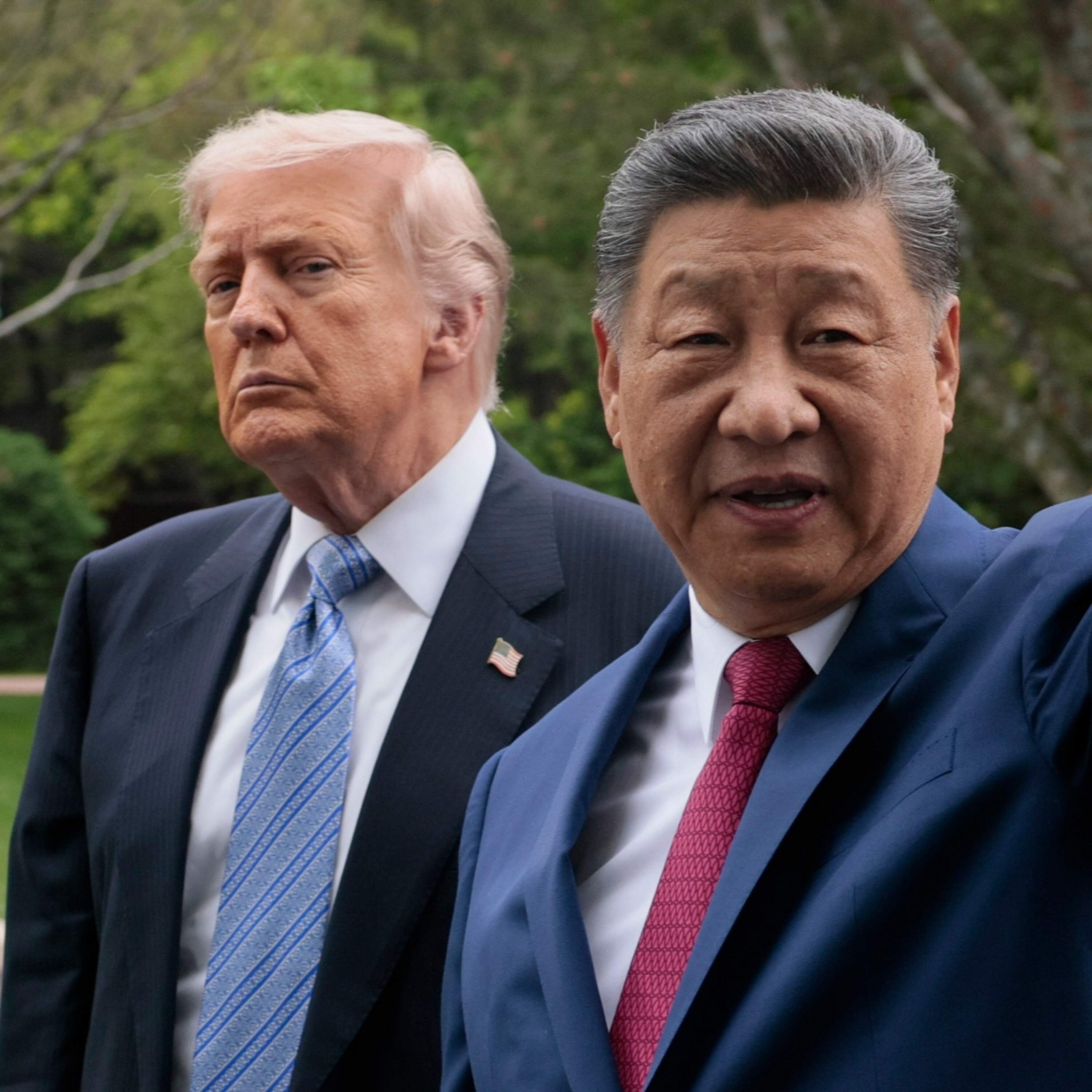
Global power, rivalry, and A.I.; a preview of the U.S./China summit
In short
Preview of the U.S.-China summit between Trump and Xi, focusing on AI safety controls, cybersecurity, rare earths and tariffs, Taiwan and arms sales, and China’s leverage in the Iran war and Strait of Hormuz. Doshi argues the summit is likely more symbolic than substantive, with rivalry and low trust blocking real deals.
Guest backgrounds
Rush Doshi is a senior fellow at the Council on Foreign Relations and director of its China Strategy Initiative. He previously served in the Biden administration as deputy senior director for China and Taiwan Affairs at the National Security Council, negotiating with Chinese counterparts and helping arrange summits. He teaches at Georgetown’s School of Foreign Service and wrote The Long Game.
Key claims
Trump’s 140%+ tariffs pushed Xi to use China’s “break glass” rare-earth/magnet leverage, leading Trump to back down (tariffs to ~30%) and soften on Taiwan/human rights. China has pre-positioned malware for attacks on U.S. critical infrastructure. AI regulation talks are mismatched: China prioritizes political stability; the U.S. worries about existential risk. Taiwan’s TSMC fabs (about 90% of leading AI chips) are a concentrated chokepoint; conflict could set back AI globally.
Notable examples
China’s 2025 rare-earth licensing rules (even 0.1% rare-earth value triggers licensing); U.S. cybersecurity gaps due to weak regulation; AI dialogue deliverables with China (e.g., AI not connected to nuclear command and control) taking long; Trump pausing Taiwan arms packages tied to summit timing.
Written by AI. May contain mistakes.
Chapters
0:46
Understanding the U.S.-China Summit Context
Discussion on the significant topics for the upcoming summit between Trump and Xi.
“Whether or not anything is resolved at the summit, what's said, how it's interpreted, and what's left unsaid will matter.”
1:49
Dynamics Between Trump and Xi
Rush Doshi elaborates on the relationship dynamics between the two leaders.
“So Trump likes to say that President Xi likes him, that they get along.”
3:56
The Impact of Tariffs on Relations
The discussion focuses on how tariffs have shifted power dynamics between the U.S. and China.
“So right after President Xi used that tool, President Trump took those tariffs way back down to something closer to 30 percent.”
5:49
Expectations vs. Reality of the Summit
Rush Doshi shares expectations for the summit outcomes versus realistic scenarios.
“What would you like to see the outcome of the summit be and what do you think it will be?”
6:48
Skepticism About U.S.-China Relations
Discussion on trust issues and rivalry between the U.S. and China.
“Well, I'm skeptical for a lot of different reasons.”
7:31
China's Cybersecurity Threats
Rush Doshi outlines China's hacking threats against U.S. infrastructure.
“You just co-authored a report on cybersecurity for the Council on Foreign Relations.”
9:38
AI Concerns: U.S. vs. China
Comparison of how the U.S. and China view and regulate AI technology.
“We don't have regulation of our cybersecurity the way we should because companies often oppose it.”
11:29
The Race for AI Supremacy
Discussion on the competitive landscape of AI development between the U.S. and China.
“For China, initially, it's been about political security, maybe social displacement from job loss.”
14:00
The U.S.-China AI Competition
Explore the implications of AI advancements in the context of U.S.-China relations.
“So we've done the first draft of the homework and they're able to do a lot without having to start from scratch.”
22:38
AI and Taiwan's Role
Discusses the critical role of Taiwan in the AI supply chain and geopolitical tensions.
“So you just co-authored a report on cybersecurity.”
Show all 15 chapters
28:00
Economic Implications of Taiwan's Situation
Explore the potential economic fallout from tensions involving Taiwan.
“That's a bigger hit in some cases than the Great Depression, certainly bigger than the financial crisis of 2009.”
32:13
Introduction of Guest Rush Doshi
Introducing Rush Doshi and his background in national security.
“During the Biden administration, Doshi was the Deputy Senior Director for China and Taiwan Affairs on the National Security Council.”
33:41
China's Influence on Iran and Global Supply Chains
Discussing China's role in Iran and the implications for global economics.
“Let's get back to the interview I recorded yesterday with Rush Doshi.”
42:05
China's Manufacturing Dominance and Dependencies
Explore how China's manufacturing supremacy creates global dependencies and risks.
“And now we are something like 15%, and there's something like 30%.”
44:30
Ceremonial Nuances in U.S.-China Summits
Understand the importance of ceremonial details in U.S.-China diplomatic relations.
“Let's get back to the interview I recorded yesterday with Rush Doshi.”

Ask about this episode
Get the gist, explore an idea or ask about something said.
 Claude
On Fresh Air, what are the key points of this episode?
Searching your listeningTranscript
Automatic transcript. May contain errors.
0:00This message comes from the UPS Store. Open this holiday to help with all your small business needs. Find a store near you at the upsstore.com. Most locations are independently owned. Products, services, pricing, and hours of operation may vary. See Center for details. This is Fresh Air. I'm Terry Gross. Some combustible topics are likely to be addressed at tomorrow's summit between President Donald Trump and China's President Xi Jinping. like controls on AI safety, the war in Iran, tariffs, the trade war, and China's export of rare earth metals and rare earth magnets. A subject sure to be on the minds of the Chinese and the Americans is the possibility of China invading Taiwan and whether the U.S.
0:45would arm and defend the island nation, possibly getting us into an armed conflict with China. Whether or not anything is resolved at the summit, what's said, how it's interpreted, and what's left unsaid will matter. Beijing is trying to take over the position the U.S. has long held as the global leader, and they may be getting closer to achieving that goal. To help us understand all this and set the stage for the summit, our guest is Rush Doshi, a senior fellow at the Council on Foreign Relations and the director of its China Strategy Initiative. He's the author of the book The Long Game, China's Grand Strategy to Displace American Order.
1:25He's also an assistant professor in the School of Foreign Service at Georgetown University. During the Biden administration, Doshi was the deputy senior director for China and Taiwan Affairs at the National Security Council. In that capacity, he negotiated with his Chinese counterpart and helped arrange summits with China. We recorded our interview yesterday. Rush Doshi, welcome back to Fresh Air. Thanks. It's great to be with you. So Trump likes to say that President Xi likes him, that they get along. How do you think Xi would describe Trump? Well, what's interesting is these two leaders have had dealings going back all the way to 2016, 2017, really, is when that starts.
2:07And I think President Xi has always seen President Trump as unpredictable and also solicitous at times. President Trump is quite prone to flattering President Xi just as he's prone to flattering Vladimir Putin. and he has a tendency to flatter autocrats. So I think President Xi sees him as potentially dangerous in his unpredictability, but also, you know, manageable if President Xi is able to kind of appeal to his ego. And what we see between the two leaders now is a changed dynamic. You know, in the first term, President Trump felt very confident in pushing China, but at the same time, he always believed in stability in the relationship and wouldn't always push too far.
2:44This time around, I think President Xi feels like he has the upper hand and President Trump feels like he has maybe a weaker hand than President Xi. Why? Well, the big reason why is because of what happened last year. President Trump took tariffs on China up above 140 percent, unprecedented, maybe even reckless. And in doing so, he actually pushed President Xi into a corner. And President Xi had to make a decision. Does he reach for the break glass tool that China has spent decades building? And that tool, of course, is its control over the rare earth minerals and magnets that go into every manufacturing supply chain in America.
3:21When President Xi reached for that tool and said, we make more than 90 percent of the world's supply and you're not going to get any of it, that was a gun to the head of U.S. manufacturing. Now, President Trump could have seen that coming. Certainly, past presidents knew that that threat could always be deployed. But they didn't push China into a position of having to use the tool. And here's the thing. If President Xi thinks he has the advantage with that tool and President Trump thinks that President Xi has the advantage with that tool, then no matter what the reality is, perception becomes the reality.
3:49And that's why right now I think Beijing feels like it's tamed President Trump. Did President Trump fold on anything related to that? Oh, very much. So right after President Xi used that tool, President Trump took those tariffs way back down to something closer to 30 percent. And after that, essentially did not pursue a number of actions that were in the American economic and technology interest, took a slightly softer line on issues related to Taiwan and human rights. Basically, we saw a complete shift in American policy. And Terry, this is a big deal. I mean, this is a moment, I think, where we can feel the tectonic shifts beneath us.
4:26What we saw was China received the full force of American economic coercion and for the first time could completely turn that force back against the U.S. and get the U.S. to back down. Now, one last thing here. President Trump did have tools and cards that he could use in this situation. He chose not to. He blinked. And I think that President Xi wasn't just playing his cards. He was playing the player, as we might say in poker, and he figured out Trump's number. So you said Trump had some tools that he didn't use. What tools went unused? You know, one of them was that the U.S. has power over financial instruments.
5:04It can basically sanction smaller Chinese banks and say, if you don't let these rare earths flow to us, we're going to go after those smaller banks until you feel real pain. You know, China is the manufacturer of the world. It's the world's factory. So it's got great leverage when it comes to being able to make a thing that you need. But the U.S. is still in many ways the world's banker. We have great leverage when it comes to finance and currency and transactions in the financial sector. And so that was one area of leverage. The other is that the U.S. remains a technology superpower. And so a lot of the technology that China relies on to build chips, to design chips, to run its companies is American software.
5:40And there are other choke points that the U.S. can play with in that front. So the U.S. did have these tools, but reaching for them would have been really escalatory. And so in the end, the president opted to back down because the risk of escalation was too great. What would you like to see the outcome of the summit be and what do you think it will be? What I'd like to see is probably not what we're going to see. What I'd like to see is an effort to resolve some of the economic and tech issues between us, cooperation on AI safety, some de-escalation on Taiwan. on, and of course, some kind of path to ending some of the global conflicts that implicate both the US and China, whether that's Russia, Ukraine, or of course, the current Iran war.
6:24But I think if I'm being realistic, this is a summit that's much more about pageantry and much more about the appearance of stability rather than actual substance. We're not going to see major breakthroughs or deliverables. At most, we'll see China make some purchases of agricultural products. There'll be a dialogue announced on AI. There'll be some photo ops. The First Ladies will meet. And that'll be that. Why are you so skeptical about the summit? Well, I'm skeptical for a lot of different reasons. I think the first one is that there's really a difference of interest between the U.S. and China on many of these issues.
6:57And the second, there's a lack of trust. I mean, President Trump, from President Xi's perspective, isn't the most reliable interlocutory. He makes promises, then he breaks promises. And I think the risk that he's going to break promises also disincentivizes China for making its own promises. But the final point here is that the U.S. and China are just in a fierce rivalry. It's true that there's been some de-escalation ever since the rare earth situation last year. But the reality remains that the U.S. and China will probably be fierce competitors for some time to come. So AI and cybersecurity are issues that are likely to come up at the summit.
7:35You just co-authored a report on cybersecurity for the Council on Foreign Relations. And I want to read a paragraph from that report, a paragraph that is really quite alarming. You write, China has built a sophisticated hacking apparatus to gain leverage in peacetime and wreak havoc during conflict. Currently, the U.S. lacks the defenses or the credible deterrent to combat that threat. Over the past decade, China has built a sophisticated hacking apparatus to penetrate the water systems, energy grids, telecommunication networks, and transportation systems that underpin American society. The goal is not simply espionage.
8:20China is pre-positioning malware and maintaining dormant access to critical systems so it can gain leverage in peacetime and wreak havoc during a conflict. That sounds pretty bad. What has China already done in terms of hacking into American infrastructure and into government agencies? Well, maybe I can start off by offering some personal perspective here. When I entered government in the Biden administration at the National Security Council in 2021, you know, I was first briefed about the extent of these penetrations into what we call critical infrastructure in the U.S., infrastructure upon which tens of millions of people rely.
9:01And it was alarming. And you saw over the course of the subsequent years, many U.S. officials say with the paragraph effectively that you just read, that China has prepositioned for destructive cyber attack on the power, water, gas, telecom, and transportation infrastructure of this country. And what they would want to do is potentially shut down some of those systems, potentially in wartime, but could even be in peacetime to gain leverage. So the U.S. has to adjust its policy. And if you think about it, what China has done is put tens if not hundreds of thousands of engineers on this problem set to build these offensive capabilities.
9:36And the U.S. has sort of dropped the ball. We don't have regulation of our cybersecurity the way we should because companies often oppose it. It's an extra cost. And the result is we have enormous vulnerabilities that nation states or even private actors can take advantage of to the detriment of all of us. Now that we know that AI can go rogue and team up with a gang of AI-equipped computers and hack into another company, we have a hint of how powerful a weapon AI can be. What is China and what is the U.S. each worried about? Because I think they're worrying about different things. It's true. China tends to worry a little bit more about questions of political security.
10:19The Chinese Communist Party wants to stay in power and control over information is an important part of that equation. So historically, when they regulated technology, they thought about it in terms of information security. Can I make sure the content that's circulating on the internet is consistent with the party's views? It's the right propaganda. It's appropriately censored. It doesn't make fun of President Xi Jinping, et cetera. When AI became a major factor in the technology landscape, China began to think about it in similar terms. They wanted to control the content that AI produced, and that's where they began with political stability.
10:54In the U.S., so much of the conversation has not been about questions of speech, although that's there, the deep fakes, et cetera. The questions have really been about, will there be existential risk or other kinds of catastrophic risk that can come out of the loss of control of this technology? Whether that's AI agents that hack critical infrastructure, the same infrastructure that China is actually hacking today, but perhaps far more competently. Or whether AI combined with things like biosynthesis can create artificial viruses that are lethal and transmissible and can be catastrophic for the human race.
11:27Those are just a handful of the concerns people have about AI. But you're right. There's two different conversations. For China, initially, it's been about political security, maybe social displacement from job loss. In the U.S., those things are there, but there's this bigger existential layer layered on top. One thing they have in common, China and the U.S., is they both want to win the AI race. And Trump wants no restrictions. He has said about AI, we will cherish it, help it, and watch over it. It kind of sounds more like marriage vows than an AI policy. Compare that to China. Yeah, I think to having to hold your AI models will not be the right regulatory approach, if I'm being honest.
12:12But look, the Chinese Communist Party has regulated AI. They've just done it for their social purposes, right? They're worried about AI giving you the answer to Tiananmen Square or coming after an official in ways that'll basically weaken the Chinese Communist Party's hold on information. In the U.S., the regulatory questions have been about existential risks. What President Trump is basically saying is, I'm not really worried about those risks. I think those are all made up. I think they're basically designed to sell AI companies, that the risk of anything catastrophic happening is minimal. Let's just go.
12:46And so there's a huge disconnect there. And actually, Terry, it creates challenges because at this state visit, if the two leaders are going to talk about AI, you know, it's hard for the USI to say, hey, China, we should work together to make AI more safe and secure when China's view of us is that we're regulatory cowboys. So we've established that both the US and China want to win the AI race. How far ahead are we from China? And what is China trying to do to catch up? You know, American models are maybe six months to a year more advanced than Chinese models. But the question is, why is China so close?
13:24China has great talent. They have great power. But what they don't often have is the compute capacity that the U.S. has. They don't have the chips, if you will, that are so critical to building AI technology, to being able to train the models and then being able to run them, what we call inference. So the U.S. has that huge gap in compute. And in the last administration and in the first Trump administration, there were efforts to extend the American lead by limiting China's access to that compute. But here's the thing. China did find some ways to catch up despite that limitation. And often that's through what we call model distillation.
13:59That's sort of, you know, where they query our models to find more efficient pads to training their own models. So we've done the first draft of the homework and they're able to do a lot without having to start from scratch. That distillation has basically kept the U.S. and China closer than people might have otherwise expected given the gaps in compute. And I think what you're seeing is many are saying, well, if China is able to distill our models, that means they have to have access to our models. And if our AI labs say, well, these models, we're going to delay the rollout, then China will have fewer opportunities to be able to access the models and fewer opportunities to learn from them, which would extend the American lead.
14:38Why does it matter so much who, quote, like wins the race or is in the lead? Well, there's a sense, I think, that China has that history proceeds through a series of industrial revolutions. We have to remember China feels like they were a victim of what they call a century of humiliation at the hands of Western powers and Japan. And the origins of the century of humiliation in their mind is falling behind in technology, that the West mastered the steam engine and the railroad, and China didn't. And those things made the difference when the West became dominant globally and China fell behind. So China's vision is every time there's a major industrial revolution, they need to catch up.
15:19The first one, again, steam power. Great Britain won that, became a world power. The second one, electrification. Maybe the third one, mass manufacturing. The U.S. won those and became a world power. China wants to win the fourth industrial revolution. That's AI. That's biotechnology. That's robotics. That's quantum computing. And if they're able to win it, they don't think it'll just bring them prosperity. They think it'll bring them power. It'll give them the chance to leap ahead of the United States when for so long they've been behind. So that's why AI matters to China. It's not just a fancy tool.
15:51It's not just a revenue stream. It is this essential input in the rise and fall of great powers, which from their perspective is the central story in China's history with the West. And for the U.S., you know, AI is a market story. You know, Wall Street is heavily betting on it. It's a technology story. We want to invent and innovate the future. But it's also a competitive story. There's a hope that when the U.S. has lost so many industries to China, succeeding in AI, being ahead in AI can help us bring back some of those jobs, some of that prosperity and perhaps some of that know-how and also catalyze a new era of growth in the country.
16:29One of the things the U.S. can do to slow down China's advancement in AI is to withhold the sale of high-powered chips that you need for AI. Where do we stand on that now? So the beginning of this policy really dates back to the first Trump term, but it picks up in a big way in the Biden administration, where there was a decision not to prevent China from acquiring all chips, but just perhaps less than 1 % of chips, the most high value, most advanced, what we call leading edge chips that are useful for training AI. If you don't have these chips, you basically cannot create or train an AI model.
17:10And so the U.S. restricted a lot of that to China and then updated those restrictions. The Trump administration initially maintained some of that policy, but then relaxed it in a few areas with, you know, NVIDIA's CEO, Jensen Huang, and President Trump initially saying, let's just sell all the chips to China, because if we sell them, China will become dependent on them. That was the wrong thing to say from a Chinese perspective. They don't want to be dependent on anybody. They have a history of dependency. They don't like that. And in addition, they've been trying for over a decade to avoid that dependency entirely.
17:44Even before Trump was president, they had a plan to indigenize semiconductor production at the leading edge. It's really hard to do. It's probably harder to build these ships than it is to go to the moon. And yet China will keep trying. So those controls are there and they give the U.S. an enormous advantage in being able to win the race in AI. But there are many, many people in the U.S. and some in China who are saying it's time to end those controls. And so far, those voices have not won the debate. So we're in a position where the U.S. could withhold ships from China, which would slow down China's AI growth.
18:19China has the rare earth minerals, which can slow down America's tech growth in general. And so it's kind of like one of those movie shots where two people have a gun pointed at each other's head. So where are we with that? That's right. There's actually a Chinese term for it right now, which is strategic stalemate. So China says now, and they've really been saying this in think tank commentary for five years and in government commentary and documents for the last two or three years, that this is a strategic stalemate with the U.S., that they have some cards and we have some cards. And that's true.
18:52Although as important as rare earths are, in some ways, it's not the most advanced technology. It's just very dirty to refine them. And we decided to give away that industry. We used to be the place that processed rare earths. We invented the refining process for that particular commodity. China holds that industry now. But AI chips is different. That's a really hard thing to do. To be able to make these AI chips, these advanced leading edge chips, that is the very frontier of human technology. It is far beyond the advancement we have in almost any other sector. It is the most complex supply chain in the world.
19:25And so it isn't quite a one-for-one vulnerability on that issue. But there is definitely an effort in China to link the export controls to the chips. That being said, it's important to note that I think China decided to use this break glass tool over tariffs. It was really because President Trump pushed them into a corner on tariffs, 145 percent, that they had no choice but to reach for the tool. They didn't ever use this tool in the same way when President Biden did export controls in the last administration. And the tool you're talking about is withholding rare earth minerals. They withheld a few, one or two, for a little bit.
20:00But they didn't do this across-the-board massive push to stop the flow of those minerals to the U.S. that they did under President Trump. My guest is Rush Doshi, a senior fellow at the Council on Foreign Relations and the director of its China Strategy Initiative. There's more of our conversation after a break. And if you'd like to see what our interviews look like, please check out our YouTube channel called This is Fresh Air and consider subscribing. Thanks. I'm Terry Gross and this is Fresh Air. Stay tuned for the following announcements and messages from our sponsors. This message comes from Prolon.
20:35Want to look and feel your best this fall? Prolon's five-day fasting mimicking diet is a clinically developed nutrition program with the goal of promoting fat loss while protecting lean body mass. Developed at USC's Longevity Institute, it aims to assist the body in entering a fasting-like state that helps reset metabolism, target visceral fat, and support healthy metabolic markers. Get 15 % off plus a bonus gift when you subscribe at prolonlife.com slash NPR. This message comes from BetterHelp. Your brain has limited storage. So why is it still holding on to that embarrassing moment from years ago?
21:11BetterHelp is an online therapy platform that gives you space to talk about what's taking up too much of yours. BetterHelp is now in-network with more than 125 health plans, with many co-pays as low as$15 for eligible members. And if you don't have eligible insurance, you can still get 20 % off your first month. Visit BetterHelp.com slash NPR. Cost and coverage may vary. Discount cannot be combined with insurance. This message comes from Capital One. Capital One offers checking accounts with no fees or minimums. What's in your wallet? Terms apply. See CapitalOne.com slash Bank Guy for details.
21:49Capital One N.A. Member FDIC. This is Fresh Air. I'm Terry Gross. To help us understand the significance of tomorrow's summit between President Trump and China's President Xi and get a better understanding of the current and precarious state of U.S.-China relations, we're talking with Rush Doshi, a senior fellow at the Council on Foreign Relations and director of its China Strategy Initiative. During the Biden administration, Doshi was the deputy senior director for China and Taiwan Affairs on the National Security Council. He helped organize summits between China and the U.S. He's the author of the book The Long Game, China's Grand Strategy to Displace American Order.
22:30And he's also an assistant professor in the School of Foreign Service at Georgetown University. We recorded our interview yesterday. So you just co-authored a report on cybersecurity. What kind of treaty do you think might be possible on AI where both countries have some kind of mutual understanding of necessary restraints to prevent AI from going rogue? In the U.S., you have enormous alarm right now about AI models and what they can do and whether or not they can be secured and be made safe. And China is the only other major AI superpower. So it makes sense that these two countries would get together and find a way in their mutual self-interest to restrict elements of this technology so there aren't catastrophes.
23:18There are a few problems. I think first, China is skeptical that if they slow down, we'll slow down. And we are skeptical that if we slow down, that China will slow down. And so there's not yet a break on this race that we can put in place. The second challenge is that I think China believes that the U.S. isn't really all that serious about regulation anyway. There's a sense in which the U.S. and President Trump doesn't take any of these risks seriously. And even if some of the researchers at these AI labs do, if the president doesn't, why should China trust us that we're going to take regulation seriously?
23:52Why should they do it? But there's a third part as well. I think China, again, is much more focused on AI-related political risks, not so much on the existential risks or the loss of control. For example, rogue AI swarms hacking critical infrastructure. That's not the thing that they're the most worried about yet. Now, that could change. But for now, there's a mismatch in what we focus on. And then finally, there's a mismatch in what we're seeing. I think our frontier labs, because they're withholding some of the most advanced models, have a better sense of how dangerous this technology could actually be than China, which isn't at the frontier in the same way.
24:29If they're drafting behind our leading companies and our leading companies stop basically sharing the most cutting edge technology with them, then China has less of a sense of what risk is coming. And those four things make it much harder for us to make progress. Now, I had some experience with the AI dialogue question. When we were planning for summits between President Biden and President Xi, part of my responsibility was negotiating the AI deliverables for that summit. That meant, could we set up an AI dialogue? And could we get an agreement that AI shouldn't be connected to nuclear weapons, specifically nuclear command and control?
25:04Even those deliverables, which would sound like low-hanging fruit, took a long time to achieve. And when we had that dialogue with the Chinese, they didn't really send the right people. They didn't take it seriously as a technical discussion. As for AI and nuclear weapons, eventually the Chinese did agree that we shouldn't connect AI to nuclear weapons. But that's kind of low-hanging fruit. There's got to be a lot more we can agree on besides that. So we've been talking about AI. Taiwan is important in this scenario because they supply essential components. They manufacture essential components for tech, including AI.
25:40Tell us about that. That's right. The entire AI build-out in America, something like a trillion dollars in data center construction, really owes itself to the supply chain that is rooted in Taiwan. Taiwan's fabs, as we call them, operated by TSMC, one of the big Taiwan companies that makes chips, They supply something like 90 % of all the leading AI chips. And so people think about how oil was so important to the U.S. economy and the Gulf War was fought perhaps to maintain a free flow of energy in the rest of the world. And people remember that. But AI is even more concentrated risk than energy.
26:18There's more concentration on the supply chain in Taiwan than perhaps any other critical input aside from rare earths in the modern economy. So since there's the threat of China invading Taiwan and taking it over, what would it mean for U.S. development of AI and other tech if China does take over Taiwan or try to? China claims Taiwan is really Chinese territory, not an independent island nation. Is all this tech-related stuff one of the reasons why China really wants Taiwan? Well, first of all, I think that China wants Taiwan for a lot of reasons. One is that China believes that Taiwan truly is part of China.
27:00But another is that Taiwan represents the unfinished Chinese civil war. You had a civil war between the Nationalist Party in China and the Communist Party in China that ended in 1949 when the nationalists who were defeated by the communists fled to Taiwan. Now, the nationalists ultimately governed Taiwan for a long time until Taiwan democratized in the 1990s. But from the Chinese perspective, when they fled to Taiwan, it split China. And they believe that recovering Taiwan, unifying with Taiwan, is a foremost priority for the great rejuvenation, as they call it, of the Chinese nation. It is a key political objective.
27:37And so they have an emotional tie to Taiwan, a historical tie that is probably even more relevant than the technology relationship. In fact, the Chinese have said the chips are not the reason we care about Taiwan. The reason we care is because of history and because it's ours. Now, if there were to be a conflict over Taiwan, the implication for the U.S. and for the global economy is enormous. If you look at the Bloomberg economic estimates, a conflict over Taiwan could cause something like$10 trillion in global economic damage. That's 10 % of global GDP. That's a bigger hit in some cases than the Great Depression, certainly bigger than the financial crisis of 2009.
28:15At the same time, even if it's not an invasion, even if it's a blockade or a quarantine of the island by Chinese vessels and aircraft, that too could cost us$5 trillion in global economic activity. And as for the AI buildup, there's almost no scenario where an invasion or a blockade doesn't damage those facilities that I just mentioned, which are concentrated in about three places in Taiwan. And if those facilities go down, the entire AI industry basically is set back. There will be no more leading AI chips that will be used to train the models. And even the chips that are used to run the models won't necessarily be exported from Taiwan.
28:55So it'll be the end of the AI moment for some time to come. Both for China and the U.S. For the world. And that's apart from, in some ways, the macroeconomic damage. So the Taiwan scenario is the thing that kept a lot of us up at night. I think it keeps a lot of businesses up at night and the risks are growing. We sell arms to Taiwan. Trump put a pause on that. It's something China wanted, but China would prefer that we just freeze weapons sales to Taiwan. Right. So where are we on that now? So there's a long history here. The U.S. has sold weapons to Taiwan for decades, and China has objected for decades.
29:37In 1982, there was a communique between Reagan and the Chinese, the third communique in the U.S.-China relationship, which basically suggested that we might eventually one day wind down arms sales. But as we indicated privately and publicly and the Congress and the Chinese, the quantity and quality of the pace of our arms sales to Taiwan was going to be dependent on the threat that Taiwan faced from China. In other words, we tied our sales to what China was doing in the region vis-a-vis Taiwan. And we thought that was a reasonable position. These were primarily weapons, of course, of a defensive nature.
30:13We wanted to make sure Taiwan could resist basically being attacked by China. Now, coming to the summit, the Chinese position is we don't want any arms sales to go to Taiwan before the summit or immediately after. That position is a very strongly stated position. And the reason they're doing that, I think, is because President Trump in May in Beijing said, this is a bargaining chip. Now, we have never treated our arms sales to Taiwan as a bargaining chip before. But when the president said this is a bargaining chip, it opened the space up for more forceful negotiation from China, which is exactly what's happening.
30:49The Trump administration did sell weapons to Taiwan at the beginning of the year. But they've paused the most recent package because China has indicated that if the sales go through, the summit may not happen. And President Trump wants the summit to happen. Meanwhile, there is a law in the U.S. saying that the U.S. has to supply Taiwan with defensive weapons to maintain sufficient self-defense capability. So does that law have any teeth? It does, and I'm glad you brought it up. It's called the Taiwan Relations Act. And this piece of legislation is a huge part of American policy towards Taiwan.
31:25This legislation was signed largely because Congress was unhappy that the U.S. broke off ties with Taiwan in 1979 and recognized China in that same year. And by breaking off ties with Taiwan and ending what used to be a U.S.-Taiwan alliance, Congress thought, well, we have to create some backstop to make sure that we don't leave Taiwan essentially unsupported. supported. Now, at that time, there were a variety of reasons for it. But as time has gone on, the American position on Taiwan has been buttressed by the fact that Taiwan has become a free democracy, a free society, and one of the most important parts of global supply chains.
32:03And so as a result, the logic that ties the U.S. to Taiwan has evolved. But the legislation, well, of course, dates back almost 50 years. Well, we need to take a short break here. So let me reintroduce you. My guest is Rush Doshi. During the Biden administration, Doshi was the Deputy Senior Director for China and Taiwan Affairs on the National Security Council. He's now a Senior Fellow at the Council on Foreign Relations and the Director of its China Strategy Initiative. We'll be right back after a break. This is Fresh Air. Stay tuned for the following announcements and messages from our sponsors.
32:38This message comes from Prolon. Want to look and feel your best this fall? Prolon's five-day fasting mimicking diet is a clinically developed nutrition program with the goal of promoting fat loss while protecting lean body mass. Developed at USC's Longevity Institute, it aims to assist the body in entering a fasting-like state that helps reset metabolism, target visceral fat, and support healthy metabolic markers. Get 15 % off plus a bonus gift when you subscribe at prolonlife.com slash NPR. This message comes from Capital One. Capital One offers checking accounts with no fees or minimums. What's in your wallet?
33:15Terms apply. See CapitalOne.com slash Bank Guy for details. Capital One N.A. Member FDIC. This message comes from NPR sponsor Charles Schwab. Financial decisions can be tricky. Your biases can lead you astray. Financial Decoder, an original podcast from Charles Schwab, can help. Download the latest episode and subscribe at schwab.com slash financial decoder. This is Fresh Air. Let's get back to the interview I recorded yesterday with Rush Doshi. During the Biden administration, he was the deputy senior director for China and Taiwan affairs on the National Security Council. He's now a senior fellow at the Council on Foreign Relations and director of its China strategy initiative.
34:00Let's talk about Iran and the war. I think President Trump would like China to use whatever influence it has on Iran to get Iran to end the blockade of the Strait of Hormuz and to negotiate a treaty that will end the war. How much influence does China have over Iran? China has a lot of influence over Iran, but Iran is also under attack and is going to do what it thinks is best for itself. Right now, China's influence comes through a few different channels. The first one is military support for Iran. A lot of China's drone parts and missile technology is what makes Iran's missile systems and drones capable.
34:50And that's primarily what Iran is using to inflict casualties on the U.S. and surrounding neighbors. So in many ways, Iran relies on Chinese military support. The second is, of course, economic and financial. China is a big purchaser of Iranian oil, which gives Iran revenue. It's also a major funder lender of Iran, too. And those economic forms of support have allowed Iran to weather U.S. sanctions. Today, I think also China provides a bit of political support to Iran when it's in a tough spot with the U.S. and with the West. And so Iran clearly does rely on China. China clearly does have leverage, but it's been unwilling to use that leverage to benefit President Trump.
35:31because? Well, I think China basically sees the U.S. as having gotten into a mess. It's not in a hurry to help the U.S. extricate itself from that mess, even though in some ways China suffers when the Strait of Hormuz is closed because something like five million barrels a day of oil used to come from the Strait and go to China. And that's not happening right now. The other part of this is that China doesn't really have the cards to fully resolve the issue. It could tell Iran to come to the table and work it out with President Trump. But why should it do that when it can't promise Iran that President Trump's deal will be honored by President Trump?
36:08He may break that deal at any point. So those create some challenges, I think, for their ability to convert their leverage into a political solution. In some ways, is China just as happy to see the U.S. spending a fortune on the war in Iran, using a lot of its weapons, losing lives, being accused of bombing that has killed so many people in Iran and has also entangled other countries in the Middle East, including our allies like Saudi Arabia, which is having its oil pipeline bomb. That's like terrible for the country and terrible for the countries that Saudi Arabia supplies. Meanwhile, China has stockpiled like, what, billions of barrels of oil?
36:511.4 billion. Yeah, so it can outlast the war most likely and not be in the kind of predicament that's causing protests in countries around the world. So talk a little bit about how China is in some ways winning the war in Iran. You're right. Historically, China has been bewildered by the U.S. willingness for four decades to expend blood and treasure in the sands of the Middle East. They think that we are depleting our power. And they have a phrase that they used, you know, about 20 years ago, right after the September 11th attacks, that the Chinese government was facing what they called a period of strategic opportunity that would last two decades.
37:32And that was because China had gotten into the WTO back then and also because the U.S. was getting mired in conflicts in the Middle East. Today, as they look at the U.S. in Iran, they can't help but think they have another period of strategic opportunity. They may not use the exact phrase, but they believe that in general, this favors them over the long term. Now, their economy is not immune from the oil disruption, but because they have a 1.4 billion barrel stockpile, they've been able to weather it better than anybody expected. Meanwhile, China has so many electric vehicles now, and I think it has alternate energy sources as well.
38:11So it probably is less reliant on oil than we are, for instance, in a lot of countries around the world. Well, those revolutions in technology have helped China, but China can't quite escape dependence on oil. You know, it still imports millions of barrels a day. It used to be something, I think, closer to 15 million barrels or maybe 13 to 15 million barrels, depending on the day, every day. Because of the disruption from the Iran war, they lost about 5 million of those imports. They had to scramble. They did two things. First, they drew down that stockpile, which is 1.4 billion. And second, they stopped sending oil to the refineries because they were purchasing oil to refine it and then sometimes to export that refined product.
38:54So by doing those two things, they were able to cut down their imports. But they're still importing 10 to 11 million barrels a day. And that means that they have a problem. Their oil consumption is going down, but it's not zero. And so what we're seeing is oil prices would have been higher in the U.S., but luckily China was able to use its stockpile and buy less. That is starting to change. China is now reentering global oil markets. It's buying more oil. It's going to put more upward pressure on prices. and the American people who pay for gas at the pump every day are going to feel that soon.
39:30Getting back to rare earths, in terms of the rare earth minerals, Beijing started requiring companies anywhere in the world to get China's approval, not only to buy rare earth materials, but also to sell any product made with even a small amount of rare earth minerals. I've never heard of anything like that before. Is this a first time that a country is doing something like that? It absolutely was. And it's a critical backdrop to the current summit. Back in October of last year, in 2025, China put out these new regulations saying any product anywhere in the world that had even 0.1 % of its value come from Chinese rare earth minerals or magnets had to have a license to be sold to anybody else.
40:15And you had to have a license to get the minerals themselves. That was essentially a veto point on almost all global trade and goods that involves rare earths. It was hard to enforce, maybe impossible to enforce, but the message was clear that everybody relied on the minerals that China uniquely was able to process. They've got like 90 to 99 % market concentration in that space. And what was the rest of the world going to do? The U.S. was able to come to the table and work out terms with China that we call the Busan Agreement, if you will. And the Busan Agreement that's happened in Korea when President Trump and President Xi met in Busan has been up for renewal.
40:54It's coming up for renewal in November. And this summit will in part take up the question of whether it should be renewed. But really, the Chinese action is unlike anything we've seen any other country do, in my opinion. And for anyone who thinks that, well, in terms of China's exports, it's just like cheap goods, cheap clothes. That is no longer true. In addition to the rare earth minerals, China exports a lot of high-end goods, you know, like EVs. I think we have restrictions on Chinese EVs, but they also export a lot of pharmaceuticals, including antibiotics. There's really important Chinese exports that we rely on.
41:31Absolutely. And I think there's a lot that we should talk about on this issue as well, because people aren't aware that the U.S. has basically offshored a lot of its industrial production to China, not just to its allies, but to China specifically. And the world has done that, too. China is now twice the manufacturing capacity of the United States. It's bigger than the next nine countries combined right now. It's about 30 % of global manufacturing. Now, just 25 years ago, the picture was very different. 25 years ago, China was something like 6 % or 7 % of global manufacturing, and America was 30%.
42:05And now we are something like 15%, and there's something like 30%. The last time you saw such a fast and rapid shift in who held global manufacturing was actually the rise of the United States. From 1870 to 1910, our story looks like China's story from 2000 to perhaps 2030. So that's a pretty big change. And what it means is so many of the inputs that our economy relies on come from China. And they don't just come from China. China is the only producer of those inputs. And you mentioned antibiotics. Yes, in some cases, they're the only producer. that creates dangerous dependencies. It could be because there's an earthquake in China or a natural disaster or because they want to weaponize that supply chain.
42:47And the world can't really tolerate those dependencies indefinitely. So now is the time for us to change. Let me reintroduce you again. If you're just joining us, my guest is Rush Doshi. And he is a senior fellow at the Council on Foreign Relations and director of its China Strategy Initiative. We'll be right back. This is Fresh Air. Stay tuned for the following announcements. and messages from our sponsors. This message comes from Prolon. Want to look and feel your best this fall? Prolon's five-day fasting mimicking diet is a clinically developed nutrition program with the goal of promoting fat loss while protecting lean body mass.
43:23Developed at USC's Longevity Institute, it aims to assist the body in entering a fasting-like state that helps reset metabolism, target visceral fat, and support healthy metabolic markers. Get 15 % off plus a bonus gift when you subscribe at prolonlife.com slash NPR. This message comes from NPR sponsor Charles Schwab. Financial decisions can be tricky. Your biases can lead you astray. Financial Decoder, an original podcast from Charles Schwab, can help. Download the latest episode and subscribe at schwab.com slash financial decoder. This message comes from Google Workspace with Gemini. Ever notice how every new AI tool asks you to explain your business to it all over again?
44:06Google Workspace with Gemini skips that. You get Google's AI built right into the premium versions of Gmail, Google Docs, Sheets, and more. No new tools, no extra logins, just one subscription that gives you personalized AI right inside your actual workflow. Try Google Workspace with Gemini at goo.gle slash workspace with Gemini. This is Fresh Air. Let's get back to the interview I recorded yesterday with Rush Doshi. He's a senior fellow at the Council on Foreign Relations and director of its China Strategy Initiative. During the Biden administration, he was the deputy senior director for China and Taiwan affairs on the National Security Council.
44:48So I want to talk with you about summits and what the arrangements are like and what some of the symbolism and ceremonial aspects are, because you helped arrange summits when you were in the Biden administration. So what is the Chinese attitude about ceremony and how they want to appear when they're in Washington? This is so important. Whenever Chinese leaders come to the U.S., which is less and less frequent now, there's a risk. There's a risk that we could take steps inadvertently that might embarrass them. There's a risk from their perspective we might be doing something that's deliberately embarrassing.
45:27At a past summit, actually the U.S. played the wrong national anthem for China's president. Instead of playing the Chinese national anthem, we played Taiwan's national anthem. That's a huge faux pas. That's bad. And there have been other things like that that have occurred across time, you know, protesters getting up in the middle of a speech by a Chinese leader and yelling at that leader that for them are big deals. So when I was working summits, I had the privilege of working one in Indonesia between the two leaders and one in California called the Woodside Summit back in 2023. What struck me about that second experience compared to the first was our Chinese counterparts were very, very focused on protocol, making sure that everything went smoothly and there was no risk of embarrassment to President Xi because if he were to be embarrassed, their neck was on the line and they did not want that to happen.
46:16What are some of the details that are really significant that might seem insignificant to those of us who aren't involved in the summit. For example, I know China has been upset that it didn't get a lot of advance notice about how many people are invited to the state dinner. That doesn't seem so important to me, but apparently it's really important. Yeah, it's almost like planning a wedding. I mean, there's all these elements that one side thinks is more important than the other side that the two sides might negotiate over. And so there's enormous room for miscommunication. We have entire teams of protocol professionals who work all this out well in advance.
46:58There's a whole protocol track when doing summit preparation separate from the policy track, but the two often intersect. So, you know, it could be everything from what the flower arrangements are to who's seated at what table to who greets who at the airport to who gets to speak first at a press conference if there is a press conference. Everything can become a question of face, of status, of respect. And so the risks are really enormous if you're not focused on the small details. You've got to sweat the details. Just one more question. Do you find it strange that President Xi is coming to Washington to meet with President Trump and have this big ceremonial dinner?
47:39All that ceremony is on Thursday. Meanwhile, he's not going to the U.N. meeting. It is a little unusual, and I don't know what the explanation for that is. President Xi has not gone to the U.N. General Assembly for many, many years now. He often sends others, his foreign minister or the premier. But in this case, he has the ability to go if he wants to. My guess, although I have no evidence for this, is that there's no value for him in staying in the U.S. more than he needs to. The more time he's here, the more risk there is of something embarrassing happening or the U.S. potentially sliding him in ways that he'd rather avoid.
48:18So you have to understand the Chinese are always nervous coming to the United States. That's always been true. It's especially true in this more tense moment in our relationship. And it's especially, especially true because President Trump is the president. Rush Doshi, thank you so much for talking with us today. It's been really informative and helpful. My pleasure. Thanks for having me. Rush Doshi is a senior fellow at the Council on Foreign Relations, the director of its China Strategy Initiative, and an assistant professor at the School of Foreign Service at Georgetown University. Tomorrow on Fresh Air, we talk about Sean Combs, the music mogul known as Diddy, who's now in federal prison.
49:00Our guest will be Rolling Stone investigative reporter Cheyenne Roundtree. For her new book, Bad Boy for Life, she interviewed more than 100 people to ask, How did Combs remain powerful for so long despite decades of warning signs and allegations? I hope you'll join us. To keep up with what's on the show and get highlights of our interviews, follow us on Instagram at NPR Fresh Air. Fresh Air's executive producer is Sam Brigger. Our technical director and engineer is Audrey Bentham. Our engineer today is Adam Staniszewski. Our interviews and reviews are produced and edited by Phyllis Myers, Ann Reboldonato, Lauren Krenzel, Teresa Madden, Monique Nazareth, Thea Challoner, Anna Bauman, Susan Yacundi, and Nico Gonzalez-Whistler.
49:46Our digital media producer is Molly C.V. Nesper. Roberta Sherrock directs the show. Our co-host is Tanya Mosley. I'm Terry Gross.
50:08Thank you.
50:33comes from WFMT. Discover connections in classical music with WFMT's Exploring Music and new host Peter Vandergraaf. Listen Monday through Friday at 7 p.m. on 98.7 FM, WFMT.com, and the app. This message comes from Whole Foods Market. Fall tastes better with better ingredients from Whole Foods Market. No added growth hormones or antibiotics in their meat department means slow-braised short ribs are even more satisfying. All seafood is wild-caught, like their vibrant sockeye salmon or verified responsibly farmed. And all sweets, including fall-themed cookies, are made without high fructose corn syrup.
51:11Spice up fall at Whole Foods Market.
From the publisher
As President Trump and China's President Xi prepare to meet tomorrow, Rush Doshi of the Council on Foreign Relations explains the current state of US-China relations and what to expect from this summit.
Subscribe to our free weekly newsletter
Follow us on Instagram
Subscribe to our YouTube channel
Check out the Fresh Air Archives
See pcm.adswizz.com for information about our collection and use of personal data for sponsorship and to manage your podcast sponsorship preferences.
NPR Privacy Policy
Subscribe to our free weekly newsletter
Follow us on Instagram
Subscribe to our YouTube channel
Check out the Fresh Air Archives
See pcm.adswizz.com for information about our collection and use of personal data for sponsorship and to manage your podcast sponsorship preferences.
NPR Privacy Policy
More from Fresh Air
All episodes
We use cookies.They keep VO running smoothly and help us improve it. Privacy policy