
 Ask ChatGPT


In short
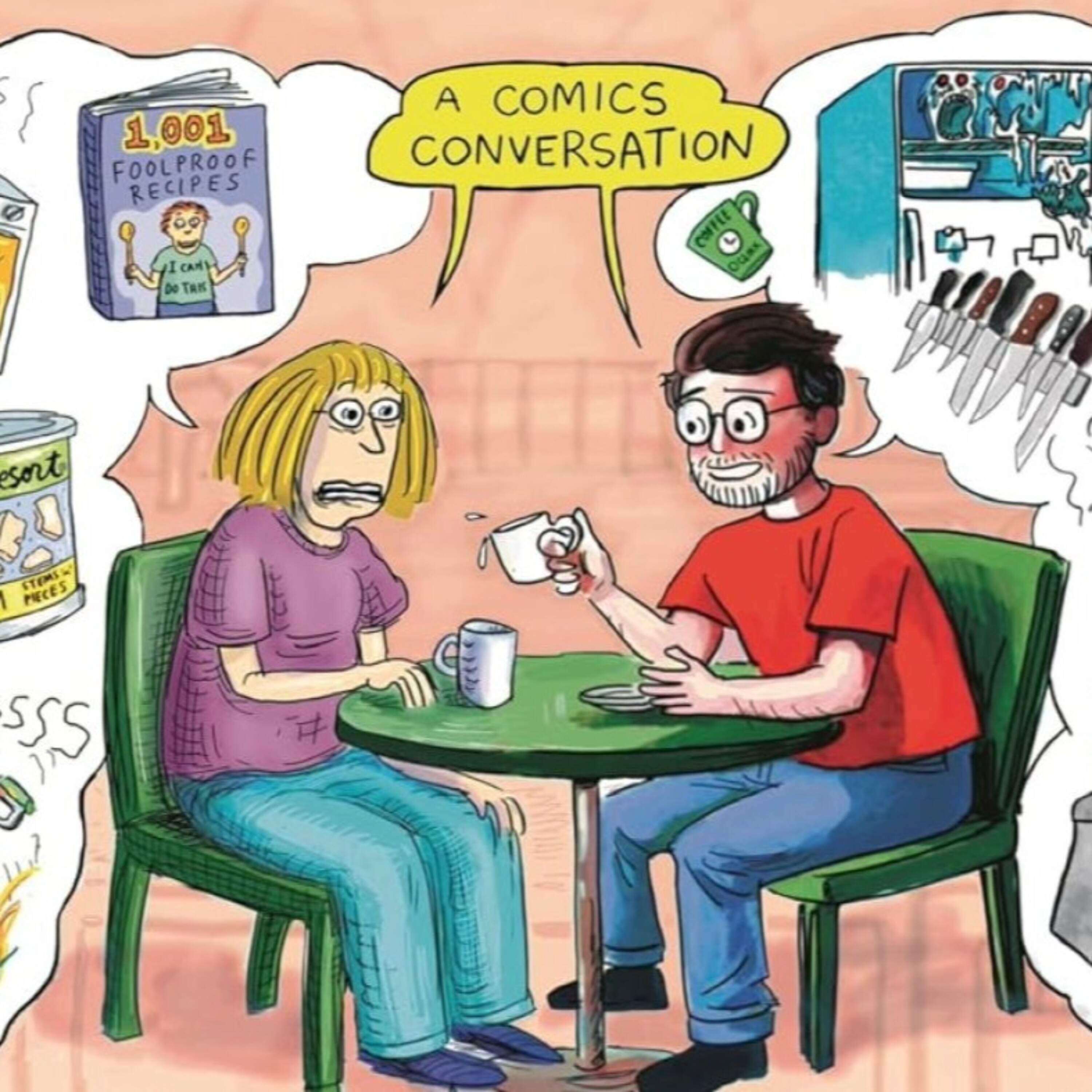
Roz Chast and Jason Adam Katzenstein discuss their graphic memoir The Two Saddest Kitchens, about the shame, dread, and comedy of their “nightmare kitchens” and what’s hidden behind the cheerful facade. They also connect kitchen mess to family history, OCD anxieties, and exposure/response prevention.
Guest backgrounds
Roz Chast is a New Yorker cartoonist; her earlier memoir Can’t We Talk About Something More Pleasant? focused on her changing relationship with parents as their health declined. Jason Adam Katzenstein is a New Yorker cartoonist; his 2020 graphic memoir Everything is an Emergency recounts growing up with OCD.
Key claims
They dislike cooking and feel embarrassment about personal mess. Sadness often lurks “inside the refrigerator” and drawers; they avoid cleaning because there are “more interesting things to do.” Jason describes ERP therapy and antidepressants reducing OCD’s dominance.
Notable examples
moldy food behind fridge shelves; mismatched plastic container lids; “Undersink Cabinet of Doom”; cockroach infestations; stained mugs; a “cheese-tainer” bin patched with decades of masking tape; a college pizza-putts incident that filled a dorm with smoke; a friend’s DIY cabinets prying off, smashing crockery, and filling the kitchen with gas.
Written by AI. May contain mistakes.
Chapters
1:41
Confessions of Kitchen Disasters
The guests share their comical and relatable kitchen problems and disasters.
“Roz Chast, Jason Adam Katzenstein, welcome to Fresh Air.”
3:08
The Burden of Kitchen Shame
Discussing the shame and embarrassment around their chaotic kitchens.
“I can hear the voices of my lefty grandfathers.”
4:24
Exploring Kitchen Secrets
The guests reveal hidden chaos behind the facade of their kitchens.
“I mean, there's always, when you're writing about personal stuff, an aspect of embarrassment.”
6:16
Refrigerator Regrets
Confessions about the sad state of their refrigerators and expired food.
“What is the part of your kitchen that you don't want people to see, that you most don't want people to see, that you would be most embarrassed by?”
8:12
The Complexity of Expiration Dates
A deeper discussion about expiration dates and their implications.
“I have so many other things I want to do.”
10:41
Family Cooking Backgrounds
The guests share their family cooking experiences and influences.
“and the expiration date is sometimes totally invisible.”
14:00
Kitchen Catastrophes and Fending for Yourself
Discussing kitchen disasters and the concept of fending for oneself in food preparation.
“Even though he was afraid of hot liquids?”
22:21
Exploring OCD and Its Impact on Food Life
Jason discusses how OCD affects his relationship with food, including therapeutic strategies.
“And this is Terry Gross, host of the show.”
28:00
Exploring OCD Through Comics
Jason discusses using comics as a therapeutic outlet for his OCD experiences.
“But in general, I've made it an ethos to be really open about this stuff.”
34:30
Dreams and Nightmares: A Personal Exploration
Roz and Jason share their dreams and how they reflect their anxieties.
“Because, Roz, you've talked about lucid dreaming, where you're dreaming and you know you're dreaming.”
Show all 14 chapters
41:04
Critique of Elizabeth McCracken's Stories
Book critic Maureen Corrigan reviews Elizabeth McCracken's short story collection.
“Stay tuned for the following announcements and messages from our sponsors.”
42:01
Review of 'Seven Stories About Tammy'
Exploring Elizabeth McCracken's narrative style and thematic depth.
“The work that kicks off this series is called Seven Stories About Tammy by celebrated writer Elizabeth McCracken.”
43:38
Character Insights and Family Dynamics
Analyzing the characters and their interactions in the story.
“Not every piece of fiction, after all, fits into the prefab format of a novel or a single short story.”
46:47
Assessment of McCracken's Writing
A critical assessment of the humor and depth in the book.
“In the penultimate story, the family, minus dad Dennis, who's died, gathers at a rental house in Rhode Island for the holidays.”

Ask about this episode
Get the gist, explore an idea or ask about something said.
 Claude
On Fresh Air, what are the key points of this episode?
Searching your listeningTranscript
Automatic transcript. May contain errors.
0:00This message comes from Capella University. That spark you feel? That's your drive for more. Capella University's FlexPath Learning Format lets you earn your degree at your pace, without putting life on pause. Learn more at capella.edu. This is Fresh Air. I'm Terry Gross. My guests are two New Yorker cartoonists, Roz Chast and Jason Adam Katzenstein, who have teamed up to reveal a shameful problem they share. Their kitchens. Their new graphic memoir, The Two Saddest Kitchens, reveals it all in words and illustrations, including moldy food hiding in the back of the refrigerator, the shelf with plastic storage containers and lids, but none of the lids fit, dysfunctional appliances, and a couple of cockroach infestations.
0:47Chapter titles include The Undersink Cabinet of Doom and Our Kitchens Are Trying to Kill Us. In an era where cooking shows and food travel shows are very popular and fabulous kitchenware is prized, Chast and Katzenstein confess they don't much like to cook. The book is laugh-out-loud funny and Don't Tell My Kitchen, but I relate to their descriptions. Roz Chass last joined us after the publication of her graphic memoir, Can't We Talk About Something More Pleasant? about her changing relationship with her parents in the last years of their lives when their physical and mental health were deteriorating.
1:25Jason Adam Katzenstein is the author of the 2020 memoir in Words and Pictures titled Everything is an Emergency. It's about having OCD, which was at its worst when he was growing up. It's really funny, but you also feel his pain and shame. Roz Chast, Jason Adam Katzenstein, welcome to Fresh Air. I want you to start with a dramatic reading from the book, kind of as if it were a play, because the book is based on dialogues between you. So if you can read the opening part, that would be great. Okay. Okay. What a disaster of a morning I've had. How was yours? A constellation of catastrophes, but I'm here.
2:07I am so relieved to be here with you and not alone in my kitchen. Usually when we get together, we discuss things like death, anxiety, scary movies, Thomas Mann, comedy, our animals. But today, all we can do is fetch about kitchens. It's not just about the coffee maker or cooking, although yes, I'm a cooking disaster. It's the hums and the beeps in the drawers overflowing with useless junk in chipped mugs. There's Freon tubes and rotting fruit and poisons under the sink and those impossible-to-access cabinets with dust-encrusted liqueur glasses which you will never ever use and dish towels with depressing stains.
2:51And I know the kitchen is supposed to be the heart of the home, but mine fills me with dread. And then I feel bad for feeling bad about this space that brings my friends and family comfort and joy. And then I feel lonely feeling this bad about a silly room. Sometimes when I think about super fancy Martha Stewart iced kitchens with their giant stoves and refrigerators, each costing as much as a house, and zillions of dishes and pots and pans and islands everywhere and a special precious sink just for washing scallions or whatever, and seasonal linens and everything is new, I start to feel upset.
3:30I can hear the voices of my lefty grandfathers. This is capitalism. Run amok. Nobody should have a hundred dish towels, and when some people do not even have one dish towel. On the other hand, admittedly, I'm a 34-year-old man who lives alone, but I do think I could probably splurge on having more than three bowls, zero plates, and one cheap, scary pan. I'm pretty tidy and minimalist. If you saw my kitchen, you'd probably think, cute, unassuming Brooklyn situation. But start opening up cabinets, the fridge, ask a few questions about what I cook and eat. Beyond this lies only madness. Thank you both for reading that.
4:13That's really great. Did you have to overcome shame and embarrassment to write about how pathetic your kitchens are? I think that the kitchen thing for me tipped more over into funny. I mean, there's always, when you're writing about personal stuff, an aspect of embarrassment. But at this point, I feel like revealing anything that's personal probably comes with some degree of embarrassment. So it's just like, how much can you handle? And even without revealing anything, just in general, there's like a low level of embarrassment just any time I leave the house or open my mouth. Great. Yeah, and I've always found that the things that I want to run away from making work about are the things that I most need to make work about, or the things that are actually going to be interesting to explore.
5:11So have you each been in each other's homes, and can you vouch for each other's honesty about your kitchens? I have not been in Jason's kitchen yet. I was in your kitchen yesterday. Yes. And I think that had we not made this book and were I a stranger entering your kitchen, I would think, what a lovely kitchen. I think that one thing that we discovered in making this book is that a lot of the sadness and the scariness lurks inside the drawers, in the back of the fridge, underneath. Yes. The facades are often not that scary, and your kitchen looks very cheerful to me. Yes, I would say it's worn.
5:58It's not depressing when you walk in, but behind the scenes, it's really pretty chaotic. We did not look at the cabinet above the refrigerator where, you know, that's definitely one of the hearts of darkness up there. What is the part of your kitchen that you don't want people to see, that you most don't want people to see, that you would be most embarrassed by? I think inside the refrigerator is pretty bad. You know, it's terrible. I just realized I'm a little bit replicating my parents' refrigerator. I don't think Freud wrote too much about this, but my parents in their refrigerator had this plastic bin that they called a cheese-tainer.
6:46My mother made up this word. And all of the—if she bought, like, cheese and stuff—my father liked cheese, so there's always, like, different kinds of cheeses. And all the cheeses would sort of go into this plastic bin. bin. And the worst part about this bin is that they had it for about at least 30 years. So over the years, it was plastic and it would crack. And my mother, instead of buying a new one, she would fix it with masking tape. And there were places that were like patched and overpatched and overpatched, like decades worth of masking tape patches. And why she didn't think like, Maybe it's time to buy a new cheese tainer bin.
7:33This is a mystery to me. But I see that I have now in our fridge, we have a plastic bin that is this sort of repository now of things that I'm afraid if I put on a shelf are going to like either fall behind the shelf. And that is the stuff that falls behind shelves and then like slips down the back of the refrigerator and then sometimes like gets half buried beneath the like fruit and vegetable drawers. That's just some sort of sadness that you don't really want to think too much about. And I don't want to deal with it. I don't want to clean it. I have so many other things I want to do. Yeah, time is the enemy of a clean refrigerator for sure.
8:19Yeah. Jason, what would you like to confess to about the most embarrassing part of your kitchen? Well, I think it's the cabinets that I use for non-kitchen related storage. The junk drawer? The junk drawer, but also underneath the sink, I have all of my loose comic books. That's the only place that they fit. So it's that and it's inside the oven where I've stored all of the pots and pans that I don't use. But it's the fact that I use so much of it for storage. And when I say storage, I mean put things that I'm not ever going to look at and I just can't look at. And so I just, you know, you put them in the drawers that are too high up or too low down or just the ones that you don't want to open anymore.
9:10So when you have food that has expired, including milk, and I'm sure that this has happened to you a lot, judging from your book, do you taste it, smell it, and do you pour it down the sink or the toilet? I don't taste it, but sometimes I make my husband smell things. And sometimes I do make him taste things. The same way that if I think a plug is maybe bad or a burner on the stove and I'm afraid of turning it on, this is really bad. I'll make him sort of try it. He'll say, if you think the stove is going to explode, why are you making me turn it on? And I can't really answer that. If you're in a position where you're choosing between do I taste this or pour it down the toilet, you should probably pour it down the toilet.
10:13I deal with a third thing, which is I just leave it. I say I'll get to this later and later never comes. I do have a completely empty thing of oat milk in my fridge, but it expires on my birthday and I feel kind of sentimental about it.
10:32Do you know what I hate when I'm trying to figure out if something that's like canned or in one of those like carton kind of things, you know, like a broth. I'm trying to see if it's expired. and the expiration date is sometimes totally invisible. You have to hunt and hunt to find it. Does that get on your nerves? Oh, yeah. It's like leftover roulette.
10:58That's kind of profound to me. Don't we all just have expiration dates that we can't quite see? Yes, or that we don't want to see. Yeah, when we did our chapter on expiration dates, we went so quickly to death. Yes, yes. I think they're really kind of a kiss and cousins, you might say. And you have something on refrigerator magnets. And I love the example that you give. Roz, do you want to say what it is? Yes, this is from the sad fridge magnets. We have coffin-shaped Golden Valley coffins for all your funerary needs. 1-800-COFFINS. Ask for Ed. And, Roz, you've got another fridge magnet I'd like you to describe.
11:47This is a roach problem, and the drawing is of a giant cockroach waking up in his bed with a stricken look on his face, and it says, roach problem? Call Gregor Samsa. 1-800-ROACH-BEGONE. I love it. In the book, it's mentioned mugs that are stained inside. And I have that problem with my white mugs. And I always try to figure out, is it from my teapot? Is my teapot getting like rusty? Is it from grains from my filter? What is it? Whatever it is, it's probably fatal. Yeah. I would throw those away. We have that too. You have it too? Yeah. I don't want to throw those away. I like them. But I do worry about poisoning myself.
12:38Very slow. Slow poisoning. Yeah. That's good, right? Oh, yeah. It'll catch up with everything else. It'll be listed like number 47 on cause of death. It's so true. Yeah, there are so many things that you have to worry about even more. So just kind of file it away. Did your parents or grandparents cook and did they cook well? Was the food good? My mother is an amazing cook. Really? Yes. She loves it. She doesn't follow recipes. And she cooked dinner every night when we were growing up. And it is her happy place. It is calming for her. And all of my siblings are great cooks. And I don't know what happened to me.
13:26I became a cartoonist instead. And, Raz, what about you? My mother did not cook. I don't think she enjoyed it. I think she saw it as yet one more boring thing that she had to do to keep my father and me from dying of starvation. And, yeah, she didn't take any real delight in it, and she wasn't particularly good at it. And I never saw my father cook anything, so I never even saw him make toast. He boiled water. Even though he was afraid of hot liquids? No, he was afraid of cold liquids. Oh, yes. Sorry, sorry. Yeah, anything that was like, you know, directly out of, he would boil a little bit of water so he could kill the chill of something like juice that came from the refrigerator.
14:20Because in his universe, if you drank something straight from the refrigerator, you might as well, you know, be jumping off, you know, the top of Mount Everest. Jason, you live alone. And Roz, you lived alone for a few years. Yes. In an apartment where you could only cook on a hot plate. That sounds bad. Oh, yeah. When you live alone or when you lived alone, did you feel like it's not worth it to cook? It's just me. Yes. Yeah. Yeah. I mean, I have an apartment, a little studio apartment in the city now, and I'm there a lot. And I've never used my stove. Yeah, I have a kitchenette. My kitchen is in my living room, and I live alone.
15:08But I love, you know, yogurts and fruits, and I like to do scrounging. I scrounge more than I cook. Yeah, I had written a thing in The New Yorker about what my husband and I, we use the term fending for, like, when I'm not going to cook and we're not going to eat out. My husband will just say, you know, should we just fend, which is short for like fend for yourself. And then I asked people on my Instagram page, like, what word do you use? Like you use scrounge. We use fend. People sent in the most wonderful terms for this activity. I'm interested if you've had any kitchen catastrophes where like something's blown up or, you know, caught on fire, including a sleeve or you've poured like hot liquid on, you know, accidentally spilled hot liquid from the pot onto you.
16:06So can you each mention a kitchen catastrophe? I have a page in the book called Pizza Putts, and it's about the time in college that I decided this was a really brilliant plan I had. I was going to put a frozen pizza in the oven while I also got really high, and then I was going to eat it and then run off to a night class because I was 20 years old. what I did is I turned the oven on forgot what I was doing was late for class went to class and got a distressed call from my roommates when they came back to the dorm because our dorm had filled up with smoke I had left the oven on I had never even checked what was in the oven which was because, again, we were all 20, it was a plastic cutting board that we were storing there.
17:03And so what I did was I lit plastic on fire and melted it onto the oven and filled the whole dorm with smoke. And we probably all inhaled poison that is doing its work to this day. Wow. And what about the frozen pizza? Oh, it stayed in the freezer. I never even took the pizza out of the freezer. There are a few things that I did wrong in that story, and I see that now. Roz, do you have a kitchen catastrophe story to share? I have a kitchen catastrophe story, but it's not from my own kitchen, which I think the reason we have not had catastrophes is that I am so panicked about the possibility of having one that I do try to prevent them whenever possible.
17:55But I do have a friend that had, I think, I don't know if this one can be topped. She and her husband were going off on vacation. But before they went on vacation, in the months before, they decided that they really needed to replace the cabinets in their kitchen. And her husband and her father decided that it was going to be a do-it-yourself job. So they replaced the cabinets. They put the cabinets up themselves. And it was just this really wonderful thing. It was great. So then they went on vacation. And while they were on vacation, the cabinets pried themselves off the wall. and smashed into the kitchen.
18:50When they came home, the kitchen was just a wreck. There was a massive pile of wood and smashed crockery and broken glass. But it gets worse because one of the cabinets had hit a burner on the stove and the kitchen was filled with gas. Oh, God. Yeah. And then they had to call the fire department. And luckily, nobody lit a match because it was pretty terrible. But yeah, I think that's it's kind of like a Rube Goldberg meets the Grim Reaper. Wow. Wow. The Grim Goldberg. Yeah. Yeah, definitely. The Rube Reaper. Yeah, the Rube Reaper. Definitely. Have you cleaned out your kitchens since publishing the book?
19:43Nope. No. Is that because you want to be true to the nature of your book or because you can't be bothered? There's just so many more interesting things to do. Yeah, I think we made the book because we're really like this. My guests are New Yorker cartoonists Roz Chast and Jason Adam Katzenstein. They wrote the graphic memoir about their kitchens called The Two Saddest Kitchens. Katzenstein also wrote a graphic memoir about growing up with obsessive-compulsive disorder. That one's called Everything is an Emergency. We'll hear more of the interview after a break. You can keep up with Fresh Air by subscribing to our podcast and leave us a review.
20:31It helps a lot. Thank you. I'm Terry Gross, and this is Fresh Air. Stay tuned for the following announcements and messages from our sponsors. This message comes from BetterHelp. Your brain has limited storage, so why is it still holding on to that embarrassing moment from years ago? BetterHelp is an online therapy platform that gives you space to talk about what's taking up too much of yours. BetterHelp is now in-network with more than 125 health plans, with many co-pays as low as$15 for eligible members. And if you don't have eligible insurance, you can still get 20 % off your first month. Visit BetterHelp.com slash NPR.
21:11Cost and coverage may vary. Discount cannot be combined with insurance. Support for NPR and the following message come from Legacy Box, preserving family stories by converting home movies, film, and slides into digital files. Co-founder Adam Baselager shares how this brought his own family closer. I think one of the magical moments of Legacy Box, for me personally, was being able to show my five-year-old son what dad was like when he was five. I just think that like generational connection where you're like, dad was 5 '2", and look, I was playing soccer just like you. That's a moment that is near and dear to my heart.
21:46Learn more at LegacyBox.com slash NPR. This message comes from Cachava. Sometimes flavors need a pinch of salt to unleash their full potential. Kind of like life, a little saltiness can keep things interesting and deliciously sweet. Fuel your salty sweet cravings with Cachava's new salted caramel all-in-one nutrition shake. Just two scoops provide protein, fiber, greens, and more. Embrace your salty side. Go to cachava.com and use code NPR for 15 % off your first order. That's K-A-C-H-A-V-A dot com, code NPR. Hi, this is Molly C.V. Nespert, digital producer at Fresh Air. And this is Terry Gross, host of the show.
22:26One of the things I do is write the weekly newsletter. And I'm a newsletter fan. I read it every Saturday after breakfast. The newsletter includes all the week's shows, staff recommendations, and Molly picks timely highlights from the archive. It's a fun read. It's also the only place where we tell you what's coming up next week, an exclusive. So subscribe at whyy.org slash fresh air and look for an email from Molly every Saturday morning. So, Jason, I'd like to talk with you about your OCD memoir. It's a graphic memoir in words and pictures. You have OCD, and my understanding is it's not nearly as bad as it was during your formative years.
23:07But it's not like you no longer have OCD. So how does OCD affect your food life? Well, I tend to go to the same few places and get the same few things, and same with groceries. I long for decisions to be taken out of my hands. and so I just kind of you know I rely on familiarity in terms of portions in terms of what I eat and where I go but one result of doing a lot of exposure and response prevention therapy is that when I worry about these things rather than try to reassure myself by finding explanations for why, in fact, don't worry, these things can't be too contaminated, I'm encouraged to go in the opposite direction and to go, you're right, it's all poisoned.
24:01And that's why when you bring up the stained mugs that my impulse is to go, yeah, it's poisoned. We're all slowly poisoning ourselves because when you exaggerate some of these anxieties, they turn into jokes and it takes away some of their power. And it's a tactic that I've used in ERP therapy. And that's exposure response therapy. Exposure and response prevention therapy. Prevention therapy, yes. And that's when you expose yourself to some of the things that you're afraid of to convince yourself that it's not really going to harm you and you're going to survive? Yes. You're training yourself where instead of, if you avoid some of these things, then it makes them feel more and more powerful.
24:53You know, if there's a contaminated doorknob, every time I don't touch the doorknob, I reinforce for myself that there's something scary about the doorknob. But if instead I seek out the doorknob, and then instead of washing my hands afterward, I do something like touch my face. And instead of trying to reassure myself, it'll all actually be okay, don't worry. People rarely die from doorknob touching related events. Instead of doing that, if I say, oh, this is a disaster any second now, and I make myself laugh about it, and I kind of turn it into a parody, it takes away some of the power of the anxiety.
25:35So where are you now in terms of the OCD after therapy and antidepressants? Because I know it's helped you, but... Yeah, I would liken it to I have friends who are in AA who have been sober and you still go to meetings and you tell your story. You do your reps like you go to the gym. And that's where I'm at where OCD is not usually the top story in my day, which is incredible. I didn't think when I was younger that I would ever wake up and not have, you know, the top five things that I was attending to be obsessive thoughts or compulsive behaviors. but I do feel really lucky to say that that is the case and it's a combination of therapy, antidepressants, and also just knowing kind of how the machinery of OCD works a little bit more.
26:39One of the most important things to do is to identify when something is OCD and in that way you can often nip it in the bud. Before it becomes like a chronic problem? Yeah, exactly. Do you tell friends who you're first meeting that you have OCD? And if so, like at what point do you feel comfortable mentioning it as opposed to like ignoring it or consciously hiding it? Well, growing up, before I knew it was OCD, I felt really ashamed of what I, you know, labeled as just these really weird thoughts and behaviors. And I was very ashamed. And what I learned in group therapy, really, was it was so powerful to talk out loud about these things.
27:34And the reason that I made Everything is an Emergency is because it's the book that I wish I had when I was younger. there's something really lonely about being ashamed and hiding these things. So I don't know that, you know, I say, hey, I'm Jason. Nice to meet you. I've got obsessive compulsive disorder. And I'm wondering if, you know, my shirt is offending you in a way that's going to ruin your day. And then it's my fault. But, you know, I might do that. But in general, I've made it an ethos to be really open about this stuff. I got so tired of being ashamed. So, Jason, in your memoir, you become a character who has OCD.
28:19I mean, it's you. You're writing about yourself with your name. But still, you're turning yourself into a character on a page in a book. And I'm wondering if that kind of standing apart from yourself and looking at yourself from the outside is therapeutic as well. And Roz, I'd like you to answer that too. So Jason, let me let you answer first. Absolutely. And in fact, everything as an emergency began as a therapeutic exercise. I was doing exposures, and then you're encouraged, instead of doing a compulsive response, to take 10 minutes and focus on something that feels calming. And then after 10 minutes, check in and go, do I still want to wash my hands?
29:05Do I still want to check the internet? Do I still want to perform the compulsion? So in that 10-minute window between exposure and response, what I would do is I would make comics that were little jokes about OCD. And also, I'm not great at, you know, sleeping, eating regularly, attending to kind of my physical and mental health needs, but I take comics very seriously. And one thing I was thinking about when I was making everything as an emergency is I don't take my mental health seriously enough, but I take comics very seriously. And what if I make comics about mental health? Will it help me actually attend to these things in real life?
29:47And it did. When we were working on Too Sad as Kitchens, I thought that I would become a gourmand and a great chef, and I did not. You can blame me. I don't blame you at all. Roz was the one who wanted to do cooking. We did a few. We would Zoom from our kitchens and cook together, but I think it descended very quickly into gripes and kvetching, which is our forte. Hey. Roz, do you find it helpful to stand outside yourself about things that make you uncomfortable in the world or about yourself and do a comic about it? Some things definitely. But then there are two sort of, well, there's a lot of fields of things that make me very anxious.
30:35But medical things and driving things. And I have made jokes about those things, but I can't say that they've helped. I mean, I have seen a psychiatrist for years about this. And at this point, I mean, I think he just sort of realized that these things like, well, she's beyond help. So I see him four times a year, mainly for meds. But my driving issues, I can drive locally. But if I had something where I knew I would have to drive in an area from one point to another area, it would be on my mind like 24-7. Is your concern about driving outside of the neighborhood, about getting lost, about getting in an accident, about being an incompetent driver?
31:37It's something about going fast and then realizing you're going in the wrong direction. I don't understand the blind spot. I don't even like the phrase. I get like car hypochondria where I think I hear something or I think I smell something and that's a bad thing. It's not good. You ever get the light with the exclamation point? Oh, yes. There's the light with the exclamation point, which in my car has been on practically since I got it, which I think is really what that means is that it's cuing into my psyche and it has nothing to do with a car at all. It is just like. What a terrible ominous light that is.
32:21It's a horrible light. It's nonspecific. Yeah. It's just like there's a problem. What is it? Something is bad. Won't tell you. Something's bad. Something's bad. That's all it is. It's just screaming at you. Something's bad. I think the kitchen should have exclamation lights for you're not roasting the chicken correctly. Yes. Yeah. The microwave has a popcorn button. Yeah. So I feel like we can get specific with these things. But I don't like the microwave either. I don't really understand it. I don't have one. You don't have a microwave? I don't have a microwave. Because? There wasn't one in my apartment when I moved in, and I didn't.
33:08Well, let me reintroduce you both. My guests are New Yorker cartoonists Roz Chast and Jason Adam Katzenstein, authors of the new book, The Two Saddest Kitchens. We'll be right back. This is Fresh Air. Stay tuned for the following announcements and messages from our sponsors. This message comes from Cachava. Sometimes flavors need a pinch of salt to unleash their full potential. Kind of like life. A little saltiness can keep things interesting and deliciously sweet. Fuel your salty sweet cravings with Cachava's new salted caramel all-in-one nutrition shake. Just two scoops provide protein, fiber, greens, and more.
33:44Embrace your salty side. Go to cachava.com and use code NPR for 15 % off your first order. That's K-A-C-H-A-V-A dot com, code NPR. This message comes from Glass Half Full with Craig Melvin. In this podcast, the Today Show anchor talks with cultural icons like Jalen Brunson and Shonda Rimes about the moments that shaped them. Listen and you might get a fresh perspective. Search Glass Half Full wherever you get your podcasts. This message is brought to you by Pushkin Industries. Michael Lewis's new audiobook looks at the early days of Trump's Department of Government efficiency, as told by the public servants it targeted.
34:21Get Blockers on Blockers.fm. Available now. I want you each to just say something about your dream life, if that's okay. Because, Roz, you've talked about lucid dreaming, where you're dreaming and you know you're dreaming. Yes. And Jason, you've written about nightmares. So, Jason, dreams, nightmares? Dreams, nightmares. Well, I depict this recurring dream that I had in Everything is an Emergency in which there's a woman petting her cat, and I have to compliment the cat, or the woman and cat will turn into this kind of monster. and I realized when I was making the memoir that that dream kind of is an expression of OCD.
35:11It's a depiction of how OCD feels. You mean to have dreams like personify feelings? Yes. I have a lot of dreams that I've lost my dog. Those are my nightmares these days. I have dreams sometimes where I have too many birds. It sounds like Alfred Hitchcock. Like, I have two birds, but I have had dreams where I have, like, 15 or 20 birds. That is too many. That's way too many. And they're, like, some of them are in cages. Some of them are just, like, walking around a room. And then the dreams would fall under the heading of too many birds and not enough cages. And I have no idea what that means.
35:57And as soon as I try to, I get a bird, like suddenly I have a canary, which I don't have, and then I have to find like a small cage for the canary and I have to put it in a cage with a bigger bird and then I'm worried about that. But that's a recurring dream, definitely. It sounds like you invented an idiom. Like, how are you doing today, Ross? Oh, you know, too many birds, not enough cages. Oh, yeah. So true. That sounds about right. Yeah. It's a kind of anxiety dream. And most of my dreams are anxiety dreams, for sure. So you're both friends and you're both New Yorker cartoonists. Are you competitors too?
36:36Because the New Yorker has a lot of cartoons, but, you know, it's limited space. There's a lot of cartoonists who do things for the New Yorker. So can you talk about being friends and maybe also competitors? earth? I think Linda Barry said that cartooning was a very rickety profession. And I think in many ways, it feels like we're all in the same boat that we're the cartoonists at the New Yorker, the young ones, the old ones. We're doing this because we love to do it because, or at the very least, it feels worse to not do it than it does to do it. Because it's not always like the most fun thing when you're having a day where you don't feel inspired, when you don't feel funny, when, you know, then it's just awful.
37:33But to not work feels worse than working. And I feel like everybody I know who's a cartoonist, we're all in the same boat in a way that there are so few markets for cartoons. I don't know. It's almost past the point of being competitive because it's like we're competing in a profession where nobody is going to be like super successful or some kind of thing. We're doing this because we want to do it. I mean, the generation of cartoonists at The New Yorker who I got to meet when I first came in to pitch, you were all my heroes. And it is a bummer that people who I always put on a pedestal are also having to make do in an ecosystem that is sort of squeezing us out a little bit.
38:32And I've talked to folks about how do we do this. Meeting George Booth. When I met George Booth, he summoned me from across the room and he said, do you know why I called you over here? Because you look like a cartoonist.
38:49And, yeah, I think you could say, you know, this town ain't big enough for both of us. But I haven't really found that to be the case with the New Yorker cartoonists. So, Jason, you read in your memoir, I Want to Be With Friends Who Want to Make Things With Me. And the book that you, Jason, and you, Roz, have collaborated on together about your kitchens, that's exactly what you were asking for, Jason. I know. I feel so lucky to get to work on this with you, to get to have made this book. It really is, to me, when I read it, it's the story of a friendship. Yeah, I think that's for me, too. I mean, it's a collaboration, which is what a friendship is.
39:38It is a kind of collaboration. And I also, you know, I wanted to rise to your level. Like when you would make a drawing that was hilarious or exciting to me, then, you know, it was like, well, let me make something that'll make Ros laugh. And it's such a solitary profession. And so to be able to do it collaboratively and to have somebody else that you're showing the work to makes something that is often lonely turn into something that is really joyful. And it's the most that art making has ever felt to me like a conversation. Well, thank you for the book. It brightened my day. And thank you for coming on Fresh Air.
40:22I really enjoyed talking with you both. Thank you, Terry. Thanks for having us on your show. It's really great to talk to you again. Yeah, this was wonderful. Thank you so much. Thank you so much. Jason Adam Katzenstein and Roz Chast are New Yorker cartoonists and authors of the new book in Words and Pictures, The Two Saddest Kitchens. Katzenstein wrote a memoir in Words and Pictures about his experiences growing up with obsessive-compulsive disorder. That one's called Everything is an Emergency. After we take a short break, book critic Maureen Corrigan reviews Elizabeth McCracken's new collection of short stories about a family's encounters with the eldest son's girlfriend and eventual wife.
41:03This is Fresh Air. Stay tuned for the following announcements and messages from our sponsors. This message comes from Instacart. Game day is here. And with Instacart, missing a play for a snack run is a thing of the past. Get veggies, chips, dips, and drinks delivered right to the door, along with groceries for the week. One order, everything needed from favorite local stores. Download the Instacart app and get delivery in as fast as 30 minutes. This message comes from Glass Half Full with Craig Melvin. In this podcast, the Today Show anchor talks with cultural icons like Jalen Brunson and Shonda Rimes about the moments that shaped them.
41:40Listen and you might get a fresh perspective. Search Glass Half Full wherever you get your podcasts. This message is brought to you by Pushkin Industries. Michael Lewis's new audiobook looks at the early days of Trump's Department of Government efficiency, as told by the public servants it targeted. Get Blockers on Blockers.fm, available now. A new series called Biblio Shorts is publishing great short fiction from around the world in standalone book form. The work that kicks off this series is called Seven Stories About Tammy by celebrated writer Elizabeth McCracken. Book critic Maureen Corrigan has a review.
42:17I've been thinking a lot lately about the famous opening sequence of Up, the Pixar animated film. That movie begins with a wordless montage of a marriage, Carl and Ellie's marriage, its youthful giddiness, the pain of infertility, and the long goodbye of Ellie's death in old age. The montage takes less than four and a half minutes and yet contains the emotional depths of a much longer film or novel about a marriage. Relying solely on words, Elizabeth McCracken's Seven Stories About Tammy does much the same for the family saga. As its title bluntly announces, Seven Stories About Tammy is composed of seven interrelated short stories about a family's encounters with their eldest son's girlfriend and eventual wife, an older woman named Tammy.
43:18McCracken's story sequence has appeared earlier in a literary magazine, as well as in the 2025 anthology of the Best American Short Stories. But having it available in standalone book form is just the right vessel for this family montage. Not every piece of fiction, after all, fits into the prefab format of a novel or a single short story. The only downside is that this 70-page book is so tiny, the size of a pamphlet really, that I misplaced it repeatedly around my house. Whenever I found it again, though, I felt like something rich and strange had been returned to me, out of the jumble of the mundane.
44:07We first meet Tammy when the Harkin family does, in the mid-1970s, when eldest son Morris, who's been living in Florida, brings her home to Boston for dinner. Here's our omniscient narrator describing that first encounter. They had never met anyone from Florida, only people who ended up there, as if by gravity. Tammy was tall and angular, stood with her hands in her own back pockets, blue jeans, ironed. Morris's jeans were ironed now, too, by her? Or had she put Morris to work at the ironing board? She seemed like that sort of woman, efficient and ruthless, with beautiful manners. On that evening, the family parlor game of How Old Is She?
45:03will begin, because we're flatly told, Morris was 27. She wasn't. In the third story, set about 15 years later, insecure middle child Victoria visits Tammy and Morris, now married, at their high-rise apartment in Philadelphia. Victoria, who struggled with seesawing weight all her young life, is served a shallow bowl of soup. Here's some dinner table dialogue. Do you want more? asked Tammy in a friendly way. Oh no, thank you, Victoria said. I'm saving room for dinner. In the pause that followed, she understood that this was dinner. There was no further course, not so much as a cheese plate. She began in her head to tell the story to her mother.
45:56Mortification could be useful if you could convert it to a story, though usually you had to sit with the mortification a while to be able to soften it up enough to fashion it into something for somebody else to admire. What do we make of this moment? Is Tammy really a woman who, as Victoria thinks, was never so happy as when other people were stupid? Or is that a judgment born out of Victoria's own self-loathing? Wielding precise but plain language, McCracken engages that central question of whether or not we ever really see ourselves or each other, twisting it like a helix, both within stories and throughout the long arc of this story sequence.
46:47In the penultimate story, the family, minus dad Dennis, who's died, gathers at a rental house in Rhode Island for the holidays. Younger Harkin's son Porter, a recovering alcoholic, takes center stage here. Years ago, his drunken kiss of Tammy's shoulder on the night of her and Morris' wedding changed the course of Porter's life. Or so goes the story he tells himself. Porter, naturally, blames Tammy for his diminished status in the family, the effort he has to make to be picked up on the family radio. However you categorize it, Seven Stories About Tammy is a brilliant piece of writing. This book is so funny, profound, and short that you may just want to read it over again, immediately, as I did.
47:45Maureen Corrigan is a professor of literature at Georgetown University. She reviewed Seven Stories About Tammy by Elizabeth McCracken. Tomorrow on Fresh Air, the gay poet Federico Garcia Lorca was murdered during Spain's Civil War, leaving behind four pages of an unfinished play. Our guests will be the two Spanish filmmakers, known as Los Javis, who've turned those pages into an epic called La Bola Negra. The film won the Best Director Award at the Cannes Film Festival. I hope you'll join us. To keep up with what's on the show and get highlights of our interviews, follow us on Instagram at NPR Fresh Air.
48:24Fresh Air's executive producer is Sam Brigger. Our technical director and engineer is Audrey Bentham. Our interviews and reviews are produced and edited by Phyllis Myers, Ann Reba-Baldonado, Lauren Krenzel, Teresa Madden, Monique Nazareth, Thea Chaloner, Susan Yakundi, Anna Bauman, and Nico Gonzalez-Whistler. Our digital media producer is Molly C.V. Nesper. Roberta Shorrock directs the show. Our co-host is Tanya Mosley. I'm Terry Gross. Stay tuned for the following announcements and messages from our sponsors. This message comes from Thumbtack. Some tasks can feel easy, but home projects can bring second guesses.
49:01Is that noise normal? Is that water damage? Who should be called? That's where Thumbtack comes in. Just upload a photo or voice note, and it uses AI-powered search to match with the right top-rated local pro. So instead of guessing, there's clarity and confidence when hiring. For your next home project, try Thumbtack. Hire the right pro today. This message comes from Glass Half Full with Craig Melvin. In this podcast, the Today Show anchor talks with cultural icons like Jalen Brunson and Shonda Rhimes about the moments that shaped them. Listen, and you might get a fresh perspective. Search Glass Half Full wherever you get your podcasts.
From the publisher
New Yorker cartoonists Roz Chast and Jason Adam Katzenstein confess to the horrors lurking behind their kitchen cabinets and refrigerator doors – and the comedy they find in their anxiety. They spoke with Terry Gross about their new book, The Two Saddest Kitchens. Katzenstein also talks about his graphic memoir about living with OCD.
Subscribe to our free weekly newsletter
Follow us on Instagram
Subscribe to our YouTube channel
Check out the Fresh Air Archives
See pcm.adswizz.com for information about our collection and use of personal data for sponsorship and to manage your podcast sponsorship preferences.
NPR Privacy Policy
Subscribe to our free weekly newsletter
Follow us on Instagram
Subscribe to our YouTube channel
Check out the Fresh Air Archives
See pcm.adswizz.com for information about our collection and use of personal data for sponsorship and to manage your podcast sponsorship preferences.
NPR Privacy Policy
More from Fresh Air
All episodes

We use cookies.They keep VO running smoothly and help us improve it. Privacy policy