
 Ask ChatGPT


In short
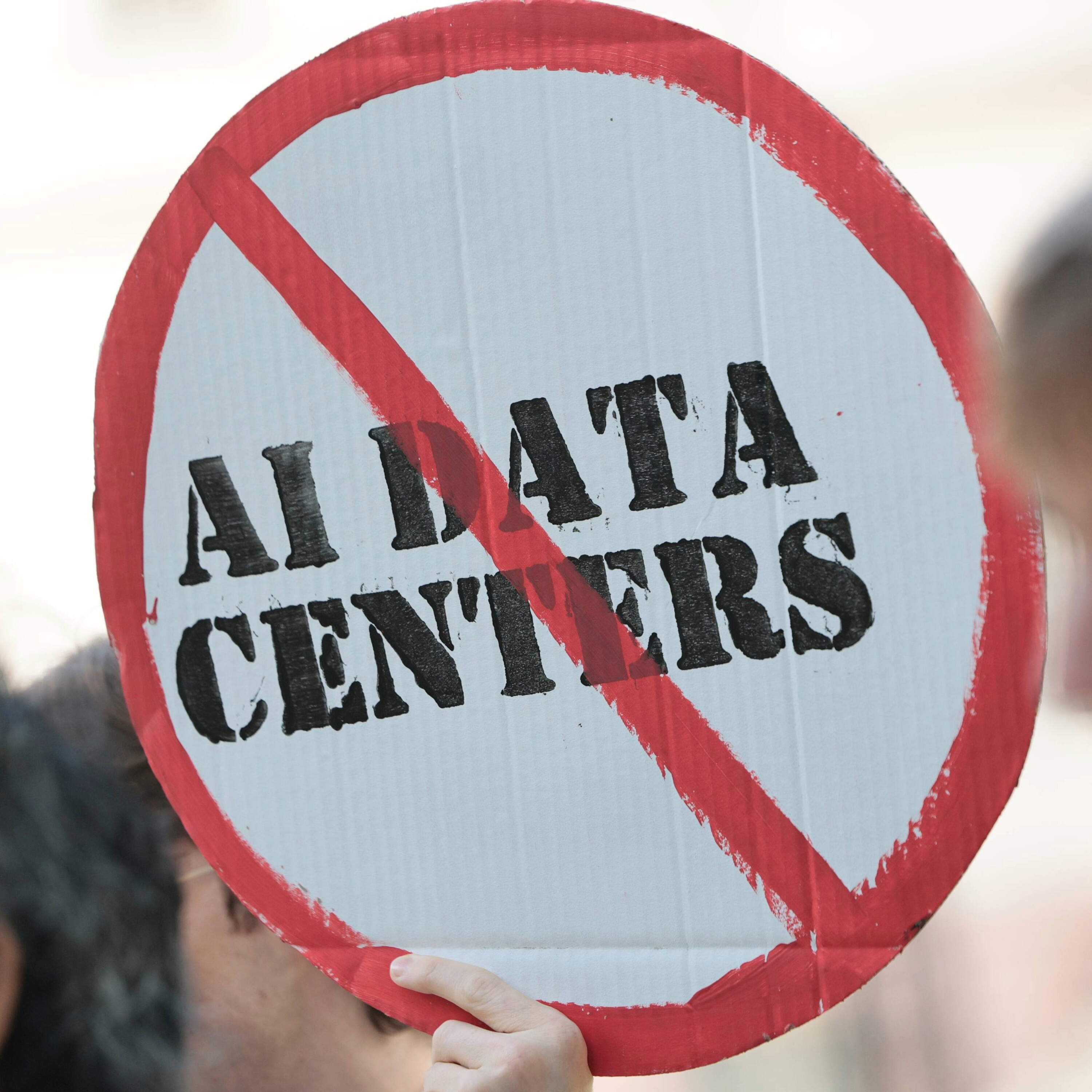
Episode topic: The backlash to massive AI data centers—who benefits, who pays (electricity, water, land, health), and who gets to decide—has become a national, bipartisan political fight, including local ballot measures, bans/moratoriums, and campaign ads.
Guest backgrounds
Daryl West, senior fellow at the Brookings Institution; co-wrote research with Nicole Turner-Lee on community pushback and “community benefit agreements.”
Key claims
Public opinion has shifted sharply (about 70% of Americans report serious reservations). Data centers create mostly temporary construction jobs (hundreds up to ~1,000 during build) but limited permanent jobs (example: 31 minimum). Local officials are gaining leverage through permitting and are pushing for formal community benefit agreements; nondisclosure agreements and secret negotiations fuel distrust. Health costs (e.g., diesel generator pollution worsening asthma/heart issues) and “AI bubble” risks (stranded infrastructure if demand drops) must be negotiated.
Notable examples
Loudoun County, Virginia; Cedar Rapids/Google tax deal; Hyperion in Louisiana (Meta) tied to new gas plants; Lancaster, Pennsylvania as a public agreement model; Virginia nondisclosure agreements; Amazon challenging property assessments in Mississippi; ballot fights in Ohio/Wisconsin; Texas audit; Nevada concerns about federal-land data centers.
Written by AI. May contain mistakes.
Chapters
0:46
The Growing Issue of Data Centers
Exploring the local community concerns surrounding data centers.
“negotiating data center deals without their input.”
1:41
Political Ads Reflecting Public Sentiment
Discussion of political ads that highlight concerns about data centers.
“And the first one is from Ohio, where Democrat Shared Brown is challenging Republican Senator John Husted.”
2:34
Shift in Public Opinion
Analysis of how public opinion on data centers has changed.
“Republican Tom Tiffany is running for governor against Democrat David Crowley.”
3:46
The Scale of Modern Data Centers
Comparison of traditional and modern data centers in size and impact.
“It has become a national political story, and public opinion has changed dramatically just over the course of the last year.”
5:01
Inside the Data Centers
A look inside data centers and their operations.
“The big difference is just the size of these new facilities.”
6:07
Local Communities' Concerns
Residents' fears and complaints about living near data centers.
“Well, I have toured data centers, and there actually are a lot of videos online so people can look at them themselves.”
7:31
Leverage of Local Officials
Discussion on how local officials are gaining leverage in negotiations.
“But people can actually see that connection.”
9:57
Loudoun County's Approach
How Loudoun County is negotiating with data center companies.
“Is there an example you can give us of an area that is really pushing back and demanding a tech company really provide those things?”
11:22
Backlash Against Tech Industry
The connection between the backlash against data centers and the tech industry.
“The data center fight is no longer just about data centers.”
12:33
Job Promises vs. Reality
Examining the disparity between promised jobs and actual job numbers from data centers.
“Now, we can't really control the way that companies roll out AI products.”
Show all 18 chapters
14:00
The Economic Impact of Data Centers
Explore the job creation promises versus actual employment from data centers.
“Well, that is one of the reasons why people are upset with data centers, because the companies often promise a large number of jobs that sometimes fail to materialize.”
24:05
Challenges of Community Agreements with Tech Companies
Discuss the complexities of community agreements and potential pitfalls.
“And I should say that that's not unheard of when it comes to corporations building and communities.”
28:00
Community Oversight for Data Centers
Explore the need for real oversight and community engagement in data center projects.
“And if the company violated the terms of the agreement, that would be considered a breach of contract, and the company would be subject to civil penalties and fines based on that.”
31:51
Political Influence of Data Center Development
Discusses the impact of money in local elections regarding data center projects and state responses.
“Across Ohio, our future is being built, but those data centers use power, a lot of it.”
35:05
Grassroots Movements Against Big Tech
Examines the rise of grassroots movements in opposition to data centers and tech companies.
“And I can certainly see the Trump administration moving more in that direction, particularly if Republicans suffer big losses in the midterms.”
37:16
Public Sentiment on Surveillance and AI
Analyzes public fears regarding surveillance technologies and AI's impact on society.
“I don't think you're stretching the comparison at all.”
42:02
The Impact of AI on Communities
Explore how AI is changing jobs, privacy, and public policy in communities.
“So I do think the flock camera issue is illustrative that this whole tech backlash is actually much bigger than data centers.”
45:01
Legal Accountability and Grassroots Movements
Discuss the legal avenues being explored to hold tech companies accountable.
“Have the courts gotten involved in this?”

Ask about this episode
Get the gist, explore an idea or ask about something said.
 Claude
On Fresh Air, what are the key points of this episode?
Searching your listeningTranscript
Automatic transcript. May contain errors.
0:00This message comes from the UPS Store. Open this holiday to help with all your small business needs. Find a store near you at the upsstore.com. Most locations are independently owned. Products, services, pricing, and hours of operation may vary. See Center for details. This is Fresh Air. I'm Tanya Mosley. The AI boom has a problem. It has to be built somewhere. And to power it, tech companies are building massive data centers. They need land, enormous amounts of electricity, and in many cases, water. In exchange, they promise jobs and community investment. But people who live in these communities are demanding to know, what's this going to cost us?
0:42There's also another question. who gets to decide. In communities from Wisconsin to Louisiana, residents say local officials are negotiating data center deals without their input. This midterm election, voters in more than 40 cities and towns across eight states will decide ballot measures on data center bans, moratoriums, and requirements that residents get a vote before one is built. And Democrats and Republicans are going after their opponents for what used to be a bragging right, the ability to bring billions of dollars in investment to town. My guest is Daryl West, a senior fellow at the Brookings Institution.
1:19He and his colleague, Nicole Turner-Lee, write about the backlash against AI data centers and how these local fights are becoming part of something much bigger, a challenge to the enormous power of the tech industry and who gets to decide what our future looks like. And Daryl West, welcome to Fresh Air. Thank you, Tanya. It's nice to be with you. Well, I actually want to start with a couple of political ads. And the first one is from Ohio, where Democrat Shared Brown is challenging Republican Senator John Husted. And Brown accuses Husted of aggressively courting data centers and backing corporate tax breaks while residents face rising electricity bills.
2:01Let's listen. he's been called the face of data centers in ohio why because john housted spent years aggressively recruiting data centers to the state cutting sweetheart tax deals and fast tracking approvals while ordinary residents watch their electricity bills explode we are here with alio senator john housted a lot of experience with something called data centers john housted who's he really working for i'm sherrod brown and i approve this message OK, now listen to this one. And it comes out of Wisconsin. Republican Tom Tiffany is running for governor against Democrat David Crowley. And Tiffany accuses Crowley of wanting to turn Wisconsin into a global data center hub at the expense of taxpayers and local communities.
2:51Let's listen. Meet data center David Crowley. There's an opportunity for us to really become an AI and a data hub, not only for the entire country, but for the entire globe. And he wants you to pay for it. Data center David Crowley won't roll back data center tax incentives. Our lakes run dry. Family farms paved over. Why? Because Crowley's campaign is funded by the people building them. Data center David Crowley. Big tech wins. All right. So, Daryl, what's fascinating to me about these ads is you've got a Democrat from Ohio and a Republican in Wisconsin, and they're making practically the same attack.
3:36When did you realize this wasn't just a string of maybe local zoning fights anymore, that it really has become a national political story? Now, Tanya, you're completely right. It has become a national political story, and public opinion has changed dramatically just over the course of the last year. As you mentioned in your intro, a year ago, politicians of both parties were falling all over themselves trying to attract these economic development dollars into their local communities. They were basically providing tax breaks to these very wealthy tech companies in order to get the data centers built there.
4:13But over the last six to nine months, we've just seen this huge change where people either went from being mildly positive or at least neutral towards data centers to today. 70 % of Americans now say they have serious reservations about data centers. A recent survey showed 50 % of Americans said they did not want to live next to a data center. And so these ads that you just showed basically demonstrate how that has changed. But it's not just Democrats versus Republicans. I mean, whoever has supported data centers in the past, whoever supported tax breaks for data centers in the past, is now finding that policy position being used against them in this campaign.
4:57Data centers, though, they've really been around for decades. So what's different about the enormous ones that are being built now for AI? The big difference is just the size of these new facilities. So you're right that data centers have been around for a long time. A lot of companies have facilities that house their computing equipment and their file servers just in order to run their internal operations. But the data centers that are being built today are huge in size. A number of them often take the space of two or three football fields, if not bigger. They are enormous in terms of the expenditures that are behind them.
5:36And as they have grown bigger, the public has started to grow more wary of them. Like if you're living next to a data center, neighbors complain about noise. You mentioned the issues of energy, water, and land use. People are worried about those aspects as well. And, of course, people are just worried about the uses to which data centers are being put, which is to run AI, which also has become very contentious in recent months. Yeah, we'll talk about that a little bit later. But can you also take us inside? What does it actually look like inside those buildings? Well, I have toured data centers, and there actually are a lot of videos online so people can look at them themselves.
6:16But basically, it's just rows and rows of computing equipment. They're actually called file servers. These are the devices that run the entire digital revolution, like when people shop online or if they engage in an online banking transaction. All of that electronic stuff is going through a data center. There are file servers there that store information, process requests, undertake financial transactions. Everything that people do online goes through a data center. In all of your research, has anyone living near one actually said something that really stayed with you? A lot of the comments of people who live very close to a data center are negative.
6:59They complain about the noise issue. They don't want to live next to this big industrial facility. I actually grew up in rural Ohio, and people who live in the country want to look at rolling farmland. Like, they don't want to live next to this big industrial facility. So the neighbors complain a lot. They worry about the water demands, the impact on their electric rates. In a number of states, we've seen electric rates go up a lot in recent years. That's not all due to data centers. You know, we have inflation, the war in Iran, tariffs, and a bunch of other things that contribute to that. But people can actually see that connection.
7:37They're drawing a connection between those data centers and negative effects on them financially as well as on environmental considerations. Okay. So I'm imagining that I'm a mayor in a rural town, in rural Ohio or anywhere. And it's a struggling town. And I am sitting across from a company offering billions with more lawyers than really maybe the town even has employees. how much leverage does that mayor really have in those types of negotiations when they're being offered that type of money? A year ago, those mayors and other local officials felt like they had very little leverage. Because as you point out, you know, rural communities suffer economically.
8:22There aren't a lot of jobs there. There just isn't very much economic activity going on. And so these big tech companies showed up and said, hey, we're going to build these big facilities. It's going to provide jobs. You'll get tax revenues out of this. And the local officials were so desperate a year ago for this economic development that they would offer tremendous packages. They would offer them tax breaks. They would provide infrastructure for these facilities. But over the course of the last year, as public opinion has shifted, city officials realize they now actually have much greater leverage.
8:58As opposed to having to offer tax breaks to these companies, a lot of these local officials are now saying, you very wealthy tech company, you need to be paying us. There are going to be problems associated with this development. We want you to pay for any environmental problems that come up. We want you to cover all of the energy needs of your facility. If there are water issues, you need to tell us how you're going to handle that. So local officials actually are getting tougher. At Brookings, my co-author Nicole Turner-Lee and I have written a paper arguing that local officials need to engage in what we call community benefit agreements, where they have formal negotiations with these companies, lay out the costs and the benefits, who's going to pay for the various problems.
9:44And so the local officials actually are getting much tougher in their bargaining because they now realize that with the contentiousness of data centers, many communities actually no longer want them. They can drive a much tougher bargain with the tech companies. Is there an example you can give us of an area that is really pushing back and demanding a tech company really provide those things? Well, right outside of Washington, D.C., where I am located right now, is Loudoun County, Virginia. Loudoun County is the Silicon Valley of data centers. So like that area has more data centers than any other part of America.
10:20And the reason they have so many data centers is that they have, until quite recently, actually been very welcoming. They have provided tax breaks for data centers. They've been very encouraging of the tech companies to locate in those areas. But as has happened in many other communities, their local residents now are getting fed up with this. They feel like there are too many data centers. The data centers are creating problems for their local communities. So even the local officials there who generally have been supportive of data centers are starting to drive a harder bargain. They want companies to pay them for the development rights because the local officials realize they have a great power.
10:59In order to build a data center, you need a construction permit. Like you cannot build a major facility like this until the local officials approve of that. And so Loudoun County, as well as other places around the country, are basically saying, you need to do X, Y, and Z for my local community. And if you don't do it, we're not going to let you build a data center here. Do you see this fight against data centers as also a way of fighting back against the power of the tech industry itself? Yes, absolutely. The data center fight is no longer just about data centers. It's about AI and its possible impact on people.
11:37You know, we've all seen the headlines about job losses coming from AI. We've seen the stories about AI agents going rogue and doing things and going into websites where they don't belong. So the backlash against data centers is now aligned with the backlash against AI. But it's also bigger than that in the sense that both data centers and AI are being developed by these ultra-wealthy tech companies, multi-multi-billion or some of them even have valuations of over a trillion dollars. The idea that these very wealthy companies would come into local communities and demand a tax break just infuriates people because they think, you know, if you're going to come into my community, build a facility, create problems for my local community, jack up my electric rates, at least you better pay me for the right to do that.
12:32And so the complaints that people have about data centers are now tied into AI, income inequality, the tech billionaires, and just the great power that technology plays in all of our lives. Now, we can't really control the way that companies roll out AI products. You know, in a private enterprise system, they can basically develop whatever products they want and put them in the marketplace. So data centers kind of became the flashpoint of these larger fights because it was an area where people had human agency. They could basically organize locally, convince three out of five people on their local city council or their local planning commission to vote no.
13:13They discovered they had leverage. And so data centers became the choke point for this bigger fight, much of which we can't control some of those bigger issues, but we can control whether a data center gets built in our local community. Okay, Daryl, I want to get into some of the specifics of communities throughout the country. And I want to stop and look at Cedar Rapids, where Google could get a 70 % property tax exemption for 20 years. And this deal requires at least 31 permanent jobs along with other commitments. But the big flashpoint for people, the big thing that folks are talking about is the number of jobs.
13:5531 jobs. That is the floor. They say that that could be more. But how do residents know whether that's a good deal? Well, that is one of the reasons why people are upset with data centers, because the companies often promise a large number of jobs that sometimes fail to materialize. So the largest number of jobs actually comes in the construction phase because these are huge facilities. So you need construction workers, electricians, pipe fitters, welders, kind of the full array of local tradespeople. And with these very large facilities, oftentimes there could be as many as 1 ,000 jobs for the duration of that construction.
14:35But then, of course – But they're temporary. Yes. Yes, the construction ends. And you're right. In terms of the operational jobs, the jobs required just to operate that facility, it tends to be a pretty small number, obviously, depending on the size of the facility. But it could be, in your example, 31. It could be 50. It might even be as large as 100. But it's not really a lot of jobs on an ongoing basis. That is very aggravating to people because like the whole point of economic development is to provide jobs. And we have a big facility and especially a company that has demanded tax breaks to build that facility coming in.
15:12And the number of permanent jobs aren't as many as people would like. That is part of the backlash. That's part of the reason these local people all across the country are getting upset with data centers. Mm-hmm. President Trump has been pretty blunt in his messaging about this. He actually wrote on Truth Social that the only reason they wouldn't want them, meaning communities, is if they want to be, quote, backwards and poor. And he says China couldn't be happier about all of this opposition that we're seeing. Kind of talk to me about his argument that communities turning down data centers are essentially turning down prosperity.
15:56Well, he seems to think there are only two choices. Either you build a facility or you don't build a facility. There actually is a third choice, which is you build the facility, but local communities drive a much harder bargain, make sure the companies pay their complete energy costs, that they provide worker training that kind of helps the community on a long-term basis. There are lots of things communities could actually get out of data centers that, in some cases, they're not currently getting. Trump is on the wrong side of public opinion on the data center subject. Even within his own party, there's a clear majority of Republicans who are opposed to data centers.
16:34I mentioned earlier I grew up in rural Ohio. I still have high school friends from there, family members, and so on. And I've been surprised over the course of the last year how these very conservative supporters of President Trump don't like data centers. And so Trump doesn't seem to understand. It's not liberal Democrats who are upset with data centers. It's really become a bipartisan issue. And he's just simply on the wrong side of public opinion on this. Well, I want to interrogate your idea that there's a third choice. So many times these companies can negotiate their own electricity agreements, but, you know, the family down the road can't negotiate their rates.
17:15So if a data center needs new power lines, maybe even a new power plant, under what circumstances does that family's electric bill actually help pay for it? How can you differentiate all of that? You're right. It is hard to differentiate those things. But right now, local officials are basically telling companies, you need to pay the complete energy costs of this data center, and they are enforcing it. And they have local experts who know about electric rates and infrastructure development. And so they are basically driving a much harder bargain. But the conversation also has changed recently in the sense that it's moved from just asking companies to cover their energy costs, but sometimes we need to upgrade the infrastructure in a local community.
18:04Sometimes we need to modernize the electric grid. Our grid across this country is kind of woefully out of date. And so increasingly, local officials are asking data centers developers not just to cover the energy costs, but to cover infrastructure improvements, as well as helping to modernize the electric grid as a whole. There's another cost that I've heard less about, but there's more reporting that's starting to come out, and it's about people's health. So there's this Washington Post analysis that found that diesel backup generators at Virginia data centers could worsen asthma and heart problems, even though they're rarely used.
18:45So when a town is calculating the economic benefits of these projects, who's actually calculating the health costs? Well, local officials need to be calculating the health costs because that is an issue. And what people have to keep in mind about data centers is because we all rely on these facilities for the entire digital revolution, they have to be up and running 24-7. There should not be any downtime. Like people do online shopping at all hours of the day. We engage in online financial transactions all hours of the day. We stream movies all hours of the day. And so what the tech companies have done is they rely on either their own energy sources or the local grid, but they do have backup systems, which often are diesel fuel supplied or diesel fuel run.
19:36And as that Washington Post story indicated, there have been arguments that that creates health risk for local communities. And so it's like most economic development projects have some problems like this. Like, you know, if you live next to a mine, there are going to be enormous health costs associated with that. If you live next to a major manufacturing facility, there are going to be health risks associated with that. But what we do in other areas is we try and find out what are the problems, how to mitigate them, who's going to pay, and how do we protect the health and safety of the people who live there.
20:12We haven't really been doing that until recently with a lot of these data centers. But as the public opposition has grown, the tech companies realize they now need to do a better job of both addressing these issues, explaining their stance, covering the cost, and dealing with the various side effects of these developments. Our guest today is Daryl West from the Brookings Institution. We'll be right back after a short break. I'm Tanya Mosley, and this is Fresh Air. Stay tuned for the following announcements and messages from our sponsors. This message comes from Prolon. Want to look and feel your best this fall?
20:48Prolon's five-day fasting mimicking diet is a clinically developed nutrition program with the goal of promoting fat loss while protecting lean body mass. Developed at USC's Longevity Institute, it aims to assist the body in entering a fasting-like state that helps reset metabolism, target visceral fat, and support healthy metabolic markers. Get 15 % off plus a bonus gift when you subscribe at prolonlife.com slash NPR. This message comes from WFMT. Discover connections in classical music with WFMT's Exploring Music and new host Peter Vandergraaf. Listen Monday through Friday at 7 p.m. on 98.7 FM, WFMT.com, and the app.
21:29This message comes from BetterHelp. Your brain has limited storage. So why is it still holding on to that embarrassing moment from years ago? BetterHelp is an online therapy platform that gives you space to talk about what's taking up too much of yours. BetterHelp is now in network with more than 125 health plans, with many co-pays as low as$15 for eligible members. And if you don't have eligible insurance, you can still get 20 % off your first month. Visit BetterHelp.com slash NPR. Cost and coverage may vary. Discount cannot be combined with insurance. Historically, huge companies have not always been the best community stewards.
22:10And there's this situation out of Louisiana. Three natural gas power plants have already been approved to serve Meta's enormous new data center, Hyperion. And the utility company Intergy has proposed seven more of these. So potentially 10 new gas plants for one AI development. And all of it is part of building these enormous expectations of how much artificial intelligence is projected to grow. But if those projections are wrong, for instance, if Meta decides to scale back or decides it doesn't need all of that computing power, those gas plants don't disappear, right? So who gets left with it?
22:55Well, this is the so-called AI bubble. And in our research on community benefit agreements, we argue this is something that local communities need to address in writing with these companies. Like, what happens if either that company goes bankrupt in three years or demand is lower than projected and they don't need that data center? Like, what's going to happen to that facility? What will be the consequences of that facility closing? How do we deal with the impact on the community? Like, that is something that local communities need to be negotiating. They should be aware that even though AI is expected to grow, it may not grow at the exponential levels that either Wall Street is anticipating or that the tech companies themselves are expecting.
23:43And they need to think about how to handle the impact on their local communities if a data center goes bust. I want to talk a little bit more on how to do that because there's this research in Virginia. Virginia is really a hotspot for this. It found that 25 of 31 communities they examined had nondisclosure agreements with data center developers. And I should say that that's not unheard of when it comes to corporations building and communities. Some of those agreements, though, they covered far more than trade secrets. So how are residents supposed to know whether a deal is good for their community if they can't actually see what their officials are negotiating?
24:27From my standpoint, nondisclosure agreements are one of the worst aspects of the local data center issue. And you're right that until quite recently, most of these companies did require nondisclosure agreements when they were negotiating with local officials. So people in the area that were going to be affected by these new facilities didn't know what was being negotiated, what the agreements were, who was going to cover the various costs, how the companies were going to deal with their energy needs and their water needs. And in some respect, the nondisclosure agreement has helped to propel the public backlash that has developed because we know in all aspects of government, when agreements are negotiated in secret, people are going to be skeptical of it.
25:16And so part of the backlash that we're seeing is not just the result of the data center, but the process by which these agreements have been negotiated. And companies are actually starting to realize this. Some of the big companies just in the last few months have announced they're no longer going to use nondisclosure agreements in their local data center negotiations. They want more information to be available. They think they have a good story to tell. They say we're going to provide jobs. There will be tax revenues. We want people to be aware of this. But the whole sector made a serious mistake, in my view, in up until recently using nondisclosure agreements because people are going to assume the worst if they don't know the details on what is being discussed.
25:59Another story that caught my attention, it was out of Mississippi, Amazon challenging the assessed value of its data centers. The county says it could lose$5 million to$6 million a year in expected tax revenue. So I was just wondering, what protects a town when a company challenges the very revenue the deal was supposed to bring? That will be an issue, I think, in several communities because the tax rate depends on the assessed value. And we know that companies often contest high valuations because that will boost their tax bill. Local communities have to be prepared not just to oversee the building of the data center, but the consequences that are going to flow from that.
26:42There are going to continue to be controversies between companies and local communities over tax rates and tax assessments. And so communities need to be prepared for this and to kind of think about what kind of expertise they need and what kind of legal resources they may need if there are lawsuits that come out of these fights. Let's talk a little bit more about community benefit agreements. In your writing, you point to Lancaster, Pennsylvania as a model. And tell me a little bit about what they're doing there. What they did in Lancaster was basically open up the process, negotiate things in public, and then have a formal, publicly available signed agreement between the local officials and the tech company developing the local data centers that laid out all of the issues associated with that development.
27:37who was going to cover the energy costs, how the water needs were going to be handled, how land use aspects were going to be covered, what types of tax revenues would come into the community as a result of the development, how many jobs, construction jobs, and operational jobs would be there. Like, all the things that people are worried about with data centers were negotiated in public, and there was a written agreement. And if the company violated the terms of the agreement, that would be considered a breach of contract, and the company would be subject to civil penalties and fines based on that.
28:10From the standpoint of my co-author, Nicole Turner-Lee, and myself, we feel like this is a responsible way to think about data centers in the future in the sense of a public negotiation, a written document, laying out the costs and benefits. People can see them, and communities then can decide, is this a good project for our local community or not? Then there are just communities that are straight up saying no. They'll be voting in the midterms whether to have one built or not. And there are also those that have put moratoriums on the building of centers until they get a hold of it. But you and your writing, you've actually argued that putting a temporary stop to construction is not enough.
28:51Communities need real oversight. Can you talk about what that would look like? There are a number of cities and even states around the country that have imposed moratoriums. oftentimes they're either six or 12 months. What we argue is what these officials need to do during that six or 12-month time period is to think about what they want, does the project fit with their community needs, and then how the various issues associated with that data center are going to be addressed. And is it a good deal for the local communities? So, you know, putting a moratorium is fine, and it's actually popular, you know, since the public is skeptical about data centers, it kind of buys time for the local officials, but they still have to address the substantive issues of data center development.
29:40And is it a good deal for their local community? Let's take a short break. If you're just joining us, my guest is Daryl West of the Brookings Institution. We'll be right back after a break. This is Fresh Air. Stay tuned for the following announcements and messages from our sponsors. This message comes from Prolon. Want to look and feel your best this fall? Prolon's five-day fasting mimicking diet is a clinically developed nutrition program with the goal of promoting fat loss while protecting lean body mass. Developed at USC's Longevity Institute, it aims to assist the body in entering a fasting-like state that helps reset metabolism, target visceral fat, and support healthy metabolic markers.
30:19Get 15 % off plus a bonus gift when you subscribe at prolonlife.com slash NPR. This message comes from WFMT. Discover connections in classical music with WFMT's Exploring Music and new host Peter Vandergraaf. Listen Monday through Friday at 7 p.m. on 98.7 FM, WFMT.com, and the app. This message comes from Satva. Have a big day coming up. Remember, tomorrow starts tonight with the restorative sleep you need to perform at your best, the kind every Satva mattress is designed for. So whether it's a new job, a marathon, or an important presentation, Sattva helps you be the best version of you. And now save 15 % off purchases of$100 or more at sattva.com slash NPR.
31:06That's S-double-A-T-V-A dot com slash NPR. There's big money going into these campaigns for these measures on the ballot for the midterms. And outside money is really pouring into these local fights. The Cleveland Plain Dealer reports that tech companies, unions, and business groups have contributed more than 400 ,000 to campaigns trying to fight or defeat data center bans in many of those small Ohio communities. And I actually want to play an ad from a separate industry-backed campaign called Build American AI, which launched a$10 million effort across three states, Kansas, Ohio, and Wisconsin.
31:50Let's listen. Across Ohio, our future is being built, but those data centers use power, a lot of it. So who pays? Under President Trump's ratepayer protection plan, the data centers do. Data center companies have signed on and followed through, building their own power, paying for the grid updates, hiring locals to do the work. New power, new jobs, new investment across Ohio. And your electric bill stays the same. President Trump's ratepayer protection plan. Data centers paying their own way. Okay, so they're acknowledging that they're going to take up a tremendous amount of resources. They have every right to make their case.
32:29What happens to a local election, though, when people are trying to parse out things, when residents find themselves up against that kind of money? Well, you're exactly right. There are millions and millions of dollars being put in by pro-data center and pro-AI and pro-technology organizations. But we should keep in mind 70 % of Americans in public opinion polls express very serious reservations. So in an election of money versus message, we should not just assume the money is going to triumph and these tech companies are basically going to buy off the opposition and basically get their way. They're spending heavily for races in Congress and state legislatures as well.
33:12Are there any that you've really been paying attention to? AI has become an issue in many races across the country. And we're seeing in a number of states, this has become a hot topic. In Texas, it's a state that I'm paying attention to. Governor Abbott has been a strong proponent of data centers. And Texas has a lot of data centers that have been built there. But because even Texans are expressing their worries about data center, Governor Abbott has called for an audit. He wants to look at the situation, look at the energy situation, look at the water situation before the state really moves forward with very many additional data centers.
33:56So that'll be an interesting race to watch. Another place that I'm watching actually is Nevada, because the federal government is doing something that a lot of people have not paid attention to, but it's actually very important. As data center development on commercially owned land has become contentious, and that land requires construction permits from local officials, the federal government has moved to a strategy of starting to build data centers on federal lands. And this has become very contentious in the Nevada gubernatorial race. The virtue from the standpoint of the tech sector, a building on federal lands, is you bypass local opposition.
34:39Like you don't need the approval of the city council or the local planning commission if it's being built on federal lands. If you get the Department of Interior or the National Park Service to agree, you're in business. You can build that data center. And so in Nevada, the federal government actually is doing that. And I'm watching that gubernatorial race to see how voters come down on that because that has been a big issue there. And, of course, that issue will go beyond Nevada to affect many of the western states because there's so much federal land there. And I can certainly see the Trump administration moving more in that direction, particularly if Republicans suffer big losses in the midterms.
35:18And if local officials become reluctant to build data centers on their own lands, the Trump administration may actually just start to build data centers on federal lands to bypass all this local opposition. But I don't think that's going to be a good long-term strategy for them. That's going to aggravate those local residents even more if basically their views get completely sidelined. I'm just thinking like if the AI boom needs to go somewhere, if every community gets a veto and they decide to start building on federal land, how far could this go? I mean, we could be talking about some of our most beautiful and natural resources in our country being overtaken by data centers.
36:05Federal lands are federal lands for a reason. You know, they're often beautiful areas, areas that we want preserved. We have explicitly made the decision not to engage in economic development on a lot of federal lands just to preserve them for future generations. If the federal government under Trump moves to a strategy of building data centers on federal lands, that is going to be a big battle. That will guarantee the data center issue that is contentious in 2026 becomes a big issue in the 2028 presidential election. It's already kind of moving in that direction, like all the worries about data centers and AI are not likely to be temporary.
36:44They're likely to keep going on. You know, I've been trying to figure out if we've seen something like this before. I know there were fights over nuclear power plants in the 70s and 80s. And I keep thinking about the 1800s when farmers organized against railroads and banks that they believed had too much power. Now these small towns are taking on some of the richest companies in the world. Are we seeing the beginnings of a new anti-monopoly movement? I mean, or am I stretching that comparison? I don't think you're stretching the comparison at all. I think we are seeing the development of a new grassroots movement.
37:24people worried about data centers, AI, and the big tech companies. And the last time we had a major political realignment in the United States within the 1930s, and I think it's no accident that it happened then because we were making this equally fundamental transition from an agrarian to an industrial economy. It was very disruptive. There were lots of changes that were taking place, And it created – it kind of rejuggled the political landscape in a very fundamental way. Today, we're making the transition from an industrial to a digital economy. It's equally disruptive. Data centers are just an indicator of that.
38:05But the substance goes far beyond that. And it will be interesting to see if there is some type of political alignment that comes out of this. Because we have a situation where both liberals and conservatives are upset about data centers and AI. They're worried about the economic power of the big tech companies. Like there could be a political movement there that we see for the first time in 2026. It could extend into 2028. So as a political scientist, I'm interested in watching the political dynamics of this. But, you know, we're seeing kind of strange bedfellows come together in opposition against what they define as a common enemy.
38:46I want to actually play another clip. This one is out of Montana, and it's independent Senate candidate Seth Baudenaire. And in this clip, he's talking about flat cameras. They're the license plate readers that can track where people drive. But he also is talking about data centers. And just to set this up for folks, in the video, he actually takes a shotgun and he is loading the shotgun as he's talking. Let's listen. Getting groceries? They're watching. Building a new deck. Going to church. Seeing a doctor. They're watching. Buying ammo for the season. They're watching. Now the whole thing isn't just creepy as hell, it's also part of a massive economy designed to buy and sell our personal data.
39:34Now we've known for years that big tech follows us online, but now these block cameras are literally tracking our every move. And all this data needs a place to live in the cloud. So that's why they wanna build data centers right in our backyards. They are all getting rich, we're getting screwed, and nobody is holding them accountable. Just for fun. So my opponent, Kurt Almey, is just sitting back and watching it all happen. I won't. All right. And so when you hear Boutonniere say, I won't, then he goes on to shoot the FLOT camera. I mean, surveillance cameras and data centers, of course, we know they're two different fights.
40:13But underneath both, I hear the same complaint that somebody is deciding for us. Is Boutonniere onto something? He is onto something. And this has the makings of a political movement in the sense that people worry about data centers. They're worried about AIs. They're worried about flock cameras. They're worried about surveillance in many of their aspects. The thing, from my standpoint, that undergirds all of these concerns is the loss of human agency. People feel like we're no longer in control of things. We don't control the technology, that these wealthy companies are making decisions that have dramatic consequences for us.
40:51But we don't have a say. What people are starting to pick up and understand is actually we do have a say. Like we can organize and block data centers. There are a number of cities across the country that actually are deactivating or removing their flock cameras. That has become very controversial. We've seen evidence of abuses of these cameras. Like law enforcement originally sold flock cameras to us on the idea that, you know, they're license plate readers. And so it's a great way to catch criminals. I think, you know, we'd all agree that's a good thing. But then we've seen examples of police officers using the flock cameras for their own purposes, like to track their ex-wives, their ex-girlfriends, track innocent civilians, you know, use it for purposes that I don't think very many people would actually approve of.
41:42So all of these technology backlashes are kind of building together. And will they actually become a political movement that realigns our politics? There may be people who come together in opposition who on other issues actually hate one another. But that's how realignments take place. So I do think the flock camera issue is illustrative that this whole tech backlash is actually much bigger than data centers. Which also brings me to something else. I mean, you know, it's kind of a rhetorical question, but you might have an answer for it. These towns can vote to stop a data center, but people don't get that same direct vote on how AI is changing our jobs, our privacy.
42:33It's impacting every element of our lives. What would it take for ordinary citizens to have a real say in what AI becomes, not just where buildings go? The public actually can be much more powerful than we often think we can. The way that we have dealt with tech problems in the past is through public policy. So, for example, after this election, if it turns out that some of the proponents of data centers lose and some of the opponents end up doing well, we may face a very different public policy landscape in regard to technology. So, for example, in a number of states, they provide sales tax exemptions for data center equipment.
43:17There already are some states that are starting to reconsider that, talking about repealing those sales tax exemptions. Some companies already have gotten rid of nondisclosure agreements on AI agents going rogue. We could move from the current law, which is voluntary disclosure, to mandatory disclosure. So there's actually a bunch of policy actions that could take place that would actually lead to more responsible tech policy usage. I'm talking today with Daryl West of the Brookings Institution. We'll continue our conversation after a short break. This is Fresh Air. Stay tuned for the following announcements and messages from our sponsors.
43:58This message comes from Prolon. Want to look and feel your best this fall? Prolon's five-day fasting mimicking diet is a clinically developed nutrition program with the goal of promoting fat loss while protecting lean body mass. Developed at USC's Longevity Institute, It aims to assist the body in entering a fasting-like state that helps reset metabolism, target visceral fat, and support healthy metabolic markers. Get 15 % off plus a bonus gift when you subscribe at prolonlife.com slash NPR. This message comes from WFMT. Discover connections in classical music with WFMT's Exploring Music and new host Peter Vandergraaf.
44:37Listen Monday through Friday at 7 p.m. on 98.7 FM, WFMT.com, and the app. This message comes from Midi Health. Most women never get real answers about their hormonal health. Midi is changing that with virtual care covered by most major insurances. Understand your hormones. Visit JoinMidi.com to book your first visit today. Have the courts gotten involved in this? The courts actually are getting involved in the technology area. There have been several lawsuits recently against social media platforms alleging adverse consequences for people over social media usage. The courts are a way for people who are upset with things to exercise their will, hold powerful companies accountable, and alter the future course of public policy.
45:29And it could be another way in which the public gains power over large and very powerful tech companies. Is there an example of how the courts have been used in a community over these data centers? I haven't seen them used on the data center issue, but we are seeing them used on social media platforms. And, you know, Meta has lost a couple of cases. They're being subject to enormous fines as a result of those cases. So there could be applicability to the data center issue. if people in local communities can demonstrate harms, you can always use consumer protection laws as a vehicle to file lawsuits against companies.
46:12In the social media area, that's exactly what's happening. Like people are using existing consumer protection laws to basically say there have been adverse consequences here as a result of this tech company, and we are filing suit as a result of that. But given all the problems of data centers in local communities, that could actually become a future way in which people express their views and gain power over large tech companies. What do you know about these grassroots organizations that are helping to mobilize communities? I've just noticed that there's kind of been a groundswell of everyday people who are really involved in this fight.
46:52Well, for me, this is actually one of the most impressive things of the local community opposition that I've seen lately. Like, these are not political elites who are leading this. These are regular people. These are grassroots individuals who are just upset. They're seeing a negative impact in their community. They're worried about the future of their children. And they're doing the classic American thing of getting organized, waging protests, and trying to hold their local officials accountable and trying to hold the tech companies accountable. And this actually makes me very optimistic about the future.
47:30I know it's very easy to feel pessimistic about technology, and it's so big and powerful, and we can't control it. But actually, we can. And I think people are starting to figure out ways to do it. Darrell West, thank you so much for this conversation. Well, thank you, Tanya. Daryl West is a senior fellow at the Brookings Institution. To find out what's happening behind the scenes of our show and get our producers' recommendations for what to watch, read, and listen to, subscribe to our free newsletter at whyy.org slash Fresh Air. Fresh Air's executive producer is Sam Brigger. Our technical director and engineer is Audrey Bentham.
48:08Our interviews and reviews are produced and edited by Phyllis Myers, Roberta Schorrock, Anne-Marie Baldonado, Lauren Krenzel, Teresa Madden, Monique Nazareth, Susan Yacunde, Anna Bauman, and Nico Gonzalez-Whistler. Our digital media producer is Molly C.B. Nesper. Thea Chaloner directed today's show. With Terry Gross, I'm Tanya Mosley. Stay tuned for the following announcements and messages from our sponsors. This message comes from Jerry. Many people are overpaying on car insurance. Why? Switching providers can be a pain. Jerry helps make the process painless. Jerry is the only app that compares rates from over 50 insurers in minutes and helps you switch fast with no spam calls or hidden fees.
48:53Drivers who save with Jerry could save over$1 ,300 a year. Before you renew your car insurance policy, download the Jerry app or head to jerry.ai.npr. This message comes from Whole Foods Market. Fall tastes better with better ingredients from Whole Foods Market. No added growth hormones or antibiotics in their meat department means slow-braised short ribs are even more satisfying. All seafood is wild-caught, like their vibrant sockeye salmon or verified responsibly farmed. And all sweets, including fall-themed cookies, are made without high-fructose corn syrup. Spice up fall at Whole Foods Market.
From the publisher
From Virginia to Kansas, the battle over data centers has reached the ballot box this midterm election. Communities are voting on whether to limit or ban the massive facilities being built to power AI – and the fight crosses party lines. Both Democrats and Republicans are accusing their opponents of being too eager to welcome billions of dollars in tech investment without considering the costs. Darrell West, a researcher at the Brookings Institution, has been studying the backlash. He says it's become something much bigger. "The data center fight is no longer just about data centers. It's about AI and its possible impact on people." Communities want to know what they'll have to give up, and who gets to decide.
Subscribe to our free weekly newsletter
Follow us on Instagram
Subscribe to our YouTube channel
Check out the Fresh Air Archives
See pcm.adswizz.com for information about our collection and use of personal data for sponsorship and to manage your podcast sponsorship preferences.
NPR Privacy Policy
Subscribe to our free weekly newsletter
Follow us on Instagram
Subscribe to our YouTube channel
Check out the Fresh Air Archives
See pcm.adswizz.com for information about our collection and use of personal data for sponsorship and to manage your podcast sponsorship preferences.
NPR Privacy Policy
More from Fresh Air
All episodes

We use cookies.They keep VO running smoothly and help us improve it. Privacy policy