
In short
Podcast Summary: Generative Now | AI Builders on Creating the Future
Episode Title
PART 1: Generative Quarterly with Semil Shah | Consumer AI Tech, Seed Investing, and Apple
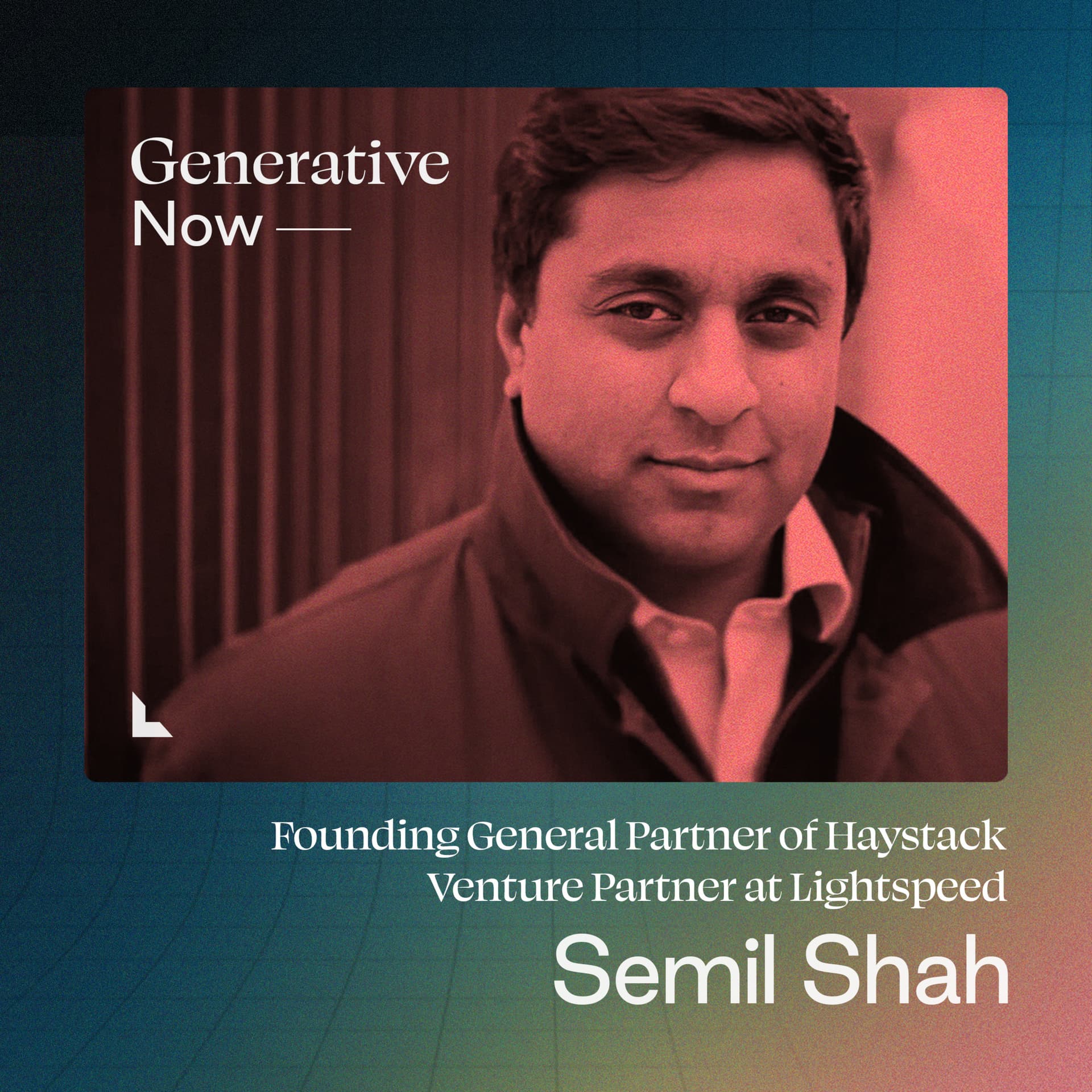
Host: Michael Mignano Guest: Semil Shah, Founding General Partner of Haystack and Venture Partner at Lightspeed
Episode Overview In this episode, Michael Mignano engages in a thought-provoking conversation with Semil Shah, discussing various topics related to seed investing, AI consumer technology, and the competitive landscape between tech giants like Apple and Google. The episode covers the current state of seed investing, advice for founders seeking venture capital, and insights into the potential of AI in consumer products.
Episode Chapters
- (00:00) Welcome and Introduction
- (00:37) Shohei Ohtani and Baseball
- (03:25) State of Seed Investing
- (11:04) Semil’s Advice on Pitching Venture Capitalists
- (14:26) VC Fund Dynamics and AI Hype Machine
- (18:42) Miami’s Tech Scene
- (19:18) Building the Next Big AI Consumer Product: Hype vs Reality
- (26:52) Apple’s New iPhone: Where is the Apple Intelligence?
- (32:17) Google Android
- (34:04) Conclusion
---
Key Discussions
- State of Seed Investing
- Market Activity: September to Christmas is typically a fertile time for new company formation; current demand for seed funds is robust.
- Investor Sentiment: A notable influx of Limited Partners (LPs) eager to invest in seed funds, contrasting the earlier cautious behavior post-pandemic.
- Emerging Trends: Experienced fund managers are seeing oversubscription for their new funds, driven by renewed interest in early-stage investments.
- Advice on Pitching Venture Capitalists
- Founders need to articulate their "right to exist" clearly, which is critical for successful fundraising.
- Investors are interested in companies that can leverage AI in transformative ways or have a compelling narrative that aligns with market trends.
- VC Fund Dynamics and AI Hype
- AI's Role: The excitement surrounding AI has led to a frenzy in venture investing. Companies are categorized into three buckets based on their AI integration:
- Bucket A: AI-native companies that could not exist without AI.
- Bucket B: Companies benefiting from AI as an adjacent tailwind.
- Bucket C: Companies using AI but not reliant on it for their core value proposition.
- Investment Trends: Investors are more inclined to back Bucket A companies due to the heightened valuations and interest in AI.
- Consumer AI Technology
- Current Landscape: Despite significant excitement around AI, there is skepticism about its impact on consumer products. The podcast discusses whether this is the moment for consumer AI or if it's merely hype.
- Challenges for Consumers: The conversation highlights the difficulties consumers face in adopting new technologies, stressing the need for compelling user experiences.
- Investment Opportunities: Investors are advised to diversify their portfolios across different consumer tech sectors to mitigate risks.
- Apple vs. Google
- Apple Intelligence: A critical discussion revolves around the skepticism regarding Apple’s upcoming features and whether they are playing catch-up to competitors.
- Product Execution: Concerns are raised about Apple marketing features that aren’t yet available, indicating potential issues with product rollout and execution.
- Google's Advantages: Google is seen as maintaining a strong position due to its existing ecosystem, despite lacking a hardware foothold comparable to Apple.
---
Key Takeaways
- Seed Investing Outlook: The market for seed investing is healthy and competitive, with a noticeable shift in investor interest towards early-stage companies.
- AI's Influence: The surge of interest in AI is reshaping investment strategies and company narratives, with a clear distinction between companies that are AI-native and those leveraging AI as an adjunct.
- Consumer Products: While there is optimism about consumer technology, the challenges associated with distribution and adoption remain significant.
- Tech Competition: The rivalry between Apple and Google is increasingly highlighted, with implications for product innovation and market strategy.
---
Conclusion The conversation provides a fascinating exploration of the intersection between AI and venture capital, particularly in the consumer technology space. Semil Shah's insights into the dynamics of seed investing and the implications of AI advancements offer valuable perspectives for entrepreneurs and investors alike.
Stay Tuned: The discussion will continue in the next episode, where further insights into these topics will be explored.
Stay Connected
- [Lightspeed Ventures](http://www.lsvp.com/)
- [Twitter](https://twitter.com/lightspeedvp)
- [LinkedIn](https://www.linkedin.com/company/lightspeed-venture-partners/)
- [Instagram](https://www.instagram.com/lightspeedventurepartners/)
- [Subscribe to Generative Now](http://generativenow.co/)
- Email: generativenow@lsvp.com
> *Disclaimer: The content shared does not constitute tax, legal, business, or investment advice.*
Written by AI. May contain mistakes. Listen to the episode to check what was said.
Transcript
Automatic transcript. May contain errors.0:04Hey everyone, welcome to Generative Now. I am Michael Magnano. I am a partner at Lightspeed And this week, we've brought back to the podcast my good friend, colleague, and fellow investor, Samil Shah. Samil is the founding general partner of Haystack, an early-stage VC firm and a venture partner at Lightspeed. There's so much going on in the world of AI. I love to check in with Samil every couple of months and see how it's affecting both startups and investors. And so this was another great conversation. So check it out, my conversation with Samil Shah. Hey, man. Morning. What's going on? Friday's my day.
0:41I usually don't schedule anything and try to close out everything from the week because, you know, running around to meetings, meeting people, talking to people. It's a manager schedule in the PG framework, you know? Until I blow that whole thing up by asking you to record a long-ass podcast on your catch-up. No, no, that's easy. Maybe starting out on a topic not really related to tech or AI, but Otani. 50 and 50. I want to say my first thought when I was reading all the sidelines is did his, like, did his bookie pay off all the pitchers? From prison? And wait, how many games are left in the regular season?
1:22Not many, right? I mean. He's really got like nine to ten games left. Yeah. So, I mean, it's not like he's going to go 60 for 60, 60 and 60. Yeah. I mean, he got thrown out a third for a triple for the cycle. That was part of the stat line. and just yeah he's got to be the best single baseball player ever if he can keep it going longevity is part of it i don't think so no i mean but there are always these like one-off legendary seasons for all sorts of players i think about in like a three to four year period of dominance like to me that's the most important thing like patrick mahomes i don't go by the rings is like in that three to five year period he's the best quarterback i've ever seen So you're basically saying he's better than Brady.
2:05I wouldn't take anything away from any of these great players. I just think when you're on the margin or like on that razor's edge of saying like, who's the actual greatest player? Longevity matters, but I think it matters slightly less than in this like window of time. Do you dominate? I don't see it that way. Because then you're just as how toing to stats and stats are not a sense of dominance. So like if you go back to baseball and you think about like Pedro Martinez, he may not have 300 wins, which is like the marker for people in that era of being successful. But for like a three to four year period is basically unhittable.
2:43I thought of him as well, because, as you know, I'm a big Mets fan. I tried to think of like who was one of the best pitchers ever, but didn't really do it for that long. And he was actually the first person I thought of. but i guess i just feel like if you don't include longevity in the mix like luck could play a bigger part or not not in like a three to five year time frame i feel like every year there's like a single season or something some guy is something totally insane yeah i think he's just literally the best that was really cool to see and it was the same night as it feels like my jets actually may be a real team uh very very commanding win over the pats yeah really cool to see so um lots going on in the world.
3:22I feel like there's a ton that I want to talk to you about. Let's do it. A thing that I love to get your perspective on, because I feel like you have such long range and such like a wide scope of sort of view into the market is just like the state of seed investing. Obviously, some intersection with AI would be interesting to hear from you. But like, you're seeing everything in the market, your portfolio is just obviously bigger as a result of like doing seed deals. So what are you seeing in the market right now yeah what is the state of the market are rounds getting done which ones are which ones aren't how does ai factor into all that you know the sort of the micro and the macro like the the fall is always a very fertile time for new company formation and like seed investing what i define seed investing is like under three to five million dollars you You know, at or around three to five million or under rounds, however you want to do the nomenclature.
4:23And so every fall, like every September to, you know, Christmas time is extremely active in general. Right now, I think when you add the amount of money in the ecosystem, the excitement in the ecosystem by a lot of the stuff you talk about on your podcast here, you know, for the last year, the sort of licking of the wounds people have done since the pandemic of, you know, entering. companies too late. It's created an absolute frenzy in the entire capital stack. So we see it as a small fund with Haystack. We have a ton of LPs who wouldn't talk to us seven years ago, who are rushing to get into small funds.
5:02I have a number of friends who just started seed funds, who are experienced managers, who are wildly oversubscribed for their seed funds. That cascades down to like, you know, if you and I were to start a company today, and we were, you know, co founders of the company working on it, just by reputation, network, excitement. Those rounds are relatively easy. There's always going to be people who say that raising around is hard. And I'm sure it is hard for some people, especially people who don't look the right way on paper or have the right networks. And that will always be a thing, I think. But generally, you know, if you're in the Bay Area, New York, and you want to raise a million bucks, you know, which is kind of my line, can the person raise a million bucks, if you can't do that right now, I think something is wrong.
5:50Yeah. That's interesting that you say that there's demand for new, new seed funds and like new managers. That's been the case for years. Absolutely. Well, if you think about it, LPs will stay with funds for a really long time, because they want to do the work up front and then they know every portfolio isn't going to be the same performance because it goes in waves. So you pick a set of managers you like and you stick with them because you sort of, you know, the way one LP described it to me was like, if I'm in you for five funds, I think one could be spectacular. One is going to be a turd and three are going to be just okay.
6:27And I need to wait around for the spectacular one. Right. Yeah. Since the pandemic or a little bit before the pandemic and then accelerated through the pandemic, what used to be a$30 million slug in a growth fund may have been pushed up to 60 or 100 because that fund scaled and they would ask their LPs to scale with them. You have the same reaction as you have of a lot of growth investors who say, hey, let's go a little bit earlier, right? Let's go a little bit earlier. And I think a lot of the LPs, we just see it in the inbound. They want to go earlier in the sense of, hey, if I'm in a fund that's just 100, you know, my friend just raised an oversubscribed $150 million fund.
7:04And he's been an investor for over 10 years. But they're saying, hey, the fact that he's rate limiting how much money is going to deploy gives me a chance to drive a return. If I give him$15 million of the$150 and it goes to zero, that's just$15 to zero. It's not$100 to zero. That was my thesis when all this began. It was like, the capital from the top of the source, your university foundation endowment, is going to want to go earlier and earlier, and that will cascade through all the way. Yeah, I guess the reason I'm surprised is because it felt like there were a lot of these smaller micro funds, solo GP funds getting started after the pandemic when things were getting crazy.
7:47Yeah. Oh, those people will have problems. That's yeah, exactly. And that's why I thought there was actually less demand, because I think that those things have underperformed. I think that number, that era may not be replicated ever or for a long time, but that's probably healthy. But I think people who are focused on early stage investing, who have experience, are being inundated with demand. Yeah. So like the tourist VCs, they won't be able to, but people that have actually done some interesting things will be able to raise funds. And if you're connected and you keep your fund small, this shouldn't be a problem.
8:21The problem comes in when you want to turn it into a business and raise institutional capital. Those doors are kind of closed unless you've done it before. Or you can show something unique. Like, I'm sure you've heard of this firm, Pebble Bed. It's a small seed fund. I think they're doing their second fund. They're super technical, focused on AI. And they're really nice people. Clearly have great backgrounds and approach startups and founders in a unique way, given their background. And so LPs are interested because it's fresh and new, you know, but if you're just a guy or a gal running your fund, I mean, I do the same introspection.
9:00And this goes back to the seed market. If we see, you know, a lot of companies that we pre-seed or seed not be able to get to the next round, that's sort of a natural attrition or Darwinian attrition that happens. But we usually ask them in an exercise, like, what's your right to exist and can you articulate it? because if you go talk to Mike Mignano or the next investor who could give you a$5 million check or$10 million a check it's not just the stats that are going to get you the check you have to be able to paint a compelling picture that people want to talk about your artwork I think the same applies to funds I ask at a haystack all the time what's our right to exist you know and I don't think the answer needs to be super complicated or elegant but you need to have an answer.
9:43And I think a lot of people won't have an answer. There are definitely funds that are doing interesting things and from really smart and interesting people. And I agree, it does seem like they have no problem raising, you know, a friend of ours, Matt Hartman, a super unique fund in factorial. And my understanding is it's been no problem for him, but maybe the types of funds we saw back in 2020, 2021, these rolling funds, like those probably are not going to happen. That was an era. And yeah, that's just like, you know, it's sort of past. Matt's able to swim in those lanes. He's not trying to raise$600 million.
10:20Size is a factor here. Size is a huge factor. And size for VC funds is the right to exist element. Say more. If a company is pitching you and trying to explain their right to exist to you, it's not about how much they've raised or how much they need to raise. It's really about the painting they want to draw on. Is it a compelling painting? For a fund size, because you're trying to drive a multiple, one of the inputs of that multiple is what's your fund size. So the smaller the size and the more you can get entry ownership relative to fund size and push that metric, you know, if you have a good deal flow and you get lucky, you can really move the needle for people.
10:59How much is AI hype, excitement, factoring into all of this? If we didn't have the AI craziness? Going back to your original question a few minutes ago, like what's happening in the seed market? I probably say this speech two to three times a week, but when we tell our founders, when you're going out to raise, that they need to pick one of the following three buckets in order to present themselves to the next investor. You are either an AI native company, meaning you have a vision for the future based on new technologies that are here and emerging, and that the company could not have existed without these Gen AI slash multimodal slash fill in your favorite buzzword.
11:40And that's giving us a right to exist. Okay. there are there's a second bucket which i would call like an ai adjacency slash tailwind which is hey mike and simile started a company in 2022 we're trying to help people uh fertilize their loans better you know through this little thing lo and behold something in ai fill in the blank absolutely is giving us a tailwind we couldn't have even imagined yep and and so the thing we're doing is already working and now this tailwind is accelerating it yeah it's sort of like you catch a comet you know and then the third one is like hey my consumer is starting a company it's a and we just made this investment this summer it is a you know workflow automation and like vertical sas software for travel agents around the world to get better at what they do they're gonna use some AI for document OCR and like some flows, but like the right to exist isn't because of AI.
12:44Right. And their belief is that like people want to talk to other people and book their trips. Right. That's fine. Made the investment. When I go to these entrepreneurs and I say, you tell me which bucket you're in. Let's let me validate that that's a bucket you're in. Right. Because sometimes people just shoehorn these things. Right. Yeah. Dot AI. Once we agree on what bucket you're in, how do you present that to an investor? Now, here's the hard part when we go through the chain. If you're in bucket A, you are this, I could not have existed earlier company, you'll be able to raise more capital potentially.
13:20And, you know, that's the thing everybody wants right now. So that's the hot, white hot zone. If you're in bucket B, that kind of tailwind or caught a tiger by the tail or whatever you want to call it, that will be interesting to some people but some people will opt out because they want only the white hot zone. Your audience of potential investors decreases a little bit, but you still could get an interesting valuation bump from the standard 20 % plus or minus dilution. Here in bucket C, it's mixed news. I think the good news is there are still investors who want to invest in those countersignal companies, and they're looking for investment deals and opportunities.
14:03But they're going to be slower and they're going to be not as exciting on valuation as your buddies who are in bucket A or B. So let's just have that conversation up front so that you're not hearing it for the first time. So that's a conversation I've been having for months. Got it. But how do you think this affects the fund, like the VC fund market? Like what we talked about with, you know, experienced people starting these smaller funds and having no problem. Is that somewhat a result of AI because of the excitement around AI? I tend to I tend to believe the, you know, let's step back. I think if you watch a Sergey Brin talk at the All In Summit, like, you know, he's not the most eloquent guy, but like, I think he's worth one hundred and twenty billion dollars and he's going back to work to work on AI.
14:55It's a pretty good signal. So Michael Dell, who's a genius, has been very public about how and why he's so interested in this. I don't see him needing to go around doing anything. So I think the intellectual interest and impact on Dell and Bryn just in and of itself is a huge signal. And then I always rely on the Peter Thiel comment, which is the parallels he sees between, you know, 97, 96, 97, up to the founding of Facebook, which is we will have a number of calamitous investment events and implosions and something will come out of it. And I think from, to answer your question now, from the investor point of view, I think there are some investors who are so excited about the newness, the freshness of AI and the excitement, frankly, it's caused a kind of frenzy.
15:48That's all they want to look at. And that's all they can think about. I saw this a little bit with crypto. Actually, I had a number of friends who were venture investors. They were intellectually curious and captivated by the sort of decentralized elements of what blockchains could do and decentralized ledgers. And then once they started to get a taste of liquidity, when tokens would sort of pop, very hard to go back to illiquid investing. I think you have some, maybe it follows a pattern that I gave those buckets for those founders. I think you have some who are doing a mix. I would say Haystack is doing a mix where, you know, we meet some great AI teams and then we meet some teams like we made an investment this week solely based on the entrepreneurial energy of this founder.
16:35Who knows whether he leverages AI or not, but we were like, we have to take a ride with this guy. And then I think you have some other people who are like going to play the counter signal like, hey, these deals don't make sense. Maybe I'll do one or two just for learning or exposure. But like, I'm going to do my$4 million on 16 posts and own 25 % and build a business. And maybe it's not an$8 billion company. Maybe it's an$800 million company. And that's still value. I'll swim here while all of you guys are swimming over there. What do you think of that? I do think that makes sense. It feels like there's a lot of capital from LPs being deployed right now.
17:16There's probably more activity happening in new fund formation, new managers. than I even realized. You haven't addressed it directly, but it does sound like what you're saying is a lot of this new money probably is chasing AI. And so if AI wasn't a factor, we might be experiencing a very different market right now. Oh, I mean, AI, and go back to Peter Thiel, right? If OpenAI did not crack open this part of the terrain, it's not really clear what would be happening. Yeah. So the timing of it, the size of it, the excitement of it was a huge shot in the arm for the venture capital ecosystem. Yeah.
18:01I have a friend who's a very well-known New York-based investor. And I know you're from New York. I'm from there. We invest a lot in New York. He basically said that New York was rising so fast as a number two, obviously not anywhere close to San Francisco in terms of founder talent density, and that the AI wave has completely clipped it in his view. And I think it's just an enormous force. Yeah. Enormous force. And, you know, really exciting. Yeah. As you know, I've had very little activity in New York and I'm here. I'm doing most of the stuff in the Bay Area. I think I hear that from a lot of New York investors that they're sort of here now.
18:42Yeah. Or Miami. Oh, boy. Oh, boy. Is that a thing, do you think? I don't know. A lot of strong opinions on both sides of this Miami thing. Are there actually companies there? I think so. What Miami's trying to do now, I think LA tried to do 10 years ago, there was an active blog and social media community trying to like will that ecosystem into like existence. And, you know, we'll see. I think it's it's in some ways like you could try really hard and it's sort of out of your control. So AI is is the is the reason for excitement. It is the reason for all this capital. Obviously, you know, Peter Thiel saying, hey, reminds us of sort of early The internet sounds like that's implying that a lot of this capital may get incinerated.
19:30But I also think that there will be some some pretty big companies as a result. I think it's hard to know which. I think I think everybody does. You know, they just don't know who, where, when and why. Yeah, it's still it. Strangely, it is still too early to know. Yeah. Even though we have some very, very, very large private companies right now. I've always found, too, when these valuations get really high, I mean, it's not rocket science. Like at some point you need more capital. You need to show financials. And at some point the next investor isn't as charitable as the previous one. Consumer is an area where a lot of people are excited.
20:10I'm excited. I'm a consumer investor. I'm excited about consumer. I think, you know, probably comes from my background as a product builder and just thinking about if I was building products right now, all the new toys I would have to play with. And obviously there are a lot of other people out there talking about this. What is your sense on sort of the hype versus the reality? Is this finally consumer's moment to come back or is this a big old head fake? One of my mentors had a huge like garden party last night in Atherton and sort of a who's who of the VCs were there. And one of his partners is a friend of mine is a consumer investor.
20:44So I drove him home all the way home over the bridge. And so we were talking about this last night. And he kind of admitted that, you know, I just said, hey, I don't want it to be this way. But I really look back over the last seven, eight years, since maybe 2016, 18, what is a consumer company that you, let's just say U.S. based, because I know a consumer is more than just U.S., but that you want to be in or can go public. And I think the pickings are pretty slim. If you look at some of the top VC funds, let's just say your top 15 or 20 funds, and you look over those vintages and you look at just Series A investments, I think the deal count has gone down if you look at their deal sheets, and the total dollars in has gone down.
21:29Now, okay, so that's the last whatever, seven, eight years. What happens going forward? I mean, I would never say consumer is impossible. I think that there's some differences, though, that are worth pointing out. I think one is I've heard every two years, consumers coming back and comma, now is a great time for consumer because fill in the blank trend. So I think people rally around it kind of with a false hope. And I just kind of tune it out. I mean, we heard that about crypto. We heard that about a bunch of other things. Yeah, I think that's fair. And I agree with all of it. No, here's the difference, right?
22:09When you see entrepreneurs selling tools into companies or enterprises, their budgets they can tap into, where they have this layered ROI of helping you go faster or increase revenue or engagement while also decreasing costs. So you have this very punchy pitch. and I'm not sure consumers will want that yet and or pay for it in a way that's meaningful. So if you think of Notion right now as being like one of the top three canonical prosumer kind of applications, right? That is laying the groundwork for how a consumer application could do the$399,$999 a month and make it like a Spotify subscription or service.
23:08I think what it comes down to is, will they want it to just work without knowing it's AI? Is a question. Will they get it from a new application or a point of entry in which they're already playing within? And so I think that, of course, something will emerge over the next 10 years. And if I'm keeping my eye out for those interesting people, who knows what they are? But I think it's very hard to see. As if I were an investor, I would be probably making a few portfolio bets within each portfolio to at least learn and have some exposure. But I don't know. I think it's also like the number of miracles.
23:49Like if you fund an enterprise AI startup for$5 to$10 million, they can go get everything up, get everything running, go down the road, talk to their friends, get an install, get going. I think with consumer, you're adding the layer of like distribution, app store, engagement, staying top of mind. The friction, the amount of hurdles to clear that first lap of the race feels pretty onerous. So I don't want to poo-poo it, but I just think it's a tighter window. Yeah. I'm maybe a little more optimistic about consumer. And again, fully acknowledging that every couple of years, it's probably pretty easy for people to say that.
24:27Remember this app, Ethan? No, it was this guy. He was in Brooklyn. His name was Ethan. And he just started an iPhone app called Ethan, where you could like communicate with him. No, I don't. When was this? I don't remember this. It went viral. How long ago? Oh, man, it might have been like seven, eight years ago. It's hilarious. Yeah. So I think there's going to be that kind of stuff, like this kind of wacky stuff that could kind of take off as an investor. I don't know. Ethan is not an investable product. No, no. But I mean, just the randomness of it or like, can you create an Ethan for everyone so you can have your own app and I can just communicate with you through the app instead of text?
25:11Yeah. Look, the way I see it is like, I think AI is going to make all forms of work more efficient. And that might take a long time, by the way. Like, I don't necessarily think this is something that's like happening within the next one or two years. But assuming like this long term trend towards efficiency, I do believe we end up in a place where we have more time and money to spend as consumers. Now, I don't know where that goes. There are distribution challenges. There's probably more platform risk for consumer builders than ever before. Arguably, that may increase, right? Like these incumbents are chasing AI as well, and they're going to chase consumer AI opportunities.
25:51I have a new iPhone being delivered to my home today. If we get some time back or some of our money back, because now everything we do is made more efficient because of AI and things doing stuff on our behalf and agents, it feels like consumer. I don't know. Intuitively, it feels like consumer spending is the beneficiary of that. Again, I don't know where it goes. Maybe just maybe iPhones just get more expensive. I don't know. I don't know. To me, that makes sense. Yeah. I would say modify that and say consumer spending and attention. Right. Like I think Sheryl Sandberg famously said Facebook's biggest competitor is Netflix.
26:29Yep. But I don't think that's like a direct consumer AI opportunity. That's fair. Yeah, we don't know. We don't know. Yeah. But I do think it helps that there are now new things for consumer builders to build with. Right? Yes, absolutely. Absolutely. On the on the iPhone. So so first of all, let me tell you, like the bull case for Apple and Google, really those two. I mean, look, they've got they've already got the attention, right? They've got the hardware in my hands, not just in my hands, but in my ears, on my on my wrist. When I see these new companies introducing new form factors, I have a hard time seeing those as big opportunities because I really do think Apple and potentially Google have that market pretty well cornered.
27:21But I am a little bit skeptical of the execution of some of the stuff on the software side, especially with Apple, maybe less so with Google. I mean, the fact that I am getting an iPhone delivered to my home today, where when I bought it on the website, one of the main things that it was marketing to me was Apple intelligence, a new feature of this phone. And it's literally not shipping to the phone for, I don't know, however many months. Like, it doesn't exist yet. This is the first time I've bought effectively vaporware from Apple. This is like the reminds me of Elon Musk, like turning on the OTA of self-driving right later.
28:00Yeah, totally. When have you ever seen Apple do that? Ever. Never. I've never seen that. Is what you're saying that like you view that as a potential bad sign? For Apple. Yes. OK, so to explain that more. The fact that the greatest product company to ever exist is now selling me something that doesn't yet actually exist is maybe an indication that that their their execution on product is lacking. Oh, that's super interesting. I was not aware of like all of that, how that threads together till you just put it together. When we did our last podcast was when they announced Apple Intelligence. You were Apple excited.
Read the full transcript
28:42But now that I know that this Apple intelligence thing isn't even going to be on this phone that I open up, I'm a little more skeptical. And they're playing from behind. It's from what I've heard of the beta testers who have the early versions of the new Siri. Apparently, it's still terrible. So, I don't know. So, do you think it's, A, they know all of this, everything you just said, they're aware of. And they're using this, and they recognize they're from behind, and they need to do something bold, and this rallies all the troops. or is it B, like, they're navel-gazing, they're not listening and aware to, like, what the reality is.
29:20They don't listen to the Mignano podcast and understand what's happening. They don't? They don't listen to this? I'm sure they read MG's blog, and he's been turning them. Tim, are you not listening to this? I'm pretty sure they read MG's blog, and he's been putting them over a barrel. Yeah, and he's one of the most diehards out there. He's one of the most diehards out there. Yeah. That's fascinating. I'll have to think about that more. I mean, I tend to think their strength is in that consumer experience. I think technically they're behind. I'm actually surprised they're pushing a lot of it through Siri, but I don't know.
29:55What do I know? Yeah, I mean, we'll see. Again, they have such an advantage by having the consumer footprint, the devices, and the devices are great, right? Like on one hand, I think it's hysterical that I bought a device to get Apple intelligence and it doesn't even exist yet. But on the other hand, just shows you how much I love the phones. Like I want the newest phone. There's kind of nothing more to it besides that little slider button on the camera. And I decided to plunk down a fresh$1 ,300 to get the new phone. They make great products. But I think it's a little funny that they're marketing a feature on this phone that doesn't exist yet.
30:32Yeah. I wonder how unprecedented that is. I mean, I'm guessing quite. Yeah. I think Google has a good shot here. And I do think like, you know, look, they don't have the strength of device footprint that Apple does, but obviously they have the OS and they have a lot of the other pieces. And I would say they probably have a lot of the other pieces in a much stronger position. One thing I've been thinking about, not to sound super sketchy, is actually just doing the old Fred Wilson and having both phones. Yeah. Yeah. And using one as kind of like a weekend phone. Yeah. But also just testing it out because I don't know if you know James Cham.
31:07I don't know. Oh, he's awesome. You should know. You see an investor here in the Bay Area, but he, um, he always has two phones and he's like, Hey, part of my job is to, to, to use both and understand what's happening in both ecosystems. Maybe I should do that and just sort of just see. It's not a bad idea. I was actually, um, so I was talking to a friend, another investor, he has a weekend phone and I think it's genius. You know, I think like everyone else. I feel so addicted to my device. And I've tried all these apps. I've tried Opal and all these screen time apps. It doesn't work. And so one day Ben called me from another number and I'm like, what's this number, man?
31:53And he's like, oh, this is my weekend phone. And basically he's got another phone and he just swaps it out and it's got nothing on it. It's got no bullshit. It's got no Twitter. It's got no TikTok. But anyway, I like the Google idea a lot, actually. But I think the Gemini with the voice mode is only available on Android. I think that is a sign that we may start to see a lack of parity across these platforms in terms of AI features. And it may be helpful to really try them both. It's almost like this divergence, right, where they were trying to converge for a while. And now it's diverging. And I wonder, what is the tale of the tape of that fight is like on the Apple side, you have iMessage, you know, you have the blue bubbles, you have, you know, an insane camera, um, the best app ecosystem.
32:47And is that enough to overpower what AI purportedly can do for you in a native, uh, context, if you're all in Google, Right. If you're all in Google photos, all in Google mail, all in Google text, Google voice. And I'm not really sure when when I frame it that way, like what consumers will want. It could be that they want to stay. Yeah. The lock in is real. Although I'm sure, you know, that Apple gave on the the messages thing. And I wonder if it should be interesting to see if that hurts some of the lock in a little bit. Yeah, they open it up so they're going to be on third parties, right? Yeah, RCS.
33:31Although it's funny. I was texting. So I have iOS 18. I was texting somebody. And it actually says RCS when you're texting somebody on Android. But it's still green. What does RCS stand for? It's a messaging protocol. It's called Rich Communication Services. I see. But it's funny. It's still green. So you get all these new features. You get the emojis. You get the red receipts, all this stuff. But the bubble's still green. Yeah. Someone's having a lot of fun. Oh, yeah. Oh, for sure. For sure. Thank you so much for listening to Generative Now. We will be back with part two of this conversation next week.
34:06If you liked what you heard, please do us a favor and rate and review the podcast on Spotify and Apple Podcasts. That really does help. And of course, follow the podcast if you want to get notifications every time we drop a new episode. If you want to learn more, follow Lightspeed at Lightspeed VP on YouTube, X and LinkedIn. Again, Generative Now is produced by Lightspeed in partnership with Pod People. I am Michael McDaniel, and we will be back soon. See you then.
From the publisher
Semil Shah is back for another episode of Generative Quarterly with Michael Mignano, Lightspeed Partner and host of Generative Now. Semil is a founding General Partner of Haystack and a Venture Partner at Lightspeed. Semil and Mike discuss the seed investing landscape, challenges and opportunities in building consumer tech, and competition between Apple and Google.
Episode Chapters
(00:00) Welcome and Introduction
(00:37) Shohei Ohtani and Baseball
(03:25) State of Seed Investing
(11:04) Semil’s Advice on Pitching Venture Capitalists
(14:26) VC Fund Dynamics and AI Hype Machine
(18:42) Miami’s Tech Scene
(19:18) Building the Next Big AI Consumer Product: Hype vs Reality
(26:52) Apple’s New iPhone: Where is the Apple Intelligence?
(32:17) Google Android
(34:04) Conclusion
Stay in touch:
LinkedIn: https://www.linkedin.com/company/lightspeed-venture-partners/
Instagram: https://www.instagram.com/lightspeedventurepartners/
Subscribe on your favorite podcast app: generativenow.co
Email: generativenow@lsvp.com
The content here does not constitute tax, legal, business or investment advice or an offer to provide such advice, should not be construed as advocating the purchase or sale of any security or investment or a recommendation of any company, and is not an offer, or solicitation of an offer, for the purchase or sale of any security or investment product. For more details please see lsvp.com/legal.


