
In short
Generative Now | AI Builders on Creating the Future
Episode Summary
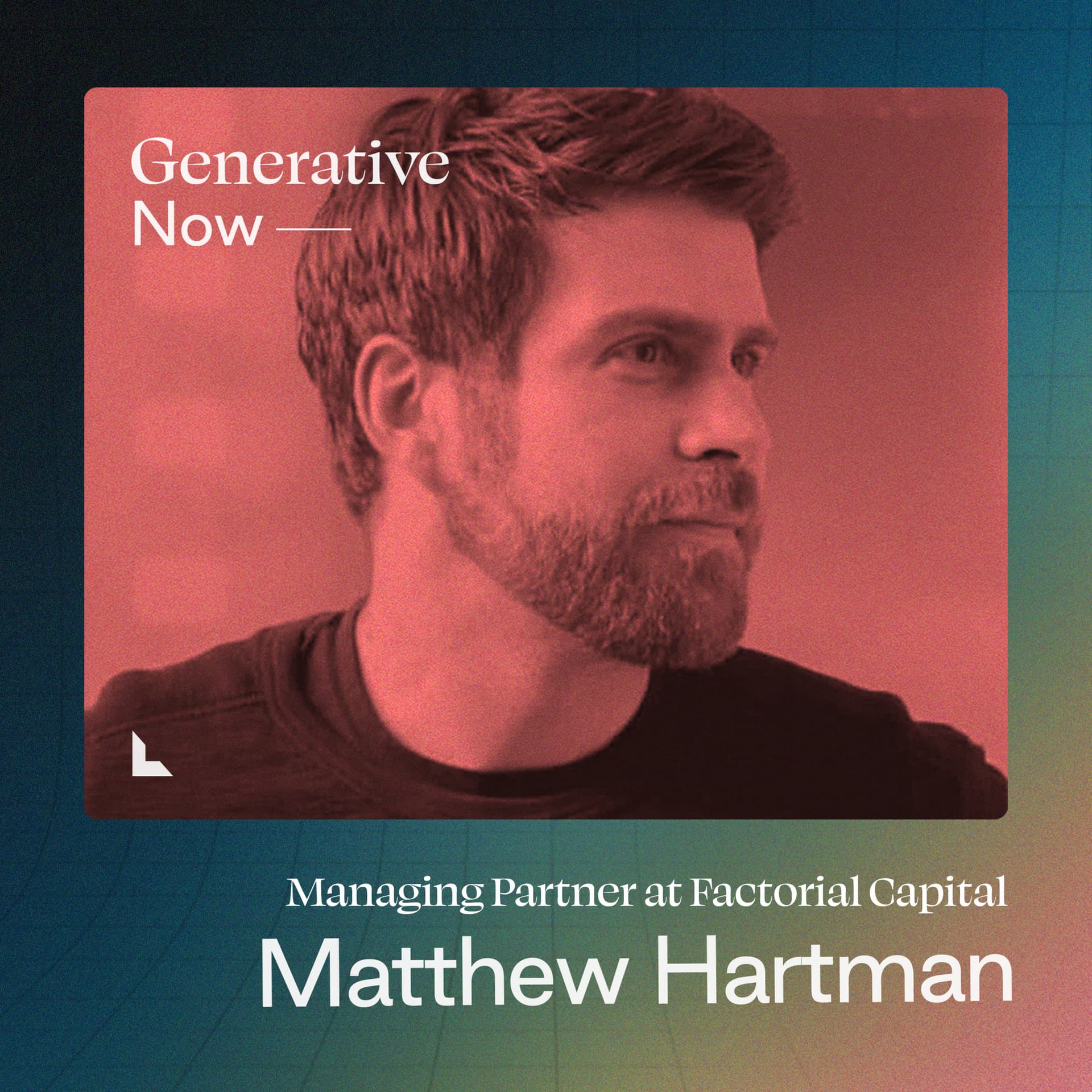
PART 1 - Matthew Hartman | How Factorial Invests in the Future
In the first part of a two-part series, host Michael Mignano interviews Matthew Hartman, managing partner at Factorial Capital. The discussion centers around Factorial's unique approach to venture capital, particularly its collaboration with technical founders in the AI sector. They delve into various topics such as investments, new technologies like WebGPU, and the evolving landscape of AI and its applications.
Key Points
Introduction
- Host: Michael Mignano, Partner at Lightspeed
- Guest: Matthew Hartman, Founder of Factorial Capital
- Focus: Insights into Factorial's investment strategy and the AI landscape.
Factorial and Technical Founders
- Factorial partners with technical founders, focusing on AI startups.
- Hartman emphasizes a collaborative investment model with founders of successful tech companies (e.g., Hugging Face, Giphy, Venmo).
- The model involves leveraging the founders’ insight and expertise to identify promising investment opportunities.
Technology Discussion
- WebGPU:
- A new technology that enhances browser capabilities by allowing access to GPU for web applications.
- Implications for the development of AI applications and how they could operate directly in browsers.
- Future of AI and LLMs:
- Discussion on the current capabilities of Large Language Models (LLMs) and their potential use cases.
- Recognition that many AI products require clearer applications and improved user interfaces.
- AI and Calendars:
- Conversations around the challenges and limitations of AI in scheduling and calendar management.
- Importance of reliability in calendar tools due to the high stakes involved in scheduling.
Understanding Scout Funds
- Hartman explains how Factorial operates differently from traditional scout funds:
- Larger investment checks (up to $400,000) compared to typical scout checks ($25,000).
- Direct involvement of angel investors in the cap table, enhancing the signal of investment quality.
- Factorial functions without a central fund; each investment decision is made collaboratively.
Focus on AI and New Tech Products
- Hartman discusses the excitement around new tech products that couldn't have been built a year ago due to technological limitations.
- Emphasis on innovations driven by technologies like transformers and their applications across various domains (e.g., music, weather forecasting).
Making Music with Suno
- Matthew shares personal experiences using Suno for music generation and its impact on creativity.
- Discussion of how AI is being leveraged in music production, leading to innovative outputs.
The Future of Creative Tools
- Exploration of how new tools will shape the creative landscape, particularly in music and video production.
- The conversation touches on the need for integrated platforms that facilitate creative workflows.
The Economics of Content Creation
- Insights into the economic implications of AI in content creation and the changing business models in the digital landscape.
Key Takeaways
- Collaborative Investment: Factorial's model thrives on partnerships with technical founders, leading to informed investment decisions.
- Technological Evolution: New technologies like WebGPU could revolutionize web applications, especially in AI.
- Creative AI: Tools like Suno are changing the way music is created, illustrating the broader impact of AI on creative industries.
- Investment Strategy: Factorial's approach offers a unique perspective on the role of angel investors and the future of venture capital in AI.
Upcoming Topics in Part 2
- The conversation will continue with a focus on the economics of content creation and future business models in the internet space.
Contact and Follow Us
- Stay connected with Lightspeed and Generative Now through their various social media platforms and subscribe to the podcast for more episodes.
This episode sets the stage for a deeper understanding of how AI is being integrated into various sectors, highlighting the innovative approaches being taken by venture funds like Factorial Capital.
Written by AI. May contain mistakes. Listen to the episode to check what was said.
Transcript
Automatic transcript. May contain errors.0:04Hey, everyone, and welcome to Generative Now. I am Michael Magnano. I am a partner at Lightspeed. And this week, I sat down with Matt Hartman, a dear friend of mine and the founder of Factorial Capital. Factorial is a new venture fund that partners with angels with a focus in startups in the AI space. I talked to Matt about all things Factorial. And then we spent a bunch of time just talking about the new interfaces of AI, the new business models, who's going to win, lose as a result, and just a bunch of stuff we're both thinking about. So check out this conversation with Matt Hartman, partner and founder at Factorial Capital.
0:44Hey, Matt. Hey, Mike. Welcome. Welcome to the pod. Thank you for having me on. I'm excited. Yeah, of course. Me too. Me too. Like I was telling you, my most fun episodes are the ones where I just get to hang out with my friends, talk about the same stuff I would talk to if we weren't recording a podcast. So this will be good. But so before we just go into our normal banter, which I'm sure we will devolve into within the first few minutes, let's lay some groundwork right now. Like, Factorial is fascinating. I mean, I've talked about it in other episodes. I talk to a lot of people about Factorial because I do think it's one of the more interesting things going on in VC at the moment.
1:24And I think it's happening at a time, obviously, where lots of crazy things are going on in VC, obviously, with respect to AI. And while you're not an AI fund, you are doing a lot of AI or maybe all AI. And I think it's probably because of your unique model, which I will let you explain. I set up Factorial as a new kind of venture fund to partner with the set of founders that I had backed in the past in the starting point. They were all technical. And what I found was that the model is really simple. I said to a set of people, the founders of Hugging Face and Giphy and Venmo, when you guys are looking, going through the world, finding interesting companies and products, let's partner together as if we each have a fund together.
2:08And just back really interesting technical founders, technical products, people who code, where we have some unique piece of information. Either we're using the product and like know it's awesome, or we know the person and know that they're great. But what do you mean by partner? Like, so Clem sees this technical founder using the product he likes. Yeah. So like with Flower AI, which is a federated machine learning framework, Clem was really excited about it because it was the most popular. It was growing quickly in terms of developers are using it. There's a bunch of reasons why federated models are interesting.
2:46I was excited also because there's like a privacy component to federated learning I think is interesting and smart. And so we, in that case, understood the product. We thought really well. Clem being the founder, and we made a very fast investment because it was easy to come to an investment decision because it was based on product and team and, you know, sort of our existing conviction. And that's sort of like how almost all of the companies we are meeting are sourced. So Clem is like a partner in the fund in that. Yeah, basically, we have a bunch of sourcing partners. And, yeah, exactly. He's a partner who's going out and meeting companies, and we talk about the companies, and then we make investment decisions.
3:31And he doesn't have to think about, like I also work with Alex Chung at Giphy. He doesn't have to think about what Alex cares about. Alex and I work together separately on a bunch of different kinds of companies. And so that's kind of how Factora was set up. And part of the reason was I felt like, I mean, you probably find this true as somebody who's built a company before, the people who are really understand the technology like when you code i mean i don't know i've coded since i was 13 like when you code you get excited about a new kind of technology and like oh i wonder what you could make with this thing and that's that ends up being the wedge into understanding it and then layering on okay is this a company that could you know is a venture-backable company is in the category that makes sense of think about product and go to market but but i think starting with that kind of curiosity as like the main vector of a tech and deep understanding of the actual technology, I find pre-product market fit.
4:26For me, when I was a beta-archer, the first investors knocking face, it was the exact same reason. I was really excited about the Word2Vec library. I was like, wow, I've always wanted to build a bunch of things that I couldn't build with like regex matching. And all of a sudden, Word2Vec allowed you to take words and actually encode meaning, which like we've been doing with images, but like you couldn't really, you could put images because there's pixels into a neural network. Couldn't really do that with like letters because the letters don't mean anything and the words, the combinations don't mean anything.
4:52But as soon as you had Word2Vec and then obviously it was Transformers that opened up a whole new set of use cases. But that's, and I think that that, I guess, at least to me has served me as a way to identify really interesting new technologies. I think you look at the last decade, there have been a bunch of venture firms built up around tech-enabled products. And I think that the next decade is already starting. I mean, you and me have talked about this. It's about the technology itself. Not that you're not having application-layer products, but the technology is what's interesting. It's the fun part, I think, of the cycle when we don't actually know what these products are going to look like.
5:29The technology is still kind of being figured out. When was the last time that happened? I mean, I think probably people argue it was the iPhone. like I think iPhone was a bit easier to understand because of, you know, it was GPS and internet and like internet everywhere and having a browser like that. Like a person who wasn't a technologist could sort of see where it was going. I'm not sure it's as easy with transformers. I've been thinking a lot about, I'll give you a random example, but this is sort of a thought in progress. Do you remember when Ajax came out as a way to do? Kayak was like the first.
6:04Exactly, right? I was like, oh, how does it do this? And Mint, you could have these really rich web-based experiences. I would almost argue that seeing that allowed you to see that Facebook wasn't going to just be a website. It was going to be an operating system, right? Yeah. And I've been playing around a little bit with WebGPU. So have you tracked WebGPU at all? No, tell me. So WebGL came out. Yeah, a long time ago. A while ago, you could now run graphics in the web. Really cool. It's not even default enabled right now. WebGPU allows websites to have access to your GPU. And I wonder what that...
6:46So Hugging Face just released a new Transformers library that can run in your browser. Because it's as if you downloaded Olama as a developer and can then download the models and tell it what you want it to run, except that you can now do that through the browser. I think that that's, it made me think a lot about Ajax and like how underrated that was as a piece of technology that made what really we believe is like the entire SaaS business model possible. What can come out of that? What do you think could come out of web GPU? If you have the thought experiment of what happens if you have a web browser that in it, you have all of the stability and Llama 3 or the update of Llama 3 or whatever.
7:30Imagine you had a web browser where that was default installed. You could run it locally. Run it locally. It's private. You could do inference locally, basically. And the websites that you're using could use your machine to do that for you. Right. So does that mean it's for private? There's no like call. It's private, but it's also fast, right? It's fast. Well, arguably fast, probably fast, but free in the sense that the website, think about the business models right now that all of these companies have. where you go to the website. They're charging you to inference a GPU somewhere. And they have to because it costs them something often, right?
8:03Yeah. But imagine now that they can ship you the model. It would take a while. You download it first. Imagine every time you went to that site. I think about all the companies that have their own cost of goods. I always thought Spotify was funny because it's a website, but they have a cost of goods. They have to pay the artists, right? Right now, we kind of have the same thing. OpenAI has an inference cost they have to run. But what if you have that built into your computer? And now, for some tasks at least, it's effectively free because it's your energy on your computer that it's using. Well, this is what everyone feels like is coming with the iPhone, right?
8:37Right. Apple's going to have this stuff run on the device. Inference is going to happen on the device. It's going to be private. It's going to be free. I was debating getting the new iPhone. I was like about to get it. And then I heard that like the Apple intelligence thing isn't even installed on it yet. Is that true? Yeah, I've talked about this on this podcast a few times. like it seems crazy to me that Apple, we're talking about Apple here, like the best hardware company ever, is marketing a feature on the box or on the website of the phone. And like, it doesn't even ship with the feature.
9:05I'm both personally and also noticing that people are less excited than ever at the new Apple iPhone. Yeah. Like I'm just like, I think it's kind of like an interesting dynamic where we have this amazing new technology, but we actually have a pretty limited number of ways that it's making our lives better. Yeah. Oh, totally. But supposedly there was a report that came out the other day that said that Apple's two years behind OpenAI in terms of models. Yeah, which is crazy. But maybe to your point, like once they catch up, maybe it will impact our lives in much more meaningful ways. Like one of the things I've been talking to some people about is the fact that OpenAI has this massive distribution advantage right now.
9:46They have, I don't know, however many hundreds of millions or billions. I forget what the number is, but they have a massive consumer footprint right now. But Apple could change that really fast. I mean, I know they're partnering with Apple, but if they partner with other models, you can imagine another model that could have a billion users overnight. I feel like when the partnership with it when I was first announced, the question was, which one of them is the operating system? right? Like if, you know, and I, I think it's a valid question to ask. Yeah. My take on open AI's user growth is like, I'd love to see how many people are actually using it because they had probably, I think it was like the fastest, you know, to a hundred million paying users or whatever it was.
10:33But I got to imagine it's the fastest to lose like 75 million users. Well, the churn on all these things, crazy, crazy high, crazy, all AI products. And I think that probably includes It's OpenAI. But that part of that is because people are still figuring out how to use it. Yeah. I mean, this maybe takes the conversation in another direction, but I don't know that the next most interesting AI thing, I think where we are with LLMs is we're now, like, they're good enough. We just need to figure out how to use them. And then there's all these other models, kinds of, so, like, that's the problem to solve with LLMs is use cases, and we can call it, like, application layer, but what are the real ways that we're going to, pipelines we're going to put together to make these work?
11:12not like, oh, we need yet another parameter order of magnitude increase so that they're better. I think we now need to figure out how we're going to use them. I could make the argument for like, there's so much more room for them to get even better and the capabilities just get even crazier. But yeah, I think your point is just like, these things are probably actually very usable today. If we could get access to them in the right places and for the right costs, there's already so much power that's probably being constrained by like other limiting factors, I think is what you're saying. To what degree, we were talking about the iPhone before, to what degree is the iPhone that much better today than the last version, than the last version, than the last version?
11:50There was a period of time where it was like, oh wait, what if we had a much better camera? All of a sudden, that makes the entire sort of surface area of what you can do with a phone much better. What happens if you, you know, if it's waterproof? What happens if you, you know, can theoretically run inference on it? Like I think, to me, LLMs, I mean, they are being used, right? There are places where people have used LLMs, but I think there's so much room for use case improvement. I don't think the reason people aren't using them is because they're hallucinating too much anymore. No, it's distribution.
12:22I think it's distribution. Again, this is why I think Apple could be so big for LLMs. If all of a sudden Siri is very, very good and powered by an LLM, and it's instant and it's free, think about how different that would make the iPhone. Also, if it's a Gentic and it can like start actually doing things for you. I mean, that would be crazy. I agree with that. But that one, I feel like we're still a step function away from. I don't feel like we're iterating our way towards like an agent. Okay, my, I am kind of... I think we're like less than three years from that. I mean, did you see the anthropic thing?
12:51I'm behind on that. I know. I mean, you have to watch that video. It's operating a computer for you. So that's awesome and required. And my general question is, is that the hard part of like booking a flight isn't clicking by. Like, that's actually a pretty hard computer science problem to be like, hey, go in and like figure out which button. Like, I know exactly what thing I want. Just go, right? That's a hard computer science problem and like not that helpful of a human problem. I think the best co-pilot helps you understand the problem. It's like having an analyst who gives you a PowerPoint that's like, actually, here's the, given what you're trying to solve, here's the best way to understand all of the massive data so you don't have to like read through everything.
13:32you know and like people talk about like okay agents to like book your flight maybe what it needs is to understand where you're staying and when your flight when you're when you're where your meetings are and maybe the best way to understand like to make your flight decisions is actually to look at like a map that's like a weather map that over time is changing like based on flights or something like like some other way that you have an assistant like literally an analyst like what would an analyst do an analyst wouldn't say hey want me to click book on your flight you would sit down the analyst and say here's the thing i'm trying to solve they come back with three choices and they'd say, look, here's the choice optimizes for fastest travel time.
14:05Once you're there, here's one that's going to get you the most sleep. If it's a, you know, if it's an overnight flight and here's one that gets you back in the morning. Cause I know you have like a kid's birthday party in the morning. So like those are the trade-offs and here's how to present those best. Have you, have you used 4.0 much? I mean, don't you feel like what you just described? Like we're probably going to get there pretty quickly with like multi-step reasoning. And I mean, I could totally see that being handled. And then if you pair that with this sort of agentic computer usage. I mean, I think that's how it's going to happen.
14:33Yeah. I don't know, this stuff just ends up looking different than the literal version. That's totally true. With the exception, I suppose, of Safari, like the thing that made iPhone work is that it just looked like the website version, but frankly, it didn't look like the website version, right? You'd pull up the website version of a site on Safari and it looked terrible. And we had to like spend a lot of time reinventing that, right? Like the, you know, Anchor wasn't what Libsyn looked like. Like Libsyn was perfectly fine on a desktop, but as soon as you go to, you know... Then it was perfectly broken.
15:04Right, exactly. On your mobile phone. Yeah, totally. And I think like, what is perfectly broken? That's a great articulation of it. What is perfectly broken in your agentic world? Right. And I think a lot of this stuff is going to come out and look really literal. Well, I think the stuff that is perfect, maybe, perfectly perfect, is all like entertainment-based stuff. like i don't need an lm to help me entertain myself you know i need to like do stuff that i don't want to do book my doctor's appointment like yeah it's probably like scheduling type stuff right yeah i mean that's the use case people always come up with i'm just remember like their old xai the calendaring thing yeah of course there are a bunch of those now they're getting pretty good but like isn't calendly amazing it is but don't you feel like the next step for calendly is for these things to just talk to each other and just do it the problem with calendaring was that it was a really high stakes thing that you were asking the computer to do.
16:03So if you get, you know, if you're like a chat bot and it gets something wrong and it hallucinates, it's like, whatever, that's just funny, right? If, if your video model hallucinates, it's like, okay, that's like, that's not what I meant. I'll do it again. If you accidentally miss a really important meeting one time out of 150, it's really bad, right? Yeah. So, So then I look at what was the actual friction with a calendar. It took kind of a while to get adopted. And I feel like there was a period of time pre-COVID when people felt like there was this power dynamic in calendaring where one person's calendar, like the person sending the calendar was kind of being rude by saying, Yeah, just look at my calendar.
16:42Figure out, yeah, you do all the work. Here's my availability. Versus then over COVID, I feel like in this inflection, what happened over COVID? When like, at least in our world, kind of founder starts in like, here's my calendar. And it was very convenient for as an investor. Okay, I'll just I'll slot into your convenience. That's great. I try to keep my, like a substantial part of my days open. So that when there's an awesome company, we can make like we try to make decisions like super quickly. And I think that there is a thing that happens where we have it, you know, like the discounting of like the time value of money, like you discount money into the future.
17:16I think that we discount our time into the future. And so we don't talk to someone today, you end up putting on your calendar for three weeks from now saying like, future Matt, that person will take care of it. Like that, I'm just going to throw them under the bus. I like to try to say, okay, this week, here's, I'm going to do some calls that are like I had to have on my calendar. I need something. I look at my calendar. I make proactive decisions about like having enough blank time so that I can jump on with people quickly or get deep work done or whatever that is. I don't actually schedule that.
17:41Maybe I should. Yeah. No, I think this is, this, by the way, this is a very good thing for a VC to do. Like admittedly this has been i think one of the ways that i've found i'm able to to win certain deals is like just move really fast and so like if i just short cut the whole situation and take the meeting like today or like hop on a plane and take it like first thing tomorrow like i'm already ahead so i think that's really smart of you so wait since we're talking about bc again so question i didn't get to ask you about factorial like explain to me why this is different than uh So you've got these individuals, these founders, and then you're partnering with them each individually when they want to do a deal.
18:21Explain to me the difference between that and a scout fund. Yeah, so most scout funds are set up in, they have a couple of features. One is they typically are associated with a fund. So like, Andreessen has a scout fund. Sequoia has a scout fund. And sometimes they'll say to you, here's$250 ,000, do whatever you want, make 10 investments of$25 ,000, make three investments of whatever. And they all have slightly different rules. Like sometimes you have to talk to the partner, you have a partner you talk to and you kind of make the decision together. Sometimes you can just do this. And for podcast listeners, I'm making like the, you know, the gif where you like throw money, you know?
19:01Yeah, of course. So factorial is a couple of different things. First is our investment size for each individual check is bigger. So we all write up to$400 ,000 in one company. And that goes into your sort of book of companies you've sourced. You're saying where scout funds are small. Yeah, the total scout fund might be$200 ,000 because the actual thing you're doing is sourcing for a venture firm. So the venture firm... The scout checks are tiny as a result. Their check is$25 ,000. Then the total fund size over the course of a year is$250 ,000. Like, I could do three investments in somebody who've already invested over a million dollars in, you know, a year or less.
19:33So that's the first thing. Second thing is, factorial, for the most part, the angels are putting some... Whatever their own regular angel check is, they're still writing. So they're directly on the cap table. We're just upsizing it through factorial, which I think creates a useful amount of friction. It means it's a real signal when we're investing. It's not just like, oh, I thought this is my friend's company. The third thing is there's no, and this is like the weirdest, I'm still working on how to articulate this, but there's no fund at the center that you're sourcing from. So like I get the check from whatever big fund to write the thing, my little fund of$250 ,000.
20:09I get to invest that. Their goal is to write a$5 million check into that company or$10 million check and lead the A, right? That's their goal. I don't get any of that as the scout or whatever to do that. And so with Factorial, we do a follow-on, it still goes into your category. So it genuinely is like our fund together. So structurally, that's what's different. What turned out to be the case, and when I was doing my user research on whether to do this, I talked to a bunch of people who did scout programs. I talked to a bunch of founders who were like, I would never do a scout program. I'm like, why wouldn't you do a scout program?
20:38Like, it sounds pretty great. They would say, I want to be Switzerland. And I don't want to just send investments to this fund or this fund or this fund. I just want to be able to send like whatever founder who I want. I want to support them. I want to send them to all the VCs I know to the extent that they know a lot. And what I found was it sort of factorial positively select. I mean, we have some pretty, pretty exciting people who I was like really pumped to be able to work with, like Clem from Hugging Face, who they have their own brand. They are sourcing. But this isn't Switzerland though, right?
21:08It is Switzerland. Because it's their fund. It's their fund in the sense that I'm not... It's their capital. Well, see, partially their capital. It's the equivalent of their fund is why it's not. Why it is Switzerland. They can still... We still send... If you were to write... If you were a... VFX Oriel Angel. Well, let's say if you were a scout someplace. The very first thing you would do when it's time to raise... For the company to raise their seed round is... I don't even know if this is contractually required or not. but like you're going to feel like you weren't a very good scout if you didn't send this founder that you invested in to the fund that is giving you the money to do the scout program.
21:45That's not Switzerland. Picking one fund over another fund isn't Switzerland, right? That's like, I'm going to say that I'm giving you, they want to be able to give just totally unvarnished advice. And so in this case, like the capital and the decisions are us together, but it's not like, you know, if we're going to do a follow on, we'll just, we'll do the following, but that's that person I'm working with to make that decision. And we're not leading later round. So we're introducing them to everybody. But the point I was going to make was it turned out to positively select. If you're your own brand, then you don't necessarily need the stamp of another fund.
22:19Some people want that. That's totally fine. That's not a fifth factorial. The people who are their own source, really what they want to be able to do is make some investments, but focus. Some of them are running big companies. They want to focus most of the time on working on the companies. Some of them sold their companies. They have financial freedom for, you know, ever. And the last thing they want to do is go have an LP that's like a 10-year new commitment. They don't want a boss. So I pitched the fund and they're welcome to sort of meet the LPs, but they're not required to do that. Like that is what I've pitched the LPs is you're getting access to this sort of angel deal flow that is inaccessible because these people aren't starting funds.
22:57And so that's the idea. And so you started with how many angels? 10 who are kind of actively sourcing and 15 in general who are kind of like in the network. What I found was that a feature is you don't have to make any investments. Like they don't, like some people are like, I am busy this month. I got, I'm away or I have a product release or there's something I have to do in my, in whatever. You're, that's totally fine. I'm the load balancer. It's totally fine. So it ends up being this sort of feature. I don't feel like they have to deploy anything. What do they do then if they're not deploying?
23:29The part of the network. I think that they would say, I'm not doing Factora, right? I'm not investing right now. But what happens is when they pop their head back up, we have a vehicle to be able to work with them. And so we've already said, we've looked at your deal flow. Let's work together on this stuff. Let's look at companies. It happens to people, right? They get for a variety of reasons, some that are in their control, some that aren't. So it's part of the reason why they don't want to have their own fund. They don't want to sort of be like responsible for deploying capital. I think a lot of the weird incentives happen when you're like supposed to invest.
23:59Right. That's really, really cool. And, you know, I've seen your list of investments. It's awesome, by the way. Like, why do you think, I mean, it feels like they're mostly AI. Is that right? So the lens that I apply for my own, the thing that excites me, and when I'm talking to the people who I'm working with at Factorial, I think it's we have similar tastes. And so it ends up being not coincidence that this is what we do, is the thing I'm most excited about is new tech products that couldn't have been built a year ago for some technology reason. as opposed to either a non-tech product like CPG or a product that exists now, but not for technology reasons.
Read the full transcript
24:37So a user behavior change sometimes is related to technology, but often isn't. Being able to do more efficient customer acquisition on top of Instagram is like, you can build a lot of VCs back to CPG companies with that thesis. I think those tend to be like relatively constrained, Whereas a thing that is constantly a renewable source of energy is what's the technology that's changed. That's why I was mentioning WebGPU. I'm just like kind of fascinated. Like, I don't know. What does that mean? Maybe nothing. Maybe WebGPU will go the way of like WebGL is kind of like it's important, but like not that important.
25:11But it's worth understanding what could exist now that couldn't have existed a year ago. So that's why I think when you look at our set of companies we've invested in, they tend to be, right now, they tend to gravitate towards not just things with AI in the name, but things that couldn't have been built a year ago. Which coincidentally is AI, like in 2024. Right. And I think that AI is even too big of a category. Like, what is it about transformers that is really unique is that you can predict much more accurately than prior statistical models a sequence because it looks backwards and forwards.
25:50And so right now, language is like the obvious place that that's been used. We've proven out that that works in language. What are sequences that we weren't so good at predicting? Weather is an obvious one. There's a bunch of people doing things in weather. what are, you know, there's, there's, what's the next thing that's going to happen when you're driving a car and self-driving cars? Obviously that's like, it matters there. There's people doing research on stock. Like that's like less interesting to me, but I think that's an obvious example of like predicting sequences is valuable. And then what are the pipelines look like that are predicated on being able to do that much better?
26:21So, you know, there, and if you start to talk to people who are building these things in weather and in cars, there are actually like pretty established pipelines of how to do this. You like build your core model. You've got, you've then got like something, like some kind of constraints that are unique to your vertical. And then you've got, okay, a bunch of probabilistic outcomes. How do we decide between, sometimes both outcomes, like two stories generated by ChatGP might be equally happy, equally good outcomes. But a third one might be like a total hallucination. Like how do we tag that with RLHF to train that?
26:52Like that's all, you know, when we talk about application layer, I think we picture websites, But like all of that starts to become what it means to be the application layer. And so that's so. So I think when you look at the companies that we're investing in, I think they all have some unique take on. Like the why now is technology, but the why now is like usually pretty specific. Turns out transformers are really good for musical sequences. So that is like a really good transition to Suno, which is one of your investments that I think I got to imagine. I'm like one of the top paid customers. Really?
27:28Is this recent? I didn't even know you were using it. I had to like keep bumping up. I also, we have a mutual investment in Pika. Like I just had to buy more credits to Pika. I told you I've been making these music videos for my kid. And it is, talk about application layer. Like I have my pipeline of making music videos involves, currently I've been playing around. I've been using Grok a lot for some reason. I just think they could. Really? Yeah. On Twitter? yeah, Grok's Twitter. I paid for Twitter. It's pretty good. I did not think I was going to pay for using Grok. And I found myself using Grok a lot.
28:02I don't really, I don't know why. Wow. It's just something about it gets me to what I was picturing faster. My son is, as you know, is almost two. And he's like, I make up songs all the time for him. And like, my wife and I joke that the long con is he's like, think that these are real songs. And like, he's gonna say, oh, do you know the songs? Like a friend at school. And they're gonna be like, what are you talking about? It's just like songs I made up. so wanted the songs to be I found that even when I recorded them with voice notes he likes listening to it over and over and so I saw that Suno had a few my keyboard broke so I used to like my keyboard something's wrong with it and like a bunch of notes don't work and so I was like okay how am I going to record this a bunch of keys don't work a bunch of keys don't work and it's like must be they're all connected to like the same something in the chip because it's like very predictable I can predict which keys aren't going to work so I was like I saw Suno released covers So I recorded myself just me playing the guitar.
28:58And I fed it into Suno. And I started doing it in different styles. And the results blew me away. Yes. I was like, this... Because I always was like, how do you control... I was recording songs on it, but I was telling it to make a song like this. But it doesn't feel like it's mine. Because it just feels like I typed a prompt in it and I gave it the whole thing. But when you give it something, it feels like yours. So all of the songs I've uploaded are my melody, my chords. I need to hear this. How do I... I gotta... So I can tell you my surname, but actually the output that's interesting to look at is it's Dippy the Dinosaur on YouTube.
29:31It's just like at Dippy the Dinosaur. So I uploaded the one I sent you, which was the first one. Then I started making ones that kind of look like my older son. And so it's as if he's in them. And then, so I've done like, I just uploaded the fifth one a couple days ago. So one of them is about a dinosaur. One of them is about how he likes pouches. One of them is a song that I love, how he likes how he has food eats. One of them was about cleaning up. and then the most recent one we just made up this song about unicorns I dream of unicorns they're all different styles each song is like a style that's like one song I made it was kind of supposed to be a country song but I could make it actually a country song with Suno one song was supposed to be like like a rock song but I made it like an actual rock song with Suno right and it felt like a studio cover band like a studio musicians were playing a song that I gave them to play well have you seen the Timbaland thing no so Suno just partnered with Timbaland the producer and that's how he's using it he's like creating a song and then he's feeding it into suno and he's saying like give me the country version of this give me the house version of this i have to admit that i didn't fully get why i would listen to other people's songs on suno and now i'm like oh to your point you have my hand if i give you my handle my handle saying random whatever they gave me but like now that i also the other the other app that i used that i didn't actually try to get a meaningful headline was tiktok and like i was pretty early on it and i didn't try to get my name probably should try to get i guess my name on uh on suno but it is uh i get now i listen to these songs other other people's song i don't listen to other people's but i can now imagine listening to other people so like hear what kinds of stuff they're doing probably look at maybe if i can see it what the prompts they use to learn like how to make other songs like theirs and there's you know i think there's a a limitation in creating art that you run up against when you're using AI to create art.
31:20I don't know that I would call what I'm doing truly... I'm trying to... I decided the scope of what my art is. I made the words and I'm making the music and everything else can be AI and that's fine. I don't know if this is high art for me, but it's pretty fun. I will say that I'm running out of credits because it takes a lot of credits, just like with Image Generation. It takes a lot of credits to get the right thing. It's a variable reward system. It's like social media. Wow, that's an interesting way to think about it. I had not thought about that. I'll tell you, it's a variable. It's a cost system because I'm like, oh man, I only have, I have like 39 credits left on cover for free covers.
31:55But you do pay for a premium. I pay for premium. You know you can do top-ups. Yeah, I figure I'll get to that point. Oh, here's the thing I was going to say. So I upload these things so that I can watch them. We can watch them downstairs. So I upload the unicorn one and I was going to delete them to like, you can't like upload, you can't update your video, but I was, I use iMovie and I bring in Pika art to like, like to illustrate the, the, the song. And then it's really good. It's like, it's, it's the characters don't move their mouths, but it kind of doesn't matter because it's like a kid's video and I'm just like sort of showing what's going on.
32:28I was going to delete the, um, the unicorn wanted to upload the updated version, but it had like, normally they all have like 50 views and they're all just me watching them 50 times. This, the unicorn I uploaded, uploaded two nights ago, the next morning it had 1400 views. Wow. You got picked up in the, in the algorithm somehow. And I'm trying to figure out why. I think I get a better description. So it's just sort of interesting to now be like, oh wait, now I have this little dopamine hit of like, well, I don't know, maybe I want more people to listen to my music videos. Maybe you should make some series about this unicorn.
32:59Like maybe this unicorn's a character. I don't know. So what is the product that allows you to do all of this in one place fast? Using like not just video, So not just like who, like, I get that pipeline together. I don't know what that looks like yet, but I'm interested in using it. You're saying what is the place where you can do music and video all in one place? I don't know how generalizable my use case is, but it feels like there is an operating system to be built to incorporate a lot of this stuff. Like maybe it's like Runway kind of started out of that. Now they're kind of just basically focused on here's what the models are.
33:37Maybe it's Adobe comes out with it. maybe it's, you know, I've been kind of fascinated by these, you know, that like cursor is basically just a skinned or like a rethought about Visual Studio. But I think it was just like an open source project that they forked. I'm not positive about that. I could be totally wrong. I thought there was some like debate on Twitter about whether that was the case. What's the, what's the, I think about IDEs. What is the IDE for creators to just constantly leverage the new stuff? We're investors in a company called Florifana that's kind of thinking about what the...
34:13They have their own take on what the IDE is for bringing in new models to do creation. It feels like Adobe's kind of going down this path, right? Because obviously, it's a creative suite. They have all the different tools. But I remember a few months ago, they announced some video model integration where you could generate videos right within whatever Premiere, I guess. And you could choose from a variety of models, including Pika and Runway. And it feels like that's the right type of company to do what you're talking about. I think a brand new IDE. Yeah, I guess that's possible, right? To build an IDE that's like optimized for this new creative workflow, which is much different than the traditional creative workflow.
34:49Yeah, so like Cursor, Cursor's traction is fascinating to me because there's plenty of IDEs. And arguably, I think the reason I like that metaphor is what's the part of the stack that you own? What's the data that the consumer owns? And what are you best at? Do you use Obsidian? No. Obsidian is like a tool for it. Did you use Roam Research for any of that? Little. A little bit. So I was, I loved Roam Research. I didn't love that my like deepest thoughts were being put on somebody else's server. Yeah. And when I downloaded Obsidian, what I learned was that basically it looked, it looked like an ID, like the actual files that it was working with were just sitting on your computer.
35:25And if you move that Obsidian installation somewhere else, like the files don't move with it. Like you have to put the files there. Yeah. But, but it means, it made me feel like I owned it. almost like crypto, like I owned the actual underlying data. And Obsidian was just the best way to interact with it. And it reminded me of like being a coder and like, you're not indifferent between your development environment, like you have your own flavor. And that starts to like, take your data and move other places. But if I want to be able to do RAG on my content, like there's a plugin to be able to do that.
35:54And that starts to move your data elsewhere. But like, assuming that you're fine with that, now we've added an app on top of Obsidian. It was built for obsidian it's now like maybe i'm more locked into obsidian than i wasn't before right and kirscher's doing an interesting job of this obsidian is like it's just sort of the other example i can think of that isn't coding but if we think we live in a world where we have where you're trying to do your job and the tools that could allow you to do your job are improving so quickly these underlying models and like the the papers that come out are being iterated on so quickly, maybe a really good metaphor is like, what is the, instead of it being a copilot, it's like, what's the operating system that you want?
36:36Or what's the IDE that you want to use? This could be best for you to then have all of the right combinations of things that sort of combine to be a copilot. I don't know what that looks like yet, but that's like anything I'm thinking about. The tricky thing with about somebody pulling this off right now is so many of these model companies, they don't want to have APIs, right? Because their differentiation, their moat is their technology. And so why would you give it out to somebody else to monetize it? You know what I mean? That probably changes over time as all these things converge and the technology itself becomes commodified.
37:11Like at that point, you probably could get access to these things as an API and then you could see somebody building some sort of operating system on top of them all. Well, yeah, or the inverse is true, right? Like what we saw with like Facebook and Foursquare was that they were open until they realized that they needed to be closed. They grew by saying, hey, make your own app on top of Facebook. And sure, here's all that is someone who's Facebook Connect. You can't get Facebook connected anymore, right? They understood that what they needed to do to be a big company is keep everything in a walled garden, right?
37:46I don't think it's wrong from a company building perspective for somebody to say, look, we want to own this. but that's a reflection probably of how proprietary they think what they're doing actually is if you believe what you're doing is so good like open ai just has an api but they believe what they're doing is so good that like sure use our api because we're constantly improving on that and the the application they are they've built is the api maybe maybe maybe it's not right but like Like, and I guess an alternative point of view is, I think what Pika's doing is really interesting because they've built their core model and then they're using a bunch of open source to augment it, right?
38:30They're saying, like, when ControlNet came out, let you, like, write your name in the cloud. They're like, oh, that's really cool. Let's spin up a feature. And that reminds me a lot of, like, what OpenAI did with ChatGPT. They're like, oh, we have the ability to just play ground. How do we make this best for people to engage with it? I think in video, that's very much an unanswered question. How do you make an interface that's best for people to engage with it? Like there, and there's a lot of experimentation, a lot of companies experimenting around that. If you believe that some of these models, especially the open source ones will, you know, and maybe I think with music, actually, it's, I haven't seen a lot of good ones.
39:03If there was an open source music one, I would love to create like an API, a workflow for my use case. And my use case is so weird that like, I don't know that Suno is going to build for that. You know what I mean? Speaking of Pika and full disclosure, you know, I'm an investor, I'm on the board. I thought it was really cool the way they sort of leaned into this really like fun sort of use case with the peak effects. I'm sure you know what I'm talking about. Recently, they came out with a new version of the model. And it's like very consumer oriented. It's less like dystopian cinematic AI video, which is like all of the AI videos on Twitter.
39:42And it's more just like, hey, here's a bunch of really fun things you can do with it. And we're going to give you these one tap peak effects, they call him. call them to alter like the world around you. So you can like dissolve, you know, the Coke can in front of you or like inflate the building across the street from you. And it's like, it works really well. It's amazing. really fun. And the memes are just out of control. I want a whole app library of those kinds of things. Cause the one, like, you know, I think you said you're an investor. I think I disclosed at some point that we're investors too.
40:17The, one thing that I don't when I'm noticing when I'm actually trying to use them is they all destroy the main character. Yeah. And I was like, I was looking for something that did other stuff because I was like, I could make a song around that. But I the quality is amazing. It's bonkers. It's amazing. I think that's what's so cool about what's going on right now. That's why I think a lot of this stuff do you know, I don't know if you know, like are they how are they doing that don't know wouldn't tell you if i could no i i don't know they're so good and so on another level of anything i understand that because the prior version was um like when they did the control nothing i think they would filter the image first through that and then kind of peakify it then run their model on it it just i'm fascinated right now with where all of these things sit in the stack behind the scene, in your pipeline, let's call it.
41:16Because certain features you can only implement if you control that main model. Other features you could add afterwards, right? But like, or before. Well, this is the other reason, like, you wouldn't want to give out an API. It's because you could just do so much more with your technology if it's within your own platform and it's your own native format, right? Like, once you have an API, like, you naturally limit the capabilities of that technology. I think you naturally limit it also because the feedback loops are gone, right? I think - Exactly, that's what I mean. Yeah. Right, you have like, you have what the output, the output isn't really an image, right?
41:47The output is actually like as an embedding, or I think. And in a perfect world, if you have a pipeline, you take the embedding from the first thing and make it the embedding for the second thing to zero loss. The reality is if the output is like a bunch of words, you've got a bunch of loss in there that now you're plugging in. And if you want to have the feedback loop to train that first model to make it better or to make the whole system better, you kind of have to own the whole process. so then the open question to me is like what is good enough? as soon as you get to a point where it's good enough then it's fine, I'll take that and I'll fine tune it but I'm like really curious where this goes thanks for listening to Generative Now Matt and I will be back next week with part two of our conversation we get into the economics of content creation and the future business model of the internet if you liked what you heard please rate and review the podcast it really does help and please subscribe if you want to be notified next time we release new episodes.
42:41If you want to learn more about the podcast, follow Lightspeed at LightspeedVP on YouTube, X, or LinkedIn. Generative Now is produced by Lightspeed in partnership with Pod People. I am Michael McNatto, and we will be back next week. See you then.
From the publisher
This week, we are sharing PART ONE with Matthew Hartman, a managing partner at the venture firm Factorial Capital. Factorial partners with angel operators, with a focus on startups in the AI space. Host and Lightspeed Partner Michael Mignano sits down with Matt to discuss how Factorial partners with technical founders to explore opportunities. They discuss OpenAI, Apple Intelligence, WebGPU, Suno, and much more. Join us next week for PART TWO of this conversation.
Episode Chapters
(00:00) Introduction
(01:42) Factorial and Technical Founders
(06:24) WebGPU
(10:47) Future of AI and LLMs
(15:47) AI and Calendars
(18:16) Understanding Scout Funds
(23:07) The Role of Angels in Investment
(24:12) Focus on AI and New Tech Products
(25:42) Transformers and Predictive Models
(27:26) Making Music with Suno
(33:27) The Future of Creative Tools
(42:30) The Economics of Content Creation
Stay in touch:
LinkedIn: https://www.linkedin.com/company/lightspeed-venture-partners/
Instagram: https://www.instagram.com/lightspeedventurepartners/
Subscribe on your favorite podcast app: generativenow.co
Email: generativenow@lsvp.com
The content here does not constitute tax, legal, business or investment advice or an offer to provide such advice, should not be construed as advocating the purchase or sale of any security or investment or a recommendation of any company, and is not an offer, or solicitation of an offer, for the purchase or sale of any security or investment product. For more details please see lsvp.com/legal.


