Ask ChatGPT

 Great Company with Jamie Laing
8 Apr 2025 · 53m
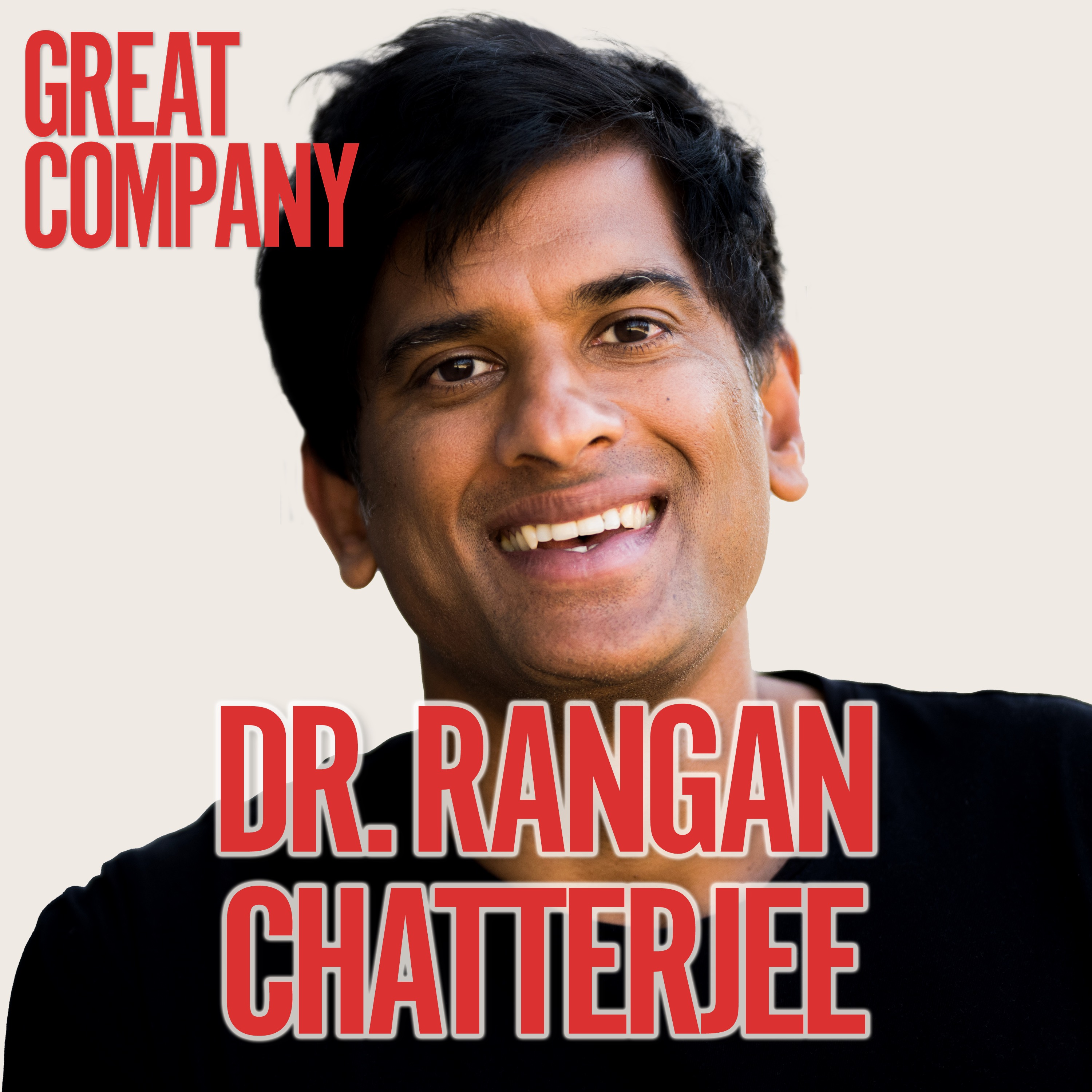
In this episode of Great Company, host Jamie Laing welcomes Dr. Rangan Chatterjee, a prominent UK doctor, best-selling author, and host of the podcast Feel Better, Live More. The conversation explores the impact of chronic stress on health, specifically focusing on libido, alongside discussions of personal growth, mindset shifts, and constructive habits.
Written by AI. May contain mistakes.

Get the gist, explore an idea or ask about something said.
 Claude
On Great Company with Jamie Laing, what are the key points of this episode?
Searching your listeningAutomatic transcript. May contain errors.
0:28Hey, it's Adam Grant from WorkLife, a podcast from TED. software, you'll work smarter, not harder. Freshworks uncomplicates. Learn more at Freshworks.com.
1:00Go to Upwork.com now and find your freelance expert. That's U-P-W-O-R-K.com. Post a job for free and get started today. If you're a smoker or vapor ready to make a change, you really only need one good reason. But with Zinn Nicotine Pouches, you'll discover many good reasons. Zinn is America's number one nicotine pouch brand. Plus, Zinn offers a robust rewards program. There are lots of options when it comes to nicotine satisfaction. But there's only one Zinn. Check out Zinn.com slash find to find Zinn at a store near you. Warning, this product contains nicotine. Nicotine is an addictive chemical.
1:38Raise your hand if you want your nails to look perfect all the time. Me too. I'm Sarah Gibson Tuttle, the founder of Olive & June, and this is exactly why we created the Gel Mani System. We wanted to make it possible for everyone everywhere to give themselves a beautiful manicure at home with our tools and our gel polish that lasts up to 21 days. Each manicure with our system comes out to just$2. That's right,$2. No more$60,$70,$80 salon trips that take hours. Now you can paint your nails on your time and love them more than ever. And by the way, when people ask you where you got your nails done, you're going to proudly brag that you did them yourself.
2:16And here's a little something extra. Head over to oliveandjune.com and get 20 % off your first gel mani system with code DIYGEL20. That's code DIYGEL20 for 20 % off your first mani system at olivanjune.com slash DIYGEL20.
2:35Hello everyone, my name is Jamie Lang and this is Great Company.
2:44Hello. Hello Jemima, how are you? I am well, how are you? I am well as well. And how are you listener? Pause for response? Great to hear it. Well maybe they said they weren't that well I'm really sorry to hear that But maybe they said they're getting engaged Well congrats And commiserations They've just had a baby Sorry the commiserations not for the engagement But if the news was bad Maybe it's their birthday Yeah congrats or commiserations I feel like covers everything Okay fine alright Hello guys welcome back I don't know where Welcome back to the show Welcome back I'm your host Jamie and this is our producer Jemima PJ like her name producer Jemima there we go and producer presenter Jamie PJ as well welcome to the show our chaotic beginning to great company if you're an old listener you know exactly what you're here for and if you're a new listener welcome to the show and we really hope you enjoy it and we have an amazing guest today which we're really really excited about I love it when we have another podcaster coming onto a podcast they know the drill I can't tell you how good other podcast mic technique Oh, they get it.
3:51They just sit. Raffi over there, our sound engineer, is smiling when they lean into the mic just the right amount. No yelling. What's funny, though, is when we have guests on who aren't sort of notorious podcasters, they're a bit nervous. They don't know what to do. And when podcasters come on, they have their own habit of doing it. So they want the microphone here, or they don't wear headphones, or they like to sit forward, or they like to sit back, so they know what they're doing. So with our guest today, Dr. Rangan Chatterjee. We are going to be interested to see what his mic technique is like We can't wait, what little nerds Rongan is a wonderful human He is a doctor, he's now a podcaster He's also an author, he's a public speaker I've known him for a while actually And I've interviewed him before And he has this amazing way of Just being very kind and considerate And I suppose today is one of those episodes Because he is also a podcast host I just would like him to talk I don't think I need to talk that much and I think it'd be interesting for him just to speak his words Yeah Which would be great Little nudge, little nudge Little nudge, little nudge, little nudge He's also got a new book out Well his book's been out for a while but do we'll pop all of those in the old description The link description below We'll pop them down there so you can go and check them out The Desk Row And also we're on social media as always and of course we have our email great company at jampotproductions.co.uk we'd love to hear from you any guests that you think we should get on if you like the episode what you don't like about the episode we want all that feedback yeah do you know what else I'd like to hear from listeners what?
5:26this shows all about connection and like going back to like those fundamentals yeah I mean we live in a disconnected world and this is about connecting people yes and lots of our DMs people say that they really resonated with the conversation so I'd really love if people wanted to write in and tell us about like conversations that they've had maybe with people that they didn't expect to connect with, like maybe from a different age. Who have they been inspired by? Who they've been inspired by, but also maybe playing it forward in a way. I love that. So like, you know, when you talk to like a stranger in the street or like when you get a coffee and like having a really funny interaction with someone and you're like, oh, that made me, I'd really like, I don't know.
6:04So what unusual connections have you had recently that you would love to share? Someone that you weren't expecting to connect with. Maybe you're on the tube. Maybe you're in your local bakery. Maybe you were dropping the kids off at school. Maybe you were on a run. Someone that you connected with and shared something with. We'd love to hear about that. I'd like to challenge the listener. Love that. To do that. Okay, so while you do your homework. Owls. How you can do your homework. We're going to get into this episode with Dr. Rangan Chatterjee. Are you ready for this? I'm really ready. I'm excited.
6:29Okay, buckle up kids. Please enjoy this episode of Great Company with Dr. Rangan Chatterjee. I'm Dr. Rangan Chatterjee and I'm in Great Company.
6:45I've also given you a lovely intro. Can't wait to hear it. Yeah, you're going to love it. Those intros you guys do, they're gold. They're really unique. Honestly, I hope you keep doing that. I think they give it a real point of difference. That was the idea behind it. The reason we started it was because, so Jemima, as my producer, she has a different take on how these podcasts work. And also when we're interviewing people, you want kind of feedback and understanding what you do wrong so Jemima was the person who said to me you know enjoy silence one of the things I learned uh maybe two or three summers ago I know what I'm going to change going forward I'm just going to embrace silence in the podcast I'm not going to try and fill the space all the time with noise or comments and I think silence is really powerful yeah but I found it so hard to do that man I found it so hard because I was like like i'm even doing it now right i i'm i'm thinking if i'm if silence for me feels awkward so when you're having a conversation there is silence or someone gives a pause my initial reaction is to fill it straight away but actually letting it settle i think that comes from an inner insecurity totally like that we we can't sit with that silence what will people think that we don't have anything good to say or you know i i used to rush in to fill that but i think that applies in all aspects of life, actually.
8:05Because what is a podcast? It's just a conversation between two people. I think that same principle actually applies in a relationship, a marriage, a doctor-patient relationship. And it's the same thing. I think science is really powerful. Stress, right? All of us feel stress. What is stress? What is it? The stress response at its core is about us feeling safe. Okay, let's go back 100 ,000 years ago, right? You're just hanging out, doing your thing in your tribe, a lion approaching, right? Or you just see it out the corner of your eye. In an instant, your stress response kicks into gear. So what happens?
8:43All kinds of things happen that are there for the singular goal of keeping you safe. Okay. Your blood sugar starts to go up. So more glucose can get to your brain. Your blood pressure goes up. So more oxygen can get to your brain. your blood becomes prone to clotting why because if that line was to attack you and cut you instead of bleeding to death the blood's going to clot and it's going to save your life well right your amygdala which is the emotional part of your brain goes on to high alerts so you can actually you're going to be hypervigilant you're going to be here every single noise you're going to hear.
9:24These things are all really, really helpful in a real life or death scenario. The problem today, Jamie, is that most of us are having our stress responses activated, not by wild predators, but by the state of our daily lives. Our email inboxes, our to-do lists, the multiple social media platforms we're trying to keep up to date with, the negativity on the news. The elderly parents were trying to care for whilst also trying to look after our children. These things are also activating our stress response in the same way. So those things that are helpful in the short term become really toxic and harmful in the long term.
10:03Got you. And that's why we turn to alcohol or whatever to suppress it very quickly, and then it comes back. But let's just take one of those four things that I mentioned, right? I mentioned blood glucose, blood pressure, the amygdala, and blood clotting, right? I could make a case for all of them, why they are helpful in the short term, problematic in the long term. Let's just take the third one. Your amygdala, the emotional part of your brain going onto high alert. That is fantastic if you think there's a line there. That is also fantastic if you are walking on a dark street in London on a Friday night back to your car and you think someone's following you.
10:38That's a completely appropriate response. You want to be hypervigilant. You want to hear any noise. But if that's what's happening to the state of your daily life, that's what we call anxiety. The stress response is there for a reason. I mentioned a few things that get switched on when we're stressed, but there's two things that get switched off, which are really important. Number one, your gut. 80 % of adults in the UK have some form of gut or digestive symptom each year. people always think about food yeah food can be a driver of that but the number one driver is stress think about it when you're stressed and most of the population is chronically stressed these days your body thinks that there's a predator approaching right so you switch off your digestion because that is not necessary in that life or death situation it's not necessary right so many of my patients over the years the way i've helped them with our digestive symptoms like heartburn or bloating or even constipation could offer me to help them with their stress.
11:42So there's a breath practice that I use with patients for years called the 3-4-5 breath. You breathe in for three, you hold for four, and you breathe out for five. Why does that work? Because anytime, Jamie, your out-breath is longer than your in-breath, you switch off the stress part of your nervous system, and you activate the relaxation arm of your nervous system. So I've been using that with patients for years who've got anxiety, very, very helpful in the moment for people who feel stressed or anxious. If any of your listeners have kids or are kids themselves, like teenagers getting nervous at school before exams, this is game changing.
12:22I've got some patients who do that for one minute before they eat. They no longer get digestive symptoms, right? Because breathing changes your nervous system. So your gut gets switched off. Here's the other thing that gets switched off, your libido. I've been a doctor for 23 years, Jamie, and I would say over the last 10 years, I've seen more and more cases of low libido in younger and younger and age groups. The number one cause of low libido these days in society is chronic stress. And think about it. if your body thinks that you're having to run away from a tiger because it's chronically stressed it's not a priority to be able to chill out and procreate with your partner it's it's not it kind of makes sense when you understand the stress response and as you load the beado you know people laugh about it this is really really serious right it really affects the way people feel about themselves it affects people's relationships and chronic stress is one of the key drivers.
13:25You know, one of your chapters, you talk about embracing discomfort. You know, why is it bad to be comfortable all the time? Firstly, you've got to understand that humans are wired for comfort, right? So we can't have any guilt or shame when we think about our comfortable lives, right? So the reason we've had all this evolution, the reason why we have these beautiful homes now, and we have central heating, and we have all these great things now that we've And the way we live today, the way even someone, like a middle earner in society, the way they live today is better than kings used to live 200 years ago, right?
14:03We forget that, right? Because we always compare ourselves to how other people are living. But humans are hardwired for comfort. We've always done things to make our lives easier. But something happened about 40 or 50 years ago where we're now living lives that are so comfortable, physically comfortable, that they're now starting to kill us, right? What? They're killing us, right? You don't get all these conditions that we struggle with. Let's say talk to diabetes, obesity, even the rates of anxiety and depression that we have. You don't see these things to anywhere near the same degree in traditional societies where we have uncomfortable lives, where you have to go out each day to get your food, bring it back, cook the food.
14:50Because let's take the extreme example. We can sit at home now. If you're able to work from home, you can literally sit on your bum all day, work while sitting on your bum, order beautiful, delicious food that's cooked for you and is warm and tasty that comes to your door. You can order light bulbs. You can order literally anything you want without having to do anything. That is comfortable. I'm not saying people aren't struggling with their lives, but I'm saying physically, we've never had it that good. So why are so many of us that are sick? Because we need a bit of discomfort. Discomfort is good for us.
15:32It helps us feel that we can overcome things. One of the things I will do with patients who've got anxiety and or depression, one of the things I'll do is I'll say, guys, we need to do one thing each day that you can repeat. So I'm a big fan of five-minute actions. I do a five-minute strength workout every single morning. And I've rarely missed a day for five years. It's because I follow the two most important principles of behavior change. Number one, you make it easy. If you make something easy, you'll do it. Rule number two, you stick on that behavior onto an existing habit. So a habit is a behavior that you do without any conscious thoughts, right?
16:15So I make coffee every morning at half five, right? I don't need my assistant to phone me up and remind me, hey, wrong, and don't forget to make your coffee today, right? It's a habit. So what I do is I weigh out the coffee, I put a timer on for five minutes. And in those five minutes, I do a strength workout in my pajamas. My five minute kitchen workout is a habit. It shows me every single morning, Jamie, no matter how busy I think I am, I still found five minutes for me. That is priceless. It's something you could call that a discomfort. It's much easier for me to sit there, scroll Instagram with my coffee, right?
16:57But I don't. I actually do that workout and it is powerful. And I've had patients, Jamie, who were suicidal, suicidal. And that five minute action has started, genuinely has saved their life because when we're struggling, it's really hard to get yourself out of a dark place sometimes because it feels too, it feels too much. God, I have to do this and I have to do that. I'm like, No, no, no, you don't. Get one thing, make it small and do it every day. The momentum you start to build from that is priceless. The way you view yourself starts to change. That is priceless. Instead of being someone who says they're going to do stuff and you don't end up doing it where you say to yourself, God, I'm a loser.
17:42I can't do anything. No, you change your self-identity. You become someone who says they're going to do something and does it. And by making it only five minutes, it happens. And I would say for many years, Jamie, I've noticed if I reflect back now on many patients, a lot of them have this low-grade anxiety that is built on a foundation of fragility. And what I mean by that is if you're not regularly doing uncomfortable things, we know on a core level that things could go wrong in our lives at some point, but we've not given ourselves evidence that we can cope because we don't regularly do hard things.
18:24If you regularly do things that are a little bit difficult, you show yourself, yeah, I can actually do stuff. So we often think doing something harm means I've got to buy a cold plunge and I've got to go for five minutes and zero degree water. Hey, listen, if you want to do that, go for your life. But that's not what I mean when I say do something uncomfortable each day. Let's make it super simple, but it is one of the most powerful things that you can do for your self-identity
18:56I've told you this before but your show was one of the shows that literally saved me in lots of ways and I'm not and that feels like a big word but I've said it to you before I just want to repeat it again I was going through a really tricky time didn't really understand my anxiety didn't understand what was going on listened to one of your episodes and I was hooked and it just helped me through yeah dude it was amazing it was incredible but we can talk about that later So back to me. So you listened to my Alan de Botton one. I did. So what do you think about the episode? I thought it was brilliant.
19:24I think you'd open from what I remember. I think you were open with what's the meaning of life. Yeah. I thought that is... And talk about getting straight into the crux of the issue. I thought that was a great opener. I have a slightly different perspective on a couple of things that Alan said. Which, if you're open to it, I'd love to discuss. I can't wait. I think Alain was saying, and I don't want to misspeak for him, but if you meet someone who doesn't have regrets, you should be a little bit suspicious. I think he said something to that effect. Like, regrets are good for us. We should be looking back and going, oh, we should have done something differently.
20:01Or I could have behaved slightly differently. and interestingly when you spoke to robin sharma yeah who i've also spoken to he had a much more similar perspective to me which is a life of no regrets yeah and i i believe that having regrets is a form of perfectionism i'm not saying we shouldn't look back at our pasts but i think if you look back on it with regret at its core you're looking back on it with sadness and disappointment and a bit of negativity. And maybe I have this perspective because I've struggled with perfectionism for much, stroke most of my life, right? So I would call myself now a perfectionist in recovery.
20:47I think regret doesn't help me because it's that perfectionism again going, oh, I should have acted differently. You should have done better on good. You should have known better. I prefer to look at my past as a learning experience. So, oh, wow, I choose to believe I was always doing the best that I could based upon the information I had at the time and where I was in my emotional maturity at the time. I think it's a bit unfair to judge myself now, the younger version of myself. I mean, were you the same person as you were five years ago? No, totally different. Exactly. So it's, I'm not the same person I was even one year ago.
21:25So now to look back on my past through the lens of my current present and judge it feels really harsh to me. So the way I look at the past now is not with regrets. I look at it as I can learn from the past. There are many things in my past that if I'm presented with the same situation again today, I will act differently because I've learned. But I choose not to look back at it with regrets. You can say I live a life of no regrets in two different ways. right? Some people say I have no regrets to mean, hey ho, you know, it doesn't matter what I do or who I hurt along the way. I'm living my life, man.
22:05I'm being authentically me. I don't mean that when I say a life of no regrets. I mean, I'm no longer, because I used to, I'm no longer going to look back at my past with disappointment and sadness. And because those things for me, Jamie, they they lead to shame and guilt. I wish I'd acted differently. I should have acted differently. Stupid you, Rangan. You should have done better. That doesn't help me. That actually keeps me locked in a cycle, a negative inner voice that stops me moving forwards in my life. So I've really changed the way I look at my past now. It's just a learning opportunity.
22:44There's plenty of things. All of us can look back on our past and go, wow, you know perhaps i could have acted differently but you couldn't have if you could have you would have but you didn't because you weren't capable of acting differently i think it's a much i would let me put it this way i think it's a more useful way to look at your past so i i literally had this morning i'm not even kidding you i was in the shower and i became really frustrated with myself like really frustrated because um i think i'm 36 now um in a married in a happy relationship like life is great it's stressful of course there's a lot going on and it's very stressful but i feel like i'm sort of um operating on a good level and i suddenly just had this real sense of shit if i had been operating like this in my 20s oh god like i wouldn't be playing catch up now and I suddenly became really frustrated.
23:41I was like, why have I done that? Why did I spend my time drinking and kind of full of anxiety and nervousness and embarrassment and drinking too much to kind of get over the social anxieties and really frustrated me this morning. And that's so weird that we're having this conversation because that happened literally this morning. Okay. That's such an interesting example. Okay. So for me, when I hear that, the question I want to ask you, and I know it's your show and I'm not the host today, But the question I would want to ask you is the way you lived your 20s, which is actually how I live my 20s as well, right?
24:15So the way you lived your 20s, what did that teach you that you would not have had the opportunity to learn had that not happened? Because that's where the gold lies. Yeah, great. Right. So it taught me that your body and your mind is your vessel and you really got to look after it. And the more you treat it badly and you digest bad things like alcohol, cigarettes, or whatever it is, sort of worse you feel. So really important to keep hold of that. It's your shell. And I learned that. Yeah. So I bet you if you had an hour to sit with that, you'd probably come up with 20 things that you've learned, right?
24:58But the point is, it's that every experience in life can teach us something. And I no longer want to, as I say, regret past experiences or push my life experiences away. It's something I try and teach my children, right? So my kids are 14 and 12. At the start of the school term in September, I can't remember if it was my son or my daughter, but we were just sitting around the kitchen table over breakfast chatting. and they were just saying, oh, I hope I'm in a class this year with my friends. And so what I try and teach my children is the stuff that I never learned and I've learned in my forties, right?
25:37I hope they can learn this when they're teenagers or the age they're currently at. And I said, okay, guys, I understand you want to be in a class with your friends, but if you're not, what would that opportunity present for you? Like everything in life has upsides and downsides. So yes, the upside of being in a class with your friends is that you're with your friends, you get to hang out and it's fun and you already know them. But also what's the opportunity if you're not in a class with your friends, what can you learn that you would not have learned had that not happened? And so my daughter, who was 11 at the time, she was thinking, she said, actually, daddy, you know, if I'm not in a class with my friends, whether i'm going to get a chance to meet new friends i'm going to meet people and i'll probably end up chatting to them and getting to know them in a way that i probably wouldn't have done if i was put in a class with my friends now jamie that sounds like such a small point but it's big man that sort of thinking has transformed how i view life yeah i just thought life is simply a set of experiences.
26:45And it's the story we put onto those experiences that determine the quality of our life. So things happen, right? Things are going to happen in our life every single day. You're going to drink and party in your twenties and then realize in your thirties, actually, I don't want to live like that anymore. That's okay. Because you can either look back with regret and guilt and shame on that or go, wow, that's who I was at the time. That's who I thought what I needed to be to fit in and be this successful 20-year-old doing my thing in the world. Oh, now I've learned from that. Now I don't necessarily need to do that going forward.
27:23The other thing I've realized, which in many ways is the foundation of this new book, Make Change At Last, is that every single behavior in our life either comes from love or from fear. Like I really believe that to be true. Explain that. Right. So let's take a new year's resolution, right? Which is really common, right? So people, first of January, people are waking up and they're thinking, right, this year is going to be different, right? This year I'm going to do the things that I really want to do for my health, my happiness, my wellbeing. Usually these things don't last, right? We know that maybe 80 to 90 % of New Year's resolutions have gone by the start of February, depending on which statistic you read.
28:09Now, why is that? I think it's because a lot of those New Year's resolutions come from the energy of lack or fear, right? We feel that we're not enough in who we are, right? My abdomen, my tummy is not where it should be. Like, I don't like who I am. So I'm going to try and overcome that by punishing myself in the gym and cutting out all the sugar and, you know, pushing through basically. We're trying to overcome the person who we think we are. And that's why they don't last, actually. Yes, we can talk about behavioral change tools, which I write about a lot, for sure, they can be helpful. But ultimately, if you go to the real root cause, if you're trying to overcome something, they're not going to last in the long term.
28:54Whereas if you come from an energy of what I would say is love, joy, empathy, cooperation. I like who I am today, actually. And I'm I want to engage in some behaviors that are a reflection of the fact that I actually like who I am. Right. And I know it sounds ridiculous. We should all like who we are, but I don't know, like, I think as Brits, sometimes we can't say that, you know, we can't say I like who I am. You know, I love who I am that, you know, to a British guy, it just doesn't roll in this country that well. Do you know what I mean? Totally.
29:33on hold. That's why results-driven companies are using Upwork to keep work moving. Go to Upwork.com today and start hiring proven freelance talent fast. No bulky overhead, no rigid long-term contracts, just the right expert right when you need them. Work smarter and faster with Upwork. Go to Upwork.com now and find your freelance expert. That's U-P-W-O-R-K.com. Post a job for free and get started today. Hi, this is Knox from the Popcast with Knox and Jamie. And maybe like us at the Popcast, you also know people who have been smokers or vapors. And Zen is the one product it seems like everyone is talking about.
30:10Because there are many good reasons to make a change to Zen nicotine pouches. Reasons like Zen nicotine pouches are still America's number one choice for smoke-free, hands-free nicotine satisfaction. And you can choose between 10 varieties, each variety available in either 3 or 6 milligrams. Check out zen.com slash find to find Zen at a store near you. Warning, this product contains nicotine. Nicotine is an addictive chemical.
30:59days. All you do is prep, paint, cure, and you're good to go. And the best part, it's super easy and so affordable. Each mani breaks down to$2. So let's skip that$80 salon appointment and get the salon quality look at home for so much less than on your schedule. Head to oliveandjune.com slash DIYGel20 and use code DIYGel20 for 20 % off your first gel mani system. That's oliveandjune.com slash DIYGel20. Code DIYGel20 for 20 % off your first gel mani system.
31:37If you're someone right now who's listening to this and they're saying, my life is stressful. My boyfriend, my wife, my girlfriend have just left me or my parents, my dad just died or my mom just died and the job I just got. And you're just, it's one thing after another after another. and it's very hard to just sort of look at life and go, you know what, it's okay. And these things keep happening to you. How do you then look at life in a positive way if you'll keep being hit with these tidal ways of disasters or upset? Great question. Okay. So it took time, right? It's not as if I could just hear a podcast and go, oh, I get it.
32:18I frame my whole experience of life. Okay. I'm going to reframe everything. No, it took a bit of time. You do get emotionally triggered. So what I would say to that person who's struggling, right? Let's say they're getting constantly hit by negative experience after negative experience. The first thing you need to do is create a bit of space in your life. I mean, time with yourself where you're not getting external inputs. So we're living in a world now, Jamie, where we're getting bombarded with information, right? We wake up and many of us, most of us, the first thing we do is go on our smartphones.
32:52We go into social media. We go into the news. We go into email. Now here, what I'm trying to say is that you can live your life how you wish to. It's not for me to tell you what you should or shouldn't be doing, but there's a consequence to that. If you're constantly consuming information from the outside, even good quality information like this podcast or my podcast, right? You're still consuming from the outside and you're not allowing your innermost thoughts to come up. And so we're not hearing what our body is there to tell us, right? That can be scary for some people, right? It can be scary.
33:27Yeah, totally. But it doesn't mean we shouldn't lean into that, right? You will never change your life for good in the long term unless you can actually sit with your own thoughts at least for five minutes. So let me give two practical ways that people might be able to do this. I start each day with a morning routine, but the way I end that morning a routine is by answering three questions. And hopefully this is a really nice practical take home for your audience. The first thing I ask myself is, what is one thing I deeply appreciate about my life? So let's think about that hypothetical person you put to me who's constantly being hit by bad things in life.
34:08You know, job losses, their girlfriends just left them or whatever it might be. Right. You probably know this, Jamie, but the human brain has a negativity bias, right? What does that mean? Right. What that means is that we are hardwired at a deep core level to look at the negatives. That is what has kept us alive for hundreds, thousands of years, right? Very simply, 100 ,000 years ago, you had to know when you're with your hunter-gatherer tribe, if that rustling in the bush, you had to know whether that was the wind or a tiger. and you were handsomely rewarded by overreacting, right? If it was the wind, but you thought it was a tiger and you took aversive action, no problem.
34:53You live, right? If you thought it was the wind when it was a tiger, well, you've got a problem. You probably die or someone's got seriously injured. The problem is for many of us now, we're living in much safer worlds. Not everyone I acknowledge, but many of us are. And so that negativity bias starts to work against us. So we then focus at the end of the day on everything that went wrong. But actually, no matter how bad your life is, I guarantee there's at least one thing that you can be grateful for. And we know from the scientific research that regularly practicing gratitude, it helps lower anxiety, it helps lower depression, it improves your focus, it can reduce your perception of pain, right?
35:38There's some studies which show if you write a gratitude letter for five days, that's it. Even three months later, it has been shown that you are happier, right? So even if your life is bad, start off each day with that one question. It really is that powerful, I promise you, right? Wow, that simple and that powerful. That's the first question. Second question I ask myself each morning is, what is the most important thing I have to do today? Now, again, we're living in a world, Jamie, where our to-do lists are never done. When was the last time you completed your to-do list? Ages ago. Yeah. When was the last time you cleared all your emails?
36:18Ages ago. Yeah. I mean, even let's say in a fictional life that somehow after this conversation, you actually cleared your entire email inbox and replied to everyone. You could then go and make a cup of coffee and have a break. You could get 30 emails in those 20 minutes. There's nothing you can do about that, right? So we're living in this world where our to-do lists are never done. So we always feel as though we're struggling. We're never completing anything. This question, as I write in my new book, is the anti-busyness question. It makes you decide every morning, what is the most important thing I have to do today?
36:54For the next seven days, if you answer that question every morning with your morning tea or coffee, if in seven days you don't feel any better about yourself and the quality of your life, you know what? Stop doing it. Say that doctor was talking utter rubbish. I'm not going to listen to anything he has to say, but I've been doing this myself. I've tried it out with hundreds of patients and loads of my Instagram followers over the past two years. It is transformative. because and it's so simple you're so right because we are we and and it's so um the weird thing is that i find is is that it's almost comfortable to live in that state it's uncomfortable to sort of change habit and push against it so we live in these stressful places because that's what we're used to doing and it's disempowering right the number one thing i've always tried to do with every single patient i've ever seen jamie is i want them to walk out the door feeling empowered feeling that there is something I can do in my life that influences the outcome of what's going on.
37:55So many people, Jamie, they need the world around them to go perfectly. They need there to be no traffic. There to be no queue when you go to the supermarket, right? Hey, listen, I love it when all those things happen. But if I'm dependent, or as I say in the book, if I'm reliant on those things happening in order to feel good, then actually I'm putting my internal wellbeing and things outside my control. And actually, that's a very vulnerable place to be. And when people really, really get this, Jamie, there is a state of calm and peace on the other side.
38:38What were you, I suppose, running from? And when was the realization that actually was the wrong thing and actually loving yourself and who you are was the answer to it. So I was the child of Indian immigrants to the UK, right? So dad came to the UK in 1962. Mum came in 1972 with a view to having a better life, right? Now, I can remember Jamie being maybe six or seven years old and walking home from primary school and coming in the front door and telling mom and dad, I've got 19 out of 20 in this test. Mom and dad would never say well done. They would always say to me, what did you get wrong and who came top?
39:26Now I want to be really clear here. I am not blaming my parents here. It just isn't helpful. So I've been on this process for a number of years now. Probably since my dad died in 2013, if I'm honest, that's the first time I started to stop looking outward for answers and start going inwards. So if you think about it from mom and dad's perspective, they come to the UK, they face various elements of discrimination. So in their head, the way that they avoid their children having the struggles that they had is you become a straight A student, you become a doctor or a lawyer, and your life is fine.
40:06That's the immigrant mentality. Certainly in a lot of Indian families, that's the mentality. And if you think about it from their perspective, it kind of makes sense. Because it creates security. Creates security. They think, oh, we want our kids to be secure, get a good job like being a doctor where you're respected by people around you, you have a secure income and pension. So this is why, it's a bit of a cliche, but you will know how many doctors exist in the UK from Indian backgrounds because we're very much brought up where that is something that is put on a pedestal. The problem was for me, and I didn't realize this until a few years ago, Jamie, little Rangan takes on the belief at the age of six or seven, I'm only loved when I get full marks.
40:54I'm only loved when I'm top of the class, right? So here's the problem. If you ask any of my close friends, Jamie, they will tell you, Rangan is one of the most competitive people they know. But I'm not anymore, Jamie. I was, right? But being competitive, it wasn't who I was, it was who I became. So if you think about it, if I only think that I'm going to get of validation and love when I'm top dog, that's going to drive me to be competitive. And I think for me, I really realized this over the last few years because like you, Jamie, I've ticked a lot of the boxes of societal success, right? I've got five Sunday Times bestsellers.
41:41I have a mega global podcast. I'm a doctor. I'm a professor at Chester Medical School. I've got all these ticks, but I realized after a couple of years of having all these tics that oh it doesn't fix the inner discomfort it doesn't make you feel any better and I know that sounds I don't know how relatable that is but I think we've all got our own version of that made you feel a little bit better well funnily enough it did for my first one yeah and then it goes then it goes wow how crazy is that it goes suddenly you realize on your third and you're like, oh, wow, this comes and goes, that arrival fallacy that, oh, you get there and somehow things are going to be great.
42:21So I feel in some ways I needed the success to teach me that it doesn't make you happy. But there must have been a moment within you that you were suddenly like, I've done another podcast or I've hit another milestone or I've, I don't know, done another book and it's been successful and I'm still not happy. There must have been a moment where you were like, my usual way of working, my habitual sort of way that I am, that isn't changing my core. It isn't making me happy. So what was that moment? What was that title? Was it slow progressional? Was there a moment where you're like, I need to change this?
43:01Look, the one big moment was when my dad died, right? But I don't think that was it. That was the first time where I had to go, wow, whose life are you really leading, Ronkin? Is it your life or someone else's life. I think it's a lot of slow steps, a lot of mini breakthroughs along the way. I would say my podcast has been a huge help to me for sure. There's been many episodes that have been quite transformative for me, but I think the one, probably the most powerful conversation I've had in my life, both on and off the mics, was with a 93-year-old lady called Edith Eager. you know we get the messages that we need when we're ready right i was ready for that message i was already on that path but a few things she said to me in that conversation completely changed my perspective on life okay so can i just walk you through what those things were right so when she was 16 years old she was growing up in eastern europe she was really excited because that night she had a date with her boyfriend so she was trying and I think, what dress am I going to wear tonight?
44:11Anyway, they get a knock on the door and her mom, her dad, and one of her sisters gets put on a train to Auschwitz concentration camp. Within two hours of getting to Auschwitz, both her parents are murdered in the gas chamber. About one hour later, Jamie, she gets asked to dance for the senior prison guards. right so this is a 16 year old girl she's a very good dancer they know that her parents have been murdered and she now has to dance and perform for these senior prison guards okay it's awful right the first thing that she said to me in that conversation that i've never forgotten is that she said dr chastity i never forgot the last thing my mother said to me she said to me edith nobody can ever take away from you the contents that you put inside your own mind So then she tells me, Jamie, when I was in Auschwitz and dancing, I wasn't dancing in Auschwitz In my mind, I was dancing in Budapest Opera House I had a beautiful dress on, there was an orchestra playing, there was a full house It was wonderful And I thought, okay, this is pretty insane that she's actually in a concentration camp But in her mind, she's somewhere completely different And then, Jamie, I have to say the final word she said to me, I really feel they are tattooed onto my soul.
45:40She said, wrong and listen, I have lived in Auschwitz and I can tell you the greatest prison you will ever live inside is the prison you create inside your own mind. And Jamie, the penny dropped for me. In that moment, I'm not kidding you, right? The penny dropped. I thought, oh my God, that's what we all do. We go around the world and we create these self-defeating stories. Oh, that stupid person. They shouldn't have cut me up in the street like that. My boss was ignoring me. They shouldn't have sent me an email like that. We create these stories and it puts us in a mental prison. And actually, Edith has heavily influenced this new book of mine, Make Change It Last.
46:22How do we actually make changes that last in our life? It's by understanding that we get to put a story on every single situation in our life, right? So let's say, Jamie, you're driving to work, right? So you're in your car, you're driving along and you're running a bit late. So you're trying to get there. And let's say another driver cuts in front of you. My God, stupid driver. They need their eyes checked. They shouldn't have a license. Can't believe they did that. Okay. If you act like that, as I used to, so I'm not judging anyone. I used to have those reactions. What we don't realize is that we're creating emotional stress in our bodies by our response.
47:05And that emotional stress is not neutral. You will have to neutralize that emotional stress in some way. How do we tend to do it? Sugar, caffeine, an extra glass of wine, you know, all these low-grade addictions, these behaviors in modern life, we're too focused on the behavior without understanding the role that behavior is playing in our life. Every single behavior that we engage in, Jamie, serves a role, right? So often we're creating emotional stress by the way we interact with life. That means we are going to engage in these behaviors. That's why we can't make changes that last because we keep focusing on the behavior.
47:45We're not focusing on why are we engaging in that behavior? So I've trained myself now and I'll share how I've done it to get to the point now where most of the time, unless I'm sleep deprived and exhausted, right? My default response now in that situation is, oh, I wonder what's going on for them. I wonder if that's a father whose daughter was up last night with earache and they're just knackered and they didn't see me. The truth of the situation actually, Jamie, for your happiness and your wellbeing, the truth actually doesn't matter. What matters is that you put on an empowering story. Like you don't need to generate that emotional stress.
48:26And if you don't generate the emotional stress, you no longer need the behavior. Does that make sense? It makes beyond sense. And it's something that I've tried to be doing for a while where trying to look at the world in a different light, not judge ever and not bring that sort of energy within me because I totally agree. I think it creates that sort of negative cortisol in your body that you don't really need. It really does. Why I'm so passionate about this book, Jamie, is I think this is the big topic in health and wellness that we are simply not talking about. We keep talking about the behaviors.
49:03Do you know what I mean? So in the evening, once my kids went to bed, I would sit with a journal and I'd ask myself, Rangan, where did you get emotionally triggered today? Instead of putting the blame on that other person or that external event, I would ask myself, what has that brought up in me? Because you've got to understand, no external event is inherently triggering. No external comment is actually offensive. It can't be. Because if it was, everyone would get offended to the same comment. But we don't. If we're not all getting offended to the same comment, it can't be the comment that was offensive.
49:39It's something within us that's been activated by that comment. Chapter five in this book is called Take Less Offense. And I make the case in that, that if you can train yourself to take things less personally, which you can very easily and not take offense and go, wow, in a world of 8 billion people, actually, of course, not everyone's going to see the world in the same way as me. Isn't it interesting? What must have gone on in that person's life to mean that they have that view of the world? And why I'm so passionate about this idea, Jamie, is you just start to interact with the world with an energy of compassion.
50:16You're trying to understand people instead of judging people. It doesn't mean what they're doing is necessarily right or you have to agree with. Let me be really clear on that. Yes, some people actually are not behaving that nicely and they're leaving some quite vicious comments. I understand that, but I'm saying if you can train yourself to first of all go, why is it that they think like that? It changes your relationship with that event and ultimately it changes your relationship with life and you will be happier you will be calmer and you'll be a lot healthier as well i i cannot wait for people to get this book and for them to change their lives and to as you said what's so amazing about it is the fact that everything in there is free you can just do it which is so incredible i love that we like to end the episode and oh man i know i thought we I thought we were warming up.
51:10We're just starting. Dude, honestly, and your little insights that you're going to give to people are just going to be incredible. And I just, I want to caveat, you know, this world is full of stress and anxiety and pressure and all those things. But if we can separate ourselves, as you said, and have these moments by ourselves and really understand what we're dealing with, that is going to save so many people. It's incredible. It really is. This stuff is powerful, honestly. And I would just say, try it. Give it a go. Are you ready for your final questions? I'm ready. I'm gutted it's the end already.
51:41Maybe we'll have to do a part two. I would adore that. I'll hold you to that. Okay, here we go. What's a saying or phrase that always makes you smile or cheers you up? Daddy, I love you. Come on. Best compliment anyone's ever given you. When people stop me and say, that last podcast episode, Rangan, has changed the way that I parent my children, that makes me really happy because that has so many ripple effects. It's not only that person, it's that child. And then that, of course, as we've already mentioned, that influences the adults who they're going to become. Love that. That's great. What scares you most about yourself?
52:20Speaking really honestly, I'm not sure I can say there's anything that scares me any more about myself. And the reason I say that, and I think it really fits with the content of our conversation. I look at all behaviors that I have. When you go in then and you understand yourself better, there's actually nothing scary inside. So yeah, if I'm honestly hand on heart trying to speak honestly to you today, I don't think there's anything within me that scares me at the moment. I love that. When was the last time you cried and why? I cried two days ago. I was in my podcast studio. I had a guest called Sahil Bloom in the studio, he was over from America.
53:05And during our conversation, I started to share stuff about my parents. I've had to really confront over the last two years, the reality that in the not too distant future, I won't have any parents alive. And although I'm okay with everything the way it is and I feel a sense of peace, I think when I just said that out loud two days ago, which I hadn't really thought about, or even as I'm saying it to you now, yeah, I'm even crying now as I'm saying it, you know, just what will it feel like to exist in the world and not have mom or dad, I don't know, but I don't think it's going to be that long.
53:50I'm sorry. it's um it's one of those things at the moment that i for some reason i'm just obsessing over as well so because it never really becomes a reality until it is and that's what's so scary you don't think about that thing happening until it actually happens yeah and thank you for being so vulnerable because honestly it's coming from you who's so put together and understanding and things that to show your vulnerability is so powerful it really is what's something you can't like I've just got a thirst for learning. I'm really curious, right? That's why seven years into my own podcast, like I can't wait for the next seven years.
54:31Like I handpick every single guest on my show. And my criteria is, do I want to sit across this person for two hours and go deep and learn? If I do, great. Let's have them on. If I don't, they're probably not the right guests my show. So I have this real thirst for learning and I can't let go of that. Oh my God. I love that. What's your guilty pleasure? Probably my love for Bon Jovi. There we go. What turns you off? Rudeness. Same as me. 100%. Yeah. What turns you on? Generosity and kindness. That's a great answer. What do you like most about yourself? Maybe that generosity and kindness. I think I am a kind person.
55:14I think I generally treat people, I think I treat everyone with respect. Bonus one, your favorite quote that you live by. It's probably a Viktor Frankl quote. Between stimulus and response is a space, and in that space is your power to choose your response, and with that response comes your freedom. I didn't get that word perfect. So Witzer Frankl fans, please forgive me. But the essence of that quote is probably the most important thing in terms of how I view my life. It goes to what I said before, life is simply a set of experiences. And it's the story we put onto those experiences that ultimately determines the quality of our life.
56:07thank you so much for coming on great company it's been fantastic you've been amazing hey jamie man i love you i love your energy i love what you're doing and it's been a real honor to come on your show so thank you thank you so much you're brilliant thank you so much that was amazing oh my god an amazing guy lovely insights were amazing that's one of the things you get You get your little notebook out and you just write them down because everything was golden. And I really, really enjoyed that. Me too. What an amazing guy. Lovely. Lovely, lovely. Lovely, lovely. Well done, Jamie. Thank you very much.
56:45Thank you very much. I really appreciate you. My name is. Hey, listen, a quick little excerpt for us today. But we hope you enjoyed the show. As always, let us know what guests you want on next. Also, if you haven't already checked out on social media, TikTok, Instagram, you can find us there by sliding to our DMs. And you can send us an email. great company at jampopproductions.co.uk everything is in the show description and let us know what guests you would like on and Jemima's homework if you homework is the word and we're on YouTube if you're ever curious to know what these guests look like I'm sure you know what they look like but you can go and check us out there if you want to see and thank you for listening thank you for listening thank you for listening okay Jemima that is we'll see everyone next week on Wednesday for another episode of Great Company
57:46Hi, this is Knox from the Popcast with Knox and Jamie. And maybe like us at the Popcast, you also know people who have been smokers or vapors. And Zen is the one product it seems like everyone is talking about. Because there are many good reasons to make a change to Zen nicotine pouches. Reasons like Zen nicotine pouches are still America's number one choice for smoke-free, hands-free nicotine satisfaction. And you can choose between 10 varieties, each variety available in either 3 or 6 milligrams. Check out zen.com slash find to find Zen at a store near you. Warning, this product contains nicotine.
58:17Nicotine is an addictive chemical. Shameless is the pop cult podcast for smart people who love dumb stuff. I'm Mish and every Monday and Thursday I'm joined by my co-host Sarah. Hello, I am Sarah. Every Monday we go deep on a big culture story like why you love the summer I turned pretty so much or why you keep seeing so many celebrities announcing they have Lyme disease. On Thursdays, we welcome you to the Quick and Dirty, also known as the biggest sugary headlines of the week. Our episodes have been listened to over 100 million times. Search for Shameless in your favourite podcast platform to see why.
Have you ever listened to a podcast and felt it’s changed your life? That happened to me when I listened to an episode of my guest today’s podcast at one of my lowest points. It’s one of the reasons I love podcasting - that ability to really connect and speak to people, and I was so delighted to welcome Dr Rangan Chatterjee onto my own podcast today…
Dr Rangan is one of the UK’s most well-known doctors, but he’s also a best-selling author and host of the aforementioned, hugely successful podcast, Feel Better, Live More. We talked about stress—what it really is, how it can spiral into anxiety, and how it is driving the growing issue of low libido in younger age groups. Rangan shared his unique perspective on regrets, and he shared some useful tips on how to change your mindset and grow healthier habits.
He also shared two powerful questions he asks himself every morning to start the day feeling empowered, along with his advice for anyone struggling to see how life can get better.
This conversation was a reminder that small, consistent actions can have a huge impact—and that showing compassion to others and ourselves matters more than we realise.
You can also follow us on Instagram and Tiktok @greatcompanypodcast and if you've got thoughts, questions and comments, you can email us at [email protected]
--
Find Dr. Rangan Chatterjee’s new book Make Change That Lasts here: https://drchatterjee.com/books/make-change-that-lasts/
--
THE CREDITS
Exec Producer: Jemima Rathbone
Assistant Producer: Gurlina Heer
Video: Jake Ji & Ryley Kirby
Social Media: Laura Coughlan
Great Company is an original podcast from JamPot
Hosted on Acast. See acast.com/privacy for more information.