
 Ask ChatGPT



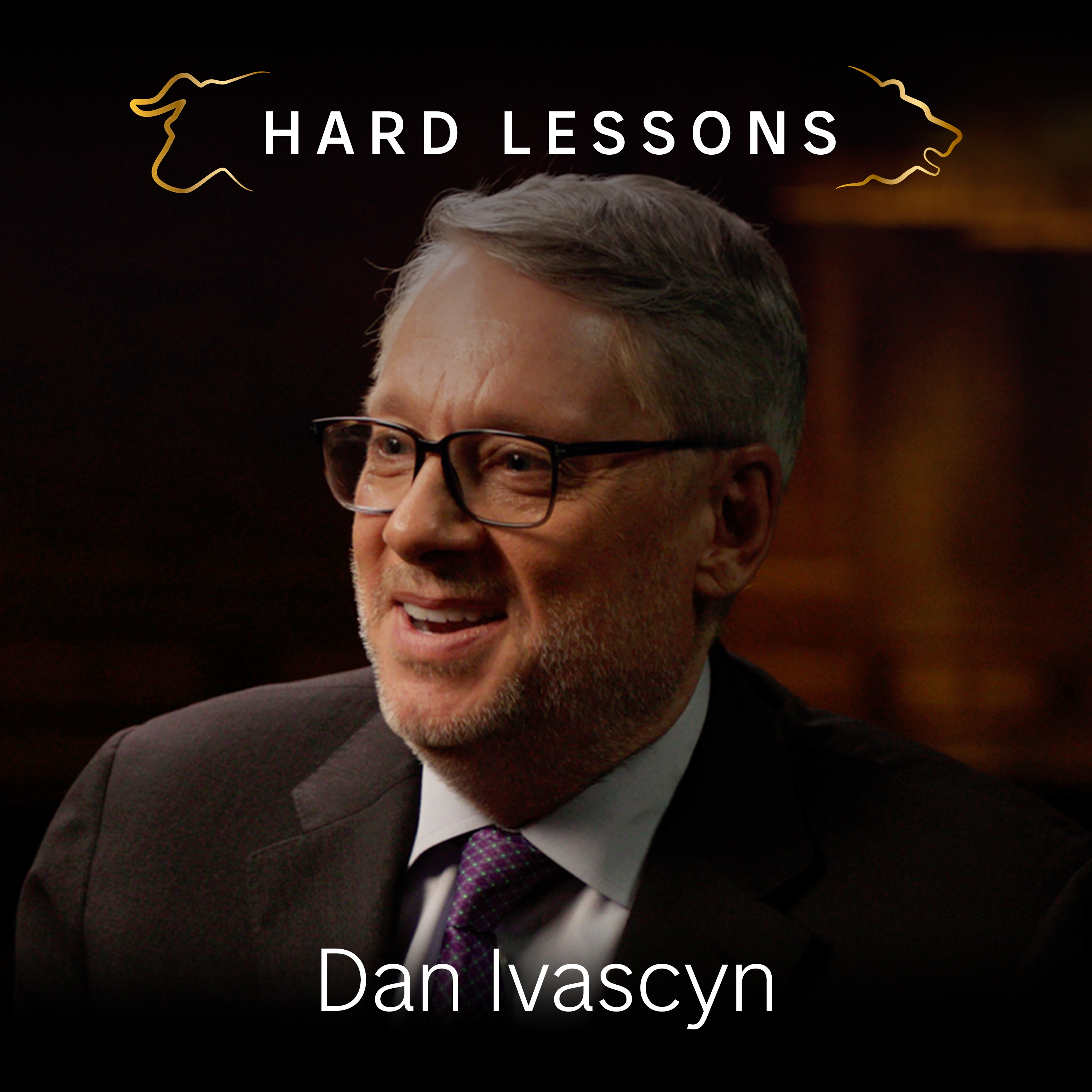
Dan Ivascyn (PIMCO CIO) and Dan Simkowitz (Morgan Stanley co-president) discuss the lead-up to the 2008 global financial crisis, how conviction can be right but still fail due to timing, capitulation, and regime change, and how they later rebuilt risk after stress (including “failed rallies” in late 2008).
Dan Ivascyn is Group Chief Investment Officer at PIMCO (about $2.33T AUM), with ~30 years at PIMCO; previously worked at T. Rowe Price and Fidelity, studied economics, earned a University of Chicago analytical finance/derivatives background, and co-authored a 1997 Home Equity Handbook at Bear Stearns. Dan Simkowitz is co-president of Morgan Stanley.
Rating-agency loss estimates (5% lifetime losses) were too low; they expected 10–12% but realized ~30%, showing limits of historical models. Defensive positioning worked firm-wide, but portfolio-level hedges failed when “safe” AAA structures matured and credit support eroded. Hedging must account for regime change and non-financial drivers (policy/geopolitics). Diverse views and humility are essential.
2005–2010 mortgage/CMBS trades; a defensive strategy that shorted risky tranches under a safe position but lost money; false rally late 2008; buying “well-structured” risk at prices where loss seemed “mathematically impossible” absent rule changes.
Written by AI. May contain mistakes.
Overview of Dan Ivascyn's career and the themes of resilience and timing.
“When people think you're finally coming out of a situation and you end up hitting new lows, that's quite detrimental from a psychological perspective, and that's exactly what we had at the time.”
Discussion on PIMCO's partnership with Morgan Stanley and recent AI infrastructure deals.
“It's so incredible how durable and important the partnership is with PIMCO.”
Exploration of Dan Ivascyn's background and his path into finance.
“I always had a fascination with finance, for whatever reason.”
Insights into the market conditions of 2005 and early concerns about aggressive lending.
“then another one that didn't work out so well, but usually from different eras.”
Discussion on the defensive positioning taken in response to market conditions.
“Treasury and the Federal Reserve in the summer of 07.”
Examination of the pressures leading to capitulation in investment strategies.
“Is there a moment where the pressure really built or a person came in or a client said this or a media source said what's going on over there where that capitulation started to take hold?”
Key lessons on risk management and the unpredictability of market participants.
“and then the AAAs started to take losses on a pro rata fashion.”
Dan reflects on past predictions and the current state of AI investment.
“But when you're underweight risk, and when a trade depends on other participants in the market changing their views, it's more unpredictable.”
Exploring the importance of diverse perspectives in a changing financial landscape.
“your point of reference was this historical data, how it has always been.”
Insights on risk management and capital deployment following market stress.
“So that was the lesson and really quite amazing at the end of the day.”
Addressing fear and uncertainty when making investment decisions during downturns.
“When people think you're finally coming out of a situation and you end up hitting new lows, that's quite detrimental from a psychological perspective.”
Reflecting on the importance of resilience and mentorship in a financial career.
“that trusted us at the end of the day and were willing to yield even though they didn't feel completely comfortable about the trade.”
Discussing how durability and strong relationships contribute to long-term success.
“The PIMCO-Morgan-Stanley relationship and how we think of the world is exactly what you just said.”

Get the gist, explore an idea or ask about something said.
 Claude
On Hard Lessons, what are the key points of this episode?
Searching your listeningAutomatic transcript. May contain errors.
0:00Dan Simkowitz: From Morgan Stanley, this is Hard Lessons, where iconic investors reveal the critical moments that have shaped who they are today. I'm saying, God, the rating agencies are all wrong here. They look at these deals and they see 5 % lifetime losses. We said, no way. They're going to be much, much higher than this. They're going to be 10, even 12%. They turned out to be 30%. Today on the show, Dan Ivescyn, Group Chief Investment Officer at PIMCO, one of the largest fixed income managers in the world, with$2.33 trillion in assets under management. You better be resilient in this industry. You've got to accept the fact that sometimes timing's going to matter.
0:36Dan Simkowitz: Dan guides us through his successes and setbacks during one of the hardest chapters of his career, the global financial crisis and its lead-up. Failed rallies are the worst. When people think you're finally coming out of a situation and you end up hitting new lows, that's quite detrimental from a psychological perspective, and that's exactly what we had at the time. He sat down with Dan Simkowitz, co-president of Morgan Stanley. They met at the Campbell inside Grand Central Terminal. Dan, thanks for joining us. Thanks for having me, Dan. Listen in to hear how external pressures can throw the right thesis off track, why systemic forces can obliterate a good hedge, and how conviction plus capital can equal a career-defining opportunity.
1:1930 years almost at PIMCO, and I've been at Morgan Stanley almost 35 years.
1:24Dan Simkowitz: It's so incredible how durable and important the partnership is with PIMCO. And it's been exciting last year. We worked on some of the biggest deals in history together in the last 12 months, largely around AI infrastructure. Yeah, I mean, it's an area of the market where there's a lot of complexity. And it's nice to get paid for complexity as opposed to economic sensitivity or credit risk in a narrow sense. So from that perspective, we're quite excited as we've worked as a team together on some deals. Yeah, I think when we worked together on the Metadata Center and probably the largest deal at the time in the infrastructure space, but also in the sort of gray area of public and private credit, your team and their ability to look at it from multiple angles and be really big was really incredible.
2:12Yeah, to do it right, you need a lot of different perspectives. With that said, of course, as we know, AI is going to be disruptive. And increasing economy-wide productivity is one thing. Companies figuring out how to make money from this technology is another. So there's some risks and you've got to be cautious. But what are the better, more scalable opportunities we've seen for clients in quite some time?
2:34Dan Simkowitz: It's delivering alpha and it's delivering scaled alpha, which is so important. So, Dan, AI is today, but how did you get from Western Mass, outside Worcester, to LA, the pinnacle of fixed income? Tell us about that journey a bit. I always had a fascination with finance, for whatever reason. My family were educators, but I always found it quite interesting. Went to school, studied economics. after college worked T. Rowe Price Fidelity, but in more of a client servicing function, and got to a point after many years in the business and excited about fixed income relative to other areas of the market, hey, I want to get to the next level.
3:13And to do that, for me, at least, with a slightly less technical background than many, it meant going back to business school.
3:20Dan Simkowitz: And you went to the pinnacle of quant finance at the University of Chicago, right? Is that where I did. I went there and I focused on analytical finance, derivatives pricing, a lot of the much more targeted courses that would help me run money. And then ultimately got a great internship with a great mentor over at Bear Stearns. A little different than your typical summer internship. And then I ended up spending several months after the summer ended co-authoring what's called the 1997 Home Equity Handbook. Home equity is a better term than subprime. So they used home equity, right? So it got me excited about that.
3:56At the time, growing area of the market, thought I was going back to Bear Stearns, interviewed very, very late in the process over at PIMCO, and ultimately decided to join PIMCO. And that was, I guess, in 1997.
4:10Dan Simkowitz: So Dan, usually on the show, we talk about an out-of-consensus call that worked, and then another one that didn't work out so well, but usually from different eras. But I think in your context, we're going to talk about a series of calls within the same discrete time period, 2005 to 2010, which was formative for myself as I thought about markets and certainly was really important to the world of finance and to PIMCO. So let's go back to 2005. A lot of euphoria, a lot of maybe exuberance. How were you thinking about the market back then? and then tell us about the view that was forming. Sure. So, you know, back in 2005, we were beginning to see significant innovation in more aggressive lending and the structured product areas more broadly, mostly focused on mortgages.
4:59There was a thesis that had formed, you know, around the globe, backed up by data that U.S. home prices on a national level never go down. They hadn't gone down too significantly over a 30-year type period. So you enter that into your model and you end up with an empirical justification to just lend more aggressively against home as an asset. So myself and our team did more research here, looked at a lot of data, of course, but also got out and looked at what was going on across the industry at the time. Home builders, brokers, mortgage servicers, mortgage insurers, and quickly got the sense that there was a level of aggression on the lending side that wasn't sustainable and quite concerning.
5:45Even some of our own scenario analysis at the time suggested that some of the originations during 2005 and even going back to late 2004 were aggressive and not fundamentally sound. So that was the conclusion and the recommendation. And ultimately what we did to start was to get very, very defensive in that sector of the market. As things progressed over time, began to see that this aggressive mindset was beginning to permeate the banking system, other vehicles at the time, and began to get even more cautious based on a lot of the feedback that was emanating out of the mortgage area. So good old-fashioned defensive positioning, outright shorting where we could, but relative to indices or relative to our peers, significant underweights in terms of risk, which of course would perform well if there was a repricing of that risk or if there was actual realization of credit losses, but put us in a position of significant negative carry where we were significantly underyielding our peers, even in some cases underyielding our benchmarks.
6:50So that was the starting point.
6:52Dan Simkowitz: So we got called in to help the U.S. Treasury and the Federal Reserve in the summer of 07. So we've got a long period between late 04 and 05 and 07. How does the trade progress? Yeah, I think you may have been personally involved in some of that, too, if I remember correctly. And, well, the challenge for us was that, you know, people typically measure our performance in our industry over a three-year period, if you're lucky. As we know, the three-year period sometimes isn't long enough if you have a cycle of excess building in the system. But the bottom line is getting into this position early left us in a very precarious position because we were underperforming peers.
7:32And underperforming peers quite significantly because they were out yielding us for an extended period of time. So, you know, ironic, just as people began to become concerned, we weren't so sure we could hold this position long enough. And in fact, it's quite interesting the way that these instruments work. We had been very, very cautious. We had been buying only the very safe piece that would mature, we thought, before any problems with the structural underweight. But we began to capitulate, couldn't take it, and ended up not diving back into the market, but saying, hey, look, we can't be this short for this long.
8:09Dan Simkowitz: Is there a moment where the pressure really built or a person came in or a client said this or a media source said what's going on over there where that capitulation started to take hold? It was a little bit of everything. So I think there was, you know, consulted feedback, client feedback. And it's funny. I don't want to get into the technicalities of the market. But what was amazing about the way these deals were structured is that you typically had your triple A risk. Then you had the bonds beneath them that would provide protection. Typically, you had a few different AAA tranches. The first tranche would get paid down.
8:45Then the second tranche would get paid down. And then the last tranche, if it had enough credit support remaining, it would mature, go away, it would fall off your system. You would have collected your yield and never saw it again. Success. So we had been conservative for years. People used to refer to the type of bonds we liked as a PIMCO bond. It was a safer bond than anyone else in the market would structure. It had very, very specific characteristics that we thought would allow our bond to mature before any problems developed. We began to capitulate a little bit at the end. So we started to buy a bigger percentage of that AAA bond.
9:20Still very safe, but just not as safe as it had been. Well, what happened was all those really, really safe bonds matured. They paid off, and then the losses came. As we ended up buying a slightly riskier AAA bond, what ended up happening is the credit support beneath us got eroded. and then the AAAs started to take losses on a pro rata fashion. So that front AAA bond that used to get all the cash flow and would mature turned into a AAA that was going to be outstanding forever, basically. Still outstanding. Still outstanding. So a story I tell the young kids when they come in today, tell this story, and then you can look at portfolios.
9:55They're a constant reminder, and it will be the remainder of my career, about that episode and about the fact that even though you can be right for a long period of time, other pressures could lead to capitulation or a relaxation of that cautious view at, in some sense, precisely the wrong time. Because right around the corner, of course, we were proven right at the end of the day.
10:17Dan Simkowitz: What's the lesson on capitulation timing and influence? I mean, would you do it differently today? Or is it just the reality? If it lasts long enough, you got to make the move? One lesson is that you get the concept right. But when you're underweight risk, and when a trade depends on other participants in the market changing their views, it's more unpredictable. It's just a harder, less robust trade structure in the market. The other alternative being something that structurally is very, very robust, cheap, attractive yield, which creates predictability of return. Those types of investments, in contrast, just tend to be much more well-balanced, much more well-structured.
11:00So I think anytime you're underweight in the market, you need to give yourself enough time in order for the overall situation to play out.
11:08Dan Simkowitz: Was size also part of it? Were you right size that you could take the duration hit or the underperformance hit? Or was it both duration and magnitude and sort of out of your control market dynamics? Yeah. So in a macro sense, we ultimately ended up doing very well with that trade across the firm. In fact, the general defensiveness ultimately worked out, and it put us in position to take risks later on as the global financial crisis played out to make returns on the follow. That's at the firm level. Now, even though it worked out at the firm level, there were some mistakes structurally with that defensive mindset that occurred at the portfolio level for me.
11:49And that was the fact that within some of our strategies, hedge fund strategies in particular, we were cautious. We were right on caution. But even we didn't imagine how bad the situation would be in terms of ultimate losses. So we got creative with a trade where we said, hey, look, we're going to own the really, really safe stuff. And we're going to outright short the risky tranches beneath that safe position. And that's a trade where we ultimately lost money. Quite incredible. That type of trade under any type of reasonable scenario within the market would have worked out very, very well. It was the classic trade where you're short, but you're not paying out a lot of negative carry.
12:30You're getting your carry back at a very, very senior tranche that had never taken losses before. So it made a ton of sense. Ultimately, it didn't work out.
12:38Dan Simkowitz: You had a view, and it was the right view around caution. But the less risky stuff just really implodes. As you've gone forward now, it's been almost 15, 16 years. How do you think about hedging? And has your philosophy changed? Oh, absolutely. I think the lesson, to your point, is that there's a limit to a backtest. When there's a regime change or when things are going on that are so unusual and not captured in that historical opportunity set, in this case, this really incredible wave of aggressive lending, you have to use a different approach to analyze a risk. The second point, and probably the most important point, is related to a conversation I had with my colleague at the time.
13:17We got off work, went over to get a beer, and we were talking about losses in the mortgage area. I was chuckling and saying, God, the rating agencies are all wrong here. They look at these deals, and despite the aggressive underwriting, they see 5 % lifetime losses in these deals. And we said, no way. They're going to be much, much higher than this. They're going to be 10%, even 12%, which at the time was quite out of consensus, leaning absolutely in the right direction. They turned out to be 30%. At 12%, we would have made a killing on that trade. We would have pivoted nicely to the long side.
13:49The rest would have been history. At the 30-some-odd percent, it led to considerable losses for our trade. And again, I think the lesson that I try to take from that experience is that sometimes there's natural limitations to how outside the box you can think when you're involved or active in a sector that you grew up in, where your point of reference was this historical data, how it has always been. It took merger ARB folks, a lot of equity traders to peer over at our market and say, oh, my God, this is so ridiculous what's going on. That loss is going to be much, much higher than even relatively cautious folks like Dan Iverson thought at the time.
14:30I think that's quite important in this AI environment that we're in today. We know there's massive investments in this technology. We all use it ourselves and know that this is game changing. Something unique is going on here, but it may be hard without getting independent insights to understand the range of potential outcomes here, especially for someone like myself alone that spent 30 years in the finance industry, not in the tech space. So that was the lesson and really quite amazing at the end of the day.
14:59Dan Simkowitz: So the equity guys came in and actually did extraordinarily well on the trade because they weren't bound by imagination. In the world we live in now, how do you grab diverse views and not repeat that lack of imagination element of the trade? Again, this is something I think about all the time. Over the last few years, this has not been an environment where you can just do discounted cash flow analysis, classic analysis, and expect great outcomes. Politics is driving decisions. Trade tensions, trade frictions are leading to economic results as opposed to the opposite, which used to be the case.
15:36Good economy means good outcomes for politicians. Today, we live in a world where trade policy is very much focused on geopolitical tensions. There's much more conflict in the world that you have to price in. So what we try to do at PIMCO is to leverage those perspectives. We have an outside advisory board, senior people that are willing to share their views, even if they're different than us. A lot of time on other perspectives in investment committee above and beyond traditional financial analysis. I think appropriate humility in realizing what we'll never be experts in, like modern technological innovation.
16:10Even from a generational perspective, this is important today. Those that are most in tune to modern technology and the resulting uncertainty or potential disruption tend to be our newest employees. In some sense, the quietest voice within the organization. So spending a lot of time to ensure that we have as open a set of dialogue within the organization as possible, while again, having humility that we're never going to have, you know, the same perspective around this tech innovation and disruption as you're going to get up in Silicon Valley. So a lot of conversations there, not just focusing on the bullish case, but also trying to find the bearish perspective as well.
16:46Dan Simkowitz: So let's go back to fall of 08, pretty scary times. And certainly in Morgan Stanley, the leadership today, remember, is third quarter of 07 through mid 09. And we're still leveraging the lessons around how to manage a crisis. And from our engagement with PIMCO, it certainly feels that way as well. Oh, for sure. Absolutely right. So talk me through your ability to start to take on risk and do analysis and deploy capital coming after such acute stress and pain in the markets. So as you know, during this period, you needed to have the initial conditions to be able to take risk. That was a credit to us realizing and seeing some of the excesses that had developed to be sufficiently liquid defensive early on to be able to go on the offense.
17:35There are a lot of people that would have liked to have taken more risk, but they didn't have the liquidity. Financing wasn't always available at that time, but a lot of what you needed to do was on a cash basis. I think the same thing with Morgan Stanley. We're in a position to benefit from the stress of others. You don't wish others to go through stress, but when you have the initial conditions generally right, you can then realize on the opportunity. And it's interesting, as we know, there was a false rally in late 08, and we didn't hit the bottom until early 2009. Failed rallies are the worst.
18:09When people think you're finally coming out of a situation and you end up hitting new lows, that's quite detrimental from a psychological perspective. But when you are looking to react to an incredible opportunity set, you have to accept the fact that you're going to be a little bit early. You almost had to be early to be able to put on the scale of the positions to be able to benefit clients for many, many years to come. So it was stressful along the way. But in retrospect, one of the best opportunities to buy at incredibly attractive prices.
18:40Dan Simkowitz: So you're in the midst of the analysis on this incredibly attractive and then ultimately incredibly successful trade. Where are the voices around fear, whether it's a client, some of your peers? And how do you engage with that, given how proximate it was to the bottom in terms of emotion, but also these false rallies? Yeah. Again, I said retrospect. It's always easier to look back on these periods than it is in the heat of the battle to make these decisions. Not easy to pull the trigger when you have this massive balance sheet uncertainty across the financial industry. But we're looking at the situation in the mortgage market, even the CMBS markets.
19:17you could buy reasonably well-structured to sometimes quite well-structured risk at dollar prices that are so low that in a traditional sense, it's almost mathematically impossible to lose money, unless someone changes the rules, basically. But it takes some convincing from an organizational perspective. You need to distill down what's a very complicated situation to someone that's got a broader role and not a specialist in the space and to get as much buy-in as possible. Because I mentioned in a traditional sense, it was almost mathematically impossible to lose money. But then you start thinking about, well, what if Washington, D.C.
19:54changes the rules? What if to support housing or to support a displaced homeowner, rules get changed? What about contract rights? All of these are low probability type scenarios that could justify these very, very low prices. And there was a lot of that news flow in the market, a lot of discussions of more extreme events. So it took a lot of filtering of the information. But I think the important point is enough odds were in our favor with a massive potential payoff where we were able to make the decision to begin to add risk. We were able, again, to realize on the opportunity.
20:27Dan Simkowitz: And it turned out to be a multi-year opportunity. One of the great hedge fund investors who's quite quantitative and analytical says communication skills, the ability to convince people to come with you is really critical. It sounds like on this trade, if you hadn't been able to convince the team to either do it in the size or go at all, it would have been a real disappointment. Absolutely right. Very hard to pull the trigger when prices have gone down that much on an asset that you just didn't think was possible. With that said, we had very trusting management. We had a process and a structure that really, really looked to leverage the ideas of the specialty teams.
21:09and there was a general sense of confidence across the platform. I'd like to think in retrospect, we did a good job communicating, but it was a set of additional decision makers across the firm that trusted us at the end of the day and were willing to yield even though they didn't feel completely comfortable about the trade.
21:26Dan Simkowitz: So you delivered incredible alpha success, organizational durability during the financial crisis. What's the hardest lesson? What's the hardest career lesson? and how have you deployed some of the lessons? Let me start with the hardest lesson. I'm going to go all the way back to the very beginning at PIMCO. And we talked about pretty good preparation for a job in this industry at Chicago. Well, I started in 1998, right in the midst of the Asian financial crisis. We didn't have the same type of Wall Street training program. We had a little bit of training, but got dropped into the mortgage area.
22:01LTCM happens. There's a tremendous amount of volatility. I did not hit the ground running. I don't know that I had the right mentorship at the time, maybe not the right support in a narrow sense, but I wasn't doing very well. So very early in my career, I was asked to potentially consider leaving the firm. Maybe not a right fit. Maybe the resume looked good, but just wasn't working. That's a pretty significant lesson. You get pretty confident. You're doing well. You get great grades at Chicago. You get hired at one of the most, if not the most well-respected fixed income shop in the world. and you get a job on the coveted mortgage desk at PIMCO.
22:36So I was feeling pretty good and it went south fast. And I think the important lesson is that in this industry, markets can be harsh. There's good luck and there's bad luck. And you can confuse that with fundamental weakness and skill set. It's very, very confusing. Also, timing matters a lot. What ultimately happened is that Scott Simon ended up joining the firm from the street, turned out to be a great mentor. I think said to folks, hey, wait a minute, how do you know if this guy's any good? He's only been around about a year or so going through one of the toughest market environments. He went from textbooks and pretty good grades, writing papers and doing math proofs, you know, to a trading desk.
23:13So it's a pretty tough lesson that you better be resilient in this industry. You got to accept the fact that sometimes timing's going to matter. You got to just accept failure in order to achieve ultimate success. So that was the hardest lesson. I think the other point, and you've mentioned this term, it's funny, even before the discussion Today, I had durability written down, which is that you can have highs and lows, but durability is super, super important. And you develop that through various experiences within the firm, both good and bad, different market environments. I think there's also this concept of compounding.
23:45We always talk about compounding interest, compounding returns. But I think from a career perspective, there's this concept of compounding. Good values, good relationships. It expanded Rolodex, bringing great people into an organization, surrounding you with great people with sufficient perspectives. That's what's so important, this idea that throughout one's career, you're expanding and compounding the support function, the relationships, Morgan Stanley, PIMCO, within our respective teams, across teams, appreciating perspectives of younger folks. So I think that's the other lesson, not a hard lesson, a very, very important lesson in terms of success in this business.
24:21Dan Simkowitz: The PIMCO-Morgan-Stanley relationship and how we think of the world is exactly what you just said. It's a compounding of higher highs and higher lows. There are going to be lows in all parts of life, your professional career, your personal life, but also in the markets. And if we can build durability so you get higher highs and higher lows, it really works. Yeah, I probably left out the most important thing, too. Durability is a life concept as well. For durability, you have to have the right relationships at home. You've got to have the right appreciation of playing the long game. And at times, there'll be personal distractions you've got to deal with.
24:57You've got to have that part as right as possible. And I think, again, when you focus on durability, you can have a very, very exciting career in this business. At the end of the day, generate great outcomes for our clients.
25:06Dan Simkowitz: Your lessons are amazing. Resiliency can drive durability. And teamwork can help drive durability. And if you put it all together, it's a very powerful combination. Thank you, Dan. Thanks, Dan. Absolutely.
Dan Ivascyn, Group Chief Investment Officer at PIMCO, joined Morgan Stanley’s Co-President Dan Simkowitz for a deep dive on his experiences during the global financial crisis. He shared how an early underweight on mortgage-backed securities was the right call at the wrong time, and how he ultimately benefited from taking on risk as markets recovered.
The preceding content was informational only and is not an offer nor a solicitation to purchase or sell any security, commodity, instrument, or fund or to participate in any investment or trading strategy. The appropriateness of a particular investment or strategy will depend on an investor’s individual circumstances and objectives. Morgan Stanley does not render advice on legal or tax and tax accounting matters to clients. Clients should always consult their own legal or tax advisor for information concerning their individual situation.
Opinions expressed by third parties are solely their own. All opinions are subject to change without notice.
©2026 Morgan Stanley, all rights reserved.
See Privacy Policy at https://art19.com/privacy and California Privacy Notice at https://art19.com/privacy#do-not-sell-my-info.


