In short
Hidden Forces interviews Pulitzer Prize-winning energy/geopolitics author Daniel Yergin on why energy disruptions tied to the Ukraine war and Iran/Strait of Hormuz crisis have been less catastrophic than “nightmare” forecasts, and what this implies for a shifting global energy order and regional power balances.
Guest background
Daniel Yergin is the author of The Prize, The Quest, and The New Map; he has taught at Harvard Business School and Harvard Kennedy School; and he is vice chairman of S&P Global (with major energy-sector coverage).
Key claims
The Strait of Hormuz closure risk was buffered by pipelines (Saudi), US shift from major importer to major producer/exporter, Strategic Petroleum Reserve/IEA stock releases, demand reductions, and especially China’s large oil reserves and import cuts. China’s “new map” strategy emphasizes storage, renewables, EV/battery leadership, and diversification away from single suppliers. Iran’s MOU aims to turn Hormuz into an “Iranian canal” via ambiguous fees/tolls and new Persian Gulf institutions, increasing regional uncertainty.
Notable examples
Hormuz handles 20% of world oil and 20% of LNG; other traded goods (fertilizer, aluminum, helium) are also affected. China’s EV market share (about 1 in 4 new cars globally) and Gulf drone/ missile attacks (e.g., UAE) drive Gulf self-reliance. OPEC’s stabilizing role may weaken amid UAE/other defections and potential oversupply volatility.
Written by AI. May contain mistakes. Listen to the episode to check what was said.
Chapters
Tap a time to open that second in VOThe Current Energy Landscape
0:45 to 2:52
Discussion on the ongoing energy disruptions and the resilience of the global economy.
“Despite those disruptions, the straits closure has proven far less catastrophic than many oil analysts and decades of nightmarish scenario planning had predicted.”
Daniel Yergin's Background
2:52 to 4:00
Daniel Yergin shares his journey and insights into energy and geopolitics.
“I must have reached out to you years ago.”
The Impact of Historical Events
4:00 to 6:16
Yergin discusses the influence of historical decisions on current energy dynamics.
“didn't set out to do this, but I've ended up being a chronicler of world energy and how it changes and the interaction between energy and geopolitics, the two seem inseparable.”
The Commanding Heights Documentary
6:16 to 8:04
Exploration of the significance of the Commanding Heights documentary and its themes.
“But I think the book, the prize and the subsequent books are richer because I understand what it's like to be inside and watching where things are happening.”
Understanding the Strait of Hormuz
8:04 to 10:24
Yergin explains the importance of the Strait of Hormuz and its impact on global oil markets.
“I haven't read the book, but I did watch the documentary in 2002, if I'm not mistaken.”
US Strategic Considerations
10:24 to 12:26
Discussion on US leverage in global choke points and strategic planning with respect to China.
“So Asia really did get hit much harder than Europe and much, much harder than the United States, where it's mainly about gasoline prices.”
The Role of Energy Storage
12:26 to 14:00
Yergin highlights the significance of energy storage in mitigating crisis effects, particularly in China.
“they could exercise through the use of the US Navy to blockade such choke points?”
China's Energy Strategy and EV Dominance
14:00 to 17:00
Explore how China's energy storage strategies and electric vehicle production are reshaping global markets.
“And there's been this question, why do they have such large storage of oil?”
Iran's Control Over the Strait of Hormuz
17:00 to 19:40
Discuss the implications of Iran's perceived dominance over the Strait of Hormuz and the MOU signed in Switzerland.
“What is your understanding of the contours of that agreement and how much stock should we be putting into it?”
Iran's Negotiation Tactics and Regional Stability
19:40 to 22:20
Analyze Iran's negotiation strategies and the potential for stability in the region amidst growing tensions.
“And remember, they have the population and they've shown their resilience.”
Show all 21 chapters
The Future of U.S. Involvement in the Middle East
22:20 to 27:20
Examine America's shifting role in the Middle East and how it impacts regional alliances and security.
“We see the Iranians talking to the Omanis.”
Impacts of Energy Agreements and Future Stability
27:20 to 28:01
Evaluate the effects of recent energy agreements on global markets and potential future conflicts.
“How dominant is Iran going to be over the region?”
Economic Pressures and Energy Stability
28:01 to 29:18
Learn about the economic challenges and energy stability negotiations in the context of geopolitical tensions.
“at his press conference at the NATO meeting.”
The Role of OPEC in Today's Oil Markets
29:18 to 30:30
Understand OPEC's current significance and the implications of its member states' actions on global oil markets.
“But I still think when we look at our inventory numbers, they still are very low in historic terms.”
Geopolitical Alignments and Energy Agreements
30:30 to 32:29
Explore how recent geopolitical shifts among Middle Eastern countries impact energy agreements and alliances.
“The UAE basically said, we're going to pursue our own interests.”
Investment Strategies of Gulf Producers
32:29 to 34:28
Discover how Gulf countries are diversifying their economies and investing in global markets amidst regional conflicts.
“Well, there was the momentum of the Abraham Accords.”
China's Energy Strategy and Global Trade
34:28 to 37:15
Analyze China's approach to energy imports from the Middle East and its broader global trade strategy.
“So the UAE, I think well over half of its GDP, I forgot what the number is, is non-oil based.”
The Future of Renewable Energy Technologies
37:15 to 39:26
Examine the advancements and competitiveness of solar and battery storage technologies in the energy sector.
“That's where they've redoubled their efforts to play a much bigger role.”
Modernizing the Energy Grid and Security Risks
39:26 to 40:58
Discuss the importance of modernizing the electric grid and the associated cybersecurity risks in energy security.
“And now because of AI and data centers, and the sense that we're going to go from virtually no annual growth electricity to substantial growth electricity.”
Navigating Uncertainty in Global Energy Conflicts
40:58 to 42:03
Learn how to approach uncertainty in global energy politics and the implications of ongoing conflicts.
“So Dan, one more question before we end today's conversation.”
Navigating Energy Security and Resilience
42:03 to 44:28
Explore the evolving landscape of energy security amidst global crises.
“So oil and gas, we have an energy transition, but it's not going in the way that people just kind of optimistically assumed it would be.”
Transcript
Automatic transcript. May contain errors.0:00Demetri Kofinas:What's up, everybody? My name is Demetri Kofinas, and you're listening to Hidden Forces, a podcast that inspires investors, entrepreneurs, and everyday citizens to challenge consensus narratives and learn how to think critically about the systems of power shaping our world. My guest in this episode of Hidden Forces is Daniel Yergin, a Pulitzer Prize-winning author and leading authority on energy, geopolitics, and the global economy, who also serves as vice chairman of S &P Global and has previously taught at Harvard Business School and the Kennedy School of Government. Dan and I recorded this conversation on Monday, June 29th amidst ongoing talks between the United States and Iran to reopen the Strait of Hormuz and restore commercial shipping through the world's most important energy choke point.
0:47Demetri Kofinas:Despite those disruptions, the straits closure has proven far less catastrophic than many oil analysts and decades of nightmarish scenario planning had predicted. The question then is why? Why, in the case of both the ongoing war with Iran and the Ukraine war, have disruptions to energy markets proved far more manageable than many expected? And what does their resilience and that of the global economy tell us about the changing nature of global supply chains, energy diversification, inventory management, and the roles of the United States and China as the world's largest swing producers and consumers of energy.
1:23Demetri Kofinas:From there, we examine how this crisis has served as a catalyst for a series of ongoing transformations to the global order and regional geopolitics, beginning with China and the lessons it continues to draw from this conflict and from America's entanglements in the Middle East. Iran's bid to turn the Strait of Hormuz into its own private waterway, the recalibration of Gulf security as American commitments to and interests in the region grow less certain, and the shifting alignments among the Gulf states, Iran, China, and the United States that will define the regional balance of power in the years ahead.
1:58Demetri Kofinas:If you want access to the transcripts and intelligence reports for this and other episodes, which includes summary sections with key takeaways, you can access those by subscribing to our Super Nerd tier at hiddenforces.io. If you want to join in on the conversation and become a member of the Hidden Forces Genius community, which includes Q &A calls with guests, discounted access to third party research and analysis, and in-person events like our intimate dinners and weekend retreats. You can also do that on our subscriber page. And if you still have questions, feel free to send an email to info at hiddenforces.io.
2:36Demetri Kofinas:And I, or someone from our team, will get right back to you. And with that, Please enjoy this incredibly timely and informative conversation with my guest, Daniel Yergin.
2:52Demetri Kofinas:Daniel Yergin, welcome to Hidden Forces. Glad to be with you today. Thanks. It's my pleasure having you on. I must have reached out to you years ago. I'm sure I did. I've wanted to have you on the podcast for a long time and fortunate circumstances have made that possible today. And it's actually a timely opportunity because we're going through another war with another series of energy disruptions that also feel like they haven't shown up. It hasn't been as severe. The impact to the global energy system doesn't appear, at least on the surface, to be as severe as some of the more dire forecasts had anticipated.
3:27Demetri Kofinas:And in that sense, it reminds me of the Ukraine war. There were a lot of dire predictions and the global economy is more resilient and supply chains adjusted faster than I think people anticipated. I want to ask you about that and I have another series of questions to ask as well. But before we do, just for those who aren't familiar with you, you're famous for having written The Prize, you've written The Quest, you've written The New Map. You're one of the most recognized commentators and writers on oil and energy markets. But just give us a little bit of a background on who you are. Oh, as you say, it starts with the books and I've certainly didn't set out to do this, but I've ended up being a chronicler of world energy and how it changes and the interaction between energy and geopolitics, the two seem inseparable.
4:11I started off as an academic. I did a PhD at Cambridge University. I taught for a little while at the Harvard Business School and the Harvard Kennedy School, and then started a company really with one other person. And that company is now merged and merged and merged and merged. And now I'm vice chairman of S &P Global, which is, people know it as the S &P because they follow that every day, but it's a 42 ,000 person company that covers a range, including a big part of what it does focuses on the energy sector. So I've been able to combine this kind of writing books that are accessible, but really bring the picture together at the same time while being also active continually around the world in the energy sector.
4:58Demetri Kofinas:And you started your most recent business at the same time that you published the prize, if I'm not mistaken, correct? Well, no, it was even more loony than that. I started the business the same year. I signed a contract to do the prize. So I was really working kind of all the time. The way I would relax at night would be by working on the book or weekends. And of course, I signed a contract to do the book in two years, but I was a little late. It took seven years. Did you find that that helped you, that doing those two things together was a net benefit? Yes. I think it did because it helped me understand that not to make the mistake of looking at events and thinking that you know the outcome and so therefore it's logical what happened and not recognizing the contingency.
5:45And of course, business decision makers never have enough time. And government decision makers, they don't have all the information and they don't know how things will come out. And I think I captured one of the things that I think has made the prize so enduring. I captured that sense of that it's not foreordained what happens. And there's a lot of contingency in the world and surprises come again and again. So I think I did gain from it. It made it a harder task doing two things at the same time. But I think the book, the prize and the subsequent books are richer because I understand what it's like to be inside and watching where things are happening.
6:27Demetri Kofinas:I love that point. I just recorded an episode with Yale political scientist Ian Shapiro to discuss his book After the Fall. And that was one of his points that although we, well, he didn't say this, but I'll go ahead and say it. We have a tendency, and this is certainly true with the fall of the Soviet Union, to come up with all sorts of explanations post facto for why XYZ was inevitable. And yet, at the time, things were often a great surprise and individual human beings who had agency in those moments played a bigger role than I think we really are prepared to admit or acknowledge, I think. I think that's right.
7:03I mean, there are the larger forces, but I was thinking about it. We're now at the age of what I call easy globalization is over. And you have somebody who's probably the next prime minister of Britain talking about nationalizing British steel, to take an example. And of course, the book I did, Commanding Heights, was about how things went in just the opposite direction. The greater confidence that people had in markets and that state-owned companies often tend to be very inefficient and a drain on budgets. but I was thinking about that. If there hadn't been the conjunction of Ronald Reagan and Margaret Thatcher, they really kind of opened up an era.
7:44So there were forces at work, which was economies were becoming more integrated, technology was changing and so forth, but personalities really made a difference and people making decisions and following through on them. Or if I may say that, unexpected things happening and then they have to cope with it.
8:02Demetri Kofinas:I failed to mention The Commanding Heights. I haven't read the book, but I did watch the documentary in 2002, if I'm not mistaken. I think that was the year I watched it, or 2003. Amazing documentary describing a very different time in the world. Yeah. It's still, if you watch it, it's still, I think people said, oh, you can't make a TV series about economics, but we did and we captured the drama of it. And again, the contingency of it. And I think we see it again today. One of the things at the end of the book said, that this frontier between state and market is never fixed. It's always shifting.
8:35And we sure see that happening today.
8:37Demetri Kofinas:I should mention the date that we're recording this. It is Monday, June 29th, because things were in the midst of a war. Even though we keep being told that we're all also on the verge of peace, it's kind of like I've heard it described as Schroediger's Strait, the Strait of Hormuz, because you don't know whether it's open until you actually pass through it. So those are some questions I have for you in terms of where are we exactly in this entire affair. But the question I started the interview with was, why haven't things been as bad as people expected. Well, so let me compare Ukraine, Russia's brutal invasion of Ukraine, and people thought, well, that was going to be disruptive.
9:17But what it really did was what you said, is really the supply chains were reconfigured. So we had a global oil market on February 23rd, 2022. The US was importing 600 ,000 barrels a day of oil from Russia. That ended and we now have a partitioned world oil market and a confusing world oil market. Here, for decades, the nightmare scenario when people did scenarios about that region was a closing of the Strait of Hormuz. It is, to be clear, the most important maritime choke point in the world. Over 20 % of world oil, 20 % of liquefied natural gas passed through it. We learned, by the way, that a lot of other things too, like a third of the world's traded fertilizer, aluminum, helium, which you need for making semiconductors, you need it for chips.
10:13So it's a region very integrated in the world economy. And then your question is a very good one. Why was it not a nightmare? Obviously, it was partly where the impact was because in economic terms, the Strait of Hormuz pointed to Asia because 80 % of the oil, 90 % of the gas went there. So Asia really did get hit much harder than Europe and much, much harder than the United States, where it's mainly about gasoline prices. The reason is, it turned out there were pipelines. The Saudis had built pipelines because of a previous war called the Iran-Iraq war and a tanker war. So you could get some of the oil out that way.
10:51The second thing, the big change is the position of the United States, which went from bringing the world's largest importer to the world's largest producer of oil and gas and was able to export jet fuel and gasoline to make up for what was not coming from the Gulf. There's a thing called the International Energy Agency, and it coordinated releases from kind of like what are called strategic stocks. The US has something called the Strategic Petroleum Reserve. That helped. And then there was demand went down. You know, in some of the Asian countries, they actually rationed gasoline because they were running out.
11:25But I think the big thing that people didn't see coming was China, because China has built up enormous reserves of oil. And China is the world's largest oil importer. Largest oil importer, they managed to cut their oil imports very substantially. So we never saw the kind of$200 barrel oil that people thought would happen. But we still have, we're not going to go back to what things were before this crisis.
11:53Demetri Kofinas:So there's been a prevailing view among strategists that the United States, in the event of a conflict with China, would be able to exercise asymmetric leverage over key strategic choke points. Now, the Strait of Malacca is obviously the most important for China specifically, but the Strait of Hormuz is up there. It's number two or number three, depending on whether you want to count Taiwan. Given the resiliency of the Chinese economy in the face of this most recent crisis. Do US strategic planners need to rethink some of their priors about just how much leverage they could exercise through the use of the US Navy to blockade such choke points?
12:34Demetri Kofinas:Or is comparing the Strait of Malacca to the Strait of Hormuz really comparing apples to oranges? Well, I think China, in the new map, in the paperback, I have an appendix called the Four Ghosts Who Haunt the South China Sea. And I think that's a very important essay actually, because the Chinese basically have set out to claim the South China Sea not as an international waterway, but as their own territorial waters. And they've built a number of islands and they've fortified the islands because they're very conscious that during World War II, the US, particularly starting in 1944, US submarines sank the tankers that were carrying oil to Japan.
13:18And as a Japanese admiral said during the war, we were going to become scarecrows because we're not able to get oil. And so I think the Chinese know that. And so that's why they've focused. And they did talk about things to talk about the Malacca dilemma about dependence. So they have expanded their military footprint. And the US, Australia, the other countries in the region, the British, et cetera, et cetera. The Japanese, none of them recognize the Chinese claim of sovereignty over the South China Sea, but the Chinese have backed it up with their military fortifications. The other thing they've done is they've built up incredible storage of oil, far larger than anybody else has.
14:00And there's been this question, why do they have such large storage of oil? And why do they have such large storage of so many other things? And maybe it does have to do with potential conflict. But I think in terms of warfare, a lot of what's happening now is really rethinking, partly because of the experience first of the Ukraine war and now the Gulf, that it's a different world in terms of technology, in terms of drones and AI. And I think that's what military planners, I think, are struggling with right now.
14:32Demetri Kofinas:So in the new map, you covered alternative forms of energy storage and transmission. How important were those in buffering the effects of this crisis, in particular for China, where most of those investments have been made? Well, I think the storage was very important. I think that's what enabled them to draw on their inventories, their storage, rather than importing oil. They also told their refineries, which exported, would get Middle East oil, process it and export it as jet fuel and other things. They told them to stop doing that for a time. So I think that's important. Clearly, China is also the leader in terms of deploying renewable energy.
15:13I mean, what is it produces? About 90 % of the solar panels in the world. It has a dominant role in batteries and of course, a dominant role in EVs. And so I think those, particularly on EVs, I think they're a longer term beneficiary. Already, people don't recognize this because in the US, of course, when I last looked at the numbers, about 7 % of new car sales in the United States are EVs. But in the world last year, one out of every four new cars sold was an EV. And most of them were Chinese.
15:47Demetri Kofinas:As far as advertisements go, would you say that this is the best PR that China's electric vehicle manufacturers and more broadly really any Chinese company that benefits from alternative energy production, transmission, and storage could hope for? And is this going to accelerate, do you think, both electrification and Chinese technological adoption in the global South and Asia? Yeah. I hadn't thought about it as an advertisement, but maybe a message. Yeah. I think that this is a boost for that. I think in Southeast Asia, it means they'll look more at renewables. It also means they'll use coal for a longer period of time.
16:27But of course, you need electricity and reliable electricity if you're going to have EVs. But I think China has a very aggressive export campaign now. And it's a strategy. They realized they could never overtake internal combustion engines from Japan, Germany, US, South Korea, but they could leapfrog. And I think to sort of follow from what you said, I think this has really accelerated that leapfrog.
16:55Demetri Kofinas:So let's double back a second here because I want to discuss the memorandum of understanding that was signed a few weeks ago in Switzerland. What is your understanding of the contours of that agreement and how much stock should we be putting into it? Well, I've read it a few times now. I think lawyers would find it very ambiguous in a number of points, even where the commas are, actually. I think the Iranians think that it solidifies their position as the dominant power in the Gulf. And in particular now, they're saying, we're in charge of the Strait of Hormuz, we'll decide who goes through. It's not even clear.
17:34It says they won't charge tolls or fees for a 60-day period. There's a funny comma in there, but I think they made it clear that they intend to, to some degree, turn the Strait of Hormuz into an Iranian canal. And if they don't call them tolls, they might call them environmental fees, navigation fees, insurance. They've set up the Persian Gulf Strait Authority and the Persian Gulf Insurance Company, and they see their control as both political leverage, which absolutely Arab countries in the Gulf completely reject, and they also see it as a money-making deal.
18:12Demetri Kofinas:Does that ambiguity in the MOU benefit one side more than the other in your view? And what is it that the Iranians are gaming at? Because it does seem from all the experts I've spoken with and conversations I've had and things I've read, and understandably by the way, that there's deep cynicism in Iran around the potential for any kind of peace agreement with the United States. And so, it seems that they approached these negotiations with the mindset that we're going to get something up front right now that's going to compensate us for whatever it is we're going to enter into. And we're not really betting on a long-term resolution to this conflict.
18:50Demetri Kofinas:So, how do you think that the Iranians are seeing it from the conversations that you've been having? Well, I think a couple of things. They have pointed out now that twice when the U.S. was negotiating with them, the U.S. also attacked them. And that came up again in the last few days with this upsurge in violence. I think first, they're expert negotiators. And everybody who's dealt with them say one of the things, the negotiation never ends. It's a very important factor to keep in mind. You talk to companies, you talk to governments, they said nobody negotiates in the way they do. And they have a series of objectives to dominate the region.
19:30I saw a comment from one of their mouthpieces saying that security arrangements now will center on Iran. So they want to dominate. And remember, they have the population and they've shown their resilience. From the beginning, this regime, anti-Americanism, death to America, has been central to the whole ideology of the regime. Why would that go away? They're economic actors, but they're also ideological actors. And they're also, we saw, What's the number that often gets cited that they had no compunction killing 40 ,000 people in those protests earlier this year? So I think your term of deep cynicism and strategic objectives are there.
20:19There's certainly, you know, so often, I think it's in the prize. I have a comment. There was an Iran-Iraq war that went on for about eight years in the 1980s. And there's a quote in there. Iraq started the war. They thought it'd be over quickly and the Iranian regime would collapse. And there's a quote in there from an Iraqi official saying, you know, things don't go the way you thought they would. Putin thought the war in Ukraine would be over in five days. People brought their victory uniforms for the triumphant parade. It's now going into its fifth year, longer than World War I. So I don't think when this began, there was a thought this would be over quickly, but it isn't.
21:01Iran has proved to be more resilient and probably had also been preparing for this for some time in terms of decentralizing decision-making so that they could withstand a shock. I'll be going over in the region in a few months. I think it's very key to see how the Arab countries now see the world and how the international community responds to if Iran really does say it's controlling the strait, which President Trump says will not be the case, but what this means for other choke points in the world as well. But I think the two sides interpret that memorandum, which may well be overtaken by events in any event, they interpret it quite differently.
21:51Demetri Kofinas:I'm glad you brought up Ukraine. Do you think that's the best analog for thinking about this conflict and where we end up? I don't think it'll be a... I mean, going back to our initial discussion, contingency, things go in ways you don't think. I don't think it's a five-year war, but is it going to be some sort of gray zone in which there's just less sense of security. And it's really going to be critical over the next few months to see what kind of regime is set in place to manage the strait. Now, things change day to day. We see the Iranians talking to the Omanis. It's a country on the other side of the strait.
22:32And a lot of ships have been trapped in the Gulf. There was like over a thousand have been getting out by hugging the Omani coast. But that's when the Iranians a couple of days ago fired on a ship to basically say, we're in charge here. And everything the Iranians say is that they are in charge. And I think that's going to be a great unresolved question here.
22:57Demetri Kofinas:Speaking of unresolved questions, another question that seems unresolved is, no pun intended, American resolve. The Middle East is no longer as vital to American national interests as it once was. And if the US is receding from its imperial commitments to its allies in Europe and Asia, then really what incentive do the Americans have to continue spending money and risking lives in that part of the world? Something you wrote about magnificently in the new map is that America has gone from being the largest importer of oil and gas in the world to now being its largest exporter. And countries in the Gulf know this, and it gives them cause to question America's commitment to the region and to what lengths they should be prepared to go to reduce their own dependency on American arms sales and military commitments.
23:55Demetri Kofinas:And so my question is, when you take all of this into account, coupled with the resiliency that the Iranian regime has shown and its geopolitical imperatives. It's there to stay. It doesn't have the luxury to pack up its stuff and leave like the US does. How does that change the calculus of regional actors and how will it influence the balance of power and the contours of regional alliance structures and negotiated settlements in the years to come? That's a very important question. I've been trying to wrap my mind around it to think through and you only start to do it in terms of scenarios. But I remember when it became about a decade or so ago, when it became evident that the position of the US was radically changing from the world's largest importer to the largest producer, an energy minister, one of the countries said to me, don't leave us, don't forget us.
24:50And there's always been that because it was the oil that was so, independence on oil, dependence on the global market. It is different today. The US still has this leadership role and the US has an enormous stake with battles over tariffs in a well-functioning global economy. And we have this big naval base in Bahrain, which the Iranians had made a particular point of attacking. We have basis really throughout the region. But I think there's a big rethink coming, and so much will depend upon what the Soviets used to use this phrase, correlation of forces, how these balance out. And I think that some of the thinking has been that Iran is mainly, the regime is mainly economic and interested in economic development.
Read the full transcript
25:43But it's clearly, first and foremost, an ideological movement.
25:49Demetri Kofinas:Do you think this will lead to more regional stability as countries seek out negotiated settlements to longstanding differences, whether that be Saudi Arabia and the UAE, or Israel and Iran? Or will the absence of an external mediator like that of the United States lead to more instability and violence over the long term? You know, it's still early days to do that, but I think the Arab Gulf countries are going to take a deeper interest in their own security and own security arrangements. It's striking to see President Zelensky of Ukraine in the Gulf countries, basically helping them develop their own drone capabilities.
26:38So I think those countries are going to go through a period of, you know, they've been attacked, like almost 3 ,000 missiles and drones in the UAE. The sense that they had before of security isn't going to be there. They don't know how it's going to unfold. So I think really over the next six months, we'll see how the forces change, but I think they're all going to put much greater emphasis on developing their own capabilities to have more, I mean, they may want to strengthen their weapons relations with the US, but they're not going to just feel that they can just rely on the US. Right, for sure.
27:17Demetri Kofinas:And so the question is, what is their alternative? Well, how do they live with Iran? How dominant is Iran going to be over the region? But we're still in the middle. This is far from over. So I think that the question is, do they find a way to live with Iran or is there a sense of threat? And what degree will Iran overplay its hand? So I'd heard you say that if the strait remained closed, we would begin to see the effects of that closure really start to bite in July. How did the process - Late July. Do you still feel that way in the context of these agreements? Because those comments were made before the MOU was signed, but of course - Well, I think President Trump himself said that.
28:00You have to go back and look at his press conference at the NATO meeting. He said that if they didn't do a deal, there was going to be a very difficult economic energy situation by the end of July because we would of drained our inventories, basically. That was what was happening. And remember, he used the word, he said there would be bedlam, it might be a depression. He invoked, he said, I never wanted to be Herbert Hoover. So I think it was pretty widespread sense that, boy, we're getting to the bottom of the tank. We better do, needed to do something to stabilize the situation. But I think we're not in that situation now.
28:36It will still take time for refineries to run product. We still see stresses. It depends how much the flow, really the resources come out and to what degree do people feel confident sending their tankers back into the Gulf because they don't want to say, oh, flared up again and our tankers are stranded there for another two months. But it certainly, it looks like what would have been quite a dire situation by the end of July, which is what President Trump said motivated him to make the deal, has been averted by this kind of, I guess I call it a, it's neither war nor peace, this kind of gray zone of getting product out.
29:18But I still think when we look at our inventory numbers, they still are very low in historic terms.
29:26Demetri Kofinas:So I have a question about OPEC to go back to the regional geopolitics. It has lost three members in the last seven years, the latest of which is the UAE. And there's talk now of Iraq threatening to leave if it doesn't get a significant increase in its oil production quota. How important is OPEC today anyway? And what would further defections mean for global oil markets and the region's geopolitics? Well, OPEC, which then became OPEC plus because it brought in the non-OPEC players. It was basically a stabilizer for oil prices, because if you just had the oil flood out in very large volumes, the price would have really dropped.
30:09And U.S. production, which is very sensitive to price, would have really gone down quickly because U.S., you need with shale, you need to continue to drill to maintain or increase production. It's just the nature of the resource. So kind of what it means is maybe you won't have that stabilizer there. The UAE basically said, we're going to pursue our own interests. And because there was always a constant negotiation, who's going to cut back more and who wants to increase production. So if you don't have, I mean, the history of the world, the oil market going back to the 19th century is that supply and demand are often in imbalance.
30:55And when you do that, you have more price volatility and that affects what happens to investment. So it will be a different global market because not only will you have UAE going its own way, other countries going their own way, but Iran back to, under these agreements, being able to export as much as it can. So that means some people are now saying we will go from tight list now in the global market to oversupply. And by the way, at the beginning of the year, for three weeks before the military buildup started, the main discussion was, oh, we're going to be so oversupplied in the market, what's going to happen to price?
31:31And price was down to low 60s for a barrel of oil. So we could be back. That's a possibility, but I think it depends upon the key countries, particularly what Saudi Arabia wants to do, but Saudi Arabia has made clear that it's not going to curtail its production so that other people can increase their production. And of course, Iran is a member of OPEC too. So I think OPEC will continue to be a factor and a force, let's put it that way, a player as a sort of representing a number of their producers. So And it was the decision of the UAE to exit during the middle of the crisis was, I guess we could put it this way, noteworthy.
32:17Demetri Kofinas:Does that speak to future geopolitical alignments within the region? For example, the UAE, Israel, and the United States as sort of one axis in Turkey, Saudi Arabia, and - Well, there was the momentum of the Abraham Accords. And it does seem that one reason for the timing of the devastating attack by Hamas in Israel on October 7th was to undermine Saudi Arabia's moving forward to joining some version of the Abraham Accords. So a lot of those things are on hold. I think there is that relationship that wasn't there before between the UAE, Israel, United States. and I think the significance of the Abraham Accord has sometimes been underestimated.
33:06Demetri Kofinas:So we talked about China in the beginning of the conversation and how they have become a swing consumer of oil and natural gas from the Middle East and lessons learned from why they had become so resilient. And one of them was, as you mentioned, inventories. Is one of the easiest things to predict coming out of this crisis that countries around the world will invest more in building up their inventories? Can I answer that in one word? Yes. Yes. And also, I think that the Gulf producers are going to put new efforts into building up their own inventories outside the Gulf. And also, there'll be more emphasis on pipelines.
33:48Demetri Kofinas:So, in terms of investment into the region, a lot of these countries, UAE, Saudi Arabia, were also a destination for capital as they were looking to modernize and diversify their own economies. And they were also destinations for a lot of wealthy people seeking refuge in other parts of the world for tax reasons and other reasons, not just tax reasons. How has this war disrupted that? Well, I think that the strategies of these countries, if you sort of go up to 40 ,000 feet, was use oil revenues to diversify your economy away from oil. So the UAE, I think well over half of its GDP, I forgot what the number is, is non-oil based.
34:35That's what Vision 2030 is about in Saudi Arabia to diversify. And that goes back to what we talked about at the beginning. Who knew that the world depended on fertilizer or sulfur or helium on that region, how integrated. And you touched on another point. Not only was their investment coming in, but they have become enormous sources of capital that they're exporting to the rest of the world. And that's part of their diversification too. You have these sovereign wealth funds that are well over a trillion dollars. In some cases, you put them together several trillion dollars, which are invested in real estate and manufacturing in the US, in Europe, in Asia, in China.
35:17So their export of capital has been something that's been very important to US financial institutions.
35:26Demetri Kofinas:What lessons does Beijing take away from all of this? Does it further highlight the need for investment in a blue water navy, or do they actually come to the opposite conclusion, which is that we really want nothing to do with the Middle East because it truly is the graveyard of empires, and look what's happening to America right now, we're going to stay as far away as possible. I think that the Chinese, when I looked at it, about half of their oil imports were coming from the Middle East and much more from the Arab countries than from Iran, but they were getting cheap oil from Iran. I think at one point when there seemed to be a detente of some kind between Saudi Arabia and Iran, the Chinese took credit for brokering it.
36:07Although some Saudis said to me, don't believe that. I mean, they're overstating it. So China looks to the region very much in commercial terms, I think, not in strategic terms. So it's important to China, but the Chinese also have been very careful to diversify where they get their energy from. They don't want to become too dependent on any one party. So Russia has basically become an economic vassal of China. So it exports oil and natural gas to China. But the Chinese are also careful about not being over-dependent. I remember when I was in Beijing, a Chinese official saying to me, we've learned the lesson of Europe.
36:48We don't want to be over-dependent on Russian natural gas. So I think they have very much pursued a strategy of diversifying where their dependence. The other thing is really interesting. If you look at what's happened since the shock of the Trump tariffs first term on China, their level of exports to the US and Europe remained roughly constant. What's really grown is their exports to the rest of the world, to the global south. That's where they've redoubled their efforts to play a much bigger role. And I think, going back to an earlier point, that one reason some hypothesize that they use their inventories to keep oil prices from shooting up too high is because they depend upon the global market to export to, and they didn't want to see a global recession.
37:36And one of the things, going back to writing history, sometimes you can think that people have grander, well thought out visions of what they're doing and the things are really connected, particularly when you're talking about the other side, but it turns out that they're not. But there is a thought that the Chinese are very focused. They need a healthy global economy because they desperately need to continue to increase their exports for their own economic well-being.
38:05Demetri Kofinas:And by the way, that's a form of soft power and global leadership, which is what the United States did after World War II. Yeah. I think you're absolutely right that with the Marshall Plan and everything was in the US interest to have Europe recover. So how competitive, speaking of the global south, how competitive are solar and battery storage technologies today? And where do you see them in 10 years? And I say speaking of the global south because China's obviously dominates both of these technologies. Well, costs of solar have come down enormously. And mechanically of everything, it's the simplest one to do.
38:39I was talking to an American entrepreneur who builds wind, he builds solar, he builds natural gas, he's done coal, he's done nuclear in the past. But he says the great virtue of solar is it's simple, relatively speaking. On the other hand, it is intermittent and batteries are very important. And so I think we've certainly seen the growth of batteries and the cost of batteries coming back down. And there, boy, the Chinese sure do have the lead.
39:06Demetri Kofinas:Do we underestimate the importance of the electric grid, modernizing it, smart grid, et cetera? I think we did maybe two years ago. But although there were already warnings that particularly in the US, the system is very taut and it needs investment, but it's very hard to get things done because of permitting. But I think that is very much the case. And now because of AI and data centers, and the sense that we're going to go from virtually no annual growth electricity to substantial growth electricity. And I'll just give you one example. Our system is not up to it. It really needs investment. It needs to happen faster.
39:47I was talking to the CEO of a major utility in the Southeast United States where demand had been growing at like one half, 1%. So I asked him, how much is your demand going to grow this year? He said, 8%. Well, when your demand is growing like that, you have to hustle.
40:03Demetri Kofinas:Do you think the US is making a strategic mistake by doubling down on oil and gas without at the very least reinvesting some of those proceeds into modernizing their grid and adding alternative sources? Well, I don't think the two are inconsistent. I mean, it's not the US that's doubling down its companies, entrepreneurs who are making that decision. But I don't think one includes the other. I think it's incredibly high priority to modernize our electric power system. And we've talked about energy security in terms of oil and gas and electric power. You don't normally talk about it. You talk about reliability of the system, but I think reliability is really a subset of energy security.
40:43And I think the energy security question extends to our grid. And then of course, there's that whole other dimension where one worries about the cybersecurity risk to our grid. And that gets you back to what we talked before about the US-Chinese competition.
40:58Demetri Kofinas:So Dan, one more question before we end today's conversation. What are the important questions that people should be asking themselves? And I'm talking specifically now about this ongoing conflict, but feel free to widen the context, and this isn't just with Iran in general, it's difficult with this administration in particular, and because of how powerful and important the United States is, to really gauge from public commentary what it wants to accomplish. And so we seem to be caught in this just prolonged state of uncertainty with this war. Yeah, we signed an MOU, but it's not clear whether that's actually going to lead to anything.
41:35Demetri Kofinas:How do you approach that uncertainty? And what What are the questions you ask to try and resolve it in anticipation of future events? Well, I think a starting point is that events are not predetermined as to what will happen. And so we can be talking about it today and something can come from a field that changes the situation a month from now. But I think that, I mean, the big question for me is, what you've been talking about is how does this rebalancing work out? So oil and gas, we have an energy transition, but it's not going in the way that people just kind of optimistically assumed it would be.
42:15Oil and gas will continue to be important for a long period of time. But I think it means what do you have to do to address energy security? And I think also that this crisis in the Gulf has also accentuated the crisis in NATO, the relationship between the United States and its Western European allies or its European allies. And so if you think about two big sources of instability in Europe, much more here, you know, responsible people really do worry that conflict between Russia and Ukraine, Russia may choose to expand either through, it's already doing it through hybrid warfare or by an accident.
42:56You know, accidents set off a lot of things, unexpected events. So I think the question is, how do you build resilience? How do you address energy security? How do you assure that you have economic growth? How do you assure that markets do function well? I mean, you watch The Commanding Heights. For me, I learned so much from writing Commanding Heights and then doing that TV show that markets, if properly managed, really are the engines of growth. I think something that we're not thinking much about and we haven't been talking about, I think Europe is in really serious trouble because of its loss of competitiveness and its kind of deindustrialization that's going on.
43:42And that also resonates on us. But I guess I do come back if I look at the lessons of all these books that I've written and the work I've done, thinking in a very strategic way about energy security and managing for what's going to be the next crisis. I'll just give you an example. I was talking to somebody who runs a major international company and he said, we now run the company figuring every three or four years is going to be some major crisis in the world. What do we do to build more resilience into our company financially and organizationally? How do we do that in a world that is becoming in which globalization is fragmenting?
44:22I think it's preparing for the unexpected is actually part of the way to approach the world in which we live now.
44:29Demetri Kofinas:I love that. Thank you so much for coming on the show, Dan. It was great to finally get you on. Well, it's great to have this conversation. Thank you for the avenues that we've gone down. My pleasure. If you enjoyed listening to today's episode and want to join in on the conversation by becoming a member of the Hidden Forces Genius Community, which includes Q &A calls with guests, access to special research and analysis, in-person events, and dinners, you can do that at hiddenforces.io slash subscribe. And if you still have questions, feel free to send an email to info at hiddenforces.io and I or someone from our team will get right back to you.
45:10Demetri Kofinas:Today's episode was produced by me and edited by Stylianos Nicolaou. For more episodes, you can check out our website at hiddenforces.io. You can follow me on Twitter at Kofinas and you can email me at info at hiddenforces.io. As always, thanks for listening. We'll see you next time.
From the publisher
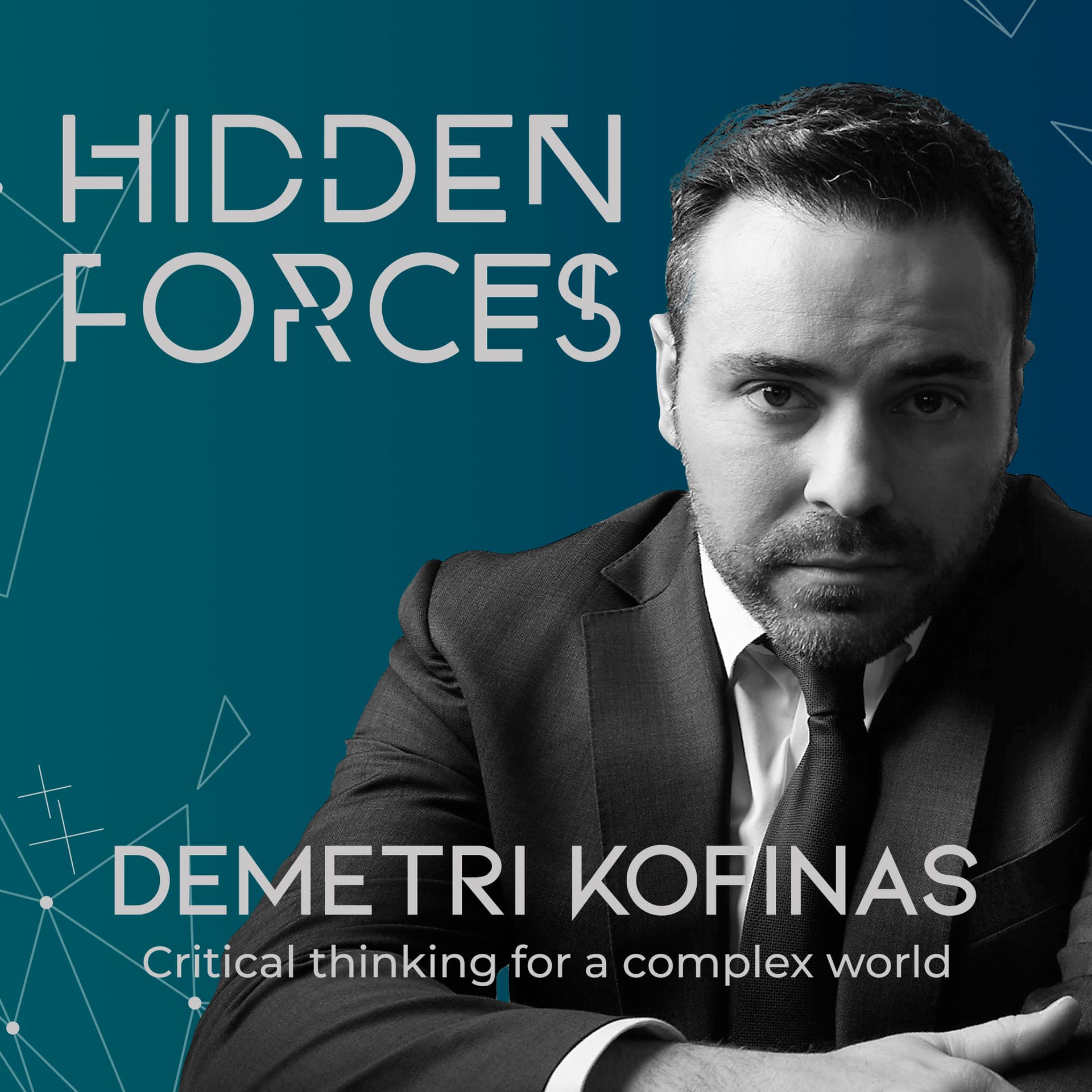
In Episode 486 of Hidden Forces, Demetri Kofinas speaks with Pulitzer Prize-winning author and leading authority on energy and geopolitics Daniel Yergin about the surprising resiliency of the global economy in the face of major supply disruptions and the consequences of the US war with Iran and the closure of the Strait of Hormuz for global energy markets, energy security, electrification (including alternative energy generation and storage), and the balance of power in the Gulf.
The conversation begins with a simple question: Why have energy market disruptions from both the Iran conflict and the Ukraine War proved far more manageable than many analysts and decades of scenario planning predicted? Demetri and Dan examine what that resilience tells us about the transformation of global supply chains, energy diversification, inventory management, and the roles of the United States and China as the world's largest swing producers and consumers of energy.
From there, they turn to the broader geopolitical consequences of the crisis—the lessons China continues to draw from America's entanglements in the Middle East, Iran's bid to convert the Strait of Hormuz into a strategic chokepoint and long-term revenue source, the recalibration of Gulf security as American commitments to the region grows less certain, and the shifting alignments among the Gulf states, Iran, China, and the United States that will define the regional balance of power in the years ahead.
Subscribe to our premium content—including our premium feed, episode transcripts, and Intelligence Reports—by visiting HiddenForces.io/subscribe.
If you'd like to join the conversation and become a member of the Hidden Forces Genius community—with benefits like Q&A calls with guests, exclusive research and analysis, in-person events, and dinners—you can also sign up on our subscriber page at HiddenForces.io/subscribe.
If you enjoyed today's episode of Hidden Forces, please support the show by:
-
Subscribing on Apple Podcasts, YouTube, Spotify, Stitcher, SoundCloud, CastBox, or via our RSS Feed
-
Writing us a review on Apple Podcasts & Spotify
-
Join our mailing list at https://hiddenforces.io/newsletter/
Producer & Host: Demetri Kofinas
Editor & Engineer: Stylianos Nicolaou
Subscribe and support the podcast at https://hiddenforces.io.
Join the conversation on Facebook, Instagram, and Twitter at @hiddenforcespod
Follow Demetri on Twitter at @Kofinas
Episode Recorded on 06/29/2026