In short
Russia’s war in Ukraine analyzed as multiple simultaneous conflicts (kinetic attrition in Donbass; economic deep strikes on refineries/ports; political struggle shaping a new global order). Discussion covers human/economic costs, Western support fraying unevenly across Europe and the US, and what Putin would need to end the war (plus why he seeks symbolic Donbass gains). Also addresses escalation routes (direct NATO challenge vs more plausible sabotage/hybrid warfare), succession risks, and implications for energy markets and the global economy.
Guest background
Mark Galeotti is a historian and analyst of modern Russia focused on politics, security, and the criminal underworld. He hosts In Moscow’s Shadows and has been banned from entering Russia since 2022. He has academic roles (e.g., Cambridge; NYU Center for Global Affairs chair; UCL) and wrote Forged in War and Homo Criminalis (organized crime history).
Key claims
Putin is driven primarily by insecurity and survival; he avoids hard decisions and lets war run “autopilot.” Elite debates are increasingly public because Putin permits them to test options and share blame. Russian casualties are estimated up to ~1.5 million (about ~500,000 dead), disproportionately from poor regions via volunteers. Ukraine’s economy is “on life support” largely funded by Europe; recruitment increasingly resembles “busification.” US support has shifted toward intelligence and reduced direct military aid, outsourcing burden to Europe.
Notable examples
Donbass grinding/attrition; Ukrainian deep strikes hitting Russian refineries/ports; “wild berries”/“Russian Amazon” framing; targeting water treatment plants to make cities unlivable; recruitment videos showing people resisting commissariat buses; Patriot interceptor restocking constraints; Munich Security Conference Vance speech signaling European burden-sharing pressure.
Written by AI. May contain mistakes. Listen to the episode to check what was said.
Chapters
Tap a time to open that second in VOUnderstanding the Russia-Ukraine Conflict
0:45 to 2:57
Discussion on the multifaceted nature of the Russia-Ukraine war and its implications.
“We discuss the human and economic costs of the war, the strategic aims of the various European nation states and how those align with Washington's, and the fraying and increasingly uneven state of Western support.”
Sponsor Promotion
2:57 to 3:40
Promoting subscription options for accessing more content.
“Go to hiddenforces.io slash subscribe and join our premium feed, which you can listen to on your mobile device using your favorite podcast app, just like you're listening to this episode right now.”
Mark Galeotti's Background
3:40 to 4:32
Mark discusses his background and expertise on Russia and its politics.
“And with that, please enjoy this incredibly informative and timely conversation with my guest, Mark Gagliotti.”
Podcast Origin and Focus
4:32 to 6:48
Mark explains the inspiration behind his podcast 'In Moscow's Shadows'.
“I have been fascinated with this country since as long as I can remember.”
Books and Insights on Organized Crime
6:48 to 10:30
Discussion on Mark's books and the intersection of organized crime and society.
“Why did Moscow ban you from entering the country?”
The Current State of the War
10:30 to 14:03
Mark provides insights on the current dynamics of the war and its broader implications.
“So I think we're definitely going to have a chance to put that to use later in this conversation.”
Putin's Decision-Making
14:03 to 14:15
Explore Putin's current approach to the ongoing war and decision-making dynamics.
“Putin does not like making tough decisions.”
Public Elite Discussions
14:15 to 14:51
Discuss the emergence of elite discussions in Russia and its implications.
“Is that both popular opinion you're describing and elite opinion?”
Putin's Benevolent Role
14:51 to 15:17
Understand how Putin positions himself as a benevolent leader amidst criticism.
“And therefore, I think it's even that Putin is looking for that, both because this is a classic Putin measure to kind of try and work out what his options are.”
War Impact on Ukraine
15:17 to 16:01
Analyze the ongoing impact of the war on Ukraine's infrastructure and society.
“So, yes, this is something that's happening amongst the masses and the elite alike.”
Show all 26 chapters
Russian Casualty Figures
16:01 to 17:42
Examine the challenges in assessing Russian military casualties in the conflict.
“is renewed Russian attacks on Ukrainian energy infrastructure.”
Societal Impact of Casualties
17:42 to 18:44
Discuss the social impact of casualties on different strata of Russian society.
“One is what strata of society are these people coming from?”
Recruitment Dynamics
18:44 to 19:53
Explore the recruitment dynamics of Russian soldiers and the socio-economic implications.
“The point is, though, that it does seem to be that that pool of employees, of soldiers, is drying up.”
Perception of War in Russia
19:53 to 20:27
Delve into how Russians perceive the war as bearable due to volunteerism.
“These are people who, in some ways, have been playing particularly bloody lottery.”
Long-term Consequences of War
20:27 to 22:25
Understand the long-term demographic consequences of the ongoing conflict in Russia.
“And I think, you know, in that context, and look, obviously Russia is a thuggish police state where protest is actually not at all easy.”
Ukraine's Economic Struggles
22:25 to 24:58
Review the state of Ukraine's economy during the ongoing conflict and external dependencies.
“What has been the effect on the Ukrainian people and their economy?”
Western Support for Ukraine
24:58 to 28:00
Analyze how Western support for Ukraine varies between countries and its implications.
“And it's very hard, therefore, to judge precisely what would happen if, God forbid, suddenly that external assistance was withdrawn, but it certainly wouldn't be pretty.”
European Defense Dynamics Amidst the Ukraine War
28:00 to 29:52
Explore how European nations prioritize military aid to Ukraine based on their own security concerns.
“I mean, Britain basically, for example, handed over almost all its self-revelled artillery.”
The Lack of a Unified Russia Strategy
29:52 to 32:56
Discuss the absence of a cohesive strategy among European nations regarding Russia and Ukraine.
“European nation states and the United States on what would be described as a Russia strategy?”
Ukraine's Strategy and Western Support
32:56 to 35:14
Analyze Ukraine's approach to maintaining Western support and pressure on Russia as the war continues.
“incremental pressure now increasingly attacks into Russia to force him to the negotiating table?”
US Policy Towards Ukraine and Europe
35:14 to 39:20
Examine the complexities of US policy regarding Ukraine amidst changing dynamics with Europe.
“to Ukrainians, they were very worried about when the whole Gulf conflict emerged, because suddenly Ukraine was no longer big news.”
The Shift in American Focus from Europe
39:20 to 42:00
Delve into the reasons behind America's pivot away from Europe towards other global issues.
“What I don't understand is the antagonism.”
America's Shift in Global Focus
42:00 to 44:24
Explore how the U.S. is reallocating its foreign policy priorities away from Europe.
“Well, threat wise, America does not really regard Russia as a threat so much as China.”
Understanding Putin's Decision-Making
44:24 to 46:01
Delve into the motivations and logic behind Vladimir Putin's actions and leadership style.
“I mean, look, I was at the Munich Security Conference where Vice President J.D.”
The Insecurity Driving Putin
46:01 to 49:48
Examine the elements of insecurity that influence Putin's behavior and decisions.
“Help us understand what you think motivates him and the forces driving his decision-making.”
Putin's Inner Circle and Echo Chamber
49:48 to 52:38
Analyze the dynamics of Putin's relationships with his advisors and how they shape his perceptions.
“Who and what is informing his perception of how this war is going?”
Transcript
Automatic transcript. May contain errors.0:00Demetri Kofinas:What's up, everybody? My name is Demetri Kofinas, and you're listening to Hidden Forces, a podcast that inspires investors, entrepreneurs, and everyday citizens to challenge consensus narratives and learn how to think critically about the systems of power shaping our world. My guest in this episode of Hidden Forces is Mark Galeotti, one of the most informed and provocative voices on modern Russia, who hosts the renowned podcast In Moscow's Shadows and whose work has centered on the politics, security, and criminal underworld of Putin's Russia, a country he has been banned from entering since 2022.
0:38Demetri Kofinas:Mark and I spend the first hour of our conversation today taking stock of Russia's war in Ukraine, a conflict Mark describes as several wars all happening at once, a grinding battle of attrition in the Donbass, an economic war of deep strikes on refineries and critical infrastructure, and a political war that has enveloped not only the conflict's chief counterparties, but all of the war's major powers and regional blocs for whom this war has become the central battlefield in the emergence of a new global order. We discuss the human and economic costs of the war, the strategic aims of the various European nation states and how those align with Washington's, and the fraying and increasingly uneven state of Western support.
1:21Demetri Kofinas:From there, we engage in a thought-provoking discussion about the mind of Vladimir Putin, The insecurities marked places at the core of his character, his survival instincts, his narrow circle of trust, and the sources and forces shaping his perception of how this war is going. In the episode's second hour, our conversation moves into an exploration of what Putin would actually need in order to end this war, why he keeps chasing a symbolic victory in the Donbass rather than the settlement that is presently available to him, and why his aversion to weakness is critical for us to understand if we want to make sense of his decision-making and calculations.
2:00Demetri Kofinas:From there, we turn to the taboo question of succession, what the death or departure of a personalistic ruler tends to unleash, the lessons we can learn from Stalin's untimely death, and why Mark expects any transition of power in Moscow to reflect the will of a coalition of post-Soviet elites rather than the machinations of a younger, smarter Putin. We weigh the escalatory paths that were European capitals, from a direct challenge to NATO's eastern flank, to the sabotage, subversion, and campaigns of hybrid warfare that Mark considers more plausible, and close by examining how America's current entanglement in the Middle East has been received by Putin, what a hollowed out but battle-hardened post-Ukraine war Russia could mean for the world, the lopsided and deepening dependency on Beijing and the prospects for Washington to cleave Moscow away from its fear of influence, and what all of this could mean for energy markets and the global economy.
2:56Demetri Kofinas:If you want access to all of this conversation, Go to hiddenforces.io slash subscribe and join our premium feed, which you can listen to on your mobile device using your favorite podcast app, just like you're listening to this episode right now. If you want to join in on the conversation, become a member of the Hidden Forces Genius Community, which includes Q &A calls with guests, discounted access to third-party research and analysis, and in-person events like our intimate dinners and weekend retreats. You can also do that on our subscriber page. And if you still have questions, feel free to send an email to info at hiddenforces.io.
3:36Demetri Kofinas:And I or someone from our team will get right back to you. And with that, please enjoy this incredibly informative and timely conversation with my guest, Mark Gagliotti.
3:51Demetri Kofinas:Mark Gagliotti, welcome to Hidden Forces. It's great to be here. It's even better having you here, Mark. I've been a listener to your podcast since the very early days of the Russia-Ukraine war. You'd of course been doing it for several years before that, but I realized heading into this interview that I don't really know anything else about you outside of the podcast, other than the fact that you're one of the world's leading experts on Russian politics, crime and security. I knew you were banned by Moscow from entering the country in 2022, so there's probably some interesting backstory there.
4:22Demetri Kofinas:Tell us a little bit about you and how you became such a popular authority and leading voice on Putin's Russia. Well, in many ways, I'm a quintessential wonk. I have been fascinated with this country since as long as I can remember. And I had no clear or good reason for it. There's no family connection. I'm half Italian. And there's no real reason why it's not like I'm, like so many who come into this field, fascinated by Russian literature or music or whatever. I'm actually interested in the country. And in some ways, it's because I'm a historian of the old school. I'm interested in the stories.
5:00And for me, Russia's always had the best stories. Not the happiest stories, generally, but nonetheless, the most fascinating. And so I did this sort of classic, went to university at Cambridge. Then after a year working in the financial sector, then went and did my PhD where I could actually focus on what was then still the Soviet Union. And really since then, I have exactly built my career around trying to understand and explain this country. So I've been in the academic world, both in the UK and also I was academic chair of the Center for Global Affairs at New York University for some years.
5:36I've been a visiting professor in Moscow as well as in other places, but I've also done my time on attachment to the British Foreign Office within think tanks and the like. So now I find myself in a position in which I'm an honorary professor at University College London School of Stupine and East European Studies, but I also have my own consultancy firm in which, well, the corporate work to a considerable extent dried up after 2022 and sanctions, as you'd expect. Interestingly, though, really for the past year, it has begun ticking up again. As companies which had fled the market, and I did my fair share of advising companies on how they could leave Russia, are now beginning to scope out the possibility of a return.
6:22They're not there yet. They're just beginning to think it may be something that is closer to the horizon than they thought. So in a way, look, I'm a mix of all kinds of different ways of looking at Russia. I've lived there, exactly. I've now been banned from there. But that's essentially sort of how I've come to it. And that means that a lot of my work has been done precisely by talking to Russians, by living in Russia, by traveling around Russia and so forth. And I think that's one of the key things. You can't misunderstand this or need any country just by seeing what comes up on your newsfeed.
6:52Why did Moscow ban you from entering the country? Well, I mean, look, your guess is as good as mine in the sense of, you know, I was in the first batch of British citizens who were indefinitely barred in June of 2022. And there's a rather boilerplate thing you simply said because of my terrible Russophobic views and spreading lies about the Russian Federation. Look, if I was better at marketing, I would sell myself as the man Putin fears. In practice, the odds are some junior desk officer at the Russian foreign ministry was told, find us a list of irritating Brits to ban for tat reasons. But nonetheless, And I see what's happened is since then, this list proliferated until pretty much anyone who looks at Russia, it feels like, is likely to be banned.
7:38Demetri Kofinas:That's so interesting because your analysis is pretty sober. I mean, it's not politically or emotionally charged in any way. By the way, I've been meaning to ask you, what is the backstory to the name of your podcast? Why did you end up calling it In Moscow Shadows? Well, look, I mean, look, podcasts like mine are essentially exercises in hubris, clearly at some point. However much I rationalize it, I decided that the world needed more Mark Gagliotti. But I think it was also, look, this was a time which we've seen this extraordinary explosion in podcasts like, indeed, your own. And it is actually a phenomenally powerful vessel for engaging, shaping and tapping into the conversations that are being had.
8:18I mean, look, here I'm going to shamelessly hype myself. Although, obviously, the podcast is open to anyone who wants to tune in. But I also know from my own experience that I have had generals and diplomats and all sorts of other people actually comment on and respond to it. So I think from my point of view, it's that I wanted to be part of those conversations. And I wanted to help open up the conversations. Because, yes, particularly obviously since 2022, but even to a degree before then, there was a certain monomania, a certain focus on Russia and its more belligerent relationships with the rest of the world.
8:52And I get that totally. But there is more to Russia than that, and there's more that we need to understand to explain why it is going on. So topics I've covered range from the sometimes slightly more lighthearted one, what can we learn from Russian science fiction, through to precisely trying to explain the day-to-day engagements of Russia with the war and with politics. And I called it in Moscow shadows. Well, because a particular focus of my work has been not just Russian organized crime, but also the Russian intelligence and security community. And therefore, I sort of like to feel that I can at least shed some light on what are, after all, these very, very shadowy aspects of Russia.
9:37Yeah.
9:38Demetri Kofinas:You've also authored several books on Russia. Homo criminalis was the most recent one, but what was the most recent one before that? Homo criminalis is one, and forged in war is the other. So the forged in war is essentially a military history of Russia since its very origins back in the 8th century, which is an attempt in some ways to explain in the grand historical terms how we got to where we are today, but also to kind of put it in that wider historical context. Whereas Homo criminalis that you mentioned, I mean, that's actually not a Russia book. That was a sort of a, I hesitate to call it a hobby book, but it's something that I've been working on for years, little bit by little bit in the corners when I had the time.
10:16It's essentially an organized crime history of the world, or rather a history of the world told through the prism of organized crime. I'm just trying to explain how organized crime in so many ways underpins modern economics and
10:29Demetri Kofinas:society. So I think we're definitely going to have a chance to put that to use later in this conversation. When Russia first invaded Ukraine in late February, 2022, it was all anyone in the media could talk about. And for a while, the conflict felt very dynamic. There was even a point during the Hartiva offensive in late 2022 when a number of outspoken analysts, it wasn't just a number, it was many in the media, began to believe that maybe Ukraine could actually prevail in this conflict. It seems that the war has now entered a protracted phase of attrition and simmering conflict where neither side seems to be able to achieve a concrete victory or accomplish something on the battlefield that would gain them leverage in a potential negotiation.
11:16Demetri Kofinas:Where does the war stand at this moment? And how has it gone for both Ukraine and Russia, in your opinion? Huge question. In some ways, it's a huge precisely because we could almost think of it as multiple wars or at least multiple fronts. There is, of course, the shooting war that has taken place in Ukraine. And then the Russians are advancing, one has to recognize that, but painfully slowly and at painfully high human cost, which raises interesting questions about whether or not they can actually sustain that in the long term. But although there's a danger in trying to map too much onto assessments of, well, they advanced 200 meters in this period, therefore we can assume that in the next equivalent period, they can only advance another 200 metres because things can change.
12:04But nonetheless, it is clear that although the Russians are grinding forward in their bid to essentially take the last part of Donetsk region, which may or may not, depending on how Putin feels on that day, be essentially the furthest edge of their territorial ambitions. Again, I suspect Putin basically will go for whatever he thinks he can get, to be honest. There's also an economic war going on, in that particularly we now see these Ukrainian deep strikes, which have been hitting Russian ports and oil refineries that are now shifting to wild berries, which is often quite rightly, I think, described as the Russian Amazon.
12:44And they may well, in due course, pivot to another bunch of targets. And this is economic because clearly it all has costs to the Russian state treasury. In every ruble that they might end up having to spend, for example, in compensating the people who are hit by the wild berries attacks is a ruble they can't spend on producing tanks and missiles. But it's also a political campaign to try and make the Russians feel that this war is coming to them. And on that, well, it's a little bit harder, frankly, at this moment to actually assess the success, because it's clear that there is a slightly larger proportion of ordinary Russians who actually would like the war to end.
13:23I mean, not that, frankly, Putin cares too much about what ordinary Russians think, up to a point. But there's also a a vocal minority who actually are getting angry and actually saying, no, we need to escalate. We need to really show these Ukrainians and bring this war to an end. The one thing I can say, if I just briefly pivot to Ukraine, is that what I am getting from both the kind of more pragmatic, let's end the war now camp, and also the let's escalate now camp, is actually a shared sense that this war can't be allowed just to keep on going on forever. We need to bring this to some kind of conclusion.
13:58And they are both trying to persuade Putin of their particular approach. Putin does not like making tough decisions. And so at the moment, I think he's just in a way letting the war run on almost on autopilot, but it may well be that he'll feel he has to come off the fence.
14:14Demetri Kofinas:Before you go to Ukraine, just clarify something for me. Is that both popular opinion you're describing and elite opinion? Yeah. Okay. I think so. I mean, this is it. Again, And the interesting thing is we've seen this year something that we hadn't seen before, which is actually elite discussions beginning to become public. You know, I've known just from my own conversations with people back there and so forth, that these conversations have been going on behind the scenes within the elite beforehand. But this year it's actually come out. We're seeing it played out in newspapers, on blogs and such like, even in parliament, the State Duma.
14:47And that wouldn't be happening unless Putin had allowed it. These people are not daring mavericks. And therefore, I think it's even that Putin is looking for that, both because this is a classic Putin measure to kind of try and work out what his options are. But also it means that this way, if he does make a decision, he's not making it himself. He will pitch it as the benevolent czar agreeing to this group of his aristocrats, which also means that basically he can blame them if it goes wrong. So, yes, this is something that's happening amongst the masses and the elite alike. Anyway, and then just briefly about Ukraine, and here I'm going to be much, much briefer, simply because I'm not a Ukraine specialist.
15:27And I think there's always a danger, and people still seem to assume that if you're a Russianist, you could also deal with Ukraine or Georgia or Belarus or whatever. Well, no, in some ways, that's a betrayal of the whole notion of sovereignty that the Ukrainians are trying to fight for. But nonetheless, it is clear that at the same time, the Russians are hammering the Ukrainians. You've got whole sort of long swaths of roadways now with no petrol stations. you've got the Russians hitting a whole variety of industrial targets, and also gearing up for what's likely to happen if the war continues, as it probably will, through the winter, is renewed Russian attacks on Ukrainian energy infrastructure.
16:05But also something that they're increasingly targeting now is water treatment plants. Because let's face it, if you can cut off electricity and clean water, you begin to make Ukraine cities unlivable. So I think that we have to realize that this is a campaign that's being fought on the battlefield, but also deeply
16:24Demetri Kofinas:within each country's economies and societies. So I have a number of, I don't want to get bogged down here, but I think it's important to at least address some of my blind spots here. It's hard for me to really take a measure of the impact that this war has had on each of these countries. I mean, we just spoke a little bit about the impact on the physical infrastructure of Ukraine. I don't remember in your answer on Russia, whether you even addressed that, if you focused mainly on sort of what the popular opinion was. The most important question of all is what has been the impact in terms of deaths and casualties and people killed and wounded, both in action and civilians on both sides of this conflict?
17:01Demetri Kofinas:Let's start with Russia. What do we actually know here? Because I have seen such a wide range of numbers thrown around. The honest answer is that we don't really know. Various methodologies have been tried to assess it And well, really, it seems to be that the overall casualty figure is anything up to about 1.5 million. That's not all killed. Maybe about half a million, perhaps more, have actually been killed, and the rest are seriously injured, to the point they can't just simply be patched up and returned to the fray, but instead are hospitalized or having to be sent home. Still, though, this is a massive figure.
17:41Demetri Kofinas:So a couple of clarifying questions there. One is what strata of society are these people coming from? What class of society? Has this begun yet to impact the wealthier Russians? Help me understand who's bearing the brunt of the war here. Essentially, it's poor Russians. One of the ways that Putin has minimized the political impact of the war is precisely by not in the main, though there have been exceptions, but in the main, not actually forcing people to go and fight. Instead, these are volunteers. These are volunteers who are being offered what by the standards of an impoverished Russian are actually life changing sums of money, you know, multiples of the average salary.
18:20And so what we're getting is people who are volunteering, who are on the whole from the poorest parts of the poorest regions of Russia, which also hardly coincidentally are also the politically less significant ones. If you're a Muscovite, the odds are good that you don't know anyone who has gone to fight unless you happen to know someone who is a professional soldier and therefore an officer. On the other hand, if you go to the impoverished regions, Dagestan in the North Caucasus, Bashkiria in the east and so forth, there you can find villages which are basically being, I won't quite say depopulated, but certainly decimated by this war.
18:59The point is, though, that it does seem to be that that pool of employees, of soldiers, is drying up. It's perking up a little bit at the moment, but certainly earlier this year, actually, we could see recruitment was lagging behind the casualty rate.
19:17Demetri Kofinas:We didn't have a chance to linger on this earlier, but that casualty figure of 1.5 million with at least 500 ,000 dead is an extraordinary number. It is. I mean, okay, on one level, we're talking about a country with a population of over 140 million people. But nonetheless, yes, to be able to absorb those kind of casualties, I mean, this is something that brings us back to the really big conflicts like the First and Second World War. And it's one that, again, because on the whole these people are volunteers, so far at least Russian society has been willing to accept. I think there is a widespread assessment almost.
19:55These are people who, in some ways, have been playing particularly bloody lottery. That because there's lots of money to be made, and even if you die, your family then get a very substantial death payout. It's almost like, well, they had a go to see what would happen. And if it doesn't work out for them, well, that was on them, which is a very cynical way of looking at it. But nonetheless does seem to be sort of the, at least up to now, the sort of primary way people have been thinking about it, if they've been thinking about it at all. And I think, you know, in that context, and look, obviously Russia is a thuggish police state where protest is actually not at all easy.
20:36But I think in that context, it helps us explain why Russians continue to see this as a bearable war. It is because essentially if they don't want to be involved, they don't have to be involved.
20:53Demetri Kofinas:So the Vietnam War produced less than 60 ,000 dead Americans. I continue to find it remarkable that there are people in Western countries, especially in the US, who think that this war was anything other than a disaster for Russia, especially those who correctly identified Iraq and America's misadventures in the Middle East as strategic own goals. I also find it notable that Putin has been able to sustain this war for as long as he has, despite the enormous cost of human life, even if it hasn't had short-term consequences, because I imagine that for a country like Russia with its below replacement rate demographics, in fact, what is the fertility rate in Russia exactly?
21:33Demetri Kofinas:Do you know off the top of your head? Look, I can't give you the figure off the top of my head, but it is poor. I mean, obviously, most European countries, most Western countries are currently sort of experiencing shrinkage on that level. Russia certainly has that. I mean, this is the thing. This is one of the reasons why it's not actually youngsters who are going and fighting. One of the many reasons why, for example, Putin is not sending conscripts to fight in this war, apart from that, that politically it would be massively contentious. So instead, you have a mean age of the Russian soldiers and indeed Ukrainian soldiers, which is around 40 years old.
22:09So again, actually, this is a war that has been fought by the middle aged.
22:13Demetri Kofinas:Yeah. And so essentially where I was going with that is that there are huge long-term consequences that aren't priced in today because of the fact that you have declining population dynamics anyway, and you add to that the attrition of a war. What has been the effect on the Ukrainian people and their economy? Well, we talked a little bit about the infrastructure and such, but really, I mean, obviously as bad as it's been for Russia, it's been much worse for Ukraine. And what do we actually know there about the number of people dead, conscription rates, et cetera? We know very little, it has to be said.
Read the full transcript
22:43Again, Ukrainians are not putting figures out, except occasionally President Zelensky has given some figures, which frankly, even the more Ukraine sympathetic analysts I have spoken to within UK and other governments do not regard those figures as credible. And it's not a criticism of him. I mean, clearly this is an existential conflict for Ukraine and sometimes you have to keep certain information secret. Well, also we're going to have a chance to talk about the other
23:08Demetri Kofinas:war, which is the propaganda war. Right now we're discussing the kinetic war, but the propaganda war is as important, if not more important. So look, we know that Ukraine has suffered, obviously far fewer casualties than the Russians, despite those people who claim that somehow Ukraine has absorbed more. It hasn't. But nonetheless, proportionate to its remaining population, actually, it may well be that Ukraine is suffering a higher casualty rate. But in part, that's precisely because there's been this massive exodus of millions of refugees who have headed to Europe and indeed beyond, mainly, but not entirely, women and children.
23:43And as a result, in order to feed the war effort, we see that Ukraine is increasingly adopting a model of recruitment that frankly looks a lot like press gagging, the so-called busification, whereby officers from the local military commissariat will stop people on the streets, grab them, throw them into buses and drive them off. And we often get, you can see all sorts of videos on the net of crowds actually mobilizing to try and stop these potential soldiers from being dragged away. So it is a difficult situation. And as regards the economy, well, in many ways, the economy is on life support. It is actually being funded predominantly by the Europeans.
24:27And the Europeans essentially are covering the cost of the civil side of the Ukrainian government. and a large proportion of its defense expenditures too. So, yes, there's all sorts of dynamism still to be found, ranging from the coffee shops that still exist on the street corners up to these tremendously successful corporations which have emerged to actually provide drones and missiles and other necessary kit for the Ukrainian military. But in some ways, it's operating within a rather artificial economy. And it's very hard, therefore, to judge precisely what would happen if, God forbid, suddenly that external assistance was withdrawn, but it certainly wouldn't be pretty.
25:11Demetri Kofinas:How would you describe the state of Western support for the war? And how does that vary between country to country, not just between Europe and the United States, but within Europe itself? Yeah. I mean, obviously, one has to touch on Europe versus the United States first, which is actually that the United States essentially is no longer really providing concrete military assistance, though it is still providing intelligence. And that is absolutely crucial, targeting packages, which are central to the Ukrainian long-range strikes deep into Russia. It's questionable. What kind of assistance was it providing before we got to where we are now?
25:45Demetri Kofinas:Help me understand how significant the change has been under this administration. The change has been pretty significant. I mean, originally we actually had direct military assistance, in other words, stuff being given to the Ukrainians, all sorts of different pieces of kit, as well as preferential access to being able to buy things, not just for the Ukrainians, but for other countries, primarily Europeans, who wanted to buy kit for Ukraine. Now, what we find is essentially that there isn't any more of that kind of direct aid. There is still the Pearl system, which again allows, for example, European countries to buy a certain amount of kit to give to the Ukrainians.
26:23But essentially, why would America not want to just simply sell military equipment? But there actually, it does look as if the priority access has been dramatically weakened so that in a way, Europeans have to get in line. And we're seeing this, for example, with Patriot interceptor missiles, where actually now the priority is for the United States to restock its magazines because of the Gulf War, but also its Gulf allies who have been shooting off vast numbers of these interceptors. So that means that there's just not that many for others to be bought. So that's the Europe versus America situation.
27:00Europe, I mean, there is, we have to say, a lot of money being spent. And a lot of it is precisely just in terms of financial assistance to keep the Ukrainian system afloat. It's getting harder and harder to provide military assistance. Again, in the early days of the war, what happened is a lot of militaries essentially just emptied their storage of, frankly, rather dated systems that they either were planning to replace or had already sort of phased out in existence and were sort of sitting, beginning to gently rot in storage meadows around. So you had a lot of, frankly, second order kit being provided, but obviously, from Ukraine's point of view, everything was gratefully accepted.
27:43Then you had a certain amount of more advanced equipment, things like two tanks and so forth, which are being provided, but which was beginning to make European militaries feel rather uncomfortable because they were worrying about how far they were actually giving up their own stocks. I mean, Britain basically, for example, handed over almost all its self-revelled artillery. And so now we have a situation in which European countries, which are after all committed to increasing their defence expenditures up to 3.5 % as part of a sort of common NATO agreement, 3.5 % of GDP. On the one hand, trying to buy stuff for their own militaries, but also trying to source things for the Ukrainians.
28:25And I suspect that actually the former too often tends to get priority. And in terms of the variation, I mean, it is pretty massive. There are countries, particularly for example, Scandinavian countries or the Baltic countries, which clearly the Baltic countries are much smaller with smaller budgets, but nonetheless have given much more in terms of military aid as well as financial. And other countries, and I wouldn't want to point the finger at countries like, say, Spain. But anyway, and there are other countries which have been much, much less generous in what they provide. But that's also in part because if you're on the Mediterranean tier of Europe, there is a real debate about where does the genuine security threat come from?
29:07If you're Estonia, you have no doubt that Russia is the potential threat, and therefore the longer Russia is bogged down in Ukraine, the happier you are. If you are Spain or Italy or indeed Greece, actually you see the real threat as coming from the Middle East, North African region. And actually, I've talked to people within the various military structures there who actually are quite peeved. they feel that NATO is ignoring their security concerns just to look at the eastern flank. So it's not just simply whether they're impoverished or whether they're mean, it is also that actually they had different concerns.
29:48Demetri Kofinas:So where is their agreement among the most important actors in this war, the most important European nation states and the United States on what would be described as a Russia strategy? Yeah. I mean, I think the honest answer is there isn't a Russia strategy. There is a Ukraine war strategy, which for many is one and the same, but I would suggest actually we should be much more directly disaggregating. I mean, in terms of the war, there is essentially an agreement to continue with the status quo. I don't think there's any real enthusiasm for increasing the level of commitment, whether we're talking about financial commitment or whether we're talking about boots on the ground or anything like that.
30:35But on the other hand, I don't think there's anyone who is seriously suggesting any kind of scaling down the commitment. So, I mean, actually, the irony is that at the moment, Russia, Ukraine, and Europe are all really just sort of running in neutral. They're continuing their main line, hoping in effect that it's the other side that breaks first. But of course, in Europe, it's worth noting that we have a certain amount of political churn, likely. I mean, if one thinks of the three key European countries, France, Germany, and Britain, Britain has just got a new prime minister who is saying all the right things about supporting Ukraine, but he also has all kinds of other ambitions about building a social care service and such, which is going to cost money, and he's going to have to find that money somewhere.
31:28So there are some concerns about what other money will be available for defence in Ukraine. In France, President Macron is pretty much embattled, and there are elections coming up next year. And essentially, it's quite likely that there will be a change of government. And if that change of government is for the far right movement of Mrs. Le Pen, well, she's very Ukraine sceptic. And likewise, in Germany, Chancellor Mertz is equally in battles and you've got the rise of the right-wing AFD movement, which again is not very happy about the idea of supporting Ukraine. So unfortunately, it may well be that in the next 12 months, we see a certain amount of questioning of the support for Russia amongst those three countries.
32:12And if they start to look wobbly, Other countries, frankly, are probably more lukewarm anyway, like Italy, they might well seize on that as an excuse. Say, well, we can't make up the shortfall, so we too should start to pull back.
32:28Demetri Kofinas:So it seems to me that going back to this question of strategy, if we're just focusing on the Ukraine-Russia war strategy, it seems that the strategy on the part of the Europeans is more domestically geared. In other words, the strategy for the war itself seems to be defined increasingly by Ukraine. And the focus in Europe is how do we support Ukraine? And then how do we convince our population to continue to support Ukraine? How do we find the funds to continue to support Ukraine? And Ukraine's strategy seems to be essentially, how do we apply enough pressure on Putin and incremental pressure now increasingly attacks into Russia to force him to the negotiating table?
33:05Demetri Kofinas:And how do we do so in a way that won't alienate the Europeans, that convinces them also of both the importance of the war and also our own importance as a long-term geostrategic ally on Europe's Eastern flank? And that is kind of what the strategy looks like. Fill in any kind of missing gaps for me or correct anything that I've misidentified there. No, I think you've actually done a very good job of summarizing the current situation. I think the only point I would make is a little element of nuance is from the Ukrainians' point of view, and maybe I'm going to put this a little bit too starkly, they don't trust Europe.
33:42They are tremendously grateful for all the assistance that has been provided. But the point is, Zelensky's job is not just simply to be a war leader, but in many ways also to be a cheerleader. He has to constantly struggle to make sure that Western countries continue at the very least with their current level of support. And hopefully, from his point of view, he would like to push it even further. So even if one looks at the current campaign of deep strikes in Russia, it was pushed by a whole variety of different reasons and timing likewise. Part of it, though, was precisely at a crucial point to try and convince both Donald Trump and the Europeans that, in fact, Ukraine was resurgent, that in some ways it was a winner and therefore deserve to be backed.
34:34So in some ways, there is always this distorting factor, this sense of not just how can we make sure that we don't alienate Europe, but also how do we keep Europe engaged? And how do we essentially not let the Europeans off the hook? And that's really quite a challenge. And in some ways, I think it's becoming an increasing challenge because the longer the war goes on, on one level, it just gets normalized. But in some ways, people to accept that, well, there's going to be a certain amount of their budget that they're going to be paying to keep Ukraine going. End of story. But on the other hand, it also begins to run the risk of essentially coming off the front pages.
35:13This was something that, again, speaking to Ukrainians, they were very worried about when the whole Gulf conflict emerged, because suddenly Ukraine was no longer big news. Another drone hitting a school or whatever, which once upon the time would have been front page news and keep people engaged and outraged, now was related to two column entries on page seven because there was other big stuff happening. So that is a key struggle for Ukraine, it has to be said.
35:41Demetri Kofinas:Yeah. I'm actually glad that you brought up the media aspect of the story because while it may be a backstory in Europe, it's really become a non-story in the US. And that's been in no small part due to this administration and the strident tone that it's taken from the outset, not just against Europe, but against Ukraine. And I still don't really understand what exactly this administration wants from Ukraine. I mean, Trump came into office, energized to do a deal with Russia. He even had that infamous meeting with Zelensky in the Oval Office where he dressed him down in front of the cameras. And oddly enough now, it feels like since then, relations with Kiev have actually improved somewhat.
36:19Demetri Kofinas:So what exactly is US policy vis-a-vis Ukraine at the moment? And how does it fit into US grand strategy? I mean, what is your mind on this? Yeah. I mean, I think everyone would love to know the answer to that question. I mean, seriously, it is clear that essentially the White House first and foremost would like this whole problem to go away. It's not a problem. I mean, although sometimes the White House relishes a crisis because it gives the opportunity for sort of grand heroic action and such like, because this hasn't proven amenable to the kind of quick fixes that I think Trump had in mind when he first came into office.
37:02I think he did think that he would be able to very quickly solve this. I don't think it was just his rhetoric. He did think so. And that therefore he could kind of gain all the kudos for being the man who resolved the crisis that previous Democrat administrations hadn't. Well, that didn't work out. And therefore, in some ways, it's become, in many ways, I would say, geopolitical inconvenience. Now, in that context, again, early Trump seemed to feel that the best route to a quick resolution was to bully Ukraine into accepting an ugly deal with Russia. And I think that was part of the thinking behind that Oval Office mugging.
37:44Since then, it's been demonstrated, A, that Ukrainians aren't willing to accept this, B, that the Europeans have been actually backing the Ukrainians in this front. But C, also that in fact, Ukraine isn't without cards, to use Trump's own rhetoric. And therefore, I think in some ways, what we see is a White House that feels a little bit rootless in this context, because likewise, it's not in a position to bully the Russians into making a deal on Kiev's terms. Russia is too strong and Trump still has this odd genuflection towards Putin. I think not necessarily just Putin. I think it comes down to it.
38:27Trump likes strong men. And again, that was part of how Zanetsky managed to sell himself after all. So I think in that context, really, again, there isn't, to my knowledge and opinion, a clear US strategy other than just simply, well, at the moment, it's not really costing us anything. At the moment, it's not really demanding anything from us. At the moment, we don't need anything from the Russians that the Russians could demand anything for. So let's just outsource this to Europe and see what happens.
39:02Demetri Kofinas:So I don't want to sound naive here, but I genuinely don't know the answer to this question. I don't really understand the extent of the antagonism toward Europe coming out of Washington. I understand the desire for burden sharing. I understand the desire to offload as much cost as possible to the Europeans. That makes total sense to me. What I don't understand is the antagonism. Do you think that's part of a strategic effort to force the Europeans to take on more and more of the burden of their own security and the burden of funding this war? Help me really understand why relations between the Europeans and Washington has become so contentious?
39:42Demetri Kofinas:Do you think it's largely political or is there a calculus here to get the Europeans to do more? Look, I'm no Trump whisperer. I mean, so this is just my own personal opinion, but don't regard you or your listeners shouldn't regard it as one that is rooted in deep insider DC knowledge. But I mean, my sense is that first of all, for this administration, the personal is political and vice versa. I think Trump himself has this notion of Europe that he's key questions, it's moral values and so forth. Secondly, he feels that it has been for a long time freeloading off the United States, which he has a bit of grounds for saying so.
40:26I mean, certainly in terms of defense and security, Europe has just allowed itself just a shelter under the American security umbrella without really paying enough attention to it itself. And he also feels that the Europeans don't know their place. Again, I think he has this very, frankly, 19th century notion of the world, which is something that he shares with Putin, interestingly, which is one of the reasons why the two men can actually engage, which is essentially that there are a handful of serious players in the world scene. And everyone else, the only question is, whose sphere of influence do they fall in?
41:03And from his point of view, Europe is part of America's sphere of influence, and those damn Europeans ought to realize that. How dare they snigger at him and his fashion and redevelopment choices? How dare they not immediately accept when he says that they should be doing X, Y, and Z? How dare they criticize the human rights record of his administration? How dare they not support his war in the Gulf? I mean, all of these, I think, provide personal animus that then gets manifest in political. But also, this is part of a much, much longer trend. Yes, it's almost caricature, but nonetheless, it is part of America pivoting away from Europe.
41:46Europe is no longer the linchpin of the world. And speaking as a European, I'm not sure if I should regret that or be delighted. But America is pivoting towards Asia, and it's pivoting more towards, I think, global issues. Well, in the sense of - It doesn't seem that it is. Well, threat wise, America does not really regard Russia as a threat so much as China.
42:07Demetri Kofinas:But it's pivoting into the Middle East. It is ostensibly pivoting into the Middle East. It's giving, there has been lip service allocated toward the Asian theater, but look at where the resources are being spent. This administration, you're absolutely right. But in some ways, I think it follows conflict and again, follows personal relationships. But broadly speaking, America over the years has been firstly signaling that it's dissatisfied with picking up the tap for securing Europe. Secondly, that actually it feels that Europe is not seriously under threat. If we're talking about the European Union, obviously not Ukraine.
42:42And then thirdly, saying that actually it does need to reallocate attention and resources tend to follow attention to elsewhere in the world. So, I mean, what we're getting is something that was handled on a much, much more diplomatic level by previous administrations, now looking like some kind of dramatic shift, but in fact, just simply being a sort of an exaggeration and acceleration, I would say, of an existing process. But when it comes down to it, this is an imperial White House. And what Trump happens to feel, who he thinks is his friend and who he thinks is his enemy and who he thinks is just simply an
43:22Demetri Kofinas:insufficiently servile lackey that matters. Have you read Maggie Haberman and Jonathan Swan's book, Regime Change? I haven't yet. I haven't yet. It's sitting on the shelf along with far too many others. It's not sitting on my shelf yet because I'd rather have it sent to me for free, an agreed upon interview, which I would much prefer, though I would read it anyway. A very wise move. It seems fantastic. And they've given just wonderful interviews. There was one recently with Ezra Klein and Maggie Haberman and another one with Tim Dillon, believe it or not, who actually was just surprised me just how good of an interviewer he was in that conversation.
43:55Demetri Kofinas:We'll put a pin in that for now. Maybe we'll revisit some of the palace intrigue later. One last question before I pivot to Putin. Do you think that we will look back in time and whether or not we agree that there was a strategic effort to get the Europeans to burden share by antagonizing them, that Trump and the way that he approached the Europeans was ultimately necessary to get them to take on more and more of the responsibility for their own security. I wish I could disagree, to be brutally honest, but I think it did take something particularly shocking. I mean, look, I was at the Munich Security Conference where Vice President J.D.
44:37Vance famously gave this very, again, very combative speech, essentially taking the Europeans to task for, as he saw it there, their failure to uphold basic values and such like. And it was a fascinating case study in European responses that almost went through that kind of classic arc of grief, through bargaining and denial, through to acceptance, just in the course of one weekend. And I think it really did signal to Europeans, not that they were now, they had to consider themselves to be the lackeys of the United States or anything like that, of course not. But nonetheless, that things were changing.
45:22That the old hope that you can just mollify Washington by saying, yes, yes, we really need to address this and we take this terribly seriously and then do precious little. Actually, we're not going to work with this particular administration.
45:37Demetri Kofinas:I agree with you. And I think that the inertia evident in large European capitals to invest in their collective defense proportionate to the threat that they face is evidence for that. Mark, I want you to put on your Putin analyst hat for a moment, because I have a lot of questions I want to ask you about him. Let's start with his decision-making. What is the logic under which Putin operates? Help us understand what you think motivates him and the forces driving his decision-making. Well, I think the first point I'd make is to actually underscore something that you just said, the logic by which he operates in that you will get some people who say, oh, Putin is just a lunatic and a power hungry megalomaniac or whatever.
46:21I mean, he's clearly not a nice chap by any means, but he is a rational actor. However, like all rational actors, his decisions will be shaped by often incomplete or inaccurate information, by prejudices and crass misunderstandings of realities and by his own kind of needs at the moment. First and foremost, what does Putin care about? Putin cares about Vladimir Putin and his own actual survival, his political survival, and the ease of his life.
46:58Demetri Kofinas:Oh, that's a really interesting point, that very last one. I've never heard anyone actually put it that way, but that tracks. Well, I mean, this is not a workaholic. I mean, he does what he needs to do. He's not like one of the totally pointless leaders like Leonid Brezhnev in his later years. But nonetheless, it's known that he gets up very late. He does his swim, has breakfast before he does a bit of work. He summons everyone to him on his timeframe and such like. He doesn't travel much these days because he frankly can't be bothered. Why bother going to go and meet the Ahoy polloi. You are in control of this country.
47:32You don't need to win any real elections. I think one has to realize the extent to which there are those leaders who are clearly driven and who need to produce and to create and to build something. And there are those leaders who actually just think the purpose of being a leader is to enjoy yourself. And I think Putin is much more on the latter. Yes, he does want to see a strong, united, sovereign Russia, but he's not an ideologist by any means. He doesn't have some kind of grand, greater vision of the world. He seizes whatever rationalization is convenient. So I think his logic, therefore, is driven very much exactly by the needs of survival.
48:19And particularly because, and this is something that I've been thinking about in some ways. Look, I've been watching this guy since before he was president. I've spoken to people who have engaged with him personally and such like. And I do think that if there's one fundamental driving principle in Putin and his character, it is insecurity. This is a man who has gone through his entire life desperately looking to find security, whether it was when he was running with street gangs as a kid in the still war rubbled ruins of what was then Leningrad. He joined the KGB because he wanted to be sword and shield of the Communist Party, but because it seemed to be the biggest gang in town.
49:00And since then, he's constantly, I think, prioritized security over everything else. Now, the trouble is he stumbled into this war in February 2022, certain it was going to be a quick and easy operation. Again, totally wrong. But in hindsight, now that we have a better sense of what he was being told by his own people, his security agencies and so forth, actually, that makes, I mean, I don't want to say it makes sense, but one can understand the logic behind it. But now he's stuck in this war. And again, I think from his point of view, he's desperate to ensure that he survives it as best as possible.
49:41And the only question is, what does he think is going to be the best route to that kind of survival? Who and what is informing his perception of how this war is going? Well, look, institutionally, one can point to various things. We know, for example, that part of his routine, the first thing he does when he starts his working day, he gets three briefing books. One from the Federal Security Service, the Domestic Security Agency, on what's going on inside the country. one from the Foreign Intelligence Service on what's happening in the world, and one from the Federal Protection Service, which is like his kind of Praetorian Guard, on what's happening within the elite.
50:18And in some ways, they shape his vision of the day. So, you know, all the other people are going to come in and breed him and so forth. He's already, in some ways, got his assumptions ready. He clearly listens to people like his Prime Minister, Mikhail Mishustin. But these guys, I think we have to realise they are not Putin's friends. They're not the people who Putin trusts. They are Putin's staff. I've often drawn the comparison that essentially Prime Minister Mishustin is basically the head butler of the Putin country estate. His job is to make everything run smoothly for the interests of the master of the house.
50:54The people who Putin actually seems to listen to most assiduously and trusts the most are his long-term old friends. These are people who he was in the KGB with, or he was in Leningrad with, or in the St. Petersburg City Administration with back in the 1990s. And these on the whole are not within government. Now, after all, if you are a confidant of Putin's, if you're one of his mates, why bother getting a tedious, demanding government job when you could just become phenomenally rich by him handing you some state corporation, some sweetheart contracts and whatever else. On the whole, these are very wealthy.
51:35You could almost call them autogarques. I don't like that term. I think it's no longer really that valid. But anyway, these are rich guys who, on the whole, don't give interviews. They don't talk widely about how they feel. But for them, they all need to keep Putin there. He is their protector, their krisha, their roof in Russian parlance, and he's their meal ticket. I mean, we know that, for example, back in 2008, when Putin sort of stepped away from the presidency to become prime minister just to get around term limits, though he was still running the show, he clearly was contemplating not returning to the presidency.
52:11And one of the key factors convincing him to come back seems to have been these guys, for whom actually the prospect of Putin no longer being president was terrifying. And these people, as I say, they are not specialists. They are not professionals. They are driven by their own passions and prejudices. And you end up with Putin in this echo chamber of people who are more likely to tell him what he wants to hear rather than what he needs to hear. We certainly know that people who actually do try and stand up to him, like his former lead negotiator with the Ukrainians, Dmitry Kozak, actually get frozen out.
52:49And Kozak himself left the presidential administration clearly thinking, wow, there's no point to my
52:54Demetri Kofinas:being here. So Mark, I have so many more questions that I want to ask you. I'm going to move the second hour of this conversation onto the premium feed. Let me give our listeners an idea of where this conversation is going. First, I want to wrap up this line of questions. Specifically, Basically, I want to understand what Putin needs in order to arrive at a negotiated settlement that ends this war. And I want to understand, though I know it's a big question to ask, how Putin holds and exercises power and what this can tell us about potential lines of succession, should he pass away unexpectedly or should he even be forced to step down?
53:31Demetri Kofinas:I would also like to discuss how the war in Ukraine has led to innovations on the battlefield, be those technological or tactical, and how this has increased the fitness of the Russian army and the likelihood, as has been reported, that Putin may attempt to challenge Article 5 through a limited ground incursion or step up in hybrid warfare against a NATO country in the next few years, as well as how the war has influenced the larger geostrategic picture and rivalry between the US and China, and how events there interact with other theaters like the Middle East and Asia. And I want to make sure that we end with a discussion about what post-war Russia looks like, because at some point this war will end.
54:16Demetri Kofinas:And whether there's any reasonable hope at the conclusion of this conflict that the West can reconcile its relationship with Russia, or if its increased dependency on China is going to deepen this pre-existing path dependency in ways that survive even Putin's time in office. For anyone new to the program, Hidden Forces is listener supported. We don't accept advertisers or commercial sponsors. The entire show is funded from top to bottom by listeners like you. If you want access to the second hour of today's conversation with Mark, head over to hiddenforces.io slash subscribe and sign up to one of our three content tiers.
54:55Demetri Kofinas:All subscribers gain access to our premium feed, which you can use to listen to the rest of today's conversation on your mobile device using your favorite podcast app, just like you're listening to this episode right now. Mark, stick around. We're going to move the second hour of our conversation onto the premium feed. If you want to listen in on the rest of today's conversation, head over to hiddenforces.io slash subscribe and join our premium feed. If you want to join in on the conversation and become a member of the Hidden Forces Genius community, you can also do that through our subscriber page.
55:32Demetri Kofinas:Today's episode was produced by me and edited by Stylianos Nicolaou. For more episodes, you can check out our website at hiddenforces.io. You can follow me on Twitter at Kofinas, and you can email me at info at hiddenforces.io. As always, thanks for listening. We'll see you next time.
From the publisher
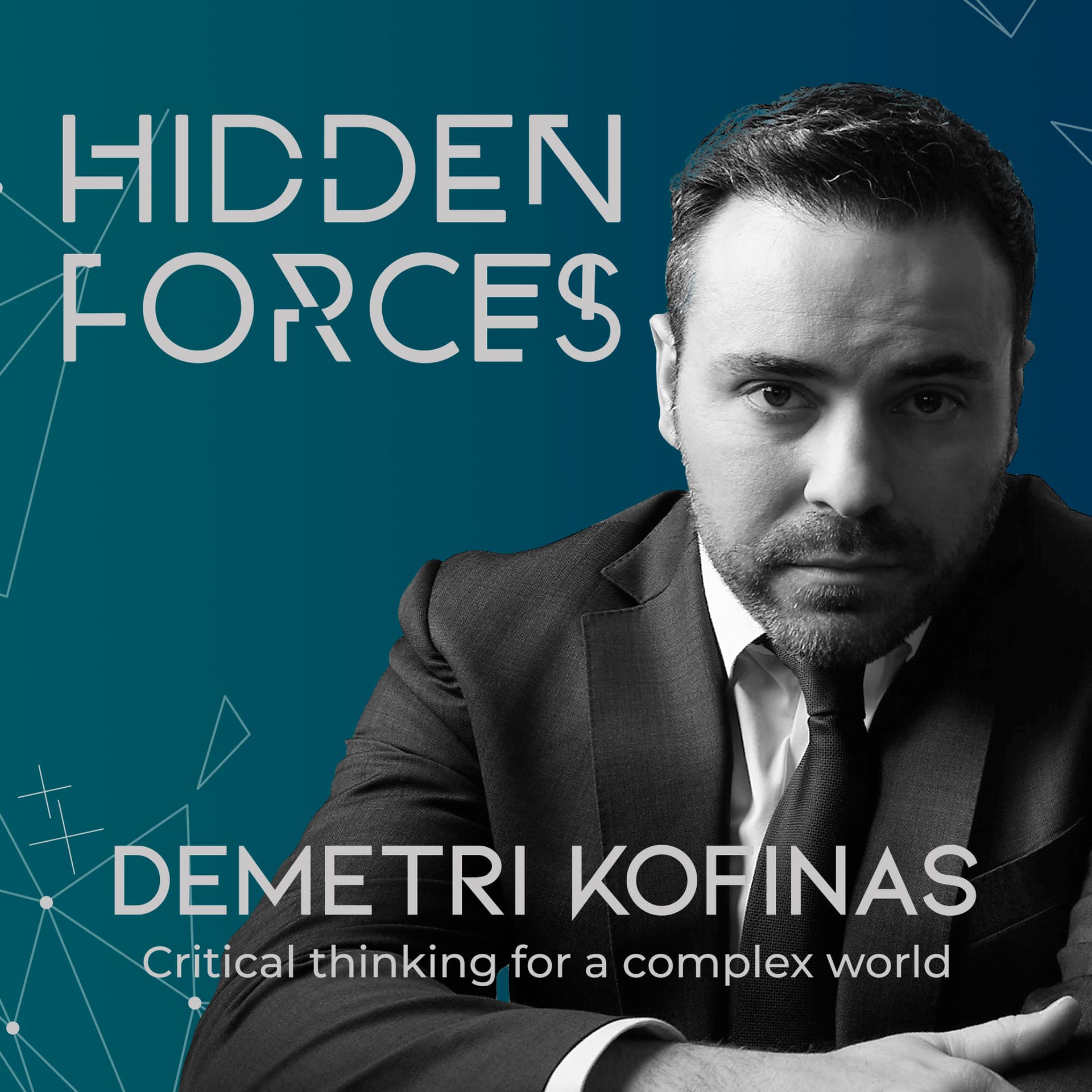
In Episode 494 of Hidden Forces, Demetri Kofinas speaks with Mark Galeotti — host of In Moscow's Shadows and one of the most informed and provocative voices on modern Russia — about the war in Ukraine, the risk that it spills over into NATO's eastern flank, and the escalatory paths and deepening dependency on Beijing that will define Russia's place in the emerging global order.
The first hour takes stock of Russia's war in Ukraine, a conflict Galeotti describes as several wars happening simultaneously — a grinding battle of attrition in the Donbas, an economic war of deep strikes on refineries and critical infrastructure, and a political war that has enveloped not only the conflict's chief counterparties but every major power and regional bloc for whom this war has become the central battlefield in the emergence of a new global order. They discuss the human and economic costs of the fighting, the strategic aims of Europe's nation states and how those align with Washington's, and the fraying, increasingly uneven state of Western support, before turning to the mind of Vladimir Putin — the insecurities Galeotti places at the core of his character, his survival instincts, his narrow circle of trust, and the forces shaping his perception of how the war is going.
The second hour explores what Putin would actually need in order to end the war, why he keeps chasing a symbolic victory in the Donbas rather than the settlement presently available to him, and why his aversion to weakness is essential to making sense of his calculations. The conversation then turns to succession, what tends to follow the death or departure of a personalistic ruler, the lessons of Stalin's untimely death, and why Galeotti expects any transition of power in Moscow to reflect the will of a coalition of post-Soviet elites rather than the machinations of a younger, smarter Putin. They weigh the escalatory paths that worry European capitals, from a direct challenge to NATO's eastern flank to the campaigns of sabotage, subversion, and hybrid warfare that Galeotti considers more plausible, and close by examining how America's entanglement in the Middle East has been received in Moscow, what a hollowed-out but battle-hardened post-war Russia could mean for the world, Moscow's lopsided and deepening dependency on Beijing, the prospects for Washington to cleave Russia away from China's sphere of influence, and what all of it means for energy markets and the global economy.
Subscribe to our premium content—including our premium feed, episode transcripts, and Intelligence Reports—by visiting HiddenForces.io/subscribe.
If you'd like to join the conversation and become a member of the Hidden Forces Genius community—with benefits like Q&A calls with guests, exclusive research and analysis, in-person events, and dinners—you can also sign up on our subscriber page at HiddenForces.io/subscribe.
If you enjoyed today's episode of Hidden Forces, please support the show by:
-
Subscribing on Apple Podcasts, YouTube, Spotify, Stitcher, SoundCloud, CastBox, or via our RSS Feed
-
Writing us a review on Apple Podcasts & Spotify
-
Join our mailing list at https://hiddenforces.io/newsletter/
Producer & Host: Demetri Kofinas
Editor & Engineer: Stylianos Nicolaou
Subscribe and support the podcast at https://hiddenforces.io.
Join the conversation on Facebook, Instagram, and Twitter at @hiddenforcespod
Follow Demetri on Twitter at @Kofinas
Episode Recorded on 08/11/2026