In short
Hedge fund manager Alap Shah argues AI is a substituting (not enabling) technology that will compress the “supply curve for intelligence,” reducing demand for human cognitive labor and potentially depressing the consumer economy and democratic politics. He says the prior “white-collar escape valve” (workers moving from routine cognitive tasks into non-routine cognitive roles) is closing as agentic systems automate non-routine work.
Guest background
Alap Shah is a hedge fund manager and co-author of The Global Intelligence Crisis (three-part essay series). He has 20 years as a public market investor (Viking, Citadel) and 15 years as an AI builder; he built Centio, a “Google for financial information” search intelligence platform.
Key claims
AI agents disintermediate internet and financial services by removing intermediation “search costs” and contract frictions; labor share of income may fall toward ~50%, triggering policy responses.
Notable examples
software feature creation shifts from weeks of PM/design/engineering cycles to ~20-minute Claude specs and <1-hour working prototypes; investment analysis increasingly done directly via Claude/ChatGPT instead of analysts. Proposed interventions: tax labor-like “agent work” (FICA/Medicare parity), support gig-style benefits, raise corporate taxes on AI-driven job cuts, and fund an “AI dividend” (Alaska Permanent Fund-style). Forecast: both major parties move left economically while cultural divides persist.
Written by AI. May contain mistakes. Listen to the episode to check what was said.
Chapters
Tap a time to open that second in VOUnderstanding AI's Impact on Society
0:44 to 1:23
Alap Shah discusses the profound implications of AI for employment and politics.
The Reception of Alap's Article
2:20 to 3:37
Alap reflects on the unexpected impact of his co-authored article on financial media.
“please enjoy this conversation about AI and its impact on the economy and society with my guest, Alap Shah.”
Discussing AI Fears and Societal Impact
3:37 to 6:34
Exploration of societal fears related to AI and its potential displacement effects.
“get into what you guys talked about in that piece, which was part of a three-part series that you had written, the second part was something that you guys co-wrote.”
The Evolution of Software Development
6:34 to 11:39
Alap shares his personal experiences transforming software development processes with AI.
“So you guys stated up front at the very top that this was a thought experiment.”
The Central Argument of the Global Intelligence Crisis
11:39 to 14:01
Alap outlines his argument regarding the economic implications of AI substituting human intelligence.
“is sort of upstream of everything else that's coming for software, but broader for society.”
The Impact of AI on Employment and the Economy
14:01 to 17:48
Explore how AI might disrupt job markets and economic stability.
“We have a truly substituting technology.”
The Evolution of Cognitive Work in the AI Era
17:49 to 23:19
Discuss how AI is changing cognitive work and its implications for the workforce.
“So I would push back to say that it's not required that this be better than humans.”
Intermediation and the Future of Human Labor
23:20 to 28:00
Analyze how AI and technology are reshaping the role of humans in the economy.
“Look, I will tell you that I have seen, I use Claude all the time now for my pre-production and especially for my post-production work, which is much more routine.”
The Transformation of Intermediation in Our Economy
28:00 to 31:20
Explore how agents and AI will redefine intermediation in various sectors, enhancing efficiency and productivity.
“the three-part series, was your observation about trillions of dollars of enterprise value having built on monetizing human limitations, essentially the frictions in our economy.”
The Skills Advantage in an AI-Driven World
31:20 to 36:00
Understand the skills needed to thrive in a future dominated by AI and the importance of entrepreneurship education.
“The other place that is a huge intermediation layer is financial services.”
Show all 17 chapters
Concerns About Job Displacement Due to AI
36:00 to 40:00
Discuss the potential risks of AI on job displacement, especially for entry-level positions and recent graduates.
“It becomes a new source of competitive advantage.”
Proposed Reforms for an AI Future
40:00 to 42:05
Examine the necessary policy changes and social safety nets required to adapt to the rise of AI in the workforce.
“cover in part three of the global intelligence crisis.”
Navigating the Shift in Job Markets
42:05 to 43:11
Learn about the evolving job market due to AI and the gig economy.
“And so that's a very simple fix that we think we should make.”
The Need for Corporate Taxation
43:11 to 45:06
Discover why taxing corporations replacing jobs with AI is essential.
“And so the way that we've structured the plan is to focus on what is labor share of income.”
Investment Implications of AI's Rise
45:06 to 47:18
Understand how AI's growth affects consumer spending and investments.
“you know, essentially use the earned income tax credit framework to help those folks.”
Political Realignment in Response to AI
47:18 to 51:48
Explore potential shifts in political alignment driven by AI's impact.
“And so that will be the other side of that barbell where semis keep going up, but the consumer economy, which is the bulk of the US economy, will suffer.”
The Importance of Proactive Political Responses
51:48 to 53:18
Learn about the necessity for timely political action regarding AI.
“And by 2028, I think it's going to be the only issue that matters because it's moving that fast.”
Transcript
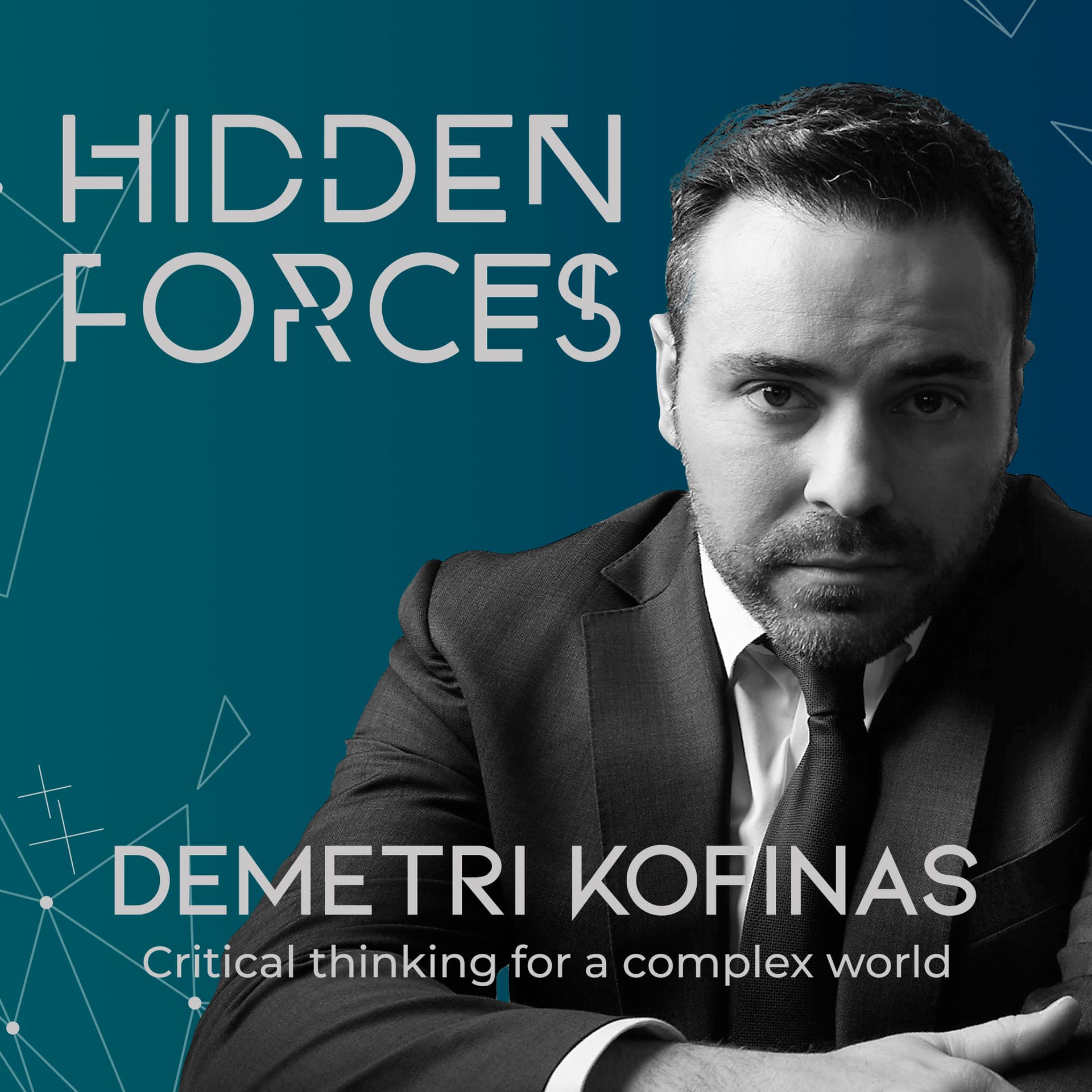
Automatic transcript. May contain errors.0:00Demetri Kofinas:What's up, everybody? My name is Demetri Kofinas, and you're listening to Hidden Forces, a podcast that inspires investors, entrepreneurs, and everyday citizens to challenge consensus narratives and learn how to think critically about the systems of power shaping our world. My guest in this episode of Hidden Forces is Alap Shah, a hedge fund manager and co-author of The Global Intelligence Crisis, a three-part essay series examining the economic, political, and social consequences of the dawn of artificial intelligence. In this conversation, Alap argues that AI is a categorically different technology from those that came before it, with profound implications for employment, the consumer economy, and democratic politics.
0:43Demetri Kofinas:We discuss why he believes the white-collar escape valve that absorbed displaced workers in past waves of automation is closing, the synthetic short on the U.S. consumer economy embedded in today's AI trade, the disintermediation of internet and financial services by agentic systems, and the policy interventions from new corporate taxes to an AI dividend fund that he believes will become politically necessary as labor share of national income declines. The conversation closes with Halap's forecast of a coming political realignment in which both major parties move meaningfully leftward on economic redistribution, while the cultural divide between them remains largely intact.
1:23Demetri Kofinas:If you want access to the transcripts and intelligence reports for this and other episodes, which include summary sections with key takeaways, you can access those by subscribing to our super nerd tier at hiddenforces.io slash subscribe. If you want to join in on the conversation and become a member of the Hidden Forces Genius community, which includes Q &A calls with guests, discounted access to third-party research and analysis, and in-person events like our intimate dinners and weekend retreats, you can also do that on our subscriber page. And if you still have questions, feel free to send an email to info at hiddenforces.io.
1:59Demetri Kofinas:And I, or someone from our team, will get right back to you. Lastly, because this conversation deals with investing. Nothing we say on this podcast can or should be viewed as financial advice. All opinions expressed by me and my guests are solely our own opinions and should not be relied upon as the basis for financial decisions. And with that, please enjoy this conversation about AI and its impact on the economy and society with my guest, Alap Shah.
2:31Demetri Kofinas:Alap Shah, welcome to Hidden Forces. excited to be here. Awesome. So you first came on my radar because of a piece that you co-wrote with a former guest of the podcast, James Van Galen, also known as Citrini Research. And this was, remind me again when this piece was published? Late February. I was going to say two months ago. So that was more than two months ago. We're recording this on May 25th. So I guess three months ago. That was an explosive article. I I mean, I remember that it was one of those rare works or interviews or something, piece of content that effectively broke the news cycle within a certain segment.
3:13Demetri Kofinas:And that segment is financial media. And it was even attributed to certain SaaS companies selling off. And you guys got a lot of heat and blowback. Now, this was a thought experiment. So, it was quite interesting to see the reaction of people. I went back and reread the piece since it first came out. And it was interesting how it felt reading it now versus reading it then. But I'm just curious, before we get into what you guys talked about in that piece, which was part of a three-part series that you had written, the second part was something that you guys co-wrote. But before we get into what it was, just tell me a little bit about that experience.
3:50Demetri Kofinas:What was your sense of the impact that this piece would have when you were first writing it and preparing to publish it? Sure. It was quite interesting because we knew we were writing something that was quite important and that was very topical to what everyone was focused on. And we had certainly a unique point of view versus what else had been out there. But certainly we did not expect the level of pickup that we ultimately saw. And, you know, we didn't expect the level of kind of pushback. But it made sense in retrospect when we thought about it and we sort of looked back at things because we were saying something very thought-provoking and ultimately something that while being a thought experiment was quite scary.
4:29Because we're all in this world right now together where we're experiencing AI on a daily basis. We're seeing the improvements. We're seeing how fast it is improving and we're seeing how much of our own lives are being changed. in a lot of our cases, how much of the work we do day in, day out can, if not be replaced, significantly augmented today by AI. And certainly in a world where if we just draw those timelines out and continue to see similar progress, a lot of it could be replaced. And so really felt like we hit a significant nerve around this idea that there was huge risk of displacement.
5:04And also that, you know, that just contributed to this broader sort of malaise and fear that we have in our society today around, you know, a lot of ways, the American dream not being what it used to be. And, you know, even more risk around, you know, where's my place? What am I going to do? And, you know, is there a world and a social support system and a political support system to be able to protect me if that happens? And so I think we kind of really touched a nerve in all those things together. And I think that was the reason why it had the pickup that it did. Ultimately, that was the intent to get people talking about it and really focused on what could happen, because ultimately the way that I think about this is it is in a lot of ways the most transformative technology we've ever seen, but it is also something that we as society need to grapple with much more than just us, you know, as technologists and as financiers.
5:53And as a society, we're not doing a good job of that. We're very, very early in talking about it. And so ultimately we put it out and the reason for it was we wanted to get the dialogue going. And, you know, in that sense, it has been heartening to see a lot more discussion and, you know, excited to come on formats like this to really get that discussion going because ultimately there are very clear solutions to this problem that are around our political economy and ultimately how we deal with taxes. And if we get those things right, which we should, but it's going to take a while and it's going to take a lot of compromise, but should we get that right, this is the most beautiful sort of opportunity for humanity to flourish.
6:32But there's a lot that has to happen to get there.
6:34Demetri Kofinas:So you guys stated up front at the very top that this was a thought experiment. So you were very explicit about that. And yet the backlash you got from a lot of people was pretty significant. And when I reflected on it the second time that I read it, I came to the conclusion that essentially when you say you touched on a nerve, that there is a real fear out there. And what essentially that thought experiment did was it stoked those fears. And a lot of people took that personally, got upset. And it's very interesting because other topics don't do that, but this one did. And I think it speaks to just the level of fear out there.
7:14Demetri Kofinas:And I think you're right to align not just fears people have about AI, but also fears people have in general and have had for years about not making it, of not getting to participate in runaway asset growth, or not having enough money to purchase a home or that others are making it and they're falling behind in this increasingly case-shaped economy. So I think it's important to kind of put that up. Would you agree with that? I mean, I think I'm pretty much echoing what you just said, but would you agree with that sentiment? Absolutely. It's just the AI is sort of the next thing that folks are even more concerned about to pile on top of everything else.
7:47Demetri Kofinas:And there's a lot of confusion and a lot of different opinions, even amongst those people that one would look to for expert answers on the topic. So also important to keep in mind as we go through this. So one more question for you. As I said, you guys co-wrote part two of this Global Intelligence Crisis three-part series. The first one that you wrote, what is the origin of this sort of three-part series? And then walk me through the argument that you make in the pieces. So part one was more of an overview of how I came to the idea. And to do that, I quickly sort of laid out my background and why I was uniquely qualified to opine on this topic.
8:25And the reason I believe that's the case is I have 20 years of experience as a public market investor. I was at Viking. I was at Citadel. I've been running my own fund for over a decade. I also have 15 years as an AI builder. When I left Citadel in 2011 to run my own fund, I realized that ultimately all I did was process data all day. And the tools I used to process that data, Bloomberg and a lot of others, were all very dated for what I needed to do. And so I ultimately ended up building my own search intelligence platform called Centio. The idea was essentially Google for your financial information, which didn't exist at the time.
8:58That made me a much, much more broad and fast investor that had a huge impact on my returns and eventually scaled that business to a few hundred people on my team and a few thousand clients before we sold it to a competitor. But in the process, I saw kind of soup to nuts from me and my brother in my apartment to a decent-sized company, what it takes to build and especially build an AI, and the size of the impact I was able to have on my own workflow when I was able to really utilize the most powerful tools that were out there.
9:29Demetri Kofinas:Before we get into the argument then, since you brought up your work experience, what have you specifically watched happen in your corner of the world that you would say was the most paradigm shifting for you around AI capabilities and what's coming? Make this concrete for people. Two examples. I think the most important one is today I run a couple of different companies where we build software for external users, for internal users. And a few years ago, and even a year ago, the process had not really changed. It had gotten a little bit more efficient, but it had not fundamentally changed. It was still, I had an idea for a new feature.
10:05I would speak with a product manager. together, we would work with the designer to build the designs. And then we would ship that to a team of engineers who would, you know, maybe a week later, two weeks later, would come back with a prototype. We would look at the prototype, we would, you know, give feedback and push back on a lot of the prototype. And then we would do another round of revisions, you know, maybe three weeks, a month later, that idea would turn into a shippable feature. Since the advent of Agentec AI and coding interfaces since last summer, and really for us since last fall, that has just fundamentally changed.
10:39Now, my process, if I want to create that new feature, is I talk to Claude, and in the course of 20 minutes, often less, I have a clean spec. And then, you know, within under an hour, I can have something that's actually working. It's not going to be the thing that I'm going to ship to a client, but it is very, very powerful to iterate and get 80, 85 % of the way there in a very short time period. And so that has just fundamentally changed how I think about software development. And in a lot of ways, software development is just the tip of the spear, the thing that we've got the most training data on, the thing that we focused on the most.
11:15And thus, it's the thing that is accelerated the fastest. That means that ultimately, the teams we need to build software are much smaller, they're much leaner, they're much more agile, we can move a lot faster. And today, for us, that doesn't mean we're not hiring as many folks. But I think it will likely mean that in the future. And I think it is going to mean that for larger companies since I'm primarily running small agile companies. And so that has been the fundamental change that I think is sort of upstream of everything else that's coming for software, but broader for society.
11:44Demetri Kofinas:Okay. So I actually look forward to talking with you as well about how many of these gains can be generalized. In other words, what we're seeing in the area of software development, where else does that, do you expect that to filter through? It sounds like you expect to filter through to almost, if not all other jobs. So I'd like to understand the principle there behind your thinking. Again, let's go back to your central argument. Lay that out for me as best you can. The central argument that animates the three pieces of the global intelligence crisis. Absolutely. So at a high level, human intelligence is an extremely important, if not the most important input into the production function.
12:19We need it to make pretty much everything. And the underlying idea there is this has been a bedrock of how the economy works. Knowledge work is really important. Ultimately, white collar workers generate the majority of the wages in society and drive the vast majority of the spending. For the first time ever in the last six months, AI has gotten to a level of capability where it is able to begin to substitute for some of that cognitive work. And ultimately what that represents is just a huge rightward shift, outward shift of the supply curve for intelligence. And as it becomes more and more competitive with human intelligence, it is going to substitute more and is going to drive the price of a unit of human intelligence down.
13:04In a world where a price of a unit of human intelligence goes down significantly, there are just massive downstream consequences of that throughout our entire economy that haven't really been dealt with or thought through clearly. Ultimately, what that means is that there's going to be less demand for human intelligence. And the fundamental argument that the bulls are making is that, part of which I don't disagree with, but the idea is, okay, great, we have way more intelligence in the world. We always need more intelligence. That is going to lead to more GDP growth, more productivity, and we're going to be completely fine.
13:38There'll be more jobs coming out of that. The place where I push back is every previous boom of technology like this has ultimately been one where the technology that was booming was a enabler of human labor. And so, yes, you needed fewer telephone operators, but that led to all kinds of other white collar jobs. The problem this time is we don't have an enabling technology. We have a truly substituting technology. It can just do the work that humans would previously do. And so if you take that as a given, which is a big debate, which I'm happy to get into, But if you take that as a given, and it is truly substituting, then it is not clear where the new jobs are going to come from in this sort of GDP growth world.
14:20And so if that happens, we have this sort of problematic transmission mechanism where historically, okay, more GDP growth, more jobs, but new jobs will show up in to replace the old jobs and we'll be fine. This time around, the difference is if those jobs don't show up, we could have this insane, amazing AI productivity boom, but it could actually lead to a huge slowdown in the economy rather than a speed up in the economy once it really gets going. And the reason for that is that those jobs, even if, let's say, 5 % of jobs in the U.S. go away, they will be very high-paid, white-collar jobs. And our economy is ultimately a consumer economy, meaning that those folks are going to stop spending, especially as the safety nets run out.
15:06And more importantly, if you, you know, I think this is happening in a lot of tech companies today. If you look to your left and your right and the person who, you know, was working in accounting next to you, was working in operations or customer success has now lost their job. You still have your job, but you're massively going to retrench on your spending and take your savings rate up very significantly. And so it won't take that much for those folks to really have an impact on the economy. And those folks who do lose their jobs, they're going to go into the blue collar economy to find an additional job if there isn't white collar work available.
15:37And so they're going to depress the blue collar sort of supply demand balance as well. And so all of this could very quickly lead to a situation where you have a very depressed consumer economy. And once that happens, it could be pretty self-fulfilling because those companies will cut. The consumer economy is ultimately the U.S. economy. And so from there, the problem is it won't necessarily balance because historically in that world, what happens? The Fed comes in and they say, okay, you know, it's very, you know, inflation is low or negative now, we need to cut significantly and in the process boost demand.
16:10The problem is the demand for those folks that are already slowing down is not really going to bounce in a world where they're worried about AI getting more and more powerful. And so all of the sort of traditional heuristics around how economic cycles work will stop applying in the same way because AI is just this completely new technology. And so we need a new framework and a new playbook to deal with it is ultimately sort of our argument.
16:34Demetri Kofinas:So I definitely, I think where I'm probably at least at the beginning of this conversation, before we got into the end of it, because I'm waiting to see if you can convince me otherwise, but I tend to agree with you from the standpoint that the rate of change is different for this technology. Where I'm not yet convinced, and I want you to try to convince me in this conversation and those who are skeptical in the audience, is that this is a different kind of innovation cycle. And when I say different kind, I mean different, not just in the way that the industrial revolutions one and two was different from the IT revolution, assuming that this is not actually part of that larger IT revolution, which is a different question, but that it is different from all of those in a substantive way so that it sort of just breaks the economy in a way and society in a way that the previous ones didn't.
17:22Demetri Kofinas:And fundamental to your claim, it seems to me, is that what you just said earlier, which is that human intelligence is substitutable in this case, whereas it wasn't in the previous cycles of innovation. And I'm yet to be convinced of that. So walk me through why you believe that these large language models are basically going to become so good that they will exceed human intelligence in every single domain that we can possibly think of. Such that, importantly, such that there is no room for innovation in the place of cognitive work so that the existing roles that we have today that people do, that can, and I agree with you, should be substituted by AI, that those can't be replaced with other forms of cognitive work that AI cannot do.
18:13So I would push back to say that it's not required that this be better than humans. In a lot of ways, all it is required is that they be almost as good as humans to substitute a large amount of today's labor because ultimately, Humans are expensive to employ. They require lots of time off, benefits, et cetera. And most importantly, an organization is a collection of humans and increasingly agents that are trying to get something done. And the problem is most humans, to get more than a small group of humans rowing in the same direction to get something done, there's a large coordination tax. I wrote in my piece, I think in a lot of ways you can think about the entire Microsoft office suite as just a large coordination suite for humans.
19:03So Outlook, Word, PowerPoint, these are all different ways to get people together and understand why we're doing something and how we're doing something. The beauty, but also the scary thing about agents is they don't require any of that. They will work 24-7. They don't need benefits. The cost of doing a unit of work is a tiny fraction of what it costs a human to do something. I would typically, the numbers will represent less than 1%. And they don't require coordination because they can all be singing from the exact same context, the same song sheet. One of them learned something, you can update that in real time.
19:34The other ones basically know in real time. So you put all those things together and you're in a situation where it doesn't really take that much, not for all humans to become unemployed, right? That is a far cry from what we're advocating here. But we're in a world where we haven't really seen white collar job growth in the US in many years. And into that world, we are now seeing agents enter and AI enter in such a way that it doesn't take much to have a company say, you know, we're going to cut 10%, we're going to cut 15 % and move that over to a combination of agents, but more importantly, those most productive people in my organization who now can do five times, 10 times as much.
20:14And those are real numbers that we're seeing in a lot of places where the most productive folks in an organization are just being enabled in unbelievable ways by AI.
20:23Demetri Kofinas:So just to be clear, I actually think that, so to your point about super intelligence versus intelligence that's comparable to humans and costs much less, I don't necessarily disagree, but within the existing domains of cognitive work that we can cite currently, my question is, why do you feel so confident in the long term that large language models and AI will dominate from an economics perspective every single domain of cognitive work? That's a sweeping statement. And so what is it that you have seen? What is it that you can point to that makes you feel so confident in the capability of these systems?
21:08The first thing I've seen is just I see it in my daily life, day in, day out. My process for building software has completely changed. We need 30 or 40 % of the number of people that we did in the past. And I myself, as a leader of the organization, can get so much more done without having to consult with any humans. And a lot of the latency and the drag around getting things done in an organization is senior management, figuring out how to get things done and how to start if you want of something. And now I can hand my team something that has been reasoned through with an LLM for an hour or two that is quite crisp and has most of my thinking built in.
21:48Something I could never do before. And so it massively increases the velocity, which is a huge positive, but it also means I need less of those folks on my team. The other example is I run an investment fund. And previously, you know, the more analysis I needed to do, I would hire more analysts. And I increasingly find myself just going directly to Claude and ChatGPT and not going to analysts much at all for that analysis because all of that data is sitting in the system. Because imagine if you had an analyst that instead of spending 20 minutes figuring out your query, could respond in 30 seconds and had the full internet's knowledge built in.
22:24And that's sort of the world that we're in today, I find for myself with financial analysis. And so it is something where I can prompt the thing, it gives me the answer, and I've iterated on three or four more decision branches before ever having to talk to anyone else. And so in the process, I see myself just massively accelerated where I'm running multiple businesses and I'm able to just me plus my AI cover so much ground in a way that I never could before. And so there is absolutely the opportunity for everyone to be this accelerated. But the way our society is set up from a wage perspective is that that is going to concentrate the spoils to very, very few people.
23:03And so it doesn't take anything to be super intelligent. It's just where those things are positioned and how they're able to accelerate leaders is something that is really positive, but also what is going to happen to the bottom half of the distribution is ultimately what I'm super focused on from a risk perspective. Yeah.
23:20Demetri Kofinas:Look, I will tell you that I have seen, I use Claude all the time now for my pre-production and especially for my post-production work, which is much more routine. And it's been incredible. I'll acknowledge that. But yeah, I guess we don't have to try and sort of sort this out, at least not at this moment, because there are other things I want to ask you about from your thought piece. But at the end of the day, this is all in service to me. I can't rely on Claude to do things autonomously at anywhere near the level that I am able to do them in conjunction with the AI. And you acknowledge this as well, that you're using the systems in service to you.
Read the full transcript
24:01Demetri Kofinas:So I certainly can see how this disintermediates the economy more, how it advantages startups in many ways and reduces the headcount for a lot of companies, at least startup companies that need fewer resources to start up, what that means for job losses at corporations and how the politics at these companies maybe create some inertia, I don't know. Okay, so that kind of begins to address the question of why do you think this time is different? In the piece, you also argue that AI is the first technology that targets the non-routine cognitive work that absorbs every prior wave of displaced workers, and that essentially this is going to be a problem for employment.
24:42Demetri Kofinas:So my question is, separating questions of super intelligence and high-level cognitive replacement, why is it a problem if non-routine work goes away? Because the specific framework that we're referring to here is think about a two-by-two matrix of manual labor and cognitive labor, and then think about routine work and non-routine work. The first quadrant being manual routine work that has begun to be automated since the dawn of the industrial revolution, right? The factory line is sort of the best example of that. So those jobs have gone away. That leaves you the other three quadrants. Since the 1980s and sort of the first sort of IT revolution, you started losing a lot of the routine cognitive work.
25:26This is sort of like, you know, things in accounting and things like that, if you think about it. The reason that that automation did not lead to significant job losses is that most of those folks moved into cognitive non-routine work. This is sort of the work that most of our white-collar work is today. And the problem is that that was the escape valve for all of those white-collar workers. And that escape valve, our belief is, will no longer hold in this AI-first world. Today, you're right, the AI cannot sort of take a full task and do it end to end. Some of them are getting better, but they're not quite there yet.
26:04But ultimately, the reason I think that the risk is so large is we have to just look at the trend lines and how these trend lines are progressing, where we have this exponential trend line of AI improvement that has been, in a lot of ways, going for almost a decade. But really, if you think about ChatGBT as the starting gun, has been going for well over three years now. And we're in a world where as those trend lines continue to trend upward, and this is an exponential, so the growths are tremendous. But most importantly, what are we doing as a society and what are we doing as an economy in response to those trend lines?
26:40We're putting more and more dollars and focus into the AI story and especially AI CapEx. By 2028, AI CapEx will be more than 1 % of global GDP. I think that is a floor and it will continue to go up. I mean, just look at what's happened to semiconductor stocks in the last even month. It's very clear to everyone that the ROI on these things, look at what happened to semiconductors and look what's happened to Claude's run rate RAR in the last few months where it's adding the equivalent of entire SaaS complexes in ARR in a single month because it's becoming that powerful and it's becoming that useful.
27:16And so this virtuous cycle has taken off and it's going to a new level. We have most of the world's most intelligent people all focused on the same problem. And so you put all those things together, you have the compute, you have all the algorithmic improvement, you have the capital that is backing it. And you're in a world where we're going to see continuous accelerating AI capabilities even more than we've seen in the last three years. So just consider what that would mean a year from now, two years from now. You put all those together and that's why I've got a reasonable level of confidence that a lot more intelligence is coming from AI and ultimately that's going to mean that there is going to be a lot more risk around replacement of human labor.
27:57Sure.
27:57Demetri Kofinas:So I think maybe the thing I enjoyed the most, and this was probably in the part two of the three-part series, was your observation about trillions of dollars of enterprise value having built on monetizing human limitations, essentially the frictions in our economy. Walk me through this argument and tell me a little bit about how you guys came to it, this observation, this belief about essentially everything in the middle getting wiped out. Yeah, it's really interesting because I've been an investor and a student of the internet for almost 20 years. And if you think about what the internet ultimately does, it helps you find information and then helps you find goods much more easily than you could before.
28:44So that's ultimately just a form of intermediation. And if you really take a step back and think about what our economy is, it's a ton of intermediation. You know, there's lots and lots of search costs and pre-internet, things were really hard, you know, to get information. And now they've gotten easier and easier. And so a huge amount of our economy and especially a huge amount of our market cap is just a tax on, you know, human time, human laziness and human imperfect information. And agents flip all of that on their head. You know, you and I, to save a buck, are not going to run three or four more searches on our phone and spend an extra few minutes.
29:23For an agent, that is a trivial thing to do. You and I are not going to find every listing. We're not going to be able to go in and understand all the pros and cons, read all of the reviews of a given product. Agents flip all of that on their head where they can be infinitely patient and they can find all that information. And if you think about a world where today, the way we work is we open up our phone and we're going to go to our trusted app to go in and find how to get a pizza, how to get a ride, how to book a hotel. But in the world that is coming, in the world that, you know, the reason we came to this thesis is because I'm kind of living in this world already where I'm running agents for all these things.
30:06It just fundamentally changes how you behave. Where your phone, imagine, let's say, it's a year from now and either this is happening on your Android phone or using Gemini or using ChatDBT. and instead of opening up the DoorDash app, opening up the Uber app, opening up the booking app to book something, you just speak into your AI or into your phone, you know, order me a pizza from Joe's, book me a four-star hotel in Boston for me and my family and it does the rest, right? That's the world we're rapidly moving to. In a lot of cases, you know, I'm able to do a few of those things today and that world will be one where all of those intermediation steps that created some of the largest companies in the world and created some of the big what was historically perceived as some of the biggest moats in the world will essentially be completely flipped on its head are all those businesses going to go away of course not you know they're going to adapt and there's going to be new opportunities but there is going to be a huge sort of aggregation of demand into these companies that are driving the intent.
31:09And it will make humans way more productive, we'll be able to get way more done, we'll be way more efficient. But it will also mean that we don't have to pay any of the taxes of an intermediation layer. And so most of the internet is an intermediation layer. The other place that is a huge intermediation layer is financial services. Most of the financial services that we consume, again, we have our trusted partner. We use our banks for all kinds of things. We use a few other insurance brokers and whatnot to buy most of the information, and the financial products that we require. But it's the same thing.
31:38It's because you and I don't want to read the 20 pages of an insurance contract to understand what the pros and cons are. And last year, I had this insurance contract. I probably didn't use it. I'll just renew and I'll go along my merry way. Whereas instead, the agent's going to be able to find, A, it's going to be able to find the best contract, but it also is then going to be able to iteratively negotiate on your behalf to find the one that is willing to give you the best deal, you know, the most product for the least money. And so you put that together across these industries, like around internet and financial services, it's a huge percentage of our market cap and employment.
32:15And I do believe that a lot of that is going to have a huge, huge sort of negative impact from agents, which the really good news there, though, is most of those surpluses are going to flow back to individual consumers. And that will hopefully cushion some of the blow from potential job losses as well.
32:31Demetri Kofinas:Okay. So I think we're certainly capable of revisiting some of the negative knock-on effects. And we haven't even really talked about the doom loop that you guys wrote about, which you touched on early on in the conversation. What are the skill sets that you envision that will be advantaged or are advantaged in this world and that will become more advantaged? The skill sets, and if you want to, you can describe them also as jobs, but I mean, more fundamentally, who are the individuals that are going to be well-positioned of this world? People who are agentic by nature, who are able to use the AIs and ultimately - What does that mean?
33:09Demetri Kofinas:Because I've heard that term used a lot and I don't really understand it. I mean, it sounds like they're saying basically people that are conscious, but even that doesn't quite track with me. People with initiative, first and foremost, I guess what I would say is if you have a vision of a thing you want to do, a thing you want to build, These AIs are so empowering in a way that nothing else has been. The company that you previously could not have started, now you can start with essentially a Claude subscription. Previously, you'd require people to help you build the product and people to help you market it and people to help you serve your customers.
33:44Those people are still required, but you need a lot fewer of them. And especially to get started, it's really powerful to just be able to come in and say, hey, build me this thing. find me these customers, help sell these customers. That is the most promising and exciting part of where we are today with AI, and it's only going to get more powerful. So people who have that initiative, that have that vision, that in the past really just wouldn't have had the capital to go and build these companies. Now the capital requirements are way, way smaller. At the same time, there are more dollars available for these sorts of entrepreneurship.
34:18Demetri Kofinas:Just to make that more concrete and tangible for people, are you essentially saying that people who possess the skill set that's commonly seen in entrepreneurs are going to be advantaged? Or is there something that we can distill even further in this notion of, you know, being ambitious, being driven, being uninhibited, having initiative? People with the entrepreneurial skill set absolutely are going to be hugely empowered. But ultimately, I think this is something that we as society need to embrace and, you know, our education system especially needs to embrace is the skill set of entrepreneurship needs to become much more broadly distributed and taught.
34:53Because that is the skill that I think will become most important in our society is that initiative is the way that you would direct your AI, your set of agents to bring about a new product, new change in the world. And that's not just, in a business sense, it's true for any sort of pursuit where the ability to direct AI in a way where you understand what it's good at, what it's not good at, and how that maps against, you know, whatever the requirements of your customer are, or of, you know, a cause that you're working on, it's sort of the most important skill. And it's not one that's necessarily being taught in school today.
35:30It's not even one that's necessarily being taught in the workplace today, but it is becoming increasingly important. So this idea of sort of AI and agentic literacy is in a lot of ways going to be upstream of just being a productive human in society. Yeah.
35:45Demetri Kofinas:So no, I'm glad you brought up education because I think there are both huge opportunities there and it's also very exciting what can happen. And I also agree, and we're going to have a chance to talk about this, about the need for reform at the state of the social compact, the social contract. But I still don't understand why. Because in a world where individuals who are, let's say, have what we more commonly think of as the entrepreneurial skillset are advantaged, I don't understand why that advantage, which seems to be unique to human beings, based on my extrapolation of your argument around the differentiation of agency, why that doesn't become one of the new pillars around which society is organized, or the gains of the new economy are distributed.
36:30Demetri Kofinas:It becomes a new source of competitive advantage. That's what I'm not understanding. In other words, I feel like there's so much that I don't understand and can't imagine about what the new economy is going to look like. And you're not the only one. This is a common view. So your article hit on a nerve and a lot of people are worried about this. And again, I want to emphasize further that when I have seen some of the things that Claude can do, I've had moments where I look inside and look at my business. I say, am I going to be replaced? When I see Notebook LM having two hosts talking about a topic, I'm like, what is the value that I provide.
37:06Demetri Kofinas:But in each of those situations, I ultimately look inside of myself and I say, okay, I may not know how this thing is going to evolve, but I have to have some faith that I'll be able to navigate it. And I just think we haven't seen anything like this in so long that we don't appreciate how frightening some of the previous waves were, where I would certainly agree is this one does seem to be moving faster. But just why do you feel so confident that these areas that you've already identified as being points of differentiation between human beings and AI are not the new focal point around which the gains of this technology will be organized and distributed?
37:42It's the distribution that's the problem. Because the gains for folks like you and I are going to be very significant. But if you and I operating at the levels that we do are having real existential questions around, what am I going to be doing in a few years' time if this technology continues progressing at a similar rate, then what's going to happen, a great example I'll give you is what's going to happen to the person who just graduated from college at like a second or third tier university with a mediocre GPA within that college, right? We're already seeing a world where historically, young people coming out of college historically had much better unemployment rates than older folks.
38:28And that has very definitively flipped since 2023 and has gotten worse and worse every month. I'm seeing this in my own business. And I, you know, talk to friends who run companies and we see the same thing where historically you would invest in someone early on and they would take five to 10 years to really come up the curve and become, you know, some of your best performers when they got into their thirties. Now that ladder is just being pulled up for folks like that. And, you know, part of that is other parts of our economy having issues, but the ultimate driver of that I think is AI. There's a lot of data to suggest it is AI because, you know, that person in the first few years of their tenure are ultimately a bit of a drag on the organization and you're training them and investing in them for the long-term opportunity.
39:11And in a world where AI can do especially that entry-level work really well, in a lot of cases better at a tiny fraction of the cost, you end up in a situation where, those folks are just not going to be employed the way they have been in the past. And so I think those folks are at the bottom of the distribution in terms of their skill set and their experience set. And so it makes sense that that's where AI would hit first. And we're very clearly seeing that it is biting. And we can see it in our own day-to-day and we can see it in the numbers. And so if those folks are a proxy of AI today and AI's capabilities continue advancing at a significant rate, then why isn't that going to essentially apply to more and more of the population as AI continues to improve.
39:52That's ultimately, I think, what I'm most concerned about and what gives me some confidence that this is a real risk.
39:58Demetri Kofinas:So let's talk about what are some of your proposed interventions, which is what you cover in part three of the global intelligence crisis. What do you think needs to change? What policies need to be instituted on the part of government in order to address the social fallout that will stem from the advancement of these technologies? So the way that I've tried to structure this in part three of my piece is first and foremost, to think about this, not as if you were to rebuild our sort of economic system and taxation system for AI, tabula rasa, there's a lot of aggressive things that you would do.
40:37And I think we will end up in that world and we will be forced to do that at some point. But I wanted to lay out a plan that was much more of the moment that might have an opportunity to be passed in the next few years as society and our political economy wakes up to where things are moving very quickly. And so most of what we've proposed is more of an incremental, let's change our existing rules in this way so that we might get better outcomes. And so the first sort of obvious here is that we tax labor even today more than we tax AI. We have social security and Medicaid taxes on labor that doesn't exist at all when you instead tax corporations.
41:15And so we should fix that. That That should be a pretty easy fix.
41:19Demetri Kofinas:When you say fix that, what do you mean? You mean reduce income tax versus capital gains tax? No, it's just, you know, if an agent does some work for you, you know, it doesn't really, it doesn't get taxed in the way that if a human does work for you, you know, there's a seven or 8 % FICA plus Medicare tax on that. And so the easiest way to do that is like measure an agent's work and put a similar tax on that in the same way that you would an employee. because essentially the way the tax system works today is you have incented corporations to outsource work from humans to any form of automation.
41:53Historically, it was software and other forms of automation, including, you might even say, sending things overseas. And now we're increasingly incenting the use of AI rather than humans to do work. And so that's a very simple fix that we think we should make. And then the other side of that is we haven't really responded to the way the job markets have shifted over the last 20 years, where it's no longer, you know, a world where you come in and you have a job for many decades and you build a career. It's much more, we have portfolios of careers and people are doing different things and side gigs and there's lots of just gig work.
42:30That gig work doesn't come with any sort of benefits. It doesn't come with any sort of social safety net. And so a world where I think more and more of that is coming with AI, we should recognize that and we should build some sort of benefit system that moves with you from job to job. I think these are kind of very obvious, no-nonsense things that we should get done soon.
42:47Demetri Kofinas:And I would argue that that suggestion also, I think, applies even to the pre-AI world. The gig economy, I think, was itself made the case very well for something like that. Yeah. It's been a long time coming. Obviously, there's a bunch of vested interests that are pushing against that. But I do think that the world that we're moving into with AI is going to give that a lot more momentum to actually get something done. That's sort of step one, really obvious, no nonsense things. The thing that I think ultimately matter more is what happens when AI starts accelerating from here. And so the way that we've structured the plan is to focus on what is labor share of income.
43:23And so labor share of income, you know, started out in the 60 plus percent range, you know, in the 80s and 90s, and it's been trending down to around 54 % today. we say, you know, if that breaks definitively to the downside, so close to 50 and certainly below that, then a bunch of sort of new things should be triggered. Because essentially what that means is, you know, AI is continuing to zoom. Corporations are replacing human work increasingly with AI. And in the process, if we don't really focus on it, it's going to lead to a lot of the sort of scary scenarios that we're worried about. And so in that world, what needs to happen is there's a few different ways you could tax this, right?
44:01So Dario and others have talked about a token tax. And, you know, I think there's a world in which that makes sense, especially kind of the end state. But for now, the way we think about it is let's be really direct. Like Americans don't really like income taxes. They don't like increased taxes on the rich and they don't really like wealth taxes. They have a much less of a negative association with corporate taxes. And in this world, corporate taxes are the sort of ground zero of where the impact is coming from, right those corporations are the ones that are you know replacing all those jobs with ai and so we should tax them more heavily we should specifically tax corporations that are doing that and the easiest way to figure that out is the places where margins are just exploding right so if you're a company that is hiring more people your margins are steady your taxes shouldn't change at all but in a world where overall you know jobs are disappearing really fast then let's go directly to the source of where the jobs are disappearing the places where corporations are aggressively cutting humans.
44:56And let's go and tax right there and take those taxes and make some of the humans that have lost their jobs and can't find new jobs because AI is continuing to accelerate, you know, essentially use the earned income tax credit framework to help those folks. And initially, the idea is don't make that a giveaway, but instead make that just like the EITC focus on folks that find new jobs or new jobs are not available, who are looking for new jobs, who are reskilling or doing sort of community service work. So very much conditioned on continuing to work in some sense, but support those folks because you're likely in a world where the jobs are just not out there.
45:36And so that we think about as sort of step one is tax the corporations and use that to make some of the folks that lose their jobs whole. In a world where things get worse than that, we advocate for more of the same sort of taxation and focus that taxation on not just earn income tax credit type job support, but more significant handouts. And then what we call kind of an AI dividend fund, which is like the Alaska permanent fund where you use some of the taxation and some of the spoils from AI to essentially kind of give every American some sort of a stake and something that is an account that actually they can use.
46:14This all will come from a world where GDP is zooming, corporate profits are through the roof, and we'll be able to afford more of those things.
46:24Demetri Kofinas:So what are the investment implications? Obviously, you don't want to be, as we said, in general, you don't want to be a company that has benefited from the friction. But how do you formulate this into an investment thesis? And how have you done that? So the way that we talk about it in the piece is I believe there is a large synthetic short on the consumer economy that is inherent in the AI trade today. So the flip side of semiconductors and anthropic going up every day is that the reason they're going up is because they're substituting for human labor. And so today we're not seeing that yet because we're still in the first inning.
47:05If we're in the third or the fourth inning of that, and we're really starting to see that, you're going to see that show up in consumer spending. You're going to see that show up in jobs being reduced, and especially spending retrenching, even for folks who still have jobs. And so that will be the other side of that barbell where semis keep going up, but the consumer economy, which is the bulk of the US economy, will suffer. And so from an investment implication perspective, before any of the policy gets passed to fix that, the way I think about it is semiconductors and other parts of the AI complex are very clearly winners and will continue to be winners.
47:40And anything that is focused on human wages and labor leading to consumer spending will be on the other side of that. And so most of retail, most of consumer, most of the leisure economy, and all the other sectors that serve those sectors, like trucking and things like that are all going to suffer. And so that is, I think, the clear sort of investment implication of V1. Now what we need to think about are what are the knock-on effects of all this happening. And that's where I'm reasonably positive that as a society, we'll be able to address this problem, figure out the taxation, and in the process, kind of close that synthetic short, which I think will be good for society, will be good for the markets.
48:21Because ultimately, it's unlikely we're going to have a market that keeps going up when semiconductors keep doing really well and most of the consumer economy continues slowing down. That's going to lead to all kinds of weird recession implications as well as ultimately the risk of AI CapEx and AI funding drying up.
48:41Demetri Kofinas:So one more question for you, Alup. You mentioned to me, I think you mentioned to me that you have another piece coming out. Is that right? Do I remember correctly? You're working on a part four? Not necessarily a part four, but a new piece around. Yeah. Can you give us a preview of what your next piece is going to be about? Sure. Thinking through what we've just talked about in terms of where our political economy will go and how we navigate this transition if it comes to pass the way that we expect it might, the piece is really focusing on what we believe to be a new sort of alignment, a political alignment that's likely to arise from AI.
49:15And the idea is, historically, you've had the left and the right, and they both have very different beliefs on both cultural issues as well as economic issues. And so on the economic side, the right was focused on lower taxation, less redistribution, and generally kind of more open laissez-faire economics. And the left is focused on the opposite of that, more redistribution and more regulation. We have this very interesting situation arising right now where if AI continues progressing and jobs do get hit in a way that we expect they will, the cultural alignment will not change. But I do believe that there could be a significant sort of realignment when it comes to economic policies.
50:05In a lot of ways, you can think about folks that are voting for the right who are not wealthy, who are the majority of the electorate on the right today, as folks that are voting primarily for social issues at the expense of economic issues. And that's something that you can afford to do in a world where you have a stable economy, you have a job. In a world where your jobs are gone or are not stable, you have to start focusing on that first and foremost to put money on the table day to day. And so in that world, we expect a real opportunity from a redistribution perspective for both the left and the right to move to the left to essentially say, you know, if you're a politician on the right, you know, we're going to be focused on traditional cultural values.
50:47But we need to react to AI by having a real social safety net, because if not, you know, the wheels are going to fall off and ultimately, you know, you're going to lose the majority of your voting base. And so in the process, I think the left is likely to move significantly more left in terms of redistribution. I also believe that the right is going to move significantly left on those redistribution issues. Certainly not as far left as the left will, but both parties will move significantly to the left because that's the only logical replacement AI. And in a lot of ways, that's the only way that the thing that we're talking about in part three can actually come to pass.
51:24because today's political alignment probably won't get that done. But as jobs continue to erode, it's something where, you know, politicians are going to become much, much more responsive to that. And so the belief there is, you know, I think already AI has gone from issue number 10 or something in terms of voters focused, I think three or four today. And I believe, you know, by the midterms, it's going to be, you know, top two, top three issue. And by 2028, I think it's going to be the only issue that matters because it's moving that fast. It's that clear to everyone what's happening. And it's just a fundamental risk to sort of everything underlying our jobs, our economy, and ultimately kind of security of an individual.
52:08Demetri Kofinas:So I really appreciate you coming on the show, Alup. And I especially appreciated part two of your three-part series. If I didn't already say this, I should have. despite remaining unconvinced about some of your assertions, including the determinism around job losses and the substitutability of human general intelligence for machine intelligence. Because I think engaging in thought experiments like this is invaluable. And the fact that it triggered so many people and generated such a deep emotional response is in and of itself, I think, a very powerful piece of information that speaks to just how significant this issue is and how little air time the topic seems to be getting among the political class.
52:51Demetri Kofinas:In fact, I feel like politicians are treating this technology the same way they've been treating social media, which is to say that they're paying lip service to people's concerns, but doing nothing about them. When the correct response should probably look more like our response to the pandemic or to the 2008 financial crisis, though that would require a degree of preemptive action that I think is rarely seen in politics. If people want to follow your work, Alip, or read any future issues that you publish, how can they do that? Primarily through X. I'm Alip Shah 1 on X, A-L-A-P-S-H-A-H, and then also on Substack, Alip Shah, A-L-A-P-S-H-A-H.
53:31Appreciate you having me. It's been great chatting.
53:33Demetri Kofinas:Absolutely. Thank you so much for coming on the show. Cheers. If you want to listen in on the rest of today's conversation, head over to hiddenforces.io slash subscribe and join our premium feed. If you want to join in on the conversation and become a member of the Hidden Forces Genius community, you can also do that through our subscriber page. Today's episode was produced by me and edited by Stylianos Nicolaou. For more episodes, you can check out our website at hiddenforces.io. You can follow me on Twitter at Kofinas, and you can email me at info at hiddenforces.io. As always, thanks for listening.
54:14Demetri Kofinas:We'll see you next time.
From the publisher
In Episode 482 of Hidden Forces, Demetri Kofinas speaks with hedge fund manager Alap Shah, co-author of "The Global Intelligence Crisis," a three-part essay series examining the economic, political, and social consequences of the dawn of artificial intelligence. Alap argues that AI is a categorically different technology from those that came before it, with profound implications for employment, the consumer economy, and democratic politics.
The conversation explores why Alap believes the white-collar escape valve that absorbed displaced workers in past waves of automation is closing, the synthetic short on the US consumer economy embedded in today's AI trade, and the disintermediation of internet and financial services by agentic systems. They also discuss the policy interventions—from new corporate taxes to an AI dividend fund—that Alap believes will become politically necessary as labor's share of national income declines, closing with his forecast of a coming political realignment in which both major parties move meaningfully leftward on economic redistribution while the cultural divide between them remains largely intact.
Subscribe to our premium content—including our premium feed, episode transcripts, and Intelligence Reports—by visiting HiddenForces.io/subscribe.
If you'd like to join the conversation and become a member of the Hidden Forces Genius community—with benefits like Q&A calls with guests, exclusive research and analysis, in-person events, and dinners—you can also sign up on our subscriber page at HiddenForces.io/subscribe.
If you enjoyed today's episode of Hidden Forces, please support the show by:
-
Subscribing on Apple Podcasts, YouTube, Spotify, Stitcher, SoundCloud, CastBox, or via our RSS Feed
-
Writing us a review on Apple Podcasts & Spotify
-
Join our mailing list at https://hiddenforces.io/newsletter/
Producer & Host: Demetri Kofinas
Editor & Engineer: Stylianos Nicolaou
Subscribe and support the podcast at https://hiddenforces.io.
Join the conversation on Facebook, Instagram, and Twitter at @hiddenforcespod
Follow Demetri on Twitter at @Kofinas
Episode Recorded on 05/25/2026