Ask ChatGPT

 Honest Ecommerce
26 Oct 2026 · 37m · 11 chapters
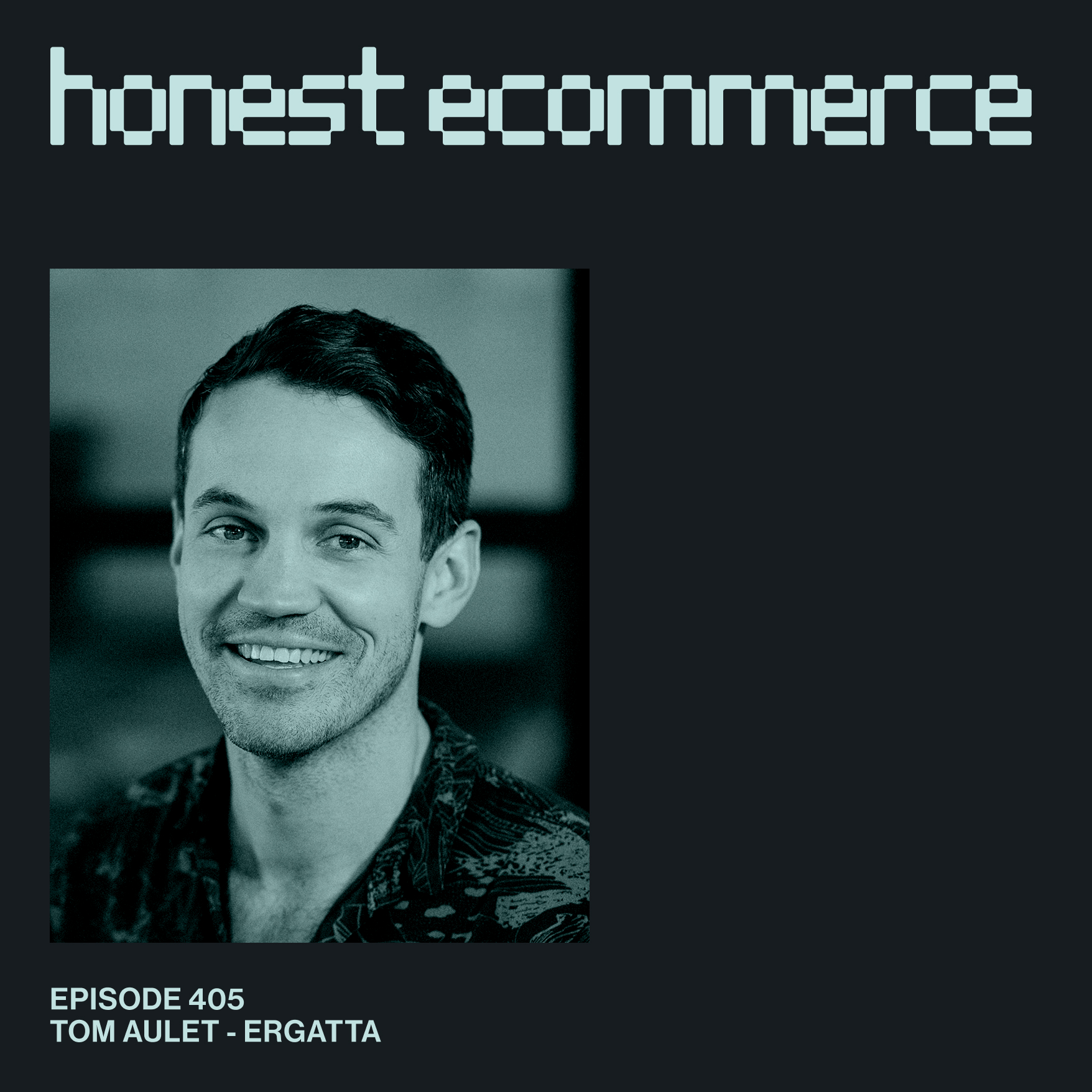
Ergatta’s path to launching a home fitness rowing hardware brand and getting its first 500 customers, covering market research, product development, go-to-market, and customer feedback loops.
Tom Ouellette, co-founder and CEO of Ergatta (game studio for home fitness). Background: worked at other companies for about a decade; co-founded with two long-time collaborators; not from the fitness industry.
Their “special sauce” was gaming content for cardio (not hardware), validated via hundreds of interviews/surveys. They acquired early customers without marketing spend by partnering with WaterRower, emailing WaterRower’s install base, and selling bolt-on tablets at cost. They used a post-purchase qualitative survey (“Heidi How”) to learn how customers found them and what overcame hesitations. They later regretted raising too much venture money (raised $35M).
MVP games included multiplayer “races” and “Pulse” interval-based gameplay; first press hits came from CES Jan 2020; hard launch shipped March 20, 2020 just as COVID hit.
Written by AI. May contain mistakes.
Exploration of Ergatta's rowing machines and their gaming content.
“founders and leaders to find out what it takes to start, grow and scale an online business today.”
Tom Ouellette shares the journey of founding Ergatta and market research.
“So we did hundreds and hundreds of interviews with would-be customers.”
Discussion on the importance of finding the right co-founders.
“Finding a good business partner is just like anything in life.”
Tom highlights the crucial nature of communication in partnerships.
“Brands like ThirdLove have seen a 15x ROI from SMS after consolidating channels.”
Learn why hiring experienced professionals is essential for success.
“It's building a product, building a brand, us building the agency.”
Understand how ergonomic gaming content can differentiate a brand.
“We were willing to partner with someone and outsource it and iterate lightly on something that existed out there in the market that was proven.”
Explore how strategic partnerships helped acquire initial customers.
“So you got this whole thing pretty well fleshed out and you're ready to go to market.”
Gain insights on how the brand scaled and initially marketed itself.
“Inopportune time to launch in the moment.”
Learn how qualitative surveys can provide deep insights into customer behaviors and preferences.
“And then all of those responses and they were all qualitative, we'd get dumped into one single doc and then we'd iterate on the questions over time.”
Explore the pitfalls of overfunding and the importance of setting realistic business goals.
“So the name of the show is Honest Ecommerce.”
Understand how a consistent brand identity can enhance perceived value and customer loyalty.
“And even now, if it's a software business, you could probably get it off the ground for even less than you used to be able to.”

Get the gist, explore an idea or ask about something said.
 Claude
On Honest Ecommerce, what are the key points of this episode?
Searching your listeningAutomatic transcript. May contain errors.
0:00Tom Aulet: The one thing I'll mention that's kind of more interesting that I just loved and everyone on our team loved and was just such so informative and so helpful and so colorful was we said we called it Heidi Howe. It was like a how did you hear about us qualitative survey. And it was basically after you purchased, you'd get a plain text automated email that looked like I wrote it that would come from me and my email address. Absolutely. I'm a huge fan of surveying at the agency. We do so much CRO over here and it's immediately go, Alright, we're launching surveys. And here's... We're gonna email some recent purchasers.
0:35We're gonna email... There's a lot of different strategies that we do. But the post purchase is just so easy. They've already bought. Just ask them. Honest eCommerce is a weekly podcast where we interview direct-to-consumer brand founders and leaders to find out what it takes to start, grow and scale an online business today.
1:05Hey, everybody. Welcome back to another episode of Honest Ecommerce. Today, I'm welcoming to the show the co-founder and CEO of Ergata, the leading game studio for home fitness, Tom Ouellette. Welcome to the show.
1:18Tom Aulet: Thanks, Chase. Appreciate you having me here. Absolutely. It's a long time coming, as we were joking about a few minutes ago. But so let's just get into it. For those that are unaware, what does the leading game studio for home fitness mean? What are you guys bringing to market over there? Yep. So practically, we sell a series of rowing machines with gaming content attached to them. So they're beautiful rowing machines are made out of wood. They're designed to look like furniture. They store compactly, they go in the home and then they have a tablet on them and a content experience on them. I think Peloton or similar.
1:53Tom Aulet: But rather than that content experience being classes and instructor-based content, it's gaming-inspired content. So when you're rowing, when you're working out, you are playing one of several different games. You might be racing against other people in the community. You might be moving through 2D space, avoiding obstacles, collecting tokens. You might be doing any one of several different game experiences that entertain you, motivate you through the workout and keep you hooked coming back much like a video game or sports or something like that. Absolutely. That's amazing. So just... And obviously, I don't want to distill it down.
2:29But some people in the audience are as dense as I am. So it's like... If we wanted to make it really simple, it's like it's Peloton, but a rowing machine, but games instead of instructors.
2:39Tom Aulet: Yes, exactly. Well said. Awesome. Great idea. Where did it come from? Take me back in time. Yeah. So the first... I've always wanted to start a company. I've always been really, really pumped to do that. And I frankly, I'm surprised it took me so long to do it. I worked for other companies for a decade before I did it. First, I found the people I wanted to start a company with. Two people that I've worked with for many years. And we would meet every week and come up with business ideas. It was the founders happened before this specific concept. And then we honed down. We had 2 or 3 concepts that we were really excited about.
3:13Tom Aulet: And the one that became Argata was like, rowing machine, content subscription, but different type of content than classes. Yeah. How do we be unique? How do we differentiate? Yeah. Right. And then that was the concept. And it was like, how we fleshed that out. The biggest answer I have for you is what we call primary market research. So we did hundreds and hundreds of interviews with would-be customers. And we did a lot of survey work to hone in on exactly who our customer would be, what the nature of their problem and need was, and what was likely to be able to solve that need. So we really honed down on who was not addressed by classes, who didn't want classes, but who still wanted to work out and what would work for them.
4:00Tom Aulet: What were the times in their life where they were in the best shape? What motivates them to get out of bed in the morning? What else gets them through workouts or inspires them to be active or achieve other things? That was the biggest. We obviously did a bunch of talking to investors in the space, talking to industry experts, internal strategy sessions, all the other stuff. But the real unique insights came from that primary market research and really the qualitative information from those interviews and that survey work. Yeah. You mentioned the co-founders came before the company. Talk to me about that.
4:38How did you identify what a good co-founder would be? How many co-founders do you have over there on the team? Just talk about that process a bit.
4:47Tom Aulet: Yeah. There's 3 of us. We needed to work really well together, communicate really well together. There needed to be no surprises in terms of what type of people we were and how we worked together. and what our strengths and weaknesses were. We had to give each other energy and we all had to get along. And the way that that happened was just like, it was my favorite technical and non-technical person that I worked with at my last company for years. So it was a good skill set match. And we all worked well together individually and as a group. So there just weren't... It was very de-risked. There was just not a lot of surprises.
5:23Tom Aulet: We had done a lot of different types of work together. And our skill sets complemented each other. We gave each other energy. We communicated well. And then we also went through this process to come up with business ideas and flesh them out together before we signed contracts, incorporating a business together and allocating shares across the group. So that was how I went about it. I was lucky enough to have worked with them before and knew who they were and knew that it was going to work well. Absolutely. Yeah. It's always... Finding a good business partner is just like anything in life. A good partner in anything, even in marriage and whatnot.
5:59It's you got to make sure that the communication is there. You can have tough conversations. And then another thing that I always like to point out when we're talking about these types of things on the show is you need someone that has strengths where you have weaknesses or enjoys doing things that you maybe don't do. Because if you guys or gals or whatever are both good at something and not good at the same things, then there's gaps in your team? And also, why do you need them? Yeah.
6:31Tom Aulet: Yeah, totally. I agree with that to a large degree. But I also think you guys just need to get along and communicate well and work well together and give each other energy. And you can hire to fill gaps. You can bring in investors or advisors to fill gaps. You obviously need to have someone that's good at sales, have someone that can code. You need some basics on the team. But you can always close gaps later, I think. as long as you all get along, communicate well, work well together. And I believe you have to date before you marry. And starting a business with someone is very... There's a lot of legal paperwork similar to marriage.
7:08Tom Aulet: So it's an intense commitment and you want to know who you're getting a bed with. Do you know what's going on with Klaviyo? When is the last time you explored what it can do? Klaviyo has been shipping tons of new AI, data, and automation features designed to help Ecommerce teams move faster, personalize better, and automate more of the work that used to take entire teams. Most brands are only using a fraction of what is already inside their Klaviyo account. Klaviyo is not just email and SMS anymore. It is your customer data platform, your lifecycle marketing engine, your analytics layer, and now your AI-assisted execution layer They're all in one place.
7:48That means your customer data updates in real time. Your segments stay current automatically. Your flows and campaigns all run off the same source of truth. And now AI can help predict churn risk, forecast spend, recommend next best products, generate campaign content, and optimize send timing across channels. The big unlock is speed and efficiency. There are fewer tools to manage, less dependency on engineering, less time moving data between systems, and a lower total cost of ownership across your marketing stack. And brands are seeing real results from leaning further into Klaviyo. Dollar Shave Club has reported over 30 % reduction in total CRM stack costs after consolidating onto Klaviyo.
8:34Brands like ThirdLove have seen a 15x ROI from SMS after consolidating channels. And companies like Corksicle have grown flow revenue over 90 % after bringing email and SMS together inside Klaviyo. Across our customer base, almost every single brand we work with today is using Klaviyo. That is just where serious Ecommerce customer data and lifecycle infrastructures are living these days. If you're already on Klaviyo, but you feel like you're not getting everything you can out of it, or you're just running multiple tools and want to simplify without losing power, I think this is worth your time.
9:09You should head on over to klaviyo.com slash honest to learn more. That's K-L-A-V-I-Y-O.com slash honest to learn more about what Klaviyo can do for you today. The start of the business, you mentioned that you did quite a bit of research and surveying. Talk to me. How did you find people to talk to? I think there are a bunch of people out there with great ideas. And I think that validating it with talking to your ideal customer is a great thing to do. So how did you do it?
9:37Tom Aulet: Yeah. I just had no shame. So you start with your network, you start with who you know. So you just talk to people that fit people in your professional network, personal network that fit the profile. Then ask them at the end of the call to introduce them to 2 or 3 people that would be interested or excited by this. I would also go to the gym and just approach random people. I remember I went to Equinox in Williamsburg at the time. And I would just go there and I would walk up to people that were getting on the treadmill or the road mission to the bike and be like, why do you do this? What do you find boring or interesting about it?
10:12Tom Aulet: What would entertain you? Would you be open to this type of thing? I don't know. I would just approach random people. And then once you had someone on the hook, ask them if they had any other people that they'd be willing to introduce me to. And then I built up a file of... It was like 400 or 500 people of would-be customers that fit our ICP that were interested or engaged that would give us time or generally would answer questions. And that was our first little customer file that we sold to that we would go to to pull, to test concepts, to do some live prototype review, stuff like that. So that was how I approached it, how we approached it.
10:54Absolutely. And I want to point out here, you were not sitting behind a computer doing this. You went to where your customer... No, no, no.
11:00Tom Aulet: Yes. Yes. You went to where your customer was, you had awkward conversations with them. I think it's something that's come up before here is you have to... At the beginning, you have to do the things that can't scale. And you just have to just do the work. Yeah, totally. Yeah. And then... Because you get biased data from people that are in your network. It's worth doing. But you get less biased data by just walking up to random people that are about to get on a treadmill and asking them questions, in my experience. So I think you need both. Alright. So you're getting all this awesome data from chatting with folks out in the real world.
11:38How long does it go from... We have this idea of a better rowing machine with some sort of elevated content model to... We have this beautiful rowing machine with this well thought out gaming strategy? What was the timeline?
11:58Tom Aulet: Yeah, the concept we had, it was September 2018. We incorporated February 2019. So 3 months of fleshing it out. And then everyone was on board. And then we had to quit our job, sign docs, etc. And then we actually delivered products a year later, Q1 2020. And then we did pre-sales and alphas and betas throughout 2019. But shipping a final GA hardware product with everything at full price was JanFeb 2020. That seems pretty quick. Did you guys already have an in with the ecosystem? Or did you collaborate with people that had familiarity there? We didn't have an in. None of us came from the fitness industry.
12:47Tom Aulet: The biggest challenge there... Software you can build and ship relatively quickly and iterate on. The biggest challenge there is obviously hardware. And that was not our strength or interest. And our big unlock there was... And we built a partnership with a manufacturer close by that had manufactured a lot of rowers and shipped a lot of rowers that were similar to what we wanted and already had gone down the cost curve, had all the component parts and inventory on site, had all the supplier relationships. And we obviously had to tweak that and source a tablet and do some other stuff. But that was the big unlock in terms of speed to market was the WaterRower.
13:31Tom Aulet: And the manufacturing partner is called WaterRower. They're based in Rhode Island. We could drive there in 4 hours from New York. It helped us get to market much more quickly because we could see them in person. We could go to their factory. We could iterate on stuff really quickly with them. And they had done a lot of the work that we could just build on top of and tweak the things that we wanted to tweak. So that was the biggest unlock in terms of speed to market. Absolutely. Yeah. I always say... I mean, it's just with anything. It's building a product, building a brand, us building the agency.
14:09It's like, hire someone that has done exactly what you want to do before. Yeah.
14:14Tom Aulet: Yeah. Right. That's the biggest cheat code to all of this. Totally. What is the next big idea that could change your business? A pricing change? A new bundling strategy? Adding subscriptions? Tweaking your shipping offer? Most brands make these decisions based on gut feel. They roll out the change, hope for the best, and have no real idea if it helped or hurt their business. IntelliGym's fixes that. It is an AI-powered testing platform that brings CRO-level clarity to the decisions that actually move the needle. Not just button colors and headlines, but the big stuff. Pricing, offers, shipping, new apps, even major site changes.
14:56Brands like Ridge, Jones Road, and True Classics are using IntelliGems to test their most important decisions and see exactly how each one of those impacts profit before they commit. Momofuku used it to test promotional offers ahead of Black Friday and found the version that increased profit by about 28%. Mott & Bo ran structured pricing tests that drove roughly 30 % more incremental profit. We use it at Electric Eye with almost every client we work with. And now IntelliGems has a free AI-powered audit that gives you 3 specific ideas that you can test on your store today. No commitment, no credit card, just 3 opportunities worth exploring.
15:35Head to IntelliGems.io audit and get your free audit in just a few minutes. That's IntelliGems.io audit. IntelliGems.io audit. But something that's also about this idea and a lot of ideas out there, it's not groundbreaking as far as the technology or the physical hardware, but it's just a novel idea. So it's an iteration on something that already exists. So it's like, we can get there pretty quick. We just need to find people that have done this before.
16:10Tom Aulet: Totally. And what I would add to that is, know what your special sauce is and what it isn't. And our special sauce wasn't hardware and manufacturing. What it was fundamentally was this gaming content. No gaming content for cardio existed out there. So that had to be good. We couldn't outsource that. That had to be innovative. That had to work really well. And then the second thing was just packaging it all together, marketing it effectively. As you said, it's bringing things that exist out there together into a single brand and value proposition that was compelling for people. Yeah. So hardware wasn't our special sauce.
16:47Tom Aulet: We were willing to partner with someone and outsource it and iterate lightly on something that existed out there in the market that was proven. Whereas a lot of our competitors were like, no, we need to be like Apple and own everything soup to nuts and design from scratch a rowing machine and manufacture it in Taiwan and take 2 years to get it. And that just wasn't our approach to that. Well, funny thing about Apple is they did not own all of it at the beginning. They slowly started to build out those components. They only got on their own silicone in the past decade. I remember when they launched it, which it is fantastic.
17:25Don't get me wrong. It's an amazing product. And I'm glad it entered the space to make other people innovate. But yeah, I mean, their older stuff was just parts from IBM back in the 90s. So you got to get your feet into the market. And you're not going to be some insane, vertically integrated business overnight.
17:48Tom Aulet: Right. You're not going to be like a vertically integrated, closed ecosystem brand that owns everything in your first year of existence. You got to start somewhere and then build on that. Let's talk about that first year though. So you find this partnership. the other half of it is the gaming content. Yeah. How does that iterate? And what is the first... I guess... Is it an app? Is it an experience? What are you calling it in your sales process? And what did you launch with? Yeah. So it's... Technically speaking, it's an app. It's an Android app that lives on an Android tablet that sits on a running machine.
18:30Tom Aulet: We called it a digital membership or digital experience. We still call it that. And like, yeah, the MVP was three different kind of like rowing experiences, two games, and then like a kind of basic kind of open row, free row situation. So one game was races. It was a multiplayer game where you race against other people. It looks kind of like a simplified version of Mario Kart, but with a kind of refined design. Another one we called Pulse, which was a single player game that was like, you know, get in get into different um power zones and hold it for a certain period of time you know uh basically like interval based train gamified interval interval based training and then this kind of like more basic like open row you know free row experience that was like had a sleek but very simple kind of digital visualization of like your speed data your kid instead of whatever um and then within each of those within each of those two games there were like hundreds of workout options.
19:34Tom Aulet: So you can pick a bunch of different workouts or courses or whatever you want to call them. So that was the MVP. And like, yeah, the most fun thing, or maybe one of the most fun things was like conceive it, you know, coming up with the games and like testing and iterating on them and building them like that. There just wasn't a real playbook for gaming content on cardio equipment. And we, yeah, we just followed kind of like software product management, best practices. And we would come up with concepts and test them before we wrote a line of code, live with people, get responses, get reactions, and then build super basic prototypes, put them on a couple hundred growing machines that people would test.
20:17Tom Aulet: And we would look at abandoned rate data, completion rate data, and then we'd get a lot of qual, survey-based feedback from them. So yeah, it was very iterative. We defined core product principles upfront. It's like, what is this and what is this not? And then within that boundary, we could brainstorm, we could come up with a bunch of stuff. And then we would test it, iterate on it, and get a bunch of customer feedback along the way before rolling it out. It's just pretty de-risked by the time it was out there. Yeah. That's amazing. So you got this whole thing pretty well fleshed out and you're ready to go to market.
21:01You said you launched with a pre-order campaign. Was that correct?
21:03Tom Aulet: So there was... Yeah, we launched a... I forget what we called it at the time. A pre-sale or a soft launch or something where you could buy the rower and pay for it, but it was going to ship in 2 or 3 months or whatever. And we launched that at Holiday 2019. But before that, and this is maybe interesting to you and your followers, is the way that we got our first 500 customers and that we had this install base of beta testers that had rowing machines in their home with tablets and our app installed that were willing to test all these products with the hardware in their basement or whatever, was that we with WaterRower, they basically had...
21:50Tom Aulet: WaterRower had hundreds of thousands of machines in homes already. And the reason that they were willing to do this partnership with us was that their customers were asking them for digital solutions, digital products, content, and that wasn't what they were good at. So part of the reason we said, we can solve that problem for you. And that was the core of the partnership. And so what they let us do was email their customer base and say, hey, do you want digital products? If so, you can buy a little tablet to bolt onto your existing rowing machine for$200,$300, whatever it was, which was basically cost.
22:25Tom Aulet: And you can test out for free this Orgata app. And so we acquired the first 250 and then 500 customers with no marketing dollars, with just having water rowers send an email to their install base or a subset of their installed base and selling them tablets at cost because you can get people to test software on their phone or on their computer relatively easily. But if it has to be on a rowing machine with a tablet, it just gets harder and it's hard to acquire those customers. Because people aren't going to buy a$2 ,000 rower from a brand they've never heard of without a lot of press or affiliate or reviews or what have you.
23:02Tom Aulet: So that was what got us off the ground. And those became ultimately our first 500 subscribers over the course of 2019. And then, yeah, we did a pre-launch around holiday 2019. And then we started to ship and did an actual... Our hard launch, and this is funny, our actual launch where we depressed and we're like... Prama shipping within one to two weeks was March... I believe it was March 20th, 2020. and New York shut down for COVID, I think like 2 days later or 2 days before. It was right around the time that COVID lockdowns started, which was crazy. Yeah. You have prepped all year and all that hard work is paying off.
23:47Your store is converting, the ads are working and this is shaping up to be your best holiday season. But your 3PL can't keep up. Orders are backing up. Customers are asking where their stuff is. the reviews are starting to turn. All that hard work, all that momentum, undone by a fulfillment partner that can't scale with you. This is a nightmare scenario and it happens to brands every holiday season. Enter eFulfillment Service. eFulfillment Service is the 3PL that scales with you. They are family-owned, they've been in business for over 25 years, and they're built specifically for growing direct-to-consumer brands.
24:22There are no setup fees, no minimums, and no long-term contracts. You only pay for what you use. If you're scared your 3PL can't keep up this holiday season, now is the time to reach out to eFulfillment Service. Go to eFulfillmentService.com slash honest and get up to 8 weeks of account fees completely waived. That's E-F-U-L-F-I-L-L-M-E-N-T-S-E-R-V-I-C-E.com slash H-O-N-E-S-T efulfillmentservice.com slash honest. Inopportune time to launch in the moment. But I believe there was quite a big home fitness boom during that. So once people got used to what was happening, I'm assuming you guys saw a bit of an increase.
25:12And how were you getting in front of those folks? Were they just actively organically seeking out in-home solutions? Or were you also doubling down and getting into paid media, earned media? What was your go-to-market strategy? How are you getting more eyeballs on this?
25:26Tom Aulet: Yeah. It was originally iterative. So it was first... We'd obviously set up a website and email all our own channels. Then we got into Earned. So we did a big press event. I remember it's CES in Jan 2020 that got our first 10-15 legit press hits. It was like CNET, Engadget, whatever it was. And then it was like... So if you Google Ergata, you're like, Oh, this is a legit brand. And I can get reviews from credible sources that I've heard of. And then we started to slowly scale up paid media from there, starting with Google, Facebook. But basically, what we found out pretty quickly was the way that people would find about us, whether they would start searching for home fitness or home cardio or home rowing machines.
26:14Tom Aulet: And then that was the start of their discovery process. And then we would show up in press roundups that would rank well and in paid search ads and YouTube videos that would rank well, whatever it was. But that was the trigger. It was like a non-brand generic search term for home fitness equipment that would eventually lead them to Orgata and eventually to a purchase. Yeah. It's definitely a considered purchase. I would say it leans a little bit more towards luxury, just where it sits in the market. I'm assuming that's an interesting customer journey. And you already mentioned a bit about it. But how did you set up the feedback loop to learn about how to improve your marketing, where to spend your dollars?
27:04Tom Aulet: Yeah. I mean, we did a lot of normal best practice stuff. The one thing I'll mention that's more interesting that I just loved and everyone on our team loved and was just such so informative and so helpful and so colorful was we called it Heidi How. It was like, how did you hear about us qualitative survey? And it was basically after you purchased, you'd get a plain text automated email that looked like I wrote it that would come from me and my email address. It was like, thank you so much for finding and purchasing Ergata. We're an early stage startup. Our early customers mean the world to us.
27:38Tom Aulet: If you have 2 minutes, I'd love to hear from you on a couple of questions. And it was like, how did you find out about us? What were your biggest hesitations? Were there any reviews or materials that were particularly persuasive? And what got you over the hump? And is there anything else I should know? And I would read every single one. Everyone on the marketing team and product team would read every single one. I would often respond back to them and ask clarifying questions. And then all of those responses and they were all qualitative, we'd get dumped into one single doc and then we'd iterate on the questions over time.
28:10Tom Aulet: And the response rate was super high at first and went down over time. But that was how we got just a super rich, colorful, qualitative picture of who our customer was, how they found us, what were hesitations, what was persuasive, what would get them over the hum, how considered it was. Was it a week? Was it a month? Was it a quarter? Was it a year? What was our competition? Was it just nothing? Or was it another rowing machine? Or was it Peloton? And all that was just fascinating. And that was how we got the core basics of who our customer was, what our journey looked like, and what our marketing strategy should look like and consider.
28:50Absolutely. I'm a huge fan of surveying at the agency. We do so much CRO over here. Yeah. And immediately we go, Alright, we're launching surveys. And we're going to email some recent purchasers. We're going to email... There's a lot of different strategies that we do. But the post-purchase is just so easy. They've already bought. Totally. Just ask them some clarifying questions. And some of it is about the store and the experience, to bundle the offer. Some of it's more... All of this stuff is useful to create those optimizations. And it's also something that we're always saying. It's like, all this information we're learning that we're using to optimize the store, you can just give to your marketing team to help write better ad copy.
29:32Tom Aulet: It's useful in all these different places. And give to your product team to understand the customer better. It's just such a rich and interesting data set for everyone. is particularly the qualitative storytelling components of certain survey work. Hey, everybody. Just a quick reminder. Please like this video and subscribe. If you haven't, we're releasing interviews like this every week. So don't miss out. Now back to the interview. So the name of the show is Honest Ecommerce. And the conversation thus far has been... You guys have had home runs left and right, knocking things out of the park, making the right choices.
30:09I know the truth though. Do you guys make any missteps along the way that you can share?
30:15Tom Aulet: Yeah, definitely. The biggest one that I wish I could get back and that I tell people is just, we raised too much money. We have a great business. It's very profitable. It's super consistent. We're clearly solving a market need. Our customers really, really like our products. like, you know, there's a growth engine, there's a retention engine, there's a word of mouth engine, blah, blah, blah. But it's not a billion dollar IPO business, right? Like, and, and with, with the kind of venture backed startup space, there's this notion that you should raise a bunch of money as you possibly can. And like, there's this like gravity that pulls you towards like, I'm gonna, you know, run a$20 billion public company or whatever it is.
31:01Tom Aulet: And the right goal for us was probably for this type of business was probably like a 50 to a hundred million dollar outcome rather than a 10 billion dollar outcome and that points you towards a specific capital structure and a specific amount of cash to raise and we raised 35 million dollars that was in retrospect too much and it was just i honestly didn't that wasn't my goal it just like it became such a hot space at the time and there was just so much demand that and everyone the all the energy was just raise as much as you can at as high a valuation as you can. And yeah, that's the one I would take back.
31:39Tom Aulet: I would be clear about how big is this business going to be realistically and what is my goal and then work backwards from that. How much money should I raise so that I can get there and that when I get there, it's lucrative for all of our shareholders, common, preferred employees, everyone. Absolutely. Yeah. And I think that a lot of our audience can read into that a bit more and make their own evaluation about that statement. And I think that's the first time anyone on the show has said something like that. So I truly appreciate that level of transparency there. It might help some people about to raise right now and on the fence about asking for more or just...
32:17They might have a number in their head that they think it should be. And so hearing it from someone that's been in their shoes 5-10 years down the line, I think that's super amazing. Great.
32:29Tom Aulet: And even now, if it's a software business, you could probably get it off the ground for even less than you used to be able to. So I think being super careful about how much money you raise and how big the outcome is really likely to be and sticking to your guns, despite all the pressure in the venture ecosystem to say, our TAM is a trillion dollars and And we're going to IPO for$100 billion in 5 years, whatever it is. It's just not realistic for every business, obviously. Absolutely. Now, is there anything I didn't ask you about, Tom, that you think would resonate with our audience? Ecommerce and growth marketing.
33:08Tom Aulet: It tends to be such a quant game. And the quant... People that are super quantitatively driven tend to do well. And it can be a very data-driven enterprise, which is great. And I'm all for that. But I think having a clear perspective on what your brand is and how it shows up and having a specific design aesthetic that aligns with how you're pricing your product and who your customer is and keeping that consistent over time is super, super, super important. And that's not really a quantitative thing. That's like knowing who your customer is and what their problem is and how you're solving it and how you're pricing your product and matching that to a brand identity and a product marketing strategy that is consistent over time and that you don't change with new data.
34:09Tom Aulet: I think we have gotten a lot of credit for having a premium design forward brand that people want that has some lifestyle appeal, that has some luxury appeal that our competitors don't have. And that's been as big a part of our marketing success as channel optimization, creative optimization, conversion rate optimization. I think that's really mattered a lot. When you do interviews, when you read the qualitative survey data, it's clear that that matters to people a lot. And that's registered with our leads, with our customers as well. And that wasn't intuitive to me because I come from a very acquisition, quant-driven marketing background.
34:59Tom Aulet: And that was... And brand was always like, that seems soft and fluffy and a waste of money. But it really wasn't. Having a clear concept of what your brand is and how you're going to show up from a visual design, product marketing, messaging perspective, and being consistent about that, not changing it with the wins was a good thing for us. Absolutely. I think that that's something that really makes sense at the investment that the product is for the customer. Yeah. They want to... The value is subjective. And the one thing that increases perceived value, and you could look right at Apple to this again, coming up twice is their aesthetic and their design is 100 % also in line with the value of the product.
35:48Totally. If it was this... And you could argue that you can get the same performance out there of similar products for less price, but the packaging design, the experience, the unboxing, the store you get it at, that isn't the same experience.
36:06Tom Aulet: Totally agree. Apple is a great example. They tend to be a great example across the board. Yeah, I know. They seem to keep coming up. Awesome. Tom, I cannot thank you enough for coming on the show today and sharing all those amazing insights. Thank you so much, Chase. This has been great. I'll come back anytime. I appreciate you having me on. It's been great. Awesome. Thank you so much. Thanks, Chase.
36:36you
Tom Aulet is the Co-Founder and CEO of Ergatta, the leading game studio for home fitness.
A graduate of Vanderbilt University with a degree in Spanish and Economics, Tom began his career teaching English in Spain before moving into economic consulting at Cornerstone Research. He then joined MediaMath, a marketing technology company, signing new business deals, overseeing revenue EMEA and LATAM, and ultimately building and running their global Media Agency business.
Amid the demands of his career, Tom struggled to find a fitness routine that was both practical and engaging.
Teaming up with two trusted former colleagues, he co-founded Ergatta and introduced the world's first game-based cardio machine – winner of Health's 2024 Fitness Awards and 2022 Men's Health Home Gym Awards – and the leading game studio for the fitness industry.
In This Conversation We Discuss:
Resources:
If you’re enjoying the show, we’d love it if you left Honest Ecommerce a review on Apple Podcasts. It makes a huge impact on the success of the podcast, and we love reading every one of your reviews!