Ask ChatGPT


 Honest Ecommerce
9 Nov 2026 · 24m · 10 chapters
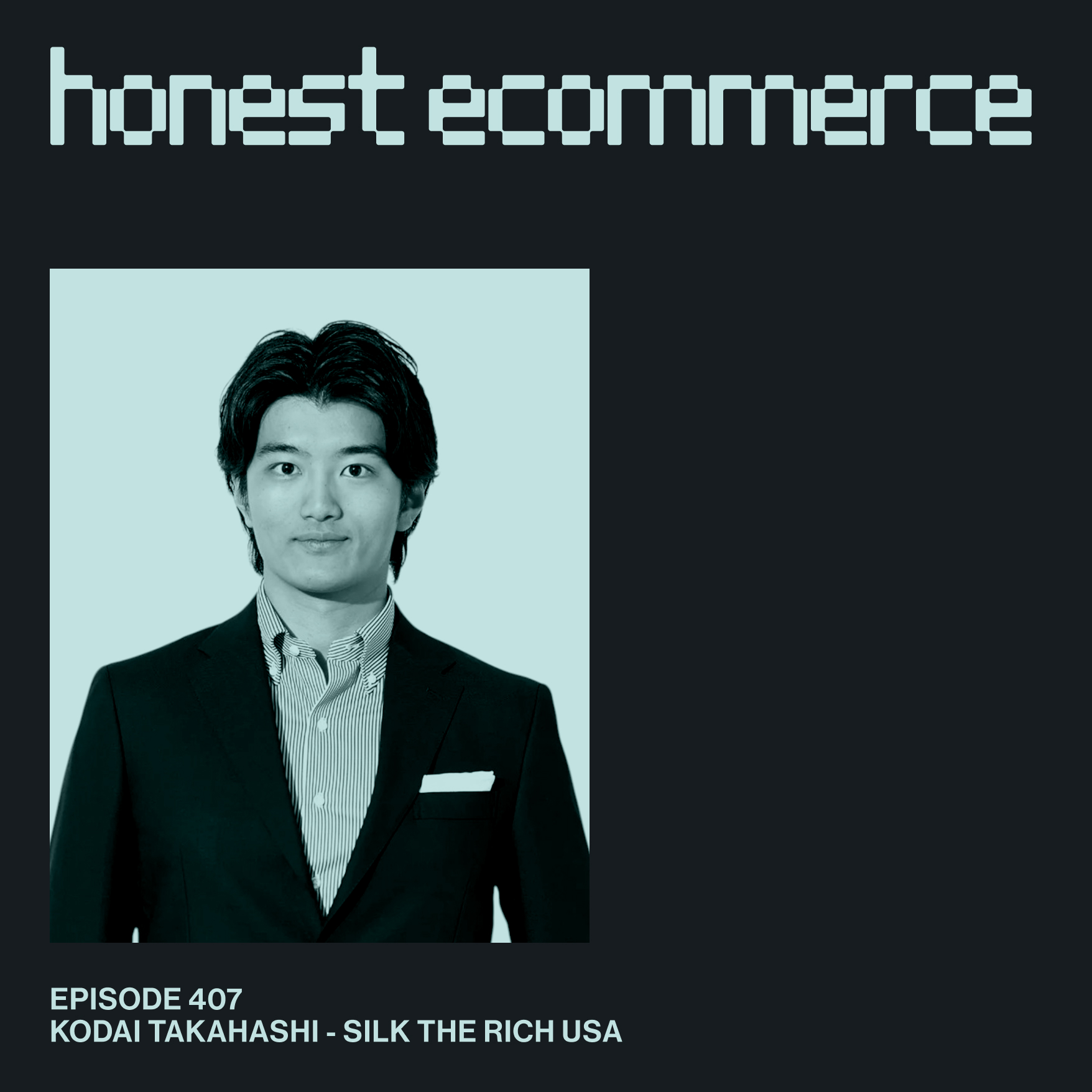
Silk the Rich USA’s US market expansion and how earned media (Vogue) drove momentum across Amazon and D2C Shopify, plus how the team uses owned data and AI to optimize conversion and operations.
Kodai Takeyoshi, CEO of Silk the Rich USA (Japanese hair care brand). Background: launched and scaled in Japan and other Asian markets; first time living/operating in the US; leads a small US team (3–4 part-timers) using AI tools.
US launch started “from zero,” requiring a new playbook by learning US beauty shopping behavior. Organic Vogue coverage triggered sustained Amazon growth, which was repurposed into D2C. D2C provides customer data and community feedback unavailable on Amazon.
Vogue “best Japanese shampoo and conditioners” feature (no paid ads) led to immediate Amazon growth; Shopify conversion rate increased ~3x after Vogue creative; selling focus on California/New York/Seattle/Hawaii; expanding retail later using Amazon/D2C learnings.
Written by AI. May contain mistakes.
Learn about the impact of earned media on brand visibility and sales.
“We're featured in CBS and then Fox News and all the things.”
Explore Silk the Rich's product offerings and their entry strategy into the US market.
“Welcome back to another episode of Honest Ecommerce.”
Understand the unique challenges faced when entering the US beauty market.
“You were already finding success obviously in Japan.”
Discuss how earned media, including a Vogue feature, bolstered sales on Amazon.
“But when we think about expanding to the other states in the retail, you have to think about like the strategy again, I guess.”
Explore how earned media impacts direct-to-consumer strategy and revenue.
“Did she tell you that it was posting or did you just wake up one day and it was posted?”
Learn about the small team at Silk the Rich USA and their use of technology.
“Yes, I cannot agree with you more about just how much more information you can get from your own.com.”
Learn about the team structure and the role of AI in optimizing operations.
“You take all that learnings and you put it right back into that experience and you see things grow and grow and grow.”
Explore differing perspectives on how AI influences service pricing in agencies.
“And I'm going to keep his answer in without any edits, everybody.”
Understand the strategies for expanding into retail and leveraging sales data.
“the power of ai yeah i mean i agree with you in terms of like like agency service providers have to understand AI more than ever.”
Find out where to learn more about Silk's products and their benefits for consumers.
“Now, if I'm listening to this podcast, and I'm curious to learn more about the product, and maybe I even want to try the product.”

Get the gist, explore an idea or ask about something said.
 Claude
On Honest Ecommerce, what are the key points of this episode?
Searching your listeningAutomatic transcript. May contain errors.
0:00Kodai Takahashi: We're featured in CBS and then Fox News and all the things. But if we didn't do anything with the team, just revenue is going up and down, maybe. But we try to keep it, keep a momentum with those features.
0:14Justin Christianson: Very similar to what you did with the Vogue and something that keeps coming up with them. It's just like, once you get one, it makes it easier to get the others. And then you repurpose that content, never stop talking about it because your newest customer didn't know you were featured in Vogue. vogue and that social proof might be the thing that drives them to make the purchase to try the product. Honest Ecommerce is a weekly podcast where we interview direct-to-consumer brand founders and leaders to find out what it takes to start, grow, and scale an online business today. Honest Ecommerce is proudly produced by Electric Eye, a Shopify Plus partner helping Ecommerce brands sell more with strategic design and development.
0:55Justin Christianson: Visit electriceye.io for more information. Hey, everybody. Welcome back to another episode of Honest Ecommerce. Today, I'm welcoming to the show Kodai Takeyoshi. He comes to us as the CEO of Silk the Rich USA. It is the US arm of a Japanese hair care brand. Kodai, welcome to the show. Hey, Chase. Good to see you. Yeah, it's great to see you. We were just talking about it. We met a year ago at ShopTalk in Chicago. You were just at the ShopTalk in Nashville, literally yesterday as of recording. Yeah. But yeah, let's kind of dive in here. Now, could you talk a bit about Silk the Rich and the types of products you and the team are bringing to market?
1:34Kodai Takahashi: For sure. So Silk the Rich is a Japanese hair care product, mostly doing shampoo, conditioner, hair care product, and body care products using liquid silk inside every single product, which is like a unique coin. we sew like a liquid silk from the fabric silk in japan mix it and then infuse it into the product we have and sell it over 20 countries now making around 25 million dollars annually uh this is our fourth year and get ready to expand to the u.s absolutely yeah and i met you
2:10Justin Christianson: i believe right before you expanded maybe it was right around the same time yeah um how did you guys plan... We always talk about brands that are in America looking to branch into other markets. You had already launched. You were already finding success obviously in Japan. What would you say was most frustrating or difficult about breaking the product in the US market?
2:41Kodai Takahashi: Chase, a lot of things I can talk about. So first of all, by myself, I have never been to the States and it's the first time for me to stay in the US. So culture is a whole new thing. So how people buy things, how people find the things, how people want to see the products, especially in beauty. It's totally different. So I met a lot of people here in LA and learned from them. And yeah, so it's like life versus work kind of thing in the States now.
3:14Justin Christianson: You had found success in obviously the Japanese market and you're like, well, this playbook just is not working here in America. And it was kind of you had to throw that out the window and start over.
3:24Kodai Takahashi: Yes, 100%. So after two years, we hit like$10 million in revenue in Japan. So we expanded to Taiwan, Korea, Malaysia, over 10 countries, including Middle East. So we're ready to go. But in the States, we're starting from zero. No team members and no revenue for sure. So yeah, everything is starting from zero last year. It's been a year so far.
3:52Justin Christianson: Obviously, I feel like the transition from the Japanese market into the similar markets over on the other side of the world, did those work a lot better than this expansion into the States just because of similar demographics and cultures?
4:09Kodai Takahashi: I feel so because other marketing in Asia is pretty small compared to the states. But states has like 50 countries, I can say. So right now we focus on California, New York, Seattle, especially like West Coast and Hawaii. But when we think about expanding to the other states in the retail, you have to think about like the strategy again, I guess. because there are so diverse people out there. And we have to reconsider how we talk to them, communicate them.
4:45Justin Christianson: Yeah. And you guys aren't just selling on your dot com. You're also selling on some of these other marketplaces, including Amazon. You had a magazine feature. And obviously, you saw some success from that from Amazon. You want to talk a bit about that?
5:04Kodai Takahashi: Yeah. So last December after launching Amazon, we were featured on Vogue as the best Japanese shampoo and conditioners. That was so sudden. That was no paid ads. That was an organic editorial post from Vogue. So I gave away some shampoo to the editor in LA and she literally liked our product and she posted about us into Vogue. And then the next day after the publishing, I saw the tip in Amazon. I saw the really good growth. And that growth didn't go down. That didn't drop, actually. So it stayed a little bit. We pushed a lot more about we featured it here and including other magazines. Then we could make a kind of momentum in Amazon.
5:58Kodai Takahashi: And we used that creative into D2C and Shopify and generated more sales and subscribers in there. So yeah, last December, we could make a really good momentum.
6:11Justin Christianson: Do you know what's going on with Klaviyo? When is the last time you explored what it can do? Klaviyo has been shipping tons of new AI, data, and automation features designed to help Ecommerce teams move faster, personalize better, and automate more of the work that used to take entire teams. Most brands are only using a fraction of what is already inside their Klaviyo account. Klaviyo is not just email and SMS anymore. It is your customer data platform, your lifecycle marketing engine, your analytics layer, and now your AI-assisted execution layer all in one place. That means your customer data updates in real time.
6:50Justin Christianson: Your segments stay current automatically. Your flows and campaigns all run off the same source of truth. And now AI can help predict churn risk, forecast spend, recommend next best products, generate campaign content, and optimize send timing across channels. The big unlock is speed and efficiency. There are fewer tools to manage, less dependency on engineering, less time moving data between systems, and a lower total cost of ownership across your marketing stack. And brands are seeing real results from leaning further into Klaviyo. Dollar Shave Club has reported over 30 % reduction in total CRM stack costs after consolidating onto Klaviyo.
7:33Justin Christianson: Brands like ThirdLove have seen a 15x ROI from SMS after consolidating channels. And companies like Corksicle have grown flow revenue over 90 % after bringing email and SMS together inside Klaviyo. Across our customer base, almost every single brand we work with today is using Klaviyo. That is just where serious Ecommerce customer data and lifecycle infrastructures are living these days. If you're already on Klaviyo, but you feel like you're not getting everything you can out of it, or you're just running multiple tools and want to simplify without losing power, I think this is worth your time.
8:07Justin Christianson: You should head on over to klaviyo.com slash honest to learn more. That's K-L-A-V-I-Y-O dot com slash honest to learn more about what Klaviyo can do for you today. Yeah. Did she tell you that it was posting or did you just wake up one day and it was posted?
8:22Kodai Takahashi: That was posted after wake up. Yeah.
8:24Justin Christianson: Yeah. Yeah. So you had no warning. You're like, Oh no. But also, it's always fun to see that and then kind of to scramble to make things work. Yeah, I think so.
8:33Kodai Takahashi: So it's not only about magazine works well, but our team worked really hard to, how can we maintain this revenue or even like make it grow even more with that fact. So we did a lot of things, including magazine. We were featured in CBS and then Fox News and all the things. But if we didn't do anything with the team, just revenue is going up and down. Maybe. But we try to keep a momentum with those features.
9:06Justin Christianson: Yeah. We've had a lot of brands on here talk about how they got that initial traction for the brand through earned media. So PR features, editorials, very similar to what you did with Vogue. And something that keeps coming up with them. It's just like, once you get one, it makes it easier to get the others. And then you repurpose that content, never stop talking about it because your newest customer didn't know you were featured in Vogue. And that social proof might be the thing that drives them to make the purchase to try the product. So again, some of these people listening to the show, here's another example, Kodai's and his team, they got featured and they repurposed it a bunch and it's still helping them make more sales.
9:53Justin Christianson: Yeah, I bet. Now, you found that success and a lot of it was through Amazon, but you're also looking to... You have to your feet in both worlds. You've got Amazon, then you've got the Shopify.com. I know that you spent some time streamlining the funnel and experimenting with landing pages for the.com experience. Can you walk us through that thought process and how things worked or didn't work?
10:25Kodai Takahashi: So we launched our Shopify pretty late after Amazon. We launched like after the Vogue feature, we basically launched. And I mean, even before Vogue, we had a website, but it didn't have any conversion. It's not any, but it's like we didn't push any ads. So we saw really small conversions, even though we pushed a lot of ads in there The CAC was pretty high and expensive. And I thought it doesn't make sense. The ROI was, it doesn't make sense. So I stopped it and posted it. After the vote feature, we pushed it again with the creative. And then it made our conversion rate really high. Like you said, three times more.
11:13Kodai Takahashi: And then even more after that, after all the efforts of our teams. and through those journeys after launching d2c channel we can see how like people behave and we can get more customer information because for amazon it's so hard to get the information of customers but in d2c channel we can see what they like or how they find our product we can ask some questions we can send email so we found like small community kind of thing after vote feature So through those communities, we can get good feedback about the product. And we can change how we communicate with the customers and potential customers.
11:56Kodai Takahashi: So I feel like making the communities after the Vogue makes sense for us now.
12:03Justin Christianson: What is the next big idea that could change your business? A pricing change? A new bundling strategy? Adding subscriptions? Tweaking your shipping offer? Most brands make these decisions based on gut feel. They roll out the change, hope for the best, and have no real idea if it helped or hurt their business. IntelliGym's fixes that. It is an AI-powered testing platform that brings CRO-level clarity to the decisions that actually move the needle. Not just button colors and headlines, but the big stuff. Pricing, offers, shipping, new apps, even major site changes. Brands like Ridge, Jones Road and True Classics are using IntelliGems to test their most important decisions and see exactly how each one of those impacts profit before they commit.
12:49Justin Christianson: Momofuku used it to test promotional offers ahead of Black Friday and found the version that increased profit by about 28%. Mott & Bo ran structured pricing tests that drove roughly 30 % more incremental profit. We use it at Electric Eye with almost every client we work with. And now IntelliGems has a free AI-powered audit that gives you 3 specific ideas that you can test on your store today. No commitment, no credit card, just 3 opportunities worth exploring. Head to IntelliGems.io slash audit and get your free audit in just a few minutes. That's IntelliGems.io slash audit. IntelliGems.io slash audit.
13:29Justin Christianson: Yes, I cannot agree with you more about just how much more information you can get from your own.com. Yeah. You get all the demographics and the best part is you can email them and ask them specific questions. You can do surveying. You can do a lot more, not intrusive, but more explorative stuff with heat maps and user testing and whatnot on your own experience where some of these other marketplaces really gate that stuff because at the end of the day, it's the marketplace's customer. It's not really your customer, even though they're just selling the product for you. But yeah, the owned experience and getting that customer feedback and data, it just...
14:08Justin Christianson: You take all that learnings and you put it right back into that experience and you see things grow and grow and grow. And it's amazing to see you guys doing that with such a small team. Do you want to talk about the team structure for the US company?
14:22Kodai Takahashi: So in like global scale, we have 70 employees, mainly heavily in Japan. But in the States, we only have like three or four. They are like part-timers, actually. So I'm the CEO, but some people are in charge of social media is one of them and sales and shipping and admin and me. So it's basically four of us. But we heavily utilizing AI and stuff recently, especially like AI agent. You know, we see like muse and dots coming up. So we try to utilize those agents too. But I personally using AI and I let my team members use AI to whatever they can use AI. So that makes our work really efficient and we can really focus on what only we can do.
15:18Kodai Takahashi: So that's what's structure.
15:20Justin Christianson: Yeah. It's very interesting watching brands get built these days. Obviously, we love AI at the agency too. And we are very open with our clients that we're using AI. We share our wins. We're like, Hey, this is what I got Claude to do this week. We're very open about it within the team communication. You have prepped all year and all that hard work is paying off. Your store is converting, the ads are working, and this is shaping up to be your best holiday season. But your 3PL can't keep up. Orders are backing up. Customers are asking where their stuff is. The reviews are starting to turn. All that hard work, all that momentum undone by a fulfillment partner that can't scale with you.
16:02Justin Christianson: This is a nightmare scenario and it happens to brands every holiday season. Enter eFulfillment Service. eFulfillment Service is the 3PL that scales with you. They are family-owned, they've been in business for over 25 years, and they're built specifically for growing direct-to-consumer brands. There are no setup fees, no minimums, and no long-term contracts. You only pay for what you use. If you're scared your 3PL can't keep up this holiday season, now is the time to reach out to eFulfillment Service. Go to eFulfillmentService.com slash honest and get up to 8 weeks of account fees completely waived.
16:37Justin Christianson: That's E-F-U-L-F-I-L-L-M-E-N-T-S-E-R-V-I-C-E.com slash H-O-N-E-S-T efulfillmentservice.com slash honest. I guess I have a question for you. Yeah. And we didn't prep this before. And I'm going to keep his answer in without any edits, everybody. So I've had some conversations with folks where they think that AI is making things more efficient. So a service provider should charge less for those services. I'm not going to try to muddy the waters of the question anymore. I guess like what do you think about that?
17:18Kodai Takahashi: So you mean like service provider like OpenAI?
17:23Justin Christianson: Like building a website, right? Yeah. Basically, the agencies are using AI and brands are hiring agencies. Oh, okay. I got what you mean. Some people... I have had conversations where folks are like, you should not be charging that anymore because AI makes it easier. That's what they say. I have my own answer.
17:48Kodai Takahashi: Interesting. I feel like it all depends on brand owners, right? Or even CMO decides whether they're going to use agency or they're going to do in-house. and recently I feel like even our company doing a lot of things in-house because of AI so some brands which can utilize AI gonna more get into like in-house team with AI and there are service providers which can utilize AI for sure because they are professional and they have to understand how brands think about because if the brand figure out the way to utilize AI into their work, brands don't have a reason to work with service providers, right?
18:33Kodai Takahashi: So I think it's more important for brands and service providers to talk more, to talk more about how we can work together, even with AI. And through those conversations, I feel like there might be some opportunities for discounting or we should discuss more about that.
18:56Justin Christianson: Yeah. I mean, I think that some stuff perhaps, but it's also just a tool. And I like to make the comparison too. It's like, well, AI can tell you how to build a house. Why aren't you building your own house? Right? It still takes people with skill and experience and strategy to harness a tool to do it the right way. And I actually am almost on the opposite side of things where I'm like, we should actually be charging more because we're harnessing AI. Because the speed to market and the speed to value that you are getting having experts on top of these cutting edge technologies, we're building things faster with less bugs, with more specific functionality to the end customers' needs, i.e.
19:45Justin Christianson: your customers' needs as a brand. um you know i i feel like that is the power of ai to get things that are you know everything is getting less templated and cookie cutter and it's getting more specific because ai is allowing us to build towards these specific use cases of all your little customer avatars like i think that's
20:03Kodai Takahashi: the power of ai yeah i mean i agree with you in terms of like like agency service providers have to understand AI more than ever. And they have to deeply understand how they can utilize AI to brands. Right? So yeah, I agree with you on that.
20:22Justin Christianson: Hey, everybody, just a quick reminder, please like this video and subscribe. If you haven't, we're releasing interviews like this every week. So don't miss out. Now back to the interview. Is there anything I didn't ask you about that you think would resonate with our audience today?
20:38Kodai Takahashi: So after a year, we are heavily on like online selling right now because I don't want to expand too much to retail stores without any awareness of the brand. But we're selling in 50 locations, mainly in West Coast from Seattle to San Diego, heavily in L.A. because I'm located there and Hawaii. but towards the end of the year we're gonna open more doors um like including the main major retailers in the states and so i feel like after seeing all the data on amazon or d2c or we started tiktok shop recently i feel like we can start expanding more in retail but to going to go expanding to retail took really long time over a year for me.
21:30Kodai Takahashi: So it was a long process. Yes.
21:33Justin Christianson: Yeah. I think that especially for somebody... I don't know if we really specifically said it. You got to the States in 2024 and you didn't know anybody here. It's not like you had been here before and you had a big network. So you got here roughly a little over 2 years ago and you You had to build this network out and find these wholesale partners while juggling everything else. Launching the Amazon, launching the Shopify, TikTok shop. So a lot of hats that you were wearing and obviously AI helping you manage that stuff. But yeah, at this point, I guess you could argue that Silk the Rich is now Omnichannel.
22:20uh that was that was a big term five years ago yeah i know yeah yeah we can say that i mean
22:27Kodai Takahashi: we're we're already selling in 50 locations i mean 50 is really small in terms of like thousands of stores in in japan 12 we are selling in 12 000 stores globally so compared compared to that 50 is small but still we can get some data like pos which store is selling better than other stores and what kind of customers are purchasing. So we gather the data and connecting the data with Shopify and compare those data. And we can deepen down into our target customers more than ever. So it's good to do both, I guess.
23:10Justin Christianson: Absolutely. You can learn from everywhere. Now, if I'm listening to this podcast, and I'm curious to learn more about the product, and maybe I even want to try the product. Where should I go? What should I do?
23:21Kodai Takahashi: You can just search Silk's Rich online and you can get the best deal in the WD2C channel, I guess. So if you have any concerns about like freezy hair or like, you know, if freezy hair is the best concern, biggest concern of our customers, because if you like injure somewhere on the street and then when you go to hospital, doctor is going to use a silk strings to cure you and that strings get into yourself because this silk is the most closest protein structure to human beings so silk has to be closer to you to human beings and we are utilizing that silk into beauty products awesome we'll make sure to
24:08Justin Christianson: link to that in the show notes kodai thank you so much for coming on the show today thank you chase
Kodai Takahashi is the co-founder and U.S. CEO of SILK THE RICH, a Japanese premium haircare brand built on nano-processed silk fibroin.
Launched in Japan in 2023 by THE RICH Inc., the brand is backed by the Katakura family — historic owners of the Tomioka Silk Mill — and a group of Japanese entrepreneurs and athletes.
Kodai moved to Los Angeles in 2024 to lead the brand's U.S. expansion across salons, Japanese and Asian specialty grocers, Amazon, and D2C, and runs the U.S. business with a lean team supported by an in-house system of AI agents.
In This Conversation We Discuss:
Resources:
If you’re enjoying the show, we’d love it if you left Honest Ecommerce a review on Apple Podcasts. It makes a huge impact on the success of the podcast, and we love reading every one of your reviews!