Ask ChatGPT


 Honest Ecommerce
2 Nov 2026 · 33m · 14 chapters
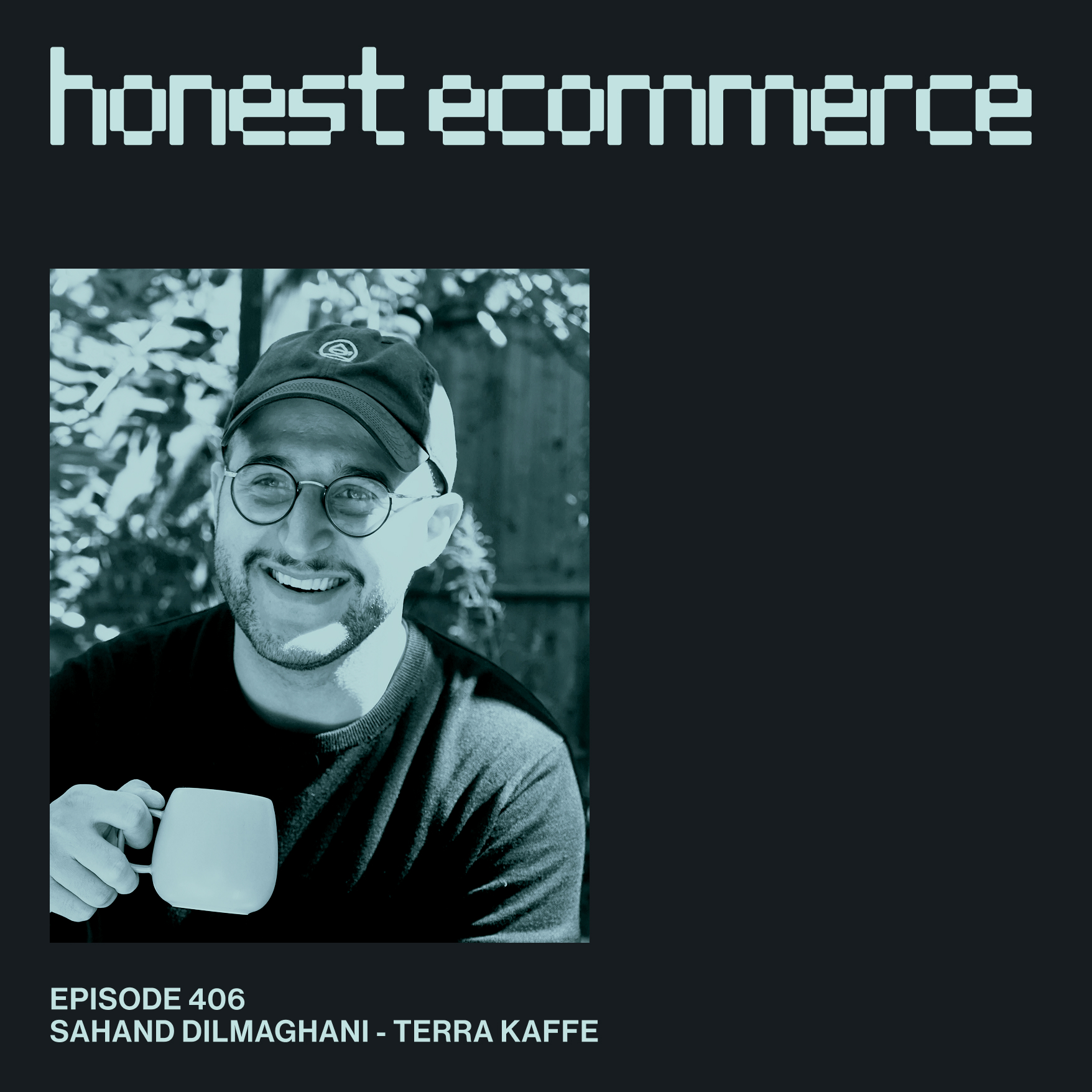
Terra Kaffe’s founder explains how to price and market premium DTC hardware (espresso machines) without a big team or large upfront tooling spend, and how pricing changes drove CAC down. He also covers bootstrapped product development, pre-order strategy, and a buy-or-rent model.
Sahan Dilmoghani, founder and CEO of Terra Kaffe. Background: years at an electric-vehicle startup; began career in investment banking. Terra Kaffe makes premium, easy-to-use espresso/coffee machines designed to replace pod ecosystems.
Premium presentation matches a highly considered daily purchase. Capital constraints require “hurdle rate” rigor and trade-offs (MOQ tooling rights, deposit/balance pre-orders). Raising price from $5.95 to $7.45 (and later to $750) reduced CAC from ~$95–$150 to as low as ~$28 by improving persona resonance and reducing “it’s missing features” skepticism. Renting (e.g., Demi at ~$39/month) is an easier on-ramp for transient users and offices.
street demos at Equinox/SoulCycle/co-working spaces; first purchase before public launch; O1 to O2 product upgrade; customer comments about “not a super auto” and “doesn’t do milk.”
Written by AI. May contain mistakes.
Learn about the philosophy behind showcasing premium products at Terra Kaffe.
“I loved when people would walk up to me and be like, oh, this is another one of those like$50, $100 million funded D2C brands.”
Explore the innovative espresso machines designed by Terra Kaffe.
“For those that don't know, could you quickly talk to us about the types of products that you're bringing to market over there at Terra Cafe?”
Sahan shares the journey from the initial idea to developing a prototype for Terra Kaffe.
“We had every gadget under the sun that you could imagine.”
Discussing the hurdles faced during the development of the first product.
“That still required us to get to a place where we had to make a lot of trade-offs in terms of decision-making and what we could invest in.”
Exploring how limited funds influenced design and production decisions.
“But frankly, you have a minimal amount of dollars available and you have to basically select only a handful of items that you're really going to invest in.”
Sahan reflects on the value of being resourceful and innovative during startup early days.
“But a lot of tough trade-offs at the beginning to really question whether or not is this the right idea?”
Sahan recounts the story of negotiating the first purchase order for their product.
“To your credit, you got to the punchline before I could, which is like money doesn't solve problems.”
Learn how word of mouth and product resonance fueled growth.
“And the good thing for us was that there was a high product resonance.”
Explore unique methods for driving pre-launch customer traffic.
“You mentioned something, I think, just now, and I want to call back to it.”
Discuss the hurdles and changes faced in product development.
“So tell me about after that, the growth phase.”
The hosts remind listeners to engage with the content before resuming the interview.
“but also how the macro landscape kept shifting too.”
Discussion on the pros and cons of the renting model for machines and its appeal to different customer segments.
“And there's something super interesting about your business model.”
Host discusses the options available for customers, emphasizing the choice between renting and purchasing.
“but locks you into that closed ecosystem.”
Information shared on how to learn more about Terra Kaffe and engage with the brand.
“I mean, look, certainly, as an eCommerce company, it's just taracafé.com.”

Get the gist, explore an idea or ask about something said.
 Claude
On Honest Ecommerce, what are the key points of this episode?
Searching your listeningAutomatic transcript. May contain errors.
0:00I loved when people would walk up to me and be like, oh, this is another one of those like$50, $100 million funded D2C brands. And I was like, that's crazy because we have no employees. We have like, it's me and one guy that's been with me since the beginning. But it was like, effectively, there's really no team here. But we always try to showcase the product in a very premium way because we knew it's a highly considered purchase. This is the thing you're going to wake up and engage with every morning, the first thing out of your bed. we can't be putting some sort of trivial or utilitarian foot forward.
0:33It has to harmonize and connect with the moment that we're trying to tap into the brand identity visuals and how we show up has to match that. Honest Ecommerce is a weekly podcast where we interview direct-to-consumer brand founders and leaders to find out what it takes to start, grow, and scale an online business today. Honest Ecommerce is proudly produced by Electric Eye, a Shopify Plus partner helping ecommerce brands sell more with strategic design and development. Visit electriceye.io for more information. Hey, everybody. Welcome back to another episode of Honest Ecommerce. Today, I'm welcoming to the show the founder and CEO of Terra Cafe.
1:13He started the company after years of working at a startup in the electric vehicle space. And he also kicked off his career in investment banking. Sahan Dilmoghani, welcome to the show. Chase, thanks for having me, man. It's good to be here. I'm excited to chat to finally get this interview rolling. For those that don't know, could you quickly talk to us about the types of products that you're bringing to market over there at Terra Cafe? Absolutely. We make beautifully designed, easy to use espresso machines, coffee machines that deliver high quality coffee at the push of a button. No need to resort to single use plastic or aluminum coffee pods or coffee capsules.
1:47Basically wanting to give everyone a better way to start your day and be a real solution people that want to get off of the coffee pot ecosystem. Absolutely. Take me back in time. Where did the idea for this business come from? What really drove you to dive in here? Yeah. I mean, I think much like a lot of founders that end up starting something, especially within the consumer space, it came out of a personal challenge or problem that I was experiencing. I was out there shopping for a new machine. We were a bit of an oddball family. We had every gadget under the sun that you could imagine. But funnily enough, when it came to making espresso at home, we did have a manual machine.
2:28But to really serve the whole household, we wanted something that was easy. And when you looked at what was out there, pretty much everyone was getting pushed to the same two solutions, which are just within the pod ecosystem, which was really Nespresso was the kingpin of that duality. And so that's where it started. I did see that there was a category of what was called super automatic bean-to-cup machines that existed. But they were very, very complicated to use. They were prohibitively overpriced. And frankly, they just had incredibly dated designs. The way I describe that is it's like Sega Genesis designs without any of the vintage charm.
3:07It's just there was no endearing quality to what they were providing. And frankly, it wasn't something that I, nor what I quickly learned other people were excited to have on their countertop. Absolutely. So how long was... Let's call it the ideation phase. Yeah. Were you sitting on this like, this would be a good area to invest my time? Let's call it from where you really had that aha moment to you have your first prototype. How long was that? Yeah. I mean, I think it's an interesting thing, right? Because I probably didn't have that type of maybe early days conviction where I was like, like, oh, this is undoubtedly going to be a great idea.
3:46I think I had a lot of trepidation or reticence really from the early days. And I think some people might feel a lot of solidarity with that. But if anything, what I would say is that it actually helped us be more data-driven and consumer-centric in how we created the business. So to be specific to the time horizon, probably from first idea to first prototype was around one year. That still required us to get to a place where we had to make a lot of trade-offs in terms of decision-making and what we could invest in. I was bootstrapped for the first 1.5, almost 2 years of the business. But we really got to a place where we could be reliably mass-producing the product about a year and a half in.
4:28Absolutely. And walk me through some of those larger challenges of getting that prototype to a production-ready model that you could ship to the masses. What were some of the big hurdles that you had to get through in that first year, 18 months? Yeah. I think the prioritization and what that means for dictating the capital allocation was really tough, especially when you're bootstrapped. You're not going to be putting crazy amounts of dollars to anything. But frankly, you have a minimal amount of dollars available and you have to basically select only a handful of items that you're really going to invest in.
5:07So for me, a big part of what I wanted to stand out on from the beginning was it was design and quality of the product. Of course, there was another side of that to me where it was the community side. And I thought there was definitely a lot by way of foundation that we would need to set early on to really stand out and build a strong community. But in the earliest of days, before we even started a pre-order, to me, it was really all about the product and understanding what do customers actually want? Where are the pain points? What problem are we actually solving? And when it came to actually building the product and testing it, every data point I got brought back orders of magnitude, greater validation, social proofing, credibility that we were on to something with our thesis.
5:50But there were so many tough conversations at that time. I mean, even with the manufacturer, the V1, a lot of people think it was purely an ODM relationship of launching something someone else had built. When in reality, we did a huge sourcing project for various vendors and suppliers that had the right internal components we could build the base off of. But virtually everything we did design, we didn't really own at the very beginning of the company because I couldn't pay for tooling. I couldn't pay for a lot of the hardware injection molded parts. And so the manufacturer was like, okay, if you can't pay for this, that's fine.
6:22but then we're going to have the right to be able to sell this elsewhere. You can have rights to the US. And for me, the way I looked at it was really a proof of concept. So I thought, okay, if nothing else, this can be the case study or the data that I need to be able to go out and raise money to really build out this business and really solve the problem we were setting out to solve in the beginning. But a lot of tough trade-offs at the beginning to really question whether or not is this the right idea? Is this going to hurt? really the long-term potential of the company and the brand. But I think that's what it looks like in a lot of companies in the early days.
6:57Absolutely. It's funny. I had another conversation earlier today about how they launched and another expensive piece of hardware. Oddly similar price points, but completely different verticals. But the way that they launched was a partnership with someone that had done it before and iterating off of previous attempts. And it sounds like you entered the market there, but you... Not to belittle your creation, but Frankenstein together, your V1, through various... What you felt were the best pieces to make the best product for what you wanted to do. You mentioned it was from capital restraints. How could you tell the audience the difference between this approach of trying to be scrappy and using and thinking outside the box and producing that v1 of the product, as opposed to if you had to go raise capital or just somehow you had it in the bank.
7:58What does that look like in difference from a product like this? Yeah. I mean, I almost don't even want to talk to the crowd that already has it in the bank, other than to say that I would just be cautious of that just because you have it doesn't mean you suspended. There are so many, so many case studies of companies that had deep, deep pockets when they started building, but they didn't really validate things early on to actually determine whether or not there was staying power for the brand, whether there was real desire and latent demand for the product. I've seen a lot of that world and I don't agree with a lot of the sequencing of investment.
8:32And I think it actually creates the wrong incentives internally that a lot of people, frankly, of course, corrected on too. But I think to the people that are very, let's say, capital constrained, especially in the beginning, I know it's easy for me to say it now, having gone through it. But I would honestly appreciate that moment. Because if you actually lean into it, it sets a baseline rigor and judiciousness in the company that you will need and will pay dividends going forward. If you actually embrace it in a way where it's like, we have a very high hurdle rate for what we invest in as an organization, it will always benefit you in the long run.
9:17I think not enough people when they're running, whether it's an e-commerce business or any type of startup, I don't know if they ever look at it like, hey, almost think of it like an investment committee internally. The same way a VC would think about investing in a company, like your own hurdle rate for investing in new projects, and new products, new channels and new markets, you should take it with the same level of seriousness of like, is this actually worth it? What conviction do we have? And why do we have it for going down those paths? But in the early days, it's easy for me to say, but in the early days, I remember, man, I would get a call from the manufacturer and he would be saying, okay, you need to cut the purchase order for the units or we have to pay for the tooling.
9:58And I'd be like, yeah, I can't pay for that. He was like, I thought Americans have money. And I was like, okay, not all of us. But it doesn't feel the best. But frankly, I think a lot of our success today is because of what it looked like in the early days. What is the next big idea that could change your business? A pricing change? A new bundling strategy? Adding subscriptions? Tweaking your shipping offer? Most brands make these decisions based on gut feel. They roll out the change, hope for the best and have no real idea if it helped or hurt their business. IntelliGems fixes that. It is an AI-powered testing platform that brings CRO-level clarity to the decisions that actually move the needle.
10:39Not just button colors and headlines, but the big stuff. Pricing, offers, shipping, new apps, even major site changes. Brands like Ridge, Jones Road, and True Classics are using IntelliGems to test their most important decisions and see exactly how each one of those impacts profit before they commit. Momofuku used it to test promotional offers ahead of Black Friday and found the version that increased profit by about 28%. Mott & Bo ran structured pricing tests that drove roughly 30 % more incremental profit. We use it at Electric Eye with almost every client we work with. And now IntelliGems has a free AI-powered audit that gives you 3 specific ideas that you can test on your store today.
11:22No commitment, no credit card, just 3 opportunities worth exploring. Head to IntelliGems.io slash audit and get your free audit in just a few minutes. That's IntelliGems.io slash audit. IntelliGems.io slash audit. To your credit, you got to the punchline before I could, which is like money doesn't solve problems. It probably creates more problems in a certain sense. And it's also... You could argue that using some of these off-the-shelf components and And economies of scale, these things could get cheaper. But the tooling and the amount you'd have to purchase upfront for a startup with a non-validated idea, you could be sitting on useless inventory, which is essentially sunk capital at the beginning, versus being scrappy.
12:11How do we just get 100 units created? Yeah. Do you remember what the first purchase was? How many you guys got? Yeah, of course I do. I'm laughing because that was another moment where he was like, God, this American. I really got the only American who doesn't have money. It was our MOQ that we had agreed upon was going to be 300 units, which would not even fill up a 40-foot long-haul freight container. I mean, even if palletized, that's really what you would fit in a 20-foot container. And that's still almost like an LCL shipment than it is a fully loaded our floor loaded container. So it was$300.
12:50It came time to cut the PO. And I had to go back to him and negotiate to see if he could cut that in half. And we had pre-orders, which was great. But I had a lot of guidance from other hardware businesses that were like, don't take the full transaction value of the goods when you're doing pre-orders, especially for the very first run. Do a deposit and balance model. It will reduce the barriers to transact. It'll make people, especially for high AOV products, it'll make them at least kind of put their foot in the door and say, Hey, like I would at least want to try and test this out, but they're not shelling out the full cost of the product upfront.
13:22And to me, that made a ton of sense, right? Like we weren't doing a Kickstarter. We didn't do any crowdfunding. So we're not giving a take rate to any platform. So I think for us to be driving traffic and hopefully converting these people, it did make sense that let's make this as seamless and streamlined as possible. But just for the way it shook out, even after the first deposit orders came in, it was great. But we still had to tell them, like, hey, for the full order, full purchase order, we need to cut this in half. And it was like, I can't tell you how many 11pm to 1am calls I had just going back and forth with them about trying to get a concession there, at least for the first run.
14:03And the good thing for us was that there was a high product resonance. So we did have a lot of success and that resulted in a lot of word of mouth that resulted in more transactions, which then put us in a better position where we didn't have to take such a small deposit amount upfront. And also then attracted investors to the company because they could see the momentum, the virality happening around the brand. Most brands outgrow their legacy choices long before they switch. Bad platform decisions do not fail all at once. They fail slowly, then suddenly. First, it is one workaround, then another tool, then another integration that is duct taped on top.
14:42And eventually, your team is spending more time managing the stack than actually marketing to customers. Eventually, rebuilding is less painful than staying, usually when it starts to show up on the P &L. That's when scaling brands simplify and standardize on Klaviyo. Klaviyo is the AI-first B2C CRM. It combines your customer data, email, SMS, analytics, and customer experience tools into one platform. So you're not stitching together 5 different systems just to understand what your customers are doing. Your database updates in real time, your segments update automatically, your flows, campaigns, and personalization all run off the same source of truth.
15:22And that shift is why many brands are moving to Klaviyo. Brands like Dollar Shave Club have reduced total CRM stack costs by over 30 % after consolidating onto Klaviyo. Multi-brand operators like Mark Fisher have migrated multiple brands and drastically reduced the time required to execute CRM marketing. And brands using email and SMS together inside Klaviyo are seeing massive ROI compared to running channels in separate platforms. The big unlock is simplicity and scale at the same time. Klaviyo is built for marketers, not for engineers. It is built for online businesses just like yours. And it is built for where Ecommerce is going, not where it was 5 years ago.
16:02If you're running email and SMS across multiple tools, or you're on a legacy platform and thinking about your next phase of growth, it's probably time to look at Klaviyo. Go to klaviyo.com slash honest and see why hundreds of thousands of brands have already made the switch. That's klaviyo.com slash honest, Just K-L-A-V-I-Y-O.com slash H-O-N-E-S-T. Absolutely. You mentioned something, I think, just now, and I want to call back to it. You weren't giving a percentage away within this pre-order campaign. You were managing that yourself. So you were driving traffic to, I'm assuming, your own.com, perhaps a Shopify store or something similar.
16:42How did you do that? How were you getting customers that weren't your friends and family. What were you paying to do that? How are you getting eyeballs on this thing pre-launch? I mean, I still can't believe some of the people that transact with us at the beginning. I remember the very first person was this woman from Connecticut. And I remember just calling her because I was like, why did you buy this? The first order in... Even... I mean, got in before my family. My mom was like, I want to be the first order. And this person snuck in on the website. We hadn't even really announced it yet publicly.
17:13And we're in New York. I wanted to use that to my advantage. So I did do a lot of demos ahead of announcing it publicly or running any paid ads to our website. So I was out in the street every week. We were 2 people. We did 1 event a week minimum in the city. So it was the first class coming out of an Equinox, the first class coming out of a SoulCycle, any co-working space that let us come by. We were showcasing the product wherever we could. I just kept knocking on doors. And you knock on 50 doors, one of them says, yeah, sure. Come this weekend to some D2C brands showroom in Soho and serve our weekend crowd coffee.
17:54And that's a lot of, frankly, a lot of the data that I retrieved in the early days about what messaging resonates with people was I had already spoken to thousands of people and had just listened to what they were saying. I just played dumb. I record. What are they saying? What do they hate about the Nespresso? What do they love about out-of-home coffee that they can't get in home? That all just became all of our taglines, copy hooks for all of the first ads. And then yeah, when it came time to put paid media dollars behind it, I remember John, our growth guy, was like... He was the first employee with me.
18:25He was like, Sahan, okay, let's do$50. Let's do$50 budgeted per day to start. And I was like, John, can we make it$25? And he's like, I feel like we're negotiating with coins. It's a Turkish bazaar or something. But yeah, that was the very first dollars. What was interesting was, we did the pre-order. We were selling and it was okay. It wasn't amazing. It was okay. But I remember when we were at full steady state pricing, it was$5.95 for this product that we've since Sunset called the TKO1, our acquisition costs would fluctuate anywhere from like$95 to$150. And it was always oscillating within that range.
19:11But you could tell the velocity wasn't moving the way that we wanted it to. It was going well, not great. And there was one night where I remember calling John. I was like, I think we have to up the price to$750. $150 price increase, which at that time, especially proportional to what it was, was a huge jump. And he was like, why do you think we should do that? I'm like, because I'm reading all the comments. And we're still a very, very unknown brand. And people don't know what this product does. And it's like where I got a crash course in Veblen goods and pricing strategy. And I said, I want to go...
19:47I think we need to up the price tomorrow. Essentially, we wake up in the morning, we up the price on everything. And he was like, I think that's a big jump. But okay. The moment we did that, our CAC went from a$95 to$150 CAC down to, at its lowest,$28. It was crazy. I need you to walk me through how that worked out. What were you seeing in the comments? And how did that affect who was being shown the product to... basically, I have some assumptions, but I want to hear you explain it to me. I'm so curious what your assumption is of what you think was happening. Do you want me to tell you what it was or do you want to tell me the assumption first?
20:33Let me guess. No, I love being a fool. So my guess would be that the comments you're reading are something about price sensitivity, which means that the audience that's being shown this ad is not in the correct... Let's just call it... They're not rich enough. All right? For lack of a better term. So when you raise the price, Facebook reallocates to a better band of income level to now people are perceiving the value better and it's resonating more. That's my guess. Okay. That's very interesting. That's part of the answer. So part of the answer was the cohort resonance or essentially persona resonance.
21:17The other was because there was such little social proofing of the product online, people were making assumptions of what it did and did not do. And by virtue of pricing below the floor of our tier of what's called super autos, people were making claims in comments, in thread of what it did and specifically what it did not do. And so they were saying like, oh, it's not a super auto. It's a fully auto. It's not a fully auto. It's a semi auto. It doesn't do milk. It doesn't do this. And it's like, it's in the photo. It's there. But then there's comments like, oh, that's just like, they're just advertising what it is.
21:52It's not bad. Because you were undercarding the market so much, they assumed the way you got there was by leaving something out. And they thought it was, and this is all pre AI ads too. So these are whatever is there is yes, sometimes photorealistic renters, but very unlikely because even that's incredibly expensive to create. It was mostly photos. But the idea was that this has been Photoshopped. It's not doing a milk-based beverage. You're not getting that. You're not getting the full gamut of drinks, they're saying. And also, it's a lot more manual process. It's very likely to send me on. I'm like, okay, we're literally showing it's push-button brewing.
22:24But we're seeing the commentary. And it's like, oh, this is just like, don't listen to this advertising. And I'm like, oh, we're getting relegated to the high end of the tier below us, which has very different functionality versus an incredible deal for the category that we're in. And when we upped it from$5.95 to$7.45, it was still at the floor of the category. It was just at the very bottom floor. There was one player that kind of oscillated around there depending on their discounts and promo strategies. But we were at the very, very bottom, but we still showcased super premium. And we're like, oh, it's just the consumer psychology anchoring of I don't trust this thing.
23:07It doesn't make sense to my brain. If somebody came to me tomorrow and wanted to zone me a brand new 2026 Mercedes S-Class for$12 ,000, I would naturally be like, what's the catch? What is this? Why are you dumping this lemon on me? You're all of the things that we've learned through human psychology and sociology and survival. It's like, this doesn't make any sense. And so I'm naturally more reticent towards it. And so when we changed the price, I was like, this is crazy because I'm upping the price. And my CAC has plummeted. My efficiency has skyrocketed. And it's just a crash course in pricing strategy.
23:44It's like you're going so far, so many standard deviations outside the mean that you're now confusing people. And it doesn't make any sense. But it also then the high... I just like design. I'm the son of two architects. I was surrounded by designers. I always wanted a polished foot forward. I loved it when we had no money and I was bootstrapped and I'm just doing demos. I loved when people would walk up to me and be like, oh, this is another one of those $50,$100 million funded D2C brands. And I was like, that's crazy because we have no employees. We have... It's me and one guy that's been with me since the beginning.
24:19But it was like, effectively, there's really no team here. But we always try to showcase the product in a very premium weight because we knew it's a highly considered purchase. This is the thing you're going to wake up and engage with every morning, the first thing out of your bed. We can't be putting some sort of trivial or utilitarian foot forward. It has to harmonize and connect with the moment that we're trying to tap into the brand identity visuals and how we show up has to match that. Everybody's about to spend the next 2 weeks obsessing over one number. Black Friday, Cyber Monday revenue.
24:52Here's the problem. That number is the least useful one you can look at all year. It tells you how many people bought once. It says nothing about whether you built a business or just ran a really expensive discount code. That is what Flowium fixes. They're a lifecycle marketing agency for Shopify brands, Klaviyo elite master partners, and they build the infrastructure that turns a first purchase into a habit and a habit into an advocate. So every dollar you're about to spend on Black Friday, Cyber Monday ads actually pays off. Book your free retention diagnosis this week. Last chance before the surge hits.
25:23Head to Flowium.com for more information. That's F-L-O-W-I-U-M.com. Flowium.com. So I'm assuming after that aha moment, it was all gravy. Everyone's dancing to the bank. You're increasing your Facebook spend. So tell me about after that, the growth phase. Give me a few of the key points there here before I let you go. Man, I mean, I think the things that were... I mean, it was a roller coaster ride throughout. So we were growing very quickly. There was a period where we were building the O2 based off of everything we had learned from the O1. And it's just, frankly, it's a superior product across the board.
26:09But we did end up in a tricky spot. The interest rates change and capital markets shifting, like the financing of R &D. We had to make very quick decisions and launch that product when we got it out the door. Finally, in early 2024, it was about a year later than we initially wanted. There was a lot of lessons learned in terms of... Again, I would go back to the prioritization and willingness to really... I don't want to say kill your babies. That feels a little too harsh. But you have to sacrifice some things in the ideal state to get the product out the door. Better said, perfect is the enemy of good and perfect is the enemy of done.
26:46So we had to launch the O2 in a pretty cash-constrained scenario. And then that resulted in some challenges in terms of, ultimately, the customer service and the response times, the availability of spare parts to basically get back to customers. So we had a lot of challenging times around that 2023, early 2024 phase. But yeah, since then, we did a lot of changes internally as an organization. We put ourselves on a much more stable footing. And then saw the success of the O2 really picking up steam going into early 2025. But we also very quickly learned that not everyone can make the leap to buy a$2 ,000 machine.
27:29They liked the functionality, they liked the design. But we used a lot of that insight and frankly, a lot of the brand building with the O2 to launch the Demi machine, which is a smaller form factor, lower price point machine. And that has completely changed the game for the business. And so right now, we're really accelerating at such a fast clip that it's creating its own separate challenges. Never a dull moment in Ecommerce and in startups. But yeah, we just had to make a lot of changes through navigating not just the business scale, but also how the macro landscape kept shifting too. Hey, everybody.
28:07Just a quick reminder. Please like this video and subscribe. If you haven't, We're releasing interviews like this every week. So don't miss out. Now back to the interview. Yeah. And there's something super interesting about your business model. I've seen it before. Don't get me wrong. It's not brand new, but you're the first person I've been able to ask on the record. Yeah. You have a secondary call to action on all your product pages. You can buy this thing or you can rent it. Yeah. How has that been? Oh my gosh. It's so controversial. commercial. I always find it so... I'm going to just call it interesting for now, that there are a lot of comments of like, what is the world coming to that we're renting machines?
28:50It's very funny because it's very clearly a very ephemeral, transient look at the company because they're not saying that you can absolutely buy the product. But there are a lot of people that the renting actually just makes more sense for. So frankly, it was one of those things that I went into with a lot of hesitation. I did not want to confuse customers. And I frankly also just didn't want to shoot too far down this new business model path that has all sorts of different challenges associated with it. So it is a very controversial thing. It works really well for certain types of people. And sometimes those types of people are...
29:32It's frankly, a lot of times commercial environments. So offices that are more used to paying for food and beverage services on a monthly cadence. So it just works better to have a machine that they tee up with a coffee subscription and other food service providers that send everything on a monthly cadence. Sometimes it's people who are more transient. Sometimes it's, I just want to try before I buy kind of thing. And yes, we have a 30-day free trial on the machine. But hey, maybe you don't want to drop$2 ,000 on your credit card with a brand that you just became familiar with. And you have to mentally go through the thought of, Oh, if I do want to return it, I got to box this thing back up.
30:06I got to send it back out. A monthly rental just becomes a really easy on-ramp to try out the product and get familiar with what it can do, get familiar with the brand or service level where we take a lot of pride in making sure customers are taken care of. But it just works better. And then look, frankly, for some people, it's just better economics against an espresso. right? It's why Nespresso tries to charge you almost nothing for the hardware, but locks you into that closed ecosystem. If you look at our Demi machine, you can get it for$39 a month. It's literally competitive to what you will economically pay for a Nespresso from day one.
30:40So the machine plus the pods and capsules you would need for that first month, you're already ending up in the green, in the black, if you will, from day one, getting a Demi with a coffee bag, which not only will be cheaper on a running basis versus a pod machine, but it's obviously going to be far superior quality. But it doesn't work for everyone. And you can still buy a machine. So you don't have to go down that path if you don't want to. No, no, no. It makes complete sense. And that's one of the things. It's like, give people the options. And if your customers are looking into that option, it is a thing that you can do now in the ecosystem.
31:15There are solutions out there. before we go, if I'm listening to this, you're obviously passionate about these machines, the quality of them. And where should I go? What should I do if I want to learn more? Perhaps rent one? Perhaps maybe just make the whole purchase? Yeah. Yeah. I mean, look, certainly, as an eCommerce company, it's just taracafé.com. So you can check us out there. We have a pretty active Instagram, which is just at Terra Cafe. We are very open to our policy. If anybody ever wants to come by the office, come check out our machine, see us, see the products, meet the team and just hang out for a bit.
31:54We're at 25th Street, 36 West 25th Street, 6th floor. You can swing by anytime. Yeah. So we're always happy to engage with, honestly, anybody who just wants to learn more about our products or frankly, coffee in general. So please check us out. And yeah, if you want to give it a try, you can rent or buy. Awesome. Sahan, thank you so much for coming on the show today and sharing all those amazing insights. Thanks for having me. Thanks, Chase.
Sahand Dilmaghani is the founder and CEO of Terra Kaffe.
Equipped with a global perspective, Sahand earned his MBA in France, worked as Head of Finance & Corporate Development at Unu (an electric scooter startup in Berlin), and is fluent in Mandarin, Farsi, German, and English.
His entrepreneurship started young and never wavered and his enterprising attitude has inspired a wide range of diverse ideas. Throughout it all, he's been obsessed with high-quality coffee, believing that finding it should be simple and sustainable.
In founding Terra Kaffe, he was inspired to blend the best of European coffee culture and the pioneering spirit of the US start-up scene. A son of two architects, it was only a matter of time before he found his way back to design.
In This Conversation We Discuss:If you’re enjoying the show, we’d love it if you left Honest Ecommerce a review on Apple Podcasts. It makes a huge impact on the success of the podcast, and we love reading every one of your reviews!