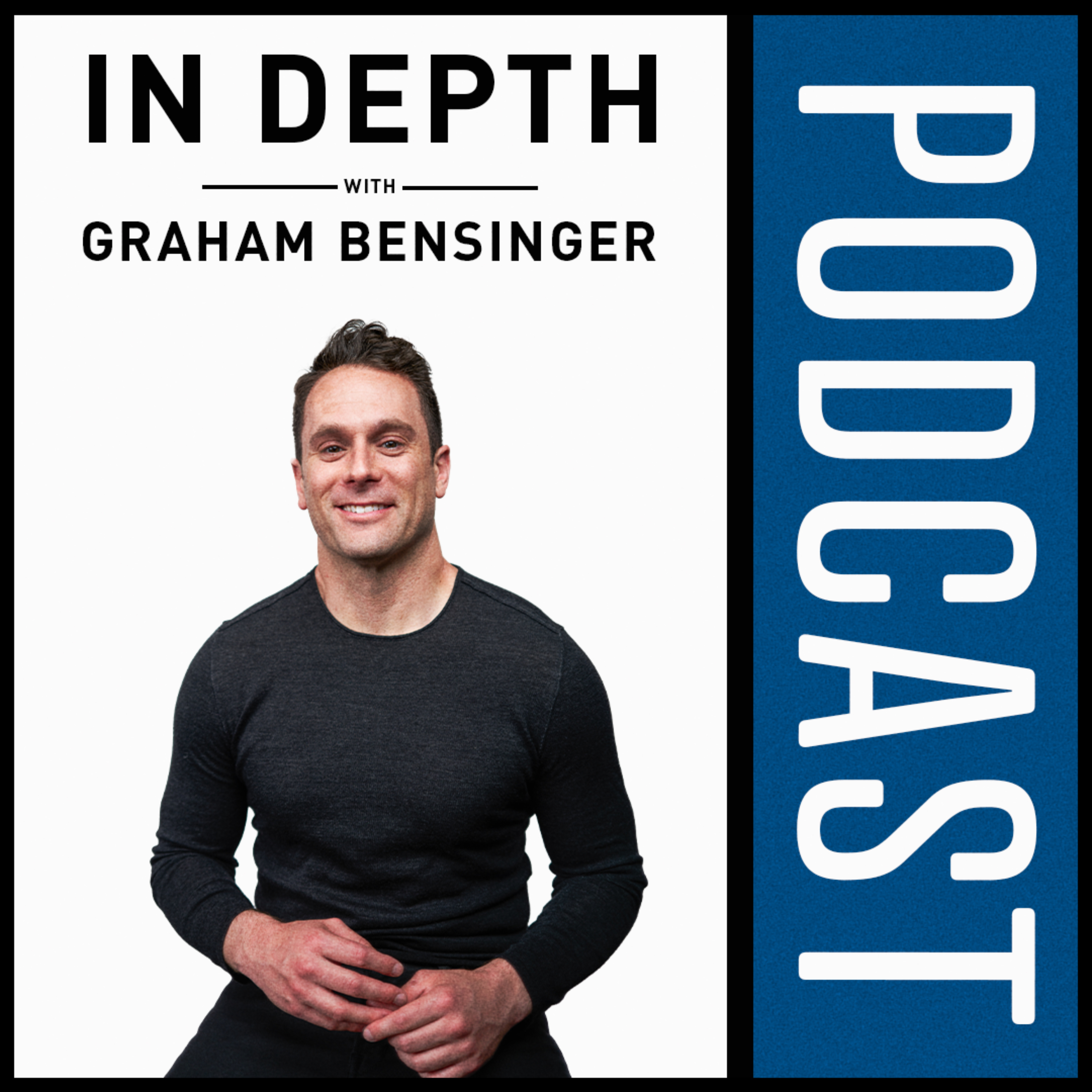
 In Depth With Graham Bensinger
16 Nov 2026 · 2h 29m

 Add vo to ChatGPT or Claude to ask about everything you hear
vo listened to this episode to put together the overview and transcript, so there may be the odd mistake.
David Yarrow discusses how he built a $35 million photography business by shifting from finance to fine-art wildlife/conservation photography, how major financial events (9/11, Lehman, Bernie Madoff) shaped his career, and what it takes to get “authentic” shots—often in remote places like Madagascar and South Africa.
David Yarrow is the main guest. The host is Graham (interviewer). Other named people appear as references rather than guests: Cameron (Yarrow’s son, mentioned in a story), Jane (his ex-wife), Charlie Sheen (mentioned via Wall Street cultural reference), Nassim Taleb (Fool by Randomness), Chris Fallows and Paul Nicklen (marine biologists/photographers), and “Jaws” (a Texas lawyer who bought a shark print).
0:01This episode is brought to you by Google Chrome. You think you know a browser, but Gemini and Chrome, that's new. It can help you with practically anything on the web, like restoring a vintage motorcycle from a 50-page restoration block, or finally break down that long article you've had open for weeks. Gemini and Chrome is here for it. Ready to make anything online make sense? There's no place like Chrome. Check responses set up required. Compatibility and availability varies 18+. Big news! Wayfair's Black Friday sale is here. Early! Right now at Wayfair, get up to 70 % off everything you need for the season ahead.
0:34Save on kitchen and dining, bedroom furniture and mattresses, holiday decor, and way more. Now is the time to score big, from seasonal finds to favorites you'll use all year long. Plus, with Wayfair, enjoy fast and easy shipping with delivery and time for the holidays. Save up to 70 % off early Black Friday deals. Shop now at Wayfair.com. Wayfair, every style, every home. Look at this handsome gentleman, Harley. It'll be a beautiful day. We've got these to go that way, probably another foot. Hey, this is a nice setup. It looks like you've got a screensaver behind you. How are we doing? We're seconds away.
1:15Just going to do a poor man's slate, just to be safe. Explain what you look for when setting up a shot. To have a frame that tells a story, You have to make it sweat. I said, well, what about$6 ,000? And I always remember when he went,$6 ,000? So I thought I'd gone way too high. He said, no, I'm going to get one for every room in my office.
1:47At the best part of that day, he took Cameron away for one hour, one-to-one, and they drank tequilas and talked about business. What did Cameron tell you about that? Damn, that was the best, best thing.
2:02David Yarrow is arguably the most scorned person in conservation, in conservation photography. It seems there is nothing he won't do to get the shot. Two or three cases which you talk about, I don't think we did anything wrong.
2:25Have you ever thought you were going to die?
2:32So here we are. Here we are. Okay, by the way, this is where on your travels in terms of number of days away from home, and when do you next go back home? I'm not quite sure when I go next home. I think maybe in about 10 days time okay but it's raining in the UK everyone's back at school everyone's finished with the summer so there's no big pressure to go back right now and you're going where on this trip going to Madagascar tomorrow which most people thinks cartoon animated movie but it's French speaking part of Africa off the Indian Ocean. It's a bit sketchy in places but... And sketchy means what to you?
3:23Sketchy to me would mean that there are moments where you feel you're trespassing in other people's territory, that you've got to be quite careful what you eat. Because it didn't work out for you recently in the eating room, right? And once bitten, twice shy. But I'm fine now, that's why I'm wearing white trousers. But there's not much traffic, as you know, on the extra mile. So to go to a place like Madagascar, you do know that you aren't going to see too many people you know when you arrive there. Whereas if you're in content, the most disillusioning day is if you turn up somewhere like, which I wouldn't, like Yosemite, because there's going to be a lovely moment with the waterfall and the 600 people with the same idea, well, that kind of doesn't work towards authenticity.
4:17So I do have a tendency to look to go to places where there isn't much traffic. And what are the worries or points of concern or nerves on this trip? Well, the most basic one is to lose money. And the way you lose money is you don't bring home anything that people want to see, either because it's boring, it's mundane, it's hackneyed, it's not authentic, but most likely because it's mundane. And there's always got to be a good chance that that happens. So I think that's always the biggest risk. So we're here in South Africa. You're doing some filming at Kevin's place, who we profiled before. Is it more important to you to kind of get the shot there or get the shot in Madagascar or, you know, equally?
5:15This is a safe shot because I've been here 25 times and we work with each other a lot. We know each other. We're familiar. I know what we can get. It doesn't excite me as much because, like everything, if you do it a lot of times, perhaps the edge, some of the novelty wears off. but I think it's good to have occasional shoots where maybe the creative factor or the energy is a lower mark out of 100 but the the financial side is slightly safer I don't think you have to go for Hail Marys the whole time now does your best work often come when you go for the Hail Marys or the familiar? I think that's a good question.
6:06Clearly, if you go for a Hail Mary and you get it, you've got to ask yourself, was it a Hail Mary in the first place or am I just bluffing myself? But some of the shots that we've got over the last 10 years in places that are not familiar for us, like South Sudan, yeah, they've been the most satisfying. So I want to take you way back what a lot of people would be less familiar with who are kind of unaware of your story is you did not start out professionally in photography. You started out in finance, but you had kind of two paths initially because you had a job offer from Getty, which interestingly, your business is now today more valuable than that of.
6:59I wouldn't, well, the marketplace suggests that Getty's got very limited equity value. I wouldn't have an opinion on that, but that was what the marketplace would suggest, that they were under enormous pressure. Which is a hell of a statement to be able to make regardless, you know, who's, you know, making. Yes, but you could argue soon a lot of businesses around the world have a better value. It's more a reflection of them than us. but you're right but so you know back in the day you have an offer from a bank yeah and an offer from getty same offers uh why do you decide to go the finance route well funnily enough uh another of the people that you've uh interviewed uh uh charlie sheen had just starred in wall street and everyone wanted to be their gordon gecko or bud fox i just come back from the winter olympics in Calgary, which was famous for Eddie the Eagle, that Britain had the worst ski jumper in the world.
8:04And they thought, Getty thought I was probably the worst photographer in their stable. So they gave me Eddie the Eagle to photograph. And I just got a little bit disillusioned at that Olympics about, I didn't see any role models. I saw some very accomplished photographers, but I didn't see people that really were enjoying life. They seemed to be a crew that didn't have much good energy and were almost moaning about one thing or another. And there was an extent to which it seemed perfunctory in going through the motions for them. And I remember trying to get different photographs of things like the bobsleigh.
8:41And then those were the days of film when you'd come back to the Kodak or Fuji editing theaters. And three hours later, you'd get your transparency back. and you think oh that's quite novel the way I've used line and light and composition and then six other German photographers had exactly the same picture so I worried then and so I had the job offer from them and the job offer from a British bank. Which by the way is impressive to be conscious of that you know the worry you speak to at that age. I think my bigger concern was I always wanted to have heroes and my heroes were some great writers in the press corps in sports and I know you know your sports press industry very well but maybe less so in the photography side of things I wasn't very good at it I hastened to add and maybe the fact that I didn't enjoy it was a function of the fact that I wasn't very good at it and I got the big jobs like photographing East German ice skaters went to the best photographers and I was given the Olympic medal ceremonies because they would say well at least yeah we know Yarrow can't mess that up all he has to do is take a picture of someone being given a gold medal but a lot of my friends at the time age 21 22 you keep an eye on what they're doing and it was the era when Wall Street was exciting.
10:11Michael Lewis's Liars Poker had just come out talking about Salomon Brothers and that whole bond trading floor and then of course Oliver Stone's Wall Street. So the idea of working either in the City of London or Wall Street appealed to me and it appealed to my father who thought that photography was not a normal profession, he thought it was a hobby. And so it seemed to be the non-controversial conformist route. And I don't think you know yourself when you're 22. I mean, 22, you're so young. So to go out and do something very brave, different, I think it's different now. But in those days, I think people did conform a little bit more.
10:54And so I went down the investment banking route. And once you do go down that route and pass the exams eventually and get on the kind of earnings ladder and the expense accounts and the overseas trips. It's quite difficult to get off that hamster wheel. Because there are a lot of enjoyable elements. You meet a lot of people. And I was in a trading floor of 500 people. So even if 60 % of them I didn't have much time for, there would be 30 % that were okay, and then there'd be a few gems. and it was a big eye-opener. And there was no sense of anyone being given preferential treatment. It was a boiler room, dog-eat-dog, a meritocracy.
11:45I quite liked that. You were going to be challenged all the time, and if you weren't good enough, you'd be fired. And fast-forwarding some, how did 9-11 impact your business? It impacted our business in a way that was fortunate in a dreadful day in that I specialized in European companies and I was actually in America that day. I worked with Goldman Sachs, who were our prime brokers at the time. I was in Aspen that morning and I saw that plane go in. and I got onto Goldman's and the European markets weren't moving they didn't move and they sold our entire portfolio before the second plane went in and of course when the second plane went in your markets didn't open for six days but Europe continued to trade and of course European markets plummeted straight away but that wasn't really my concern I knew quite a few people in the area as I'm sure you might have done or your parents might have done.
12:56And so my concern wasn't the fact that we didn't, we had zero exposure. My concern was for the safety of my friends. And there's a great writer, Nassim Tlaib, who wrote a book called Fool by Randomness, which is how, as humans, we attribute good things that happen to us to skill and judgment and bad things to bad luck. but as we know a lot of good things happened to us because of luck and vice versa so it's a sort of retrospective distribution of things that happened between luck and skill I just got lucky but and I became a cynic because so many people thought I was smarter than I actually was and you might I remember about four, five weeks after 9-11, a flight from, I think, LaGuardia to Dominican Republic went down in Queens at about the same time.
13:56I did exactly the same thing, sold everything, and of course, it was an engine failure. That just shows that on one occasion, I did the right thing. But the implications were material because I went from having a very small business to employing 40 people and had investors all around the world and not really having any time for myself. I thought it was a good thing, but actually it was not really going to be the start of a particularly happy journey that everyone else thought I was, you know, I'd fallen into a lake and come out with fish in my shoes. And was not happy. Why? I was too young, I think, to...
14:42The job of looking after other people's money, when you've just got a few and it's quite Corinthian and small, that's okay. That's why so many people to choose it. But if you start looking after the money of farming in Montreal and teachers in Ontario and, I don't know, multinationals in Switzerland, and all the compliance that goes with that and then monitoring your performance on a week-to-week basis. And that industry is characterized by the clients having a constant thirst for gratification. You're only as good as your last week. And if you live your life where the perception in the outside world is you're only as good as your last week, you're only as good as your last interview, sorry about that or I'm only as good as my last photograph that is a fairly miserable way to live your life and I don't see that many happy people you meet people that you know are worth so much money and they come into the restaurant and I say why are you looking so down in the face and they go it's been a really tough February and I've lost two percent and you want to go who cares you made it in January it's just the mean reverting so I think there was that and also I had by 9-11 I had one daughter she was one years old and then the following year so we had two children under the age of three 40 staff at the firm and before you know it you think it's your life I thought the 30s were meant to be quite fun.
16:30And I'm going, this is far too serious for me right now. So I think there was an element of that. I was talking to your wife, or ex-wife, then-wife, Jane, yesterday. And we'll get into this a little more in a bit. But she was talking about how, I think, David wishes we had popped out to kids that started at 18 years old. so he could just kind of have a couple buddies to party with and that the life was quickly becoming too pedestrian, in her words, for him at the time. But how did Bernie Madoff kill your business? Well, I didn't know who he was. I knew who some of what were called feeder funds were because they're clients of mine.
17:19but in in that industry some people lock in the capital so if you give money to a business and they say I'm going to give you a hundred thousand or half a million or a million but you can't get it out and that happens in a lot of private equity businesses when I set my business up because only idiots or family or friends were going to invest in me because I had no real pedigree I was just a answer. I said, if you want your money out, you can get it back in a week. And I was also believing that if you say something, your word is your bond. Never move the goalposts. So when that happened, clearly a lot of people that invested in him were getting real shit from their clients and they were getting redemptions.
18:08So they had to finance the redemptions from selling other funds investors and so here was David Yarrow who was hardly of institutional quality albeit we'd got a good track record but I allowed them to get their money back in a week and those are the days when people wanted to stop doing business with you they would send a fax because it was kind of before the internet was going but there would still be faxes sent through and I'd come into the office to collect all the faxes before the other staff came in so they didn't see the fact that our business was just imploding so by christmas we were kind of done because of one person that i've never heard of before at the time did you know you were done investing professionally or were you still no because i i didn't have an escape route um it was one thing to say that photography could be a means by which you could look after children, look after Mike's wife and find a way forward.
19:18But there wasn't a business model of photography that I could see that was working in 2008. So I knew it was my passion and I knew it It was my potential road to salvation, if you like. I did a book called Nowhere, and it kind of summed up where I was in my life. I mean, my children thought I was a lunatic. Jane obviously thought I was a lunatic. Do you think they actually thought that at the time? Well, they just didn't think I should be taking them to Scarface when they were five. That kind of stuff. and I was so desperate that they would think that I was fun that I built enormous railway tracks around the house because I'm still a kid myself but I think they wanted me to be a little bit more normal.
20:09I remember one occasion after school I picked them up and I was going to North Korea and I had to have a meeting at the embassy. I said, but I'm with my children and they're kind of like in Harry Potter school uniform and they said don't worry we'll put them in a waiting room but there wasn't a waiting room and they sat down in their Harry Potter clothes and then there were seven Koreans opposite them all with those enormous green hats and full uniform and interrogating me and the main guy said Mr Yarrow we would like you to come as guest of Supreme Leader to North Korea on one condition. And I was thinking, well, this is going to be a little bit scary.
20:53I mean, what the condition is going to be? I said, of course, sir, whatever I can do to assure you of the fact that I'm not coming in here to try and tell stories of, bad stories about North Korea. He said, no, no, no, we just need three tickets for Adele. So that was the request which got me in tune for North Korea. Explain a little later on your aha moment that you had when you were off the coast of South Africa looking for that key, you know, great white shark shot. And then you get it and how the net result of that impacted your thinking. I had a girlfriend at the time and she was saying. A girlfriend at the time because this is.
21:44Years later, you're since divorced. Yeah, and I'd fly down to Cape Town on a Thursday evening in their winter, so this kind of time of year, but it was more June and July to photograph great whites because in that period of time, and it's changed now, the greatest concentration of great whites was down off the coast of Cape Town. They've moved. And there's a great marine biologist photographer, Chris Fallows, is a super friend of mine, far better marine photographer than I'll ever be, as is Paul Nicklin. And I went out for 30 hours over a period of time and got nothing. And then you'd come back to London and the girlfriend was saying, you know, you don't have much money anyway and you're wasting five grand every weekend trying to photograph a great white shark coming out of the water why don't you just go and see a therapist and maybe that would be a better use of your your money and i'm not going to hang around with some sort of strange shark photographer anyway you're thinking what where she's telling you this like why no i thought she might be right actually but i wasn't didn't want to quit and i finally got the picture and i remember because it's a lonely profession sometimes photography and and my kids were a bit too young for me to show them the picture.
23:08Jane didn't want to see the picture. And I was in a, you come in about nine o 'clock in the morning and you look at your screen on shore and you go, in the old days of sports photography, things were either in whack or out of whack. And in whack meant it was pin sharp. And it was pin sharp. And I was in a restaurant in a place called Kwok Bay on my own. And I just got drunk. and I think I probably cried a little bit. Why? Because I got it. I got what I was looking for and I wanted to start to believe in myself again. Do you still remember that feeling? Yes, I remember what I ate for lunch. I remember the wine.
23:51We had we, I, I. We had some very nice Sauvignon Blanc and yeah, went home to Cape Town fairly hammered. Didn't drive. What about it though, thinking about it now, still kind of touches you a bit. Well, the importance of the story, it does, because I was bouncing along the bottom. After having had a reasonably successful career in finance. Yeah, and then Lehman going down was another kind of hammer blow. I think, you know, if you worked in finance and your marriage didn't work out and you settled a month before Lehman went bankrupt and the whole subprime thing collapsed on you. It's the kind of perfect storm in a way, other than you've still got your health.
24:46But that picture went around the world. And I got my check from the agency. It wasn't Getty, it was someone else actually. And of course, you know how these things work. The model's broken now, But in the old days, if you got a picture in the Washington Post or New York Times, you'd get a bit of money. But now they don't pay much at all. So my total proceeds from the picture were about$15 ,000,$16 ,000 or something like that. And I thought I've actually created an even worse business model than the one I've had before because it cost me$20 ,000 to take this picture. So I lost£4 ,000 or dollars taking a picture that I thought was quite cool.
25:34So I thought, what am I going to do with my life? Because this is not a way to make money. And I needed to make money because of the circumstances. I wasn't going to take my kids out of a school because I couldn't afford to pay the school fees. And that would be the ultimate fear. But then a Texas lawyer who's called Jaws said, did you take the picture of the shark? I said, I think I might have done. He said, well, I'm an attorney called Jaws, and I want one from my office in Houston. He said, how much is it going to cost? And I hadn't really thought about the monetization of photographic content through putting it in a frame and making it a nice big print.
26:17So I didn't really know what to say. So I said, well, what about$6 ,000? And I always remember when he went,$6 ,000? so I thought I'd gone way too high so I said don't worry sir I will deliver it to Houston for free he said no I'm going to get one for every room in my office because that price is way too low and that was when you said aha moment or my road to Damascus moment or when the penny dropped that was when one person could pay me more for a photograph than all the newspapers and magazines in the world and that's when I wrote my Jerry Maguire the things that we say with things we think but cannot say paper which pissed off a lot of people why because I said that there was if you look at the ways to monetize photography go back 15 years how what are the ways you can you can be a commercial photographer very few get to that level you can get jobs for Vogue or harbors czar or whatever and that's crushed you can be a sports photographer and I knew so many really very good sports photographers.
27:28But the problem is last week's American football game goes out of people's heads a week later. It's just yesterday's news. And it's so difficult with 100 photographers around the pitch to get something that's different or authentic. So I went through all the categories. Certainly don't want to be a wedding photographer. certainly don't want to be um really doing sports photography when it's so crowded don't want to be a newspaper photographer because they were cutting down anyway and i said that the only way i can see where photography is going to be a good way to spend your life from a financial perspective and i know that's not to be at all and end all but it slightly had to be for me was to go down the fine art route.
28:19And at that time, that was kind of a very weird suggestion because there were just a handful of people that were doing that. But it has proved probably to be right. And I look at... Probably.
28:39But, and a lot of other people would now accept that that is the route that they want to go down it's very tough to it's one but it's one thing to have an idea it's a totally different thing to to execute it and I was miles away from the execution of it if uh not for your dad do you think you would have started the process of pursuing your passion professionally sooner um i don't think so and i the best thing i did was go into work in finance why because i think you learn the rules of the game in terms of having a financial compass and if you're working week every morning revolves around having a 100 % appetite for every piece of news in the world and knowing that if you make too many mistakes, you're out.
29:39I think that's a very healthy training. It's a miserable job, but it's a healthy training. You know, after Lehman and Michael Lewis's books like The Big Short, There was a lot of attitude in the UK and America that bankers were vile. They were, it's a community where heads I win, tails you lose. They can't, too big to fail, if the government will bail the banks out, and in the meantime, when things are good, they'll make a lot of money. And I understand the sentiments within that. All I know is that since I left, I've worked with a lot of quite big brands and consumer and non-durable industries, whether car manufacturers or luxury clothing brands, you meet more common sense in Wall Street than you do in an awful lot of businesses that I've seen outside.
30:36And so if I had to have a friend from Goldman Sachs or BlackRock or Morgan Stanley, they're very loyal as well. And they've been incredibly loyal to me. I was like almost like the Shawshank Redemption. I was the guy that got out. So they celebrate the guy that got out. So the best thing I did was to spend time there. And I learned a lot. And I met some great people. A lot of people would presumably think you grew up quite wealthy. You know, oftentimes in stories you read about your family, a shipbuilding company wasn't really the case. Um, explain also how, uh, the British government, uh, came in and nationalized the company.
31:22Yeah. So my, uh, uh, great grandfather, uh, was, uh, lived in London, was a shipbuilder, was an inventor engineer. And he thought, why don't we move to Glasgow because labor is cheaper. There was, there was coal. Um, there was a deep river called the river Clyde and Glasgow is a like Pittsburgh in some ways, always been a manufacturing industrial city. So my great grandfather moved 3 ,000 workers from London and housed them up in Glasgow. And those were the glory days when, well they're not actually glory days, you sit here in South Africa, this is the British Empire had some of its most embarrassing moments around where we're having this conversation in the Boer War.
32:08But because of the size of the British Empire, they needed a lot of boats and our family made a lot of those boats. But you never want the government as your biggest customer. I think that's a really dangerous position to be in in any industry. And after the Second World War, demand for big military vessels went down, and we, of course, had that crazy war with Argentina in the early 80s over the Falklands. but after that the whole industry was downsizing and my dad was a good salesman he actually managed to sell some boats to landlocked countries which I think is quite an achievement but it was a tough it was very heavily unionized you know Glasgow's a sectarian city where 50 % is Protestant 50 % is Catholic if you're Catholic you can't work in a shipyard because they find out where you went to school and if you went to a Catholic school, no.
33:13If you went to a Protestant school, you can't go down the coal mines. And that seems incredibly anachronistic now, but the unions created a lot of fuss. So the business was inherently a low profitability one. There was a lot of honor supporting your country, but it was not, and our family had a small stake. But then the government decided to nationalize all the shipyards in the UK, irrespective of whether they're profitable or not, and pay them nothing. And the reason they could do that was they're saying, we're going to save jobs. Margaret Thatcher felt exactly the opposite. She believed in a free economy, but the socialist governments wanted to protect employment.
33:57But the people that lost out were the shareholders in the businesses. So my father, none of us are perfect, and he had his many admirable qualities, and he took the government to court. And what happened? He lost. so that was in the late 80s and he lived in one of these big old 19th turn of the century 100 year old homes overlooking the Clyde in Scotland but the problem was it was a very difficult house to sell because it was near quite a rough neighborhood and yeah Dad got divorced, and I don't think financially, which I think is a very good thing. I remember we got such trouble for not turning lights off, and I think that's a good discipline whether you're wealthy or not.
34:55But he ran quite a tough ship, and I admire that. So, no, it was not as if we were always comfortable, but when I see the wealth that you see around today, no, nothing like that. In what ways was your relationship with him challenged? Challenging, yeah. You know, the Brits, I'm sure you've seen the Downton Abbey series in America. I'm not suggesting that we lived a Downton Abbey life, but he was old school. So the expression, I love you, for him would be a very, very difficult thing to be able to say, the expression of love. Did he ever tell you? No, no. But do you feel like he did?
35:46When I did something good. But he would always, I'd come home and see him. He said, now tell me about all your problems. I said, well, Dad, I don't really have many problems. But that's a bit of a dispiriting way to start off the conversation. um it didn't help that my mother when she left him married a photographer and they were always broke so the like to him it was like double jeopardy he said i can't i've had one photographer in my life that didn't do much i don't want another one um he had many good components as well and we loved our football together he'd always take me to football matches um and in Glasgow football's a religion uh and he would always come see me um and uh but I think in terms of emotional intelligence he would score lowly and he was a bully how so um because you just couldn't answer back and it was his way or the highway and abusive at all no one thing that uh the bullies do i think sometimes is if they if there's a an argument and there's uh and they don't know quite how to react to the argument if no one said i'm sorry and he wouldn't do that is he would sometimes do whatever he could to show an immediate reaction to the fact that he wasn't happy, like change his will.
37:29So my will was changed more than my... By the way, it was an irrelevance anyway, but that would be the way that he'd want to punish back. We're all a function of what we grew up with, and I think I'm sorry and I love you are such easy two phrases to use. I probably overuse them. I think, you know, this old saying, say sorry when you know you're right, just makes life so much easier. But inevitably, I tend to, I've tended to flip the other way from that.
38:03And I think when I, I couldn't win with dad either, because if you're in finance and you did well, you might make some money. and if you did badly you get fired and if you live your mindset with what will the neighbors say I think it's quite a de-energizing and a challenging mindset to have if you're always thinking about what other people were going to say with my kids the last thing I can think about is what the neighbors are going to say don't care they're our children you think he was proud of you I think he would be okay now. I think he would be proud of me now. I think he'd be proud of what we've done for philanthropy in Scotland.
38:53I think at difficult moments, which our family have had recently, where I've had to give a tough eulogy and a bit like that, I think he'd be proud of that. What about back then, though?
39:07I challenged him. And he called his father Sir. So if you grew up calling your father sir and then you have a son that turns around said dad you're absolutely wrong on that I can see how that 180 degree break from tradition is and my other brothers didn't challenge him but I challenged him and stuff. The one thing he was he was never a snob and he did treat the artisan in exactly the same way as the kind of name-dropping socialite which he hated and I think that was his strongest quality. Your mom, she I believe left when you were six or seven years old. Yeah, eight, yeah. That impacted you how?
39:55Well, I think it did have an impact in me because she was a sculptor, an artist. She believed if you were an artist that that allowed you to circumvent the normal rules of finance so that you could actually have no money because you'd say, well, I don't know. I'm just an artist. I don't really know what happened in the marriage and I've got no one really left to ask now. I think she might have had an affair. I don't know. But in Scottish law, and Dad was quite well connected, I think her divorce settlement was not great. So I ended up living in a caravan. I think you call them trailers or whatever.
40:38in a caravan park in Scotland for a while while she tried to find a home. And I think that was an experience that either consciously or subconsciously I think has always had an impact on me. I wanted to succeed. I supported her for the last 20 years of her life because she had no money. And she certainly wasn't going to get it from her husband. but she had she had a talent she just didn't know how to monetize it i would have thought that her annual income from being a sculptress was maybe 20 000 a year and her costs were way more than that hard to support her during that period given kind of how things unfolded with her when you were younger i never had a quarreling relationship with mom we just didn't really She grew up as a tea planter's daughter in India, and she was far more comfortable with animals than people.
41:41So she really preferred the company of horses, and I would go and stay with her, and she would be out on her horse. And she certainly wasn't interested in taking me to a football match. And your dad didn't really want you to have a relationship with her, right? I don't know about that. he certainly wouldn't certainly didn't want me to be a photographer that's for sure and that might have come from that but he knew that I'd get very upset when I went there because I didn't have any she lived in the middle of nowhere with no friends and it wasn't a happy time that was like and that's when I first kind of picked up a camera when I was maybe 13 14 and I know I'm diverting but You know, your most famous photographer, Ansel Adams, he gave the best quote ever about photography.
42:35He said, he said, photography is not about a camera. It's about the music you've listened to, the loves you've lost, the loves you've made, the poetry you've written. And it's about the work of others. and so what he was saying is that is a kind of outer manifestation of your inner soul it's not at a camera and I think it's very difficult for people that are not emotional people to be particularly strong photographers I'm sure there'll be people that will challenge that okay explain that because photography is the language of emotion you're trying to convey emotion if it's if it I don't know that there's a German school of photography called uh dispassionate There's some very famous exponents of that, like Andrzej Gurski.
43:25But by and large, I think if you are emotionally stifled, I think it's hard to tell strong stories through a camera. It is about here and here as much as it is here. That's certainly what he thought and certainly what I think that it's a key factor in the journey. Okay, speaking of a period that has to have drawn on your emotions quite a bit, the last couple years, you know, you mentioned your dad would have been proud in the eulogy. You know, no parents left. Your three siblings are gone, you know, two in the past couple years to suicide. Yeah. That's impacted you how?
44:23Well, one of them was very troubled, and we didn't have a close relationship, and he inherited a lot of my father's sort of bullying tendencies. Peter. Yes. So when he killed himself, it wasn't a huge shock because he'd tried before, and he had a pilot's license, quite dangerous, and he tried to do a few things with that. What do you mean? Tried to? Fly the plane while drunk and see what happened kind of thing. My other brother, who I was very close to, Norman, yeah, he got Parkinson's, and Parkinson's is a miserable disease because you know you don't get any better. But he was always an optimist.
45:15Yeah, he tried. He always searched for the silver bullet. And there is quite a lot of literature and press now that, you know, some of the drugs you can take in Parkinson's are dangerous. And what dopamine does is it gives you a little, I mean, some people compare it to Coke as in cocaine because it makes you feel that you're king of the world. but it has side effects impulsiveness and Norman started to suffer from some of these side effects and also it can lead to increased sexual desires which he was not really in a position to fulfill perhaps or maybe thought he could So it was all very unfortunate and that came to a head and his wife left him, which I totally sympathized with.
46:23I totally understood why she'd do that and she'd been a saint to him for so long. And then it just spiraled and the consultants always said that if he came off this thing that papered over the cracks, he would realize that life was not looking good. Uh, so yeah, he killed himself, but it was quite funny. I was in the waste management open in Scottsdale, Arizona, and I nearly got arrested that day because I went, I found out at two in the morning and I went down to the front desk of the hotel and I said, I need to get my son's, uh, uh, room number. Um, my name's David Yarrow. Here's what I did.
47:10sir we cannot give we can't give you that information i said you've got to be you've got to be kidding can i speak to the manager please my brother's just died sir we're not in the position we're and of course we're because it was it was the waste management where everyone gets fairly drunk there were a lot of people at two in the morning hammered in the fight so and he was not the sort of person that my kind of person anyway he then said anyway sir you have a good rest of the night of your evening and I so I said I said what did you just say to me did you not hear sir we're gonna have to call security if you can so I lost it anyway he did get fired the next day I'm not a tempered guy but that was my one moment I've been told you haven't given yourself enough of an opportunity to grieve the loss
48:06I think I don't know about that I don't
48:32With delivery and time for the holidays. Save up to 70 % off early Black Friday deals. Shop now at Wayfair.com. Wayfair, every style, every home. Carhartt's holiday gift guides were built in collaboration with the greatest gift giver of all time, Santa Claus himself. Old St. Nick counts on Carhartt's durable gear to have his back through rain, sleet, and snow on the biggest night of the year. Because when everyone's counting on you to do your job, what else would you wear to work? Tap the banner to grab a gift for every hard-working person on your holiday shopping list or head to carhartt.com
49:16I think about it. I think about him a bit. There are moments where I think it would be great to call Norman now, but He declined three or four years ago, and he stopped being himself yeah but I think the realization that there's no one left but it's going to happen to us all but it also coupled with the realization that I'm kind of not in charge of the family but I'm the whatever word you want to use I've got to lead the family forward and there's no one else if it's not going to be me. In what ways do you feel like there's connectivity between your dad and some of the kind of mental health challenges oh graham that's a tough one and i wouldn't want to say something that was controversial but what i would say is some people are maybe more emotionally intelligent than others um and uh i value emotional intelligence far more highly than whether you have some title before or after your name.
50:22I think being kind and emotionally aware is the most important human virtue. And I'm very much a work in progress. I've got a lot of things I've got to work out. Okay, on that front, what do you think you struggle with? I think I struggle with criticism where I feel it's misplaced, but I guess I'm comfortable with criticism when I think it's valid. I think I've lived quite a self-centered life over the last seven or eight years and I often say this to my family I say, you know, I really haven't seen so much of X, Y, some of my friends I think there's an imbalance in my life I spend 90 days in the UK, not for tax reasons, but it's probably around that and I don't, friends are the most important things in life.
51:33And of course you see them, but I did see them when there's 30 or 40 people around rather than let's go and spend two days fishing or just doing absolutely nothing and laughing and drinking beer. I don't do enough of that. You've said before, I am so damn miserable. Like give some color to that. I think that's, I'm saying that slightly tongue-in-cheek, but I'm very tough on myself. I don't celebrate outwardly my own moments. I celebrate my family's moments. But I'm miserable in terms of, if someone asks me next week, let's go on a golfing holiday with four mates to Cabo, I'd rather put pins in my eyes.
52:32Why? Because it's going to involve going out, probably going to some dodgy bars late at night, drinking too much, playing golf, which I'm not particularly good at, and just coming back a wreck. I used to enjoy, quite enjoy, you know, going out, but that to me, whereas what you should say is, wouldn't it be great to spend a week with some friends? You historically don't give yourself an opportunity to kind of stop and take a breather, right? I think that's fair. And I worry of the fact that if I came off the treadmill a little bit, that we would lose our currency in our position. And then I think galleries get bored.
53:20people get bored of artists quickly and whatever profession you're in if you're if you're managed through hard work or whatever to get towards the higher levels it's an interesting question as to whether at that point you become less happy and you work harder if you're the golfer we were talking about this the other day if you're if you're the number one golfer in the world and you've got all the money in the world and I'm not suggesting Scottish efforts like this or whatever but you probably might be less happy than when you were going from 18 to 6 in the world rankings and then why when you get to that position on a Monday morning do you feel even more compelled to practice 300 golf bunker shots where manifestly you're quite good at it anyway and I probably I'm terrified of the fact that at some stage it will go downhill and it will that's the one sure thing is at some point soon we will start to see the momentum we've had unwind and I'm just determined that that day should be pushed out as long as possible but I It's quite a natural human behavioral trait.
54:41But I guess we did have a week's holiday in France. Okay, but when it inevitably at some point declines some, that will impact you how?
54:56I might lose some of my, I don't have swagger, some of my sense of attacking and confidence I think I'm a much better person on the front foot I know I'm a better person on the front foot when I'm on the back foot I defend I close in a little bit and I know I'm a much better company when I'm I feel good about myself and my work and there will come a time, of course, and I just don't want it to be imminent. Okay, because you brought up this topic, are you happy? Yeah, I think right now there are other constituent parts in happiness. I you know I'm a very lucky guy Graham I see so many fathers that rarely see rarely see their children and as you know the next thing that happens after we've interviewed I'll see my son for lunch and then we might watch some football tonight and he's bright he's far brighter than me he really is he's strong, he might not have the visual eye, but I've been working at it for a long time.
56:28But he chose to come here. And that's an enormous privilege, and I recognize that. And my kids are healthy. I get to meet extraordinary people, get to travel around the world. Was it David Bowie that said, aging is a wonderful process where you become the person you wanted to be. I'm happier now even with thinning hair and less energy than I was when I was 40 40 I was all over the place 50 I think even 50 I was huge work in progress I'm still work in progress I don't know if you ever stop being work in progress and I promise I'm going to get to work here coming up but as one of the people I spoke to as part of the preparation for this was your ex-wife, Jane.
57:21Since your guys' relationship have dated, you were famously dating the actress Liz Hurley for a while, but Jane said, I think part of why our other relationships didn't work is because we couldn't keep one another out of our lives. The role she now plays in your life is what?
57:49Yeah, we both had fleeting moments in the newspapers, but they were very fleeting. I can never date someone famous because... Why? Well, I don't want to lose my own identity for a start, and I don't want to compromise, and I will always put my children first. And Jane will always put the same children first. So she had her famous relationship because she went out with Princess Diana's brother. so she was much more in the papers of me and Cameron thought he's dreadful because he had 600 rooms so there wasn't a sports television that's by the by I
58:33You know, if you're in a relationship and you wake up and there's a lovely, beautiful lady next to you and people, for whatever reason, have envy and you're not happy, it's telling you an awful lot because you're taking the ultimate test of what makes you happy. And I'm actually quite a conformist. I I knew that I'd never get remarried and I think really? yeah I think so well I couldn't have done what I'm doing now because she'd have left again so I'd be too down you know to lose one wife fine but I wasn't damned and I see so many people that are brave enough to go and do it and mix children together children are complicated enough without mixing in steps and whatever and And I just couldn't see myself, and I might be wrong, but I very much doubt it now.
59:42I'm a conformist. She's a fantastic mum. And kids are the most important things.
59:52I was not good when the kids were two and three. I don't think I changed a nappy. I would deliberately get them wrong so that I'd never be asked again I think I'm a much better dad now I'm having to make up for lost time one of my friends actually recently who's my age got remarried and his wife is wonderful said there is a condition because I have no children we're gonna have to have a kid and I'm I'm in awe of him for doing that but I could I could never ever have a one-year-old. I would never see them for a start. So Jane's my rock. We fight, like all couples fight, even though we're not married.
1:00:37Real fast, she said having cancer was a walk in the park compared to getting divorced. What caused the relationship to go south? see I would say the reason we got divorced was lawyers you know and I tell everyone that's having a marriage issue do not engage lawyers until the last moment because they're hard guns they will write whatever you want to write and say and it will inflate it flame it and it will make it ten times worse and she was advised to hire a very nasty lawyer and so I took the advice of others to hire an equally tough one the other side and it was just like burning up 10 pound notes 100 pound notes because and I'll be I was also playing for both and that's what made it that's what made it I think doubly bad.
1:01:45I think we're both far better versions of ourselves now than we were. There was suboptimal behavior on all sides, but it was never relationships. Relationships was never the cause of our divorce. I think that one of the problems of the old industry that I was in is if you have a good year, there is no assurance that the next year will be good. And I was brought up as a Calvinistic sort of Scott that said, well, just because we've done well this year doesn't mean we can go and buy this or buy that. So money, which is such a miserable thing to row about, money was one thing. And I don't think either of us was, one of us was right, one of us was wrong.
1:02:35but it certainly helped our relationship now that i mean i've got a same car i've got one house i've got the same car i've had for uh six or seven years um i've got five pairs of shoes actually i've got i've got six i got one the other day so i don't have a really a flat hopefully some people might have meant i'm not a flashy guy um she said uh she thinks had you started as a photographer you'd likely still be married no because uh i don't think i'd have got anywhere i don't think i'd have got anywhere why because i didn't have enough war wounds and i had to grow up and learn and get commercially smart uh it's not easy to not easy to get to that that place where you you've got 50 galleries around the world that are calling you off to labor day saying how's it going in Africa it's not easy to get there I was lucky to have one gallery so I don't I don't know about about that but Jane is I mean she's a ball breaker she broke my balls so often and she's a ball breaker with the kids and that's why they've turned out it's not me I'm a I'm a big softy okay so I was talking to your son Cam yesterday and he was saying if six years ago somebody had told him your relationship with your ex-wife would be where it was today, he would never have believed it.
1:04:09And I was talking to, and then I'll move on from this topic, but I was talking to Jane yesterday and I said, ever a scenario where you guys get back together? And she goes, it feels like we are remarried in a lot of ways. And I go, well, what about romantically? And she's like, I could envision a day. And she goes, you will always be her go-to as long as you feel like you don't need to be her go-to.
1:04:55you've had open for weeks. Gemini and Chrome is here for it. Ready to make anything online make sense? There's no place like Chrome. Check responses set up required, compatibility and availability varies 18 plus. Big news, Wayfair's Black Friday sale is here, early. Right now at Wayfair, get up to 70 % off everything you need for the season ahead. Save on kitchen and dining, bedroom furniture and mattresses, holiday decor, and way more. Now is the time to score big, from seasonal finds to favorites you'll use all year long. Plus, with Wayfair, enjoy fast and easy shipping with delivery and time for the holidays.
1:05:30Save up to 70 % off early Black Friday deals. Shop now at Wayfair.com. Wayfair, every style, every home. That's a nice way of looking at it. I think, you know, when we check into hotels and the concierge or the guy thinks we've made a mistake because we're in separate rooms, it gets, she just says, oh, he snores or whatever. I think we're so used to it. I think it would have to take enough recreational drugs to kill a herd of African elephant for us to get back together at the moment. But you never know.
1:06:07You have two kids, a daughter, Jay, who's in financial consulting. Yes, she's very able and she's mucking around in private equity stuff at the moment. And then Cam, who made the decision to initially take a gap year and come to work for you, and then decided he didn't want to go to university, much to, I think, your initial chagrin, to then come work for you full time. What's that been like? Well, I have three jobs. I am his father, I'm his friend, and I'm his boss. so and i'm not the first person to uh employ my son and america happens i think more than in in europe uh and uh i won't be the last and i'm three things uh to him as well i think the most important one is to be the father i think the second most important one is to be his friend and the third is to be the boss but if you look at it from the outsider perspective it's exactly the other way around.
1:07:17He doesn't want to let me down and he knows all our counterparties so well and he's good with people. From a technological perspective you should look at the back end of our system, it's world-class in terms of and he's done all of that himself. His relationship with Claude in AI I think is the strongest he's a very strong relationship with Claude they know each other very well but he he is intuitive gets things right and he's all the time he's growing up and I we have a rows and when we have a row the problem is there's no way out because of his boss and also his friend. We got a... We landed at Newark Airport to go into Manhattan.
1:08:17And we couldn't find where the Ubers were. So I got one of the white taxis, which obviously quite a lot of people do do because that's why there's a white New Jersey taxi ring as she came outside Newark. Unfortunately, the guy was stoned. That's not my fault. And by the time we knew he was stoned, we were going 105 miles on that freeway and then he took a wrong turn and ended up in Old Brooklyn or whatever it's called before you get to Manhattan. And then I got in a fight, not a physical fight, just saying, go out, because it took two and a half hours. and then Cam got stressed, left his wallet in the taxis we got out.
1:09:04I walked off because we'd had a row, and then he was nowhere with no money and whatever. And we shouted at each other. It's no one's fault if you get into a taxi where the driver's stoned. It's a random walk of life. And so we had one of those, and those happen once a year. But they're good, and they're healthy, and then as long as you can say sorry. I think if you employ your son, he's going to be doubly good or daughter. I think he has. And if you work for your father or mother, I think they've got to be doubly good. Otherwise, it's not going to work. And people would just view it as nepotism.
1:09:42Yes, and I'm fully aware of the opportunity cost for him. He is finding his way. He's not necessarily a visual. I'm a visual guy. Cameron doesn't care whether he sits in a window seat or an aisle seat i kind of if you're a visual guy you always sit on the window seat i i won't do anything other than look out and see what's going on um but that's fine he recognizes that but if i put him in a room with people the sportsmen that you know where he's energized with him he will be 22 going on 28 he's he's he's able and he and he sees when we make uncomfortable decisions in terms of getting rid of people or whatever he's my first counsel um is he somebody you could see one day taking over for you not really because he's i don't think he he doesn't he's a passion for um uh recording work as in maybe doing cinematography or like what you guys do so so well um i don't think he has got my um tunnel vision in terms of which is all better for him in terms of wanting to go and get that transcending work he owns a bit of the company now and um i think he's very we get we get so many treats the rider cup was such a treat to you know be with the european team for the rider cup and every morning rory and tommy would come down and say to cam because we're literally in the same floor as them how are you cam and he'd say well i think you're about to tee off in front of 50 000 new yorkers how are you is more more to the point but he loves stuff like that and with erling holland and odegaard for the north he meets a lot of sports stars and he loves his sport he's obsessed with the u.s sport and uh as we move more because we see sports as much more of a smart way to focus my lens on on some areas of sport than on say wildlife um so uh and he likes that if i was a well because i used to focus a little bit on wildlife if i if that's what i did he wouldn't be here you don't think so no i know um uh so but i made that decision independently but he he certainly bought into that being the right kind of switch of focus i want to talk to you more about your business uh first uh how about some of the notables who own your work
1:12:32well uh this is there's you know a few hollywood people knocking around leading male actors and i think i've got a you know there's a few people that have been in some big blockbusters over the years oh come on who comes to mind uh lovely people that's some in hollywood some lovely people chris hemsworth's a lovely guy don't know leo very well at all leonardo di caprio i'm shy but I think he's pleased with some of the work I've got and then Scottish Connect, Jerry Butler is a good Scottish mate You got Gerard Butler He came to our party in Boston And he was in one of your photos as a surprise birthday present That's right And then in sports and politics I'd like to think four out of the last five presidents that got my work, I think.
1:13:27Who's the one that doesn't? I'm not sure whether Clinton has. Not sure. I had a great honour having lunch with George W. That was a great, great honour. And I found him very good value. And then in sports, golf's obviously a big part of what we do. I know Bryson and Rory have had their spats, but we've worked with both of them. I know Gary Player very well. Through him, got to know Jack Nicklaus. Done Augusta a few times, which has all been a great honor. And football, which is soccer. Yeah, we know quite a lot of people in that world, and we did the campaign for Adidas. And meeting people that are the best of what they do, I think lends me enormous humility, because versus what these people have done, I've done very little.
1:14:24What about business titans? I heard you photograph Jeff Bezos. Best part of that day, he took Cameron away for one hour, one-to-one, and they drank tequilas and talked about business. What did Cameron tell you about that? I guess my insecurity is always that father thing. So, because I wasn't very good at it. But he did say, Dad, that was the best, best thing. What about that touches you?
1:14:53I guess just that I'm doing a better job than I used to. Because, truth be known, the only reason I'd do something like that was in the possibility that he would take him off for half an hour. That was the goal. It wasn't that I'm going to take a great creative picture of Jeff Bezos. And it's not as if he's going to play a big part in my life going forward and fascinating to meet him.
1:15:21and then you know in America a lot of the finance guys had breakfast with David Solomon we got president chairman of Goldman Sachs the other day and we did laugh I said when I was running that stupid fund you'd never have breakfast you least have breakfast with me now I like meeting business people I must admit I do like people that have made a a real go of it in the business world that I can look up to and understand their business whether we were talking about you know Johnny Morris from Bass Pro and so many extraordinary American businessmen that I've I've got to meet through them knowing my work and actually I promise I don't want to talk about my work with them I want to talk about what they've done even like the Walton family we've been lucky enough to do some bits and pieces with them and I just want to talk to them about Walmart, I don't really want to talk about, and I guess that's my old past life coming out a little bit but these are all folks that in turn become collectors of hopefully you know one of the things that's been shared with me that everybody has said has really played into your success has been your kind of never-ending willingness to show up at galleries for talks.
1:16:49You are very clearly your own best salesman. Why you do that and how that then impacts the work travel schedule? yeah I worked out I think this year we'll do about in the course of the year about 65 gallery nights that's quite a lot all over the world yeah but we're not really in Australasia and we're not really in the Middle East so Europe and America and I think if I didn't do them what is the percentage drop in sales I think it would be material you know it's quite interesting having this conversation in South Africa because South Africa has got some very very talented photographers and actually that's another word I don't like talented it's just thrown around far too much very accomplished experienced photographers but they have such a tough route to market because if they believe that their work has a global appeal, well, if they're going to start selling in America, that means that the dollar price is going to have to be matched here in Rand, which is going to price most South Africans out of their market.
1:18:17Secondly means, as we both know, if you fly from Johannesburg to New York, that's 17 hours in a plane. And by the time you've come back to go to one show, you've probably invested 10 ,000 pounds. maybe unless you're gonna suck it up and be knackered when you're over there and if with galleries taking 50 % any South African trying to start building relationships with galleries in America knows that before they even get going at their average prices they're gonna have to sell work fairly early on otherwise they're gonna be out of money on it and there's some really talented people here that I've tried to help, but they're never going to make it just selling in the domestic market.
1:19:01And because a lot of them specialize in wildlife anyway, where there must be 200 or 300 South African wildlife photographers, it's become a little bit generic, no matter how good some are. They're just, it's so tough for them. There were a lot of also British photographers who were in fashion, who don't like standing up and speaking in front of a crowd. To them, it's just something that I love. I'm lucky that I quite enjoy. It's quite a laugh. And it focuses the mind on what you're going to say. And I think it's easier if you're relaxed in public speaking and things like that to get out. What made you realize you should be showing up at all these galleries?
1:19:48Well, first of all, they've got to appoint you. we only had one gallery in 2014 one in the world and you have how many now 55 60 but but um that that all require some but i won't give some i won't we have a sort of cutoff point that unless they're selling say half a million dollars a year which is which might sound a lot but remember you're 50 % gross margin business, so that's 250 ,000. That's the kind of level at which we would, and of course it becomes then a self-fulfilling prophecy because if you go, you're going to create more sales. But you can't. We're clustered. So Colorado, there's a lot there, and Texas, and middle America was New York or whatever.
1:20:35So sometimes we'll try and do two or three with. But there's no doubt, people by people, we reckon 65 percent of the work that is sold have been through people that have met me around 65 and that's quite a big number it shows that the lack of scalability in a way because I can't really do any more than I'm doing there are very few artists that I know in the world they have to be an iconic level and I'm certainly not that but they have to be a kind of Banksy or a cause or a coons that can have the level of sales
1:21:14without personal interface. I think that's 0.01 % of people. If I buy a piece of art, I want to say, unless they're dead, oh, isn't that great? I saw the artist the other day. Of course they'd want to say that. So the time you stop emotionally investing in your marketplace and you meet so many good people as well. So many options for people to go and have a laugh and dinner with. And like we're talking about having dinner on New York on Saturday night. I would never have those group of people around the table if I was still selling or working at an hedge fund. Absolutely not. So to give kind of context to the scale of your business, I think in 2014, it was virtually non-existent from a financial perspective.
1:22:08In the year 2025, you did north of$35 million in business. And correct me if I'm wrong on any of this, but why decide to take on investors? This episode is brought to you by Google Chrome. You think you know a browser, but Gemini and Chrome? That's new. It can help you with practically anything on the web, like restoring a vintage motorcycle from a 50-page restoration block, or finally break down that long article you've had open for weeks. Gemini and Chrome is here for it. Ready to make anything online make sense? There's no place like Chrome. Check responses set up required, compatibility and availability varies 18+.
1:22:49Big news! Wayfair's Black Friday sale is here, early. Right now at Wayfair, get up to 70 % off everything you need for the season ahead. Save on kitchen and dining, bedroom furniture and mattresses, holiday decor, and way more. Now is the time to score big, from seasonal finds to favorites you'll use all year long. Plus, with Wayfair, enjoy fast and easy shipping with delivery and time for the holidays. Save up to 70 % off early Black Friday deals. Shop now at Wayfair.com. Wayfair, every style, every home. Well, I did that a long time ago because I didn't know I was going to do it. I didn't know it was going to succeed.
1:23:26And I wanted a breadth of advocacy. The worst mistake that photographers can make is not to choose the route of third-party advocacy and vertically integrate. And explain what that means. Do you have an acronym in America called FigJam? so I'm good just ask me fig jam and that means having your own gallery saying yarrow gallery and keeping 100 % so you're actually going down the retail route and in America and here so many photographers choose to do that but you can't be talking about yourself you need other people to talk about your work and take and also you can't be in 30 places at once warren buffett used to say the best businesses who's one of your heroes yes i used to say i've never never given the opportunity to photograph him sadly and i understand him and willie nelson the two we missed out on and both for the same reason because when i'm in my 90s i don't want anyone photographing me um i i get it but he said invest in businesses that make money while you're asleep.
1:24:44Well, if you have your own art gallery selling your own stuff, you're going to make money while you're there, and you can't be in too many of these places. So going down, and I always had the idea that if a gallery is representing an artist, that gallery wants to say, oh, and by the way, this is the number of whatever one to selling. They don't want to say, oh, he's ranked 38. So there's Tim Ferriss, who you know, I remember doing, he said, gave me a line that market leadership is self-propagating. Market leadership is self-propagating if you have a third-party distribution model because they all want to say that to their customers.
1:25:35And that's one of the reasons we don't want to lose that because it does help those galleries.
1:25:44So I think I've answered. So you own 60 % of your business. How many investors do you have? About 20, 25, something like that. It worked out quite well for them. I guess, and I hope that a lot of these, I've made so many bad private investments, but I think it's okay. I mean, yeah, they do well, but they've earned it because they backed me when I was on my knees bouncing along the bottom. What do you think the best return is for any one of your individual investors has been? Oh, well, they should have made about 100 times their money now. Over what period of time? 12 years yeah and I hope it will continue for them for a while but they earned it because they backed me when a lot of people have said no he's divorced he's bouncing along the bottom he's got a way how can you go from wall street to photography what a load of nonsense that's a fairly easy pitch for the reasons not to invest explain how your business model with top talent that you photograph works uh well we disrupted a little bit because if you're if If you're the very best, like, say, Cindy Crawford.
1:26:59Who you've worked with a lot. Yeah. If I was Cindy, I wouldn't get out of bed for, unless it was A, an awful lot of money, and B, it was something that was fun to do and creative. And quite rightly, her day rate, it should be very, very high because of who she is. and luckily we find a way whereby we said well why don't uh rather than me paying you that rather trans i hate transactional relationships uh let's see if we can do something whereby you can um you can share in the equity on the upside but don't have any downside risk so i'll pay for the whole production setup and we invest in production.
1:27:45And then when the production costs are covered, you take 50 % of the upside. That business model was the one we chose at the Ryder Cup because Europe might have some good golfers, but the European Professional Golf Association are not going to invest$400 ,000 in a production of some golfing pitchers in Manhattan. They'd go, where's that money going to come from? We might do three grand if you ask very nicely. So the idea that we would then say, we will pay for all of that, just give us ownership rights of the pitchers. And if we make money, we'll give all the money to your charity of choice for the next Ryder Cup, which is in Ireland.
1:28:36So we've currently got a check for a million dollars to give to whoever Luke Donald and the team want to give when the Ryder Cup is in Limerick next year. It's quite a tough part of Ireland. So that model then was adopted by the Norwegian football team. And I think the momentum's building. How did it work out financially that first time with Cindy Crawford? It worked out well, and her principal philanthropic beneficiary is the University of Wisconsin's Pediatric Cancer Care Unit.
1:29:18And we went up to do this event there together. It was very funny, actually, because it's ended up, I think we've raised a couple of million for the hospital. So they did this thing in Chicago, and she's a Midwest girl. and they got a thousand guests for dinner and the idea was that for$500 you could have your picture taken with Cindy Crawford and unfortunately David Yarrow but this was a genius marketing scheme because so many people were going out and say if I pay you a thousand can David be out of the picture so by me being removed from the picture we delivered double the money she's been amazing and going to that hospital and seeing young children suffer and seeing the progress that's been made through the money that they've raised.
1:30:14America's leaps and bounds ahead of the UK and in those kind of Wisconsin, Nebraska, all these, which Buffett's involved with, but it's very humbling. um so and through it's funny through cindy uh uh husband randy uh randy's brother scott uh has become one of my best friends so he's he's a very good very good mate of mine how much money have you raised for philanthropy over the years i get shy about it graham because i don't want i would think it'd be something you should be really proud of no well we're proud of And Jane, it's Jane, she runs the foundation now, but it must be 30 million, I guess.
1:31:01And to begin with, it was a bit... Dollars? Yeah. To begin with, it was a bit scattergun in that we would do a little bit for anyone that asked. And conservation was a big part of it, but now it's kind of conservation a little bit, and then pediatric cancer care through Cindy. And then I'm a Scot, and so the kind of underprivileged in Scotland, that kind of whole giving back to where you're from, it's kind of what I identify with. Can I talk to you about criticism? Yeah. Okay. And I should preface this with saying I tried to find the toughest quotes. Okay. So here's one from Saving the Wild. David Yarrow is arguably the most scorned person in conservation, in conservation photography, for he embodies everything that is not conservation, from using wolves, bears, and tigers that are enslaved, to game farms with a track record for abuse, to baiting and chasing animals in the wild.
1:32:16It seems there is nothing he won't do to get the shot. Okay, well first and foremostly, Jamie Joseph is an advocate for change and good and she's a very passionate person and has done an awful lot to raise awareness of alleged corruption in rhino poaching and how a lot of the rhino poaching has been an inside job. I think that those comments are quite a motive, and obviously I know them, and we made a joint statement, I think, after that. What was your reaction the first time you read them? I was upset. I don't believe that we did it. And the two or three cases, which you talk about, I don't think we did anything wrong.
1:33:16But the, so Tusk, which is the biggest conservation or longest serving conservation organization in the UK. I've been ambassador for many years. We gave back, I think, four or five hundred thousand dollars this year. I doubt there's a photographer that's given back more over the years. But that, I would be the first to admit that that in itself does not exonerate wrongdoing. You cannot, if you do wrong, and then you use the conservation card and the philanthropy card to say that's my get out of jail, I don't think that's right. So I think what is more important is to address what she had a go about.
1:34:04And we used to work with real wolves in Montana. We stopped working with them in 2019, 2020, because the handler was under investigation for, and you get a lot of these places under investigation for one thing or another. it's a moot point as to whether you should wait and you know guilty until innocent until proven guilty kind of thing or whether you take the circumspect prudent course saying well why risk it if this guy has done something wrong and perhaps as soon as we were notified of it we did one other trip with these guys we never saw any abuse and who are the guys They're called Animals of Montana up near Bozeman.
1:35:03I don't know whether they're still around or not. So the irony is we haven't used wolves for six years. We use Tamascans, which are registered as dogs. And it made no difference to our business. So with that one... Because you recognize... I recognize that why I'm risk averse. and I thought well yeah maybe that's right. Why wait to the verdict? I think it's a fairly moot point and she's got a very loyal band of followers a lot of whom are perhaps quite keen to have some success with their monetiser photography but I admire her passion, her dedication and apparently she's doing a movie in Australia soon and she said that Margot Robbie's going to be the lead and player in the lead.
1:36:05So if she pulls that off and I'm sure she's got every reason to believe that's going to happen, then massive creditor.
1:36:15You know the history of photographing in East Africa and elephants and putting people with elephants or actually even in circuses in Paris. One of the most expensive pictures of all time is Richard Avedon's picture of the circus elephant and a model taken in the 1950s. And then Peter Beard who of course was legendary. He did all sorts of things with his models and lions and elephants in Kenya. But those were before the period of enlightenment. And about six years ago, I hatched a plan with the Kenyan Wildlife Service, who we're close to, to take a photograph of a very famous elephant, mellow elephant called Tim, Craig, and have a model in front of the elephant.
1:37:07and the idea was which in retrospect i think was ill conceived what well come on um was that uh the model was not a trophy and the elephant was not a trophy or elephants generically are not trophies so i called it no trophies and when i took the picture and the elephant who is mellow known to be yellow and known to the rangers was probably about 10 yards from the lady and they were laughing the kdavs that i wasn't closer because people get very close to that elephant i um and we when we when we took the picture we were all very pleased with it the Kenyan Wildlife Service, the model. The mistake I made was that in an Instagram post, it is impossible to give the full narrative in terms of the fact that this was in conjunction with KWS.
1:38:09And also, most importantly, do not try this at home. Do not jump out of a car in Kenya and try and put someone in front of an elephant because there's 99 % chance that they'll get killed and what are you David Yarrow doing being an advocate for that kind of behavior when you should be setting an example and also what about aren't we bored of objectifying women and glorifying women in a photograph so I think there was three different layers of of criticism I'm going to put the one about objectification of women to one side because I celebrate women and that's why so many They want to work with me.
1:38:50And we very rarely, we tend to ask women to put their clothes on rather than take them off. I think in terms of the model being at risk from something happening, that's never going to happen because we all know the wardens knew the animal's behavior. My mistake, which I would totally accept if Jamie Joseph came in here now, is that I have a responsibility to set an example. I should have said this is not normal circumstances. This is not a normal elephant. Do not get out of your car and stuff like that. I think down the list of crimes where you're going to go to hell on, I think it's quite low down the list of crimes.
1:39:34But wildlife photography is a kind of toxic area because it's recording reality. and if you're recording reality it's questionable whether it's art and and that is I went to see the chairman of the Tate Modern you probably know this not long ago and he said the only form of art that will never be in the Tate Modern is wildlife photography and I said why I think I know why but tell me why he said because I know what a giraffe looks like I don't need to see a picture of a giraffe from someone who's normally a safari guide in my Take Modern be told it's art. It's not. It's a picture of a giraffe.
1:40:16There's no interpretation. There's no abstraction from reality. And so in the quest for photographers to take pictures that can cross that barrier and become art, what's happened is people have tried to get as immersive as possible and when BBC Wildlife first came out with David Attenborough and you had Attenborough with the gorilla and whatever that was taking immersion to a whole new level and it was applauded and I don't know where we are in the woke cycle right now but I'm I was late in and I'll be very late out because I'm still I'm wary of it my family all say that dad you are so behind the curve it's past but if you try and get immersive with wildlife by putting a remote camera where the elephant kicks it or so, ten years ago you were applauded, now you get those kind of messages that she would send so in many ways she might have done me a favor.
1:41:29Why? Because I left wildlife photography largely behind. She was, I would say that, and I don't say this is a criticism of Jamie, I think she's a passionate advocate for the rhino in South Africa. I know that she might be,
1:41:49sometimes she might rub some people up the wrong way in political office, but that's going to happen if you're a disruptor. but it was it there was a lot of people trying to do maybe what I was doing and it's got I know that if you go to an art gallery and call them up and say I'm a wildlife photographer that's also a safari guide in Kenya you're you're you're going to struggle you're going to struggle to get an audience no matter how good and there's a there's a couple of guys actually in in in Kenya who are actually really good. Better than me, I don't mind saying that. I'm just a photographer.
1:42:30I think it's very difficult for them to get into the art market when they're recording reality. Last quote I mentioned I had, too. And again, I tried to find the two most biting. Yarrow is using animals that are genetically wild but kept in cages all their lives for the benefit of profit, it's nothing more than animal slavery. It's cruel, inhumane, and barbaric. Well, as I said, I don't photograph much wildlife any longer. I do a bit of bears in Alaska, and they're certainly not in cages. And the only time that anything within that could be connected with what we do is with our friend Kevin Richardson right here.
1:43:24And Kevin is lauded as someone that has put the plight of the lion on everyone's table. And the lion that he has six miles away, some of them would have been brought from zoos in Bratislava. So whoever wrote that, the reason he can finance that animal no longer being in Bratislava, but there amongst hundreds of acres is my work. And yeah, and look, we profiled Kevin for an episode and I think it's, you know, we've talked about this already, but the region, you know, allows, you know, petting zoos where people go to pet cubs. but then when the cubs would get to a size that no longer can be safely pet, they would often get sold to canned hunting operations, which Kevin, to his credit, rescued these animals and has done a lot of good.
1:44:20I think it seemed like that maybe was more speaking to prior days on your end, where you're saying basically that times, you've kind of evolved with the times. I mean, that would go back to that same place in Montana. And the person that wrote, they probably know each other. Seven years ago, but I wasn't the only. The reason a lot of these places survive is through Hollywood. Yeah. Hollywood used to use some bears, but that bear is past now. But whenever there's been quite a few movies where they've used a tame bear, I've never worked with that tame bear. I think they're based out of Idaho or Wyoming.
1:45:07And it's an interesting essay debate is if you have a bear that cannot survive in the wild, how is that the unnatural habitat for that bear? Who's going to finance it? Because quite often what happens is they then just get euthanized if there isn't the financing. And who's going to pay the bills? Well, it will probably be Hollywood. But if I was a friend of this person, I could see how that narrative, which is kind of one-dimensional, you can see how spiritually it has some power behind it, which against, oh, and he might does it for money, without really digging too much deeper. I can see why that can gain traction with people that are angry.
1:46:00A lot of angry people in conservation, and there are a lot of good people in conservation.
1:46:08And there's so many gray areas. Our future king is chairman of, or patron of Tusk. He gets a tough time because he shoots pheasants at the weekend. How can you be patron of a conservation organization and shoot pheasants? that's a long old that's a long old essay i'm not going to waste too much time on that essay but there's a very different thing shooting a bird like a huge number of duck shooters here to shooting an elephant where would you draw the line today or what reforms do you think should be made to just kind of industry-wide best practices it's a gray area but i see someone recently you know people use remote control cameras and they plant they plant the remote control camera and they operate the remote control from the safety of a jeep uh and then how the elephant could have hurt his foot stamping on the camera i think that's a little bit over the top because i don't think the elephant i think the elephant was likely to just kick the camera 200 years 200 yards and that's the end of your camera so i think that crusade where you're decoupled from the camera, I think that's fine and I'm surprised that that's getting a little bit of heat right now.
1:47:30You know, you have the migration has become migration of Jeeps over tourism in Kenya with the huge emergence of the middle class in China and India, three times as many people going as 10 years ago. I think in terms of here, we were, we just don't do it any longer. I think the one thing that some people would fight back on is unless you've got a billionaire philanthropist, some animals cannot survive in the wild. Like in Namibia, there's a cheetah sanctuary. Those cheetos can't survive in the wild because they've been orphaned, they're habituated to humans, so someone needs to look after them.
1:48:18Where are they going to get the money from? Filmmakers.
1:48:23So I think that's, in terms of rules, the rules are going to change all the time. In Norway, these cruise ships are not allowed within 800 yards of land to see the polar bears now, and yet the government can fly a helicopter over and shoot them. And so there's all sorts of, wow.
1:48:44So I, well, clearly I'm going to, on the basis of those two emails, I'm going to be the last person that's selected to a committee of code of conduct. But I think that some of the criticism has been overdone. If you do an essay on, are all zoos bad? Are all zoos bad? No. Here's three reasons why all zoos aren't bad. Number one, the vast majority of people cannot afford to come here but if they want to get the emotional connection with that animal the most likely chance is seeing it in a zoo. So it's very elitist to say that the only way people can see the greatest show on earth is to spend$10 ,000 and go well that's not going to help global awareness of the plight of the lion, number one.
1:49:35Number two, some zoos are very good at breeding and also educational science and research. So I'd say those are the three big rules. I think being able to enfranchise those that can't afford to come to Africa is the number one reason. But people want to put, like Fort Worth, one of the great zoos in the world. Palm Beach is one of the great zoos in the world. I'd imagine the zoo in Bratislava, with the greatest respect to the people of Slovakia, is not as good as Palm Beach Zoo. And Palm Beach Zoo does an awful lot of good. So I don't think people should say all zoos are bad. Some of them are very, very useful.
1:50:21I want to talk about some folks that have been on your wish list to photograph. You already spoke to Willie Nelson and Warren Buffett. just not going to happen in your mind tried so hard on both who did you get close i'm as near i'm like you i'm like a dog with a bone i won't i i don't i won't let go i think i got quite close with willie warren buffett i got uh as close as i could through contacts in the nebraska and whatever and he's you know he's on his he's not on his way out but he's old uh i wanted to have him because he made so much money from trains and I wanted to have him around a model train track and I thought that would be...
1:51:06And I thought he'd buy it. What was the feedback? Doesn't want to be photographed any longer. North Korea's leader? Yeah, that was... I went over there. Great, fascinating 10 days. met some hijackers that have been in solitary confinement for 50 years since hijacking in Tokyo. They wanted me to spend two weeks in North Korea to teach the government photography. And at the end of those two weeks, I might be given a chance to photograph the Supreme Leader. And I thought that was the wrong risk-reward to take because they could just turn around and say no. But we got a lot of other stuff out of it, which was good and the hijacker stuff was brilliant do you think you go back sometime to try it again no i think i got i learned and it was a time when america was very scared of north korea i think that that that fear has diminished dissipated a bit but i went on fox news and then the best part of it was warren beattie because he's always been fascinated with uh korea and he directed red didn't he so So I got to have dinner with Warren Beatty, and I did my research on him, and they give a list of partners, which in his case went on for three days.
1:52:36He's had a colorful life. I did say to him, Warren, we sat down for testing, you slept with everyone. This episode is brought to you by Google Chrome. You think you know a browser, but Gemini and Chrome, that's new. It can help you with practically anything on the web, like restoring a vintage motorcycle from a 50-page restoration block or finally break down that long article you've had open for weeks. Gemini and Chrome is here for it. Ready to make anything online make sense? There's no place like Chrome. Check responses set up required. Compatibility and availability varies 18+. Carhartt's holiday gift guides were built in collaboration with the greatest gift giver of all time, Santa Claus himself.
1:53:17Old St. Nick counts on Carhartt's durable gear to have his back through rain, sleep, and snow on the biggest night of the year. Because when everyone's counting on you to do your job, what else would you wear to work? Tap the banner to grab a gift for every hardworking person on your holiday shopping list. Or head to carhartt.com.
1:53:40Okay, Vladimir Putin. Yeah, I tried to do that. So when Russia put on its Sunday best for the World Cup, In 2018 I had a show at Museum of Modern Art in Moscow. I love Moscow. When Moscow's looking after Westerners and you've got someone on the inside to show you hospitality, it doesn't get any better. Red Square in the winter and being shown around, fantastic. And with their love of the arts. so I met I met the Elssons and they it was like having an evening I would imagine with Anna Wintour where just shades on the whole time and just smoking in a restaurant never took their shades off and that was my that was my chance to get in with Putin but it's not going to happen now How close did you get then?
1:54:35To talking about conceptually And what happened? Nothing and then things well it dried then COVID happened and then Ukraine. So I think I've got quite a big, I think actually I've got quite a big miss rate. So I've missed Buffett, Putin. Any others? I've never filmed Tiger Woods and I wonder whether now is not the time to do that either. I'd let him lay low for a while. Huge respect, but it would have been a good one to photograph. Any others on the wish list? you know I don't do politics it's another of these grey areas you're going to piss off half the people if you've got a view
1:55:25but a photographer's job is relevance if you go and photograph a football team playing it doesn't mean you support them you're just doing your job so you might actually hate that football team and you support their arch rivals you're just doing their job So I think I would like to photograph the president. President Trump. And I just, I would like that opportunity. He shared one of your photos on social the other day. He did, of Trump Turnberry, the golf course, yeah. I've never met him. But I know people that, maybe that might happen. What's your gut tell you? my gut tells me that it will happen my gut also tells me that if if I post it on social media I'll be more careful with my wording than I was with the Jamie Joseph elephant shot because I'll get an awful lot of stick again I should say do not do this at home as well but the biggest thing that I danger of just being a storyteller photographer is that you miss relevance.
1:56:37And I think I score less highly on relevance. I score highly on trying to just remind people the world's a beautiful place. Explain who your buddy Ed is that I talked to yesterday. Oh, Ed Razak. Ed was the creative director of Victoria's Secret for quite a while. He was actually a Madison, a madman guy. He was in the glory days of advertising and he had that account and then he was brought inside to do their marketing. He's a visionary. Yes, he got caught out in cancel culture and Victoria's Secret had a tough, tough period of time. I know he took that badly. He's a very bright man and photographers also that worked on some of those campaigns.
1:57:36I think their careers have struggled. And I don't know, all I know is I always vouch for Ed and he's been a great advocate of mine. He's got an incredible eye and he's on the spectrum as well. Some people think I'm on the spectrum, but nothing like him. His attention to detail is quite extraordinary. and your Aspen New Year's Eve date annually. Oh, yes, that's right. So he said, not since Robert Evans has there been a voice like yours in the art community. And we were talking about, you know, just shots and kind of what you kind of look for. and, you know, he spoke to kind of dominant, secondary, tertiary.
1:58:29He uses that Mondrian thing, doesn't he? Explain what you look for when setting up a shot. Well, I think the most important thing to remember, my heroes, by the way, are all filmmakers. Martin Scorsese, Steven Spielberg. Yeah, and Ridley Scott and Anthony Mangella, a long list. They tell stories over two hours. So what we do is so trivial in comparison. But I do have to tell a story over 250th of a second. So to have a frame that tells a story, you have to make it sweat. you've got to squeeze every bit of information to help the viewer build up a story in their mind how do you do that i think you have to employ layers i've made the curious analogy a few times if you go to a wedding party on the saturday you don't and let's imagine you don't want to go but you're going because your partner's relatives are involved or whatever and it clashes with a big sports match that you want to watch on TV and just never get out of your pajamas and just sit and be a bloke watching a match but you have to go to the wedding and if you arrive at the wedding and the marquee and if there isn't someone with a plate offering you an espresso martini within two yards you're entering the marquee you turn around to your partner and go this is a wedding I just wish I was back watching football on the couch whereas if you come into the marquee of the wedding you're looking forward to go to and within two yards there's an espresso martini you turn around you say actually you know what this might not be too bad at all and the analogy is that's what a photograph should be like.
2:00:31The biggest mistake I see in, if I see 200 pictures today from around here, they are loose. There is no espresso martini hitting you when you enter the picture. Get that espresso martini in and then use the layers behind to build up the story. First layer, second layer, third layer. yes you can't you're not going to make a career um from discovering moab in utah it's it's the secret's out but use some of that extraordinary grandeur as your final layer in a story that where there'll be layers before it so i think that's that's number one um i think the second thing for me is that uh is to borrow from spielberg is to have a huge fear of the mundane uh and to be very nervous about what's boring and to have a high threshold so that 90 of what you do doesn't get near that threat threshold of of of what can grab the attention and hold the attention I think it's one thing to grab but then hold it.
2:01:47So I think there are a paranoia, healthy paranoia of boring people is a fundamental platform for me to start everything I do. Like when we go to Madagascar, the place we're going is a no-known. There are no bonus points for going there. I often say to my team, it's not about, you can't turn around at a dinner and say, I'm going to Burkino Faso tomorrow. And expect people to congratulate you. It's a transactional relationship with an airline. Anyone can go to Burkino Faso tomorrow. The question is, what are you going to do when you get to Burkino Faso? Anyone can go to Madagascar tomorrow. What are you going to do when you get there?
2:02:34And what was your ideation process around what to do when you get there? Where to? Madagascar?
2:02:45Well, I've never met him, but I think Matt Damon's obviously one of the smartest people in Hollywood. And he has this expression called constant iteration. And I like that. I think this constant iteration, and I'm borrowing a lot of quotes from my heroes now, but Spielberg said, good ideas start off as bad ideas. That's why they take so long. And so our initial ideas in Madagascar would be bad. Which were what? which were to focus on the trees and perhaps one or two props around the trees. But I now know more from having been there and what I got wrong. Because you did some kind of reconnaissance.
2:03:41Yes. so do you do better second time around the first time around i think i think you do i i i think i do um i'm better when i've got a degree of familiarity um and you've said many times before the way to be a better photographer is putting more interesting in front of the camera It's almost laughable, but it's the one thing that people forget. And our whole premise is that in order for good things to be in front of the camera, it's going to be more likely to happen if you're making the picture rather than taking the picture. If you're a tornado... And that speaks to the staged narrative shoot?
2:04:27Yes, and to Adam's was, some people take pictures, I make them. I make pictures. I didn't used to. You know, Maradona in 86 was not a, is a picture I took rather than made. Which was your famous sports photo that really kind of launched your career. But I think if you can. Be a production company and put stuff in and make the picture. That's where the magic can start to happen. And I would say it's quite rare now, even when we're doing, like bears in Alaska, to the extent we're making the picture because we know exactly why we're going at that time of year. we went this year because we knew there was snow in the mountains and I knew the place that I could get the angle to get the bear and the snow in the mountains to play that contrast between the bear and the grandeur of Alaskan scenery but that quote is I think it's bang on the money and I don't it's not for me to be a critique on the on the work of others but I do look at the work of others a lot and every day there's some fantastic photographs that come out but I'll tell you one interesting thing if you go if you take the three lead auction houses in the world Sotheby's Christie's and Phillips and you look at their photographic auctions for the last 10 years now the first thing is I wonder how many photographers that have aspirations of being a success as a fine art photographer have done that i would suggest that you can count them on the figures of one hand we have because we some people think that we're too business oriented it's not i'm just fascinated to see and we're on the spectrum a little bit so let's imagine 10 years three auction houses um you might you might be talking you might be talking 3 000 pictures yeah albeit some are repeated because they're pretty so let's go for a thousand how many of those pictures do you think so i don't know this is a rhetorical question have been taken on a lens that compresses distance
2:07:04zero so of the thousand pictures that have been on auction at Sotheby's Christie's Phillips to the best of our knowledge none of them maybe there's been the odd 60 millimeters so just marginally more than standard and why is that because people buy stories and if you compress distance you compress a story if you take our top 10 selling pictures over the last 10 years there's one there's one picture with a telephoto lens and it was a marginal one and the rest are wide angle. You said the way we respond to the plurality of content in the world is scarcity of content. Yeah. Edit, edit, edit. That would always be my number one rule.
2:07:54What does the process entail from the moment you finish photographing? So there'll be occasions where something has happened and you know you've got it I've done I've prefaced this before I don't think you're allowed too many moments of magic in a year I've had two this year which were what? I did one smart thing this year so I was speaking at the Sundance Film Festival the last one in Park City and And I was due to fly home via Salt Lake to London on a Saturday. And this was on the Tuesday. And my PA calls me up and said, David, just slightly concerned. The weather forecast suggests there's the mother of all snowstorms coming into New York.
2:08:51And you know you're being routed through New York. But that's your heaven, right? Yeah. And I said, seriously? This is fantastic. And she's going, you are nuts. you're going to try and get home i said no we've got to get in to film in the snowstorm and i got my no longer wolves tomaskins on the american airline flight got them up to new york and i i got in at about 10 past six on the red eye from salt lake city on that sunday and then by nine o 'clock i was with one of the last flights in and then i got and it was a sunday place it went dark you probably heard it was not the second storm the first storm and it was cold as well we were supposed to be in for barry diller and it got pushed a number of weeks so i got the wolf on wall street in the snow and uh no one around 11 o 'clock on that sunday morning and that's cost me didn't really cost much to do because i didn't we didn't even need to get permits because no one was going to be there and then it went very dark and so that one that was a big big moment of spontaneous thinking and a bit of luck because we could easily have not got in so I think you know if you when you see us working now and I know you're all familiar with this because what do you do?
2:10:16I, um, these are intense days. So I, last night when I left here, I didn't go to bed. So I worked from, I guess, nine to one so that my guy in LA had stuff to show me this morning so that then I could react to that when I got up this morning. And again, And you were doing what from 9 p.m. to 1 a.m.? I'm going through compositional balance, trying to find the right pictures, knowing what I'm missing in the compositional balance. So in other words, we will... If we had a situation like yesterday where we have a lion, where there's no people that can be in the picture because there's a lion out, depending on where the line is the best picture of the line is we have to build the story around where that best picture of the line is but i won't know that until i've gone through all the files uh and then also i think i like to think i understand compositional balance and i know what works.
2:11:34One of the riddles is the bigger the story you try and tell, the smaller the lead person's face. And if you employ an actress for a huge amount of money in the film, and she's Margot Robbie, you will have lots of contextual pictures where she will be 0.01 % of the image, but it doesn't matter because you're going to have some close-ups in a scene a scene where you're going to see exactly why they've been put, yeah, sort of perfect features or whatever. Problem I have is that I've only got one shot. So at a picture of a model that's taking up 30 % of the screen, that's going to be very unlikely to sell because that sounds like a portrait to me, not a story.
2:12:24if it's there so most of our pictures the lead protagonist is between 0.3 percent of the frame size and 0.7 and that sounds tiny but it's actually quite a quite a big part of an image and so i'm looking at all those is her face big enough or is it too big or is how's that bird doing for you i i was just wondering if it was going to go right above you and you know do something And then I'm like, well, maybe she can do it on me.
2:13:00So we work quickly. I made a mistake this morning, which is irritating me, and I might be able to get away with it, but that means we're going to be on our, we're bringing our A game. Because Kevin brought his A game this morning, so we've got to bring our A game this afternoon. uh research you do going into a shoot yeah i mean clearly not as as uh comprehensive as you um but uh we do do quite a bit of research i mean i wait and that that looks like what on uh well the um a very famous british uh um film director uh anti-mangela and you you know his movie so So, of course, he did English Patient, The Talented Mr.
2:13:52Ripley, one of his great movies. Sure. So, The Talented Mr. Ripley was filmed 10 % in Manhattan, 90 % in Italy. He, on his own, went to every one of the locations to check them out prior to the shoot. Because he said, I can delegate sound, I can delegate catering, I can delegate vehicle transportation, but you surely can't. How can you delegate location scouting? It's such a personal thing. It goes right to the heart. So I can't really delegate location scouting. When we shot in Tuscany recently, quite very close to where actually another English, Ridley Scott shot Gladiator. This episode is brought to you by Google Chrome.
2:14:42You think you know a browser, but Gemini and Chrome? That's new. It can help you with practically anything on the web, like restoring a vintage motorcycle from a 50-page restoration block, or finally break down that long article you've had open for weeks. Gemini and Chrome is here for it. Ready to make anything online make sense? There's no place like Chrome. Check responses set up required. Compatibility and availability varies 18+. Carhartt's holiday gift guides were built in collaboration with the greatest gift giver of all time, Santa Claus himself. Old St. Nick counts on Carhartt's durable gear to have his back through rain, sleep, and snow on the biggest night of the year.
2:15:19Because when everyone's counting on you to do your job, what else would you wear to work? Tap the banner to grab a gift for every hardworking person on your holiday shopping list. Or head to Carhartt.com.
2:15:35My team go there first just to check out simple things like fixers, and then I will go on a location scout myself, and then we'll go back. I think the people that travel with us and join us, the thing that probably surprises them the most is how weather-obsessed we are. because you can't necessarily choose the weather, but you've got to react to the weather. The worst days are blue sky days. The best days are when the weather's bad. Bad weather is a very good bedfellow to what we do. And particularly in the American winter. You know, in Tarantino's movie, The Hateful Eight, which was all shot just above Telluride, they were waiting for the first scene required snow and snowfall and uh didn't come didn't come and then people have to go and do something else whatever that's our the big request we have uh at the beginning of when we start a new year is where the first big snow falls hitting and let's go there if you say there's eight storm systems that come through the rockies a year we want to hit at least three of them.
2:17:03And I think that's research because you're constantly it's the number one question. I'll ask my team what's the weather and people don't recognize that because they think that it doesn't I think it's still stuff, it matters enormously. In the remaining moments with you I want to run through some notable stories from your travels. The first one being what role did the Palm Beach Gallery play in you going to Sudan? So I think the worst moment of when my life was probably rock bottom was the winter of 2014. I my business that was it was gone. I'd sold it for very little.
2:17:59and Jane and I were fighting a little bit about money, and it became clear to me that before Christmas that I wasn't going to see the kids on Christmas Day. And Christmas Day is just one day of the year, but you feel such a bloody failure in your life that you're not going to be there. And I had the choice of going around to a friend's house for lunch, Christmas Day lunch and them all feeling sorry for me and then maybe speaking to the kids in the afternoon and I thought nah I can't do that I'm going to go to South Sudan and I'm going to go in and photograph in the Civil War in South Sudan and it wasn't me like thinking my life's so miserable I don't care if something happens it was if I don't do it now this is my chance so I woke up on Christmas Day in Juma, the capital, and then traveled north by Jeep for 36 hours to a place called Euro.
2:19:02I'd done a lot of homework. I knew that we were introduced to the chief of police, hard bodyguards, the works.
2:19:12And very tough accommodation, maybe$1 a night to stay there. and that's where on the 27th of December I took that picture Mankind and then I knew it was good straight away and I then went to Los Angeles I then got it printed in LA and then I took the picture to the gallery that had rejected me five times in Palm Beach that was the moment that uh uh after they saw that picture they they rep me from there and i think that was the turning point that was the first big turning point because they were seen as being um uh their opinion mattered they were seeing that as seeing as someone that were aficionados of they've only got nine i think they were upset nine living photographers and three of them are Scottish and that makes me quite proud that I'm amongst my peers sorry Albert Watson and then yep so that was that was a big moment for me and we first started pricing at 25 ,000 pounds and a year later it sold at Sotheby's for 100 ,000 so that was that was nice that it gave me that sort of bit of momentum.
2:20:38How about when the gun was pointed at your head? That was the same trip. That was on the 26th. So maybe I'd had a gun metaphorically pointed at my head earlier on the year, but then the literal thing happened. It was, I was never actually that worried. You know, they chew these leaves that are just like, make you high there. And it was basically the previous photographer that had been up there that promised them cow medicine and hadn't come and because he was at a camera and he was white they thought we knew each other so that was their assumption that because I was you don't see any white people there anyway I got it sorted but yeah there were a lot of guns there but then I went back about four years ago to a decent picture it's not a nice place Ural and of course North Sudan's got a lot of problems now but they would have these village skirmishes where one village would steal a cow the village would then retaliate by stealing three three cows, five cows, whatever, because cows are the currency.
2:21:55If you want to marry someone, it's ten cows or whatever. So the new mayor came in and said, this gun ownership's out of control. We're going to do random spot checks, and if anyone's still holding a gun, they're going to be executed. so the mayor about a month later they did this thing and then there were six people hanging in the square so all the guns went quite a good policy so that was South Sudan but I owe that country an awful lot I think if I hadn't taken that picture I wouldn't be where I am now Have you ever thought you were going to die? I've had two I've had a, the worst one was in Norway.
2:22:48These Norwegians made me a raft so I could photograph killer whales up, right up in the north, Siberia. And unfortunately their activities at its peak in November when you've only got about three hours of light anyway. But they made me the raft so I could photograph from the water level their fins and and I was freezing and I wasn't wearing a wetsuit because I'm in a raft well anyway the uh after I got the picture the raft I wanted to get back in and I'm moving along the raft like this and I put my knees on the wrong place and the raft goes like that hits me flips and I've got my 200 around my neck and I get hit by a raft and it goes down so I go down underneath a raft in the uh in the Arctic and I thought I thought this is this is yeah the shock it all happened within two seconds anyway the Norwegians they're not only very good at football they're also very good about getting people out of the water quickly but then I get in then I get hypothermia and I don't know if you've ever had hypothermia it's a very weird thing where you go from shivering to sweating and then back to shivering, sweating so they got me to hospital the nurse said you've got to take all your clothes off and I said all the clothes off and I said yes and she said but your penis has disappeared and basically it inverted into my body.
2:24:38It was one of my most embarrassing moments. She said, where did it go? I said, the whale must have taken it. It wouldn't have fell in for long. It actually took quite a while. I mean, not years, but it took quite a while to come back. But I got the picture. That was the most important thing. I got the picture. And the picture survived when the camera fell in? Well, that's when you know whether you have a passion for something or not, because it's a bit like, you know, if you ever flown over Greenland in the summer, and you're going LA, London, and it's a beautiful, clear day, and you can see villages down in the middle of nowhere.
2:25:24I was always the guy that got the stewardess to say can you ask the captain what that town is and then when I land I'd go and look and say I want to go there one day also if you nearly die from a raft hitting you on the head in the Arctic and the first thing you do is see whether the camera's still got the file you know you've got a passion for it that's obviously what I did you said there were two times, what's the second? the other one actually should have been worse so in in mauritania don't go there um it's uh unless you're playing the new act shot the capital is i mean it makes where we're going to more like heaven uh uh it's al-qaeda but uh but it's where you can get the camel trains start going over the desert and I found this microlight sort of hybrid thing to fly into the desert and photograph from the air.
2:26:25The previous day we'd done it in the ocean photographing these fishing villages in Mauritania and when I was there I was worried about the kind of latch on the helmet and not seeing it seem right and I did say to the pilot who's Belgian I said are you sure the strap is okay and he said yeah it's all right and the following day within 20 minutes of takeoff we're in the Sahara now windy the strap unbuckles and the helmet hits the propeller and we go straight we go down and I'm going I cannot believe that I'm going to die in the Sahara desert from a bloody plane crash the good news is that if you're going to crash a hybrid plane anywhere the sahara is probably not a bad starting point certainly better than the mead and the sea anyway um he got me out but then we're in the desert it's like that one of those movies where you're covered in blood and you're going through the desert waiting to stumble across a car lucky it was seven in the morning so it wasn't too hot but those are those Those are the two occasions.
2:27:35Where is on the wish list of places to still go? I'd love to go to Russia, back to Russia. We all know the visually blessed per square footage places, the kind of Norways, the Chili's, the Namibia's, are extraordinary. Argentina. But it's the people that make the places. I think if it was just scenery, it would be a bit boring. I think America is the most visually blessed country in the world because it has such variety. I mean, it's enormous. Russia doesn't have that variety. Canada doesn't have that variety. But you have Louisiana and Utah and the urban beauty of Chicago. There is so much here.
2:28:23It's just very over photographed. I've got a few little things in the pipeline for, I think we've underexplored maritime stuff and fishing and kind of big, the perfect storm type stuff, big waves and people put in there. so I've got this idea right now that we scale's always been important to me and a sense of scale and I want to convey a sense of scale at sea in storms and stuff that's that's something I'm playing around in my eyes I think Nazarene absolutely going there weird have you done it yeah uh do you remember which month uh not the month that they get the waves the the biggest so So the downside of that was we missed those.
2:29:21The upside was we had the ability to be out on the water with Maya Geberra and Sebastian Stoichner and, you know, some of the best big wave surfers. Yeah, it's well photographed. I mean, if I can, you kind of get three days notice, don't you? And it's a goal. I think there's some stuff. Great vantage point. Love to love to do that. And super impressive. I mean these people surfing. Yeah, 80 foot waves. Yeah
2:29:57And sometimes we're dismissive of what's close to home and Scotland's beautiful and I've done a there's no marketplace there. There isn't enough money there, but there's a lot of beauty there and Americans like Scotland. So I read your most recent letter and And, you know, you spoke to the fact that you're tired and that you have some medical procedures coming up. What does the short-term future look like for you? By how many? By the next year? You tell me. There's some big dates ahead. Looking this time next year, we've got a big one. that'll be the Ryder Cup hopefully in which we'll be involved in but that's a that's a year out the ski seasons where we spend a lot of time in the snow in the Rockies and and in Europe not around the corner I've probably done about 70 percent of my shooting for the year because October November December is kind of showtime so I changed from I've got two jobs really I've got a job of being a photographer and then the job of selling and they they both need each other one person that I haven't mentioned I'm really talking about and I don't know whether he's someone that's on your list but right now I keep very close eye on what Taylor Sheridan's up to and I spend an awful lot of time in Fort Worth I got a great amount of respect for him and it's been great fun to get to know some of his bunch of thieves and a big fan of his work ethic.
2:31:50I said to him, I said, what time of day do you work the best? Because he's a prolific writer. And I know for myself that I'm at my best for writing between probably 6 and 10 in the morning and probably about five and eight in the evening. And I'm terrible between 1.30 and 4. So I said to him, I said, when are you best at writing? He goes, 1.30 and 4.
2:32:27It's good to have heroes. I often, when someone comes and applies for an internship with me and I say, who are your heroes? and they say, I haven't really thought of that. They're at the door. And I would say he's, for me right now, he's one of my heroes. I think he's changed an awful lot in Hollywood. Okay, but I was asking you about short-term future. Sure, sure. On the personal front. On a personal front... You have every right to be tired. Yeah. The schedule you keep is insane. um my my operation is just um a boring sort of it's not sport it's not golf i've just got to get some simple kind of but it's going to mean a knife job always comforting when you're pointing to the groin when saying that um i'm gonna have a 60th birthday party and celebrate life um and i've been i've been because we had a party in boston this year but that was more Scottish things I'm gonna and I think yeah it's time to enjoy a lot of fun over over I love New York in the fall as well I think it's New York at its best so looking forward to spending some time there so did you ever think when you got a random DM from me a month back when we were both near veil yeah a month later we'd end up in south africa and we're we're full of admiration for what you've done and your team and i hope that uh we can have some fun over the next couple of days and and uh i'm i'm very lucky to have the job i have and part of that luck is to meet very smart people like yourself so thank you thank you for doing this thanks mate thank you Thanks for listening to this week's podcast.
2:34:27Don't forget to leave a rating and review. And for more in-depth interviews, visit GrahamBensinger.com.
2:34:54or shop with us anytime at tecovas.com.
2:35:24Shop now at Wayfair.com. Wayfair, every style, every home.
David Yarrow joins Graham in South Africa for a candid conversation about his journey from hedge fund manager to internationally collected fine-art photographer. He shares how a great white shark photograph changed his career, how he built a multimillion-dollar business, and what it’s like working with Cindy Crawford. Yarrow also opens up about divorce, losing his brothers, working alongside his son, and the fear that keeps him pushing forward. Plus, he responds to criticism of his wildlife photography and recounts near-death experiences in the Arctic and the Sahara.
Scan the code with your iPhone camera
Listen in the app.