
In short
Insightful Investor Podcast - Episode #6 Summary
Episode Title
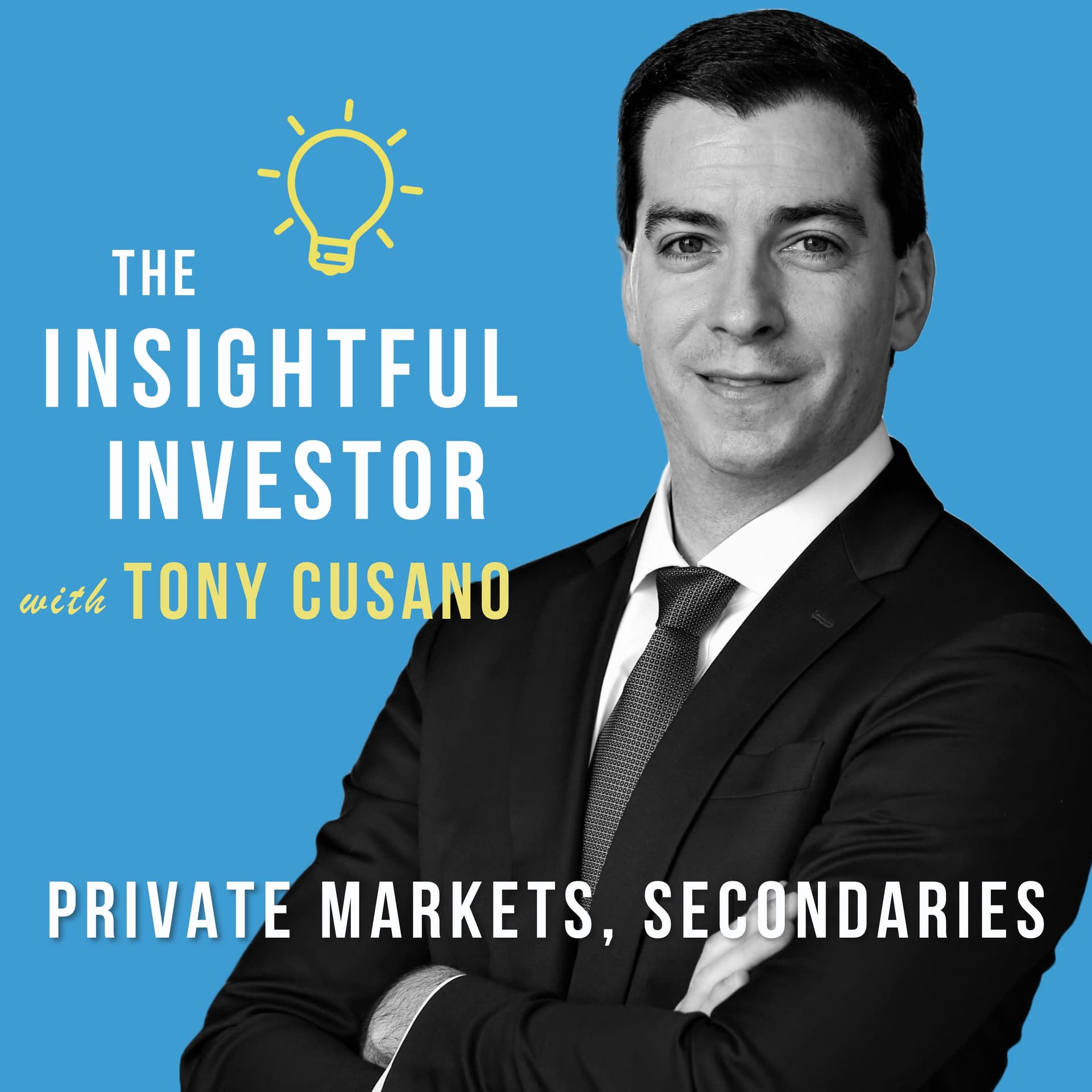
Tony Cusano: Private Markets, Secondaries
- Host: Alex Shahidi, Co-CIO of Evoke Advisors
- Guest: Tony Cusano, Co-Founder and Managing Partner of Banner Ridge
---
Episode Overview In this episode, Tony Cusano shares his insights into the private market landscape, focusing particularly on the secondaries market. He discusses the evolution of his career, the challenges of investing, and the opportunities available in private markets.
---
Key Topics Discussed
- Guest Background and Career Journey
- Tony's entrepreneurial spirit was evident from a young age, having started various businesses.
- He graduated with a finance degree and initially ventured into IT consulting before entering financial services.
- His experience during the global financial crisis shaped his understanding of risk management and private equity.
- Understanding Private Markets
- Primary Markets: Involve managers raising capital for specific strategies with limited or no existing assets.
- Secondary Markets: Involve the trading of limited partner interests in funds that have been operational for several years.
- Co-Investments: Allow investors to invest directly in specific assets alongside a fund.
- Growth of the Secondaries Market
- The secondary market has matured and grown significantly, now seen as a portfolio management tool.
- Cusano compares the growth of the secondaries market to the acceptance of online dating, highlighting the decrease in stigma.
- As more private equity firms embrace secondaries, the market's volume is expected to increase.
- Selling at a Discount
- Reasons for selling assets at a discount include liquidity needs and portfolio management decisions.
- There is often a disparity between perceived value and actual market value, which creates opportunities for buyers.
- Secondary buyers must assess the true value of the assets they are purchasing.
- Inefficiencies and Information Asymmetry
- Buyers often have an information advantage over sellers, as sellers may not fully understand the current value of their assets.
- The secondary market includes a large number of transactions driven by unsophisticated investors.
- The Importance of Team and Culture
- Building a strong team and maintaining company culture is critical to success in investment management.
- Tony emphasizes that every hire matters and that strong leadership and a properly aligned team are necessary for optimal performance.
- Insights on Fund Management
- The importance of alignment between fund managers and investors is highlighted.
- Red flags to watch for in fund managers include fund size growth without corresponding investment performance and poor alignment of interests.
- Market Environment and Future Trends
- Cusano discusses the impact of rising interest rates on private equity allocations and how this could lead to a reduction in risk-taking.
- He emphasizes the importance of understanding the evolving landscape of private markets while recognizing that certain strategies may continue to offer opportunities.
---
Key Takeaways
- The secondaries market is growing rapidly and becoming an important part of portfolio management due to its increasing acceptance among GPs.
- Understanding the dynamics of private versus public markets is essential for investors seeking to diversify their portfolios.
- Team culture, management alignment, and maintaining a strong information edge are crucial for long-term success in private equity investing.
- Investors should continuously assess the motivations of fund managers and the structure of their funds to ensure alignment of interests.
---
Conclusion Tony Cusano provides valuable insights into the complexities of private markets and emphasizes the importance of informed decision-making in investing. The evolution of the secondaries market represents a significant opportunity for investors who are willing to navigate its intricacies.
For more episodes and insights, visit [insightfulinvestor.org](https://insightfulinvestor.org/).
Written by AI. May contain mistakes. Listen to the episode to check what was said.
Transcript
Automatic transcript. May contain errors.0:06Welcome to the Insightful Investor Podcast, a weekly series that seeked to share industry investment and market insights. We define insights as concepts that are counterintuitive, widely misunderstood, or underappreciated. In other words, unique ideas that you probably won't hear elsewhere. I'm Alex Shahidi, the host of the podcast and co-CIO of Evoke Advisors, one of the nation's leading investment advisory firms. Learn more about our show at insightfulinvestor.org.
0:43I'm pleased to have Tony Cassano joining me today. Tony is the co-founder and managing partner of Banner Ridge, a$7 billion alternative asset manager. We focus on providing liquidity solutions to limited partners of private equity firms. Tony, I appreciate you joining me today. Absolutely. My pleasure to be here. I recall we had a meeting several months ago. So this was before the podcast launched, and I told you that I was planning on launching a podcast. And I was very pleased about your enthusiasm for being a listener. And I'm also very fortunate to have you as a guest. Have you been listening to the podcast?
1:26And what do you think so far? I have. I've actually listened to all of them, partially in prep, but partially because they were all very interesting. The people he had on so far, their backgrounds were very different than mine. Most of them were in the public markets to some degree. and so kind of listening to their views on risk management and just overall their experience. I think several of them were at Bridgewater was kind of fascinating. So I feel like the podcast is off to a great start. Yeah, I appreciate that. And obviously there's so many different ways to make money and I like hearing different perspectives, public markets, private markets, different orientations for investing, different areas of focus that managers have.
2:07So I'm really excited to jump into your perspectives. Great. Yeah, I'm looking forward to it. So Tony, why don't we start with your background and maybe talk about your evolution from school up until today and what led you to this industry. And if you can highlight any unique or interesting parts of the path that you traveled to get here. So I was very entrepreneurial from a young age. I started a number of small businesses in my teen years. I started a surfboard business where I was shaping glassing boards. I then moved on to a business where I was actually going around bars in San Diego, California, buying neon lights, like neon bar lights, because these bars would get these lights as promotional items for free.
2:55And back then, you could sell them to fraternities and people who had pool rooms on eBay for$500 to$1 ,000, depending on the lights. I started doing that. I was going around to colleges, collecting the textbooks, the school wouldn't buy back after the semester was over. And I realized that there were colleges across the US that were still using that book. So I could get them for free in San Diego and in LA at these colleges and sell them on what was an online bookstore at the time, which became everything, Amazon. And I was collapsing the market for all these college textbooks. I started a property management business, which I later moved on from.
3:34but made money at. And I kind of got my big break when I started an IT consulting business when I was just out of undergrad. And I took a lot of the experience I had in a class, an information technology class in undergrad, designing websites. And from a friend of mine in college, who kind of gave me some of the early skills on the IT side. And I started that business just after I graduated. I graduated with a finance degree in undergrad from Cal Poly. Polytech in Central California, but then went on to do this IT thing next as I was going to graduate school. So I went straight into graduate school out of undergrad and ran this IT business for two years.
4:16I ultimately sold that business when I graduated from graduate school two years later. And in one month in June of 2007, which was a big month for me, I bought a house with some of the proceeds. I sold my company and I got a job and I got a job in financial services business. And that was really always the plan for me. You know, I loved starting companies. I loved finding ways, non-traditional ways to make money. But really what drove me into finance was when I was younger, early teens, you know, my father, my grandfather were both engineers by training, were invested with a broker at one of the big wire houses during the dot-com bubble.
5:05And back then, there was this concept of churning that was very real in both of their accounts. They both lost a pretty significant amount of money from this individual just trading their accounts. And I remember thinking when I was younger, I felt the instability from it. But I remember thinking, wow, these really smart people, but they didn't know nothing about managing money. And it was kind of my, you know, my first thought was I got to figure out how to do this so that this never happens to me and I can help my family. And so when I got out of graduate school, I took a job at a consulting business in San Diego, California, called Stepstone Group.
5:44And, you know, Stepstone was doing private equity consulting, but they were a startup. You know, I was the seventh hire. You know, today, Stepstone is a$3 billion plus public company. Back then when I started, I sat two feet away from a senior associate who had just left TPG, the big buyout shop in San Francisco, who later became a mentor and a close personal friend. He's now the CEO, and that business has come a really long way. But the reason it was exciting for me was because my plan after selling the company was, okay, I want to get into finance, but ultimately I want to do something else entrepreneurial.
6:21And the best way to do that, at least as I thought as a 24-year-old, was to go look at other really smart people operating businesses and decide, do I want to try to, is there a key insight I can get to get into another business on the operation side, running something that actually creates a product? Or is there something, some key insight that I can glean from this role at StepStone where I can go out and start something in finance on my own down the road? And so when I started at Stepstone, I was the most junior person on the team. So I originally was covering kind of the least sexy part of the market, which in 2007 was distress, special situations and credit.
7:05You know, buyout, venture, everything was on fire, just doing really well year over year. And it's just no one cared about credit. No one thought about downside. And so that's where I focused. And that's what I covered for the early years. I was there through the global financial crisis, which gave me this really unique perspective, incredibly valuable. And it's something I think of a lot about today, because I think if you're under 35 years old, you really haven't lived through a major recession. And therefore, your views on risk management, which some of your other guests on previous podcasts focus a lot on, I don't think would be as well-developed, unless you can get that out of a book.
7:46But living it is just very different. So I was fortunate enough to be there in 2009 when Stepstone brought on an individual to help build out their secondary business. This individual came in. And so by day, I was consulting on distress, special situations, and credit. By night, I was working with him on transactions, largely in buyout, on the secondary side. And it was really the first time I'd heard of secondaries. I kind of knew what it was by name when I joined StepZone. But really, once this individual came on, I got a kind of a firsthand view and got to dive right into understanding what the transactions looked like, who the sellers were, how liquid the market was, what were the average discounts, what sort of returns could you get at least at that time.
8:36A lot of the big sellers then were these Ivy League schools. They were running this kind of endowment model, which Yale was famous for. And they were coming to market saying, we overcommitted to private equity. We need to sell stuff. Let us know what you're interested in. And that was really exciting. But the one key insight I gleaned that year, which ultimately led to where my career is today, was all the buyers in the market at the time were buying secondaries in funds where the strategy of the fund was buyout. And it made sense because that's what the majority of private equity was. But when there were funds being sold where the strategy was to stress special situations, opportunistic credit, venture, real estate, infrastructure, there weren't buyers.
9:24And at that time, it was fairly obvious to me that the best opportunity that I was seeing was buying secondaries in funds where the underlying assets were credit. Remember, this is global financial crisis time. You didn't really want to be buying massively levered equity where the loans of these companies were trading at huge discounts. It just wasn't a risk that I think you'd want to take relative to the risk of buying credit at a big discount. So I started looking around for a seat that I could join in a different firm where I could take advantage of this because Stepstone at the time was just a consulting firm.
10:02Later, they became an asset manager, but they weren't doing that then. And so I found a firm in New York City called SiglerGuff that I'd never heard of. I moved from San Diego to New York. I didn't know a single person who lived in New York City at the time. And I took this role because SiglerGuff had just raised$2.4 billion in a fund that was discretionary to them to invest in distressed special situations in credit, which is what I covered where I thought the opportunity was. But they had never done a secondary. They had done direct deals. They had done co-investments and they had done primary deals, which we'll talk about later, but they've never done a secondary.
10:41So when I joined the co-founders of Sigler Guff, George Sigler and Drew Guff were great guys and gave me this incredible opportunity to build this business over the next nine years. It allowed me to deploy capital out of their flagship vehicle, this$2.4 billion vehicle. The opportunity at the time felt like it could be a trade versus a business. So I didn't focus as much on institutionalizing what we were doing because I actually thought that the opportunity would go away at some point. Three years in 2013, the opportunity still existed. I thought, wow, this is maybe more than a trade. Maybe this is something that's more structural in nature that could last a lot longer.
11:26And you thought it may be a trade because it was just time specific, meaning there was an environment and then the opportunity came up and then eventually the environment would pass and then the opportunity would go away? Is that exactly right? Yeah, because coming out of the global financial crisis, there's so many dislocations that it wasn't a stretch to think that this could just be one of those and that at some point the opportunity would just close and sellers would go away. And that was my bigger concern at the time was, why are people selling at these prices? Why does this keep happening?
11:59But in 2013, 14, 15, the credit markets were trading at par, and I was still doing these deals. So kind of rolling forward to today, we invested a significant amount of money at Singular Guf. My team and I, we raised our fund one and fund two, dedicated vehicles there. We deployed those. We fully realized them. And in 2019, this opportunity still existed. In fact, we knew we were missing deals because we weren't scaled at the time. We were a small team with a small capital pool. We spun out as a team and started Banner Ridge. My co-founder, CJ Dreesen, worked with me since 2013 at SigularGuff.
12:41And my other partner, Scott Halper, came in 2015. And we came out to basically build the same business that we had at SigularGuff, but with all the lessons learned and in a scaled way that was more institutional than what we had there. And then that included software and other things. And then the Banner Ridge story in a nutshell is we started in 2019 with zero assets. Today, we're at$7.2 billion. And our flagship secondary fund, we raised three incremental funds since starting Banner Ridge. And so far, everything is doing incredibly well. And then we continue to generate the same types of performance that we did for the previous nine years at SiglerGuff.
13:24Okay. So before we get into secondaries and the different markets and the opportunity, why don't we just start with, you know, kind of go back to the beginning. A lot of people who decide to move into the investment management world are looking at public markets, but you immediately jumped into private markets. What was it about that space that attracted you? Yeah, I think it was the recognition pretty early on that you could generate a real edge in private markets by having better information than the people you're competing against. You know, in public markets, it's very difficult because for somewhat obvious reasons, everyone has very similar information.
14:05And even if you're dedicated to covering one stock, and that's just all you do, you'll know that stock better than a lot of people. But there are still other people that cover that stock for different hedge funds. It's just hard to get an edge that's legal. And in private markets, relationships create opportunity for better information. More work with less competition overall allows you to really get an edge that translates to outsized performance. And that became abundantly clear to me when I was at Stepstone. I thought this could be the case going into Stepstone. I had this as a thesis. But after seeing the information that we had and the edges that we could glean through the global financial crisis, I thought, wow, this is really exciting.
14:54And this is the path I'm going to forge for my career. Yeah, that makes sense. And why do you think that that gap doesn't close? Because you have trillions of dollars looking for outsized returns relative to the risk that's taken. And you would think it would find itself in all corners of the market where that disproportional return to risk ratio exists. And so why do you think that private markets, that gap hasn't closed as quickly as you would expect, obviously, public markets to do? Yeah, I mean, I think there's probably a number of reasons. One of the reasons that I think it's still there in what we do, and we'll kind of get into these more specifics and what are edges in the later part of the discussion.
15:36But I think a big part of it is if you're a distressed special situations manager and there is someone buying and selling your LP interest, so they're an investor who wants to sell their LP interest to another investor, you're heavily guarded on what information you want out in the market. You know, it's similar to, and Bridgewater might have had this aspect to it as well, but most hedge funds are very guarded about what they own. And so it takes having a personal relationship. It takes being a partner with them to actually get access to information. It'll even allow you to underwrite what's in a fund that you're buying.
16:14And that's just not something that's ever going to be broadly disseminated because they view their edge as their positions. Their proprietary research went into putting those positions on and taking them off. And so that's just something that's heavily guarded across the board with general partners. And on private companies, when you move away from the distress managers more to the buyout managers in the secondary market, the only time that you can actually get information without having direct line to the manager is if they have public debt. And that information will be useful, but it won't tell you the whole story.
16:50So I think it's just because it's more of a relationship business and there's just a limit on the number of relationships that you can maintain as a general partner. So the barrier is just significantly higher to get in and get the information. Yeah, and the markets are very fragmented. They're more complex and the information isn't publicly available that anybody can pull it up. So it takes a little work to get the information. and that can keep that gap between private and public markets sustained for an extended period of time. Exactly. Yeah. So before we get into investing, you know, you're, you're, you've been a business owner since you graduated from, from college.
17:28That was one of your first things that you did. Most people, by the way, they graduate, they get a job somewhere, they learn it, then they start their own business. You took the fast track, started your own business, then, you know, realize, okay, I need to learn from other people in this other space that you wanted to enter, and then got that experience and then launch your business. So that part of it, I think, is really interesting. But why don't you just talk a little bit about the challenges of building a firm, building a culture, continuing to operate at a high level, maintaining quality, passing that go on to people who work for you and with you.
18:08Talk about that side of your experience. Yeah, sure. Building an A-team and keeping your culture intact is incredibly difficult. Every hire matters. So making sure you don't let people who don't fit stick around is essential, but hard to do because there's a human element to that decision. You also take some grief from investors when your turnover is too high. But turnover to some degree is good. No one picks right 100 % of the time. And pushing people out who don't fit, I think by doing that, you show the people who do fit that they're special. And actively managing your team while it's hard, I think it's a sign of strong leadership in a firm that prioritizes culture and results.
18:57And so I think that's one thing. On the investment side, I think to be your best, you clearly need the right team. But it's so much more than just having smart people, so many smart people on Wall Street. You need the right process. And part of that process involves access to the right information at the right time, which is, I think, best accomplished with software. And in our business, there's just not great off-the-shelf solutions. You know, in the public markets, there's tons of software solutions. Some firms create their own still, but there's lots of different options for helping you organize, underwrite, filter.
19:35You know, that doesn't exist in our business. And part of it is because secondaries is kind of a cottage industry for a long time. So when we started Banner Ridge, you know, after having nine years of experience, largely using Excel and a whiteboard as our pipeline, you know, we built software from scratch. You know, kind of use the IT background I had when my partners also has a bit of an IT background. And we spent a lot of money and time. You know, the biggest cost is actually senior leadership time. You know, but in the end, having the software has allowed us to make, I think, more informed decisions at a speed that others, I think, would have a hard time replicating.
20:11Takes tons of information, makes it easy to filter and gives our analysts and team what they need at the right time to make those decisions. Yeah. And obviously being a good leader requires quite a different skill set than being a good investor. And in a sense, you're wearing two hats. You're kind of running the firm, but you also focus on the investments. Would you talk through some of your learnings in terms of running the firm and being a good leader and how that's evolved since you started? Yeah, sure. And I think for everyone, this is like a constantly evolving thing. is you grow in your career and you manage more and more people.
20:54Managing a team of five is very different than managing a team of 25. And it's very different, which I haven't got to yet, of managing a team of 100 plus. But I talked a bit about the culture and finding the right people. But leadership really starts with the senior people and then proliferates from there. And at Banner Ridge, all of our partners are in the office every day and we're accessible. and that's very real. So, you know, there's oftentimes I'll be sitting here after, you know, the regular workday is kind of over say 6 p.m. and I'll have an analyst or an associate stop by just to chat.
21:29That makes a difference in your culture. You know, we work similar hours, the partners here to the rest of the team. And I think we take, you know, few, probably not enough liberties that come with the position and the success we've had. But this sets the standard for everyone else. You know, when I was younger, I wanted to be part of everything. you know, underwriting, you know, the execution side, the sourcing side, it was kind of all exciting to me. And I wanted to do as much as I possibly could about myself. You know, you want something done right, you do it yourself. But what I realized is that the only way I could scale, you know, a business was to find the right people and empower them to do their jobs.
22:10And so CJ Dreesen, he's a co-founder here, was my first real hire back in 2013. I ran the business for like three years by myself, which was two and a half. And then found CJ. We worked closely for years before I trusted him to handle lots of the prior responsibilities, really with limited input for me even. And he's better than me at most of what he does at VanderRidge today. And he's allowed me to focus my energy elsewhere. It's similar to our next partner, which is Scott Halper. Same situation. He joined 2015, became a partner in 2022, but he proved himself over a long period of time. And certainly, he's better at the majority of the tasks he's responsible for today.
22:53So I guess the gist for me is you got to get the right people in the right seats on the bus and then be honest with yourself about what you're really good at and maybe what you're not. And that's been an evolution for me as I've kind of grown from doing everything myself to now managing a$7 billion business. Yeah. And one thing that I've learned in managing my own business is you have to be honest and kind of self-reflecting on your own weaknesses. And ideally, you want to be able to surround yourself with people who have those strengths that complement you. And in that case, one plus one can equal three.
23:30Yeah, there's no question. Yeah, absolutely. Okay, so let's transition into investing. We kind of talked about building a firm and being successful in that regard. But before we get into the nuts and bolts, maybe just think level set so everybody listening is on the same page. Would you just describe the private market landscape and talk about primary, secondary, co-invest and become into different pockets? And then we'll get into where you're finding opportunities. Yeah. I mean, in the private markets, there's just different ways to get to get access to assets. You know, primaries are think about primaries as a manager is raising capital for a specific strategy.
24:18It could be venture capital. It could be infrastructure, real estate, buyout, whatever it is. And when you look at the pool of capital they're raising, there's either very limited number of assets that they've already purchased or none. A lot of the best primary investments with managers are really good. By the time you make a commitment, there's actually nothing in the fund. So it's a full blind pool is kind of the term we use to articulate primaries. And you know the strategy the manager is going to go after with your money, but you don't know what assets they're going to buy. So primaries are something where you're kind of picking the manager versus picking the assets, is the way I think about it.
25:02Secondaries are really just primaries that are four plus years into their life. So that same example we just gave you, if you fast forward four years, you made an investment, you're a limited partner in that fund, say the fund does buy out. Four years later, they've invested 80 % of your money. And for some reason, you need to sell. You need liquidity. And this could be a portfolio management decision. This could be a distressed situation. This could be because you just lost faith in the manager or their strategy. For whatever reason you want to sell, there is a market, a secondary market, to trade that limited partner interest.
25:41So when you trade that interest from one person to another, they effectively step into your shoes. And the manager is no worse or better off. They just swap the name on the ledger, and a new person now owns. So there's a whole market. It's about$110 billion annually, at least last year, of positions that trade on the secondary market. Co-investments, following the same example, somewhere along the line, this buyout fund that we've been talking about, they might find an investment where they need$100 million to close it. But they can only put$75 million from their fund in responsibly. So go out to their partners, LPs typically, and offer to co-invest$25 million of that particular deal.
26:31And so that co-investment is really you buying into one asset versus if you invest in a primary fund, it's typically a diversified pool and a secondary is just a primary that happens later. So that's also a diversified pool. Typically, co-investment is typically one asset. And in rare cases, it can be more, but that's not usually the situation. Okay. And we, if we're going to zoom in a little bit on secondaries, the area that you focus on, assume that market has grown over time, right? It used to be smaller, it's getting bigger. Maybe just comment on why you think it's growing and kind of where you see that trend uh playing out yeah this the secondary market it's uh i kind of view it like like what online dating was 15 years ago it's it's like people who met their spouses online it was sometimes they were hesitant to tell you that there's a little bit of a um you know a stigma associated with it and and that's how that's how GPs were about their interest being sold on the secondary market 10 years ago.
27:37They kind of took it as a personal insult that one of their investors would sell out early and not stick with them for the full 10-year term. And so the market was somewhat capped by the GPs not wanting the secondary market to grow. And you fast forward, if you know anyone who has kids in their 20s and they're single, they're all online dating. There's no more stigma. It's just how it is. It's part of life. And the secondary market is the same. It's just how it is. It's used as a portfolio management tool today. Most general partners are fine with it as long as they can determine who the buyer is and sign off on them.
Read the full transcript
28:19So they aren't just going to let anyone buy into their fund, but they understand it's just part of the ecosystem. And so that's led to this kind of dynamic where it's being used for portfolio management in a very material way. When you look at the overall privates market, how much it gets invested per year around the world, we think about that as kind of 5 % to 6 % of that over some period of time will get transacted and sold on the secondaries market. So as privates have grown, secondary market has grown, but at a faster rate because it's become more normalized and more acceptable by the GPs.
28:57Got it. Yeah. And it's kind of like if you just think about a mutual fund, somebody buys that, they can sell it whenever they want. In this case, the market is expanding for people that are buying private interests that normally you can't sell. You're locked in. And obviously, there's often demand to sell. and when there's demand to sell and the entry point is a driver for the buyers, you're going to build a market and that's going to continually grow over time. Exactly. Yeah, exactly right. Okay, so let's, before we zoom in a little bit more, let's talk a little bit about why would somebody want to sell at a big discount?
29:33You know, if what I own is worth$100, why would I sell it for$80 or$70 or$60? What would motivate me to sell it at such a big discount? Yeah. I mean, there's different reasons. Sometimes it's because you're selling a billion and a half dollars of assets. And all you care about is that the pool of assets you're selling gets you some price. Let's say that price is 95 cents in the dollar. Well, you're not going through every line item and trying to figure out, is the venture fund that I'm selling getting me the same price as the buyout fund that I'm selling or the Sequoia Venture Fund that's one of the hottest funds on the secondary market today, if you will.
30:18I think you're just saying you either got 95 for the whole thing or you didn't. And so within that, there can be multiple buyers pulled together. And almost certainly, some of those buyers are buying for a massive discount to that 95 price. But the question is, are they really buying real value for that discount? And we can talk about discounts in general at some point, but basically, buying a discount in and of itself does not mean you're getting a good deal. Because there are lots of situations where GPs overmark their portfolios. So they're telling you it's worth a dollar, but if you went out and tried to sell that today, it might be worth 70 cents.
30:58And that's really the secondary buyer's job to determine what the real value is and then make sure they can buy it at a discount. Now, there are other reasons that people sell at bigger discounts. There's liquidity needs, which happen from time to time. There's a denominator effect issue, which has been plaguing US public pensions for a while, where they're significantly ahead of their private allocation. They might have an allocation to privates of 20 % for all privates, buyout, venture, infrastructure, everything. And they're at 35%. Well, that puts them in a position where they, over time, need to either sell or stop making new commitments or hope that the other 70 % of their portfolio that's liquid rips higher and then reduces the impact of the privates and moves it closer to 20 % again.
31:56So in those situations, I wouldn't say they're forced sellers because they're really not, but they're motivated. And so as long as you can justify the price that you're buying as being in the ballpark of fair, they'll take it. So there's a lot of reasons, but those are some of them. Okay. And so that was the seller side. So somebody owns a private interest and a fund and they're looking to sell. Would you talk about some of the inefficiencies you're finding on the buyer side in terms of people looking for these opportunities and maybe some areas where you're seeing inefficiencies where there's maybe more discount than one might imagine?
32:32I think the best opportunities that I've seen and I've taken advantage of in my career were situations where my team and I had better information about the assets we were buying than the seller did. And this is a unique situation where there are a lot of investors and privates that are very unsophisticated. Because if you think about where so much the institutional money is coming from, these aren't typically the same types of investors that you would find at hedge funds or at direct private equity funds. So there's an information asymmetry which exists and creates opportunity. The more skewed the information asymmetry, the better the deal on average.
33:13So we give Banner Ridge cast a pretty wide net, look at everything at a high level, and and try to determine where the information differential is the largest and really focus there. But I think a lot of people talk about forced sellers and, you know, because it sounds sexy and it's, you know, it's exciting. It's a story point. But in, you know, my career, I could probably count the number of forced seller situations we've been a part of where we bought something on one hand. And actually only one of those deals would make it into the top 10 of the best deals that I think we've done. So there are lots of exciting kind of inefficiencies that all boil down to the information asymmetry in private markets, specifically in secondaries.
34:01And we're trying to really take advantage of as many of those as we can in each one of our funds. Yeah. There's something interesting that you said there, which is you oftentimes have an information advantage over the seller, which sounds pretty counterintuitive. So if you think about it, if I own a house and I put it on the market to sell it, there's no way the buyer of that house is going to know more about my house than I do, that I've lived there for 10 years. And you think about somebody who owns a fund and has been invested in it for three or four years, and it sees all the reports and the holdings and the buys and the sells, and you coming in are going to know more than they do, and you could price their investment better than they can.
34:42It sounds counterintuitive, which is, I think, really fascinating. Yeah. And I take your analogy and it's changed it a little bit to make it work for what I'm talking about on my side and what I'm seeing is that it'd be like you inherited 10 ,000 houses and you needed money. And so a new CIO steps into a pension fund. Well, they just inherited all these houses. And they could, if they had enough resources and time, go through and really understand the nuances of each one. But they have a staff of three or four, and they realize that if they don't sell something, they won't have any money to deploy into their own ideas because this pension fund might be over allocated.
35:24And so in reality, what they usually do is they just take a simple approach of saying, okay, which managers haven't done well? Okay, well, if those managers haven't done well, let's sell them. But what a manager's done in the past isn't representative of what assets they own today necessarily. And that's where the information inefficiencies happen. One of you knows what the assets are and has priced them. And the other person is making a judgment based on the past, which is like driving in the rear view mirror. Right. And I guess the advantage of having the information knowledge over the seller is the seller may be thinking they're selling at a 10 % discount, but in reality, and maybe a 30 % risk.
36:08Exactly. Exactly right. Yeah, exactly. And so when you think about the relative risk reward of primary versus secondary markets, how do you think about it and how should investors think about that? Yeah, it's a great question. Secondaries are more of an evergreen strategy because you can kind of pick your return just simply based on a purchase price discount to NAV. There are certainly times where there are more interested sellers at a price you want to buy than others. But part of the art in the secondary business is not only figuring out what price you want to pay, but how to get a willing seller to take that price.
36:51Primaries are very situation dependent. For Panerich to make a primary investment, there has to be a clear opportunity that's accessible today, like right now. The bottom quartile of all these private benchmarking services are kind of littered with managers who told their investors there's this great opportunity right around the corner. I can't tell you how many pitch books I've looked at where it's a distressed manager raising money in a non-distressed environment. And what they're telling you is every pitch book has the same slide. It's the maturity wall. There are huge amounts of maturity is coming and the market's not going to be able to absorb them.
37:31And what's happened over the past 20 years is the market just pushed them out and absorbed them. So when the opportunity doesn't materialize in one of these funds you commit to, the manager's not going to give you your money back. They're not going to say, oh, the opportunity went away. I'm really sorry. I'm going to let you out of your commitment. You're on the hook for that commitment at that point once you sign up. So you really want to make sure in a primary, the opportunity is right now. These primary funds, in a nutshell, they're like the Hotel California. You get in and you can't leave.
38:04So you really want to make sure you're staying at the four seasons, whereas in secondaries, you have a price that corresponds to a return. And you might not be able to get anyone to sell at that price, but it's not like you're stuck in it because you aren't getting the assets unless you get the price you want. So I kind of think that primaries are a tool to access markets through the best managers at a point in time for most strategies that aren't evergreen. And then there are some strategies to just work in and out of markets and cycles like secondaries where accessing the best secondary groups really give you outsized performance on great years and in down years.
38:47Yeah, and sometimes even better in down years because there's more distress and you have LPs, limited partners that need to sell or GPs that need to sell stakes. And oftentimes there's a greater need for liquidity during difficult environments. And in that case, there is confidence widens and there may be fewer buyers too. Yeah, yeah. All those are true. And raising money is harder in down markets like it has been in 2022 and early 23. So there's just less funds that are raising capital to compete with you if you're more of a competitive part of the market. Yeah. And if you think about constructing a portfolio, just in my experience, a lot of things go down at the same time during these very challenging environments that they're always a surprise.
39:32They kind of come out of the blue. And oftentimes they happen when people don't expect anything bad to happen, as opposed to when people are anticipating difficult times. And so in terms of constructing a portfolio, it's really helpful to have a return in there that one is resilient to those environments. And ideally, if it can outperform in those environments because that discount gap widens. Yeah, I think the so one thing in private investments in general is that managers only mark their books quarterly. So you as an investor, your most recent mark is at least three months old. And it's at most six months old.
40:19So there's a large delay from when a market event occurs, when there's a downturn, when most investors know what their assets are actually worth. So if you think about COVID, that event, that market event happened in March of 2020. I mean, most investors in private funds, their most recent capital account statement, which is what tells them what their assets are worth from the GP's perspective, was 9-30-2019, which was almost six months prior. So what were those assets really worth? I mean, they definitely weren't worth what they were worth at 9-30-2019. And I think hence the opportunity to have better information and make more informed decisions.
40:57Now, is the correlation between the public markets and the private markets tighter in reality versus what the managers are showing because of this muted effect of the structure of showing quarterly marks? Probably. I mean, there's probably more correlation there than the marks would imply. The other point I'd make is most private equity managers and direct managers, unless there's a QCIP or a public stock that they own for some reason, they tend to mark their private assets conservatively and therefore don't mark them down as much during times of volatility. So you could argue that they're really not always marked to market in the same way that you think about a public stock.
41:42But then that really dampens the volatility. So private markets, when you mix them with a public portfolio, there's no question that they dampen volatility and that the correlation, because you can't calculate daily returns to these privates, is a lot less than one. And I think that is something that is really attractive to a lot of institutional investors. They view it as a diversifying asset class and something that they don't have to justify to their board or their constituents at the very beginning of a downturn. And so let's zoom in a little bit and talk about how you can develop and maintain this edge, this information advantage.
42:26Obviously, competition grows over time. So maybe talk through how you think about all that. Yeah. Developing an edge in the financial markets is very rarely the same type of edge you see in something like Google, where you just got the best search engine in the world. And once you monopolize that, everyone goes to that search engine. Someone else could create just as good of one, and they're still not going to beat you out, because the switching component of that doesn't make sense. In finance, it's much more of these accumulation of much smaller advantages that roll up to one moat that ends up being pretty real if you generate alpha for a period of time.
43:07But it's not one big thing. So at Banner Ridge, I'd kind of point out four that I think are really important for what we've created over the past 14 years. And the first one is GPs that you're buying, you're buying a secondary interest in a GP. That GP ultimately has to sign off on that trade. So when you transfer that private equity interest from one investor to another, the GP has to ultimately sign documents saying we're OK with Banner Ridge as a buyer. and it doesn't sound that meaningful as a barrier to entry, but here's why it is. When you're a GP, there's certain things you care about a lot.
43:52And one of them is competitors. And you're not going to allow a competitor to own an interest in your fund. So that takes away a huge part of the sophisticated, knowledgeable universe in a secondary transaction. You know, And an Oak Tree, using Los Angeles GPs here in the analogy, is not going to allow an Aries to buy one of their funds. So Banner Ridge is a neutral party because we're not competing with them. We don't have a direct business competing with any business that Oak Tree or Aries has. So effectively, you have to be a neutral party. And that knocks out all these potential competitors, really smart Wall Street people that could actually really disrupt this market.
44:35Then you set up your business intentionally that way. Yes, absolutely. I mean, it's by design. And you think about having primary money gives GPs a reason to be in front of you more frequently. It allows for more potential opportunities to do business, which translates into better information flow. So, you know, groups that don't have a primary business and aren't making primary commitments to the market that they buy secondaries in are at a significant disadvantage to groups that do. I mean, it just makes sense. If a GP sees you as a potential partner or you could actually support them in other businesses, they're going to treat you differently than if you're just buying and selling their funds.
45:18Because ultimately, that doesn't help them in any way. It's just neutral to them. I think the other point that's differentiated is an edge. It's just team. And it's really the backgrounds of your team. Having a team with direct investment experience is actually unique in the secondary and primary investment world. And I think it allows for the development of more accurate assumptions, better underwriting capability. And I think it leads to more informed decisions. So you think about it, it's having primary money. It's the nature of the structure where you're not competing with other smart people who work at direct firms.
45:54It's having the right team. And I think the last one that I'd focus on is having software that organizes information in a smart way. Kind of giving your team the right information at the right time is incredibly differentiated in the secondary space and something that is truly underappreciated by many of the large players that built their businesses at a time when that maybe wasn't available or wasn't necessary. A lot of the secondary firms today that are scaled have founders who are in their 60s and 70s who did this business at a time where software maybe wasn't as important as it is today. And I think over time, that's going to really, it's going to be a spread in returns between the people that can utilize all the massive flow of information that comes through their firm to provide better pricing and those who can't.
46:44Yeah. I mean, one of the things that as an asset allocator is really attractive to me in that secondaries market is the return that you're earning, the investors are earning, isn't just how the assets perform. It's a combination of the underlying assets, whether they do well or poorly, plus the closing of that discount. If you buy something at a 20 % discount to what it's actually worth today, assuming you do good underwriting, you get that 20 % back. And that return isn't really dependent on how those underlying assets do. And you could think of it as like two return streams in one. And that can be very diversifying when you think about it from a fully construction standpoint.
47:25Yeah, absolutely. So let's talk about size. Obviously, the firm has grown. It's something that investors are always thinking about. And in some ways, there is some conflict because fees are paid on assets under management. If you're too small, you're not really relevant. If you're too big, you're priced out of a lot of maybe really attractive opportunities because it won't move the needle. How do you think about size? I'll take it from two angles. You know, when we, all the fees in carry are priced into our deals. So the returns need to work net of those fees. So when we're a buyer in the secondary market, we're buying a fund.
48:08I don't really care if it's a big fund or a little fund because we're making sure that all the fees are priced in. Now, there's other reasons you might care, but that one is neutral. And to price that in, you're just taking a bigger discount. So if I had no fees, let's say you could pay 80 cents, but it has fees. That means you got to pay 74 cents. Well, you priced in those fees into that transaction. So I think making sure you have the right alignment is a key part of any investment, public, private. And at Banner Ridge, I think we're, on our side, for our own funds, really careful about sizing and really want to make sure we're raising capital that's consistent with the current opportunity.
48:49you know we're huge investors in our own funds and believe in in eating your own cooking and and we want to see that from others as well so on the primary side you know when we're looking at new managers uh it's really important they can justify their fund size and you see this all the time where managers have a have a great fund or two and then they go from you know 500 uh you million to 3 billion. And their team changes by 10%. And really, it's just all the same people with 10 % more trying to manage six times the capital. And they start competing in markets they didn't expect would be more competitive.
49:29And they don't have the infrastructure in place. So you've got to make sure that there's justification that passes, I think, passes the smell test on the primary side as it relates to fund size. Yeah. So when you're looking at managers in private markets, you mentioned one red flag is fund size. Are there other red flags that you think about? And on the other side, are there certain qualities that you emphasize as you're searching for the best managers? Yeah. I mean, fund size is definitely a red flag that once you see someone raising more money than they've deployed over the previous four or five years, because then you're betting on the future.
50:14And back to my point earlier on primaries, where you want the opportunity to exist today, you really need to, again, just make sure that the fund size is rational. So that's one. Alignment is really essential. So many GPs try to commit the absolute least amount of money they can to their own funds, which gives them a free option with investors' money, because they have a carry. They share in the performance. At great firms, everyone on the team is trying to figure out the maximum they can invest because they view the opportunity as the best option to create wealth. And so I think focusing on alignment is really important.
50:52When you see alignment off, that's a big deal. Again, back to my point on making sure there's an opportunity today. I just can't emphasize that enough that a lot of primaries I've seen where people end up with very poor performance, oftentimes it's because the opportunity didn't materialize. It all made sense as a story, but then it just didn't happen. It's kind of like the recession of 2023. It sounded great and it just didn't happen. Could it happen in the future? Yeah, but it didn't then. I think leadership is really important and having strong leadership where the stars stay at the firm long-term, the BNC players are kind of managed out.
51:37You don't want to see significant turnover because of economics. Economics is something where you've got to make sure the team is aligned with the firm. And that takes a bit more effort. And a lot of times GPs tend to be a bit reluctant to share that, but that's an important point. Um, I think it's also really important to meet the significant owners of a firm that you're going to invest with. You know, your gut feel, um, when you're with them goes a really long way. It's sniffing out issues. I can tell you my career, I've avoided some, some pretty tough situations when a lot of the stars aligned and I, and the last check was to meet the owners and spend time with them.
52:17And I, and I always make sure that I do that personally. and I pulled the plug on countless investments over that meeting. So I think that's really important. And I guess the last one is just a consistent history of winning as people. Great track record, but generally just putting A-plus effort into things and the senior people being very involved in avoiding distractions. Oftentimes you can pull up the press and you Google the heads of firms and it shows up that they own a huge real estate portfolio They own not just one house, but they own 40 houses all over the country. There's just so many things you can do with money to distract yourself.
52:55And I'm not going to pick on anyone for any specific example outside of that, but there are a lot. And so we're looking for GPs where the senior people are still involved. They're in the trenches and they're laser focused on building an incredible business. Yeah, I mean, we're talking about money. You need to trust the people that you're partnering with. That's, you know, I think always the highest priorities. The other thing that I've learned in talking to managers and investors over the last couple of decades is I feel like investors and managers fall into one of two camps. And obviously there's a spectrum there.
53:31One is they're in the business of generating returns. That's the primary objective. And then those are in the business of gathering assets. And obviously you're paid on the assets that you manage. and so there's a there's kind of an incentive to grow your assets and and everybody will tell you they're the business of generating returns but their track record may suggest the other extreme and and so i'm always trying to when i'm sitting down with somebody i'm trying to answer this very simple question of what business are you in are you in the business of doing the best for your investors or are you the business of doing the best for yourselves and obviously there's a spectrum there but but uh you listen to what they say but that's taken with a grain of salt you got to look at their actions.
54:13It's such a key insight. And there's lots of evidence that can go in. There's so many factors that go into determining that, where you shake out on that question. But when you're investing with firms that are public, and you know the public markets value fees at a massive multiple relative to carry, it's really tough to work at a company that's public and be only focused on performance. So I think that's the first filter for us is, who owns this firm and then it goes it gets harder and harder to sort through from there but if it's public that's one that we've always struggled with yeah and there's always obviously exceptions but uh that's just yeah it's just evidence so your you know your objectives yeah exactly let's let's discuss the market environment for a second uh there's been a massive shift the last couple years and you went from zero interest rates for plus all of a sudden the fastest rate increases in 40 years and potentially higher for longer rates.
55:15So there's been a kind of a shock to the system and shockwaves kind of playing out. What's your perspective of the environment and where it's headed? And then more specifically, how secondary is placed into that? So zero interest rates going away was a massive shift for everyone. That single change is leading to a lot of tough questions being asked at investment firms, but also by investors. And does a company work with current rates? How long can a company survive without rates coming down? How much risk should an individual investor take while it can get 5 % risk-free? And so on and so forth.
55:53I was on a panel recently where there was an insurance individual from an insurance company on the panel with me. And he made a point where he said, when rates were at zero, we really backed up the truck into privates because we needed to get the additional return from privates to meet our overall hurdle for our plan. And now with risk-free rates at 5%, I just don't need to do that. And so his perspective was that they were going to pull back on the percentages they were allocating to risk assets in the private markets because they just didn't need to take that much risk to meet their goals. And I think that's going to be an interesting paradigm shift if rates stay where they are or maybe slightly lower, but for longer.
56:40It's just how does it roll through the markets as people make different decisions in their portfolios? So that'll be interesting to watch. On the secondary market, as it continues to mature and becomes more of a portfolio management tool, I think the volume is just going to continue to increase at very significant rates. I mean, it's just you still feel like you're in the early days with secondaries because you're such a small percentage of the total amount of money that's invested in privates today. You know, as a percentage of the total amount, secondaries is tiny that trades in the market and changes hands.
57:19And I think it's over time it's going to become more and more. And I also believe that the buyout part of the secondaries market has been the first part of the market to become more commoditized. And I would expect lower returns in that space in the future relative to the last 10 to 20 years where the beta in that market has been pretty exceptional. This is the large secondary groups that are buying buyout funds. That's what I'm kind of referring to specifically. You know, the concept of a mega secondary fund is back with several funds raising 20 plus billion. And these funds control a lot of the dry powder in the space.
57:57So, you know, there's also some niche secondary strategies that I would kind of view as the field of dreams today. Direct lending is one of those. Direct lending on the primary side of the market has grown exponentially post-global financial crisis. It's people needed to kind of stretch for yield. and you've seen lots of groups come out in the last two years saying, I'm going to do a secondary fund to focus on buying direct lending funds. But the issue is that there just isn't enough sellers because if you're looking to rebalance your portfolio and you have a direct lending fund with a low duration, it pays a cash coupon and it's performing, it's probably not the first thing you're going to sell.
58:40That's probably going to be close to the end of the list. And so you're seeing lots of money coming into the market to chase those opportunities, but they don't, it hasn't really materialized. And even worse than that, I think you have a better opportunity to invest in direct lending in a primary fund than you do on the secondary market, which is pretty unique. It's usually the reverse. And then I guess my last point here is just that I think the strategies and secondaries that have clear barriers to entry where information is hard to get, venture, distress, special situations, and credit, I think they're just going to sustain their edge much longer.
59:20You know, as these markets become more efficient, as secondaries continue to proliferate, I think you're going to see the first part of the curve, which is already happening on buyout, and then it's going to continue to get more efficient. But I think the end of that efficiency, which is pretty far off today, in my view, is going to be these strategies where information is extremely hard and there's just clear barriers to entry. Right. And then obviously, we haven't had major distress for some time. So in terms of the growth and opportunity set for secondaries, I would anticipate that would improve if you do get a bad stretch.
59:59Yeah, I think that's fair to say. And I think within one of the things that we think about a lot is where is the new volume of secondaries in distress going to come from? And really, all you need is a good story every few years where a bunch of investors invest in primary funds to capture distress that's, again, it's not now, but it's coming soon. And COVID is such a great example because there were 39 different dislocation funds that were being raised over the summer of 2020. But by and large, the dislocation was gone by the summer of 2020. And most of these funds raised capital. And some of them raised 15 billion plus.
1:00:41Huge opportunities for us, you know, starting really this year, the end of this year and then going forward for the next five or six years. That's really fascinating. Why don't we close on your, you know, What you feel is one insight that you've learned throughout your career, an investment insight that you think most investors may not think about? It's hard to come up with an insight where most investors haven't thought about it. But maybe giving perspective on an insight that you maybe have thought about, but from a GP's perspective. Because one of the things that's really great about Banner Ridge is we get to sit on both sides of the fence.
1:01:18We're an LP in portfolios, but we're also a GP. And so I think we look for managers that have overwhelming majority of their net worth tied up in their business. There's lots of managers that make excuses and get cagey when the topic comes up of how much they've invested. The right managers are proud to talk about how much money of their own capital is at risk alongside yours. and if you think about if you really have something special with real alpha, which is rare, it's incredibly rare, it's not hard to put a whole bunch of your money into that. And believe me, when things get hard, you want to know that the managers that you're invested with are hurting as much, if not more than you, and they're willing to do whatever it takes to work things out.
1:02:09I've avoided a lot of really tough situations by being laser focused on this point. And I'll just give you two quick anecdotes. You know, one of my clients owns a massive hedge fund. He's been wildly successful for a very long time. And he very rarely does interviews. But the two interviews that he's done, in both interviews, it's an important, and this is an important component for him personally when you meet him. He talks about how the employees of his firm are the biggest investor by far. in his funds. And they eat their own cooking, but the proof is in the pudding. And this alignment point that I'm making, I'll give you an example from the end of last week, where we ended up passing on a deal we spent a significant amount of time on.
1:02:57This situation, we loved the company. It checked a bunch of boxes. It was a co-investment deal. We were at the 95-yard line. And something that was holding us up was that the sponsor here, the GP, was they were rolling a transaction fee into the deal as their GP commit. So it wasn't coming out of their bank account. It was just being basically it was a deal fee that they were just rolling into the transaction and risking. But they were making more in annual monitoring fees than that deal fee just 12 months later. So they were essentially putting no money in. They were getting a fee stream no matter what happened when this deal closed.
1:03:35And the owner of the firm, which is a family-owned business. He'd owned this business for 13 years. He was selling two thirds of his interest for a life-changing amount of money. And he chose that much. He had the option to keep more in, but he chose to sell. And you just looked at the alignment and said, there's too many ways where both of these people end up totally happy and we lose. And so we passed on that deal. We'll see where it shakes out. But I don't feel confident that if that company didn't hit a hard time that they would do whatever it took. I think they would be completely okay walking away if things got really tough and they'd both be incredibly rich from it.
1:04:18Yeah, I guess it goes back to just follow the money, right? Exactly. Yeah, exactly. Tony, this was great. I appreciate you taking the time. I think it's a market segment that a lot of investors may not be familiar with. It's kind of a corner where there seems like just really interesting opportunities. So I appreciate you walking us through that and sharing your insights and your experience. Thank you. Of course. It was my pleasure. And this is really fun. So thanks for inviting me on. Thanks for listening. We hope you enjoyed this episode. Please visit our website at insightfulinvestor.org to access past shows and learn more about our podcast.
1:04:57If you have questions, feel free to email us at info at insightfulinvestor.org. And if you enjoyed the discussion, please subscribe to this podcast to ensure you don't miss future episodes. And don't forget to forward today's conversation to others you think would enjoy listening. This podcast is provided for informational purposes only and should not be relied upon as legal, business, investment, or tax advice. All opinions expressed by podcast participants are solely their own opinions and do not necessarily reflect the opinions of Evoque Advisors, their affiliates, or companies featured. Due to industry regulations, participants on this podcast are instructed not to make specific trade recommendations, nor reference past or potential profits.
1:05:41And listeners are reminded that securities trading, commodity trading, and alternative investments are complex and carry a risk of substantial losses. As such, they are not suitable for all investors.
From the publisher
Tony Cusano is the Co-Founder and Managing Partner of Banner Ridge, a $7B alternative asset manager that focuses on secondaries. Tony describes the private market landscape and the unique opportunities available in the secondaries market.


