Ask ChatGPT

 InsurTech Geek Podcast
13 Nov 2026 · 42m · 28 chapters
Workers’ compensation underwriting and claims/policy decisions using data analytics and AI, emphasizing “analytics as a tool, not a replacement,” and how technology should speed information gathering and validation while keeping humans in the loop.
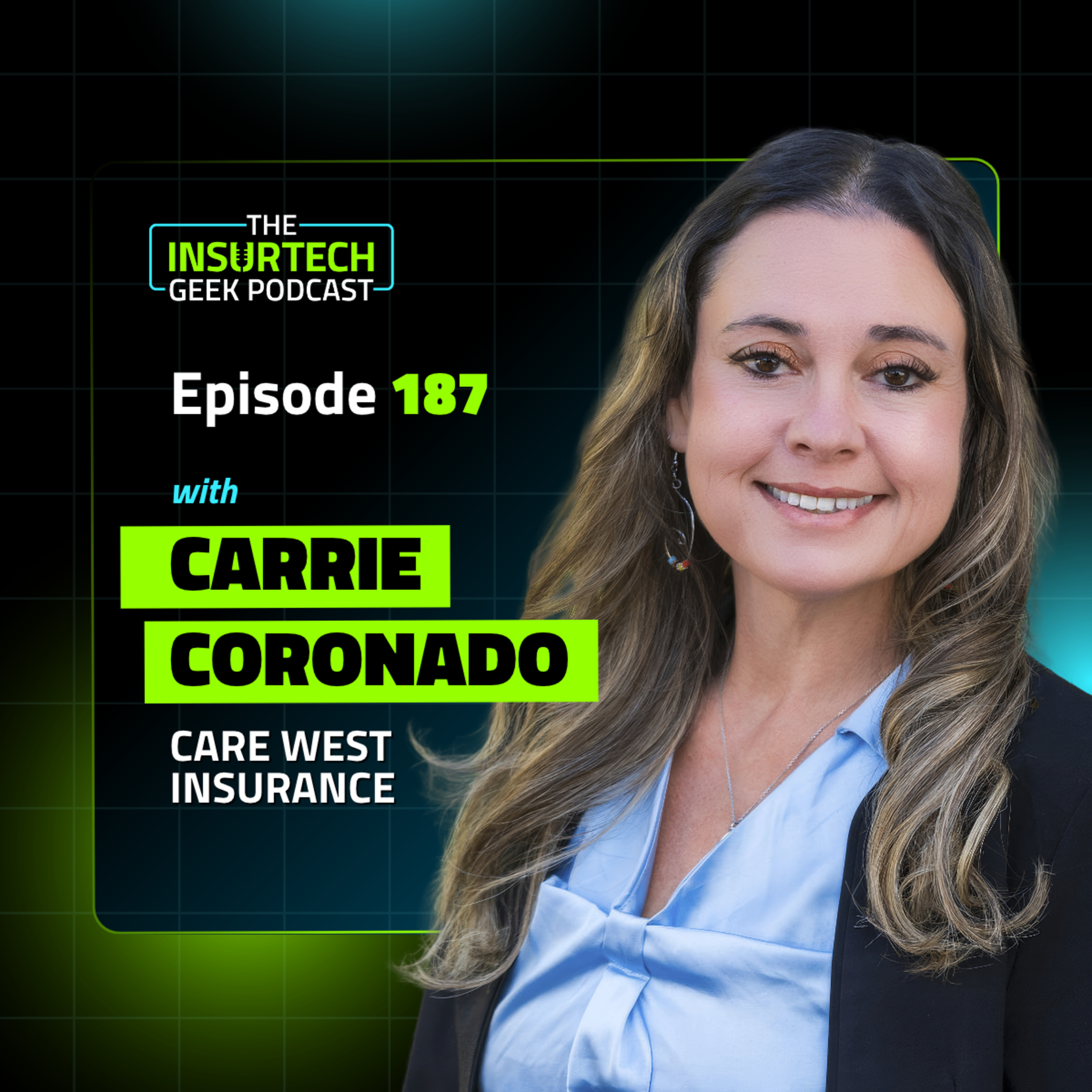
Carrie Coronado, Director, Workers’ Compensation Underwriting and Data Analytics Manager at CareWest Insurance Company. Grew up in the Sacramento area; studied nursing-related topics, then switched to business after working in an auto insurance call center updating underwriting guidelines (using physical binders). Joined CareWest in 2008 (underwriting assistant; later analytics focus, including Institutes AIDA program). Works in a single-account underwriting model for CareWest’s middle market.
Workers’ comp’s statutory nature makes dishonesty/coverage outcomes unavoidable, so analytics helps find correlations and support underwriter judgment. Historical analytics can reveal when the company “should have been writing this all along.” Change management is about measuring ROI (loss ratio improvements) and “elevating” underwriters as AI automates redundancy.
“Capital One” credit-model analogy for finding underserved groups; using analytics to identify large-loss indicators and to evaluate medical provider networks for faster recoveries; video AI example in skilled nursing facilities to detect gait changes and fall risk; concern that AI could overlearn (e.g., excluding “zip line” risks) without proper confidence/oversight.
Written by AI. May contain mistakes.
Introduction of Tara as the episode's sponsor and its impact on workers' comp.
“The Insure Tech Geek Podcast is all about insurance and how it's being transformed by technology.”
Rob Galbraith introduces himself, the show, and guest Carrie Coronado.
“This week's episode sponsor is revolutionizing the world of workers' compensation claims and policy management.”
Carrie shares her childhood aspirations and early interests in business and science.
“And I guess we always start with the question of when you were a little girl growing up, did you want to become an insurance professional or did you have some other career aspirations?”
Carrie discusses her educational background and how she entered the insurance industry.
“So did you also try to dress up maybe a little bit more than some of the other kids in school?”
Carrie's journey and varied roles at Care West Insurance since 2008.
“But at least you had a little bit more direct path in some of the art history and philosophy majors I've met over the years.”
Carrie explains her shift towards data analytics within underwriting processes.
“In 2019 is when the institutes started the AIDA program.”
Exploration of significant changes in underwriting guidelines and risk evaluation.
“And so that's when I really started focusing on analytics and modeling and how those things relate to underwriting.”
Discussion on the importance of data analytics in improving underwriting decisions.
“So what are some of those biggest changes you've seen and how underwriters risk or how underwriters evaluate risk and make decisions, particularly as data and technology has become more central in the process?”
Exploring the outdated practices in underwriting and the role of analytics in challenging these norms.
“To your point about the guidelines, like why are we doing this the same way we've always done it?”
Discussing the importance of data signals in preventing large losses in insurance.
“And then kind of realizing like, well, what were some of the missed signals that this could end up in a large loss?”
The pride of single account underwriting and the importance of personalized account reviews.
“Um, so do you have any, uh, specific examples?”
Insights on using proprietary models for better underwriting decisions and profitability.
“More so what I've found is if you're on the fence, the type of model that we're utilizing is proprietary.”
How analytics enhances claims processing and supports recovery for injured workers.
“profitable for five years, that's when there's a real power in, I think, the use of analytics.”
Defining the mission of workers' compensation in supporting injured employees and their families.
“that I don't think we talk about enough, but we're also applying this to claims, right?”
Strategies for overcoming skepticism in incorporating data analytics within underwriting processes.
“Of people that, whether it be, you know, individual patients or sketchy providers or whatnot, right?”
Challenges of measuring innovation and ROI in the insurance sector using analytics.
“So just from a change of management standpoint or introducing like how did you maybe overcome skepticism about incorporating more data and analytics in the work that the underwriters have been doing at Care West?”
The discussion on how analytics should be seen as a tool, not a replacement for underwriters.
“So it wasn't a hard sell to my executive team for us to just try it.”
Exploring how AI can enhance the underwriting process and improve efficiency.
“So I think the change management is, we're having it right now with AI, right?”
The game-changing impact of fast information gathering and validation in underwriting.
“I'm so glad you went there with AI because that was my next question.”
How analytics and AI improve interactions with clients and agents in the underwriting process.
“sending them down five different Google searches and researching.”
The barriers faced in automating underwriting processes and the need for incremental improvements.
“able to return to them an answer before they lose interest.”
Discussing the potential for low-hanging fruit in the insurtech space to enhance operations.
“And then actually doing maybe some proprietary, you know, risk scoring or things like that.”
Explore the challenges and opportunities of automation in the insurance industry.
“I mean, even still, I've been in the insure tech space, at least as a witness for, you know, 15 years.”
Discuss the evolution of underwriting roles in light of automation and AI.
“I remember tacking one, two, three, four, line through, right?”
Examine how technology will shape talent and skills in the underwriting field.
“Cause you're trying to recruit more seasoned, probably underwriters as the retirement wave has hit or whatnot.”
Discover how video AI could transform risk assessment and underwriting practices.
“I am very interested in video AI and kind of how that's going to change our clients' lives and therefore our ability to understand them, underwrite them.”
Learn about the importance of keeping a human perspective in tech-driven environments.
“I find myself a lot reminding my team that we insure people.”
A brief conclusion wrapping up the episode's discussions.

Get the gist, explore an idea or ask about something said.
 Claude
On InsurTech Geek Podcast, what are the key points of this episode?
Searching your listeningAutomatic transcript. May contain errors.
0:00Carrie Coronado: And it's proved out that four years later, we should have been writing this all along.
0:06Rob Galbraith: It was an underwriting conference, but you might as well call it an AI conference.
0:10Carrie Coronado: Does the model now decide, well, we shouldn't write anything that has zip line?
0:16Rob Galbraith: Their critical thinking skills were really poor relative to prior generation.
0:21Carrie Coronado: Hey, this doesn't seem right. Just because the computer says it's right doesn't feel right to me. We're going to elevate you. That's the answer.
0:30Rob Galbraith: On this episode of the InsureTech Geek podcast, we explore workers' compensation, data-driven underwriting, and the evolving role of technology with Kerry Coronado, Director, Workers' Compensation, Underwriting, and Data Analytics Manager at CareWest Insurance Company.
0:57Carrie Coronado: The Insure Tech Geek Podcast is all about insurance and how it's being transformed by technology. Join us on a disruptive journey, interviewing the leading voices of the insurance industry from all around the world. So enjoy the ride and geek out. Tara.
1:18Rob Galbraith: This week's episode sponsor is revolutionizing the world of workers' compensation claims and policy management. Tara's cutting-edge platform empowers insurers with comprehensive benchmarking tools, robust management systems, and an integrated ancillary services marketplace. Discover how Tara is driving innovation and efficiency in workers' comp at tara.insure. And we are here again on another episode of the InsureTech Geek Podcast. This is your host, Rob Galbraith. I am flying solo. We have no James for this episode, sadly, but it is during ITC week, so a very busy time that we are recording this.
1:56Rob Galbraith: Joining us today and also traveling, coming to us from Scottsdale, Arizona, where she will be flying back to her hometown area of Sacramento, California later today is Carrie Coronado. Welcome, Carrie.
2:10Carrie Coronado: Thank you, Rob. I'm glad to be here.
2:13Rob Galbraith: So thrilled to have you. And I know this is your very first time as a podcast guest. So we are fantastic to have you on our show for the very first time. This may be the first of many, who knows? And I know you've done a lot of other kind of work in the past, kind of from a promotional, getting the word out, but first time on a podcast. So we'll definitely be kind. And I know that our listeners are going to gain a lot from your insights. So thank you so much for joining us on the Intro Take Geek podcast. So Carrie, we get started typically by just learning a little bit about you to start with.
2:50Rob Galbraith: And I guess we always start with the question of when you were a little girl growing up, did you want to become an insurance professional or did you have some other career aspirations? And where did you grow up?
3:04Carrie Coronado: Yeah, I did grow up in the Sacramento area. Yeah. My mom will tell a story that I used to walk around with the backgammon game like it was a briefcase. So I think I did always want to be a businesswoman.
3:15Rob Galbraith: Love it. Love it.
3:16Carrie Coronado: But I also spent a little bit of time considering going into microbiology, like studying viruses and things like that. And it wasn't until maybe three or so years ago that I realized that I found a way to like microanalyze insurance as well. So it comes a bit full circle. So I think I've found where I'm supposed to be based on the combination of my backgammon briefcase and my love of science.
3:46Rob Galbraith: Now, I love the backgammon briefcase. That is fantastic. So did you also try to dress up maybe a little bit more than some of the other kids in school? Or was it more the backgammon case that kind of gave it away?
3:58Carrie Coronado: No, I mean, I've always loved a blazer from a young age. Yes.
4:05Rob Galbraith: Yeah, I think there was a time there that I decided that, you know, your hometown that has the Sacramento Kings, right, the NBA team, we've got our only professional franchise, the San Antonio Spurs. So I liked the NBA draft look where I would have the business shirt tie and then the baseball cap kind of, I don't know, strange, you know, but I thought it, I look good in middle school. What can I say?
4:33Carrie Coronado: Oh, great.
4:35Rob Galbraith: Um, so, um, yeah, once you, uh, graduated, like tell us a little bit about kind of your educational background and how you got started in the industry.
4:44Carrie Coronado: Yeah, I was in college and studying some, you know, entry-level nursing type things, kind of getting started in that part of the medical field. And I ended up taking a job at a call center for auto insurance. And I was doing really well there and they assigned me a project to go through all the underwriting guidelines and update them with the carrier's information. And of course, this is like when we were using binders for this, there was no online database for that. So it really just fascinated me how the same but different the guidelines were by the different carriers and like what makes that their secret sauce.
5:34Carrie Coronado: Why do they care more about seatbelt violation than this carrier cares about tires? Like how are they developing that? and I soon just decided like that this is for me and just switched my major to business and I've been in insurance ever since. So like many of us who just kind of trip and fall right into an insurance company.
6:01Rob Galbraith: Yeah, yeah, absolutely. So many great stories. But at least you had a little bit more direct path in some of the art history and philosophy majors I've met over the years. So you've been with Care West since 2008. How did you start working with them and what are some of the roles that you've had over the past 18 years?
6:26Carrie Coronado: Yeah, I was working at an agency. I was doing sales. I was having mild success at it. But this is 2008, so obviously a big construction downturn in the economy. me and I was working primarily with contractors and so needed something a little more stable. Care West was hiring. I was recruited as an underwriting assistant, which felt a little bit like a step down, to be honest, but it was a carrier position. So I said, you know, this is right for me. And one of the things that I learned while I was at the agency is that I'm more of an advocate for the carrier than I am for the direct sales part of it.
7:12Carrie Coronado: So it was really back to home for me to be at a carrier. In between the call center, the agency, and Care West, I was at MGU. And so I got more of an appetite for the standards and practices and underwriting. So it was a return back to that for me going to Care West. And since then, I like to take sometimes staff around and show them every desk I've sat at because I started at the tiniest desk as an assistant and now I'm in the corner director's office and I've done most things in between.
7:50Carrie Coronado: In 2019 is when the institutes started the AIDA program. So that was the associate insurance standard analytics designation. And I'd done the ARM at that point and I was talking to my boss and I'm in my 30s at this time and I've got a lot of career left and if data and analytics is going to be a big part of underwriting, I needed to dive into that. And so that's when I really started focusing on analytics and modeling and how those things relate to underwriting. And that's kind of been my trajectory since then is to really combine the two.
8:37Rob Galbraith: I love that. And I can relate a little bit, Carrie. So my background is I was an economics major. I started my career at the Federal Reserve Board working as a research assistant for like PhD economists, right? To help set interest rates for that. And then moved to, and I grew up in Michigan, went to Michigan State. Then after two and a half years in DC, I moved down here to be with my college sweetheart, now ex-wife number one. So I will bore with all that stories. But so I was looking to catch on and I caught on with USA where I ultimately spent 20 years of my career. And so I kind of bounced around a little bit in a couple of different roles.
9:20Rob Galbraith: and found my way to be a pricing analyst, but I couldn't pass the actuarial exams. I was 0 for 5. I was not that good at math. I was good at math, but not that good at math. And so in 2005, I really caught a break in that the underwriting team at that time was standing up a data analytics team for the first time. So it was actually pretty early. And so there was a vice president that was going to be leading the effort. And he kind of knew, I think, a little bit about my background and not having an actuarial science degree or whatnot you know so kind of good with that a bit struggling and so he said like you know you already have your cbcu which i had gotten in like 2004 i got a recommendation just to learn more about the insurance industry and so it was perfect so that was my entry to underwriting where i spent 15 years 10 in a leadership position and i always valued that because you know some of the first projects that I was on was, you know, we have this rule underwriting guideline you were talking about, you know, we will not insure a secondary home unless we insure the person's primary home.
10:22Rob Galbraith: He's like, you know, that's been a rule forever, but, you know, does that actually make sense? And so we did the analysis and then we realized ultimately that the RIS profile was different. A secondary home was much less frequency, right? Because you're not there that often, but much higher severity because if something does happen while you're not there, a water leak or something like that, then it could be, you know, or damage to the roof hail damage, and then it's been undiscovered for months, right? All of a sudden you've got some water seepage from following rain events or snow or something like that.
10:51Rob Galbraith: And so from a loss cost standpoint, they were actually almost identical. And so we made some adjustments to our pricing and whatnot. We removed that guideline, and we went through a whole bunch of others kind of from that data and analytic lens. And so it was interesting then leading some of the underwriters that were managing individual accounts, talking to the USA members and listening to some of those calls and having to take some of the escalation calls and then even later managing our property guidelines for homeowners, for renters, for what we called valuable personal property, jewelry and things like that.
11:23Rob Galbraith: Just because I had never grown up as that underwriting assistant or started from that background that most of the other people did. So it's kind of cool to have that underwriting lens and that data analytical lens. And so I love that you kind of came to it almost from the opposite way that I did. So I am curious, like, you know, given your long tenure at Care West, you've probably seen a lot of changes in the underwriting guidelines. So what are some of those biggest changes you've seen and how underwriters risk or how underwriters evaluate risk and make decisions, particularly as data and technology has become more central in the process?
12:04Carrie Coronado: Yeah, with workers' compensation, there's always the concern that you cannot form your way out of dishonesty, right? So if somebody indicates to you that they don't have a height exposure and you write the account and someone falls off a ladder, you still have to pay the claim. It doesn't matter if they were either dishonest or misunderstood the question or any of those things, whereas in a liability, you could say, okay, well, we're going to put a six-foot height exclusion on there, and if you have an overspray claim or something like that, we're not going to pay it. So the statutory nature of workers' comp, I think, lends very well to the use of data analytics because it can find correlations and insights that you can't maybe see on a supplemental application or on a court application.
12:53Carrie Coronado: It's been my goal over my time there to just change the way people think about analytics as a tool and not a replacement. um again because it is so statutory comp doesn't lend as easily to straight through processing or those kind of um submission um guidelines you really you really do need a person validating that we're getting the right story and um and using the data to um kind of support the gut pricing feeling of the underwriter working the desk. And another growth that we've had in using analytics is that you can now look back historically, now that we've had the analytics profiles for so long, and you can see where you've really been wrong.
13:47Carrie Coronado: Like they've been saying we could price this successfully for four years, and we've been disagreeing for four years. And it's proved out that four years later, we should have been writing this all along. And so that's a powerful tool to show not only an underwriter, but also the executive team, right? To your point about the guidelines, like why are we doing this the same way we've always done it? And I think what you mentioned about the two roles, right? Analytics and underwriting, when you've come from this world of, we never do this. We have a strict guideline on this. Something tells you, okay, well, that's wrong.
14:25Carrie Coronado: And if I do that, then you're going to feel guilty about it because you've wired something in your brain. And then to have the analytics part come over and say, actually, you were right and you could have been doing this and you shouldn't feel guilty about it. It can actually support you in a way I think people are scared to allow sometimes, unfortunately.
14:47Rob Galbraith: Yeah, I love that. I think your natural tendency as an underwriter, most underwriters, is to be kind of risk adverse and there's always that flip side of it. And And especially, I don't know about your experience at Care West, but some of the experiences I've had in the past with underwriters, again, not necessarily being the person to make a decision on a particular account, but being in meetings with our claims team doing large loss reviews, right? And then kind of realizing like, well, what were some of the missed signals that this could end up in a large loss? And some of them are just really unfortunate and tragic circumstances and there's not much that we can do.
15:26Rob Galbraith: But sometimes when there is some question about, you know, did we not do as much due diligence as we could be, I do think over time, you know, in all reasonable questions and always good dialogue, right? But it does kind of lend maybe over time just to have that effect where you tend to be like more and more conservative, I guess. so it's good to counterweight that or to have the large loss is obviously a single data point right so it's an important data point but it's it is just that and so sometimes from an underwriting perspective we were always frustrated it's like well you don't understand like yes that happened on this but we have 10 ,000 others that the same thing didn't happen right you know what I mean yeah whether it's a limb overhanging a roof or things like that and we were like well if we send an inspector out there for every you know concerned about a limo ring or if I could spend so much money on inspections, we'd never, you know, be able to, to, uh, insure all, but like the most high value homes or something like that.
16:24Rob Galbraith: Um, so do you have any, uh, specific examples? I'm just curious, like where maybe there was like a, a guideline that each and you don't have to specify like, you know, in, in detail, but maybe a philosophy or a change in position on, you know, particular.
16:40Carrie Coronado: Yeah, we operate as single account underwriters at Care West. It's something I'm really proud of, actually, because we are a middle market. So every account is getting looked up by a person and whatever story is being told is being heard. And so I think it's not really to say that we've had like an overhaul of like, oh, we used to not write plumbers and now we write plumbers or something like that. More so what I've found is if you're on the fence, the type of model that we're utilizing is proprietary. We purchase it from a third party. They use our data and a consortium of data that's like, that's similar and build the model that way.
17:28And so more than anything, when you have that account where you're being pushed, let's say, by the broker for a couple extra points on rate or something.
17:39Carrie Coronado: and you're maybe at your wits end with it or you can't really find the validation, but the model is telling you this performs better than like risks in the group historically and by these data points and whether that's frequency or severity or payroll, different metrics. And then you go and you write that account and you win it and that account's profitable for five years, that's when there's a real power in, I think, the use of analytics. And for me, it was as simple as my first time hearing the story about Capital One and being able to find a whole group of borrowers who were not being accessed and building a very successful credit model on that.
18:28Carrie Coronado: And how can we apply that to insurance? That was my first question. How do we find these underserved people that aren't being recognized in the marketplace and bring them a product that they need, whether that's small businesses or, you know, again, like I said, plumbers or something like that. How do you find that correlation and then apply it? And I think that's been the more, it's been a shift in culture and understanding more so than it's been a shift in like underwriting guidelines by definition. There's also this other whole part of analytics that I don't think we talk about enough, but we're also applying this to claims, right?
19:09Carrie Coronado: And trying to figure out to your point, what are indicators of development of a large loss? And we're dealing with humans, right? And their health and comorbidities and these kinds of things. So finding those elements, but also we are applying analytics to the medical provider network and see who's giving the best results and how, what people are getting back to work. And I don't like to get too philosophical about it, but like, that's what we do. That's our why, right? Is to make a person whole and make sure they can take care of their family and get back to their job and to be able to use analytics in all these different places to find the best results and the speediest recoveries, I think is also a really powerful part of the conversation.
19:55Rob Galbraith: I'm so glad you went there because again, it is easy to get cynical, right? Of people that, whether it be, you know, individual patients or sketchy providers or whatnot, right? That are really trying to to game the system right and so um where the whole point right of workers compensation is to be there right you got hurt at work this wasn't your fault it's not covered by your regular health insurance like we're going to step in and we're going to provide for you and your family to make sure your injuries are taken care of to replace the income right so that's not lost and things like that and it is very powerful you know um and i've met people i had the fortune of working at AF Group for two and a half years.
20:39Rob Galbraith: So that's their specialty is work comp. So I definitely think it's a great line to be in if you want to make a difference. But yeah, it can be challenging as well. So I think finding the right balance there is is fantastic to hear. So I'm curious, Carrie, like as you, you personally were kind of going down this data and analytics road, you mentioned the designation from the institutes and your belief, like I'm going to guess that not everybody in underwriting at Care West was equally as passionate about data analytics. So just from a change of management standpoint or introducing like how did you maybe overcome skepticism about incorporating more data and analytics in the work that the underwriters have been doing at Care West?
21:38Carrie Coronado: Yeah, I think measuring innovation is probably one of the most challenging things for an insurance carrier to do. What is the return on investment? Because we were such early adopters, candidly, it was very cheap for us. They needed more data to build the consortium, right? So at that point, they're kind of buying data. So it wasn't a hard sell to my executive team for us to just try it. And then to take it from that and make it measurable, what I started doing is obviously measuring the loss ratio and saying, okay, this saved us two points on a$25 million book, and we paid$18 ,000 for the year to have this.
22:23Carrie Coronado: So who's being hurt by this, right? I've always, the whole time that we've been utilizing analytics, considered it a tool and not a pricing model for multiple reasons. I mean, there's also concern with the Department of Insurance and how, you know, you can show what's in your black box and those different things. But it's never been a replacement to an underwriter. And so I think it's less threatening that way. But I can see opportunity in analytics to do some straight through processing and things like that, especially in different lines of coverage. So I think the change management is, we're having it right now with AI, right?
23:11Carrie Coronado: We're having the same conversation. And what I just yesterday with one of my long-term strong team members who's, you know, wants to know, hey, what's going to happen to me if we get into this AI business, you know, we're going to elevate you. That's the answer. We're going to find something more fun for you to do that take away some of the redundancy and daily grind that you're dealing with and find out what your next value proposition is. And I think if you're – we always say at Care West that we are in the business of doing good. And so if you're in the business of doing good and that's your focus, I think if you stay people-centric, even when you're talking about analytics and AI, that the rest kind of works itself out.
24:04Rob Galbraith: I'm so glad you went there with AI because that was my next question. So obviously, tons of buzz, tons of hype around AI. I just was at an underwriting conference in Austin a couple weeks ago. So it was an underwriting conference, but you might as well have called it an AI conference because that was basically for the full two days. Every session, every topic of conversation felt like it revolved around AI, automation, predictive analytics. So when you specifically look at kind of workers' comp like underwriting, where do you see technology creating the most meaningful opportunities? And where is that experience and judgment?
24:43Rob Galbraith: Are the human underwriters still essential?
24:45Carrie Coronado: Yeah, for me, I think the fast gathering of information and then the validation of that information is game changing for us, right? If you can, without being too proprietary, is to say that we're basically, if you can gather all the information and put it in front of an underwriter at the start of the review, instead of sending them down five different Google searches and researching. And there's some key things you can identify using the analytics. You can figure out what are your most frequently asked questions? What are your business drivers? What is your underwriting talent? What are they looking at that maybe no one else is looking at that you think is giving you an edge?
25:38Carrie Coronado: And then how do you package that and provide that to the underwriters so that they can then make informed decisions faster? I think it's a lot more about scaling than actually reducing your staff, right? It's not about really cutting to the bottom line, but if you've worked the desk as an agent, then you understand that once you get somebody on the phone willing to talk to you, willing to give you their payroll information, and you need to be able to return to them an answer before they lose interest. And we've had this process of back and forth, especially in workers' compensation underwriting and these mammoth lists of questions.
26:22Carrie Coronado: And, you know, it's really frustrating from a sales perspective. And you want to, you know, I say we're in the business of paying benefits. We are. Our other two values is that we protect wealth and we help people build wealth. We're helping our agents build wealth and we're helping our clients protect their wealth in their businesses. And so you have to be good at those two things too. And analytics helps us and AI helps us refine these processes so that we can deliver them in a much better way to our end users.
26:58Rob Galbraith: yeah i think some of the consensus was um definitely automating you know as much as possible but more of the data gathering steps to your point right um a lot of talk about underwriting workbenches and bringing all the information whether that be internal whether that be external right it could be a department of transportation report it could be you know loss runs, whatever it is. Right. And then actually doing maybe some proprietary, you know, risk scoring or things like that. But all that information is presented to the underwriter. So they're actually using their underwriting skills and training, right.
27:35Rob Galbraith: Rather than data gathering, which unfortunately was a lot of the job in the past where, yeah, they know where to look, they know what to get, but you know, that information gathering isn't, that's not where they're adding the most value, right. They're adding the most value is once they have it, right their insights their judgment uh those conversations with the agent or broker you know um it's it's that part that's really the special sauce of an underwriter like what they're really bringing the value add it's not logging into you know and we would use um the past i've used tools like rpa or whatnot but then as soon as like the you know driver's license website changes and whatever all of a sudden your rpa breaks and you gotta redo it you know and so there was definitely and frustrating and I remember um you know executive just saying hey I still have people that's taking information from screen one and having to type it into screen two because these you know systems like don't talk to each other so they're very sometimes basic prosaic problems that you know did we hear the hype right but sometimes the day-to-day life like there's a lot of area for
28:38Carrie Coronado: incremental improvement oh well yeah I I think there's a lot of low-hanging fruit especially in insurance. I mean, even still, I've been in the insure tech space, at least as a witness for, you know, 15 years. And I've been, I did not go this year, my operations director did, but I also attend ITC. And I see, I've seen the movement. But we still move very slow as an industry, insurance does. And so I still see a lot of low hanging fruit, even in my own organization that we're working on right now, but just throughout an opportunity to learn from each other and share information without giving away our secret sauce, you know, that makes all of us better.
29:29Carrie Coronado: I think that if you've ever worked an underwriting desk and have received 60 pages of lost runs, you will know how beneficial it is to have a program that can read that information, transcribe it into Excel, give you data points that you may not have recognized or would have taken you four, five, six hours of scanning to see like, oh, out of these 175 claims, what percentage are cumulative trauma? Okay, now you've got it. I remember tacking one, two, three, four, line through, right? Sitting at a desk and those would be my notes. And now to just run that through a program and have that delivered, I think is really great.
30:19Carrie Coronado: My concern, which I think exists across the industry, is that I know to tell the AI to do that because it's the job that I did. And so as we move and move through this AI, are we going to get to the point where it's always just answering itself and we're not really getting new insights or you know we should be they should be learning models but we have to understand at what speed should they be learning and like to your point earlier just like a human okay if we have this one severity exposure does the model now decide well we shouldn't write anything that has zip lines and so now our whole camp program is gone because we because the model learned something and we're not maybe confident in what it's learned right so there's a there's going to be a lot of managing the bots that i don't think we're having enough kind of respect for yet because we are we are starting with the most low-hanging fruit and processes that we've been doing for hundreds of years in the insurance industry, we've got a lot of data points for that.
31:28Carrie Coronado: But what about what we want to do that's new? And how are we going to teach the tech to do that?
31:34Rob Galbraith: So following up on that point, and kind of tying back to your earlier comment about the conversation you were having with a more seasoned underwriter about how their job will evolve. So a lot of conversation in my circles about talent and what's happening with talent. And I think everyone still agrees we need a human in the loop, et cetera. But I think there is a concern about, you know, underwriting has been such an apprenticeship job over the years and you kind of learn, right. And you start as a UA and you kind of work your way up and, and, you know, your, um, level of responsibility, you know, keeps increasing, increasing.
32:11Rob Galbraith: And so if we start automating or simplifying, you know, those, the more routine tasks or whatnot, you know, do we, it's already been a challenge of, you know, a lot of people don't stay at the same company every 30, you know, for 30 years, the way that they used to and a career ladder has now turned into kind of a career journey. And so there's a little bit of like robbing Peter to pay Paul, like in the industry, right? Cause you're trying to recruit more seasoned, probably underwriters as the retirement wave has hit or whatnot. But I think there's a lot of concern about the entry level, that first five to 10 year kind of role.
32:42Rob Galbraith: And are we creating a gap there? So I don't know if you just, I'll throw it broadly to you, like from a talent perspective, How do you see this maybe playing out in the next five to 10 years?
32:53Carrie Coronado: Yeah, I remember the first time we eliminated file clerks and went to paperless, right? And thinking like, well, how will anybody ever start in our business if they can't do like certs? Like if you're not doing certificates of insurance and you're not filing and you're not seeing the documents, you know, the way that when I was coming up, if something came in and I was curious about it, I would just go to the underwriter or to a leader and say, hey, I've never seen this form before. What does this do? And so it's also was, it's always been a way to vet out curiosity, which is a really important part of underwriting.
33:39Carrie Coronado: And so I don't, I don't completely know the answer. I know So I tell my team, I've never done this before either. So let's figure it out together.
33:55Carrie Coronado: I'm working on really kind of a associate underwriter accelerated path to underwriting that starts as somewhat of an assistant position and is responsible for monitoring really the tech, but also beginning early, you know, renewal and writing and that kind of stuff. I hope it works. But in my office, I have a black and white picture of a typing pool from, you know, the 40s, I think. And it just reminds me all the time that all of that exists just inside of my tablet. So it's, we evolve, right? But people are still working. I think there was a time that we were scared that we wouldn't without typing pools we wouldn't be able to employ people so you know we've we've learned as we've gone on and there's I remember hearing something at a conference of some years ago that you know 40 or something of the jobs that were going to be had in 12 years didn't exist yet but wow you know I think we're at a precipice of that again um so just we have to evolve, I guess.
35:05Carrie Coronado: That's the best way to say it.
35:07Rob Galbraith: Yeah, I love that. No, and yeah, it's not fully clear, right? But you're actively working towards shaping the paths and I love that you're bringing your team with you along that journey, Kerry. So just to wrap up, this has been a fantastic conversation, really enjoyed your insights. So kind of looking ahead, how do you see workers compensation underwriting evolving over the next five to 10 years? Is data, AI, automation continue to mature? And what should carriers and underwriting leaders be doing today to help prepare for that future?
35:39Carrie Coronado: I am very interested in video AI and kind of how that's going to change our clients' lives and therefore our ability to understand them, underwrite them. I think, Like, I mean, video AI can look at so many clips so much more minute detail than any human eye can. So if I'm ensuring like currently in skilled nursing facilities, for example, video AI has the opportunity to show us that somebody's gait has changed and the likelihood of them falling has increased just in a micro way that we can't see with the human eye. It can review manufacturing processes the same way. There's just so much, I think, information in video, visual, that we're yet to really capture.
36:42Carrie Coronado: And I think that finding a way to continue to reward businesses that are best in class, we'll be able to better identify that by having visual proof and the data points to say, yes, they don't just say that they stretch for 15 minutes every three hours. You can see it. Maybe there's a body mechanics measurement or a video measurement or something along those lines that really can validate what good mitigation tactics are. And then we have to ask ourselves, is stretching working? We've been saying that for the last 20 years, but can we test that theory with some of these newer tools and devices?
37:30I think we can and we will.
37:33Carrie Coronado: So I think it's going to be being open to that in industries, understanding that risk profiles will be changing and what opportunities will we find in those changes. There are, I think, competing personalities in terms of tech adoption. it's funny we talk a lot about um the more seasoned or veteran employees and their um distrust and technology or they're not wanting to what we don't talk a lot about is some of the people who have had tech their whole lives that are coming into the industry and anticipating instant gratification or for things to work the way their bank app works or, you know, these different, the appetites are so different on each side and there's not a right answer for either, right?
38:36Carrie Coronado: We don't want to be so dependent on tech that we lose sight of humans and doing good and capacity and all of those things. I find myself a lot reminding my team that we insure people. And these are real businesses. They're not just numbers and spreadsheets. So that's going to be part of that challenge too, is adoption without blinders. Yeah.
39:05Rob Galbraith: I love that. I wish I could remember where I saw this article and I'm probably misremembering part of it, but I want to say it was like a Wall Street investment bank was saying that they had hired a bunch of young people that were experts in AI, right? The cutting edge developments. And they were finding that they had to introduce new training and supplement that they thought they would be like really good employees. But it turns out that they felt like their critical thinking skills were really poor relative to prior generations, you know, because they hadn't been faced with it. They'd been so used to kind of, you know, defaulting to whatever the machine told them or whatnot.
39:44Rob Galbraith: That's just some of the healthy skepticism or putting things in context was really lacking, right? And so I think about that, particularly in an underwriting context. Like, okay, yeah, I think this is going to – the human-machine relationship is going to continue to evolve over time. But I don't think we're at a point in the even five to ten years, right, where they're going to just be able to fully take over for us. Well, I think it goes back to kind of where what my, for me right now, I will continue to stay people-centric, like I said.
40:23Carrie Coronado: And that I think if you do that and you validate people and especially younger people, or maybe not younger, let's just say tech forward people or people who've spent a lot of time with technology, keep telling them that they're special and important and seen and heard and that you don't always default to the machine, that they have a voice. and they can challenge them. They can come to me or someone else on the team and say, hey, this doesn't seem right just because the computer says it's right. It doesn't feel right to me. If you create that kind of space, I think that validates people. You'll have better results in this whole kind of process of applying these new technologies to your businesses.
41:13Rob Galbraith: Gary, this has been a fantastic conversation. I really appreciate your insights. So many good nuggets from our talk today. If there are folks that are watching or listening to us out there and they want to reach out, maybe they have got a question for you or want to compare notes. What's the best way for them to connect with you?
41:31Carrie Coronado: Oh, I think LinkedIn is great. And it's just Carrie Coronado, Care West Insurance. So I'm easy to find.
41:40Rob Galbraith: Fantastic. Well, thank you so much, Carrie. Really appreciate you being on the InsureTech Geek podcast. And thank you, audience, for once again tuning in today to geek out for our interview with Kerry Coronado from Care West Insurance. We'll see you next time.
42:15Thank you.
“You cannot form your way out of dishonesty.” Carrie Coronado, Director, Workers’ Compensation Underwriting and Data Analytics Manager at Care West Insurance Company, joins host Rob Galbraith to explore how data, analytics and technology are changing workers’ compensation underwriting, and where the human underwriter is still essential.
Carrie found insurance through a call center job, where updating every carrier’s underwriting guidelines in paper binders made her curious about what makes each carrier’s appetite different.
After time at an MGU and an agency, she joined Care West as an underwriting assistant in 2008 and worked her way to the director’s office, earning her AIDA designation along the way to bring underwriting and data analytics together. This was her first podcast ever.
In this episode:
• Why the statutory nature of workers’ comp makes data analytics so valuable
• How years of model history showed where Care West’s old guidelines were wrong
• How Carrie proved the value of analytics: two loss ratio points on a $25 million book for $18,000 a year
• Where AI creates real opportunity in comp underwriting: gathering and validating information fast, and scaling the team
• How to train the next generation of underwriters as routine work gets automated, and why video AI could change risk assessment
🔗 Connect:
Carrie Coronado: https://www.linkedin.com/in/carrie-coronado-cpcu-arm-aida-48158097/
Care West Insurance Company: https://carewestins.com
👤 Host:
Rob Galbraith: https://www.linkedin.com/in/rob-galbraith/
🎙️ This episode is sponsored by Terra, the next generation Workers’ Comp and Commercial P&C Software. Visit 👉 https://terra.insure
📌 Find InsurTech Geek:
LinkedIn: https://www.linkedin.com/showcase/insuretechgeek/
YouTube: https://www.youtube.com/@theinsurtechgeekpodcast
Instagram: https://www.instagram.com/insurtechgeek/
Follow the show and leave a rating. As always, Enjoy the Ride & Geek Out! 🤓